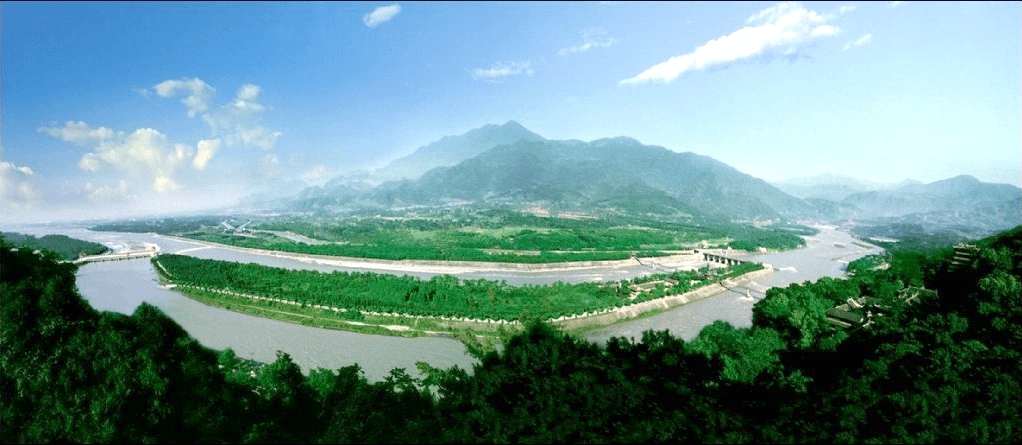
While many ancient wonders exist only as weathered ruins—silent witnesses to lost civilizations—Dujiangyan Irrigation System is something entirely different. It is not a relic of the past, but a living, breathing masterpiece.
Built around 256 BC by the visionary engineer Li Bing, this extraordinary irrigation system continues to do exactly what it was designed to do over two millennia ago: tame the waters of the Min River, prevent catastrophic floods, and nourish vast stretches of fertile land across the Chengdu Plain.
What makes Dujiangyan truly astonishing is not just its longevity—but its philosophy. It achieves perfect water control without a single dam.
Modern engineering often seeks to conquer nature with towering concrete barriers. Dujiangyan, by contrast, embodies a radically different idea: harmony over control.
Rather than blocking the river, the system gently guides it—using the river’s own energy to regulate itself through three elegantly designed components:
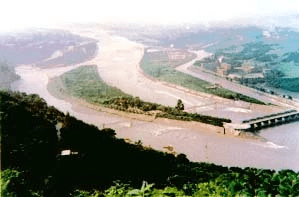
Yuzui (Fish’s Mouth Levee): A natural divider that splits the river into inner and outer channels.
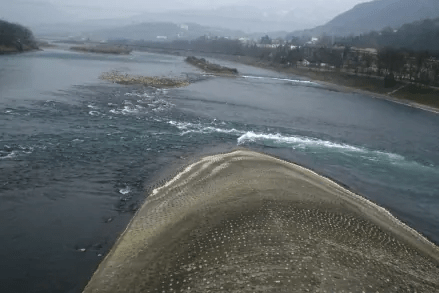
Feishayan (Flying Sands Weir): A clever spillway that uses the river’s force to flush away excess water and sediment.
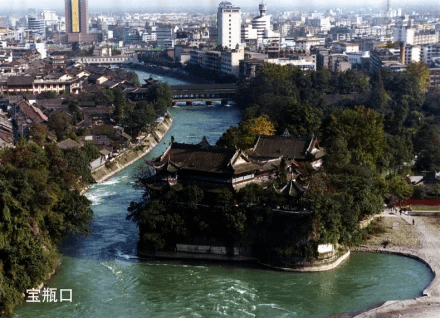
Baopingkou (Precious Bottle Neck): A narrow opening carved through the mountain, acting like a natural valve to control water flow.
Fish’s Mouth Levee
Flying Sands Weir
Baopingkou
Together, these elements form a system that feels less like machinery and more like a living organism—responsive, adaptive, and enduring.
The “Four-Six” Rule: Nature’s Invisible Hand
At the heart of Dujiangyan lies one of its most brilliant innovations: the Four-Six Divide (四六分水)—a subtle yet powerful hydraulic principle.
Through careful shaping of the riverbed, Li Bing created an automatic system that adjusts itself with the seasons:
In the dry spring months, the deeper Inner River naturally draws in about 60% of the water, ensuring that farmlands receive the nourishment they need.
During the summer floods, the wider Outer River takes over, diverting roughly 60% of the surging waters away from populated areas.
No gates. No sensors. No human intervention.
Just the quiet intelligence of design aligned with nature.
The result is nothing short of extraordinary: a self-regulating system that protects against both drought and disaster.
Why It Still Thrives After 2,200 Years
It is rare—almost unimaginable—for a piece of infrastructure this ancient to remain central to modern life. Yet Dujiangyan continues to serve as the lifeline of the Chengdu Plain.
Its enduring relevance lies in principles that feel strikingly modern:
Sustainability: Instead of fighting sediment buildup, the system uses the “Flying Sands” technique to naturally flush out the majority of silt, keeping waterways clear.
Ecological Harmony: Without a massive dam or reservoir, the river remains alive—fish migrate freely, and ecosystems flourish undisturbed.
Living Tradition: The annual practice of Zhuoshui—a deep cleaning of the riverbed—continues today, blending ancient ritual with contemporary science.
Li Bing’s guiding philosophy was deceptively simple: “Deepen the channel, keep the dykes low.”
Yet within these words lies a profound truth—one that extends far beyond water management.
By respecting the natural flow rather than resisting it, he created a system that has outlasted kingdoms, revolutions, and the passage of time itself.
Recognized today as a UNESCO World Heritage Site, Dujiangyan stands as a quiet but powerful reminder:
Sometimes, the most advanced solutions are not those that overpower nature—but those that understand it.
And perhaps, in a world still learning to balance progress with sustainability, this ancient marvel is not just a story of the past—but a guide for the future.
Sometimes, the smallest gifts carry the greatest meaning—and plant the seeds for something extraordinary.
In the late 1800s in Philadelphia, a little girl named Hattie May Wiatt was heartbroken. She loved attending Sunday school at Grace Baptist Church, led by Reverend Russell H. Conwell, but the room was too small to hold all the children who wanted to come. Some Sundays, children were turned away for lack of space. Hattie dreamed of a bigger Sunday school where every child could learn and feel welcomed.
Determined to help, Hattie began saving what she could. Little by little, she set aside pennies, nickels, and dimes—eventually saving up 57 cents. It was a humble offering, but a heartfelt one. Sadly, Hattie became ill and passed away at just seven years old before she could see her dream come true.
After her passing, her mother brought the small purse of coins to Reverend Conwell, explaining Hattie’s wish. Deeply moved by the child’s devotion and generosity, Reverend Conwell shared Hattie’s story with his congregation. Her simple act of love touched hearts far and wide.
Inspired by her story, the congregation began to give. Donations poured in. That small sum of 57 cents became the spark that lit a fire. With the funds raised, Reverend Conwell purchased a house that would serve as the site for Sunday school classes. But the vision didn’t stop there.
That humble beginning became the foundation of Temple College, an institution built on the belief that education should be accessible to all. Over the years, it grew and evolved into Temple University, one of the leading public research universities in the United States today.
And it all began with one little girl and her 57 cents.
The Power of a Small Act
Hattie May Wiatt’s story is a powerful reminder that no contribution is too small when it comes from the heart. Her tiny savings became the cornerstone of an institution that has educated thousands and impacted countless lives. More than just a tale of generosity, it’s a lesson in faith, hope, and the incredible potential of selfless giving.
In a world where people often feel powerless to make a difference, Hattie’s story whispers a timeless truth: every effort matters. Every kind deed, no matter how small, can ripple outward and change the world.
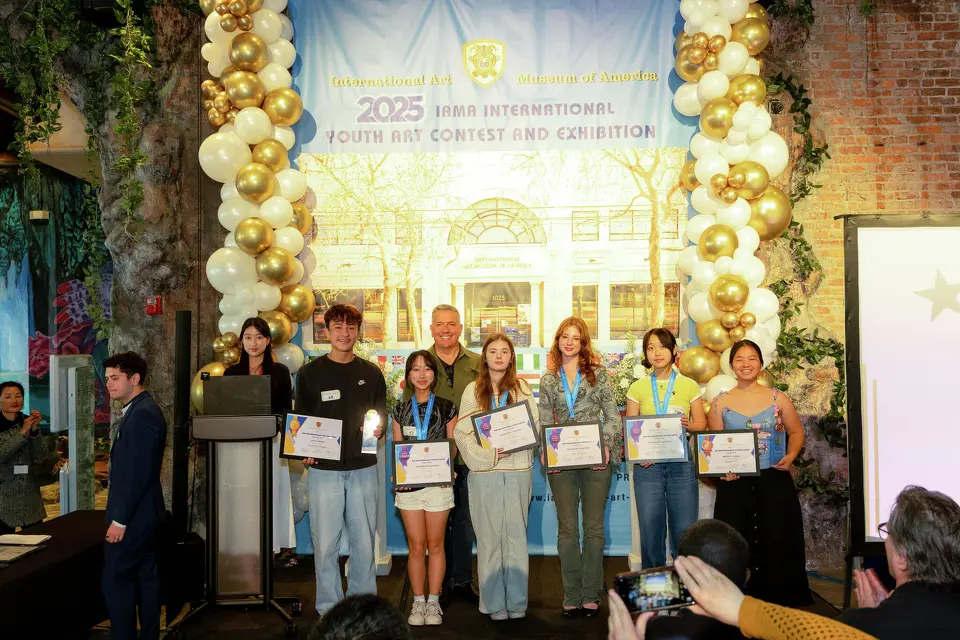
Award recipients from the youngest age group (five- to six-years-old) at the 2025 International Youth Art Contest, pictured with Mr. KC Hsieh, IAMA President.Photo by Johnny Trieu
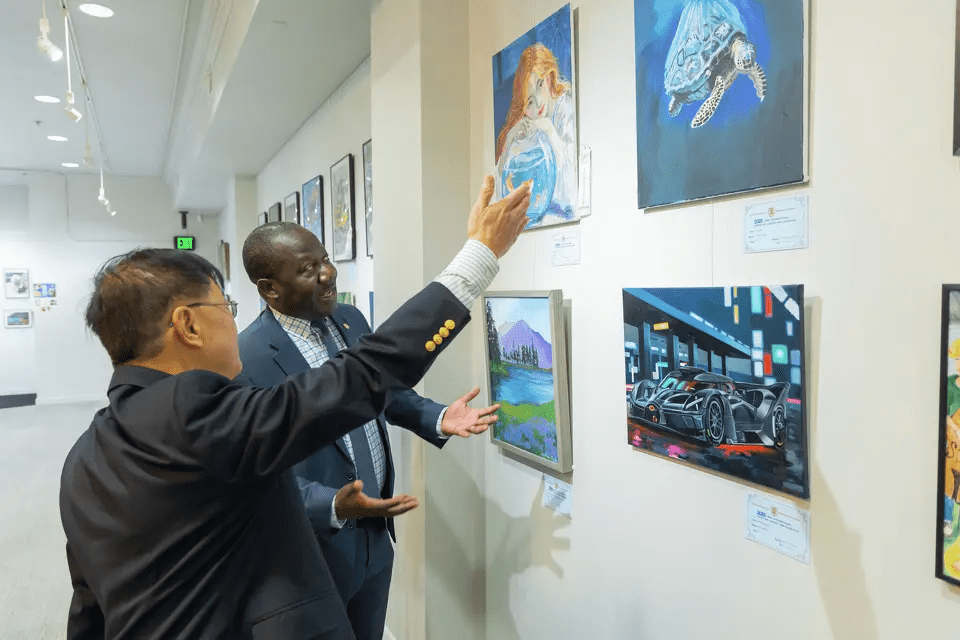
(Ad) On July 13th, 2025, San Francisco’s International Art Museum of America (IAMA) hosted the awards ceremony for the Second Annual International Youth Art Contest and Exhibition. The museum hosted nearly 400 attendees who were eager to see this year’s exhibition of youth artworks from around the world. Distinguished guests included Mr. Guy Djoken, Executive Director of UNESCO Center for Peace of Washington D.C.; San Francisco District Six Supervisor Matt Dorsey; and Professor Adam Caldwell, Chair of the Jury Committee and faculty member at the Academy of Art University, San Francisco. The ceremony spotlighted the creative achievements of young artists and underscored the museum’s role in fostering cultural exchange and youth artistic expression. Now, in its second year, the International Youth Art Contest and Exhibition continues to expand its reach and impact, advancing IAMA’s mission to champion emerging talent and foster intercultural connection through the arts.
This year, 1,600 youth participants submitted over 3,800 artworks to the Youth Art Contest. Artists from sixty-five countries across five continents competed within four age groups. After a rigorous selection process evaluating creativity, technical skill, and overall presentation, 477 young artists from seventeen countries were selected to exhibit a total of 616 outstanding works in IAMA’s Grand Exhibition Hall. The artistic caliber and thematic richness of the selected pieces left the jury in awe.
Attendees of the 2025 International Youth Art Contest viewing the installation in the Grand Exhibition Hall located at 1025 Market Street in San Francisco.Photo by Johnny Trieu
During his address at the awards ceremony, Mr. Guy Djoken offered high commendation for IAMA and its dedicated team, applauding their ongoing commitment to promoting international artistic exchange and cultivating a space where the public can find joy and renewed hope through art. Reflecting on the global turbulence and widespread uncertainty facing today’s global community, Mr. Djoken declared, “At a time when many live in fear—especially of war—just for us to be here at the museum, smiling and happy, and most importantly hopeful about the future—this is the best thing about this competition.” Mr. Djoken’s heartfelt message set a hopeful tone for the awards ceremony and attendees alike.
Executive Director of the UNESCO Center for Peace, Guy Djoken, was deeply impressed by the exceptional quality of the young artists’ work, finding both joy and hope for the future in their creativity.Photo by Johnny TrieuAward recipients in the eleven – fourteen age group at the 2025 IAMA International Youth Art Contest, joined by Mr. Guy Djoken, Executive Director of the UNESCO Center for Peace in Washington, D.C., who presented the honors during the ceremony.Photo by Johnny Trieu
Matt Dorsey, San Francisco’s District Six Supervisor, also addressed the audience, expressing his appreciation for the International Art Museum of America as a true hidden gem of San Francisco’s art landscape, and pledged his continued support for the museum’s mission and contributions to the community. Supervisor Dorsey offered words of encouragement to all participating youth artists, urging them to pursue their creative passions with perseverance—regardless of the outcome—and to never stop pursuing their artistic dreams.
Award recipients in the fifteen–eighteen age group of the contest were presented with their honors by San Francisco District Six Supervisor Matt Dorsey during the awards ceremony.Photo by Johnny Trieu
Professor Caldwell praised the range of themes and talent amongst all submissions and ages, which made selecting the winners of each age group challenging for the judges. Professor Caldwell noted the importance of international art exchange, stating “It’s a great way to bridge gaps between countries. The artistic community has always crossed political, social, and ethnic borders. Art and music are among the most universal forms of expression. They allow us to feel what others felt… Art brings people together across divides.” Professor Caldwell’s wise words perfectly captured the mission and outcome of the International Youth Art Contest.
Award recipients from the seven – eleven age group honored by Prof. Adam Caldwell—Chair of the Jury Committee, and faculty member at the Academy of Art University, San Francisco.Photo by Johnny Trieu
In this year’s contest, a newly introduced category for the youngest age group—participants ages five to six—garnered enthusiastic engagement from a remarkable number of budding artists. Through their sincere brushwork and vibrant imagination, these children demonstrated an extraordinary innate talent that captivated both audiences and judges alike.
Dr. Amy Hughes, Jury Committee Member and Director of Student Services at the New York Academy of Art, recognized the courageous creativity of the youth artists reflecting, “I was struck by the fearless creativity on display — the young artists did not shy away from complex themes, experimenting with materials, and expressing deeply personal narratives. Each piece felt authentic and fresh, demonstrating both technical skill, and emotional depth. The entries explored themes ranging from family, community, and environmental justice to dreams, culture, and identity—powerfully reflecting the younger generation’s keen insights and profound emotional connection to the world around them.
Charlotte Wu, third place award recipient in the five- to six-year-old age group, looks up at her winning painting, The Garden Where She Waits.Photo by Johnny Trieu
Lucas Shao, the first place winner of the five- to six-year-old age group, depicted himself joyfully swinging through the air in his painting, Wonderland. When asked about his hopes for his art, Lucas enthusiastically declared “I hope my art makes people happy, warm, big smiles just like me!”
Five-year-old Lucas Shao, winner of first place in the five- to six-year-old age group, stood proudly beside his painting Wonderland, depicting his happiness while swinging on the playground.Photo by Tong Shao
Third place winner of the five- to six-year-old age group, Kedarnath Kalidindi depicted a goldfish in a small fishtank in his painting, Freedom in Captivity, inspired by “finding inner freedom during incarceration.” The addition of this age group was an exciting component of this year’s event, and underscored the value of shining a spotlight on youth artwork, and garnering the wisdom of today’s youth.
Five-year-old Kedarnath Kalidindi, third-place winner in the five- to six-year-old age group, introduced his painting, Freedom in Captivity, to the audience.Photo by Johnny Trieu
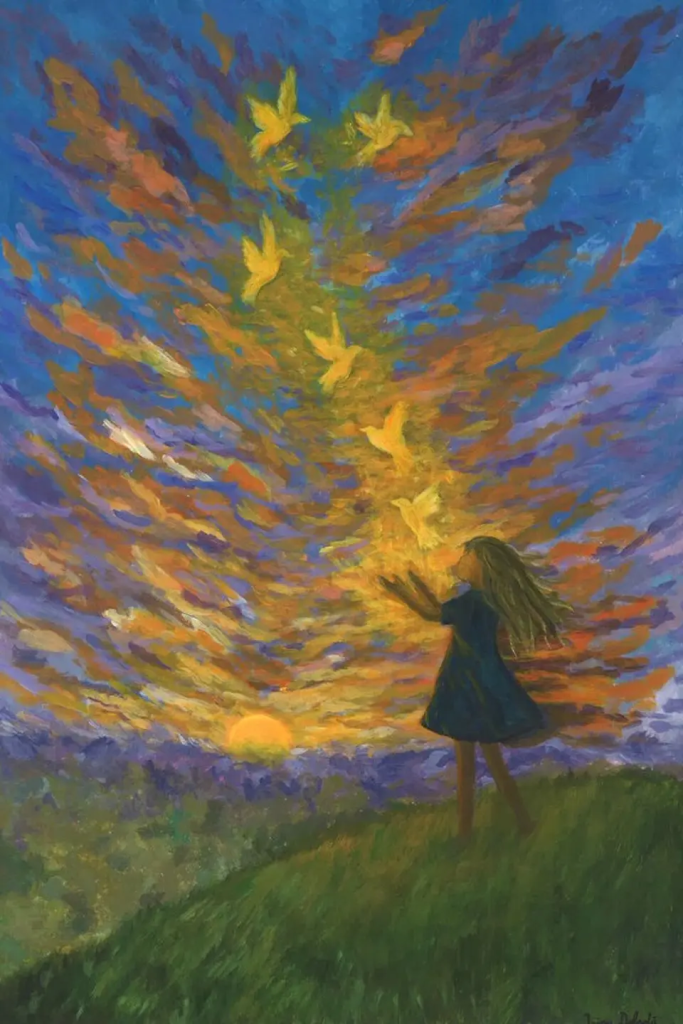
Ten-year-old Irina Elena Dobrota from Romania was honored with third place in the seven- to ten-year-old age group for her painting, Flight of Dreams, which was selected for the final exhibition at IAMA. Celebrated for its gentle spirit and imaginative vision, the piece radiates themes of kindness, freedom, and hope. Irina’s achievement brought pride and joy to her local community, and she hopes her work will inspire others to believe that every heartfelt wish can take flight—if we have the courage to let it soar.
Third place winner of the seven- to ten-year-old age group, Irina Elena Dobrota’s painting, Flight of Dreams.Photo by IAMA
Ashley Hein, second place winner of the fifteen-to-eighteen-year-old age group, impressed the jury with her painting, Animal Instinct, distinguished by its mature composition and outstanding execution. Professor Caldwell commented that he had shown several of the entries to his university art students, who were deeply moved and inspired by the technical skill and creativity on display.
Ashley Hein’s artwork, Animal Instinct, won second place in the fifteen- to eighteen-year-old age group.Photo by IAMA
Seventeen-year-old Kate Fieldhouse from South Africa received an honorable mention for her painting Between Worlds, which depicts a striking worldscape through an intense and creative exploration of breaking the canvas.
Seventeen-year-old Kate Fieldhouse from South Africa received an Honorable Mention for her painting Between Worlds.Photo by Johnny Trieu
Sixteen-year-old Polina Larina received an Honorable Mention Award for her painting Moscow Buns Evening. During her interview, Polina shared how she views her art as an opportunity to introduce people to Russian culture, and how the Youth Art Contest inspired her to continue to pursue her art dreams, “It was my first time participating in the IAMA competition. Participation in this competition helped me to feel recognized as an artist, and inspired to keep making art and put more effort into it.” Polina’s painting, inspired by a memorable walk with her grandparents, serves as a reminder to escape into nostalgia and childhood memories in trying times.
Sixteen-year-old Polina Larina (second from right, standing beside her mother) who received an Honorable Mention for her painting Moscow Buns Evening, in the Grand Exhibition Hall, joined by her parents and twin sister.Photo by Johnny Trieu
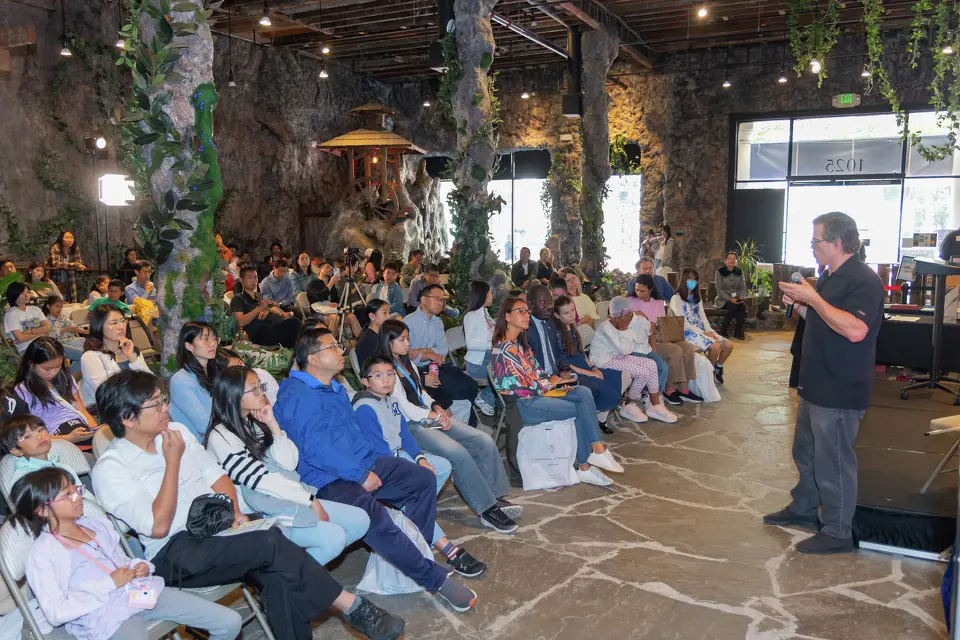
Following the ceremony, Professor Caldwell gave a masterclass for all participants, offering thoughtful insights on artistic growth, and encouraging continued exploration and confidence in their creative journeys. His masterclass focused on four elements: visual storytelling and composition, techniques and materials, the role of art in communication and expression, and advice for young artists. This is the second year Professor Caldwell has judged the artwork for the contest and delivered a masterclass for attendees of the contest.
Professor Caldwell delivered a knowledgeable and enlightening masterclass to attendees and participants. Photo by Johnny Trieu
About IAMA
Located in the heart of San Francisco, IAMA was voted the “Best Art Gallery” and was a finalist as the “Best Museum” in SFGate’s Best of Bay Area 2024. IAMA is dedicated to making world-class art accessible to all through exhibitions, education, and international contests. With a mission to foster peace and happiness through art—especially by nurturing the next generation—IAMA brings together works from around the globe, bridging East and West, classical and contemporary.
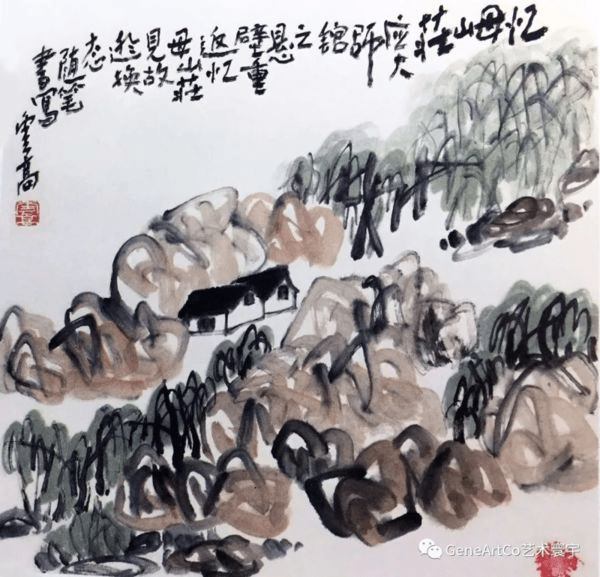
This is a deeply moving landscape painting by H.H.Dorje Chang Buddha III, marked by smooth, flowing brushwork and a natural rhythm. The undulating crimson cliffs seem to rise freely from the artist’s heart, while the vigorous lines brim with vitality and strength. Ink strokes form the skeletal structure of the mountains and rocks, while delicate willows hang softly across the scene, adding a quiet touch of green serenity. The overall palette is vivid but never garish, exuding a warm and nostalgic atmosphere.
In the painting, two thatched cottages nestle beside the mountains and water. Their deep-set doors and silent windows seem to hold untold, quiet stories. It was under these eaves, by these doors, that a loving mother once stood—sending her children off into the world with silent heartache, and waiting countless times in patient hope for their return. That wordless farewell, those tears of longing, have gently seeped into the fabric of time. Among all human emotions, none is greater than a mother’s love. Our memory of that love stirs an innate sense of gratitude—a sacred emotion that transcends the ordinary.
This work embodies the style known as the “Childlike Native School”, which embraces the beauty of rural life through the innocence of a child’s heart. Though the brushstrokes appear naïve and spontaneous, they conceal great depth and mastery. The painting style is free and unrestrained, exuding both boldness and tenderness. The soft, flowing lines connect seamlessly—like a mother’s love, endlessly enduring, gentle yet firm. Its simple composition holds rich emotional meaning and invites the viewer’s imagination to wander. The scene pulses with a childlike liveliness that fills the heart with joy.
The painting’s pure and innocent imagery evokes a return to the carefree days of childhood. No matter where you are, simply gazing at this piece can bring the scene and its emotions vividly before your eyes, awakening the deepest tenderness and longing in your soul.
In creating Mountain Village with Memories of Mother, the artist approached the work with the pure heart of a child, yet painted with the maturity and finesse of a seasoned master. The brush technique draws from traditional Chinese calligraphy—guided by the wrist, powered by the arm—each stroke flowing naturally with graceful spontaneity. This painting was not created for show or technical display, but as a sincere outpouring of emotion and inspiration. Every application of ink and color arises from genuine feeling.
What is art? At its essence, art is the ability to immediately evoke inner peace, comfort, joy, or spiritual fulfillment in the viewer. But where does this feeling come from? Is it merely the subject matter or visual beauty of the work? Certainly not. A painting does not become great simply because it looks pleasing.
In the context of Chinese painting, the true heart of art lies in a quality called “spiritual resonance” (shen yun). It is vivid, yet elusive—a mysterious charm and subtle power that cannot be described with words. It is born when the artist’s personal cultivation, emotional depth, and spiritual awareness infuse the work, allowing spirit and technique to merge. The result is an artistic vitality that transcends mere form.
Only when viewers are moved by this spiritual resonance do they begin to explore the painting’s formal elements—its composition, color palette, brush technique, balance between painting and calligraphy, and the portrayal of the subject in both spirit and form. While these aspects matter, they ultimately serve a deeper, more profound experience.
In Chinese art, the true value of a painting—its ability to soothe the soul—does not depend on technical skill alone. It lies in whether the work can touch the heart and stir the spirit. Mountain Village with Memories of Mother beautifully embodies this artistic spirit. Every brushstroke gently stirs the viewer’s emotions, evoking tender memories and inviting the soul to linger in its serene beauty.
This exceptional work is housed in the permanent collection of the International Art Museum of America, located in San Francisco—a fitting home for a piece that speaks a universal language of love, nostalgia, and spiritual beauty.
“People photography has a rich, captivating history, evolving alongside the development of the medium itself,” the organizers explain. “From capturing iconic figures to telling the stories of everyday individuals, it continues to fuel our profound curiosity about the human experience.”
This award sought to celebrate the most powerful and compelling images of people today, highlighting the diverse and meaningful narratives that shape our shared world.”
Crossing borders, spanning cultures and traversing the world’s most remote corners, the People Photography Award celebrates the diverse beauty of humanity.
The People Photography awards were judged by prizewinning photographer Steve McCurry, one of the most celebrated voices in contemporary photography and author of a unique collection of work featuring some of the most famous images of our time — not least his iconic portrait of an Afghan Girl with piercing green eyes.
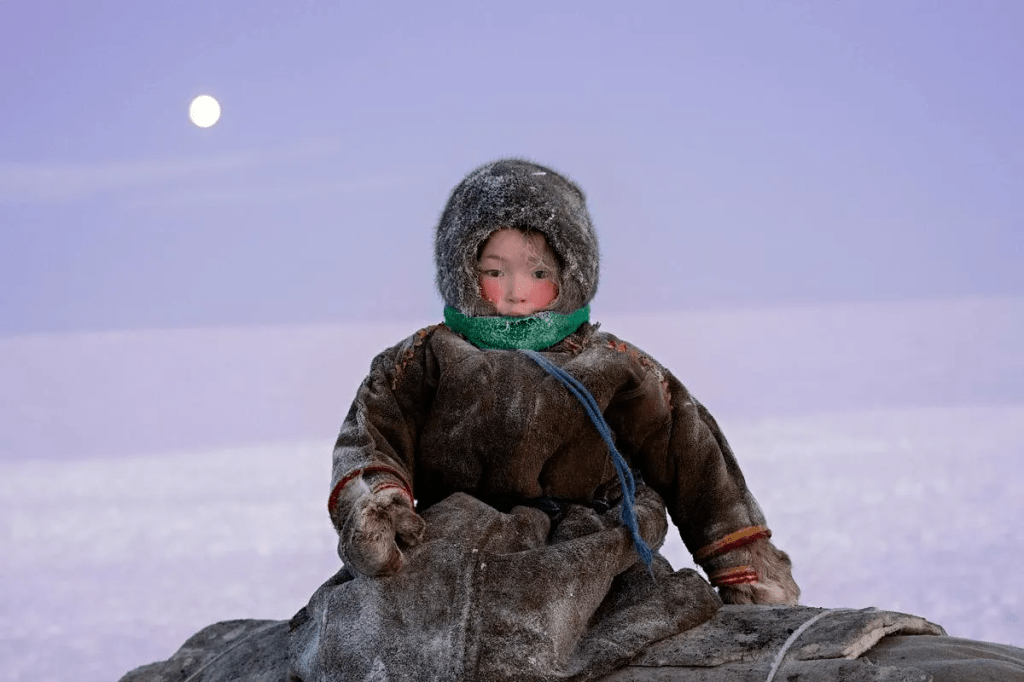
“Shades of white,” 3rd Prize, Yamal peninsula, Siberia, Northern Russia Nicola Ducati – People Photography Awards, The Independent Photographer
The photo above, winner of the third prize and $400, is one of the series “Shades of white” and was taken in the Yamal peninsula, Siberia, Northern Russia, where the air is thin and the polar day is very short.
For 4 1/2 hours, the light becomes magical and the colors of everything are perfect pastel against the artic sky, with delicate and unreal shades.
This land is inhabited by the Nenets people, nomadic reindeer herders who, guided by the seasonal cycles and the needs of their animals, migrate incessantly in an infinite circle of movements between ice, frozen rivers and incessant winds in search of new pastures in the most remote tundra. The hostile environment didn’t stop their innate adaptability and gave them prosperity for millennia.
“The soft polar light accentuates frosted textures and the child’s rosy cheeks, underscore both the harshness of the environment and the resilience of those who call it home,” the editors wrote. “It tells a powerful story of a people who have forged a life in one of the planet’s most unforgiving regions — but a people whose future remains uncertain.”
“Puzzled,” 2nd Prize, Western Mongolia Alessandra Manzotti – People Photography Awards, The Independent Photographer
A curious Kazakh nomad from Western Mongolia stops his truck to find out what a group of Westerners are doing walking in this remote and desolate stretch of land in the middle of a bitterly cold winter.
“This image captures the spirit of curiosity and resilience that defines life in remote Mongolia,” says McCurry. “The composition is powerful, with the truck and its vibrant blue color creating a striking contrast against the muted tones of the barren landscape. The candid expressions of both the nomad and the dog evoke a sense of warmth and connection, even in a harsh and unforgiving environment. The attention to detail, like the weathered texture of the truck and the distant herd in the background, adds depth to the story. It’s a beautiful balance of humanity and environment, which makes it a memorable piece.”
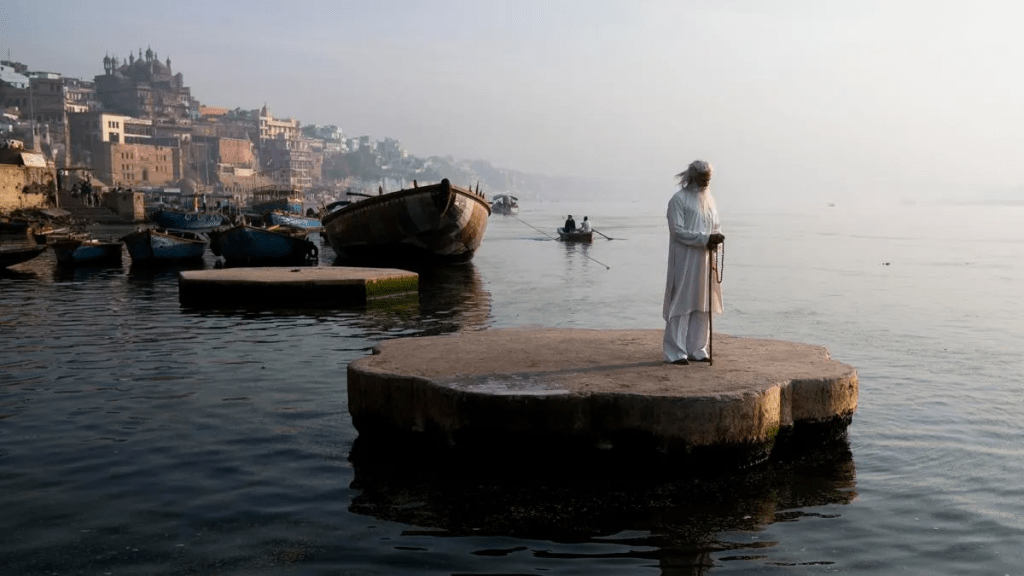
Contemplation, 1st Prize, Ganges River, Varanasi, India Mohammad Kamal – People Photography Awards, The Independent Photographer
A lone Sadhu stands pensively at the edge of a platform in the Ganges River in Varanasi, India. The image “Contemplation” , taken by photographer Mo Kamal in Varanasi, India, won first prize and $1,000.
“This image embodies a profound sense of stillness and spirituality, which perfectly captures the essence of Varanasi and the sacred Ganges,” said McCurry.“The man’s serene pose, framed against the soft morning light, evokes a sense of timelessness and introspection. The photograph is a poetic depiction of solitude and faith.”
“Andean Motherhood,” Finalist, Peruvian Andes Jimmy Strouse – People Photography Awards, The Independent Photographer
In the Peruvian Andes, a mother carries her baby in a traditional bag. “The backdrop of rugged mountains just added to the beauty, giving a glimpse into the rich traditions of indigenous life,” Jimmy Strouse explains. “After showing her the photo on my camera, she nearly started crying, and it hit me: She probably doesn’t see many photos of herself, if ever.”
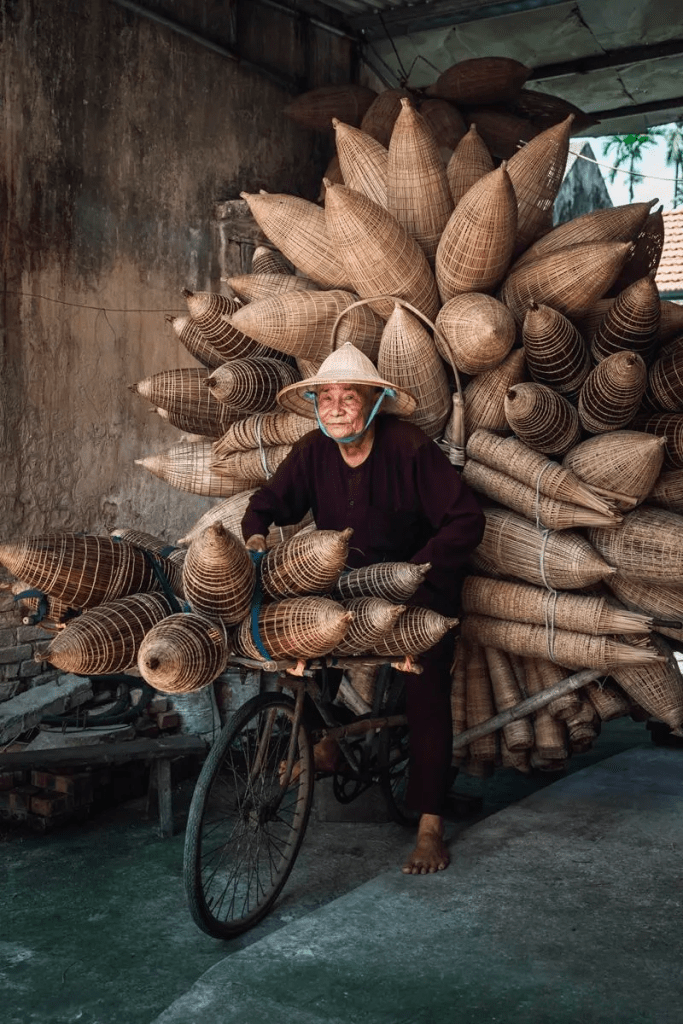
“The Art of Fish Traps,” Finalist, Thu Sy, Vietnam Vincenzo Avallone – People Photography Awards, The Independent Photographer
“During my journey, I had the opportunity to visit Thu Sy, a village in Vietnam known for its artisanal production of fish traps,” Vincenzo Avallone explains. “In this photo, I captured a local elderly man transporting an incredible number of fish traps on his bicycle.
“Villamar,” Finalist, Villamar, Bolivia Michael Murray – People Photography Awards, The Independent Photographer
In a small settlement outside Villamar, Bolivia, a clothes maker pauses for a portrait.
“Shore Bound,” Finalist, Ladakh region, India Wasim Malik – People Photography Awards, The Independent Photographer
This is Lamo, a nomadic woman from the serene Changthang region in Ladakh, India, where the vast highlands meet a life of simplicity and resilience.
Technology art is a new form of multidimensional creative expression that blends technology and art. By incorporating mechanical instruments, scientific data, and spatial elements such as light sources, temperature, and speed, it presents a unique visual experience. Imagine a three-dimensional painting on a flat sheet of paper, where the depth of space extends beyond the surface, and the imagery seems to leap out of the frame, resembling a real sculpture.
Among these art forms, glass painting is particularly breathtaking. With its transparent dual-sided effect akin to a celestial realm, it creates a mesmerizing and soothing atmosphere when paired with changing lights. Photography, on the other hand, captures emotionally stirring moments through the interplay of light, composition, and color. Whether depicting landscapes, people, or animals, it brings out a unique aesthetic through the lens.
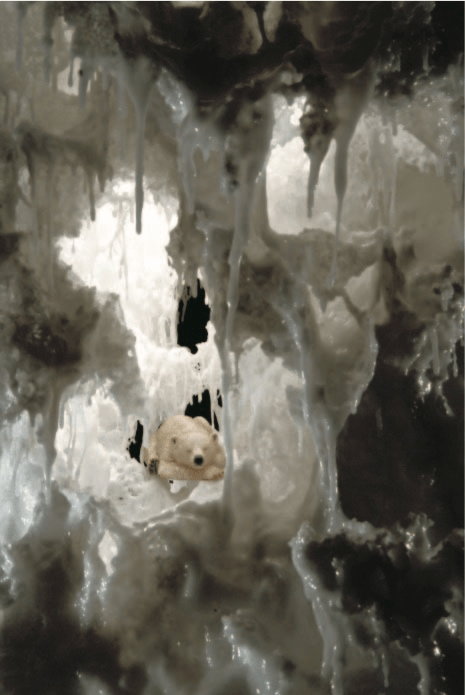
At the convergence of these three artistic expressions, H.H. Dorje Chang Buddha III, skillfully integrates them to create stunning works of technology art. One such masterpiece, the 3D painting Polar Bear in an Ice Cave, vividly portrays the charming image of a polar bear, making viewers feel as if they are inside an icy Arctic cavern. Through the artwork, one can almost see the adorably clumsy bear sleeping soundly in the cold cave. The artist’s extraordinary craftsmanship is awe-inspiring, delivering an unparalleled visual experience.
H.H. Dorje Chang Buddha III composed a poem for this artwork. Translating it into English is incredibly challenging due to its profound meanings. However, here is a simple translation to offer a glimpse into the Buddha’s deep compassion for all beings:
The polar bear loves the cold the most, Sleeping in ice caves through all seasons. Do not take food from the water, Instead, pick up the bones of wandering souls for a meal.
Not everyone understands the mysteries within the profound, For Zen enlightenment dissolves the barriers of hunger. The splendid affairs of the crystal palace are beyond full expression, Within the cave, a guest drunkenly enjoys the company of an immortal.
In all the world there is no one else exactly like me.
Everything that comes out of me is authentically mine because I choose it…
I own everything about me, my body, my feelings, my mouth, my voice, all my actions whether they be to others or to myself
I own my fantasies, my dreams, my hopes, my fears
I own all of my triumphs and successes, all of my failures and mistakes because I own all of me.
I become intimately acquainted with me by so doing, I can love me and be friendly with me in all my parts
I know there are aspects about myself that puzzle me and other aspects I do not know…
but as long as I am friendly and loving to myself, I can courageously and hopefully look for solutions to the puzzles and for ways to find out more about me…
however I look and sound whatever I say and do, and whatever I think and feel at a given moment in time is authentically me
if later some parts of how I looked, sounded, thought and felt turned out to be unfitting, I can discard that which is unfitting and keep the rest and invent something new for that which is I discard
I can see, hear, feel, think, say and do.
I have the tools to survive, to be close to others, to be productive, and to make sense and order out of the world of people and things outside of me…
I own me and therefore I can engineer me
I am me and I AM OKAY.
Satir’s beautiful and empowering poem “I Am Me” encapsulates her core belief in self-worth and individuality. Its heartfelt lines inspire readers to embrace their authentic selves, fostering inner peace and self-acceptance. Through her words, Satir invites us to celebrate who we truly are, reminding us that personal growth is both possible and transformative.
In the intricate tapestry of human beliefs, the concept of reincarnation has woven itself through the fabric of traditional Asian cultures for centuries. However, this idea finds little resonance in Western cultures and often faces skepticism from the scientific community. Amidst this cultural and scientific dichotomy, a pioneering exploration is unfolding at the prestigious University of Virginia School of Medicine, led by Dr. Jim B. Tucker, a child psychiatrist with a unique perspective on life after death.
Born and raised in the southern United States, Dr. Tucker’s early life was immersed in the traditional beliefs of the American South. As he embarked on his academic journey, obtaining an undergraduate degree in psychology and specializing in child psychiatry, he encountered the notion of reincarnation with a healthy dose of skepticism. The clash between cultural beliefs, scientific inquiry, and personal skepticism set the stage for Dr. Tucker’s intriguing exploration into the mysteries of existence.
The documentary, highlighted on the Discovery Channel, explores the extensive and worldwide research conducted by Dr. Tucker. The film encapsulates the core of his studies, presenting interviews, case studies, and the profound implications of his findings. Through this visual medium, viewers are welcomed to observe the intersection of traditional beliefs, modern skepticism, and scientific exploration—all in the quest to unravel the mysteries of human existence.
Buddhism holds that life undergoes reincarnation through the six realms. After a person dies, if the karmic conditions accumulated in their past life mature, they may be reborn into the heavenly realm as a deity, or into the realm of asuras, or they may be reincarnated in the human realm. If negative karma, such as killing, deception, or greed, comes to fruition, the individual will inevitably fall into the hell realm and suffer, or they may be reborn in the realms of hungry ghosts or animals to endure suffering.
As for which realm one will be reborn into among the six, it depends on the karmic conditions of their virtuous and non-virtuous actions. Why does reincarnation occur? The fundamental reason lies in the attachment of sentient beings. Attachment gives rise to the confusion of karma, and from this confusion arises ignorance. Due to the endless causes and effects generated by ignorance, various positive and negative karmic forces are produced. It is these karmic forces that determine which realm of existence one will be reborn into.
The investment realm bids farewell to its philosopher, the golden partner of Warren Buffett, Charlie Munger, who passed away on November 28th this year, at the age of 99. Munger’s life was a testament to generosity, kindness, rationality, humility, and a low-key demeanor. Renowned for his honesty, integrity, lack of complaints, and absence of hindsight bias, Munger earned global admiration and respect. His impactful literary work, “Poor Charlie’s Almanack,” reflects his profound humanity.
Among Munger’s profound teachings, five sentences stand out, resonating deeply with individuals and serving as timeless nuggets of wisdom. Deserving Success, Value Investing Strategy, Success and Surroundings, Magic of Compound Interest, Probabilities Over Luck.
“The best way to obtain something is to make oneself deserving of it” reflects classic wisdom upon contemplation. Unlike typical words of wisdom that merely offer principles without practical methods, Munger’s comprehensive approach in “Poor Charlie’s Almanack” reveals a value investing strategy intertwined with life philosophy.
Charlie Munger’s love for books was profound. Often referred to as a “bookshelf with two legs,” Munger’s voracious reading habit extended beyond the realms of finance. He explored diverse genres, not just for knowledge acquisition but to open his mind to different angles and views. His extensive reading shaped him into a profound thinker, and his eclectic taste in literature reflected in his unique perspectives. Munger’s commitment to continuous learning and intellectual curiosity made him an embodiment of wisdom.
Munger’s belief in value investments extended beyond finance to personal development. He advocated assessing the value of a business before evaluating its stock, discarding speculative opportunities, and overlooking short-term factors. The enduring factor for a stock’s reliability, according to Munger, is whether it truly deserves its current price. This principle, he argued, holds true for personal growth, embodied in the saying, “The essential reason for a person’s success is that those around him wish for his success.”
Throughout his illustrious investment career, Munger adhered to the traditional values of the American West — diligence, focus, sincerity, thrift, and future investment. These principles earned him the trust of many collaborators. Notably, Munger’s initial million came from a real estate investment while he was still a lawyer. Recognizing the potential for real estate development in a property left by a client’s ancestors, Munger, through the client’s trust, achieved tremendous success.
Munger’s philosophy that making oneself valuable attracts potential collaborators is the most reliable investment method. This philosophy aligns with renowned stock guru Warren Buffett’s simple yet effective secret to wealth: save, invest, continue saving, and continue investing. Munger’s teachings delve into the power of compound interest, demonstrated in a thought experiment within “Poor Charlie’s Almanack.”
The experiment presents two choices — receiving $1000 daily for 30 days or receiving an escalating amount starting with 1 cent, doubling each day for 30 days. The seemingly attractive first choice limits the total to $30,000, while the second, with the magic of compound interest, accumulates to an astonishing $5.37 million. Munger highlights the patience required for compound interest to exhibit its true power, a principle applicable to personal growth.
Economist Xiang Shuai’s intriguing experiment reinforces Munger’s teachings. Progressing a little every day, even by 1%, leads to significant advancement after a year, while regressing daily results in minimal talent advantage. Munger’s emphasis on the importance of daily learning and reading resonates with the ancient wisdom: “Accumulate small steps, and you will cover a thousand miles.” He advocates believing in probability over luck, emphasizing that probability theory aligns closely with the world’s functioning.
Munger’s views on setting goals underscore the importance of realistic expectations and avoiding fanaticism. He advises setting goals slightly beyond one’s capabilities, then striving wholeheartedly to achieve them. The rational and joyful life attitude Munger promotes hinges on believing in the magic of compound interest.
Despite initial misconceptions, “Poor Charlie’s Almanack” is hailed as a seriously underestimated gem, transcending the appearance of a self-help book. Patiently reading through Munger’s insights reveals a figure resembling a traditional Chinese sage, offering universal wisdom for living a fulfilled and prosperous life. His desire for everyone to master universal wisdom echoes in the statement, “I only pass my sword to those who can wield it.” Munger’s legacy serves as a guiding light, illuminating our paths to a brighter and more brilliant existence.




















 Peace LiLy