The Bell in the Horse’s Belly

The Buddhist concept of cause and effect (karma) is truly an unfathomable truth

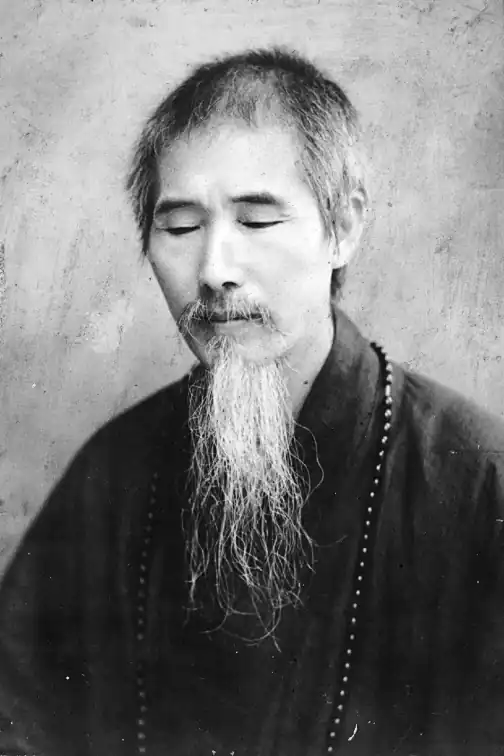
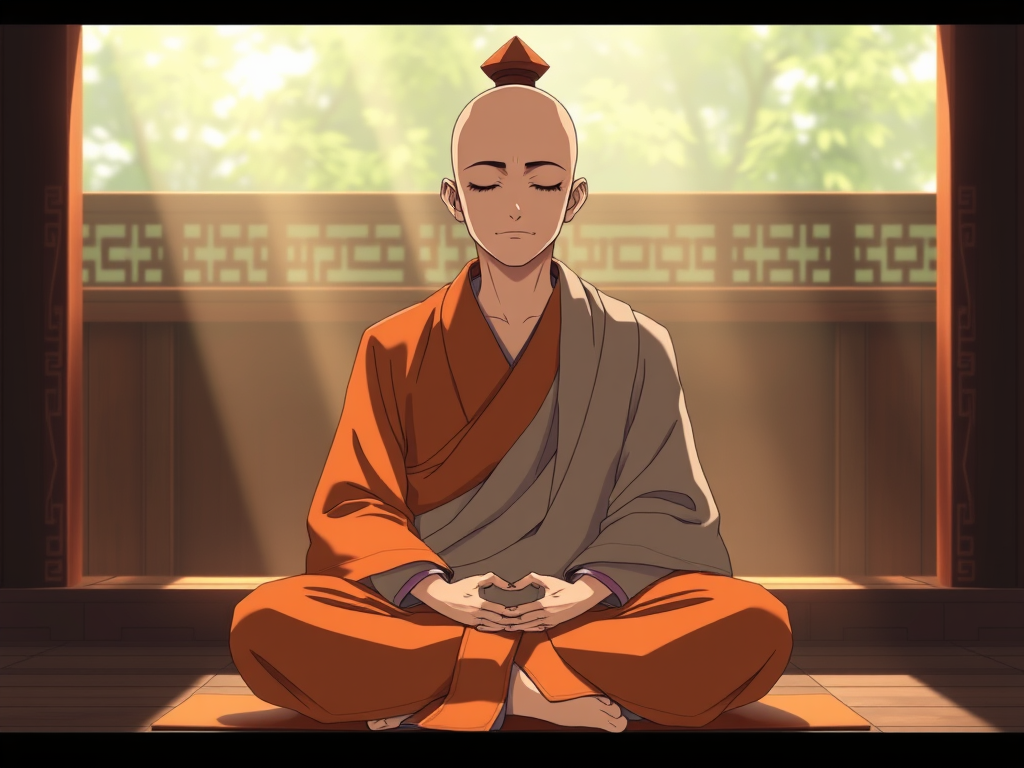
Long ago, deep in the mountains, there lived a Zen master named Wuguo(无果), a practitioner wholly devoted to meditation. For more than twenty years, he was supported by a humble mother and daughter who offered him food and daily necessities so he could cultivate the Way without distraction.

As the years passed, Master Wuguo reflected deeply on his practice. Although he had dedicated his life to meditation, he felt he had not yet realized his true nature. A quiet fear arose in his heart: If I have not awakened, how can I truly repay the kindness of these offerings?

Determined to resolve the great matter of life and death, he decided to leave the mountain to seek instruction from other masters.

When the mother and daughter heard of his departure, they asked him to stay a few more days. They wished to sew him a monastic robe for his journey. At home, the two women worked carefully, chanting the name of Amitabha Buddha with every stitch, their hearts filled with sincerity. When the robe was finished, they also wrapped four silver ingots to serve as his travel funds.
Master Wuguo accepted their offerings and prepared to leave the next morning.

That night, as he sat quietly in meditation, a vision appeared. A young man dressed in blue stood before him, holding a banner. Behind him came a procession playing music and carrying a magnificent lotus flower.

“Zen Master,” the youth said, “please ascend the Lotus Seat.”

Master Wuguo remained calm. He reflected inwardly: I am a Zen practitioner, cultivating meditative concentration. I have not practiced the Pure Land path. I should not become attached to visions. Even for a Pure Land practitioner, such an experience could be a delusion.

He ignored the vision.

Yet the youth returned again and again, urging him earnestly not to miss this rare opportunity. Finally, Master Wuguo picked up his small hand-bell (yinqing) and placed it on the lotus seat. Soon after, the youth and the entire procession vanished.

The next morning, as Master Wuguo prepared to depart, the mother and daughter hurried toward him in distress. Holding the hand-bell, they asked anxiously:

“Master, is this yours? Something very strange happened last night. Our mare gave birth to a stillborn foal. When the groom cut it open, he found this bell inside. We recognized it immediately and rushed to return it—but we cannot understand how it came from a horse’s belly.”

Upon hearing this, Master Wuguo broke into a cold sweat. Deeply shaken, he composed a verse:
One monastic robe, one sheet of hide;
Four silver ingots, four hooves inside.
Had this old monk lacked the power of Zen,
Your stable is where I would have been.

In that moment, he clearly understood the law of cause and effect. By accepting the robe and the silver, he had created a karmic debt. Had his mind been even slightly attached—to the vision, to the offerings, or to the idea of reward—he would have been reborn as a horse in that very household, laboring to repay what he had received.

Immediately, Master Wuguo returned the robe and the silver to the women and departed.

Because he did not cling to extraordinary visions, he escaped rebirth in the animal realm. An ordinary person, upon encountering such sights, would have grasped at them, fallen into delusion, and continued revolving in the cycle of rebirth.

This story reveals a profound truth: the realms are not distant places—they arise from the mind itself.

When the mind dwells in craving and greed, it becomes the realm of the Hungry Ghosts, endlessly desiring yet never satisfied.
When the mind dwells in anger and resentment, it becomes the Asura realm, filled with conflict and struggle.
When the mind is clouded by ignorance and confusion, it sinks into the Animal realm, driven by instinct and karmic habit.

In our daily lives, we often fixate on external things—lust, fame, wealth, comfort, indulgence—believing we cannot live without them. Yet we fail to see that all phenomena arise from causes and conditions. When conditions gather, things appear; when conditions disperse, they vanish. None possess a fixed or permanent essence.

Reflect carefully:
Is there anything in this world we can truly hold onto forever?

Since nothing produced by conditions can be owned, lasting happiness cannot be found through possession or attachment. True happiness arises from non-attachment, from seeking nothing and clinging to nothing. When the mind releases its grasp, it becomes light, clear, and free.
So we may ask ourselves:

Can we remain at peace amid changing emotions?
Can we stay calm in the face of conflict?
Can we remain unmoved by fame and profit?
And when the moment of death arrives, can our mind remain clear and mindful?

The law of cause and effect never errs.
What we cultivate in the mind today shapes the world we inhabit tomorrow.

Link:https://peacelilysite.com/2026/01/07/the-bell-in-the-horses-belly/

Zhenru Chan Temple: Where Chan Practice Lives in Mountains and Daily Life

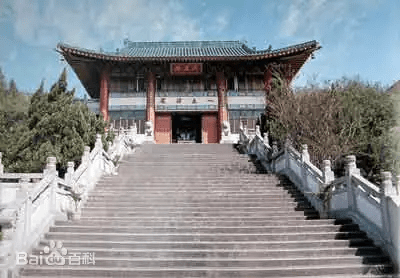
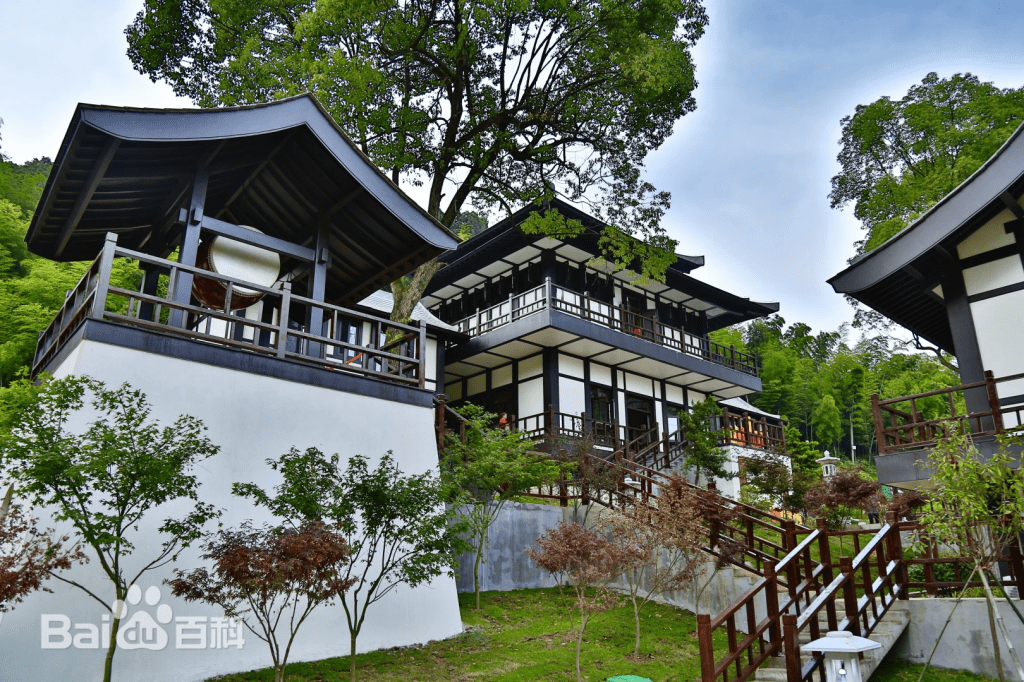
Zhenru Chan Temple is nestled on the southwestern slopes of Yunju Mountain in Jiangxi Province. Surrounded by peaks said to resemble unfolding lotus petals, the landscape is poetically described as “lotus peaks clustering around Huatai.” Huatai, the mountain’s central peak, anchors this natural harmony. Here, architecture, terrain, and spiritual intention merge seamlessly, creating a setting that feels both grounded and quietly transcendent.

Even before understanding its history, one senses that this is a place shaped not to dominate nature, but to listen to it.

The name Zhenru (真如) means “True Suchness”—a fundamental concept in Chan Buddhism that points to ultimate reality as it is, beyond words, labels, or conceptual thinking. It is not something to be grasped intellectually, but something to be directly experienced.

Founded during the Tang Dynasty (806–810), Zhenru Chan Temple is regarded as the cradle of the Caodong School of Chan Buddhism, which later spread to Japan as the Soto Zen tradition. Revered as one of China’s three great model Chan monasteries, the temple has long been a center for authentic practice. Though the present structures were rebuilt in the 1950s, they preserve the simplicity and elegance of traditional Chinese monastic architecture.

Chan in Action: Meditation and Farming as One Path

One of Zhenru Temple’s defining characteristics is its embodiment of the Chan principle that “agriculture and meditation are equally emphasized.” Monks here did not retreat from life; they engaged it fully.

Alongside meditation, monks cultivated tea fields and farmed the land. This was not merely practical—it was spiritual. Farming ensured self-sufficiency in the remote mountains, freeing the monastery from reliance on external donations. More importantly, working the soil was understood as a form of Chan practice: repetitive, mindful, intimate with the rhythms of nature.

In the Caodong tradition, there is no division between the sacred and the ordinary. Plowing a field is no less sacred than chanting a sutra. The monks alternated between sitting meditation and physical labor, living out the Chan maxim:

“A day without work is a day without food.”

This principle is traditionally attributed to the Tang-dynasty Chan master Baizhang Huaihai (720–814), a disciple of Mazu Daoyi and a key figure in establishing Chan monastic regulations. His teaching reminds us that awakening is not found apart from daily life, but revealed within it.

Master Xu Yun: Reviving the Living Dharma

Zhenru Chan Temple is also inseparably linked to Master Xu Yun (1840–1959), one of the most revered Chan masters of modern China, often described as a rare master who embodied and transmitted the lineages of five Chan schools in a single lifetime.

When Master Xu Yun arrived at Zhenru in the early 20th century, the temple lay largely in ruins. With unwavering resolve, he led an extensive restoration—rebuilding halls, pagodas, and monastic quarters with the support of disciples and lay donors. More than physical reconstruction, he revived strict monastic discipline and rigorous meditation practice, restoring the temple’s spiritual vitality.

Zhenru ultimately became the place where Master Xu Yun passed away, completing a life devoted to the Dharma.

Earlier in his life, Master Xu Yun experienced a profound awakening during intensive meditation at Gaomin Temple in Yangzhou at the age of fifty-six. In his autobiography, he described the experience with clarity and restraint:

“In the purity of my single-mindedness, I forgot my body entirely. After twenty days, my illness disappeared. From that moment on, my practice continued day and night without interruption… One evening after meditation, I opened my eyes and saw a brightness like broad daylight, in which everything inside and outside the monastery was clearly visible.”

Yet what makes his account especially powerful is what followed. Master Xu Yun did not cling to the experience. He recognized it as a mental state—not an ultimate attainment—and continued his investigation with humility and perseverance, asking relentlessly:

“Who is mindful of the Buddha?”

Later, he commemorated a moment of deep insight triggered by the simple sound of a teacup breaking in the Chan hall, capturing Chan’s direct and unadorned wisdom in a verse:

A cup fell to the ground,
The sound rang clear and sharp.
Space itself shattered—
The restless mind came to rest.

This is primarily a video demonstration of the moving meditation practiced at Zhen Ru Chan Temple. 

Zhenru Chan Temple is more than a historical site. It is a living reminder that Chan practice is not confined to silence or retreat, but woven into how we walk, work, and meet the ordinary moments of life.

Here, mountains teach stillness.
Labor teaches humility.
Meditation teaches clarity.

And together, they point quietly back to true suchness—not somewhere else, but right where we are.

Click here for more details about Gaomin Temple Chan meditation

Link:https://peacelilysite.com/2025/12/19/zhenru-chan-temple-where-chan-practice-lives-in-mountains-and-daily-life/

My Journey of Zen Meditation From Confusion to Clarity: How the Supreme Dharma of H.H. Dorje Chang Buddha III Transformed My Spiritual Journey

A few years ago, I visited a well-known Chan (Zen) practice center and began what I thought would be a meaningful journey into Chan meditation as a lay Buddhist disciple. Alongside the physically demanding daily farm work, I occasionally joined meditation sessions—but instead of clarity or insight, they often left me feeling drowsy and disoriented. I also listened to recordings of teachings by an elderly monk, but they felt dry and uninspiring. At the time, I thought this was all Chan practice had to offer. Disappointment quietly took root in my heart.

As I spent more time at the center, I began to notice that some of the Buddhist nuns displayed strange and unsettling behavior. I was told that their mental disturbances had arisen during meditation and, without proper guidance or support, their conditions had never improved. The idea that meditation—supposedly a path to peace—could lead to such outcomes deeply frightened me. I couldn’t help but worry: Would I end up like them? My own practice was already filled with drowsiness and confusion. Each time I sat for meditation, their presence weighed heavily on me. What had gone wrong? Why did their practice lead to such distress?

One memory remains especially vivid. During a seven-day retreat, the presiding master criticized the decision to take the temple’s elderly abbot to the hospital when he fell critically ill. The master insisted that the abbot should have remained in the temple, reciting Amitabha Buddha’s name to seek rebirth in the Western Pure Land. He questioned why anyone would try to prolong life at the time of death, suggesting that doing so only prolonged suffering. Many attendees agreed, believing the abbot’s passing was natural and that emergency medical care was unnecessary. I was shocked. Something felt inherently wrong with that view. I wasn’t a monastic, just a lay practitioner, yet I couldn’t help but ask: When someone is in a coma, completely unconscious, can they still recite “Amitabha” with sincere intent? Can they truly attain rebirth in the Pure Land just by wishing so? Logically, this didn’t make sense to me.

Later, I heard of a monk who made a solemn vow to realize his true nature through three years of Chan meditation—and if he failed, he would return to lay life. Sadly, three years passed, and the result was heartbreaking. He had gained no realization.

After this string of disheartening events, I lost my passion for Buddhist practice. I felt lost, as if I’d reached a spiritual dead end. I even began questioning the purpose of monastic life: If there’s no true goal or path to liberation, what’s the point? Reluctantly, I considered giving up and returning to a mundane life.

But just when I stood at this crossroads, I encountered the Dharma discourses of H.H. Dorje Chang Buddha III. It was like a brilliant light breaking through the darkness—suddenly, all the disappointment, fear, and confusion that had weighed on me vanished. At that moment, I made a resolute decision to let go of my doubts and wholeheartedly follow the path illuminated by the Buddha’s true teachings. Eventually, my wish was fulfilled.

What I shared here are just my personal experiences—perhaps not yet the true path of Chan—but they reflect challenges that many practitioners face in their spiritual pursuit. Fortunately, I came across the book Concentration and Visualization—The Essence of the Right Path by Pamu, and the profound teachings of The Supreme Dharma of Chan imparted online by H.H. Dorje Chang Buddha III. For the first time, I received complete and correct teachings and truly understood what Chan meditation is meant to be.

Furthermore, through reading H.H. Dorje Chang Buddha III’s Expounding the Absolute Truth through the Heart Sutra (specifically page 216), I finally understood why those nuns had lost their way. Their mental disturbances stemmed from becoming attached to illusions produced by the manas consciousness, mistakenly believing those illusions were real. They had failed to comprehend the profound truth that all forms are illusory and false. Caught in delusion, they strayed into a demonic path.

The retreat master’s complaints about the abbot’s emergency care were also misguided. As stated in the article “Lay Buddhist Zhao Yusheng’s Transmission of the Dharma is Genuine, Not False”, if someone truly possesses the realization and power of H.H. Dorje Chang Buddha III—to the extent that the yidam Amitabha Buddha manifests and receives the deceased into the Pure Land—then yes, there would be no need for emergency treatment. But how many people have such realization? Did that master?

And what about the monk who gave up after three years? He didn’t know that there exists a supreme and ultimate Buddha Dharma—one so profound that it can open the crown chakra in just two hours. When opened, the space is vast and expansive like an eggshell, and consciousness can freely enter and exit the body, even engage in practice outside the body. With such realization, seeing one’s true nature is not a distant goal but a near certainty.

Looking back, I feel deep compassion for those nuns. They longed for true Dharma and liberation, but without authentic teachings or proper guidance, and weighed down by attachments and karmic hindrances, they couldn’t achieve realization. Tragedies like this still happen today. It’s heartbreaking.

The most authentic and supreme Buddha Dharma is that which comes from H.H. Dorje Chang Buddha III, yet many sentient beings remain unaware of it. Even those with karmic affinity who encounter the teachings may still fail to receive them due to karmic obstacles or worldly pressures—missing their rare chance to escape the endless cycle of birth and death.

All I can do is sigh deeply and reflect: The true Dharma of the Buddha is so rare, so precious—harder to encounter than one might in millions of kalpas. I am incredibly fortunate to have this karmic opportunity to respectfully listen to and study the Dharma discourses of H.H. Dorje Chang Buddha III.

The Benevolence Temple Celebrates the Renunciation of the Shakyamuni Buddha and the Anniversary of the Temple

Photo Courtesy: Benevolence Temple (The Benevolence Temple held a Dharma assembly to commemorate the Enlightenment Day of Shakyamuni Buddha. Jiaozun Zhengda, Vice President of the World Buddhism Association Headquarters presided over the Dharma assembly.)

The Benevolence Temple, located in Las Vegas, hosted a series of Dharma assemblies and retreats from January 2 to January 11 to commemorate the Enlightenment Day of Shakyamuni Buddha and the anniversary of the Temple. Jiaozun Zhengda, Vice President of the World Buddhism Association Headquarters, led the congregation in a group study of the teachings of H.H. Dorje Chang Buddha III, revered as the Pope of Buddhism. Hundreds of participants from around the world attended this significant event.

This ten-day celebration features a variety of Dharma assemblies and spiritual practices, including a group study of the teachings of H.H. Dorje Chang Buddha III, one-day Zen sessions, the Grand Diamond Gem Repentance Ceremony, and life release rituals. Each day’s program begins at 8:30 a.m. and concludes at 9:00 p.m., providing participants with an immersive experience of the Temple’s tranquility and a temporary escape from worldly concerns. Lay practitioners also participate in the Temple’s daily routines, such as morning and evening chanting and dining ceremonies, offering them a glimpse into the essence of temple life.

The special one-day Zen session took place on January 4, 2025. Prior to the session, all participants were required to study Announcement No. 40 of the Office of H.H. Dorje Chang Buddha III, which details the “Great Dharma of Zen Practice” taught by H.H. Dorje Chang Buddha III to a group of cultivators in March 2013. This Dharma provides a clear understanding of Zen’s standard and proper practice, addressing key questions such as: What is Zen used for? Why should one practice Zen? What is the ultimate goal of Zen practice? More than one hundred Venerables, Dharma Masters, Rinpoches, and lay practitioners from the United States, Canada, Germany, mainland China, Thailand, Taiwan, and other countries and regions participated in this transformative experience.

The event took place in the Mahavira Hall of the Temple and featured ten meditation sessions: five sitting and five walking meditation sessions. Each sitting meditation lasted thirty minutes and an hour, with walking meditation sessions interspersed to maintain balance and flow. This arrangement allowed practitioners to sustain a steady rhythm and deepen their daily mindfulness. Two key roles were essential to the success of the event: the host and the discipliners. The host guided participants through the schedule and explained Zen practices’ rules and key aspects. The discipliners, equipped with a disciplinary board, patrolled the venue to gently correct participants if they became drowsy, slouched, or caused unnecessary noise, ensuring the sanctity and focus of the practice were upheld.

Photo Courtesy: Benevolence Temple (The Benevolence Temple held one-day Zen sessions)

After attending the event, a university scholar shared that she traveled more than ten hours and took three flights to attend the blessing ceremony and participate in the grand event. Having never practiced group meditation before, she was initially worried that she would struggle to sit still for an extended period. However, the outcome was both unexpected and extraordinary.

Thanks to the supportive group atmosphere, nearly all participants completed all ten sessions, overcoming the physical discomfort of sore feet and backs. By the end of the day, many reported experiencing a profound sense of Dharma joy. Dharma Master Zheng Da expressed her delight with the positive feedback from attendees. She hinted that longer Zen retreats, ranging from three to seven days, may be organized to encourage deep meditation and personal growth.

Dharma Master Zheng Da also inspired the group with H.H. Dorje Chang Buddha III’s teachings: “No matter what Zen Dharma you practice, you cannot deviate from cultivation. That is why you must go online and learn Buddha Master’s teaching of ‘What Is Cultivation?’ Furthermore, you must carry out that teaching in your daily lives. Only then will your practice of Zen truly succeed.”

Photo Courtesy: Benevolence Temple (The walk session in the Benevolence Temple’s one-day Zen sessions)

In addition to the one-day Zen event, the group study of H.H. Dorje Chang Buddha III’s teachings offered clear guidance, helping disciples cultivate the correct views and understanding.
 
 
Published by Joseph T.

Soruce of the article : The Benevolence Temple Celebrates the Renunciation of the Shakyamuni Buddha and the Anniversary of the Temple

The Temple Way of Eating: Lessons in Gratitude, Simplicity, and Reducing Waste

During a visit to Holy Vajrasana Temple, I encountered the beautiful and meaningful practice of Oryoki. Often translated as “just the right amount,” Oryoki is a ritualized way of serving and eating food that combines efficiency, mindfulness, and gratitude. Its roots trace back to the Buddha’s time, embodying the Middle Way of taking neither too much nor too little—an ethos that resonates deeply with the principles of simplicity and compassion.

What Is Oryoki?

Oryoki originated during the Tang Dynasty in China and later influenced practices such as the Japanese tea ceremony. It is widely practiced in Zen monasteries as a way to unify daily life with spiritual practice. The ritual involves a meticulous series of hand gestures, silence, and mindfulness during the meal.

Monks sit in meditation posture, waiting to offer their empty bowls to servers, who portion food to the requested amount. Every movement is intentional, every crumb is appreciated, and every element is designed to minimize waste. Even the water used to wash the bowls is partially consumed and the remainder returned to the earth, often to nourish the garden.

Simple and Balanced Eating

The meals at Holy Vajrasana Temple reflect the Oryoki tradition, featuring fresh fruits, vegetables, whole grains, and tofu. With minimal spices or stimulants, these meals are designed to nourish the body while keeping the mind clear and alert. Every effort is made to include the five flavors—sweet, salty, sour, bitter, and umami—and the five colors—red, green, white, yellow or orange, and black, blue, or purple.

Chefs follow the principle of eating simply, allowing the natural flavors of ingredients to shine. Eating in silence encourages mindfulness, helping participants savor each bite and truly appreciate the food’s journey from soil to plate.

Lessons in Gratitude and Reducing Waste

One of the most profound lessons from Oryoki is its emphasis on gratitude and sustainability. The practice reminds us to take only what we need and waste nothing. Participants are encouraged to finish their meals completely, leaving no remnants.

This principle can extend to our daily lives, especially during the holiday season when overindulgence and waste are common. By being mindful of portion sizes, recycling food scraps, and making thoughtful purchasing decisions—like avoiding vegetables wrapped in plastic—we can honor the spirit of gratitude and reduce our environmental footprint.

A Holiday Reminder: Gratitude Over Excess

As the holiday season approaches, let us take inspiration from these temple traditions. Instead of overindulging, savor each meal with mindfulness and gratitude. Remember those around the world who face hunger daily, and let this awareness guide us to be more conscious and compassionate in our eating habits.

Wishing you a joyful, mindful, and healthy holiday season! Let us cherish the food on our plates, honor the hands that prepared it, and commit to a less wasteful, more compassionate way of living.

Link: https://peacelilysite.com/2024/11/08/the-temple-way-of-eating-lessons-in-gratitude-simplicity-and-reducing-waste/

Source: https://tricycle.org/magazine/eating-just-right-amount/

The Monkey Trap: A Lesson in Letting Go

African indigenous hunters have a unique method for catching monkeys.

First, they find a hole just big enough for a monkey’s hand. They place food that monkeys like inside the hole. When a monkey passes by and sees the food, it reaches in to grab it. With its hand full of food, the monkey’s hand gets stuck in the hole. Most monkeys won’t let go of the food and instead try to pull it out from different angles.

When the hunters arrive, the monkey is still struggling and trapped, making it easy for the hunters to catch it.

Many people’s anxiety and suffering stem from holding on to too many things and being unwilling to let go, which prevents them from truly obtaining what they need.

In reality, letting go appropriately allows us to broaden our horizons, take time to adjust ourselves, and better engage in our current work.

The Young Man and the Zen Master: A Lesson in Detachment

Once upon a time, a young man visited a Zen temple to seek guidance from an old Zen master. On his way, he witnessed an interesting sight and decided to test the master. Upon arriving at the temple, he and the master chatted over tea. Suddenly, the young man asked, “What does ‘going round and round’ mean?”

“It’s because the rope hasn’t been cut,” the Zen master replied casually.

The young man was stunned and amazed. He said, “Master, I am surprised that you knew! Today, on my way here, I saw a cow tied to a tree. The cow wanted to go far to graze, but because the rope was through its nose, it kept going round and round, twisting itself without being able to break free. It was quite amusing. I thought that since you hadn’t seen it, you wouldn’t be able to answer. But you answered correctly right away.”

The Zen master laughed and said, “You asked about an event, and I answered with a principle. You asked about a cow tied by a rope and unable to break free; I answered about the mind being entangled by worldly matters and unable to find liberation. One principle can explain many situations.

“A kite, no matter how high it flies, cannot soar into the vast sky because it is tethered by a string. Similarly, what often binds us in life, preventing us from being free? A single win or loss can exhaust us; a gain or loss can cause us great anguish; an exam can keep us tossing and turning; a relationship can tie us in knots.

“For power and money, we run around in circles; for fame and desire, we are constantly entangled. Fame is a rope, desire is a rope, profit is a rope; the attachments and temptations of the world are all ropes. So the Zen master said, ‘All beings are like that cow, bound by many ropes of worries and sufferings, unable to achieve liberation throughout life and death.'”

The Wisdom of Living in the Present

A young monk once asked an old monk, “Master, what did you do when you were young?”

The master replied, “I chopped wood, fetched water, and cooked.”

The young monk asked, “And what do you do now that you’ve attained enlightenment?”

The master said, “I still fetch water, chop wood, and cook.”

The young monk, puzzled, asked, “What’s the difference? It seems like you haven’t made any progress in your entire life.”

The old monk explained, “You’re wrong. There is progress. When I was young, I would think about fetching water while chopping wood, and think about cooking while fetching water. Now that I am enlightened, when I chop wood, I chop wood; when I fetch water, I fetch water; and when I cook, I cook.”

Reflecting on myself, I often feel that I need to do something else while eating to avoid “wasting time.” So, I like to chat with others, watch TV, or think about other things while eating. No wonder I sometimes feel like “I don’t even know what I just ate.”

Enjoying the time spent eating and treating each bite with attention, I savor the sweetness of the rice, the freshness of the vegetables, and the richness of the soup. The world on my taste buds is indeed wonderful, bringing much joy to everyday life.

While walking, I now instinctively let my phone rest and focus on walking, feeling my feet propel my body, enjoying the natural comfort of the breeze, smelling the flowers, hearing the birds, and seeing the colorful flowers, green leaves, and various passersby. The scenery is infinitely beautiful, something I rarely appreciated before. Missing out and becoming numb was inevitable.

This series of practices has gradually cultivated the quality of “focus” in me. I increasingly embrace the concept of “living in the moment.” Of course, I know this is just the beginning; focus is a lifelong practice.

Link: https://peacelilysite.com/2024/05/30/the-monkey-trap-a-lesson-in-letting-go/

Source: https://gospelexpress.id/2023/01/20/%E6%9D%BE%E6%89%8B%E6%94%BE%E4%B8%8B/, http://his.newdu.com/m/view.php?aid=358718https://www.sohu.com/a/240312612_761892

Zhulin Temple (Chuk Lam Sim Yuen) at Hong Kong

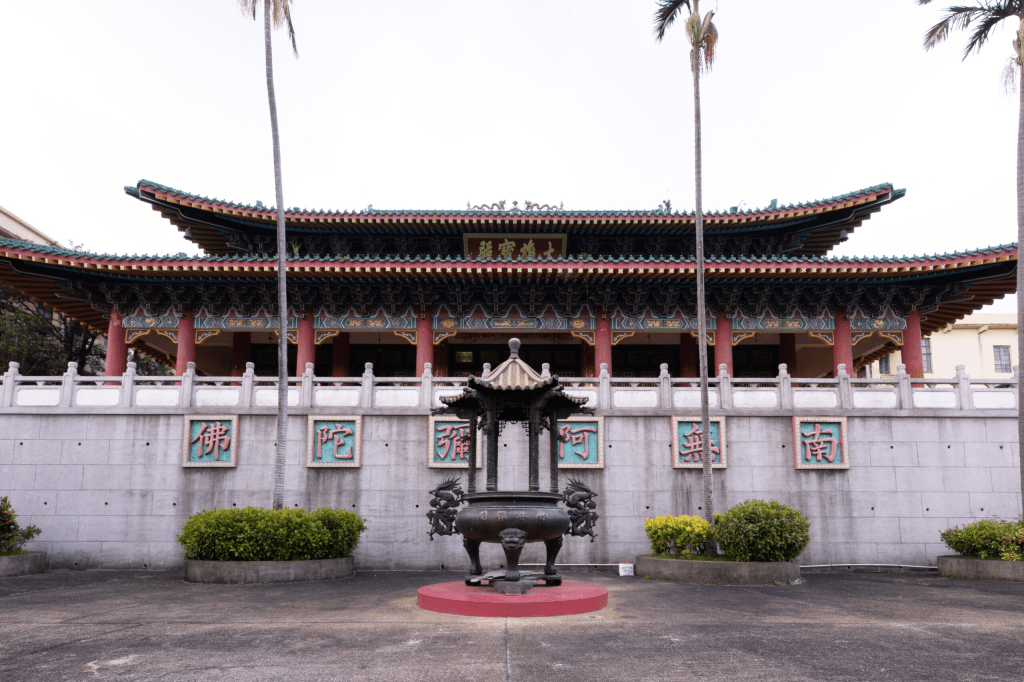
Standing on Fuyung Mountain Road in Tsuen Wan, Hong Kong, Zhulin Temple (also known as Chuk Lam Sim Yuen) proudly upholds the lineage of the Linji School of Zen Buddhism. Rooted in tradition, the temple seamlessly integrates teachings from the Tiantai and Pure Land traditions, thereby spreading the Buddha’s wisdom far and wide. Nestled within the heart of the Fragrant Harbour, it fosters a unique spiritual atmosphere known as the “Bamboo Grove Family Style,” where the Dharma is generously shared, benefiting both locals and visitors alike, serving as a haven for Buddhist study and practice.

Encompassing an expansive area exceeding 400,000 square feet, Zhulin Temple commands a serene and majestic presence, making it one of the largest and most beautiful temples in Hong Kong. Its origins trace back to 1928 when the founding master, prompted by three visionary dreams from Bodhisattva Ksitigarbha, embarked on the mission to erect a temple on Fuyung Mountain. Inspired by unwavering Bodhi resolve, six devoted followers generously donated funds to procure the land and construct the temple. Drawing inspiration from the architectural marvels of ancient Chinese mountain temples, the Pagoda Hall was completed on October 23, 1932, housing the largest statue of Ksitigarbha Bodhisattva on a lotus throne in Hong Kong. Thus, Zhulin Temple was formally inaugurated, marking the beginning of its sacred journey to illuminate sentient beings.

The architectural layout of Zhulin Temple embraces a harmonious three-section courtyard design. Upon crossing the mountain gate, visitors are greeted by the monastery’s serene courtyard garden, offering a space for worshippers to procure incense, candles, flowers, and fruits for offerings. Ascending the steps leads to the grand Hall of Heavenly Kings, where the jovial Maitreya Buddha stands at the central entrance, extending a warm welcome to all. Within the hall, the Four Heavenly Kings stand guard, with the central altar adorned by Bodhisattva Virūpākṣa, safeguarding the monastery under the benevolent gaze of Maitreya Buddha.

steps leads to the Grand Hall of Heavenly Kings,

Maitreya Bodhisattva

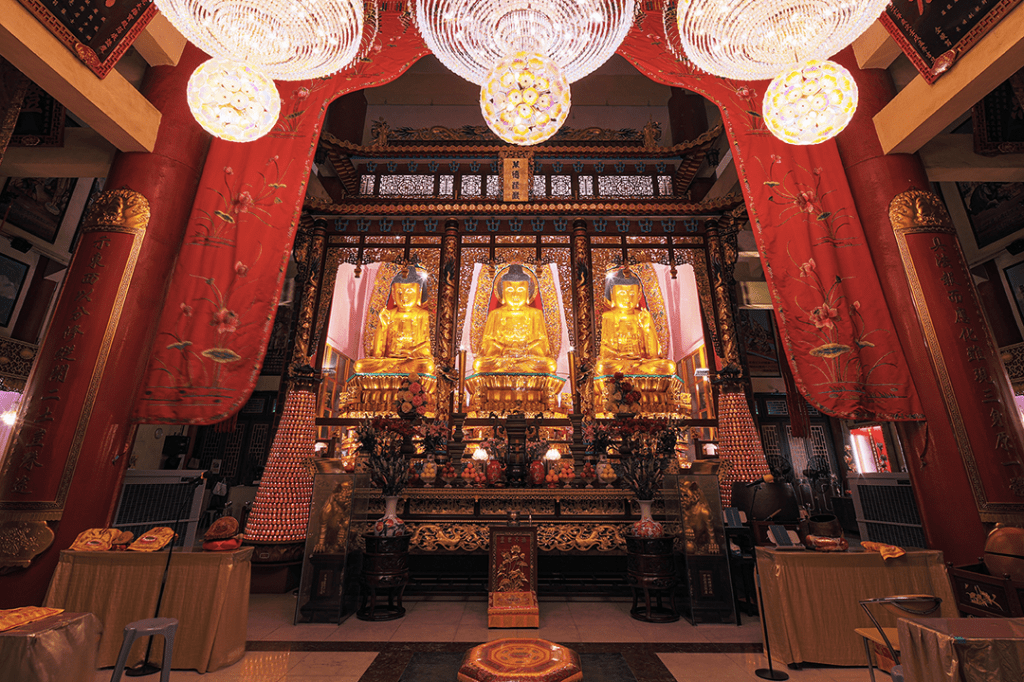
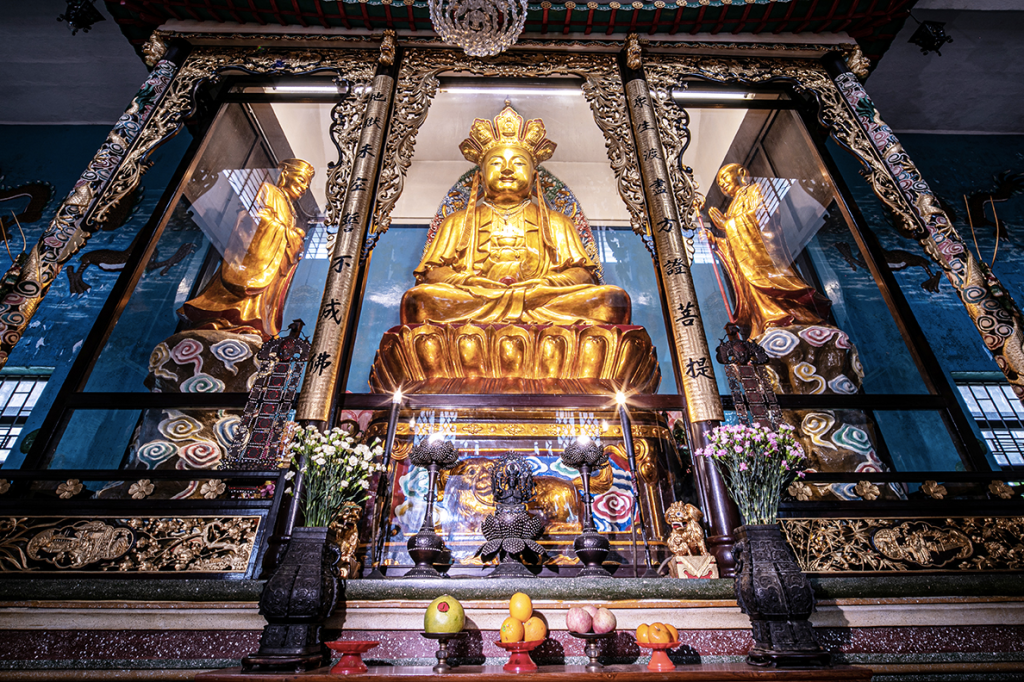
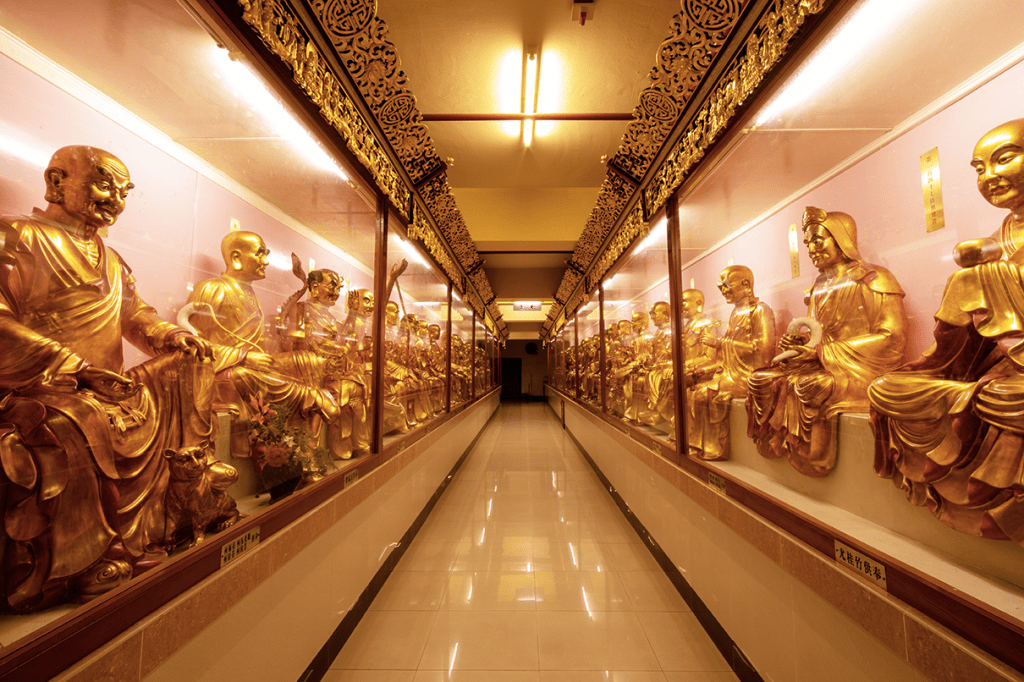
Further beyond lies a spacious courtyard flanked by a bell tower and drum tower. Ascending the stairs unveils the majestic Grand Hall, where the Triple Gem (Amitābha Buddha, Śākyamuni Buddha, and Bhaiṣajyaguru Buddha) resides on the central altar, accompanied by eighteen Arhats on either side. Adorning the rear of the Triple Gem altar is a depiction of the transformative scene from the Avalokiteśvara Sūtra, illustrating the manifestation of Avalokiteśvara Bodhisattva.

Bell Tower and Drum Tower

The Grand Hall

Adjacent to the main hall, worshippers find solace in a pavilion, while the Guan Yin Hall and Jade Buddha Hall flank its sides. Upstairs, the Pagoda Hall, now known as the Ksitigarbha Hall, stands adjacent to the Ancestral Hall and the Kitchen. Surrounding the monastery are additional halls including the Five Hundred Arhats Hall, the Dharma Hall, the Chan Hall, and the Scripture Repository, nestled along the outskirts and mountain slopes.

Guan Yin Hall

Ksitigarbha Hall
Five Hundred Arhats Hall

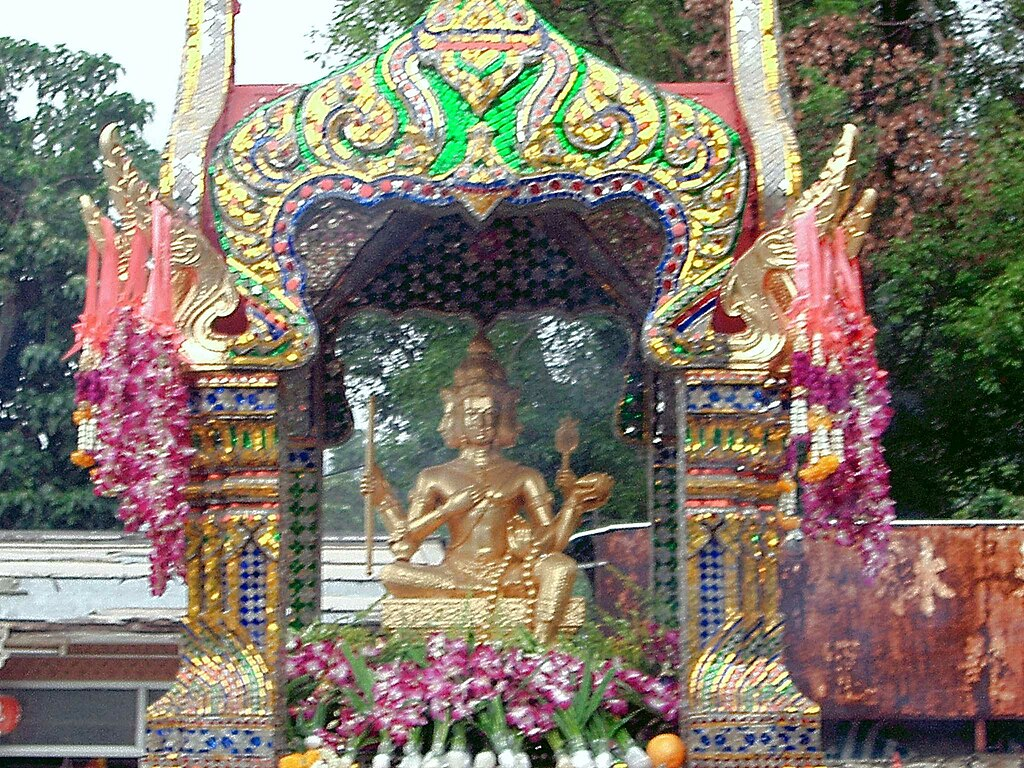
Four faced Buddha Statue 由Hkgalbert – 自己的作品,公有领域,https://commons.wikimedia.org/w/index.php?curid=9932768

Throughout its century-long history, Zhulin Temple has been overseen by five abbots. Notably, the fourth Abbot Master YiZhao emerged as an eminent monk of his time. Venerable Dharma Master Yizhao (1927-2013), born in Guangdong, China, embarked on his spiritual journey by joining Zhulin Zen Monastery in Hong Kong in 1940, formally becoming a monastic in 1941.

Under the guidance of Master Xuyun, he received the transmission of Viyana at Nanhua Temple in 1944, subsequently inheriting the Linji (Rinzai) Dharma lineage and becoming its 44th holder. Establishing the Guyan Pure Monastery in 1952, he later returned to Zhulin Temple to assist in its renovation, eventually assuming the role of abbot. He peacefully passed away in 2013, leaving behind a legacy of enlightenment and compassion.

Master YiZhao (left) and Master XuYun (right) were together at KaiYuan Temple in ChaoZhou, GuangDong , in 1946

Venerable Dharma Master Yizhao, the successor to H.E. Dharma Master Xuyun, exemplifies profound virtue within contemporary Zen Buddhism. Having attained the supreme state of Bodhi, he relinquished all ties to further reincarnation long ago. Inspired by the compassionate vow of Ksitigarbha Bodhisattva, he pledged “As long as there is any living being in the earthly realm, I vow not to become a Buddha.” Renowned as the nirmanakaya of Ksitigarbha Bodhisattva, he received the Amrit Empowerment Initiation from H.H.  Dorje Chang Buddha III, lauded as an exceptional monk who ardently upholds precepts.

In June 2000, Venerable Dharma Master Yizhao seized the opportunity to participate in the Buddhas Bestowing Nectar Dharma Assembly presided over by H.H.  Dorje Chang Buddha III. (The very left in the photo is Master Yizhao)

Following the conclusion of the assembly, Venerable Dharma Master Yizhao graciously shared his personal insights and expressed his profound admiration and gratitude towards H.H.  Dorje Chang Buddha III. For more details, please refer to the interview titled “Interview with Elder Monk Yi Zhao After the Buddhas Bestowing Nectar Dharma Assembly.

Zhulin Temple stands as a testament to beauty and sanctity, inviting visitors to immerse themselves in Buddhist culture, prayers, and blessings, offering a profound spiritual experience.

Link:https://peacelilysite.com/2024/03/14/zhulin-temple-chuk-lam-sim-yuen-at-hong-kong/

#Buddhist #BuddhaDharma #ZhulinTemple #HongKong #ZenBuddhism #YiZhaoMaster #Nectar #MasterXuYun #DorjeChangBuddhaIII  #HHDorjeChangBuddhaIII #ChukLamSimYuen #Abbot #LinjiSchool

Source: https://chuklam.org/, https://baike.baidu.com/item/%E7%AB%B9%E6%9E%97%E7%A6%85%E9%99%A2/19659656

Unveiling Insights Through the Wild Fox Koan: Understanding the Law of Cause and Effect

In the annals of Chinese Buddhist teachings, a narrative known as the “Wild Fox Koan” imparts profound insights into the principles of karma and its undeniable consequences.

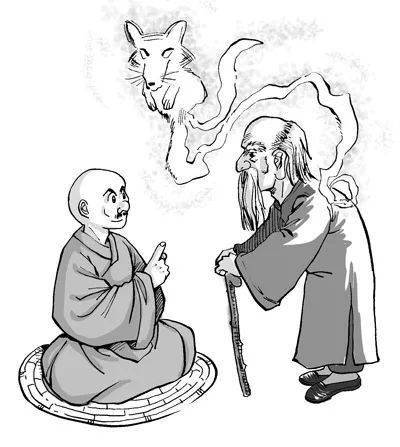
According to legend, during the Tang Dynasty in China, Master Bai Zhang Huai Hai, a venerable monk and the third-generation disciple of the Sixth Patriarch Master Huineng, played a pivotal role in this story. During his sermons, he consistently noticed an unfamiliar old man attentively listening to his teachings on Buddhism. The mysterious visitor would only depart after the session concluded. One day, after another sermon, the old man lingered, prompting the puzzled monk to inquire, “Who is standing there without leaving? Who are you?”

Huaihai, curious, asked, “Do you have something on your mind?” The old man got straight to the point, confessing, “I am not a human; I am a wild fox on this mountain. Five hundred years ago, I was a monk and once gave a Dharma talk here. One day, a junior monk asked me if enlightened beings fall under the law of cause and effect. I replied, ‘They do not fall under cause and effect.’ Unfortunately, I gave the wrong answer and fell into the realm of a fox. Today, I want to ask a question in front of you, venerable teacher. Would you be willing to enlighten me?” Huaihai replied, “Please go ahead.” The old man asked, “Do enlightened beings fall under the law of cause and effect?” Huaihai responded, “They do not ignore cause and effect.” The old man paused for a moment, then prostrated himself, saying, “Teacher, I have attained enlightenment. I have now transcended the realm of the fox. I am beneath the big stone on the back mountain. I hope that you, as a monk, will bury me according to the proper rites.” After saying this, he disappeared without a trace.

Accompanied by monks, Master Huaihai went to the back mountain and found, under a large stone, a dead black fox. Master Huaihai instructed them to light torches and cremate the fox. They then chanted sutras together, performing rites to help the fox monk attain liberation.

The Fox Zen Master, due to a single mispronounced word, uttered a great falsehood, resulting in five hundred lifetimes as a wild fox. The principle of cause and effect is unfailing, as it does not discriminate between the ordinary and the saintly. Advanced practitioners maintain a profound reverence for the law of karma. Hence, there is the notion that bodhisattvas fear the cause, while ordinary beings fear the effect. A bodhisattva contemplates the emptiness and tranquility of all phenomena, harboring no attachment or grasping. Due to their wisdom, they do not give rise to undesirable consequences such as ignorance or darkness.

If one were to claim that a bodhisattva “transcends cause and effect,” it would imply an annihilationist view. It is only by “not obscuring cause and effect” that a bodhisattva, within the profound samadhi of deep prajna paramita, can attain the ultimate wisdom.

“To keep things secret, refrain from doing them unless by oneself.” This is a commonly heard phrase advising people to do good, implying that whatever one does, there will always be someone who knows. Moreover, secrets are bound to be exposed sooner or later. Therefore, it is essential to reflect on one’s actions regularly, ensuring they align with goodness. Never assume that no one is watching, as actions that go against the laws of cause and effect will eventually come to light.

Two other frequently heard sayings are: “Within three feet, there are gods” and “Every step leaves a mark.” These cautionary words remind individuals that every action leaves an imprint, and nothing done will vanish into oblivion over time. In the realm of cause and effect, if one sows seeds of negativity, they must ultimately bear the consequences, adhering to the principle of “unobscured cause and effect.”

During the Three Kingdoms period, the king of Su, Liu Bei, offered sagacious advice to his son, Liu Shan, before his passing, saying, “Do not commit small evils, and do not refrain from doing small acts of goodness.” This counsel underscores the importance of consistently engaging in virtuous deeds, regardless of their scale, while avoiding any participation in wrongdoing. The admonition implies that accumulating small wrongs over time can lead to significant consequences.

Conversely, it’s not uncommon to encounter individuals who, despite their kindness and numerous good deeds, face repeated disasters and misfortunes. Understanding why such outcomes occur can be challenging, leading to a lack of comprehension about the concept of doing good. Some may even develop biases, assuming that avoiding wrongdoing in this life is sufficient and that there’s no need to help others since there’s no apparent reward for good deeds. This perspective represents a clear form of biased and distorted understanding, lacking insight into the law of cause and effect and focusing on one aspect without considering the other.

Applying the concept of the threefold law of cause and effect, we realize that positive causes we sow may not yield immediate results. Karmic consequences from past lives need to be accounted for and repaid. We cannot solely judge our current situation based on what we see in this lifetime. Holding the belief that “I haven’t done anything wrong, so why is life more difficult for me than for others?” is a narrow perspective. Observing others who seemingly haven’t done much good yet are living well, we might not realize that they sowed positive causes in past lives—an aspect our ordinary eyes cannot perceive, akin to the monk descending to a fox in many lifetimes.

If the notion of avoiding wrongdoing but not engaging in virtuous deeds takes root, the future may only bring unbearable misery. Reflect on whether we’ve never taken a life. Insects, ants, cockroaches, spiders—all are living beings, and consciously or unconsciously, we’ve all caused harm to one at some point. Furthermore, injuring a life means we will have to repay in kind in future lives. Without cultivating positive causes in this life, how can we expect to have a good future?

Therefore, it is crucial to firmly believe in the universal truth of “cause and effect.” You reap what you sow—good actions bring good results, and harmful actions bring harm. It’s not a matter of if, but when the time comes!

Unveiling Insights Through the Wild Fox Koan: Understanding the Law of Cause and Effect

Link:https://peacelilysite.com/2023/12/14/unveiling-insights-through-the-wild-fox-koan-understanding-the-law-of-cause-and-effect/

#Buddhism #BuddistTeaching #ZenBuddhism #ZenKoan #LawofCauseandEffect#MasterBaiZhang HuaiHai #FoxKoan #WildFox #Liberation #Enligthen

Source: https://www.sohu.com/a/493514605_121124434,

A Unique Integration of Western Psychology and Eastern Spirituality

Carl Jung’s Psychology Theory and Zen Buddhism

Carl Jung, a pioneer of western psychology, is renowned for his extensive studies of different cultures, religions, and mythologies. He was able to integrate the knowledge from these diverse fields into his theories, making him a unique figure in the field of psychology. One area that had a particularly profound impact on Jung’s thinking was Buddhism, and in particular, Zen Buddhism.

Jung conducted a deep study of Zen Buddhism, and even wrote a foreword for a book by D.T. Suzuki (“An Introduction to Zen Buddhism”), a pioneering Buddhist teacher who introduced Zen Buddhism to the west. In his foreword, Jung used his western perspective and psychological insights to explain the concepts of Zen Buddhism, offering a fresh and new perspective on this ancient tradition.

Could any of us boast that he believes in the possibility of a boundlessly paradoxical transformation experience to the extent moreover of sacrificing many years of his life to the wearisome pursuit of such a goal? And finally , who would dare to take upon himself the responsibility for such an unorthodox transformation experience – except a man who  was little to be trusted, one who, maybe for pathological reasons has too much to say for himself? Just such a person would have no cause to complain of any lack of following among us. But let a ‘Master’ set us a hard task, which requires more than mere parrot-talk, and the European begins to have doubts, for the steep path of self-development is to him as mournful and gloomy a the path to hell.

(Psychology and the East by C. G. Jung – Forward to D.T. Suzukis Introduction to Zen Buddhism, pub. Ark 1978)

One of the key concepts in Zen Buddhism that fascinated Jung was the idea of enlightenment. In Zen, enlightenment is seen as a state of perfect awareness and understanding, where one transcends the limitations of the ego and experiences a deep connection with the universe. Jung was intrigued by the way that Zen Buddhists achieved this state through meditation and other spiritual practices, and saw parallels between their experiences and his own ideas about the unconscious mind.

Jung’s understanding of Zen enlightenment was different from the way that western religions typically view spiritual enlightenment. In western religions, enlightenment is often seen as a state of moral perfection or divine union, and is usually achieved through faith and devotion to a higher power. In contrast, Zen enlightenment is seen as a direct experience of the true nature of reality, and is achieved through introspection and self-realization.

Jung believed that the concepts of Zen Buddhism could offer valuable insights into the human psyche, and he incorporated many of these ideas into his own theories of psychology. He saw the practice of meditation and mindfulness as a way to access the unconscious mind and achieve greater self-awareness, and he believed that the teachings of Zen Buddhism could help people to find inner peace and balance in their lives.

However, many Buddhist masters, experts, and scholars have their own unique understanding of Zen, which often comes from their own experiences. The contemporary Buddha, H.H. Dorje Chang Buddha III has expounded a dharma titled “The Great Dharma of Zen Practice.” In this teaching, the Buddha used perfect wisdom to profoundly explain what Zen is, how the ancient patriarchs practiced Zen and realized the way, and the specific methods of Zen meditation. If you want to understand Zen and practice Zen meditation, this is a must-read classic. Readers will surely gain great benefits and guidance from it.

A Unique Integration of Western Psychology and Eastern Spirituality

Link: https://peacelilysite.com/2023/11/09/a-unique-integration-of-western-psychology-and-eastern-spirituality/

#DorjeChangBuddhaIII #HHDorjeChangBuddhaIII# CarlJung #ZenBuddhism#WesternPsychology #EasternSpirituality #Dharma #ZenPractice #Meditation

Source: https://www.thezengateway.com/culture/c-g-jung-forward-to-d-t-suzuki-s-introduction-to-zen-buddhism

Mount Jizu

Photo From https://www.visityunnanchina.com/attractions/natural-attractions/mount-jizu

In my eyes, Yunnan Province is the most beautiful province in China. Its mild climate throughout the four seasons and its unique geographical location give Yunnan breathtaking natural scenery. The numerous ethnic minorities in Yunnan add to its diverse cultural customs. Yunnan is both romantic and passionately exotic, yet also elegant and graceful. It is truly charming and enchanting. Jizu Mountain is one of my favorite places there.

Mount Jizu (Chicken-foot Mountain) is situated in Dali Prefecture. The mountain is located to the northeast of Erhai and forms the tripoint of three counties:  Heqing,  Binchuan, and Dali City. With three mountain ranges to the front and one range to the rear, it resembles a chicken’s foot, hence its common name is Mount Cock’s Foot or Mt. Cock’s Claw. Yet another name for this mountain is Nine Strata Cliffs.

Mount Jizu is a famed holy mountain in Buddhism. Its main peak, Tianzhu Peak, rises some 3,240 metres above sea level. The mountain is vegetated with dense forests and bamboo groves.

From it, visitors can see the sunrise in the east, floating clouds to the south, Cangshan Mountain to the west and Jade Dragon Snow Mountain in the north. They are described as the “four wonders seen from the mountain top.”

The best viewing spot for the four wonders of Jizu Mountain is at its highest point, the Golden Top Temple. The view from the temple is wide and open, with visibility for more than ten kilometers. Watching the sunrise in the east is the king of the four wonders. Early winter mornings are the best season to witness the sunrise, as the reduced moisture increases visibility.

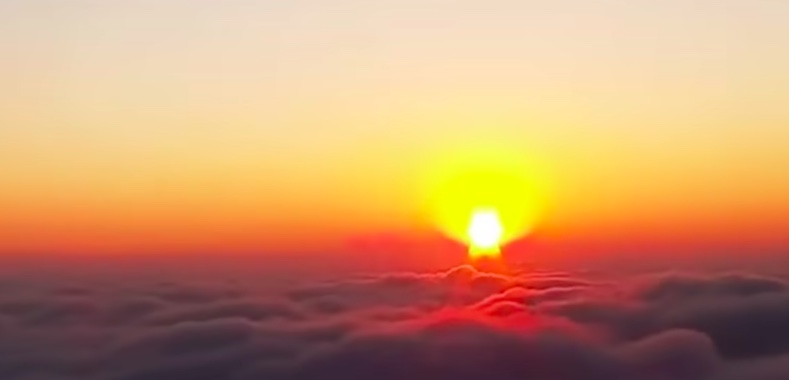
Before dawn in winter, the stars in the sky gradually dim, and the eastern horizon begins to whiten. A hint of orange appears on the just-yellowing horizon. In just a few minutes, the orange-red sun leaps above the horizon, and its dazzling rays spread across the entire landscape. If there are rolling clouds, they turn into a dazzling orange-red color within seconds. The sun’s rays, like an arrow carrying a force of ten thousand pounds, fly straight at everyone. In an instant, a huge spark bursts open in one’s heart. The ruddy morning sun is so bright that it’s hard to keep one’s eyes open. However, once you get used to it, the earth has already begun to revive, welcoming a new day in the dawn.

The best season to view the silver Cangshan and jade Erhai from the west is still in winter and spring. In these two seasons, snow accumulates on the peaks of Cangshan. Looking west from Golden Top Temple, you’ll see the plateau’s pearl, Erhai Lake, which runs between the mountains and valleys, reflecting silver waves. It’s as if pearls are dancing on the water’s surface. At the place where the water meets the mountains, you’ll find the nineteen peaks of Cangshan neatly arranged. The pure white snow on the mountain peaks becomes even more noble silver under the sunlight. The mountains and the sea echo each other, with the mountains towering and magnificent, and the water soft and charming. This is a masterpiece of beauty that cannot be drawn!

The best time to view the colorful clouds from the south is in the evening when the sun is about to set. Try to choose a time when the clouds are most densely gathered. Standing at the Golden Top Temple and looking south, you’ll see the undulating mountains covered in mist, which either wraps around or disperses in clouds, drifting freely in the blue sky, transforming into various shapes. The afterglow of the setting sun is scattered among the light and leisurely drifting clouds, blooming with a burst of colorful brilliance!

Jade Dragon refers to the “Jade Dragon Snow Mountain,” whose peak is covered in snow all year round, so it can be viewed at any time. Looking north from the Golden Top Temple, the snow-capped mountains stretching for dozens of miles look like an outstretched dragon, crystal clear as jade, pure white and flawless, without a speck of dust.

There are some other scenic views of Jizu Mountain that appear at different times and moments, unique to Jizu Mountain. Every year in the summer and autumn rainy season, sudden storms suddenly stop, and the surrounding mountains are still in the mist, except for a part of the clouds above Jinding Temple which disperse and sunlight reappears. At this time, a circle of seven-colored light circles surrounds Jinding Temple, which is one of the Eight Scenic Views, known as “Tianzhu Buddha Light.” Similarly, during the summer and autumn rainy season, Jizu Mountain sometimes experiences strong winds, thunderous sounds, flashes of lightning, and heavy rain in the valleys. However, Huashou Gate, located under Tianzhu Peak and below the Sheshen Cliff, is still clear and sunny. The sound of thunder echoes here and lingers for a long time. This is the famous “Huashou Qing Lei.”

The most abundant trees on Jizu Mountain are “pine and oak.” These trees come together to form a vast forest.

Whether you look from a distance or up close, the “forest sea” of Jizu Mountain stretches for dozens of kilometers, from the mountain peak to the valley, casting shadows with its pine trees. The forest is deep and lush, and when the wind, whether gentle or strong, blows through, the leaves rustle, creating music reminiscent of the thunderous galloping of a thousand horses. Sitting in the mountain and quietly listening to this has a special charm. This landscape is known as “Wan He Song Tao”.

There are more beautiful scenic views waiting for you to explore.

Besides the beautiful scenery, Jizu mountain is a legendary buddhist holy place.

According to Buddhist scriptures, in ancient times, Shakyamuni Buddha demonstrated to the assembly at the Lingshan Meeting by holding up a flower, and everyone remained silent. Only Venerable Mahakasyapa deeply understood the Buddha’s intention and broke into a faint smile. The Buddha said, “I have the true Dharma eye treasury, the wondrous heart of Nirvana, which I entrust to you.” He also told Mahakasyapa that he would pass on the kasaya robe to him, which would then be transferred to Maitreya when he appears in the world. Venerable Mahakasyapa bowed to the Buddha’s feet and respectfully followed the Buddha’s intention. After the Buddha’s Nirvana, Venerable Mahakasyapa gathered the true Dharma three treasures in the city of Vaishali. He later entrusted the true Dharma three treasures to Ananda and went to Jizu Mountain alone, holding the kasaya robe given to him by the Buddha. He entered meditation at the Huashoumen.

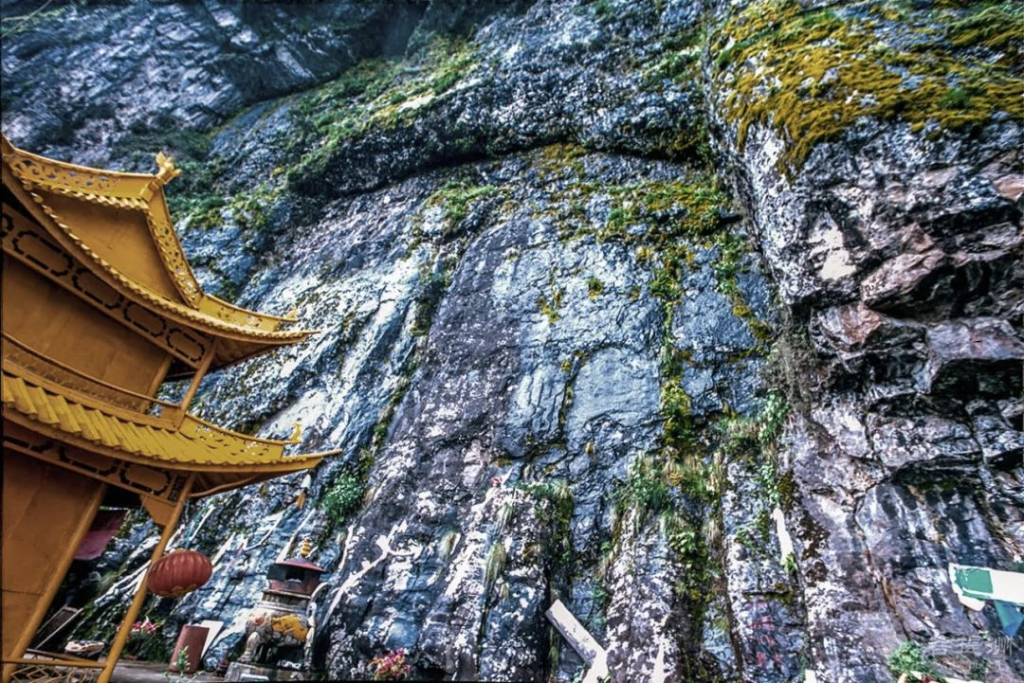
Huashou Gate is 40 meters high, with a sheer cliff face as if cut with a knife. A large stone gate is embedded at the top, and a vertical crack in the middle divides the cliff into two panels, with a “stone lock” hanging in the middle. The stone gate is covered with Hada (ceremonial scarves), and there are prayer flags around it. With an altitude of nearly 3000 meters, the landscape is very similar to that of Tibet.

When Maitreya Buddha is born in this world, he will also climb Jizu Mountain and go to the place where Venerable Mahakasyapa meditated. With a snap of his fingers, the mountain peak will open, and Mahakasyapa will pass on the robe and say his farewell. After the respectful ceremony, he will ascend into the sky, display divine transformations, and enter nirvana.

From the Buddhist scriptures, it can be seen that Jizu Mountain is the place where Venerable Mahakasyapa meditated, and it is also the future place of Maitreya. Its connection with Buddhism will never be severed for billions and trillions of years.

Jizu Mountain’s religious story stretches back nearly 1,000 years. Beginning during the Three Kingdoms period, several nunneries were built upon its slopes. But it was not until the time of the Tang Dynasty, four hundred years later, that the first known Buddhist temple was completed.

Throughout the following centuries, the construction of many other shrines and sanctuaries continued. By the late seventeenth century, during the Qing Dynasty, Jizu Mountain’s religious importance reach its zenith. At that point, according to official historical accounts, there were 42 temples and monasteries, 65 separate nunneries and more than 5,000 religious devotees residing on the mountain.

The mountain enjoys great prestige in South Asia and Southeast Asia, and shares the same fame with Wutai Mountain, Ermei Mountain, Putuo Mountain and Jiuhua Mountain in China. The mountain is a birthplace for Zen Buddhism.

The main sacred sites of Jizu Mountain include: Zhusheng Temple, Huashou Gate, Jinding Temple, Bronze Buddha Hall, Mahakasyapa Hall, Xuyun Zen Temple, Biyun Temple, Huashou Fangguang Temple, etc.

Jinding Temple

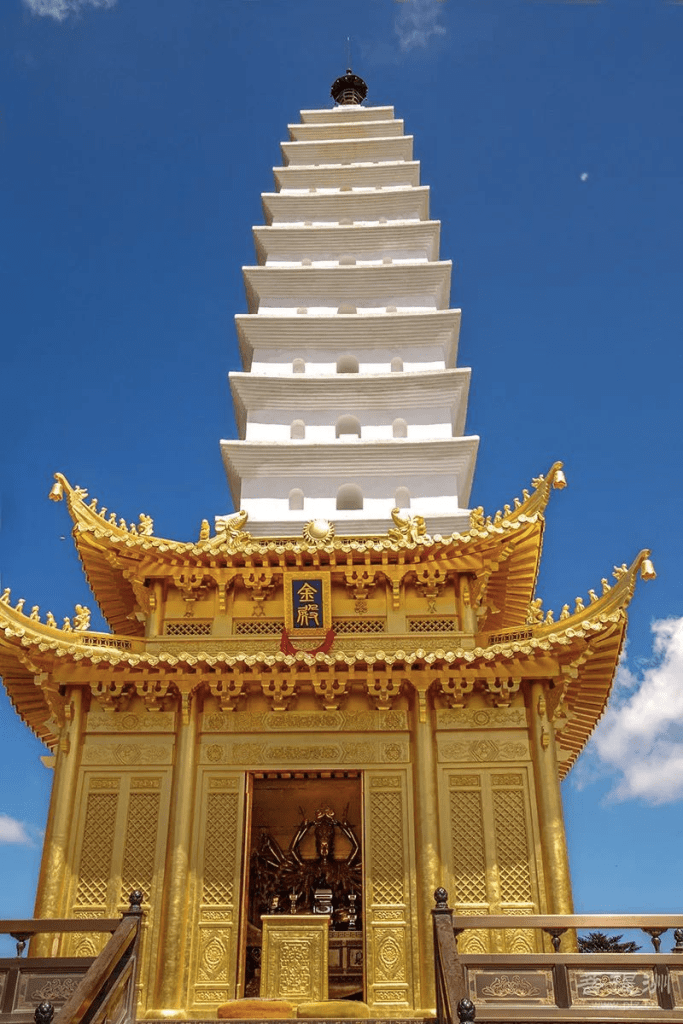
Golden Hall at Jinding Temple and LengYan Pagoda

The front entrance of Jinding Temple is typical Baizhu architecture style

Mahakasyapa Hall

From a high vantage point, the Mahakasyapa (Jia Ye) Hall is hidden among the lush green pines and cypresses in the depths of white clouds.

The Mahakasyapa Hall’s main hall houses a statue of the venerable Mahakasyapa, which is carved from camphor wood

Source: https://www.visityunnanchina.com/attractions/natural-attractions/mount-jizu, http://zgt.china.com.cn/v2/content/2022-06/17/content_11117.html, https://www.buli.page/en/article/wechat/0967339c-67be-4d26-bada-c2d7a5bc1709/