Once upon a time in a remote village, nestled between the mountains, there lived a wise old monk named Master Sean. He was renowned for his ability to guide people in finding their inner voice, a skill that had been passed down through generations of monks in his lineage.
One day, a young man named Kaito arrived at the monastery seeking guidance from Master Sean. He had heard tales of the wise monk and hoped to learn the secret of listening to his inner voice. Master Sean welcomed Kaito with a warm smile and led him to a quiet room overlooking the monastery’s lush gardens.
Before we begin,” said the wise monk, “I want you to spend some time in silence, observing the garden and the creatures that inhabited it.” Kaito sat by the window watching the birds flip from branch to branch, the squirrel scamper across the grass, and the butterflies dance in the breeze. As he observed the harmony of nature, he felt a sense of peace wash over him.
After some time, Master Sean returned and asked Kaito what he had learned from his observations. Kaito replied, “I saw how each creature has its own rhythm and purpose and how they all coexist in harmony.” Master Sean nodded, pleased with Kaito’s insight.
“Now let me tell you a story,” he said, settling into a comfortable chair. “Once there was a young monk who lived in a monastery high in the mountains. He was diligent in his studies and meditation, but he struggled to hear his inner voice. One day, his master took him to a nearby cave where they found a small clear pool of water.”
The master instructed the young monk to gaze into the pool and describe what he saw. The young monk peered into the water and saw his own reflection, along with the reflections of the cave walls and the flickering light of their torches. The master then asked the young monk to close his eyes and listen to the sounds around him.
The young monk heard the gentle dripping of water, the distant echo of their voices, and the soft rustling of the wind outside the cave. Finally, the master told the young monk to open his eyes and look into the pool once more. This time, the young monk saw something different beneath the surface of the water. He could see a world of shimmering fish darting among the rocks and plants.
The master explained that the pool was a metaphor for the young monk’s mind. The surface reflections represented his thoughts and emotions, while the hidden world beneath symbolized his inner voice. To hear that voice, the young monk needed to learn to look beyond the surface distractions and listen deeply to the quiet whispers within.
Kaito listened intently to Master Sean’s story, feeling a spark of understanding ignite within him. He asked, “How can I learn to look beyond the surface and hear my inner voice?” Master Sean smiled and replied, “You must practice mindfulness and cultivate stillness in your mind. Just as the pool’s surface becomes calm and undisturbed, so too will your mind reveal its hidden depths when you learn to quiet your thoughts and emotions.”
Over the following weeks, Kaito practiced meditation and mindfulness under Master Sean’s guidance. He learned to observe his thoughts without judgment, allowing them to pass like clouds in the sky. Gradually, he began to hear the whispers of his inner voice, guiding him with wisdom and clarity.
As the story of Kaito and Master Sean comes to a close, let us reflect on the nature of happiness. Happiness, like the inner voice, is often found in the depths of our being, beyond the surface distractions of our thoughts and emotions. It is not a fleeting sensation or a temporary state, but rather a profound sense of contentment and inner peace that arises from living in harmony with our true selves.
To cultivate happiness, we must learn to listen to our inner voice, allowing it to guide us on our journey through life. By embracing mindfulness and stillness, we can quiet the noise of our minds and tune into the wisdom that resides within us. In doing so, we discover that happiness is not something to be pursued or acquired, but rather a natural state of being that emerges when we align ourselves with our deepest values and aspirations.
In the words of the ancient philosopher Lao Tzu, “Happiness is the absence of the striving for happiness.” May we all find the courage to let go of our endless pursuit of external validation and material success, and instead turn inward, seeking the happiness that lies within our own hearts and minds.
At February 2019, the solo art exhibition of Dr. Yuhua Shouzhi Wang was held at the Ratchadamnoen Contemporary Art Center of the Department of Culture of Thailand. Dr. Yuhua Shouzhi Wang is a distinguished international art master of world renown who is highly recognized by the art world both in the East and in the West.
I am very pleased to have the opportunity to appreciate Dr. Wang’s ink paintings which are truly refreshing. I feel like I have entered an art sanctuary of wonderful colors where I can stroll slowly, appreciate silently, and savor the details thoroughly. As I am strolling along, I notice that I have left the noise of the world behind, and I sense the clarity, peacefulness and serenity in my mind.
Great masters specializing in painting flowers and fruits in the recent 100 years are such as Wu Changshuo and Qi Baishi. As I view Dr. Wang’s works, I feel that her artworks are of the top quality in the free hand style of liberal expressivity.
Professor Wang’s paintings contains the brushwork of traditional Chinese ink painting while incorporating the strategies of Western painting. Her art, honoring tradition and breaking new grounds at the same time, is unique and unfathomable, sophisticated and powerful.
From the paintings, we can see how Professor Wang especially pursues and places emphasis on the spirit, the sensibilities, and artistic conception of ink painting through which she shows the different characteristics of Chinese and Western paintings. She merges these characteristics into her distinguished style.
Professor Wang’s ink paintings are leading me into the refreshing and beautiful nature, allowing my restless soul to rest peacefully.
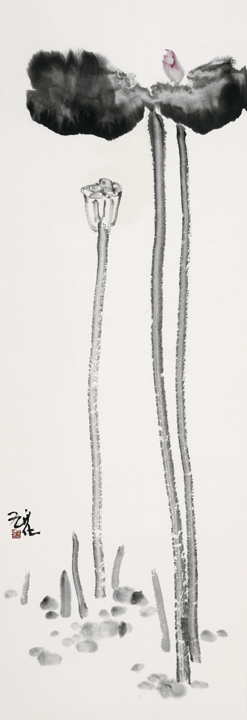
In one of the paintings, three lotuses stand elegantly and the pods have just become fully grown. The stems created by seal-script brushstrokes have a pure and dignified presence.
The composition is clean, simple and effective; echoing the legacy of Bada Shanren. The painting seems to symbolize noble qualities of a lotus that grows out of the sledge yet remains pure, sending off its refreshing fragrance.
Standing in front of the Vitality at the Lotus Pond, I am drawn to the full composition of the ink-wash pastel flowers and the carefree, other-worldly artistic conception. The painting is enlivening a wondrous scenery of lotus in misty rain where the flowers can be compared to the renown classic beauty Xishi who was known to look elegant whether she adorned her face with rich or simple colors.
In a loquat painting, the fruits are painted in a semi-abstract manner. Powerful brushstrokes are used to depict the leaves and the stems. Under Dr. Wang’s sophisticated, forceful and unrestrained brushwork, the leaves of the loquat tree appear robust and energetic. The round and perfect yellow fruits depicted by Dr. Wang in the style of realism look adorable and delicious. There is a sense of classic elegance throughout the composition which also leads one to think of prosperity, peacefulness, and a big family with many children and grandchildren.
A painting depicting cockscomb flowers is inscribed with the verse “Red and white cockscombs are cherished delights. A few strokes of the brushes capture the pleasantness.” The color contrast of the red and white cockscomb flowers seems ordinary yet it is most exceptional. This is truly an extraordinary conception. The upstanding, bright and red flowers with heads held high give a sense of positivity, upward mobility, and vigorous passion.
In another painting, the plum blossoms are energetic and full of power, with slanting branches that are charmingly graceful. The composition of this painting is audacious, lively, and untainted by the mundane, giving a unique sense of spirituality. In this painting, the rich colors are not garish, the faint colors are not cold. The artistic conception is truly transcendent in depicting the subtle fragrance and gentle movement of the flowers.
The five petals of a plum blossom symbolize the five good fortunes including happiness, joy, longevity, wellbeing, and peace. There is a saying that goes, “The plum blossoms give out a sweet fragrance after enduring the bitter cold.” Plum blossom symbolizes strong and noble character.
In the painting Plum Blossoms, Professor Wang has penned the inscription that says, “The charm of the ink and brush is in the spirit, the way of painting plum blossoms is just the same.” The inscription speaks of how vivaciousness and the highest state of artistry can be achieved through the ink, the brush, the color and the lines.
With a faithful mind, I appreciate the paintings one by one silently. I read each and every classic inscription carefully. I feel as if I am taken into a brand-new state of being where I experience poetry in the paintings, paintings in the poetry, and wonderful melodies in praise of the nature’s embrace.
German philosopher Goethe once described art in this way: Beauty is the highest principle of art. It is also the highest goal.”
Professor Yuhua Wang’s paintings are extraordinary. The excellence of her art does not lie in how the artist represents the form of nature, but in how she uses the form to express her mind, and how she brings out the spirit within the form. Her paintings express humanity’s wishes for peace and happiness; they express humanity’s praise to the qualities of freshness, transcendence, nobility and elegance; and they also express humanity’s gratitude to the selfless beneficence of flowers, trees and plants.
In this sanctuary of art, we have enjoyed a precious experience of beauty. Our souls are cleansed and transformed by beauty.
I wish that Professor Yuhua Wang’s exhibition will tour different parts of the world, so more people may enjoy the beauty of nature, the beauty of art, the beauty of life, and the beauty of character.
We also look forward to seeing more of the art of Dr. Yuhua Wang that is of the style of ease.
Tucked away in the idyllic town of San Marino, California, lies a captivating destination that continues to enthrall visitors from all corners of the globe—the Huntington Library, Art Museum, and Botanical Gardens. Boasting breathtaking landscapes, vast collections, and a harmonious fusion of nature, culture, art, history, and science, the Huntington Library is a place of awe-inspiring wonder that leaves an indelible mark on the hearts of those who venture within its gates. This July 4th holiday, we had the pleasure of revisiting this remarkable institution, once again succumbing to its irresistible allure.
Stepping foot into the Huntington Library is like entering a world where nature and culture intertwine harmoniously. The lush botanical gardens stretch across 120 acres, offering a mesmerizing collection of plants, flowers, and trees from all corners of the globe. As you stroll along the meandering paths, you’ll encounter a kaleidoscope of colors and fragrances, inviting you to immerse yourself in the serenity of nature. The carefully manicured landscapes provide the perfect backdrop for contemplation, relaxation, and exploration.
Chinese Garden
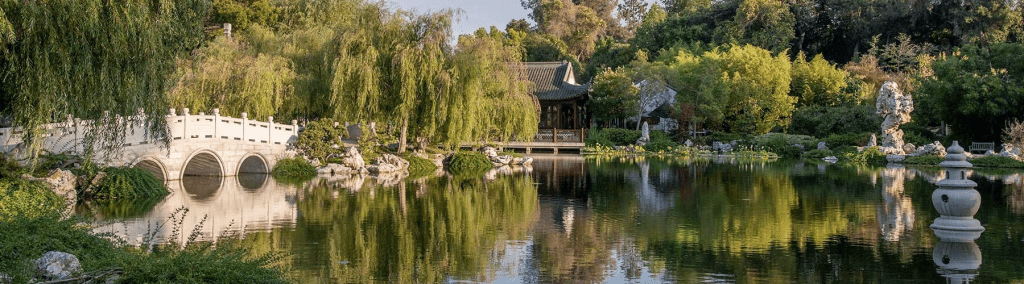
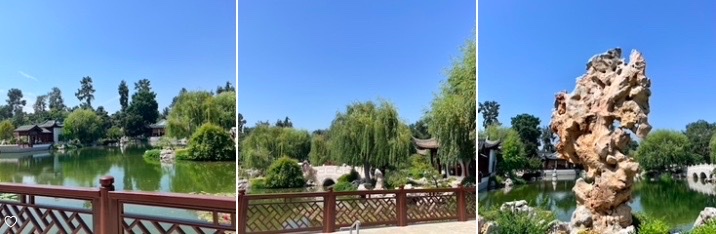
Among the many wonders that grace the Huntington Library, the Chinese Garden stands out as a true gem. This tranquil oasis, known as the Garden of Flowing Fragrance (Liu Fang Yuan), transports visitors to the essence of traditional Chinese landscaping. With its tranquil ponds, graceful pavilions, and meandering pathways, the Chinese Garden evokes a sense of peace and serenity. Every element, from the meticulously arranged rocks to the delicate architecture, conveys the rich insights of Chinese culture, inviting visitors to appreciate its profound beauty.
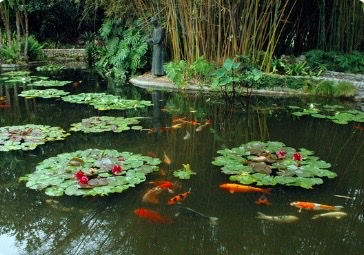
Nestled within the captivating grounds of the Huntington Library, Art Museum, and Botanical Gardens, the Lily Ponds stand as a timeless testament to the beauty and tranquility of nature. Established in 1904 as the first garden on Henry E. Huntington’s property, the Lily Ponds have become a beloved destination for visitors seeking solace and respite. Surrounded by bamboo groves and the majestic conifer tree collection, this serene haven features five picturesque ponds and an open grass meadow. With the presence of lotus blossoms, graceful koi fish, and elegant papyrus, the Lily Ponds offer a truly enchanting location for relaxation and the staging of unique events.
Beyond its mesmerizing gardens, the Huntington Library boasts an extensive collection of art, rare books, manuscripts, and historical artifacts. Art enthusiasts will find themselves immersed in masterpieces that span centuries, from the Renaissance to contemporary works. History buffs can delve into rare documents that shed light on pivotal moments in human civilization. Moreover, the Huntington Library offers an incredible array of scientific resources, including an impressive collection of botanical specimens, which serve as invaluable tools for researchers and scholars.
Peter Verstille’s diary and memorandum book, pages 19 and 20. Verstille was dismayed by the political corruption and misdirection he perceived in London. Throughout his diary, he worried what “the Deplorable Degeneracy of our present Times” would mean for the fate of the British Empire and America. | The Huntington Library, Art Museum, and Botanical Gardens.
The Huntington Library’s existence as a public treasure is owed to the foresight and generosity of Henry E. Huntington and his second wife, Arabella. The couple amassed an extraordinary collection of books, art, and manuscripts throughout their lifetimes. Instead of keeping these treasures confined to private quarters, they made the decision to establish the Huntington Library, ensuring that future generations would have the opportunity to experience the world’s wonders firsthand. Their philanthropic vision has created a lasting legacy that continues to enrich the lives of countless individuals today.
Visiting the Huntington Library is an experience that lingers in the hearts and minds of all who venture within its gates. The seamless integration of nature, culture, art, history, and science makes it a truly remarkable place. Whether you find solace in the tranquil Chinese Garden, lose yourself in the captivating art collections, or immerse yourself in the wealth of knowledge held within its walls, the Huntington Library offers a journey of discovery and inspiration. The selfless act of the Huntington couple in preserving this treasure for the public to enjoy is a testament to the power of sharing and the immense value of fostering a deeper understanding of our world. So, if you ever find yourself in California, make sure to visit the Huntington Library, where beauty, culture, and knowledge come together in perfect harmony.
Once upon a time, a young man was very much troubled by his bad habits. His life was completely disturbed due to his bad habits. He did not value his time at all. He would just waste the whole day on useless things. He was also very lazy and drowsy. Whenever his family members asked him to do some work, he would try to avoid that work by making excuses. And for some reason, if he had to do that work, he would do it in haste without any interest. Whenever his parents tried to teach him something, he would argue with them without admitting his mistake. He would always postpone important tasks and decisions for tomorrow and try to avoid all kinds of responsibilities. Slowly and slowly, when all his friends started outdoing him, he began to realize that his bad habits are now causing him to lag. He tried many times to improve his bad habits, but every time he failed in it. Then one day, one of his friends told him that a monk is staying in a hut outside the village for a few days. He suggested him to meet the monk for his problem. Although the young man did not believe, he still reached the monk to meet him the next day.
When he reached there, the monk was meditating with his eyes closed. The young man went in front of him and bowed to him. The monk opened his eyes and with a smile on his face, he asked the young man to sit. The young man told his problem to the monk and told him how he wanted to change his habits but he failed every time. The monk listened to the young man patiently. Then he thought for a moment and said, “My friend, you want to change your habits in a few days, but you must know that just as it takes a long time to form habits, similarly, it will take a long time to change those habits. For this, you have to give time and change your bad habits with good habits. For example, if you want to leave the habit of lying, then you will have to adopt the habit of telling the truth first.” Then the monk became serious and said, “Son, today I will tell you about six such habits which will not only change your old habits but can also change your life.”
The first habit to adopt is reading books. Books contain answers to the questions that arise in your mind. Many people before you have had the same questions and have written down their answers in books. By reading books, you can gain knowledge and learn from the experiences of others.
It’s a way to discover your shortcomings and develop new and positive thoughts that will help you progress in life. Successful people often have the habit of reading books, so start reading today to bring about a miraculous change in your life.
The second habit recommended is writing. While reading books is a great way to gain knowledge, it’s easy to forget what you’ve learned. Writing down valuable information helps you retain and implement what you’ve learned. It also allows you to connect with your inner self, focus your mind, solidify your thoughts, and generate new ideas. Writing down your goals and keeping them visible can inspire you to work towards them.
The third habit is meditation, described as a solution for mental problems. Often, our troubles stem from dwelling on the past or worrying about the future. Meditation brings you to the present moment, reducing the flow of thoughts, calming your mind, and preventing overthinking. Regular meditation enhances your focus, reduces stress, and keeps your mind healthy.
Expressing gratitude for what you have is the fourth recommended habit. By focusing on what you have instead of what you lack, you can fill your life with happiness. Even during difficult times, taking a moment to appreciate what is going well can keep you content. Expressing gratitude reminds you of the abundance in your life and fosters a positive outlook.
The fifth habit is waking up early. This habit is common among successful individuals. Rising early makes you feel refreshed, happier, and more energetic. Mornings offer a peaceful environment with fewer distractions, enabling better concentration on work, studies, or activities such as yoga, meditation, exercise, or a morning walk. Waking up early reduces stress, anger, and fosters an optimistic and positive attitude.
The sixth habit is self-discipline. It involves creating a daily routine that promotes punctuality and hard work. Discipline contributes to present happiness and a promising future. It forms habits that shape your identity. Examples of disciplines include waking up early, consistent meditation, reading good books, consuming healthy food, avoiding junk food, exercising regularly, and practicing breathing exercises.
By adopting these six habits, your life can experience miraculous changes. Just as the young man who listened to the monk’s advice, make a promise to yourself to incorporate these habits into your life. If you want to bring positive change and progress towards your goals, start adopting these habits today. You will witness improvement and transformation in your life.
When Sakyamuni Buddha first established Buddhist theories, there was no dual character of Buddhist theories. There was only the sameness of theories and nature (the essence of everything). The theories in the Tripitaka expounded by the world-honored Sakyamuni Buddha came from the Buddha’s state of realization. They are a kind of explanation of the ways to realize the holy state and attain liberation and nirvana. They can be called objective writings. Such Buddhist theories were born from true holy realization. They are not groundless writings based on assumptions that arose from the level of consciousness. This is recorded in the Buddhist scriptures.
In the beginning, Buddhist theory and Buddha-dharma realization were one integral body. At first, a complete body of dharma theories and rituals were born from true realization of the Buddha-dharma holy state. Later, people attained the holy state of true realization from this complete body of dharma theories and rituals. Theory and dharma were in harmony. Theory was used to further the dharma. The dharma was manifested to further theory.
“The sect of theories and true holy realization” is in accord with the sutras and abhidharma. Those of this sect apply cognition based on correct views to directly understand cultivation, the nature of the mind, and ultimate reality. They truly realize holiness that transcends intelligence and theories. Moreover, they manifest their actual realization and thereby prove that they have attained the ultimate nirvana.
This sect uses the orthodox theories contained in the Tripitaka and esoteric scriptures as its foundation. However, its goal is not the useless speaking of theories. Those in this sect must manifest their holy state of realization.
However, as the karmic connection living beings had with the dharma changed and as a large amount of dharma and rituals were lost, Buddhism’s sameness of theories and nature (essence) imperceptibly and gradually generated a dual character. One aspect was the complete retention of theory and holy realization where each brought out the best in the other. The other aspect was pure theory that arose out of a fundamental separation from the holy state of realization. The advent of this dual character of Buddhist theories objectively caused Buddhism to form two main sects. No matter what the sect or school may be within Buddhism—whether it be Mahayana, Hinayana, exoteric or esoteric Buddhism—all sects or schools ultimately belong to one of these two main sects. The first is “the sect of theories and true holy realization.” The second is “the sect of theories, views, and understanding.” Of course, the theories I am referring to here are Buddhist theories based upon correct understanding and correct view. I am not bringing up a third category of misunderstandings and heretical views that go against the sutra teachings.
The purpose of cultivation and practice for this sect is to actually transcend, in both body and mind, the fetters of samsara. This sect has an integral lineage, integral teachings, and integral rituals. Those of this sect are able to manifest supernatural wisdom powers that transcend both the material and mental spheres. It is a sect that truly accords with the essence of the Tipitaka, the esoteric scriptures, and the various commentaries and treatises. This is the sect of perfect Buddha-dharma where theory and nature (essence) are in accord. This was the original characteristic of Buddhist theory. Such Buddha-dharma played a decisive role in the liberation and accomplishment of living beings. Included in this Buddha-dharma is the Buddha-dharma of Sakyamuni Buddha during the True Dharma Age, the Buddha-dharma transmitted by Guru Padmasambhava, the Buddha-dharma transmitted by Venerable Atisha, Master Marpa, Master Milarepa, Master Tsongkhapa, Master Nairatmya, Master Rigdzin Jigme Lingpa, Bodhidharma, Xuan-zang, Hui-neng, Master Xu-yun, and the Buddha-dharma transmitted by other truly holy beings and patriarchs throughout history. All such Buddha-dharma is the Buddha-dharma of “the sect of theories and true holy realization.” Unfortunately, at this present time on earth, this sect is very rare and very seldom seen. “The sect of theories, views, and understanding” has taken its place and become the mainstream.
“The sect of theories, views, and understanding” also uses the orthodox theories contained in the Tripitaka and esoteric scriptures as its foundation. Those of this sect apply cognition based on correct views to approach and directly understand the nature of the mind in the hope that in the end they will realize nirvana. The Buddha-dharma of this sect is only able to express theories and that which arises out of mental processes. Those in this sect do not have actual holy realization that they can display. Consequently, all they can do is use the realization states and achievements of patriarchs in earlier generations as cases in point. Most present-day Buddha-dharma belongs to this sect. This is a prevalent phenomenon in current Buddhism.
However, we must see that although the theories of this sect are also based on correct understanding and correct view, it is very difficult for this sect to produce complete liberation. It is easy for this sect to fall into meaningless intellectual frivolity. It is still a question as whether those of this sect can truly attain the liberation of ultimate nirvana. That is because it is extremely difficult to lead people into the state of holy beings by relying solely upon theories. Moreover, these theories were expressed by different people and therefore vary. For example, the views expressed in the prajna writings and Middle School (Madhyamaka) writings are not the same. The “other emptiness view” also has its own way of explaining things.
I will use the modern terms of “software” and “hardware” to give an analogy. Which one of these schools of theories is practical software that can attain the positive results that hardware can attain? It is very difficult to determine this by relying only on software itself. Only when the positive results of hardware are actually produced can it be shown whether a certain theory (software) is right or wrong. Furthermore, that which is called the dharma of Buddha-dharma should be dharma that transcends the ordinary and leads to liberation. Theories alone cannot express this extraordinariness.
This phenomenon of seeking liberation from theories and views alone is mainly the result of the loss of many dharma teachings and rituals in the course of passing down the Buddha-dharma. In the case of Tibetan esoteric dharma, there has not been much change in the theoretical part since the initial stage of esoteric dharma until now. The greatest change has been in the true realization part. When the patriarchs of Tibetan esoteric Buddhism transmitted dharma in the past, there were countless manifestations of supernatural realization powers. These astounding supernatural realization powers caused people of the world to regard Tibetan esoteric dharma as holy and special. Guru Padmasambhava and Venerable Atisha displayed a great many supernatural powers. Master Marpa practiced a dharma whereby he brought back to life animals that had already died. Patriarch Milarepa flew in the air and entered the horn of a bull to avoid hail. Guwen Rinpoche flew into the air and took with him his entire family, including the tent and domestic animals. Both of the 4th Dodrupchen Dharma Kings displayed wondrous realization powers, and so on and so forth. One can give endless examples of such holy realization powers.
The original special quality of the Buddha-dharma was that it was of “the sect of theories and true holy realization,” which manifests actual realization powers. However, with the arrival of the Dharma Ending Age, many dharmas are no longer whole. The practice of them will not produce realization powers. Much Buddha-dharma, especially the esoteric dharma, has begun to devolve toward “the sect of theories, views, and understanding.”
Take, for example, the colored sand used to form a mandala during an inner-tantric initiation in the holy form. During the time of Guru Padmasambhava, this inner-tantric initiation dharma required that certain things be done. On the surface of a large flat stone, colored sand would be used to form the shape of a mandala or a vajra seed character. A person would then apply holy realization powers, causing that design on the surface of the stone to penetrate the stone and form the same design on the sand in the mandala plate underneath that large flat stone. Such sand design in the mandala plate thereby became vajra sand that went through a stone.
However, at this present time, there is no integral dharma. People cannot produce holy realization powers through dharma practice. Thus, inner-tantric initiations in the holy form cannot be performed. The above-described process of using colored sand to form a mandala has already devolved into sprinkling colored sand directly into the mandala plate to form a mandala design. As such, there is not the slightest manifestation of holy power.
Another example is vajra pills used in inner-tantric initiations. Sixty or seventy years ago, most of the people of true and holy virtue within Tibetan esoteric Buddhism were able to make a vajra pill come to life by telekinetically making it shake or even move around. However, in present-day Tibetan esoteric dharma, a vajra pill is nothing more than a medicinal pill that is a symbolic expression of dharma.
Another example is secret-division initiations relating to gods of wealth. This is a dharma source of inner-tantric dharma in the holy sense. The practitioner receiving such an initiation will generate a holy stage right then and there in the mandala. Moreover, gold dollar treasures or a treasure-spitting mongoose made of three white things and roasted barley flour will turn over and jump into the air before the practitioner, demonstrating a holy state of physics not produced by humans. The practitioner receiving the initiation will right then and there ingest a “dharma mother seed.” Out of this practice of dharma, the god of wealth will naturally descend, thereby accomplishing the completion stage. However, this type of dharma has also been lost.
It is not just these few dharmas. Most inner-tantric initiation dharmas have already deteriorated. Accomplished ones who attained the rainbow body basically cannot be found, even in the Kathok Monastery, which was the monastery of Padmasambhava and the place where more people attained the rainbow body than anywhere else. In modern times, many dharma kings did not transform into the rainbow body and fly away at death. There are many people now who at every opportunity leave their handprints or footprints on stones to show their realization powers. However, such realization powers were not manifested under the observation of masters and witnesses there at the time. What credibility do they have?
In an interview, the famous Kasuo Rinpoche of the Longwu Monastery of the Geluk sect talked about the special societal circumstances that existed in Tibet during the fifties and sixties. As a result of those circumstances, a large number of sutras, treatises, and dharma manuals were burned. Many people of great virtue were unable to pass down integral dharma before they were forced to die. Those people of great virtue who fled to India did not take with them many dharma manuals. After that, at most only twenty or thirty percent of Tibetan esoteric dharma still remained in the world. Most such dharma has been lost forever.
It is because of this type of loss of dharma that most present-day Buddha-dharma does not produce people who can show actual realization powers. Candidly speaking, people do not understand dharma and get bogged down in hollow theories over a long period of time. Many people even misunderstand the Buddha-dharma as simply something to comprehend that is theoretical or mental in nature. Of course, they are apathetic to the matter of realization powers or even feel that it is very normal not to have realization powers. This way of thinking is actually very wrong. Theories can be used to distinguish the holy ones from the ordinary ones. However, the most important way to distinguish the genuine ones from the false ones is seeing who actually manifests holy realization powers.
Take, for example, emptiness. Even practitioners with a little knowledge are able to speak copiously about theories related to emptiness. However, are those well-organized and impressive theories, understandings, and views right or wrong in the end? This is something that understandings and views alone cannot determine. It is also something that no conscious experience born of causes and conditions can determine. Only when one abides in emptiness and true such-ness and generates supernatural wisdom powers can one truly know whether an understanding or view is right or wrong.
There was a time when Ananda had not yet realized holiness. The Arhats excluded him from the hall where they were assembling the sutras. After he realized true such-ness, returned to that hall, and stood outside its door, Venerable Mahakasyapa asked him to enter the door through the keyhole to prove that he had become enlightened. Ananda then entered the hall through the keyhole. Those who have realized emptiness and untied the knot must have supernatural holy powers enabling them to enter another dimension that ordinary human ability cannot reach. Additionally, they must have this “software accomplishment” in the form of actual and extraordinary holy powers. Only then can they prove whether a given “theory software” is correct and practical.
Thus, as for this issue, the difference between “the sect of theories, views, and understanding” and “the sect of theories and true holy realization” is that the former stops at theoretical understanding. Whether people of “the sect of theories, views, and understanding” actually realize and enter the holy state that is beyond consciousness and thereby attain liberation is something unknown. It is not that people of such sect feel secure and therefore do not manifest holy powers. Rather, they do not manifest holy powers born of enlightenment because the incomplete dharma of that sect has resulted in its followers being unable to realize such powers from their practice. “The sect of theories and true holy realization” also propagates correct dharma theories. However, it definitely does not stop at purely theoretical, quick, sharp, and incisive repartee on the dharma, nor does it get entangled with theories on understanding emptiness. Rather, by following integral dharma and rituals, the people of this sect truly realize the essence or nature of true such-ness, transcend the level of consciousness, untie the knot of suffering, attain holiness and the resulting structural transformation of body and mind, and actually reach the dimension of holiness that is beyond the cycle of reincarnation.
Although both “the sect of theories, views, and understanding” and “the sect of theories and true holy realization” strive for nirvana based upon orthodox Buddhist theories, nonetheless, due to the Buddha-dharma of each of these two sects, there are great differences in the time it takes to become accomplished and the level of accomplishment. Furthermore, because “the sect of theories, views, and understanding” is limited to purely theoretical understanding and inquiry, it is often very difficult for its followers to see things from the standpoint of the pure, liberated state of holiness in order to understand the original meaning of some super-mundane (other-worldly) dharmas. This leads them to easily adopt mistaken views and understandings. If they are slightly careless, they can even slide toward heretical views.
In this Dharma Ending Age, it is very rare to be able to learn the integral dharma of “the sect of theories and true holy realization.” Moreover, this sect is not something that is fixed. Rather, it is something that evolves. It is like those Buddha-dharmas I mentioned above. When the patriarchs transmitted Buddha-dharma, they were still part of “the sect of theories and true holy realization” in which theory and nature (essence) were one. At that time, there were numerous manifestations of true realization states. The mandala dharma rules were strict. There was an orderly distinction between what was inner-tantric, outer-tantric, and inner-tantric in the holy form. However, dharmas gradually became lost. Dharmas passed down to later generations devolved into the hollow theories of “the sect of theories, views, and understanding.”
Many people of great holiness and virtue think that because of the loss of Buddha-dharma “the sect of theories and true holy realization” composes only about one or two percent of Buddhism in the world today as compared with “the sect of theories, views, and understanding.” So-called “greatly virtuous ones” within Buddhism who have heretical understanding and views are cropping up everywhere. It is distressing to see this trend in present-day Buddhism.
From a young age, many of us were taught by our parents about the importance of cultivating good habits. Whether it was going to bed early, exercising regularly, or refraining from negative behaviors, these habits were instilled in us with the belief that they would pave the way for success and a fulfilling life. Charles Duhigg, in his influential book “The Power of Habit,” sheds light on the mechanisms of habit formation and transformation. Drawing from scientific discoveries and captivating narratives, Duhigg offers fresh insights into human nature’s capacity for profound change. In addition, religious teachings, such as those found in Buddhism, also emphasize the significance of good habits in leading a virtuous and enlightened life.
“The Power of Habit” explores the scientific foundations behind habit formation. Duhigg introduces the concept of the habit loop, consisting of cues, routines, and rewards, which shape our behaviors and become deeply ingrained in our lives. By comprehending this loop, we gain a better understanding of how habits are formed and how they can be consciously modified or replaced.
Duhigg highlights the power of keystone habits, pivotal behaviors that have the potential to ignite positive transformations in various aspects of our lives. Through real-life examples, such as the habits of Olympic swimmer Michael Phelps, Starbucks CEO Howard Schultz, and civil-rights icon Martin Luther King Jr., the book demonstrates how cultivating keystone habits can lead to remarkable achievements. These habits act as catalysts, triggering a chain reaction of positive changes in other areas of our lives.
In Buddhism, there is a strong emphasis on discipline and the cultivation of good habits. Buddhist monks and nuns follow a set of precepts—more than 200 rules—that guide their daily lives. These precepts serve as a framework for moral conduct, urging practitioners to refrain from harmful behaviors and cultivate virtuous habits. By adhering to these precepts, disciples develop good habits in all aspects of life, fostering mindfulness, compassion, and ethical behavior.
In the pre-recorded Dharma discourse delivered by H.H. Dorje Chang Buddha III, His Holiness expounded on the profound concept that habits can become second nature, highlighting the transformative potential of consistent practice. Through consistent meditation, individuals develop a habit of introspection and mindfulness, leading to increased concentration and ultimately enlightenment. Similarly, the habit of performing good deeds accumulates positive merits, shaping one’s character and promoting spiritual growth.
“The Power of Habit” by Charles Duhigg reveals the malleability of habits and their potential for transformative change. By understanding the science behind habit formation and exploring keystone habits, individuals can consciously shape their behaviors and make positive changes in their lives. Additionally, Buddhism provides valuable insights into the significance of good habits in fostering moral conduct and spiritual development. By embracing these teachings, we can harness the power of habits to lead more fulfilling, successful, and enlightened lives.
Once upon a time, in a small village nestled amidst rolling hills and verdant fields, lived a humble shoemaker named Michael. Despite his meager existence, Michael was known throughout the village for his kindness and compassion.
One bitterly cold winter’s night, as the village lay shrouded in a thick blanket of snow, a weary traveler knocked on Michael’s door seeking refuge. The traveler, unbeknownst to Michael, was none other than an angel sent to test the hearts of men.
Moved by the traveler’s plight, Michael invited him into his modest home, offering him a warm fire and a hot meal. Oblivious to the angel’s celestial nature, Michael treated him with the utmost care and kindness, tending to his needs as if he were a cherished guest.
As the night wore on, the angel observed Michael’s selfless actions with great interest. He could not help but be touched by the shoemaker’s genuine love and generosity, a love that surpassed the boundaries of wealth and social standing.
Days turned into weeks, and the angel continued to reside with Michael, secretly observing the shoemaker’s interactions with his family, friends, and neighbors. He witnessed how Michael tirelessly toiled to provide for his loved ones, how he shared whatever he had with those less fortunate, and how he spread warmth and kindness wherever he went.
One fateful day, the angel revealed his true identity to Michael. Overwhelmed with awe and wonder, Michael fell to his knees, humbled by the realization that he had unknowingly saved an angel. “Why did you choose me?” Michael asked in astonishment.
The angel smiled warmly and replied, “It was your love, Michael. Your love for your fellow beings and your unwavering kindness touched the depths of my heart. Through your actions, you have shown me what it means to truly live.”
In that moment, Michael understood the profound truth that Tolstoy had sought to convey. Love was the ultimate purpose of life, the force that breathed meaning into our existence. It was love that transcended social barriers, that connected souls, and that had the power to transform the world.
From that day forward, Michael’s love and compassion only grew stronger. He became a guiding light in the village, inspiring others to embrace love and kindness as the guiding principles of their lives.
The echoes of Michael’s love spread throughout the village, reaching the ears of a wealthy man named Simon. Simon, consumed by his own greed and selfishness, felt a profound emptiness within his soul. Touched by the stories of Michael’s love, he yearned to experience that same sense of fulfillment.
With a heavy heart, Simon approached Michael, seeking guidance and redemption. Recognizing the sincerity in Simon’s plea, Michael embraced him with open arms, teaching him the ways of love and compassion. In time, Simon’s heart softened, and he too began to live a life driven by love and selflessness.
Meanwhile, in a neighboring village, a woman named Matryona lived in seclusion, her heart burdened by the loss of her family. But one fateful day, as Matryona journeyed through the forest, she stumbled upon two orphaned girls on the brink of despair. Driven by a surge of love and empathy, Matryona took the girls under her wing, offering them shelter, care, and a mother’s love.
As the seasons passed, the village flourished under the influence of love. Acts of kindness became the norm, and the air was filled with warmth and harmony. The transformative power of love had woven its magic, creating a tapestry of compassion that embraced every soul in the village.
And so, the tale of Michael, Simon, and Matryona became legendary, passed down through generations as a testament to the profound truth that Tolstoy had so eloquently expressed. Love, the essence of life, had indeed triumphed, illuminating the path to a more beautiful and harmonious world.
This YouTube documentary by the BBC was done several years ago, but is worthy of another visit as it gives us a glimpse of the various forms of Buddhism and some of the great monuments and architectural expressions in the different cultures where it took root including our own.
In this fascinating documentary, historian Bettany Hughes travels to the seven wonders of the Buddhist world and offers a unique insight into one of the most ancient belief systems still practised today. Buddhism began 2,500 years ago when one man had an amazing internal revelation underneath a peepul tree in India. Today it is practised by over 350 million people worldwide, with numbers continuing to grow year on year. In an attempt to gain a better understanding of the different beliefs and practices that form the core of the Buddhist philosophy and investigate how Buddhism started and where it travelled to, Hughes visits some of the most spectacular monuments built by Buddhists across the globe. Her journey begins at the Mahabodhi Temple in India, where Buddhism was born; here Hughes examines the foundations of the belief system – the three jewels. At Nepal’s Boudhanath Stupa, she looks deeper into the concept of dharma – the teaching of Buddha, and at the Temple of the Tooth in Sri Lanka, Bettany explores karma, the idea that our intentional acts will be mirrored in the future. At Wat Pho Temple in Thailand, Hughes explores samsara, the endless cycle of birth and death that Buddhists seek to end by achieving enlightenment, before travelling to Angkor Wat in Cambodia to learn more about the practice of meditation.
Do Buddhists advocate supernatural powers? Actually, this is not a matter of advocating or not advocating. Rather, supernatural powers are that which everyone who is accomplished in the dharma possesses. Such powers are the manifestation of realization achieved through cultivation. They are phenomena that exist in the course of cultivation but are not the goal of cultivation, which is liberation from the cycle of birth and death. They are by-products that arise during one’s practice. These by-products called supernatural phenomena naturally exist in all liberating paths within the Buddha-dharma. Becoming attached to these by-products and regarding them as the goal is heretical supernatural powers. Applying these by-products in a free and unattached way and regarding them as illusory is treating supernatural powers based on the correct Buddha-dharma view.
Sakyamuni Buddha manifested supernatural powers and also was against supernatural powers. Each of those two tacks reflects different underlying karmic conditions. To those with higher vehicle (Mahayana) faculties, the Buddha spoke of supernatural powers as enjoyment resulting from incredible realization and the free and unattached application of samadhi. Examples of this are in the Lotus Sutra, the Samyuktagama Sutra, and other sutras. To those practitioners with low faculties, the Buddha spoke of not being attached to supernatural powers in order to reach the goal of realizing emptiness. An example of this is in the Shurangama Sutra.
Anyone with low faculties who wants to become a Buddha must go through the stage of cultivation corresponding to those with high faculties. In one’s course of cultivation, this is analogous to going from one city to another city. If one does not travel along the pathway between the two cities, one will not reach that other city. When one is walking toward that other city, one will certainly see and encounter all of the phenomena that are on the way. This is like the supernatural phenomena that arise in the course of one’s cultivation when wisdom is being opened. If one does not experience such phenomena that arise during the cultivation process, then one will not reach the other shore of liberation. Because one has not traversed the path of the Buddha-dharma leading to liberation, one cannot encounter phenomena that occur while traversing that path. That is why such a person has not experienced the stage in the process whereby wisdom is opened and supernatural powers are realized. Thus, all Buddhist who become accomplished in the dharma must go through the stage of supernatural powers.
Is it true that the authentic Buddha-dharma does not speak of supernatural powers? If that were the case, then why did the great leader of Buddhism, Sakyamuni Buddha, manifest supernatural powers everywhere? Why did he even manifest great supernatural powers right before entering nirvana? What crazed and demonic person would dare say that Sakyamuni Buddha did not practice the true Buddha-dharma? Just think. If someone with great accomplishment in the dharma did not have any supernatural realization powers, what would be the difference between that person and an ordinary person who had not learned Buddhism?
Based on the Sutra, it is stated that one who attains liberation and becomes a Saint must possess six great supernormal powers or superknowledges (abhijna). These powers are as follows:
Rddhi-saksatkriya: This power grants the ability to be anywhere or do anything at will, including extraordinary feats such as flying through the air and performing miraculous acts.
Divyasrotra: This power enables the individual to hear sounds from any location, even those that are normally inaudible, such as the subtle sounds of ants walking or distant noises emanating from other realms. It is also referred to as clairaudience or “the divine ear.”
Paracittajnana: With this power, one gains the ability to understand the thoughts and read the minds of other beings.
Purvanivasanu-smrtijnana: This power allows the recollection of previous existences or past lives, both one’s own and those of others.
Divyacakus: This power provides an instantaneous view of anything, regardless of its physical presence. It encompasses the ability to see events and occurrences in faraway places or even in other realms of existence. This power is also known as clairvoyance or “the divine eye.”
The sixth supernormal power, known as asavakkhaya, is unique to Buddhism and complements the other five powers. While individuals from non-Buddhist traditions can achieve the first five powers, their significance is not as profound as those attained by a Buddha due to the absence of complete enlightenment and wisdom. For instance, a Hindu practitioner remains bound by the world of Brahma, whereas a Buddhist practitioner is not limited in such a way. A Buddha’s powers are boundless. The sixth power refers to the understanding that one’s defilements have been extinguished and that liberation from the cycle of reincarnation has been attained. It represents the state of enlightenment. This is sometimes referred to as anasrava, which denotes the cessation of outflows or asravas. These powers are also known as the six superknowledges (abhijna) or supernatural cognitions.
The Dharma Protectors guard the use of these powers very closely. They will block the chakras of those unworthy to obtain these powers. Likewise they will untie the knots in the chakras of those cultivators who are worthy of such powers, causing the supernormal dharma powers of the buddhas and bodhisattvas to suddenly turn into light and enter the chakras. At that time, the mandala in each practitioner’s body will respond and will accept the powers. When your three karmas of body, speech, and mind unite into one body and correspond with the teachings, supernormal dharma powers will come into being. When your state of realization and state of virtue have reached the level where it is appropriate to obtain supernormal dharma powers, then as soon as you practice according to the dharma, supernormal dharma powers will appear. You cannot attain supernormal powers without proper moral discipline, concentration and wisdom. You must first be able to master the Dharma.
H.H. Dorje Chang Buddha III Wan Ko Yeshe Norbu Holiest Tathagata, is the highest ancient Buddha with complete proficiency in both exoteric and esoteric Buddhism and perfect mastery of the Five Vidyas. A portion of His Holiness’s realization powers is openly shown in this book A Treasury of True Buddha-Dharma for all to clearly see.
However, the clear and definite views expressed by His Holiness have enabled us to understand the principles and direction of cultivation. H.H. Dorje Chang Buddha III said the following:
“Not only did the Buddha speak a great deal about supernatural powers in the sutras, he also manifested supernatural powers. Such words and facts were directed at those who reached the higher vehicle (Mahayana) sambhogakaya state or nirmanakaya state. The Buddha also stated in the sutras that one must not become attached to supernatural powers. Such teachings were directed at those who were at the beginning stage of realizing their original nature and dharmakaya in order to protect them. If practitioners who are at the beginning stage of realizing the true nature or true-suchness of all phenomena become attached to supernatural powers, they will fall into that which is conditioned. They will then be practicing heresy. Thus, you should understand that supernatural powers are a reflection of the unhindered, unobstructed nature of Buddhas and great Bodhisattvas. Such powers are not that which beginning stage practitioners can possess and enjoy.”
May Buddha and Bodhisattva bestow their blessings upon all, guiding them towards liberation and enabling them to reside in the realm of ultimate bliss.
The Buddha recounted this tale in response to a dispute between two monks, highlighting the destructive nature of harsh words. Gathering a large group in the monastery hall at Jetavana, he addressed them, saying:
“Monks and nuns, even animals suffer unhappiness due to harsh words. Allow me to share with you a story from ancient times, when bitter words caused a farmer to lose his fortune.”
Once, in a bygone era, the Future Buddha manifested as a bull and was gifted to a farmer. Overjoyed, the farmer named the young calf “Great Joy” and treated him like his own child. He provided the bull with the best rice and milk, fostering his growth. Great Joy flourished and became a mighty ox, black as the night sky and as radiant as the stars. Despite his immense strength, he remained gentle and obedient.
After years of tender care, Great Joy felt immense gratitude towards the farmer. He thought to himself, “The farmer has raised me with loving kindness and made great sacrifices for my well-being. He has even gone hungry at times to ensure I am well-fed. I must find a way to repay him for all his kindness!” The next morning, as the farmer brushed the bull, Great Joy spoke to him, saying, “Master, I have devised a plan to repay you for your many years of care.”
Pausing his brushing, the farmer gently placed his hand upon the bull’s large head and replied, “Great Joy, you already plow my fields, turn my well wheel, and carry heavy loads to and from the village. You work tirelessly, and there is no need for you to repay me. Do not trouble yourself with such matters.”
However, Great Joy was determined to execute his plan. “Master, please listen. I have a marvelous idea that will make you instantly wealthy. Journey to the town today and find a merchant who owns a vast herd of oxen. Make a bet with him for a thousand silver pieces, claiming that your bull is the mightiest in all of India. Wager that tomorrow morning, in the village square, your ox will draw a hundred carts overflowing with rocks, stones, and gravel!”
Skeptical, the farmer replied, “My dear friend, how could any ox in the world pull a hundred loaded carts? It has never been done before. The entire town will think I have gone mad.”
Unyielding, Great Joy persisted, “I possess the strength, and I will not let you down.”
“But what if you fail to pull such a heavy load? A thousand silver pieces comprise all I possess! If you lose, I will be left impoverished!”
Remaining steadfast, Great Joy reassured him, “I promise you, I will not let you down. I will not lose the wager, and you shall not lose your money.”
And so, the farmer followed the ox’s suggestion. He ventured to the village and positioned himself in the town square, where business transactions took place. Eventually, a wealthy merchant dressed in fine robes approached him. Seizing the opportunity, the farmer boldly proclaimed, “Did you know, gentlemen, that I am the owner of the strongest ox in the kingdom? I doubt there is a bull in all of India that can rival mine! In fact, my bull may be the largest and mightiest in the entire world!”
The crowd fell silent upon hearing his boast. All eyes turned towards the farmer. Finally, the wealthy merchant broke the silence and retorted, “It is widely known that I, sir, possess an entire herd of the world’s strongest oxen. What makes your single bull so exceptional?”
Realizing he had found the ideal opponent, the farmer promptly replied, “I have a bull capable of effortlessly pulling a hundred fully loaded carts!”
Mockingly, the merchant responded, “And where might this extraordinary bull be found? In the land of fairies and dreams?”
“He resides at my home,” answered the farmer confidently.
“Well, if you hold him in such high regard, let us make it a wager,” challenged the merchant.
“Certainly,” agreed the farmer. “I will bet you a thousand silver pieces that my bull can move one hundred carts fully loaded with rocks, stones, and gravel. Prepare the carts and meet me here in the village square at sunrise tomorrow morning.” With a firm handshake, the deal was sealed, and both parties made their preparations.
The following morning, before daybreak, the farmer fed Great Joy sweet milk and hay, bathed him, and brushed his coat until it shone. Speaking gentle and soothing words, just as he did every day, the farmer adorned the ox’s neck with a garland of flowers.
Great Joy knew the moment had arrived to prove himself.
At dawn, the farmer led Great Joy to the village square. Excited onlookers, including men, women, and children, filled the streets, eager to witness the outcome of this seemingly impossible bet. The farmer was astounded by the sight that greeted him—an unprecedented number of carts, each loaded to the brim with rocks. If any doubts lingered in the farmer’s mind, they were quickly replaced by certainty that he had been foolish to believe a mere animal’s promise.
Nevertheless, Great Joy stood proudly at the head of the line of carts, awaiting his harnessing. Magnificent and towering, his shoulders surpassing any other ox, he captured the awe of the crowd. Two men struggled to secure the heavy yoke upon his broad back, and then they attached the carts in a long chain.
Anxious, the farmer anticipated his impending humiliation before the townsfolk. Clutching the leather goad tightly, he muttered to himself, “I cannot afford to lose this wager. The ox has made a promise, but I am his master. I must ensure that he pulls the carts without fail. Ailee! I have risked my life savings on the word of a mere beast!” With determination, the farmer raised his goad and struck Great Joy forcefully, shouting, “Now, you beast, pull the carts! Pull! Pull, you rascal!”
Great Joy was taken aback by this treatment. He thought, “I am not a rascal! I am not a beast! He has never spoken to me like this before or used a whip on me. I will not move an inch!” Ignoring the lashes of the whip and the harsh words from his friend, Great Joy planted his hooves firmly, like the roots of four Banyan trees, and remained immobile.
Instantly, the crowd erupted in laughter and mockery, witnessing the farmer’s stubborn ox refusing to obey. Once again, the farmer struck Great Joy with the goad and cursed him, but the ox gazed straight ahead, disregarding the goad, the farmer, and the jeering crowd. In no time, the crowd began pelting both the farmer and the ox with mud and dung. Overwhelmed with shame, the farmer hung his head low and reluctantly handed over his entire savings to the merchant.
Jingling the coins in his hands, the merchant chuckled and said, “Whenever you wish to make another wager, seek me out! What ox could possibly pull a hundred loaded carts?” he laughed.
Despondent and penniless, the farmer unharnessed Great Joy from the line of carts and led him back home. The villagers taunted them along the way, hurling insults, rotten fruit, and mud. The farmer tied the ox to a stake and retreated inside his home, overcome with grief. “I am a pauper! It took me twenty years to earn that silver!” he wailed and moaned.
Hearing the farmer’s pained sobs from outside, Great Joy approached the window and inquired what was wrong. “I have lost all my money because of you!” the farmer bitterly exclaimed. “You promised me you wouldn’t let me down!”
Great Joy replied, “Ah, but master, it was you who let me down! Throughout all the time I have lived under your care, have I ever harmed anyone? Have I ever been clumsy or broken a pot? No. I have carried children gently on my back, even allowing the smallest of them to lead me. I have always done exactly as you asked.”
“Yes, I suppose you are right,” sniffed the farmer.
“Well, then, go once more to the town and bet the merchant double the silver. We shall meet him again in the square tomorrow morning at sunrise. But remember, treat me kindly as you always have, and I will treat you as I always have!”
Hurriedly, the farmer returned to town, found the merchant, and presented him with a new offer. Laughing at the prospect of making even more money, the merchant agreed to another wager.
At dawn the next morning, the village square mirrored the scene from the previous day. One hundred carts stood in a long line, each loaded with rocks. Once again, the streets were filled with eager spectators. Great Joy, bathed and brushed with a fresh garland around his neck, walked proudly alongside the farmer to the front of the carts. However, people chatted and joked, not taking the two participants seriously.
The weighty wooden yoke was placed upon Great Joy’s back, and the ropes were securely fastened. The farmer stood beside his ox, gently stroking his powerful shoulders. After a while, he leaned over and spoke softly into the bull’s ear, “Now, my fine fellow, my friend, pull the carts forward!”
Upon hearing these words, Great Joy seemed to grow in size. His muscles tensed, and he leaned against the ropes with all his might, causing them to tighten, cart by cart, until reaching the hundredth. Great Joy strained and pulled, taking one step and then another, each accompanied by a surge of momentum. Step by step, with unwavering determination, Great Joy continued his effort until the final cart stood exactly where the first one had started.
It was a sight to behold! Cheers and applause filled the air as flowers and money rained down upon the bull and the farmer. Great Joy, glistening with sweat, stood nobly and proudly in his place.
The merchant shook his head in disbelief but paid the two thousand silver coins as agreed. Children reached out to stroke the mighty ox, marveling at his remarkable perseverance. There was much celebration. Before the morning came to an end, the farmer and his faithful companion, Great Joy, trotted down the dusty road back home, where they lived happily and prosperously ever after.
Thus, the Buddha finished his lesson with the monks and nuns, sayingagain that harsh words please no one. And he spoke this verse in conclusion:
Speak only kind words: never be unkind.
For he who speaks gently, the ox moves the whole earth,




















 Peace LiLy