Every day you are faced with a million little traps that encourage you to take your life way too seriously. Next time you are tempted to smash your computer or lash out in a fit of road rage, remember these reasons not to take life so seriously.
1. Relationships are all that matter
Time and time again when researchers have tried to figure out what makes people happy they have come to the same conclusion: personal relationships make the biggest difference. If we valued our happiness over money we would do everything we could to spend time with friends and family and not worry so much about putting in extra time at work. When you look back on your life, you won’t reflect on the time you spent at work; you will remember family dinners, great vacations, romantic dinners, and your wedding.
2. Rich people aren’t happier people Spending more time at home or with friends will probably have a negative impact on the balance of your bank account. Just reading that sentence probably sent a wave of panic through some of you, but consider the fact that wealth is not correlated with happiness. In fact, once you have enough money to satisfy your basic needs, money makes very little difference in your overall well-being. The only exceptions are if you give your extra money to charity.
3. Worrying isn’t productive Some of us even end up stressed out in situations where it is totally unwarranted. For example, you might find yourself visiting a new city like London or Paris and end up thoroughly confused by the transit system. You can’t find out how to get where you want to go and it makes you want to scream. But what are you accomplishing by stressing yourself out? Nothing.
4. Your time is limited You only get to live one life. If you’re lucky enough to make it to age 90 you still have less than 800,000 hours between the time you are born and the time you die to cherish and enjoy all the things that make up life. One third of that time you won’t even be awake for, so you had best make the most of the remaining chunk. Do what you need to do to live a happy and fulfilled life.
There is a rather famous tombstone in Westminster Abbey. There’s nothing so special about it, except for its inscription. I believe that many people have heard of it.
“When I was young and free and my imagination had no limits, I dreamed of changing the world. As I grew older and wiser, I discovered the world would not change, so I shortened my sights somewhat and decided to change only my country. But it, too, seemed immovable. As I grew into my twilight years, in one last desperate attempt, I settled for changing only my family, those closest to me, but alas, they would have none of it. And now, as I lie on my deathbed, I suddenly realize: If I had only changed myself first, then by example I would have changed my family. From their inspiration and encouragement, I would then have been able to better my country, and who knows, I may have even changed the world.”
It is said that many world dignitaries and celebrities were deeply moved when they saw these words Some people say that this is a teaching of life, some people say that it is a kind of introspection of the soul.
There are similar teachings and philosophies in Chinese traditional culture. The Great Learning is a compilation of Confucian teachings used to address deeply important social behavior. In The Great Learning says: “The ancients who wished to illustrate illustrious virtue throughout the kingdom, first ordered well their own States. Wishing to order well their States, they first regulated their families. Wishing to regulate their families, they first cultivated their persons.”
“From the Kings down to the mass of ordinary people, all must consider the cultivation of the person the root of everything besides. It cannot be, when the root is neglected, that what should spring from it will be well ordered.”
In Buddhism, self cultivation is heavily emphasized as well. The first thing for all buddhist disciples is constantly cultivating themselves. In What is Cultivation, His HolinessDorje Chang Buddha III provides detailed guidance on self-cultivation. Self-cultivation is the fundamental and essential in the learning of Buddhism. Through self-cultivation, one will not only live a happy life and contribute the best of oneself to the society, but also can reach enlightenment and liberation.
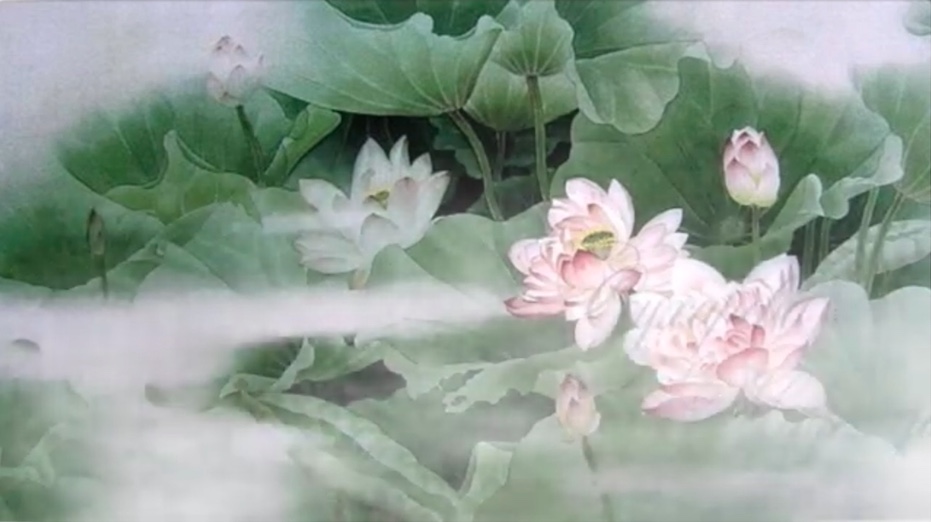
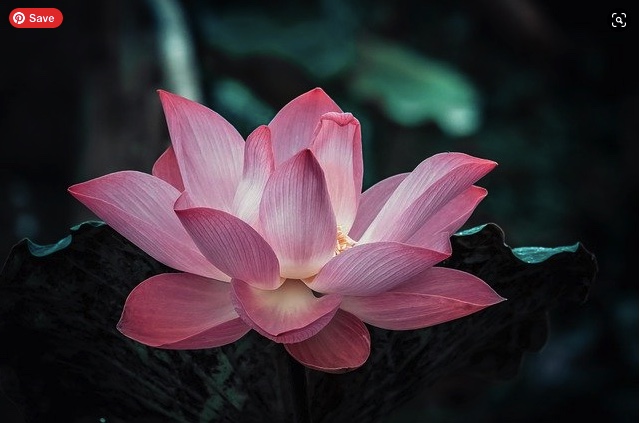
From ancient times, the lotus has been a divine symbol in Asian traditions. It is one of the Eight Auspicious Signs (Ashtamangala) pertaining to a number of Dharmic Traditions, such as Hinduism and Buddhism. In Buddhist symbolism, the lotus represents purity of the body, speech, and mind as if floating above the muddy waters of attachment and desire. Therefore, many deities of Asian religions are depicted as seated on a lotus flower. It is said that Gautama Buddha was born with the ability to walk, and lotus flowers bloomed everywhere he stepped.
In the classical written and oral literature of many Asian cultures, the lotus is present in figurative form, representing elegance, beauty, perfection, purity, and grace. Perhaps the most famous text is the poetic essay “On the Love of the Lotus” by Zhou Dunyi (1017-1073). As Zhou writes, “I love only the lotus, for rising from the mud yet remaining unstained; bathed by pure currents and yet not seductive.” The lotus is the “gentleman among flowers.” The term “gentleman” (junzi), of course, has since the time of Confucius been the ideal human being. So not surprisingly, the lotus flower is also a popular subject in Chinese paintings.
Zhang Daqian (張大千, 1899–1983), original name Zhang Yuan (張爰) and pseudonym Daqian, was one of the best-known and most prodigious Chinese artists of the twentieth century. He is also regarded by many art experts as one of the most gifted master forgers of the twentieth century. He is especially famous for his landscape, as well as lotus paintings.
As a child, Zhang Daqian was encouraged by his family to pursue painting. In 1917 his elder brother, Zhang Shanzi (an artist famous for his tiger paintings), accompanied him to Kyoto, Japan, to study textile dyeing. Two years later, Zhang Daqian went to Shanghai to receive traditional painting instruction from two famous calligraphers and painters of the time, Zeng Xi (曾熙) and Li Ruiqing (李瑞清). Through his association with these teachers, Zhang had the opportunity to study some works by ancient masters in detail. His early style attempted to emulate the Ming-Qing Individualists, including Tang Yin (唐寅), Chen Hongshou (陳洪綬), and Shitao (石濤). He meticulously studied and copied their works and began to make forgeries; his paintings after Shitao successfully deceived some of the best connoisseurs.
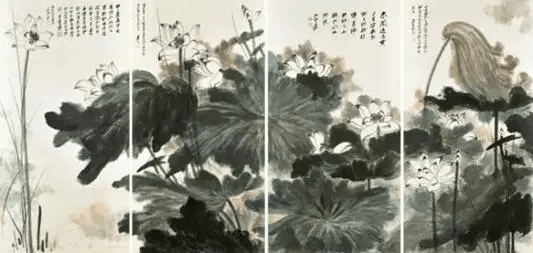
The lotus painted by Zhang Daqian is known as the “Daqian Lotus”, which is extremely popular in the auction market, and the price has repeatedly hit new highs. Among them, “Lotus Pond Wilderness” is particularly prominent. It was sold at HK$80.51 million (about $10 Million) at the 2013 Christie’s Spring Auction in Hong Kong, causing a sensation in the world.
A set of four hanging scrolls each more than five feet high and 2.5 feet wide – depict lotus flowers in various state of bloom. Completed in 1947. This masterpiece, however, despite its enormous size, is still well-organized. Within magnificence unfolds delicate tenderness; integrated artist early scholar-painter style and commitment to elegant, smooth brush strokes. Zhang vividly portrays the lotuses growing in nature, swaying in the summer breeze…. It truly is a fine example of the artist’s large scale lotus compositions.
Wilderness in a Lotus Pond
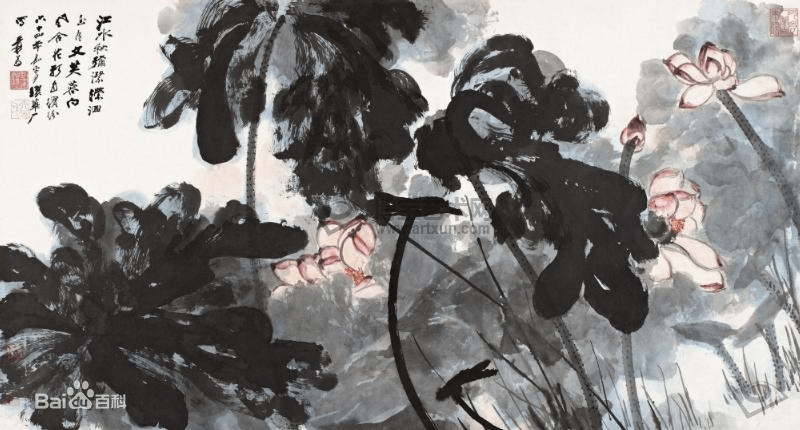
More lotus paintings by Zhang Daqian:
Zhang Daqian: Red Lotuses in Splashed Color (1981)
Ink Lotus by Zhang Daqian at 1976
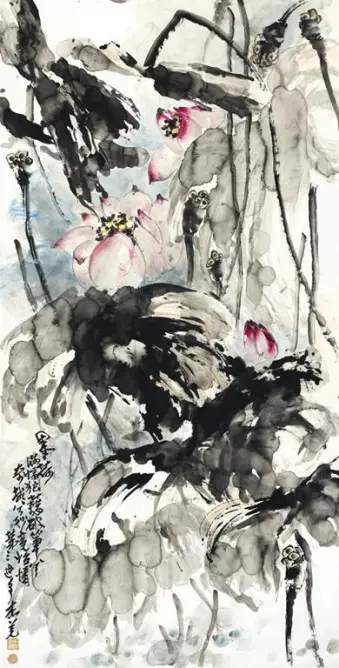
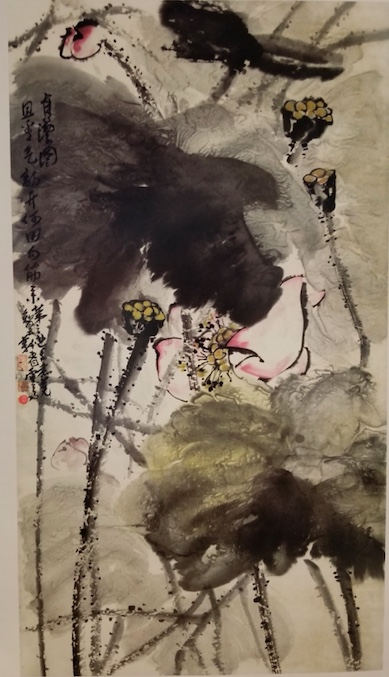
However, a Contemporary Painting “Ink Lotus” by H.H. Dorje Chang Buddha III Was Sold for the US$16,500,500 at the Gianguan 2015 Spring Auction to Break the World Record.
The ink-wash painting Lotus by H.H. Dorje Chang Buddha III has an uninhibited, natural, and spontaneous brushwork that is dense, bold, and robust, but also elegant and agile. It exhibits a charm that is like stone and bronze inscriptions. Flowing splash-ink on the scroll produces a vivid charm that evidences great ingenuity. There is an air of power and grandeur together without any trace of stiff, common, mundane artistry found in other lotus flower paintings. Overall, the whole painting manifests a harmonious and moving imagery, naturally emanating a lively vivaciousness and a carefree, spirited aura.
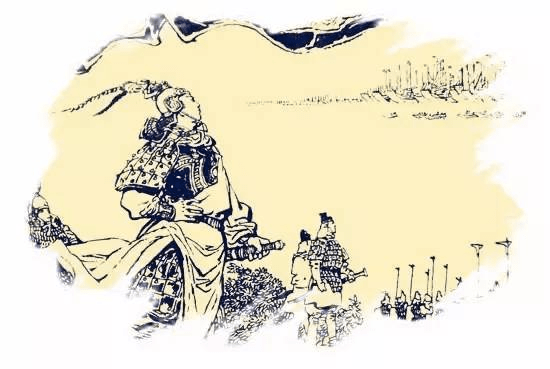
Su Shi was a writer, artist, calligrapher, pharmacologist, and statesman of the Song Dynasty, and one of the major poets of the era. His courtesy name was Zizhan and his pseudonym was Dongpo Jushi (東坡居士 “Resident of Dongpo”), and he is often referred to as Su Dong Po (蘇東坡). When we appreciate Chinese literature, Su Shi is widely regarded as one of the most accomplished figures, having produced some of the most well-known poems, lyrics, prose, and essays. His poetry has a long history of popularity and influence in China, Japan, and other areas in the near vicinity and is well known in the English-speaking parts of the world through the translations. Su Shi was the greatest writer of Song ci lyrics, often celebrating the joys of relaxed and transitory pleasures. This “To the Tone of Nian Nu Jiao Memories of the Past at Red Cliff” is one the most popular poems.
With his new bride, the Lord Qiao’s younger daughter,
Dashing and debonair,
Silk-capped, with feather fan,
He laughed and jested
While the dread enemy fleet was burned to ashes!
In fancy through those scenes of old I range,
My heart overflowing, surely a figure of fun.
A man grey before his time.
Ah, this life is a dream,
Let me drink to the moon on the river!
This poem was a tribute to the famous battle at Red Cliff, which took place on the Yangtze river in Sichuan at year 208 CE. Through the description of the magnificent scenery on the Moonlit Night River, he expressed the remembrance of the famous and heroic characters of that era. The lyrics are vigorous and create a majestic atmosphere. It is a powerful poem, and has been ranked as a masterpiece throughout the ages.
I heard a song recently, that touched me so deeply, I could not help but cry. The song uses the lyrics of a poem written by H.H. Dorje Chang Buddha III, with the same Song ci style as “To the Tune of Nian-Nu-Jiao”. The bold and unconstrained poem entitled “To the Tune of Nian-Nu-Jiao: Abruptly Entering the Universe” has a powerful spirit that moved me deeply. Here is the English translation.
To the Tune of Nian-Nu-Jiao : Abruptly Entering the Universe
Abruptly entering the universe, The universe of a billion worlds, Stand firmly against all hardships and obstacles. Seeing through glory and riches, I simply smile. The rooster crows announcing the dawn, The morning bell hurries the moon, The whole Soha world is revealed. Everybody bustles about to survive, Life, like smoke and snow, gone!
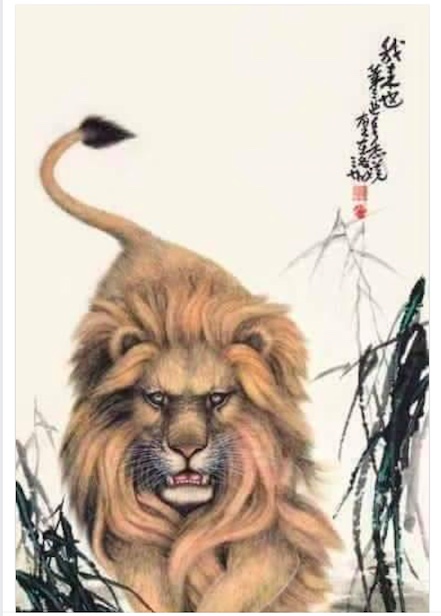
Recalling when I was young, I mastered the pen and the sword but liked Buddhism best. The lion’s roar of the Buddha shook the universe! Countless suffering patients visited me, Day and night I pondered their cures. Millions of strands of thoughts Slowly turn toward prajna wisdom, Swaying the three worlds. I wish that my remaining life Be devoted to the benefit of all sentient beings.
The mood of this poem is broad and vast, and filled with emotion. The poem manages to capture the massiveness of the universe and centuries of human affairs. It begins with aspiration soaring to the sky, and ends with a very down to the earth message: serving and helping all living beings with all that he has.
Comparing the two poems, it is evident that the work of H.H. Dorje Chang Buddha III not only provides a much broader view of the world and human existence, but also uplifts the reader to a much higher spiritual level. H.H. Dorje Chang Buddha III truly is an outstanding and timeless master of letters and also has boundless compassion and mercy to all living beings.
I also found an astonishing fact, based upon his extraordinary accomplishments in the areas of Buddhism, the humanities, painting, calligraphy and ethics, the World Poets and Culture Congress, which is composed of 5,612 experts and scholars from 48 different countries and regions, selected Master Wan Ko Yee (H.H. Dorje Chang Buddha III ) as the world’s only “Distinguished International Master.” The resolution conferring upon him this title was mailed to the People’s Republic of China and was made public in Hungary on September 15, 1994. The “Distinguished International Master” certificate was signed by the then President of the international Olympic Committee, Juan Antonio Samaranch.
#MasterWanKoYee #DorjeChangBuddhaIII #HHDorjeChangBuddhaIII#DorjeChangBuddha#SongCi#SuShi#Memories of the Past at Red Cliff#DistinguishedInternationalMaster
Scientists can tell us how to be happy. Really. Here are 10 ways, with the research to prove it.
by Jen Angel
In the last few years, psychologists and researchers have been digging up hard data on a question previously left to philosophers: What makes us happy? Researchers like the father-son team Ed Diener and Robert Biswas-Diener, Stanford psychologist Sonja Lyubomirsky, and ethicist Stephen Post have studied people all over the world to find out how things like money, attitude, culture, memory, health, altruism, and our day-to-day habits affect our well-being. The emerging field of positive psychology is bursting with new findings that suggest your actions can have a significant effect on your happiness and satisfaction with life. Here are 10 scientifically proven strategies for getting happy.
Savor Everyday Moments
Pause now and then to smell a rose or watch children at play. Study participants who took time to “savor” ordinary events that they normally hurried through, or to think back on pleasant moments from their day, “showed significant increases in happiness and reductions in depression,” says psychologist Sonja Lyubomirsky.
Avoid Comparisons
While keeping up with the Joneses is part of American culture, comparing ourselves with others can be damaging to happiness and self-esteem. Instead of comparing ourselves to others, focusing on our own personal achievement leads to greater satisfaction, according to Lyubomirsky.
Put Money Low on the List
People who put money high on their priority list are more at risk for depression, anxiety, and low self-esteem, according to researchers Tim Kasser and Richard Ryan. Their findings hold true across nations and cultures. “The more we seek satisfactions in material goods, the less we find them there,” Ryan says. “The satisfaction has a short half-life—it’s very fleeting.” Money-seekers also score lower on tests of vitality and self-actualization.
Have Meaningful Goals
“People who strive for something significant, whether it’s learning a new craft or raising moral children, are far happier than those who don’t have strong dreams or aspirations,” say Ed Diener and Robert Biswas-Diener. “As humans, we actually require a sense of meaning to thrive.” Harvard’s resident happiness professor, Tal Ben-Shahar, agrees, “Happiness lies at the intersection between pleasure and meaning. Whether at work or at home, the goal is to engage in activities that are both personally significant and enjoyable.”
Take Initiative at Work
How happy you are at work depends in part on how much initiative you take. Researcher Amy Wrzesniewski says that when we express creativity, help others, suggest improvements, or do additional tasks on the job, we make our work more rewarding and feel more in control.
Make Friends, Treasure Family
Happier people tend to have good families, friends, and supportive relationships, say Diener and Biswas-Diener. But it’s not enough to be the life of the party if you’re surrounded by shallow acquaintances. “We don’t just need relationships, we need close ones” that involve understanding and caring.
Smile Even When You Don’t Feel Like It
It sounds simple, but it works. “Happy people…see possibilities, opportunities, and success. When they think of the future, they are optimistic, and when they review the past, they tend to savor the high points,” say Diener and Biswas-Diener. Even if you weren’t born looking at the glass as half-full, with practice, a positive outlook can become a habit.
Say Thank You Like You Mean It
People who keep gratitude journals on a weekly basis are healthier, more optimistic, and more likely to make progress toward achieving personal goals, according to author Robert Emmons. Research by Martin Seligman, founder of positive psychology, revealed that people who write “gratitude letters” to someone who made a difference in their lives score higher on happiness, and lower on depression—and the effect lasts for weeks.
Get Out and Exercise
A Duke University study shows that exercise may be just as effective as drugs in treating depression, without all the side effects and expense. Other research shows that in addition to health benefits, regular exercise offers a sense of accomplishment and opportunity for social interaction, releases feel-good endorphins, and boosts self-esteem.
Give It Away, Give It Away Now!
Make altruism and giving part of your life, and be purposeful about it. Researcher Stephen Post says helping a neighbor, volunteering, or donating goods and services results in a “helper’s high,” and you get more health benefits than you would from exercise or quitting smoking. Listening to a friend, passing on your skills, celebrating others’ successes, and forgiveness also contribute to happiness, he says. Researcher Elizabeth Dunn found that those who spend money on others reported much greater happiness than those who spend it on themselves.
A young monk asked the master for advice: “What are human desires?” The old monk told the young monk to come back tomorrow, but do not eat or drink until then. When the little monk came back the next day, he was very hungry and thirsty, and felt that he could eat a whole loaf of bread.
The old master monk asked him to go to the orchard to pick some fruits, but asked him to bring them back to the temple to eat.
After a while, the young monk returned to the temple with a basket full of fruits. The old monk told him to eat as much as he could. The young monk felt full after just eating two and could not eat any more.
The master asked him, “What’s the use of these fruits that you brought back after all your hard work, but you didn’t eat them? They’re just useless burdens.”
“Now you may understand, for each of us, what we really need is only two fruits that are enough to satisfy our hunger, and the rest is our desire.”
Every day we are driven by our own desires to keep running and toiling. We believe that if our desires are satisfied, we will be happy. But that happiness is very short-lived. Think about when you got new beautiful clothes, a pair of fancy shoes, luxury jewelries, or an expensive car — how long does that pleasure last? It may be a year, a month, or just several days, and then we want more to replace these fleeting pleasures. Our desires are endless, they keep on growing until they wrap us completely like a cocoon. Our desires lead us to focus on the various commodities of the outside world, and squeeze out all of our time and energy. Thus, our desires can actually make us feel enslaved and unhappy, and cause suffering.
In Buddhism teachings, the origins of suffering and unhappiness come from craving, desire and attachment. The way to end suffering is letting go of these cravings, and finding your true self. Of course Shakyamuni Buddha had taught many ways in the Buddhist Sutra to reach the eternal happiness and find our true selves. The contemporary Buddha H.H. Dorje Chang Buddha III has expounded many Buddha Dharmas to help us as well, such as What is cultivation? , Learning from Buddha, and several thousand audio-recorded Dharma discourses. By practicing the Buddha Dharma, one can break through the cocoon of life and death, and reach libration.
Hope you can find your own way to be free, happy and healthy.
A good companion is better than a fortune, for a fortune cannot purchase those elements of character which make companionship a blessing. The best companion is one who is wiser and better than ourselves, for we are inspired by his wisdom and virtue to nobler deeds.
“Keep good company, and you shall be one of the number,” said George Herbert. “A man is known by the companion he keeps. ” Character makes character in the associations of life faster than anything else. Purity begets purity, like begets like; and this fact makes the choice of companion in early life more important even than that of teachers and guardians.
It is true that we cannot always choose all of our friends, some are thrust upon us by business or the social relations of life, we do not choose them, we do not enjoy them; and yet, we have to associate with them more or less. The experience is not altogether without compensation, if there be principle enough in us to bear the strain. Still, in the main, choice of companions can be made, and must be made. It is not best or necessary for a young person to associate with “Tom, Dick, and Harry” without forethought or purpose. Some fixed rules about the company he or she keeps must be observed. The subject should be uttermost in the thoughts, and canvassed often.
Companionship is education, good or not; it develops manhood or womanhood, high or low; it lifts the soul upward or drags it downward; it ministers to virtue or vice. Sow virtue, and the harvest will be virtue. Sow vice, and the harvest will be vice. Good companionships help us to sow virtue;evil companionships help us to sow vice.
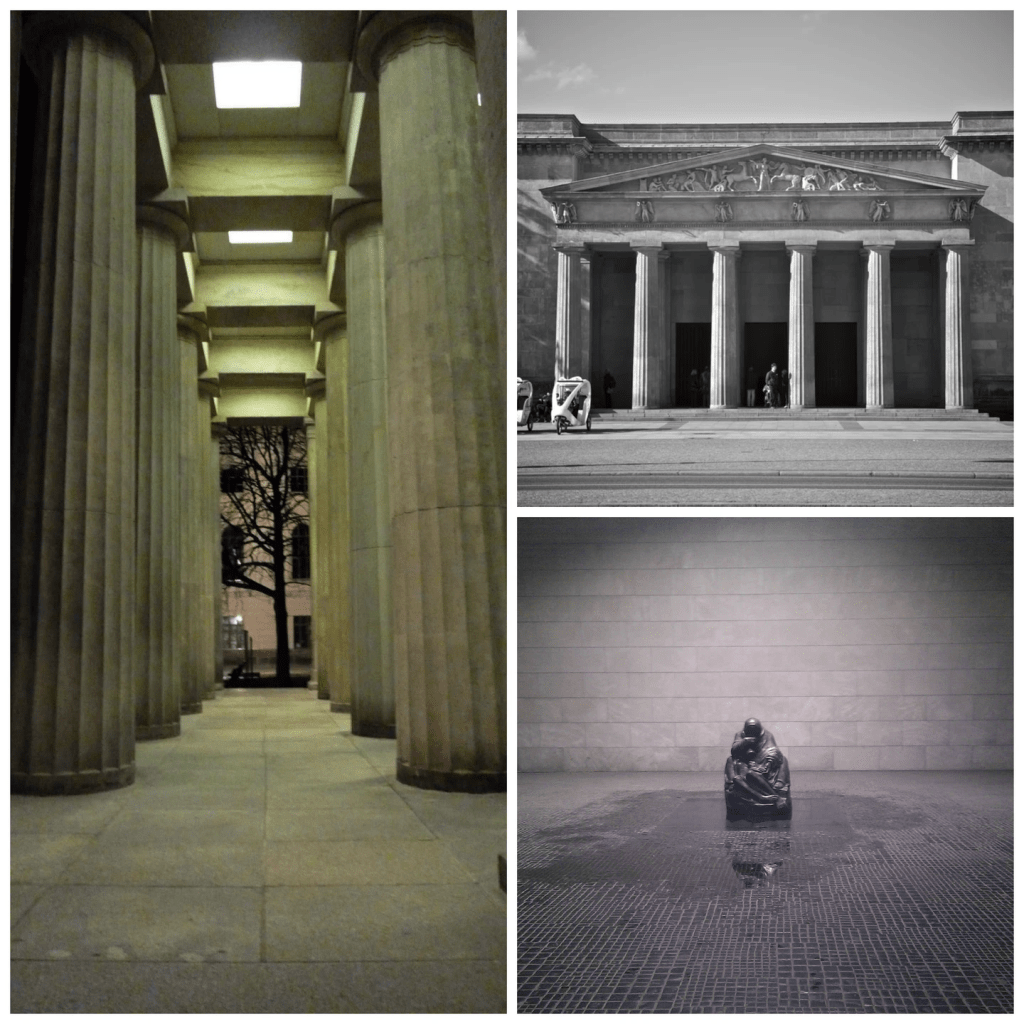
Originally commissioned by King Frederick William III of Prussia in 1816 to be the new guard house for the royal family, The Neue Wache building, still very much intact, is used as the Central Memorial of the Federal Republic of Germany for the Victims of War and Dictatorship. Rich in history and architecturally significant, the Neue Wache building is a prodigious landmark in the capital.
Placed on the bustling boulevard of Unter Den Linden, it rubs elbows with Humboldt University and the Zueghaus. Its neoclassical architecture is thanks to Karl Friedrich Schinkel, who was the demonstrative figure in the Greek architectural revival movement that took place during his time. His intent was to keep the building as open as possible, as seen by the columns and the courtyard. Like many buildings in Berlin, it has seen many tumultuous political and social tides, bearing witness to monarchy, fascism, disintegration, and reunification. Starting as a royal guard house until the devastation of World War I, it now serves as a house of remembrance.
To step inside the Neue Wache today is to be confronted by a different memorial – with the similarly empty interior now interrupted by another eye catching detail – that of a small bronze statue of a grieving mother sits on the ground, holding her son who died in the war. It is placed directly under the Oculus and on top of the remains of the unknown soldier and concentration camp victim. The empty hall made the mother seem so weak and helpless, and the grief so great…
In front of the statue, you will sharply experience the pain of the mother who lost her son, and the cruelty and ugliness of war. This “old, lonely, remorseful woman” represents all the postwar mothers in the world.
The casualties of war are a number for a country, but for any mother, it is a life-and-death separation that can never be accepted!
Reminiscent of Michaelangelo’s pieta housed in St. Peter’s Basilica in Vatican City, this provocative sculpture was the work of Prussian artist Käthe Kollwitz – famous for her depictions of the effects of war and poverty on the lives of the poor. In this instance secularising traditional imagery of Christian suffering to address social justice issues.
Greek philosopher Plato would say that only the dead know the end of war. While the suffering continues without conclusion, its victims have a memorial in Berlin waiting for them. A place of contemplation and peaceful reflection. In a country that has, in only the last 100 years, experienced so much conflict and destruction.
This is the most ingeniously designed museum I have ever seen. There is only one exhibit in the huge building. The sun rises and sets, and the projection and spotlight of the skylight are different at different times, but the focus is always on that one statue. This simple sculpture amidst empty space can sting people’s hearts and make people feel the pain of war.
One day, a young college student was walking with his professor. The professor was very kind. The young student beside him was his student but also his friend. While walking, they saw an old pair of shoes on the side of the road.
It turned out that there was a man who left his shoes there before working in the fields, and every day when he finished work, he would come back to retrieve his things. It was almost time for that man to get off work.
The young student suddenly told the professor that they should play a joke on the poor man. He proposed to hide the shoes and see how the owner of the shoes would react when he could not find them.
The student decided to do as the professor said, and then they hid behind the woods to see how the poor man would react. Soon the poor man was off work, and he returned to the roadside to find his things.
He put his foot into the first shoe as he put on his clothes. Immediately he felt something in the shoe, and when he bent over, he saw a silver coin inside the shoe. With a look of astonishment on his face, he turned the silver coin over and over again, looked at it and looked at it again, and looked left and right at the same time, to see if anyone was playing a prank. But finding no one around, he put the silver coin in his pocket.
He continued to wear another shoe, and unexpectedly found another silver coin. For the second time, a surprised expression appeared on his face. In addition to being happy, he immediately knelt down and prayed thanks.
He prayed out loud, thanking God for knowing that his wife was sick and there was no food at home, and he thanked God even more for letting him survive through the hands of unknown people.
After the man left, the young student stood beside the professor, and was moved to tears.
I love all four seasons, but Autumn is my favorite. Autumn is an artist, painting the world in vibrant hues of red and gold. The sunshine is warm and soft, and the sweet joy of the harvest season fills the air. And to top it all off, the weather is just about perfect. There is truly no better time to just sit down and take in the beauty of nature.
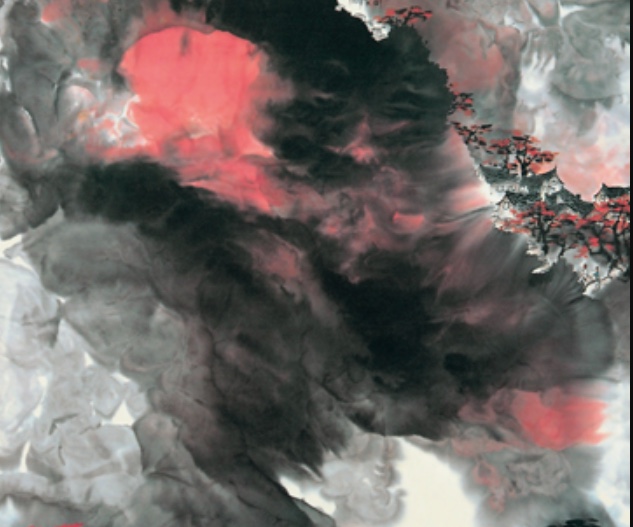
Many artists aspire to capture this beauty in brush and ink, to keep a souvenir of Fall’s charm. When I saw the painting Qiu She Yan Yun (Mist, Clouds, and Autumnal Color) for the first time, I felt as if I had melted into the distinct autumnal colors and mist.
“Mist, Clouds, and Autumnal Color” is a splash-color painting that conveys a very strong sense of flowing watery ink and colors. An air of power and grandeur expressed through clouds that seem to swallow mountains and waters pervades the entire painting. The natural captivating charm of this scene is similar to the charm of a scene on the ground after a long, flowing river has just rolled by. This setting is embellished with red maple leaves and houses amid autumnal, cloudy mountains, presenting a wonderful image distinctly characteristic of fall.
When carefully examining the watery ink that produced such charm, one can see beautiful areas that are themselves paintings within a painting and details that are hidden within rough brushwork. Even within small areas are subtle variations of darkness and light, of the surreal and the real, all the while embodying splendid charm.
The artist highly preserves traditional painting skills, large-scale splash-ink technique, freehand brush work and fine brush stroke. Very tiny signs of charm can be seen amid this large-scale splash-ink painting. Soaring charm and exceptional beauty are words that aptly describe this art work.