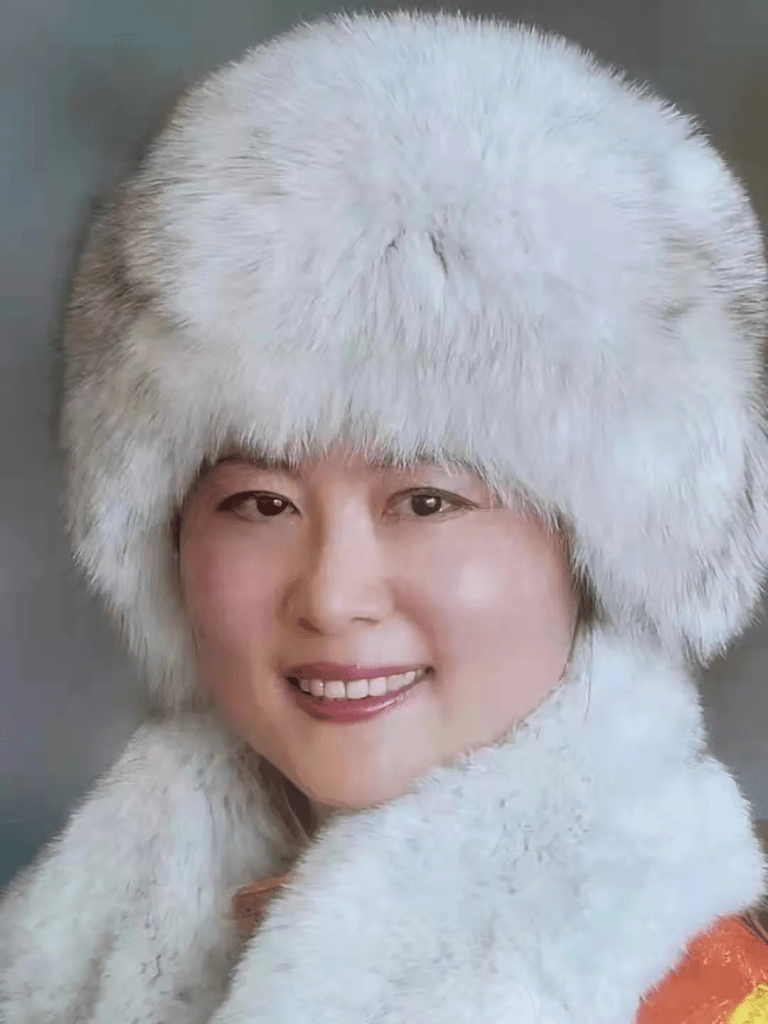
Professor Yu Hua Shouzhi Wang stands as a towering figure in the world of art, celebrated as the only artist in Asia to receive the prestigious title of International First-Class Artist. Her unparalleled achievements span an extraordinary range of artistic styles and subjects. Whether she’s creating landscapes, portraying flora and fauna, rendering animals and insects, or crafting intricate sculptures, Professor Wang’s creations are nothing short of masterpieces. Effortlessly bridging traditional Chinese painting with Western art, hyperrealism with surreal abstraction, she has achieved a level of artistic excellence that places her at the very pinnacle of her field.
One of Professor Wang’s most captivating works, Sparrows Singing on a Willow Tree, exemplifies her genius and profound connection with nature. The painting captures the graceful elegance of weeping willows, their slender branches gently drooping in an intricate, harmonious interplay. The composition exudes simplicity and refinement, with minimalistic lines that evoke the profound idea that “silence speaks louder than words.”
Despite its restrained use of color, this piece immerses the viewer in a vibrant world of subtlety and depth. The willow leaves are rendered in soft shades of pale yellow, light green, and muted ink tones, each leaf imbued with a carefree vitality. So vivid and dynamic are these details that one can almost sense the crisp freshness of the air. The leaves alone expand the painting’s spatial and emotional dimensions, drawing the viewer into an almost otherworldly tranquility. As one takes in the whole composition, it becomes evident that this work is rich in artistic flavor and showcases transcendent mastery of brushwork and ink technique.
On the right side of the painting, a lively gathering of sparrows perches on the willow branches. Each sparrow’s unique posture and expression are brought to life with remarkable precision, transforming them into endearing characters within the scene. They appear as if they are animated notes of a melody, harmonizing with the natural setting, or perhaps a group of playful children savoring their carefree moments after school. This idyllic scene evokes a serene joy and simplicity that resonates deeply with viewers.
Adding to the painting’s charm is a long inscription on the left side, written in elegant calligraphy: “Sketching in the garden at home.” This thoughtful addition not only complements the willow tree but also enhances the overall vitality of the piece. It provides insight into the painting’s creation—the place, and artist’s signature—and demonstrates Professor Wang’s extraordinary calligraphic skill. The inscription enriches the work’s narrative and aesthetic harmony, making it a testament to her multifaceted artistry.
Through this painting, it is clear that Professor Wang’s love for life and her compassionate nature are woven into every brushstroke. One can almost envision her peaceful afternoons spent in her garden, observing the interplay between the willow tree and the sparrows. The joyful spirit of the birds, carefree and unrestrained, reflects the tender care and connection Professor Wang shares with the natural world. A particularly charming detail is a small sparrow spreading its wings and gazing downward, as if greeting the artist or playfully seeking attention. The scene radiates a sense of love, harmony, and mutual understanding between the artist and her surroundings.
Sparrows Singing on a Willow Tree stands as a testament to Professor Wang’s exceptional artistry. The work is elegant and transcendent, with lifelike birds and an ethereal atmosphere that captivate the heart. From mood to color, composition to emotional resonance, the painting embodies her unique artistic style and extraordinary mastery. It is a work that not only delights the eyes but also uplifts the spirit, leaving an indelible impression on all who behold it.
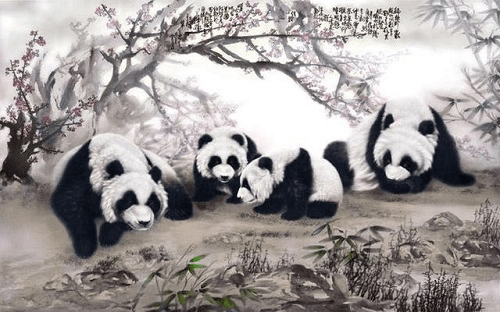
H.H. Dorje Chang Buddha III’s remarkable panda painting exemplifies a profound fusion of traditional Chinese painting and Western three-dimensional techniques, showcasing a unique mastery that elevates this artwork to an unparalleled realm. The Buddha meticulously captures the softness of the panda’s fur, detailing each hair with astonishing lifelikeness. The surrounding trees and scenery are equally vibrant, rendered with ink-splash techniques that lend a lively and enchanting quality, breathing life into the background. Every stroke in this artwork radiates a realism and elegance that words can scarcely convey.
In the foreground, delicate bamboo stalks contrast sharply with the misted backdrop, creating a powerful sense of spatial depth. This mist, drifting through the plum tree branches, draws the viewer’s gaze further into the forest, inviting them to immerse themselves in the crisp, refreshing atmosphere. With his seamless integration of artistic elements, H.H. Dorje Chang Buddha III achieves a captivating blend of classic beauty and dimensionality. The pandas, seemingly more beautiful and pristine than in life, appear freshly bathed in pure, clear waters—a vision of elegance and purity.
The painting’s harmony lies in the Buddha’s masterful approach of combining strength with gentleness, creating a scene of pandas at play, full of soft allure and charm. This balance exemplifies an artistic prowess beyond the reach of most artists. It is the interplay of surrounding elements, from mist to forest, that makes this panda masterpiece truly one of a kind.
Executed in the Kuangxi style—a hallmark of H.H. Dorje Chang Buddha III—this painting unites bold expressiveness with precision. This style combines vigorous, large-scale strokes that radiate energy with the delicate, fine brushwork of realism, resulting in an artwork that captures both elegance and raw intensity. The Buddha’s fusion of rough and refined strokes manifests as a work of art that is both dynamic and graceful, presenting a timeless visual experience that resonates deeply.
The President of the Royal Academy of Arts, Brendan Neiland (center), and the Vice President of the Royal Academy of Arts, John Wilkins (right), present the Young Artist Award to Hang Kung Yee (left)
Born in February 1988 in Chengdu, China—familiarly known as the “Land of Abundance”—Hang Kung Yee comes from a family deeply rooted in tradition and intellect. His lineage is remarkable: his great-grandfather was one of the “Four Sages” in fishing, woodcutting, farming, and studying, honored as the Sage of Learning. His grandfather, Feng Chi, was a celebrated scholar in Sichuan, renowned for his deep knowledge of classical texts and the principles of medicine and the I Ching. Carrying forward this intellectual legacy, his father, Professor YungaoYi(H.H.Dorje Chang Buddha III), is a world-renowned scholar, a grandmaster of prajna (wisdom), an acclaimed Chinese painter, and the founder of Yun sculpting. These extraordinary achievements have been recognized and certified by prestigious international organizations. His mother, Dr. Wang, Yuhua , is a distinguished professor at a top American university.
From a young age, Hang Kung Yee was immersed in an environment that cultivated both moral character and artistic appreciation. Influenced by his father’s teachings, he developed a passion for literature, calligraphy, and painting, particularly in the styles of the Song, Yuan, Ming, and Qing dynasties. He devoted himself to studying the works of great masters such as Bada Shanren, Shitao, Shen Zhou, and Nantian, as well as his father, Master Yun Gao Yi(H.H. Dorje Chang Buddha III). Despite his diligence, his early works lacked cohesion, but that changed when he sought his father’s guidance. Professor Yungao Yi(H.H. Dorje Chang Buddha III) imparted to him the profound teachings of Buddhist wisdom and prajna, unlocking a higher level of artistry within him.
Through these teachings, Hang Kung Yee’s wisdom flourished, and his artistic skill evolved rapidly. His brushwork soon embodied the refined charm of literati painting, infused with fresh, creative elements. In line with the insights of the artist Huang Binhong, who said, “Though the form may seem simple, the structure is strict; even if the form is not complete, the principle of the subject is always present,” Hang Kung’s work exemplifies precision beneath an effortless exterior.
His art reflects a unique duality: the intention is present, even when the brush has not yet touched the canvas; the spirit flows, even before the ink arrives. His strokes are casual yet deeply profound, imbued with a childlike purity and a profound sense of wonder. Modesty defines him—he never flaunts his talents, choosing instead to remain humble and continually learn. Even after moving to the United States, he kept his artistic abilities concealed, even from his peers.
Chinese Ink painting: Western Lake
Chinese Ink Painting: Deep in the Mountains
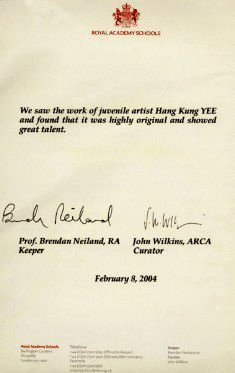
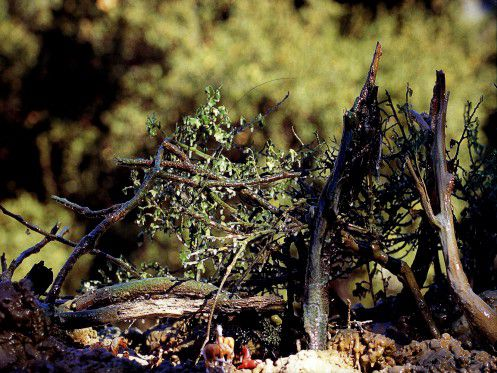
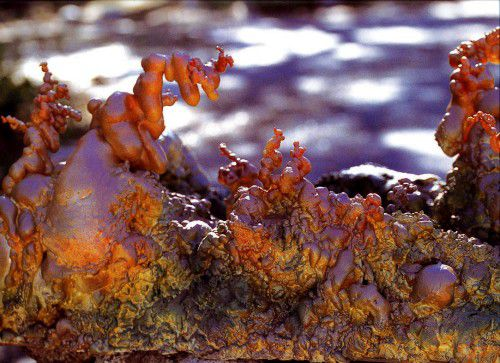
Hang Kung Yee’s true mastery shines in his landscape art and sculptures. His creations blend natural elements with refined craftsmanship, producing works that are indistinguishable from nature itself. His landscapes, though rooted in real life, transcend it, evoking a dreamlike quality as if imbued with the mystical winds of a far-off fairyland. When photographing his sculpted landscapes, one would easily mistake them for real scenery. Even the most discerning artists would struggle to differentiate between his works and actual nature captured in photographs. At the young age of fifteen, the young artist Hang Kung Yee published his first hardcover collection of landscape art. His artistic achievements were recognized by the highest authorities in the global art world, with the President and Artistic Director of the Royal Academy of Arts signing an evaluation document on February 8, 2004. The document stated, ‘The young artist Hang Kung Yee is extremely creative, showcasing exceptional talent.’ The news sent shockwaves through the international art community.
Landscape Art: The Lush Spring of Xishuangbanna
Landscape Art: “Dreamscape Melody of Lake and Sky”
Landscape Art: Mysterious Dream Lake
Mirror-like Lake
The Bond Between Humans and Animals in the Snowy Village of Banna
Rainbow Under the Morning Sun
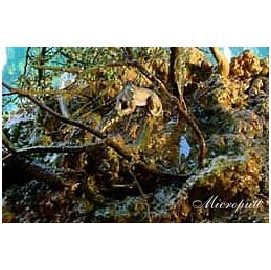
The Lion in the Swamp Forest
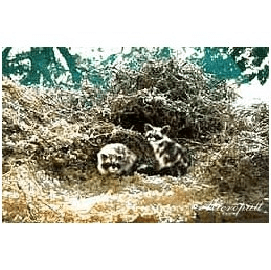
The Flower Marten in the Snow and Ice
Hang Kung Yee’s vision is to offer eternal beauty to humanity. His name, meaning “Eternity for the Public,” reflects this deep desire to share his creations with the world, hence his title “Hang Kung.” Ever humble, he downplays his expertise in art, attributing his rapid ascent into the higher realms of artistic mastery to his father’s guidance. He also speaks of his 12-year-old sister, Jinba Rinpoche, who, although not yet versed in art, will soon receive their father’s wisdom teachings, propelling her to artistic mastery in a matter of months.
For Hang Kung Yee, gratitude is central. He acknowledges the profound influence of his father, the support of fellow artists, the inspiration of nature, and the guidance of teachers and family members in shaping his artistic journey. Without these sources, he admits, he would never have reached his current artistic heights. As he continues to evolve, Hang Kung believes that art, much like his name, is boundless. “Yee” symbolizes the universal principles, while “Hang Kung” stands for “eternity for the public.” His aspiration is simple yet profound: to bring beauty, joy, and inspiration to all living beings through his art.
The winners and finalists of the 2024 IAMA International Youth Art Contest with the President of IAMA / Photo courtesy: John TrieuMore than 400 amazing artworks by young artists from 9 countries on exhibit at IAMA Grand Exhibition Hall / Photo Courtesy: John Trieu “
The International Art Museum of America (IAMA) hosted the 2024 Youth Painting Competition and Award Ceremony on Sunday, July 14th, at its Market Street location. The event celebrated the artistic achievements of young artists, awarding certificates and cash prizes. Over 400 second-round entries are exhibited from July 13th to 21st.
IAMA’s commitment to promoting youth art development was evident throughout the competition, which included submissions from over 300 youths across nine countries. Divided into three age groups (7-10, 11-14, and 15-18), the competition awarded certificates and cash prizes to the top three winners in each group, along with ten “Young Artist Awards” per group.
The competition, with its theme of “free creation,” encouraged children to express their imagination and creativity. Judges Dr. Amy Hughes, Dr. Gabriela Sotomayor, and Prof. Adam Caldwell praised the participants’ diverse techniques and styles. Dr. Hughes noted the high quality of work, akin to graduate-level creations, while Prof. Caldwell celebrated the impressive achievements of all contestants.
The award ceremony, held on July 14th at IAMA’s Garden Hall, attracted nearly 300 attendees, who were moved by the young artists’ talent and passion. The museum’s president, Mr. KC Hsieh, and other distinguished guests, including Professor Caldwell, participated in the ceremony. The day also featured a Master Class on painting by Professor Caldwell, inspiring young artists to further explore their creativity.
Chairman of Jury Committee Professor Caldwell congratulating all at the award ceremony while 300 people attended / Photo courtesy: John Trieu
IAMA Director Mr. KC Hsieh reiterated the museum’s dedication to fostering youth art development. Emily Su, third-place winner in the 15-18 age group, expressed that the award motivates her to continue pushing the boundaries of her artistic vision.
IAMA’s mission is to make art appreciation and education accessible to all, believing that “Art is for everyone.” The International Youth Art Contest exemplifies this mission, providing a platform for young artists to pursue their passion and leadership in the art world.
Located at the heart of downtown San Francisco, on 1025 Market Street near Sixth Street, the International Art Museum of America is a permanent , non-profit museum open to the public. The museum’s goal is to utilize the exhibition forum to pass on works of art that have achieved the most exquisite beauty and preciousness in the history of civilization, in order to further humanity’s moral progress, spiritual wellbeing, cultural development and world peace. It takes as its mission bringing humanity happiness and uplifting aesthetic enjoyment.
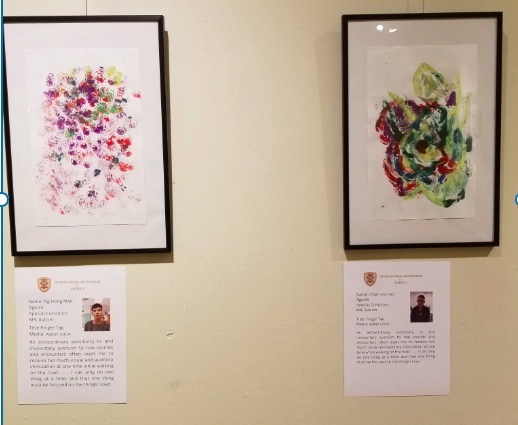
Currently, until July 21st, the museum is hosting “Art Without Boundaries,” an inspiring exhibition showcasing paintings by artists with disabilities. This event, presented by the Arts with the Disabled Association Hong Kong in partnership with The Neighborhood Advice-Action Council, provides a platform for these talented artists to exhibit their work in an international museum. This charitable initiative aims to support artists with disabilities, aligning with IAMA’s mission to actively promote public charitable art activities.
Dechen Shak-Dagsay is a Swiss-Tibetan musician and author. Over the past few decades, she has built a career in music by combining the Tibetan mantra transmissions passed down by her father, Ven. Dagsay Rinpoche, with innovative melodies and contemporary instrumental productions. She has also engaged in collaborative projects with other spirituality-inspired musicians. Having lived in Switzerland for most of her life, Dechen is one of the most prominent contemporary Tibetan singers in Europe today, and has also become globally recognized through various music awards, and for having performed songs from her albums Jewel and Day Tomorrow at Carnegie Hall in New York. Dechen is also the founder of the Dewa Che charity organization, which engages in social projects in Tibet.
Dechen’s newest album, emaho – The Story of Arya Tara, released in October 2021, is about the enlightened activity of the Vajrayana goddess Tara and contains a musical rendition of the “21 Praises of Tara.” BDG recently had a chance to speak with Dechen about her latest project.
BDG: You’ve sung about Tara on various albums before, but this new album is devoted specifically to her story. What do you find inspiring about this female buddha?
Dechen Shak-Dagsay: I have had a wish for many years now to share the extraordinary story of Goddess Arya Tara, the gentle-yet-indomitable princess who became a female buddha. The mythic story goes back many eons in ancient India, where she was called Princess Jhana-Chandra, which means Wisdom-Moon. In Tibetan, her name is Yischi Dawa, and it touches me profoundly that, out of a deep sense of compassion, she would not even eat breakfast before she had liberated hundreds of thousands of beings from samsara each day. She was a faithful disciple of her teacher Buddha Dundubhisvara, and her entire community admired her.
One day, the monks urged her to make an aspiration (vyakarana) to be reborn as a man in her next life in order to attain full enlightenment. The princess laughed at this sexist exhortation and replied: “There is no male, there is no female. To discriminate between male and female is the mind of a small being. There are neither men nor women, nor a self, nor beings.” She vowed to return again and again in a female form in order to help all beings from suffering and to reach enlightenment in female form. Therefore, her teacher, Dundubhisvara, gave her the name Tara, which means “Swift Liberator.”
Tara’s story reminds us every day that we are all equally beautiful beings blessed with great inner qualities, such as love, compassion, kindness, and clarity. These qualities are just waiting to be rediscovered and nurtured.
BDG: Your album emaho captures a profound thought: “What an amazing, wondrous moment when the mind awakens.” How does the music create a mood and ambience in which the listener can realize this moment for themselves?
DSD:Emaho is indeed not an ordinary word. It is found in ancient Tibetan spiritual texts and is an exclamation of joy and amazement when the obscured mind awakens and experiences the pure, clear, and bright shining light of the true nature of our mind.
Personally, I find that each of the eight pieces hold beautiful emaho moments for the listeners. As with all my previous albums, I received the texts for this exalted goddess from my dear father, Ven. Dagsay Rinpoche. It is a great blessing that Rinpoche gave me the transmissions for these beautiful “21 Praises of Tara,” which are practiced in all Tibetan traditions. I also had the privilege of working with Swiss producer Helge van Dyk, who also composed and produced the music of my two previous albums, Jewel and Day Tomorrow.
I said to Helge that I wished to represent the four enlightening activities of Tara in four musical pieces. I cannot thank Helge enough for creating the most sublime music to present the four skillful enlightening activities of Tara: the pacifying, enriching, magnetizing, and wrathful aspects.
When you listen to emaho – The Story of Arya Tara, my hope is that you will enter the wonderful, unique space and landscape of Tara’s buddha-field, and perceive her different fields of activities through the following musical compositions.
“emaho – an Amazing One” – “The Wisdom of Tara” – Tara’s magnetizing activities. Audio courtesy of VANDYKMUSIC
“emaho – an Amazing One” – Tara’s enriching activities. Audio courtesy of VANDYKMUSIC
“emaho – an Amazing One” – “Magic Pulse” (of Prayer Drumming) – Tara’s wrathful activities. Audio courtesy of VANDYKMUSIC
BDG: How do you think the spirit of emaho can help heal our fractured and hurting world, which is now immersed in COVID-19 and a range of other immense crises?
DSD: We generally believe in the great healing power of the Buddha’s teachings, especially when the world is going through a difficult time. We are still in a worldwide pandemic, and we constantly face threats of natural calamities and other crises.
The whole world has faced unprecedented challenges over the last two years, and we are still trying to find solutions for how to handle them. From a worldly point of view, these problems are simply devastating and are creating immense suffering for everyone. But from a Buddhist view, such challenges are exactly what we call “precious moments” for our minds to awaken and to encourage a total reset in our interior world and inner being. We call these moments precious because they allow us to open our hearts to the Buddha’s teachings, such as the Three Marks of Existence. Recalling them always has an instant healing effect on me:
• Impermanence (Skt: anitya): Nothing stays the same, everything is constantly changing.
• Whatever we experience is marked with some kind of suffering. As long as we identify ourselves with a sense of solid self, we will always suffer (dukkha).
• Everything around us and even our own person is empty of a self (anatman).
Dechen Shak-Dagsay. Image courtesy of VANDYKMUSIC
Together with Helge and other musicians, we created emaho in the hope that it will be a small contribution to helping us all through these troubled times together.
We hope to be able to bring calm and peace into people’s hearts. We will not be able to get rid of COVID-19, or the economic, social, and political fallout it has caused, but the music that carries the blessings of Arya Tara, the Swift Liberator, will help us all to overcome our fears, sadness, frustration, and pain to create some space in our hearts and to rebalance our minds. It is within this calm space that we will be able to tap into our innate beauty and strength. We all need this to transform our pain and negative thoughts, and to calmly face and embrace the difficult times ahead of us; to fully become aware of our own inner qualities.
The release of the new double album was followed by the release of my new book, Mantras, Musik & Magic Moments, in December 2021, in which I write about the healing aspects of the old Tibetan mantras, and why I chose music as a tool to reach people’s hearts. I also talk about how Tibetan healing symbols have carried sacred power for centuries. I began making mantra music about two decades ago, and I hope followers will enjoy this new perspective I am offering through my work.
BDG: Your music has been received very well worldwide and your profile has also been rising in Asia. Do you present your music as non-denominational and embracing of all Buddhist traditions, even while it expresses your Tibetan heritage?
DSD: Although I am very rooted in Tibetan or Vajrayana Buddhism, I embrace all Buddhist traditions. My dear father Dagsay Rinpoche, who lives in Chengdu, always reminded us that the essence of the Buddha’s teachings is non-violence and cultivating love and compassion for all beings. All Buddhist traditions, including the Tibetan heritage, are following this beautiful path. It is my wish to one day come to Asia to meet all my Asian friends and to perform my music in Asia together with the Jewel Ensemble.
In my third piece on disc two, called “Peace of Mind,” I sing a “Praise to the 21 Taras” in Chinese and in Tibetan. It is my deep wish to create a wonderful space of peace, respect, and reconciliation.
BDG: You’ve come together with various artists to create a fusion of music. These artists also tend to have a spiritual flavor to their work. How do you decide to work with an artist? How do you identify a potential collaboration?
DSD: Thank you for sensing what I see as a very special energy to our music. I am very thankful to Helge, who has a distinct talent in finding the right artists for a special collaboration that requires not only technical musical skills, but also an open heart that is fully inspired to play soulful music with us. He has carefully selected outstanding musicians to form the Jewel Ensemble, with whom we have played many concerts all around the world. I feel very privileged to have the following members of the Jewel Ensemble, as well as an extended ensemble that we shared the stage with when playing the Call for Peace concerts with the renowned Zurich Chamber Orchestra (ZKO).
I would like to take this opportunity to thank my Jewel Ensemble musicians and guest musicians from around the world for their beautiful contributions on emaho. It has been such an honor to work with all these outstanding artists, who committed their heartful work to this album.* I would like to thank BDG for opening the door to the story of Arya Tara. I would be very happy if this music finds its way across Asia, and I would like to thank all my musicians, my producer Helge, and my dear father Dagsay Rinpoche for letting me create such precious music. I hope it will help to remind people all around the world of their own inner strength and beauty.
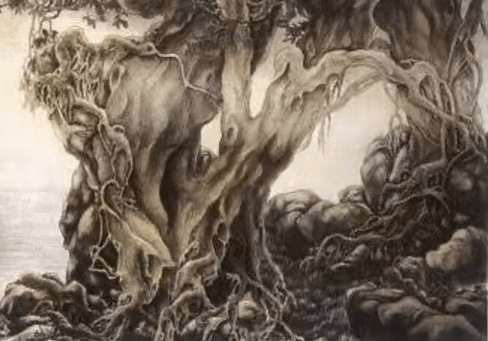
“Scene of Xishuang Banna Life” is a Chinese ink-and-wash painting with a three-dimensional quality reminiscent of oil paintings, created by the renowned artist H.H. Dorje Chang Buddha III. The moment I laid eyes on it, I felt a profound sense of comfort and tranquility. The painting’s primary hue is light brown, and the varying depths of this color vividly depict the fresh, clear water and misty air weaving between the trees. A few girls are making waves, chatting, and enjoying themselves as they wash clothes by the riverside. The elegant and beautiful banyan trees stand majestically, with cobblestones naturally scattered around them.
The old banyan tree, with its peeling bark and exposed roots, stands as a silent testament to the passage of time. The raised roots extend in all directions, seemingly spreading the pulse of life to distant places, using their vitality to nurture the earth and rivers. The roots nestle against the smooth, round pebbles like inseparable companions. Over time, they have become so intertwined that no one notices whether they are roots or stones, much like an elderly couple who depend on each other and cannot be separated.
Around the tree roots, a misty white space, activated by detailed depictions, brings boundless imagination to people. In the white mist, there is a vast expanse of water, with soft sunlight illuminating the surrounding forest. The endless lakes and rivers nourish the sturdy old roots, supporting them through countless hardships and weathering the elements, ultimately creating a world of their own. The intertwined and winding roots, twisting and coiling across the scene, form the main structure of the composition along with the variously shaped stones, the sculptural massive trunk, and the other responding trees. The sparse leaves hanging from the old tree are adorned in light green, contrasting with the large brown trunk, evoking the philosophical sentiment of “the true essence remains after all embellishments fade, gold emerges after being sifted by great waves.”
Beneath the tree are three graceful women in different postures, enjoying the flowing stream under the water-colored sky. Some are combing their freshly washed hair, some are holding a delicate veil, and some are drawing clear water from the stream.
The banyan tree, the stream, and the sunlight, along with the beautiful women in traditional attire, compose a symphony of southern charm, making one feel as if they can hear the whispers of the gentle breeze: “My enchanting homeland is where my heart belongs…” The setting resembles the sweet childhood memories buried in my heart.
About fifty years ago, my family lived in a small village in the mountains. There were no cars, TVs, toys, phones, or any other modern luxuries. We lived a very simple and modest life. All the mothers washed vegetables and rice in the clean creek and cooked meals. Very often, they washed clothes in the river for the whole family while the kids played in the water, on the trees, or along the riverbanks. School was far away, and we could only go there when we were old enough. But we had the biggest classroom—nature itself. We studied everything we could find: trees, flowers, insects, stones, etc. Twigs were our pens, and tree trunks were our tables. The chirping of the birds and the rushing of the stream were our music. We had physical education class all day long. We went to bed when the sun set. What a simple, happy life!
This is the beautiful and pure spiritual space created by the great artist, H.H. Dorje Chang Buddha III. This painting, “Scene of Xishuang Banna Life,” opens a window to another dimension, allowing people to experience the joy of living in a paradise. People in cities increasingly yearn for natural landscapes akin to an earthly utopia. Fortunately, noble artists create pure lands for people’s hearts, showing us wonderful scenery, evoking warm emotions, and deeply touching us.
The pure land in our hearts is like a secluded utopia, free from the noise and disturbances of the mundane world. It carries the dreams of people. When darkness descends, the pure land within can emit a serene fragrance, helping people discard the suffering brought by worries, gently wipe away the dust, and infuse a bit of brightness.
The paintings of H.H. Dorje Chang Buddha III are like wordless songs, containing endless stories, ancient calls, and boundless compassion for all sentient beings.
Landscape painting is a direct cultural expression of Chinese philosophy. Throughout history, eminent painters such as Dong Yuan, Ju Ran, Zong Bing, Guo Xi, Huang Gongwang, Shi Tao, and Bada Shanren have all used landscape painting to express their extraordinary spiritual realms. Unlike the representational approach of Western painting, landscape painters observe the myriad phenomena of heaven and earth, contemplate the vastness of the universe, and use their hearts to transform their inner landscapes into brushstrokes, imbuing their works with the majestic spirit of nature. Beneath the bold and uninhibited brushstrokes lies the creation of inner beauty, revealing a unified spiritual realm through the language of painting.
The quality of ink and brushwork is paramount in judging the merit of a Chinese painting. Indeed, without mastery of ink and brush, there would be no Chinese painting. The importance of ink and brush in Chinese painting is akin to that of cells in life. From mountains and rivers to figures and forests, all are realized through the use of ink and brush. The concept of bone structure and brush technique refers to the artist’s outlining, texturing, and dotting within the painting.
H.H.Dorje Chang Buddha III landscape paintings in Fanjuan Style exhibit a natural and vigorous brushwork, with bold and powerful strokes. The ink’s varying degrees of wetness and dryness create distinct layers and a lively rhythm in the composition. The rich and vivid atmosphere in the paintings brings joy and resonance to viewers, touching their hearts deeply. The exceptional quality of ink and brushwork in these paintings is truly breathtaking.
Here, let us appreciate some of His Holiness’s landscape paintings in the Fanjuan style, a style created by His Holiness himself.
The “Fanjuan” Style Numerous brush strokes exude an air of scholarly refinement. Despite the complexity of the strokes, there is no sense of disorder; instead, they reflect artistic talent rooted in profound and extensive knowledge.
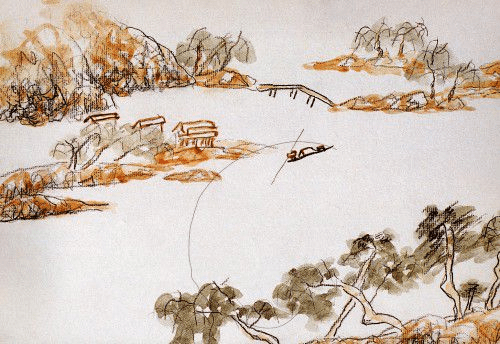
“Ferrying the Xia River” is an ink-and-wash painting created in 1993 by H.H.Dorje Chang Buddha III. While predominantly utilizing black ink, the brush strokes encapsulate the essence of both painting and calligraphy. Despite the monochromatic palette, the sense of depth and proximity is distinctly rendered. Renowned artist Mr. Huang Binhong once remarked, “Black ink pervades like the vastness of heaven and earth. A single sheet of painting paper can unfurl myriad mountains.” Crafted seemingly effortlessly within a few days, this masterpiece is the culmination of nearly a century of brushwork mastery.
The painting boasts a richly layered appearance, its thick black ink imbued with elegance, resulting in a masterfully conceived and captivating image. Amid this tranquil setting, sounds reverberate from thatched mountain cottages to boats on the water and back again.
In the artwork, a distant view unveils a series of lead-gray mountains, nestled against a lively stream at their base. Rocks, trees, and vegetation seamlessly merge with the mountain range, their tones resembling the clarity of a mountain stream’s deep pool. Though mysterious and profound, the depths of the pool are subtly visible.
The rustic palette, layered landscapes, and deep ink colors infuse the scene with a primordial ambiance. It feels like dawn, with small boats beginning to glide along the cold stream at the mountain’s foot. The entire composition radiates a misty spring ambiance, with the moist spring tide enveloping the scene. At the painting’s base, diminutive figures become the most captivating element. Despite their scale and near indiscernibility, their silhouettes vividly convey distinct personalities and ages, infusing the composition with a human touch. These lively figures serve as the painting’s eyes, enriching the work with a profound aesthetic sensibility. Truly exceptional artists possess a pure and sacred artistic vision.
Clouds, Mountains, and Water Seem To Sing a Song of Autumn
“Clouds, Mountains, and Water Seem To Sing a Song of Autumn” is a landscape painting featuring misty mountain ranges, clear rivers, rushing waterfalls, icy mountain springs, simple farmhouses, scenes of honest fishermen fishing, and humble farmers gathering firewood on the mountainside. Through this artwork, H.H.Dorje Chang Buddha III vividly captures the raw beauty of nature and the diverse lives of the people. It is a rare masterpiece of landscape painting, grand and expansive, with a profound connection to the pulse of life. The bold brushstrokes create a rich and fresh atmosphere, with a lush ink texture. Within the valleys lie a few buildings, nestled among red autumn maples, promising tranquility and serenity. The distant mountains, shrouded in mist and haze, inspire boundless imagination and contemplation.
“Ancient Village at Remote Mountain Spring” is a small-scale painting created by H.H. Dorje Chang Buddha III in last decade. An artist who saw that painting said, “Although ‘Ancient Village at Remote Mountain Spring’ is as small as only one-fourth of the size of the palm of a hand, one can see curling mist, mountains, and cliffs. It truly is a magnificent landscape scene that expresses a lofty and broad artistic conception. The energy of the cloudy mountains is palpable. Such a tiny painting seems to contain thousands of mountains. It is not merely an ink-wash painting. Rather, it is a vivid landscape scene that is brimming with vitality!”
Artworks are meant to construct a sanctuary for the readers’ souls, allowing their minds to be cleansed, purified, and elevated. Regardless of the style of art, it should convey positive energy and the enjoyment of beauty. Dr. Yuhua Shouzhi Wang deepens the concept of surreal abstract art by integrating it with both form and spirit, striving for simplicity by eliminating complex colors and intricate brushstrokes to achieve a harmonious fusion of form and spirit, making it comfortable and soothing for people to look at. Such works, with simple yet spiritually profound strokes, can be referred to as “masterpieces”. What poetry and painting seek is not the objective depiction of the external world’s reality but rather the grasp of a certain quality that moves the heart, embodying the author’s spiritual perspective and genuine emotions.
Dr. Yuhua Shouzhi Wang’s paintings are characterized by divine, out-of-this-world artistic conception. They carry the likeness of both form and spirit, created with profound skills and a strong sense of scholarly essence. Her artistic skill is solid and formidable, transcending the mundane to attain the class of ease, the highest of the four classes of artistic mastery. Following the tradition of Chinese ink paintings as her foundation, Dr. Wang incorporates super-realistic skills, elevating her works to a distinguished style and purity rarely seen elsewhere.
In ink painting, the highest state of accomplishment is the Class of Ease, where the artist attains natural ease by using simple brushstrokes to fully capture the form. With the most succinct brushwork and the most superb technique, the artist depicts objective reality and attains a state of miraculousness where both form and spirit are fully captured. This kind of art leaves viewers never tired of appreciating, leaving a wonderful aftertaste that lingers long after the viewing experience.
High Perch and Herding Cattle stand out as masterpieces belonging to the genre of Ease.
The High Perch
Upon seeing this artwork, my heart was melted by its fresh and clear painting realm. The delightful chirping of birds seems to faintly echo in my ears. A pair of adorable little birds, as if just arrived from beyond the sky to the earthly realm, one of them gazing down at the land beneath its feet while the other curiously observing the distance. This traditional Chinese painting is extremely concise in brushwork, with a simple and distant meaning, yet it possesses an enchanting artistic appeal. With just a few strokes of light ink, the vivid and lively texture of the birds is vividly presented before the viewers, instantly taking me back to my distant childhood. The moist ink and exquisite lines everywhere convey the painter’s sincere brushwork and extraordinary true temperament. At the same time, it reflects the painter’s extraordinary and unsullied noble character, free from worldly attachments.
Herding cattle
This painting of herding cattle adopts a bold and expressive brushstroke style, prioritizing capturing the spirit over exact likeness. The depiction of the water buffalo involves bold and vigorous brushwork, conveying the robustness and fierceness of the animal. The herder on the back of the buffalo is sketched with simple strokes, portraying the carefree innocence of the shepherd. To prevent the composition from being monotonous, light green strokes are lightly applied to depict willow branches as the background, creating a sense of vitality, tranquility, and beauty. In the lower right corner of the painting, a calligraphy inscription with a strong classical flavor reveals the artist’s genuine and unadorned character.
The excellence of Dr. Yuhua Shouzhi Wang’s art does not lie in how the artist represents the form of nature, but in how she uses the form to express her mind, and how she brings out the spirit within the form. Her paintings express humanity’s wishes for peace and happiness; they express humanity’s praise to the qualities of freshness, transcendence, nobility and elegance; and they also express humanity’s gratitude to the selfless beneficence of flowers, trees and plants. These ink paintings are leading me into the refreshing and beautiful nature, allowing my restless soul to rest peacefully.
At the International Art Museum of America in downtown San Francisco, there is a special exhibition room, dedicated to Professor Yuhua Shouzhi Wang. This installation was established in 2018, containing a variety of water and ink paintings as wells as sketches.
Painting is the artist’s pursuit of passion, and the artist’s spiritual realm and artistic insight determine the quality of the work. H.H. Dorje Chang Buddha III once said, “Every artist must tread the path of learning from the past while innovating for the future. Learning from the past embodies tradition, while innovation demands the fusion of Eastern and Western art, philosophy, aesthetics, and literature into a unified whole. This entails grasping the true essence, understanding the inner and outer spirit of the subject, navigating the transitions between the internal and external, the virtual and the real, and infusing rhythm into one’s creations. The result is a work that flows freely, exudes power, and embodies both familiarity and uniqueness. It conceals craftsmanship while remaining wild yet disciplined, possessing a distinct personality and charm. Upon reaching this stage, one can embark on the pursuit of egolessness and the true essence of emptiness and colorlessness. This journey leads to a profound, rich, elevated, and vibrant artistic realm that offers people the joy of beauty. With such mastery, Chinese painting can take a significant leap forward and ultimately stand as a world-class masterpiece.”
Let’s appreciate two masterpieces painted by H.H. Dorje Chang Buddha III and gain deep insights into innovation rooted in tradition.
Ancient Style Emergence
The landscape painting “Ancient Style Emergence” captivates viewers at first sight with its unique style and transcendent meaning. The simple and unadorned lines depict rugged cliffs, hills, forests, and cottages. Layers of ink washes render the rocks thick and the mountain mists hazy. The clustering mountains and overlapping peaks evoke the ancient charm of Yuan dynasty landscape paintings while also embodying a contemporary innocence. Beneath the moistened ink, clouds flicker and smoke swirls. The tree crowns, mountain shadows, and distant peaks are rendered in a nearly pale ink-like gray-green hue, creating a rich and deep landscape. The sunlit sides of the hills and rocks are lightly tinted with a bright ochre, resembling vermillion, which contrasts vividly with the large areas of gray-green, lending the painting a magnificent and ancient beauty.
The pristine and dust-free atmosphere depicted in the painting stands in stark contrast to the noisy scenes of the mundane world, perhaps serving as a reminder for viewers to awaken to the beauty of life.
The brushstrokes in the painting are highly calligraphic, lively, and modern, diverging significantly from traditional landscape depictions. It represents a landscape of the heart, created purely through brush and ink.
While lacking the specific forms of traditional paintings that one can wander and inhabit, it possesses a more authentic and dynamic charm of modern art, particularly evident in its abstract qualities, which resonate deeply with contemporary audiences.
This landscape painting is created by H.H. Dorje Chang Buddha III, characterized by its straightforward and lively brushwork, as well as its modern sensibility.
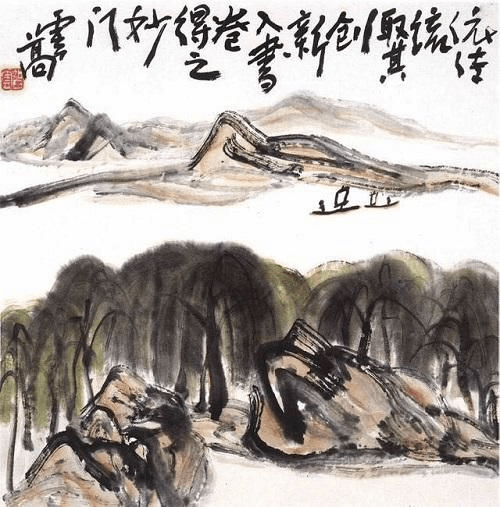
Setting Sail to the East
“Setting Sail to the East,” this painting employs thirsty brush and light ink, with free and bold strokes, abandoning the meticulousness of carving. Horizontal and vertical brushstrokes appear to be dragging mud and water, yet they possess the strength to carry a heavy weight. The brushwork is seasoned and heavy, yet balanced between reality and illusion.
In the foreground, there is a poetic dense willow forest, where two stubborn rocks seem to be “nodding” to each other, engaged in intimate conversation, perhaps narrating the endless past and future of the mundane world. In the middle ground, there are two simple small boats, leisurely passing through the river, seemingly minimalist yet imbuing the scene with a rich humanistic atmosphere. In the distance, distant mountains are depicted with dry brush and thirsty ink, subtly rendered with a watery light ochre, evoking the elegant beauty of classical Chinese paintings, reminiscent of the dry autumn wind and the moist spring rain, yet with a strong modern painting atmosphere.
This is a masterpiece of landscape painting with profound underlying themes and innovative imagery. Its lofty style, deep meaning, grand momentum, and charming spirit all stem from H.H. Dorje Chang Buddha III’s profound philosophical thoughts and masterful brushwork. The inscription on the painting reads: “Drawing on tradition for innovation, entering the wonderful realm of the written scroll.” The brushwork is arranged in a skillful and coherent manner, serving as the backbone of the painting and the soul of the entire composition.
The term “vivid charm” embodies the artistic realm of the calligrapher and painter. H.H. Dorje Chang Buddha III‘s landscape painting art transcends the ordinary and mundane, achieving a level of artistry that is beyond compare, with a spiritual realm that has become a benchmark in contemporary painting art.
H.H. Dorje Chang Buddha III ‘s traditional Chinese painting, “Old Tree,” stands as a masterpiece adorned with vibrant red plum blossoms. The depiction of a weathered old plum tree in a sea of ink unfolds a narrative of transformations—dense, light, dry, wet—unveiling the radiant beauty of its once youthful charm. The myriad red plum blossoms, seemingly engaged in a dance, cluster and clamor upon the branches, invoking an immediate sense of lively springtime. This painting is a testament to the profound artistic prowess encapsulated in H.H. Dorje Chang Buddha III ‘s work.
Embedded within the Chinese cultural tradition is the notion of the common origin of calligraphy and painting. H.H. Dorje Chang Buddha III seamlessly incorporates calligraphic brushstrokes into painting, preserving the interconnected signs of brush and ink on the canvas. This approach transforms the expressive painting into a visual symphony, akin to calligraphy music. The technique of “flying white” in calligraphy, where white spaces delicately appear amidst smooth brushstrokes, takes on a purposeful role in painting. Originating as an imprint left by the speed of the brush, “flying white” becomes a unique brush and ink technique through profound aesthetic reflections.
“Flying white” becomes a vivid recorder of authentic emotions during the writing process. The brush swiftly glides over the paper, conveying passion and resonating with the engraving sensation found in seal carving. The depiction of the main trunk of the old plum tree in “Old Tree” superbly utilizes this technique. The contrast between subdued flying white and rich ink creates a musical and vivid rhythm of black, white, and gray within the composition.
The essence of a good painting lies in its “subtlety,” an intricate quality that goes beyond precision or meticulousness. For H.H. Dorje Chang Buddha III , the process of painting is akin to flowing clouds and water—an expression of natural improvisation and delicate arrangement. As the ancients wisely said, “Add a little to Pan An’s beauty, and it becomes more; subtract a little, and it becomes less.” The subtle artistry in “Old Tree” showcases the artist’s profound insight into the delicate nuances of expression.
The quality of a work is deeply intertwined with the artist’s inherent cultivation, reaching a high realm based on the principle of “selflessness.” This term, often misunderstood, refers to losing oneself entirely in the painting process—where both mind and hand are forgotten. Artworks created in this state possess a power that transcends philosophical texts, offering a simple and clear depiction of inherent reality.
In real life, each person has unique perceptions and emotions, yet lacking rationality makes it challenging to transform these into creativity. True masters of art, exemplified by H.H. Dorje Chang Buddha III , possess not only a sublime inner world and rationality but also the ability to keenly grasp fleeting sensations and transform them into robust vitality. Their ability to endure solitude, maintain genuine nobility, and leave traces of distinctive qualities results in the creation of genuinely original works of art. The great art masters, with a spiritual realm surpassing ordinary individuals, exhibit an otherworldly and extraordinary noble quality that defines their artistic genius. In “Old Tree,” we witness not just a painting but a symphony of artistry, capturing the essence of H.H. Dorje Chang Buddha III ‘s profound mastery.














 Peace LiLy