During recent years, we at the World Buddhism Association Headquarters have been continuously receiving inquiries regarding upright masters and evil masters, asking for replies in this regard. However, WBAH has given replies to such questions many times publicly through announcements. Furthermore, H.H. Dorje Chang Buddha III also clearly explained many times the distinctions between what is upright and what is evil and between what is true and what is false. Yet, many of you still act blindly and without a direction in the matter of recognizing and distinguishing whether a master is upright or evil and are unable to decide on whether to continue following your current master or to find and choose another excellent master. Simply speaking, if you do not make recognition according to the announcements and are satisfied with devolving, even all Buddhas in the ten directions are unable to save you!
Now, WBAH provides you with three demon-detecting mirrors, which can enable you to easily see the original forms of such evil persons, regardless of whether they are masters or disciples.
The First Demon-Detecting Mirror: An absolute criterion is to see whether a master makes a big effort to facilitate the disciples to study and broadly propagate the announcements, such as the “Important Replies from Holy Virtuous Ones and Eminent Monastics” from WBAH (the 35 questions with the answers), or not. Any master who does not take measure to enable the disciples to study the announcement well and, rather, only makes propaganda about his/her own articles, writings, books, or other types of undertaking that not only do not refer to the specifics of the announcements but also violate the stipulations in the announcements is definitely an evil master!!!
The Second Demon-Detecting Mirror: Regardless of what status or title the person you follow as your master has, as long as this master’s level obtained from the holy test is not a level within the ranks of holy virtuous persons and yet this master poses as a holy person or instructs the disciples to falsely brag or praise him/her as a holy person, this master is not a holy person. Since such a master imposes rules on the disciples to prevent them from doubting the master and to force them to correspond their three karmas to the master, this is absolutely an ordinary person and is a charlatan!!!
The Third Demon-Detecting Mirror: This is about how to recognize and distinguish holy persons. Holy persons of ancient times have long been known through historical records. Regarding holy persons of the current time, only those who attained the Gold Button levels from taking the written test and the holy exam are holy ones!!! On the other hand, those who did not attain a Gold Button level after taking the examination are not holy ones!!! Anyone who scored a high level of blue buttons can only be an eminent monastic or a great virtuous one.
All those who oppose or persecute holy persons will be included in a name list of malicious persons and will not be conferred an inner-tantric initiation in this entire lifetime!!! If you have already done things that harm holy persons under the instruction of an evil master, then the only way you have is to repent immediately and publicly expose the malicious and demonic evil person who instructed you to create the sin. Then your record will be deleted from the list of malicious persons and you can immediately return to your original status of a cultivator.
These three demon-detecting mirrors can correctly and accurately show the true faces of all evil, malicious, and demonic persons and swindlers!
Sometimes, the smallest gifts carry the greatest meaning—and plant the seeds for something extraordinary.
In the late 1800s in Philadelphia, a little girl named Hattie May Wiatt was heartbroken. She loved attending Sunday school at Grace Baptist Church, led by Reverend Russell H. Conwell, but the room was too small to hold all the children who wanted to come. Some Sundays, children were turned away for lack of space. Hattie dreamed of a bigger Sunday school where every child could learn and feel welcomed.
Determined to help, Hattie began saving what she could. Little by little, she set aside pennies, nickels, and dimes—eventually saving up 57 cents. It was a humble offering, but a heartfelt one. Sadly, Hattie became ill and passed away at just seven years old before she could see her dream come true.
After her passing, her mother brought the small purse of coins to Reverend Conwell, explaining Hattie’s wish. Deeply moved by the child’s devotion and generosity, Reverend Conwell shared Hattie’s story with his congregation. Her simple act of love touched hearts far and wide.
Inspired by her story, the congregation began to give. Donations poured in. That small sum of 57 cents became the spark that lit a fire. With the funds raised, Reverend Conwell purchased a house that would serve as the site for Sunday school classes. But the vision didn’t stop there.
That humble beginning became the foundation of Temple College, an institution built on the belief that education should be accessible to all. Over the years, it grew and evolved into Temple University, one of the leading public research universities in the United States today.
And it all began with one little girl and her 57 cents.
The Power of a Small Act
Hattie May Wiatt’s story is a powerful reminder that no contribution is too small when it comes from the heart. Her tiny savings became the cornerstone of an institution that has educated thousands and impacted countless lives. More than just a tale of generosity, it’s a lesson in faith, hope, and the incredible potential of selfless giving.
In a world where people often feel powerless to make a difference, Hattie’s story whispers a timeless truth: every effort matters. Every kind deed, no matter how small, can ripple outward and change the world.
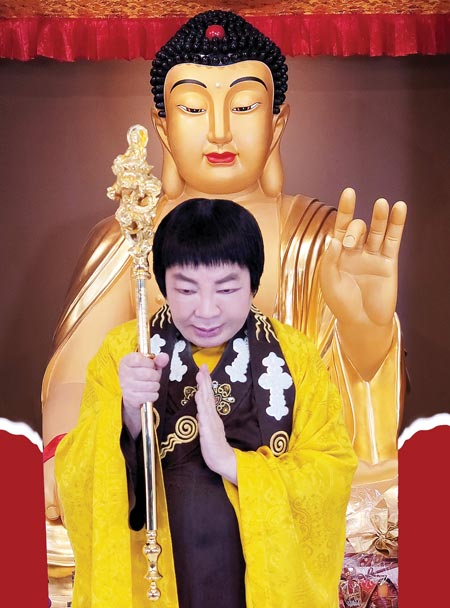
The conferment of the Pope of Buddhism to His Holiness Dorje Chang Buddha III originated in January 2018 when the World Peace Prize Awarding Council and World Peace Prize Religious Leaders Title Awarding Council passed the resolution to confer to H.H. Dorje Chang Buddha III the title of Pope of Buddhism, the highest leader of Buddhism in this world. However, His Holiness the Buddha refused to accept the conferment.
The Pope of Buddhism H.H. Dorje Chang Buddha III
For the sake of propagating Buddha Dharma and benefitting living beings, the World Buddhism Association Headquarters took the liberty to accept the conferment decree and the Pope of Buddhism Scepter. When the World Buddhism Association Headquarters respectfully presented the Pope of Buddhism Scepter and conferment decree to H.H. Dorje Chang Buddha III, His Holiness the Buddha III said: “I see that on top of this Scepter is the seated Shakyamuni Buddha, we should be respectful to Namo Shakyamuni Buddha.” His Holiness the Buddha then raised the Scepter above His head and made a symbolic closed palm gesture with one hand to express His respects. However, H.H. Dorje Chang Buddha III also expressed that He is just a humble cultivator and resolutely would not accept such a conferment. Hence, His Holiness the Buddha immediately returned the conferment decree and the Pope of Buddhism Scepter to the two Councils.
On September 23, 2020, the World Peace Prize Awarding Council and World Peace Prize Religious Leaders Title Awarding Council passed an ultimate joint resolution, determining that the return of the Pope of Buddhism Scepter and conferment decree by H.H. Dorje Chang Buddha III was not effectible. On September 24, the joint Chair of the World Peace Prize Awarding Council and World Peace Prize Religious Leaders Title Awarding Council Suzi Leggett made the ultimate announcement at the Holy Miracles Temple of the World Buddhism Association Headquarters: “Over the past several decades, the World Peace Prize Awarding Council has presented the World Peace Prize to presidents, spiritual leaders, and prime ministers of many nations, including President Ronald Reagan, Hon. Mahatma Gandhi, and H.E. Yitzhak Rabin. There has never been a precedence of an award being retracted or returned. All determinations made and implemented by our Councils are very solemn, serious, and absolutely cannot be changed. The return of the Pope of Buddhism Scepter and conferment decree by H.H. Dorje Chang Buddha III is deemed not effectible. The title, status, and authority of the Pope of Buddhism belong only to H.H. Dorje Chang Buddha III, and cannot be exercised by anyone else.” Chair Leggett once again requested that the World Buddhism Association Headquarters accept and present to H.H. Dorje Chang Buddha III the Pope of Buddhism Scepter and conferment decree that His Holiness the Buddha previously returned.
Representing the World Buddhism Association Headquarters, Venerable Mozhi Rinpoche accepted the conferment decree and Pope of Buddhism Scepter. He said during his speech, “The World Buddhism Association Headquarters considers that the decision made by the two Councils is remarkably proper and sagacious.
“Ever since Namo Shakyamuni Buddha entered parinirvāṇa, there has not been a supreme leader who has the authority to guide all Buddhists the same way that the Buddha did. However, the authoritative position of the Pope of Buddhism certainly is not a role that a leader of a single Buddhist sect would have the attributes to fulfill; rather, the Pope must be a leader who has authority over the entirety of Buddhism, namely, a Buddha.
“Namo H.H. Dorje Chang Buddha III holds the perfect teachings of Buddhism and meets the criteria used by all Buddhist sects to recognize a Buddha. His inherent nature is in accord with that of a Buddha. His unsurpassed, complete, and perfect enlightenment is in accord with that of a Buddha. Just based on the accomplishment of H.H. Dorje Chang Buddha III in Lifting the Pestle onto the Platform, surpassing His own base weight standard by 59 levels, no one else can possibly reach such a record.
“The state of virtue of H.H. Dorje Chang Buddha III is that of a Buddha. His Holiness the Buddha has perfect mastery of Exoteric and Esoteric Buddhism, perfect accomplishments in the Five Vidyas, and so forth, all of which accord with the unsurpassed, complete, and perfect enlightenment of a Buddha.
“In more than 2,000 years, there has not been a Buddhist Holy Guru in this world who possesses the same Buddha level qualities. Just by the facts that H.H. Dorje Chang Buddha III vowed and carries out the vow to benefit living beings purely on a voluntary basis and does not accept any offerings throughout His entire life, and that He possesses perfect wisdom and unimpeded accomplishments, no other Holy Guru can be of comparison. Only Namo H.H. Dorje Chang Buddha III can take on this immensely noble, holy, and heavy responsibility of the Pope of Buddhism, to properly guide Buddhists onto the correct path of learning Buddhism.
“Therefore, on behalf of Buddhists, the World Buddhism Association Headquarters thanks the World Peace Prize Awarding Council and the World Peace Prize Religious Leaders Title Awarding Council for having made the ultimate decision.”
H.H. Dorje Chang Buddha III is selfless and noble, and the first person in Buddhism to possess substantive holy realization power of a Buddha and perfectly flawless accomplishments at the pinnacle of the Five Vidyas. These are the qualities that no other eminent Buddhist monastic or virtuous person in this world has so perfectly attained. It is naturally a matter of course that H.H. Dorje Chang Buddha III is the veritable Pope of Buddhism.
During the Great Depression, a wealthy baker summoned the twenty poorest children in town and said to them, “Until God brings better times, you may each come here every day and take a loaf of bread.”
Every morning, these hungry children would rush forward, crowding around the basket of bread, pushing and shouting, each one trying to grab the biggest loaf. After snatching their bread, they would dash off without even a word of thanks to the kind-hearted baker.
But there was one girl, a poorly dressed little girl named Gretchen, who stood out from the rest. She never pushed or shouted, nor did she fight for the largest loaf. Instead, she quietly waited at the side until all the other children had taken theirs. Then she would humbly pick up the smallest loaf left in the basket. Without fail, she would gently kiss the baker’s hand in gratitude before happily heading home with her bread.
One day, after the others had left, shy little Gretchen received a loaf even smaller than usual. Still, she kissed the baker’s hand and thanked him sincerely as always. When she returned home, her mother cut the bread open—and to their amazement, found several shiny silver coins hidden inside.
Her mother gasped, “Gretchen! Take the money back immediately. The baker must have accidentally dropped it into the dough while kneading. Hurry, return it and give it back to that kind man yourself!”
When Gretchen returned the coins, the baker gently told her, “No, my child, this was no mistake. I placed the coins there on purpose. I wanted to teach you something: Those who are humble and considerate will be blessed by God. May you always keep a peaceful and grateful heart. Go home and tell your mother—this is God’s reward.”
A heart of humility is like the sky above, the sea upon the earth, and the valleys between the mountains— Humble people are vast because they are tolerant, and powerful because they are generous.
Those who are eager to fight will find Heaven itself contending against them. But those who yield and show humility will find that Heaven yields to them.
The Enigma of Existence: Exploring Life After Death
The concept of life after death has intrigued humanity for centuries. Different cultures, philosophies, and religions have provided varying explanations, yet the mystery remains. Is there life after death, or does consciousness simply cease to exist when the body dies? In this article, we explore some of the most prominent beliefs and theories surrounding the enigma of existence after death, seeking to understand this profound question from multiple perspectives.
What Are the Most Common Beliefs About Life After Death?
Throughout history, many cultures and religions have proposed theories about life after death. Religious scholars suggest that the idea of an afterlife serves to give people comfort and meaning in the face of mortality. Christianity, Islam, Hinduism, and Buddhism all have distinct views on the afterlife, each offering unique insights into the question of what happens after death.
In Christianity, for example, life after death is often seen as either eternal life in heaven or eternal separation from God in hell. Researchers point out that many Christians believe that the soul lives on after the body dies, and that salvation or damnation is determined by one’s actions during their lifetime.
In Hinduism, the concept of reincarnation is central. According to this belief, the soul is reborn in a new body after death, and the circumstances of the new life are determined by the actions (karma) of the previous life. Philosophers argue that this cycle of death and rebirth is a form of spiritual evolution, with the ultimate goal being moksha, or liberation from the cycle of reincarnation.
Buddhism also supports the idea of reincarnation, but with an emphasis on achieving enlightenment to break free from the cycle of rebirth. Experts note that Buddhism teaches that attachment to the self is the source of suffering, and liberation occurs when one transcends the ego and achieves nirvana.
Scientific Views on Life After Death
From a scientific standpoint, the question of life after death is more complex. The majority of scientists assert that there is no empirical evidence to support the idea that consciousness survives after death. Neuroscientists argue that consciousness is a product of brain activity, and when the brain ceases to function, so does consciousness.
There are notable phenomena that have intrigued researchers. Medical professionals have documented instances of near-death experiences (NDEs), where individuals report vivid sensations, such as a sense of floating above their body, moving through a tunnel, or encountering deceased loved ones. While these experiences are often interpreted by some as evidence of life after death, psychologists suggest that they may be explained by the brain’s reaction to trauma, oxygen deprivation, or the release of chemicals like DMT.
While science cannot definitively answer the question of what happens after death, these experiences have raised questions about the nature of consciousness and whether it is entirely tied to the brain. The debate continues, and more research is needed to explore the mysteries of the human mind.
Near-Death Experiences: Are They Evidence of Life After Death?
Near-death experiences (NDEs) have become a focal point in discussions about life after death. People who have experienced NDEs often describe sensations of peace, floating outside their body, or meeting beings of light. Some researchers hypothesize that these experiences are the result of a brain in distress, attempting to make sense of its impending shutdown.
Many individuals who have experienced NDEs report feeling profound transformations in their lives afterward, including a greater sense of purpose or reduced fear of death. Experts in the field of psychology and consciousness studies suggest that these transformations could point to an experience beyond the physical brain, offering a glimpse into an afterlife.
The question remains: do these experiences represent glimpses into an afterlife, or are they simply a product of the brain’s complex workings during moments of trauma? The scientific community continues to study these occurrences, and while answers remain elusive, the personal testimonies of those who have undergone NDEs continue to fuel interest in the idea of life after death.
What Philosophical Theories Are There About Life After Death?
In addition to religious and scientific perspectives, philosophical theories about life after death explore the nature of existence and consciousness. Philosophers have long debated whether consciousness is purely a physical phenomenon or if it could exist independently of the body.
One of the most famous theories comes from the philosopher René Descartes, who posited that the mind and body are separate entities. According to Descartes’ dualism, the mind (or soul) can exist independently of the body and could potentially continue after death. Modern philosophers who follow dualistic thinking often suggest that consciousness may not be confined to the brain and could persist beyond the body’s death.
On the other hand, materialist philosophers argue that consciousness is entirely dependent on the brain, and once the brain ceases to function, consciousness ceases as well. These contrasting viewpoints continue to shape the ongoing philosophical discussion on the nature of life after death.
Can Science and Religion Coexist in Understanding Life After Death?
While science and religion often present differing views on life after death, some thinkers suggest that they need not be mutually exclusive. Interdisciplinary experts argue that the two perspectives can coexist, offering a fuller understanding of the mystery. Religion provides spiritual and moral frameworks for understanding the afterlife, while science explores the empirical, physical aspects of life and death.
In recent years, there has been a growing interest in integrating scientific and spiritual perspectives on consciousness. Some researchers are exploring the idea that consciousness might exist beyond the brain, and that this may have implications for understanding life after death. Scholars in the field of consciousness studies have suggested that more research is needed to bridge the gap between spiritual and scientific explanations of existence after death.
The enigma of life after death remains unsolved. Whether through religious beliefs, scientific inquiry, or philosophical speculation, humanity continues to seek answers to this profound question, driven by the desire to understand what happens after we take our final breath.
“Those who genuinely help others always end up helping themselves.” This powerful truth was the headline of a Washington Post article recounting the inspiring life story of Carlos Gutierrez. From humble beginnings as a working-class youth, he rose to become one of the most respected figures in American business and government. His secret? A simple yet profound practice: doing one good deed a day.
Carlos Gutierrez is best remembered for saying: “A person’s destiny is not necessarily shaped by a single great act. I believe that more often, it is shaped by small acts of kindness in everyday life.”
Born into a privileged family, Gutierrez’s early life was marked by comfort and stability. But everything changed after a revolution forced his family to flee their island home. They arrived in Miami with nothing. At the age of fifteen, to help support his family, Carlos took his first job as a waiter in a small seaside restaurant.
He was diligent, eager to learn, and even willing to work without pay. His commitment caught the eye of the restaurant owner, who invited him into his home and introduced him to his children to help Carlos improve his English.
Thanks to his strong work ethic and positive attitude, Gutierrez was soon recommended for a second job—this time as a salesman and delivery driver at a food company. Before he began, his father passed on a simple family principle: “Do one good deed a day.” He explained that this habit had helped build their once-successful life, and urged Carlos to live by it.
Carlos took that lesson to heart. While delivering oatmeal to mom-and-pop shops around the city, he went out of his way to help others—carrying letters to nearby towns, giving children rides home from school, offering small kindnesses without ever expecting anything in return. He did this joyfully, for four years.
In his fifth year, the company recognized his contributions in a remarkable way. They promoted him to lead marketing operations for Latin America from their Mexico office. His performance review noted: “This employee, over the past four years, has personally accounted for 40% of Florida’s total sales volume. He should be promoted.”
From there, his rise was meteoric. He took on leadership across Canada and the Asia-Pacific region, eventually becoming CEO of the company.
Later, as top American corporations like Coca-Cola and Colgate considered him for their CEO positions, President George W. Bush nominated him as Secretary of Commerce in the United States government.
Carlos Gutierrez’s story reflects a timeless truth found in Buddhist teachings. A Buddhist master once shared how, in the early days of his Dharma teaching, only a few rural housewives followed him. He taught them to practice kindness in the simplest way: “Take a small coin from your grocery money—just a dime—and use it each day to do a good deed.” At the end of the month, they would have performed thirty selfless acts from the heart. One good deed a day, and one’s merit grows.
The practice may seem simple, but when carried out with sincerity and perseverance, it awakens our inner awareness. Like a stream that flows quietly but never ceases, daily kindness trains the mind to stay rooted in goodness and deepens our spiritual cultivation—from surface-level thoughts to the very heart of intention.
Traditional Chinese culture also upholds the principle of “doing one good deed a day.” This value is deeply reflected in the classic text The Four Lessons of Liaofan, where Yuan Liaofan outlines a path of self-transformation through the active cultivation of virtue. By committing to perform a thousand good deeds, he not only benefited others but also profoundly changed his own destiny.
Even a single kind thought toward others is an act of goodness. A word that uplifts or benefits someone is a good deed. And a small action—no matter how minor—that helps another person is still a meaningful expression of kindness.
Whether through our thoughts, speech, or actions, if we put others first, we are cultivating virtue. That is the essence of being a good human being.
And importantly, we must remember: never withhold kindness just because it seems too small. Do good whenever the opportunity arises. Act from the heart, with sincerity and joy—not for show, not for praise—but naturally and spontaneously, with the intention to benefit others. This is the foundation of true bodhisattva conduct.
Goodness does not need an audience. “Virtue does not require recognition; Heaven always sees our good deeds.” A seed of kindness, planted in silence, will one day bloom with beautiful results—often when we least expect it.
So let us each begin with just one small act of kindness a day. It may seem simple, but over time, it has the power to change not just our lives—but the world.
I have always heard certain quotes attributed to Albert Einstein concerning what he believed about Buddhism including one that implied that if he were a religious man he would be a Buddhist. There does not seem to be any evidence that he said that, but I found the following to be useful. The first part is an article by Kang Na, Assistant Professor of Religion at Westminister College that provides context for the essay and additional quotes by Einstein.
Certainly no one in 1879 in Ulm, Germany, could have guessed that one of their own born that year would someday receive global praise for his undisputed genius, meriting recently the coveted title “person of the century” (Time magazine). Likewise, international fame was probably not what Albert Einstein himself anticipated in 1895 when he failed the entrance exam for the Federal Polytechnical Institute in Zurich, Switzerland. Even as he worked and was being promoted at the Swiss Patent Office in Bern, Switzerland (1902–08), Einstein was far from becoming a household name, let alone the most renowned Nobel Prize winner in physics, which he received in 1921 not for his special theory of relativity (of E=MC2 fame) that inaugurated the atomic age in 1905, but for his discovery of the photoelectric effect (the hypothesis he proposed also in 1905 that electromagnetic radiation interacts with matter as if the radiation had a granular structure or particles).
Shortly thereafter, when Einstein’s reputation in academia waxed toward worldwide celebrity, no one could have presaged that in 1952 the newly established state of Israel would offer him the presidency, which he declined. That invitation, however, points out that he was not only perpetually engaged in the subtle mysteries of the universe but also as outspoken in the political arena as a Zionist who detested the Nazis’ rise to power, as a prophet who insisted that Jews make peace with Arabs, and as a pacifist, who, in his famous letter to President Roosevelt (1939), warned against the potential abuses of atomic energy, despite his support for the development of the A-bomb. Even days before his death on April 18, 1955, he wrote his last signed letter to the philosopher Bertrand Russell expressing his intention to sign a joint manifesto insisting that all nations renounce nuclear weapons. By then his brilliant mark on human history was as unquestionable as his unkempt hair was uniquely recognizable.
It is this larger-than-life Einstein who wrote the following essay on the proper relationship between science and religion, part one in 1939 and part two in 1941. It is also here in the latter part of the essay that we find his often quoted dictum, “Science without religion is lame, religion without science is blind.” He wrote “Science and Religion” as a contribution to a symposium held in New York in 1941 on what roles science, philosophy, and religion played in the cause of American democracy. Thus, the essay recommends itself to the multi-disciplinary approach that Inquiry takes within the liberal arts program at Westminster.
Although Einstein read the Bible often, spoke quite freely about God, and was unapologetically religious, the essay discloses a religious disposition not quite like that of an ordinary religious person. He believed “in Spinoza’s God who reveals himself in the harmony of all that exists, but not in a God who concerns himself with the fate and actions of human beings” (Einstein Archive 33-272). Hence Einstein declared, “My religion consists of a humble admiration of the illimitable superior spirit who reveals himself in the slight details we are able to perceive with our frail and feeble minds. That deeply emotional conviction of the presence of a superior reasoning power, which is revealed in the incomprehensible universe, forms my idea of God” (quoted in the New York Times obituary, April 19, 1955). Furthermore, as the essay makes clear, Einstein’s emphasis on the moral and altruistic dimensions of religion was unequivocal: “Humanity has every reason to place the proclaimers of high moral standards and values above the discoverers of objective truth. What humanity owes to personalities like Buddha, Moses, and Jesus ranks for me higher than all the achievements of the inquiring constructive mind” (Dukas and Hoffmann, Albert Einstein, the Human Side, 70). Perhaps it is only ironically fitting that it is precisely the inquiring constructive mind of Einstein that destined him for the cover of Time and for an honored place among those rare spirits whose extraordinary genius and creativity punctuated and graced the progression of human history.
(Biographical information taken from Alice Calaprice’s The Quotable Einstein, 1996)
Essay on Science and Religion
Albert Einstein
PART I (1939)
During the last century, and part of the one before, it was widely held that there was an unreconcilable conflict between knowledge and belief. The opinion prevailed among advanced minds that it was time that belief should be replaced increasingly by knowledge; belief that did not itself rest on knowledge was superstition, and as such had to be opposed. According to this conception, the sole function of education was to open the way to thinking and knowing, and the school, as the outstanding organ for the people’s education, must serve that end exclusively.
One will probably find but rarely, if at all, the rationalistic standpoint expressed in such crass form; for any sensible man would see at once how one-sided is such a statement of the position. But it is just as well to state a thesis starkly and nakedly, if one wants to clear up one’s mind as to its nature.
It is true that convictions can best be supported with experience and clear thinking. On this point one must agree unreservedly with the extreme rationalist. The weak point of his conception is, however, this, that those convictions which are necessary and determinant for our conduct and judgments, cannot be found solely along this solid scientific way.
For the scientific method can teach us nothing else beyond how facts are related to, and conditioned by, each other. The aspiration toward such objective knowledge belongs to the highest of which man is capable, and you will certainly not suspect me of wishing to belittle the achievements and the heroic efforts of man in this sphere. Yet it is equally clear that knowledge of what is does not open the door directly to what should be. One can have the clearest and most complete knowledge of what is, and yet not be able to deduct from that what should be the goal of our human aspirations. Objective knowledge provides us with powerful instruments for the achievements of certain ends, but the ultimate goal itself and the longing to reach it must come from another source. And it is hardly necessary to argue for the view that our existence and our activity acquire meaning only by the setting up of such a goal and of corresponding values. The knowledge of truth as such is wonderful, but it is so little capable of acting as a guide that it cannot prove even the justification and the value of the aspiration towards that very knowledge of truth. Here we face, therefore, the limits of the purely rational conception of our existence.
But it must not be assumed that intelligent thinking can play no part in the formation of the goal and of ethical judgments. When someone realizes that for the achievement of an end certain means would be useful, the means itself becomes thereby an end. Intelligence makes clear to us the interrelation of means and ends. But mere thinking cannot give us a sense of the ultimate and fundamental ends. To make clear these fundamental ends and valuations, and to set them fast in the emotional life of the individual, seems to me precisely the most important function which religion has to perform in the social life of man. And if one asks whence derives the authority of such fundamental ends, since they cannot be stated and justified merely by reason, one can only answer: they exist in a healthy society as powerful traditions, which act upon the conduct and aspirations and judgments of the individuals; they are there, that is, as something living, without its being necessary to find justification for their existence. They come into being not through demonstration but through revelation, through the medium of powerful personalities. One must not attempt to justify them, but rather to sense their nature simply and clearly.
The highest principles for our aspirations and judgments are given to us in the Jewish- Christian religious tradition. It is a very high goal which, with our weak powers, we can reach only very inadequately, but which gives a sure foundation to our aspirations and valuations. If one were to take that goal out of its religious form and look merely at its purely human side, one might state it perhaps thus: free and responsible development of the individual, so that he may place his powers freely and gladly in the service of all mankind.
There is no room in this for the divinization of a nation, of a class, let alone of an individual. Are we not all children of one father, as it is said in religious language? Indeed, even the divinization of humanity, as an abstract totality, would not be in the spirit of that ideal. It is only to the individual that a soul is given. And the high destiny of the individual is to serve rather than to rule, or to impose himself in any other way.
If one looks at the substance rather than at the form, then one can take these words as expressing also the fundamental democratic position. The true democrat can worship his nation as little as can the man who is religious, in our sense of the term.
What, then, in all this, is the function of education and of the school? They should help the young person to grow up in such a spirit that these fundamental principles should be to him as the air which he breathes. Teaching alone cannot do that.
If one holds these high principles clearly before one’s eyes, and compares them with the life and spirit of our times, then it appears glaringly that civilized mankind finds itself at present in grave danger. In the totalitarian states it is the rulers themselves who strive actually to destroy that spirit of humanity. In less threatened parts it is nationalism and intolerance, as well as the oppression of the individuals by economic means, which threaten to choke these most precious traditions.
A realization of how great is the danger is spreading, however, among thinking people, and there is much search for means with which to meet the danger—means in the field of national and international politics, of legislation, of organization in general. Such efforts are, no doubt, greatly needed. Yet the ancients knew something which we seem to have forgotten. All means prove but a blunt instrument, if they have not behind them a living spirit. But if the longing for the achievement of the goal is powerfully alive within us, then shall we not lack the strength to find the means for reaching the goal and for translating it into deeds.
PART II (1941)
It would not be difficult to come to an agreement as to what we understand by science. Science is the century-old endeavor to bring together by means of systematic thought the perceptible phenomena of this world into as thorough-going an association as possible. To put it boldly, it is the attempt at the posterior reconstruction of existence by the process of conceptualization. But when asking myself what religion is I cannot think of the answer so easily. And even after finding an answer which may satisfy me at this particular moment I still remain convinced that I can never under any circumstances bring together, even to a slight extent, all those who have given this question serious consideration.
At first, then, instead of asking what religion is I should prefer to ask what characterizes the aspirations of a person who gives me the impression of being religious: A person who is religiously enlightened appears, to the best of his ability, liberated himself from the fetters of his selfish desires and is preoccupied with thoughts, feelings, and aspirations to which he clings because of their super-personal value. It seems to me that what is important is the force of this super-personal content and the depth of the conviction concerning its overpowering meaningfulness, regardless of whether any attempt is made to unite this content with a divine Being, for otherwise it would not be possible to count Buddha and Spinoza as religious personalities. Accordingly, a religious person is devout in the sense that he has no doubt of the significance and loftiness of those super-personal objects and goals which neither require nor are capable of rational foundation. They exist with the same necessity and matter-of- factness as he himself. In this sense religion is the age-old endeavor of mankind to become clearly and completely conscious of these values and goals and constantly to strengthen and extend their effect. If one conceives of religion and science according to these definitions then a conflict between them appears impossible. For science can only ascertain what is, but not what should be, and outside of its domain value judgments of all kinds remain necessary. Religion, on the other hand, deals only with evaluations of human thought and action: it cannot justifiably speak of facts and relationships between facts. According to this interpretation the well-known conflicts between religion and science in the past must all be ascribed to a misapprehension of the situation which has been described.
For example, a conflict arises when a religious community insists on the absolute truthfulness of all statements recorded in the Bible. This means an intervention on the part of religion into the sphere of science; this is where the struggle of the Church against the doctrines of Galileo and Darwin belongs. On the other hand, representatives of science have often made an attempt to arrive at fundamental judgments with respect to values and ends on the basis of scientific method, and in this way have set themselves in opposition to religion. These conflicts have all sprung from fatal errors.
Now, even though the realms of religion and science in themselves are clearly marked off from each other, nevertheless there exist between the two strong reciprocal relationships and dependencies. Though religion may be that which determines the goal, it has, nevertheless, learned from science, in the broadest sense, what means will contribute to the attainment of the goals it has set up. But science can only be created by those who are thoroughly imbued with the aspiration towards truth and understanding. This source of feeling, however, springs from the sphere of religion. To this there also belongs the faith in the possibility that the regulations valid for the world of existence are rational, that is, comprehensible to reason. I cannot conceive of a genuine scientist without that profound faith. The situation may be expressed by an image: Science without religion is lame, religion without science is blind.
Though I have asserted above that in truth a legitimate conflict between religion and science cannot exist I must nevertheless qualify this assertion once again on an essential point, with reference to the actual content of historical religions. This qualification has to do with the concept of God. During the youthful period of mankind’s spiritual evolution human fantasy created gods in man’s own image, who, by the operations of their will were supposed to determine, or at any rate to influence the phenomenal world. Man sought to alter the disposition of these gods in his own favor by means of magic and prayer. The idea of God in the religions taught at present is a sublimation of that old conception of the gods. Its anthropomorphic character is shown, for instance, by the fact that men appeal to the Divine Being in prayers and plead for the fulfillment of their wishes.
Nobody, certainly, will deny that the idea of the existence of an omnipotent, just and omnibeneficent personal God is able to accord man solace, help, and guidance; also, by virtue of its simplicity it is accessible to the most undeveloped mind. But, on the other hand, there are decisive weaknesses attached to this idea in itself, which have been painfully felt since the beginning of history. That is, if this being is omnipotent then every occurrence, including every human action, every human thought, and every human feeling and aspiration is also His work; how is it possible to think of holding men responsible for their deeds and thoughts before such an almighty Being? In giving out punishment and rewards He would to a certain extent be passing judgment on Himself. How can this be combined with the goodness and righteousness ascribed to Him?
The main source of the present-day conflicts between the spheres of religion and of science lies in this concept of a personal God. It is the aim of science to establish general rules which determine the reciprocal connection of objects and events in time and space. For these rules, or laws of nature, absolutely general validity is required—not proven. It is mainly a program, and faith in the possibility of its accomplishment in principle is only founded on partial successes. But hardly anyone could be found who would deny these partial successes and ascribe them to human self-deception. The fact that on the basis of such laws we are able to predict the temporal behavior of phenomena in certain domains with great precision and certainty is deeply embedded in the consciousness of the modern man, even though he may have grasped very little of the contents of those laws. He need only consider that planetary courses within the solar system may be calculated in advance with great exactitude on the basis of a limited number of simple laws. In a similar way, though not with the same precision, it is possible to calculate in advance the mode of operation of an electric motor, a transmission system, or of a wireless apparatus, even when dealing with a novel development.
To be sure, when the number of factors coming into play in a phenomenological complex is too large scientific method in most cases fails us. One need only think of the weather, in which case prediction even for a few days ahead is impossible. Nevertheless no one doubts that we are confronted with a causal connection whose causal components are in the main known to us. Occurrences in this domain are beyond the reach of exact prediction because of the variety of factors in operation, not because of any lack of order in nature.
We have penetrated far less deeply into the regularities obtaining within the realm of living things, but deeply enough nevertheless to sense at least the rule of fixed necessity. One need only think of the systematic order in heredity, and in the effect of poisons, as for instance alcohol, on the behavior of organic beings. What is still lacking here is a grasp of connections of profound generality, but not a knowledge of order in itself.
The more a man is imbued with the ordered regularity of all events the firmer becomes his conviction that there is no room left by the side of this ordered regularity for causes of a different nature. For him neither the rule of human nor the rule of divine will exists as an independent cause of natural events. To be sure, the doctrine of a personal God interfering with natural events could never be refuted, in the real sense, by science, for this doctrine can always take refuge in those domains in which scientific knowledge has not yet been able to set foot.
But I am persuaded that such behavior on the part of the representatives of religion would not only be unworthy but also fatal. For a doctrine which is able to maintain itself not in clear light but only in the dark, will of necessity lose its effect on mankind, with incalculable harm to human progress. In their struggle for the ethical good, teachers of religion must have the stature to give up the doctrine of a personal God, that is, give up that source of fear and hope which in the past placed such vast power in the hands of priests. In their labors they will have to avail themselves of those forces which are capable of cultivating the Good, the True, and the Beautiful in humanity itself. This is, to be sure, a more difficult but an incomparably more worthy task. After religious teachers accomplish the refining process indicated they will surely recognize with joy that true religion has been ennobled and made more profound by scientific knowledge.
If it is one of the goals of religion to liberate mankind as far as possible from the bondage of egocentric cravings, desires, and fears, scientific reasoning can aid religion in yet another sense. Although it is true that it is the goal of science to discover rules which permit the association and foretelling of facts, this is not its only aim. It also seeks to reduce the connections discovered to the smallest possible number of mutually independent conceptual elements. It is in this striving after the rational unification of the manifold that it encounters its greatest successes, even though it is precisely this attempt which causes it to run the greatest risk of falling a prey to illusions. But whoever has undergone the intense experience of successful advances made in this domain, is moved by profound reverence for the rationality made manifest in existence. By way of the understanding he achieves a far-reaching emancipation from the shackles of personal hopes and desires, and thereby attains that humble attitude of mind towards the grandeur of reason incarnate in existence, and which, in its profoundest depths, is inaccessible to man. This attitude, however, appears to me to be religious, in the highest sense of the word. And so it seems to me that science not only purifies the religious impulse of the dross of its anthropomorphism but also contributes to a religious spiritualization of our understanding of life.
The further the spiritual evolution of mankind advances, the more certain it seems to me that the path to genuine religiosity does not lie through the fear of life, and the fear of death, and blind faith, but through striving after rational knowledge. In this sense I believe that the priest must become a teacher if he wishes to do justice to his lofty educational mission.
In the Buddhist scriptures of China, a profound story is recorded—one that illuminates the immeasurable merit of a sincere offering.
Once, there was a poor girl who survived by begging. She often watched wealthy young ladies, accompanied by attendants, visit the temple to offer alms and perform good deeds. Seeing their generosity, she felt a deep yearning to cultivate merit but had nothing to give. Determined, she worked tirelessly to save whatever she could. After much effort, she managed to save a single coin. Though small in value, it represented all she had. With unwavering devotion, she took her humble offering to the temple.
The abbot, upon learning of her sincerity, was deeply moved. He gathered his disciples and announced, “Today, I will personally preside over the offering and pray for this devout laywoman!”
Not long after, an extraordinary turn of events unfolded.
After the queen of the land passed away, the grieving king sank into sorrow. To lift his spirits, his ministers organized a hunting expedition. As the royal party rode through the forest, the king noticed a shimmering light ahead. Curious, he approached and discovered a breathtakingly beautiful young woman. Though her clothes were tattered, she radiated an ethereal grace.
Captivated by her presence, the king brought her back to the palace. Before long, she became his new queen.
Overjoyed by her newfound fortune, she reflected on her past: “This must be the reward of my small act of generosity! I only donated one coin, yet it planted the seed for such incredible merit. Now that I have wealth, I should return to the temple to express my gratitude with a much grander offering!”
Determined to make a grand gesture, she dressed in the finest attire, adorned herself with jewels, and loaded dozens of carts with silver and gold for donation. As she approached the temple, she thought, “Before, when I gave only one coin, the abbot personally prayed for me. Now that I bring such vast riches, surely the reception will be even greater!”
Upon her arrival, she expected an elaborate welcome. Yet, to her surprise, only a few monks came to receive her offerings, and the rituals were conducted in the usual manner.
Perplexed, she approached an elderly monk and asked, “Why is it that when I was poor and donated a single coin, the abbot himself prayed for me? Yet today, when I bring such wealth, only a few monks perform the prayers?”
The monk smiled gently and replied, “At that time, your single coin was all you had. You gave it with pure devotion and joy, holding nothing back. Now, though you bring great wealth, it is but a fraction of your fortune, and your heart is tainted with pride. The true merit of an offering comes not from its size but from the sincerity of the giver’s heart.”
Shakyamuni Buddha taught that for a donation to generate immense benefit, it must possess three essential qualities:
Before Giving – A Joyful Heart True generosity begins with happiness. The donor should give not out of duty, pressure, or expectation of reward, but with a heart full of joy, seeing giving as an opportunity to cultivate virtue and compassion.
While Giving – A Clear and Sincere Mind The act of giving should be free from hesitation, regret, or pride. A pure offering is made with an open heart, solely for the benefit of others, without seeking recognition or return.
After Giving – A Sense of Fulfillment Once the offering is made, the giver should not feel regret or attachment. Instead, they should feel a deep sense of satisfaction, knowing they have planted seeds of merit for the future.
This story serves as a timeless lesson: It is not the amount we give that determines the merit of our offering, but the purity of our heart. A sincere and joyful offering—no matter how small—carries boundless blessings.
So the next time you give, remember: True generosity is not measured in gold or silver, but in the depth of your sincerity.
This outstanding article by Brian Gallagher, published in Nautilus, provides deeper insight into Albert Einstein’s views on religion and science.
Not long ago, I heard an echo of Albert Einstein’s religious views in the words of Elon Musk. Asked, at the close of a conversation with Axios, whether he believed in God, the CEO of both SpaceX and Tesla paused, looked away from his interlocutors for a brief second, and then said, in that mild South African accent, “I believe there’s some explanation for this universe, which you might call God.”
Einstein did call it God. The German-Jewish physicist is famous for many things—his special and general theories of relativity, his burst of gray-white hair—including his esoteric remark, often intoned in discussions of the strange, probabilistic nature of quantum mechanics, that “God does not play dice.” A final or ultimate equation, describing the laws of nature and the origin of the cosmos, Einstein believed, could not involve chance intrinsically. Insofar as it did—it being the Copenhagen interpretation of quantum mechanics—it would be incomplete. (The consensus now among physicists is that he was wrong; God is indeterminate. ‘All the evidence points to him being an inveterate gambler,’ Stephen Hawking once said, ‘who throws the dice on every possible occasion.’)
But what was with Einstein’s God-language in the first place? The question may be considered anew, in light of an auction at Christie’s, in New York, of a 1954 letter Einstein wrote that a couple years ago unexpectedly sold for $2.9 million. For the occasion the Princeton Club hosted a panel discussion on the conflict, or lack thereof, between science and religion, which featured theoretical physicist Brian Greene, philosopher Rebecca Newberger Goldstein, cognitive psychologist Tania Lombrozo, and Rabbi Geoff Mitelman, founding director of Sinai and Synapses, an organization dedicated to fostering respectful dialogue about religion and science. The event was open to the public, and I was excited to attend. (Full disclosure: At the time I was a Sinai and Synapses fellow.) I believe Einstein can still offer some insight on how to think about religion and science.
“I believe in Spinoza’s God, who reveals himself in the lawful harmony of the world, not in a God who concerns himself with the fate and the doings of mankind.”
What Einstein said, in a note to the philosopher Eric Gutkind, whose book Choose Life: The Biblical Call to Revolt Einstein was reviewing, was nearly as scathing as any contemporary critique of religion you might hear from Richard Dawkins, Sam Harris, or Christopher Hitchens. ‘The word God is for me,’ Einstein wrote, ‘nothing more than the expression and product of human weakness, the Bible a collection of honorable, but still purely primitive, legends. No interpretation, no matter how subtle, can change this for me.’
It is no wonder why, for decades, Einstein’s views on religion became muddled in the popular imagination: The inconsistency is clear. Here, God means one thing; over there, another. Just going off his letter to Gutkind, Einstein appears to be an atheist. But read Einstein in other places and you find him directly declaring that he is not one. “I am not an Atheist,” he said in an interview published in 1930. ‘I do not know if I can define myself as a Pantheist. The problem involved is too vast for our limited minds.’ Einstein was asked whether he was a pantheist. The rest of his response is worth quoting in full:
“May I not reply with a parable? The human mind, no matter how highly trained, cannot grasp the universe. We are in the position of a little child, entering a huge library whose walls are covered to the ceiling with books in many different tongues. The child knows that someone must have written those books. It does not know who or how. It does not understand the languages in which they are written. The child notes a definite plan in the arrangement of the books, a mysterious order, which it does not comprehend, but only dimly suspects. That, it seems to me, is the attitude of the human mind, even the greatest and most cultured, toward God. We see a universe marvellously arranged, obeying certain laws, but we understand the laws only dimly. Our limited minds cannot grasp the mysterious force that sways the constellations. I am fascinated by Spinoza’s Pantheism. I admire even more his contributions to modern thought. Spinoza is the greatest of modern philosophers, because he is the first philosopher who deals with the soul and the body as one, not as two separate things.
Benedict Spinoza, the 17th century Jewish-Dutch philosopher, was also in his day confused for an atheist for writing things like this, from his treatise Ethics: ‘All things, I say, are in God, and everything which takes place takes place by the laws alone of the infinite nature of God, and follows (as I shall presently show) from the necessity of His essence.’
In 1929, Einstein received a telegram inquiring about his belief in God from a New York rabbi named Herbert Goldstein, who had heard a Boston cardinal say that the physicist’s theory of relativity implies “the ghastly apparition of atheism.’Einstein settled Goldstein down. “I believe in Spinoza’s God, who reveals himself in the lawful harmony of the world,’ he told him, ‘not in a God who concerns himself with the fate and the doings of mankind.’
What that amounted to for Einstein, according to a 2006 paper, was a ‘cosmic religious feeling’ that required no ‘anthropomorphic conception of God.’ He explained this view in the New York Times Magazine: ‘The religious geniuses of all ages have been distinguished by this kind of religious feeling, which knows no dogma and no God conceived in man’s image; so that there can be no church whose central teachings are based on it. Hence it is precisely among the heretics of every age that we find men who were filled with this highest kind of religious feeling and were in many cases regarded by their contemporaries as atheists, sometimes also as saints. Looked at in this light, men like Democritus, Francis of Assisi, and Spinoza are closely akin to one another.’
So, as Einstein would have it, there is no necessary conflict between science and religion—or between science and ‘religious feelings.’
Brian Gallagher is an associate editor at Nautilus. Follow him on Twitter @bsgallagher.
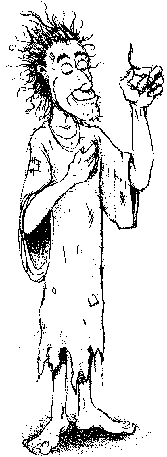
Once upon a time there was a man who looked and acted just like a holy man. He wore nothing but rags, had long matted hair, and relied on a little village to support him. But he was sneaky and tricky. He only pretended to give up attachment to the everyday world. He was a phoney holy man.
A wealthy man living in the village wanted to earn merit by doing good deeds. So he had a simple little temple built in the nearby forest for the holy man to live in. He also fed him the finest foods from his own home.
He thought this holy man with matted hair was sincere and good, one who would not do anything unwholesome. Since he was afraid of bandits, he took his family fortune of 100 gold coins to the little temple. He buried it under the ground and said to the holy man, “Venerable one, please look after this my family fortune.”
The holy man replied, “There’s no need to worry about such things with people like me. We holy ones have given up attachment to the ordinary world. We have no greed or desire to obtain the possessions of others.”
“Very well, venerable one,” said the man. He left thinking himself very wise indeed, to trust such a good holy man.
However, the wicked holy man thought, “Aha! This treasure of 100 gold coins is enough for me to live on for the rest of my life! I will never have to work or beg again!” So a few days later he dug up the gold and secretly buried it near the roadside.
The next day he went to the wealthy villager’s home for lunch as usual. After eating his fill he said, “Most honourable gentleman, I have lived here supported by you for a long time. But holy ones who have given up the world are not supposed to become too attached to one village or supporter. It would make a holy man like me impure! Therefore, kindly permit me to humbly go on my way.”
The man pleaded with him again and again not to go, but it was useless. “Go then, venerable sir,” he agreed at last. He went with him as far as the boundary of the village and left him there.
After going on a short way himself, the phoney holy man thought, “I must make absolutely sure that stupid villager does not suspect me. He trusts me so much that he will believe anything. So I will deceive him with a clever trick!” He stuck a blade of dry grass in his matted hair and went back.
When he saw him returning, the wealthy villager asked, “Venerable one, why have you come back?” He replied, “Dear friend, this blade of grass from the thatched roof of your house has stuck in my hair. It is most unwholesome and impure for a holy one such as myself to ‘take what is not given’.”
The amazed villager said, “Think nothing of it, your reverence. Please put it down and continue on your way. Venerable ones such as you do not even take a blade of grass that belongs to another. How marvellous! How exalted you are, the purest of the holy. How lucky I was to be able to support you!” More trusting than ever, he bowed respectfully and sent him on his way again.
It just so happened that the Enlightenment Being was living the life of a trader at that time. He was in the midst of a trading trip when he stopped overnight at the village. He had overheard the entire conversation between the villager and the ‘purest of the holy’. He thought, “That sounds ridiculous! This man must have stolen something far more valuable than the blade of dry grass he has made such a big show of returning to its rightful owner.”
The trader asked the wealthy villager, “Friend, did you perhaps give anything to this holy looking man for safekeeping?” “Yes friend,” he replied, “I trusted him to guard my family fortune of 100 gold coins.” “I advise you to go see if they are where you left them,” said the trader.
Suddenly worried, he ran to the forest temple, dug up the ground, and found his treasure gone. He ran back to the trader and said, “It has been stolen!” “Friend,” he replied, “No one but that so-called holy man could have taken it. Let’s catch him and get your treasure back.”
They both chased after him as fast as they could. When they caught up with him they made him tell where he had hidden the money. They went to the hiding place by the roadside and dug up the buried treasure.
Looking at the gleaming gold the Bodhisatta said, “You hypocritical holy man. You spoke well those beautiful words, admired by all, that one is not to ‘take what is not given’. You hesitated to leave with even a blade of grass that didn’t belong to you. But it was so easy for you to steal a hundred gold coins!” After ridiculing the way he had acted in this way, he advised him to change his ways for his own good.
The moral is: Be careful of a holy man who puts on a big show.















 Peace LiLy