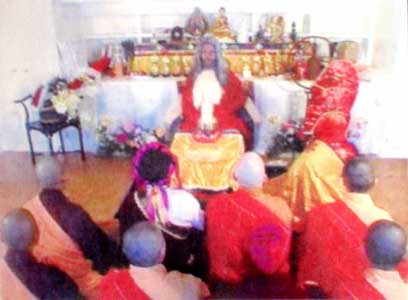
In the tranquil setting of one afternoon, Sariputra and Maudhara, the first disciples of the Shakyamuni Buddha, introduce an ascetic named Tigaro to the profound teachings of enlightenment. Little did they know that this encounter would unveil a tapestry of insights and narratives, offering timeless wisdom that transcends doctrines and narrow beliefs.
Upon meeting the Buddha, Tigaro’s skepticism manifests through his query: “What exactly is your doctrine?” His disdain for theories is palpable as he voices his disbelief. However, the Buddha, with a serene countenance, responds with an unexpected question, challenging Tigaro’s perspective: “Then you don’t believe yourself? What about those who don’t believe in any theory? Do you believe in unbeliefism?” This exchange sets the stage for an enlightening discourse on the nature of truth and belief.
With a calm and understanding demeanor, the Buddha delves into his teachings, addressing the perils of rigid doctrines. He elucidates how attachment to perceived truths stifles freedom and engenders conflict. Through poignant storytelling, exemplified by the narrative of a young widower and his son, the Buddha illustrates the consequences of attachment and false perceptions.
In the heartrending tale, a young widower cherishes his 5-year-old son deeply. However, tragedy strikes when one day the father must depart on business, leaving his son alone. Bandits ravage the village on that very day, and upon his return, the widower discovers his home burned and his son presumed dead. Overwhelmed by grief, he cremates what he believes to be his son’s remains and carries the ashes with him daily, a poignant symbol of his attachment.
A month later, the son miraculously returns, only to find his father clinging to the ashes. Despite his son’s pleas and knocking on the door, the widower, consumed by his attachment to his perceived reality, remains oblivious. In a heartbreaking moment, the son departs once more, unable to break through his father’s delusion. The narrative poignantly illustrates the impermanence of existence and the tragedy of clinging to false perceptions.
The essence of Buddha’s teachings transcends philosophical abstraction. Rooted in direct experience and empirical truth, Buddhism offers a profound understanding of oneself and the world. The Buddha invites practitioners to explore the depths of their minds, guiding them toward liberation from suffering.
The Buddha employs a metaphorical finger pointing to the moon to elucidate the nature of his teachings. He emphasizes that his teachings serve as a guide, directing attention toward ultimate truth rather than being the truth itself. This analogy underscores the importance of experiencing reality directly, beyond the confines of doctrinal interpretations.
As Tigaro seeks guidance on overcoming painful feelings, the Buddha imparts practical wisdom. He elucidates the nature of feelings and their origins, offering a pathway to transcend suffering through awareness and understanding.
In the presence of disciples such as Sariputra and Maudhara, the Buddha’s teachings resonate as a beacon of wisdom and self-discovery. The narrative serves as an invitation to embark on a journey beyond doctrines and limiting beliefs, toward a profound understanding of reality. In embracing the impermanence of existence and cultivating awareness, individuals can unlock the profound truth that lies within—an eternal truth accessible to all who seek it with an open heart.
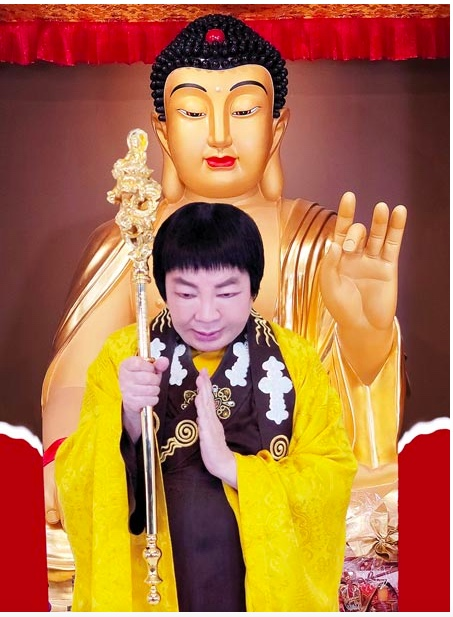
Zhaxi Zhuoma Rinpoche recalls several holy manifestations and unusual supernormal events that she personally witnessed after following her Buddha Master, H.H. Dorje Chang Buddha III Many other students have other similar experiences and are included in books and various articles reported elsewhere on this website. It must be noted that H.H. Dorje Chang Buddha III does not encourage or advocate practicing any form of supernatural power and is very modest about His own abilities. He is constantly warning us not to be attached to these states and experiences, but to instead practice our cultivation and develop our morality, concentration, and wisdom. A more complete accounting of what Zhaxi Zhuoma Rinpoche has seen and experienced is now available in book form on this website and at Amazon and other book stores.
After receiving a small blue “Return-to-Youth Pill”, my hair changed from salt & pepper to the original light brown of my youth. I even let my hair grow, just to see for sure.
When I could not understand why I was asked to do something (although, of course, I did what was asked), several unrelated events occurred that explained why this was so.
I saw three-colored nectar suddenly manifested in a freshly washed bowl after a group of us disciples chanted mantras. Click for news article.
My students have also seen and even received advice from certain holy beings. Several of my students have had the Buddha Master appear and bless them.
I have never seen the Buddha not be able to answer any question asked of him.
On a special occasion, the Buddha Master blessed me and after that a diamond formed on my head that would turn bright red and pulsate from time to time. This also happened when I read the Buddha Master’s discourses, but other times as well.
“Once, when in Washington, D.C., preparing to introduce the book H. H. Dorje Chang Buddha III, to various congressional staff, I saw a very large bright neon pink light jump from tree to tree across a field from where I was staying. Earlier that morning and at other times, I would see bright yellow lights flash when I was doing dharma work for the Buddha Master. They were like the lights that flashed when the discourse What Is Cultivation?was first transmitted.” Click for article on this event.
I saw rainbow “jewels” appear on a holy site where many inner-tantric initiations had been held and where “Auspicious Grass of the Four Jewels” had grown. Click for news article.
After having a minor stroke, I was again healed so as to be able to go on a strenuous trip to visit all fifty states in the U.S.
On several occasions, I have seen pillars of light descend from the heavens, sometimes being able to capture them on digital cameras.
I have seen nectar fall several times and places, the first being in southern California under a certain magnolia tree and the last under that same tree after it had been moved to Hua Zang Si, a temple in San Francisco. It also rained under a flowering jacaranda tree on the veranda where students performed skits and other shows in honor of the Buddha Master’s birthday. Click for news article.
I have seen students practice the tummo (inner heat or fire) dharma and raise their body temperature to very high levels–even high enough to burn the fingers of those who touched a metal bowl lying on the student’s stomach. Click for article.
I have seen sacred seed syllables form on the bodies of students and holy ones.
I have had my crown opened as documented by a MRI devise. Read article on this miraculous event.
Several very large koi fish came and did a dance for the Buddha Master in the pond at the Holy Vajrasana Temple & Retreat Center in Sanger. Schools of fish also followed the Buddha Master around as He toured a Japanese garden south of San Francisco and Dragon Fish came to pay respect to the Buddha when he gave a discourse in Thailand.
A vajra pill sang and danced while I held it.
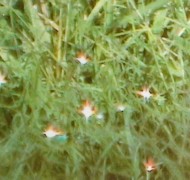
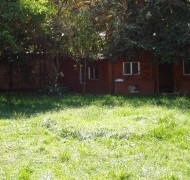
I saw a particular type of flower called “Auspicious Grass of the Four Jewels” grow directly in front of where the Ultimate Bathing the Buddha ceremony took place. The flowers had four distinct very thin parts. They grew in a particular pattern and formed a perfect circle. Prior to the Dharma Assembly the area was perfectly flat. After the ceremony, the ground became slightly elevated, forming a mound upon which these special flowers grew. These flowers grew no other place in the yard. Click for news article.
Another red vajra pill flew from my hand to a holy place and was recovered and empowered by the Kalachakra Vajra, a manifestation of Shakyamuni Buddha. The pill danced in my hand and also in a clear stupa where it remains. It continues to dance in the stupa from time to time. Click for article.
An old metal pole started shaking quite violently at the temple and over time was joined by four more poles. Sometimes the shaking is constant, sometime it seems to pulsate as if sending coded messages. Others report seeing various lights or feel energy emanating from these poles. Pilgrims travel from all over the world to see these poles. Click for article. Also see many news articles of pilgrims visiting the poles.
Many light beings from other realms appear and can sometimes be seen by the naked eye and sometimes only on video or digital recordings at the temple in Sanger. Visitors to the temple have also seen and recorded them. Click for photos.
I saw the beautiful and amazing relics or sharira from a special close disciple of the Buddha Master. Click for article.
The Buddha Master was able to transfer His energy to me and enable me to raise my temperature after it continued to decline to dangerous levels.
A colored mandala was written on top of a large flat stone. After dharma was done, the stone was removed and the same mandala had been transferred through the stone and appeared on a bed of sand beneath the stone. This I saw done twice. The second time a pile of mixed various colored sands was placed below the stone, but were sorted out into seed characters after the dharma was performed on the stone. Click for photo.
I experienced the elimination of dark karma by having the Buddha Master’s magical Dharma Wheel placed on my chest. I could not bear the heat of the small metal object, but the Buddha Master picked it up with no problem. Click for news article.
I saw the Buddha Master create incredible works of art in very short periods of time. Some even contained a permanent fog or mist. Click for photo
I saw the Buddha Master change very quickly from an old beaten and bruised person to His usual self. This happened after the Buddha Master had predicted what would happen the previous day. An even more amazing transformation from an old man to a handsome youth happened and was was documented more recently. Click for more.
I saw the Buddha Master turn blue during an empowerment ceremony. I did not know at the time that He was an incarnation of Dorje Chang Buddha who is blue. Click for article.
I saw my roommate and another rinpoche lift a pool of water weighing over two tons with only the power of their mantras at the Ultimate Bathing of the Buddha Dharma Assembly. Click for more.
I have seen the consciousness of my relatives and those of my students raised to a higher level. One western student’s mother (who was not a Buddhist) had the Buddha Master come to help her go to the Pure Land. Click for news article.
I was there when a very young rinpoche took a vow that she would become accomplished in a very short period of time after she had received a Prajna Empowerment and she did.
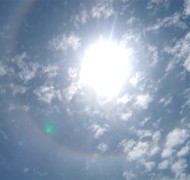
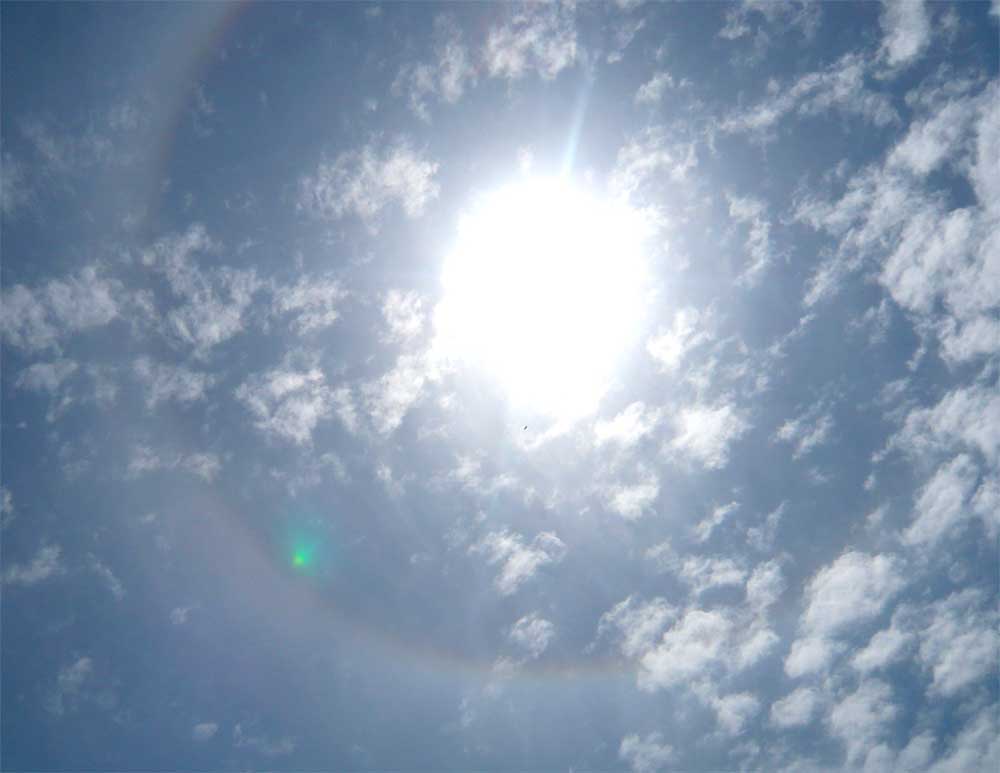
I have seen many, many Buddha Lights appear around both the sun and the moon prior or after or during special dharma assemblies or events.
I saw an antique wooden statue of Kuan Yin emit golden light after another dharma of selection ceremony. This time I shook a large container of long bamboo sticks. Each stick had a certain number that corresponded to a given outcome. I did this three or four times for each event and each time the results for each time I shook the sticks was the same AND exactly what the Buddha Master had predicted. I witnessed variations on this dharma many times.
I received a dharma of selection whereby I printed a number of outcomes on small pieces of paper for a major life decision that I was about to make; rolled these pieces of paper into tight rolls; placed these rolls in a round vase, and then asked to shake the vase and remove one. I rerolled it and replaced it doing this at least three times. Each time, I drew the same answer, which was the answer the Buddha Master gave me in the beginning.
I was present when various colored sharira appeared in a cloud of nectar.
I experienced a “freak” rain of hail one summer in Los Angeles that only rained where the Buddha Master was staying and right after a speech given by the Buddha Master that had forecasted such an event.
I saw sand from the Ganges River in India assemble to form strands of hair that created a three-dimensional crown on certain images of H.H. Dorje Chang Buddha and Shakyamuni Buddha to prove that they were both incarnations of Buddhas.
Among all Buddhas in the Dharma realm, Dorje Chang Buddha is the Primordial Buddha, the first Buddha with form, and the only Supreme Lord of Buddhism throughout the entire universe. Dorje Chang Buddha propagated Dharma throughout the universe, hence, all other Buddhas and Great Mahasattvas learned Dorje Chang Buddha’s Dharma and cultivation to attain holy state and liberation, and eventually became Buddhas and Great Bodhisattvas. Dorje Chang Buddha is the primordial ancestor of all Buddhas and Bodhisattvas. Samantabhadra, the Dharmakaya from which Dorje Chang Buddha perfectly manifested, is the Tathagata that has no form at all. The words and deeds of Dorje Chang Buddha are the compass and guiding principles of cultivation for all ordinary and holy beings in the universe.
To help Shakyamuni Buddha, Namo Dorje Chang Buddha II —Venerable Virmalakirti—applied His supreme wisdom and limitless supernormal power to edify Hinayana Arhats who then advanced themselves and eventually became Mahayana Bodhisattvas who helped living beings attain liberation. And, innumerable living beings attained liberationby learning the teachings of Venerable Virmalakirti.
After coming to the sahā world with the Buddha level enlightenment of the Primordial Sambhogakaya Buddha, His Holiness Dorje Chang Buddha III established countless number one records in the world, every one of which was for the sake of benefiting living beings. At a very young age, He saved others without any regard to His own life and was honored with the title “Young Hero.” As He grew older, His Holiness Dorje Chang Buddha III applied His inherent Healing Vidya to heal the sick, purely on a voluntary basis. More than 500 patients used to seek His help every day. His Holiness Dorje Chang Buddha III never accepted one penny from them. Plaques and pennants with words of gratitude sent by the recovered piled up in the Buddha’s house.
As His Holiness Dorje Chang Buddha III continued to benefit living beings on a larger scale, the Central Newsreels and Documentary Studio of China produced a documentary, “One Who Is Dedicated to Advance Himself,” about His life and work. The film was shown nationwide.
In 1987, the highly respected young His Holiness Dorje Chang Buddha III was named Chairman of the Chinese Painting Research Association of the National Commission of China for UNESCO. Honorary chairpersons of the Association included Liao Jingdan 廖井丹, Li Wenqing 李文清, Lü Ji 呂驥, Yuan Xiaoyuan 袁曉園, Wu Zhangshu 吳丈蜀, Qian Juntao 錢君匋, Xie Zhiliu 謝稚柳, and others. Advisors to the Association included Luo Zhanglong 羅章龍, Zhang Kejia 臧克家, and so forth.
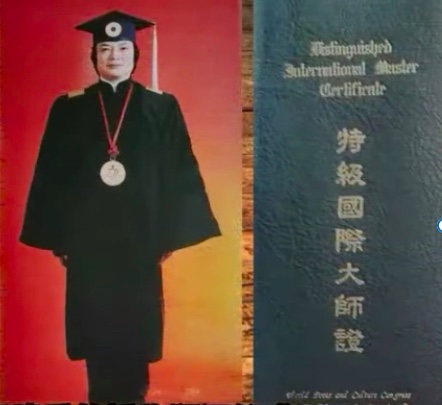
In 1992, His Holiness Dorje Chang Buddha III was accorded the “Art Maestro of the East” title. In 1994, during the fourth conference of the World Poets and Culture Congress held in Hungary, 5,612 experts and scholars unanimously voted to confer the “Preeminent Distinguished International Master” title, which was a Head of State level honor, to His Holiness Dorje Chang Buddha III.
The conferment certificate was signed by Juan Antonio Samaranch, the then President of the International Olympic Committee. In the same year, the Museum of Master Yi Yungao officially opened in Dayi 大邑, the hometown of His Holiness Dorje Chang Buddha III in Sichuan. That was the first memorial museum in China, or even in the world, being built by a government for a living person.
In 1995, when His Holiness Dorje Chang Buddha III went from Mainland China to visit Taiwan for the first time, Taiwanese people spontaneously gave His Holiness Dorje Chang Buddha III an overwhelmingly ceremonious welcome. More than 20,000 people went to the airport to greet and pay respect to His Holiness Dorje Chang Buddha III. A motorcade of more than 1,700 cars followed the lead of police motorcycles to escort His Holiness Dorje Chang Buddha III from the airport to the hotel. That became the largest welcoming event in human history. Within the short three weeks that His Holiness Dorje Chang Buddha III stayed in Taiwan, General Chiang Wei-kuo 蔣緯國, former Secretary-General of the Taiwan National Security Council, and many other high level government officials formally requested to become disciples of His Holiness Dorje Chang Buddha III. They expressed that they wanted to truly emulate the noble morality, humanistic ethics, thoughts, and deeds of His Holiness Dorje Chang Buddha III.
After His Holiness Dorje Chang Buddha III moved to the United States, His noble morality and unparalleled achievements won the love and admiration of the American people from all walks of life. In 2002, His Holiness Dorje Chang Buddha III was presented with the “Presidential Gold Medal” by the Commissioner to the President’s Advisory Commission on Asian Americans, on behalf of President Bush.
In 2003, the Organization of American States, composing of 34 countries including the United States, Canada, and Mexico,organized the Master Wan Ko Yee Yun Sculpture Exhibition in Washington D.C. at the Capitol of the United States.
The Master Wan Ko Yee Yun Sculpture Exhibition was also held at the Congressional Office Building. That was the first time the U.S. Congress held an art exhibition in their Congressional Office Building. Visitors expressed their praises in the guest book, exclaiming that the exhibition was “unprecedented,” and that the artworks were “treasures brought to the human realm by God.”
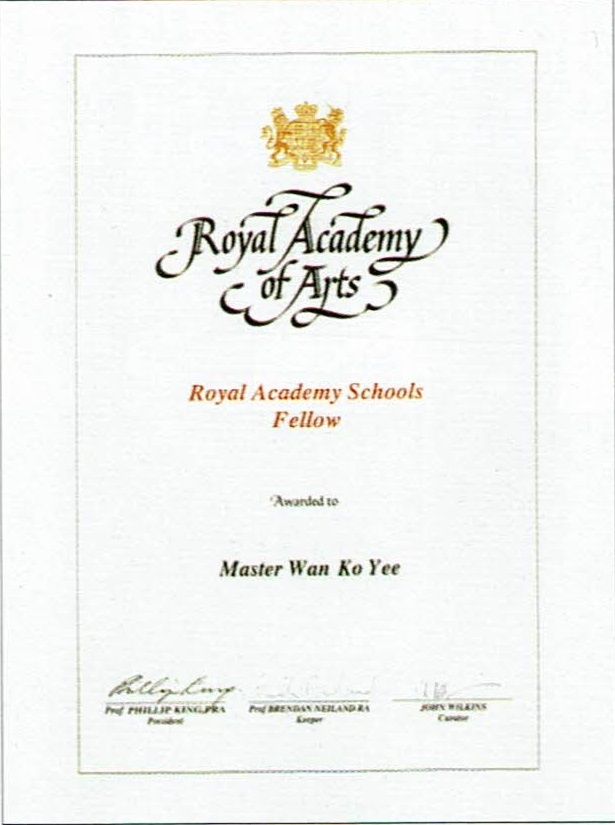
In 2004, His Holiness Dorje Chang Buddha III was named “Fellow” of the Royal Academy of Arts in the U.K.. Professor Phillip King, President of the Royal Academicians of the Royal Academy of Arts, presented the certificate to His Holiness Dorje Chang Buddha III at the British Embassy in Washington D.C., capital of the United States. The Cultural Attaché of the British Embassy personally attended the ceremony. Professor Phillip King stated that His Holiness Dorje Chang Buddha III was the first artist ever accorded this title in their renowned academy’s more than 200-year history.
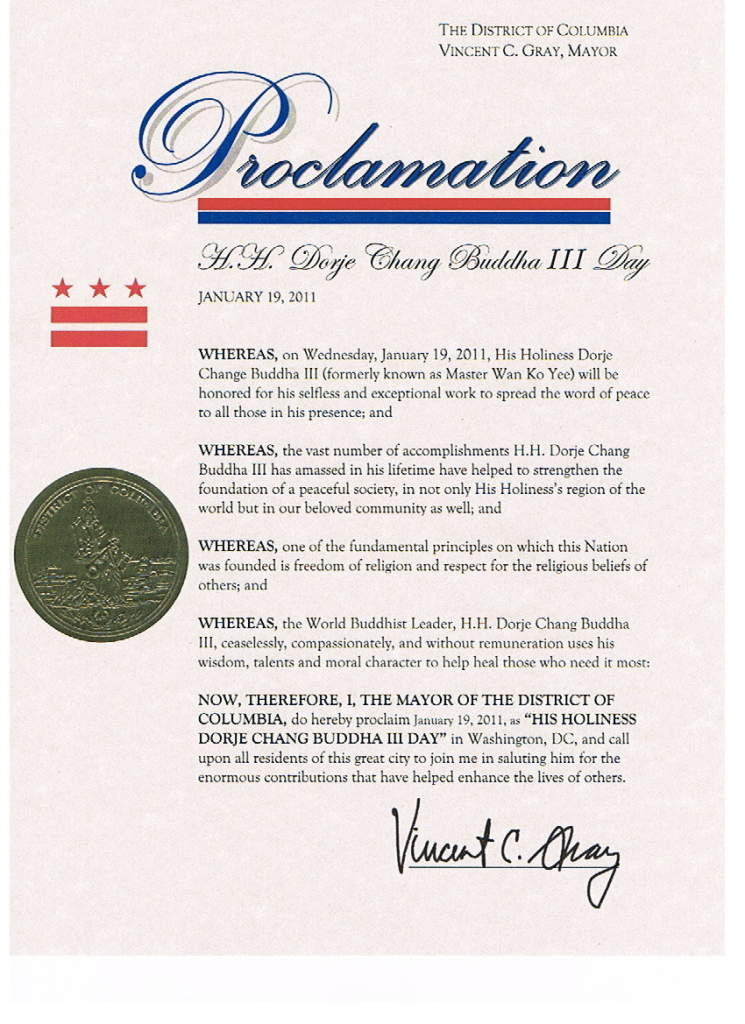
The mayor of the U.S. capital Washington D.C.pronounced January 19, 2011 as “His Holiness Dorje Chang Buddha III Day” and called on people to salute to His Holiness Dorje Chang Buddha III.
His Holiness Dorje Chang Buddha III was also accorded the “King Legacy Award for International Service & Leadership” by An International Salute to The Life and Legacy of Dr. Martin Luther King, Jr.. Dozens of great honors have also been presented to His Holiness Dorje Chang Buddha III by U.S. senators, members of the House of Representatives, governors, and governments of all levels.
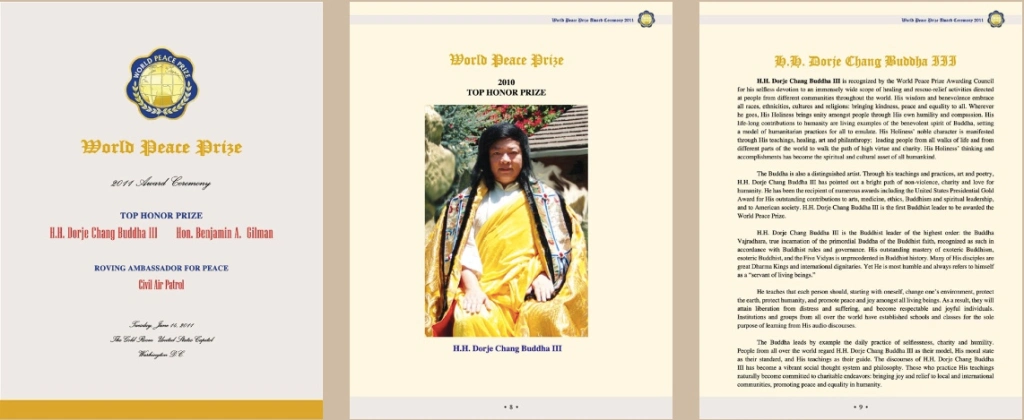
More remarkably exceptional, Namo Dorje Chang Buddha III was awarded the 2010 World Peace Prize Top Honor Prize, presented to Him at the United States Congress on June 14, 2011 at the U.S. Capitol. On occasions of the holy birthday of His Holiness Dorje Chang Buddha III, the U.S. Congress has held ceremonies to raise the national flag to celebrate, and President Trump and President Biden have sent personal congratulations.
In 2018, the World Peace Prize Awarding Council and the World Peace Prize Religious Leader Title Awarding Council resolved that His Holiness Dorje Chang Buddha III was the Pope of Buddhism of this world and decided to present the Pope of Buddhism Scepter to Him. Namo Dorje Chang Buddha III, however, did not accept the Scepter, but returned it instead. In September 2020, the World Peace Prize Awarding Council and the World Peace Prize Religious Leader Title Awarding Council made a joint resolution that solemnly stated, “The title, status, and authority of the Pope of Buddhism belong only to His Holiness Dorje Chang Buddha III and cannot be exercised by anyone else. This is a permanent and unalterable determination!” The two Councils also entrusted the World Buddhism Association Headquarters to present the Pope of Buddhism Scepter on their behalf to His Holiness Dorje Chang Buddha III.
Upon coming to this world, His Holiness Dorje Chang Buddha III immediately started teaching and saving living beings. He has always called Himself a “nameless cultivator.” His Holiness Dorje Chang Buddha III voluntarily served living beings and did not accept any offerings. One incident clearly shows how Namo Dorje Chang Buddha III taught and saved living beings selflessly. At the Heart Sutra Mandala on Xinhua West Road, Chengdu, Dharma Master Guozhang 果章法師 once recounted to some people that when he received initiation from His Holiness Dorje Chang Buddha III on Paoma Mountain 跑馬山, His Holiness the Buddha was only two and a half years old! After the identity of Namo Dorje Chang Buddha III being the true incarnation of the Primordial Buddha was formally recognized by Dharma kings, regent Dharma kings, and great rinpoches of major Buddhist sects in written congratulations and corroboration letters, His Holiness Dorje Chang Buddha III continued, as always, to teach and save living beings solely on a voluntary basis, and whole-heartedly devoted Himself to serving living beings. Whenever people made offerings to His Holiness Dorje Chang Buddha III, whether they were big or small offerings, in amounts as little as one dollar or as large as a few million US dollars, in the form of 37 acres of land in the city of San Francisco, or even a planeload or a shipload of gold, Namo Dorje Chang Buddha III categorically refused to accept. His Holiness Dorje Chang Buddha III was whole-heartedly dedicated to serving living beings voluntarily.
In the many years that His Holiness Dorje Chang Buddha III was propagating Dharma to save living beings, He imparted more than 2,000 Dharma Discourses in response to living beings’ levels and karmic conditions. Not only did His Holiness Dorje Chang Buddha III reveal the truth about humanity and the universe, He also elucidated the truths relevant to various stages of practices, from elementary to profound accomplishment levels.
Those Dharma Discourses were audio-recorded, and some of which such as What Is Cultivation 什麽叫修行, Sutra on Understanding and Realizing Definitive Truth 了義經, Imparting the Absolute Truth Through the Heart Sutra 藉心經說真諦, and Learning from Buddha 學佛, have been published into books.
In restoring Buddhist texts to their original meaning, His Holiness Dorje Chang Buddha III pointed out that the morning and evening chants used in Buddhist temples nowadays had been tampered with by the descendants of Mara, and those texts are filled with evil views and fallacies. Namo Dorje Chang Buddha III has corrected many errors made by patriarchs and translators in their interpretations of Dharma principles, and directly revealed the chaotic phenomena in Buddhism during this Dharma Ending Era. His Holiness Dorje Chang Buddha III pointed out the path that everyone who wants to attain liberation must take: That is to build our foundation on practicing cultivation. After cultivating ourselves well, we can then learn Dharma, and naturally attain liberation and accomplishment. The correct truths and Dharmas imparted by His Holiness Dorje Chang Buddha III enable listeners to develop their wisdom and good fortune, to help each other, care about each other, and be compassionate to all living beings.
In different countries, Namo Dorje Chang Buddha III has performed great Dharmas including Holy Amrita Bestowed by Buddhas 佛降甘露, Xianliang Great Perfection 現量大圓滿, Holy Fire Offering 勝義火供, Vajra Faman Determination by Holy Selection 金剛法曼擇決, Hayagrīva Raja Water Mandala Bead Divination 馬頭明王水壇珠卦, Determination by Holy Selection on the Regression or Progression on the Bodhi Path 菩提道損減增益法, Guaranteed Delivery to Buddha Land Dharma 保送法, Vajra Array 金剛陣, and Eight Wind Array 八風陣, all of which manifested authentic holy states, enabling living beings to see with their own eyes that Buddha Dharmas are scientific, have veritable power, and absolutely are not just empty talk or theory. More importantly, Namo Dorje Chang Buddha III has brought The Supreme and Unsurpassable Mahamudra of Liberation to living beings in the sahā world, showing humanity the shortcut to attaining liberation. The Supreme and Unsurpassable Mahamudra of Liberation is the highest Dharma that Dorje Chang Buddha transmitted to Amitabha Buddha as well as Buddhas and Great Bodhisattvas in the ten directions during their cultivation stage.
In The Supreme and Unsurpassable Mahamudra of Liberation, His Holiness Dorje Chang Buddha III has made the biggest and highest vow in the entire Dharma realm, “I bear all the sinful karma for living beings, I give living beings all the good karma and merit that I have planted.” Namo Dorje Chang Buddha III has actualized the greatest and holiest vow, sacrificed His life to save the lives of numerous living beings, and returned to the Sambhogakaya Buddha Land!
The unprecedented records established by Namo Dorje Chang Buddha III in this world:
Namo Dorje Chang Buddha III was, historically, the first Buddha to have received the largest, unprecedented number of status-recognition and congratulatory letters by top level great Dharma kings and rinpoches.
Namo Dorje Chang Buddha III was recognized with the highest status in history: an Ancient Buddha.
Namo Dorje Chang Buddha III is the first Ancient Buddha who manifested perfect mastery in Exoteric and Esoteric Buddhism, and perfection of the Five Vidyas. No one else has been able to accomplish the same in the past few thousand years.
Namo Dorje Chang Buddha III manifested Buddha-level wisdom in the creation of Yun Sculpture, which nobody has been able to replicate. Historically, this is the first art form that cannot be replicated.
Namo Dorje Chang Buddha III is the first Ancient Buddha throughout history who only benefited others but did not accept any offerings.
Namo Dorje Chang Buddha III is, historically, the first Ancient Buddha who manifested the most holy miracles.
Namo Dorje Chang Buddha III is, historically, the only Buddha who could offer the kind of Buddha Dharma that enables disciples to attain liberation within two hours: Xianliang Great Perfection, the quickest path to successfully enter the Buddha Land.
Namo Dorje Chang Buddha III had the largest number of disciples who attained accomplishments; for example: Dharma King Daxila of the Tsalpa Kagyu Sect attained the rainbow body; respected layperson Wang Lingze 王靈澤 and Dharma King Gar Tongstan attained freedom from death and rebirth and passed away in a sitting meditative pose; Dharma Master Puguan 普觀法師 and Elder Monk Wuming 悟明長老 attained incorruptible flesh bodies; the Elder Monk Yizhao 意昭老和尚 vowed to return to the sahā world to save living beings; and many others.
Namo Dorje Chang Buddha III has transmitted Dharma to disciples and invoked Avalokiteshvara Bodhisattva to come at a specific time to take the disciple to the Buddha Land; even non-Buddhists saw with their own eyes when the disciple Zhao Yusheng 趙玉勝 was taken away by Avalokiteshvara Bodhisattva. Some disciples, such as Hou Yushan 侯欲善 and Lin Liu Hui-Hsiu 林劉惠秀, were able to visit the World of Ultimate Bliss, then return to the human world before ascending at a specific time to the Buddha Land. The above listed are just a few examples of the numerous Buddhist disciples who followed Namo Dorje Chang Buddha III and attained liberation.
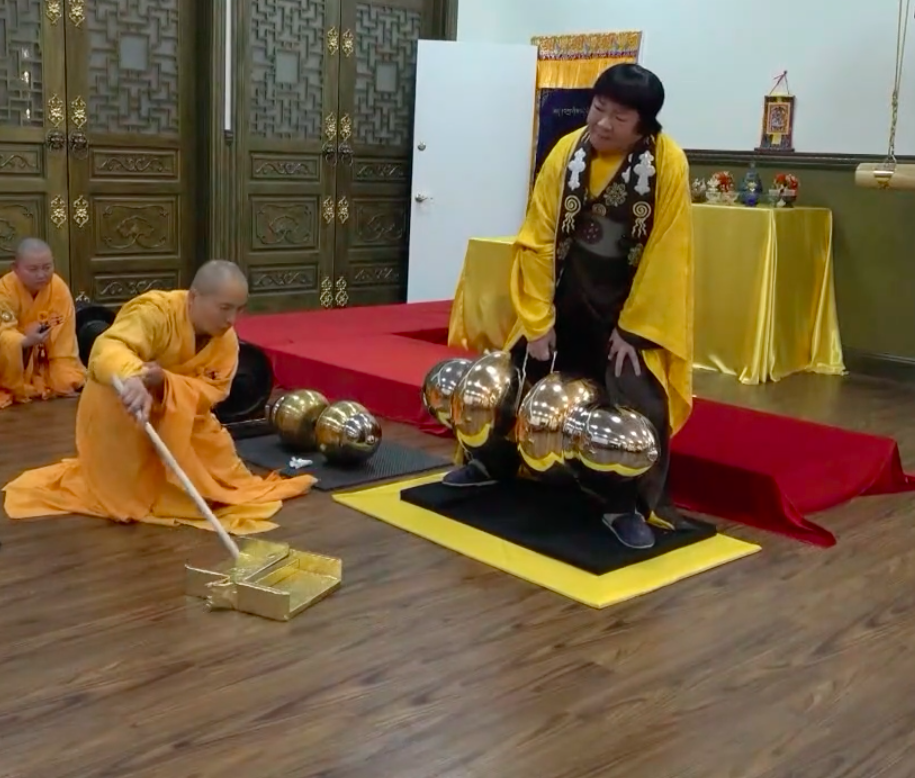
Namo Dorje Chang Buddha III possessed Buddha-level physical constitution and physical strength that are unmatched in the world. Just about a little more than a month ago, on December 23, 2021, at the Holy Miracles Temple, His Holiness Dorje Chang Buddha III lifted the Supreme Holy Vajra Pestle that weighs 437.2 pounds, by using just four fingers to hook on to the Pestle, lifted it up, and held it for more than 13 seconds, surpassing His own base weight standard by 72 levels. Taizun Poshan Waxiang 破山瓦象太尊 asserted: “In this world, from the ancient past up to now, and even before Maitreya Bodhisattva attain Buddhahood, no ordinary or holy being will be able to lift the Buddha Pestle that Namo Dorje Chang Buddha III lifted, surpassing His own base weigh standard by 72 levels!”
The morality of Namo Dorje Chang Buddha III is so noble, His accomplishments so great, and the holy miracles He performed so numerous that it is impossible for us to list them all. What was listed above was just a drop in the ocean. If we were to tell you about all the magnificent feats of His Holiness Dorje Chang Buddha III, it would take more than ten days and ten nights. The magnificent greatness of Namo Dorje Chang Buddha III is not limited to His well-respected humanistic ethics, His noble personality and morality, His erudition, His distinguished accomplishments, His selfless compassion toward humanity and all living beings, and His passion in teaching and actualizing the practice of Buddha Dharma.Through altruistic endeavors, His Holiness Dorje Chang Buddha III truthfully, sincerely, and persistently actualized the principle of compassion, and He diligently worked toward the development of world peace. Many people are moved and motivated by His Holiness Dorje Chang Buddha III. Many people in this world aspire to Namo Dorje Chang Buddha III as their model, referencing His state of morality as their standard, and using His teachings as guidance to elevate their own morality and to benefit living beings. In doing so, not only have they fulfilled happiness in their lives, but many of them have ascended to the Buddha Land, attained freedom from death and rebirth, or attained even higher states of realization and accomplishments.
More importantly, Namo Dorje Chang Buddha III pointed out a bright path for humanity to stay far away from violence, a path that leads to benevolence and loving kindness, successful endeavors, happy families, peace in humanity, and prosperity in societies. Throughout different countries and regions in the world, more and more people of different ethnicities and cultures are actively learning and following the teachings of Namo Dorje Chang Buddha III to cultivate themselves and benefit living beings. Consequently, they have greatly elevated the level of morality in society, advanced human civilization, motivating more and more people in this world to become good, kind, and ethical people, and enabling the world to become an auspicious and green planet. These are the tremendous and inexhaustible contributions that Namo Dorje Chang Buddha III has brought to all human and other sentient beings in this world, so they may increase their happiness.
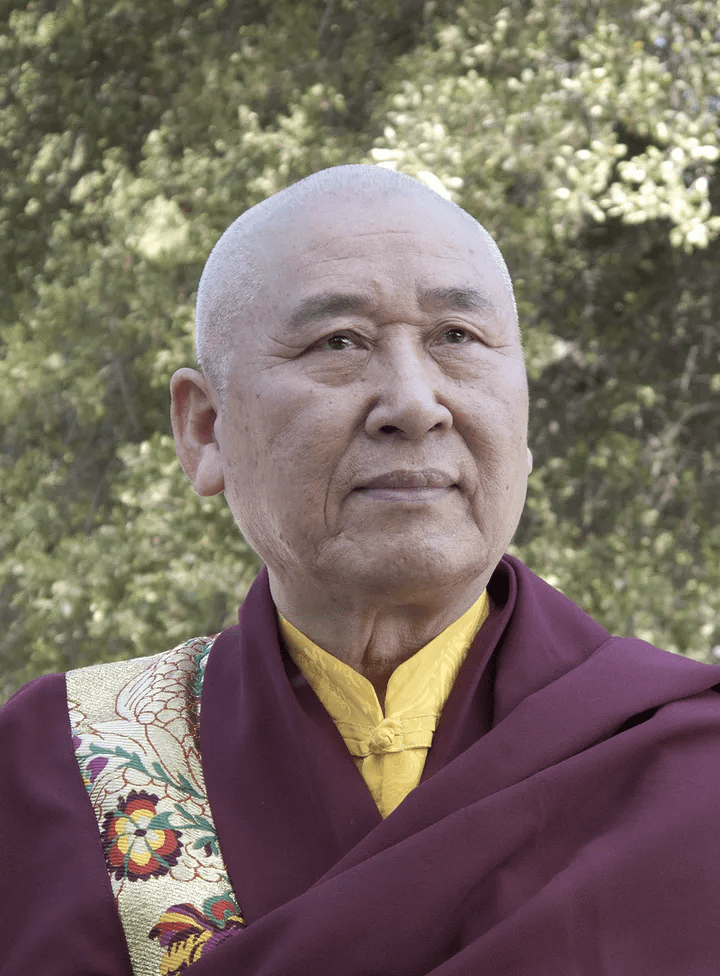
H.E. Kaichu Rinpoche, an extremely loyal disciple of H.H. Dorje Chang Buddha III, cultivates himself with apure heart in accordance with the dharma. He was recognized by H.H. Dharma King Mohe as the reincarnation of a rinpoche. He truly cultivates himself and has true realization. In fact, his realization is the most successful among all rinpoches in the entire world today.
Within one hour from the time he received the “Xian Liang Great Perfection” State Practice Initiation from H.H. Dorje Chang Buddha III, he attained the rainbow body state, enabling him to enter directly a Buddha-land state. He thereby attained realization and accomplishment in an unheard-of short time.
In order to manifest the dharma, Kaichu Rinpoche practiced the Corpse-Pose Tummo (Inner-Heat) Dharma in front of many people. The heat he generated in his body rose to 197.4 degrees Fahrenheit. Numerous dharma kings and rinpoches have been burned by the inner-heat he has generated. Among all dharma kings and rinpoches in the entire world today who practice tummo concentration dharma, Kaichu Rinpoche has generated the second highest inner-heat. The pre-eminent practitioner of tummo concentration dharma in the world today and the only one ahead of Kaichu Rinpoche is Mozhi Rinpoche, who is the highest disciple of H.H. Dorje Chang Buddha III.
Picture on top: Infrared thermal sensor detects the initial ignition and high temperature of fire Picture on bottom: The crowd gathered around the fire ignited and controlled by the infrared thermal sensor
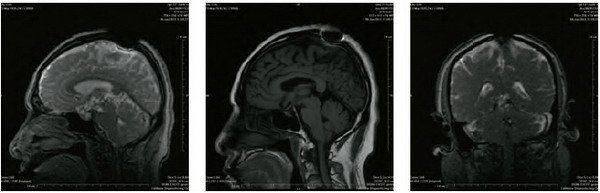
Additionally, through the Vajra Substitute Body Mediation, the crown of the head of Kaichu Rinpoche opened a width of more than two fingers. His consciousness can freely leave and enter his body. He has attained the state of non-attachment to anything and unification with the dharma realm.
KaiChu Rinpoche MRI magnetic resonance imaging brain CT scan medical images
The following is a sincere account written by H.E. Kaichu Rinpoche to convey his deepest admiration and gratitude to H.H. Dorje Chang Buddha III.
IN THIS ENTIRE WORLD, ONLY H.H. DORJE CHANG BUDDHA III CAN TRANMIT THE XIAN LIANG GREAT PERFECTION DHARMA
I prostrate to H.H Dorje Chang Buddha III!
All Buddhist disciples know that the Longchen Nying-thik Great Perfection Dharma was the highest Buddha-dharma in this world. If one practices that Buddha-dharma well, one can attain the rainbow body in twelve years and thereby become liberated.
However, within one hour I entered a rainbow Buddha-land when H.H. Dorje Chang Buddha III transmitted to me the highest and greatest dharma in the universe — the Xian Liang Great Perfection Dharma. I was so fortunate to receive that dharma. When one compares one hour with twelve years, one can see just how supreme and magnificent the Xian Liang Great Perfection Dharma is! H.H. Dorje Chang Buddha III has brought that Buddha-dharma to this world for the first time in the history of this world. Even Sakyamuni Buddha did not transmit that Buddha-dharma to any of His disciples. Great Bodhisattvas and patriarchs do not know that dharma and therefore are unable to transmit it.
I also personally experienced many inconceivable supernatural Buddha-dharma states when H.H. Dorje Chang Buddha III transmitted to me other dharmas, such as when the crown of my head opened more than the width of two fingers, when my consciousness left and entered my body at will, when I experienced the other-empty exchange state, and when I experienced high- temperature tummo heat (internal heat). Only a true Buddha such as H.H. Dorje Chang Buddha III possesses such Buddha-dharma, morality, and wisdom!
Therefore, only H.H. Dorje Chang Buddha III is the highest refuge for all holy beings and all living beings!
Throughout the ages, in the pursuit of happiness, countless individuals have renounced worldly life to engage in spiritual practice. Monks and nuns who have shaved their heads and taken vows can be seen wandering in the secular world. People become monastics for various reasons, including pressure from material needs, family discord, social conflicts, life hardships, or a desire to seek liberation from the suffering of birth, aging, sickness, and death. Some renounce the worldly life to transcend desires, cultivate spiritual practices, and embark on the path to enlightenment. However, those who renounce a life of wealth, family, and worldly pleasures to become monastics are extremely rare.
Modern figures like Venerable Xuyun, Master Hongyi, Master Nenghai, and Master Longlian are typical examples of genuine monastics. Their renunciation was wholeheartedly directed towards the Buddha, without worldly attachments. When they made the decision to become monastics, their minds were solely focused on Buddha and Bodhisattvas, despite their flourishing family lives, prosperity, talents, and widespread respect. They left their homes without any attachments, not even informing their families. Suddenly, they abandoned their comfortable lives and became ascetics in the temples. Such individuals are rare, occurring perhaps once in several decades.
However, today, there is a Bhikshuni (Buddhist nun) who has renounced the world in an extraordinary way, captivating people’s hearts. She was originally known as Renbo Rinpoche, with the Dharma name “Awangdeji,” and held some reputation in Chinese Buddhist circles. She had centers in over twenty provinces in China, and her organization had a presence in Taiwan and Hong Kong. Wherever she went, male and female disciples welcomed her with reverence. Despite her prosperous personal business, she decided to renounce her worldly life.
Twenty years ago, she practiced the Sakya tradition but found no progress in her path. Seeking guidance, she turned to the profound teachings of the H.H. Dorje Chang Buddha III. Within a year, she completed her studies and realized that her previous practice was a common worldly path accessible to everyone, not true Buddhist teachings. In 2011, after rigorous examinations, she obtained certificates of realization that many other high lamas could not attain.
Her dedication, compassion, and influence attracted jealousy and rumors from some ordinary practitioners. However, Awangdeji Rinpoche bore no resentment, remaining calm and patient, even praising those who spread rumors. In response to societal criticisms, the International Buddhist Sangha Association sought an objective assessment from the United International World Buddhist Headquarters. After a solemn examination, she was praised by seventeen examiners for her moral virtues and realization.
During the examination, when Awangdeji Rinpoche’s consciousness soared, she personally saw Buddhas and Bodhisattvas, fulfilling a vow made to Avalokiteshvara. Overwhelmed with gratitude, she immediately renounced worldly life. Without her family’s knowledge, she underwent tonsure in Lianfeng Temple, Taiwan, adopting the Dharma name “Zhengda.” She relinquished all worldly wealth and family joy, untainted by the six dusts, transcending the ordinary and entering the realm of the holy.
On December 12th, 2012, a Assembly was held to bestow the initiation of “Selection Made in Dark Confinement from One-Hundred Dharmas to Choose the Door toward Enlightenment” upon Dharma Master Zhengda. This Assembly concluded that Dharma Master Zhengda was a reincarnated holy one and a trusted aide of the Tara. Her status of the dharma was extremely high, at the upper level representing the summit of esoteric Buddhism.
On May 25, 2013, Master Zhengda was honored with the Grand Cross of Humanitarian Merit by the Spanish Humanitarian Merit Association. This award, established and presented by the association, is specifically given to international figures who have made outstanding contributions to promoting world peace, advocating for humanitarian equality, and excelling in public administration, education, arts, charity, and other fields.
After receiving the sacred inner tantric initiation from H.H. Dorje Chang Buddha III, she experienced a remarkable transformation, surpassing ordinary spiritual attainments and delving into profound realms. The International World Buddhist Headquarters at October 25th, 2019 officially acknowledges her as a JiaoZun (Golden Button Stage II), having successfully passed examination conducted and validated by about twenty buddhist masters and monastics. She stands as an embellishment to Buddhism, a virtuous teacher, and a refuge for sentient beings.
ZhengDa Jiaozun is currently the Vice President of the World Buddhist Headquarters, concurrently serving as the Honorary Chairman of the International Buddhist Sangha and the abbot of many temples worldwide. Presently, she resides at the Holy Miracle Temple in Los Angeles and the Benevolence Temple in Las Vegas.
True Words Respectfully Written by Zhou Ma Rinpoche
I AM ZHUO MA Rinpoche. I and nearly 100 Rinpoches, Geshés, Khenpos, and Dharma Teachers participated in the Great Nectar Dharma Assembly conducted by Pamu. At the Dharma Assembly, I saw sacred occurrences that I had never seen before in my life. Pamu was seated on the Dharma King dais. Part of her discourse was as follows: “Everybody look clearly. This is a pure gold, empty Dharma bowl that has just been washed by a Rinpoche. There is nothing in it. Nobody is allowed to approach it. The video camera is not allowed to move during the entire videotaping today. The scene shot by the video camera will not change. Your eyes and the video camera will be used to keep watch on the bowl so as to see how this nectar arrives. Of course, it will be bestowed by the Buddhas themselves! Although I am now living overseas, I know how difficult it is for many Chinese people and other practitioners of Buddhism who do not understand the Tibetan language to learn Vajrayana Buddhism. Additionally, the entire practice of the Dharma today is the result of the ripening of conditions for there to be a great Buddha Dharma event in the land of the Chinese people. I will, therefore, solely use the Chinese language to give a discourse on the Dharma and to practice the Dharma.”
In the middle of the Dharma Assembly, it seemed as if my entire body was filled with a warm current. It was incomparably wonderful. It was not as if I had entered samadhi, yet it was not as if I had not entered samadhi. I truly do not know the reason why. The sky was changing. The earth was changing. There were numerous sacred sights at the Buddhist altar area. I can truthfully say that this is the first time I saw the Buddhas and Bodhisattvas come to the human realm. The empowerment that those virtuous ones in attendance received cannot be described in words.
At the Dharma Assembly, specifically for the Great Perfection Rainbow Body Accomplishment Dharma Initiation, Pamu practiced the Dharma for invoking the bestowal of the Most Precious Nectar. This nectar is indispensable for such initiation. The Most Precious Nectar can also be made into Most Precious Pills. It is the highest level of nectar. With just one taste of it, one will definitely have no obstacles in this lifetime in attaining accomplishment. At the time the nectar descended, the Buddhas also bestowed more than 1,000 yellow, white, and black shariras into the gold bowl.
White Bodhi Nectar
Red Bodhi Nectar
Long Life Nectar
At the Dharma Assembly, Pamu practiced the Dharma to have five types of nectar bestowed. Each type of nectar was of a separate grade. There was Long Life Nectar. It can extend one’s life span, increase one’s merit, deepen one’s state of realization, and help one develop supernormal powers. With just one taste of the silver-gray nectar bestowed by the Long Life Buddha, one’s life span will increase to over 120 years. With two tastes, one’s life span will increase to over 150 years.
There was also the Crystal Body Nectar bestowed by Aksobhya Buddha. Its luster was much more captivating than that of any precious gem. After being initiated with this type of nectar, one can successfully practice the Dharma to achieve the Transparent Crystal Reward Body. With just one taste of this nectar, one can immediately go through walls and have other miraculous powers.
Crystal Bodhi Nectar
There is also the Red Bodhi Nectar. This was bestowed by Amitabha, the first leader of the Vajrayana. This nectar is specially used in the highest and most sacred initiation within Vajrayana Buddhism: The Great Perfection Rainbow Body Dharma. We Rinpoches who were in attendance also saw that the nectar did not have the slightest semblance of anything which was made by man. The difterent types of nectar could not possibly have been objects made by an ordinary person. Each type of nectar had a mysterious and natural structure and seemed to be alive.
When the Dharma Assembly was about to end, Pamu gave the following instructions: Whoever saw the Buddhas descending from the sky and the bestowing of nectar into the Buddhist altar area must attest here today to what they saw in order to uphold the correct view for living being Those of you who did not see these things and who falsely attest will receive karmic retribution. Those Rinpoches and Great Virtuous Ones in attendance all attested to what they saw. The descending of nectar enabled all of us to understand the true tantra and especially enabled us to understand the magnificence of Pamu’s Buddha Dharma. I do not need to say what type of Holy One Pamu is, since everyone already knows. What else can I say at this point? I can only say the following words: Maintain a heart of humility, cultivate yourself well, and save living beings everywhere.
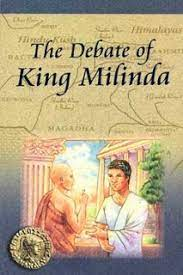
The twelfth among the Eighteen Arhats is recognized as Nagasena in Sanskrit, meaning “Dragon Army.” Often referred to as “Bhikshu Nagasena,” he was a Buddhist theoretical philosopher who received full ordination at the age of twenty and eventually attained the state of Arhat. Bhikshu Nagasena journeyed to the ancient kingdom of Shakyadesha in northwestern India to engage with King Milinda. Responding to the king’s inquiries, Nagasena eloquently expounded on the impermanence of life, the law of karma, and various facets of Buddhist practice, employing metaphors to convey profound insights. This discourse is encapsulated in the “Nagasena Bhikshu Sutra,” representing a comprehensive exposition of fundamental Buddhist teachings.
Below are excerpts from conversations between Nagasena and King Milinda, where the king poses questions and Nagasena responds with profound wisdom and intelligence.
First Question
Once, King Milinda intentionally sought to challenge Bhikkhu Nagasena and questioned him, saying, “You did not live in the same era as the Buddha, and you never met Siddhartha Gautama. How can you be sure that the Buddha actually existed?”
Wise Bhikkhu Nagasena responded by asking, “Great King, how did you inherit your throne?”
“It was passed down to me by my father,” replied the king.
“And from whom did your father receive the throne?” Nagasena inquired.
“From his father, my grandfather.”
“And your grandfather’s throne, from whom did he receive it?”
“From his forefather, my great-grandfather!”
Nagasena continued, “If we trace this lineage generation by generation, do you believe that there was an original founder of your kingdom?”
King Milinda replied with certainty, “Certainly, I believe so!”
“Have you ever seen this founder?” Nagasena asked.
“No, I haven’t.”
“How can you believe in someone you haven’t seen?” Nagasena questioned further.
The king explained, “Our founding monarch established laws, systems, and regulations, all of which are recorded in history. Though I haven’t seen him, I believe in his existence because there are historical records.”
Smiling, Bhikshu Nagasena nodded and said, “In the same way, we believe that the Buddha indeed existed. In Buddhism, there is the Triple Gem of Buddha, Dharma, and Sangha, along with scriptures, Vinaya (monastic rules), and Abhidharma (philosophical teachings). The Buddha’s ethical guidelines and historical events are not fabrications; they are as real as your founding monarch in historical terms!”
Unable to find fault with Bhikkhu Nagasena in the first question, King Milinda, using his wit, posed another challenging query. He asked, “Buddhists often speak of the ultimate happiness being the realization of Nirvana, attaining a state beyond birth, death, and cessation. Bhikshu Nagasena, have you attained Nirvana?”
Bhikshu Nagasena humbly replied, “I’m ashamed to admit that I haven’t.”
King Milinda, feeling triumphant, questioned, “If you haven’t experienced it yourself, how do you know about the state of Nirvana?”
If this question were posed to you, how would you respond?
Rather than directly answering, Bhikshu Nagasena turned the question back to King Milinda, asking, “Great King, if I were to take a large knife and cut off your arm right now, would it be painful?”
King Milinda’s expression changed, and he said, “Certainly, it would be painful! How could having one’s arm cut off not be painful?”
Nagasena pressed on, “But your arm has never been cut off before, so how do you know it would be painful?”
The king replied, “I have seen others experience the pain of having their arms cut off, so I know it would be painful!”
Smiling, Bhikshu Nagasena respectfully remarked, “Great King, just as you can understand the pain of losing an arm by witnessing others, I, too, have seen the joy of those who have realized Nirvana. Hence, I am certain about the sublime nature of the Nirvana state!”
Third Question:
King Milinda, persisting in his skepticism, attempted a third inquiry, asking, “Monastics are supposed to embrace compassion. How do you forgive your enemies?”
Bhikshu Nagasena smiled and replied, “Great King, if you had a festering wound on your leg, would you chop off your entire leg?”
“No, I wouldn’t,” answered the king.
Nagasena continued, “So, what would you do?”
“I would carefully clean it, apply medication, and with time, the wound would heal,” explained the king.
Bhikshu Nagasena stated, “Exactly! Enemies and wrongdoers are like festering wounds. If not taken care of and treated, they will spread and worsen. Therefore, one must use the water of dharma to cleanse them, encouraging them to abandon wrongdoing and turn towards righteousness. This principle is similar to how you, Great King, nurture and care for the wound on your leg!”
Fourth Question:
King Milinda nodded in acknowledgment but remained unconvinced. After contemplating, he posed another question, “You often advise people to accumulate merits for the next life. Since you haven’t experienced death, how do you know there is life after death?”
Bhikshu Nagasena responded with a simile, “It’s similar to a mandarin orange. When the fruit ripens and falls to the ground, the flesh rots away. However, the seed remains buried in the soil. When the time is right, it sprouts, grows, and becomes a robust mandarin orange tree. The human body is just a temporary aggregation of the four elements. When the illusion shatters, the body dies. Yet, the karmic consciousness continues the cycle of birth and death. It is like the seed of the mandarin orange, persistently reincarnating in the six realms, not just once but countless times, with an endless cycle of rebirths.”
Fifth Question:
Despite King Milinda’s lingering dissatisfaction, he presented a fifth question, each one more challenging than the last. However, Bhikshu Nagasena, wise and composed, continued to respond with a smile.
King Milinda asked, “Do monastics love their own bodies?”
Bhikshu Nagasena replied, “The body is merely a temporary confluence of the four elements and five aggregates. Monastics do not have attachment to it.”
King Milinda, feeling confident, cleverly countered, “Oh! You claim not to love your body, but monastics still dress, eat, and sleep. Isn’t that a way of protecting the physical form? If you say you don’t love it, isn’t that a contradiction?”
Bhikshu Nagasena smiled and offered a different perspective, “Great King, if you had a boil on your body, would you love it?”
“A boil? Such a dirty and unpleasant thing! Who would like it?” exclaimed the king.
“If you dislike it, why bother cleaning it, applying medication, and taking constant care to prevent it from worsening? Checking on it every day to see if it’s improving. If you claim not to like the boil, isn’t that contradictory behavior?” Nagasena questioned.
King Milinda, somewhat defiantly, argued, “I do it for the health of my body!”
Bhikshu Nagasena chuckled and said, “Exactly! Monastics may not love this body, but for the purpose of cultivating the spiritual path, they still have to care for this illusory form.”
Sixth Question:
King Milinda, undeterred by previous responses, continued with his inquiries, asking, “Can Siddhartha Gautama, the Buddha, know the causes and effects of the past, present, and future?”
“Buddha possesses great supernatural powers, and indeed, he can know the past, present, and future!” answered Nagasena.
“If that’s the case, why doesn’t he teach all of you those supernatural powers? Then, disciples could instantly know the past, present, and future karmic obstacles, and everyone would attain enlightenment quickly. Why go through gradual training?” questioned the king.
The clever Nagasena, handling the question with ease, asked in return, “Great King, if you were a physician, wouldn’t you know about various medicinal herbs?”
“Of course! A physician needs to know the properties of different herbs and their healing abilities,” replied the king.
“Since a physician knows about numerous medicinal herbs, can he prescribe all of them to a single patient?” Nagasena asked.
King Milinda, dismissing the idea, responded, “Certainly not! Treating an illness requires targeted medications, gradual adjustments, and specific remedies tailored to the patient’s condition. Haphazard prescriptions won’t cure the patient; it needs careful consideration!”
Seizing the opportunity, Nagasena continued, “Likewise, the Buddha imparts the Dharma based on individual capacities, tailoring the teachings to each disciple’s unique qualities. Gradual instruction is necessary, adapting to the disciples’ diverse capacities, to guide them step by step on the path to enlightenment. Otherwise, trying to rush the process might lead to unintended consequences!”
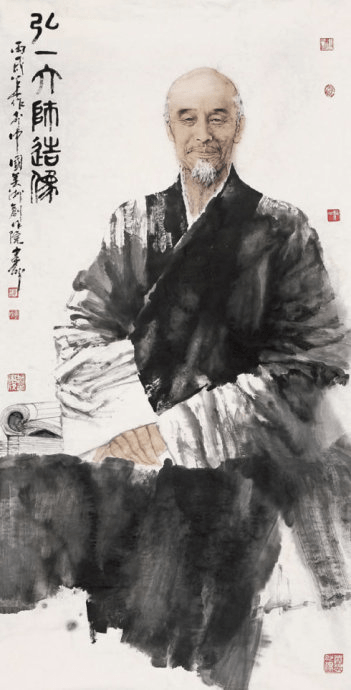
Master Hongyi (弘一大师, October 23, 1880 – October 13, 1942) was originally named Li Shutong (李叔同) and was born into a prosperous family in the bustling northern city of Tianjin on October 23, 1880. The family, originally hailing from Hongdong County, Shanxi, had relocated to Tianjin during the Ming Dynasty.
Li Shutong’s grandfather, a prosperous banker and salt merchant, and his father, Li Shizhen (李世珍), a scholar deeply immersed in Chan Buddhism and the teachings of Ming Neo-Confucian philosopher Wang Yangming (1472-1529), reflected the family’s intellectual and financial standing.
In contrast, Li Shutong’s mother had a modest upbringing as the daughter of a farmer in Pinghu, Zhejiang Province. She became Li Shizhen’s fourth wife in their multi-courtyard household, marrying him at the age of 20 when he was 68.
Tragically, Master Hongyi’s father passed away when he was just four years old. Subsequently, his mother faced challenges in maintaining her position within the complex dynamics of the household while residing under her eldest son’s roof. Fortunately, Li Shutong found support from two of his elder half-brothers during his early years, allowing him to access a quality education and a firm foundation in the Confucian classics.
The young Li Shutong mastered the art of calligraphy and after his ordination as Master Hongyi, he continued to engage in this artistic tradition. This calligraphy, produced during the period of his life when he was known as Master Hongyi, reads from right to left “Zijing Qixin” (自净其意). It means “to cleanse one’s mind” and is an extract from a famous verse
Influenced by his formative experiences, Li Shutong eloquently expressed a profound perspective on life through poetry at the tender age of 15, capturing the fleeting nature of wealth and honor: “Life is truly like the setting sun on the western hills; wealth and nobility are as transient as frost on the grass.” His personal life, marked by an unconventional marriage, served as a poignant reflection of the internal conflict between societal expectations and his genuine affections.
Li Shutong’s participation in the Hundred Days’ Reform and subsequent rumors prompted his relocation to Shanghai, where he thrived in the dynamic literary scene. Becoming a prominent figure in Shanghai’s cosmopolitan lifestyle, he joined the Chengnan Wenshe and co-founded the “Five Friends of Tianya.”
His impact extended beyond literature. Collaborating with the painter Ren Bonian, he established the Shanghai Calligraphy and Painting Association, marking a pivotal moment in Chinese art history. Li Shutong’s engagement in Liyuan activities showcased his versatility as a performer in plays such as “Bai Shuitan” and “Huang Tianba.”
Li Shutong’s literary repertoire included numerous poems and songs, among them the renowned poem “Farewell” (《送别》, Song Bie), which later inspired the widely sung “The Farewell Song” (《送别歌》, Song Bie Ge).
The Farewell Song
Outside the long pavilion, along the ancient route, fragrant green grass joins the sky, The evening wind caressing willow trees, the sound of the flute piercing the heart, sunset over mountains beyond mountains.
At the brink of the sky, at the corners of the earth, my familiar friends wander in loneliness and far from home, One more ladle of wine to conclude the little happiness that remains; don’t have any sad dreams tonight.
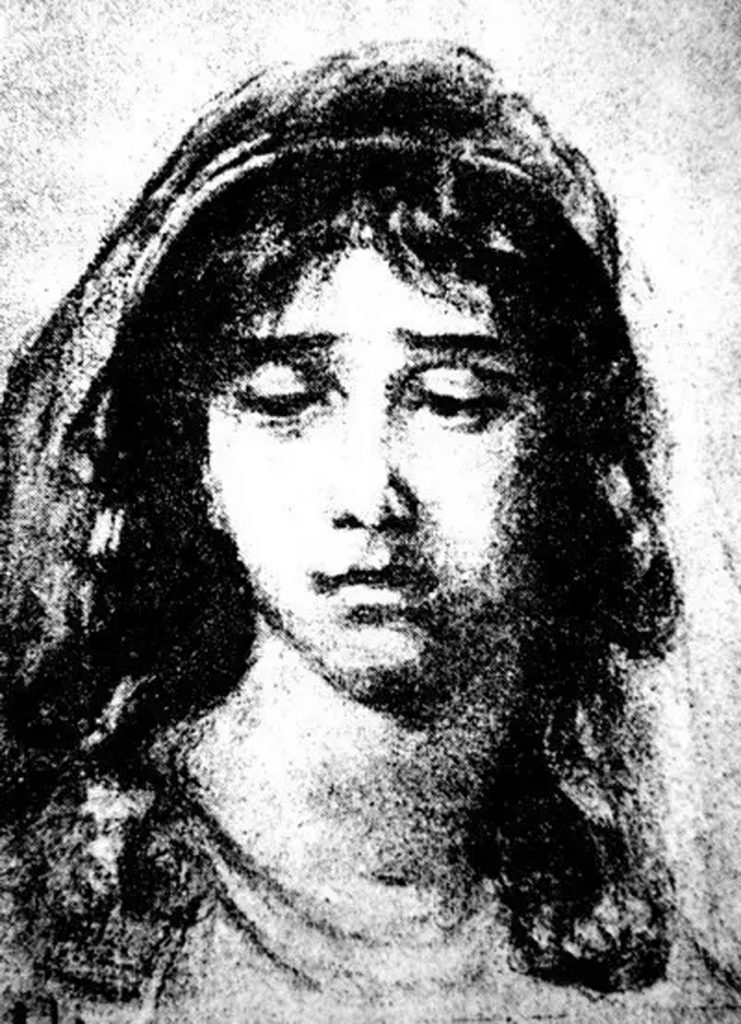
Li Shutong’s charcoal drawing titled ‘Maiden’
“A Half-naked Woman” by Li Shutong, collected by CAFA Art Museum, China
However, Li Shutong’s life underwent a profound transformation. Confronted with personal and financial challenges, he voluntarily entered a self-imposed exile in Japan. The success of the Xinhai Revolution in 1911 further complicated his circumstances, resulting in financial ruin. Undeterred by these setbacks, Li Shutong maintained composure and supported his family by teaching in Tianjin and Shanghai.
His teaching career, notably at Zhejiang First Teachers’ College, left an indelible mark. Li Shutong played a pivotal role in introducing Western painting to China, earning him the title of the forefather of Chinese oil painting. As the first Chinese art educator to incorporate nude models in his painting classes and introduce Western music to China, his influence was far-reaching. Some of his personally groomed students, including contemporary Chinese artist, educator, and musician Feng Zikai (丰子恺), and Singaporean artist Chen Wenxi (陳文希), went on to become accomplished artists in their own right. His impact on students, such as the renowned painters Pan Tianshou and Shen Benqian, underscored his lasting influence.
During this period, Li Shutong delved deeper into Buddhism. In 1916, he embarked on a 21-day fast at a temple in Hangzhou to experience aspects of the spiritual path. This experience prompted his decision to embrace the ordained life, leading to his monastic vows at Hupao Temple. His disciplined lifestyle, which included fasting therapy for deeper insights, marked a significant spiritual transformation.
Li Shutong’s transition from a worldly existence to a monk, detailed in a letter to his second wife, Yu, reflected his detachment from transient fame and wealth. His decision to leave behind a worldly life for monastic vows occurred only a month after joining the Order. He was known by the monastic names Yanyin (演音) and Hongyi (弘一) after undergoing full ordination rites at Lingyinsi, the largest monastery in Hangzhou.
His departure, though painful for those close to him, exemplified Master Hongyi’s profound understanding of Buddhism. In a conversation with his second wife, he elucidated the nature of love, defining it as compassion, aligned with Buddhist teachings that emphasize letting go of attachment and cultivating compassion.
Master Hongyi’s transformation from the proud and arrogant Li Shutong to a humble and receptive teacher was evident in his approach to teaching Dharma. Contrary to expectations of flawless mastery, Master Hongyi sought feedback from student monks and welcomed constructive criticism without defending himself.
By early 1942, the toll of austerities and fasts began affecting Master Hongyi’s health, and by mid-May, his condition deteriorated rapidly.
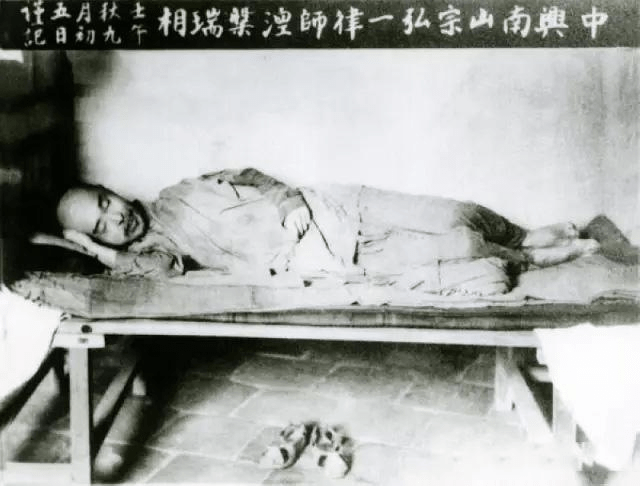
The paranirvana of Master Hongyi
Three days before his passing at Busi Temple in Quanzhou, Fujian Province, on October 13, 1942, Master Hongyi inscribed his final calligraphic strokes, creating the work known as “Sorrow and Joy Comingle,” “Worldly Sorrows and Joy Are Intertwined,” or “Sorrow or Joy Are Inextricably Bound to Each Other” (《悲欣交集》, Beixin jiaoji).
Master Hongyi’s philosophical framework posited three distinct stages in human life: material, intellectual, and spiritual. The material phase pertains to mundane existence, the intellectual phase characterizes the life of ordinary intellectuals, while the spiritual phase encompasses the religious realm.
Material, intellectual, spiritual; beauty, profundity, deity. These concepts are intricately tied to the principles of abstinence, composure, and wisdom in Buddhism.
Abstinence, in this context, denotes the renunciation of materialistic pursuits. Composure signifies the practice of deep meditation—tranquil and remote—a path that ultimately leads to the attainment of wisdom. The imagery of Venerable Hongyi experiencing both sorrow and joy (欣) symbolizes the dynamic interplay between these various dimensions of life.
Li Shutong: From Prodigy to Monk – A Journey Beyond Wealth and Artistry
In the midst of the First World War, a remarkable event occurred that transcended the boundaries of conflict and highlighted the true essence of Christmas – the Christmas Truce of 1914. As we celebrate this joyous season, it’s essential to reflect on the lessons of compassion, love, and humanity that emerged during that extraordinary moment in history.
“It will be over by Christmas.” This false assurance echoed among the 60 million soldiers sent to the battlefront, exposing the grim reality that war does not adhere to predetermined timelines. The soldiers found themselves entrenched along the Western Front, living in harsh conditions, mere meters away from their adversaries.
Despite the hostility of war, the spirit of Christmas prevailed on that fateful Christmas Eve. German troops, unwrapping gifts from home and lighting lanterns along their trenches, initiated a surprising turn of events. Carol singing broke out, and soon British and French troops joined in, bridging the gap between enemies.
As Christmas morning dawned, a temporary ceasefire was proposed, and soldiers from both sides cautiously ventured into no man’s land. Greetings, well wishes, and even gifts were exchanged. Spontaneous football matches broke out, demonstrating a shared humanity that transcended the barriers of war.
The Truce of 1914 was not an isolated incident; it was a series of truces involving over 100,000 soldiers across the British-held area of the Western Front. The scale of these impromptu ceasefires is a testament to the universal longing for peace, even in the midst of one of the deadliest conflicts in history. Spontaneous football matches broke out, transforming caps and jackets into makeshift goal posts. Corporal John Ferguson vividly described the scene: “What a sight – little groups of Germans and British extending almost the length of our front! Out of the darkness we could hear laughter and see lighted matches, a German lighting a Scotchman’s cigarette and vice versa, exchanging cigarettes and souvenirs.”
Reflecting on the teachings of Jesus, who implored his disciples to love their neighbors, it becomes apparent that the message transcends religious boundaries. In times of war fueled by religious differences, it is crucial to remember that faith should serve as a source of inspiration for compassion, love, and kindness, irrespective of one’s beliefs.
Similarly, the teachings of Shakyamuni Buddha echo through time, emphasizing the compatibility and mutual respect among religions. The contemporary Buddha, H.H. Dorje Chang Buddha III, extends this ethos by acknowledging figures like Jesus Christ as great holy beings. In his Dharma discourses, His Holiness emphasizes the imperative for all Buddhist disciples: “When encountering living beings, regardless of whether they are handicapped, deficient, sick, or healthy, treat them all equally as family members…” His Holiness further calls for global cooperation, transcending religious, cultural, and national boundaries. He underscores the importance of treating each other as dear relatives, emphasizing a collective effort necessary for the peace and auspiciousness of the world.
As we celebrate Christmas today, let us draw inspiration from the Christmas Truce of 1914. In a world where conflicts persist, particularly in places like Gaza, may we strive for peace, understanding, and empathy. Let the spirit of Christmas be a beacon of hope, guiding us towards a future where love triumphs over hatred, and unity prevails over division.
The Christmas Truce of 1914 serves as a timeless reminder that even in the darkest of times, the light of humanity can shine through. As we gather with loved ones during this festive season, may we carry the spirit of Christmas within our hearts and work towards a world where the message of love and peace prevails.
Some ancient structures were purposely and skillfully constructed at the riskiest of locations or sometimes just had their appearance altered to reflect a sense of danger and awe. These ancient buildings are so remarkable that even modern scientists are amazed and astounded by them.
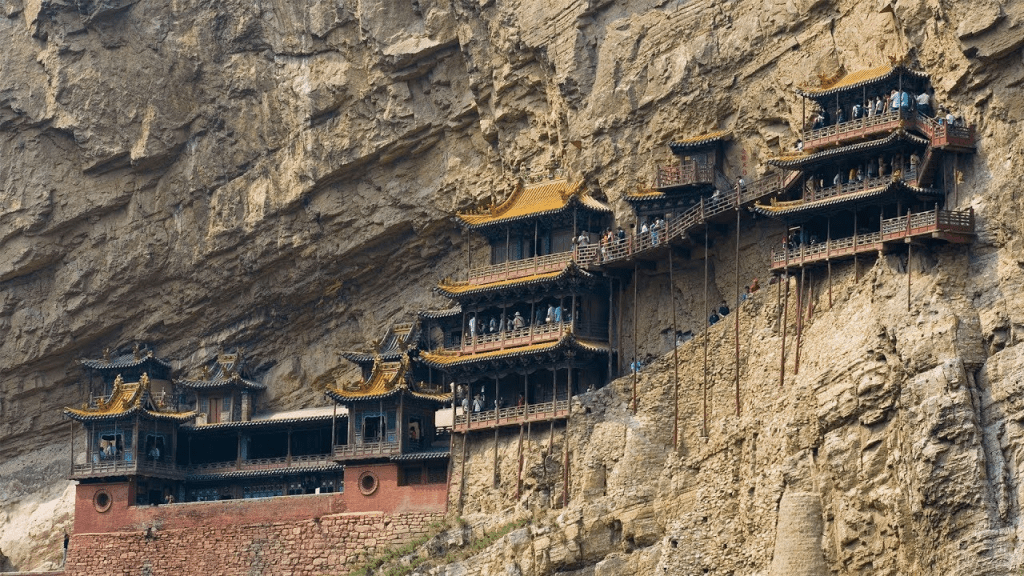
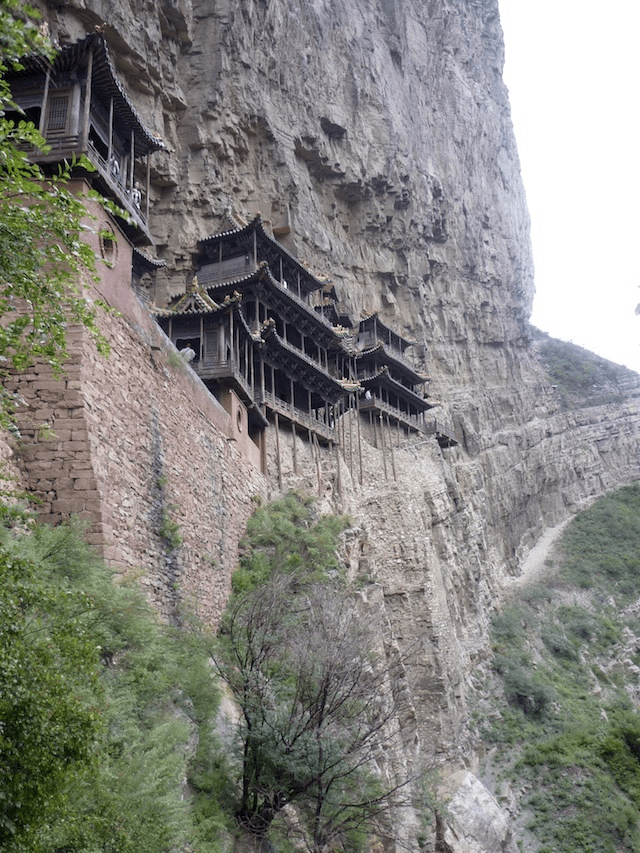
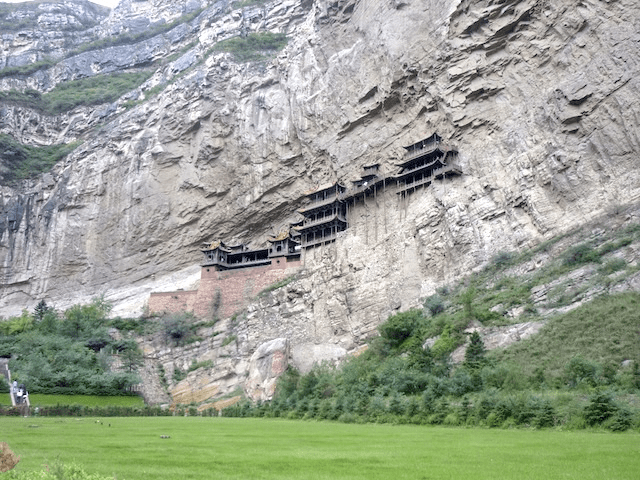
There are 10 most dangerous structures in the world, XuanKongSi Temple in China is one of them. Temples and monasteries were usually built on the ground, and if there was no money or it was necessary to hide from someone, then under the ground in caves. It seems impossible to think of anything else, but the temple tells us otherwise. It turns out that in one of the northern provinces of China, there is a so-called Hanging Temple which seems to be attached to the Rock at a height of 75 meters. It was built almost 1500 years ago in 491 during the northern Wei Dynasty. The Chinese call this Temple complex XuanKongSi.
The temple is located in Shanxi Province, 65 kilometers southeast of the city of Datang, it looks as if the entire Temple is held up on a steep Cliff by the power of Prayer. Perhaps prayers help because the temple is unique; it is the only Temple of three religions in China. It combines Buddhist, Taoist, and Confucian altars. It has everything that other temples have: the main gate, the bells, and drum Towers, the main and side Halls. The largest structure of the monastery is called sangana, and it stands on a stone ledge. There are also 40 halls in Pavilions, but they are smaller than the sangana. They are built on pallets that lie on beams hammered into the Rocks. The rock is used as the back wall of the rooms, and niches are made in it for statues. The larger the niches, the more statues they contain, and the larger they are.
Upon first glance, the temple’s buildings seem to have been partially swallowed by an expanding mountain rather than built onto and into it. Some of the pathways that connect the separate buildings are hewn into the mountain. Others feature the same design as the buildings themselves – parked atop seemingly impossibly-thin wooden poles.
It is composed of three main sections:
North Pavilion
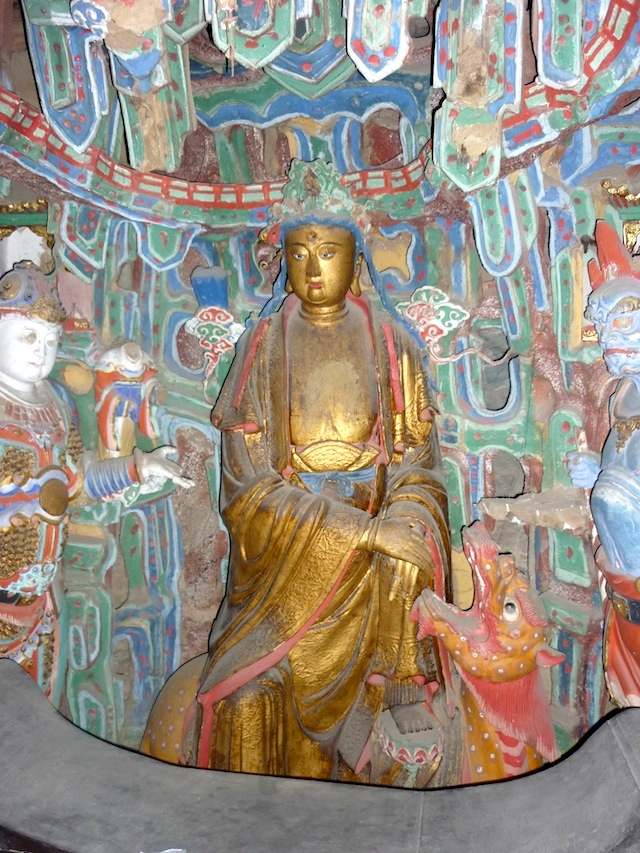
This pavilion is three storeys tall, 4 metres (13 feet) wide and 7 metres (23 feet) in length. Wufo Hall, which is located on the lowest floor is dedicated to the Five Dhyani Buddhas. Above it is Guanyin Hall and on the top storey is Sanjiao Hall. Sanjiao Hall, or the Hall of the Three Religions is widely regarded as the most important room in the Hanging Temple, at least in terms of symbology. It contains large statues of Buddha Shakyamuni, Lao-Tze and Confucius standing together.
SanJiao Hall
Given that the Hanging Temple is the only surviving example of the concept of the Three Teachings Harmonious as One, the Hall of Three Religions is perhaps the most important of these chambers. The idea of Three Teachings Harmonious as One, which emphasises the complementary nature and unifying ideas of Buddhism, Taoism and Confucianism, flourished during the Ming and Qing Dynasties.
Accordingly, the hall features sculptures of deities of all three religions. Three large statues take centre stage here: Buddha Shakyamuni in the middle, flanked by Lao-Tze on his left and Confucius on his right.
GuanYin Hall
South Pavilion
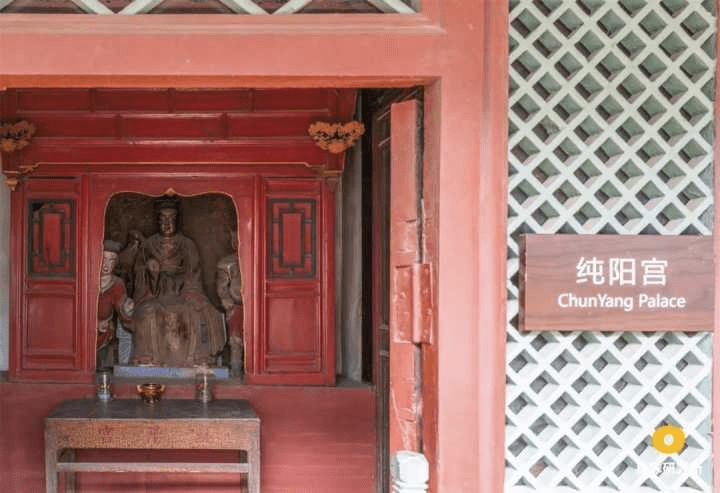
Slightly larger than the North Pavilion, it is also three storeys tall and 4 metres wide but longer at 8 meters (26 feet). The North Pavilion contains Sanguan Hall. It is the biggest hall of the Hanging Temple and is home to a 2-metre tall clay sculpture, the largest in the complex. On the middle storey is Chunyang Palace, which is dedicated to Lü Dongbin, one of the Eight Immortals of Taoism. He is the most popular Taoist character in Chinese culture. Leiyin Hall, which is dedicated to Buddhist deities is on the top storey.
The Long Bridge
The top storeys of the two pavilions are linked by a 10-metre (30 feet) bridge (a stairway has been cut into the mountainside to link the lowest storeys). A small balcony for worshipping sits above the bridge.
However, as impressive as the Hanging Temple appears from the outside, the bulk of the builders’ efforts went into the portion of the complex that is ensconced within the rock. 40 halls and pavilions lie inside, covering an area of 125 m2.
The biggest and most prominent halls are the Hall of Three Religions, Guanyin (Avalokiteshvara) Hall, Hall of Shakyamuni, Qielan Hall (Hall of Sangharama), Sanguan Hall (Hall of the Three Officials) and Chunyang Hall.
Spread throughout the other halls are 78 sculptures made from stone, terracotta, copper and iron. They are remarkable for their vivid and detailed depiction of facial features and clothing.
Construction
Despite its precarious location and the logistical challenges construction must have presented, no design feature that is seen in other temples of the period has been spared. The two main buildings sport traditional multiple-roof designs, eaves and balconies with images of auspicious creatures like dragons common to Chinese holy structures.
Today, the part of the temple that extends beyond the face of the cliff is supported by poles made of oak. These poles have been inserted into holes chiselled out of the rock. From a distance, the brown oaken poles meld into the background, making the temple appear to float in the air.
Amazingly, the real support framework for the temple complex is hidden within the mountain and the structure itself. If these external vertical poles were removed, the hanging temple would continue to hang!
While it’s impossible to overlook the fact that the architecture disrupts the natural rock wall formation, a closer examination reveals something quite astounding. The way the roof, walls, and other structures seamlessly integrate with the rock pattern suggests that significant care and effort were put into minimizing any unnecessary destruction.
A unique mechanical theory guided the construction of the framework. Crossbeams were partially inserted into the rock as the foundation, while the rock in the back provided support. The Hanging Monastery seems to defy gravity, appearing to float in midair.
At certain points, a roof will abruptly end at an outcrop, only to resume on the other side, leaving the stone intact. This not only benefits the structural integrity of the building but also signifies a harmony with nature, a state to which all Buddhists aspire.
Construction experts from countries including Britain, Germany, and Italy have visited the monastery. In their opinion, the Hanging Monastery, which melds mechanics, aesthetics, and Buddhism, is a rarity. The monastery and everything it represents is a significant cultural achievement of the Chinese people.