When we were young, our parents and elders all taught us not to lie. Many stories and fairy tales illustrate the consequences of lying, such as a child being eaten by a wolf or having a long nose like Pinocchio. Different cultures and religions praise honesty and disapprove of liars. However, most of us have told a lie at one time or another, often to gain an immediate benefit, without realizing that the long-term consequences of lying can be very costly. In Buddhism, one of the ten precepts is to abstain from lying.
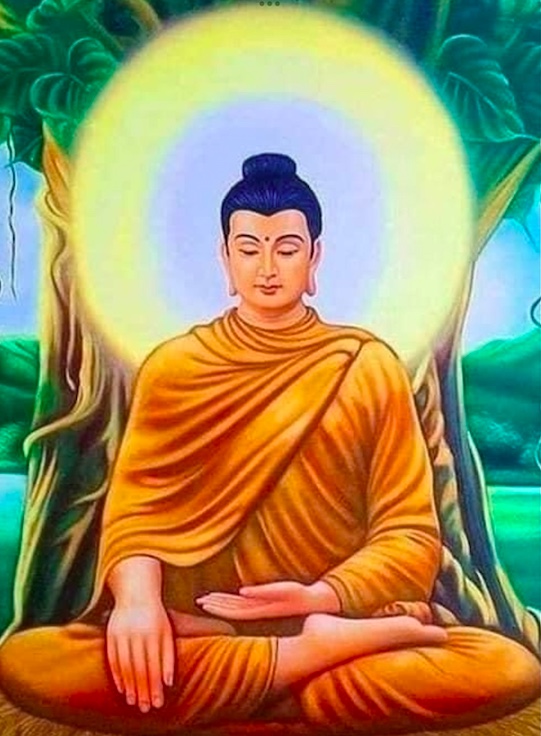
There is a recorded story in a Buddhist sutra about Shakyamuni Buddha teaching his son to refrain from lying.
The Buddha’s son, Rahula, was quite mischievous in his youth. He often enjoyed playing pranks on others, using deceptive words to tease people. For instance, when someone came to see the Buddha, Rahula, knowing that the Buddha was not present, would intentionally mislead them about the Buddha’s whereabouts, causing them to search in vain for amusement.
When the Buddha learned of this, he asked Rahula to bring him some water to wash his feet. After washing his feet, the Buddha pointed to the water and asked Rahula, “Can this water be drunk?”
Rahula replied, “The water is dirty from washing feet; it cannot be drunk.”
The Buddha then asked, “Can this basin, used for washing feet, be used to hold food?”
Rahula replied, “No, it cannot. The basin is dirty and cannot be used to hold food.”
The Buddha sternly said, “You are like this water. The water was originally very clean, just as you were originally a prince, able to renounce the false glories of the world and become a monk. But if you do not diligently pursue the path, do not purify your body and mind, and do not speak carefully, the impurities of the three poisons will fill your heart, just like the clean water being soiled by washing dirty feet. You are like this basin. Although you have become a monk, if you do not practice precepts, concentration, and wisdom, and do not purify your body, speech, and mind, how can the food of the Great Path fill your heart?” After speaking, the Buddha kicked the basin, causing it to roll. Rahula was very frightened. The Buddha asked, “Are you afraid the basin will break?”
Rahula replied, “No, the basin is a coarse utensil; it doesn’t matter if it breaks.”
The Buddha said, “Rahula, you don’t cherish this basin, just as people will not cherish you. As a monk, if you do not uphold dignity and discipline, and speak deceitfully, the consequence is that no one will care for you or value you. When your life ends, you will not attain enlightenment, but will only increase your delusion.”
From then on, Rahula changed his mischievous ways, strictly observed the precepts, and diligently practiced the path.
According to the teachings of the Buddhist sutras, we should take a long-term view and consider the consequences of lying for both this life and future lives.
In this life, if we frequently lie, deceive, or slander others, we will inevitably face retaliation from those we have wronged. In the mundane world, most people are naturally inclined to protect themselves and have a tendency for “an eye for an eye” revenge, unless they are saints who have subdued their own minds. If we deceive others, the victims, unwilling to be deceived, will expose our misdeeds among people. As word spreads from one to ten and from ten to a hundred, our bad reputation will quickly become widespread. Our credibility will be utterly destroyed, and our trustworthiness will plummet. From then on, even if we speak the truth, it will be seen as a lie, and people will be wary of us to avoid being deceived. No one will trust us. In such a predicament, we will constantly feel the pain of isolation and helplessness. Our lives will shrink, and our careers will suffer as a result.
In future lives, under the influence of the dark karma of lying, one will inevitably fall into the three lower realms. When the bad karma diminishes and one is reborn as a human, the residual effects of lying will manifest in various speech-related congenital obstacles in both body and mind. These may include having an impaired tongue root, stuttering, or unclear speech. Additionally, there will be a habitual tendency to lie, and sometimes, even when one wishes to speak the truth, it will come out as a lie involuntarily. In interactions with others, one will frequently be slandered and deceived. Even when speaking the truth, people will not believe it. Moreover, even when preaching the true Dharma, others will be unwilling to listen.
Sister Sun Houfang has gone to the hospital for chemotherapy again. She suffers from leukemia, a disease that is almost a death sentence, but she has miraculously survived. She became a Buddhist disciple in July 2016 and often says, “Others with the same illness as mine have all died, but I am still alive. I want to thank Namo Dorje Chang Buddha III and all Buddhas and Bodhisattvas of the ten directions. I also want to bring those with affinity into Buddhism.” No one expected that her friends with affinity would be three Christian friends.
On April 28, 2017, I visited Sister Sun at the hospital again. She was having lunch, so we chatted briefly. I learned that she was scheduled to start chemotherapy medication the next day, and her wardmate, Wei Wenwen, was to be discharged in the afternoon. I sincerely invited them to our Tantric Buddhist Center the next morning to participate in a blessing ceremony. I hoped that through the blessing, they would receive good fortune and have their suffering alleviated. Sister Sun immediately agreed to delay her medication by a day, and Wei Wenwen also wanted to delay her discharge. At this moment, the patient in bed 6, Lu Shaohua, spoke up. She said she was a Christian and did not dare to believe in Buddhism, fearing it would be against her faith. She also mentioned, “A few days ago, I couldn’t sleep at night after arriving here. It was very uncomfortable, and no matter how much I recited the Bible, I couldn’t fall asleep. Ms. Sun suggested I recite the Buddha’s name instead, and after doing so, I was able to sleep.” I said, “That’s great! It shows you have a deep connection with Buddhism. Each of us has our own karmic reasons for our religious beliefs, but regardless of the religion, the key is the benefit we receive from it. In fact, many people don’t know that the Virgin Mary is an incarnation of Avalokitesvara Bodhisattva.”
In the Dharma audio teachings of H.H. Dorje Chang Buddha III, there is a story about hundreds of Christian Taiwanese indigenous people converting to Buddhism. This took place in 1995 when H.H. Dorje Chang Buddha III, visiting Taiwan under the guise of an art delegation, was greeted by the chief of the indigenous group, a devout Christian. (There is a video recording on youtube for this event https://www.youtube.com/watch?v=Qxdaug7x9IU)
H.H. Dorje Chang Buddha III asked, “Have you ever seen the Virgin Mary? If you haven’t, I can invite her to come, and you can meet her.”
The chief responded, “Can I? Even our priest has never seen her!” H.H. Dorje Chang Buddha III said, “If I let you see her, will you then take refuge in Buddhism?”
The chief replied, “That would depend on the Virgin Mary’s approval. We have taken vows and been baptized.” H.H. Dorje Chang Buddha III said, “Let’s do it this way: let the Virgin Mary tell you what to do, and you can follow her guidance. How about that?” The chief agreed, saying, “Okay!”
At this moment, the chief began to recite the Bible and use his inner power. His Holiness told the chief, “That won’t work.” Then, His Holiness performed a Dharma practice, and the Virgin Mary suddenly appeared standing on a cloud, several dozen feet high, astonishing the chief on the spot!
The Virgin Mary said to the chief, “My child, although I am your Holy Mother, I am also a servant of the Buddha. I am learning Buddhism. You should immediately take refuge before this supreme Buddha, who represents the true Dharma of the Tathagata in this world.”
Hearing this, the chief prostrated himself in full devotion and immediately took refuge. Later, all nine tribes of the indigenous group came to take refuge in His Holiness as their chief king.
Photos from video in youtube
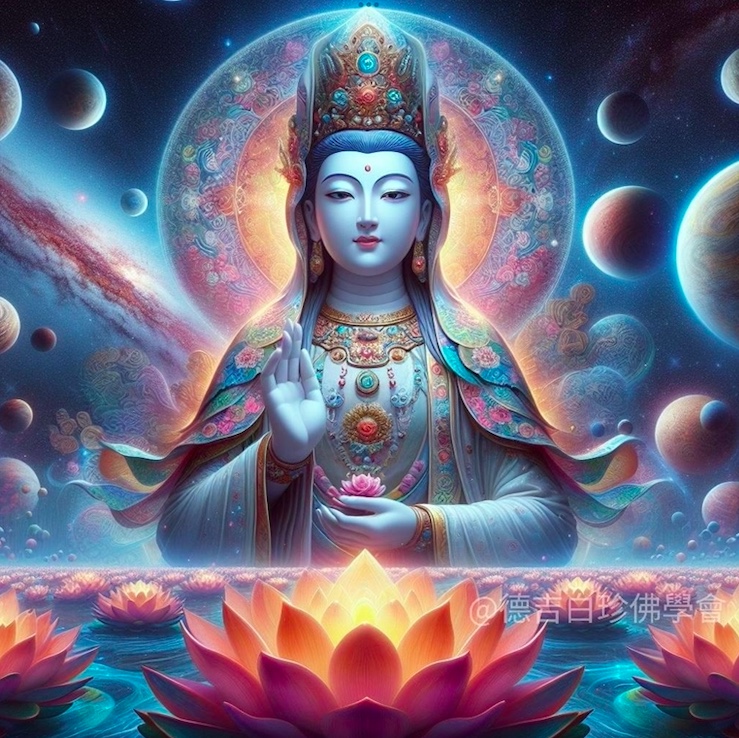
In the Universal Gate chapter of the Lotus Sutra, the Buddha tells the world that Avalokitesvara Bodhisattva will manifest in various forms and save sentient beings according to their different karmic conditions. Any worldly being in danger will be delivered instantly upon calling her name. Therefore, Guanyin has been worshipped and revered by all classes of people. As a compassionate divinity with countless virtues and merits, she is endowed with transcendental power. The Bodhisattva excels in skillful means, allowing the Bodhisattva to appear in whatever form is needed by sentient beings.
After hearing my story, Lu Shaohua seemed to understand something and expressed a willingness to explore Buddhism.
On the morning of April 29, two Christians, accompanied by their families, came to our Tantric Buddhist Center. After everything was prepared, the blessing ceremony began. As we chanted the Heart Sutra, I heard intermittent crying from the crowd.
After the ceremony, I noticed tears still on their faces, but their complexions looked much better than when they first arrived. I asked them, “Did you all cry? How do you feel?” Wei Wenwen said, “I really enjoyed listening to the Heart Sutra. I felt very comfortable and happy here, and I didn’t want to leave.” Lu Shaohua also said, “As soon as I heard it, I couldn’t help but cry. I don’t know why, but it felt like meeting a family member.”
From that moment on, the three Christians—Wei Wenwen, Huang Youyou, and Lu Shaohua—began to listen to the extraordinary Dharma teachings of Namo Dorje Chang Buddha III. Through listening to the Dharma, they understood some principles of karma, realized the impermanence of life, and the illusory nature of dreams and bubbles. They expressed their determination to stop killing, to practice releasing living beings, and to diligently study and practice Buddhism. They even took home Buddha statues to venerate and vowed to take refuge in Buddhism.
Although Buddhism is the teaching of perfect liberation, Christianity is also a good teaching. When Christians shed tears upon hearing Buddhist scriptures and find peace in reciting the Buddha’s name, it indicates their inherent karmic connection to Buddhism. The differences in religious beliefs among sentient beings arise from their various karmic roots and blessings accumulated over countless eons. All good teachings should coexist harmoniously and tolerate each other without rejection, as true good teachings all aim to free sentient beings from suffering and bring them happiness.
Once, the Buddha was residing in the Jetavana Monastery in the kingdom of Śrāvastī, spreading his teachings. At that time, there was a prince of a celestial king named Pilu. One day, he flew down from the heavens to the Jetavana Monastery, prostrated himself at the Buddha’s feet, and, with hands folded in reverence, asked the Buddha: “In this world, people are constantly pursuing clothes, food, treasures, pleasures, official positions, and territories. Are there any treasures that pursue people in return?” The Buddha praised Prince Pilu: “You have asked a good question. Indeed, there are situations where territories, treasures, and pleasures pursue people.”
Prince Pilu asked again, “What does it mean for the causes and conditions that fulfill people’s wishes and bring complete satisfaction to always follow them?”
The Buddha replied, “All actions can be categorized into two types: doing good deeds, which brings blessings, and committing evil deeds, which results in calamities. Whether it is blessings or disasters, they always follow each person like a shadow.”
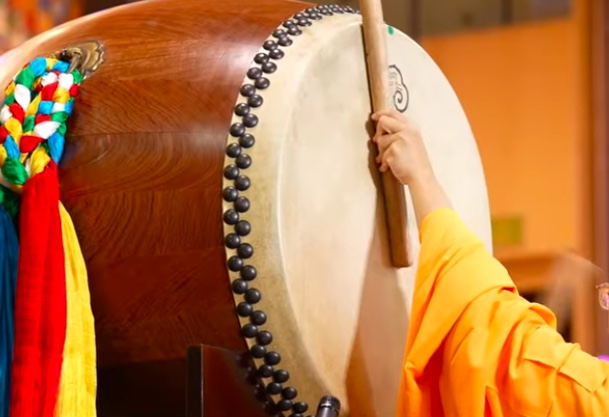
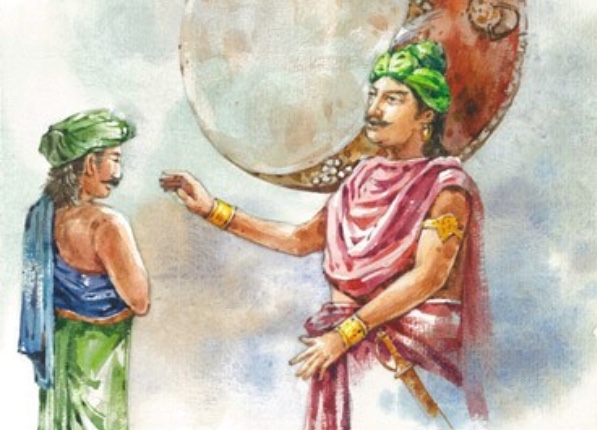
Prince Pilu said, “This is truly extraordinary! Just as the World-Honored One has taught, in my past life, I was once a king among humans. Because I was aware of the impermanence of life and had no attachment to material things, I wanted to practice generosity widely. One day, during a gathering of my ministers, I announced: ‘I want to make a great drum whose booming sound can spread for a hundred miles. Who can accomplish this task for me?’
However, the ministers all replied, ‘We are incapable of doing so!’ At that moment, a minister named Kuang Shang, who had always been loyal to the court and compassionate towards the people, stepped forward and said to the king, ‘I can accomplish this task, but it will require some funding.’
The king said, ‘Great! Whatever amount you need is not a problem.’ Thus, the treasury was opened, and a large sum of money was handed over to Kuang Shang.
Kuang Shang transported a carriage full of treasures to the gate of the royal palace and beat the drum to announce, “Today, our benevolent king, with great compassion, is distributing wealth to the world to relieve all those in poverty and distress, as well as to provide for the needs of practitioners. Anyone in need can come to the palace gate to receive these goods.”
The news quickly spread to neighboring countries. The poor, carrying their babies and bringing along the elderly and young, came in droves, filling all the roads leading to the city. People would often look up to the sky and exclaim, “Thank you, benevolent king! We, the poor people, finally have the chance to escape the days of hunger and cold!”
A year later, the king asked Kuang Shang, “Is the great drum completed?” The minister replied, “Your Majesty, it is done.” The king asked again, “Since it is finished, why haven’t I heard the drum sound?” Kuang Shang responded, “Please, Your Majesty, take a trip into the city tomorrow, and you will hear the sound of virtue resonating far and wide.”
The next day, the king’s procession entered the city, discovering it was crowded and bustling. The king exclaimed, “Why are there so many people in the city?” Kuang Shang answered, “Last year, Your Majesty ordered me to create a great drum, hoping its mighty sound would spread for miles, proclaiming Your Majesty’s benevolence. I thought that a drum made of dead wood and cowhide would not adequately convey the king’s virtue. After much deliberation, I decided to use the treasures Your Majesty entrusted to me to provide for the practitioners and relieve the poor and distressed. Since the announcement, people from neighboring countries have come, hoping for Your Majesty’s benevolence, like hungry children yearning for their compassionate mother.”
Upon hearing this, the king asked the nearby citizens, “Where have you come from?” The people respectfully bowed and replied, “We came from a hundred miles away.” Some said, “I came from two hundred miles away.” Others said, “I came from thousands of miles away.” Then, they all declared, “Wise and benevolent king! Your widespread generosity has brought joy to the people of the neighboring countries. Many have even moved their entire families here, seeking to live under your benevolent protection and hoping for a stable life henceforth.”
The king was very pleased and said, “Kuang Shang, you have done an excellent job! Previously, I was attached to fame, hoping that the great drum’s mighty sound would resonate far and wide. Now, I finally understand that the unrest in the country comes from the people’s unease. Just as a sick body needs medicine to be healed, I should provide remedies to address the people’s suffering. You, my minister, understood the hardships of the people and distributed food to help the poor and needy, allowing the people to live in peace and return their loyalty to me.” Thus, the king declared, “From now on, as long as it concerns the people’s needs, take care of it to the best of your ability without needing to consult me!”
After the king’s natural death, he was reborn in heaven as King Miao. After his life in heaven ended, he was reborn as a Cakravartin (Wheel-Turning) King on earth, always accompanied by seven treasures and surrounded by followers who protected him. Now, he has again been reborn in heaven as a prince of the heavenly king. All of this was because he strictly upheld pure precepts and compassionately aided all living beings, earning such blessings. If we follow the Buddha’s teachings and rectify our body, speech, and mind, we can all obtain such magnificent blessings.
The Buddha encouraged Prince Bilu, saying, “A person’s actions are like a shadow following the body, or an echo responding to a sound. For every cause, there is an effect, and retribution is certain!” Prince Bilu, after hearing the Buddha’s teaching, joyfully made obeisance and departed.
Every year in May, the Bathing Buddha ceremony is held to commemorate the birth of Prince Siddhartha Gautama, who was born in northeastern India over 2500 years ago into the Shakya clan. Upon attaining enlightenment, the Prince became known as Shakyamuni Buddha. During the sacred celebration of Shakyamuni Buddha’s birthday, participants in the Dharma Assembly of Bathing the Buddha offer prayers and make offerings to establish a connection with the Buddhas, seeking their blessings and invoking peace and well-being. As they ritually bathe the image of the Buddha with auspicious water, they vow to purify their three karmas (body, speech, and mind) across past, present, and future.
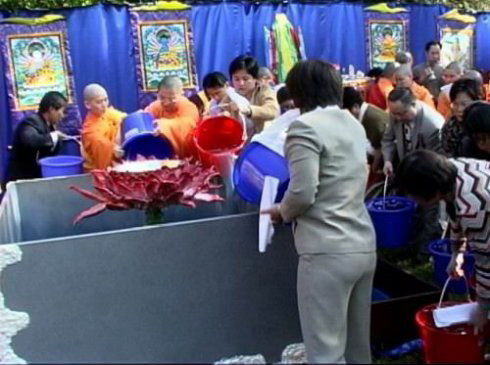
While many of these assemblies are ordinary ceremonies without any extraordinary occurrences, a remarkable event took place on May 26th, 2004—the “Highest Form of Bathing the Buddha Dharma Assembly” in Los Angeles, on the Buddha’s birthday. Led by H.H. Wan Ko Yeshe Norbu (H.H. Dorje Chang Buddha III), the supreme leader of exoteric and esoteric Buddhism, this assembly was unlike any other. Gathered on the lawn of a religious site surrounded by majestic blue curtain screens forming a dignified mandala, renowned Rinpoches, Huo-Fos, Dharma Teachers, and laypersons from around the world came together. It was an unprecedented and extraordinary event, far removed from the usual temple ceremonies. During this assembly, the conductor must possess the realization of a Buddha or Great Bodhisattva to invoke holy supernatural phenomena. On that day, Buddha appeared, Dharma-protecting Bodhisattvas displayed sacred sights, and celestial dragons and other deities of the Dharma laughed in the sky. It was a grand assembly where various holy scenes, unimaginable to ordinary people, manifested. Led by Supreme Vajradhara H.H. Wan Ko Yeshe Norbu (H.H. Dorje Chang Buddha III), this assembly was conducted and practiced with utmost reverence and devotion.
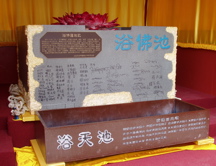
Lotus tub used to bathe the Buddha, 3 feet high, square, and weighed 700 pounds itself
The Dharma Assembly was divided into an internal mandala and external mandala. The internal mandala was the central area where the Buddha was bathed. The external mandala was the dharma realm of accomplishment. Eminent monastics and persons of great virtue attended the Dharma Assembly. Those who were part of the internal mandala included Akou Lamo Great Rinpoche, Zhaxi Zhuoma Rinpoche, Dharma Teacher Long Hui, Dharma Teacher Jue Hui, Dage Gongla Rinpoche, Bodi Wentu Rinpoche, Dharma Teacher Kui Zhi, Dharma Teacher Ruo Hui, layman Ciren Jiacuo (Gyatso), Dharma Teacher Miao Kong, Dharma Teacher Baolian, and others. Those who were part of the external mandala included Fuzang Wanghu Great Rinpoche, Yan Long Great Rinpoche, Awang Nuobu Great Rinpoche, Kang Qin Great Rinpoche, Xijao Zhibenge Rinpoche, Yixi Kanbu, Dharma Teacher Cikong, Dharma Teacher Fahai, Dharma Teacher Cixin, Dharma Teacher Haoling, and others.
The dharma stipulates that the purpose of a Highest Form of Bathing the Buddha Dharma Assembly is pouring dharma water that has been used to bathe the Buddha. The ability to pour such dharma water is based upon one’s true level of realization. Pouring such water bathes the celestial beings in the various heavenly realms. It shows that the Buddha blessed the celestial beings in the various heavenly realms, the dharma protecting deities, and the seven types of disciples. Thus, there must be a successful “pouring of water based upon one’s true realization.” Otherwise, it is not a Highest Form of Bathing the Buddha Dharma Assembly.
Additionally, at that Dharma Assembly all seven holy states were manifested. The seven types of holy states are: (1) Wind Celebrates the Mandala, (2) Flowers Rain from a Tree, (3) A Dharma Object Manifests Holiness, (4) A Cloud Provides an Umbrella-Like Covering, (5) Celestial Dragons Laugh Joyfully, (6) A Lama is Given a Sign, and (7) The Color of Dharma Water Is Received.
The successful “pouring of water based upon one’s true realization” is the most important part of such a Dharma Assembly. It is the key aspect of a Highest Form of Bathing the Buddha Dharma Assembly. It is why the name of such a Dharma Assembly contains the words “Highest Form.” Three to five thousand pounds of dharma water are used to bathe the Buddha. After the Buddha is bathed, this water is used to bathe the celestial beings in the various heavenly realms. When bathing the celestial beings, the dharma water must be poured down from the lotus tub used to bathe the Buddha into the tub used to bathe the celestial beings. During the pouring process, one cannot touch the dharma water with any part of one’s body, nor can one use any type of container to be filled with water. That is because the human body and containers are soiled by unclean dust and dirt. People are only allowed to tilt the entire lotus tub used to bathe the Buddha so that water is poured downward.
With such a heavy amount of dharma water in the lotus tub used to bathe the Buddha, how could anyone tilt that tub to pour the water down into the tub used to bathe the celestial beings? One must rely upon one’s Buddha-dharma state of realization. But no more than ten people can attempt to lift the lotus tub used to bathe the Buddha. Otherwise, it would not be regarded as the Highest Form of Bathing the Buddha Dharma Assembly. If the dharma water is not successfully poured into the tub used to bathe the celestial beings, then no matter what types of supernatural holy sights may appear at the Dharma Assembly, it cannot be called a “Highest Form of Bathing the Buddha Dharma Assembly.”
FLOWERS RAIN FROM A TREE
The atmosphere that day at the mandala to bathe the Buddha was holy and solemn. H.H. Wan Ko Yeshe Norbu (H.H. Dorje Chang Buddha III) wore his golden brocade and jeweled robe. His Holiness had an extremely dignified-looking appearance. A golden bronze statue of Dharma Prince Siddhartha stood in the mandala. In the middle of the mandala was a lotus tub used to bathe the Buddha that was 3 feet high, square, and weighed 700 pounds itself without water. Over the middle of that tub was a beautiful lotus flower about the size of a car wheel. Below and adjoining that lotus tub used to bathe the Buddha was a rectangular, one-foot high tub used to bathe the celestial beings. Ninety buckets of fragrant water were also placed in the mandala to be used to bathe the Buddha. The offering water in those buckets was light brown due to the sandalwood, eaglewood, saffron, and other scents that were boiled and added to the water.
At the beginning of the Dharma Assembly, His Holiness practiced Dharma according to Buddhist scriptures. As soon as the Buddha Master began practicing dharma, a tree full of jacarandas (a pale purple flower) immediately began raining flowers. The jacarandas drifted in the golden sunlight and fell all over the mandala and into the ninety buckets of water. Auspicious clouds rolled through the sky. It seemed that the mandala was no longer part of this world. Rather, it seemed like a holy Buddha-land. Flowers rained for more than three hours continuously, starting from the beginning of the Dharma Assembly. Those flowers floated down upon everyone. However, not one petal touched the Buddha Master. When the Dharma Assembly ended, the flowers instantly stopped raining.
A DHARMA OBJECT MANIFESTS HOLINESS
In order to express the unity of exoteric and esoteric Buddha Dharma, the Buddha Master did not select a highest-level practitioner of great virtue or a highest-level Great Rinpoche to announce and conduct the rituals and ceremonies of that Dharma Assembly. Rather, His Holiness selected Great Dharma Teacher Long Hui to announce the rituals and ceremonies. Great Dharma Teacher Long Hui is Han Chinese and is Chairperson of the International Buddhism Sangha Association. His Holiness also selected Great Dharma Teacher Jue Hui, Great Dharma Teacher Kui Zhi, Great Dharma Teacher Ruo Hui, and Dharma Teacher Miao Kong to conduct the rituals and ceremonies.
When Great Dharma Teacher Long Hui announced that all Buddhist disciples in attendance should pour fragrant water into the tub used to bathe the Buddha, all of the Rinpoches and Huo-Fos, Dharma Teachers, and laypersons in attendance quickly poured the ninety buckets of light brown fragrant water into the tub used to bathe the Buddha, filling it up completely. Everyone then returned to their seats and respectfully requested that His Holiness consecrate the fragrant water in the lotus tub. The Buddha Master was then seen holding a white Vajra Wheel.
During the Highest or Ultimate Form of Bathing the Buddha Dharma Assembly, some people saw the Vajra Dharma Wheel float up, sink down, and move around in the water. Some also saw the appearance of eight Dharma protecting deities. Additionally, some people saw two Dharma protecting deities, Mahakala and Sri-maha-devi, supernaturally change their forms. In an instant, the two Dharma protecting Bodhisattvas appeared. In an instant, they disappeared from the Vajra Wheel without a trace. In the photos, the Vajra Wheel turned into the shape of a lotus leaf floating on the water. From the size of the Vajra Wheel’s shadow, one can know the height of its position in the water.
His Holiness approached the lotus tub used to bathe the Buddha and placed that Dharma object (i.e. the Vajra Wheel) into the water. That dharma object is half as thick as a coin and as large as the palm of the hand. The Buddha-dharma stipulates that only a Supreme Vajradhara Dharma King may possess such a Vajra Wheel. After the Supreme Vajradhara Dharma King’s empowerment, the dharma protecting Bodhisattvas in the sky descended upon that dharma object. That dharma object can move around in the dharma water used to bathe the Buddha. It can rise up in the water and sink down into the water. After it does this, the practice of the Highest Form of Bathing the Buddha Dharma Assembly may begin.
Everyone surrounded the lotus tub to see that dharma object. One or two minutes later, everyone indeed saw the Vajra Wheel moving in the water. No one touched the lotus tub. While in the water, that dharma object moved forward and backward, to the left and the right, all on its own. One moment, it sank downward; the next moment it floated to the surface of the water. When the Vajra Wheel was approaching the bottom of the water, many saw red light emanate from the bottom of the Vajra Wheel. That red light was the true fire of samadhi. Many people saw eight dharma protecting bodhisattvas standing on that dharma object. There were also those who saw Mahakala and Sri-maha-devi supernaturally change their forms on that Vajra Wheel. Everyone present was full of dharma joy.
WIND CELEBRATES THE MANDALA
After a dharma object manifested holiness, everyone began to respectfully recite the invocation text. Suddenly, a strong wind began blowing from the west. Trees began to sway and things began to shake in the once peaceful mandala. Jacarandas flew through the air. Everyone was amazed. Indescribable and auspicious dharma joy filled the entire assembly. The world-honored Buddha had arrived in the sky above the mandala to manifest the dharma! Everyone chanted a mantra in unison to respectfully welcome the arrival of the Buddha. That strong wind from the west blew for a period of time and then abruptly stopped. The quietude of the mandala was restored.
An auspicious atmosphere filled the mandala. Amid the sound of everyone chanting a mantra, the holy ritual of bathing the Buddha formally began. Great Dharma Teacher Kui Zhi respectfully lifted the statue of Dharma Prince Siddhartha off the altar and put it on the lotus flower in the middle of the lotus tub. Everyone then respectfully requested that H.H. Wan Ko Yeshe Norbu bathe the Buddha. After His Holiness bathed the Buddha and practiced Dharma, each of the attendees bathed the Buddha three times. Great Dharma Teachers Jue Hui and Ruo Hui wiped dry the statue of the Buddha with a white silk scarf, put a robe on the statue of the Buddha, and placed it back on the altar.
POURING OF WATER BASED UPON ONE’S BUDDHA DHARMA REALIZATION
After the Buddha is bathed, according to the rules and rituals of the Buddha-dharma, it is time to pour fragrant water from the lotus tub used to bathe the Buddha into the lower tub used to bathe the celestial beings. At that time, His Holiness must practice dharma to bathe the celestial beings. According to fixed dharma, the bathing of celestial beings must take place in order for it to be a real Highest Form of Bathing the Buddha Dharma Assembly. Otherwise, the words “Highest Form” should not be used. This is the key factor in determining whether the Dharma Assembly will be completely successful.
Dharma Teacher Long Hui announced the ritual and requested that everyone attempt to lift the lotus tub used to bathe the Buddha so that its fragrant water would pour into the tub used to bathe the celestial beings. All of the attendees stepped forward one after another and attempted to lift it in groups of ten. However, no matter how hard they tried, they could not lift that lotus tub. Later, in violation of the rules, fourteen strong men together attempted to lift that tub. They assumed various postures and used all of their strength to tilt that lotus tub while shouting out a mantra. In the end, their faces turned red, they became exhausted, and they gave up in frustration. They were not able to move that lotus tub one bit. With awkward smiles on their faces, they went back to their seats.
That lotus tub used to bathe the Buddha weighs more than seven hundred pounds. When 90 buckets of fragrant water used to bathe the Buddha were added to this weight, the total weight was 4,260 pounds. Only a large crane could lift that tub. Even world-class musclemen would have no chance of lifting it.
Everyone looked at the lotus tub and felt the situation was hopeless. Great Dharma Teacher Long Hui did not know whether to cry or laugh. She could not announce that the ritual was successfully completed. Under these circumstances, the Dharma Teacher thought of a disciple of His Holiness by the name of Akou Lamo Rinpoche. That Rinpoche is from Tibet and can cause a mani stone to fly through the air. Great Dharma Teacher Long Hui asked Akou Lamo Rinpoche to test her strength and attempt to lift the lotus tub. Akou Lamo Rinpoche said, “I want to select someone to assist me.” She then invited an elder layman who lives in the Unites States, Ciren Jiacuo, to step forward and assist her. Elder layman Ciren Jiacuo has realized the state of prajna emptiness. He constantly abides in the dharmakaya state. His state of realization is extraordinary. He is a person of great accomplishment spoken of in the tapes contained in the silver box.
Bathing Buddha ceremony is annually performed to honor the birth of Prince Siddhartha Gautama who was born in north-eastern India over 2500 years ago of the Shakya clan. The Prince, upon enlightenment, became Shakyamuni Buddha. On the holy birthday of Shakyamuni Buddha, followers who participate in the Dharma Assembly of Bathing the Buddha make offerings to establish their karmic conditions with the buddhas and also to wholeheartedly beseech the empowerment of the buddhas and to pray for peace and well being. While bathing the image of the Buddha with auspicious water, they vow to cultivate themselves in attaining the purity of their three karmas (body, speech, and mind) in the past, present, and future. However most of these assembly are ordinary ceremony, there were no holy states appearing.
Akou Lamo and Ciren Jiacuo each held one side of the lotus tub. Upon Akou Lamo’s uttering the mantra “Ong Ah Hong,” they lifted their shoulders. With a roaring sound of cascading water, the lotus tub tilted upward. Holy water used to bathe the Buddha was poured into the tub used to bathe the celestial beings. Upon another uttering of the mantra “Ong Ah Hong,” the two of them again lifted the lotus tub. Like a silver pillar, dharma water poured into the tub used to bathe the celestial beings.
All of the attendees were astonished! They sat there dumbfounded. Fourteen men using all their strength in concert could not move that more than four thousand-pound lotus tub. However, to everyone’s surprise, a young woman and an elderly man seventy years old exhibited their states of realization and lifted that lotus tub for all to see! What a wonderful expression of the true Buddha-dharma, of the power of Vajra! Neither of them has any innate spiritual powers. Under Holiest Tathagatha Wan Ko Yeshe Norbu, they have practiced and learned the true Dharma and have reached a high level of Buddha-dharma realization. That is why they were able to successfully complete the key ritual of the Dharma Assembly— pouring water based upon one’s Buddha-dharma realization. All of the attendees were surprised and praised the two of them highly. Everyone was moved and joyful. That Highest Form of Bathing the Buddha Dharma Assembly was successful precisely because of this holy event.
CELESTIAL DRAGONS LAUGH JOYFULLY
After pure water used to bathe the celestial beings was successfully poured, the His Holiness began practicing the dharma to bathe the celestial beings. As soon as all of the attendees chanted in unison one time the verses relating to bathing the celestial beings, suddenly, a strong wind began swirling. The curtain screens began to bulge and rumble. The tankas hanging on the curtain screens flew upward in a ninety-degree angle from the ground. The poles holding up those curtain screens creaked in the wind as if they were about to break. Even the sandbags used to anchor the curtain screens were turned over and moved by the wind. Two-thirds of the people there heard very loud, low and deep dragon’s roars explode in the air accompanied by the clap of rolling thunder. One-third of the people there only heard the sound of the wind but did not hear the sound of thunder. This all the more proves the magnificence of the Buddha-dharma, since different karmic states manifested at the same time.
At that time, the hot sun was high in the sky. It seemed as if the joyful roars of the celestial dragons shook the sun so that it shined even more brilliantly! The dharma protecting deities came to the mandala where the Buddha was bathed and received a dharma bathing bestowed by the Buddha! At this time, people remembered that a few days before the Dharma Assembly when the curtain screens and dharma altar were being erected, the Buddha Master personally arrived. His Holiness repeatedly instructed everyone to fasten well the foundational support for the dharma altar and curtain screens so that the altar and screens would not be blown over by the wind. A layperson whose last name is Hsu said to the Buddha Master, “The weather station forecasted that there will be no rain or wind for the next seven or eight days.” His Holiness then told everyone, “At the Dharma Assembly, of course it will not rain. However, when I practice the Dharma, a strong wind will blow. There will be strong gusts of wind, especially when all of the Dharma protecting deities arrive and manifest their powerful spirits. Therefore, the foundational support must be fastened firmly.” It is very fortunate that the buddha Master made such a prediction. On the day of the Dharma Assembly, the dharma protecting deities joyfully laughed in the sky. Although there were strong gusts of wind, the dharma altar and curtain screens did not fall.
A RINPOCHE IS GIVEN A SIGN
After the Buddha Master practiced dharma to bathe the celestial beings and the dharma protecting deities, His Holiness instructed everyone to look inside the water to see whether the Vajra Wheel was moving. People were amazed to see that even though those two people with holy virtue and high states of realization lifted the lotus tub and thereby poured Dharma water from a tub weighing more then 4,000 pounds downward into the tub used to bathe the celestial beings, the Vajra Wheel surprisingly did not move in the slightest. The Vajra Wheel remained in its original position. Many people saw eight dharma protecting bodhisattvas standing on that dharma object blowing air upward.
At this time, a rinpoche who weighs 280 pounds beseeched the Vajra Wheel to manifest its powers and eliminate his remaining karmic hindrances. His Holiness agreed to this request and put the Vajra Wheel on that rinpoche ’s chest. At first, that rinpoche felt that the temperature of the Vajra Wheel was cool. His Holiness then began intoning a mantra. With his fingers pointing to the sky, His Holiness lightly snapped his fingers. That rinpoche suddenly let out a miserable scream. He was in such pain his face turned pale. Like the power the Incantation of the Golden Hoop had over the Monkey King in Journey To The West, the Buddha Master’s mantra caused the solemn face of the rinpoche to become distorted from pain he could not endure. It seemed that the rinpoche could not endure the pain. As a result of His Holiness practicing a certain dharma, the Vajra Wheel emitted the true fire of samadhi. Its temperature quickly rose to an extremely high degree. Of course, that rinpoche could not endure such heat.
H.H. Wan Ko Yeshe Norbu(H.H. Dorje Chang Buddha III) then snapped his fingers again, and the true fire of samadhi instantly disappeared. The Vajra Wheel suddenly became cold. That rinpoche immediately returned to his normal condition. He was not injured in the least. However, there remained an imprint of the Vajra Wheel on his chest. His Holiness predicted that after one week a three-dimensional dharma object in relief would grow out of the imprint on that rinpoche ’s chest. That rinpoche was full of dharma joy and thanked His Holiness for eliminating his karmic hindrances. That rinpoche then vowed to do his utmost to benefit living beings.
A CLOUD PROVIDES AN UMBRELA-LIKE COVERING
From the beginning of the Dharma Assembly all the way to its end, a beautiful cloud continuously floated in the sky above the mandala. The shadow of that cloud continuously covered the bronze statue of Dharma Prince Siddhartha. The Dharma Assembly lasted more than three hours. The sun moved westward. That cloud moved together with the sun. It was like an umbrella that served to block the sunlight from the statue of Dharma Prince Siddhartha. However, the sun continued to shine upon the area of the dharma altar only two or three inches from the statue of Dharma Prince Siddhartha.
THE COLOR OF DHARMA WATER IS RECEIVED
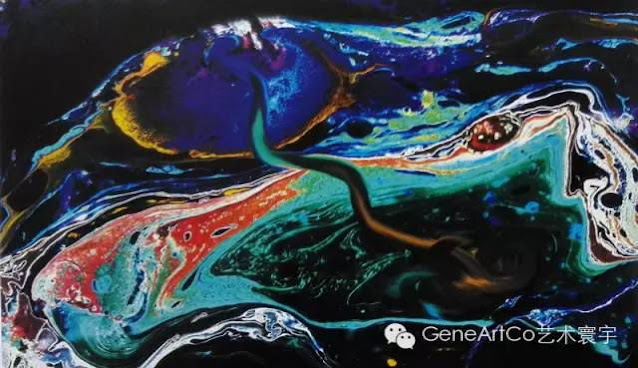
The Dharma Assembly ended solemnly. Everyone took some dharma water from the tub used to bathe the Buddha and the tub used to bathe the celestial beings. Suddenly, someone said in a surprised manner, “The Dharma water is changing!” Everyone rushed over to see. They discovered that the ninety buckets of light-brown fragrant Dharma water taken from the tub instantly became clear water. The Buddha and the celestial beings received the merit of that fragrant water. The merit of the Dharma Assembly was wonderful and complete. All of the attendees prostrated and uttered words of praise.
H.H. Wan Ko Yeshe Norbu (H.H. Dorje Chang Buddha III) conducted this Highest Form of Bathing the Buddha Dharma Assembly, a respected event in the history of Buddhism. His Holiness practiced the dharma during this assembly. All seven holy states were manifested. Water was poured based upon the states of realization of those who poured it. Those two people thereby exhibited their extraordinary powers. The Buddhas and Bodhisattvas and the heavenly dharma protecting deities personally arrived at the mandala and received bathing water bestowed by the Buddha. Various holy states of the Buddha-dharma appeared one after the other. Only this type of magnificent Bathing the Buddha Dharma Assembly is a true Bathing the Buddha Dharma Assembly as stipulated in the dharma. This grand event in Buddhism took place as a result of the good fortune of living beings.
After the Dharma Assembly, one of the two persons with high states of realization who lifted that lotus tub, Akou Lamo Great Rinpoche, requested that the holy lotus tub used to bathe the Buddha be transported to Tibet so that it could serve as an offering in furtherance of Tibetan Buddhism. Great layperson Ciren Jiacuo requested that it be kept in the United States as an offering. In order to be fair, His Holiness had everyone vote on the matter. Akou Lamo Great Rinpoche lost the vote by a ratio of three to two. The United International World Buddhism Association Headquarters will keep that lotus tub used to bathe the Buddha. It will be kept in the United States as an offering. The tub is currently stored at Hua Zang Si Temple at San Francisco.
In the course of benefiting sentient beings in this world, H.H. Dorje Chang Buddha III Wan Ko Yeshe Norbu Holiest Tathagata has inadvertently revealed His state of virtue and realization. This has profoundly enriched our understanding of the realization, boundless compassion, enlightenment, and sublime conduct of a Buddha. Sacred phenomena manifest wherever H.H. Dorje Chang Buddha III goes. These phenomena occur during His Holiness’s initiation ceremonies for esteemed monastics, rinpoches, dharma kings, and even renowned Bodhisattvas. They also arise when His Holiness delivers discourses on the dharma to His disciples or when He bestows blessings upon sentient beings to enhance their fortune and wisdom.
In this post, I would like to share some examples.
Dragon-Fish Stand Straight Up on the Surface of the Water and Pay Respect to H.H. Dorje Chang Buddha III by Bowing to His Holiness
On November 6th, 1999, at Puttamonton, Thailand, a group of around thirty people accompanied H.H. Dorje Chang Buddha III. After prostrating before the holy image of Sakyamuni Buddha, they gathered under a bodhi tree beside a serene lake, where H.H. Dorje Chang Buddha III sat. One of the Rinpoches respectfully beseeched H.H. Dorje Chang Buddha III to give a discourse on how an Arhat can realize the state of a Bodhisattva, how a Bodhisattva can attain the supreme and complete enlightenment of a Buddha, and why a Buddha must rely on saving sentient beings to attain Buddhahood.
At that moment, various birds flew over from all directions and perched themselves on the tree, while different types of wild fish in the lake swam over to them. Two wild dogs even approached and joined the group in front of H.H. Dorje Chang Buddha III’s seat, creating an extraordinary scene.
As H.H. Dorje Chang Buddha III began expounding the highest wondrous dharma, waves suddenly surged from the calm waters of the lake, accompanied by a loud sound. A black dragon transformed into a large black and gold fish, emerging vertically from the water’s surface and bowing its head toward H.H. Dorje Chang Buddha III after each movement.
This remarkable display lasted about twenty seconds, with other fish, both white and black, also emerging to pay their respects to H.H. Dorje Chang Buddha III.
Witnessing this unprecedented spectacle, the disciples were filled with wonder, understanding that these fish were dragon-spirits transformed to receive the dharma and pay homage. H.H. Dorje Chang Buddha III, however, remained humble, stating, “This is a response evoked by the Buddha-dharma. One should practice the Buddha-dharma with a heart of humility. Amazing feats are like dreams and illusions, like clouds and smoke that pass in an instant. One must not be attached to them. They are not worth mentioning.”
Indeed, when great saints expound the wondrous dharma, both humans and non-humans pay their respects, a testament to the merit and realization of a Buddha.
A Wild Squirrel Offered Avocadoes to H.H. Dorje Chang Buddha III
In the afternoon of April 24th, 2000, disciples Long Zhi and Juehai walked along the swimming pool in the outer area of the mandala with H.H. Dorje Chang Buddha III Wan Ko Yeshe Norbu Holiest Tathagata. H.H. Dorje Chang Buddha III pointed to an avocado tree and said, “I want everyone to try the fruits.” So H.H. Dorje Chang Buddha III instructed Long Zhi to get a fruit catcher. Long Zhi searched but couldn’t find one. H.H. Dorje Chang Buddha III then said, “We have to pick some avocados.”
Moments later, a brown squirrel descended from an old pine tree. H.H. Dorje Chang Buddha III instructed everyone, “Don’t chase the squirrel away. It came to help.” The squirrel skillfully climbed the avocado tree, searching for ripe fruit. Jumping from branch to branch and sometimes hanging upside down, it located the avocados hidden amidst the dense foliage. Within minutes, the squirrel retrieved six avocados. H.H. Dorje Chang Buddha III deemed it sufficient.
Addressing the squirrel, Long Zhi said, “Hey, squirrel, you have worked diligently. Your offering has accumulated ample merit. It is enough.” The squirrel paused on a branch, holding its paws together, acknowledging H.H. Dorje Chang Buddha III. These six avocados were offerings to H.H. Dorje Chang Buddha III from the squirrel.
As H.H. Dorje Chang Buddha III prepared to leave, the squirrel performed one prostration before the Buddha Master and then departed slowly. Since then, the nuns residing at the holy mandala have observed squirrels climbing the avocado tree but no longer witness avocados being offered as offerings.
The Buddhas Praise H.H. Dorje Chang Buddha III’s Discourse; Buddha Light Blessing Illuminates the Lecture Hall
In April 2006, the Buddha Master was in the lecture hall delivering a discourse on “What Is Cultivation” in response to a question from Zhaxi Zhuoma Rinpoche. As the Buddha Master began, a beam of sparkling iridescent light suddenly appeared, circling the indoor lecture hall with the force of lightning. The sight was dazzling and auspicious! Throughout the discourse, this radiant Buddha light appeared and illuminated the hall as many as five times.
Approximately twenty Rinpoches and masters were present, witnessing the phenomenon. However, not all disciples perceived the same colors and number of Buddha lights due to their varying levels of cultivation and karmic conditions. Some witnessed Buddha lights appearing six times, while others saw them twice. The colors varied as well, with some seeing red, others white, and still others witnessing iridescent Buddha lights sparkling in the hall. The Buddha Master’s discourse on the Buddha-dharma, along with the praise and blessings of the Buddhas and Bodhisattvas, filled all present with joy.
These Buddha lights were special manifestations with underlying causes. They appeared when the Buddha Master discussed the karmic conditions behind the publication of the book “A Treasury of True Buddha-Dharma.” Dazzling Buddha lights flashed in the mandala, as the Buddhas and Bodhisattvas used them to celebrate the birth of this book, which would provide countless beings in the earthly realm with a path to practice the true dharma. As proclaimed by many great dharma kings and rinpoches, the karmic conditions for beings to experience good fortune have matured!
Translated from the account recorded by Long Zhou Rinpoche
In the summer of 1998, I had the great honor and privilege of accompanying His Holiness Dorje Chang Buddha III Wan Ko Yeshe Norbu Holiest Tathagata on a journey to propagate and spread the Buddha-dharma. We formed a large group and were driving along Highway One, the Pacific Coast Highway, towards San Francisco.
As our motorcade navigated the winding mountain roads, His Holiness Dorje Chang Buddha III instructed the driver to turn off the air conditioning and open the windows to let in the fresh air. The Buddha Master asked, “How do you like the air here compared to Los Angeles?” “Of course, the air here is better,” we all replied in unison. “Why?” asked the Buddha Master.Brother Chang, who holds a Master’s degree in chemical engineering, quickly responded, “Buddha Master, this is because in places with dense trees or close to the sea, the air contains a large amount of negative ions, which…” He began explaining the chemical properties. His Holiness Dorje Chang Buddha III patiently waited for him to finish and then asked, “What do negative ions look like?” We were all at a loss for words. The Buddha Master smiled but said nothing. A few minutes later, a ray of blue light suddenly entered the vehicle through the windshield, filling the air with a fresh and sweet scent. We were all left bewildered, not knowing what had just occurred. The Buddha Master turned to us and said, “Now do you know what negative ions look like? As practitioners, you cannot stay confined to theoretical discussions.”
When we reached the Big Sur area, we were captivated by the breathtaking views. Suddenly, the Buddha Master directed us to drive onto a small road and stop. He walked towards a pavilion near the cliff’s edge and told us solemnly, “Demons will come to disturb us soon. Let us all calm our minds and recite the Heart Mantra of Avalokiteshvara Bodhisattva without conversing or getting distracted.” At that moment, the sky was clear, and the sea was calm. Where would the demons come from? His Holiness gazed at the sky and performed mudras. Within minutes, strong winds began to blow, carrying sand and dust into the air, causing rocks to move. The tranquil sea turned into roaring waves, crashing against the shore, splashing as high as hundreds of feet. Even small rocks were thrown into the sky. It was a frightening scene. Witnessing this, we focused on our practice and recited the mantra loudly. Eventually, peace returned after His Holiness subdued the demons. He then imparted a teaching, “Among our group on this dharma propagation journey, there are rinpoches, great dharma teachers, and officers of the Institute and publishing house. Demons fear that the correct Buddha-dharma will benefit beings in the Western world, so they will do everything to obstruct us. However, there is no need to worry; the demons cannot harm you.”
Our journey continued into the night. The mountain roads were rugged, and it was dark. We sought a motel to stay for the night but faced difficulties finding one with available rooms. We even tried negotiating with the manager to let us stay in the lobby but were refused. We returned to the parking lot, feeling tired and cold. The temperature was around -2 degrees Celsius (29 degrees Fahrenheit).
His Holiness suddenly rolled down the window and warned us, “The demons are coming to harm you again. Quickly get into the vehicles and concentrate on reciting the mantra.” Before we could settle back into our seats, we heard eerie howls from the forest, drawing closer and closer.
We were chilled to the bone, our bodies shaking. At that moment, hunger and cold became insignificant as we focused solely on reciting the mantra. After a few minutes, we were startled by frantic knocking on the window. I looked out and saw His Holiness gesturing for me to come outside. He led me towards the forest, where he performed mudras towards dark shadows. “These shadows are demons. They are constantly seeking opportunities to attack us,” he explained. It took nearly half an hour to subdue the demons. By then, it was well past midnight, and His Holiness continued practicing dharma silently inside the vehicle. We still had not found a place to stay. Just as we were unsure of our next move, a Caucasian man approached us and kindly offered the use of his mansion. We were overjoyed and eventually arrived at the mansion after driving through the dark. Some of us prepared food in the kitchen, finding exactly fourteen sets of dinnerware and fourteen seats in the dining room—miraculously matching the number of people in our group. We were amazed by this inexplicable occurrence.
Early the next morning, we gathered on the mansion’s balcony, our fright and fatigue from the previous night vanished. The surrounding scenery was stunning, with valleys stretching endlessly and peaks surrounded by swirling clouds and mist. From east to west, the horizon was adorned with the silver light of the sea, waves crashing against the shore. As we enjoyed breakfast, we attributed our survival the previous night to the protection of dharma deities. His Holiness asked, “Is this what you disciples believe?”
Our journey continued, fraught with dangers and crises as demons continued to pursue us. Fortunately, under the protection of His Holiness, we faced and overcame these challenges each time. Normally, the journey from Los Angeles to San Francisco takes a day or less, but this time it took us seven days and seven nights. Even if I spent seven days and nights recounting His Holiness’s merit and holy deeds, it would not suffice. Therefore, I have composed the following poem to express my profound gratitude:
The Supreme Buddha Vajradhara of all sects, Honored one with boundless unimaginable merit; His Holiness expounds the esoteric scriptures of the Tathagata, With great compassion, benefiting all sentient beings.
The roars of the Vajra Lion shake the Three Spheres, Praised by holy and virtuous dharma kings; Guiding master of humans and celestial beings, Never hesitating to save the suffering.
The Buddha Master’s kindness is as grand as Mount Sumeru, I can never repay his boundless favors; I pray for His Holiness to remain in this world forever, Manifesting a sacred realm within samsara!
Humble disciple, Long Zhou Recording the truth in this account
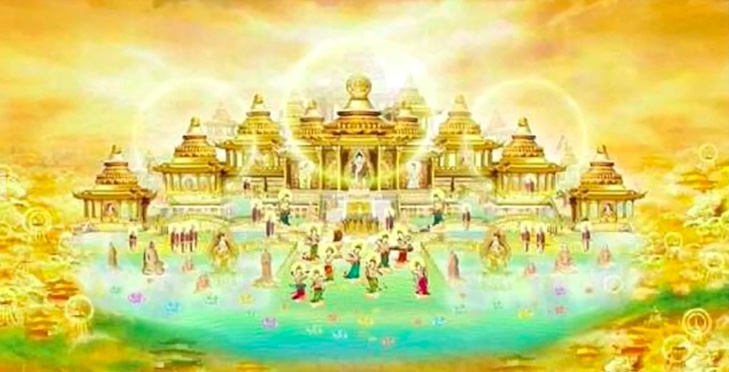
When Zhaxi Zhuoma’s close relative died, she asked H.H. Dorje Chang Buddha III, “What should I do?” As a result of her sincere request, H.H. Dorje Chang Buddha III performed a very wonderful and amazing ceremony that enabled her to see her relative, actually go to the Western Paradise of Ultimate Bliss (Sukhavati). This is a very high ritual of the Supreme Yoga Vajra Division, which cannot be discussed in detail with those who have not received initiation. However, she was able to report that she actually witnessed with her own eyes the miraculous scene where this person was transported to the sixth level of this Buddha-land that is beyond the worldly realms of suffering and sorrow. There are nine levels all together in the Western Paradise of Ultimate Bliss. This is the highest tier of the middle level, known as the Zhong Pin Shang Sheng in Chinese.
The picture of this person quivered in her hands as the ceremony began. It seemed that he could hardly wait. Or was this in response to the extraordinary dharma powers of the H.H. Dorje Chang Buddha III? It was a glorious and marvelous sight! There are no words that can express the joy she experienced when this event took place. His Holiness explained that this was because she was able to obtain a “glimpse” of the bliss that occurs in the Western Paradise. There is no other Dharma King or master who can do this! It was incredible!
Earlier H.H.Dorje Chang Buddha III allowed Zhaxi Zhuoma to see the sufferings of Hell. Now she was able to experience the bliss of the Western Paradise. The Petitioning the Western Paradise of Ultimate Bliss Dharma is a very high and special dharma that is rarely practiced in this world. Many people want to go to the Western Paradise, but can’t. They would like to receive this dharma or have it performed for their loved ones, but can’t. Zhaxi Zhuoma said, “I have been with H.H.Dorje Chang Buddha III for six years and seen him perform very many forms of inner tantric initiations and received some, but this is the first time that I have seen him perform this particular dharma. It was only through the maturing of certain causes and conditions that this ritual was successfully performed.“
“My dear relative, who was ninety when he died, had been a good Christian man, but knew nothing of Buddhism. His only contact with Buddhism had been through knowing me, although he had also met my younger vajra sister, Ven. Akou Lamo Rinpoche, in 2003 when we briefly visited him while on tour of the U.S.. Ven. Akou Lamo Rinpoche is a great rinpoche from Tibet and also a close disciple of H.H.Dorje Chang Buddha III . I am sure we were the only Buddhists he had ever even heard of, let alone met. “ This person had lived a good life and was very kind and generous, being willing to go to great lengths to help those who needed help. His immediate family, who are all also good Christians, were quite certain that he would go to the Christian heaven, but who would have thought that he would have had the good fortune to escape the realm of reincarnation altogether?
He had, after all, also been an avid hunter and fisherman and had killed many living beings in his life. With such negative karma, how could he be reborn in heaven? Needless to say, it would be even more impossible for him to go to the Western Paradise. But H.H. Dorje Chang Buddha III’s Buddha-dharma is so magnificent! I could actually witness my relative going to this superb Buddha-land and enjoying the incomparable happiness one finds there. His Holiness told me, ‘You are a rinpoche. That is why you can see this.’
“I was horrified when the minister giving the eulogy at my relative’s funeral praised him for teaching his grandchildren how to fish. I wanted to cry out “How can you praise someone for teaching children how to kill?” but I held my tongue and remained silent. In this rural community and this culture, hunting and fishing are very important, both for food and for pleasure. They do not understand the principles of either reincarnation or karma. It is only through the incredible merit, dharma skills, and great compassion of the H.H.Dorje Chang Buddha III that this could happen.
“Just eleven days after my relative left this world, his wife also left. She was also ninety. H.H. Dorje Chang Buddha III was also able to raise her consciousness so that she could join her husband in the Western Paradise. I saw the Buddhas and Bodhisattvas come to the sacred mandala to receive her and witnessed their acceptance of her into the Western Paradise. This was a different ceremony held at a different mandala. At first it looked as though she might not be able to make it. H.H. Dorje Chang Buddha III went back and practiced the dharma a second time. This time he was able to send her to this paradise of eternal joy and happiness.
She, too, had been a good Christian, but knew nothing about Buddhism. She also did not have the good fortune to meet Ven. Akou Lamo Rinpoche. However, she was still able to go to the Western Paradise. It was so amazing. This was because of the incredible compassion and Buddha-dharma powers of H.H. Dorje Chang Buddha III Wan Ko Yeshe Norbu Holiest Tathagata. The Buddha-dharma is magnificent!”
In 2004 H.H.Dorje Chang Buddha III performed another ceremony to raise the consciousness of Zhaxi Zhuoma’s non-Buddhist parents, Carl and Elsie Welker, to a higher realm as well. At that time she saw the Dharma Protecting Deities come to perform this rite. She was very, very grateful to her vajra master for his kindness and compassion in blessing her dear relatives. These miraculous Buddha-dharma events, performed for those who had not practiced or known anything about Buddhism, were all due to the amazing merit and compassion of H.H. Dorje Chang Buddha III Wan Ko Yeshe Norbu. He was willing and able to share his boundless merit with these non-Buddhist to enable them to enjoy the blessings of Amitabha Buddha’s Western Paradise. This was a great teaching on compassion and true equanimity.
REINCARNATION:
H.H. Dorje Chang Buddha III reminded us that we must realize that reincarnation is not something that just exists for Buddhists or easterners. It existed before the coming of the Buddha or before Jesus and continues to exist even after they have left this realm. It is a fact based on the principles of cause and effect. It does not exist because people believe in it or talk about it—it just exists. Nor does reincarnation cease to exist just because people do not accept it or believe in it. Only the Buddha was able to see how the cycle of reincarnation worked and to realize the method for escaping the suffering that is inherent in continual rebirth in the six realms of existence. Only a Buddha is capable of understanding the workings of karma.
Some concept of “heaven” or a “happy hunting ground” or “paradise” is held by most religions. Buddhism recognizes these realms as well, but does not hold the various heavens or abodes of the gods (devas or angels) and other celestial beings to be the goal of spiritual practice. They could be viewed as a “rest stop” or a nice vacation site, as one can surely go to these wonderful places if one lives a good life, avoids evil, and accumulates sufficient “merit.” However, even in heaven, when one’s merit is used up (and it is very hard to accumulate more merit while in those realms—the pleasures are just too great), one must still be reborn and repay one’s karmic debts.
There is even no guarantee that living a good life is enough to enable you to have a good next life, for your karma from past lives may catch up with you on your next round. Only by becoming a holy or enlightened being (or saint), can one escape the cycle of reincarnation and the suffering of existence. The early Christians also believed in reincarnation, as do many Christians today, but it is not accepted as Christian dogma. There are two dharmas whereby one can go to the Western Paradise. One dharma involves repeatedly reciting Amitabha Buddha’s name. The other is Petitioning the Western Paradise of Ultimate Bliss Dharma, which is a very high and special dharma that very few people who have lived in this world could perform. Shakyamuni Buddha and the Ugyen Second Buddha, Great Dharma King Padmasambhava, could do it, as could great holy dharma kings after them. H.H. Dorje Chang Buddha III Wan Ko Yeshe Norbu, however, is more accomplished than any of these dharma kings.
No wonder H.E. Tangtong Gyalpo Great Bodhisattva, who was once the leader of the four main sects of esoteric Buddhism, wrote a congratulatory letter highly praising H.H. Dorje Chang Buddha III Wan Ko Yeshe Norbu’s proficiency in both esoteric and exoteric Buddhism and his wonderful mastery of the five vidyas. That letter also praised His Holiness as being the first person in history to accomplish this. Zhaxi Zhuoma said that “to my knowledge, His Holiness is the only living vajra master who can perform such a ceremony involving great dharma and have the Buddhas and Bodhisattvas come to the sacred altar to help the deceased reach this high level of achievement. We are very fortunate to have such a holy one with us here in America.”
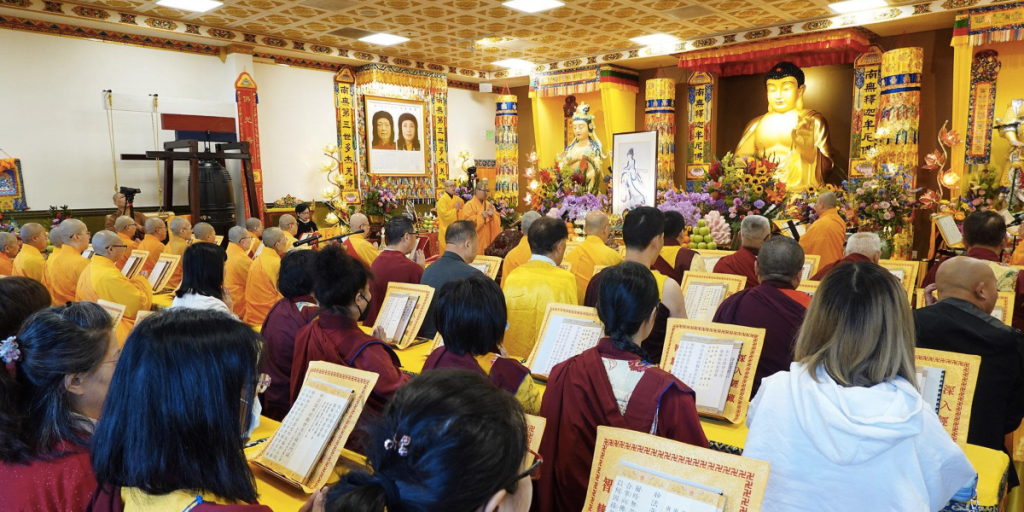
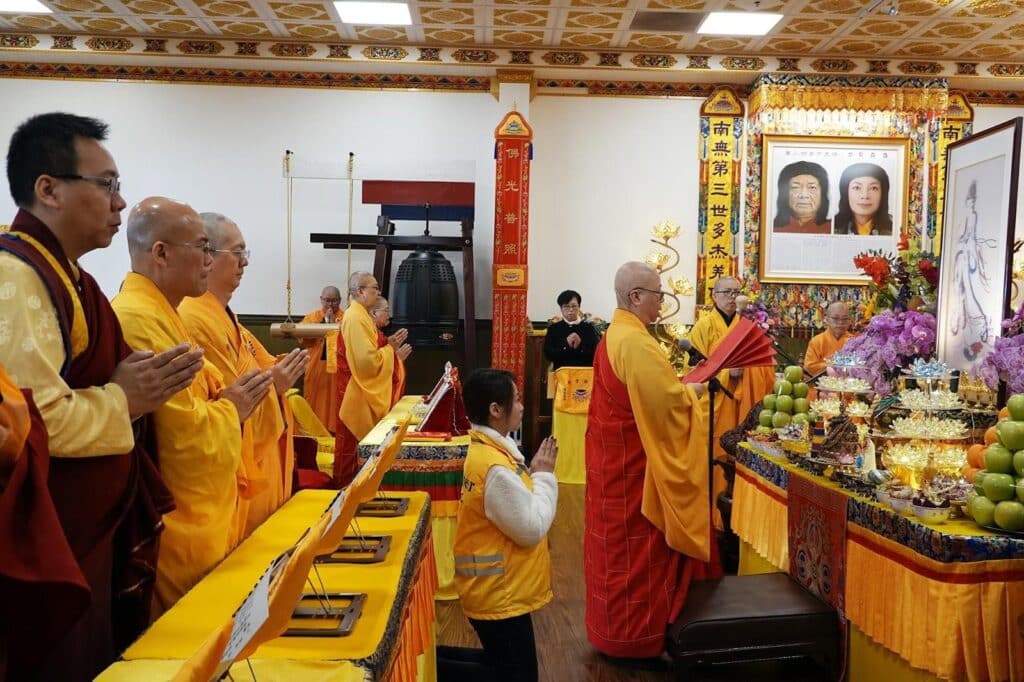
To honor the Holy Birthday of Avalokitesvara Bodhisattva, Buddhists and local residents converged at the Holy Miracles Temple in Pasadena, California, for the Avalokitesvara Bodhisattva Dharma Assembly. Held on March 17, 2024, within the Sakyamuni Buddha Hall, this event was a collaborative effort between the World Buddhism Association Headquarters, Holy Miracles Temple, and Sanger Mission.
Presided over by the Abbess of the Hua Zang Si Temple, Ruzun Ruohui, and jointly guided by Dharma Master JueHui and Dharma Master MiaoKong, the assembly brought together a congregation of holy gurus, eminent monks, dedicated monastics, and others. Their shared purpose was to pay homage to Avalokitesvara Bodhisattva, whose boundless compassion and loving kindness have been a beacon of hope for countless beings throughout the ages.
The Avalokitesvara Bodhisattva Dharma Assembly was held in the Sakyamuni Buddha Hall of Holy Miracles Temple. Photo Courtesy: Joyce Lee
Avalokitesvara Bodhisattva, also known as Guan Shi Yin Bodhisattva in Chinese, is revered for profound compassion and unwavering commitment to alleviating the suffering of all sentient beings. According to Buddhist scriptures, Avalokitesvara Bodhisattva attained Buddhahood eons ago and is known as Zheng Fa Ming Ru Lai, the Correct Dharma Realization Tathagata. Through sacred vows and bodhicitta, the Correct Dharam Realization Tathagata manifests as a Bodhisattva to extend aid to those in need and save sentient beings from suffering. Avalokitesvara Bodhisattva expounded one of the most influential Buddha Sutras – “The Prajna Paramita Heart Sutra,” which encapsulates the profound wisdom of the Buddha, illustrating the meaning of prajna.
While honoring Avalokitesvara Bodhisattva’s great compassion, sovereign wisdom, profound power, and benevolence, the assembly also reflected on the significance of bodhicitta, as elucidated by H.H. Dorje Chang Buddha III in the Sutra – “What is Cultivation.” He imparted, “The broad meaning of bodhicitta encompasses all of the Mahayana Dharma related to saving living beings out of great compassion and the causes leading to attaining the stages of enlightenment of a Bodhisattva.” This essence of conduct rooted in compassion deeply resonated with the attendees, reinforcing their dedication to selflessness and enlightenment.
The assembly witnessed the recitation of passages from “The Lotus Sutra’s Universal Gate Chapter on Avalokitesvara Bodhisattva,” a revered text extolling the virtues and profound wisdom of Avalokitesvara Bodhisattva. Participants engaged in practices such as meal offerings to the Buddhas, seeking blessings for happiness, auspiciousness, and the enhancement of fortune and wisdom. The gathering also collectively expressed their aspirations for the endurance of world peace, the cessation of calamities, while invoking prosperity, good health, and longevity for all.
As incense wafted through the temple and chants echoed in the halls, attendees were reminded of the profound teachings of compassion and empathy advocated by Avalokitesvara Bodhisattva. The ceremony served as a reminder of the transformative power of faith, uniting individuals from all walks of life in celebration of the Dharma.
King Ajatasattu, in order to seize the throne, murdered his own father, King Bimbisara. Afterwards, he felt constant pain and fear in his mind and body, seeking help from various physicians and religious experts but to no avail. Finally, at the urging of a monk named Jivaka, he went to seek the Buddha.
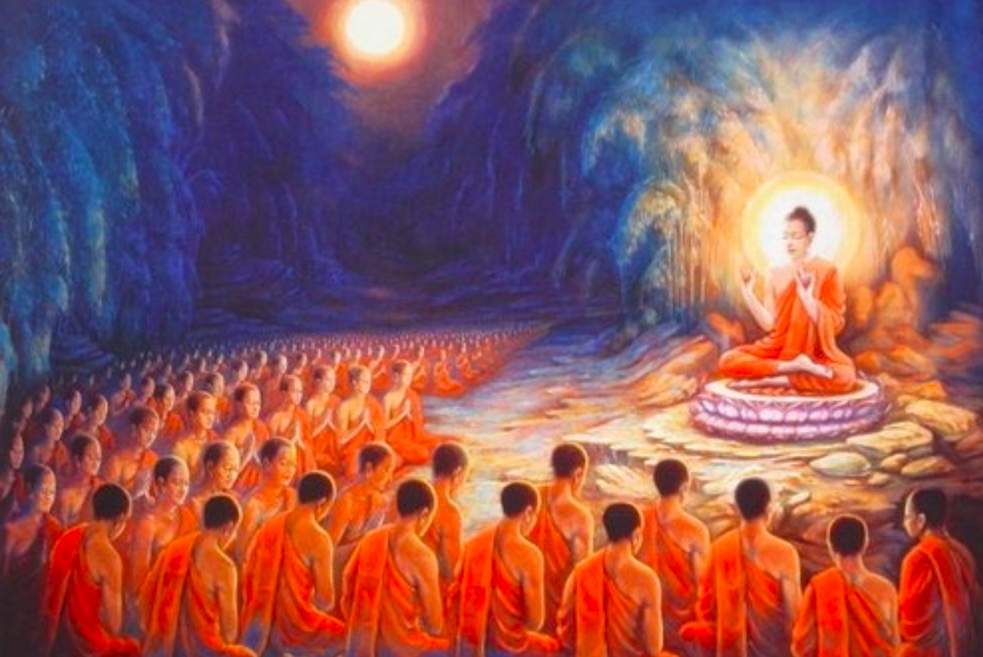
At that time, the Buddha was residing in a grove with a thousand monks. King Ajatasattu entered the assembly hall and saw a thousand monks sitting peacefully around the Buddha, not even the sound of rustling robes could be heard. King Ajatasattu had only briefly encountered the Buddha before, as he had never attended any of the Buddha’s teachings with his father. The Buddha invited them to sit down, and after bowing, the king said, “World-Honored One, I remember hearing you speak when I was young in the palace. Now I have a question for you: what practice can lead thousands of people to renounce worldly life and seek enlightenment?”
The Buddha asked if he had asked the same question to other teachers. King Ajatasattu said he had asked many different teachers, including Devadatta, but had never received a satisfactory answer. The Buddha said, “Your Majesty, tonight the Tathagata will explain to you the fruits of the true Dharma, some of which can be enjoyed in the present and some of which can be harvested in the future. You do not need to seek lofty answers; you just need to see clearly the mango you hold in your hand. Your Majesty, let me give you an analogy: a servant who obeys his master’s every command from morning till night. One day, he asks himself, ‘Why should I willingly be enslaved by my master?’ This servant decides to renounce his servitude and become a monk. He lives a life of celibacy, diligence, and mindfulness, eating only one meal a day, practicing walking and sitting meditation. His demeanor exudes peace and dignity in his actions and speech; he becomes a virtuous and respected monk. Although you know he was once a servant, when you see him now, would you say to him, ‘Come here, boy, I want you to serve me from morning till night, obeying all my orders’?”
King Ajatasattu said, “Certainly not, World-Honored One. I would never speak to him in such a manner. I would respectfully bow to him, offer him food, and ensure he receives the legal protections due to a monk.”
The Buddha said, “Your Majesty, this is the first fruit of the monk’s practice: he has liberated himself from prejudices of race, society, and class, and he has regained the dignity of being a human being.”
The Buddha continued, “Your Majesty, a person’s dignity is just the first fruit. A monk who observes the two hundred and fifty precepts can reside in a state of tranquility. Those who do not observe precepts are more prone to stray from the path; they may commit sins such as deception, intoxication, adultery, theft, or even murder. Such actions bring terrible punishments to their bodies and minds, and they may face severe penalties when caught. A monk who observes the precepts of non-killing, non-stealing, chastity, truthfulness, abstinence from intoxicants, and over two hundred other precepts finds it easier to live a psychologically freer life than ordinary people. This is another fruit that can be enjoyed in the present.
The Buddha continued, “Your Majesty, a monk possesses only three robes and an alms bowl. He never fears robbery nor needs to guard against thieves at night. He can sleep under a tree without worry. The freedom released from fear is the greatest joy. This is another fruit attained through practice. A monk’s life is very simple; although he eats only one meal a day, the food in his bowl comes from thousands of different households. He does not pursue fame or profit; he only uses what he truly needs, seeking nothing else. Dwelling in such unfettered freedom is a fruit that can be enjoyed at this moment.
King Ajatasattu said, “Truly remarkable, World-Honored One! Please continue.”
The Buddha said, “Your Majesty, if you understand how to cultivate mindfulness and contemplation of breathing, you can experience the joy of those who walk the path of practice. That is the bliss of meditation. A monk observes the six senses to overcome the five hindrances of desire, anger, delusion, sloth, and doubt. He attentively observes the breath to create joy nourishing body and mind, which helps him progress on the path to enlightenment. The pleasure derived from sensory experiences cannot compare with the joy obtained through meditation. The joy of meditation permeates body and mind, dispelling all anxieties, sorrows, and grief, allowing the practitioner to experience the true wonder of life. Your Majesty, this is one of the most important fruits of practice that can be enjoyed at this moment.”
The Buddha continued, “Your Majesty, because a monk consistently maintains mindfulness and adheres to the precepts, he can develop right concentration and insight into all phenomena. Through this insight, he sees the impermanent and selfless nature of all phenomena, thus no longer being bound by worldly affairs. He can then sever all entanglements of afflictions such as greed, anger, desire, sloth, doubt, attachment to views, speculative views, distorted views, and mistaking wrong views for right ones. After cutting off all these entanglements, the monk can attain liberation and freedom.”
“Your Majesty, liberation is true happiness and one of the greatest fruits of practice. Some of the monks sitting here tonight have already attained this fruit. Your Majesty, this is a fruit that can be realized in this very life.”
King Ajatasattu exclaimed, “Excellent, World-Honored One! I hope you can say more.”
The Buddha said, “Your Majesty, by illuminating the true nature of all phenomena, a monk knows that all phenomena are neither born nor extinguished, neither defiled nor pure, neither increasing nor decreasing, neither one nor many, neither coming nor going. With this understanding, a monk no longer discriminates; he regards all phenomena with equanimity, without hindrance. He rides the waves of birth and death to rescue sentient beings from the sea of suffering. He introduces sentient beings to the Great Way, allowing them to taste the joy of liberation. Your Majesty, helping others to break free from the maze of greed, anger, and delusion is the greatest joy. This joy extends from the present into the future as the supreme fruit of practice.
Your Majesty, in all his interactions, a monk never forgets the responsibility to guide others towards virtue and liberation. Monks do not engage in politics; they only contribute to the peace, morality, and happiness of society. The fruits of practice are not only for the benefit of monks; they are also the legacy that can be inherited by the people of the country.
The king stood up, sincerely clasping his hands together. He said, “Most Honored Teacher! World-Honored One! With your simple words, you have enlightened me, showing me the true value of the Dharma. World-Honored One, you have helped me rebuild what was shattered, revealed what was concealed. You have guided me back to the right path in my confusion, turning darkness into light. I beseech you, World-Honored One, to accept me as your disciple, just as you accepted my parents in the past.”
The king prostrated himself before the Buddha, who nodded in acceptance. He asked venerable Shariputra to teach king Ajatasattu the Three Refuges.
The meeting between the Buddha and King Ajatasattu was beneficial for all present, greatly alleviating the king’s mental torment. That night, he dreamt of his father smiling at him, healing all the wounds of the past. The king’s disposition completely changed, bringing infinite joy to his subjects. From then on, the king often visited the Buddha privately, no longer arriving on an elephant and without any guards. He climbed the meticulously carved stone steps up the mountain as his father had done in the past. In these conversations, King Ajatasattu confessed his innermost thoughts to the Buddha and repented for his past sins. The Buddha regarded him as his own son and advised the king to associate with virtuous people.
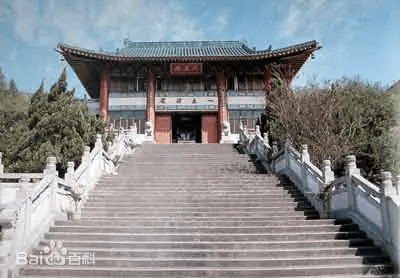
Standing on Fuyung Mountain Road in Tsuen Wan, Hong Kong, Zhulin Temple (also known as Chuk Lam Sim Yuen) proudly upholds the lineage of the Linji School of Zen Buddhism. Rooted in tradition, the temple seamlessly integrates teachings from the Tiantai and Pure Land traditions, thereby spreading the Buddha’s wisdom far and wide. Nestled within the heart of the Fragrant Harbour, it fosters a unique spiritual atmosphere known as the “Bamboo Grove Family Style,” where the Dharma is generously shared, benefiting both locals and visitors alike, serving as a haven for Buddhist study and practice.
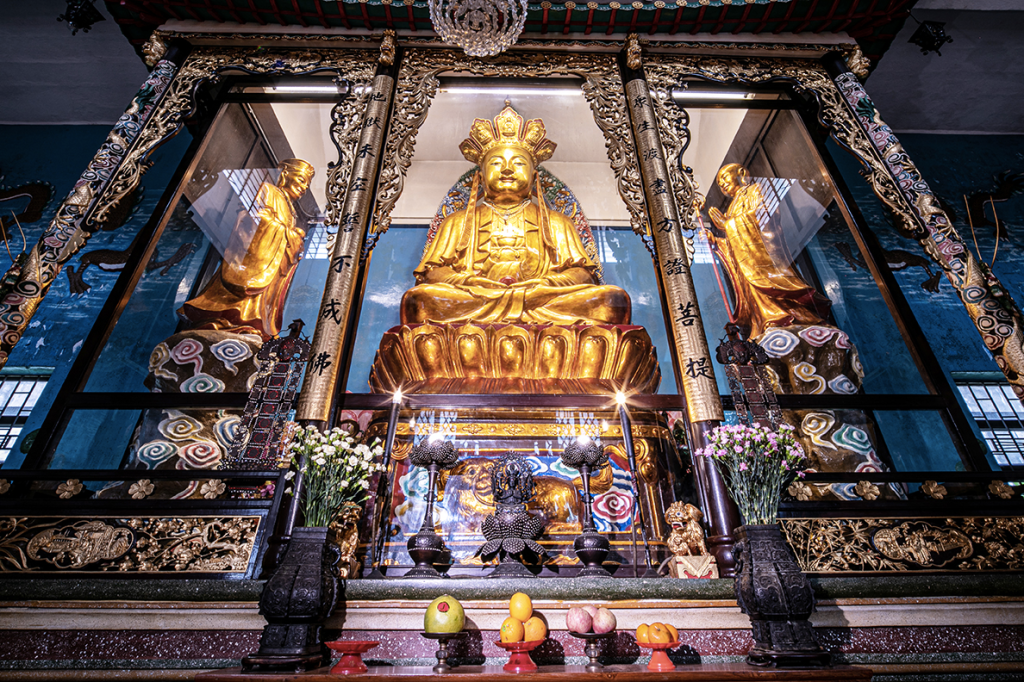
Encompassing an expansive area exceeding 400,000 square feet, Zhulin Temple commands a serene and majestic presence, making it one of the largest and most beautiful temples in Hong Kong. Its origins trace back to 1928 when the founding master, prompted by three visionary dreams from Bodhisattva Ksitigarbha, embarked on the mission to erect a temple on Fuyung Mountain. Inspired by unwavering Bodhi resolve, six devoted followers generously donated funds to procure the land and construct the temple. Drawing inspiration from the architectural marvels of ancient Chinese mountain temples, the Pagoda Hall was completed on October 23, 1932, housing the largest statue of Ksitigarbha Bodhisattva on a lotus throne in Hong Kong. Thus, Zhulin Temple was formally inaugurated, marking the beginning of its sacred journey to illuminate sentient beings.
The architectural layout of Zhulin Temple embraces a harmonious three-section courtyard design. Upon crossing the mountain gate, visitors are greeted by the monastery’s serene courtyard garden, offering a space for worshippers to procure incense, candles, flowers, and fruits for offerings. Ascending the steps leads to the grand Hall of Heavenly Kings, where the jovial Maitreya Buddha stands at the central entrance, extending a warm welcome to all. Within the hall, the Four Heavenly Kings stand guard, with the central altar adorned by Bodhisattva Virūpākṣa, safeguarding the monastery under the benevolent gaze of Maitreya Buddha.
steps leads to the Grand Hall of Heavenly Kings,
Maitreya Bodhisattva
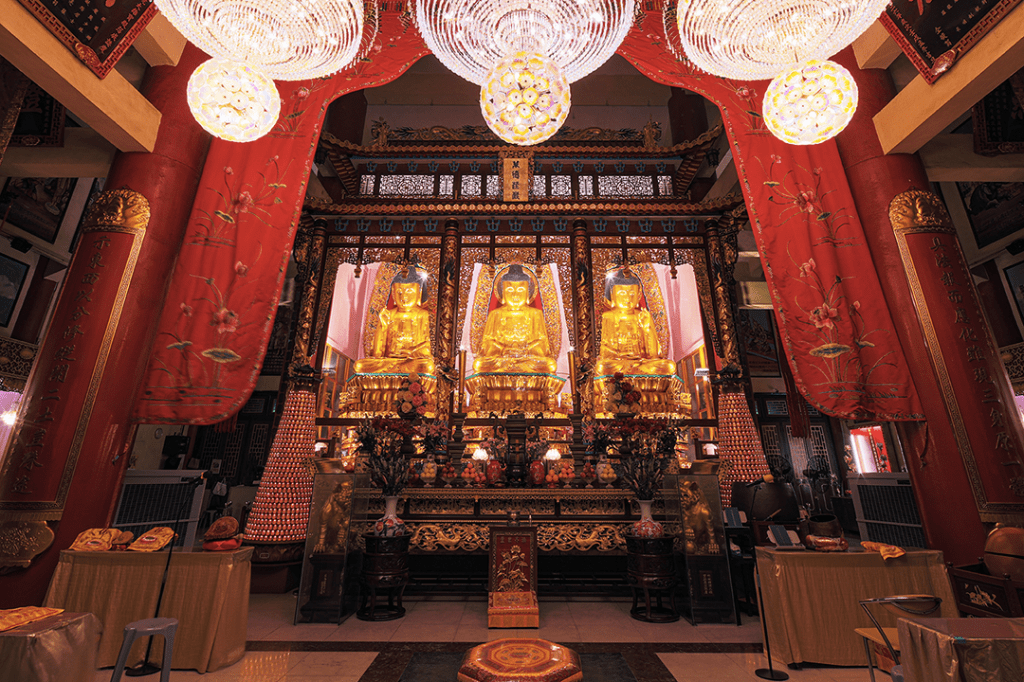
Further beyond lies a spacious courtyard flanked by a bell tower and drum tower. Ascending the stairs unveils the majestic Grand Hall, where the Triple Gem (Amitābha Buddha, Śākyamuni Buddha, and Bhaiṣajyaguru Buddha) resides on the central altar, accompanied by eighteen Arhats on either side. Adorning the rear of the Triple Gem altar is a depiction of the transformative scene from the Avalokiteśvara Sūtra, illustrating the manifestation of Avalokiteśvara Bodhisattva.
Bell Tower and Drum Tower
The Grand Hall
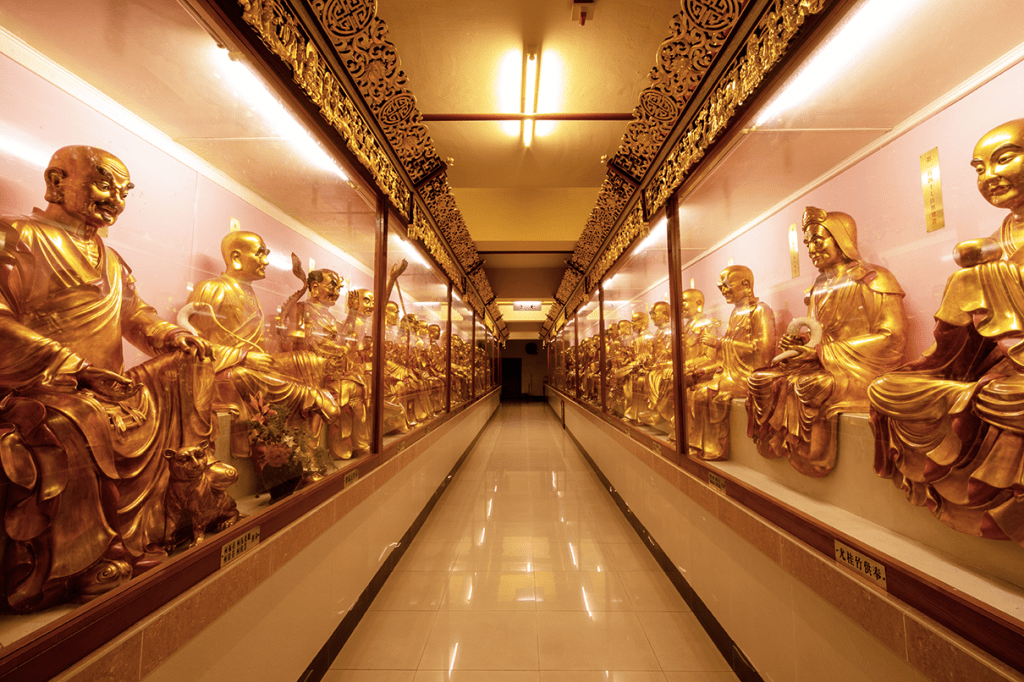
Adjacent to the main hall, worshippers find solace in a pavilion, while the Guan Yin Hall and Jade Buddha Hall flank its sides. Upstairs, the Pagoda Hall, now known as the Ksitigarbha Hall, stands adjacent to the Ancestral Hall and the Kitchen. Surrounding the monastery are additional halls including the Five Hundred Arhats Hall, the Dharma Hall, the Chan Hall, and the Scripture Repository, nestled along the outskirts and mountain slopes.
Guan Yin Hall
Ksitigarbha Hall
Five Hundred Arhats Hall
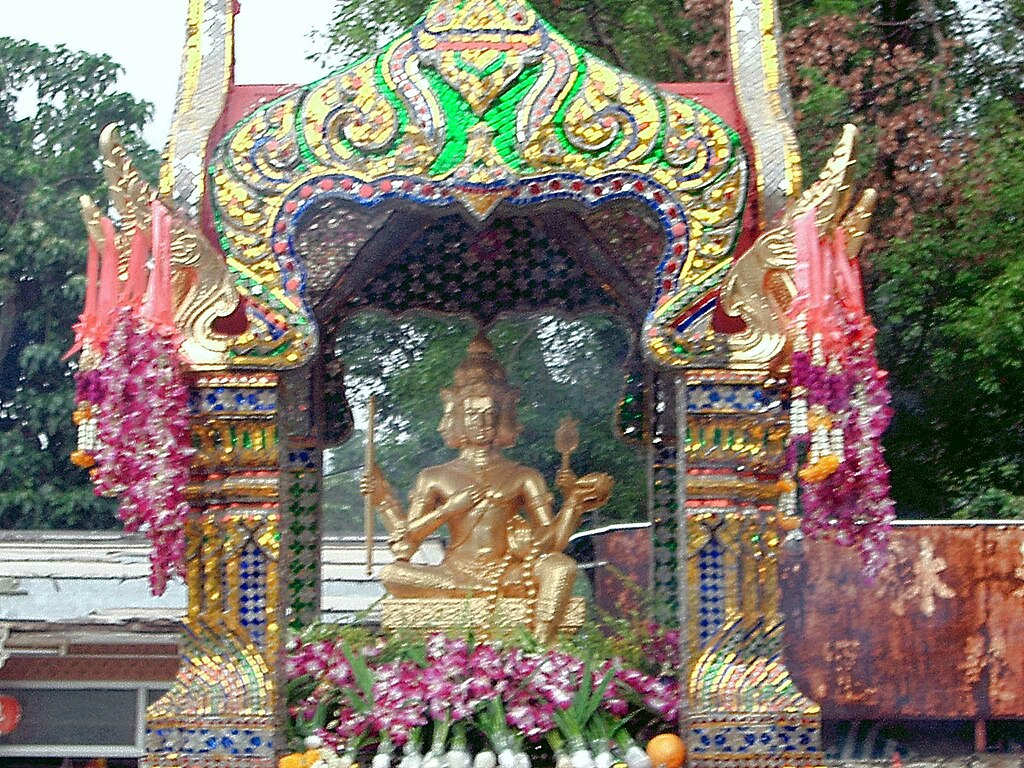
Four faced Buddha Statue 由Hkgalbert – 自己的作品,公有领域,https://commons.wikimedia.org/w/index.php?curid=9932768
Throughout its century-long history, Zhulin Temple has been overseen by five abbots. Notably, the fourth Abbot Master YiZhao emerged as an eminent monk of his time. Venerable Dharma Master Yizhao (1927-2013), born in Guangdong, China, embarked on his spiritual journey by joining Zhulin Zen Monastery in Hong Kong in 1940, formally becoming a monastic in 1941.
Under the guidance of Master Xuyun, he received the transmission of Viyana at Nanhua Temple in 1944, subsequently inheriting the Linji (Rinzai) Dharma lineage and becoming its 44th holder. Establishing the Guyan Pure Monastery in 1952, he later returned to Zhulin Temple to assist in its renovation, eventually assuming the role of abbot. He peacefully passed away in 2013, leaving behind a legacy of enlightenment and compassion.
Master YiZhao (left) and Master XuYun (right) were together at KaiYuan Temple in ChaoZhou, GuangDong , in 1946
Venerable Dharma Master Yizhao, the successor to H.E. Dharma Master Xuyun, exemplifies profound virtue within contemporary Zen Buddhism. Having attained the supreme state of Bodhi, he relinquished all ties to further reincarnation long ago. Inspired by the compassionate vow of Ksitigarbha Bodhisattva, he pledged “As long as there is any living being in the earthly realm, I vow not to become a Buddha.” Renowned as the nirmanakaya of Ksitigarbha Bodhisattva, he received the Amrit Empowerment Initiation from H.H. Dorje Chang Buddha III, lauded as an exceptional monk who ardently upholds precepts.
In June 2000, Venerable Dharma Master Yizhao seized the opportunity to participate in the Buddhas Bestowing Nectar Dharma Assembly presided over by H.H. Dorje Chang Buddha III. (The very left in the photo is Master Yizhao)
Zhulin Temple stands as a testament to beauty and sanctity, inviting visitors to immerse themselves in Buddhist culture, prayers, and blessings, offering a profound spiritual experience.