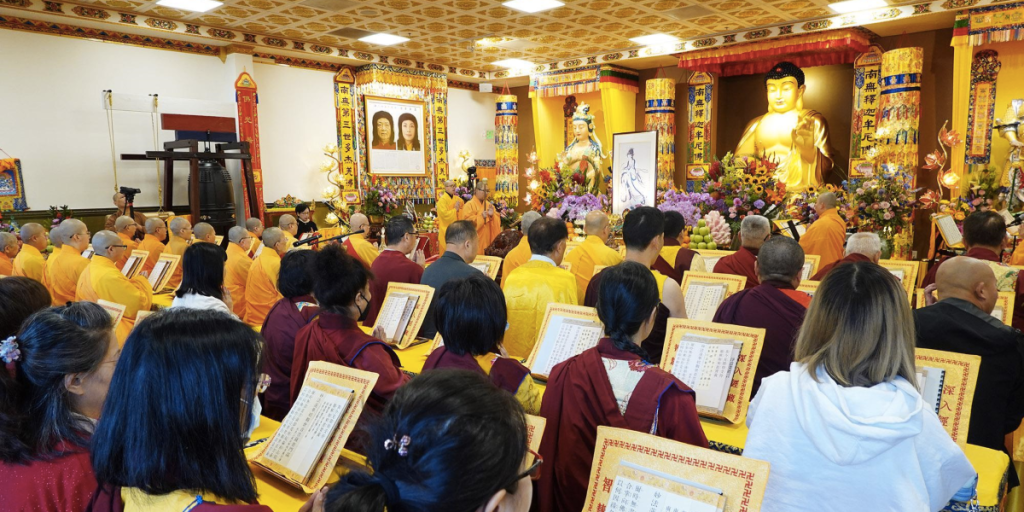
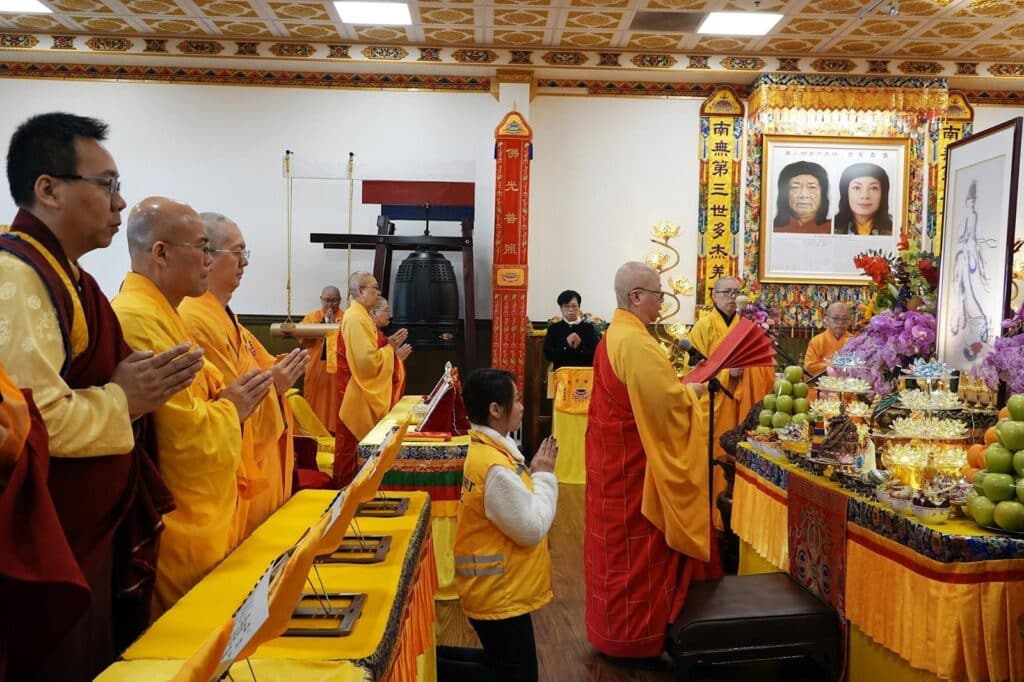
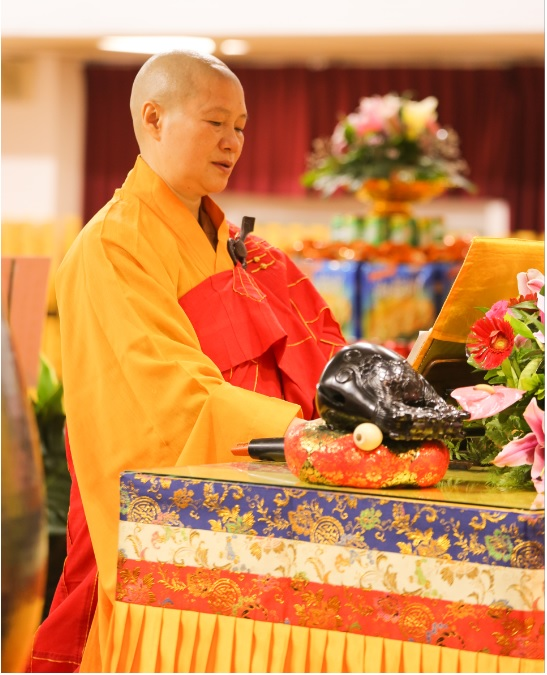
To honor the Holy Birthday of Avalokitesvara Bodhisattva, Buddhists and local residents converged at the Holy Miracles Temple in Pasadena, California, for the Avalokitesvara Bodhisattva Dharma Assembly. Held on March 17, 2024, within the Sakyamuni Buddha Hall, this event was a collaborative effort between the World Buddhism Association Headquarters, Holy Miracles Temple, and Sanger Mission.
Presided over by the Abbess of the Hua Zang Si Temple, Ruzun Ruohui, and jointly guided by Dharma Master JueHui and Dharma Master MiaoKong, the assembly brought together a congregation of holy gurus, eminent monks, dedicated monastics, and others. Their shared purpose was to pay homage to Avalokitesvara Bodhisattva, whose boundless compassion and loving kindness have been a beacon of hope for countless beings throughout the ages.
The Avalokitesvara Bodhisattva Dharma Assembly was held in the Sakyamuni Buddha Hall of Holy Miracles Temple. Photo Courtesy: Joyce Lee
Avalokitesvara Bodhisattva, also known as Guan Shi Yin Bodhisattva in Chinese, is revered for profound compassion and unwavering commitment to alleviating the suffering of all sentient beings. According to Buddhist scriptures, Avalokitesvara Bodhisattva attained Buddhahood eons ago and is known as Zheng Fa Ming Ru Lai, the Correct Dharma Realization Tathagata. Through sacred vows and bodhicitta, the Correct Dharam Realization Tathagata manifests as a Bodhisattva to extend aid to those in need and save sentient beings from suffering. Avalokitesvara Bodhisattva expounded one of the most influential Buddha Sutras – “The Prajna Paramita Heart Sutra,” which encapsulates the profound wisdom of the Buddha, illustrating the meaning of prajna.
While honoring Avalokitesvara Bodhisattva’s great compassion, sovereign wisdom, profound power, and benevolence, the assembly also reflected on the significance of bodhicitta, as elucidated by H.H. Dorje Chang Buddha III in the Sutra – “What is Cultivation.” He imparted, “The broad meaning of bodhicitta encompasses all of the Mahayana Dharma related to saving living beings out of great compassion and the causes leading to attaining the stages of enlightenment of a Bodhisattva.” This essence of conduct rooted in compassion deeply resonated with the attendees, reinforcing their dedication to selflessness and enlightenment.
The assembly witnessed the recitation of passages from “The Lotus Sutra’s Universal Gate Chapter on Avalokitesvara Bodhisattva,” a revered text extolling the virtues and profound wisdom of Avalokitesvara Bodhisattva. Participants engaged in practices such as meal offerings to the Buddhas, seeking blessings for happiness, auspiciousness, and the enhancement of fortune and wisdom. The gathering also collectively expressed their aspirations for the endurance of world peace, the cessation of calamities, while invoking prosperity, good health, and longevity for all.
As incense wafted through the temple and chants echoed in the halls, attendees were reminded of the profound teachings of compassion and empathy advocated by Avalokitesvara Bodhisattva. The ceremony served as a reminder of the transformative power of faith, uniting individuals from all walks of life in celebration of the Dharma.
Have you ever stumbled upon a book that instantly captivates your attention, drawing you into its pages with an irresistible allure? That’s precisely what happened to me when I discovered the Chinese version of “The Boy Who Saw True.” From the moment I started reading, I was completely enthralled.
At the heart of this remarkable book is a young boy from England, born into privilege yet endowed with an extraordinary gift. Raised in a family where literature was cherished, he inherited his father’s passion for reading, immersing himself in books far beyond his tender years. Despite his mother’s attempts to steer him away from certain subjects, his determination to explore the literary world only grew stronger, infusing his writings with a delightful blend of wit and charm that is uniquely his own.
But what truly sets this young boy apart is his “third eye” – an innate ability to see truths hidden from ordinary sight. In his diary, he meticulously chronicles the myriad of peculiar phenomena he encounters in the spiritual realm. From envisioning himself as a monk in a secluded cave, imparting ancient Buddhist teachings to his disciples, to glimpsing his past life as a revered priest in ancient Egypt, seduced by the allure of worldly power – each revelation is as astonishing as it is profound, offering profound insights into the mysteries of human nature and the cosmic order.
Despite facing skepticism and misunderstanding from those around him, the boy’s unwavering insight into the spiritual realm remains unquestionable. His experiences, both mysterious and mesmerizing, serve as a beacon of inspiration, igniting a fervent curiosity in readers eager to unlock the secrets of the universe.
The author’s integrity shines through every page, as he never seeks to exploit his psychic abilities for personal gain. It’s this steadfast commitment to truth and authenticity that makes his diary a rare and precious gem, entrusted to the world by the esteemed editor, Mr. Cyril Scott, after the author’s passing.
What makes “The Boy Who Saw True” truly exceptional is its exploration of the spiritual realm through the innocent eyes of a child. Unlike other metaphysical books, it eschews complex theories in favor of a refreshingly simple and humorous narrative style, making it accessible to readers of all ages.
As I delved deeper into its pages, I couldn’t help but feel a profound sense of wonder and enlightenment. This book is more than just a literary masterpiece – it’s a journey of self-discovery and spiritual awakening that transcends the boundaries of time and space.
In conclusion, “The Boy Who Saw True” invites readers to embark on a transformative voyage into the unknown, where the boundaries between reality and imagination blur, and the truth reveals itself in the most unexpected of places. It’s a reminder that our lives are but a small part of a vast and wondrous universe, waiting to be explored and embraced with open hearts and minds.
Eben Alexander, a distinguished neurosurgeon, once firmly embraced the philosophy of Epicurus, believing in the finality of death and positing that there is nothing beyond our mortal existence. However, his own extraordinary encounter shattered these convictions, launching him into a profound journey that defied conventional understanding. In his compelling book, “Proof of Heaven,” Alexander shares a narrative that not only transformed his perceptions but also prompted contemplation on the very essence of existence.
As a highly esteemed figure in the medical community, Alexander boasted impeccable credentials, marked by significant contributions to neurosurgery and numerous academic accomplishments. His trajectory took an unexpected turn when he confronted bacterial meningitis caused by a rare strain of E. coli. With his neocortex, the seat of consciousness, succumbing to the illness, survival seemed improbable.
Against all odds, Alexander emerged from a seven-day coma with a surprising declaration: “All is well.” His miraculous recovery, confounding medical experts, extended beyond the physical realm. He vividly recounts a journey into a realm of ineffable beauty, profound understanding, and divine love—an experience that transcended his compromised brain function.
The title of Alexander’s book, “Proof of Heaven,” encapsulates the essence of his revelation. Through his firsthand account, supported by corroborating testimony, he challenges the notion that consciousness is solely a product of neural activity. His inexplicable recovery stands as a testament to the mysteries that lie beyond our comprehension, prompting profound reconsideration of life and death.
In the ethereal realms that Eben Alexander traversed during his coma-induced journey, he vividly described scenes of unparalleled beauty and awe. His narrative delves into luminous landscapes with vibrant colors and radiant light, transcending the limitations of earthly perception. Alexander spoke of meadows adorned with blossoms emitting melodies, a symphony of sound intertwined with vibrant hues that danced harmoniously.
Moving through this celestial expanse, Alexander encountered entities of immense love and wisdom, beings emanating a profound sense of interconnectedness and understanding. He described interactions with ethereal guides who communicated not through conventional language but through a telepathic exchange of pure emotions and intentions. These guides, he noted, possessed a divine knowledge surpassing the comprehension of the earthly mind.
Furthermore, Alexander shared experiences of traversing a vast, intricate network of interconnected realms, each layer revealing higher levels of consciousness and spiritual understanding. He conveyed encounters with deceased loved ones and souls radiating unconditional love, contributing to an overwhelming sense of peace and acceptance.
Colleagues attested to Alexander’s astonishing recovery, leaving the medical community baffled about the disease’s origin and subsequent recovery. Infectious diseases specialist Scott Wade, in an appendix, described the recovery as “truly remarkable.”
The crux of Alexander’s narrative lies in the title of his book, revealing his journey to a realm of hyper-real beauty, understanding, and divine love—a journey that occurred without the active participation of his brain. This challenges the notion that consciousness is solely a product of brain activity and provides compelling evidence for the existence of an afterlife.
In his book, Alexander also described what compelled him to return to the earthly world. He recounted seeing his son’s sad face and sincere prayer for Alexander to come back and be a father again. Alexander realized that taking care of family is a crucial responsibility on Earth.
Despite skepticism and criticism, the integrity of Alexander’s character and the veracity of his accounts remain steadfast, prompting broader questions about the limitations of empirical science in explaining transcendent phenomena.
Contemplating the implications of Alexander’s revelation compels us to ponder transformative potential across diverse fields of inquiry. What paradigm shifts would occur if the hypothesis of an afterlife were embraced within disciplines such as psychology, sociology, literature, and philosophy? How might our perceptions of reality and human experience be redefined in light of such profound revelations?
For many, Alexander’s journey offers a profound shift in perspective—a redirection of focus from the fear of death to the complexities of earthly existence. His account underscores the interconnectedness of the human experience, suggesting that the struggles and choices we face in this life hold profound significance.
Alexander’s account prompts contemplation on the relationship between the earthly realm and the divine. While he suggests that Heaven supports and holds us invisibly, it is equally plausible to consider that Heaven depends on us. Earth, with its struggles and challenges, becomes the consequential place where the battle between good and evil unfolds, shaping our choices and influencing realms beyond.
In essence, Eben Alexander’s odyssey transcends the boundaries of conventional understanding, beckoning us to explore the uncharted territories of consciousness and existence. Whether embraced as irrefutable proof or contemplated as a profound allegory, his journey serves as a catalyst for introspection, challenging us to reconsider the fundamental questions that define our humanity. As we navigate the mysteries of life and death, perhaps we are reminded that the ultimate truth lies not solely in the destination but in the journey itself.
This complex world is neither exclusively rosy nor entirely thorny. The rose, soft, beautiful, and fragrant, grows on a stem filled with thorns. What is rosy remains so, and what is thorny persists. One should not interfere with the thorns due to the presence of the rose, nor disparage the rose because of the thorns.
To an optimist, the world appears absolutely rosy; to a pessimist, it seems entirely thorny. However, a realist views the world neither as entirely rosy nor wholly thorny. From a realistic perspective, the world is a blend of beautiful roses and prickly thorns.
An understanding person appreciates the rose’s beauty without becoming infatuated, acknowledging the thorns’ nature and taking precautions not to be wounded.
Similar to a pendulum swinging between right and left, four inevitable conditions prevail in life — gain and loss, fame and defame, praise and blame, happiness and pain.
Gain and Loss: Businesspeople experience both gain and loss. While it’s natural to be pleased with profits, one must exhibit moral courage and maintain a balanced mind in the face of losses. Anticipating losses and being prepared helps reduce disappointment.
Fame and Defame: Fame and defame are inevitable in life. Seeking undue praise or avoiding criticism can lead to unfulfillment. True greatness is indifferent to external approbation.
Praise and Blame: Wise individuals remain unaffected by praise or blame, recognizing that opinions vary. The Buddha’s teachings emphasize responding to false accusations with patience and understanding.
Happiness and Pain: Genuine happiness is not solely derived from material possessions, power, or external circumstances. Inner happiness is found in non-attachment and leading a blameless life.
Facing pain, whether from old age, disease, separation, or death, requires equanimity. The Buddha himself endured physical suffering but maintained a balanced mind. Death, inevitable for all, should be faced with perfect equanimity.
Amidst these dualities, a balanced mind is crucial. The Buddha’s teachings encourage cultivating equanimity in the face of worldly conditions.
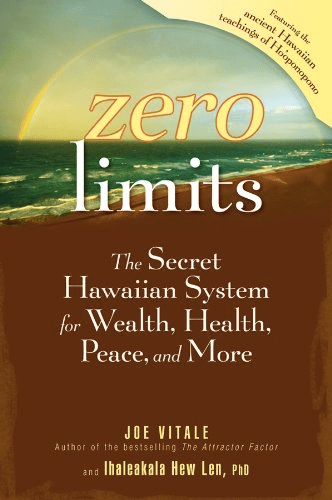
In 1984, a therapist in Hawaii achieved remarkable results over three years, healing mentally ill patients at the Hawaii State Hospital without resorting to clinical counseling or medication. Reviewing their records, he repeatedly recited four phrases to “clear” himself: “I’m sorry, please forgive me, thank you, I love you.”
This extraordinary tale intrigued Mr. Vitale, inspiring him to seek out this extraordinary therapist and learn from him. Vitale discovered that Dr. Hew Len employed these four sentences as part of a traditional Hawaiian healing technique known as “Hooponopono,” which translates to “to correct, to clear, to make right” in Hawaiian.
This method not only restored the health of mentally ill patients but also miraculously cured a woman who had suffered from asthma for 50 years overnight. Can four sentences really resolve all problems? Smooth out everything?
These four affirmations have the power to clear all negative energy, balance emotions, and enable you to return to the divine state of “zero limits” (a state of returning to zero, also known as emptiness in Buddhist philosophy, where nothing exists, and anything is possible). By embracing these four phrases, you can face your life more freely and elegantly, leading to health, wealth, and joy.
By approaching each day with an unrestricted perspective, repeating these four sentences concerning your mind, subconscious, experiences, people, and encountered problems with a sincere, repentant, and grateful heart, you will learn to love yourself, forgive yourself, and appreciate yourself. This practice will lead you to live a more fulfilling, wise, and abundant life.
Let us not only refrain from complaining but also say, “I love you!”
What is the Zero Limits method?
It’s straightforward—just four sentences: “I’m sorry, please forgive me, thank you, I love you.”
What do these four sentences represent? In simple terms:
“I’m sorry”: Acknowledge 100% responsibility for what has happened (because everything is created by oneself).
“Thank you”: Express gratitude, show trust, and believe that all problems will be resolved in the best way for everyone involved.
“I love you”: Invoke the power of divinity to clear related memories and heal all wounds.
Although these four sentences in Ho’oponopono therapy are simple, they encompass profound states and meanings. This is a convenient method that can be used at any time during our spiritual growth journey, transcending various spiritual practices.
How to use this method? It’s straightforward—whenever you encounter a problem, simply keep repeating these sentences (there’s no need to rush into belief or doubt; give it a try).
Fundamental Theory of Zero Limits:
You are not aware of what is happening.
Whether consciously or unconsciously, it is impossible to be aware of everything happening within and around you. At this very moment, your body and brain are self-adjusting without your conscious awareness. Countless invisible signals are transmitted through the air, from radio waves to thoughts and consciousness. All of this occurs unconsciously, and your consciousness is not aware of nor in control of this process. This is why you can think positively but still face challenges. In essence, you must understand that your consciousness is not the true creator of everything.
You cannot control everything
If you are unaware of what is happening, you certainly cannot control it. Believing that the world follows your commands is merely a manifestation of satisfying the desires of the ego. Since your ego cannot completely comprehend what is happening in the world, allowing the ego to decide what is best for you is obviously unwise. You can make choices, but you cannot control. You can use your consciousness to choose what you want to experience, but you must also learn to let go and not worry about how or when it will happen; surrender is the key.
You can heal everything that happens.
Regardless of what appears in your life and how it comes about, it requires healing. Because it is now within your perception, if you can feel it, you can heal it. If you see it in others and it troubles you, you must heal it. You may not understand why it appeared in your life or how it happened, but you can let go now. As you have become aware of it, the more you heal, the simpler it becomes to manifest your desires. By releasing blocked energy, you allow this energy to be used for other things.
You must take 100% responsibility for everything you experience.
The events in your life are not your fault, but they are your responsibility. This responsibility includes everything said, done, and thought, as well as everything said, done, and thought by others appearing in your life. If you take 100% responsibility for everything in your life, then when others have problems, those problems also become yours. In short, you cannot blame anyone or anything for your current situation. All you can do is take responsibility, accept it, embrace it, and love it. The deeper you heal, the more connected you become to the source of life.
The ticket to the state of Zero Limits is saying “I love you.”
To overcome the bottleneck of understanding, to obtain a pass from healing to manifestation, is that simple phrase “I love you.” Saying “I love you” to divinity clears everything within you, allowing you to experience the miracle of “Zero Limits.” The key is to love all things: love the excess fat, love the hidden pain, love the troublesome issues, love children with problems, or love neighbors and partners—in short, love everything. Love transforms and releases blocked energy, and by saying “I love you,” you can experience the power of divinity, just like saying “Open sesame.”
Inspiration is more important than thought.
Thoughts are toys of the mind, while inspiration is a directive from divinity. From a certain point onward, you will surrender and learn to listen instead of begging and waiting. Thought is an attempt by the ego to control life from a limited perspective, while inspiration is a reception of messages from divinity and taking action. Thought yields results, while inspiration produces miracles.
Even if you are not sure what is happening, you can still solve problems.
A part of the purpose of survival is to solve problems. To solve problems, you must first understand: Who am I? Who is actually in charge? The consciousness thinks that intellect is the problem solver, capable of controlling what happens, what one experiences, and when. However, in reality, decisions are made before the consciousness decides, and intellect is unaware of this. If it is not intellect or consciousness, then who is in charge?
It is your subconscious. The subconscious is dominated by replayed memories, and it imitates, repeats, and resonates with these memories. The actions, understanding, feelings, and decisions of the subconscious are entirely dictated by memory. Similarly, consciousness operates through replayed memories without awareness. Therefore, replayed memories dominate everything the subconscious and consciousness experience.
The subconscious is the repository of accumulated memories since the beginning. It constantly replays past memories, and the power of choice that consciousness possesses is the power to choose. Both the subconscious and consciousness do not create their own thoughts, feelings, or actions; rather, their experiences resonate with replayed memories and inspirations.
To solve problems, it is crucial to understand that the physical body and the world itself are not the issue; the problem lies in the replayed memories within the subconscious.
The universe comes from nothing and will return to nothing. The universe begins at zero and ends at zero.
Throughout the ages, in the pursuit of happiness, countless individuals have renounced worldly life to engage in spiritual practice. Monks and nuns who have shaved their heads and taken vows can be seen wandering in the secular world. People become monastics for various reasons, including pressure from material needs, family discord, social conflicts, life hardships, or a desire to seek liberation from the suffering of birth, aging, sickness, and death. Some renounce the worldly life to transcend desires, cultivate spiritual practices, and embark on the path to enlightenment. However, those who renounce a life of wealth, family, and worldly pleasures to become monastics are extremely rare.
Modern figures like Venerable Xuyun, Master Hongyi, Master Nenghai, and Master Longlian are typical examples of genuine monastics. Their renunciation was wholeheartedly directed towards the Buddha, without worldly attachments. When they made the decision to become monastics, their minds were solely focused on Buddha and Bodhisattvas, despite their flourishing family lives, prosperity, talents, and widespread respect. They left their homes without any attachments, not even informing their families. Suddenly, they abandoned their comfortable lives and became ascetics in the temples. Such individuals are rare, occurring perhaps once in several decades.
However, today, there is a Bhikshuni (Buddhist nun) who has renounced the world in an extraordinary way, captivating people’s hearts. She was originally known as Renbo Rinpoche, with the Dharma name “Awangdeji,” and held some reputation in Chinese Buddhist circles. She had centers in over twenty provinces in China, and her organization had a presence in Taiwan and Hong Kong. Wherever she went, male and female disciples welcomed her with reverence. Despite her prosperous personal business, she decided to renounce her worldly life.
Twenty years ago, she practiced the Sakya tradition but found no progress in her path. Seeking guidance, she turned to the profound teachings of the H.H. Dorje Chang Buddha III. Within a year, she completed her studies and realized that her previous practice was a common worldly path accessible to everyone, not true Buddhist teachings. In 2011, after rigorous examinations, she obtained certificates of realization that many other high lamas could not attain.
Her dedication, compassion, and influence attracted jealousy and rumors from some ordinary practitioners. However, Awangdeji Rinpoche bore no resentment, remaining calm and patient, even praising those who spread rumors. In response to societal criticisms, the International Buddhist Sangha Association sought an objective assessment from the United International World Buddhist Headquarters. After a solemn examination, she was praised by seventeen examiners for her moral virtues and realization.
During the examination, when Awangdeji Rinpoche’s consciousness soared, she personally saw Buddhas and Bodhisattvas, fulfilling a vow made to Avalokiteshvara. Overwhelmed with gratitude, she immediately renounced worldly life. Without her family’s knowledge, she underwent tonsure in Lianfeng Temple, Taiwan, adopting the Dharma name “Zhengda.” She relinquished all worldly wealth and family joy, untainted by the six dusts, transcending the ordinary and entering the realm of the holy.
On December 12th, 2012, a Assembly was held to bestow the initiation of “Selection Made in Dark Confinement from One-Hundred Dharmas to Choose the Door toward Enlightenment” upon Dharma Master Zhengda. This Assembly concluded that Dharma Master Zhengda was a reincarnated holy one and a trusted aide of the Tara. Her status of the dharma was extremely high, at the upper level representing the summit of esoteric Buddhism.
On May 25, 2013, Master Zhengda was honored with the Grand Cross of Humanitarian Merit by the Spanish Humanitarian Merit Association. This award, established and presented by the association, is specifically given to international figures who have made outstanding contributions to promoting world peace, advocating for humanitarian equality, and excelling in public administration, education, arts, charity, and other fields.
After receiving the sacred inner tantric initiation from H.H. Dorje Chang Buddha III, she experienced a remarkable transformation, surpassing ordinary spiritual attainments and delving into profound realms. The International World Buddhist Headquarters at October 25th, 2019 officially acknowledges her as a JiaoZun (Golden Button Stage II), having successfully passed examination conducted and validated by about twenty buddhist masters and monastics. She stands as an embellishment to Buddhism, a virtuous teacher, and a refuge for sentient beings.
ZhengDa Jiaozun is currently the Vice President of the World Buddhist Headquarters, concurrently serving as the Honorary Chairman of the International Buddhist Sangha and the abbot of many temples worldwide. Presently, she resides at the Holy Miracle Temple in Los Angeles and the Benevolence Temple in Las Vegas.
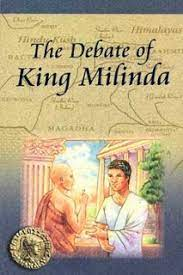
The twelfth among the Eighteen Arhats is recognized as Nagasena in Sanskrit, meaning “Dragon Army.” Often referred to as “Bhikshu Nagasena,” he was a Buddhist theoretical philosopher who received full ordination at the age of twenty and eventually attained the state of Arhat. Bhikshu Nagasena journeyed to the ancient kingdom of Shakyadesha in northwestern India to engage with King Milinda. Responding to the king’s inquiries, Nagasena eloquently expounded on the impermanence of life, the law of karma, and various facets of Buddhist practice, employing metaphors to convey profound insights. This discourse is encapsulated in the “Nagasena Bhikshu Sutra,” representing a comprehensive exposition of fundamental Buddhist teachings.
Below are excerpts from conversations between Nagasena and King Milinda, where the king poses questions and Nagasena responds with profound wisdom and intelligence.
First Question
Once, King Milinda intentionally sought to challenge Bhikkhu Nagasena and questioned him, saying, “You did not live in the same era as the Buddha, and you never met Siddhartha Gautama. How can you be sure that the Buddha actually existed?”
Wise Bhikkhu Nagasena responded by asking, “Great King, how did you inherit your throne?”
“It was passed down to me by my father,” replied the king.
“And from whom did your father receive the throne?” Nagasena inquired.
“From his father, my grandfather.”
“And your grandfather’s throne, from whom did he receive it?”
“From his forefather, my great-grandfather!”
Nagasena continued, “If we trace this lineage generation by generation, do you believe that there was an original founder of your kingdom?”
King Milinda replied with certainty, “Certainly, I believe so!”
“Have you ever seen this founder?” Nagasena asked.
“No, I haven’t.”
“How can you believe in someone you haven’t seen?” Nagasena questioned further.
The king explained, “Our founding monarch established laws, systems, and regulations, all of which are recorded in history. Though I haven’t seen him, I believe in his existence because there are historical records.”
Smiling, Bhikshu Nagasena nodded and said, “In the same way, we believe that the Buddha indeed existed. In Buddhism, there is the Triple Gem of Buddha, Dharma, and Sangha, along with scriptures, Vinaya (monastic rules), and Abhidharma (philosophical teachings). The Buddha’s ethical guidelines and historical events are not fabrications; they are as real as your founding monarch in historical terms!”
Unable to find fault with Bhikkhu Nagasena in the first question, King Milinda, using his wit, posed another challenging query. He asked, “Buddhists often speak of the ultimate happiness being the realization of Nirvana, attaining a state beyond birth, death, and cessation. Bhikshu Nagasena, have you attained Nirvana?”
Bhikshu Nagasena humbly replied, “I’m ashamed to admit that I haven’t.”
King Milinda, feeling triumphant, questioned, “If you haven’t experienced it yourself, how do you know about the state of Nirvana?”
If this question were posed to you, how would you respond?
Rather than directly answering, Bhikshu Nagasena turned the question back to King Milinda, asking, “Great King, if I were to take a large knife and cut off your arm right now, would it be painful?”
King Milinda’s expression changed, and he said, “Certainly, it would be painful! How could having one’s arm cut off not be painful?”
Nagasena pressed on, “But your arm has never been cut off before, so how do you know it would be painful?”
The king replied, “I have seen others experience the pain of having their arms cut off, so I know it would be painful!”
Smiling, Bhikshu Nagasena respectfully remarked, “Great King, just as you can understand the pain of losing an arm by witnessing others, I, too, have seen the joy of those who have realized Nirvana. Hence, I am certain about the sublime nature of the Nirvana state!”
Third Question:
King Milinda, persisting in his skepticism, attempted a third inquiry, asking, “Monastics are supposed to embrace compassion. How do you forgive your enemies?”
Bhikshu Nagasena smiled and replied, “Great King, if you had a festering wound on your leg, would you chop off your entire leg?”
“No, I wouldn’t,” answered the king.
Nagasena continued, “So, what would you do?”
“I would carefully clean it, apply medication, and with time, the wound would heal,” explained the king.
Bhikshu Nagasena stated, “Exactly! Enemies and wrongdoers are like festering wounds. If not taken care of and treated, they will spread and worsen. Therefore, one must use the water of dharma to cleanse them, encouraging them to abandon wrongdoing and turn towards righteousness. This principle is similar to how you, Great King, nurture and care for the wound on your leg!”
Fourth Question:
King Milinda nodded in acknowledgment but remained unconvinced. After contemplating, he posed another question, “You often advise people to accumulate merits for the next life. Since you haven’t experienced death, how do you know there is life after death?”
Bhikshu Nagasena responded with a simile, “It’s similar to a mandarin orange. When the fruit ripens and falls to the ground, the flesh rots away. However, the seed remains buried in the soil. When the time is right, it sprouts, grows, and becomes a robust mandarin orange tree. The human body is just a temporary aggregation of the four elements. When the illusion shatters, the body dies. Yet, the karmic consciousness continues the cycle of birth and death. It is like the seed of the mandarin orange, persistently reincarnating in the six realms, not just once but countless times, with an endless cycle of rebirths.”
Fifth Question:
Despite King Milinda’s lingering dissatisfaction, he presented a fifth question, each one more challenging than the last. However, Bhikshu Nagasena, wise and composed, continued to respond with a smile.
King Milinda asked, “Do monastics love their own bodies?”
Bhikshu Nagasena replied, “The body is merely a temporary confluence of the four elements and five aggregates. Monastics do not have attachment to it.”
King Milinda, feeling confident, cleverly countered, “Oh! You claim not to love your body, but monastics still dress, eat, and sleep. Isn’t that a way of protecting the physical form? If you say you don’t love it, isn’t that a contradiction?”
Bhikshu Nagasena smiled and offered a different perspective, “Great King, if you had a boil on your body, would you love it?”
“A boil? Such a dirty and unpleasant thing! Who would like it?” exclaimed the king.
“If you dislike it, why bother cleaning it, applying medication, and taking constant care to prevent it from worsening? Checking on it every day to see if it’s improving. If you claim not to like the boil, isn’t that contradictory behavior?” Nagasena questioned.
King Milinda, somewhat defiantly, argued, “I do it for the health of my body!”
Bhikshu Nagasena chuckled and said, “Exactly! Monastics may not love this body, but for the purpose of cultivating the spiritual path, they still have to care for this illusory form.”
Sixth Question:
King Milinda, undeterred by previous responses, continued with his inquiries, asking, “Can Siddhartha Gautama, the Buddha, know the causes and effects of the past, present, and future?”
“Buddha possesses great supernatural powers, and indeed, he can know the past, present, and future!” answered Nagasena.
“If that’s the case, why doesn’t he teach all of you those supernatural powers? Then, disciples could instantly know the past, present, and future karmic obstacles, and everyone would attain enlightenment quickly. Why go through gradual training?” questioned the king.
The clever Nagasena, handling the question with ease, asked in return, “Great King, if you were a physician, wouldn’t you know about various medicinal herbs?”
“Of course! A physician needs to know the properties of different herbs and their healing abilities,” replied the king.
“Since a physician knows about numerous medicinal herbs, can he prescribe all of them to a single patient?” Nagasena asked.
King Milinda, dismissing the idea, responded, “Certainly not! Treating an illness requires targeted medications, gradual adjustments, and specific remedies tailored to the patient’s condition. Haphazard prescriptions won’t cure the patient; it needs careful consideration!”
Seizing the opportunity, Nagasena continued, “Likewise, the Buddha imparts the Dharma based on individual capacities, tailoring the teachings to each disciple’s unique qualities. Gradual instruction is necessary, adapting to the disciples’ diverse capacities, to guide them step by step on the path to enlightenment. Otherwise, trying to rush the process might lead to unintended consequences!”
In the intricate tapestry of human beliefs, the concept of reincarnation has woven itself through the fabric of traditional Asian cultures for centuries. However, this idea finds little resonance in Western cultures and often faces skepticism from the scientific community. Amidst this cultural and scientific dichotomy, a pioneering exploration is unfolding at the prestigious University of Virginia School of Medicine, led by Dr. Jim B. Tucker, a child psychiatrist with a unique perspective on life after death.
Born and raised in the southern United States, Dr. Tucker’s early life was immersed in the traditional beliefs of the American South. As he embarked on his academic journey, obtaining an undergraduate degree in psychology and specializing in child psychiatry, he encountered the notion of reincarnation with a healthy dose of skepticism. The clash between cultural beliefs, scientific inquiry, and personal skepticism set the stage for Dr. Tucker’s intriguing exploration into the mysteries of existence.
The documentary, highlighted on the Discovery Channel, explores the extensive and worldwide research conducted by Dr. Tucker. The film encapsulates the core of his studies, presenting interviews, case studies, and the profound implications of his findings. Through this visual medium, viewers are welcomed to observe the intersection of traditional beliefs, modern skepticism, and scientific exploration—all in the quest to unravel the mysteries of human existence.
Buddhism holds that life undergoes reincarnation through the six realms. After a person dies, if the karmic conditions accumulated in their past life mature, they may be reborn into the heavenly realm as a deity, or into the realm of asuras, or they may be reincarnated in the human realm. If negative karma, such as killing, deception, or greed, comes to fruition, the individual will inevitably fall into the hell realm and suffer, or they may be reborn in the realms of hungry ghosts or animals to endure suffering.
As for which realm one will be reborn into among the six, it depends on the karmic conditions of their virtuous and non-virtuous actions. Why does reincarnation occur? The fundamental reason lies in the attachment of sentient beings. Attachment gives rise to the confusion of karma, and from this confusion arises ignorance. Due to the endless causes and effects generated by ignorance, various positive and negative karmic forces are produced. It is these karmic forces that determine which realm of existence one will be reborn into.












 Peace LiLy