What Happens After Death? Unraveling the Mystery of Existence

What Happens After Death? Unraveling the Mystery of Existence
Photo Credit: Unsplash.com

The Enigma of Existence: Exploring Life After Death

The concept of life after death has intrigued humanity for centuries. Different cultures, philosophies, and religions have provided varying explanations, yet the mystery remains. Is there life after death, or does consciousness simply cease to exist when the body dies? In this article, we explore some of the most prominent beliefs and theories surrounding the enigma of existence after death, seeking to understand this profound question from multiple perspectives.

What Are the Most Common Beliefs About Life After Death?

Throughout history, many cultures and religions have proposed theories about life after death. Religious scholars suggest that the idea of an afterlife serves to give people comfort and meaning in the face of mortality. Christianity, Islam, Hinduism, and Buddhism all have distinct views on the afterlife, each offering unique insights into the question of what happens after death.

In Christianity, for example, life after death is often seen as either eternal life in heaven or eternal separation from God in hell. Researchers point out that many Christians believe that the soul lives on after the body dies, and that salvation or damnation is determined by one’s actions during their lifetime.

In Hinduism, the concept of reincarnation is central. According to this belief, the soul is reborn in a new body after death, and the circumstances of the new life are determined by the actions (karma) of the previous life. Philosophers argue that this cycle of death and rebirth is a form of spiritual evolution, with the ultimate goal being moksha, or liberation from the cycle of reincarnation.

Buddhism also supports the idea of reincarnation, but with an emphasis on achieving enlightenment to break free from the cycle of rebirth. Experts note that Buddhism teaches that attachment to the self is the source of suffering, and liberation occurs when one transcends the ego and achieves nirvana.

Scientific Views on Life After Death

From a scientific standpoint, the question of life after death is more complex. The majority of scientists assert that there is no empirical evidence to support the idea that consciousness survives after death. Neuroscientists argue that consciousness is a product of brain activity, and when the brain ceases to function, so does consciousness.

There are notable phenomena that have intrigued researchers. Medical professionals have documented instances of near-death experiences (NDEs), where individuals report vivid sensations, such as a sense of floating above their body, moving through a tunnel, or encountering deceased loved ones. While these experiences are often interpreted by some as evidence of life after death, psychologists suggest that they may be explained by the brain’s reaction to trauma, oxygen deprivation, or the release of chemicals like DMT.

While science cannot definitively answer the question of what happens after death, these experiences have raised questions about the nature of consciousness and whether it is entirely tied to the brain. The debate continues, and more research is needed to explore the mysteries of the human mind.

Near-Death Experiences: Are They Evidence of Life After Death?

Near-death experiences (NDEs) have become a focal point in discussions about life after death. People who have experienced NDEs often describe sensations of peace, floating outside their body, or meeting beings of light. Some researchers hypothesize that these experiences are the result of a brain in distress, attempting to make sense of its impending shutdown.

Many individuals who have experienced NDEs report feeling profound transformations in their lives afterward, including a greater sense of purpose or reduced fear of death. Experts in the field of psychology and consciousness studies suggest that these transformations could point to an experience beyond the physical brain, offering a glimpse into an afterlife.

The question remains: do these experiences represent glimpses into an afterlife, or are they simply a product of the brain’s complex workings during moments of trauma? The scientific community continues to study these occurrences, and while answers remain elusive, the personal testimonies of those who have undergone NDEs continue to fuel interest in the idea of life after death.

What Philosophical Theories Are There About Life After Death?

In addition to religious and scientific perspectives, philosophical theories about life after death explore the nature of existence and consciousness. Philosophers have long debated whether consciousness is purely a physical phenomenon or if it could exist independently of the body.

One of the most famous theories comes from the philosopher René Descartes, who posited that the mind and body are separate entities. According to Descartes’ dualism, the mind (or soul) can exist independently of the body and could potentially continue after death. Modern philosophers who follow dualistic thinking often suggest that consciousness may not be confined to the brain and could persist beyond the body’s death.

On the other hand, materialist philosophers argue that consciousness is entirely dependent on the brain, and once the brain ceases to function, consciousness ceases as well. These contrasting viewpoints continue to shape the ongoing philosophical discussion on the nature of life after death.

Can Science and Religion Coexist in Understanding Life After Death?

While science and religion often present differing views on life after death, some thinkers suggest that they need not be mutually exclusive. Interdisciplinary experts argue that the two perspectives can coexist, offering a fuller understanding of the mystery. Religion provides spiritual and moral frameworks for understanding the afterlife, while science explores the empirical, physical aspects of life and death.

In recent years, there has been a growing interest in integrating scientific and spiritual perspectives on consciousness. Some researchers are exploring the idea that consciousness might exist beyond the brain, and that this may have implications for understanding life after death. Scholars in the field of consciousness studies have suggested that more research is needed to bridge the gap between spiritual and scientific explanations of existence after death.

The enigma of life after death remains unsolved. Whether through religious beliefs, scientific inquiry, or philosophical speculation, humanity continues to seek answers to this profound question, driven by the desire to understand what happens after we take our final breath.

Link:https://peacelilysite.com/2025/06/09/what-happens-after-death-unraveling-the-mystery-of-existence/

Source: https://worldreporter.com/what-happens-after-death-unraveling-the-mystery-of-existence/

How to Face Unfounded Accusations and Grievances — A Lesson from the Buddha

More than 2,500 years ago, when Shakyamuni Buddha walked the earth, even He—an enlightened being of supreme virtue—was not immune to slander and false accusations. Yet, through profound wisdom and boundless compassion, the Buddha addressed these challenges with grace, setting an eternal example for all beings on how to face adversity.

One such episode is recorded in the sutras and remains deeply relevant in our modern world, where misunderstandings and grievances often escalate due to fear, anger, or ego.


One morning in Jetavana Monastery, as the Buddha and his monks were preparing to go on their daily alms round, a group of royal guards suddenly stormed in. They announced that they were under orders to search the monastery grounds for a female corpse.

The monks were shocked. Venerable Baddiya inquired further and discovered that the deceased was Sundari, a young woman known for her recent attendance at the Buddha’s teachings. She belonged to a large sect in the city of Savatthi.

Despite the monks’ firm belief that no such thing could happen in their peaceful community, the guards began their search. To the horror of all present, Sundari’s body was found hastily buried in a shallow pit—shockingly close to the Buddha’s own residence.


The body was taken away, and almost immediately, members of Sundari’s sect began parading through the streets of Savatthi, wailing and pointing fingers. They accused the monks—disciples of the Buddha—of rape and murder. Their shouts pierced the hearts of the city’s residents:

“Is this what compassion looks like? Is this the kindness preached by the monks of the Sakya clan?”

Faith began to waver. The once-revered monks were now questioned and ridiculed. Even devout followers hesitated. Doubts crept in like shadows.

But amidst this storm of falsehood, the Buddha remained calm. He instructed his disciples:

“Do not be disturbed. Do not feel shame for what you have not done. As long as we uphold the Dharma, the truth will reveal itself.”


Compassionate Action and the Power of Truth

While the Buddha taught patience, some of his lay supporters took discreet action. Visakha, a wise and generous patroness of the Sangha, consulted with Sariputta, one of the Buddha’s chief disciples. Together, they enlisted the help of Prince Jeta and hired a private investigator to uncover the truth.

Within seven days, the real story surfaced. Two men, drunk and arguing over their ill-gotten gains, confessed: they had been paid by Sundari’s sect leader to murder her and bury the body near the monastery—an act designed solely to discredit the Buddha and his followers.

The culprits were arrested. The truth was undeniable. King Pasenadi, deeply moved and ashamed that such injustice had occurred, visited Jetavana to publicly reaffirm his trust in the Sangha.

Yet the Buddha, ever compassionate, requested the king not to seek vengeance. He said:

“As long as jealousy and hatred exist in the human heart, such misdeeds will continue. Let us rise above them, not descend to their level.”

The people of Savatthi, now enlightened by the truth, restored their faith in the Buddha and the monastic community. What began as a moment of crisis ended as a testament to the strength of integrity and the enduring power of compassion.

This story serves as a profound reminder: when facing unjust accusations, our greatest protection lies in truth, patience, and inner peace.

We cannot control the words or actions of others, but we can choose how we respond. If we hold fast to our principles, walk the path with sincerity, and act from compassion rather than reaction, the light of truth will inevitably shine through the darkness of misunderstanding.

Link:https://peacelilysite.com/2025/05/23/how-to-face-unfounded-accusations-and-grievances-a-lesson-from-the-buddha/

Stop Comparing. Start Living.

As the saying goes, “Don’t be afraid of not knowing the quality of something—be afraid of comparing one thing with another.” Comparison is a double-edged sword. Without it, there is no disappointment. But once we begin measuring ourselves against others, dissatisfaction creeps in. Comparison is one of the root causes of suffering, and often the very reason happiness eludes us. Much of our pain in life arises not from reality itself, but from our attachments and the distinctions we draw in our minds.

I recently came across a thought-provoking story:
A king once posed a question to a wise man—“If I draw a line on a piece of paper and you’re not allowed to shorten it, how can you make it appear shorter?”
The wise man calmly stepped forward and drew a longer line next to it. Suddenly, the original line seemed shorter, not because it changed, but because of the comparison.

This simple parable reveals a profound truth: dissatisfaction often comes not from our actual circumstances, but from comparing them to someone else’s.

Take a look at real life. I weigh 170 pounds and carry a round belly. But if I constantly compare myself to someone who weighs 140 pounds and is lean and fit, I’ll label myself as “fat.” If I live on $2,000 a month and compare my lifestyle to someone spending $20,000, I’ll think I’m “poor.” But what if I didn’t compare? What if I simply appreciated what I had?

Survival is only part of life’s weight. The heavier burden is comparison. Many people spend their whole lives chasing after what others were born with, only to realize too late that what they’ve always had was someone else’s lifelong dream.

In the classic novel Demi-Gods and Semi-Devils, the character Murong Fu dedicates his entire life to a goal that Duan Yu was born into. Ironically, the woman Duan Yu longs for is someone Murong Fu already had from the beginning. And Ding Chunqiu, who went to great lengths and harmed countless people to get what he wanted, lost in the end to Xuzhu—who gained it all effortlessly, through virtue and sincerity.

We come into this world busying ourselves, striving, chasing after happiness. Yet we become trapped in appearances, constantly looking outward for fulfillment. We complain about stress and pressure, but when we pause to reflect, we often find that we’ve created most of that pressure ourselves—through endless comparison and unrealistic expectations.

It’s unwise—and even harmful—to judge the value of your own life by someone else’s standards. In life, not everything goes our way. If we spend all day comparing ourselves to others, we’ll always feel like something’s missing. But what if we started each day with gratitude instead?

Try this: When you wake up, take three minutes to feel content. Say to yourself with sincerity: “I am grateful for what I have right now. I am content. I am thankful.”
It’s a small act, but it can change your entire mindset.

Comparison doesn’t have to be harmful. It can also be a mirror for growth—if we use it wisely. Rather than feeling inferior and falling into envy or resentment, we can choose to let comparison inspire self-improvement. Let it motivate us to become a better version of ourselves.

And most importantly, compare yourself to your past self.
As a Buddhist disciple, I ask myself daily:

  • Have I improved my spiritual practice compared to yesterday?
  • Have I reduced negative thoughts and actions?
  • Have I done more good today than I did yesterday?

Over time, these small reflections add up. Bit by bit, we grow in virtue, in clarity, in compassion. And when we live this way—progressing each day, anchored in gratitude—we naturally find peace. We naturally move toward liberation and fulfillment.

Be thankful for what you have, right here, right now. Don’t compare. Don’t compete. Contentment is the true path to lasting happiness.

Fill your life with kindness and righteousness. Strengthen your heart and spirit. In a world full of comparisons, choose instead to grow, to give, and to be deeply, joyfully alive.

Link:https://peacelilysite.com/2025/05/14/stop-comparing-start-living/

Embracing Buddha’s Grace: Bathing Ritual and Blessings at Hua Zang Si Temple

Photo Courtesy: Catherine Song | Hua Zang Si temple‘s serene atmosphere fostered reverence as attendees honored Shakyamuni Buddha’s Holy Birthday.

San Francisco, CA – On Sunday, May 4, 2025 (Sunday) – Hua Zang Si, a renowned Buddhist temple in San Francisco, solemnly hosted the Bathing the Buddha Dharma Assembly, welcoming local residents and visitors from diverse cultural and religious backgrounds. This sacred gathering commemorated the Holy Birthday of Shakyamuni Buddha, the World-Honored One, offering attendees a profound spiritual experience.

Organized by the World Buddhism Association Headquarters (W.B.A.H.), Hua Zang Si, and Sanger Mission, the event offered profound spiritual enrichment and served as a harmonious celebration that united the community in shared reverence and joy.

Under the guidance of Abbess of Hua Zang Si Temple, Ruzun Ruohui, the ceremony commenced in the temple’s majestic Grand Hall, where attendees chanted “The Heart Sutra” and the “Bathing the Buddha Verse” in unison, seeking blessings, wisdom, and spiritual purification. At the Bathing the Buddha Pavilion, participants held ritual ladles and poured fragrant water over the statue of the infant Prince Siddharta Gautama — later known as Shakyamuni Buddha —accompanied by heartfelt prayers: 

“Today, I bathe the Buddha with a wholeheartedly pious, seeking blessings and wisdom from the Buddha. May I and all sentient beings be free from obstacles and together attain the realization of the Pure Land.”

The rituals serve as a reminder of Buddha’s profound teachings on mindfulness and self-cultivation, inspiring all individuals—regardless of their beliefs—to cultivate compassion, reflect on their actions, and strive for a harmonious and meaningful life. Blessings were offered for all sentient beings to be freed from defilements and burdens, fostering a compassionate force to bring harmony and stability to society. The merit of this ceremony was dedicated to alleviating global disasters and pandemics, ending conflicts, bringing happiness to all living beings, and a prosperous and peaceful nation.

Attendees poured fragrant water over the infant Prince Siddhartha Gautama statue with ritual ladles, seeking blessings and wisdom from the Buddha.

Photo Courtesy: Catherine Song | Attendees poured fragrant water over the infant Prince Siddhartha Gautama statue with ritual ladles, seeking blessings and wisdom from the Buddha.

According to Buddhist scriptures, following the birth of Prince Siddhartha Gautama, nine dragons poured streams of fragrant water to bathe Him—which later became a tradition upheld globally in commemoration of His holy birth. The “Sutra on the Merits Accrued from Bathing the Buddha” details the blessings associated with this sacred practice, including health, longevity, spiritual fulfillment, and familial harmony. The ceremony concluded with the distribution of fragrant water to devotees, filling them with immense joy and spiritual bliss.

Founded on December 26, 2004, in San Francisco’s Mission District, Hua Zang Si has become a prominent center for authentic Buddhist teachings, guided by the teachings of H.H. Dorje Chang Buddha III and Shakyamuni Buddha. Throughout the year, the temple hosts Blessing Dharma Assemblies, providing a welcoming and inclusive space for individuals to engage with the profound teachings of Buddhism.

In addition to its spiritual mission, Hua Zang Si remains deeply committed to humanitarian efforts. Over the years, the temple has organized Lunar New Year celebrations at nursing homes, assisted with hospital relocations, provided meals to those affected by disasters, and conducted charity sales to support underserved populations. Recent initiatives have included fundraising for animal rescue centers, assisting low-income families, donating to local food banks, and delivering essential supplies to wildfire-affected areas. Hua Zang Si continues to embody the principles of compassion, unity, and service, fostering hope and harmony throughout the community.

Published by Steven S.

Source: https://sanfranciscopost.com/embracing-buddhas-grace-bathing-ritual-and-blessings-at-hua-zang-si-temple/?fbclid=IwY2xjawKPV_NleHRuA2FlbQIxMQBicmlkETFQNWRCRTBnOWhjWUV1b0tXAR54_T2CfqiC7ESWyBMWYopxXjWgyDB4grJBTJJgDtVF_VQUWoJJfOaVvGqKNA_aem_vVRFOtQI45KmXlNOVZNkSw

The Subtle Truth of Karma: Only a Buddha Sees It All

During the time of Namo Shakyamuni Buddha, there was an old man who heard that by renouncing the worldly life and practicing cultivation, one could be free from suffering, attain happiness, and achieve liberation and ease. Filled with joy, he went to the monastic dwelling, hoping to take refuge under the Buddha.

When the old man arrived at the monastery, he learned that the Buddha had already gone out to teach and transform beings. He thought to himself, “Although the World-Honored One is not here, I’ve heard that Venerable Shariputra is foremost in wisdom—why not ask him to allow me to become a monk?”

Shariputra silently observed the old man to see whether he had the necessary virtuous roots. After careful contemplation, he discovered that this person, in this life and even through countless past kalpas, lacked sufficient virtuous roots and blessings.

When the other monks heard that even the most wise Venerable Shariputra had declined him, they said, “If even Venerable Shariputra will not accept you, you must have some grave shortcomings. How can we possibly let you enter monastic life? You’d better leave.”

The old man felt deeply ashamed and heartbroken. Through tear-filled eyes, he suddenly felt an incredibly gentle hand caressing his head, as tenderly as a loving parent would touch their child. The figure before him radiated a pure and gentle light—it was none other than the Buddha, beloved and revered by all.

The Buddha compassionately asked the old man why he was crying. The old man replied, “I wish to renounce the worldly life, learn the Buddha’s teachings, and cultivate the path, but the monks all refused my request. They said my causes and conditions are not yet sufficient, so I feel very sad.”

“Who said that you lack the causes and conditions to become a monk?” the Buddha asked.

The old man replied, “It was Venerable Shariputra, who is foremost in wisdom.”

The Buddha then turned to ask Venerable Shariputra. Shariputra answered, “World-Honored One, I observed his past life causes and conditions and found that he truly does not have even the slightest virtuous root.”

The Buddha said to Shariputra, “You must not think this way. This person’s virtuous roots are extremely subtle. A long, long time ago, in an eon far in the past, there was a poor man who went into the deep mountains to gather firewood. He encountered a tiger, and in his panic and terror, he cried out, ‘Namo Buddha!’ That one utterance of the Buddha’s name planted the seed for his future aspiration to learn the Dharma and attain liberation. That poor man is the old man in this life. Because the seed of his virtuous root has now matured, he has the conditions to renounce the world and cultivate the path.”

So the old man was ordained under the Buddha’s guidance and received personal instruction from the Buddha himself. Through continuous diligence and effort in his cultivation, he ultimately attained corresponding realization and achievement.

In the Dharma discourses of Namo Dorje Chang Buddha III, there is also a story (a gong’an, or spiritual case) that was told. Once, while Namo Shakyamuni Buddha was expounding the Dharma, seven tall beings suddenly appeared. These were exceptionally tall figures who entered and immediately prostrated before the Buddha, saying:

“Oh Buddha! Great Holy One! You have liberated us—we are deeply, deeply grateful!”

At that moment, Maitreya Bodhisattva saw them and thought: “How could these people be disciples of the Buddha? They’re clearly not!” Maitreya Bodhisattva, known for his incredible abilities to see into countless past and future kalpas, believed they were lying and said:

“Why are you speaking falsehoods? You must not lie! You are clearly not disciples of the Buddha!”

Hearing this, the seven tall beings had no choice but to explain: “We became his disciples in past lifetimes. We are disciples of the World-Honored One. If you don’t believe us, ask the Buddha.”

So Maitreya Bodhisattva turned to the Buddha and said: “Rare and wondrous World-Honored One, can you tell us—are these people truly your disciples?”

The Buddha replied: “They have not spoken falsely.”

From this story, we can understand that even a Bodhisattva of equal enlightenment like Maitreya could not perceive the subtle karmic causes and conditions of these seven beings. This shows just how profoundly deep and inconceivably subtle the true nature of karma is—only a Buddha of unsurpassed, perfect enlightenment can fully understand it.

In fact, there are many similar gong’an (spiritual cases). On one occasion, Namo Shakyamuni Buddha was transmitting the Dharma to a tall person who had been that way since beginningless kalpas. When the Buddha designated a particular yidam (personal deity) to guide him, the yidam refused. The Buddha asked, “Why won’t you teach him?”

The yidam replied, “This person has serious problems. He lacks virtuous roots.”

The Buddha asked, “How do you know?”

The yidam said, “As soon as you pointed to him, I immediately observed his karmic history over many kalpas. He has no virtuous roots and is incapable of learning the Dharma—he’ll only turn into a bad person.”

The Buddha said, “Let’s ask Manjushri Bodhisattva.”

Manjushri then said, “This person does have virtuous roots. In the previous kalpa known as the Worthy Eon (Xian Jie), he was a crab. At that time, he committed many evil acts—catching and eating shrimp and other crabs. But later, he encountered the Dharma in the Dragon Palace and repented his sins. From that moment, he vowed to become vegetarian and made a great aspiration: from that moment until beginningless time, he would never again harm any living being. Gradually, through the force of that vow, he was reborn as a human in this lifetime. So, he does indeed possess wholesome karma.”

At that point, Namo Shakyamuni Buddha said to Manjushri Bodhisattva, “You should take the yidam to witness that past life.”

The yidam then said to the Buddha, “There’s no need. Since a Bodhisattva has verified it, and what the Buddha says is to be followed without question, I’ll abide by it. I simply didn’t see that part before—my cultivation is still shallow, and I feel deeply ashamed.”

Thereafter, the yidam vowed to accept the person as a disciple.

From this, we can see that only the enlightened state of a Buddha can, in a single thought, fully perceive the true reality of all beings’ karmic causes and effects.
Therefore, to cultivate and learn the Buddha’s teachings, one must begin with understanding karma—cause and effect—as it is the very root and essence of the Dharma.

As Namo Dorje Chang Buddha III has taught:
One must know that all phenomena are governed by causality. With good causes, you receive good retributions. Good retributions yield good fruits. Good fruits enable you to receive the true Dharma. Relying on the Dharma, you can achieve perfect good fortune and wisdom. Then you can step into the state of accomplishment, break away from the sufferings that living beings experience, cease transmigrating in the cycle of birth and death, and accomplish the perfect enlightenment of a Buddha!

We should uphold the precepts of Buddhism, develop firm faith in karma, and never err in understanding cause and effect. Only through proper and lawful cultivation can we transform our karma, perfect our blessings and wisdom, ultimately see through and fully realize karma, and attain the sacred path of bodhi enlightenment.

Link:https://peacelilysite.com/2025/05/08/the-subtle-truth-of-karma-only-a-buddha-sees-it-all/

Namo Dorje Chang Buddha III Complete Sutra Collection

During this Dharma-Ending Age, H.H. Dorje Chang Buddha III descended to the human realm, demonstrating perfect mastery of both Exoteric and Esoteric Buddhism, as well as unsurpassed accomplishment in the Five Vidyas—the disciplines through which Buddhas and Bodhisattvas benefit sentient beings.

Over the past 2,000 years, the teachings of the Buddha have been distorted through mistranslation and misinterpretation by patriarchs, eminent monastics, and scholars. Recognizing these errors, H.H. Dorje Chang Buddha III corrected the deviations that had crept into the Dharma, restoring its original purity, wisdom, and power.

Having come to the saha world during this degenerate age, Namo Dorje Chang Buddha III left behind irrefutable, supreme examples of omniscient realization in the Exoteric and Esoteric teachings, as well as in the Five Vidyas. He also provided incisive, complete sutras and audio recordings of the Dharma He expounded. These supreme Dharma treasures are essential for all Buddhist practitioners to study and put into practice in order to attain realization and liberation.

In short, anyone who wishes to achieve true accomplishment and liberation must earnestly study the “Namo Dorje Chang Buddha III Complete Sutra Collection.

Namo Dorje Chang Buddha III Complete Sutra Collection primarily consists of the transcriptions of the Dharma discourses by Namo Dorje Chang Buddha, and also includes all of the Buddha’s sutras, poems, writings, and other works. Given the urgent needs of those studying the teachings and the vast quantity and length of the Buddha’s discourses, Namo Dorje Chang Buddha III Complete Sutra Collection is being published in volumes over time (up to now, six volumes have been published).

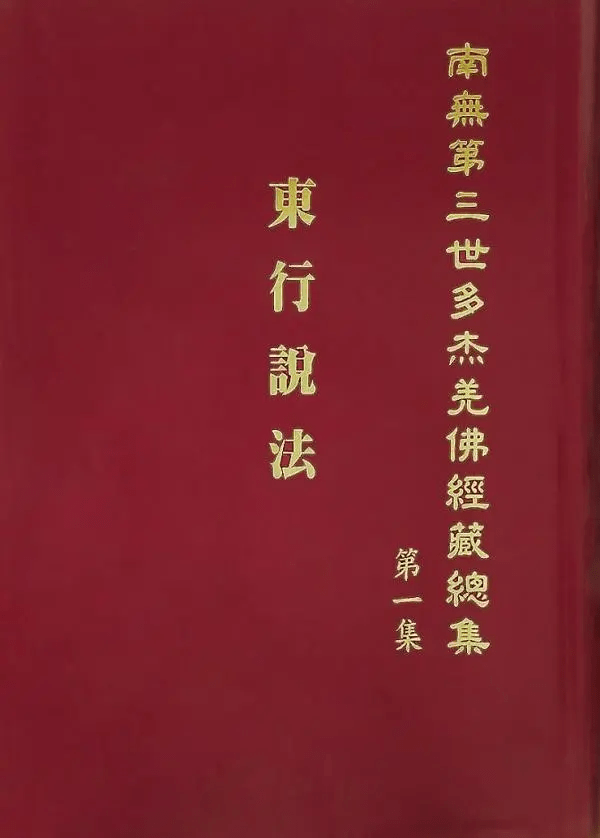
Volume I: Dharma Expounded During a Trip to the East

On November 13, 2008, the United States Congress held an art exhibition for the Buddha Mother (Professor Yuhua Shouzhi Wang) inside the Capitol Building in Washington, D.C. To ensure the safe transportation of the artworks, it was decided to rent a recreational vehicle (RV), forming a convoy with the truck carrying the artworks. Namo Dorje Chang Buddha III, the Buddha Mother, and accompanying disciples all traveled and lived in the RV during the journey.

The convoy led by Namo Dorje Chang Buddha III departed from Los Angeles on October 25, 2008, and arrived in Washington, D.C. on November 10. Following the successful completion of the Buddha Mother Professor Yuhua Shouzhi Wang’s art exhibition at the Capitol on November 13, the group returned on November 26. The journey lasted 33 days, traversing more than 20 states from the western to the eastern United States. Except for the time spent in D.C., where they were occupied with preparing the exhibition, Namo Dorje Chang Buddha III gave Dharma discourses to His disciples almost every evening during the trip. These teachings were compiled into the Dharma Expounded During a Trip to the East, totaling 19 volumes.

Throughout the journey, many holy manifestations occurred wherever Namo Dorje Chang Buddha III went, some of which were mentioned by the Buddha during the teachings. On the day before the journey concluded, Namo Dorje Chang Buddha III even performed a Dharma rite to eliminate obstacles for His disciples. Moreover, after returning to Los Angeles, at the Buddha’s Vajra Mandala in Pasadena, holy nectar descended from the Buddha, confirming that the Dharma Teaching Journey to the East is a pure and supreme Tathagata Dharma of the Buddha.

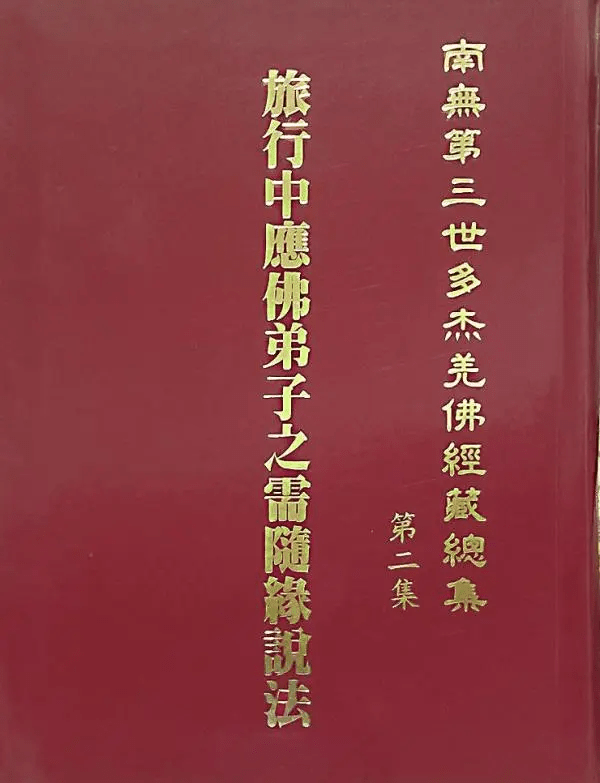
Volume II: Dharma Expounded During a Trip in Response to the Needs of Disciples

In October 2021, after the government lifted the restrictions on public gatherings and travel due to the Covid-19 pandemic, Namo Dorje Chang Buddha III, the Buddha Mother, and accompanying disciples set out by car along the coastal Highway 1, traveling from Los Angeles to San Francisco. Along the way and during their stay in San Francisco, Namo Dorje Chang Buddha III gave Dharma discourses daily, addressing questions raised by His disciples.

After returning to Los Angeles, Namo Dorje Chang Buddha III made a special trip to Las Vegas because Rocket, the guardian dog of the Las Vegas Dharma center, had dashed out the gate and was fatally hit by a car. The Buddha performed a transcendental liberation ceremony for Rocket and also gave daily Dharma teachings to His disciples.

From these two trips, a total of fifteen volumes of Dharma discourses were compiled.

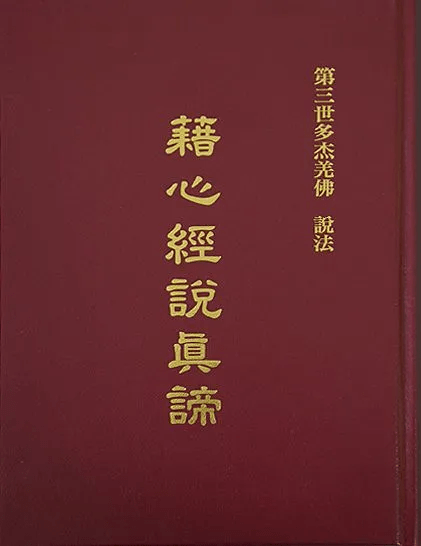
Volume III: Expounding the Absolute Truth through the Heart Sutra

H.H. Dorje Chang Buddha III expounds the Dharma using the words and profound meanings of the Heart Sutra, illuminating the relationship between the mind, the Buddha, and sentient beings. This can also be described as an explanation of the impermanence and permanence of all things—both sentient and insentient—in the universe, as well as the principles of formation, existence, decay, and emptiness versus the truth of no formation, existence, decay, or emptiness. What is a Buddha? What is the relationship between sentient beings and the Buddha? What does it mean to attain liberation from the cycle of birth and death? H.H. Dorje Chang Buddha III clearly explains the true essence of Buddhism and the meaning of liberation.

The Dharma teachings of H.H. Dorje Chang Buddha III are profoundly insightful, precise, and easy to understand. One can only say that, in the thousands of years of Buddhist history, this is the first time such a supreme, precious Buddhist text and highest-level classic has appeared.

Volume IV: Fundamental Dharma Expounded in the East

Fundamental Dharma Expounded in the East is the first publicly released series of Dharma discourses given by Namo Dorje Chang Buddha III to all disciples in 1995. It is a compilation of selected teachings and instructions delivered between 1992 and 1994, during a time when people were not yet aware of His true identity as a Buddha and only knew Him as Master Yi Yungao.

Namo Dorje Chang Buddha III titled this set of teachings “Foundational Dharma Teachings” to emphasize that the principles explained within are essential for every Buddhist practitioner—they are truths that must be clearly understood and applied in actual cultivation on the path of learning Buddhism and practicing the Dharma.

Through direct discourses, answers to disciples’ questions, empowerment during Dharma practices, and reports of disciples’ personal experiences, Namo Dorje Chang Buddha III helps people deeply comprehend the Dharma, gain thorough insight, and apply it concretely in their lives. At the same time, by respectfully listening to these Dharma discourses, we can truly come to recognize that the “supreme greatness” of Namo Dorje Chang Buddha is fully deserved and genuinely manifested.

Volume V: Dharma Expounded During a Trip to Taiwan

Dharma Expounded During a Trip to Taiwan is a compilation of selected Dharma discourses given by Namo Dorje Chang Buddha III between 1995 and 1996. The complete set consists of 18 volumes, organized into the following sections:

  1. Volume 1: The Supreme and Incomparable Dharma
    This volume presents a profound and rare teaching of the highest order.
  2. Volumes 2 to 6: The True and Unimaginable Deeds of Namo Dorje Chang Buddha III
    These five volumes document the holy manifestations and teachings of Namo Dorje Chang Buddha III during His visits to the United States, Japan, Hong Kong, and Taiwan from April to May 1995.
  3. Volume 7:
    This volume contains the teachings given by Namo Dorje Chang Buddha III in early July 1995 when He received a group of Taiwanese Buddhist disciples.
  4. Volumes 8 to 10:
    These volumes recount the events surrounding the disciple Peng Chubin, who in a previous life violated the vows he had solemnly made before Buddhas and Bodhisattvas, resulting in karmic retribution that destined him to die a violent death in each lifetime. In this life, upon encountering Namo Dorje Chang Buddha III, the Buddha not only foretold Peng Chubin’s impending tragic situation in advance, but also performed a great Dharma to empower and save him, ultimately freeing him from his karmic death sentence. These volumes also include teachings from September 1995 and reports from disciples Peng Chubin and Yu Lihua.
  5. Volumes 11 to 14:
    These volumes contain Dharma discourses given by Namo Dorje Chang Buddha III in Guangdong and Hainan in January 1996.
  6. Volume 15:
    This volume records two disciples reporting their Dharma practice progress to Namo Dorje Chang Buddha III.
  7. Volume 16:
    This volume includes teachings given by Namo Dorje Chang Buddha III during the summer of 1996 at His residence on Yinsi Street in Chengdu.
  8. Volumes 17 to 18:
    These final two volumes feature discourses given by Namo Dorje Chang Buddha III during His travels to Wulingyuan in Zhangjiajie, Hunan, in the summer of 1996.

Volume VI: Dharma Expounded During a Trip to the United States

At the end of September 1998, due to a significant karmic cause related to the Dharma, H.H. Dorje Chang Buddha III came to the United States alone in a simple and unassuming manner. During His 40-day stay on the West Coast of the U.S., in addition to visiting many cities in Southern California, He also led His disciples along the coastal Highway 1 northward to San Francisco and visited the world-famous casino city, Las Vegas.

To ensure His disciples received the greatest benefit, H.H. Dorje Chang Buddha III upheld the consistent practice of Buddhas throughout history—whenever He arrived at a place, He would do His best to make time to expound the Dharma for the public, offering teachings anytime and anywhere. He diligently nurtured His disciples’ correct understanding and views. The Dharma Expounded During a Trip to the United States is a compilation of the Dharma discourses delivered by H.H. Dorje Chang Buddha III during this visit. From the titles of these discourses, one can see that He gave teachings in Los Angeles, Las Vegas, at the then headquarters of the “Yi Yungao Master International Cultural Foundation,” and other locations. Out of great compassion, H.H. Dorje Chang Buddha III began by addressing even the most basic questions posed by the disciples at the time. Step by step, He guided their growth, encouraging them not only to cultivate themselves in the Buddha-Dharma, but also to give rise to bodhicitta and compassion, to widely propagate the radiant and magnificent Dharma, and to help more kind-hearted beings learn the conduct of the Buddhas and walk the path of liberation.

In October 1998, H.H. Dorje Chang Buddha III led fourteen disciples from Los Angeles on a road trip along Highway 1 to San Francisco. The evil demons, knowing that this journey marked an important karmic event for the entire Dharma realm—whereby the true Buddha-Dharma would begin to flourish in America and the Western world, leading countless sentient beings of the Saha world to attain accomplishment and liberation—launched an assault. The Demon King Mara specifically sent many demon generals with their minions, attempting to destroy this great Dharma propagation event by taking the lives of the Buddha’s disciples.

As a result, various demons and evil spirits continuously created disturbances along the route, attacking and sabotaging H.H. Dorje Chang Buddha III and His entourage. What was originally planned as a one-day trip took five days to complete. Yet, the demons could not ultimately prevent the Buddha’s mission of spreading the Dharma and saving sentient beings. H.H. Dorje Chang Buddha III subdued each demon one by one. Under His guidance, all the disciples safely arrived in San Francisco, symbolizing that the authentic Buddha-Dharma of H.H. Dorje Chang Buddha III would indeed blossom and bear fruit in the United States and throughout the Western world, bringing auspiciousness and liberation to the sentient beings of the Saha world.

Link: https://peacelilysite.com/2025/05/02/namo-dorje-chang-buddha-iii-complete-sutra-collection/

The Holy Miracles Temple in Pasadena Hosts Prayer Ceremonies for Global Peace and Healing

The American News Staff 

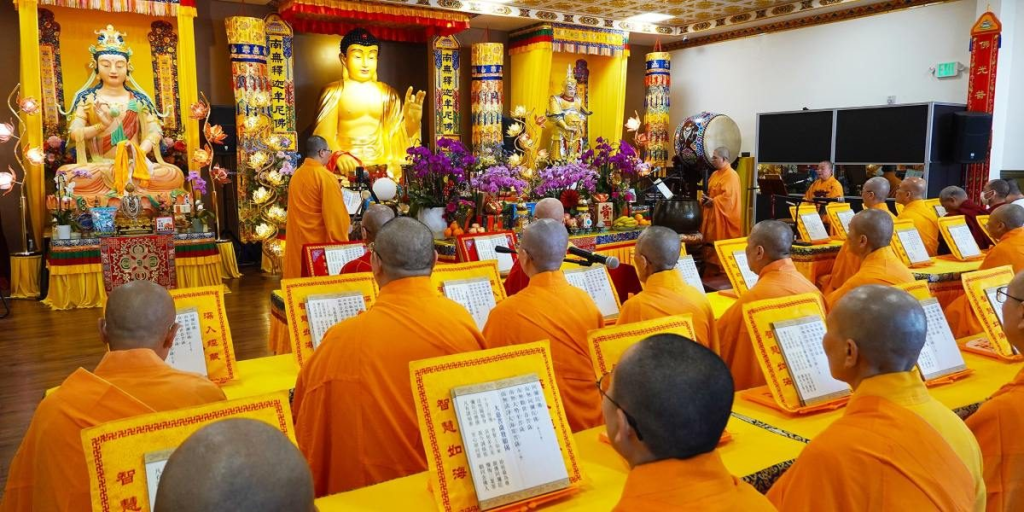
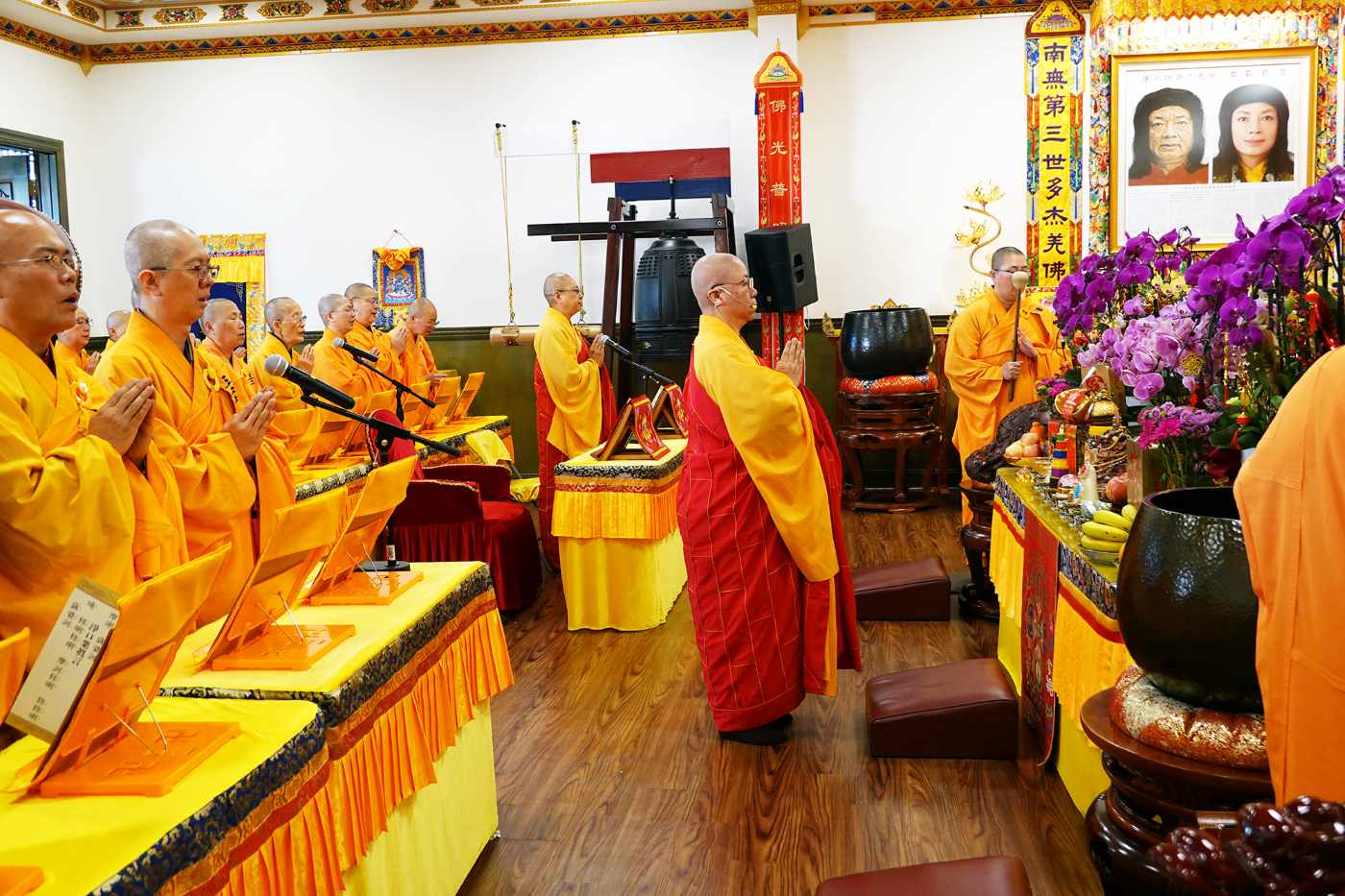
Photo Courtesy: Joyce Lee (The Holy Miracles Temple in Pasadena, Southern California, conducted a series of noteworthy Buddhist prayer ceremonies.)

In a heartfelt endeavor to bring solace and hope to those suffering worldwide, the Holy Miracles Temple in Pasadena, Southern California, conducted a series of noteworthy Buddhist prayer ceremonies.

Organized by the World Buddhism Association Headquarters, Holy Miracles Temple, and Jen Chen Buddhism Sanger Mission, these gatherings saw a substantial turnout of local community members. Together, they chanted “The Lotus Sutra’s Universal Gate Chapter on Avalokitesvara Bodhisattva” and “The Buddha Speaks of Amitabha Sutra” with a shared intention for peace and relief for all life forms enduring hardships globally. Participants expressed reverence and sought the blessings of all Buddhas and Bodhisattvas, hoping to ease sufferingsupport peaceful conditionsreduce conflicts, and encourage global harmony.

In recent years, the world has faced numerous challenges: ongoing conflicts, earthquakes in Japan’s Noto Peninsula and Myanmar, frequent wildfires in California and Australia, floods in southern China and Indonesia due to heavy rains, and outbreaks of dengue fever and new viral diseases in Africa and Central and South America. These events have heightened a sense of shared adversity globally. Holy Miracles Temple endeavors, through these Buddhist rituals, to offer spiritual support for the departed souls’ ascension to the Pure Land, encourage the swift reconstruction of disaster-affected areas, and provide a space for those in distress to find emotional relief, courage, and renewed hope.

The Holy Miracles Temple in Pasadena Hosts Prayer Ceremonies for Global Peace and Healing
Photo Courtesy: Joyce Lee

The Holy Miracles Temple upholds the teachings of H.H. Dorje Chang Buddha III, highlighting the core Buddhist values of striving for the liberation and well-being of sentient beings.

The ceremonies were both solemn and heartwarming, with the collective expressions of goodwill and chanting symbolically extending beyond geographical boundaries. This gathering served as a meaningful demonstration of community unity, generating a sense of positive intention and a shared commitment to facing difficulties through compassion. Participants noted that attending the prayer ceremony at Holy Miracles Temple allowed them to engage in prayerful reflection for victims, emphasizing Buddhism’s contributions to fostering inner peace and societal harmony.

This initiative reinforces Holy Miracles Temple’s commitment to the teachings of H.H. Dorje Chang Buddha III, highlighting the core Buddhist values of striving for the liberation and well-being of sentient beings. It underscores the essential qualities of cultivators: the Four Immeasurable States of Mind—kindness, compassion, joy, and almsgiving. In addition to regularly donating essential goods to local welfare organizations, the World Buddhism Association Headquarters has called for continued compassion and material support for Myanmar’s earthquake victims, combining humanitarian concern with religious practice and encouraging public participation in relief and blessing efforts.

To address the dire situation in Myanmar following the earthquake, where numerous families have been displaced amid ongoing civil strife and infrastructure damage, a donation appeal has been issued. The residents in the devastated areas urgently need humanitarian aid. The World Buddhism Association Headquarters encourages everyone to contribute to organizations like the United Nations World Food Programme, International Committee of the Red Cross, International Rescue Committee, Médecins Sans Frontières, and United Nations High Commissioner for Refugees. These organizations are actively involved in relief efforts. It is recommended that everyone conduct due diligence before donation to ensure appropriate contributions.

The Holy Miracles Temple in Pasadena Hosts Prayer Ceremonies for Global Peace and Healing
Photo Courtesy: Joyce Lee

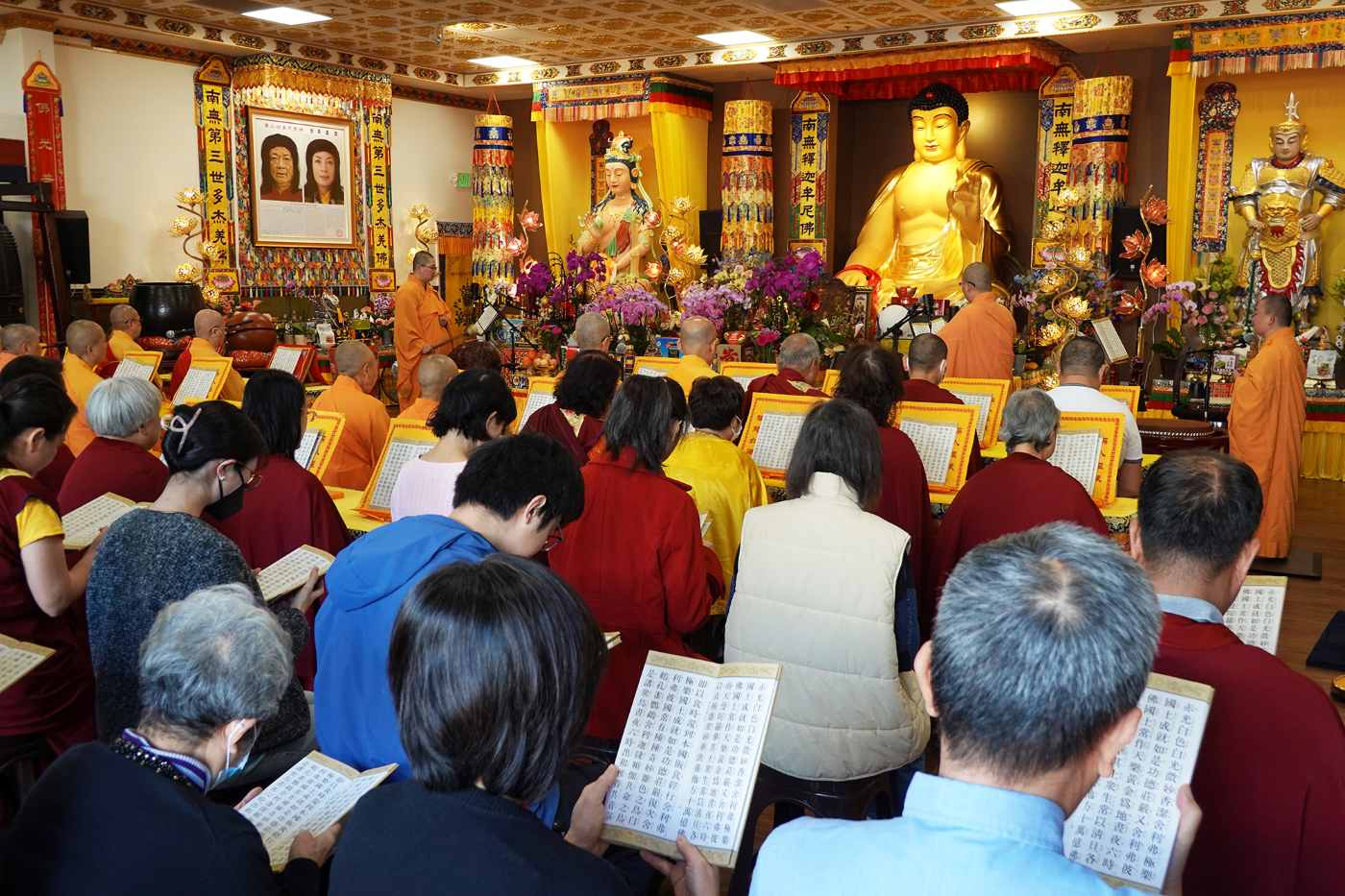
A substantial turnout of local community members participated in the gatherings organized by the World Buddhism Association Headquarters, Holy Miracles Temple, and Jen Chen Buddhism Sanger Mission.

The Holy Miracles Temple emphasizes that everyone can contribute to a better world by cultivating goodwill. In the face of impermanence and disaster, even a single act of kindness—be it a blessing, a chant, or a good deed—can help uplift others and serve as a beacon of hope. The temple plans to continue organizing similar sutra chanting and prayer events, encouraging broader public participation to help inspire a more peaceful and stable world through collective compassion and mindful action. The series of prayer ceremonies also serves as a reminder to the world that fortune and misfortune are ever-changing, and life is fragile. Only through the purification of the mind guided by the principles of the Buddha’s teachings, along with actual practice, can one’s misfortune truly be transformed. In this ever-changing and impermanent world, it is a way to find genuine peace and light, and to move toward a future of harmony and sustainability.

Published by Jeremy S.

Link:

Source: https://theamericannews.com/the-holy-miracles-temple-in-pasadena-hosts-prayer-ceremonies-for-global-peace-and-healing/?fbclid=IwY2xjawKBIctleHRuA2FlbQIxMABicmlkETFaM2o3OEUxUDByTmt6Tmd4AR6u_1ChV9guYzSvw0Wa-80eR1G1b42u3hA-Hyb6WbfAMrhcvEWYxUq2ACR6YQ_aem_D4AvFWCwa6Mp6fYtQYMciQ

Psychoenergetic Science: A Second Coperican-Scale Revolution

Dr. Tiller, a professor emeritus of materials science and engineering at Stanford University, tells us that “the term Psychoenergetics[1] was coined by the Russians in the Soviet era or 1950-1970. This was done to provide a strongly materialistic flavor to the fields of parapsychology and spiritual-related phenomena in order to make research in these areas palatable to the communist party’s worldview.” Dr. Tiller started his work to find a rigorous framework for scientifically understanding this class of phenomena during this period and until the present time.

He expanded on Einstein’s revolutionary work in this area even expanding Einstein’s famous E=mcto incorporate the evolutionary concept of consciousness. He even devised formulae, based upon careful experimental research, that link “subtle energies” to those of mainstream science and which expand the present-day formation of quantum mechanics. He noted that there “…was a class of truly weird phenomena that had been visible for more than a century and was somehow related to various processes associated with the application of human consciousness in our world. On the other hand, there still exists today, a very long-held, underlying assumption of conventional science that ‘No human qualities of consciousness, intention, emotion, mind or spirit can significantly influence a well-designed target experiment in physical reality.’ Something is very wrong here!”

He noted that “…the first Copernican revolution of thought lifted humanity from an earth-centric, theocratic-inspired, model of our solar system, which was largely qualitative in terms of details, to a local solar system which was sun-centered.” This, in turn, with the contribution of Galileo, Newton, and others, expanded our world-view and provided the framework for the great technological advancements of our modern era. He also provided his intuitive hypothesis on the link of our physical reality within the context of our higher [or spiritual] dimensional nature”…that this new, second Copernican-type revolution will, in terms of scale, be at least as significant for the progress of humankind as the first one!”

Not all scientists are there yet, or even close, but this beginning is hopeful. Much of what he writes is vastly beyond my capacity to absorb and, frankly, my interest. However, I believe that it is very relevant to our practice and is consistent with the teachings of the Buddha, albeit in a different language and perspective and with a different goal although Dr. Tiller holds that the underlying principle of all is “love.” You may ask how I can talk of dragons and yidams and all sorts of strange things and still be interested in science? I know a very bright young man, who was brought up as a religion-scorning communist, who thought that monks were parasites of the people and begrudged the donations his pious mother gave them. After several business failures, he took some time off to reflect on what had gone wrong in his life and started reading books by some on his favorite scientists and mathematicians. At the end of one such work, a scientist whom he admired greatly, said something after explaining an evolved scientific finding, “Of course, the Buddha told us all of this over 2,500 years ago.” He then decided to reconsider the works of the Buddha and is now a great master as well as a successful scientist. I too believe that science will eventually catch up with the Buddha or at least come closer to explaining what is now unkown and mysterious and the world will be better for it. I also believe that like unlocking the power of the atom through the work of Einstein et al came with great risks and potential for disaster, likewise our research into consciousness and our higher natures must be based in the evolution of our character. Correct Cultivation is essential on so many levels.

[1]   Psychoenergetic Science relates to the relationship between human consciousness and subtle energy.

The Farmer of the Mind: Cultivating Mastery Over Thought


The Farmer of the Mind: Cultivating Mastery Over Thought

I have heard that on one occasion the Blessed One was staying at Sāvatthī, in Jeta’s Grove, Anāthapinḍika’s monastery. It was the rainy season, and the forest hummed with the soft patter of raindrops falling upon leaves. The scent of wet earth filled the air, and a gentle mist curled around the trees.

A great assembly of monks had gathered, their saffron robes glowing in the dim light of dawn. They sat in deep silence, their hands folded in reverence, awaiting the Blessed One’s words. He gazed upon them, his serene face illuminated by the morning light, and addressed them:

“Monks!”

“Yes, lord,” the monks replied in unison.

The Blessed One spoke:

“When a monk is intent on the heightened mind, there are five themes he should attend to at appropriate times. Which five?

“There is the case where evil, unskillful thoughts—connected with desire, aversion, or delusion—arise in a monk while he is referring to and attending to a particular theme. He should attend to another theme, apart from that one, connected with what is skillful. As he does so, those unskillful thoughts are abandoned and subside. With their abandoning, he steadies his mind, settles it, unifies it, and concentrates it.

“But if those thoughts persist, he should reflect on their drawbacks: ‘These thoughts lead to suffering. They darken the mind. They are thorns in the path of peace.’ Just as a traveler carrying a heavy sack realizes that dropping the burden brings relief, so too should the monk see how abandoning unwholesome thoughts brings lightness to the heart.

“If even then the thoughts persist, he should withdraw his attention—he should give them no mind. As a man walking through a marketplace ignores the clamor of voices around him and focuses only on his path, so too should the monk disregard the noise of unwholesome thoughts.

“If they still do not subside, he should attend to the relaxing of thought-fabrication, gently calming the movement of the mind. Just as a potter, shaping a vessel, slows the turning of his wheel to smooth its edges, so too does the wise monk soften the momentum of thought, guiding it toward stillness.

“And finally, should all else fail, he should take up the final method—firm and resolute. With teeth clenched and tongue pressed against the roof of his mouth, he should subdue the mind with force, constraining and crushing the unwholesome impulses with clear awareness, as a strong man might subdue a wild beast.

The Parable of the Two Farmers

The Blessed One paused, then continued:

“Monks, this is like two farmers who inherited the same land.

“One farmer was negligent and careless. He did not prepare his field properly. He let weeds grow alongside the crops, believing they would not harm the harvest. When pests came, he did not chase them away, thinking they would leave on their own. When the sun was too hot, he cursed the sky but did not shade his plants. And when the rains came, he lamented his ruined field but had done nothing to build proper irrigation.

“In the end, his harvest was meager, his efforts wasted. He blamed the land, the weather, and misfortune, but never did he see that it was his own negligence that had led to his failure.

“The other farmer was diligent and wise. He knew the land required effort. He removed the weeds as soon as they sprouted, before their roots took hold. When pests arrived, he drove them away with patience and care. If the sun was too harsh, he adjusted his crops and provided shade. When the rains came, he had already prepared the channels to guide the water where it was needed.

“In the end, his harvest was abundant, his granaries full. When asked the secret to his success, he simply smiled and said, ‘I cared for my field, and in return, it cared for me.’

“Monks, the untrained mind is like the lazy farmer’s field—overrun by weeds of desire, pests of aversion, and floods of delusion. But the well-trained mind is like the diligent farmer’s field—protected, cultivated, and yielding the fruits of wisdom.

“Just as the wise farmer does not despair when weeds appear but instead removes them skillfully, so too should you train your minds.

“Do not be disheartened when unskillful thoughts arise. Attend to them wisely, knowing that a well-tended mind, like a well-tended field, leads to a bountiful harvest—peace, clarity, and liberation.

The Power of a Well-Trained Mind

The Blessed One looked over the assembly and continued:

“Monks, you may ask, ‘What is the fruit of a well-trained mind?’ I will tell you.

“It is like a still lake in the heart of the forest. The surface is clear and unmoving, reflecting the moon and the stars without distortion. When an animal approaches to drink, it sees its own reflection perfectly. In such a lake, the sky, the trees, and the mountains appear as they are, undisturbed.

“But an untrained mind is like a lake constantly churned by the wind. Its waters are muddy, and no reflection can be seen. Even if the stars shine above, they are lost in the restless movement of the waves.

“When a monk, by these five methods, steadies his mind, unifies it, and concentrates it, he becomes a master of thought sequences. He thinks only what he chooses to think, and does not think what he does not. He has broken the bonds of craving and aversion. He has seen through conceit, and with right view, has reached the end of suffering and stress.

“Monks, train yourselves well. Be like the diligent farmer. Master the field of your own mind. Be like the still lake, where truth is seen clearly. For in doing so, you will not only benefit yourselves but all beings who come into your presence.”

The Awakening of the Monks

As the Blessed One spoke, a great stillness settled over the gathering. Some monks felt their minds clear as if a veil had been lifted. Others, who had struggled with restless thoughts, felt their burdens lighten. Among them was a young monk who had long battled with doubt.

That night, he sat beneath a great tree, reflecting on the Blessed One’s words. He thought of the two farmers and saw himself in the lazy one. But now, he resolved to change. He would uproot his weeds, guard his field, and let no impurity take hold.

With renewed determination, he entered deep meditation. As the night passed, his mind grew still, and as the first light of dawn touched the horizon, insight arose within him. He saw the nature of thought, the impermanence of all things, and in that moment, a great joy filled his heart.

The next morning, when the monks gathered once more before the Blessed One, the young monk stepped forward, bowed deeply, and said, “Lord, the field of my mind is now tended. The weeds are gone. The path is clear.”

The Blessed One smiled, his eyes filled with knowing. “Then, monk, walk that path with diligence. For now, you have truly begun.”


That is what the Blessed One said. Deeply inspired, the monks rejoiced in the words of the Blessed One, and many resolved then and there to train with renewed vigor, knowing that mastery over the mind was the key to liberation.

Link: https://wisdomtea.org/2025/04/03/the-farmer-of-the-mind-cultivating-mastery-over-thought/

In Search of a Great Master to Learn from – H.H. Dorje Chang Buddha III


In Search of a Great Master to Learn from – H.H. Dorje Chang Buddha III

California is home to numerous Buddhist temples, each offering a distinct school of teaching to inspire and guide practitioners. Among them, Hua Zang Si, a unique Buddhist temple in San Francisco, particularly captured my attention as I live in the San Francisco Bay Area.

Hua Zang Si is dedicated to the authentic teachings of Sakyamuni Buddha and H.H. Dorje Chang Buddha III and provides pre-recorded oral teaching expounded by H.H. Dorje Chang Buddha III for visitors to listen to. However, other than Sakyamuni Buddha—historically known as Prince Siddhartha—who is this Buddha, H. H. Dorje Chang Buddha III?

Dorje Chang Buddha is, in fact, a primordial Buddha and the embodiment of the absolute truth of the universe, which itself has no form. As stated on page 17 of H.H. Dorje Chang Buddha III: A Treasury of True Buddha-Dharma:

“In the entire universe, Dorje Chang Buddha is the first Buddha with form and is the highest Buddha. That is, the highest leader of Buddhism in the entire universe came into being in the form of Dorje Chang Buddha. It was Dorje Chang Buddha who began transmitting dharma and saving living beings in the dharmadhatu. As a result, Buddhism was born and the Buddha-dharma began spreading.”

This extensive text of book provides a detailed account of H.H. Dorje Chang Buddha III, documenting the profound realization and supreme achievements of the true Buddha-dharma as demonstrated by the highest Buddha in the world.

Numerous awe-inspiring accounts of H.H. Dorje Chang Buddha III, a revered Buddhist master—indeed, the highest Buddhist master—can be found in various publications and online sources. A documented example is the Buddha’s ability to predict the arrival of a flock of birds and accurately describe their actions upon arrival—an extraordinary and precise demonstration of insight.

This remarkable event, known as The Holy Feat, occurred in Mexico in 2014 and was witnessed firsthand by numerous Buddhist disciples, all of whom provided sworn testimonies under their own names, attesting to the authenticity of what they observed.

Attending a single temple, such as Hua Zang Si in San Francisco, which propagates complete Buddhism of all Buddhas will enable you to learn diverse practices, such as Zen meditation, the chanting of Buddhas’ and Bodhisattvas’ names, and Tibetan Dharma practices—these latter being transmitted only in accordance with an individual’s specific karmic affinity with the yidam and their karmic conditions at the time. Additionally, sutra chanting – a focus on Mahayana Buddhism and other Buddhist practices are available, ensuring a holistic approach to your spiritual cultivation.

How can I learn Buddhism directly from the Buddha? The monastics at Hua Zang Si recommend attending the temple or visiting Dharma-Listening Session centers worldwide to respectfully listen to the prerecorded Dharma teachings.

The temple offers additional religious services, including chanting and blessing services, group study meetings, support groups, Fish Release (field trips to release and save lives), and Buddhist storytime. The temple also hosts larger Dharma assemblies as part of its annual schedule. The Buddhist practice can be a lot of fun!

As a Buddhist disciple following the teachings of H.H. Dorje Chang Buddha III, I have found solace in the voice and wisdom of the Buddha. Through these teachings, I have learned to seek answers, clarity, wisdom, and strength to navigate both the joys and challenges of life.

I hope you, too, will find confidence in searching for a true, holy, and virtuous Buddhist master—one whom you can rely on not only in this lifetime but all the way until you attain enlightenment and become a Buddha yourself. This attainment is guaranteed by all Buddhas as long as we diligently cultivate ourselves with sincerity and perseverance.

In Search of a Great Master to Learn from – H.H. Dorje Chang Buddha III

Link: https://hhdorjechangbuddhaiiiinfo.com/2025/04/01/in-search-of-a-great-buddhist-master-to-learn-from-h-h-dorje-chang-buddha-iii/

#DorjeChangBuddha #H.H.DorjeChangBuddhaIII #PrinceSiddharta #DharmaofDorjeChangBuddhaIII #HolyFeat #FishRelease #TheTreasureBook #HuaZangSi