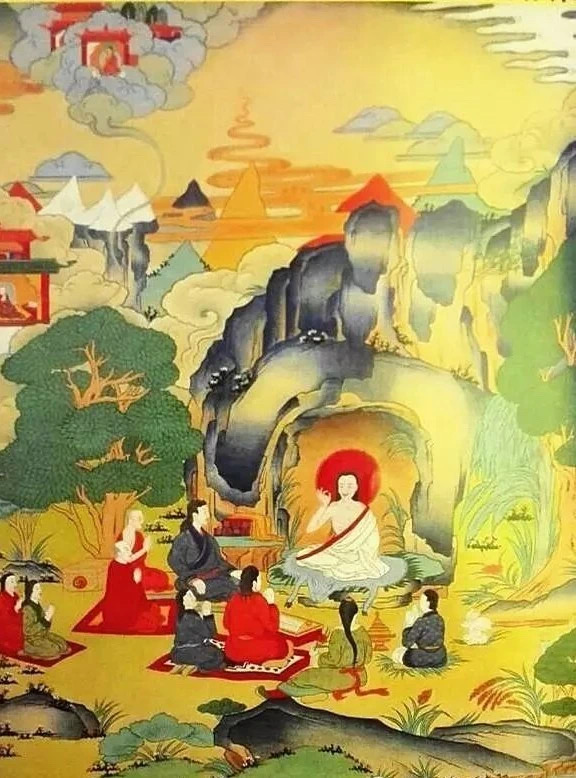
In early Buddhism, an arhat (Sanskrit) or arahant (Pali) — “worthy one” or “perfected one” — was the highest ideal of a disciple of the Buddha. He or she was a person who had completed the path to enlightenment and achieved nirvana. In Chinese, the word for arhat is lohan or luohan.
“There is no more worldly existence for the wise one who, like the earth, resents nothing, who is firm as a high pillar and as pure as a deep pool free from mud. Calm is his thought, calm his speech, and calm his deed, who, truly knowing, is wholly freed, perfectly tranquil and wise.” [Verses 95 and 96; Acharya Buddharakkhita translation.]
In early scriptures, the Buddha is sometimes also called an arhat. Both an arhat and a Buddha were considered to be perfectly enlightened and purified of all defilements. One difference between an arhat and a Buddha was that a Buddha realized enlightenment on his own, while an arhat was guided to enlightenment by a teacher.
In the Sutta-pitaka, both the Buddha and arhats are described as being perfectly enlightened and free from fetters, and both achieve nirvana. But only the Buddha is the master of all masters, the world teacher, the one who opened the door for all others.
As time went on, some early schools of Buddhism proposed that an arhat (but not a Buddha) might retain some imperfections and impurities. Disagreement over the qualities of an arhat may have been the cause of early sectarian divisions.
The Arahant in Theravada Buddhism
Today’s Theravada Buddhism still defines the Pali word arahant as a perfectly enlightened and purified being. What, then, is the difference between an arahant and a Buddha?
Theravada teaches there is one Buddha in each age or eon, and this is the person who discovers the dharma and teaches it to the world. Other beings of that age or eon who realize enlightenment are arahants. The Buddha of the current age is, of course, Gautama Buddha, or the historical Buddha.
The Arhat in Mahayana Buddhism
Mahayana Buddhists may use the word arhat to refer to an enlightened being, or they may consider an arhat to be someone who is very far along the Path but who has not yet realized Buddhahood. Mahayana Buddhist sometimes use the word shravaka — “one who hears and proclaims” — as a synonym for arhat. Both words describe a very advanced practitioner worthy of respect.
Legends about sixteen, eighteen, or some other number of particular arhats can be found in Chinese and Tibetan Buddhism. It is said these were chosen by the Buddha from among his disciples to remain in the world and protect the dharma until the coming of Maitreya Buddha. These arhats are venerated in much the same way Christian saints are venerated.
Arhats and Bodhisattvas
Although the arhat or arahant remains the ideal of practice in Theravada, in Mahayana Buddhism the ideal of practice is the bodhisattva — the enlightened being who vows to bring all other beings to enlightenment.
Although bodhisattvas are associated with Mahayana, the term originated in early Buddhism and can be found in Theravada scripture as well. For example, we read in the Jataka Tales that before realizing Buddhahood, the one who would become the Buddha lived many lives as a bodhisattva, giving of himself for the sake of others.
The distinction between Theravada and Mahayana is not that Theravada is less concerned with the enlightenment of others. Rather, it has to do with a different understanding of the nature of enlightenment and the nature of the self; in Mahayana, individual enlightenment is a contradiction in terms.
The highest point of the leg: The Dochu La pass at 3,100 meters
By Gongjue Tuji
With many impressions from Thimphu and a feeling of gratitude, we continued our pilgrimage. Before leaving the busy capital behind for good to drive deeper into the mountains, however, we spent another day in its surroundings. After all, Bhutan is not only defined by its holy temples and deeply rooted Buddhism. The landscape itself also holds enormous power. We were looking forward to traveling to places where the country’s history and the powerful nature form a very special unity.
Semtokha Dzong: The Palace of Secret Mantras
On the third day, our path first led us about six kilometers south of Thimphu to Semtokha Dzong. This place also bears the meaningful name “Sangak Zabdhon Phodrang,” which translates to “Palace of the Profound Meaning of Secret Mantras.”
Semtokha Dzong
Historically, this is a milestone: The Dzong was built between 1629 and 1632 by Shabdrung Ngawang Namgyal, the legendary unifier of Bhutan. He introduced something completely new here, namely the combination of a monastery and an administrative center under one roof. This innovative concept worked so well that it later became the model for all other major fortresses in the country, such as in Paro or Punakha. This historical significance mixed with a very present joy on the day of our visit. Since the entire country was honoring the fourth King’s birthday, a particularly festive mood could be felt everywhere.
But something else left a deep impression on me. In the temple rooms, the distinct scent of butter lamps hung in the air. It is a very unique smell that we would encounter again and again at other places, and which for me is now inseparably linked to the atmosphere of these holy sites.
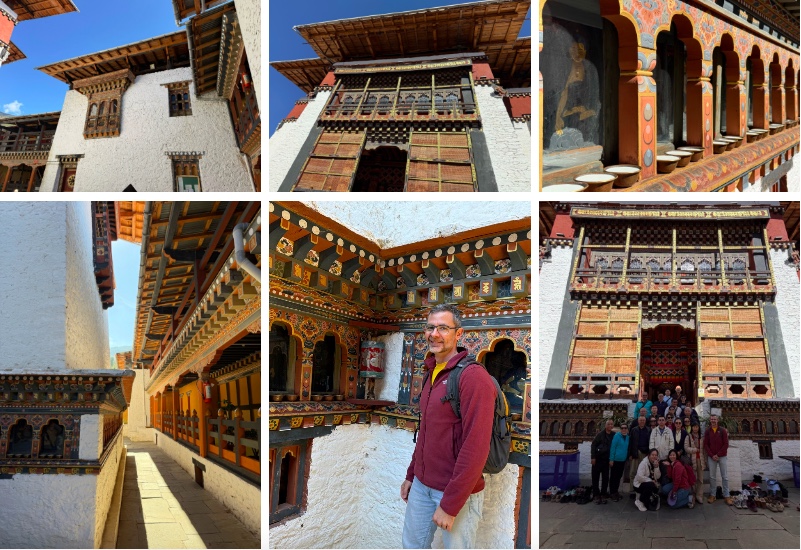
Impressions (in order): View into the courtyard, the magnificent entrance area, water bowls as offerings, the corridor with prayer wheels, myself inside, and our group on the entrance stairs.
Takin Preserve: The Creation of Drukpa Kunley
Bhutan is deeply rooted in its spiritual traditions, where the power of the Dharma also manifests in nature. We visited the Royal Preserve to see the national animal: the Takin. It is a fascinating creature, unique to the Himalayas, with an appearance that resembles a cross between a cow and a goat.
Its existence traces directly back to the miraculous activity of Drukpa Kunley, also known as the “Divine Madman.” In the 15th century, people asked him to perform a miracle to prove his realization. He requested to be served a cow and a goat. After consuming both, he placed the goat’s head upon the cow’s skeleton. With his supernatural powers, he brought this new being to life. This event stands as a powerful testament to the Master’s unconventional teaching methods and his ability to act beyond ordinary concepts.
Impressions (in order): The spacious forest area of the preserve, a resting Takin in the shade, and an animal by the stream.
Dochu La: Commemoration at the 108 Chortens
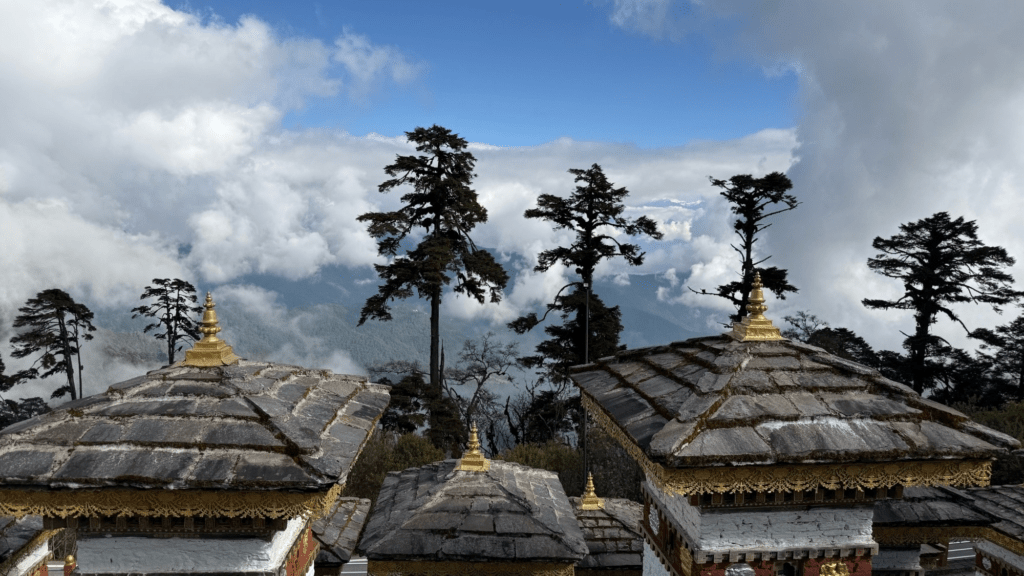
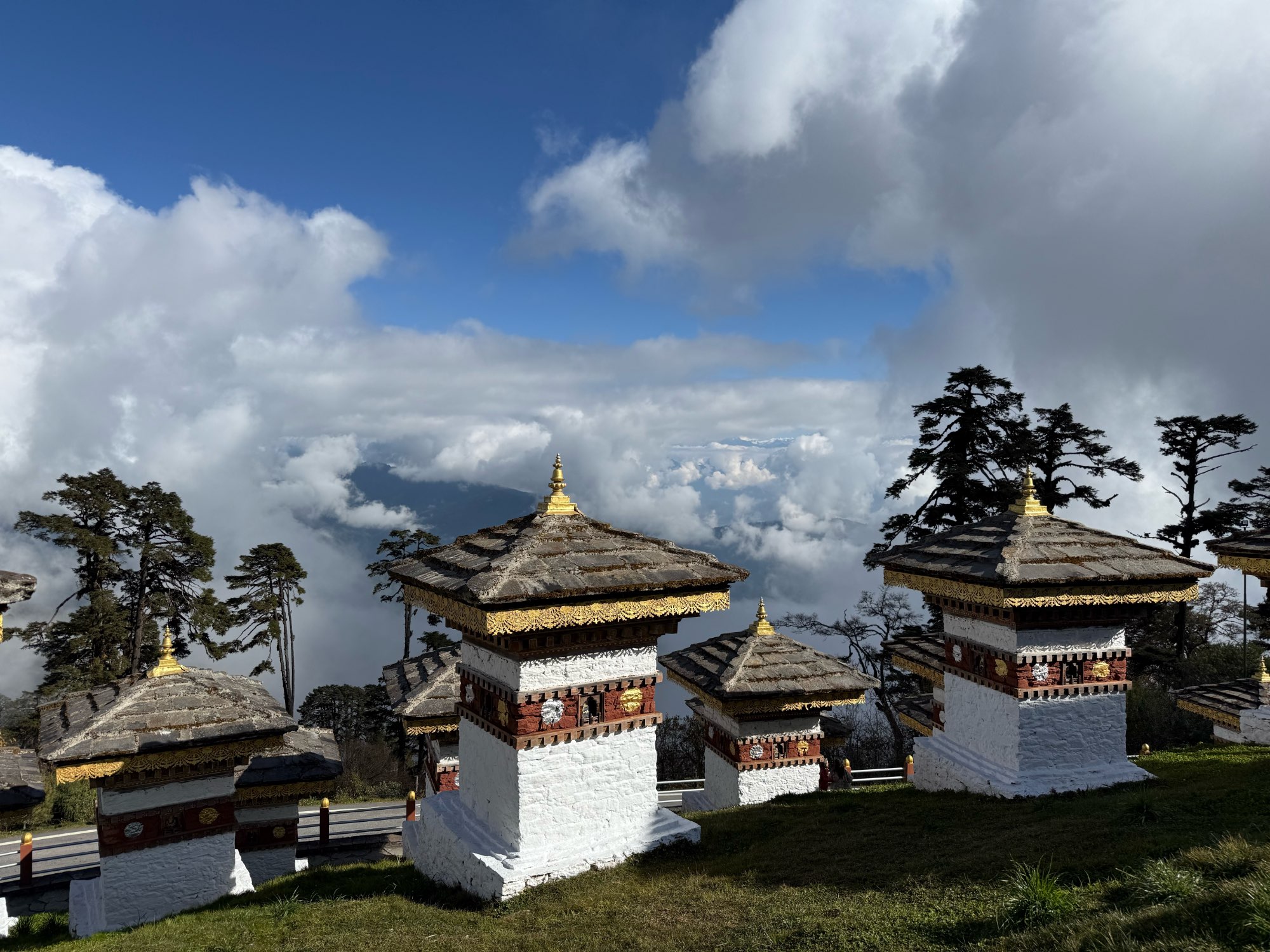
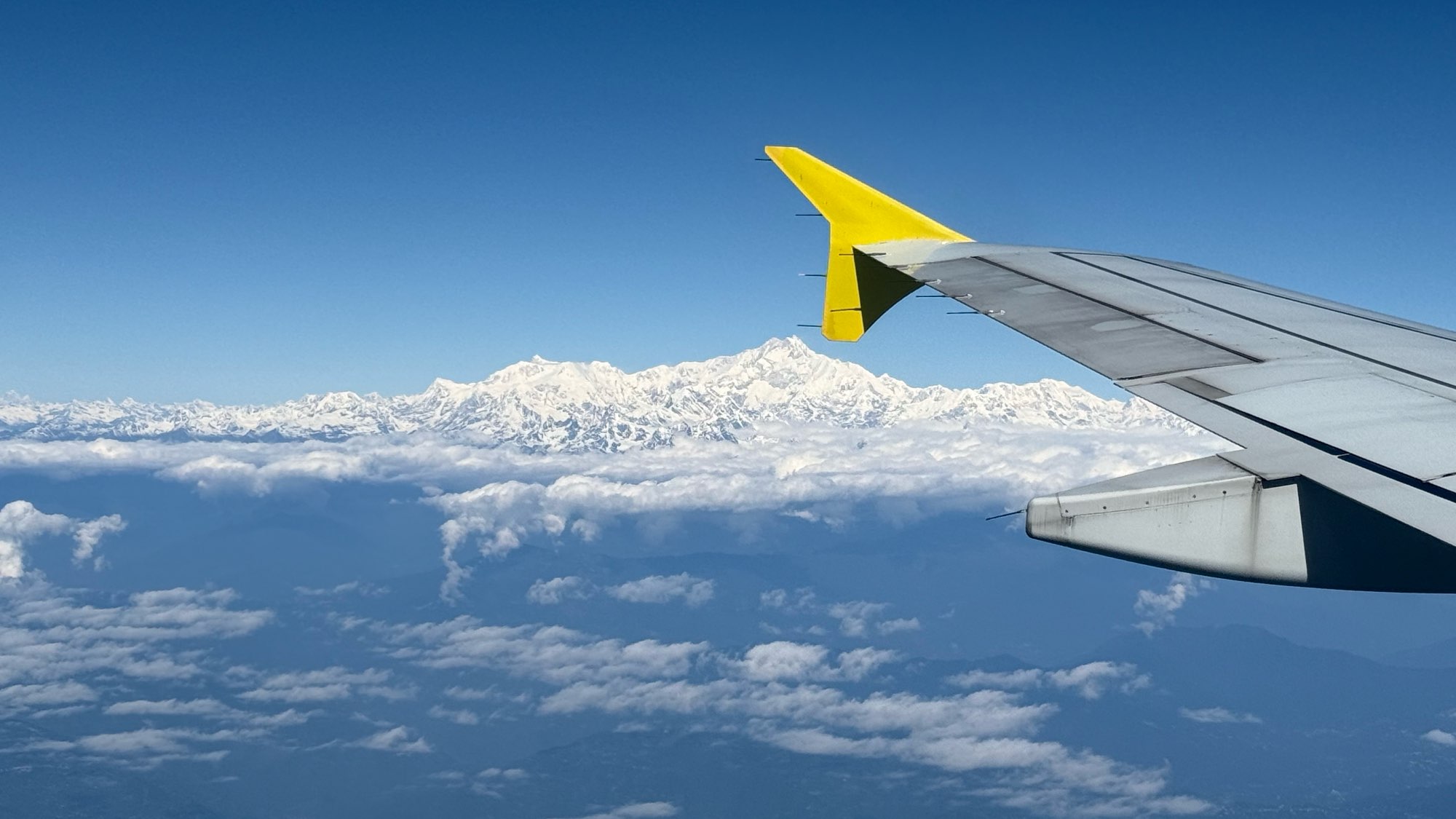
On the fourth day, we left the capital heading towards Punakha. The road led us over the Dochu La, a pass at an altitude of about 3,100 meters. Although a few clouds obscured the view of the very big ice giants of the Himalayas, gaps opened up again and again, through which we could see the snow-covered peaks.
The 108 Druk Wangyal Chortens against the backdrop of the Himalayas
Up on the pass stand the 108 Druk Wangyal Chortens. They are an important place of remembrance. They were not built to celebrate a military victory in 2003, but to commemorate the fallen. It is characteristic of the culture here that triumph is not put in the foreground, but rather compassion and remembrance.
Chimi Lhakhang: The Legacy of Drukpa Kunley
In the Punakha district, the legacy of the “Divine Madman,” Drukpa Kunley, is ever-present. Even in the surrounding villages, we noticed the many houses painted with phallic symbols. What may initially seem unusual to foreign eyes is regarded here as a powerful symbol of protection.
View into the Punakha Valley
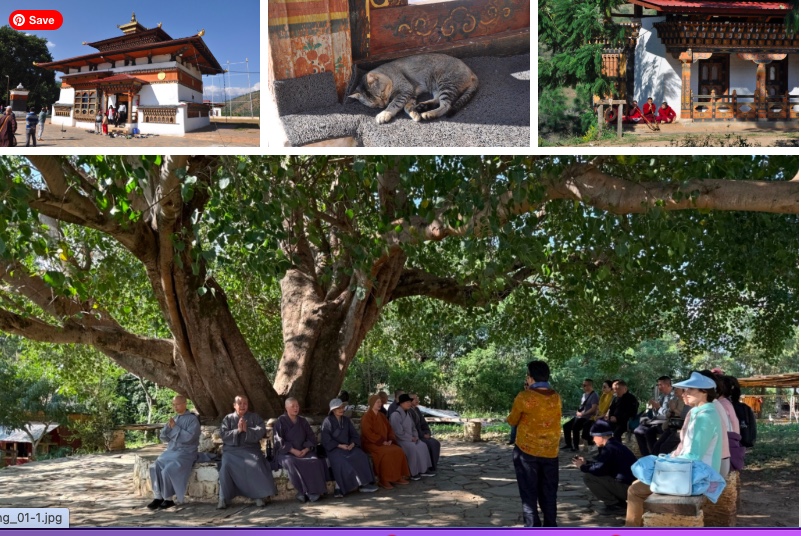
Our next destination was Chimi Lhakhang. The path there leads very picturesquely right through green rice fields. The temple itself stands exactly at the spot where the great master Drukpa Kunley manifested his power to subdue a demon that had taken the form of a dog. He did so with his “flaming thunderbolt of wisdom.” This also explains the paintings on the houses, as they represent this victorious thunderbolt. At the place of this subjugation, a small black stupa still stands today. Also, statues of the master can often be recognized by a dog lying at his feet. Today, the place is mainly known as the Temple of Fertility, to which couples from all over the world make pilgrimages. We used the peaceful atmosphere there to chant together under a large Bodhi tree in front of the temple.
Impressionen (der Reihe nach): Der Chimi Lhakhang Tempel mit der schwarzen Stupa, eine schlafende Tempelkatze, junge Mönche beim Üben der Dharma-Instrumente und unsere Gruppe beim gemeinsamen Chanten unter dem großen Bodhi-Baum.
Punakha Dzong: Palace of Great Bliss
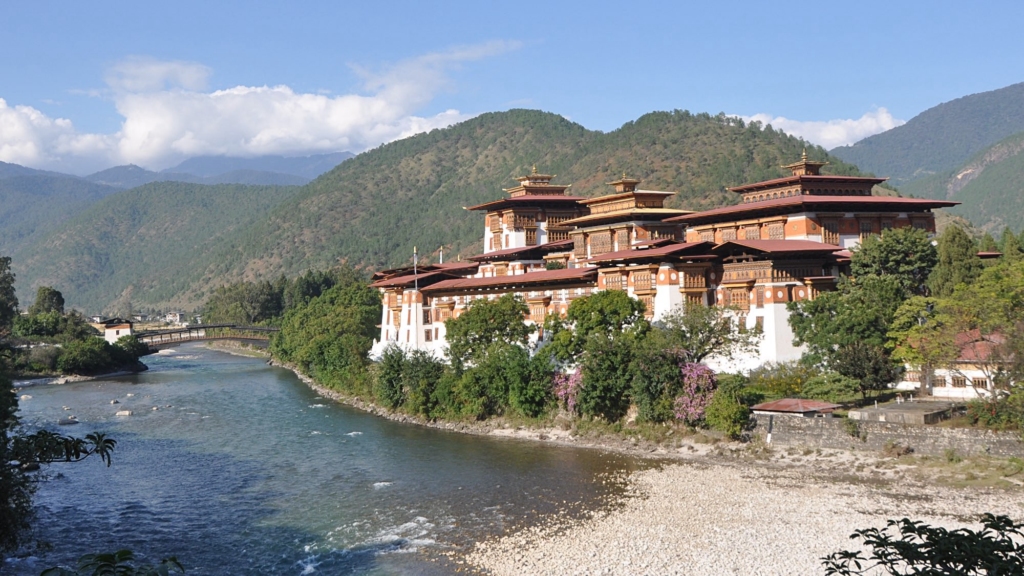
Afterwards, we continued to Punakha Dzong. It is situated very picturesquely right where the Pho Chhu (Father River) and the Mo Chhu (Mother River) meet. Its full name is Pungtang Dechen Photrang Dzong, which translates to “Palace of Great Happiness.” The building is not only huge but also historically of enormous importance. It was built as early as 1637 and for a long time formed the center of the then winter capital Punakha.
Punakha Dzong
Even today, the monastic community moves here during the cold months. Moreover, it is a historic place for the monarchy, as the first King of Bhutan was crowned here in 1907. Inside rest the mortal remains of the state founder Shabdrung Ngawang Namgyal. However, this area is strictly protected. Only the King and the Je Khenpo, as well as two guardian lamas, are allowed to enter the room with the relics.
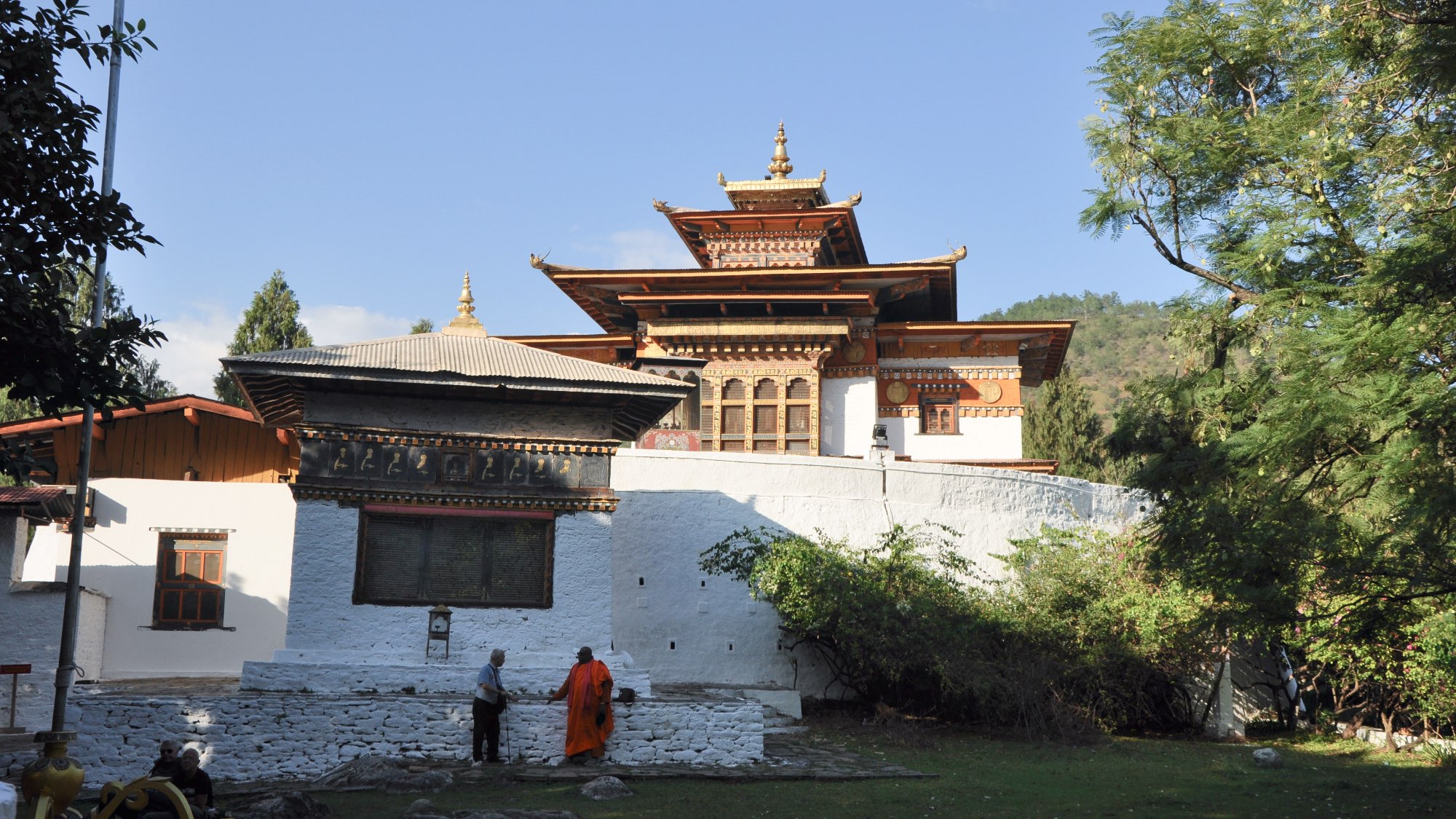
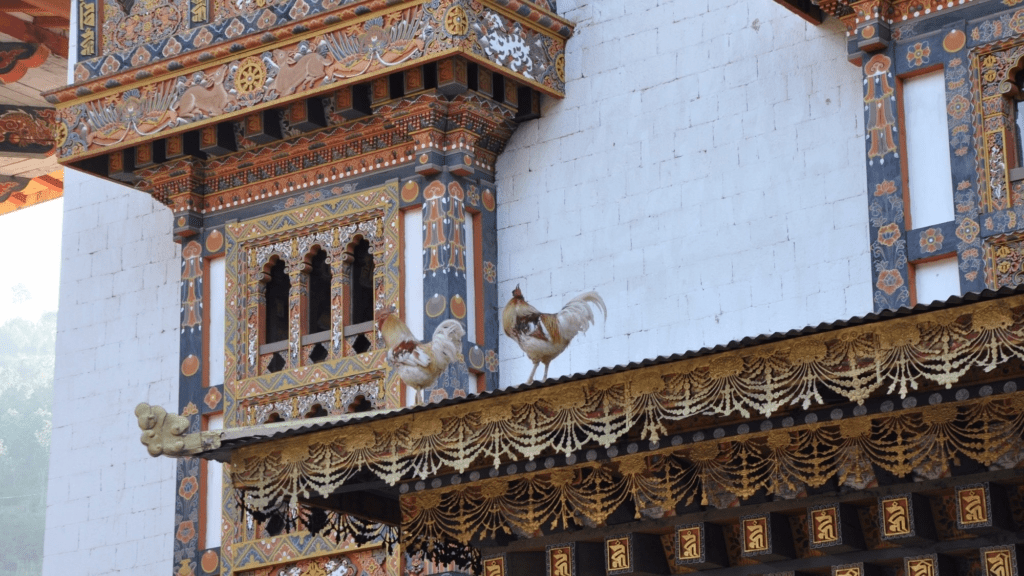
Impressions (in order): Conversations in front of white walls, roosters on the intricate roof ledge, and the entrance to the sacred temple area (Machen Lhakhang), where the relics of the state founder are kept.
Wangdue Phodrang: Rebuilding a Landmark
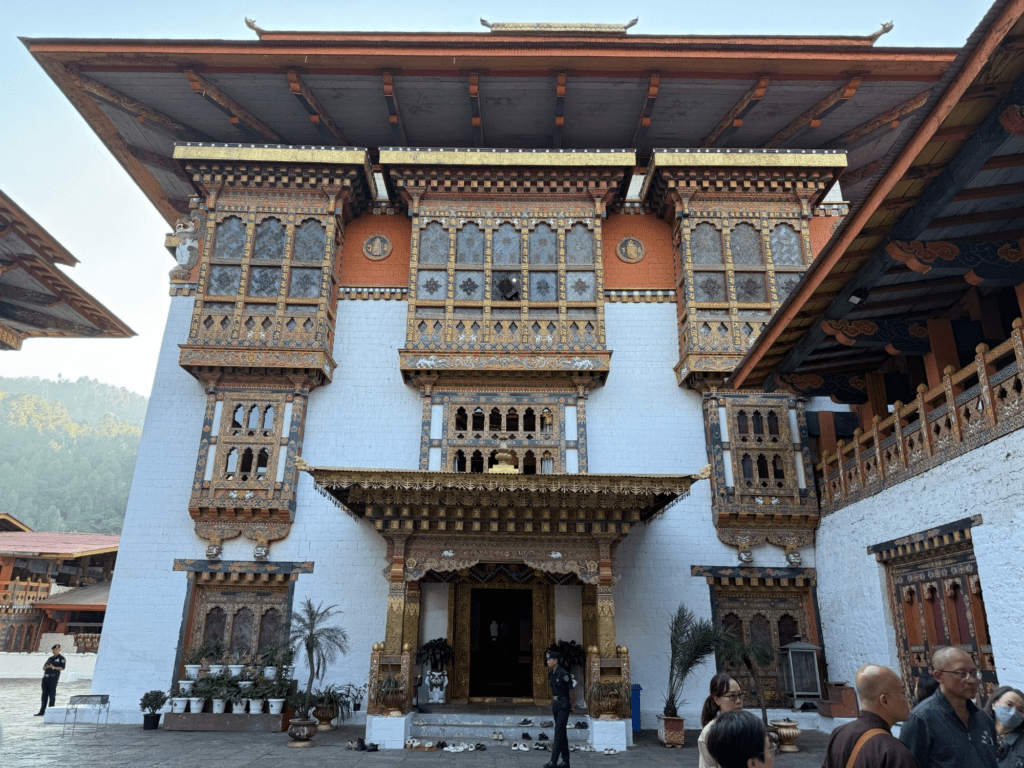
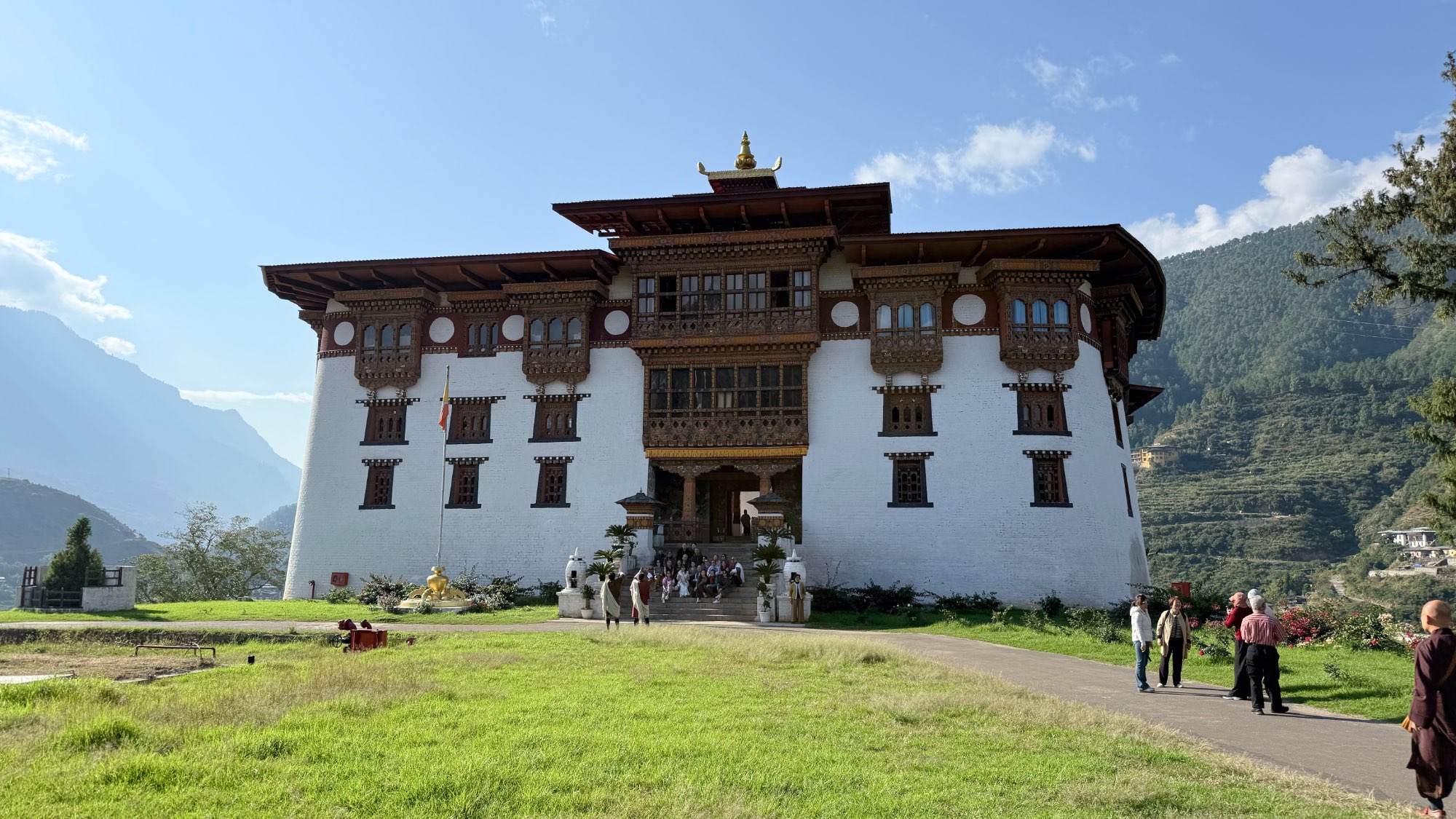
In the morning of the next day, we stopped at Wangdue Phodrang Dzong. This place has a moving history. It was founded in 1638 by Shabdrung Ngawang Namgyal under the auspicious name “Palace of the Four Cardinal Directions.” It sits strategically on a ridge that resembles a sleeping elephant and overlooks the confluence of two rivers.
Wangdue Phodrang Dzong
For a long time, it was considered the only Dzong that had never fallen victim to a fire in its almost 400-year history. But on June 24, 2012, fate struck: A technical defect triggered a fire in the early morning, and fueled by strong winds, the proud fortress burned out completely within a few hours.
But what we saw was not a place of mourning, but of hope. The reconstruction, which began in 2014, is an impressive testament to Bhutanese unity, but also to the deep friendship with neighboring India. Through close cooperation and generous support from India, this massive project could be realized. It wonderfully shows how modern engineering and cross-border solidarity are used not only to preserve traditional culture but to literally let it rise anew from the ashes.
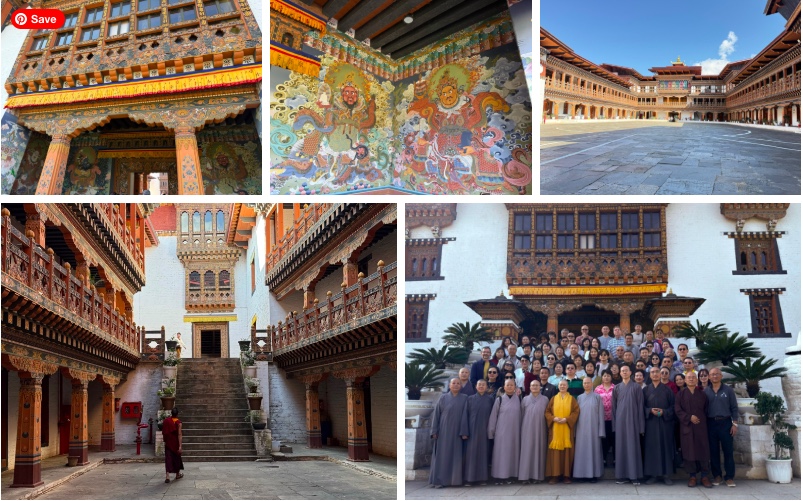
Impressions (in order): Intricate carvings at the portal, colorful wall murals of guardian deities, the spacious courtyard, a monk at the staircase, and our group photo in front of the Dzong.
Drive through the Black Mountains
With this image of a new beginning in mind, we continued our journey towards the Phobjikha Valley. The drive was scenically very impressive. Our bus wound its way up the Black Mountains curve after curve. We had perfect weather. The sun was shining and allowed us a clear view that reached further with every meter of altitude. The road snaked along the partly steep mountain slopes in tight serpentines until we crossed the pass and finally drove down into the valley.
Phobjikha Valley: Winter Home of the Black-Necked Cranes
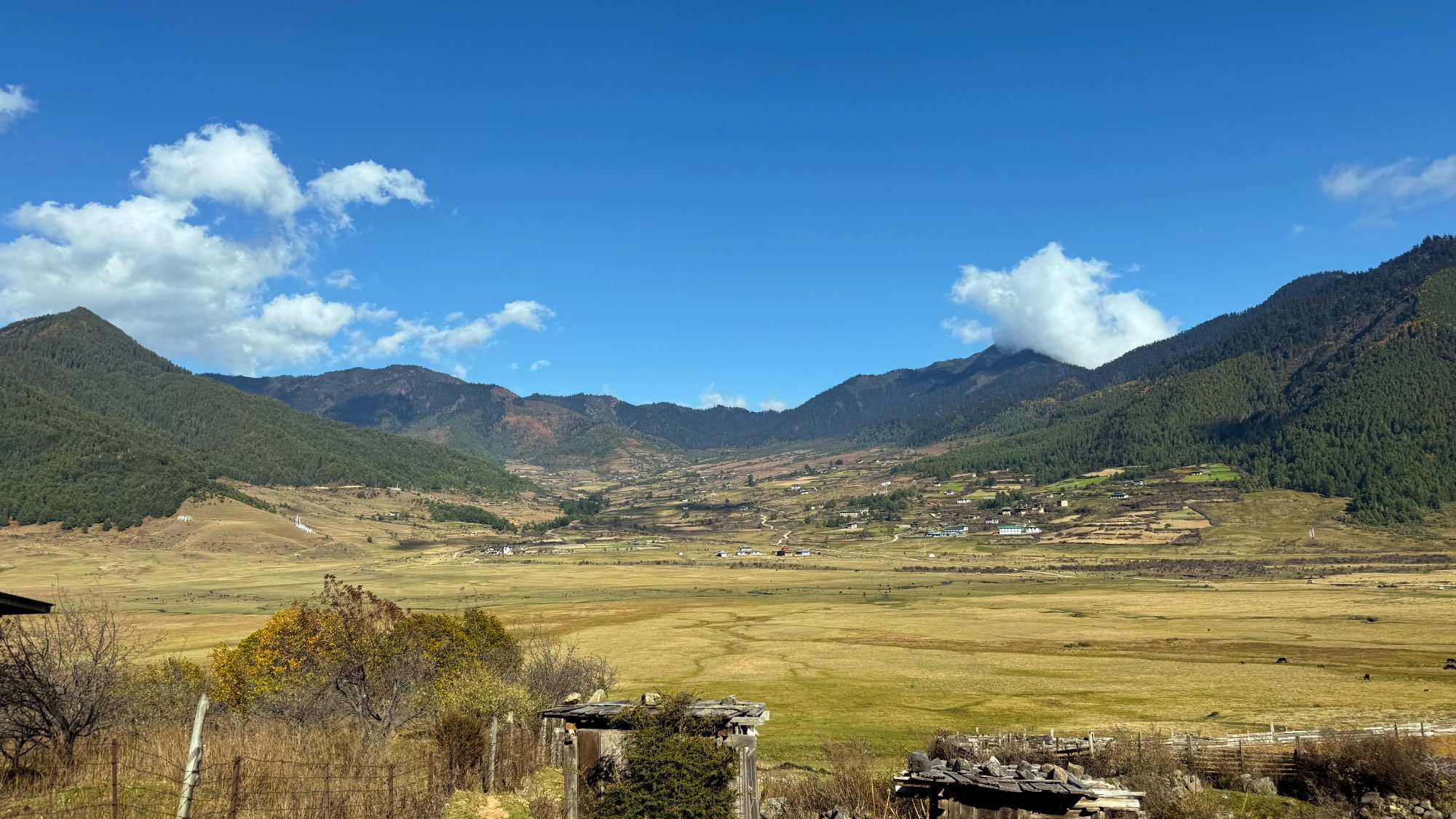
The Phobjikha Valley is a very special retreat. It serves as the wintering ground for the rare Black-necked Cranes from Tibet. There is a nice observation about this. When the birds arrive, they circle the local Gangtey Monastery three times. And apparently, they do the same when they leave again. Even the animals seem to have a connection to the Dharma here. We were lucky and some of us saw the first cranes that had already arrived.
Phobjikha-Tal
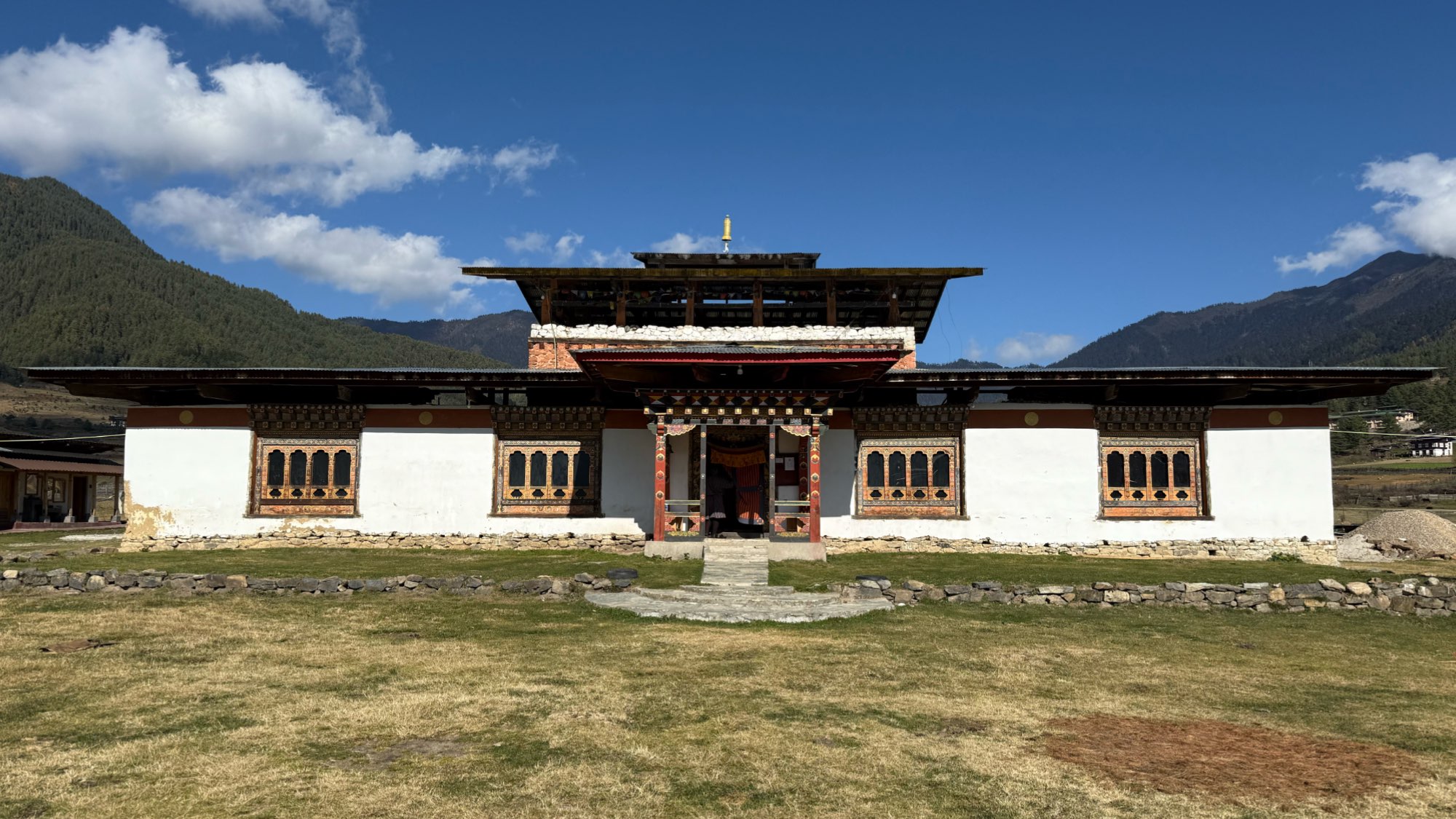
Our lunch was organized for us in an open field right in front of Khewang Lhakhang. We enjoyed it with a wide view into the valley. Afterwards, we visited the temple itself. Inside are still the original statues, which at a good 500 years old are as ancient as the building itself. One of these statues is particularly well-known, as it is said to have spoken twice already.
Khewang Lhakhang
I especially remember the story that’s connected to this place: A demon had taken the form of a young woman to deceive a young man. When the man died, the demon wanted to bring the body into the temple. But the Buddha statue spoke and denied him entry. The demon had to move on and was finally defeated by the deceased’s real girlfriend. A small stupa still stands at this spot today. Such events are not just fairy tales here; they are part of the living spiritual landscape.
Gangtey Goenpa: Spiritual Center of the Nyingmapa
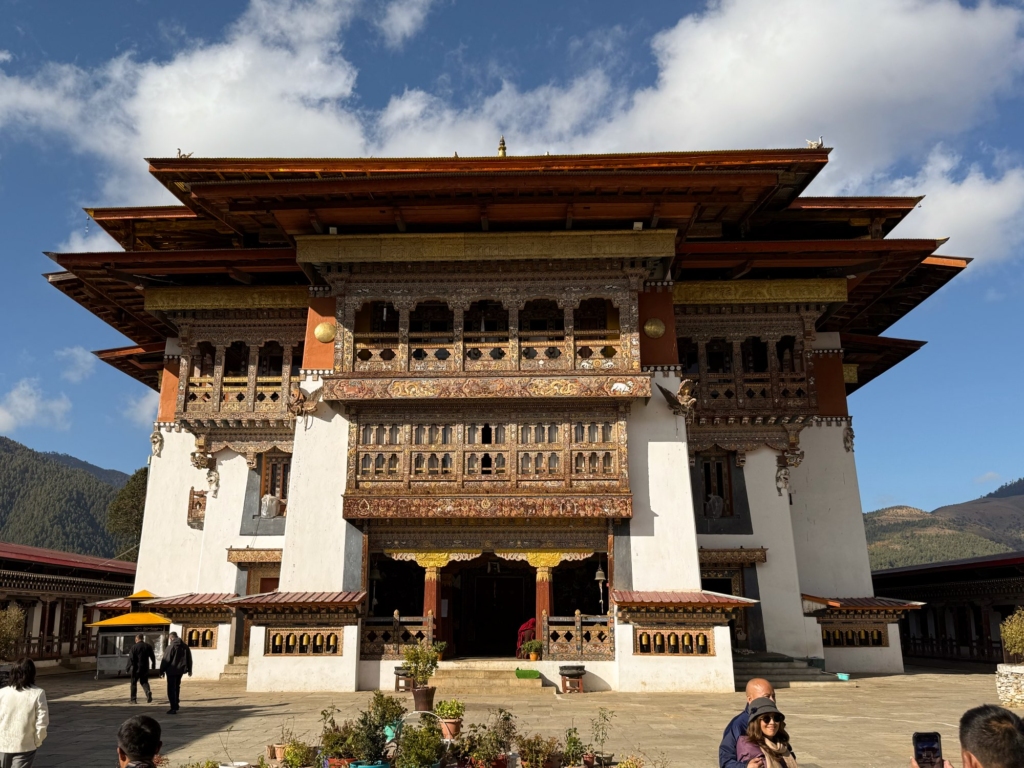
The crowning conclusion of this day was Gangtey Goenpa. It sits on a ridge above the valley and is far more than just a beautiful building. It is the largest and most important Nyingmapa monastery in western central Bhutan and is considered the spiritual heart of the entire region.
The history of this place goes back a long way and begins with a vision. The great “Treasure Finder” (Terton) Pema Lingpa visited the valley in the late 15th century. He looked at the ridge and prophesied that one of his descendants would build a monastery there one day. This prophecy was fulfilled in 1613 when his grandson Rigdzin Pema Thinley founded the monastery.
Gangtey Goenpa
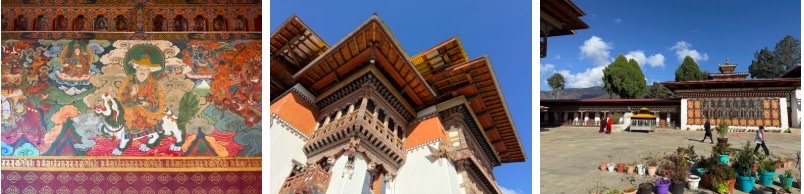
Architecturally, it is fascinating. At first glance, it looks like a Dzong, meaning one of the mighty fortresses we had seen before. But if you look closely, you notice a crucial difference. The military elements are missing. There are no arrow slits and no defensive walls. It was designed purely as a place of peace and practice. I was particularly impressed by the elaborate wood carvings visible everywhere, testifying to the high level of craftsmanship.
Impressions (in order): Wall mural of Dharmapala Gyalpo Pehar in the entrance area, the view up to the intricate wooden architecture, and the sunny courtyard.
Today, the monastery is a very lively place and acts as the seat of the Pema Lingpa tradition as well as the seat of the master’s ninth reincarnation. About 140 monks live here. Together with the nearby Shedra, the Buddhist college, they ensure that the teaching is not only preserved here but actively studied and lived.
I had a special experience inside the temple. We had gone in to pay our respects to the Buddhas and chant together. Scarcely had we entered the hall when the power went out and it became pitch dark instantly. In the light of our phones, we looked for a place to sit. For about ten minutes, we chanted in this darkness, illuminated only by the faint flickering of a few butter lamps. That created a very unique mood. Suddenly the light came back on. Only at that moment did I see what was directly on the wall opposite me. My gaze fell on a beautiful mural of the 21 Taras. That was an unexpected and deeply moving moment for me.
Actually, we had a specific hope in our hearts for our return to Thimphu and Paro: We wanted to try to get an audience with the King. But as so often in life, plans do not always go in a straight line. Karmic conditions had intended another encounter for us, which we had not expected in this way.
I will tell you about that and our ascent to the famous Tiger’s Nest in the next part.
About Author: Gongjue Tuji
As a committed Buddhist and initiator of the Xuanfa Dharmazentrum, Gongjue Tuji has made it his mission to help other people integrate the teachings of Buddhism into their daily lives. In this blog, he regularly provides insights into his experiences, current news and highlights fascinating aspects of the Buddha-Dharma.
Thus have I heard. At one time the Buddha was in Vārāṇasī, at the Deer Park in Ṛṣipatana.
At that time, the Bhagavān said to the bhikṣus, “Would a lady, said to be the most beautiful in the world, cause many people to gather together to see her?” The bhikṣus replied to the Buddha, “Certainly, Bhagavān.” The Buddha said to the bhikṣus, “If that lady, reputed to be most beautiful in the world, could perform all kinds of music, song, and dance, would many people gather together to watch?” The bhikṣus addressed the Buddha, saying, “Certainly, Bhagavān.”
The Buddha said to the bhikṣus, “Suppose there were a lady said to be the most beautiful in the world, and in this place there would be all kinds of entertainment with music, song, and dance. Moreover, a great crowd would converge upon this one place. Suppose there would be a gentleman, not foolish or stupid, preferring happiness to suffering, valuing life and fearing death. A person would say to him, ‘Sir, you should carry this bowl of oil, filled to the brim, and pass in between this world beauty and the crowd. There is a killer who will draw out his blade and follow you. If a single drop of oil is lost, he will cut off your head.’
“What do you think, bhikṣus? Would that man carrying the oil bowl be able to forget about the oil bowl, and forget about the killer, and watch that skillful lady and the large crowd of people?” The bhikṣus addressed the Buddha, saying, “No, Bhagavān. Why? Bhagavān, that man would be concerned about the man with his blade drawn out. He would think, ‘If I spill even one drop of oil, that man with his blade drawn will cut off my head.’ With that only thought, his mind would be fixated on the oil bowl. He would walk between the world beauty and the crowd and go past them, not daring to catch a glimpse.”
“Thusly, bhikṣus, if there is a śramaṇa or brāhmaṇa who is dignified in body and resolute in mind, not regarding voice and beauty, skillfully regarding all dharmas of the mind, abiding in mindfulness of the body, then this is my disciple who is in accordance with my teaching.
“What does it mean for a bhikṣu to be dignified in body and resolute in mind, not regarding voice and beauty, persevering in all dharmas of the mind, abiding in mindfulness of the body? Thusly, bhikṣus: mindful of the body, observing the body: ardent, correctly aware and mindful, setting aside worldly craving and sorrow.
“Abiding in the mindfulness of sensations… and of the mind… and of dharmas, observing dharmas, are also such as this.
“This is called a bhikṣu who is dignified in body, resolute in mind, not regarding voice and beauty, and skillfully regarding dharmas of the mind, abiding in the Four Bases of Mindfulness.”
At that time, the Bhagavān spoke a gāthā:
Focused and well-mindful, As if protecting an oil bowl: The mind protected this way Reaches the unprecedented— What is extremely difficult to reach, Supremely wondrous and subtle. Those things the Buddha speaks: That teaching is a sharp sword. With a resolute mind, Focusing and persevering— Not like an ordinary person, Negligent in affairs— One is able to enter thusly, Not neglecting the teaching.
After the Buddha had spoken this sūtra, the bhikṣus heard what the Buddha had said, and joyfully practiced in accordance.
In November 2025, I went on a very special trip. Together with 66 Dharma brothers and sisters, I set off for Bhutan. Being the only German in this group from the USA, China, Taiwan, and Sri Lanka, I felt at home right away. We were a wonderful mix of monks, nuns, Rinpoches, and lay Buddhists. We all met in Thailand first to travel on to Paro together.
Our goal was more than just a visit. We came to honor the holy sites of this country and to dive into Bhutan’s deep-rooted Buddhist tradition. Of course, we were also excited to get to know the land and its people. Dedicated members of our group took care of the entire organization. Thanks to their excellent planning and the great local guides, everything ran smoothly. We also owe the fact that this trip was possible in this special way to the Venerable Dr. Chandima from Sri Lanka. Through his personal connections to the Kingdom of Bhutan, doors opened for us that might otherwise have remained closed. Having the Venerable Master Shi Zheng Da with us was also especially valuable.
We brought two matters close to our hearts with us. First, it was important to us not to arrive empty-handed. We had collected donations within the group to directly support the hospital in Thimphu and the expectant mothers there. Second, it was our spiritual mission to represent the Buddha Dharma as we learned it from H.H. Dorje Chang Buddha III. Connected to this was the wish to share news of the “Holy Heavenly Lake Buddhist Town” project, which is planned to provide space for over 30 Buddhist centers from all over the world.
Arrival in Paro & the Journey to Thimphu
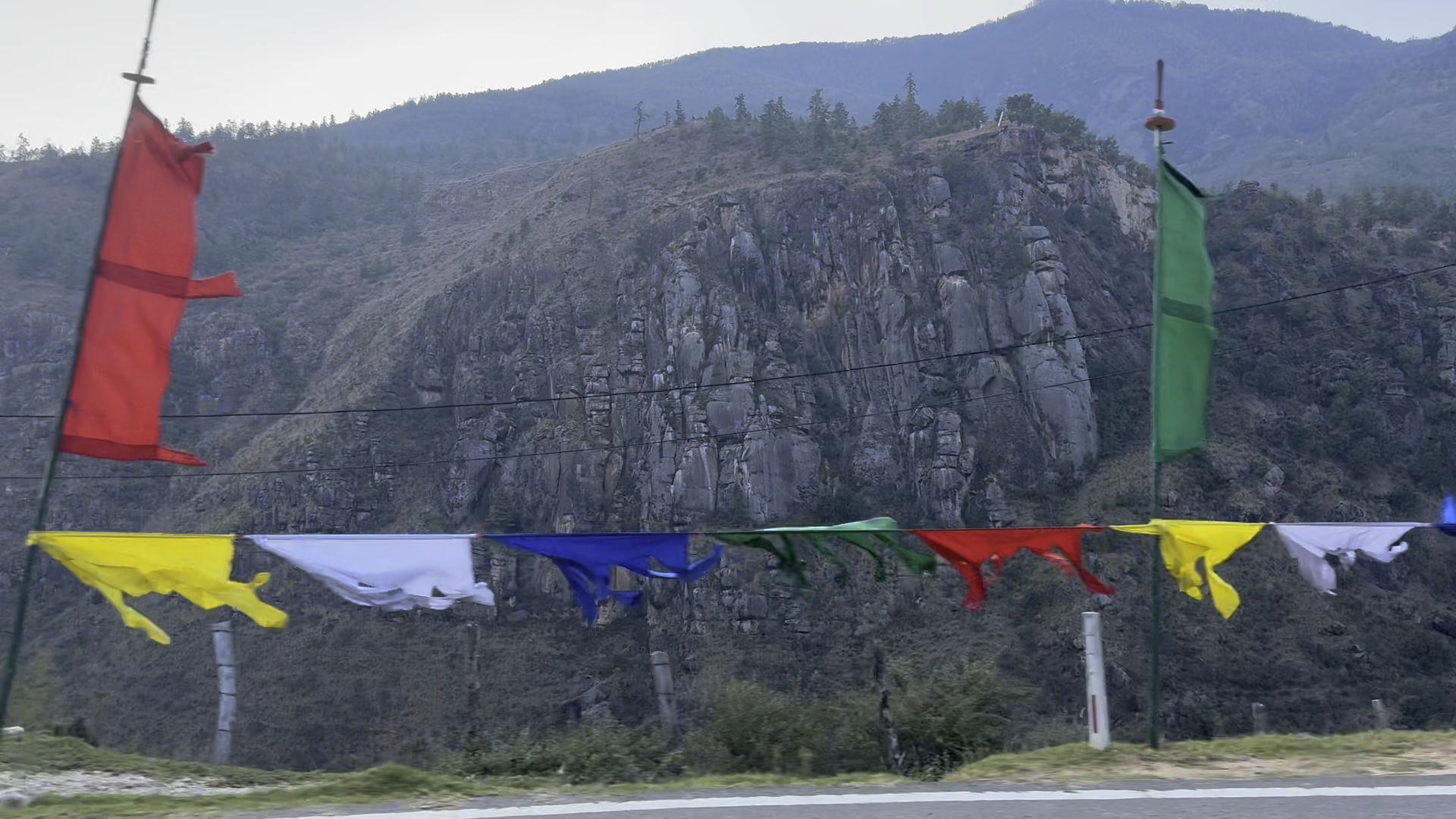
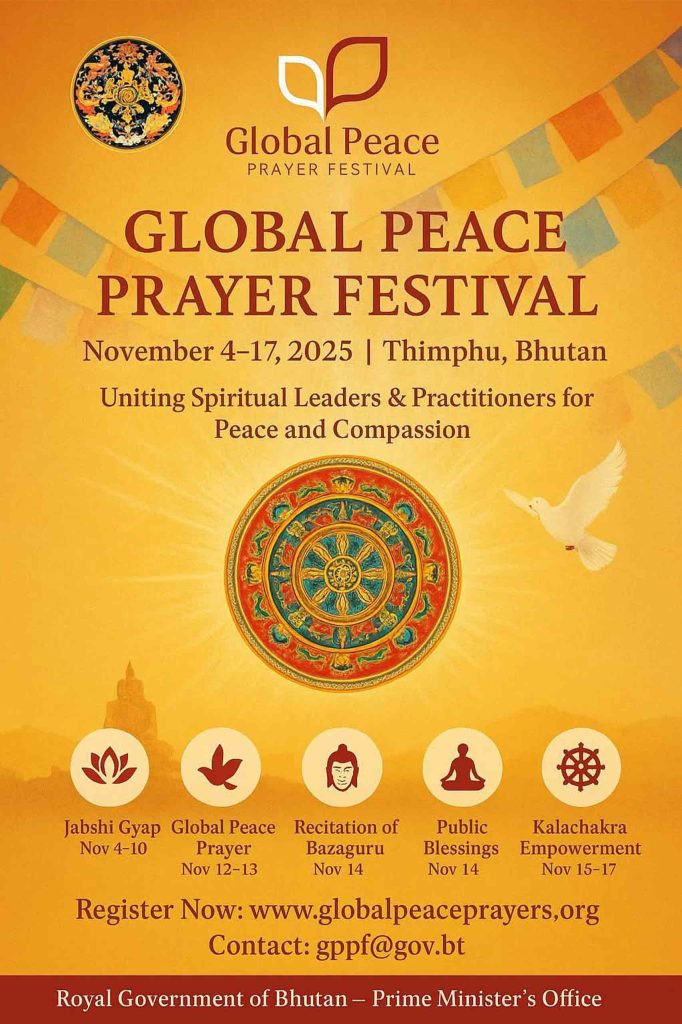
We landed in Paro on November 9th. From there, we took a bus about 40 kilometers through the valley to Thimphu. What I noticed immediately was that the entire road was decorated with five-colored banners. Our guide told us that this was the welcome greeting for the international guests of the “Global Peace Prayer Festival.”
Five-colored flags and pennants along the route
Thimphu itself was incredibly busy. Several events were happening at once: alongside the festival and the King’s upcoming birthday, Indian Prime Minister Narendra Modi was also expected for a state visit. You have to know that Thimphu is the only capital city in the world without traffic lights. Despite the crowds and the resulting traffic chaos, everyone remained calm. No one pushed, and people were patient and respectful. This relaxed attitude really impressed me.
National Memorial Chorten: The Spiritual Heart of Thimphu
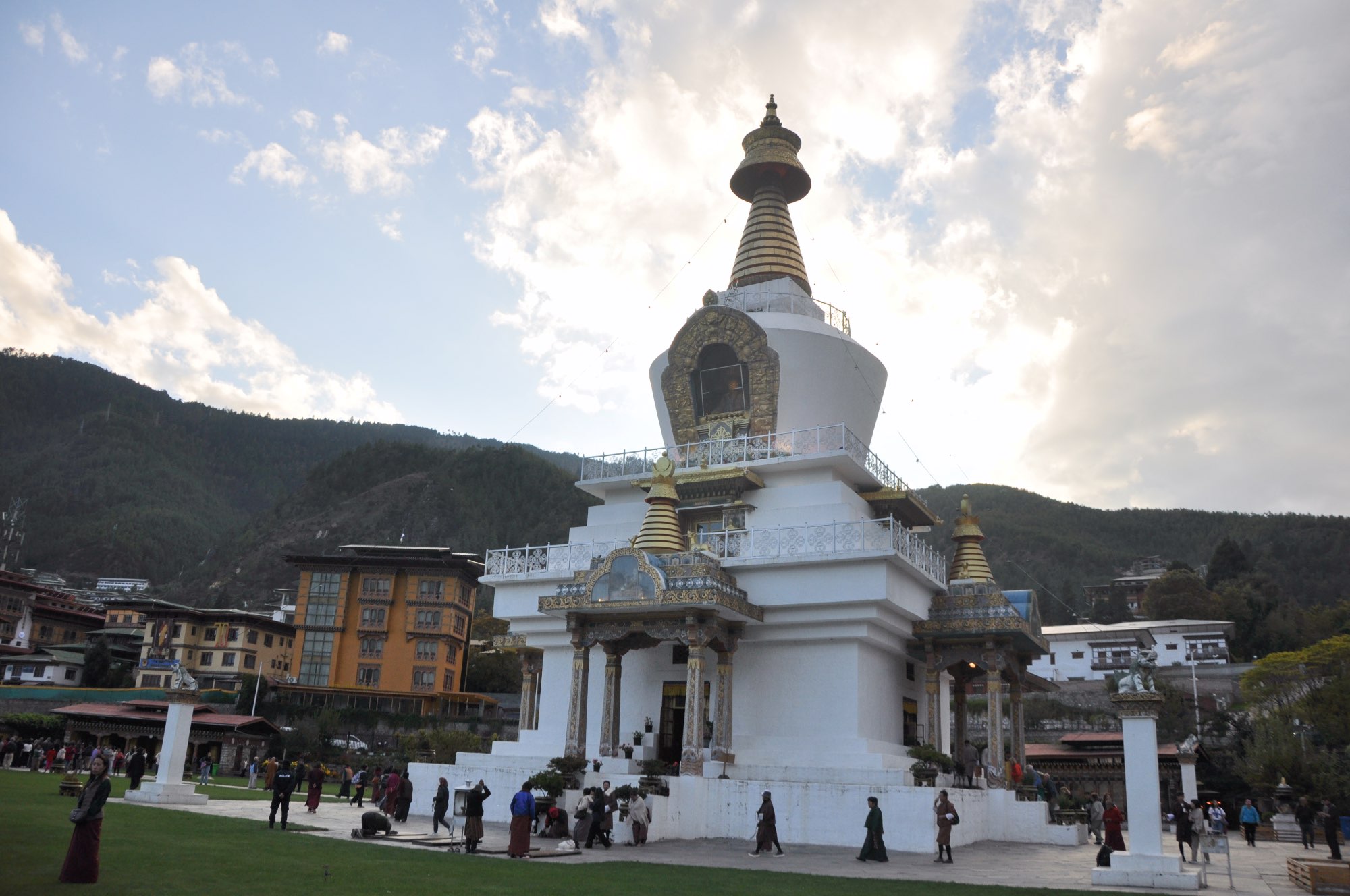
After checking into our first hotel, we visited the National Memorial Chorten. This is a large, white stupa in the middle of the city, built in 1974 for the third King. For the locals, this is an important place in everyday life. Many go there to walk around the stupa and spin the prayer wheels.
As at all holy sites, photography is not allowed inside. A simple rule applies: as soon as the shoes come off, the camera stays off. This allowed us to soak in the atmosphere without any distractions. The interior houses larger-than-life statues of wrathful deities in Yab-Yum posture and murals of Guru Rinpoche (Padmasambhava), Shakyamuni Buddha, and Ngawang Namgyal, the unifier of Bhutan. Colorful sculptures stand in all four directions. There are also mandalas, shrines for the third King, and images of Vajrakilaya.
Impressions (in order): The white Memorial Chorten, pilgrims at the prayer wheels, the sea of lights from the butter lamps, believers performing prostrations, and our group in front of the stupa.
Our group took the opportunity to chant on the square in front of the stupa, led by the Venerable Master Shi Zheng Da. It was a beautiful experience to do this at such a place.
Authentic Bhutanese Crafts Bazaar: Traditional Arts and Crafts
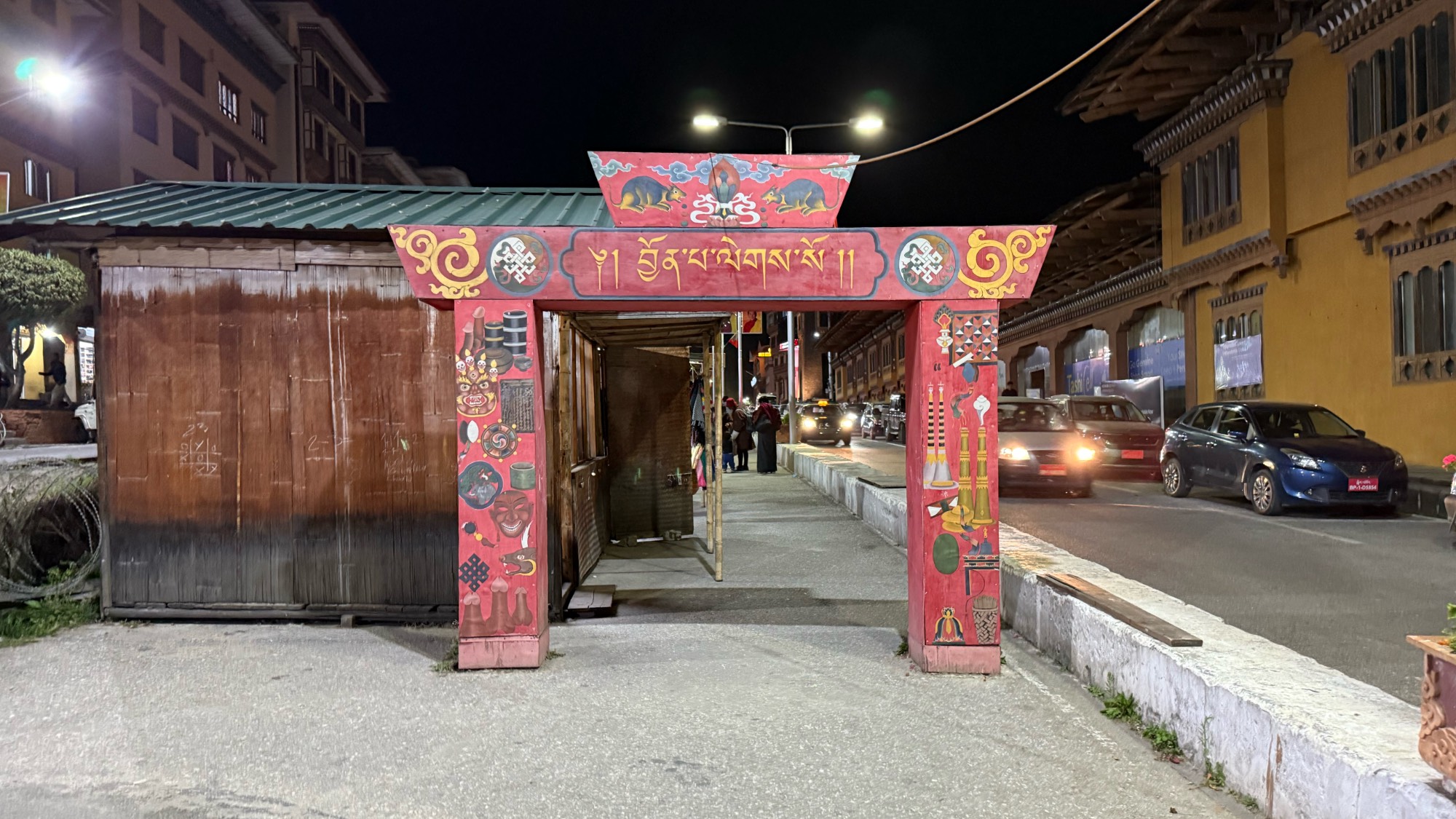
In the evening, I took the chance to stroll along Norzin Lam. That is where the Authentic Bhutanese Crafts Bazaar is located, which you enter through a distinct red gate. Behind it, many small huts are lined up where local artisans display their goods. There was really a lot to discover. Besides handmade textiles, jewelry, wood carvings, and thangkas, you can also find nice souvenirs to remember the trip by.
Entrance to the Authentic Bhutanese Crafts Bazaar
Global Peace Prayer Festival: Shared Prayers for Peace
November 10th was all about the Global Peace Prayer Festival. Since the stadium was within walking distance of our hotel, we went there on foot. Even on the street, we could feel how many people were flocking to this event. Once inside the stadium, we showed our respect through prostrations before the Venerables present. Afterwards, we were given a spot on the side where we could join in the peace prayers.
From there, we watched the program on the main stage, where various Buddhist traditions took turns with their recitations. Between the prayer sessions, there were traditional dances and songs. I was deeply impressed by how many people came together there peacefully. It was simply a good feeling to be right there among them.
Buddha Dordenma: The Golden Statue Above the Valley
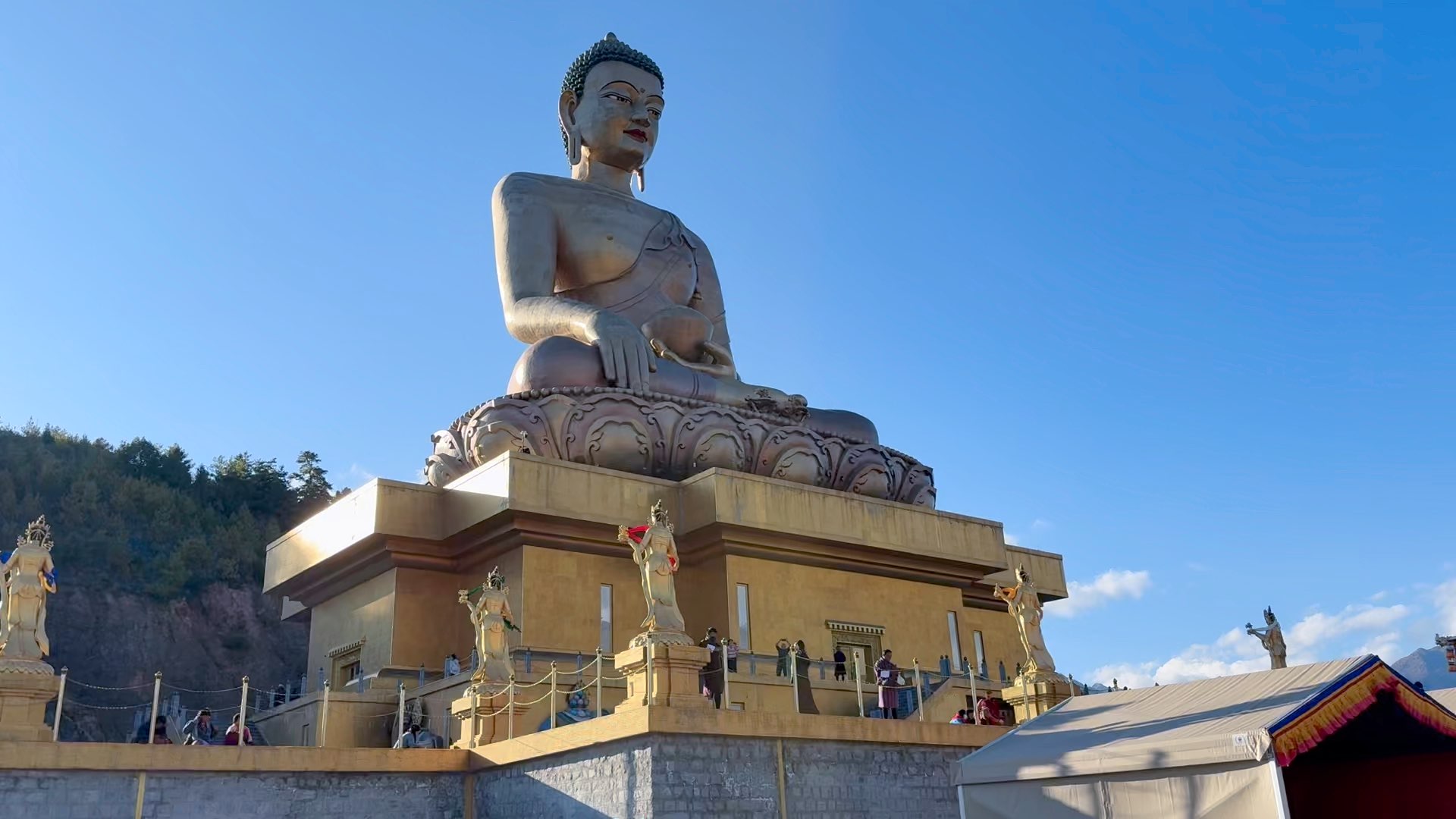
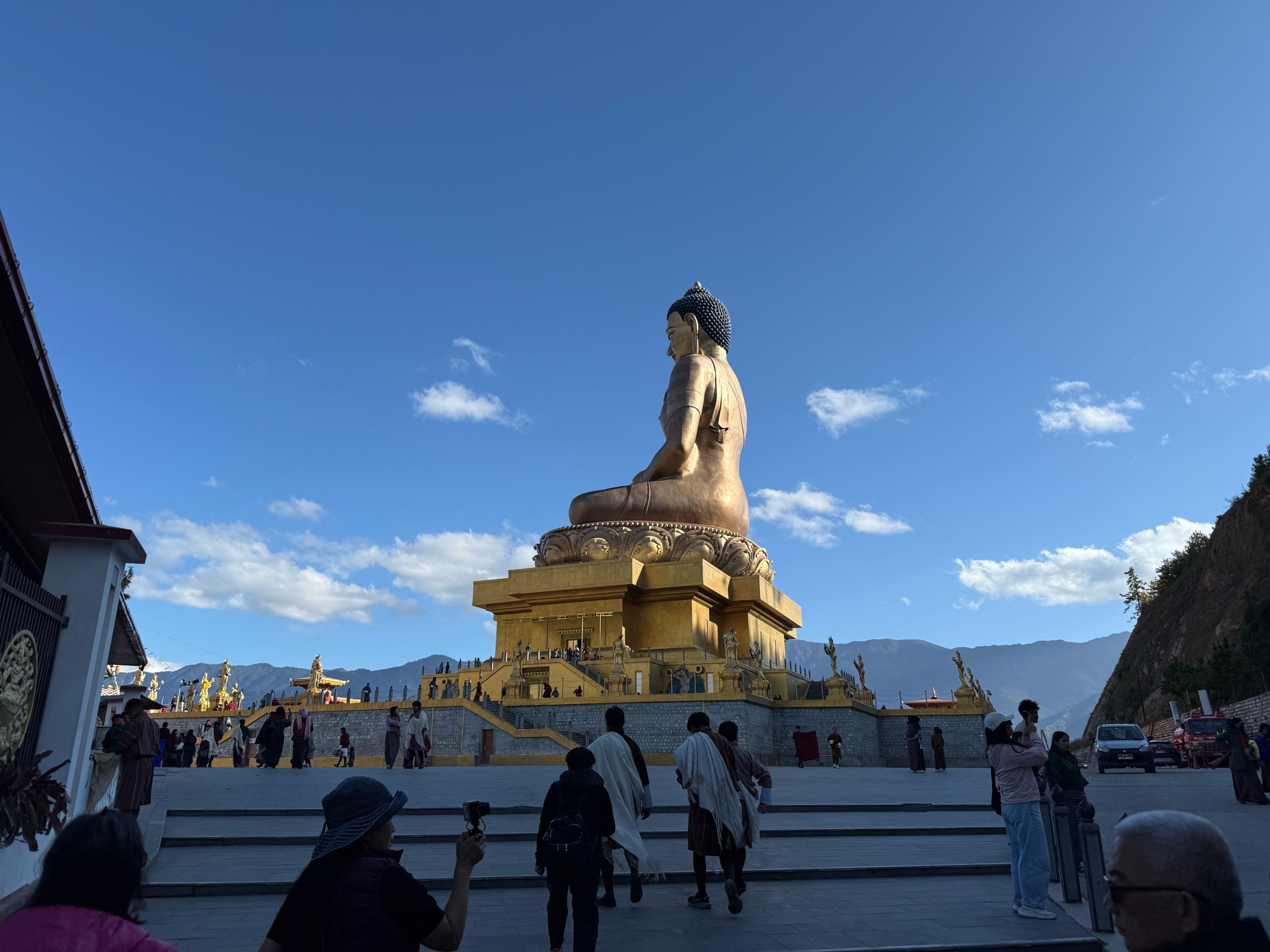
After noon, we continued to the Buddha Dordenma statue in Kuensel Phodrang Nature Park. This is an impressive, 51-meter-high statue of the seated Shakyamuni Buddha. It is made of bronze and completely gilded. By the way, it was built to celebrate the 60th birthday of the fourth King, Jigme Singye Wangchuck.
Buddha Dordenma Statue
Inside the building beneath the statue, there are over 100,000 small Buddhas, also made of bronze and gold. Every single one was donated. There is also a large meditation hall with many more beautiful Buddha statues. Various relics are kept in these rooms, which we were allowed to see during our visit.
Impressions of the Buddha Dordenma statue: The gigantic seated statue in side view, ritual structures featuring traditional thread crosses (Namkha/Mdos) on the plaza, the view up to the Buddha’s face, a relief of a blue elephant on the golden base, and the view over the square featuring golden Dakini statues.
What made this visit special was not just the statue itself. Right there, the conclusion of the Jabshi Gyap ritual was taking place. This is a major, multi-day ceremony intended to purify negative karma and bring healing. Thousands of devotees, monks, and Rinpoches were gathered. We learned that this ritual was done specifically for world peace. It was our good fortune that we could be there at exactly that moment.
A Matter of the Heart: Support for Expectant Mothers
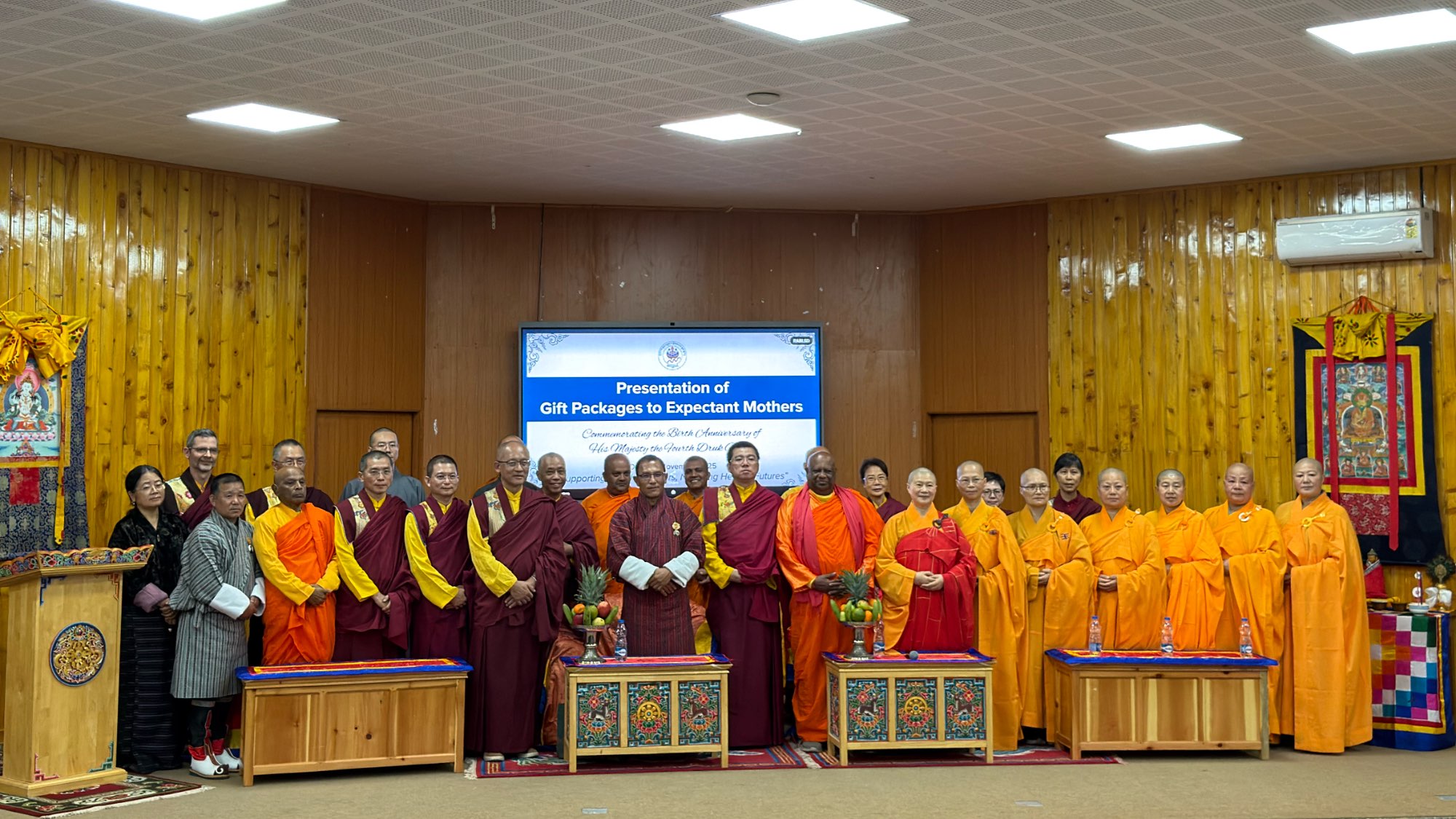
We had collected money in advance to support 500 expectant mothers with care packages. For this reason, we gathered at the end of the day for a ceremonial handover at the hospital in Thimphu.
Handing over the donation at the hospital
In addition to our travel group, hospital staff, the Secretary to the Health Minister, and some mothers also took part. We had the opportunity to personally hand over the first packages to the mothers present.
With that, the first days in the capital were over. Next, the journey would take us out of the city, to ancient Dzongs and into nature.
Unveiling the mystical realization state of esoteric Buddha-dharma—a true account of a grand assembly of esoteric Buddha-dharma
People think of Tibetan Buddhism in general as a far-away culture full of mystery. Especially when patriarchs from various sects manifested mystical phenomena and supernatural powers, people become curious about esoteric Buddha dharma.
Based on the descriptions of some lamas, there are various examinations for Buddhist practitioners in Tibet. One’s proficiency of Buddhism is examined by means of different scales of dialectical debates. The one who passes thousands of debates and is in first place is called Lharampa geshe. The ones in second place and third place are called geshes. Only after completion of tens of thousands of dialectical debates can geshes enter schools of Esoteric Buddhism to learn esoteric dharma.
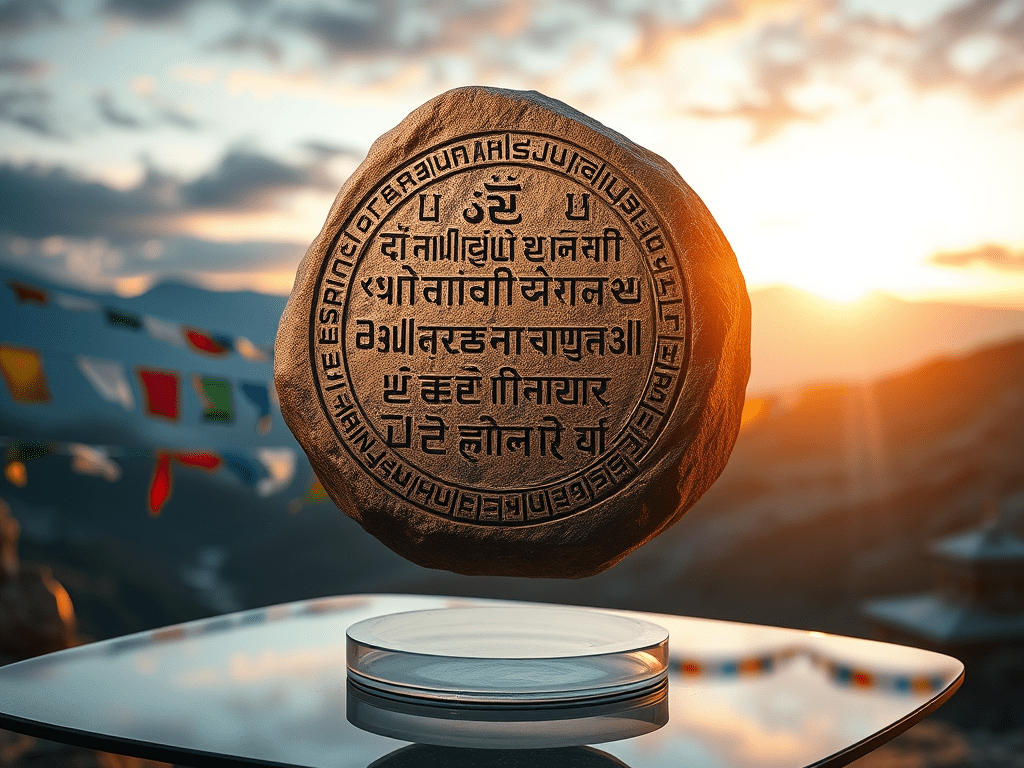
These lamas said that esoteric dharma emphasizes states of realization. In Esoteric Buddhism schools, mani stones are usually used to evaluate practitioners’ levels of realization. There are two types of mani stones.
The first type is stones that are inscribed with mantras by ordinary people and placed in mani stone mounds. This type of mani stone does not contain dharma power.
The second type is stones that are inscribed by great patriarchs from lineages of Tibetan Buddhism after practicing dharma. These stones are inscribed with images of Buddhas or seed syllables of mantras. They are placed in mani stone mounds to be used as empowerment to eliminate disasters and obstacles. The most important function of this type of mani stone with power is to test and measure levels of self-cultivation.
According to some accounts, only practitioners who have attained states of realization through self-cultivation are able to practice dharma that causes mani stones to move at a distance. Mani stones move in different ways: some move slowly, while others walk or fly. Ordinary people cannot make them move at all, no matter how much force they use or how many people recite mantras at the same time. These stories have added an element of mystery and significance to Tibetan esoteric dharma.
Recently, the reporter had the honor of attending a grand assembly in the United States where various states of realization were revealed. Attendees included great lamas and ordinary lamas from Tibet, as well as great dharma masters and ordinary dharma masters of Exoteric Buddhism.
The mantras recited included the Great Compassion Mantra, the Green Tara Heart Mantra, and the mantra of Vajrakila (Dorje Phurba). Some dharma masters were unable to cause the mani stone to move even after a prolonged period of practicing dharma. Several Exoteric Buddhist dharma masters recited mantras in unison and, across space, caused a 150-gram mani stone on a glass table to move. A great dharma master and a female lama were able to make a mani stone at a distance move as soon as they chanted mantras combined with mudras.
While the attendees marveled at these sights, a great female lama from Tibet arrived. Before the testing, she requested that the person videotaping not capture her face. She said that she was a self-cultivator who wished to attain liberation and realization, and that she did not intend to manifest Buddha-dharma to show off her powers. Soon after, something stunning happened.
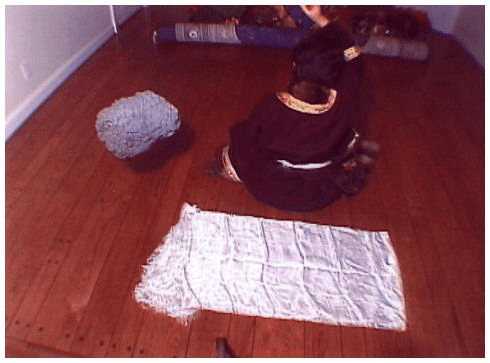
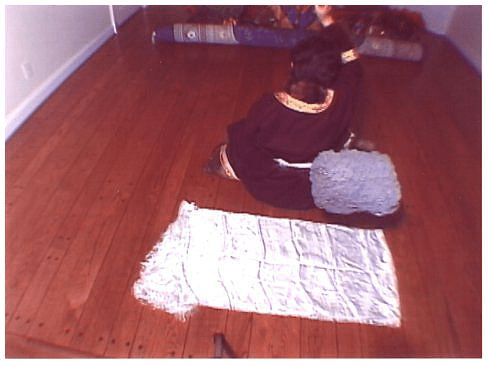
As soon as she recited mantras, a ninety-eight-pound stalactite stone surprisingly rose from the ground and circulated in the air following her hand gestures. This mani stone with supernatural powers stopped and trembled after rising into the air.
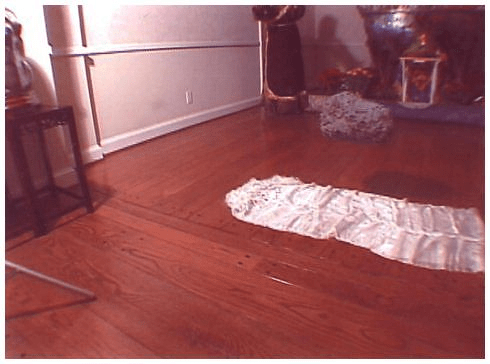
What was even more astonishing was that when the female lama sat on the wooden floor, the mani stone moved from behind her to the front in a split second. Witnesses felt that the ninety-eight-pound mani stone had moved in the blink of an eye, at such speed that it seemed to pass through her body.
Then the mani stone circled the great female lama twice, following her finger gestures. It moved up and down while trembling as it circled. When the mani stone moved to her back the second time, her index finger—forming a mudra above her head—pointed downward, and the stone immediately descended. Following the direction of her fingers, it paused briefly and then dropped onto the wooden floor with a heavy thump. The weight of the stone was evident, and it would be difficult to imagine such a scene without witnessing it firsthand.
The most famous gigantic stalactite mani stone, Duo Qie Xu from Tibet, was also included in the assembly. It weighs approximately 430 pounds, equivalent to about 200 kilograms, and was shipped from Tibet to the United States. It revealed great supernatural powers during the assembly.
The gigantic mani stone Duo Qie Xu is not an ordinary stone. It is a mani stone with a distinct identity, similar to the famous Cuiyu Cabbage (a renowned jade carving from the Qing Dynasty displayed at the National Palace Museum in Taipei). Most Tibetan Buddhist practitioners are familiar with Duo Qie Xu. During the testing involving Duo Qie Xu, even more incredible phenomena occurred.
When the great Tibetan female lama was about to test her powers on Duo Qie Xu, she again requested that her face not be captured on camera, for the same reasons as before. The video recordings were intended solely as keepsakes for those present and were not to be used for any form of promotion. Her strict adherence to the precepts deeply moved those in attendance.
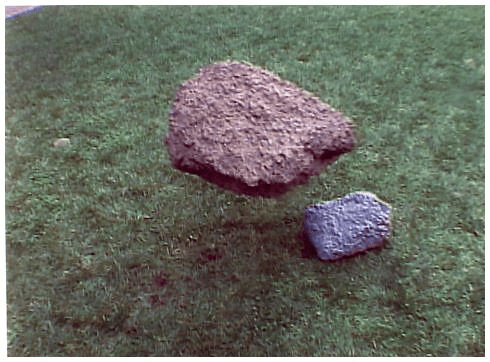
Then something extraordinary happened. The 430-pound Duo Qie Xu followed the hand gestures of the great Tibetan female lama, trembling as it rose from the lawn and flew into the air. The crowd was awestruck and suddenly felt the lawn move like ocean waves. Rooftops and trees also appeared to move simultaneously.
The mani stone flying in the air then returned and suddenly fell from a height of three feet above the ground, making a large dent in the lawn. Such an occurrence—normally found only in fiction—unfolded in real life. The lamas and dharma masters present stated that this holy feat demonstrated the magnificence and authenticity of Buddha-dharma, through which all things can be accomplished, including the transformation of mountains and oceans.
At the Exposing Buddha Statues to the Sun Dharma Assembly held at Chiang Kai-shek Memorial Hall in Taipei on January 13, 2002, there was a mound of stones inscribed with mantras from Lapuleng Temple in Gansu. It was a Mani Stone Mound consisting of mani stones.
In the annals of spiritual history, few figures are as revolutionary as Huineng (慧能), the Sixth Patriarch of Zen (Chan) Buddhism. His life story is a profound testament to the idea that enlightenment is not reserved for the elite or the scholarly, but is the inherent birthright of every human being.
Known for the iconic verse you mentioned—“Bodhi originally has no tree”—Huineng transformed Zen from a complex Indian philosophy into the direct, spontaneous practice we recognize today.
Huineng’s journey did not begin in a monastery. He was born into a poor family in 7th-century China and worked as an illiterate woodcutter to support his widowed mother.
His life changed in an instant when he overheard a traveler reciting the Diamond Sutra. Upon hearing the line, “Depending upon nothing, the mind arises,” Huineng experienced a sudden moment of clarity. This “sudden awakening” became the hallmark of his future teachings.
Driven by this experience, he traveled to the Dongshan Monastery to seek guidance from the Fifth Patriarch, Hongren.
Huineng’s status as an illiterate outsider meant he was initially assigned to the kitchen to hull rice. When the time came for the Fifth Patriarch to choose a successor, he asked his disciples to write a “mind-verse” to demonstrate their understanding.
The lead disciple, Shenxiu, wrote a verse emphasizing constant, diligent practice:
“The body is the Bodhi tree; the mind is like a bright mirror on a stand. Take care to wipe it always, and let no dust collect.”
Huineng, hearing the verse, realized it missed the ultimate truth of emptiness. He dictated his now-famous response to be written on the wall:
“Bodhi originally has no tree.The bright mirror on a stand is also not real.From the beginning, not a single thing exists.Where, then, can dust collect?”
Hongren recognized Huineng’s superior realization and secretly passed him the robe and bowl—the symbols of the Patriarchy—in the middle of the night, instructing him to go into hiding until the time was right to teach.
Huineng eventually emerged from hiding and began teaching at Nanhua Temple. His impact on Buddhism was so immense that his teachings were recorded in the Platform Sutra of the Sixth Patriarch. This is the only Buddhist scripture not spoken by a Buddha to be officially granted the title of a “Sutra.”
His major achievements include:
The Southern School of Zen: He founded the “Southern School,” which emphasizes “Sudden Enlightenment” (Dunwu) over gradual study.
Democratizing Wisdom: He taught that the “Buddha-nature” is present in everyone, regardless of literacy or social status.
The Foundation of Zen: Nearly all surviving Zen lineages (including Japanese Zen and Korean Seon) trace their ancestry back to Huineng.
A Living Legacy: The Whole-Body Relic
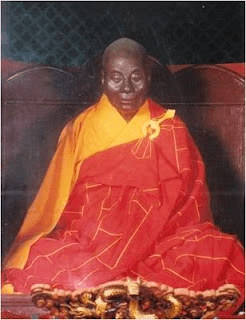
Perhaps the most miraculous aspect of Huineng’s story is his physical departure from this world. In 713 AD, Huineng entered Nirvana, but his body did not decay.
To this day, his whole-body relic (mummy) is enshrined and preserved at Nanhua Temple in Shaoguan, Guangdong Province. For over 1,300 years, devotees have traveled to the temple to pay respects to the Sixth Patriarch. His physical presence remains a powerful symbol of the “Diamond Body”—the incorruptible nature of a truly enlightened mind.
Huineng reminds us that we do not need to look outside ourselves for wisdom. As he famously taught, our original nature is pure, and enlightenment is simply the act of seeing through the “dust” to the emptiness that was there all along.
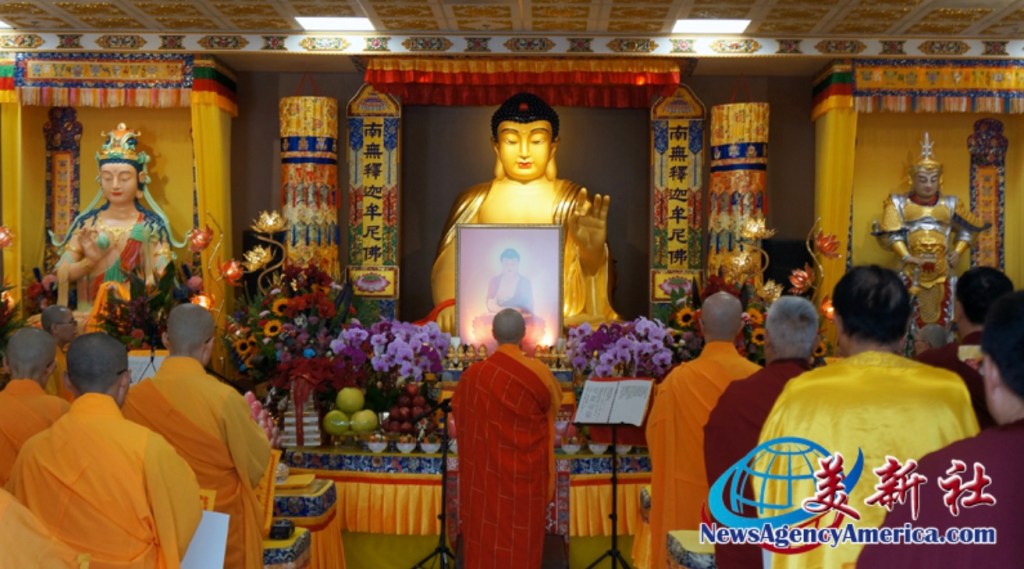
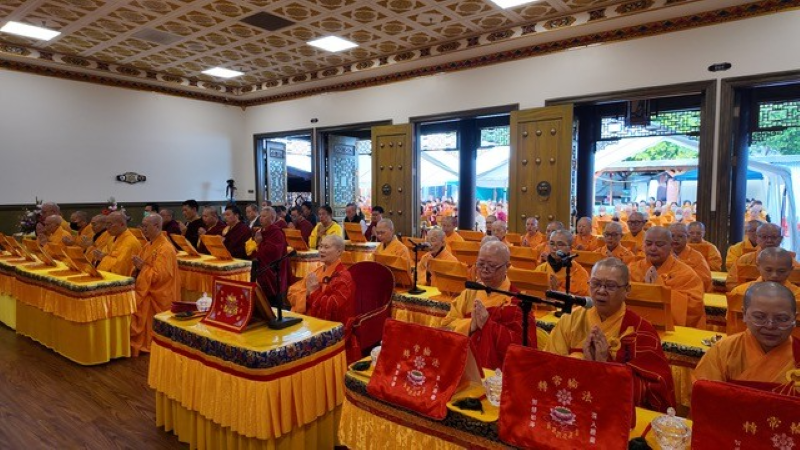
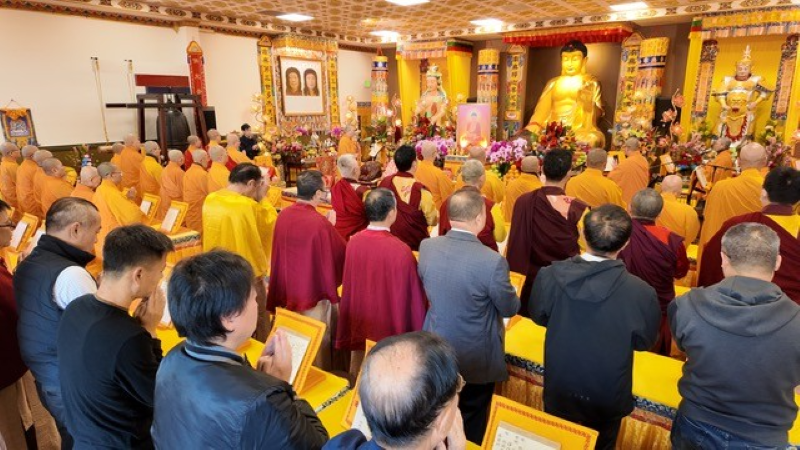
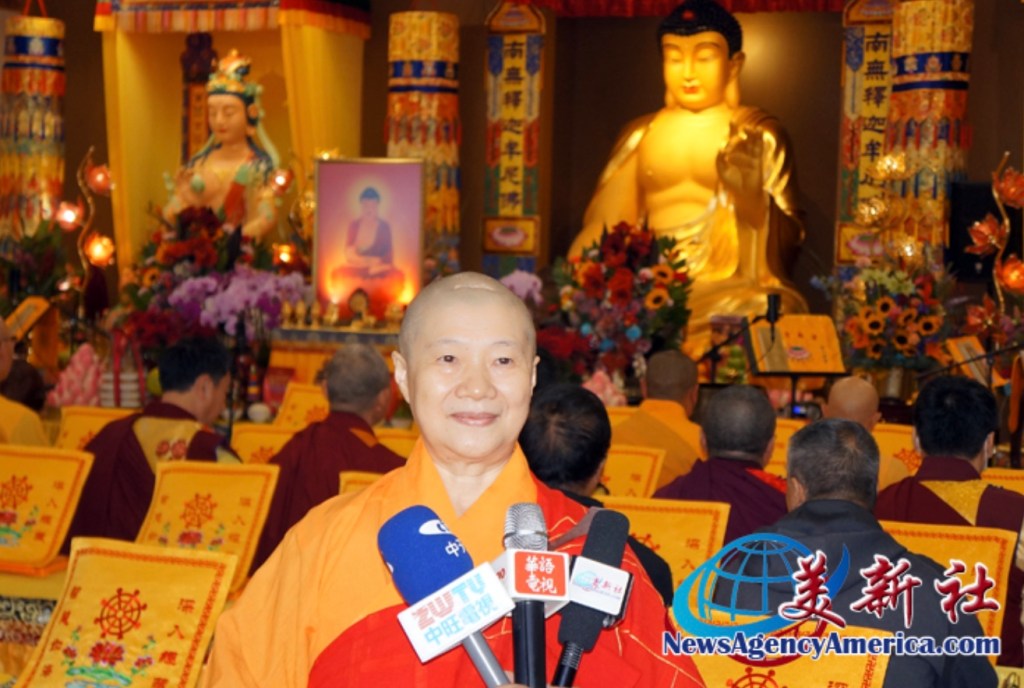
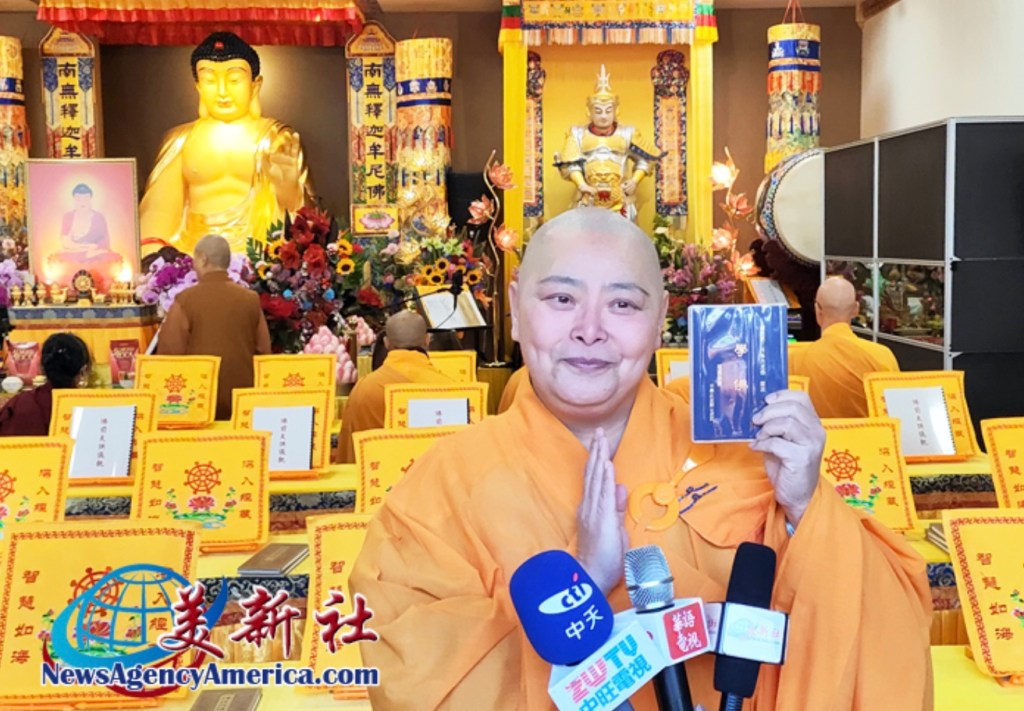
PASADENA, CA — Four major Buddhist organizations—the World Buddhism Association Headquarters (W.B.A.H.), Holy Miracles Temple, Hongfa Temple, and Sanger Mission—recently held a joint Dharma Assembly at the Grand Hall of Holy Miracles Temple in Pasadena to celebrate the Holy Birthday of Namo Amitabha Buddha, the Lord of the Western World of Ultimate Bliss.
The assembly was presided over by Venerable Dharma Teacher Zhengda, Vice Chair of the W.B.A.H. and a Holy Virtuous One of Gold Button Grade II. Hundreds of devotees from across California and overseas attended the ceremony.
The assembly officially commenced at 10:00 AM. Inside the Grand Hall, the sounds of bells, drums, and rhythmic chanting filled the air, creating a solemn and serene atmosphere. Led by Venerable Dharma Teacher Zhengda and Venerable Ruohui, Abbot of Hua Zang Si and Hongfa Temple (a Holy Virtuous One of Gold Button Grade I), the monastics and Rinpoches guided the congregation in prostrations and the sincere recitation of the Amitabha Sutra.
Following the recitation, a Grand Offering was performed. Incense, flowers, lamps, fresh fruit, and various offerings were presented before the Buddha. With pure and respectful hearts, the faithful prayed for all sentient beings to be free from suffering and attain happiness. The organizers stated that beyond celebrating the Holy Birthday, the merits of the sutra chanting and offerings were dedicated to world peace, the cessation of war, social harmony, and the longevity, health, and spiritual growth of all beings.
The Compassionate Vows of Amitabha Buddha
According to Buddhist scriptures, Namo Amitabha Buddha is the “Amitabha Buddha of the West” among the Five Dhyani Buddhas and is a disciple of the primordial Buddha, Namo Dorje Chang Buddha. During his past cultivation, Amitabha Buddha made 48 Great Vows to deliver sentient beings from the sea of suffering to the Pure Land. Upon the perfection of his vows and attainment of Buddhahood, he established the pure and majestic Western World of Ultimate Bliss. He is currently the Lord of that realm and the Head of the Lotus Section of the Vajrayana teachings.
During an interview, Venerable Dharma Teacher Zhengda remarked:
“Today, we gathered to recite the Amitabha Sutra and pray for blessings. The devotees showed great sincerity in their chanting and repentance, expressing deep gratitude for Amitabha Buddha’s salvation. We should emulate the vast compassion of Amitabha Buddha and all Buddhas of the ten directions. We pray that Namo H.H. Dorje Chang Buddha III, Namo Amitabha Buddha, and all Buddhas and Bodhisattvas bless the world with peace and prosperity, protecting all beings from disaster.”
Bhikkhuni Zhengqin of Hongfa Temple shared her reflections on cultivation, noting that after facing many hardships in life, studying the true Buddha Dharma provided her with inner peace. She highlighted the book Learning from Buddha as a “treasured guide” that offers clear direction for practitioners.
Another attendee, Ms. Wu Guangling, shared that over ten years of practice have taught her to face life’s challenges with equanimity. She quoted an ancient virtuous saying to describe her mindset: “Face negative karmic effects with composure, while planting good causes as if treading on thin ice.”
Jon, a first-time attendee, was moved by the experience:
“Seeing everyone chanting so sincerely was impressive. I’ve never chanted with so many people before, and I hope to have the chance to attend such an assembly again.”
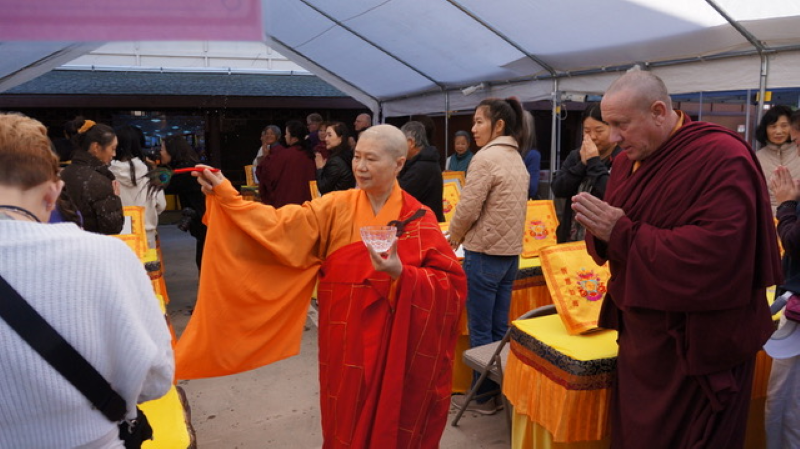
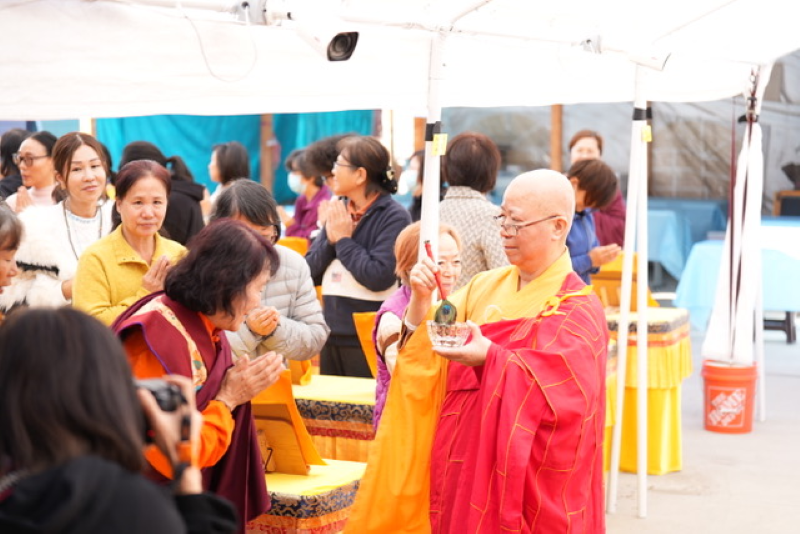
As the assembly concluded, the monastics sprinkled holy water over the crowd, blessing them with longevity and wisdom. The organizers noted that the event not only allowed the faithful to draw closer to the Dharma but also united the community in a spirit of goodness. The W.B.A.H. expressed gratitude to all participants and encouraged everyone to integrate the Buddha’s teachings into their daily lives to contribute to social harmony and world peace.
A Buddha Truly Recognized as Such in Accordance with the Dharma
The people on both sides of H.H. Dorje Chang Buddha III on this page are the highest present-day dharma kings and regent dharma kings from various Buddhist sects or are famous rinpoches. It is they who wrote recognitions, corroborations, or congratulations to H.H. Dorje Chang Buddha III.
H.H. Dorje Chang Buddha III is the first Buddha on earth to have received such a large number of recognitions, corroborations, and congratulations and to have been recognized as having the highest status! No other Rinpoche on earth has ever received even one third of the number of recognitions, corroborations, and congratulations from great dharma kings, regent dharma kings, etc. that H.H. Dorje Chang Buddha III has received. H.H. Dorje Chang Buddha III has singlehandedly manifested accomplishments in thirty large categories involving all of the Five Vidyas, thereby establishing the highest record of accomplishment in the history of Buddhism in this world.
Certain evil people have slandered H.H. Dorje Chang Buddha III as having conferred upon Himself the status of H.H. Dorje Chang Buddha III, and they have thereby guided Buddhist practitioners toward evil. In order to protect the wisdom roots of living beings, H.H. Dorje Chang Buddha III makes the following vow of truth: “If those recognitions, corroborations, and congratulations that follow did not come from the dharma kings, regent dharma kings, and rinpoches whose photographs appear on this page of from their temples and/ or are not copies of the original texts but rather are my fabrications with forged signatures – if even one such case exists – then i should descend into hell without the possibility of ever leaving hell. If those recognitions, corroborations, and congratulations were written or typed by them as well as signed and/ or stamped by them, the merit of this truth will bring to everyone wonderful blessings and wisdom! Vow Maker- Dorje Chang Buddha III“
FATHER OF MEDICINE, FERRYBOATS, BRIDGES, AND OPERAS IN TIBET IN A PREVIOUS LIFE: H.E. DHARMA KING TANGTONG GYALPO
H.E. Tangtong Gyalpo is a greatly accomplished person within Tibetan esoteric Buddhism who attained the rainbow body. In a prior life in Tibet, he was the supreme dharma king of the four main sects esoteric Buddhism. He is a great Bodhisattva known and respected by one and all in Tibet. He is also a person of great holiness who has made huge contributions to the Tibetan people. It was this great Bodhisattva who was the father of medicine, ferryboats, bridges, and operas in Tibet. To this day, Tibetan temples and families continue to worship H.E. Tangtong Gyalpo Bodhisattva.
H.E. the 16th Tangtong Gyalpo Bodhisattva (Thangtrul Rinpoche) took birth in Bhutan. His physical appearance resembles that of Guru Padmasambhava. Even when he sleeps, his eyes remain open. During a Dharma Assembly that took place in 2005 at Hua Zang Si in San Francisco, he entered a supernatural state of samadhi in which he saw H.H. Dorje Chang Buddha. H.E. Tangtong Gyalpo said to H.H. Dorje Chang Buddha III that he had received teachings directly from Guru Padmasambhava. He also said that he specially came to formally acknowledge H.H. Dorje Chang Buddha III as his Master and to request the highest dharma in order to save living beings. H.H. Dorje Chang Buddha III immediately accepted H.E. Tangtong Gyalpo as one of his disciples who is on the level of a great venerable one and performed an initiation for him. H.E. Tangtong Gyalpo organized many rinpoches to practice the Kuan Yin Dharma one billion times as an offering to the treasure book about H.H. Dorje Chang Buddha III. He also sent his written congratulations stating that the magnificence of H.H. Dorje Chang Buddha III is supreme and that no other holy being in history can compare with this master of the Buddhas.
H.E. Dharma King Tangtong Gyalpo, the Father of Medicine, Ferryboats, Bridges, and Operas in Tibet in a previous life, acknowledged H.H. Dorje Chang Buddha III (H.H. Dharma King Wan Ko Yeshe Norbu) as his Master, who is unanimously recognized by great holy beings as the true incarnation of Dorje Chang Buddha, the Master of the Five Buddhas, having manifested complete mastery of exoteric and esoteric Buddhism and the Five Vidyas.
During a Dharma Assembly held by the International Buddhism Sangha Association at the Hua Zang Si temple in San Francisco, I saw the awe-inspiring and peerless powers and realization of the Master. Bodhi nectar went through the walls of the bowl unhindered as it left and entered the bowl. That nectar can make a person’s body change involuntarily in an instant. H.H. Dharma King Wan Ko Yeshe Norbu bestowed upon me that holy bowl. H.H. Dharma King Sakya Trizin; Dharma King Omniscience Jamyang Lungdok Gyaltsen; Lama palchug Ugyen Sherab; Dharma King Renzeng Nima; the Eastern Tibetan Dharma King of the Nyingma sect, Renqing Rongbo Barongbo Rinpoche; the Green Jewel Crown karmapa, Dharma King Jiezong; and other great, holy and virtuous beings who are on the levels of Buddhas and Mahasattvas unanimously acknowledge that H.H. Wan Ko Yeshe Norbu is the true incarnation of Dorje Chang Buddha, the Master of the Five Buddhas, and has for the first time in the history of Buddhism in the human realm truly manifested complete proficiency in exoteric and esoteric Buddhism and perfect mastery of the Five Vidyas. This is a goal of Buddhism that all other Buddhists have not been able to achieve. This goal has finally been achieved by H.H. Master Wan Ko Yeshe Norbu. This is an honor to Buddhism and a blessing to living beings.
May the seven types of Buddhist disciples hear the true dharma taught by H.H. Great Dharma King Wan Ko Yeshe Norbu, and may they soon realize enlightenment!
This ancient Buddhist narrative reveals a timeless truth: the value of spiritual wisdom far outweighs any material wealth. It is a powerful reminder to cherish the opportunity to hear and practice the true teachings.
The story begins with the aunt of Shakyamuni Buddha. Out of deep love and devotion, she wove a magnificent robe for him, intricately threaded with gold. It was a labor of heart, an offering fit for an enlightened one.
Yet when she presented it, the Buddha gently advised her to give the robe instead to the entire monastic community—the Sangha.
This puzzled her. The garment was made especially for him. Why give it away?
The Buddha explained with compassion:
“The Field of Merit provided by the Sangha is vast and boundless. Offer it to them, and the virtue you gain will be immeasurable. To give to the Sangha is to give to me.”
Moved by this wisdom, she offered the robe to the monks. Out of humility, none dared to accept it—except Bodhisattva Maitreya, the future Buddha.
Wearing the golden robe, Maitreya went into the city to receive alms. His majestic presence, radiant in that resplendent garment, astonished the townspeople. They were mesmerized—so much so that they forgot to offer him food.
Among them was a master bead-stringer. Captivated, he invited Maitreya to his home for a meal. Afterward, he requested a Dharma discourse.
The artisan listened with such joy and absorption that he forgot everything—including an urgent commission from a wealthy patron who had paid him generously to craft a wedding ornament worth one hundred thousand coins.
When the client’s messengers arrived repeatedly to collect the finished piece, they found him entirely engrossed in listening to the teachings. Enraged, the wealthy man demanded back his jewels and the full down payment.
The artisan’s wife was devastated. Facing such a financial loss, she scolded him bitterly:
“By simply finishing that order, you would have earned a great fortune. Instead, you threw it all away listening to philosophy!”
The artisan felt a wave of regret wash over him.
Sensing this inner turmoil, Maitreya gently asked, “Will you come with me to the monastery?”
The artisan nodded.
Back at the monastery, Maitreya posed a question to the venerable Arhats:
“Which carries greater merit: listening to the Dharma with a joyful heart, or earning a great fortune?”
One by one, the senior monks affirmed that nothing can compare to the merit of hearing the true teachings.
Venerable Kaundinya declared:
“Receiving ten thousand pounds of gold cannot compare to offering even a single bowl of food to a virtuous practitioner. And listening to the Dharma with pure faith—even for a moment—surpasses that merit by hundreds of millions of times.”
Four other Arhats repeated this profound truth.
Finally, Maitreya asked Venerable Aniruddha why this was so.
Aniruddha replied:
“In a past life, I offered just one bowl of food to a Pratyekabuddha. Because of that single offering, for ninety-one world cycles I was reborn as a Heavenly Emperor and a human King, enjoying peace and prosperity. In this life, I was born into the same clan as the Buddha, and came into this world with a natural treasure field forty li wide.”
Hearing this, the bead-stringer felt his regret dissolve. Joy filled his heart. He understood the treasure he had received was far beyond the hundred thousand coins he had lost.
This ancient story is far more than a tale. It invites us to reflect deeply on the power of the Dharma.
Listening to the Truth is not merely an intellectual exercise. It opens the heart. It awakens wisdom. It strengthens the willpower needed to transform our deepest flaws and afflictions.
Material wealth is limited and fleeting. The merit gained from receiving the Dharma is limitless, enduring, and life-changing.
And yet the opportunity to listen does not always come easily. Conditions shift. Circumstances change. None of us can guarantee the next moment of life, much less another chance to sit peacefully and hear teachings that can liberate us from suffering.
When the causes and conditions ripen—when the Dharma reaches our ears—we must listen wholeheartedly.
We must not assume tomorrow will come. We must not assume our hearts are already pure. We must not assume we know enough.
The greatest freedom comes only when we break the cycle of birth and death and attain effortless liberation. Every moment of listening, every spark of understanding, moves us closer to that awakening.
This story encourages us to treasure every opportunity to hear the teachings, to recognize that spiritual wisdom is the greatest wealth of all, and to remember that even a moment of true Dharma listening can bring blessings far beyond the measure of gold.
In this Dharma-ending age, we are truly blessed that an ancient Buddha has come into our world to reveal the authentic, uncorrupted Dharma. The recorded discourses of H.H. Dorje Chang Buddha III guide practitioners through a clear and progressive path of cultivation, offering incisive teachings that encompass the essence of the twelve divisions of the Tripitaka and the ten divisions of the esoteric scriptures. Nothing is diluted or lost—each teaching preserves the profound meaning of both the exoteric and esoteric Dharma. These discourses illuminate an extraordinary range of topics, from the principles of the Trikaya and the Four Wisdoms of a Buddha to the supreme vajra Dharma of the highest division. They reveal the true realization of the Great Perfection of Ultimate Wisdom, and through the Xian Liang Buddha Wisdom Great Perfection Dharma, disciples may even personally witness the rainbow-body state on the very day the Dharma is transmitted. In both theory and practice, the teachings of H.H. Dorje Chang Buddha III stand complete, perfect, and unparalleled—an immeasurable blessing in this age of fading Dharma.
Most religions have moral and ethical rules and commandments. Buddhism has Precepts, but it’s important to understand that the Buddhist Precepts are not a list of rules to follow.
In some religions, moral laws are believed to have come from God, and breaking those laws is a sin or transgression against God. But Buddhism doesn’t have a God, and the Precepts are not commandments. However, that doesn’t exactly mean they’re optional, either.
The Pali word most often translated as “morality” is sila, but sila has many connotations that go beyond the English word “morality.” It can refer to inner virtue such as kindness and truthfulness as well as the activity of those virtues in the world. It can also refer to the discipline of acting in a moral way. However, sila is best understood as a kind of harmony.
Being in Harmony
The Theravadin teacher Bikkhu Bodhi wrote,
“The Buddhist texts explain that sila has the characteristic of harmonizing our actions of body and speech. Sila harmonizes our actions by bringing them into accord with our own true interests, with the well-being of others, and with universal laws. Actions contrary to sila lead to a state of self-division marked by guilt, anxiety, and remorse. But the observance of the principles of sila heals this division, bringing our inner faculties together into a balanced and centered state of unity.” (“Going for Refuge and Taking the Precepts “)
It is said that the Precepts describe the way an enlightened being naturally lives. At the same time, the discipline of upholding the Precepts is part of the path to enlightenment. As we begin to work with the Precepts we find ourselves “breaking” or defiling them over and over. We can think of this as something like falling off a bicycle, and we can either beat ourselves up about falling—which is disharmonious—or we can get back on the bicycle and start pedaling again.
The Zen teacher Chozen Bays said, “We just keep on working, we are patient with ourselves, and on and on it goes. Little by little our life comes more into alignment with the wisdom that gives rise to the precepts. As our minds get clearer and clearer, it’s not even a matter of breaking or maintaining the precepts; automatically they are maintained.”
The Five Precepts
Buddhists don’t have just one set of Precepts. Depending on which list you consult, you might hear there are three, five, ten, or sixteen Precepts. Monastic orders have longer lists.
The most basic list of Precepts is called in Pali the pañcasila, or “five precepts.” In Theravada Buddhism, these Five Precepts are the basic precepts for lay Buddhists.
A more literal translation from the Pali for each of these would be “I undertake to observe the precept to abstain from [killing, stealing, misusing sex, lying, abusing intoxicants].” It’s important to understand that in maintaining the Precepts one is training oneself to behave as a buddha would behave. It’s not just a matter of following or not following rules.
The Ten Grand Precepts
Mahayana Buddhists generally follow a list of Ten Precepts that are found in a Mahayana Sutra called the Brahmajala or Brahma Net Sutra (not to be confused with a Pali sutra of the same name):
Some Mahayana Buddhists also vow to uphold the Three Pure Precepts, which are associated with walking the path of a bodhisattva. These are:
To do no evil
To do good
To save all beings
The Pali words usually translated as “good” and “evil” are kusala and akusala. These words can also be translated “skillful” and “unskillful,” which takes us back to the idea of training. Very basically, “skillful” action takes oneself and others closer to enlightenment, and “unskillful” action leads away from enlightenment.
To “save all beings” is the bodhisattva’s vow to bring all beings to enlightenment.
The Sixteen Bodhisattva Precepts
You will sometimes hear of the Bodhisatva Precepts or the Sixteen Bodhisattva Vows. Most of the time, this refers to the Ten Grand Precepts and Three Pure Precepts, plus the Three Refuges:
I take refuge in the Buddha. I take refuge in the Dharma. I take refuge in the Sangha.
The Eightfold Path
To fully understand how the Precepts are part of the Buddhist path, begin with the Four Noble Truths. The Fourth Truth is that liberation is possible through the Eightfold Path. The Precepts are connected to the “ethical conduct” part of the Path—Right Speech, Right Action and Right Livelihood.







 Peace LiLy