Ten Paths to Happiness

Mahāratnakūṭa: 30. The Maiden Sumati

The “Ten Paths to Happiness” sutra, where an eight-year-old girl named Sumati asks Buddha ten profound questions. These questions explore essential aspects of human life and happiness, and Buddha provides insightful answers. This sutra is significant as it presents complex philosophical ideas in an accessible manner through the dialogue between Buddha and a child.

Thus have I heard. At one time, the Buddha was in the city of Rājagṛha, on the mountain of Gṛdhrakūṭa, along with a great assembly of bhikṣus, twelve hundred and fifty people in all. The bodhisattva-mahāsattvas there numbered ten thousand in all.

At that time in the city of Rājagṛha, there was a laywoman named Sumati, who was in her eighth year. Her appearance and features were upright, colorful, and beautiful, appearing so nice that those who saw her were happy. Already, she had approached and made offerings before innumerable buddhas of the past, planting good roots. When that maiden went to the place of the Tathāgata, she bowed her head at the feet of the Buddha, and then circled around him three full times to the right. Kneeling with palms joined, she spoke a gāthā:

Anuttarā Samyaksaṃbodhi
Is a lamp for the entire world!
Of the practices of a bodhisattva,
I wish you would hear my questions!

The Buddha said to Sumati, “You may now ask questions as you like, and the answers will cut through your net of doubts.” At that time, Sumati went before the Buddha and spoke a gāthā to inquire:

How can one attain upright features
And a body of wealth and nobility?
Moreover, what causes and conditions
Make kinship difficult to destroy?

How may one perceive oneself
Receiving birth by transformation,
Arising from a thousand-petaled lotus flower,
And giving reverence to the bhagavāns face-to-face?

How is one able to attain realization
Of supreme and sovereign superknowledge,
And go off to innumerable lands
To pay homage to the buddhas?

How can one attain blamelessness,
So that others will have belief,
Purely removing obstacles to the Dharma
And forever departing from the deeds of Māra?

How is one able, at the end of life,
To attain perception of the buddhas,
Hear the speech of the pure Dharma,
And not be subject to suffering?

Great compassionate supremely honored one,
I merely wish you would speak of these for me!

At that time, the Buddha spoke to the maiden Sumati, saying, “Excellent, excellent! It is good that you are able to ask about such profound matters. Now listen carefully, listen carefully and well mindfully, and I will tell you.” Sumati then spoke, saying, “Just so, Bhagavān. We are joyfully wishing to hear it.”

The Buddha told Sumati, “A bodhisattva who accomplishes four dharmas receives an upright body. What are these four? [1] The first is not giving rise to a mind of hatred for bad friends. [2] The second is to abide in great kindness. [3] The third is to have profound delight in the correct Dharma. [4] The fourth is to create images of the Buddha.”

“Moreover, Sumati, a bodhisattva who accomplishes four dharmas will attain a body that is rich and noble. What are these four? [1] The first is that you should give timely gifts. [2] The second is to do so without a mind of disdain for others. [3] The third is to do so with happiness. [4] The fourth is to do so without expecting any reward.”

“Moreover, Sumati, a bodhisattva who accomplishes four dharmas will attain birth by transformation before the buddhas, seated upon a lotus flower. What are these four? [1] The first is to give flowers, fruit, and fine powdered incense as offerings to the Tathāgata and to the stūpas. [2] The second is not to tell lies or harm others. [3] The third is to make images of the Tathāgata placed within a lotus flower. [4] The fourth is to give rise to profound and pure faith in the bodhi of the buddhas.”

“Moreover, Sumati, a bodhisattva who accomplishes four dharmas may travel from one buddha-land to another buddha-land. What are these four? [1] The first is to not perceive others’ cultivation of goodness as obstruction or annoyance. [2] The second is to never hinder others when they are expounding the Dharma. [3] The third is to burn lamps and make offerings to the stūpas of the Tathāgata. [4] The fourth is to constantly strive to cultivate the dhyānas.”

“Moreover, Sumati, a bodhisattva accomplishes four dharmas for the station of blamelessness in the world. What are these four? [1] The first is to draw near to virtuous friends without a mind of flattery. [2] The second is to not have a mind of jealousy regarding others’ excellence in the Dharma. [3] The third is to always be happy when others receive honors and recognition. [4] The fourth is to not vainly criticize the practices of a bodhisattva.”

“Moreover, Sumati, a bodhisattva accomplishes four dharmas for his speech to be believed by others. What are these four? [1] The first is develop speech and cultivation always in unison. [2] The second is to not do evil things to virtuous friends. [3] The third is to not find faults in the Dharma one has heard. [4] The fourth is to not give rise to a mind of evil for one who speaks the Dharma.”

“Moreover, Sumati, a bodhisattva accomplishes four dharmas for being able to leave obstacles to the Dharma and quickly attain purity. What are these four? [1] The first is to accept the Threefold Discipline with profound conviction. [2] The second is that one does not give rise to slander for extremely profound sūtras. [3] The third is to perceive the newly-developed intention of a bodhisattva as the arising of the mind of omniscience. [4] The fourth is regarding sentient beings with great kindness and equanimity.”

“Moreover, Sumati, a bodhisattva accomplishes four dharmas for being apart from māras. What are these four? [1] The first is to fully know the equality of the nature of dharmas. [2] The second is to give rise to determination. [3] The third is to constantly strive to be mindful of the Buddha. [4] The fourth is to transfer over all good roots.”

“Moreover, Sumati, a bodhisattva accomplishes four dharmas so that at the end of life, the buddhas manifest before him. What are these four? [1] The first is to fulfill the wishes of others by giving what they are seeking. [2] The second is giving rise to profound faith and understanding of good dharmas. [3] The third is to give adornments to the bodhisattvas. [4] The fourth is to diligently make offerings to the Triple Gem.”

At that time, the maiden Sumati heard what the Buddha had spoken, and said, “Bhagavān, as the Buddha has spoken of the practices of a bodhisattva, so will I practice them! Bhagavān, among these forty practices, if there is one that is lacking or uncultivated, then this will be conflicting with the Buddha’s teachings and deceiving the Tathāgata.”

At that time, Venerable Mahāmaudgalyāyana spoke to Sumati, saying, “The practice of a bodhisattva is extremely difficult to carry out. You are now developing this extraordinary great aspiration. How will you attain accomplish mastery over this vow?”

Sumati replied, “Venerable, if my great aspiration is true and not void, able to bring these practices to complete fulfillment, then may the three thousand great thousand-worlds shake in six directions, and the heavens rain wondrous flowers, and may the drum of heaven sound of its own accord!” When this had been spoken, flowers fell from the sky like rain, and the drum of heaven sounded of its own accord, and the three thousand great thousand-worlds shook in six directions.
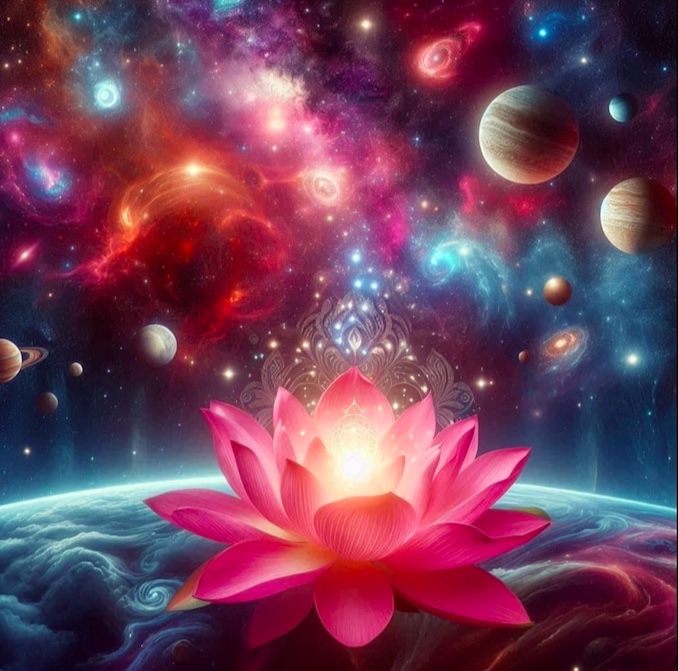
At this time, Sumati again addressed Maudgalyāyana, “From my true words, in a future era I will attain buddhahood, just as Śākyamuni, the Tathāgata. In my land there will be no deeds of Māra, and not even the words for evil destinies, or for women. If what I say is not fabrication, then may the bodies of those in the great assembly all take on a hue of gold!” After speaking this, the assembly took on a hue of gold. At that time, Venerable Mahāmaudgalyāyana then arose from his seat, bared his right shoulder, and bowed with his head at the Buddha’s feet. He spoke saying, “Bhagavān, from these things I have developed the mind of a bodhisattva and even that of the assembly of bodhisattva-mahāsattvas!”

At that time, Dharma Prince Mañjuśrī spoke to Sumati, saying, “In what dharma do you abide to make this sincere aspiration?” Sumati replied, saying, “Mañjuśrī, it is not proper to ask this. Why? This is because in the Dharma Realm there is nothing which abides.” He also asked, “Then what is Bodhi?” She answered, “The non-differentiation of dharmas is what is called Bodhi.” He also asked, “Then what is it that is called a bodhisattva?” She answered, “A bodhisattva is one who is aware that all dharmas are equal to the manifestation of empty space.” He also asked, “What is it that is called the practice of Bodhi?” She answered, “The practice of Bodhi is like a mirage, or like the echo of a valley.” He also asked, “With what underlying meaning do you say such things?” She answered, “In this I do not perceive even the slightest thing which may be underlying or manifest.”

He also asked, “If it is as you say, then all ordinary people would have Bodhi.” She answered, “You speak of Bodhi as being different from an ordinary person? You should not have this view. Why? These are all of the same characteristic of the Dharma Realm, to be neither grasped nor abandoned, with nothing to accomplish or destroy.” He again asked, “How many beings are able to fully understand your meaning?”

She answered, “Their number is like the number of illusory minds and mental functions. The illusion of sentient beings is already able to understand my meaning.” Mañjuśrī said, “Illusions are without basis, so how can there be such minds and mental dharmas?” She answered, “The Dharma Realm is also such, neither existing nor non-existing, and for the Tathāgata is it also such as this.”
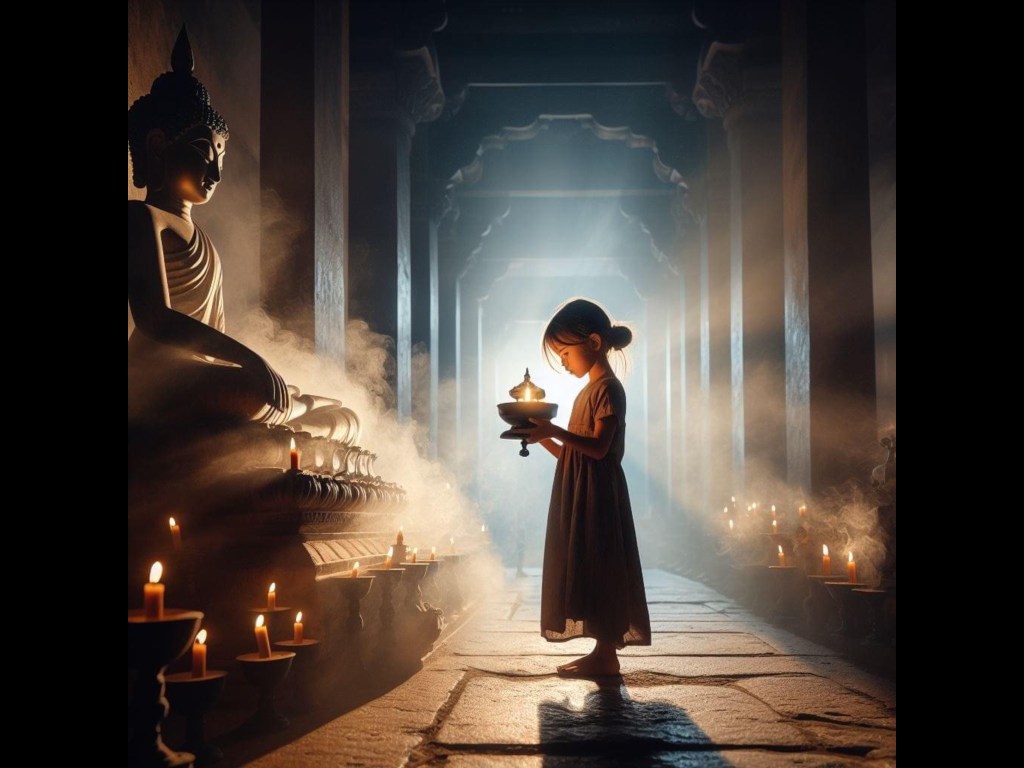
At that time, Mañjuśrī addressed the Buddha, saying, “Bhagavān, this Sumati is extraordinary, even able to accomplish such dharma-patience!” The Buddha said, “Thusly, thusly! What she has spoken is sincere and true. In such a way, this maiden has long since developed the mind of Bodhi, throughout the past thirty eons, even developing the destiny of my supreme Bodhi, causing such abiding in the patience of the non-arising of dharmas.”

Link:https://peacelilysite.com/2024/07/12/ten-paths-to-happiness/

https://lapislazulitexts.com/tripitaka/T0310-LL-30-sumati/ Translated from Taishō Tripiṭaka volume 11, number 310.


The Spiritual Journey of Superstar Jacky Cheung and the Masterpiece “Rare Supreme Chant”

Hong Kong’s superstar Jacky Cheung has achieved numerous successes in the entertainment industry and is widely recognized as a superstar. However, few people know about his dedication to studying Buddhism. Jacky Cheung’s master is H.H.  Dorje Chang Buddha III, an internationally acclaimed master in arts, philosophy, and culture. He was awarded the International Master of Arts and Culture by the World Cultural Conference, comprising experts from 48 countries and regions. Additionally, the Chinese government built a grand museum in his honor in Dayi County, Sichuan, highlighting his unique achievements and contributions.

Around 1995, at the earnest request of many disciples, including Jacky Cheung, H.H.  Dorje Chang Buddha III composed a unique masterpiece called “Rare Supreme Chant.” The lyrics, composition, singing, and chanting were all personally handled by the master.

The song’s melody is rich, and its sound changes are exquisite, ranging from powerful and resonant to gentle and intricate. It includes lion’s roars, sacred chants, deep contemplations, and even modern rock and rap elements. The singing techniques transcend traditional vocal resonance, harmonizing with the cosmic realm. This “Rare Supreme Chant” not only broadens the listener’s auditory experience, allowing them to hear various sounds, but also elevates the mind, nurtures moral strength, and purifies body and soul through the blessings of H.H.  Dorje Chang Buddha III’s voice.

According to those who provided musical accompaniment for H.H.  Dorje Chang Buddha III, his lyrics and melodies are filled with ancient charm and profound knowledge. His voice is versatile and spontaneous, making it difficult to complement with our limited cultural and musical expertise. While they believe his unaccompanied voice is superior, they fear that without accompaniment, the music might be too challenging for listeners to appreciate, thus missing the compassionate intention behind its creation. Despite these challenges, they made an effort to provide accompaniment, hoping listeners would understand and appreciate the master’s work. Listeners are encouraged to attentively enjoy and experience the profound benefits of the music.

The Great Bright Six Syllable Mantra is a very popular Buddhist song, with many audiotapes and CDs distributed worldwide. However, His Holiness’s rendition of the Great Bright Six Syllable Mantra is entirely different from all others I have heard. It is in a powerful vajra style, and at the end of the song, His Holiness uses the lion’s roar voice, with a bursting energy that seems to penetrate the universe and awaken all living beings.


The great bright six syllable mantra

The song “Guo Ping Chang” describes the scenery and feelings of His Holiness passing through Ping Chang (a place in Sichuan).

The sound of the flute sends me across Pingqiang, The boat docks at Wuyou, filled with lantern-lit halls. The spring breeze warmly welcomes visitors, Mist colors the dusk, but the mountains remain evergreen.

This song was sung in an opera style. It has four lines of lyrics, which the Buddha sang using four different Peking Opera styles. This fully demonstrates the Buddha’s profound vocal skills, leaving listeners deeply moved and with a lasting impression.

Passing through PingQiang

H.H.  Dorje Chang Buddha III, has even composed a unique masterpiece, in modern rock and rap style, the energetic and festive song “Chinese Dragon,” showcasing the dragon’s cultural significance. This song demonstrates the Buddha’s ability to effortlessly and masterfully handle any musical form.

Chinese Dragon

The Prajnaparamita Heart Sutra is a very important Buddhist scripture. The Buddha composed an elegant and beautiful yet powerful melody for this sutra. His voice is rich and clear, strong yet gentle, as if bringing the compassionate love of the Buddhas and Bodhisattvas to every sentient being.

The Prajnaparamita Heart Sutra

#DorjeChangBuddhaIII#HHDorjeChangBuddhaIII#Poetry#Vocal #Buddha #Buddhism #buddhist #Music#BuddhaDharma#MasterofOrientalArt#DistinguishedInternationalMaster

Link:https://peacelilysite.com/2024/07/11/the-spiritual-journey-of-superstar-jacky-cheung-and-the-masterpiece-rare-supreme-chant/

84. A QUESTION FROM A SEVEN-YEAR-OLD [SIX WORTHY WAYS]

84. A QUESTION FROM A SEVEN-YEAR-OLD [SIX WORTHY WAYS]

Once upon a time there was a rich man living in Bane’s, in northern India. He had a son who was intelligent, curious and eager to learn. Even though he was only seven years old, he was determined to find out what is really valuable.

One day the little boy asked his father, “What are the ways to gain the most valuable things in life?”

His father said, “Only worthy ways lead to worthwhile goals. These are the six worthy ways:

  • Keep yourself healthy and fit;
  • Be wholesome in every way;
  • Listen to those with more experience;
  • Learn from those with more knowledge;
  • Live according to Truth;
  • Act with sincerity, not just energy.”

The boy paid close attention to his father’s words. He tried hard to practice these ways from then on. As he grew up and became wise, he realized that the six worthy ways, and the most valuable things in life, could not be separated.

The moral is: “A serious question deserves a serious answer.”

84. A Question From a Seven-year-old [Six Worthy Ways]

Link: https://hhdorjechangbuddhaiiiinfo.com/2024/06/11/84-a-question-from-a-seven-year-old-six-worthy-ways/

#Buddhisttalesforyoungandold #Buddhiststories #storiesforkids #moralstories #Buddha #Jatakastories #PansiyaPanasJataka

Renowned Buddhist Scholar Jeffrey Hopkins, Professor Emeritus at the University of Virginia, Has Died

Photo courtesy Christof Spitz

Jeffrey Hopkins, a brilliant scholar, author, teacher, and translator who founded one of the largest Tibetan Buddhist Studies programs in the West, died on July 1 in Vancouver, Canada. He was 83.

For more than three decades, beginning in 1973, Hopkins was a leading light at the University of Virginia. He directed UVA’s Center for South Asian Studies for twelve years and taught Tibetan Buddhist studies and Tibetan language for thirty-two years, but his signature achievement was the Tibetan Buddhist studies doctoral program he established in 1975, which became the largest in North America. Among its graduates are some of the most esteemed academics in the field today, including Anne C. Klein of Rice University, Donald Lopez of the University of Michigan, Georges Dreyfus of Williams College, and Bryan Cuevas of Florida State University. Hopkins’s program, by placing Tibetan Buddhism (rather than Indian, Chinese, or Japanese Buddhism) at its center and bringing prominent Tibetan masters from India to Charlottesville to teach the classic texts of that tradition, “changed the way Buddhism is taught in the American academy,” Donald Lopez says.

Hopkins’s singular force was evident from the moment he arrived at UVA in 1973. Lopez, a senior when Hopkins joined the faculty, remembers: 

Despite being a newly arrived assistant professor, he immediately gained a large following among the “Be Here Now” crowd. By the second semester, students were walking around campus wearing buttons that said, “Buddha’s Slogan: Dependent Arising.” In a men’s room on campus one day I noticed something written on a urinal. Assuming it said “R. Mutt” [as Marcel Duchamp had signed his urinal artwork, “The Fountain”], I went closer and saw that it was four words stamped in red letters: “DOES NOT INHERENTLY EXIST.” Inspired by such visions, I wrote my senior thesis, master’s thesis, and doctoral dissertation under Hopkins’s direction.

Convinced that scholars of Tibet must be able to both read classical Tibetan and speak modern Tibetan, Hopkins established the first Tibetan language program at UVA and coauthored a comprehensive language course, Fluent Tibetan: A Proficiency Oriented Learning System. He also compiled a 900-page Tibetan-Sanskrit-English dictionary of Buddhist terms that is posted online

During his career, Hopkins also held visiting professorships at the University of Hawaii and the University of British Columbia. After he retired from UVA, he focused on translating. He was the founder and president of the UMA (Union of the Modern and Ancient) Institute for Tibetan Studies and from 2011 directed its Great Books Translation Project, set up to make Tibetan texts freely available. 

Hopkins was also a peace and human rights activist and published The Art of Peace, edited from talks at a conference of Nobel laureates he organized in 1998 for UVA and the Institute for Asian Democracy, a Washington, D.C.-based non-profit that promoted self-governance in Asia, particularly in Burma. Hopkins was president of the institute from 1994 to 2000.

One of the most respected Tibetologists of his generation, Hopkins authored, edited, or translated more than fifty books. His extensive published work includes scholarly books on emptiness and tantra, as well as translations of works by such famed figures as Nagarjuna, Chandrakirti, and Tsongkhapa. His first and most influential work was his massive 1973 doctoral dissertation, Meditation on Emptiness, which provided the first detailed presentation of the Geluk synthesis of philosophy and practice. After circulating widely as a bound Xerox copy, it was published by Wisdom Publications in 1983. A fortieth-anniversary edition will be published next year. Much of Hopkins’s work was devoted to the Geluk founder Tsongkhapa, translating major sections of his massive exposition on tantra, Stages of the Path of Mantra. Later he turned to Tsongkhapa’s most beloved work among Geluk scholars, Essence of Eloquence, a text recited from memory by the monks of Ganden Monastery at his funeral in 1419. Although Tsongkhapa’s text is rather brief, Hopkins devoted three large volumes to it: Emptiness in the Mind-Only SchoolReflections on Reality: The Three Natures and Non-Natures in the Mind-Only School, and Absorption in No External World

In 1979, Hopkins was instrumental in arranging His Holiness the Dalai Lama’s first visit to the United States and served as his chief translator from 1979 to 1989 on tours of the US, Canada, Europe, Southeast Asia, and Australia. Hopkins translated and edited His Holiness’s teachings for sixteen books, including The Dalai Lama at Harvard, along with titles aimed at a general audience, such as Kindness, Clarity and InsightHow to See Yourself As You Really AreHow to Practice: The Way to a Meaningful LifeMind of Clear Light, Mind of Clear Life: Advice on Living Well and Dying ConsciouslyHow to Be Compassionate; and How to Expand Love: Widening the Circle of Loving Relationships

Hopkins collaborated with the tulkus Lati Rinpoche and Denma Locho Rinpoche on Meditative States in Tibetan Buddhismbased on a text by the Geluk master Panchen Sonam Drakpa. With the Nyingma lama Khetsun Sangpo he published Tantric Practice in Nyingma, a translation of a famous work by Patrul Rinpoche that would later be translated as Words of My Perfect Teacher.

Born Paul Jeffrey Hopkins in 1940, he grew up in Barrington, Rhode Island. A rebellious youth, he was a member of what he later described as a “suburban gang . . . disgusted by the aims that were being presented to us: merely making money and so forth.” Hopkins was then sent to Pomfret, a prep school in Connecticut, where he thrived. During his freshman year at Harvard, he read Thoreau’s Walden and retreated to the woods of Vermont, where he lived in a one-room cabin, wrote poetry, and “began finding my own integrity,” he later told an interviewer. Further inspired by Herman Melville’s Typee and W. Somerset Maugham’s The Moon and Sixpence, he hopped a freighter to Tahiti. It was during this period that Hopkins began meditating—in a fashion. 

Hopkins returned to Harvard after a year and a half, then between his junior and senior years, took off again. While floating down a river in Oklahoma, he saw a dead man propped up on a bank. It was a turning point. “I suddenly realized that his last perception in this lifetime would be no fuller than any of his other perceptions,” he recalled. “I began to recognize the ultimate futility of external activities and to turn my attention inward, to a light within. When I returned to Harvard in the fall of 1962, it was as if a coffin had been opened. I had been living my life in a coffin and had not recognized the presence of the sky.”

During Christmas vacation from college that year, a classmate drove Hopkins to Freewood Acres, New Jersey, to meet Geshe Wangyal,  a Kalmyk Mongolian Tibetan Buddhist who had established a monastery there in 1958. In 1963, after graduating magna cum laude from Harvard—an English major, Hopkins won the Leverett House Poetry Prize for his translation of the Anglo-Saxon poem “The Wanderer”—Hopkins spent seven years studying with Geshe Wangyal in New Jersey. After a false start in graduate school at the University of Pennsylvania, he enrolled in the doctoral program at the University of Wisconsin-Madison. 

Later, Hopkins called his time in the Buddhist Studies program at Wisconsin as “thrilling in many ways and . . . certainly a crucial choice for my career.” At Hopkins’s urging, Richard Robinson, the head of the Buddhist Studies program, hired Geshe Lhundup Sopa, a Geluk scholar who had been living at the Kalmyk monastery in New Jersey. He was instrumental in the hiring of renowned tantric master Kensur Ngawang Lekden, former abbot of the Tantric College of Lower Lhasa. Anne Klein, then a master’s candidate at Wisconsin, recalls that Hopkins, with Robinson, “founded Tibet House on a farm outside Madison, where Kensur, Jeffrey, and grad students could live, learn Tibetan, and share kitchen duties. Jeffrey served ice cream on small, flat plates, which, as Kensur demonstrated with delight, meant you could lick them clean.” Hopkins read with Kensur daily, Klein remembers, material that formed his dissertation, Meditation on Emptiness.

Throughout his career, Hopkins’s interest in Buddhist studies was broad, encompassing South Asia, Tibet, and East Asia. He was the recipient of three Fulbright fellowships and made twelve trips to India and five to Tibet for research.

As a translator, Hopkins had an approach unusual among his peers at the time: working closely with Tibetan scholars and regarding them not as “native informants” but as collaborative partners. “I thought it was . . . extremely important to treat every Tibetan scholar fairly, to give them credit for their part in producing any book,” he said. “If I couldn’t understand the text without somebody informing me of its meaning, then that person has played an equal role in its translation even if they don’t know English.” 

In 1991, Hopkins suffered a debilitating, near-fatal case of Lyme disease that temporarily left him partially paralyzed with noticeable mental gaps. He recovered, but “I had to reconstruct my mind,” he later told Tibetan Buddhist nun Robina Courtin. “In any field, I had to consciously make a logical connection, and then once the connection had been made, that area was reopened.” What saved him, he ventured, was a habit formed in his years at the monastery in New Jersey: repeating the intelligence mantra of Manjushri, bodhisattva of wisdom, aimed at enhancing mental acuity: Om ah ra pa tsa na dhih. “I overheard Geshe Wangyal tell one Mongolian boy who was having trouble memorizing it, ‘Then do dhih dhih dhih . . . endlessly,’ ” he recalled. 

Link:https://peacelilysite.com/2024/07/05/renowned-buddhist-scholar-jeffrey-hopkins-professor-emeritus-at-the-university-of-virginia-has-died/

Source: https://tricycle.org/article/jeffrey-hopkins-obituary/, By Joan Duncan Oliver
 JUL 02, 2024

Pixar’s Inside Out: A Deep Dive into Human Emotions and Buddhist Philosophy

From slashfilm.com

I really enjoy animated movies for their humor and cheerfulness. What better way to relax than to watch Garfield shovel down 450 pounds of lasagna? However, beneath the appearance of levity and simple fun, animation has its own unique way of addressing serious and abstract philosophical questions. Pixar’s Inside Out is an outstanding work in this regard. It made me ponder what makes myself, well, myself.

Inside Out is a masterpiece of animation that presents human emotions—specifically Joy, Sadness, Anger, Disgust, and Fear—as protagonists, rather than focusing solely on Riley Anderson, the girl these emotions reside in. Writing in The Guardian, Julian Baggini muses that the film “. . . reflects some of the most important truths about what it means to be an individual person. The first of these is that there isn’t actually a single, unified you at all. . . . [your brain] is made up of various different, often competing impulses. You are simply how it all comes together, the sum of your psychic parts.”This film heralds a gradual opening of popular Western media and culture to the idea of the “three marks of existence” in Buddhism: impermanence (anitya), no-self (anatman), and suffering (duhkha). It is a completely new way of articulating (to children, no less) a richer, more complex understanding of the human person.

In this story, the five emotions work together to look after Riley and manage her reactions to external stimuli inside “HQ”—her head. HQ is visually located in the “sky” of her mind and overlooks a vast labyrinth called Long-term Memory, where memories in the form of orbs are stored. Orbs of core memories, or formative experiences of Riley’s life, are stored in a central hub within HQ itself. Most memories (including the core ones) are touched by Joy so that they are bright gold and happy. Other memories are touched by Sadness (blue), Disgust (green), Fear (light purple), and Anger (red).

Anger prepares to make Riley react angrily. From video.disney.com

The external narrative—the one that audiences usually see in a movie—is simple, almost boring. Riley struggles with moving from Minnesota to San Francisco, making new friends at school, and coming to terms with losing her old life. The real action goes on inside her head. To Joy’s dismay, Sadness, who feels like she serves no beneficial purpose to Riley (in contrast to emotions like Disgust, who protects Riley from broccoli, or Fear, who compiles copious notes on possible risks to Riley’s everyday activities), starts touching the Memory Orbs, turning more and more of Riley’s memories blue. Later on, it is revealed that Riley needs Sadness to express her inner difficulties and articulate her distress, therefore serving a vital purpose for her well-being, but none of the other emotions at this stage can understand why.

By several twists of misfortune after Joy tries to stop Sadness from touching the orbs, they get lost in Riley’s various mental spaces outside of HQ, such as Imagination Land (complete with an Imaginary-boyfriend Generator), the Abyss of the Subconscious, and Dream Productions. With Joy and Sadness missing, Anger, Fear, and Disgust do their best to help Riley cope with her increasingly unhappy life. For example, befitting his purpose and personality, Anger argues that the only way for Riley to be happy again is to run away from her parents back to Minnesota. However, they just end up making her react to the world with burgeoning anger, fear, and disgust.

A resolution is reached when Joy realizes that Sadness needs to touch more of the Memory Orbs. As much as Joy wants to see Riley happy, she can’t be the emotional driver of every event. But in gratitude for her newly acknowledged importance, Sadness also invites Joy to touch the memories she is holding, so that Riley can feel meaning and happiness in the process of grieving. By the end of the movie, Riley’s Memory Orbs are no longer a simple mix of five colors: each ball is variously touched by the emotions, resulting in a beautiful array of “mixed emotions” and marking the beginning of growing up.

This, however, is just the first crack at the myth of the enduring, unified self. What the film also shows is that each of these parts is impermanent. Riley’s personality is represented by a series of islands that reflect what matters most to her: friendship, honesty, family, goofiness, and hockey. But as life becomes difficult, each of these in turns threatens to crumble. And that is how it is in the real world: as we grow and change, some of the things that matter most to us will endure, others will fall away, and new ones will come in their place.

In competition … Sadness, Fear, Anger, Disgust and Joy. Photograph: Courtesy Ev/Rex Shutterstock

The third key element in understanding the self is that what keeps this all together is memory. At first, it seems like the film is going to over-simplify this, presenting memories as little movies, experiences that are captured, stored, and played back. But as it progresses, it gets more complicated. It becomes clear that not only do many memories simply get lost—even ones that were once most precious—but others change their character as we do. For memories to do their work, they need to be nurtured and understood.

What it all adds up to is a picture of the self as something which coheres into a single narrative but which has nothing permanent and unchanging at its core. We are forever in flux, always in the process of growing out of what we once were into what we are to become next.

Not surprisingly, this animated movie is the most sophisticated children’s film in recent memory and has been critically applauded in many reviews. It turns traditional storytelling on its head: instead of telling us what the protagonist feels, it tells us what the emotions are making the protagonist feel. Of course, our brains aren’t populated by anthropomorphic or Platonic representations of concepts such as Joy or Sadness. Nevertheless, this children’s film is an example of meta-storytelling, in which the motivations for the narrative (usually the protagonist’s emotions or conflicts) are abstracted into their own story (the emotions’ adventures inside Riley’s head).

Baggini, like many other critics, observes that by being “made up” of the five emotions, the traditional fictional character has become a composite construction of various mental components, just like we are in the real world. He also notes that apart from deconstructing the myth of the unified self, Inside Out also presents these components as impermanent. HQ overlooks five islands attached to Long-term Memory that reflect fundamental aspects of Riley’s personality: friendship, honesty, family, goofiness, and hockey. But as the emotions struggle to manage Riley’s inner world, these islands crumble and fall away (for example, Friendship Island collapses after Anger makes Riley react furiously to her Minnesota friend’s apparent happiness despite her departure). However, by the end, new islands are formed: for example, the new Friendship Island now has a “friendly argument section,” indicating a collaboration between Joy and Anger.

Just as we see in real life, some of the things that “characterize” who we think ourselves to be endure—but others fall away, hopefully to be replaced by new, more complex and enriching “islands.” Baggini concludes: “What it all adds up to is a picture of the self as something which coheres into a single narrative but which has nothing permanent and unchanging at its core.” Our no-selves are forever in flux, engaged in a never-ending process of shedding what we once were and reforming into a new identity.

The ideas of no-self and cognitive impermanence should open up new avenues into exploring how a contemporary story (be it through the medium of live action or animation) can be told. There are no antagonists in Inside Out—the conflict (or the reason for the story to exist) all happens within, inside Riley’s head. The fundamental problems of the world, according to Buddhism, are also within, not “out there.” Nevertheless, understandably, there are philosophical differences between a Pixar film and 2,500 years of insight. The Buddhist explanation for the world’s unhappiness is much more complex. In Buddhist phenomenology, sentient beings are made up of the five skandhas, or aggregates (mind and matter being considered inseparable, unlike in Cartesian thought): form (rupa), sensation (vedana), perception (samjna), mental formations (samskara), and consciousness (vijnana). These aggregates become the subject of expanded commentary in the Abhidhamma literature of early Buddhism and the Mahayana and Vajrayana traditions. If Riley’s happiness depends on the interplay of her emotions, Buddhist liberation depends on the Buddhist insight of understanding the “empty” nature of the aggregates: that they are impermanent, composite, and interdependent.

I think the reason this can be conveyed in a children’s film is that, in many ways, kids are more receptive to this message than adults. Children change so rapidly that they might be able to understand the idea of impermanence more readily than adults, whose self-conception has often ossified. Kids have no problem imagining that they might grow up to be quite different, while adults assume they are stuck being the person they have turned out to be.

The best children’s films often serve a dual purpose. They help kids to grow up but they also remind adults of what they have lost by doing so. Inside Out succeeds brilliantly on both counts.

If there were any “villains” to be scripted in a Buddhist version of Inside Out, it would be the “three poisons” of greed, hatred, and delusion—the factors inhibiting our well-being and blocking our path to enlightenment. For now, it’s too big a question to ask how such concepts might be brought into an animated film, but the high stakes and existential conflict in the Buddhist teachings would make for a children’s story that is both immersive and educational.

Link:https://peacelilysite.com/2024/07/05/pixars-inside-out-a-deep-dive-into-human-emotions-and-buddhist-philosophy/

Source: Buddhistdoor View: Buddhist Dimensions of Inside Out By Buddhistdoor Global August 7, 2015, https://www.theguardian.com/film/filmblog/2015/jul/27/inside-out-philosophical-mind-pixar-philosophy

Father’s Day Joy: Poems to Celebrate Dad

Dads are just the best, aren’t they? They work hard, put up with so much, make us smile, and make everything okay. Father’s Day is a wonderful occasion to show the Dads in our lives how much we appreciate them. Here are some awesome Dad poems to celebrate every dad.

Fathers Mean the World
Fathers are the ones who work so hard,
Building bridges and fixing up the yard,
Driving trucks and feeding their families,
Their hard work is the backbone of society.

They have toiled in the sun and rain,
Working hard to help ease the family’s pain,
Their dedication and hard work, never in vain,
For their love and care, there is no refrain.

They have built homes and schools and more,
Their contributions we cannot ignore,
From fixing everything that’s broken,
To teaching us lessons that remain unspoken.

Fathers are the unsung heroes of our time,
Their sacrifices and hard work are a true sign,
Of their unwavering dedication and love,
That lifts us up and makes us soar above.

We need fathers in this world today more than ever,
To guide us through life’s twists and turns, we must endeavor,
To honor their hard work and sacrifice,
And cherish their love and care, forever in our lives.
~ Dev Sommerville

My Dad is My Rock
My dad has always been my rock,
Supporting me as I chased my dreams around the clock,
Encouraging me to go on the craziest adventures,
And taking me seriously, no matter the venture.
He gave me advice and encouragement,
Even when I was feeling lost and disheartened,
His words of wisdom, always on point,
Helped me navigate life’s twists and turns with every joint.

With his unwavering support, I gained strength,
To pursue my passions, no matter the length,
For all the times he’s been there, day by day,
My dad’s love and support, I’ll always repay.
So on this Father’s Day, I want to say,
Thank you, Dad, for all the support along the way,
Your love and care have helped me soar,
And for that, I’ll cherish you forevermore.
~ Winnie Smith-Garland

Photo by Josh Willink on Pexels.com

Dads Show Us the Way
Dads are the guiding lights that lead the way,
Raising kids to be strong, brave, and never stray,
Teaching us to try hard, and put ourselves to the test,
To see the funny side of things, and do our best.

Dads inspire us to be optimistic and kind,
To find our mission in life, and always keep in mind,
That success comes to those who never give up,
Who work hard and never hold a grudge.

With patience and love, dads show us the way,
To live in the here and now, and seize each day,
To face life’s challenges with grace and ease,
And to never ever give up on our dreams.

Dads teach us values that shape our lives,
To be kind to others, and treat them with respect and thrive,
Their love and guidance, we’ll cherish forevermore,
For dads play a crucial role in the world, that we can’t ignore.
~ Harrison Beslow

Photo by Lgh_9 on Pexels.com

My Dad, My Teacher
From the very start, my dad’s been there,
Teaching me to ride my bike without a care.
When my toys broke, he fixed them with a grin,
And when I needed help, he always pitched in.

Through every scrape and tear, he wiped away my fears,
Making everything okay, and drying up my tears.
He’s been my rock, my guide, my hero, all in one,
And I’m grateful for everything he’s done.

He’s taught me to be kind, and to spread my wings,
And he’s always been there to help with anything.
With his patience and love, he’s helped me through it all,
And I’m grateful for his support, big and small.

I’m lucky to have such an awesome dad,
And I’m grateful for all the fun we’ve had.
He’s the best friend I could ever wish for,
And I’ll always love him more and more.
~ Reese Carlington

My loving dad is always there,
To show me love and give me care,
With hugs and kisses, he makes my day,
I love my daddy more than words can say.
~ Louie Clyborne

Link:https://peacelilysite.com/2024/06/14/fathers-day-joy-poems-to-celebrate-dad/

Source: https://www.homemade-gifts-made-easy.com/fathers-day-poems.html

The Consequences of Lying: A Lesson from Buddhist Teachings

When we were young, our parents and elders all taught us not to lie. Many stories and fairy tales illustrate the consequences of lying, such as a child being eaten by a wolf or having a long nose like Pinocchio. Different cultures and religions praise honesty and disapprove of liars. However, most of us have told a lie at one time or another, often to gain an immediate benefit, without realizing that the long-term consequences of lying can be very costly. In Buddhism, one of the ten precepts is to abstain from lying.

There is a recorded story in a Buddhist sutra about Shakyamuni Buddha teaching his son to refrain from lying.

The Buddha’s son, Rahula, was quite mischievous in his youth. He often enjoyed playing pranks on others, using deceptive words to tease people. For instance, when someone came to see the Buddha, Rahula, knowing that the Buddha was not present, would intentionally mislead them about the Buddha’s whereabouts, causing them to search in vain for amusement.

When the Buddha learned of this, he asked Rahula to bring him some water to wash his feet. After washing his feet, the Buddha pointed to the water and asked Rahula, “Can this water be drunk?”

Rahula replied, “The water is dirty from washing feet; it cannot be drunk.”

The Buddha then asked, “Can this basin, used for washing feet, be used to hold food?”

Rahula replied, “No, it cannot. The basin is dirty and cannot be used to hold food.”

The Buddha sternly said, “You are like this water. The water was originally very clean, just as you were originally a prince, able to renounce the false glories of the world and become a monk. But if you do not diligently pursue the path, do not purify your body and mind, and do not speak carefully, the impurities of the three poisons will fill your heart, just like the clean water being soiled by washing dirty feet. You are like this basin. Although you have become a monk, if you do not practice precepts, concentration, and wisdom, and do not purify your body, speech, and mind, how can the food of the Great Path fill your heart?” After speaking, the Buddha kicked the basin, causing it to roll. Rahula was very frightened. The Buddha asked, “Are you afraid the basin will break?”

Rahula replied, “No, the basin is a coarse utensil; it doesn’t matter if it breaks.”

The Buddha said, “Rahula, you don’t cherish this basin, just as people will not cherish you. As a monk, if you do not uphold dignity and discipline, and speak deceitfully, the consequence is that no one will care for you or value you. When your life ends, you will not attain enlightenment, but will only increase your delusion.”

From then on, Rahula changed his mischievous ways, strictly observed the precepts, and diligently practiced the path.

According to the teachings of the Buddhist sutras, we should take a long-term view and consider the consequences of lying for both this life and future lives.

In this life, if we frequently lie, deceive, or slander others, we will inevitably face retaliation from those we have wronged. In the mundane world, most people are naturally inclined to protect themselves and have a tendency for “an eye for an eye” revenge, unless they are saints who have subdued their own minds. If we deceive others, the victims, unwilling to be deceived, will expose our misdeeds among people. As word spreads from one to ten and from ten to a hundred, our bad reputation will quickly become widespread. Our credibility will be utterly destroyed, and our trustworthiness will plummet. From then on, even if we speak the truth, it will be seen as a lie, and people will be wary of us to avoid being deceived. No one will trust us. In such a predicament, we will constantly feel the pain of isolation and helplessness. Our lives will shrink, and our careers will suffer as a result.

In future lives, under the influence of the dark karma of lying, one will inevitably fall into the three lower realms. When the bad karma diminishes and one is reborn as a human, the residual effects of lying will manifest in various speech-related congenital obstacles in both body and mind. These may include having an impaired tongue root, stuttering, or unclear speech. Additionally, there will be a habitual tendency to lie, and sometimes, even when one wishes to speak the truth, it will come out as a lie involuntarily. In interactions with others, one will frequently be slandered and deceived. Even when speaking the truth, people will not believe it. Moreover, even when preaching the true Dharma, others will be unwilling to listen.

Link:https://peacelilysite.com/2024/06/13/the-consequences-of-lying-a-lesson-from-buddhist-teachings/

Source: https://fo.china.com/m/fostory/20001207/20231107/25809400.html

“An Amazing, Wondrous Moment”: Tibetan-born Musician and Artist Dechen Shak-Dagsay’s emaho

By Raymond Lam January 19, 2022

Dechen Shak-Dagsay is a Swiss-Tibetan musician and author. Over the past few decades, she has built a career in music by combining the Tibetan mantra transmissions passed down by her father, Ven. Dagsay Rinpoche, with innovative melodies and contemporary instrumental productions. She has also engaged in collaborative projects with other spirituality-inspired musicians. Having lived in Switzerland for most of her life, Dechen is one of the most prominent contemporary Tibetan singers in Europe today, and has also become globally recognized through various music awards, and for having performed songs from her albums Jewel and Day Tomorrow at Carnegie Hall in New York. Dechen is also the founder of the Dewa Che charity organization, which engages in social projects in Tibet.

Dechen’s newest album, emaho – The Story of Arya Tara, released in October 2021, is about the enlightened activity of the Vajrayana goddess Tara and contains a musical rendition of the “21 Praises of Tara.” BDG recently had a chance to speak with Dechen about her latest project.

BDG: You’ve sung about Tara on various albums before, but this new album is devoted specifically to her story. What do you find inspiring about this female buddha?

Dechen Shak-Dagsay: I have had a wish for many years now to share the extraordinary story of Goddess Arya Tara, the gentle-yet-indomitable princess who became a female buddha. The mythic story goes back many eons in ancient India, where she was called Princess Jhana-Chandra, which means Wisdom-Moon. In Tibetan, her name is Yischi Dawa, and it touches me profoundly that, out of a deep sense of compassion, she would not even eat breakfast before she had liberated hundreds of thousands of beings from samsara each day. She was a faithful disciple of her teacher Buddha Dundubhisvara, and her entire community admired her.

One day, the monks urged her to make an aspiration (vyakarana) to be reborn as a man in her next life in order to attain full enlightenment. The princess laughed at this sexist exhortation and replied: “There is no male, there is no female. To discriminate between male and female is the mind of a small being. There are neither men nor women, nor a self, nor beings.” She vowed to return again and again in a female form in order to help all beings from suffering and to reach enlightenment in female form. Therefore, her teacher, Dundubhisvara, gave her the name Tara, which means “Swift Liberator.”

Tara’s story reminds us every day that we are all equally beautiful beings blessed with great inner qualities, such as love, compassion, kindness, and clarity. These qualities are just waiting to be rediscovered and nurtured.

BDG: Your album emaho captures a profound thought: “What an amazing, wondrous moment when the mind awakens.” How does the music create a mood and ambience in which the listener can realize this moment for themselves?

DSD: Emaho is indeed not an ordinary word. It is found in ancient Tibetan spiritual texts and is an exclamation of joy and amazement when the obscured mind awakens and experiences the pure, clear, and bright shining light of the true nature of our mind.

Personally, I find that each of the eight pieces hold beautiful emaho moments for the listeners. As with all my previous albums, I received the texts for this exalted goddess from my dear father, Ven. Dagsay Rinpoche. It is a great blessing that Rinpoche gave me the transmissions for these beautiful “21 Praises of Tara,” which are practiced in all Tibetan traditions. I also had the privilege of working with Swiss producer Helge van Dyk, who also composed and produced the music of my two previous albums, Jewel and Day Tomorrow.

I said to Helge that I wished to represent the four enlightening activities of Tara in four musical pieces. I cannot thank Helge enough for creating the most sublime music to present the four skillful enlightening activities of Tara: the pacifying, enriching, magnetizing, and wrathful aspects.

When you listen to emaho – The Story of Arya Tara, my hope is that you will enter the wonderful, unique space and landscape of Tara’s buddha-field, and perceive her different fields of activities through the following musical compositions.

emaho – an Amazing One” – “The Wisdom of Tara” – Tara’s
magnetizing activities. Audio courtesy of VANDYKMUSIC
emaho – an Amazing One” –
Tara’s enriching activities. Audio courtesy of VANDYKMUSIC
emaho – an Amazing One” – “Magic Pulse” (of Prayer
Drumming) – Tara’s wrathful activities. Audio courtesy of VANDYKMUSIC

BDG: How do you think the spirit of emaho can help heal our fractured and hurting world, which is now immersed in COVID-19 and a range of other immense crises?

DSD: We generally believe in the great healing power of the Buddha’s teachings, especially when the world is going through a difficult time. We are still in a worldwide pandemic, and we constantly face threats of natural calamities and other crises.

The whole world has faced unprecedented challenges over the last two years, and we are still trying to find solutions for how to handle them. From a worldly point of view, these problems are simply devastating and are creating immense suffering for everyone. But from a Buddhist view, such challenges are exactly what we call “precious moments” for our minds to awaken and to encourage a total reset in our interior world and inner being. We call these moments precious because they allow us to open our hearts to the Buddha’s teachings, such as the Three Marks of Existence. Recalling them always has an instant healing effect on me:

• Impermanence (Skt: anitya): Nothing stays the same, everything is constantly changing.

• Whatever we experience is marked with some kind of suffering. As long as we identify ourselves with a sense of solid self, we will always suffer (dukkha).

• Everything around us and even our own person is empty of a self (anatman).

Dechen Shak-Dagsay. Image courtesy of VANDYKMUSIC

Together with Helge and other musicians, we created emaho in the hope that it will be a small contribution to helping us all through these troubled times together.

We hope to be able to bring calm and peace into people’s hearts. We will not be able to get rid of COVID-19, or the economic, social, and political fallout it has caused, but the music that carries the blessings of Arya Tara, the Swift Liberator, will help us all to overcome our fears, sadness, frustration, and pain to create some space in our hearts and to rebalance our minds. It is within this calm space that we will be able to tap into our innate beauty and strength. We all need this to transform our pain and negative thoughts, and to calmly face and embrace the difficult times ahead of us; to fully become aware of our own inner qualities.

The release of the new double album was followed by the release of my new book, Mantras, Musik & Magic Moments, in December 2021, in which I write about the healing aspects of the old Tibetan mantras, and why I chose music as a tool to reach people’s hearts. I also talk about how Tibetan healing symbols have carried sacred power for centuries. I began making mantra music about two decades ago, and I hope followers will enjoy this new perspective I am offering through my work.

BDG: Your music has been received very well worldwide and your profile has also been rising in Asia. Do you present your music as non-denominational and embracing of all Buddhist traditions, even while it expresses your Tibetan heritage?

DSD: Although I am very rooted in Tibetan or Vajrayana Buddhism, I embrace all Buddhist traditions. My dear father Dagsay Rinpoche, who lives in Chengdu, always reminded us that the essence of the Buddha’s teachings is non-violence and cultivating love and compassion for all beings. All Buddhist traditions, including the Tibetan heritage, are following this beautiful path. It is my wish to one day come to Asia to meet all my Asian friends and to perform my music in Asia together with the Jewel Ensemble.

In my third piece on disc two, called “Peace of Mind,” I sing a “Praise to the 21 Taras” in Chinese and in Tibetan. It is my deep wish to create a wonderful space of peace, respect, and reconciliation.

BDG: You’ve come together with various artists to create a fusion of music. These artists also tend to have a spiritual flavor to their work. How do you decide to work with an artist? How do you identify a potential collaboration?

DSD: Thank you for sensing what I see as a very special energy to our music. I am very thankful to Helge, who has a distinct talent in finding the right artists for a special collaboration that requires not only technical musical skills, but also an open heart that is fully inspired to play soulful music with us. He has carefully selected outstanding musicians to form the Jewel Ensemble, with whom we have played many concerts all around the world. I feel very privileged to have the following members of the Jewel Ensemble, as well as an extended ensemble that we shared the stage with when playing the Call for Peace concerts with the renowned Zurich Chamber Orchestra (ZKO).

I would like to take this opportunity to thank my Jewel Ensemble musicians and guest musicians from around the world for their beautiful contributions on emaho. It has been such an honor to work with all these outstanding artists, who committed their heartful work to this album.* I would like to thank BDG for opening the door to the story of Arya Tara. I would be very happy if this music finds its way across Asia, and I would like to thank all my musicians, my producer Helge, and my dear father Dagsay Rinpoche for letting me create such precious music. I hope it will help to remind people all around the world of their own inner strength and beauty.

Link:https://peacelilysite.com/2024/06/09/an-amazing-wondrous-moment-tibetan-born-musician-and-artist-dechen-shak-dagsays-emaho/

Source: https://www.buddhistdoor.net/features/an-amazing-wondrous-moment-tibetan-born-musician-and-artist-dechen-shak-dagsays-emaho/

Scene of Xishuang Banna Life: A Timeless Masterpiece by H.H. Dorje Chang Buddha III

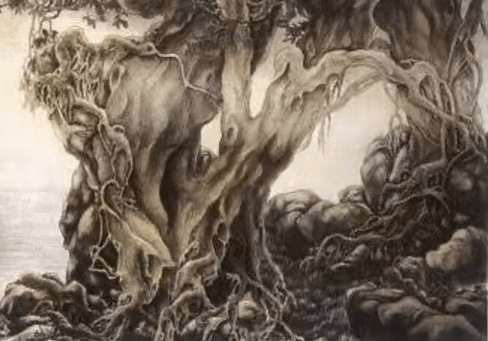
“Scene of Xishuang Banna Life” is a Chinese ink-and-wash painting with a three-dimensional quality reminiscent of oil paintings, created by the renowned artist H.H. Dorje Chang Buddha III. The moment I laid eyes on it, I felt a profound sense of comfort and tranquility. The painting’s primary hue is light brown, and the varying depths of this color vividly depict the fresh, clear water and misty air weaving between the trees. A few girls are making waves, chatting, and enjoying themselves as they wash clothes by the riverside. The elegant and beautiful banyan trees stand majestically, with cobblestones naturally scattered around them.

The old banyan tree, with its peeling bark and exposed roots, stands as a silent testament to the passage of time. The raised roots extend in all directions, seemingly spreading the pulse of life to distant places, using their vitality to nurture the earth and rivers. The roots nestle against the smooth, round pebbles like inseparable companions. Over time, they have become so intertwined that no one notices whether they are roots or stones, much like an elderly couple who depend on each other and cannot be separated.

Around the tree roots, a misty white space, activated by detailed depictions, brings boundless imagination to people. In the white mist, there is a vast expanse of water, with soft sunlight illuminating the surrounding forest. The endless lakes and rivers nourish the sturdy old roots, supporting them through countless hardships and weathering the elements, ultimately creating a world of their own. The intertwined and winding roots, twisting and coiling across the scene, form the main structure of the composition along with the variously shaped stones, the sculptural massive trunk, and the other responding trees. The sparse leaves hanging from the old tree are adorned in light green, contrasting with the large brown trunk, evoking the philosophical sentiment of “the true essence remains after all embellishments fade, gold emerges after being sifted by great waves.”

Beneath the tree are three graceful women in different postures, enjoying the flowing stream under the water-colored sky. Some are combing their freshly washed hair, some are holding a delicate veil, and some are drawing clear water from the stream.

The banyan tree, the stream, and the sunlight, along with the beautiful women in traditional attire, compose a symphony of southern charm, making one feel as if they can hear the whispers of the gentle breeze: “My enchanting homeland is where my heart belongs…” The setting resembles the sweet childhood memories buried in my heart.

About fifty years ago, my family lived in a small village in the mountains. There were no cars, TVs, toys, phones, or any other modern luxuries. We lived a very simple and modest life. All the mothers washed vegetables and rice in the clean creek and cooked meals. Very often, they washed clothes in the river for the whole family while the kids played in the water, on the trees, or along the riverbanks. School was far away, and we could only go there when we were old enough. But we had the biggest classroom—nature itself. We studied everything we could find: trees, flowers, insects, stones, etc. Twigs were our pens, and tree trunks were our tables. The chirping of the birds and the rushing of the stream were our music. We had physical education class all day long. We went to bed when the sun set. What a simple, happy life!

This is the beautiful and pure spiritual space created by the great artist, H.H. Dorje Chang Buddha III. This painting, “Scene of Xishuang Banna Life,” opens a window to another dimension, allowing people to experience the joy of living in a paradise. People in cities increasingly yearn for natural landscapes akin to an earthly utopia. Fortunately, noble artists create pure lands for people’s hearts, showing us wonderful scenery, evoking warm emotions, and deeply touching us.

The pure land in our hearts is like a secluded utopia, free from the noise and disturbances of the mundane world. It carries the dreams of people. When darkness descends, the pure land within can emit a serene fragrance, helping people discard the suffering brought by worries, gently wipe away the dust, and infuse a bit of brightness.

The paintings of H.H. Dorje Chang Buddha III are like wordless songs, containing endless stories, ancient calls, and boundless compassion for all sentient beings.

This painting is in permanent collection of The International Art Museum of America.

Link:https://peacelilysite.com/2024/06/07/scene-of-xishuang-banna-life-a-timeless-masterpiece-by-h-h-dorje-chang-buddha-iii/

#DorjeChangBuddhaIII #HHDorjeChangBuddhaIII#DorjeChangBuddha#IAMA#InternationalArtMuseumofAmerica#Xishuangbanna #ChineseInkPainting#Art#Artist

Twelve years of Thangka Art: Apprenticeship, Personal Practice, and Evolution

By Dakini As Art, Tiffani Gyatso

A commonly held view is that the body houses the soul—but have you ever thought that the soul could live elsewhere? I have experienced that feeling. Although my body was born in 1981 to my German mother in Brazil, where I grew up, 18 years later I had an “encounter” with my soul’s home in Mongolia. For almost a year, my family and I traveled east by motorhome from Germany and right across Russia. Reaching the border between Russia and western Mongolia, it took days just to receive permission to cross. Stuck in the middle of nowhere, we feared we might never make it! Finally a drunken general provided the necessary authorization and we drove freely onwards into Mongolia, sometimes without a visible road in front of us.

Beneath the expansive blue sky that crowned the arid landscape, my happy tears fell like rain. Those tears nourished a hungry artistic seed within me that desired to grow in the direction of the sunshine; to follow a path to spiritual liberation through art. I believed in such a path and it made sense to me, but until then I hadn’t known how to go about following it. Once in Mongolia, however, I was introduced by a monk at Gandantegchinlen Monastery in Ulaanbaatar to the sacred art of thangka painting, which depicts the various Buddhas, spirits, enlightened beings, and spiritual worlds of Tibetan Buddhism. I had been seeking an artistic discipline of some kind that would guide me to the divine, and this was it! 

One of the paintings by Tiffani at Lama Padma Samten’s temple in Brazil

Nevertheless, it was a long road before I was accepted three years later as the first Western student at the Norbulingka Institute, founded by His Holiness the Dalai Lama, near Dharamsala in northern India. I have traveled all my life—even living for a few months with an aborigine community in the Australian outback, and spending a couple of years on a sailboat on the Brazilian coast during my teens—but India was beyond anything I could have imagined. I was sick for the first three months I spent there, during which time the school was unsure whether to accept me or not. Even my mother urged me to go home. But something inside me was unmoved by all these “tests.” I felt that if I went back, my soul would abandon my body.

I was finally accepted as a student at the Norbulingka Institute in September 2003. All the wise and holy artists I had expected to meet turned out to be mostly teenagers eager to meet a girl—a blond girl—in the studio at last. Gen-la, the master, was initially somewhat reticent, and we didn’t even share a common language. He gestured towards a Buddha face made up of many symmetrical lines and then pointed to a blank sheet of paper, so I sat on the floor near him and started to sketch. The first word I learned in Tibetan from Gen-la was “again!”—do it again! And so I did, for weeks, the same drawing over and over again until Gen-la would give me my next project. 

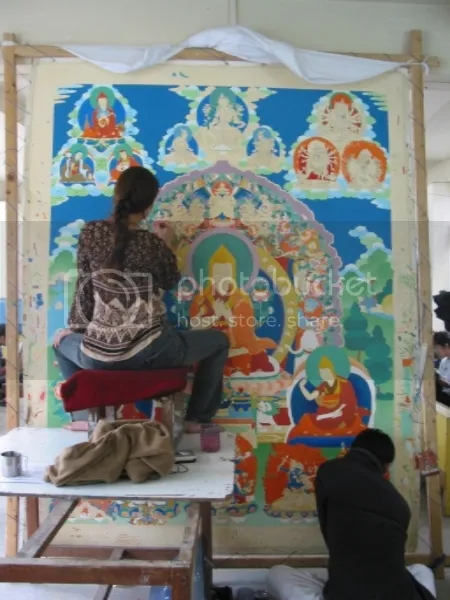
Painting class at the Norbulingka Institute, 2005

My apprenticeship during the three years I spent there was very slow and painstaking. It was essentially this atmosphere that molded my predisposition to understand that painting a thangka is a spiritual practice in itself; the thangka is there for you to give your time and attention to, and to house your soul. It is a sacred art with a unique function. If you do not have that understanding in the very depth of your being, you will soon abandon the training. Some do not even consider thangka painting to be art, but a practice involving paint that has the same aim as any other Buddhist practice. It was a year before Gen-la even called me by my name; until then he just called me “intchi bhumo,” or “foreign girl.” And it was more than a year before I actually even touched paint, and then only because one of my classmates hid me behind a big canvas and started to teach me himself. Gen-la was actually proud of my boldness when he found out, and finally guided me on my first proper painting. Those were precious times; I was truly happy despite the difficulties I experienced, and my certainty of being on the right track never wavered.

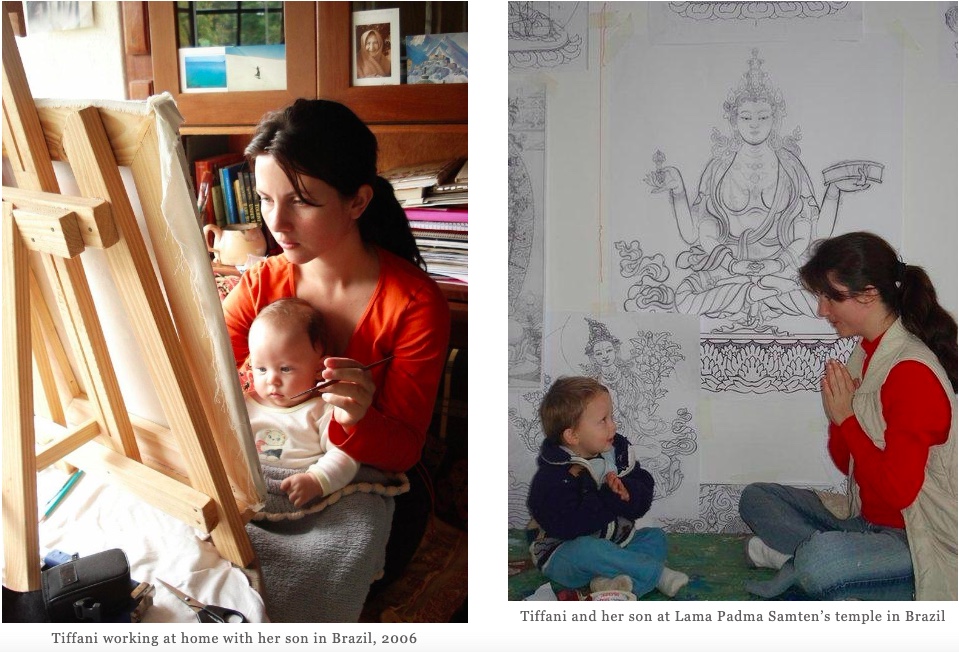
In 2006 I returned to Brazil to discover that I was pregnant. In October that year, a little boy of Tibetan-Brazilian-German heritage was born. His father came over and we lived together for a few years until he moved to the United States to join a larger Tibetan community. Back in Brazil I was fearful that I would have to stop painting—I was 24 with a baby and no money, and all I knew how to do was paint. Afraid that such worries would make me lose my path, I continued to paint my thangkas, my son held close to my body.

When my son was only a few months old, I was contacted by a Brazilian lama—Lama Padma Samten, a disciple of Chagdud Tulku Rinpoche, who had already established a huge sangha. He had heard about me through a mutual friend and sent my son and me tickets to visit his new temple in the south of Brazil. When I finally arrived I was amazed by the size of the temple, which was built to accommodate 300. As I stood there sleep-deprived and perfumed with milk and diapers, he asked me if I would paint the interior walls. I was astonished—but I agreed!

For a month I stood gazing at those terrifyingly huge white walls in fear. I really had no idea how to start! I could not call anyone in India because of the language barrier, and the materials available in Brazil for painting murals wouldn’t be the same as those I was familiar with. So I began slowly, as Gen-la had taught me. First, I met with a local artist to learn more about the proper materials. I learned about the specific deities and mandalas that Lama Samten wished to incorporate. The members of his sangha were very supportive, and many came to help. Those who could give more of their time I trained to paint. Those who couldn’t paint, I asked to massage our aching shoulders, play some instrument or other, give yoga lessons, or even bake a cake for our tea breaks. I felt that everyone should be included. The project took five challenging years to complete, all guided by Lama Samten’s blessings.

As mentioned earlier, those tears in Mongolia had fed the artist within, and now the artist was awake. I soon had the feeling that thangka painting was a “safe zone” for me as the work is all done according to rules that, if followed, offer some guarantee of success. So, in a way, I felt that thangkas had given me discipline and now, only now, was I ready to risk expressing myself. So I began to take more seriously the opportunity to try a more intuitive kind of painting, especially when my personal life was a mess. I was allowed to explode on the canvas, I was allowed to make mistakes . . . I needed to be able to be wrong yet acceptable. 

Accumulating a body of art pieces during my free time while painting the temple, with some trepidation I presented my work to Tibet House in New York. I was relieved when they accepted my work and agreed to produce my first show, in 2012—a solo exhibition titled Mystic Nostalgia, in which I sought to express that longing for a lost “home.” Not necessarily a real place; the work is more about our inner landscape . . . a mystic longing. My second exhibition will open at Tibet House on 23 October this year.

Since completing my work at the temple at the end of 2012, I have focused on holding thangka workshops, producing thangkas to order, and taking part in workshops and retreats to teach the intuitive process of self-expression through paint, movement, and writing. I believe the key is maintaining the approach of an apprentice—the beginner’s mind. I feel that I’m learning each time I teach, each time I listen to people, each time I encounter another culture or eat a different food. I learned the benefits of discipline and following rules from the thangka tradition, and when I walk into the unknown with my wild self that sometimes wants its own way, I continue to learn.

Tradition provides us with the roots and structure through which we express ourselves like a hundred branches growing in the air, catching the breeze with their lush leaves. Nourish discipline as much as you nourish your freedom and you’ll soon discover that they are one.

Tiffani Gyatso is a traditional Buddhist thangka painter and a member of the Dakini As Art Collective. To learn more about Tiffani, her work, and Dakini As Art, please visit Dakini As Art.

Link:https://peacelilysite.com/2024/06/07/twelve-years-of-thangka-art-apprenticeship-personal-practice-and-evolution/

 #SpiritualPractice #ThangkaPainting #TibetanBuddhism #Vajrayanabuddhism

Source: https://www.buddhistdoor.net/features/twelve-years-of-thangka-art-apprenticeship-personal-practice-and-evolution/