This famous prayer has hidden wisdom in every line

This famous prayer has hidden wisdom in every line

God grant me the serenity
to accept the things I cannot change; 
courage to change the things I can; 
and wisdom to know the difference.

Living one day at a time; 
enjoying one moment at a time; 
accepting hardships as the pathway to peace; 
taking, as He did, this sinful world
as it is, not as I would have it; 
trusting that He will make all things right
if I surrender to His Will; 
that I may be reasonably happy in this life
and supremely happy with Him
forever in the next. 
Amen.

The Serenity Prayer is well known by both believers and non-believers. The famous prayer asks for God’s help achieving something that most people desire but few can achieve: peace and happiness in life. Unlike many prayers that ask for peace or happiness, the Serenity Prayer does not simply ask that God hand a person peace wholesale. Instead, the prayer lays out specific steps that will help a person achieve serenity in their life and asks God to help them gather the strength to live by those smaller goals. The Serenity Prayer does not so much ask for a gift as much as it asks God to help a person create or earn their own peace.

The first half of the Serenity Prayer is the most commonly quoted section of the prayer. The prayer has inspired millions of people, Christians and non-Christians alike. This beautiful prayer, however, is so often quoted that its wisdom can be lost. Here is a breakdown of the wisdom of the Serenity Prayer.

God grant me the serenity to accept the things I cannot change…
Everyone has things in their life they wish that they could change, whether it is something as small as the traffic and congestion that fills a person’s daily commute or something as serious as a loved one’s diagnosis with terminal cancer. When faced with something we wish we could change, we often fight it. We rage against the congested traffic and fall prey to road rage. We deny the terrible news of a deadly diagnosis and stick our heads in the sand. We hide from the truth. We hate it. We curse it. We do the spiritual equivalent of punching a brick wall and expecting the wall to come down instead of our knuckles to bruise and split and break. In our hearts we know that there is nothing we can do to change some facts of life. People will die. Tragedies will happen. The inevitability of those facts does not make them less horrible, but it does mean that there is nothing we can do about it.

The first two lines of the Serenity Prayer ask for perhaps one of the hardest things of all: the strength to both accept that some things are out of our control and come to peace with that fact rather than drowning in useless, toxic rage.


Courage to change the things I can…
People love to complain. Think about it. How often do our coworkers start the week not with a smile and story about something pleasant they did over the weekend but a moan, groan or curse about the first day of the work week? When starting a conversation, do we share our joy? Unfortunately, we are much more likely to start a conversation by complaining about something, even something as small as the weather. Complaints seem to be our go-to form of communication, but how often do people really try to change what they claim so grievously offends, inconveniences or angers them?

In the age of social media and the internet, it is easier than ever to jump on the bandwagon and complain about an event, person, policy or organization. Ironically, many of the loudest virtual voices have never done a thing to help the causes they claim matter so much. It is easy to complain, especially from behind the protection of a screen name and keyboard. It is not easy to actually enact change. It is not easy to go up to someone we respect and say “I disagree.” It is not easy to face down someone who is screaming with hate and say, civilly and respectfully, “You are wrong and here is why.” Truly creating change does not happen from behind a screen or around a water cooler. It takes time, effort, energy and, yes, risk.

The penultimate line of the first stanza of the Serenity Prayer asks God to help us find the inner strength and deep well of bravery we all possess and turn that willpower and courage toward bringing about the changes that matter to us.

And the wisdom to know the difference.
Discernment is one of the most difficult skills to master especially when it comes to dealing with our ability to influence the world around us. We often have an overinflated sense of our own power to enact change. On some subconscious level, we truly believe that we can make other people see our point of view if we just have one more conversation with them, explain our position one more time or, sometimes, yell loudly enough. This, of course, is ridiculous. People do not change their minds when others shout at them or call them names. Even those who try to change events or others’ opinions with civil, respectful behavior often find themselves frustrated as things refuse to change. This is because the things they want to influence are not within their ability to alter. Discerning what we can change and what we simply wish we could change is not easy. The Serenity Prayer recognizes that very human refusal to admit defeat and accept that something is out of our hands. As such, the prayer asks for God’s help discerning what we can truly control and what we merely wish we could influence.

Living one day at a time, enjoying one moment at a time
We all know someone who is never really present in the moment. They may be worrying constantly about tomorrow or forever daydreaming about the next great thing that they believe will happen in their life. They never take the time to enjoy the moment they are standing in or to revel in the life they live. Their focus is always on something else. Unfortunately, when we are focused on something in the far off future or distant past, whether good or bad, we let life pass us by. Whether we want to admit it or not, most of life is composed of the little moments that so many of us ignore. When we are worrying about the big presentation we have at work later in the week, we are not paying attention to our spouse who is longing for some emotional connection. When we are consumed with excitement for our cruise next month, we miss the friend who was looking to simply catch up over lunch. The Serenity Prayer reminds us that those little moments—the butterfly perched on the flowers by the office door, the smile of our child when she sees that daddy’s home, the smell of fresh baked cookies–get lost so easily even though those little moments are the ones that make up most of our lives and make our lives worth living.

Accepting hardships as the pathway to peace
No one likes to focus on the difficulties that come with life. For all that people love to complain, no one really wants to have a troubled life. We want to be able to win the competition of “who had the worst day,” but we do not actually want to be miserable. We want to have our cake and eat it, too. Unfortunately, this is not possible. Hardships will come up in life, but they are so much more important than a way to win the misery Olympics that so often take place at family dinners or around the water cooler.

“Nothing worth doing was every easy.” This cliché phrase has been both revered for its truth and reviled for its unpleasant reality, but there is no denying its accuracy. Finding love is difficult, and marriages are hard work. Few relationships, however, come close to being as fulfilling as a loving marriage. Parenting is a lifetime of staring at the ceiling at night wondering if we are screwing up our kids irreversibly. That does not mean that it is not the most important job on earth. Almost anything that will bring us true lasting happiness and peace instead of transient pleasure comes with difficulty and trial. In moments when we want to walk away, the Serenity Prayer reminds us that those struggles will be worth it in the end.

Taking, as He did, this sinful world as it is, not as I would have it
The world is not perfect. Anyone who would say otherwise is naïve, blind or has their head buried so deep in the sand that their hair is poking through the grass on the other side of the globe. The advent of 24 hour news and the internet has driven home the imperfection of the world in all its gruesome, filthy, nightmarish detail. The worst of humanity is regularly on display as both natural and human made disasters dominate the news and religious extremism and terrorism are documented with sickly loving detail. Given that the horrors of the world are regularly shoved down our throats, is it any wonder that many people would prefer to hide under the covers and pretend that everything is just hunky dory?

Hiding from reality, however, does nothing to change what is actually happening in the world. Distorting facts and figures to feed a popular narrative robs those actually hurt of any chance of enacting real change. The key to dealing with this world is to accept it as it is, both the good and the bad. It is wrong to pretend away the suffering of others, but it is not right to rub the worst of human depravity in the face of someone who is counting their own blessings. The Serenity Prayer makes it clear that we need to deal with reality, not wishful fantasy. To do that, we need to celebrate the highs and spread the good as far and as wide as we can. We need to mourn the lows and fight fiercely to correct what wrongs we can. We cannot change reality when we do not even know what is real.



Trusting that He will make all things right if I surrender to His Will
Trust is one of the key components of the Christian faith. Christians must trust that God has a plan for their lives. They must trust that everything, even terrible things, happen for a reason. Painful though it may be, they must trust that their loved ones who die are going to a better place. Trust, however, does not always come easily. Christians who are mourning a lost parent, spouse, friend or, worst of all, a child, may find themselves raging against God and questioning everything they ever believed.

While hardship and trial sometimes brings a person’s faith to its knees, the hottest fires sometimes forge the strongest faith. Those people who come out of trials with both a faith core of steel and a deepened trust in God are often those who manage to accept, somehow, that God is in control even when everything around them is going to hell in a handbasket. Even when life is easy-breezy and good, however, it is not always easy for us to trust in God and surrender. We want to take control. We want to be in charge. The Serenity Prayer reminds us, though, that what we can influence is so much smaller than what God can determine. Whether we like it or not, we are being dragged in the direction God wants us to go, so we may as well stop fighting, go with the flow and trust that He has our best interests at heart.


So that I may be happy in this life
Everyone wants to be happy. We know that this life is too short, and we want to enjoy every minute of it. We want to spend our days smiling and laughing. We want to feel both joy and excitement and treasure every moment. The desire to be happy is one of the most natural desires of humanity. Our very biological drive to survive is based on our need to be happy. Our bodies are hardwired to use a biological reward-based system to keep us alive. When we do something that helps us survive, we are rewarded with a surge of dopamine, a feel-good chemical. These hormonal surges come when we eat, sleep, talk with other human beings and have sex. These processes are necessary for the continuation of the human species. Staying happy in this life, however, is not just about fulfilling biological urges. We are hardwired to do more than survive. Dopamine floods our brains when we truly live. Singing, dancing, creating and exploring new things all trigger dopamine. The Serenity Prayer helps remind us that, despite what some fire-and-brimstone sermons say, aiming to be happy in this life is nothing to be ashamed of as long as we do not trade morality for transient pleasure. This, however, rarely happens when we do what is hardwired to be one of our greatest natural sources of happiness: connecting with and helping others.


And eternally happy with Him forever and ever in the next.
Christians know that there is more than just this world. There is another world that is free of the horrors and tragedies that plague this world. Our current world is painfully imperfect, but that does not make it devoid of beauty. God’s hand is everywhere in the world, and hope can be found in even the darkest and most dangerous of times. The beauty and good of this world, however, pale in comparison to what is waiting in the next world with Jesus Christ Himself. When we pursue happiness and peace in this life, we must be sure not to get so caught up in earthly pleasures that we take our eyes off the ultimate prize: eternal life with Christ in the next life. The Serenity Prayer helps us focus on what we need to do to achieve happiness and peace in this life, but the final two lines of the prayer make sure to remind us that there is more, much more, than just this life. It reminds us to keep the next life in mind even as we strive to enjoy this one and to change this world for the better.

The Serenity Prayer is well known by both believers and non-believers. It offers simple, but effective methods to truly begin to feel peace in this life, but it also reminds us of what is waiting for us in the next life. It asks God not to fix our lives for us but to lend us the strength to correct them for ourselves. It offers inspiration and advice in equal measure and reminds the faithful that with God anything is possible.


By Stephanie Hertzenberg
Source: Beliefnet

This famous prayer has hidden wisdom in every line

Link: https://peacelilysite.com/2022/11/02/this-famous-prayer-has-hidden-wisdom-in-every-line/

#God#Prayer#Wisdom#Christians#Christianity

20 Life Changing Lessons to Learn from Buddha

20 Life Changing Lessons to Learn from Buddha

There are so many beautiful, powerful and life changing lessons you can learn from studying Buddhism and from reading many of Buddha’s quotes.

Here are 20 Life Changing Lessons from Buddha:

1. Love heals all things.
“Hatred does not cease by hatred, but only by love; this is the eternal rule.”

2. It’s not what you say but what you do that defines you.
“A man is not called wise because he talks and talks again; but if he is peaceful, loving and fearless then he is in truth called wise.”

“A dog is not considered a good dog because he is a good barker. A man is not considered a good man because he is a good talker.”

3. The secret of good health is to live fully in the NOW.
“Do not dwell in the past, do not dream of the future, concentrate the mind on the present moment.”

“The secret of health for both mind and body is not to mourn for the past, nor to worry about the future, but to live the present moment wisely and earnestly.”

4. Words have the power to both hurt and heal.
“Words have the power to both destroy and heal. When words are both true and kind, they can change our world.”

5. Let it go and it will be yours forever.
“You only lose what you cling to.”

6. No one can walk your path for you.
“No one saves us but ourselves. No one can and no one may. We ourselves must walk the path.”

7. Happiness never decreases by being shared.
“Thousands of candles can be lit from a single candle, and the life of the candle will not be shortened. Happiness never decreases by being shared.”

8. Be kind to all.
“Resolve to be tender with the young, compassionate with the aged, sympathetic with the striving and tolerant with the weak and wrong. Sometime in your life, you will have been all of these.”

“Have compassion for all beings, rich and poor alike; each has their suffering. Some suffer too much, others too little.”

“Teach this triple truth to all: A generous heart, kind speech, and a life of service and compassion are the things which renew humanity.”

9. Don’t believe everything you are told to believe.
“Do not believe in anything simply because you have heard it. Do not believe in anything simply because it is spoken and rumored by many. Do not believe in anything simply because it is found written in your religious books. Do not believe in anything merely on the authority of your teachers and elders. Do not believe in traditions because they have been handed down for many generations. But after observation and analysis, when you find that anything agrees with reason and is conducive to the good and benefit of one and all, then accept it and live up to it.”

10. As you THINK so shall you be
“All that we are is the result of what we have thought: it is founded on our thoughts and made up of our thoughts. If a man speak or act with an evil thought, suffering follows him as the wheel follows the hoof of the beast that draws the wagon…. If a man speak or act with a good thought, happiness follows him like a shadow that never leaves him.”


11. Let go of fear.
“The whole secret of existence is to have no fear. Never fear what will become of you, depend on no one. Only the moment you reject all help are you freed.”

12. The truth has a way of always leaking out.
“Three things cannot be long hidden: the sun, the moon, and the truth.”

13. Control your mind or it will control you.
“To enjoy good health, to bring true happiness to one’s family, to bring peace to all, one must first discipline and control one’s own mind. If a man can control his mind he can find the way to Enlightenment, and all wisdom and virtue will naturally come to him.”

“It is a man’s own mind, not his enemy or foe, that lures him to evil ways.”

14. Doubt separates. Trust unites.
“There is nothing more dreadful than the habit of doubt. Doubt separates people. It is a poison that disintegrates friendships and breaks up pleasant relations. It is a thorn that irritates and hurts; it is a sword that kills.”

15. Nobody is more deserving of your love than you yourself are.
“You can search throughout the entire universe for someone who is more deserving of your love and affection than you are yourself, and that person is not to be found anywhere. You, yourself, as much as anybody in the entire universe, deserve your love and affection.”

16. Knowing others is wisdom, knowing yourself is enlightenment.
“It is better to conquer yourself than to win a thousand battles. Then the victory is yours. It cannot be taken from you, not by angels or by demons, heaven or hell.”

17. Let go of attachment.
“To live a pure unselfish life, one must count nothing as one’s own in the midst of abundance.”

18. Choose your friends wisely.
“An insincere and evil friend is more to be feared than a wild beast; a wild beast may wound your body, but an evil friend will wound your mind.”

19. There is no way to happiness. Happiness is the way.
“There is no path to happiness: happiness is the path.”

20. Love. Live. Let go.
“In the end these things matter most: How well did you love? How fully did you live? How deeply did you let go?”

20 Life Changing Lessons to Learn from Buddha

Link: https://peacelilysite.com/2022/10/28/20-life-changing-lessons-to-learn-from-buddha/

#Buddhism#Buddha#LifeChanging#LearnfromBuddha#Morallessons#Culture#CultureExchange

Source: https://www.beinghappybuddha.com/blogs/insights/20-life-changing-lessons-to-learn-from-buddha

From Monkey King in “Journey to the West” to A Fast-flying Buddhist Nun

From Monkey King in “Journey to the West” to A Fast-Flying Buddhist Nun

The monkey king in Journey to the West was such a thrilling, fascinating, and happy memory in my childhood. I have read the books, comic booklets, and watched the cartoon movies about it many times. The one I liked the most is “The Monkey King makes an Uproar in Heaven”. It ignited my imagination. I wished I could fly on the clouds just like the Monkey King.

The Monkey King is born on Flower Fruit Mountain from a stone egg that forms from an ancient rock created by the coupling of Heaven and Earth. He first distinguishes himself by bravely entering the  Water Curtain Cave on the mountain; for this feat, his monkey tribe gives him the title of “Handsome Monkey King (美猴王).” After seeing a fellow monkey die because of old age, he decides to travel around the world to seek the Tao, and find a way to be able to live forever. He eventually found the “Grand Master of Bodhi (菩提祖師),” who taught him the 72 heavenly methods of transformation and a “sumersault cloud” which allows him to travel 108,000 chinese kilometer, almost instantaneously. The Grand Master also give him a name Sun Wukong. Sun is the Sir name, Wukong means “Awakened to Emptiness”.

After angering several gods and coming to the attention of the Jade Emperor, he is given a minor position in heaven as the Keeper of Horses (弼馬溫) so they can keep an eye on him. When Sun realizes that he was given the lowest position in heaven and is not considered a full-fledged god, he becomes very angry. Upon returning to his mountain, he puts up a flag and declares himself the “Great Sage Equal to Heaven (齊天大聖).” The Jade Emperor dispatches celestial soldiers to arrest Sun Wukong, but none succeed.

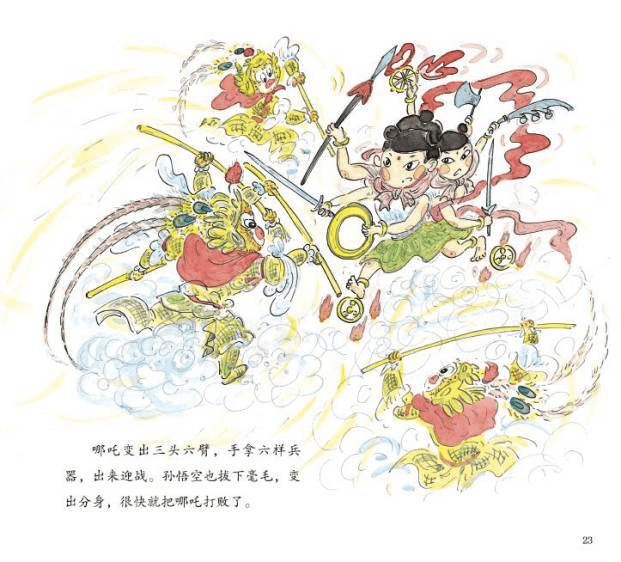
The Jade Emperor has no choice but to appoint him to be the guardian of the heavenly peach garden. The different varieties of peach trees in the garden bear fruit every 3,000, 6,000, and 9,000 years, and eating their flesh will bestow immortality and other gifts, so Sun Wukong eats nearly all of the ripe peaches. Later, after fairies who come to collect peaches for Xi Wangmu‘s heavenly peach banquet inform Sun Wukong he is not invited and make fun of him, he once again begins to cause trouble in Heaven, stealing heavenly wine from the peach banquet and eating Laozi‘s pills of immortality. He defeats an army of 100,000 celestial troops, led by the Four Heavenly KingsErlang Shen, and Nezha

Eventually, the Jade Emperor appeals to the Buddha, who seals Wukong under a mountain called Five Elements Mountain after the latter loses a bet regarding whether he can leap out of the Buddha’s hand in a single somersault. Sun Wukong is kept under the mountain for 500 years and cannot escape because of a seal that was placed on the mountain. He is later set free when Tang Sanzang comes upon him during his pilgrimage and accepts him as a disciple.

When I grew up, I started my own journey in searching the truth and meaning of life and universe. I dabbled in different religions. Finally I became a buddhist. There were many supernormal manifestations in buddhist Sutras. Buddhas, Bodhisattvas and holy venerable ones, demonstrated much much more powers than the monkey king. Such as stories of Shariputra’s action power by wisdom, Mahamaudgalyayana’s supernatural power of going a long distance in a shot time, Master Mi Hong’s trip from Shigatse to ChengDu, etc…. In Buddhism teaching, every disciple who has received initiation has the potential to quickly obtain supernormal dharma powers through practice. One has the potential to easily assume an infinite variety of forms and obtain good worldly fortune.

In the dharma discourse Learning from Buddha, imparted by H.H. Dorje Chang Buddha III. I learned there is a Buddha Dharma called “Fine Horse Traversing the Sky Stepping on Clouds”. When a qualified disciple practice this Dharma, he can fly in the sky. Here is the true account of a fast-flying buddhist nun.

(Reported from Los Angeles) In September 2013, an event of supernatural phenomenon occurred in Los Angeles. Scientists have not been able to explain it. This was about a 49-year old Buddhist  nun  named Jian Hui, a disciple of H.H. Dorje Chang Buddha IIIflying at a speed of 700 km per hour.

This event happened at a Buddhist assembly for beseeching auspiciousness, favorable weather, eliminating disasters, and increasing good fortune. The more than 50 attendees are all famous Buddhist figures. At the time, the ceremonial process required chanting a sutra and burning a letter of petition every 10 minutes. When the fifth letter of petition was to be burned, it was discovered that this letter of petition had been lost by this nun named Jian Hui. She was very sad and could not keep her from crying. Because the assembly could not be stopped and the steps of chanting sutras and burning letters of petition must be followed in the predefined order, it was decided that Jian Hui was to go to Hua Zang Si’s Southern-California satellite monastery located in Monterey Park to get this letter of petition. Some time had passed since Jian Hui left. People became very anxious and they called the satellite monastery to ask when the letter of petition can be brought back. The nuns at that monastery passed the phone to Jian Hui. Jian Hui was quite angry on the phone and said, “Don’t make a fuss! I will be back as soon as possible!” Sure enough, within three minutes after putting down the phone, Jian Hui returned to the site of the ceremony from the monastery that is 12 kilometers away. People at the site were all stunned. A nun at the site named Zheng Hui was very surprised and called the monastery to inquire the whereabouts of Jian Hui. The reply from the monastery was that Jian Hui left just three minutes ago. Further verification later also revealed that, after the phone conversation, Jian Hui also spent time to teach people chanting mantras before leaving for the site of the assembly. Based on the calculation that subtracted the time of delay, Jian Hui traveled this distance of 12 kilometers within at most one minute.

Zheng Hui planned to write this event in a book. To verify the facts, she went to the monastery to talk to the nuns there. They all confirmed, “When you called and said that she had returned to your place, it was just a very short while after she had left.” Zheng Hui then asked Zheng Xue, the nun who handed the phone to Jian Hui, where she was at the time. Zheng Xue took this question as distrusting her and was very upset. She kneeled down in front of the statue of Amitabha Buddha and took an oath against heavy consequences to swear that she received the phone call at the monastery and handed the phone to Jian Hui in person inside the Buddha hall of the monastery. If she told a lie, she is willing to descend into the hell realm. Zheng Hui also took an oath against heavy consequences to swear that, within three minutes after her phone conversation with Jian Hui, Jian Hui returned to the site of the assembly. She is also willing to descend into the hell realm if what she said is untrue. Moreover, eminent Buddhist monks including Gar Tongstan IV Ciren Gyatso, Kaichu, Akou Lamo, Shi Miao Kong, Shi Long Hui, Shi Jue Hui, Shi Kui Zhi and others also completely confirmed from their respective personal presences and witnesses at the two locations that the above event was completely true.

From Monkey King in “Journey to the West” to A Fast-Flying Buddhist Nun

Link:https://peacelilysite.com/2022/10/28/from-monkey-king-in-journey-to-the-west-to-a-fast-flying-buddhist-nun/

#SunWukong#MonkeyKing#JourneyTotheWest#buddhaDharma#Buddhist#Buddhism##HHDorjeChangBuddhaIII #DorjeChangBuddhaIII #DorjeChangBuddha

Source: https://en.wikipedia.org/wiki/Journey_to_the_West

THE MOUSE MERCHANT [DILIGENCE AND GRATITUDE]

4. THE MOUSE MERCHANT [DILIGENCE AND GRATITUDE]

Buddhist Tales for Young and Old, volume 1, Prince Goodspeaker, Stories 1-50

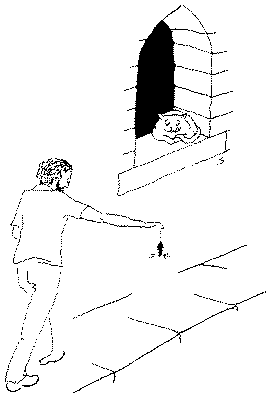
Once upon a time, an important adviser to a certain king was on his way to a meeting with the king and other advisers. Out of the corner of his eye, he saw a dead mouse by the roadside. He said to those who were with him. “Even from such small beginnings as this dead mouse, an energetic young fellow could build a fortune. If he worked hard and used his intelligence, he could start a business and support a wife and family.”

A passerby heard the remark. He knew this was a famous adviser to the king, so he decided to follow his words. He picked up the dead mouse by the tail and went off with it. As luck would have it, before he had gone even a block, a shopkeeper stopped him. He said, “My cat has been pestering me all morning. I’ll give you two copper coins for that mouse.” So it was done.

With the two copper coins, he bought sweet cakes, and waited by the side of the road with them and some water. As he expected, some people who picked flowers for making garlands were returning from work. Since they were all hungry and thirsty, they agreed to buy sweet cakes and water for the price of a bunch of flowers from each of them. In the evening, the man sold the flowers in the city. With some of the money he bought more sweet cakes and returned the next day to sell to the flower pickers.

This went on for a while, until one day there was a terrible storm, with heavy rains and high winds. While walking by the king’s pleasure garden, he saw that many branches had been blown off the trees and were lying all around. So he offered to the king’s gardener that he would clear it all away for him, if he could keep the branches. The lazy gardener quickly agreed.

The man found some children playing in a park across the street. They were glad to collect all the branches and brush at the entrance to the pleasure garden, for the price of just one sweet cake for each child.

Along came the king’s potter, who was always on the lookout for firewood for his glazing oven. When he saw the piles of wood the children had just collected, he paid the man a handsome price for it. He even threw into the bargain some of his pots.

Photo by ThuongDaiHua on Pexels.com

With his profits from selling the flowers and the firewood, the man opened up a refreshment shop. One day all the local grass mowers, who were on their way into town, stopped in his shop. He gave them free sweet cakes and drinks. They were surprised at his generosity and asked, “What can we do for you?” He said there was nothing for them to do now, but he would let them know in the future.

A week later, he heard that a horse dealer was coming to the city with 500 horses to sell. So he got in touch with the grass mowers and told each of them to give him a bundle of grass. He told them not to sell any grass to the horse dealer until he had sold his. In this way he got a very good price.

Time passed until one day, in his refreshment shop, some customers told him that a new ship from a foreign country had just anchored in the port. He saw this to be the opportunity he had been waiting for. He thought and thought until he came up with a good business plan.

First, he went to a jeweler friend of his and paid a low price for a very valuable gold ring, with a beautiful red ruby in it. He knew that the foreign ship was from a country that had no rubies of its own, where gold too was expensive. So he gave the wonderful ring to the captain of the ship as an advance on his commission. To earn this commission, the captain agreed to send all his passengers to him as a broker. He would then lead them to the best shops in the city. In turn, the man got the merchants to pay him a commission for sending customers to them.

Acting as a middle man in this way, after several ships came into port, the man became very rich. Being pleased with his success, he also remembered that it had all started with the words of the king’s wise adviser. So he decided to give him a gift of 100,000 gold coins. This was half his entire wealth. After making the proper arrangements, he met with the king’s adviser and gave him the gift, along with his humble thanks.

The adviser was amazed, and he asked, “How did you earn so much wealth to afford such a generous gift?” The man told him it had all started with the adviser’s own words not so long ago. They had led him to a dead mouse, a hungry cat, sweet cakes, bunches of flowers, storm damaged tree branches, children in the park, the king’s potter, a refreshment shop, grass for 500 horses, a golden ruby ring, good business contacts, and finally a large fortune.

Hearing all this, the royal adviser thought to himself, “It would not be good to lose the talents of such an energetic man. I too have much wealth, as well as my beloved only daughter. As this man is single, he deserves to marry her. Then he can inherit my wealth in addition to his own, and my daughter will be well cared for.”

Photo by Pixabay on Pexels.com

This all came to pass, and after the wise adviser died, the one who had followed his advice became the richest man in the city. The king appointed him to the adviser’s position. Throughout his remaining life, he generously gave his money for the happiness and well being of many people.

The moral is: With energy and ability, great wealth comes even from small beginnings.

4. The Mouse Merchant [Diligence and Gratitude]

Link: https://peacelilysite.com/2022/10/22/the-mouse-merchant-diligence-and-gratitude/

Source: INTERPRETER’S INTRODUCTION – BUDDHIST TALES FOR YOUNG AND OLD, VOLUME 1, STORIES 1-50

#Buddhisttalesforyoungandold #Buddhiststories #storiesforkids #moralstories #Buddha #Jatakastories #PansiyaPanasJatak#diligence #gratitude

The Story of the “Six-foot Alley”

The Story of the “Six-foot Alley”

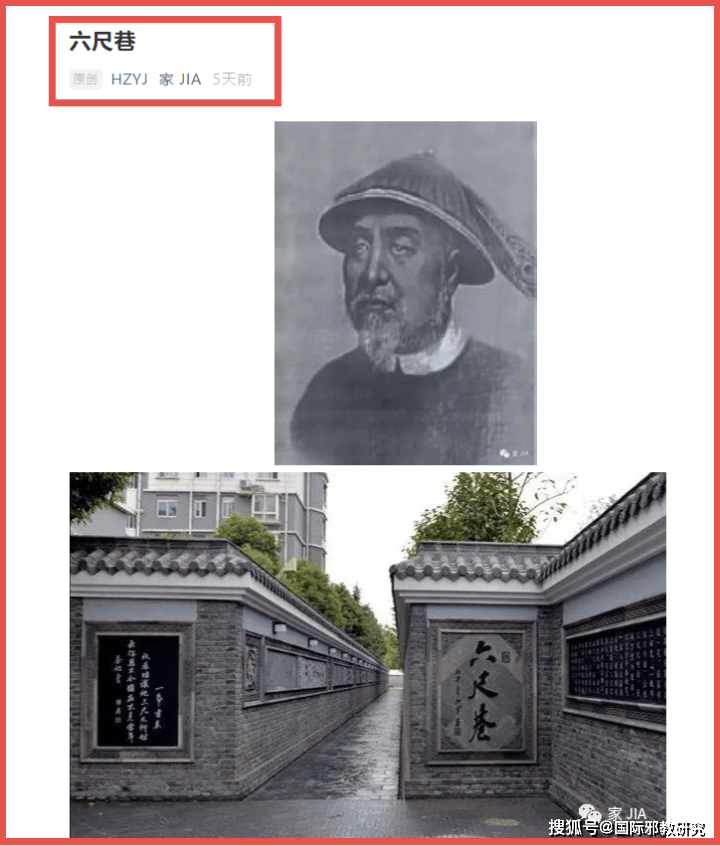
“Liu Chi Alley” (六尺巷 in chinese) is located between Xihou Street and Wumu Garden in Tongcheng District, Tongcheng city, Anhui Province. The allusion of “Six-foot Alley” has become a historical story stems from the land dispute between Zhang’s family and his neighbors.

In the Qing Dynasty, there was a famous family in Tongcheng, Anhui Province. Father and son were the prime ministers of the two generations and had great power. Their names were Zhang Ying and Zhang Tingyu.
During the reign of Emperor Kangxi in the Qing Dynasty, Zhang Ying was a Bachelor of Arts at Wenhua Palace and a minister of rites. At that time, the Zhang family’s old house in Tongcheng was adjacent the house of the Wu family. There was only about 3 feet of space between the land owned by each family.

The Wu family wanted to expand their property to occupy this space. The Zhang family vehemently disagreed. The two sides brought the case to the county courthouse of Yamen. County officials knew that both families involved in the dispute were well-known families with prominent officials. They dared not easily break the dispute.
During this period, the Zhang family wrote a letter to Zhang Ying, now a senior official in Beijing, asking Zhang Ying to come out and interfere in this matter. After receiving the letter, Zhang Ying thought that he should humble the neighbors, and wrote a poem to his home in reply:


Thousands of miles of a mail is only for a wall.

Why not give up him three feet?

The Great Wall still stands today.

But where is the Empire Qishihuang now?


The Zhang family read it and eventually realized they understood its meaning. They took the initiative to give up three feet of space for the Wu family’s property. The Wu family, deeply touched by this gesture, decided to concede three feet of their own adjacent land, thus forming a six-foot lane between the properties. The two courtesy concessions and the Zhang family’s non-oppressive approach were passed on to be good folk stories.

From this story, we learn to be modest and tolerant in life. Mutual humility can avoid many contradictions and reduce disputes between people. Mutual understanding and tolerance can help people get along harmoniously, and can greatly improve people’s happiness index. As the saying goes, “A bit of forbearance will calm the wind and silence the wave. Take a step back and have the vastness of sea and sky.”

The virtues of tolerance and equality have been passed down since ancient times. In the process of building a harmonious society for people who are open-minded and respectful, this tradition of humility needs to be carried forward even more. The allusions to a “Six-Foot Lane” have gone far beyond its original meaning and has become a testimony to the virtues of harmony and humility of the Chinese nation.

The Story of the “Six-foot Alley”

Link: https://peacelilysite.com/2022/10/19/the-story-of-the-six-foot-alley/

#ChineseCulture#Six-footAlley#Toleranceandequality#Humility#Virtues#Harmony

Source: http://mandarinedu.org/English/news/12390.html

Reasons Not to Take Life So Seriously

Reasons Not to Take Life So Seriously

Every day you are faced with a million little traps that encourage you to take your life way too seriously. Next time you are tempted to smash your computer or lash out in a fit of road rage, remember these reasons not to take life so seriously.

1. Relationships are all that matter

Time   and   time again when researchers have tried to figure out what makes people happy they have come to the same conclusion: personal relationships make the biggest difference. If we valued our happiness over money we would do everything we could to spend time with friends   and   family   and   not worry so much about putting in extra time at work. When you look back on your life, you won’t reflect on the time you spent at work; you will remember family dinners, great vacations, romantic dinners,   and   your wedding.

2. Rich people aren’t happier people
Spending more time at home or with friends will probably have a negative impact on the balance of your bank account. Just reading that sentence probably sent a wave of panic through some of you, but consider the fact that wealth is not correlated with happiness. In fact, once you have enough money to satisfy your basic needs, money makes very little difference in your overall well-being. The only exceptions are if you give your extra money to charity.

3. Worrying isn’t productive
Some of us even end up stressed out in situations   where   it is totally unwarranted. For example, you might find yourself visiting a new city like London or Paris   and   end up thoroughly confused   by   the transit system. You can’t find out how to get   where   you want to go   and   it makes you want to scream. But what are you accomplishing   by   stressing yourself out? Nothing.

4. Your time is limited
You only get to live one life. If you’re lucky enough to make it to age 90 you still have less than 800,000 hours between the time you are born   and   the time you die to cherish   and   enjoy all the things that make up life. One third of that time you won’t even be awake for, so you had best make the most of the remaining chunk. Do what you need to do to live a happy   and   fulfilled life.


Reasons Not to Take Life So Seriously

Link: https://peacelilysite.com/2022/10/16/reasons-not-to-take-life-so-seriously/

#Culture#WellnessandHealth#Relationship#Productive#Happy

A Famous Westminster Abbey Tombstone Inscription

By Linda Apple

A Famous Westminster Abbey Tombstone Inscription

There is a rather famous tombstone in Westminster Abbey. There’s nothing so special about it, except for its inscription. I believe that many people have heard of it.

“When I was young and free and my imagination had no limits, I dreamed of changing the world. As I grew older and wiser, I discovered the world would not change, so I shortened my sights somewhat and decided to change only my country. But it, too, seemed immovable. As I grew into my twilight years, in one last desperate attempt, I settled for changing only my family, those closest to me, but alas, they would have none of it. And now, as I lie on my deathbed, I suddenly realize: If I had only changed myself first, then by example I would have changed my family. From their inspiration and encouragement, I would then have been able to better my country, and  who knows, I may have even changed the world.”

It is said that many world dignitaries and celebrities were deeply moved when they saw these words Some people say that this is a teaching of life, some people say that it is a kind of introspection of the soul.

There are similar teachings and philosophies in Chinese traditional culture. The Great Learning is a compilation of Confucian teachings used to address deeply important social behavior. In The Great Learning says: “The ancients who wished to illustrate illustrious virtue throughout the kingdom, first ordered well their own States. Wishing to order well their States, they first regulated their families. Wishing to regulate their families, they first cultivated their persons.”

“From the Kings down to the mass of ordinary people, all must consider the cultivation of the person the root of everything besides. It cannot be, when the root is neglected, that what should spring from it will be well ordered.”

In Buddhism, self cultivation is heavily emphasized as well. The first thing for all buddhist disciples is constantly cultivating themselves. In What is Cultivation, His Holiness Dorje Chang Buddha III  provides detailed guidance on self-cultivation. Self-cultivation is the fundamental and essential in the learning of Buddhism. Through self-cultivation, one will not only live a happy life and contribute the best of oneself to the society, but also can reach enlightenment and liberation.

A Famous Westminster Abbey Tombstone Inscription

Link:https://peacelilysite.com/2022/10/14/a-famous-westminster-abbey-tombstone-inscription/

#WestminsterAbbey#TombstoneInscription#GreatLearning#ChineseCulture#Buddhism#DorjeChangBuddhaIII #HHDorjeChangBuddhaIII   #Buddha #Cultivation#Buddhist#SouthAfrica#Buddhist# ConfucianTeaching#ChineseTraditionalCulture

Source: http://wengu.tartarie.com/wg/wengu.php?l=Daxue&s=1

Chinese Paintings of Lotus

Chinese Paintings of Lotus

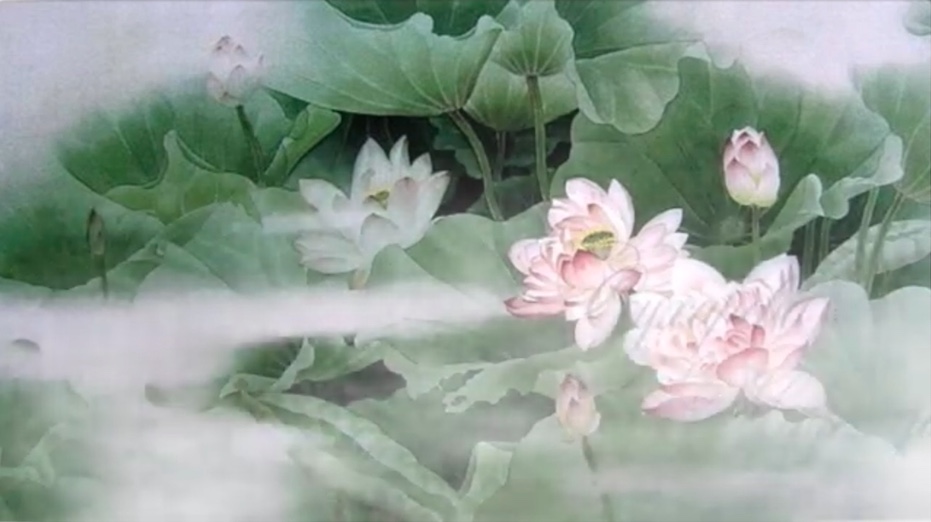
From ancient times, the lotus has been a divine symbol in Asian traditions. It is one of the Eight Auspicious Signs (Ashtamangala) pertaining to a number of Dharmic Traditions, such as Hinduism and Buddhism. In Buddhist symbolism, the lotus represents purity of the body, speech, and mind as if floating above the muddy waters of attachment and desire. Therefore, many deities of Asian religions are depicted as seated on a lotus flower. It is said that Gautama Buddha was born with the ability to walk, and lotus flowers bloomed everywhere he stepped.

       In the classical written and oral literature of many Asian cultures, the lotus is present in figurative form, representing elegance, beauty, perfection, purity, and grace. Perhaps the most famous text is the poetic essay “On the Love of the Lotus” by Zhou Dunyi (1017-1073). As Zhou writes, “I love only the lotus, for rising from the mud yet remaining unstained; bathed by pure currents and yet not seductive.” The lotus is the “gentleman among flowers.”  The term “gentleman” (junzi), of course, has since the time of Confucius been the ideal human being. So not surprisingly, the lotus flower is also a popular subject in Chinese paintings.

Zhang Daqian (張大千, 1899–1983), original name Zhang Yuan (張爰) and pseudonym Daqian, was one of the best-known and most prodigious Chinese artists of the twentieth century. He is also regarded by many art experts as one of the most gifted master forgers of the twentieth century. He is especially famous for his landscape, as well as lotus paintings.

As a child, Zhang Daqian was encouraged by his family to pursue painting. In 1917 his elder brother, Zhang Shanzi (an artist famous for his tiger paintings), accompanied him to Kyoto, Japan, to study textile dyeing. Two years later, Zhang Daqian went to Shanghai to receive traditional painting instruction from two famous calligraphers and painters of the time, Zeng Xi (曾熙) and Li Ruiqing (李瑞清). Through his association with these teachers, Zhang had the opportunity to study some works by ancient masters in detail. His early style attempted to emulate the Ming-Qing Individualists, including Tang Yin (唐寅)Chen Hongshou (陳洪綬), and Shitao (石濤). He meticulously studied and copied their works and began to make forgeries; his paintings after Shitao successfully deceived some of the best connoisseurs.

The lotus painted by Zhang Daqian is known as the “Daqian Lotus”, which is extremely popular in the auction market, and the price has repeatedly hit new highs. Among them, “Lotus Pond Wilderness” is particularly prominent. It was sold at HK$80.51 million (about $10 Million) at the 2013 Christie’s Spring Auction in Hong Kong, causing a sensation in the world.

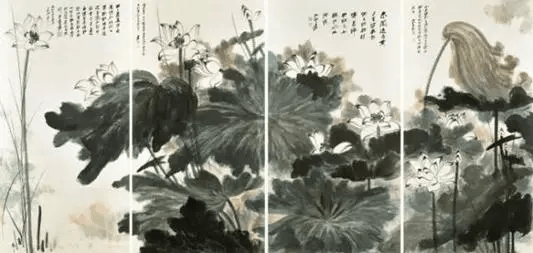
A set of four hanging scrolls each more than five feet high and 2.5 feet wide – depict lotus flowers in various state of bloom. Completed in 1947. This masterpiece, however, despite its enormous size, is still well-organized. Within magnificence unfolds delicate tenderness; integrated artist early scholar-painter style and commitment to elegant, smooth brush strokes. Zhang vividly portrays the lotuses growing in nature, swaying in the summer breeze…. It truly is a fine example of the artist’s large scale lotus compositions. 

Wilderness in a Lotus Pond

More lotus paintings by Zhang Daqian:

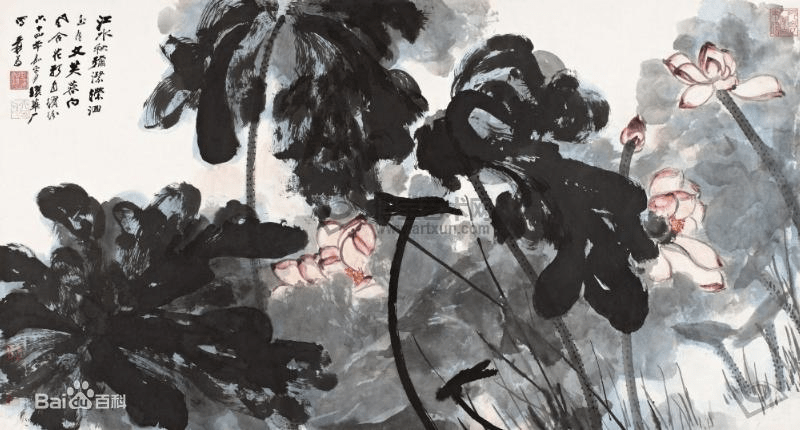
Zhang Daqian: Red Lotuses in Splashed Color (1981)

Ink Lotus by Zhang Daqian at 1976

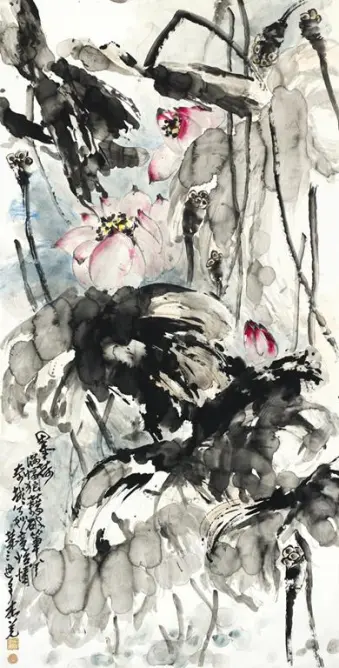
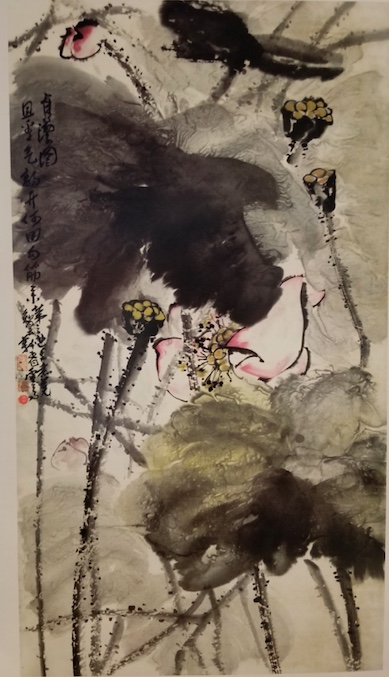
However, a Contemporary Painting “Ink Lotus” by H.H. Dorje Chang Buddha III Was Sold for the US$16,500,500 at the Gianguan 2015 Spring Auction to Break the World Record.

The ink-wash painting Lotus by H.H. Dorje Chang Buddha III has an uninhibited, natural, and spontaneous brushwork that is dense, bold, and robust, but also elegant and agile. It exhibits a charm that is like stone and bronze inscriptions. Flowing splash-ink on the scroll produces a vivid charm that evidences great ingenuity. There is an air of power and grandeur together without any trace of stiff, common, mundane artistry found in other lotus flower paintings. Overall, the whole painting manifests a harmonious and moving imagery, naturally emanating a lively vivaciousness and a carefree, spirited aura.

Ink Lotus by H.H.Dorje Chang Buddha III


Watch the Spirit of Nature by H.H.Dorje Chang Buddha III

Gao Jie Tu (Noble and Pure) by H.H.Dorje Chang Buddha III

You can find more original paintings of H.H.Dorje Chang Buddha III and Zhang Daqian at The International Art Museum of America located at downtown San Francisco.

Chinese Paintings of Lotus

Link:https://peacelilysite.com/2022/10/13/chinese-paintings-of-lotus/

#DorjeChangBuddhaIII #HHDorjeChangBuddhaIII#DorjeChangBuddha#IAMA#InternationalArtMuseumofAmerica#ChinesePaintings#Splash-inkPaintings#ZhangDaqian#LotusPaintings

Source: https://www.comuseum.com/painting/masters/zhang-daqian/

Tow Song Ci lyrics Appreciation

Tow Song Ci lyrics Appreciation

Su Shi was a writer, artist, calligrapher, pharmacologist, and statesman of the Song Dynasty, and one of the major poets of the era. His courtesy name was Zizhan and his pseudonym was Dongpo Jushi (東坡居士 “Resident of Dongpo”), and he is often referred to as Su Dong Po (蘇東坡). When we appreciate Chinese literature, Su Shi is widely regarded as one of the most accomplished figures, having produced some of the most well-known poems, lyrics, prose, and essays. His poetry has a long history of popularity and influence in China, Japan, and other areas in the near vicinity and is well known in the English-speaking parts of the world through the translations. Su Shi was the greatest writer of Song ci lyrics, often celebrating the joys of relaxed and transitory pleasures. This “To the Tone of Nian Nu Jiao Memories of the Past at Red Cliff” is one the most popular poems.

大江东去,浪淘尽,千古风流人物。故垒西边,人道是,三国周郎赤壁。乱石穿空,惊涛拍岸,卷起千堆雪。江山如画,一时多少豪杰。
遥想公瑾当年,小乔初嫁了,雄姿英发。羽扇纶巾,谈笑间,樯橹灰飞烟灭。故国神游,多情应笑我,早生华发。人生如梦,一尊还酹江月。

Nian Nu Jiao

Memories of the Past at Red Cliff

Su Shi

East flows the mighty river,

Sweeping away the heroes of times past;

This ancient rampart on its western shore

Is Zhou Yu’s Red Cliff of Three Kingdoms’s fame;

Here jagged boulders pound the clouds,

Huge waves tear banks apart,

And foam piles up a thousand drifts of snow;

A scene fair as a painting,

Countless the brave men here in time gone by!

I dream of Marshal Zhou Yu in his day

With his new bride, the Lord Qiao’s younger daughter,

Dashing and debonair,

Silk-capped, with feather fan,

He laughed and jested

While the dread enemy fleet was burned to ashes!

In fancy through those scenes of old I range,

My heart overflowing, surely a figure of fun.

A man grey before his time.

Ah, this life is a dream,

Let me drink to the moon on the river!

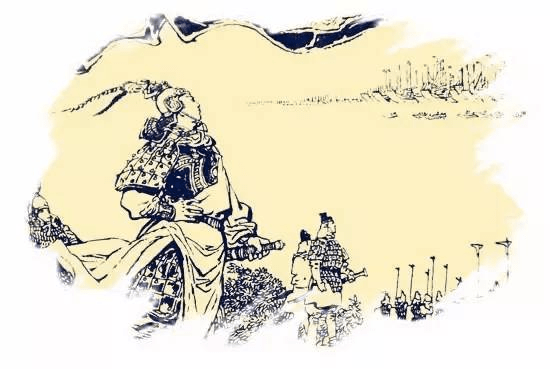
This poem was a tribute to the famous battle at Red Cliff, which took place on the Yangtze river in Sichuan at year 208 CE.  Through the description of the magnificent scenery on the Moonlit Night River, he expressed the remembrance of the famous and heroic characters of that era. The lyrics are vigorous and create a majestic atmosphere. It is a powerful poem, and has been ranked as a masterpiece throughout the ages.

I heard a song recently, that touched me so deeply, I could not help but cry. The song uses the lyrics of a poem written by H.H. Dorje Chang Buddha III, with the same Song ci style as “To the Tune of Nian-Nu-Jiao”. The bold and unconstrained poem entitled “To the Tune of Nian-Nu-Jiao: Abruptly Entering the Universe” has a powerful spirit that moved me deeply. Here is the English translation.

To the Tune of Nian-Nu-Jiao : Abruptly Entering the Universe

Abruptly entering the universe,
The universe of a billion worlds,
Stand firmly against all hardships and obstacles.
Seeing through glory and riches, I simply smile.
The rooster crows announcing the dawn,
The morning bell hurries the moon,
The whole Soha world is revealed.
Everybody bustles about to survive,
Life, like smoke and snow, gone!


Recalling when I was young,
I mastered the pen and the sword but liked Buddhism best.
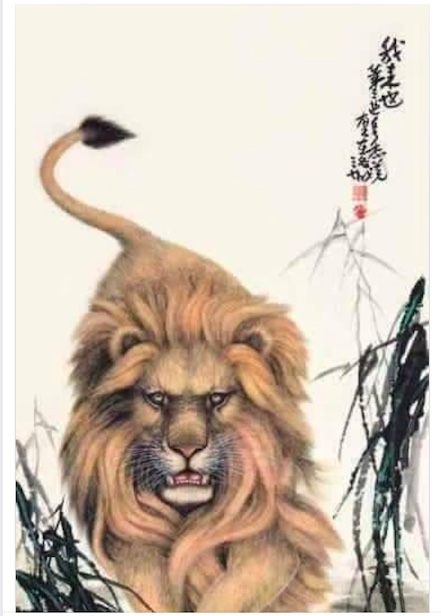
The lion’s roar of the Buddha shook the universe!
Countless suffering patients visited me,
Day and night I pondered their cures.
Millions of strands of thoughts
Slowly turn toward prajna wisdom,
Swaying the three worlds.
I wish that my remaining life
Be devoted to the benefit of all sentient beings.

Here I Come by H.H. Dorje Chang Buddha III

The mood of this poem is broad and vast, and filled with emotion. The poem manages to capture the massiveness of the universe and centuries of human affairs. It begins with aspiration soaring to the sky, and ends with a very down to the earth message: serving and helping all living beings with all that he has.

Comparing the two poems, it is evident that the work of H.H. Dorje Chang Buddha III not only provides a much broader view of the world and human existence, but also uplifts the reader to a much higher spiritual level. H.H. Dorje Chang Buddha III truly is an outstanding and timeless master of letters and also has boundless compassion and mercy to all living beings.

I also found an astonishing fact, based upon his extraordinary accomplishments in the areas of Buddhism, the humanities, painting, calligraphy and ethics, the World Poets and Culture Congress, which is composed of 5,612 experts and scholars from 48 different countries and regions, selected Master Wan Ko Yee (H.H. Dorje Chang Buddha III ) as the world’s only “Distinguished International Master.” The resolution conferring upon him this title was mailed to the People’s Republic of China and was made public in Hungary on September 15, 1994. The “Distinguished International Master” certificate was signed by the then President of the international Olympic Committee, Juan Antonio Samaranch.

Tow Song Ci lyrics Appreciation

Link:https://peacelilysite.com/2022/10/11/tow-song-ci-lyrics-appreciation/

#MasterWanKoYee #DorjeChangBuddhaIII #HHDorjeChangBuddhaIII#DorjeChangBuddha#SongCi#SuShi#Memories of the Past at Red Cliff#DistinguishedInternationalMaster

Source: https://www.sohu.com/a/129380761_256852诗苑|苏轼《念奴娇·赤壁怀古》

10 Things Science Says Will Make You Happy

10 Things Science Says Will Make You Happy

Scientists can tell us how to be happy. Really. Here are 10 ways, with the research to prove it.

by Jen Angel

In the last few years, psychologists and researchers have been digging up hard data on a question previously left to philosophers: What makes us happy? Researchers like the father-son team Ed Diener and Robert Biswas-Diener, Stanford psychologist Sonja Lyubomirsky, and ethicist Stephen Post have studied people all over the world to find out how things like money, attitude, culture, memory, health, altruism, and our day-to-day habits affect our well-being. The emerging field of positive psychology is bursting with new findings that suggest your actions can have a significant effect on your happiness and satisfaction with life. Here are 10 scientifically proven strategies for getting happy.


Savor Everyday Moments

Pause now and then to smell a rose or watch children at play. Study participants who took time to “savor” ordinary events that they normally hurried through, or to think back on pleasant moments from their day, “showed significant increases in happiness and reductions in depression,” says psychologist Sonja Lyubomirsky.

Avoid Comparisons

While keeping up with the Joneses is part of American culture, comparing ourselves with others can be damaging to happiness and self-esteem. Instead of comparing ourselves to others, focusing on our own personal achievement leads to greater satisfaction, according to Lyubomirsky.

Put Money Low on the List

People who put money high on their priority list are more at risk for depression, anxiety, and low self-esteem, according to researchers Tim Kasser and Richard Ryan. Their findings hold true across nations and cultures. “The more we seek satisfactions in material goods, the less we find them there,” Ryan says. “The satisfaction has a short half-life—it’s very fleeting.” Money-seekers also score lower on tests of vitality and self-actualization.

Have Meaningful Goals

“People who strive for something significant, whether it’s learning a new craft or raising moral children, are far happier than those who don’t have strong dreams or aspirations,” say Ed Diener and Robert Biswas-Diener. “As humans, we actually require a sense of meaning to thrive.” Harvard’s resident happiness professor, Tal Ben-Shahar, agrees, “Happiness lies at the intersection between pleasure and meaning. Whether at work or at home, the goal is to engage in activities that are both personally significant and enjoyable.”

Take Initiative at Work

How happy you are at work depends in part on how much initiative you take. Researcher Amy Wrzesniewski says that when we express creativity, help others, suggest improvements, or do additional tasks on the job, we make our work more rewarding and feel more in control.

Make Friends, Treasure Family

Happier people tend to have good families, friends, and supportive relationships, say Diener and Biswas-Diener. But it’s not enough to be the life of the party if you’re surrounded by shallow acquaintances. “We don’t just need relationships, we need close ones” that involve understanding and caring.

Smile Even When You Don’t Feel Like It

It sounds simple, but it works. “Happy people…see possibilities, opportunities, and success. When they think of the future, they are optimistic, and when they review the past, they tend to savor the high points,” say Diener and Biswas-Diener. Even if you weren’t born looking at the glass as half-full, with practice, a positive outlook can become a habit.

Say Thank You Like You Mean It

People who keep gratitude journals on a weekly basis are healthier, more optimistic, and more likely to make progress toward achieving personal goals, according to author Robert Emmons. Research by Martin Seligman, founder of positive psychology, revealed that people who write “gratitude letters” to someone who made a difference in their lives score higher on happiness, and lower on depression—and the effect lasts for weeks.

Get Out and Exercise

A Duke University study shows that exercise may be just as effective as drugs in treating depression, without all the side effects and expense. Other research shows that in addition to health benefits, regular exercise offers a sense of accomplishment and opportunity for social interaction, releases feel-good endorphins, and boosts self-esteem.

Give It Away, Give It Away Now!

Make altruism and giving part of your life, and be purposeful about it. Researcher Stephen Post says helping a neighbor, volunteering, or donating goods and services results in a “helper’s high,” and you get more health benefits than you would from exercise or quitting smoking. Listening to a friend, passing on your skills, celebrating others’ successes, and forgiveness also contribute to happiness, he says. Researcher Elizabeth Dunn found that those who spend money on others reported much greater happiness than those who spend it on themselves.

10 Things Science Says Will Make You Happy

Link:https://peacelilysite.com/2022/10/06/10-things-science-says-will-make-you-happy/

#Happy#FamilyTime#Exercise#Giveitaway#Smile#Friends#AvoidComparisons

Source: http://www.yesmagazine.org/issues/sustainable-happiness/10-things-science-says-will-make-you#top