H.H. Dorje Chang Buddha III Has Been Truly Recognized in Accordance with the Dharma

Recently, a Western friend asked me why I believe that H.H. Dorje Chang Buddha III is the true Buddha. He told me that when he searched online, he found many negative comments, and even saw that some Rinpoches claimed they did not recognize the Buddha at all. Sadly, certain people with evil intentions have slandered H.H. Dorje Chang Buddha III, falsely accusing Him of conferring the title upon Himself, thereby misleading Buddhist practitioners and causing great harm.

I feel deeply saddened that so much true and authentic information about the Buddha has been buried under falsehoods and misunderstandings. To help clarify, I would like to share selected passages from the publicly available book H.H.Dorje Chang Buddha III (A Treasury of True Buddha-Dharma). In it, many Bodhisattvas, Dharma Kings, Rinpoches, Dharma Teachers, as well as renowned monasteries, issued official certificates and congratulatory letters confirming the identity of H.H. Dorje Chang Buddha III.
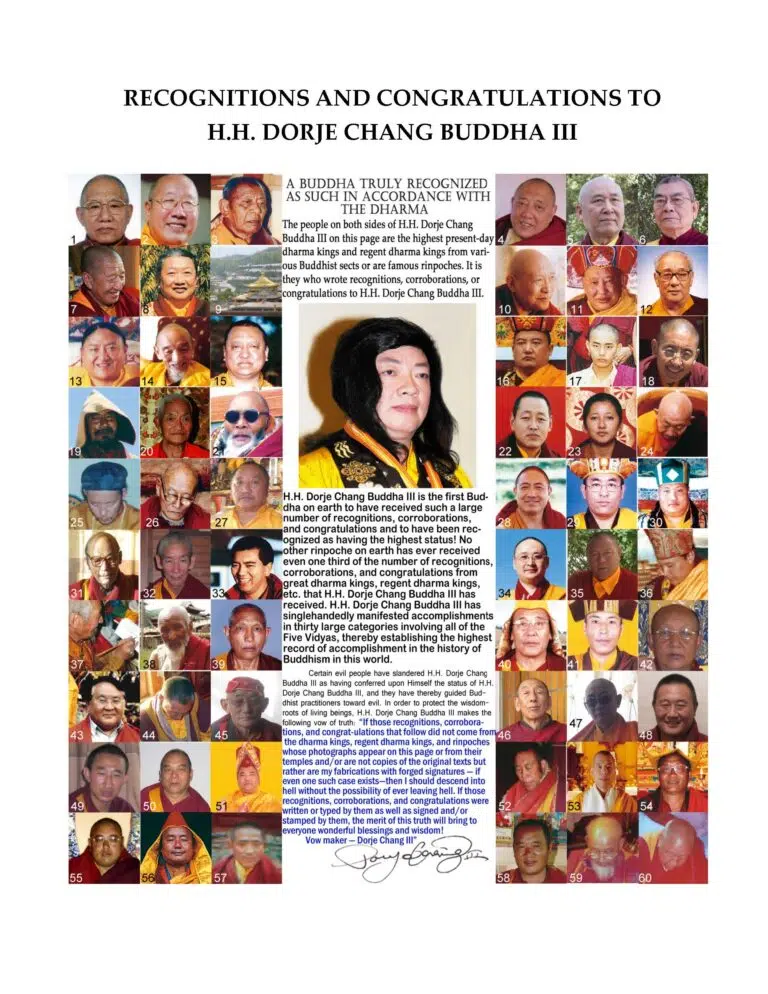
The above photo of sixty such dharma kings, rinpoches, and temples, many of whom are shown below. Photos of some of these dharma kings and rinpoches actually signing or stamping their letters are also included. Although this is only a small portion of those who have recognized H.H. Dorje Chang Buddha, the following list does represent the highest present-day dharma kings and regent dharma kings from various temples or  famous rinpoches in current times. It is they who recognized or corroborated, or sent congratulations to H.H. Dorje Chang Buddha III.

For more information and more detailed biographies on many of these great holy beings as well as their letters of certification and congratulation see A Treasury of True Buddha-Dharma . That book also explains how many of these holy beings had their identities.

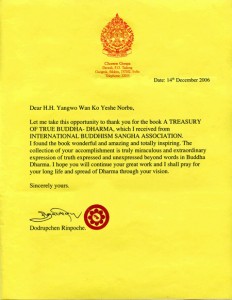
1. H.H. Dharma King Dodrupchen, the world’s sole holder of the highest rainbow body accomplishment dharma

2. H.H. Dharma King Penor, the third supreme world-leader of the modern Nyingma sect

3. H.H. Dharma Achuk, the most pre-eminent greatly virtuous one in present-day Tibet

4. H.E. Dharma King Gongbao Dumu Quji,the Yidam-dharma initiation Master of the 17th Karmapa

5. H.E. Kaichu, the greatly accomplished practitioner of tummo (inner-heat) and vajra meditation dharma

6. H.E. Dharma King Gar Tongstan, a Xian Liang Great Perfection Rainbow Body accomplished one

7. H.H. Dharma King Jigme Dorje, supreme world-leader of the Jonang sect

8.  H.H. Sleep Yoga Dharma King Mindroling Trichen, the fourth supreme world-leader of the modern Nyingma sect and Master of the Dalai Lama

9.  Kumbum Monastery, place where Lord Tsongkhapa was born

10. H.H. Dharma King Trulshik, the fifth supreme world-leader of the modern Nyingma sect and Master of the Dalai Lama

11.  H.H. Dharma King Taklung Tsetul, the sixth supreme leader of the Nyingma sect and Master of the Dalai Lama

12.  H.H. Dharma King Jigdal Dagchen Sakya, supreme leader of the Sakya sect.

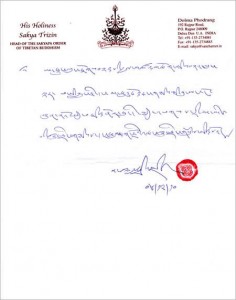
13.  H.H. Sakya Trizin, the one who succeeded to the title of supreme leader of the Sakya sect.

14.  H.E. Dharma King Chogye Trichen.

15.  H.H. Regent Dharma King Shamarpa, Master of the 17th Karmapa

16.  H.E. Regent Dharma King and National Master Goshir Gyaltsab, Master of the 17th Karmapa

17.  H.E. Dharma King Tangtong Gyalpo, father of medicine, ferryboats, bridges, and opera in Tibet in a previous life

18.  H.E. Luozhuo Nima Rinpoche, who in previous lives was both Master and disciple of the Karmapas

19.  H.E. Dharma King Xiazhu Qiuyang of the Geluk sect

20.  H.E. Dharma King Renzeng Nima, Master of Nianlong Rinpoche

21.  H.E. Dharma King Ngagwang Pedma Namgyal Palzangpo of the Jonang sect

22.  H.E. Mindroling Khenchen Rinpoche

23.  H.E. Khandro Rinpoche

24.  H.E. Dzogchen Ganor Rinpoche

25.  H.E. Urgyen Xirao Rinpoche

26.  H.E. Dorje Rinzin Rinpoche, Master of one of the 7th Dzogchen dharma kings

27.  H.E. Luokunsang Rinpoche, Master of the famous actor Jet Li

28.  H.E. Sechen Rabjam Rinpoche

29.  H.E. Renqing Rongbo Barongbo Rinpoche, Eastern Tibet Dharma King of the Nyingma Sect

30.  H.E. Green Jewel Crown Dharma King Jiezhong

31.  H.E. Banma Luozhu Rinpoche

32.  H.E. Dharma King Zongkang of the Kumbum Monastery

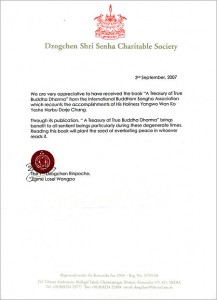
33.  H.E. the 7th Dzogchen Dharma King Jigme Losel Wangpo–India

34.  H.E. the 7th Dzogchen Dharma King Tenzin Longdock Nyima–China

35.  H.E. Saiba Rinpoche

36.  Ven. Junmai Baima Dorje Rinpoche

37.  Ven. Angwang Khyentse Rinpoche

38.  Ven. Yundeng Jiangcuo Rinpoche

39.  Ven. Abbot Kalsang Gyaltsen

40.  Ven. Zangxia Rinpoche

41.  Ven. Bamba Tuben Geleg Gyatso Rinpoche

42.  Ven. Mengjia Rinpoche

43.  Ven. Sogyal Rinpoche, author of The Tibetan Book of Living and Dying

44.  Ven. Baima Rongzhu Rinpoche

45.  Ven. Angwen Zhaba Rinpoche

46.  Ven. Dongpeng Rinpoche

47.  Ven. Suoquie Rinpoche

48.  Ven Suoma Rinpoche

49.  Ven. Tangrang Jiawa Rinpoche

50.  Ven. Gexie Rinpoche

51.  Respected Eba Rinpocheof the Sakya sect

52.  Respected Wangzhi Tudeng Jigmei Rinpoche

53.  Respected Bishop Seicho Asahi

54.  Gele Sanbu Rinpoche

55.  Luozhu Jiangcuo Rinpoche

56.  Lama Renzhen Rinpoche

57.  Gongbo Rinpoche

58.  Great Khenpo Gongcheng

59. Duozhu Tinpoche

60. Pengcuo Rinpoche

H.H. Dodrupchen Dharma King
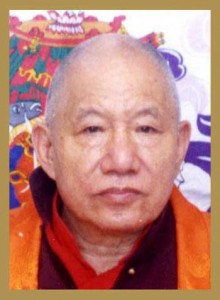
H.H. Dodrupchen Rinpoche (1927-  ), a famous great dharma king of the Nyingma sect who is the sole holder of the complete Longchen Nying-thik, said the following in his letter congratulating the publication of A Treasury of True Buddha-Dharma: “I found the book wonderful and amazing and totally inspiring. . . [It is a] truly miraculous and extraordinary expression of truth expressed and unexpressed beyond words in Buddha Dharma.”

An incarnation of Guru Padmasambhava, H. H. Dodrupchen Rinpoche IV, Thupten Thrinle Palzang, is the holiest great dharma king within the Nyingma lineage. His Holiness is the greatest living Dzogchen or Great Perfection master and the main lineage holder of the Longchen Nyingthik lineage, the highest dharma in Tibet for perfecting the rainbow body. The first Dodrupchen, Jigme Thrinle Oser (1745-1821), was the greatest disciple of Jigme Lingpa (1730-1798). The Third Dodrupchen Jikmé Tenpé Nyima (1865-1926), was both a great scholar and a remarkable yogi.

The Dharma King’s main seat is at Chorten Gonpa Monastery, which His Holiness founded in the outskirts of Gangtok, Sikkim. His Holiness is also the spiritual director of the very small isolated Sera Gonpa (Nubri Monastery) in Kylmo Lung (Peaceful Valley), Nepal. It is unique in that the 50 monks and 50 nuns that study there have identical programs. H. H. Dodrupchen Rinpoche IV is represented in the USA by the Mahasiddha Nyingmapa Center, Kunzang Choling Temple, in Hawley, MA.

H.H. Dharma King Penor Rinpoche

H.H. Dharma King Penor (1932-2009), a supreme dharma king of the Nyingma sect, wrote the following in a letter to rinpoches: “H.H. Dorje Chang Buddha III Yangwo Wan Ko Yeshe Norbu. . . has been recognized by numerous greatly virtuous and eminent monastics. . . A Treasury of True Buddha-Dharma. . .will provide the karmic conditions for living beings to . . . attain the ultimate state of Buddhahood.”

An incarnation of Vajrapani Bodhisattva, the eleventh lineage holder of the Nyingma Palyul tradition, Kyabje Drubwang Pema Norbu Rinpoche, was born in December 1932 in the Kham region of eastern Tibet and left this world in March 2009. After H. H. Dilgo Khyentse departed in 1991, H. H. Penor Rinpoche became the Supreme Head of the Nyingma Sect. In 2001 he resigned from that position to devote more time to his extensive global network of monasteries and dharma centers, recommending that H. H. Mindrolling Trichen Rinpoche assume that position. His Holiness Karma Kuchen Rinpoche IV, is the current head of the Palyul subsect.

His Holiness’s Main seat was at Palyul Monastery in Tibet, one of the six main Nyingma monasteries. His Main seat outside of Tibet was at Namdroling (Thegchog Namdrol Shedrub Dargyeling) Monastery, Bylakuppe in Karnataka State, South India, close to the sacred Drekar Pungwa Stupa where Buddha first taught the Kalachakra Tantra. In 1978 the Ngagyur Nyingma Institute for Higher Buddhist Studies was added along with a nunnery and college for women. His Holiness had a number of branch temples in the US and a retreat center in McDonough, New York. During the 2008 Dharma Propagation Tour, Zhaxi Zhuoma Rinpoche and other tour members were able to have an audience with His Holiness and hear His Holiness Penor Rinpoche praise H.H. Dorje Chang Buddha III. The rinpoche said that it was good that such a holy being would incarnate in these dharma-ending days.

H.H. Jamyang Lungdok Gylatsen Rinpoche
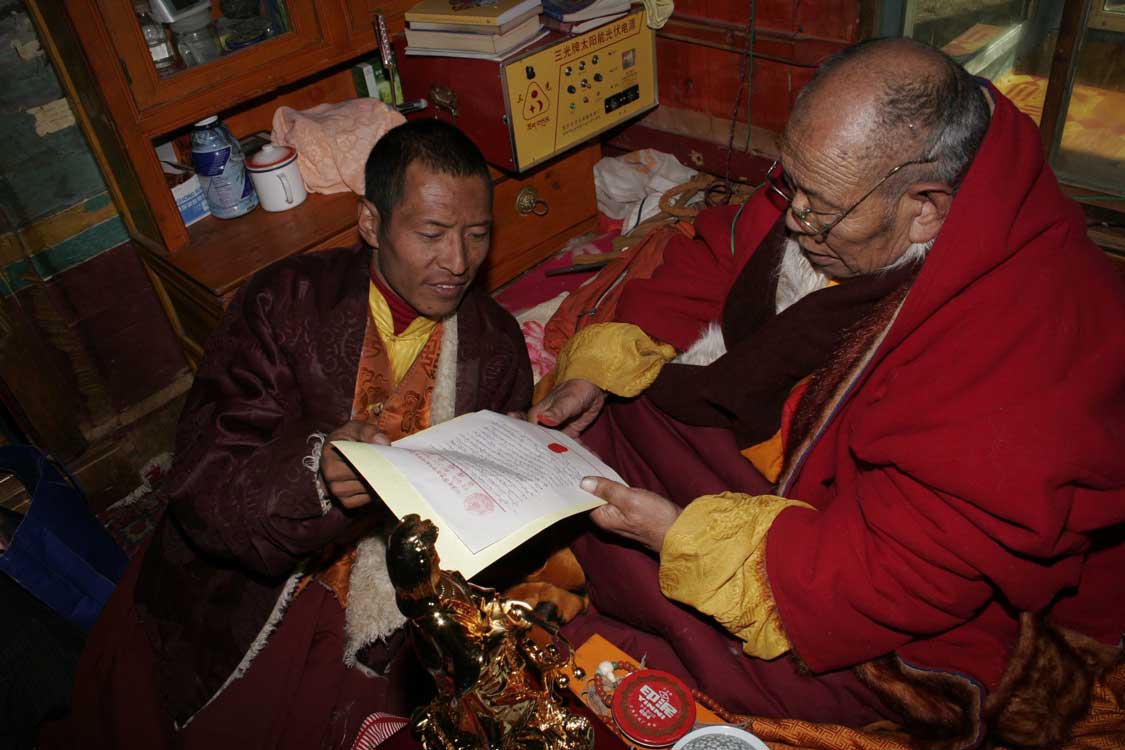
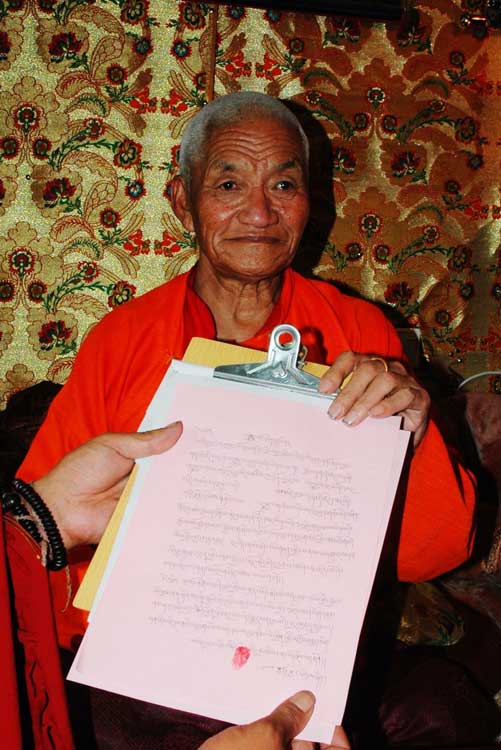
H.H. Dharma King Omniscience Achuk Lama stamps his second fingerprint onto the recognition letter he wrote recognizing the identity of H.H. Dorje Chang Buddha.

H.H. Dharma King Omniscience Jamyang Lungdok Gyaltsen (Lama Achuk 1927-2011),who is the incarnation of Venerable Longsal Nyingpo, stated in his recognition certificate, “. . . H.H. Master Wan Ko Yee . . . is the incarnation of Vimalakirti. . . is Dorje Chang Buddha III. . . .”

H. H. Jamyang Lungdok Gyaltsen or Lama Achuk (Also referred to as Khenpo Achuck Brioche or Achiu Kamabu or Lama A-chos) is an incarnation of the great terton Rigdzin Longsal Nyingpo (1625-1682) of Kathok Monastery. He was the head of the Nyingma Sect in China and the foremost person of great holiness and virtue in all Tibet.

He was born in 1927 in Eastern Tibet and spent 43 years in retreat with his master, Tulku Arik Rinpoche. On July 23, 2011 he entered into paranirvana. His Holiness lived at Yarchen

Vajra body of Lama Achuk

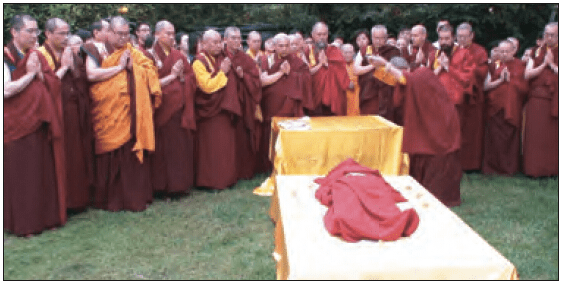
Uddiyana Meditation Monastery, an encampment (gar) of thousands of monks, nuns, and lay practitioners, that he established in an isolated valley near Ganzi (Kandze) in Baiyu (White Jade) County, in Sichuan Province, China. This was the largest concentration of rinpoches and lamas in the entire world.  The cremation ceremony of Lama Achuk commenced on August 29, 2011.  The body of Lama Achuk shrunk from a height of almost  six feet (1.8 meters) to about 1 inch tall, a sign of very high realization.  From time of Lama Achuk’s paranirvana to the cremation, many auspicious signs appeared, five colored rainbows were often sighted in the sky and five colored pure lights often appeared in the area surrounding Lama Achuk’s body.  More than 100,000 sangha members and lay devotees attended the puja and paid respect to the sacred body of Lama Achuk.

One of his disciples, Khenpo A-chos, achieved the rainbow body earlier in 1998. Father Tiso, a Catholic priest who went to Tibet to investigate the rainbow body phenomena at the suggestion of the Benedictine monk David Steindl-Rast, found evidence that H. H. Lama Achuk himself had already achieved the rainbow body as well.

H.H. Dharma King Jigme Dorje

On behalf of the Jonang sect, H.H. Dharma King

H.H. Dharma King Jigme Dorje stamps his seal onto his congratulatory letter to H.H. Dorje Chang Buddha III that he had already signed.

Jigme Dorje (1944-  ), who is the Supreme Dharma King of the Jonang sect, respectfully congratulated H.H. Dorje Chang Buddha III Wan Ko Yeshe Norbu with the following words: “Such superlative accomplishments are truly unprecedented in the past few thousand years, outshining the accomplishments of all

Kalachakra Mandala created by Jonang monks at Jamdha Monastery, Golok Region, Amdo, Tibet

others, both ancient and modern. His Holiness is a shining paragon among Buddhas.”

The supreme dharma king of the Jonang sect, H. H. Jigme Dorje is an incarnation of the Shambhala King, Suchandra, who was the first to receive the Kalachakra tantra from Shakyamuni Buddha. His Holiness continues to hold the highest teachings of the Kalachakra dharma. H. H. Jigme Dorge was born in 1944 and is head of the Zangwa (Tsangwa) Dazang Monastery in Eastern Tibet.

H.H. Dharma King Mindrolling Trichen

The chief secretary for H.H. Dharma King Mindrolling Trichen (1031-2008) of the Nyingma sect, Ven. D. G. Khochhen Rinpoche, sent a congratulatory letter on behalf of Dharma King Mindrollling Trichin and the Mindrolling Sangha in which he wrote, “. . . H.H. Wan Ko Yeshe Norbu Dorje Chang brings good fortune and wisdom to all living beings.”

Trichen Jurme Kunzang Wangyal, Mindrolling (Mindling) Trichen Rinpoche XI (1931-2008), was the supreme head of the Nyingma sect. Although the original seat of Mindrolling, one of the six major Nyingma monasteries founded in 1876 by Rigzin Terdak Lingpa on the south side of the Tsangpo River, is near Lhasa, Tibet, a new Mindrolling Monastery has been established at Dehra Dun, in Uttranchal State, India. The Nagyur Nyingma College, Mindrolling’s Institute of Advanced Buddhist Studies. (Five Vidyas University) is also located there. His Holiness’s daughter, H.E. Khandro Rinpoche has a retreat center in the USA and continues the Jetsunma lineage of female masters there and at Samten Tse, her nunnery in India.

H.H. Dharma King Trulshik

The famous H.H. Dharma King Trulshik Rinpoche (1924-2011), who is a master of H.H. the Dalai Lama and the root master of several Tibetan Buddhist dharma kings and lineage holders, wrote the following words respectfully congratulating Buddha Vajradhara Yangwo Wan Ko Yeshe Norbu: . . . “A Treasury of True Buddha- Dharma. . .will become the cause whereby each sentient being who has descended into the abyss of the six realms of reincarnation leaves suffering and attains happiness.”

H. H. Nyingma Dharma King Zhadeu Trulshik (Trulshig) Chenpo Ngawang Chokyi Lodro Rinpoche (1924-2011), who resided in the Everest region of Nepal, was an incarnation of Maitreya Bodhisattva and a lineage holder from the first Dodrupchen, Jigme Thrinle Oser. His Holiness was considered the closest and most accomplished disciple of  H. H. Dilgo Khyentse Rinpoche and like Khyentse Rinpoche a leading proponent of the Rime or non-sectarian movement in Tibet. He was entrusted with the responsibility of finding and recognizing the incarnation of Khyentse Rinpoche after he passed on in 1991 as well as Tulku Urgyen Rinpoche after he left this world in 1996. Dharma King Trulshik founded a remote monastery and retreat center in Nepal at Tubten Choling. He was the fifth Supreme Leader of the Nyingma Sect until his death in 2011.

H.H. Taklung Tsetrul Rinpoche

The highest dharma king of the Northern Treasure lineage of the Nyingma sect, H.H. Dharma King Taklung Tsetrul (1926-2015), wrote the following words of congratulations: “His Holiness Dorje Chang Buddha III Wan Ko Yeshe Norbu possesses the true dharma of the Buddhas . . .

H. H. Taklung Kyabgon Tsetrul Thupaten Gyaltsen Rinpoche is the Dharma King of the Drak Dorje (Vajra or Indestructible Rock) Monastery, one of the six main Nyingma Monasteries, founded in 1610 by Rigdzin Ngakgi (Aji) Wangpo (1580-1639). This monastery specialized in the changter or jangter tradition of Rigdzin Godem (1337-1408). Rigdzin Godem was the master of the “northern terma (treasures)” tradition of the Nyingma school. Rigdzin Godem literally means “the vidyadhara with the vulture feather.” He received this name because three vulture feathers grew from his head when he was twelve years old, and five more when he was twenty-four. A reincarnation of Dorje Dudjom of Nanam, one of the nine close Tibetan disciples of Guru Padmasambhava, he is also counted among the five king-like tertons and one of the three nirmanakayas of Guru Padmasambhava. In 2011 he became the Supreme Leader of the Nyingma Sect.

H.H. Dharma King Jigdal Dagchen Sakya

H.H. Dharma King Jigdal Dagchen Sakya (1929-  ), the second highest leader of the Sakya order, offered the following congratulations: “Many masters praise H.H. Dorje Chang Buddha III Wan Ko Yeshe Norbu and his book about his Dharma activities. The book’s name is A Treasury of True Buddha-Dharma.”

H. H. Jigdal Dagchen Sakya Rinpoche is the head of the Phuntshok Phodrang branch of the Khon dynasty, the main lineage of the Sakya tradition. The leadership of the Sakya sect has rotated between the Phuntshok Phodrang branch and the Dolma Phodrang branch, currently headed by H. H. Sakya Trizin. H. H. Jigdal Dagchen Sakya founded and serves as the main teacher of Sakya Monastery of Tibetan Buddhism in Seattle, WA. He has given teachings and empowerments in other parts of the United States and Canada as well as various European and Asian countries.

H.H. Dharma King Sakya Trizin
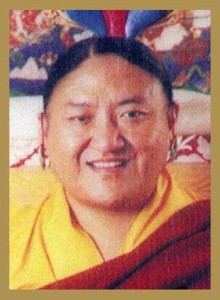
Sakya_Trizin

H.H. Great Vehicle Dharma King Sakya Trizin (1945-  ), who is the supreme leader of the Sakya order and the nirmanakaya of Manjushri Bodhisattva, wrote the following recognition concerning the descent into this world of H.H. Dorje Chang Buddha III: “. . . H.H. Yangwo Wan Ko Yeshe Norbu . . . is . . .Buddha Vajradhara Dorje Chang Buddha III.”

A true nirmanakaya of Manjushri Bodhisattva, The 41st Patriarch of the Khon lineage of the Sakya tradition was born September 7, 1945 in Tsedong near Shigatse, Tibet. While maintaining temples and dharma centers all over the world, His Holiness lives in Rajpur in Northern India with his wife and two sons.

The main seat of H. H. Sakya Trizin, the Sakya Centre at Tsechen Tenpai Gatsal Monastery, and the Sakya College are located north of New Delhi in Rajpur, Dehradun, India. Another major Sakya monastery exists at Sa Magon in Puruwalla, Himachal Pradesh, a state in northwest India, along with the Sakya Institute for Higher Buddhist Studies.

The seat of H. H. Sakya Trizin in the United States is located at Tsechen Kunchab Ling, the Temple of All-Encompassing Great Compassion, in Walden, New York. His older sister, H.E. Sakya Jetsun Chimey Luding (1938-), lives in North America.

H.E. Chogye Trichen Rinpoche

H.E. Dharma King Chogye Trichen, Ngawang Khyenrab Thupten Lekshe Gyatso (1920-2007), who was Dharma King of the Tsharpa branch of Sakya sect and the root master of H.H. the Dalai Lama, offered the following respectful congratulations: “H.H. Buddha Vajradhara (Dorje Chang) Yangwo Wan Ko Yeshe Norbu: A Treasury of True Buddha-Dharma. . . is the guidepost leading to true Buddha- dharma and the gateway of the dharma leading to benefiting and providing happiness to sentient beings.” H.E. Dharma King Chogye Trichen and Ven. Shabdrung Rinpoche are seen here reading the manuscript copy of A Treasury of True Buddha-Dharma, which has now been published as H.H. Dorje Chang Buddha III.

H. E. Chogye Trichen RInpoche, Ngawang Khyenrab Thupten Lekshe Gyatso, was the dharma king and head of the Tsharpa (Tsar) sub-sect of the Sakya Sect and thought to be an incarnation of Mahasiddha Virupa. He was enthroned as the 26th patriarch of Phenpo Nalendra Monastery in North Lhasa, Central Tibet, that was founded in 1425 by the great Sakya master Rongton Sheja Kunrig (1367-1459). The “Whispered-Lineage of Tshar” founded by Tsharchen Losel Gyatso (1502-1566) considered this to be the seat of their lineage. H. E. Chogye Trichen rebuilt the Nalendra Monastery in Nepal, which became the seat of the Tsharpa sub-sect. His Eminence established the Tashi Rabten Ling Monastery in Lumbini, the birthplace of Lord Buddha, as well as the Jamchen Lhakhang Monastery and retreat center in Boudha, Katmandu where he resided until his death in 2007. He also established centers in Hong Kong, Taiwan, Australia, and New Zealand. His Eminence taught in the West and started dharma centers in America as well.

H.E. Sharmapa

The Red Jewel Crown Dharma King H.E. Shamarpa Rinpoche (1952-2014) is the nirmanakaya of Kuan Yin Bodhisattva and is the chief of the four regents of the Kagyu sect. He offered his respectful congratulations with the following words: “H.H. Yangwo Wan Ko Yeshe Norbu . . . the third incarnation of Vajradhara . . . all his accomplishments . . . will benefit sentient beings. . .”

H. E. Mipham Chokyi Lodro of the Kagyu Sect, an incarnation of Avalokiteshvara, is the present Shamarpa and the second nirmanakaya of the Karmapa. The second Karmapa, Karma Pakshi (1204 – 1283), predicted that “future Karmapas shall manifest in two nirmanakaya forms.” The Karmapa would continue to incarnate at different times as two beings and one would recognize and teach the other. One would be known as the Black Jewel Crown Karmapa and the other as the Ruby-red Jewel Crown Shamarpa. The Shamarpa, in the absence of the Karmapa, is the lead regent with responsibility over both administrative and Buddha-dharma matters. His Eminence was born in 1952 in Derge, Tibet. The main seat of the Karma Kagyu lineage has been at Tsurphu Monastery in central Tibet where it was established in 1159 by the First Karmapa, Dusum Khyenpa (1110-1193). After leaving Tibet, the 16th Karmapa established the main seat of the Karmapa outside of Tibet at Rumtek Monastery.

His Holiness, the 14th Shamar Rinpoche or Shamarpa has established many dharma centers in the West.

H.E. Goshir Gyaltsab Rinpoche

H.E. Goshir Gyaltsab Rinpoche (1954-  )is the incarnation of Patriarch Gampopa. He is the only regent for the Karmapa Great Jewel Dharma King who has the title of “National Master.” He respectfully praised the incomparable Master, H.H. Yangwo Wan Ko, as Vimalakirti and stated: “. . . .I sincerely wish that . . . the multitudinous living beings who have the karmic affinity to read A Treasury of True Buddha-Dharma. . . will attain the supreme fruits of perfect enlightenment, omniscience, and Buddhahood!”

The Vajra Regent and caretaker for the Karmapas, H. E. Goshir, is the current incarnation of the founder of the Kagyu Sect, Master Gampopa (1079-1153). He lives in Sikkim where he oversees Rumtek, the main monastery of the Karma Kagyu as well as his own monastery Ralang, also in Sikkim. He was born in Nyimo, near Lhasa, in 1954. In 1959, the 16th Gwalya Karmapa, Rangung Rigpe Dorje, carried the dharma king on his back as he left Tibet. The Orange Jewel Crown Dharma King along with The Ruby-red Jewel Crown Dharma King Shamarpa, Situpa Rinpoche, and Jamgon Kongtrul Rinpoche are considered the four princes or regents for the Black Crown Karmapa. There are currently two incarnations considered to be the 17th Black Crown Karmapa, Urgyen Trinley Dorje (1985– ), who is recognized by H. E. Goshir Gyaltsab Rinpoche and H. E. Tai Situ Rinpoche, and Trinley Thaye Dorje (1983– ), who is recognized by H. E. Shamarpa Rinpoche. The North American seat of the Karma Kagyu, Karma Triyana Dharmachakra, is located in Woodstock, NY.

Tangtong Gyalpo Bodhisattva

The name Tangtong Gyalpo Bodhisattva has gone down in Buddhist history. In the past, this Bodhisattva was the leader of the four main sects of esoteric Buddhism in India, Bhutan, Sikkim, Mongolia, and eastern Tibet. The people of Tibet call this Bodhisattva the father of medicine, the father of bridges, the father of Tibetan opera, and the father of ferryboats. During a dharma assembly held at Hua Zang Si in San Francisco of the United States in which Buddha-dharma realization was manifested, H.E. the sixteenth Tangtong Gyalpo Bodhisattva saw the realization and virtue of H.H. Dorje Chang Buddha III Wan Ko Yeshe Norbu. He was astounded and immediately prostrated before His Holiness, formally acknowledging His Holiness as his Master. In his congratulatory letter to His Holiness, he stated the following: “. . . H.H. Wan Ko Yeshe Norbu is . . . the Master of the Five Buddhas, and has for the first time in the history of Buddhism in the human realm truly manifested complete proficiency in exoteric and esoteric Buddhism and perfect mastery of the Five Vidyas. This is a goal of Buddhism that all other Buddhists have not been able to achieve. This goal has finally been achieved by H.H. Wan Ko Yeshe Norbu.”

H.E. the sixteenth Tangtong Gyalpo Bodhisattva (Thangtrul Rinpoche) took birth in Bhutan. His physical appearance resembles that of Guru Padmasambhava. Even when he sleeps, his eyes remain open. He saw H.H. Wan Ko Yeshe Norbu during a Dharma Assembly that took place in 2005 at Hua Zang Si in San Francisco, U.S.A. In a supernatural state of samadhi, he instantly saw that H.H. Dorje Chang Buddha, the highest ancient Buddha in the dharma realm, had already come to this world again. He at once formally acknowledged H.H. Dorje Chang Buddha III Wan Ko Yeshe Norbu as his master. H.H. Dorje Chang Buddha III asked him, “Did you follow and learn dharma under Guru Padmasambhava? Why have you come here?” H.E. Tangtong Gyalpo answered that he had received teachings directly from Guru Padmasambhava and from H.H. Sakya Trizin. He also said that he had come to request the highest dharma in order to save living beings. H.H. Dorje Chang Buddha III immediately snapped His fingers, and a dharma bowl manifested awesome power. H.H. Dorje Chang Buddha III then accepted H.E. Tangtong Gyalpo as one of his disciples who is on the level of a great venerable one and performed an initiation for him. H.E. Tangtong Gyalpo took that dharma bowl back to his home country.

He later learned that the book A Treasury of True Buddha-Dharma about the H.H. Dorje Chang Buddha III Wan Ko Yeshe Norbu Holiest Tathagata was about to be published. He thereupon organized many rinpoches to practice the Kuan Yin Dharma one billion times as an offering to His Holiness Dorje Chang Buddha III.

H.E. Xiazhu Quiyang Rinpoche

H.E. Xiazhu Qiuyang Rinpoche, who is the incarnation of Venerable Naropa, respectfully congratulated the highest and holiest Wish Fulfilling Jewel Dharma King Wan Ko as follows: “. . .the book A Treasury of True Buddha-Dharma. . . is the highest authentic dharma that is of benefit to living beings.”

H.E. Dharma King Xiazhu Qiuyang has just stamped his fingerprint onto the congratulatory letter he wrote to H.H. Dorje Chang Buddha III.

H. E. Xiazhu Qiuyang Rinpoche of the Geluk Sect is a current incarnation of the great Mahasiddha Naropa (1016-1100), the venerable leader of 100,000 dakinis. Naropa, a former abbot at the famous Nalanda University in north-east India, was Master Marpa’s guru and the disciple of Tilopa.  Master Tilopa received the dharma directly from Dorje Chang Buddha as did Naropa’s sister, Lady Niguma. H. E. Xiazhu Qiuyang was born in 1945, and has become greatly accomplished in Dakini Dharma, having received guidance and empowerment from Vajrayogini herself.

H.E. Renzeng Nima Rinpoche
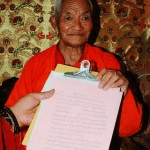
H.E. Dharma King Renzeng Nima is holding the congratulatory letter he wrote to H.H. Dorje Chang Buddha III.

H.E. Mighty Lion Dharma King Renzeng Nima previously vowed to stay in a mountain valley engaged in solitary meditation for the rest of his life. He possesses supernatural powers, inspires awe throughout Tibet, and is the reincarnation of King Gesar. He wrote the following words of recognition: “. . . H.H. Master Wan Ko Yee . . . is the true incarnation of Dorje Chang Buddha.”

H.E. Dharma King Renzeng Nima of the Nyingma Sect is a great terton and the current nirmanakaya of King Tuiba Gawa Gesar, the hero of Tibet’s great epic saga.

H.E. Ngagwang Pedma Namgyal Palzangpo

His Eminence Ngagwang Pedma Namgyal Palzangpo stamps his seal onto his congratulatory letter to H.H. Dorje Chang Buddha III that he had already signed.

H.E. Dharma King Ngagwang Pedma Namgyal Palzangpo, who is a dharma king of the Jonang sect, respectfully congratulated H.H. Dorje Chang Buddha III Wan Ko Yeshe Norbu with the following words: “The body and lifespan of the Buddha Vajradhara of the dharma realm never comes to an end. His Holiness manifests Mahayana states and has the most wondrous powers of great compassion.”

The Jonang Dharma King, H. E. Ngagwang Pedma Namgyal Palzangpo (Penam Rinpoche), was born in 1925 near Amnhymachen, the holy Mountain of the protector Machen Pomra, in Amdo, Tibet. He has been recognized as an incarnation of Duqin Langwa, an incarnation of a close disciple of Guru Padmasambhava, Gelong Namuke Niangbo. His Eminence taught the Kalachakra Dharma in the United States and established Dorje Ling Dharma Centers in New York City and Atlanta, Georgia.

H.E. Mindrolling Khenchen Rinpoche

H.E. Mindrolling Khenchen Rinpoche of the Mindrolling Monastery wrote the following congratulations: “His Holiness Buddha Vajradhara III Yangwo Wan Ko Yeshe Norbu[’s] . . . A Treasury of True Buddha-Dharma. . . will restore dharma that had faded and will cause the growth of dharma that has not yet faded.”

The ninth Mindrolling Khenchen Rinpoche, Venerable Jigmey Namgyal, was born in 1970. His lineage began with the great translation master Lochen Dharmashri (1654-1717), the younger brother of Rigzin Terdak Lingpa, the founder of the original Mindrolling Monastery, located south of Lhasa in the Drachi Valley of central Tibet.

Since 1992, His Holiness has been the president of Nagyur Nyingma College, Mindrolling’s Institute of Advanced Buddhist Studies. (Five Vidyas University) at Dehra Dun, in Uttranchal State, India. The college was founded in conjunction with the new Mindrolling Monastery also located at that location.

H.E. Khandro Rinpoche

H.E. Jetsun Khandro Rinpoche of the Mindrolling lineage within the Nyingma sect is the incarnation of Yeshe Tsogyal. She sent a congratulatory letter expressing her deep gratitude toward H.H. Wan Ko Yeshe Norbu Dorje Chang Buddha for the book A Treasury of True Buddha-Dharma.

As an incarnation of Yeshe Tsogyal, the advanced disciple of Guru Padmasambhava, Her Eminence is part of the Jetsunma lineage of female masters at Mindrolling Monastery, which was founded in 1676 by Rigzin Terdak Lingpa. Her father, H. H. Trichen Jurme Kunzang Wangyal, the XI Mindrolling Trichen Rinpoche, was the head of the Nyingma sect.

Khandro Rinpoche has a North American retreat center in the Northern Shenandoah Valley adjoining the Blue Ridge Mountains in Virginia as well as Samten Tse, a nunnery in India.

H.E. Dzogchen Ganor Rinpoche

The famous H.E. Dzogchen Ganor Rinpoche offered the following congratulations: “. . . A Treasury of True Buddha-Dharma is the wish-fulfilling true dharma that the Buddha expounded.”

H. E. Ganor Rinpoche (1942- ) is the 14th reincarnation of Terton Ratag Pelsang (Karma Lekshe Drayang). He was born near the town of Palpung in the Derge District in eastern Tibet. Because of his level of realization and practices, he was able to perform many supernatural feats like leaving his footprint in rocks and tying swords into knots as if they were rope. He was also able to communicate with non-humans like nagas and devas. He was a great terton who revealed many hidden treasures.

H.E. Urgyen Xirao

H.E. Urgyen Xirao Woxiu, who is a great terton revered by all four types of monastic and lay Buddhists in the land of the Han- Chinese and the land of the Tibetans, wrote in his recognition certificate the following: “. . . Buddha Vajradhara assisted Sakyamuni Buddha in teaching the five hundred monks and other holy ones. . . . H.H. Master Wan Ko Yee, Yangwo Wan Ko Yeshe Norbu, is the incarnation of  Buddha Vajradhara.”

Ven. Ugyen Xirao Woxiu of the Nyingma Sect is an incarnation of Ugyen Pema Lingpa (1450-1521), the fourth and most controversial of the Five Terton Kings. Guru Padmasambhava prophesied that Pema Lingpa would recover 108 sacred texts as termas, but due to inauspicious circumstances he only recovered 32. He was known for his spectacular and daring methods in recovering these texts. Once he dived into a lake in Bhutan holding a lighted butter lamp. He told onlookers that the lamp would go out if he were a false spirit. After he disappeared in the dark pool and all thought that he had drowned, he returned to the surface with his butter lamp still brightly burning and with a new terma. He is considered the greatest spiritual master of Bhutan and the immediate incarnation of Master Longchenpa (1308-1364).

H.E. Dorje Rinzin Rinpoche
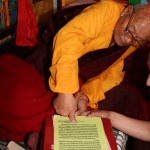
H.E. Dorje Rinzin Rinpoche, master of the seventh Dzogchen Dharma King in China, stamps his fingerprint onto the congratulatory letter he wrote to H.H. Dorje Chang Buddha III.

H.E. Dorje Rinzin Rinpoche is the incarnation of Rigzin Terdak Lingpa Unchanging Vajra, who was the founder the Mindrolling monastery. H.E. Dorje Rinzin Rinpoche, a holy being of great enlightenment, is now the master of many great rinpoches. He said the following in his congratulatory letter: “. . . the accomplishments contained in A Treasury of True Buddha-Dharma. . . are those of Dorje Chang Buddha Wan Ko Yeshe Norbu, the Master of the Five Buddhas.”An incarnation of Rigzin Terdak Lingpa Unchanging Vajra Being (1646-1714) who was the great terton and founder of the Mindrolling monastery and lineage, H. E. Dharma King Dorje Rinzin Rinpoche of the Nyingma Sect was a model for eminent monastics to follow and emulate.

H.E. Dharma King Rabjam

H.E. Shechen Rabjam Rinpoche, the dharma king of the Shechen monasteries of the Nyingma sect, offered the following words of congratulations: “. . . H.H. Dorje Chang Buddha III Yangwo Wan Ko Yeshe Norbu, the Wish-Fulfilling Jewel Holy One, has taken action that spreads and makes grander the true Buddha- dharma. How wonderful!”H. E. Shechen Rabjam Rinpoche VII (1966- ) is the grandson of H. H. Dilgo Khyentse Rinpoche. The second Rabjam Rinpoche founded Shechen Monastery, one of the six main Nyingma Monasteries in Tibet, in 1695 in Kham. H. E. Shechen Rinpoche VII is the abbot and dharma king of Shechen Tennyi Dargyeling Monastery in Nepal, one of the largest and most beautiful monasteries outside of Tibet. It is located near the Great Stupa of Boudhanath, a suburb of Kathmandu and is noted for its ceremonies and sacred dances.

H.E. Renqing Rongbo Barongbo Rinpoche

H.E. Renqing Rongbo Barongbo Rinpoche, an eastern Tibetan Dharma King of the Nyingma sect, respectfully praised H.H. Wan Ko Yeshe Norbu with the following words: “The Master is the magnificent sambhogakaya Buddha who has descended into the human world again. . . . His Holiness’s accomplishments are unprecedented in this world and reflect the pinnacle of wisdom. May H.H. Dorje Chang Buddha boundlessly save living beings. . .”

H.E. Dharma King Renqing Rongbo Barongbo Rinpoche (1969- ) of the Nyingma Sect is a current incarnation of Venerable Ananda.

H.E. Green Jewel Crown Karmapa Dharma King Jiezhong

The Green Jewel Crown Karmapa, H.E. Great Jewel Dharma King Jiezhong, prostrated to H.H. Yangwo Wan Ko Yeshe Norbu, the Buddha Vajradhara, and wrote the following words: “A Treasury of True Buddha-Dharma about the Buddha Vajradhara is a concrete expression of the highest Buddha-dharma wisdom and abilities.”

The sixth Karmapa Green Jewel Crown Dharma King was born in 1967 in Tibet amidst wonderful auspicious signs. The 16th Karmapa, H. H. Great Jewel Dharma King Rangjiong Rigpe Dorje in India, recognized him as a previous incarnation of the Green Jewel Crown Dharma King Jiezhong Rinpoche.

H.E. Jigme Losel Wangpo

H.E. Jigme Losel Wangpo

H.E. Jigme Losel Wangpo, the seventh Dzogchen Dharma King who resides in India, wrote the following words of congratulations: “. . . A Treasury of True Buddha-Dharma brings benefit to all sentient beings. . . .”

There are two incarnations recognized as the seventh Dzogchen Rinpoche of the Nyingma Sect: H. E. Jigme Losel Wangpo, born in 1964 in Gangtok, Sikkim, and H. E. Tenzin Longdock Nyima, born in Qinghai Province in the Bare Region of lower Amdo in 1974.

The original Dzogchen Monastery in Tibet, one of the six main Nyingma monasteries, was established in 1684 by Pema Rigdzin. More than 60,000 people have attained the rainbow body and become Buddhas in that lifetime while practicing at that monastery. H. E. Dharma King Tenzin Longdock Nyima Dzogchen Rinpoche VII is the current throne holder of Dzogchen Monastery in Tibet.

The official seat of H. E. Dharma King Jigme Losel Wangpo Dzogchen Rinpoche VII is at the new Dzogchen Monastery in Dhondenling, South India.

H.E. Tenzing Longdock Nyima

H.E. Tenzin Longdock (Lungdok) Nyima, the seventh Dzogchen Dharma King who resides in China, respectfully congratulated the ancient Buddha who saves all sentient beings in the three spheres, H.H. Yangwo Wan Ko Yeshe Norbu, as follows: “. . . A Treasury of True Buddha-Dharma. . . is like the. . . Wish-Fulfilling Jewel in that it outshines all ancient or modern, Chinese or non-Chinese books. . . . The book also opens up and develops the spiritual wisdom of people.”

Ven. Junmai Baima Dorje Rinpoche

Ven. Junmai Baima Dorje Rinpoche of the Shechen Temple is a nirmanakaya of Vajravarahi. He wrote a letter expressing his respect for the Three Bodies and Four Wisdoms of H.H. Yangwo Wan Ko Yeshe Norbu, the Dharma King of the Three Spheres. In that letter, he stated, “H.H. Great Dharma King is the first holy being who used true realization to display fully in the dharma realm the teachings of the Buddha! H.H. Great Dharma King is the true Buddha Vajradhara, the teacher of both humans and celestial beings!”

Ven. Junmai Baima Dorje Rinpoche VI of the Shechen Monastery in Tibet is a nirmanakaya of  Vajravarahi. The first Junmai Baima Dorje was a famous terton and the second achieved the rainbow body. As a small child, the rinpoche could transform a thick knife into a knot. That knife is currently at Hua Zang Si in San Francisco as one of the many holy objects that they hold for public display and veneration.

Ven. Angwang Khyentse Rinpoche

Venerable Angwang Khyentse Rinpoche was the closest disciple of H.H. Dzongsar Khyentse Chokyi Lodro. He is the head of the Gensa Temple of the Sakya sect and has been in retreat for a long period of time. He possesses supernatural powers and is praised throughout the snowy plateaus of Tibet for his cultivation. In his congratulatory letter, he stated, “Greatest leader of Buddhism, H.H. Wan Ko Yeshe Norbu: . . . .Only the wisdom of the ancient Buddha, Dorje Chang Buddha, could produce such a textbook [as A Treasury of True Buddha-Dharma] . . . !”

Ven. Angwang Khyentse (Qinzhe) Rinpoche is the Head of the Sakya Gensa Temple in Tibet. He has been in retreat for many years. He is a successor to the dharma lineage of the second Jamyang Khyentse, Dzongsar Chokyi Lodro, the former abbot of the Dzongsar Monastery in Tibet and later the guru of the royal family of Sikkim. Dzongsar Khyentse was one of the incarnations of Jamyang Khyentse Wangpo (1820-1892), the great nonsectarian(rime) master and terton of the nineteenth century.

Ven. Yundeng Jiangcuo Rinpoche

The eighty-year-old Ven. Yundeng Jiangcuo Rinpoche, who is the incarnation of Patriarch Milarepa, respectfully offered the following congratulations on the publication of A Treasury of True Buddha-Dharma about Buddha Vajradhara: “This book manifests great Buddha-dharma based wisdom and contains accomplishments that no other person in history has achieved. Only H.H. Wan Ko Yeshe Norbu has attained such accomplishments.”

Ven. Abbot Kalsang Gyaltsen

Ven. Kalsang Gyaltsen, who represents H.H. the Dalai Lama and is fully authorized to exercise control over the Geluk sect in Nepal, stated in his congratulatory letter the following: “I am sure the works of Venerable Vajradhara Master Wan Ko will inspire all the sentient beings to a better understanding of both the theoretical and practical aspects of the Buddhist philosophy.”

Ven. Zangxia Rinpoche

The famous Zangxia Rinpoche prostrated to the ancient Buddha and greatest leader of Buddhism, H.H. Dorje Chang Buddha III, and stated, “. . . led us to find Dorje Chang Buddha, our supreme ancient Buddha, and thereby enabled all living beings to have the ultimate refuge in this Dharma-Ending Age!”

Ven. Bamba Tuben Geleg Gyatso Rinpoche

The famous Respected Bamda Tubten Geleg Gyatso Rinpoche stated: “. . . [I] beseech the magnificent and holy Dorje Chang Buddha III to bless all sentient beings in the six realms of reincarnation so that they may realize enlightenment soon, hear of and read A Treasury of True Buddha-Dharma, . . . and attain the perfect, supreme, and complete enlightenment of a Buddha.”

Ven. Baima Rongzhu Rinpoche

Ven. Baima Rongzhu Rinpoche is widely respected in India and is revered by the people who live along the banks of the Jinsha River. Having prostrated to H.H. Wan Ko Yeshe Norbu, he wrote, “Having read A Treasury of True Buddha-Dharma, I learned that the ancient Buddha, Dorje Chang Buddha, has descended to the human world again. This is truly our greatest blessing!”

Respected Eba Rinpoche

Respected Eba Rinpoche Danba Wangxu, the fifth dharma king of his temple, used the following words to express on behalf of other rinpoches deep gratitude to the most venerable H.H. Wan Ko Yeshe Norbu: “The supreme Dorje Chang Buddha has brought to us A Treasury of True Buddha-Dharma!”

Respected Khenpo Chucheng Qupei

Respected Khenpo Chucheng QupeiRespected Khenpo Chucheng QupeiRespected Khenpo Chucheng Qupei, whose status as khenpo was conferred upon him by H.H. Dharma King Sakya Trizin, respectfully praised H.H. Dorje Chang Buddha III Wan Ko Yeshe Norbu, as follows: “His Holiness is the supreme holder of the 84,000 Buddha-dharmas, the one who is in charge of all dharma methods of Buddhism. His Holiness was the first sambhogakaya Buddha in the dharmadhatu.”

Respected Wangzhi Tudeng Jigmei Rinpoche

Respected Wangzhi Tudeng Jigmei Rinpoche, the famous abbot of the Tsangtsang Temple, expressed his gratitude to the most venerable ancient Buddha, H.H. Dorje Chang Buddha III Wan Ko Yeshe Norbu, as follows: “The most honorable ancient Buddha has perfectly and flawlessly brought to this world the Buddha-dharma of Tibet’s four main sects as well as the exoteric Buddha-dharma.”

Respected Bishop Seicho Asahi

Respected Bishop Seicho Asahi is the supreme leader of the headquarters of the Koyasan Shingon-shu North American Mission. He praised H.H. Dharma King Wan Ko Yeshe Norbu, the Buddha Vajradhara, with the following words: “. . . Your Holiness’s great accomplishments on Buddhism . . . have never been seen before in the world. Your Holiness is truly the primordial Buddha who incarnated to this world to save living beings and to transmit the authentic Buddha-dharma of Tathagata.”

Bishop Seicho Asahi is the supreme leader of the of the Koyasan Shingon-shu North American Mission which has its headquarters in Los Angeles, CA. He was born in Hiroshima, Japan and came to California as a Buddhist minister in 1981. He has been active in community work, the Buddhist Peace Fellowship, interfaith activity, and developing a prison sangha at maximum security Folsom Prison near Sacramento, where he served as Buddhist chaplain prior to becoming Bishop.

The main headquarters of this sect of Esoteric Buddhism, Kongobu-ji (Vajra Peak Temple), is located at Koyasan (Mount Koya) in Wakayama perfecture, Japan. It has been designated as a World Heritage site by UNESCO. The temple was constructed in 1593 and rebuilt in 1863.

Gele Sanbu Rinpoche

Gele Sanbu Rinpoche prostrated to the supreme H.H. Yangwo Wan Ko Yeshe Norbu and stated, “H.H. Great Dharma King thoroughly understands the true causes and effects concerning all things in the universe. His Holiness is the first great holy being in the history of Buddhism to truly manifest in the human realm complete proficiency in exoteric and esoteric Buddhism and perfect mastery of the Five Vidyas!”

Luozhu Jiangcuo Rinpoche

Luozhu Jiangcuo Rinpoche prostrated to H.H. Wan Ko Yeshe Norbu and wrote, “I was fortunate to have respectfully read A Treasury of True Buddha-Dharma about the greatest leader of Buddhism, H.H. Yangwo Wan Ko Yeshe Norbu. . . .  we see that a true Buddha has again descended into this world!”

Lama Renzhen Rinpoche
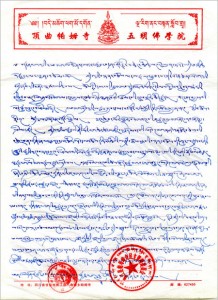
Lama_Renzhen_Rinpoche

Lama Renzhen Rinpoche of the Five Vidyas Buddhist Institute prostrated to H.H. Wan Ko Yeshe Norbu and praised the accomplishments of the Vajra Dharma King of Great Holiness with the following words: “We have respectfully read A Treasury of True Buddha-Dharma about H.H. Buddha Vajradhara Great Dharma King and were truly astounded! . . . H.H. Great Dharma King represents the Buddha-dharma!”

Link: https://peacelilysite.com/2025/08/22/h-h-dorje-chang-buddha-iii-has-been-truly-recognized-in-accordance-with-the-dharma/

Dharma King and Dharma Wheel Initiation

In Exoteric Buddhism, there is a revered title for a special kind of master known as the Dharma King. In this Dharma-ending age, it is exceedingly rare and difficult to encounter a true Dharma King. According to the Vajrayana Buddhist scripture Vajra Secret Determination (Vajra Mi Jian), a Dharma King is the Sovereign of All Dharmas. A genuine Dharma King is either a Buddha or a great Bodhisattva who has attained at least the Twelfth Bhumi and has reincarnated into this world. Such a being must possess the twofold qualities of worldly and transcendental virtues.

Worldly Virtues

Worldly, or inner-worldly, virtues include mastery of both Exoteric and Esoteric Buddhist teachings, as well as perfection in the Five Vidyās:

  • Mastery of Exoteric and Esoteric Teachings means thorough understanding of the Tripitaka—the Sutras, Vinaya, and Abhidharma—as well as complete proficiency in all Esoteric (Tantric) practices, including the cultivation of the Three Secrets (body, speech, and mind).
  • Perfection in the Five Vidyās The five vidyas are the silpakarmasthanavidya (craftsmanship vidya), the cikitsvidya (healing vidya), the sabdavidya (sound vidya), the hetuvidya (causality or Buddhist logic vidya), and the adhyatmavidya (inner realization vidya). Actually, the Five Vidyas are not that narrow. Everything in the universe can be classified into five aspects of brightness and darkness. To develop everything that is good in the universe and that benefits living beings is classified as bright. That which confuses and is bad is classified as dark. 

These Five Sciences must be fully and flawlessly accomplished.

Transcendental Virtues

Transcendental, or other-worldly, virtues refer to mastery of the Five Secret Inner Empowerments, which are revealed through the exhibition of supernatural powers within a tantric mandala. These five supreme empowerments are:

  1. Vase Empowerment by Golden Urn Divination (Dharmapāla Division)
  2. Vajra Samādhi Empowerment (Yidam Division)
  3. Auspicious Selection Empowerment (Yidam Division)
  4. Dharma Wheel Supreme Empowerment (exclusive to a Dharma King)
  5. Buddha-Bestowed Nectar Empowerment – the highest empowerment that signifies direct and non-dual communication with the Buddhas

Additionally, a true Dharma King must possess the Dharma King Dharma Wheel, a sacred object bestowed directly by the Buddha from the sky (the void). Though it appears similar to a coin in shape, the Dharma Wheel is imbued with extraordinary power. It can walk, dance, speak, and sing, and it can manifest supreme Dharma powers through the true Dharma King.

The following is a firsthand account from Zhaxi Zhuoma Rinpoche, describing how she received the Dharma Wheel Initiation from H.H. Dorje Chang Buddha III.

Although this was a high level inner tantric initiation and as such cannot be publicly discussed or shared with others in detail, an exception was made to allow me to briefly tell others of my experience so that they can learn of the true power of the magnificent Buddha-dharma. A ritual was performed for me to remove certain negative karma that served as an obstacle to my achievement of liberation. After the dharma protecting deities arrived and the the Buddha-dharma was practiced, the Vajra Dharma Wheel quickly exhibited samadhi. Very quickly, I screamed–the impact was very intense, but in that same moment I also realized the truth of the Buddha-dharma. Although there was intense feeling–greater than anything I had ever experienced before–there was also no-feeling. I realized the emptiness of that magical experience while at the same time experiencing it. It was explained that this experience was a precursor to the realization of the dharmakaya.

I understood how my Buddha Master and other enlightened beings could accomplish their amazing feats. Although there are no words to adequately describe this experience, it was a glimpse of the dharmakaya–the truth of the universe! This is what is meant by “form is emptiness, and emptiness is form.” Living in this pure state, if only for a moment and through the power of my Buddha Master, I understood that the dharmakaya is everywhere. There was no place that is not the dharmakaya. This is what enlightened beings experience or realize at all times; as a result, they can do anything! All things are inherently empty and at the same time contain the potentiality of all things! This realization exists while living in this mundane world…….and, it exists for all sentient beings! We all have the inherent nature of a Buddha.

The initiation caused me not only to eliminate certain obstacles, but also reinforced my resolve to practice and help others to learn the true Buddha-dharma. I understood the necessity of obtaining inner tantric initiations from a true vajra master if one wants to achieve enlightenment in this lifetime! Only a true vajra master can summon the dharma protecting deities and communicate directly with the Buddhas and Bodhisattvas to perform this sort of powerful ritual! Only a true vajra master can manifest the awesome power of the true Buddha-dharma. My master, H.H. Dorje Chang Buddha III, is such a master! 

Link:https://peacelilysite.com/2025/07/18/dharma-king-and-dharma-wheel-initiation/

Source: https://www.zhaxizhuoma.org/i-received-the-holy-dharma-wheel-initiation/

Iron Man of Bhutan

Great Bodhisattva H.E. Tangtong Gyalpo

H.E. Tangtong Gyalpo , the iron man of Bhutan, the Leonardo da Vinci of the Himalayas, the king of empty fields, artisan, engineer, composer, poet, soldier, merchant and more. He is a repertoire matched only by his own achievements. He is none other than H.E. Tangtong Gyalpo, the great wandering scholar and accomplished yogi saint- and all the above.

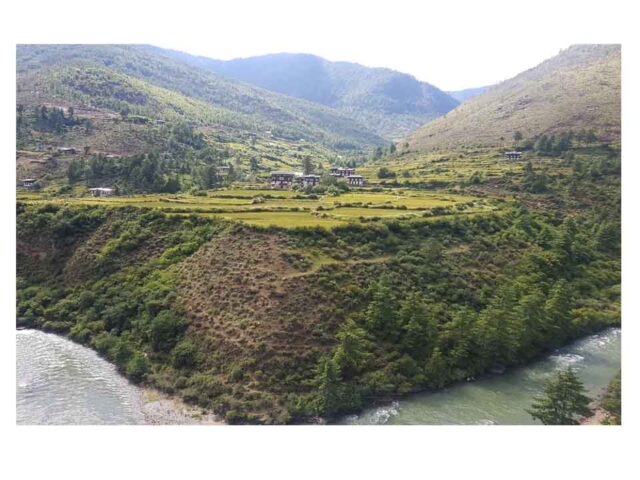
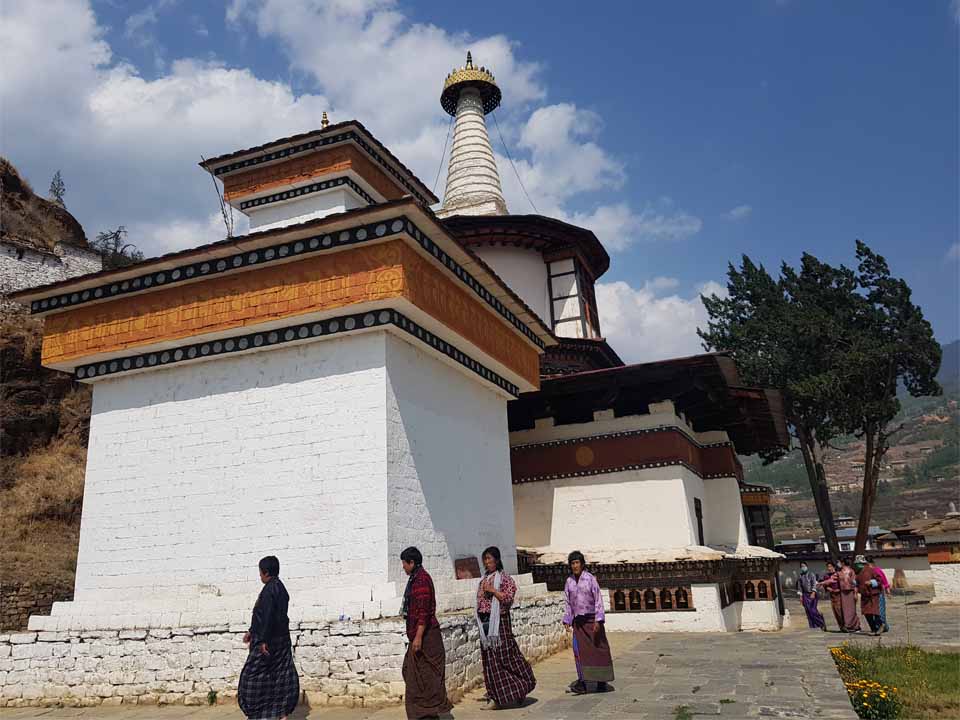
Perhaps the most enigmatic of Buddhist saints,H.E. Tangtong Gyalpo is the most renowned as the builders of iron bridges. In his many visits to Bhutan he built 8 iron bridges and 2 temples, the Dumtseg lhakhang in Paro and the Tachog Lhakhang . These are the top places to visit in Bhutan

Dumtsek Lhakhang at Paro

If any imminent personage has fired the imagination of later day chronicles, scholars and devotees, none can compare to that of H.E. Tangtong Gyalpo. From the scandalously rogue antics of Drukpa Kuenley, the divine madman, to the menacingly airborne Milarepa, the legacy of Thang Tong Gyalpo is solid iron, literally so.

Personality

H.E. Tangtong Gyalpo is most revered and remembered for the numerous iron bridges that he built, accomplishments that begat him the more popular title  Chazampa(iron bridges). For his eccentricity and unconventional behavior he was called Lungton Nyonpa, the madman of an empty village. What was generally accepted was that he was Drubthob, the realized and accomplished one. He was so, in every sense of the word.

Iron Bridge at Tacgogang Lhakhang Built by H.E. Tangtong Gyalpo

His Birth

A popular and interesting but apocryphal legend has it that H.E. Tangtong Gyalpo was born as an old man. His parents, fearing that they had given birth to a freak abandoned him in the fields. He was then brought up by the wild animals and hence his name Tangtong Gyalpo. It translates as King of the open fields.

The more accurate accounts are that he grew up a child prodigy who has mastered the scriptures and the arts at a young age. In this context the name has been interpreted as the one with incomparable excellence in meditation. He is also known for steadfast and immobile from the plains (thang) of concentration. The name is also explained as indicative of his vast and supreme views on the nature of emptiness. 

His Reincarnation

His life is one of progression. The avatars as manifold as the names and their interpretations. He is at once a militia conscript who rose rapidly through the ranks to become a commander. He has captured several forts by way of nonviolent strategy. In his youth, he was a very successful merchant who gave up his wealth and profits to a local ruler to save the lives of several unknown people from execution. 

It is hardly surprising from this incident that he was considered an active emanation of Chenrezig, the bodhisattva of compassion. Additionally, several of his sadhanas such as Avalokiteshvara sadhana ‘For The benefit of All Beings Pervading Space” was composed by him after he received the transmission of this practice directly from Chenrizig. Chenrizig Nyungnye was also said to be a practice that he did throughout his life.

His Youth

H.E. Tangtong Gyalpo lived for a time in Lhasa, at the court of  the Deb Desi and was under the patronage of the daughter of the Desi. 

The princess commissioned several major works of sculpture and paintings; most notable among them the exquisite gold sculpture of Milarepa. He also crafted several life-sized statues of Chenrezig, Tsepame and Drolma from conch shell, coral and turquoise that were destroyed in 1959.

chenrezig
Chenrezig

H.E. Tangtong Gyalpo’s creativity and ingenuity were not limited to art but even extended to developing numerous medicines and treatments including some longevity pills. Perhaps through strange coincidence, the Chakpori hilltop where H.E. Tangtong Gyalpo lived near Lhasa later became the site for the first formal Tibetan medicinal institute built in the 17th century.

His Inspiration

H.E. Tangtong Gyalpo’s engineering feats, particularly with regard to bridge building, were reportedly inspired after he was refused passage on a ferry because of his ferocious and unkempt outward appearance. He was thrown unceremoniously into the water only to emerge with an insatiable zest for building bridges and ferry points. 

Tachogang village , connected by iron bridge
Tachogang Village , Connected By iron Bridge

The new found vocation was intended to inter-link remote and inaccessible villages and propagate the Buddhist faith. His early attempts suffered many set backs, the primary one being the lack of funds. This did not deter or faze H.E. Tangtong Gyalpo and he is said to have come up with an innovative idea to compose and organize performances of the first ever Tibetan Opera, the Achi Lhamo to finance his passion. 

Acheivement

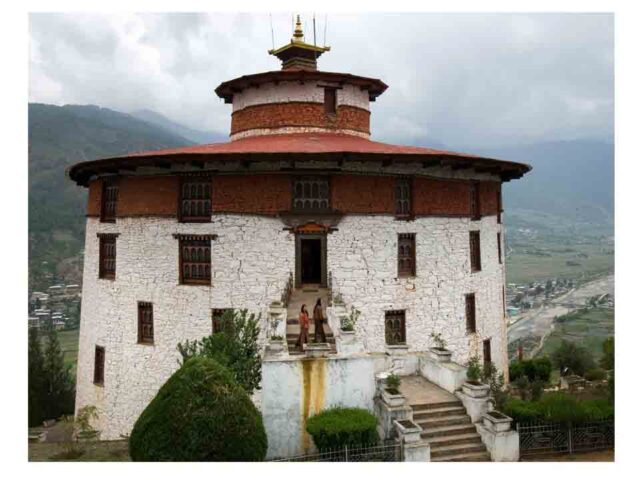
Both bridge building and the opera were great successes. H.E. Tangtong Gyalpo went on to build something like 58 iron bridges and an equal number of wooden bridges, and over hundred ferry crossings all over the Himalayas including 8 iron bridges in Bhutan. None of the bridges are known to be standing. However, parts and pieces of iron still stand the taste of time at the national museum in Paro and at Duksum near Trashiyangtse, in eastern Bhutan. 

National Museum in Paro

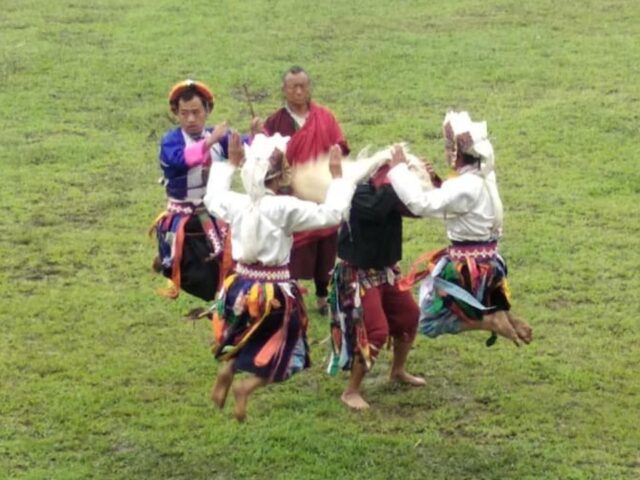
The Achi Lhamo opera, with the starting troupe of seven sisters who worked on the saint’s bridges, is still performed and enjoyed hugely to these days during the new year celebration and on festive occasions. 

Achi Lhamo Opera Still Prevalent in Bhutan
Achi Lhamo Opera Composed by H.E. Tangtong Gyalpo Still Prevalent in Bhutan

Places he visited

H.E. Tangtong Gyalpo traveled widely and is said to have visited SIkkim, Ladakh, Assam, Arunachal Pradesh and Bhutan in search of iron ore. He is a celebrated figure in this region and his exploits and compositions live on in the local folk songs and lore. He is also credited with composing many of the work songs sung in the villages of the region, including in Bhutan. Numerous stories and songs also extol his miracles and his enlightened activities and one song tells of him using the yeti as his porter. 

Living Temple of Thang Tong Gyalpo in Bhutan

H.E. Tangtong Gyalpo’s passage in Bhutan stands enshrined in the temples of Tachoggang and Dumtse in Paro that he built.

Dumtseg Lhakhang Paro

The biography of Lochen Gyurmey Dechen narrates that the blacksmith of Paro once manufactured seven thousand chain links for H.E. Tangtong Gyalpo. These he took to Tibet in 1400 carrier loads. During his frequent and long sojourns to bhutan he took a consort Drubthob Zangmo, the aunt of Great Terton Pema Lingpa from whom he had several sons whose descendants live on at the Tachogang monastery. 

The Depictions of H.E. Tangtong Gyalpo

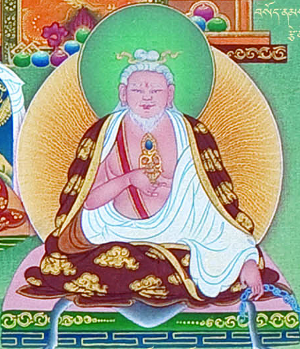
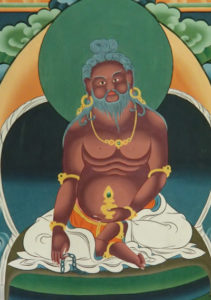
Depictions of H.E. Tangtong Gyalpo are easily identifiable given his unusual appearances as in the manner of Maha siddhas. He has the signature iron chain link held in his right hand. The saint’s body complexion is dark reddish- brown, described in some cases as having the hue of “wet liver”.

Thangtong Gyalpo

He is said to belong to the descendent of the famed and legendary king Gesar. Seated on an antelope skin in the relaxed posture, he holds a  tsebum or vase of long life in his left hand which rests on his lap in the dhyani mudra. The saint’s tsebum links him to tsepame, the bodhisattva of infinite life. He had also discovered the sacred dharani  as a terma hidden by Guru Rinpoche. Special H.E. Tangtong Gyalpo drupchens of long life are still very popular..

His Countenance

H.E. Tangtong Gyalpo is depicted with his hair in a turban-like knot. He sports a long beard and long logs up to his shoulders which may be either black or white depending on whether he is depicted as an old man or in his prime. His image in Dumtse Lhakhang near the entrance is perhaps the youngest depiction. 

Thangtong Gyalpo

Clothed  in a white garment in this particular and unusual depiction, he maintains a goatee, short hair and holds his hand in the bhumisparsa mudra. The iron chain links are not held in the hands as usual but lie at the edge of the throne, barely discernible under the folds of his garments. In contrast, the huge main statue of the saint in the ZIlukha Drubthob nunnery above the Tashichho Dzong shows him at a ripped old age with long white flowing locks and beard. A pot belly and perhaps a gentler expression on his face. Numerous slate carvings of the saint holding his iron chain and vase are found in the Dzong and monasteries all around Bhutan. In many of these slate carvings the face is embellished with gold paint. 

H.E. Tangtong Gyalpo was also famous throughout Tibet for his great strength and engineering skills. He is a great Bodhisattva known and respected by one and all in Tibet. H.E. Tangtong Gyalpo was the supreme leader of four esoteric sects within India, Bhutan, Sikkim, Mongolia, and Eastern Tibet. He possessed teachings from many dharma lineages, the most remarkable of which were the lineage to extend one’s life and the lineage to bring in wealth and change one’s fortune. H.E. Tangtong Gyalpo was a great terton, or discoverer of hidden teachings called terma, who both revealed and concealed terma for future generations. His main practice was that of Chenrezig. A young incarnation of this great master is currently living in Bhutan.

In year 2005, H.H. Dorje Chang Buddha III accepted H.E. Tangtong Gyalpo as one of his disciples who is on the level of a great venerable one and performed an initiation for him, at HuaZangSi Temple in San Francisco.

He later learned that the book A Treasury of True Buddha-Dharma about the H.H. Dorje Chang Buddha III Wan Ko Yeshe Norbu Holiest Tathagata was about to be published. He thereupon organized many rinpoches to practice the Kuan Yin Dharma one billion times as an offering to His Holiness Dorje Chang Buddha III. He also sent his written congratulations stating that His Holiness is the master of Buddhas, the magnificence of His Holiness is supreme and that in this world no other holy being in history can compare with His Holiness.

Iron Man of Bhutan

Link:https://peacelilysite.com/2024/04/12/iron-man-of-bhutan/

#DorjeChangBuddhaIII#HHDorjeChangBuddhaIII#HuaZangSi #Buddha #Buddhism #buddhist #Temple#GuanYinBodhisattva#BuddhismTemple#SanFrancisco#TangtongGyalpo #Buthan #Tibet

Source: https://www.bhutaninbound.com/blog/2022/06/11/thang-tong-gyalpo-iron-man-of-bhutan/#:~:text=Thang%20Tong%20Gyalpo%20is%20most,title%20Chazampa(iron%20bridges).

The Celestial Window of the Western Pure Land Opens, Revealing the Blissful Sacred Realm for all to Behold

(This is the text of an article published in the Asian Journal on Oct. 6, 2004.)

Elder laywoman Quan-Fang Lu who was a disciple of Great Dharma King Yangwo Yisinubu1, was from Chengdu, Sichuan. She and her husband, layman Guang-Ming Wang, had been Buddhists since the 1950’s. When they took refuge in Buddhism, they received an initiation and Dharma transmission from the Great Dharma King. In the 1950’s, they were working in Tibet. Because of their underlying karmic conditions, they received the guidance of an outstanding Rinpoche of Tibetan esoteric Buddhism. That Rinpoche told them that Great Dharma King Yangwo Yisinubu possessed the best and highest Buddha Dharma. After going through many hardships, they brought their son to the Great Dharma King. The Great Dharma King was not even seven years old at the time. The three of them formally acknowledged the Great Dharma King as their Master. Laywoman Quan-Fang Lu and her husband Guang-Ming Wang then resolutely decided to have their son stay by the side of the Great Dharma King in order to receive his training and Dharma teachings.

They have been very pious and respectful toward the Great Dharma King, and they have diligently practiced the Dharma that the Great Dharma King transmitted to them. Over the past years, certain people have spread rumors and made false accusations against the Great Dharma King. Laywoman Quan-Fang Lu and her husband Guang-Ming Wang were filled with righteous indignation at this. They vigorously berated the contemptible conduct of those rascals who spread rumors, fabricated lies, and deceived people.

Based upon layman Guang-Ming Wang’s own pious heart and upon the Great Dharma King’s realization, which is like that of a Buddha, in November of 2003, layman Guang-Ming Wang passed on to the Western Paradise of Ultimate Bliss. At his cremation, layman Guang-Ming Wang left behind 11 sarira firm relics.

In the middle of August, 2004, laywoman Quan-Fang Lu told her son Min Wang that she would soon pass away. Min Wang telephoned the Great Dharma King a few times, beseeching the Great Dharma King to cause his loving mother to stay alive longer. When Min Wang’s mother found out about these calls, she admonished her son, “Those who learn Buddhism and cultivate themselves must understand that the law of cause and effect never fails. My karmic connection with this world is about to end. My karmic connection with the Dharma is now complete. The Dharma King Master will help me go to the Western Paradise of Ultimate Bliss.”


As expected, at around noon on September 9th, the crown of elder laywoman Lu’s head suddenly opened. The crown of her head became as soft as cotton. At that time, a colorful auspicious light filled the room. Amitabha Buddha came to escort her away. Beautifully set off by a huge white Buddha light, the pure gold bowl of Amitabha Buddha slowly descended. The red lotus flowers in the bowl were bright-colored. Two photographs were hurriedly taken of this extremely rare and holy sight. Heavenly music could be heard. Imitating the Buddha, elder laywoman Lu assumed the “auspicious recumbent posture.” Amid the Buddha light, she passed on to the Western Paradise of Ultimate Bliss.
The next day, her body was placed in the Buddha worshipping hall of Bao Guang Temple in Xindu, which is one of the four great Chan (Zen) temples in China. Right after her body was placed there, an image of the Great Dharma King suddenly emitted bright light. A colorful Buddha light went round and round the Great Dharma King’s image. A fragrant scent wafted through the air.

Photo showed lotus light on the top of laywoman Lu’s house


News of such phenomena began to spread. More and more people came to chant mantras and sutras for the benefit of laywoman Lu, respectfully see her off to the next realm, and observe the ceremony. Day and night, the chanting of Amitabha Buddha’s name did not stop. On the evening of September 10th, eminent Tibetan Rinpoches and Lamas who were all disciples of the Great Dharma King arrived at the temple after having traveled a great distance. They came to perform Buddhist rites. On the evening of September 11th, the machine used to chant the name of Amitabha Buddha suddenly emitted the shocking sound of the Great Dharma King chanting the name of Amitabha Buddha. The Great Dharma King was in the United States. The monastics and laypersons in attendance were all extremely moved.


At around noon on September 12th, a holy sight appeared for the first time in history! A painting of Amitabha Buddha hangs in the Buddha worshipping hall of the temple. In front of Amitabha Buddha’s chest, a heavenly window to the Western Paradise of Ultimate Bliss suddenly opened. This heavenly window directly displayed the sights of the Western Paradise of Ultimate Bliss! People were seething with excitement. They were so pleasantly surprised they could hardly control themselves. Through that heavenly window to a Buddha land that appeared in front of the painting of Amitabha Buddha, all of those who had the requisite karmic affinity saw Amitabha Buddha. They even saw the protuberance on top of Amitabha Buddha’s head. They saw Kuan YinBodhisattva wearing white clothes and holding willow tree branches. They alssaw Mahasthamaprapta Bodhisattva. In that heavenly window, elder laywoman Lu was reciting the name of Amitabha Buddha. Her lips were constantly moving, her
eyes blinked, and her head swayed. She looked the same as when she recited Amitabha Buddha’s name when she was alive.


The image of Great Dharma King Yangwo Yisinubu appeared in that heavenly window. He was wearing a red Dharma robe and a Dharma crown. When he appeared, people excitedly shouted words such as, “Master, I see you!” “Great Dharma King Master, by following you we do not fear even death!” “Great
Dharma King, my whole family wants to take refuge in you! We want to learn the true Buddha Dharma from you!” People were awestruck by these holy scenes. They could not control their emotions. The sounds of people marveling, shouting, and kowtowing could be heard.

During the cremation of laywoman Lu, holy sights continually appeared. Lotus flowers emerged. Images of the Dharma King, the Three Holy Ones of the Western Paradise (Amitabha Buddha, Kuan Yin Bodhisattva, and Mahasthamaprapta Bodhisattva), and Maitreya Bodhisattva all appeared. Vajra
Dharma protecting deities and dragon-spirit Dharma protecting deities stood in a circle on both sides of her. Fire phoenix flew to and fro inside the cremation furnace. Beautiful scenes of pagodas and towers from the Western Paradise of Ultimate Bliss repeatedly appeared. People before the cremation furnace were filled with Dharma joy and began prostrating. They were so moved they began to
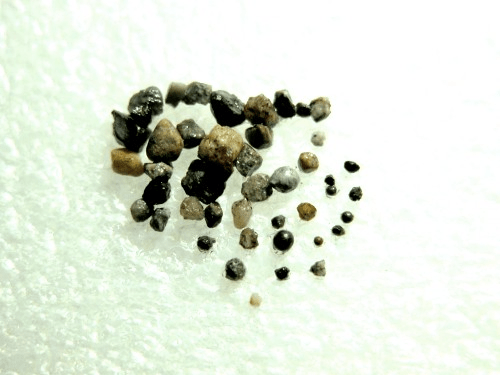
cry. The sound of joyous laughter filled the temple.After the cremation was completed, people collected 49 sarira firm relics from the bone ashes of laywoman Quan-Fang Lu.

49 solid relics from the ashes of the remains of Layman Lu Quanfang after his cremation

1.Here and below the words Great Dharma King Yangwo Yisinubu, Great Dharma King, or Dharma King Master refers to H.H. Dorje Chang Buddha III Wan Ko Yeshe Norbu Holiest Tathagata.

Link:https://peacelilysite.com/2024/02/09/the-celestial-window-of-the-western-pure-land-opens-revealing-the-blissful-sacred-realm-for-all-to-behold/

#DorjeChangBuddhaIII #HHDorjeChangBuddhaIII  #MasterWanKoYee #Buddha#AmitabhaBuddha#KuanYinBodhisattva #MahasthamapraptaBodhisattva# Relics#ThreeHolyBeings

Restoring Buddhist Practices, The True Dharma in the Human Realm

On April 18, 2014, a contest of skills of Buddha-dharma was held at Sanger Temple in the greater Los Angeles area of the United States of America. Rinpoches, dharma masters, and acaryas from the USA, mainland China, Taiwan, Hong Kong, Australia, New Zealand, and other countries were present. Among them, there were great dharma kings, venerable ones, and great dharma masters who possess uncommon abilities of realization. The master of the contesting stage was Jianggong Kangqing Rinpoche (Gong Kang), who is over 70 years old and is one of the four prominent dharma princes. He demonstrated an imposing grandeur and blustered arrogantly. The Contest was presided by Dharma King Gar Tongstan, who is a great holy virtuous one at the level of two Sun-Moon wheels.

The karmic condition of this dharma assembly was induced by a dharma master from Taiwan, whose name is Long Jing. This dharma master brought a highly capable rinpoche whose name is Baizhe Lamu and who had the title of Smiling-Face Fighter in her previous lifetime. They came to America with three laypersons Wang Sixia, Meiling, and Lianying as a group. They proposed to have a contest of dharma with dharma masters at the International Buddhism Sangha Association (IBSA). Dharma masters at IBSA thought they just wanted to have a debate on the Tripitaka and therefore accepted their proposal without hesitation. However, in addition to debating the sutras, they insisted on having a contest of dharma in the end. Baizhe Lamu stated that the purpose of the contest was to publicize the dharma and benefit living beings. Dharma Master Long Jing said that after winning the contest and returning to Taiwan they would look for a great dharma king and other great dharma masters and great laypersons to contest the dharma, because Baizhe Lamu would like to meet with them and learn each other’s realization of cultivation to see who is superior after all. When they were paying respect to H.H. Dorje Chang Buddha III in person, Baizhe Lamu’s speech and conduct showed her gaffes of arrogance and ignorance.

Coincidentally at that time, Jianggong Kangqing Rinpoche from China was in the United States. This rinpoche was fond of dharma contest even when in China. Through contesting with many famous dharma kings and venerable ones, he never met anyone who was a good match to him. After coming to America, he looked everywhere for superior persons for contesting. He declared that there was not even one dharma king or venerable one in China who could be a good match for him, and that dharma kings, dharma masters, and great laypersons in Taiwan could not withstand a single blow of his. Therefore, he came to America to find superior persons for contesting. Because of this, his Buddha Master H.H. Dorje Chang Buddha III seriously scolded him, “Your cultivation is only skin deep and very laughable. You must clearly understand that learning Buddhism requires cultivating patience, severing attachment to the self, and applying the bodhicitta of great compassion to benefit living beings. You should read and understand Expounding the Absolute Truth through the Heart Sutra to know the true dharma and the absolute truth. Showing one’s strength and pursuing winning runs counter to the undertaking of learning Buddhism and cultivation. Manifesting miraculous abilities to prove one’s power of cultivation is nothing other than playing with untrue illusions. Doing so can only produce one more actor or magician.”

At that time, Gong Kang nodded with obedience, “Yes! Yes!” Afterwards, he still did all he could to look for opponents to make appointments of contesting. He even said, “Many people who are learning from the sutras not only could not understand the sutras but also had hollow and wrong comprehension. That is why they do not have true Buddha–dharma and dare not contest with the dharma. Without comparing each other’s’ dharma through contesting, how can living beings be reminded not to be deceived by false holy ones and false Buddha-dharma?” Because he had won every fight so far, he was naturally indulged in self-pride and arrogance.

At the time, he met with the team of Baizhe Lamu Rinpoche, Dharma Master Longjing, and others. After a debate of sutras, the battle of contesting the dharma finally began on April 18!

Baizhe Lamu Rinpoche didn’t dare to engage in a one-on-one fight with Gong Kang. All five of the team joined force to participate in the match using the dharma of Kuan Yin. They climbed onto the stage and launched an imposing momentum. With focused concentration, they applied mudras and mantras. Their roars were swinging within the Hall of Three Holy Beings, demonstrating an all-out effort striving for winning. Gong Kang heightened his vigilance and responded cautiously. He practiced the dharma of Four-Armed Kuan Yin to fight back. A fierce battle was fought between the two sides with mental power, spirit, and crisscrossed movement. Additionally, with the karmadana shouting loudly to announce the battling field situation, the atmosphere was bustling and tense. Attacking mudras applied silently in unison created a scene of fighting as if sharp and flickering weapons were intercrossing. It was really an unprecedented great battle of dharma contest. Jianggong Kangqing Rinpoche truly deserved the status of one of the four prominent dharma princes. He fought bravely by himself against five in a very hard battle. In the end, Gong Kang applied the Besieging-God Battle Position to have all his five opponents tightly confined, unable to move, and thereby defeated.

In the second match, the two parties switched sides and roles. The losing party in the previous match was to confine and tie up the winning party. All five joined forces in the fighting. With an imposing manner and a sweating effort, they moved forward together with an extremely mighty power to practice the dharma to try to besiege and seize Gong Kang. Spectators at the scene were all holding their breath tightly. At this time of heavy contesting, Gong Kang chanted the Six-Character Great Bright Mantra to practice the dharma of Horsehead Vajra Armor (Horsehead Vajra is a manifestation of Kuan Yin Bodhisattva) as counter-attack. Then the five opponents were unable to defend themselves and were thrown off the stage by Gong Kang. The karmadana declared victory for Jianggong Kangqing Rinpoche, and the surrounding audience gave a loud applause.

Jianggong Kangqing Rinpoche in the contest

Gong Kang was very arrogant and put up an air of pride. He suddenly made a hand gesture to invite Great Dharma Master Zhengda who was present to contest with Buddha-dharma for learning from each other. Dharma Master Zhengda was unable to decline and had to step on the stage. In their earlier years, Jianggong Kangqing and Shi Zhengda were dharma brother and sister. They both are disciples of H.H. Dorje Chang Buddha III. However, Gong Kang was not happy to see this fellow sister taking the highest position of chief abbot at IBSA and being revered as a superior one. Therefore, he thought it was a good time to teach her a lesson on that day. That was why he invited her to contest the dharma in front of others. This arrogant act of Gong Kang scared the venerable ones and dharma masters who were present. Their hearts were trembling due to fear and they were afraid of being called by Gong Kang for contesting. It could be seen that, except Dharma King Gar Tongstan and Venerable Long Zhi Denma Tsemang, people in high ranks all lowered their heads and dared not to face Gong Kang’s eyesight.

Master Zhengda in the contest

Right after Jianggong Kangqing Rinpoche and Dharma Master Zhengda walked onto the stage, Gong Kang sneered with an air of pride and gave an arrogant statement, “You will not keep me still.” Zhengda replied, “I will besiege you and will not let you move.” The two fellow brother and sister started a verbal exchange before contesting the dharma. Later, they sat down facing each other along the north-south direction and both practiced the dharma of Kuan Yin to contest. The two entered deep concentration and manifested their dharma powers. Spectators were greatly impressed. For a long time, they fought to a match of draw without showing who could overpower the other. However, eventually the outcome could only be one defeating the other. Upon seeing Gong Kang’s extraordinary power, Dharma Master Zhengda used Kuan Yin’s dharma of Pure-Water Bottle in combination with the God-Besieging Rope. At that time, Gong Kang was tied up and captured. He was powerless and unable to move his limbs. Therefore, Dharma Master Zhengda won the first match.

They switched side to start the second match. Suffering this defeat had a great impact to Gong Kang’s record. He could never have imagined that Dharma Master Zhengda had truly became one with superior realization and was so great. Now he had to use his highest secretive method of Besieging-God Battle Position. That was truly powerful and had Dharma Master Zhengda bounded up. She was trembling all over her body and her body was as cold as ice. At this time, Dharma Master Zhengda unexpectedly used the dharma of Kuan Yin’s Pure-Water Bottle Willow-Branch Breaking Siege. Her voice of chanting the Six-Character Great Bright mantra sounded like rotating pearls and she was quickly revived. Gong Kang’s God-Besieging formation became seriously disorganized and he lost his power of concentration. Dharma Master Zhengda then made a punch to knock him off the stage. Because Gong Kong had spoken arrogantly before in public, this defeat made him very embarrassed. The Karmadana then announced, “Dharma Master Zhengda won and becomes the champion of the dharma contest.”

However, Gong Kang strongly disagreed. He said that the referee had judged erroneously, and asked for having another match of “Viewing the Realm and Exiting the Samsara” with Dharma Master Zhengda. Dharma Master Zhengda did not want to have another dharma contest with him, but Gong Kong insisted. Therefore, this big battle was fought on April 20. The battleground was a grassy lawn, with a very big piece of cubic cordierite. This is a mani stone used by a great holy virtuous one to practice the dharma. After the referee Dharma Master Long Hui sprinkled the pure soil that was empowered by an extremely great holy virtuous one onto the mani stone, the two fighters sat away from the huge stone by about three meters. Jianggong Kangqing Rinpoche started first to practice the dharma of Four-Armed Kuan Yin. He practiced 15 rounds of the mantra and the mudra, but was unable to push the mani stone into movement across the separation of empty space.

Next it was Dharma Master Zhengda’s turn in the contest. She also practiced the dharma of Four-Armed Kuan Yin. With three rounds of the mantra and the mudra, the mani stone was pushed to move across the separation of empty space. Then, after Dharma Master Zhengda, Jianggong Kangqing Rinpoche, and Dharma Master Long Hui prostrated to the mani stone to pay homage, the mani stone suddenly flew to the sky and disappeared in the sea of clouds. They were all stunned so as to be speechless. It was not known which extremely great holy virtuous one did this. Everyone could only utter exclamation and praise of surprise! The realization power of doing this is hundreds or thousands of times greater than the power of a female great rinpoche from Tibet who let a big mani stone circling around her in the empty space in 2002. The weight of this mani stone that flew to and disappeared in the sky was not exactly known. It was estimated to be about two tons heavy. Actually, weight is not the issue. Even making a pillow fly to the sky would be a world-shocking miracle.

Now, the referee announced that the dharma contest of “Viewing the Realm and Exiting the Samsara” was to begin. After the two had a conversation, Gong Kang still insisted on having the contest. Then they sat facing each other with a far distance in between to begin the dharma contest. According to the rules of the contest, Gong Kang was to besiege Dharma Master Zhengda. On the other hand, Dharma Master Zhengda had to exit samsara to win. Each of them practiced the dharma of the Tathagata to engage quickly in the battle. After only two encounters, Dharma Master Zhengda used Green Tara’s dharma of Breaking Siege by Bodhicitta of Great Compassion to break open Gong Kang’s iron peripheral surrounding of the Besieging-God Battle Position. In a moment, she started from the mandala of samsara and went through the outer court of the Tusita Heaven. After looking and verifying a few times, she quickly found the right direction and directly approached the siddhi of Bodhisattva. After arriving there, she stayed firmly unperturbed. Referee Long Hui who is IBSA’s chairperson was full of praises for her. The host of this dharma contest Great Dharma King Gar Tongstan announced, “Jianggong Kangqing Rinpoche was defeated. Dharma Master Zhengda exited samsara and won the victory. She is the champion of this contest.” The meaning of this one-to-one dharma contest is even more profound than the previous one. For details, readers can watch the live video recording of the contest.

Since ancient times, debating sutras has existed in Buddhism as a preliminary form of dharma contest. This belongs to the theoretical aspect of Buddhism. After practitioners’ cultivation and conduct reached the state of manifesting true utilization and realization, dharma contest is used as the main method of distinguishing whether one belongs to hollow theory only and appraising one’s realization for the purpose of benefiting living beings.

The earliest dharma contest in Buddhism was between two disciples of Sakyamuni Buddha, Shariputra who took the first-place in wisdom and Mahamaudgalyayana who was regarded as the best in supernatural power. Shariputra won the contest. Other examples of dharma contest in history include:

  • Baltsa Takdelwa (who later became a disciple of Dusongchienba) looked for Dusongchienba (the first-generation Great Jewel Dharma King of the Kyagu Sect) to have a dharma contest, but was defeated by a disciple of Dusongchienba.
  • Karma Pakshi (the second-generation Great Jewel Dharma King of the Kyagu Sect) lost to Chojal Pakpa in a dharma contest at the Mongolian Palace.
  • A dharma contest between Zhaguo Longjue Songmou Rinpoche (from Songzhanling Temple in Shangri-La) and Naizhang Qujiong of Lasa.
  • A dharma contest between the 13th Dalai Lama and the abbot of Kumbum Monastery Agya Rinpoche recorded in history that can be found on the internet.

During the last several hundred years, however, it became rare to see dharma contests between eminent monks. This is because true Buddha-dharmas are becoming extinct. Some rinpoches, dharma masters, and great laypersons who only have hollow theories to write books and give discourses dare not even mention the term “dharma contest.” They are afraid that their disciples would know the thing of dharma contest that can prove one’s true power of cultivation. They fear that their disciples would see the fact that their master can only talk about hollow and erroneous theories and therefore does not have Buddha-dharma. That is why the recorded stories of eminent monks contesting their dharma in the past have almost been completely wiped out within a short period of time. Today, Jianggong Kangqing Rinpoche, Baizhe Lamu Rinpoche, Dharma Master Long Jing, and others are fond of contesting with Buddha-dharma. Their deeds are opposed by H.H. Dorje Chang Buddha III. However, looking from a different angle, what they did does have boundless merit. Otherwise, the stories of holy virtuous ones contesting the dharma in the history of Buddhism would have completely disappeared without a trace. Then Buddhism would only be left with theories. Consequently false rinpoches and false dharma masters who have no understanding in the sutras could freely create and teach erroneous theories without having to prove with real Buddha-dharma. Therefore, we should thank the people who contest with Buddha-dharma on the stage. They proved the real existence of true Buddha-dharma and wrote the fact “Buddhism is not just talking about hollow theories” into the history of Buddha-dharma.

Link:https://peacelilysite.com/2024/02/02/restoring-buddhist-practices-the-true-dharma-in-the-human-realm/

#Buddhist #BuddhaDharma #Contest #ZhengdaJiaozun #DorjeChangBuddhaIII  #HHDorjeChangBuddhaIII

Source: Translated from a report in Chinese published in Taiwan Times on April 28, 2014) 

Ullambana Sutra

Ullambana Sutra

Once upon a time, it is said that the Buddha resided in Shravasti, specifically in the Garden of the Benefactor of Orphans and the Solitary.

Mahamaudgalyayana, having recently attained the six penetrations, felt a deep desire to repay the kindness of his parents for raising him. Utilizing his divine vision, he surveyed the world and discovered that his departed mother was reborn among the hungry ghosts, emaciated and without sustenance.

Touched by compassion and sadness, Mahamaudgalyayana filled a bowl with food and approached his mother to provide nourishment. However, as she attempted to consume the food, it inexplicably transformed into burning coals, rendering it inedible.

In anguish, Mahamaudgalyayana hurried back to the Buddha to recount this sorrowful experience.

The Buddha, acknowledging the profound and entrenched offenses of Mahamaudgalyayana’s mother, explained that individual efforts alone were insufficient to liberate her. Even though filial sentiments could move heaven and earth, the combined spiritual power of the Sangha from the ten directions was necessary for her liberation.

The Buddha proceeded to impart a salvific teaching, a method to alleviate the suffering and remove obstacles from accumulated offenses. He instructed Mahamaudgalyayana to make offerings to the assembled Sangha on the fifteenth day of the seventh month, known as Pravarana day. These offerings included clean basins filled with diverse flavors, the five fruits, incense, oil, lamps, candles, beds, and bedding – the best of worldly offerings. The entire virtuous Sangha, regardless of their location or spiritual accomplishments, was to gather on that day and partake in the pravarana food.

By making such offerings, Mahamaudgalyayana’s parents, as well as ancestors of seven generations, could escape the paths of suffering and attain liberation. The Buddha directed the assembled Sangha to recite mantras and vows for the benefit of the donor’s family.

Delighted by this guidance, Mahamaudgalyayana and the great Bodhisattvas followed the Buddha’s instructions. As a result, Mahamaudgalyayana’s mother found liberation from the prolonged suffering of the hungry ghosts.

Expressing gratitude, Mahamaudgalyayana inquired if future disciples, by offering Ullambana basins, could similarly assist their present and past parents. The Buddha affirmed this, emphasizing the importance of practicing compassionate filial conduct on the fifteenth day of the seventh month.

He urged disciples to place diverse foods in Ullambana basins and offer them to the Pravarana Sangha of the ten directions. The practitioners should vow to ensure their parents’ longevity and happiness, as well as the liberation of seven generations of ancestors from the realm of hungry ghosts.

In conclusion, the Buddha encouraged all disciples to consistently recall their parents and ancestors, offering Ullambana basins on the fifteenth day of the seventh month as a gesture of filial compassion. This practice, he emphasized, was a respectful way to repay the boundless kindness bestowed by one’s parents. The bhikshu Maudgalyayana and the entire assembly, inspired by the Buddha’s teachings, joyfully embraced this compassionate practice. And thus, the Buddha spoke of the Ullambana Sutra, providing a timeless guide for repaying the kindness of parents.

Ullambana Sutra

Link: https://peacelilysite.com/2023/12/12/ullambana-sutra/

#BuddhistSutra #Ullambana #Maudgalyayana #Filialcompassion

Source: https://wisdomtea.org/2023/12/07/ullambana-sutra/

Once a Thousand year Phenomenal – The Power of Tummo Concentration

Photo by Maris Rhamdani on Pexels.com

Once a Thousand year Phenomenal – The Power of Tummo Concentration

Recently I have gotten a special pill from a Dharma Assembly at Hua Zang Si Temple in San Francisco. The pill was made through Buddha-dharma, and is capable of curing illnesses. And I was even more fortunate that I had a opportunity to watch a video about how these pills were made. The whole process was so incredible and astonishing.

There are two types of the healing pills. The one is made from conducting a dharma with the Medicine Buddha as the yidam and using the practice of tummo as the cause, it is called the Daba Buqiong Pill. Another kind made from a dharma with the Kuan Si Yin Bodhisattva, one of the five great Buddha Mothers, as the yidam is named the Kazhuo Ande  Pill (also called the Black Jewel Medicine Pill). These pills are made by two types of methods, the highest or most magnificent way or worldly ways. In today’s Buddhism world, worldly ways are commonly used. The process is basically mixing all and only the required ingredients of medicine that are blessed by chanting the mantra of the dharma and then rubbing the mixture into pills. The magnificent inner tantric way of making these pills is completely different. The practice of tummo concentration must be used as the affinity of the dharma. The ingredients of the medicine are exactly the same. The blessing power of the pills is supreme and most magnificent. However, because of the loss of Buddha -dharma, the process of making these pills with the most magnificent (non-worldly) methods has almost become extinct.

The pills of Daba Buqiong and Kazhuo Ande  made from the magnificent method are rare and hard to obtain. The first difficulty is that it is hard to find a true great virtuous one to conduct tummo concentration.

Many people have heard about the dharma of tummo concentration but it is extremely difficult to see a true manifestation of tummo power. Today, in Tibet, India and other places, there are still many lamas who practice tummo concentration. However, when they walk out of the closed room at the end of the extended practice in seclusion, very few of them can actually raise their body temperature. The most they were able to do is symbolically wear a wet blanket while walking around the temple. Those who attained such initial level are now called holy and venerable ones. This is just an indication that tantric dharmas are being lost from generation to generation.

Tummo concentration is a high-class Buddha-dharma of meditation. It is a rare holy dharma indispensable for cultivating the life power of the body, mind-wind and bright spot, and the accomplishment of a rainbow-light body. Regardless of what illness or disease one has, practicing tummo can eliminate it completely. Therefore, this dharma is the dead enemy of the demon of illness. Tummo concentration is a great dharma in the division of supreme yoga. The perfect accomplishment in the practice of this dharma combined with Vajra Body Substitution Meditation can lead to the accomplishment of becoming a Bodhisattva at the twelfth stage or higher.

There are two types of practices of tummo concentration. One is Yoga Tummo from Tibetan Esoteric Buddhism. The other is the Corpse-Laying Tummo regarded as “the King of Tummo.” When practicing tummo, the higher the body temperature can be raised to, the higher the realization power of the practitioner. The normal body temperature of humans is between 98.6°F and 99.5°F (37°C and 37.5°C). When the body temperature reaches a level between 104°F and 105.8°F (40°C and 41°C), one is regarded as having a high fever. A temperature above 41°C (about 106°F) can cause danger to one’s life. However, practitioners of tummo concentration can attain much higher temperatures than that.

The realization power from tummo concentration is defined by four steps. The first step is called the Initial Warmth Step. At this step, body temperature can be raised to between 115°F and 130°F but the ability of curing illnesses is not strong yet. The second step is the Joy of Heat from Meditation  Step, with the body temperature raised to between 130°F and 150°F. The heat of tummo can be released at certain locations of the body to provide a relatively strong ability of curing illnesses. However, there are five illnesses that cannot be cured by this ability. Anyway, one will rarely become ill with the accomplishment at this step. The third step is the Step of Emptiness and Existence at High Temperature. The body temperature can be raised to between 150°F and 200°F. The heat of tummo can be distributed to any part of the body to heal illness by oneself, with the exception of two illnesses. The practitioner can collect the dark karma generated daily due to ignorance and burn it away with tummo. One can also move the heat of tummo outside of his body to cure illness and eliminate hindrance for other people or to subdue demons and evil spirits. The fourth step is the magnificent Delight at Extreme Temperature. The temperature will exceed 200°F and the heat of tummo will spread to the entire body. Master Milerapa used his realization power of this step to ignite his own body to attain the accomplishment of sambhogakaya, and nirmanakaya.

Although the true realization power of tummo is hard to find through the history of over one thousand years, fortunately Mozhi Rinpoches, a disciple of H.H. Dorje Chang Buddha III, is a great yoga master. He is the first-place master of tummo concentration in Tibetan Esoteric Buddhism.  His body weight was reduced from 241.4 pounds (109.5 kg) to 124.6 pounds (56.5 kg) by practicing tummo concentration. He once practiced tummo concentration for seven months and three days, without eating and drinking. After that, all illnesses were eliminated.

The video I watched was the recording of The dharma assembly of making the pills of Kazhuo Ande. It was held at Los Angeles at year 2009. In the dharma assembly, Mozhi JiaoZun was the chief master to produce the heat of tummo. Other rinpoches would be his dharma-protecting assistants. He stated that the purpose of his coming here was not to compare his realization power with others and was not for making Kazhuo Ande pills. It was a coincidence that he met this cause. He regards it as his duty to do something for living beings.

A porcelain pot for frying the medicine was laid on his belly

At the dharma assembly, Mozhi Rinpoche lay on the dharma board and had his head covered up so people would not know who was practicing tummo concentration. This great holy virtuous one with true realization of power and abilities never wanted to boast or praise himself. Everyone attending the dharma assembly was greatly moved and felt ashamed by such holy and pure style of humble self-cultivation.

When the great holy virtuous one was conducting the dharma, a porcelain pot for frying the medicine was laid on his belly. The high-temperature heat of tummo was strong and vicious and directly penetrated the thick porcelain pot.  Rinpoches who used a finger to test the temperature were all scalded badly. They had to throw the medicine powder into the pot and get away quickly to protect their fingers from getting injured.

At the dharma assembly of making pills with the magnificent method, the heat from the Body-Laying (Corpse Pose) Tummo Concentration scalded rinpoches’ fingers so that they were red and swollen. Some had frowning eyebrows and were sweating all over their heads. Some had blisters form on their fingers. Some had the color of the swollen finger turned into white or black colors. Some had their whole finger scalded red and unable to bend. Some even had their face scorched red by the high heat of tummo.

Rinpoches used a finger to test the temperature
Rinpoches showing their burning fingers by the high temperature of tummo

I could not help from making a heart-felt praise: the true power of Corpse-Laying Tummo Concentration from The Supreme and Unsurpassable Mahamudra of Liberationis truly amazing!

Once a Thousand year Phenomenal – The Power of Tummo Concentration

Link: https://peacelilysite.com/2022/10/20/once-a-thousand-year-phenomenal-the-power-of-tummo-concentration/

#DorjeChangBuddhaIII # HHDorjeChangBuddhaIII #HuaZangSi #HolyManifestation #Tummo Concentration#Tripitaka#BuddhaDharma#MoZhiRinpoche#TheSupremeandUnsurpassableMahamudraof Liberationis #BlackJewelMedicinePill

Mount Emei – Bodhimanda of Bodhisattva Samantabhadra

Mount Emei – Bodhimanda of Bodhisattva Samantabhadra

Mount Emei is one of the “Four Famous Buddhist Mountains” in China. It has steep terrain and striking beautiful scenery. “Emei” is a term used to describe a woman’s beautiful eyebrows in an ancient book titled The Book of Songs. The main peak, Golden Summit of Wanfoding, is 3,099 meters above sea level, it is the crown of all other famous mountains in China.

Mount Emei (Emeishan) is an area of exceptional cultural significance as it is the place where Buddhism first became established on Chinese territory and from where it spread widely through the East. The first Buddhist temple built on the summit of Mount Emei was in the 1st century CE. It became the Guangxiang Temple, receiving its present royal name of Huazang in 1614. The addition of more than 30 other temples including the Wannian Temple founded in the 4th century containing the 7.85m high Puxian bronze Buddha of the 10th century, and garden temples including the Qingyin Pavilion complex of pavilions, towers and platforms dating from the early 6th century; the early 17th century Baoguo Temple and the Ligou Garden (Fuhu Temple) turned the mountain into one of Buddhism’s holiest sites.

Mount Emei Jinding Massive Statue of Bodhisattva Samantabhadra

On Mount Emei, the importance of the link between the tangible and intangible, the natural and the cultural, is uppermost. Mount Emei is a place of historical significance as one of the four holy lands of Chinese Buddhism. Buddhism was introduced into China in the 1st century CE via the south Silk Road from India to Mount Emei. Mount Emei is traditionally regarded as the bodhimaṇḍa, or place of enlightenment, of the iconic bodhisattva Samantabhadra (Puxian). In Buddhist sutra, it is recorded that Samantabhadra Bodhisattva rides a white elephant with six tusks. Therefore, the statues of Samantabhadra in the temples of Mount Emei mostly ride on white elephants. There is an Elephant Washing Pool in Mount Emei as well.

Samantabhadra Bodhisattva is associated with Buddhist practice and action. In the Āvataṃsaka-sūtra, the Buddha states that Samantabhadra Bodhisattva made ten great vows in his path to full Buddhahood:

  1. To pay homage and respect to all Buddhas.
  2. To praise the Thus Come One-Tathagata.[3]
  3. To make abundant offerings. (e.g. give generously)
  4. To repent misdeeds and evil karmas.
  5. To rejoice in others’ merits and virtues.
  6. To request the Buddhas to continue teaching.
  7. To request the Buddhas to remain in the world.
  8. To follow the teachings of the Buddhas at all times.
  9. To accommodate and benefit all living beings.
  10. To transfer all merits and virtues to benefit all beings.

The ten vows have become a common practice in East Asian Buddhism, particularly the tenth vow, with many Buddhists traditionally dedicating their merit and good works to all beings during Buddhist liturgies.

From ancient times to the present, there have been many eminent monks and great virtues in Mount Emei. The thirteenth patriarch of Emei Master Pu Guan, and abbot of JiuLaoDong XianFeng temple Master Guo Zhang, were all disciples of H.H. Dorje Chang Buddha III. They both received Great Dharma initiation from H.H. Dorje Chang Buddha III and reached liberation. At year 1998, Master Pu Guan passed away in the meditation posture having attained control over his life and death. Eight years after his passing, he still sits in a stupa in that meditation posture without having rotted at all. At year 2015, Master GuoZhang passed away at 108 years-old, at the Western Sichuan University Medical center. Doctor diagnosed the Master passed away. Unexpectedly, after a few hours, he was resurrected and opened his eyes, he then ordered his disciples to move him back to Jiewangting Temple to officially pass away. Eleven days after he passed away, local government officials visited Jiewangting Temple. They didn’t believe that the master was a profound practitioner. So he stabbed his body with needles, and blood spurted out.

Mount Emei is an area of striking scenic beauty. It is considered to be one of the most beautiful mountains in China.

Amazing Scenery of Sun rise over clouds at Golden Summit of Mount Emei

Mount Emei – Bodhimanda of Bodhisattva Samantabhadra

Link:https://peacelilysite.com/2022/07/07/mount-emei-bodhimanda-of-bodhisattva-samantabhadra/

#DorjeChangBuddhaIII #HHDorjeChangBuddhaIII  #MasterWanKoYee #Buddha#MountEmei#liberation#SamantabhadraBodhisattva#Meditation#EminentMonk#MasterGuoZhang#MasterPuGuan#GoldenSummit#TenGreatVows

Source: https://en.wikipedia.org/wiki/Mount_Emei, https://whc.unesco.org/en/list/779/

Achieving Nothing (No Thing)

Achieving Nothing (No Thing)

Once upon a time the Bodhisattva – the Enlightenment Being – was born into a high class family in northern India. When he grew up he gave up the ordinary desires of the everyday world and became a holy man. He went to the Himalayan Mountains where 500 other holy men became his followers.

He meditated throughout his long life. He gained supernatural powers – like flying through the air and understanding people’s thoughts without their speaking. These special powers impressed his 500 followers greatly.

One rainy season, the chief follower took 250 of the holy men into the hill country villages to collect salt and other necessities. It just so happened that this was the time when the master was about to die. The 250 who were still by his side realized this. So they asked him, “Oh most holy one, in your long life practicing goodness and meditation, what was your greatest achievement?”

Having difficulty speaking as he was dying, the last words of the Enlightenment Being were, “No Thing.” Then he was reborn in a heaven world.

Expecting to hear about some fantastic magical power, the 250 followers were disappointed. They said to each other. “After a long life practicing goodness and meditation. our poor master has achieved ‘nothing’.” Since they considered him a failure, they burned his body with no special ceremony, honors, or even respect.

When the chief follower returned he asked, “Where is the holy one?” “He has died,” they told him. “Did you ask him about his greatest achievement?” “Of course we did,” they answered. “And what did he say?” asked the chief follower. “He said he achieved ‘nothing’,” they replied, “so we didn’t celebrate his funeral with any special honors.”

Then the chief follower said, “You brothers did not understand the meaning of the teacher’s words. He achieved the great knowledge of ‘No Thing’. He realized that the names of things are not what they are. There is what there is, without being called ‘this thing’ or ‘that thing’. There is no ‘Thing’.” In this way the chief follower explained the wonderful achievement of their great master, but they still did not understand.

Meanwhile, from his heaven world, the reborn Enlightenment Being saw that his former chief follower’s words were not accepted. So he left the heaven world and appeared floating in the air above his former followers’ monastery. In praise of the chief follower’s wisdom he said, “The one who hears the Truth and understands automatically, is far better off than a hundred fools who spend a hundred years thinking and thinking and thinking.”

By preaching in this way, the Great Being encouraged the 500 holy men to continue seeking Truth. After lives spent in serious meditation, all 500 died and were reborn in the same heaven world with their former master.

The moral is: When the wise speak, listen!

Link: https://wisdomtea.org/2022/05/26/achieving-nothing-no-thing/

A Close Look at Hua Zang Si

A Close Look at Hua Zang Si

Hua Zang Si is my favorite sacred spiritual worship place in the bay area. In there I find peace, relaxation, and harmony, and a home for my soul. I have gone there many times, to chant the sutra, join the meditation sessions, and participate in Dharma assemblies.

Hua Zang Si, an impressive-looking temple located in the center of the Mission District in San Francisco. The building was formerly the St. John’s Evangelical Lutheran Church, built in 1903, and has been repurposed as a Chinese temple. To me it is really a friendly symbol that different religions can coexist in harmony.

The large outside facade of the temple is painted red color, made the building a very outstanding and eye-catching landmark in the neighborhood. Red is a good color in Chinese culture that symbolizes auspiciousness and warding off evil spirits。

Once entering the temple, I feel like I am in another world. The marvelous statue at the entrance of the temple is an oversize representation of a jolly, laughing Buddha: Maitreya Bodhisattva (the next Buddha in this Saha world). It is such a warm welcoming sign. The big belly not only means jolly, it also means tolerating those intolerable things in the world. So when you look at the statue, you will start to feel that learning Buddhism is happy and kind.

The right line of the couplet is “da du neng rong tian xia shi he lai bu rong zhi rong.” As self-cultivators, we should be like the Buddhas and Bodhisattvas. We should have a broad mind, open heart, and great tolerance.
The left line of the couplet is “ren ru ke na fa jie jing qi shi you na zhong na.” The first priority for one who learns Buddhism and cultivates himself is to be patient and forbearing under insult. The thought of patience or tolerance does not arise from his mind. Everything in all of the dharma realms can change from ordinary to holy. 

Walking inside, the first floor is Shakyamuni Buddha Hall. The golden statue of Shakyamuni Buddha is a very dignified-looking Buddhist statue. On the left side is the one thousand-armed and one thousand-eyed Guanyin Bodhisattva, an awe-inspiring statue. On the right side is Skanda Bodhisattva, a standing majestic full-body armored statue. With a sword in hand, Skanda Bodhisattva is a Buddha Dharma protector, and it is believed he can subjugate demons and evil spirits.

Shakyamuni Buddha
One thousand-armed and one thousand-eyed Guanyin Bodhisattva
Skanda Bodhisattva

The second floor is Amitabha Buddha Hall. The twenty-one-foot-high statue of Amitabha Buddha (designed by H.H. Dorje Chang Buddha III) has been generally recognized as the most majestic Buddhist statue in the world. It is an extremely solemn sight. The color painted on the face is so lifelike, one feels like seeing the real Amitabha Buddha from western paradise. The Buddha’s eyes seem alive as well, looking down at all beings full of compassion and love. Every time when I look at the Buddha, I feel so moved and touched, tears fill my eyes. I can’t help but to kneel down and pray wholeheartedly: Please Buddha save me from the birth-death cycle, please take me to the western pure land. I feel my whole body melted into the compassionate gaze of the Buddha.

In the center of Amitabha Buddha hall, there is a large circular mandala on which a Yun sculpture (carved by H.H. Dorje Chang Buddha III) depicting Mt. Sumeru is placed. In that Yun sculpture are shariras (sacred relics) of the Shakyamuni Buddha for worshipping.

Directly facing the Amitabha Buddha is a tall Dharma altar, there is a huge blue Dorje Chang Buddha image. Dorje Chang Buddha is also called Buddha Vajradhara or Ruler of the Vajra Beings. In the entire universe, Dorje Chang Buddha is the first Buddha with form and is the highest Buddha. That is, the highest leader of Buddhism in the entire universe came into being in the form of Dorje Chang Buddha. It was Dorje Chang Buddha who began transmitting dharma and saving living beings in the dharmadhatu. As a result, Buddhism was born and the Buddha-dharma began spreading.

In front of the image of Dorje Chang Buddha are photos of H.H. Dorje Chang Buddha III.  Dorje Chang Buddha has come to this world twice. The first time was in the form of the holy and venerable Vimalakirti, who was Dorje Chang Buddha II. The second time was in the form of H.H. Wan Ko Yeshe Norbu, who is Dorje Chang Buddha III.

 Dorje Chang Buddha III

These photos were true records of the holy miracle Buddha Dharma. On October 18, 2012, H.H. Dorje Chang Buddha III within ten minutes, reversed his appearance back to a youthful look. This incredible Buddha Dharma ever practiced successfully by Guru Rinpoche long time ago in Tibet.

A large Tibet thangkas hang on the north wall of the hall, it is about BRIEF BUDDHIST LINEAGE REFUGE TREE.

Hua Zang Si has many Holy Treasures , make sure you check them out at the corner of this hall as well.

The third floor contains a library of Buddhist scriptures.

The backyard — a city oasis in the shadow of surrounding Victorians — is home to a magnolia tree, which the faithful say rained nectar for three days, along with a miraculous lotus tub used in the bathing of the Buddha and heavenly beings.

Further back, there is Dharma protector pavilion, a statue of the Dharma Protecting Deity Guan Yu was installed inside.

Guan Yu took refuge in Master Zhiyi at Yuquan Hill. He then manifested great supernatural power and constructed the Yuquan Temple overnight on a barren lot, where he resolved to become a protector of Buddhism. That is why, upon the plea of many Buddhist practitioners, he was recommended to be the Dharma Protecting Deity of Hua Zang Si.

Hua Zang Si is different from other temples that propagate only one sect within Buddhism. It teaches all of the various sects within Buddhism. If you want to know and learn Buddhism, Hua Zang Si is the best place to start with.

Hua Zang Si has many Holy Treasures and Holy Manifestations, make it a very special and inspiring place worth visiting. Here is the website for details: http://huazangsi.org/en/home.php

Temple address is 3134 22nd St., phone: 415-920-9816.

A Close Look at Hua Zang Si

Link:https://peacelilysite.com/2022/04/27/a-close-look-at-hua-zang-si/

#DorjeChangBuddhaIII#HHDorjeChangBuddhaIII#HuaZangSi #Buddha #Buddhism #buddhist #Temple#GuanYinBodhisattva#BuddhismTemple#SanFrancisco#Maitreya Bodhisattva#SkandaBodhisattva#DharmaProtector#DharmaProtectingDeity#GuanYu