Sister Sun Houfang has gone to the hospital for chemotherapy again. She suffers from leukemia, a disease that is almost a death sentence, but she has miraculously survived. She became a Buddhist disciple in July 2016 and often says, “Others with the same illness as mine have all died, but I am still alive. I want to thank Namo Dorje Chang Buddha III and all Buddhas and Bodhisattvas of the ten directions. I also want to bring those with affinity into Buddhism.” No one expected that her friends with affinity would be three Christian friends.
On April 28, 2017, I visited Sister Sun at the hospital again. She was having lunch, so we chatted briefly. I learned that she was scheduled to start chemotherapy medication the next day, and her wardmate, Wei Wenwen, was to be discharged in the afternoon. I sincerely invited them to our Tantric Buddhist Center the next morning to participate in a blessing ceremony. I hoped that through the blessing, they would receive good fortune and have their suffering alleviated. Sister Sun immediately agreed to delay her medication by a day, and Wei Wenwen also wanted to delay her discharge. At this moment, the patient in bed 6, Lu Shaohua, spoke up. She said she was a Christian and did not dare to believe in Buddhism, fearing it would be against her faith. She also mentioned, “A few days ago, I couldn’t sleep at night after arriving here. It was very uncomfortable, and no matter how much I recited the Bible, I couldn’t fall asleep. Ms. Sun suggested I recite the Buddha’s name instead, and after doing so, I was able to sleep.” I said, “That’s great! It shows you have a deep connection with Buddhism. Each of us has our own karmic reasons for our religious beliefs, but regardless of the religion, the key is the benefit we receive from it. In fact, many people don’t know that the Virgin Mary is an incarnation of Avalokitesvara Bodhisattva.”
In the Dharma audio teachings of H.H. Dorje Chang Buddha III, there is a story about hundreds of Christian Taiwanese indigenous people converting to Buddhism. This took place in 1995 when H.H. Dorje Chang Buddha III, visiting Taiwan under the guise of an art delegation, was greeted by the chief of the indigenous group, a devout Christian. (There is a video recording on youtube for this event https://www.youtube.com/watch?v=Qxdaug7x9IU)
H.H. Dorje Chang Buddha III asked, “Have you ever seen the Virgin Mary? If you haven’t, I can invite her to come, and you can meet her.”
The chief responded, “Can I? Even our priest has never seen her!” H.H. Dorje Chang Buddha III said, “If I let you see her, will you then take refuge in Buddhism?”
The chief replied, “That would depend on the Virgin Mary’s approval. We have taken vows and been baptized.” H.H. Dorje Chang Buddha III said, “Let’s do it this way: let the Virgin Mary tell you what to do, and you can follow her guidance. How about that?” The chief agreed, saying, “Okay!”
At this moment, the chief began to recite the Bible and use his inner power. His Holiness told the chief, “That won’t work.” Then, His Holiness performed a Dharma practice, and the Virgin Mary suddenly appeared standing on a cloud, several dozen feet high, astonishing the chief on the spot!
The Virgin Mary said to the chief, “My child, although I am your Holy Mother, I am also a servant of the Buddha. I am learning Buddhism. You should immediately take refuge before this supreme Buddha, who represents the true Dharma of the Tathagata in this world.”
Hearing this, the chief prostrated himself in full devotion and immediately took refuge. Later, all nine tribes of the indigenous group came to take refuge in His Holiness as their chief king.
Photos from video in youtube
In the Universal Gate chapter of the Lotus Sutra, the Buddha tells the world that Avalokitesvara Bodhisattva will manifest in various forms and save sentient beings according to their different karmic conditions. Any worldly being in danger will be delivered instantly upon calling her name. Therefore, Guanyin has been worshipped and revered by all classes of people. As a compassionate divinity with countless virtues and merits, she is endowed with transcendental power. The Bodhisattva excels in skillful means, allowing the Bodhisattva to appear in whatever form is needed by sentient beings.
After hearing my story, Lu Shaohua seemed to understand something and expressed a willingness to explore Buddhism.
On the morning of April 29, two Christians, accompanied by their families, came to our Tantric Buddhist Center. After everything was prepared, the blessing ceremony began. As we chanted the Heart Sutra, I heard intermittent crying from the crowd.
After the ceremony, I noticed tears still on their faces, but their complexions looked much better than when they first arrived. I asked them, “Did you all cry? How do you feel?” Wei Wenwen said, “I really enjoyed listening to the Heart Sutra. I felt very comfortable and happy here, and I didn’t want to leave.” Lu Shaohua also said, “As soon as I heard it, I couldn’t help but cry. I don’t know why, but it felt like meeting a family member.”
From that moment on, the three Christians—Wei Wenwen, Huang Youyou, and Lu Shaohua—began to listen to the extraordinary Dharma teachings of Namo Dorje Chang Buddha III. Through listening to the Dharma, they understood some principles of karma, realized the impermanence of life, and the illusory nature of dreams and bubbles. They expressed their determination to stop killing, to practice releasing living beings, and to diligently study and practice Buddhism. They even took home Buddha statues to venerate and vowed to take refuge in Buddhism.
Although Buddhism is the teaching of perfect liberation, Christianity is also a good teaching. When Christians shed tears upon hearing Buddhist scriptures and find peace in reciting the Buddha’s name, it indicates their inherent karmic connection to Buddhism. The differences in religious beliefs among sentient beings arise from their various karmic roots and blessings accumulated over countless eons. All good teachings should coexist harmoniously and tolerate each other without rejection, as true good teachings all aim to free sentient beings from suffering and bring them happiness.
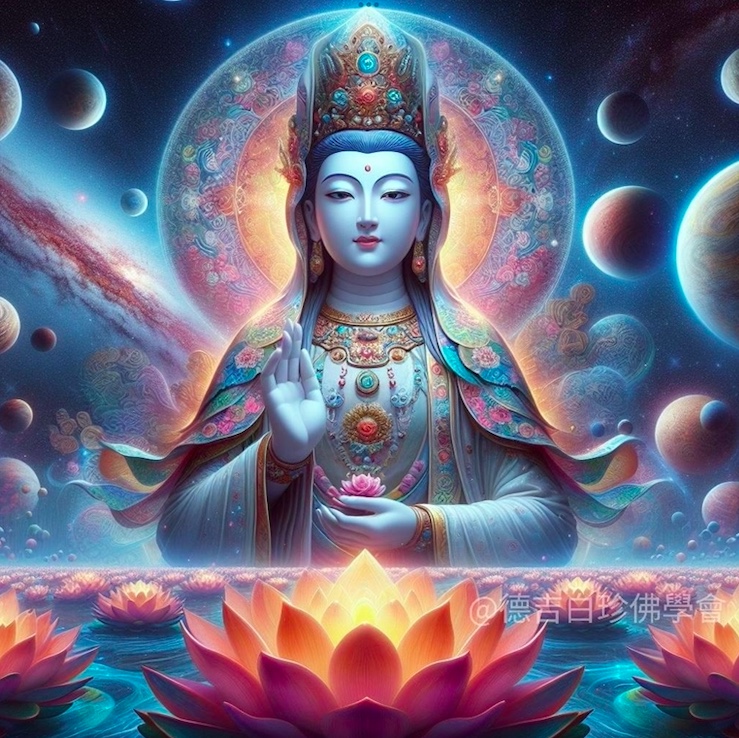
In the history of painting in China, many renowned artists have used Namo Avalokitesvara Bodhisattva as a subject for their works. These artistic images are beloved by the people because the Bodhisattva is a symbol of compassion. These exalted artistic images subtly influence the inner world of generations, inspiring and shaping the soul of the nation.
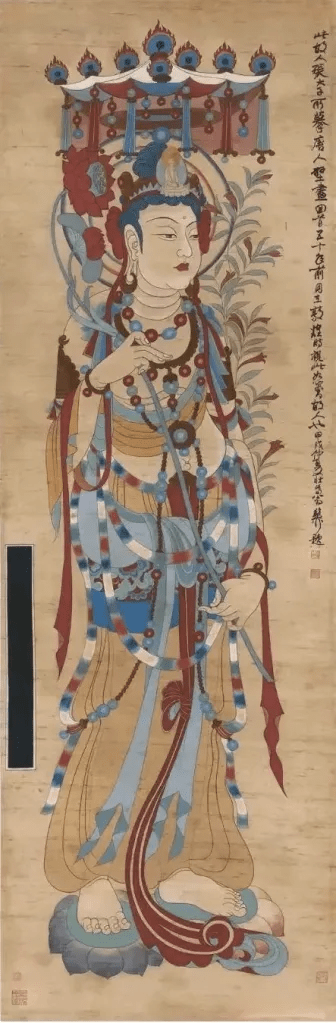
The Mogao Caves in Dunhuang are the largest and most well-preserved repository of Buddhist art in China and the world. Among the murals in the Mogao Caves, there are masterpieces of Namo Avalokitesvara Bodhisattva created by painters over the ages, including images of the Water-Moon Guanyin, the White-Robed Guanyin, and the Eleven-Faced Guanyin. It is said that this treasure trove of painting art contains works by masters like Gu Kaizhi and others from various dynasties.
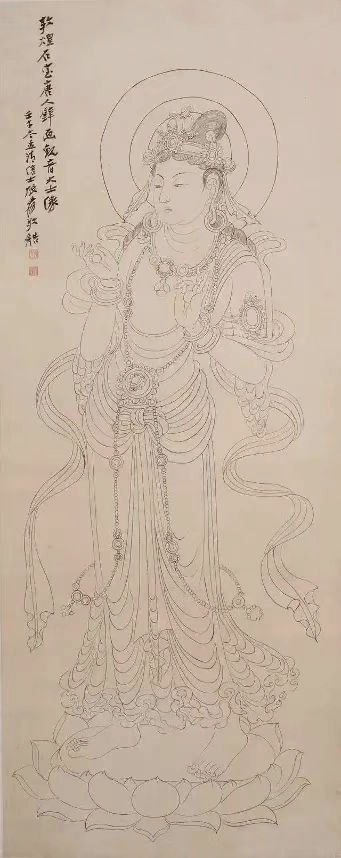
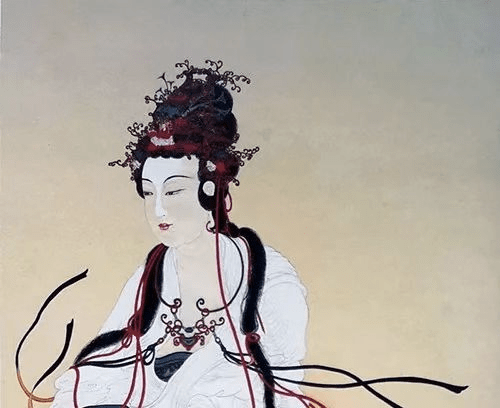
In 1940 Zhang Daqian led a group of artists to the caves of Mogao (莫高) and Yulin (榆林) for the purpose of copying their Buddhist wall paintings. The group completed over 200 paintings, and the experience left Zhang with a repository of religious imagery. He was so captivated by these unparalleled treasures that his original plan to stay for three months extended to two years, during which he dedicated himself to studying and copying the artworks. Today, his paintings of Avalokitesvara Bodhisattva are acclaimed as rare and invaluable masterpieces.
The early Tang Dynasty portrait copied by Zhang Daqian is a national first-class cultural relic
Tang Dynasty murals copied by Zhang Daqian
Mid-Tang Dynasty portrait in the Mogao Caves, copied by Zhang Daqian
At International Art Museum of America, there is a painting of Namo Guan Shi Yin Bodhisattva by H.H. Dorje Chang Buddha III that left a profound impression on me. The portrait is stunningly beautiful, executed with fine brush strokes characteristic of traditional Chinese painting. The artist used very fine and intricate strokes, rendering every detail vividly and perfectly. I could clearly see the hair, the crown, the intricate jewelry, and even the delicate patterns of the flowing ribbons. These details express the painter’s portrayal of Guan Shi Yin Bodhisattva’s meticulous compassion and love for all living beings. The entire portrait appears lifelike, exuding infinite grace, and showcasing the artist’s extraordinary skill, which is beyond perfection.
In this meticulous painting, Namo Avalokitesvara Bodhisattva is depicted wearing white garments, with a serene and compassionate expression, seemingly walking gracefully accompanied by heavenly music. The Bodhisattva’s face is as delicate as powdered jade, with elegant eyebrows and red lips, and eyes that are reserved yet radiate a light of compassion.
The Bodhisattva’s jewelry, including jade pendants, appears to emit a pleasant chime, and the pink and dark green lotus flowers beneath the feet exude a fragrant aroma. The colorful ribbons on the clothing flutter and dance in the gentle breeze. The entire painting exudes an extraordinary and majestic aura. For hundreds of years, the children of China have dreamed countless times of Namo Avalokitesvara Bodhisattva, as if the Bodhisattva is walking toward us from the vast universe.
Upon closer inspection, one can see that within the Bodhisattva’s hair, there is a small figure of Namo Amitabha Buddha, seated with a solemn and exquisite demeanor, wearing a red robe and sitting on a pink and white lotus platform.
The dark green lotus beneath the Bodhisattva’s left foot, the dark blue floral borders on the clothing, and the flowing black hair form a dynamic contrast with the light yellow-brown background and the white robe. The painting uses a large area of light yellow-brown as the background to highlight the pure and elegant clothing, with bright colors as decorative accents. This creates a composition that is both solemn and sacred, yet luxurious.
The Bodhisattva’s attire occupies a significant portion of the painting. If not handled well, it could make the painting appear empty and lifeless. However, the exceptional artist has seized this opportunity, infusing the clothing with a great amount of high-quality ink and brushwork while maintaining overall brightness. The lively and intricate lines are sometimes like flowing clouds and water, sometimes like gentle clouds, sometimes as soft as a summer breeze, and sometimes as powerful as a rushing waterfall. The interweaving lines, though densely packed, are orderly and harmonious. This extraordinary line drawing technique vividly captures the delicate texture of the gauzy fabric. Lines are the earliest form of language in the history of painting and the soul and framework of meticulous figure painting. As a vital expression in Chinese painting, “lines” have always been highly valued by painters throughout the ages.
H.H. Dorje Chang Buddha III‘s meticulous figure painting uses lines that are flexible and varied, not only vividly portraying the image of Namo Avalokitesvara Bodhisattva but also precisely conveying the Bodhisattva’s noble and pure spiritual essence. This technique of capturing the divine through form has been the artistic ideal that painters have longed for throughout history. Therefore, this great painting by Namo Qiang Buddha is destined to become a model for future generations to learn from and an immortal classic passed down through the ages.
This great artwork not only provides people with artistic enjoyment but also offers a profound spiritual experience. I stood in front of the painting for a long time, feeling as if I were leaving behind all worldly affairs and immersing myself in the Bodhisattva’s boundless compassion forever.
African indigenous hunters have a unique method for catching monkeys.
First, they find a hole just big enough for a monkey’s hand. They place food that monkeys like inside the hole. When a monkey passes by and sees the food, it reaches in to grab it. With its hand full of food, the monkey’s hand gets stuck in the hole. Most monkeys won’t let go of the food and instead try to pull it out from different angles.
When the hunters arrive, the monkey is still struggling and trapped, making it easy for the hunters to catch it.
Many people’s anxiety and suffering stem from holding on to too many things and being unwilling to let go, which prevents them from truly obtaining what they need.
In reality, letting go appropriately allows us to broaden our horizons, take time to adjust ourselves, and better engage in our current work.
The Young Man and the Zen Master: A Lesson in Detachment
Once upon a time, a young man visited a Zen temple to seek guidance from an old Zen master. On his way, he witnessed an interesting sight and decided to test the master. Upon arriving at the temple, he and the master chatted over tea. Suddenly, the young man asked, “What does ‘going round and round’ mean?”
“It’s because the rope hasn’t been cut,” the Zen master replied casually.
The young man was stunned and amazed. He said, “Master, I am surprised that you knew! Today, on my way here, I saw a cow tied to a tree. The cow wanted to go far to graze, but because the rope was through its nose, it kept going round and round, twisting itself without being able to break free. It was quite amusing. I thought that since you hadn’t seen it, you wouldn’t be able to answer. But you answered correctly right away.”
The Zen master laughed and said, “You asked about an event, and I answered with a principle. You asked about a cow tied by a rope and unable to break free; I answered about the mind being entangled by worldly matters and unable to find liberation. One principle can explain many situations.
“A kite, no matter how high it flies, cannot soar into the vast sky because it is tethered by a string. Similarly, what often binds us in life, preventing us from being free? A single win or loss can exhaust us; a gain or loss can cause us great anguish; an exam can keep us tossing and turning; a relationship can tie us in knots.
“For power and money, we run around in circles; for fame and desire, we are constantly entangled. Fame is a rope, desire is a rope, profit is a rope; the attachments and temptations of the world are all ropes. So the Zen master said, ‘All beings are like that cow, bound by many ropes of worries and sufferings, unable to achieve liberation throughout life and death.'”
The Wisdom of Living in the Present
A young monk once asked an old monk, “Master, what did you do when you were young?”
The master replied, “I chopped wood, fetched water, and cooked.”
The young monk asked, “And what do you do now that you’ve attained enlightenment?”
The master said, “I still fetch water, chop wood, and cook.”
The young monk, puzzled, asked, “What’s the difference? It seems like you haven’t made any progress in your entire life.”
The old monk explained, “You’re wrong. There is progress. When I was young, I would think about fetching water while chopping wood, and think about cooking while fetching water. Now that I am enlightened, when I chop wood, I chop wood; when I fetch water, I fetch water; and when I cook, I cook.”
Reflecting on myself, I often feel that I need to do something else while eating to avoid “wasting time.” So, I like to chat with others, watch TV, or think about other things while eating. No wonder I sometimes feel like “I don’t even know what I just ate.”
Enjoying the time spent eating and treating each bite with attention, I savor the sweetness of the rice, the freshness of the vegetables, and the richness of the soup. The world on my taste buds is indeed wonderful, bringing much joy to everyday life.
While walking, I now instinctively let my phone rest and focus on walking, feeling my feet propel my body, enjoying the natural comfort of the breeze, smelling the flowers, hearing the birds, and seeing the colorful flowers, green leaves, and various passersby. The scenery is infinitely beautiful, something I rarely appreciated before. Missing out and becoming numb was inevitable.
This series of practices has gradually cultivated the quality of “focus” in me. I increasingly embrace the concept of “living in the moment.” Of course, I know this is just the beginning; focus is a lifelong practice.
Once, the Buddha was residing in the Jetavana Monastery in the kingdom of Śrāvastī, spreading his teachings. At that time, there was a prince of a celestial king named Pilu. One day, he flew down from the heavens to the Jetavana Monastery, prostrated himself at the Buddha’s feet, and, with hands folded in reverence, asked the Buddha: “In this world, people are constantly pursuing clothes, food, treasures, pleasures, official positions, and territories. Are there any treasures that pursue people in return?” The Buddha praised Prince Pilu: “You have asked a good question. Indeed, there are situations where territories, treasures, and pleasures pursue people.”
Prince Pilu asked again, “What does it mean for the causes and conditions that fulfill people’s wishes and bring complete satisfaction to always follow them?”
The Buddha replied, “All actions can be categorized into two types: doing good deeds, which brings blessings, and committing evil deeds, which results in calamities. Whether it is blessings or disasters, they always follow each person like a shadow.”
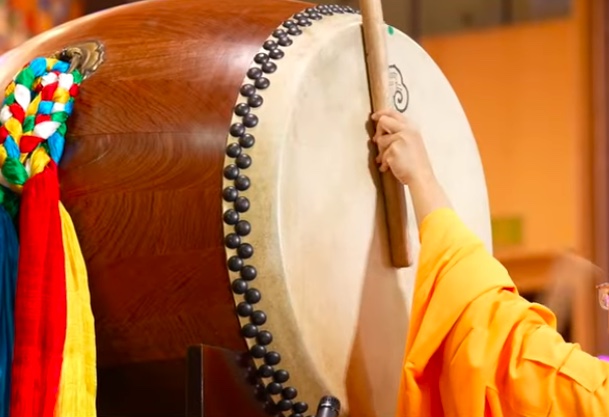
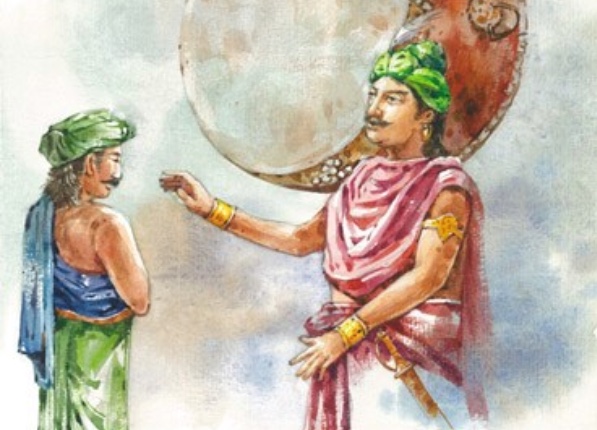
Prince Pilu said, “This is truly extraordinary! Just as the World-Honored One has taught, in my past life, I was once a king among humans. Because I was aware of the impermanence of life and had no attachment to material things, I wanted to practice generosity widely. One day, during a gathering of my ministers, I announced: ‘I want to make a great drum whose booming sound can spread for a hundred miles. Who can accomplish this task for me?’
However, the ministers all replied, ‘We are incapable of doing so!’ At that moment, a minister named Kuang Shang, who had always been loyal to the court and compassionate towards the people, stepped forward and said to the king, ‘I can accomplish this task, but it will require some funding.’
The king said, ‘Great! Whatever amount you need is not a problem.’ Thus, the treasury was opened, and a large sum of money was handed over to Kuang Shang.
Kuang Shang transported a carriage full of treasures to the gate of the royal palace and beat the drum to announce, “Today, our benevolent king, with great compassion, is distributing wealth to the world to relieve all those in poverty and distress, as well as to provide for the needs of practitioners. Anyone in need can come to the palace gate to receive these goods.”
The news quickly spread to neighboring countries. The poor, carrying their babies and bringing along the elderly and young, came in droves, filling all the roads leading to the city. People would often look up to the sky and exclaim, “Thank you, benevolent king! We, the poor people, finally have the chance to escape the days of hunger and cold!”
A year later, the king asked Kuang Shang, “Is the great drum completed?” The minister replied, “Your Majesty, it is done.” The king asked again, “Since it is finished, why haven’t I heard the drum sound?” Kuang Shang responded, “Please, Your Majesty, take a trip into the city tomorrow, and you will hear the sound of virtue resonating far and wide.”
The next day, the king’s procession entered the city, discovering it was crowded and bustling. The king exclaimed, “Why are there so many people in the city?” Kuang Shang answered, “Last year, Your Majesty ordered me to create a great drum, hoping its mighty sound would spread for miles, proclaiming Your Majesty’s benevolence. I thought that a drum made of dead wood and cowhide would not adequately convey the king’s virtue. After much deliberation, I decided to use the treasures Your Majesty entrusted to me to provide for the practitioners and relieve the poor and distressed. Since the announcement, people from neighboring countries have come, hoping for Your Majesty’s benevolence, like hungry children yearning for their compassionate mother.”
Upon hearing this, the king asked the nearby citizens, “Where have you come from?” The people respectfully bowed and replied, “We came from a hundred miles away.” Some said, “I came from two hundred miles away.” Others said, “I came from thousands of miles away.” Then, they all declared, “Wise and benevolent king! Your widespread generosity has brought joy to the people of the neighboring countries. Many have even moved their entire families here, seeking to live under your benevolent protection and hoping for a stable life henceforth.”
The king was very pleased and said, “Kuang Shang, you have done an excellent job! Previously, I was attached to fame, hoping that the great drum’s mighty sound would resonate far and wide. Now, I finally understand that the unrest in the country comes from the people’s unease. Just as a sick body needs medicine to be healed, I should provide remedies to address the people’s suffering. You, my minister, understood the hardships of the people and distributed food to help the poor and needy, allowing the people to live in peace and return their loyalty to me.” Thus, the king declared, “From now on, as long as it concerns the people’s needs, take care of it to the best of your ability without needing to consult me!”
After the king’s natural death, he was reborn in heaven as King Miao. After his life in heaven ended, he was reborn as a Cakravartin (Wheel-Turning) King on earth, always accompanied by seven treasures and surrounded by followers who protected him. Now, he has again been reborn in heaven as a prince of the heavenly king. All of this was because he strictly upheld pure precepts and compassionately aided all living beings, earning such blessings. If we follow the Buddha’s teachings and rectify our body, speech, and mind, we can all obtain such magnificent blessings.
The Buddha encouraged Prince Bilu, saying, “A person’s actions are like a shadow following the body, or an echo responding to a sound. For every cause, there is an effect, and retribution is certain!” Prince Bilu, after hearing the Buddha’s teaching, joyfully made obeisance and departed.
Every year in May, the Bathing Buddha ceremony is held to commemorate the birth of Prince Siddhartha Gautama, who was born in northeastern India over 2500 years ago into the Shakya clan. Upon attaining enlightenment, the Prince became known as Shakyamuni Buddha. During the sacred celebration of Shakyamuni Buddha’s birthday, participants in the Dharma Assembly of Bathing the Buddha offer prayers and make offerings to establish a connection with the Buddhas, seeking their blessings and invoking peace and well-being. As they ritually bathe the image of the Buddha with auspicious water, they vow to purify their three karmas (body, speech, and mind) across past, present, and future.
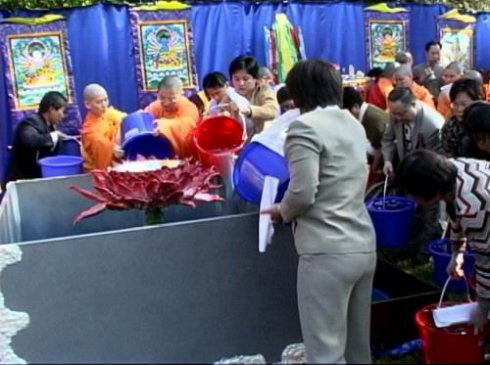
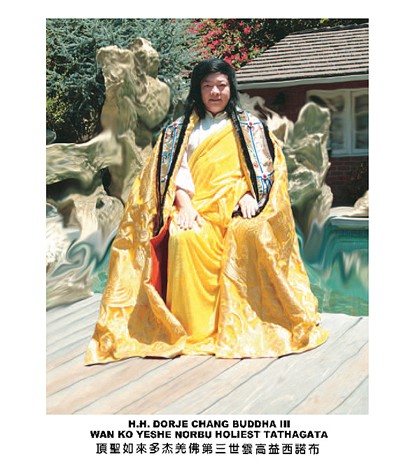
While many of these assemblies are ordinary ceremonies without any extraordinary occurrences, a remarkable event took place on May 26th, 2004—the “Highest Form of Bathing the Buddha Dharma Assembly” in Los Angeles, on the Buddha’s birthday. Led by H.H. Wan Ko Yeshe Norbu (H.H. Dorje Chang Buddha III), the supreme leader of exoteric and esoteric Buddhism, this assembly was unlike any other. Gathered on the lawn of a religious site surrounded by majestic blue curtain screens forming a dignified mandala, renowned Rinpoches, Huo-Fos, Dharma Teachers, and laypersons from around the world came together. It was an unprecedented and extraordinary event, far removed from the usual temple ceremonies. During this assembly, the conductor must possess the realization of a Buddha or Great Bodhisattva to invoke holy supernatural phenomena. On that day, Buddha appeared, Dharma-protecting Bodhisattvas displayed sacred sights, and celestial dragons and other deities of the Dharma laughed in the sky. It was a grand assembly where various holy scenes, unimaginable to ordinary people, manifested. Led by Supreme Vajradhara H.H. Wan Ko Yeshe Norbu (H.H. Dorje Chang Buddha III), this assembly was conducted and practiced with utmost reverence and devotion.
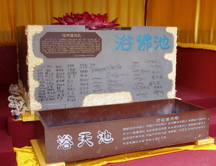
Lotus tub used to bathe the Buddha, 3 feet high, square, and weighed 700 pounds itself
The Dharma Assembly was divided into an internal mandala and external mandala. The internal mandala was the central area where the Buddha was bathed. The external mandala was the dharma realm of accomplishment. Eminent monastics and persons of great virtue attended the Dharma Assembly. Those who were part of the internal mandala included Akou Lamo Great Rinpoche, Zhaxi Zhuoma Rinpoche, Dharma Teacher Long Hui, Dharma Teacher Jue Hui, Dage Gongla Rinpoche, Bodi Wentu Rinpoche, Dharma Teacher Kui Zhi, Dharma Teacher Ruo Hui, layman Ciren Jiacuo (Gyatso), Dharma Teacher Miao Kong, Dharma Teacher Baolian, and others. Those who were part of the external mandala included Fuzang Wanghu Great Rinpoche, Yan Long Great Rinpoche, Awang Nuobu Great Rinpoche, Kang Qin Great Rinpoche, Xijao Zhibenge Rinpoche, Yixi Kanbu, Dharma Teacher Cikong, Dharma Teacher Fahai, Dharma Teacher Cixin, Dharma Teacher Haoling, and others.
The dharma stipulates that the purpose of a Highest Form of Bathing the Buddha Dharma Assembly is pouring dharma water that has been used to bathe the Buddha. The ability to pour such dharma water is based upon one’s true level of realization. Pouring such water bathes the celestial beings in the various heavenly realms. It shows that the Buddha blessed the celestial beings in the various heavenly realms, the dharma protecting deities, and the seven types of disciples. Thus, there must be a successful “pouring of water based upon one’s true realization.” Otherwise, it is not a Highest Form of Bathing the Buddha Dharma Assembly.
Additionally, at that Dharma Assembly all seven holy states were manifested. The seven types of holy states are: (1) Wind Celebrates the Mandala, (2) Flowers Rain from a Tree, (3) A Dharma Object Manifests Holiness, (4) A Cloud Provides an Umbrella-Like Covering, (5) Celestial Dragons Laugh Joyfully, (6) A Lama is Given a Sign, and (7) The Color of Dharma Water Is Received.
The successful “pouring of water based upon one’s true realization” is the most important part of such a Dharma Assembly. It is the key aspect of a Highest Form of Bathing the Buddha Dharma Assembly. It is why the name of such a Dharma Assembly contains the words “Highest Form.” Three to five thousand pounds of dharma water are used to bathe the Buddha. After the Buddha is bathed, this water is used to bathe the celestial beings in the various heavenly realms. When bathing the celestial beings, the dharma water must be poured down from the lotus tub used to bathe the Buddha into the tub used to bathe the celestial beings. During the pouring process, one cannot touch the dharma water with any part of one’s body, nor can one use any type of container to be filled with water. That is because the human body and containers are soiled by unclean dust and dirt. People are only allowed to tilt the entire lotus tub used to bathe the Buddha so that water is poured downward.
With such a heavy amount of dharma water in the lotus tub used to bathe the Buddha, how could anyone tilt that tub to pour the water down into the tub used to bathe the celestial beings? One must rely upon one’s Buddha-dharma state of realization. But no more than ten people can attempt to lift the lotus tub used to bathe the Buddha. Otherwise, it would not be regarded as the Highest Form of Bathing the Buddha Dharma Assembly. If the dharma water is not successfully poured into the tub used to bathe the celestial beings, then no matter what types of supernatural holy sights may appear at the Dharma Assembly, it cannot be called a “Highest Form of Bathing the Buddha Dharma Assembly.”
FLOWERS RAIN FROM A TREE
The atmosphere that day at the mandala to bathe the Buddha was holy and solemn. H.H. Wan Ko Yeshe Norbu (H.H. Dorje Chang Buddha III) wore his golden brocade and jeweled robe. His Holiness had an extremely dignified-looking appearance. A golden bronze statue of Dharma Prince Siddhartha stood in the mandala. In the middle of the mandala was a lotus tub used to bathe the Buddha that was 3 feet high, square, and weighed 700 pounds itself without water. Over the middle of that tub was a beautiful lotus flower about the size of a car wheel. Below and adjoining that lotus tub used to bathe the Buddha was a rectangular, one-foot high tub used to bathe the celestial beings. Ninety buckets of fragrant water were also placed in the mandala to be used to bathe the Buddha. The offering water in those buckets was light brown due to the sandalwood, eaglewood, saffron, and other scents that were boiled and added to the water.
At the beginning of the Dharma Assembly, His Holiness practiced Dharma according to Buddhist scriptures. As soon as the Buddha Master began practicing dharma, a tree full of jacarandas (a pale purple flower) immediately began raining flowers. The jacarandas drifted in the golden sunlight and fell all over the mandala and into the ninety buckets of water. Auspicious clouds rolled through the sky. It seemed that the mandala was no longer part of this world. Rather, it seemed like a holy Buddha-land. Flowers rained for more than three hours continuously, starting from the beginning of the Dharma Assembly. Those flowers floated down upon everyone. However, not one petal touched the Buddha Master. When the Dharma Assembly ended, the flowers instantly stopped raining.
A DHARMA OBJECT MANIFESTS HOLINESS
In order to express the unity of exoteric and esoteric Buddha Dharma, the Buddha Master did not select a highest-level practitioner of great virtue or a highest-level Great Rinpoche to announce and conduct the rituals and ceremonies of that Dharma Assembly. Rather, His Holiness selected Great Dharma Teacher Long Hui to announce the rituals and ceremonies. Great Dharma Teacher Long Hui is Han Chinese and is Chairperson of the International Buddhism Sangha Association. His Holiness also selected Great Dharma Teacher Jue Hui, Great Dharma Teacher Kui Zhi, Great Dharma Teacher Ruo Hui, and Dharma Teacher Miao Kong to conduct the rituals and ceremonies.
When Great Dharma Teacher Long Hui announced that all Buddhist disciples in attendance should pour fragrant water into the tub used to bathe the Buddha, all of the Rinpoches and Huo-Fos, Dharma Teachers, and laypersons in attendance quickly poured the ninety buckets of light brown fragrant water into the tub used to bathe the Buddha, filling it up completely. Everyone then returned to their seats and respectfully requested that His Holiness consecrate the fragrant water in the lotus tub. The Buddha Master was then seen holding a white Vajra Wheel.
During the Highest or Ultimate Form of Bathing the Buddha Dharma Assembly, some people saw the Vajra Dharma Wheel float up, sink down, and move around in the water. Some also saw the appearance of eight Dharma protecting deities. Additionally, some people saw two Dharma protecting deities, Mahakala and Sri-maha-devi, supernaturally change their forms. In an instant, the two Dharma protecting Bodhisattvas appeared. In an instant, they disappeared from the Vajra Wheel without a trace. In the photos, the Vajra Wheel turned into the shape of a lotus leaf floating on the water. From the size of the Vajra Wheel’s shadow, one can know the height of its position in the water.
His Holiness approached the lotus tub used to bathe the Buddha and placed that Dharma object (i.e. the Vajra Wheel) into the water. That dharma object is half as thick as a coin and as large as the palm of the hand. The Buddha-dharma stipulates that only a Supreme Vajradhara Dharma King may possess such a Vajra Wheel. After the Supreme Vajradhara Dharma King’s empowerment, the dharma protecting Bodhisattvas in the sky descended upon that dharma object. That dharma object can move around in the dharma water used to bathe the Buddha. It can rise up in the water and sink down into the water. After it does this, the practice of the Highest Form of Bathing the Buddha Dharma Assembly may begin.
Everyone surrounded the lotus tub to see that dharma object. One or two minutes later, everyone indeed saw the Vajra Wheel moving in the water. No one touched the lotus tub. While in the water, that dharma object moved forward and backward, to the left and the right, all on its own. One moment, it sank downward; the next moment it floated to the surface of the water. When the Vajra Wheel was approaching the bottom of the water, many saw red light emanate from the bottom of the Vajra Wheel. That red light was the true fire of samadhi. Many people saw eight dharma protecting bodhisattvas standing on that dharma object. There were also those who saw Mahakala and Sri-maha-devi supernaturally change their forms on that Vajra Wheel. Everyone present was full of dharma joy.
WIND CELEBRATES THE MANDALA
After a dharma object manifested holiness, everyone began to respectfully recite the invocation text. Suddenly, a strong wind began blowing from the west. Trees began to sway and things began to shake in the once peaceful mandala. Jacarandas flew through the air. Everyone was amazed. Indescribable and auspicious dharma joy filled the entire assembly. The world-honored Buddha had arrived in the sky above the mandala to manifest the dharma! Everyone chanted a mantra in unison to respectfully welcome the arrival of the Buddha. That strong wind from the west blew for a period of time and then abruptly stopped. The quietude of the mandala was restored.
An auspicious atmosphere filled the mandala. Amid the sound of everyone chanting a mantra, the holy ritual of bathing the Buddha formally began. Great Dharma Teacher Kui Zhi respectfully lifted the statue of Dharma Prince Siddhartha off the altar and put it on the lotus flower in the middle of the lotus tub. Everyone then respectfully requested that H.H. Wan Ko Yeshe Norbu bathe the Buddha. After His Holiness bathed the Buddha and practiced Dharma, each of the attendees bathed the Buddha three times. Great Dharma Teachers Jue Hui and Ruo Hui wiped dry the statue of the Buddha with a white silk scarf, put a robe on the statue of the Buddha, and placed it back on the altar.
POURING OF WATER BASED UPON ONE’S BUDDHA DHARMA REALIZATION
After the Buddha is bathed, according to the rules and rituals of the Buddha-dharma, it is time to pour fragrant water from the lotus tub used to bathe the Buddha into the lower tub used to bathe the celestial beings. At that time, His Holiness must practice dharma to bathe the celestial beings. According to fixed dharma, the bathing of celestial beings must take place in order for it to be a real Highest Form of Bathing the Buddha Dharma Assembly. Otherwise, the words “Highest Form” should not be used. This is the key factor in determining whether the Dharma Assembly will be completely successful.
Dharma Teacher Long Hui announced the ritual and requested that everyone attempt to lift the lotus tub used to bathe the Buddha so that its fragrant water would pour into the tub used to bathe the celestial beings. All of the attendees stepped forward one after another and attempted to lift it in groups of ten. However, no matter how hard they tried, they could not lift that lotus tub. Later, in violation of the rules, fourteen strong men together attempted to lift that tub. They assumed various postures and used all of their strength to tilt that lotus tub while shouting out a mantra. In the end, their faces turned red, they became exhausted, and they gave up in frustration. They were not able to move that lotus tub one bit. With awkward smiles on their faces, they went back to their seats.
That lotus tub used to bathe the Buddha weighs more than seven hundred pounds. When 90 buckets of fragrant water used to bathe the Buddha were added to this weight, the total weight was 4,260 pounds. Only a large crane could lift that tub. Even world-class musclemen would have no chance of lifting it.
Everyone looked at the lotus tub and felt the situation was hopeless. Great Dharma Teacher Long Hui did not know whether to cry or laugh. She could not announce that the ritual was successfully completed. Under these circumstances, the Dharma Teacher thought of a disciple of His Holiness by the name of Akou Lamo Rinpoche. That Rinpoche is from Tibet and can cause a mani stone to fly through the air. Great Dharma Teacher Long Hui asked Akou Lamo Rinpoche to test her strength and attempt to lift the lotus tub. Akou Lamo Rinpoche said, “I want to select someone to assist me.” She then invited an elder layman who lives in the Unites States, Ciren Jiacuo, to step forward and assist her. Elder layman Ciren Jiacuo has realized the state of prajna emptiness. He constantly abides in the dharmakaya state. His state of realization is extraordinary. He is a person of great accomplishment spoken of in the tapes contained in the silver box.
Bathing Buddha ceremony is annually performed to honor the birth of Prince Siddhartha Gautama who was born in north-eastern India over 2500 years ago of the Shakya clan. The Prince, upon enlightenment, became Shakyamuni Buddha. On the holy birthday of Shakyamuni Buddha, followers who participate in the Dharma Assembly of Bathing the Buddha make offerings to establish their karmic conditions with the buddhas and also to wholeheartedly beseech the empowerment of the buddhas and to pray for peace and well being. While bathing the image of the Buddha with auspicious water, they vow to cultivate themselves in attaining the purity of their three karmas (body, speech, and mind) in the past, present, and future. However most of these assembly are ordinary ceremony, there were no holy states appearing.
Akou Lamo and Ciren Jiacuo each held one side of the lotus tub. Upon Akou Lamo’s uttering the mantra “Ong Ah Hong,” they lifted their shoulders. With a roaring sound of cascading water, the lotus tub tilted upward. Holy water used to bathe the Buddha was poured into the tub used to bathe the celestial beings. Upon another uttering of the mantra “Ong Ah Hong,” the two of them again lifted the lotus tub. Like a silver pillar, dharma water poured into the tub used to bathe the celestial beings.
All of the attendees were astonished! They sat there dumbfounded. Fourteen men using all their strength in concert could not move that more than four thousand-pound lotus tub. However, to everyone’s surprise, a young woman and an elderly man seventy years old exhibited their states of realization and lifted that lotus tub for all to see! What a wonderful expression of the true Buddha-dharma, of the power of Vajra! Neither of them has any innate spiritual powers. Under Holiest Tathagatha Wan Ko Yeshe Norbu, they have practiced and learned the true Dharma and have reached a high level of Buddha-dharma realization. That is why they were able to successfully complete the key ritual of the Dharma Assembly— pouring water based upon one’s Buddha-dharma realization. All of the attendees were surprised and praised the two of them highly. Everyone was moved and joyful. That Highest Form of Bathing the Buddha Dharma Assembly was successful precisely because of this holy event.
CELESTIAL DRAGONS LAUGH JOYFULLY
After pure water used to bathe the celestial beings was successfully poured, the His Holiness began practicing the dharma to bathe the celestial beings. As soon as all of the attendees chanted in unison one time the verses relating to bathing the celestial beings, suddenly, a strong wind began swirling. The curtain screens began to bulge and rumble. The tankas hanging on the curtain screens flew upward in a ninety-degree angle from the ground. The poles holding up those curtain screens creaked in the wind as if they were about to break. Even the sandbags used to anchor the curtain screens were turned over and moved by the wind. Two-thirds of the people there heard very loud, low and deep dragon’s roars explode in the air accompanied by the clap of rolling thunder. One-third of the people there only heard the sound of the wind but did not hear the sound of thunder. This all the more proves the magnificence of the Buddha-dharma, since different karmic states manifested at the same time.
At that time, the hot sun was high in the sky. It seemed as if the joyful roars of the celestial dragons shook the sun so that it shined even more brilliantly! The dharma protecting deities came to the mandala where the Buddha was bathed and received a dharma bathing bestowed by the Buddha! At this time, people remembered that a few days before the Dharma Assembly when the curtain screens and dharma altar were being erected, the Buddha Master personally arrived. His Holiness repeatedly instructed everyone to fasten well the foundational support for the dharma altar and curtain screens so that the altar and screens would not be blown over by the wind. A layperson whose last name is Hsu said to the Buddha Master, “The weather station forecasted that there will be no rain or wind for the next seven or eight days.” His Holiness then told everyone, “At the Dharma Assembly, of course it will not rain. However, when I practice the Dharma, a strong wind will blow. There will be strong gusts of wind, especially when all of the Dharma protecting deities arrive and manifest their powerful spirits. Therefore, the foundational support must be fastened firmly.” It is very fortunate that the buddha Master made such a prediction. On the day of the Dharma Assembly, the dharma protecting deities joyfully laughed in the sky. Although there were strong gusts of wind, the dharma altar and curtain screens did not fall.
A RINPOCHE IS GIVEN A SIGN
After the Buddha Master practiced dharma to bathe the celestial beings and the dharma protecting deities, His Holiness instructed everyone to look inside the water to see whether the Vajra Wheel was moving. People were amazed to see that even though those two people with holy virtue and high states of realization lifted the lotus tub and thereby poured Dharma water from a tub weighing more then 4,000 pounds downward into the tub used to bathe the celestial beings, the Vajra Wheel surprisingly did not move in the slightest. The Vajra Wheel remained in its original position. Many people saw eight dharma protecting bodhisattvas standing on that dharma object blowing air upward.
At this time, a rinpoche who weighs 280 pounds beseeched the Vajra Wheel to manifest its powers and eliminate his remaining karmic hindrances. His Holiness agreed to this request and put the Vajra Wheel on that rinpoche ’s chest. At first, that rinpoche felt that the temperature of the Vajra Wheel was cool. His Holiness then began intoning a mantra. With his fingers pointing to the sky, His Holiness lightly snapped his fingers. That rinpoche suddenly let out a miserable scream. He was in such pain his face turned pale. Like the power the Incantation of the Golden Hoop had over the Monkey King in Journey To The West, the Buddha Master’s mantra caused the solemn face of the rinpoche to become distorted from pain he could not endure. It seemed that the rinpoche could not endure the pain. As a result of His Holiness practicing a certain dharma, the Vajra Wheel emitted the true fire of samadhi. Its temperature quickly rose to an extremely high degree. Of course, that rinpoche could not endure such heat.
H.H. Wan Ko Yeshe Norbu(H.H. Dorje Chang Buddha III) then snapped his fingers again, and the true fire of samadhi instantly disappeared. The Vajra Wheel suddenly became cold. That rinpoche immediately returned to his normal condition. He was not injured in the least. However, there remained an imprint of the Vajra Wheel on his chest. His Holiness predicted that after one week a three-dimensional dharma object in relief would grow out of the imprint on that rinpoche ’s chest. That rinpoche was full of dharma joy and thanked His Holiness for eliminating his karmic hindrances. That rinpoche then vowed to do his utmost to benefit living beings.
A CLOUD PROVIDES AN UMBRELA-LIKE COVERING
From the beginning of the Dharma Assembly all the way to its end, a beautiful cloud continuously floated in the sky above the mandala. The shadow of that cloud continuously covered the bronze statue of Dharma Prince Siddhartha. The Dharma Assembly lasted more than three hours. The sun moved westward. That cloud moved together with the sun. It was like an umbrella that served to block the sunlight from the statue of Dharma Prince Siddhartha. However, the sun continued to shine upon the area of the dharma altar only two or three inches from the statue of Dharma Prince Siddhartha.
THE COLOR OF DHARMA WATER IS RECEIVED
The Dharma Assembly ended solemnly. Everyone took some dharma water from the tub used to bathe the Buddha and the tub used to bathe the celestial beings. Suddenly, someone said in a surprised manner, “The Dharma water is changing!” Everyone rushed over to see. They discovered that the ninety buckets of light-brown fragrant Dharma water taken from the tub instantly became clear water. The Buddha and the celestial beings received the merit of that fragrant water. The merit of the Dharma Assembly was wonderful and complete. All of the attendees prostrated and uttered words of praise.
H.H. Wan Ko Yeshe Norbu (H.H. Dorje Chang Buddha III) conducted this Highest Form of Bathing the Buddha Dharma Assembly, a respected event in the history of Buddhism. His Holiness practiced the dharma during this assembly. All seven holy states were manifested. Water was poured based upon the states of realization of those who poured it. Those two people thereby exhibited their extraordinary powers. The Buddhas and Bodhisattvas and the heavenly dharma protecting deities personally arrived at the mandala and received bathing water bestowed by the Buddha. Various holy states of the Buddha-dharma appeared one after the other. Only this type of magnificent Bathing the Buddha Dharma Assembly is a true Bathing the Buddha Dharma Assembly as stipulated in the dharma. This grand event in Buddhism took place as a result of the good fortune of living beings.
After the Dharma Assembly, one of the two persons with high states of realization who lifted that lotus tub, Akou Lamo Great Rinpoche, requested that the holy lotus tub used to bathe the Buddha be transported to Tibet so that it could serve as an offering in furtherance of Tibetan Buddhism. Great layperson Ciren Jiacuo requested that it be kept in the United States as an offering. In order to be fair, His Holiness had everyone vote on the matter. Akou Lamo Great Rinpoche lost the vote by a ratio of three to two. The United International World Buddhism Association Headquarters will keep that lotus tub used to bathe the Buddha. It will be kept in the United States as an offering. The tub is currently stored at Hua Zang Si Temple at San Francisco.
Professor Richard Gombrich, who dedicated 40 years of his life to studying Buddhism and Pali language at Oxford University, shares his understanding of Buddhism.
When I say I’m a Buddhist, it doesn’t mean I’m purer and nicer than others. But it means I have too much ignorance and mental defilement to remove. I need Buddhas’ wisdom.
When I say I’m a Buddhist, it doesn’t mean I have more wisdom than others. But it means I have been occupied by too much arrogance. I need to learn to be humble and to develop a broader perspective.
When I say I’m a Buddhist, it is not because I am better or worse than others, but because I understand all beings are equal.
When I say I’m a Buddhist, I know I only love those to my taste, but Buddha loves even people he does not like, guiding them to be full of wisdom and compassion. That’s why I choose to follow Buddha’s teachings!
When I say I’m a Buddhist, it is not with the goal of getting what’s in my interest. But for letting go of my personal clinging to all worldly desires.
When I say I am a Buddhist, it is not because I pursue a smooth life. But for the calm acceptance of impermanence, and be calm and confident like a king in any adverse circumstances.
When I say I am a Buddhist, I do not mean to manipulate others with the motivation of self-interest. But with good use of wisdom, to benefit self and others while being empathetic to all sentient beings.
When I say I am a Buddhist, it is not because I want to escape from the world and pursue nothingness. But to know everyday life is within Dharma, and to live in the present is to practice.When I say I am a Buddhist, it does not mean that my life will no longer experience setbacks.
But with the Dharma, setbacks are transformed into a cause for my growth.
When I say I am a Buddhist, my heart is filled with endless gratitude. Just thinking I was born as a human and have the ability to practice in this life, with the opportunity to meet wise teachers and hear the Buddha’s teachings, I am deeply moved by this unbelievable karmic affinity.
When I say I am a Buddhist, it is not because there is a God outside of me. But that I find the true Buddha-nature of my own heart.
In the course of benefiting sentient beings in this world, H.H. Dorje Chang Buddha III Wan Ko Yeshe Norbu Holiest Tathagata has inadvertently revealed His state of virtue and realization. This has profoundly enriched our understanding of the realization, boundless compassion, enlightenment, and sublime conduct of a Buddha. Sacred phenomena manifest wherever H.H. Dorje Chang Buddha III goes. These phenomena occur during His Holiness’s initiation ceremonies for esteemed monastics, rinpoches, dharma kings, and even renowned Bodhisattvas. They also arise when His Holiness delivers discourses on the dharma to His disciples or when He bestows blessings upon sentient beings to enhance their fortune and wisdom.
In this post, I would like to share some examples.
Dragon-Fish Stand Straight Up on the Surface of the Water and Pay Respect to H.H. Dorje Chang Buddha III by Bowing to His Holiness
On November 6th, 1999, at Puttamonton, Thailand, a group of around thirty people accompanied H.H. Dorje Chang Buddha III. After prostrating before the holy image of Sakyamuni Buddha, they gathered under a bodhi tree beside a serene lake, where H.H. Dorje Chang Buddha III sat. One of the Rinpoches respectfully beseeched H.H. Dorje Chang Buddha III to give a discourse on how an Arhat can realize the state of a Bodhisattva, how a Bodhisattva can attain the supreme and complete enlightenment of a Buddha, and why a Buddha must rely on saving sentient beings to attain Buddhahood.
At that moment, various birds flew over from all directions and perched themselves on the tree, while different types of wild fish in the lake swam over to them. Two wild dogs even approached and joined the group in front of H.H. Dorje Chang Buddha III’s seat, creating an extraordinary scene.
As H.H. Dorje Chang Buddha III began expounding the highest wondrous dharma, waves suddenly surged from the calm waters of the lake, accompanied by a loud sound. A black dragon transformed into a large black and gold fish, emerging vertically from the water’s surface and bowing its head toward H.H. Dorje Chang Buddha III after each movement.
This remarkable display lasted about twenty seconds, with other fish, both white and black, also emerging to pay their respects to H.H. Dorje Chang Buddha III.
Witnessing this unprecedented spectacle, the disciples were filled with wonder, understanding that these fish were dragon-spirits transformed to receive the dharma and pay homage. H.H. Dorje Chang Buddha III, however, remained humble, stating, “This is a response evoked by the Buddha-dharma. One should practice the Buddha-dharma with a heart of humility. Amazing feats are like dreams and illusions, like clouds and smoke that pass in an instant. One must not be attached to them. They are not worth mentioning.”
Indeed, when great saints expound the wondrous dharma, both humans and non-humans pay their respects, a testament to the merit and realization of a Buddha.
A Wild Squirrel Offered Avocadoes to H.H. Dorje Chang Buddha III
In the afternoon of April 24th, 2000, disciples Long Zhi and Juehai walked along the swimming pool in the outer area of the mandala with H.H. Dorje Chang Buddha III Wan Ko Yeshe Norbu Holiest Tathagata. H.H. Dorje Chang Buddha III pointed to an avocado tree and said, “I want everyone to try the fruits.” So H.H. Dorje Chang Buddha III instructed Long Zhi to get a fruit catcher. Long Zhi searched but couldn’t find one. H.H. Dorje Chang Buddha III then said, “We have to pick some avocados.”
Moments later, a brown squirrel descended from an old pine tree. H.H. Dorje Chang Buddha III instructed everyone, “Don’t chase the squirrel away. It came to help.” The squirrel skillfully climbed the avocado tree, searching for ripe fruit. Jumping from branch to branch and sometimes hanging upside down, it located the avocados hidden amidst the dense foliage. Within minutes, the squirrel retrieved six avocados. H.H. Dorje Chang Buddha III deemed it sufficient.
Addressing the squirrel, Long Zhi said, “Hey, squirrel, you have worked diligently. Your offering has accumulated ample merit. It is enough.” The squirrel paused on a branch, holding its paws together, acknowledging H.H. Dorje Chang Buddha III. These six avocados were offerings to H.H. Dorje Chang Buddha III from the squirrel.
As H.H. Dorje Chang Buddha III prepared to leave, the squirrel performed one prostration before the Buddha Master and then departed slowly. Since then, the nuns residing at the holy mandala have observed squirrels climbing the avocado tree but no longer witness avocados being offered as offerings.
The Buddhas Praise H.H. Dorje Chang Buddha III’s Discourse; Buddha Light Blessing Illuminates the Lecture Hall
In April 2006, the Buddha Master was in the lecture hall delivering a discourse on “What Is Cultivation” in response to a question from Zhaxi Zhuoma Rinpoche. As the Buddha Master began, a beam of sparkling iridescent light suddenly appeared, circling the indoor lecture hall with the force of lightning. The sight was dazzling and auspicious! Throughout the discourse, this radiant Buddha light appeared and illuminated the hall as many as five times.
Approximately twenty Rinpoches and masters were present, witnessing the phenomenon. However, not all disciples perceived the same colors and number of Buddha lights due to their varying levels of cultivation and karmic conditions. Some witnessed Buddha lights appearing six times, while others saw them twice. The colors varied as well, with some seeing red, others white, and still others witnessing iridescent Buddha lights sparkling in the hall. The Buddha Master’s discourse on the Buddha-dharma, along with the praise and blessings of the Buddhas and Bodhisattvas, filled all present with joy.
These Buddha lights were special manifestations with underlying causes. They appeared when the Buddha Master discussed the karmic conditions behind the publication of the book “A Treasury of True Buddha-Dharma.” Dazzling Buddha lights flashed in the mandala, as the Buddhas and Bodhisattvas used them to celebrate the birth of this book, which would provide countless beings in the earthly realm with a path to practice the true dharma. As proclaimed by many great dharma kings and rinpoches, the karmic conditions for beings to experience good fortune have matured!
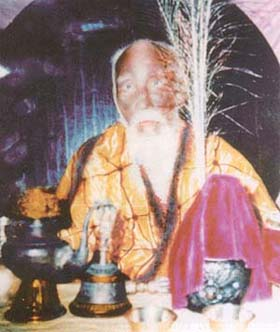
H.E. Queji Jiangyang Qingzhen was a disciple of H.H. Dorje Chang Buddha III who truly manifested realization. This Sakya rinpoche of great holiness had white hair and a youthful complexion. His silver beard extended below his belly, and a heavenly eye opened between his eyebrows. Through his practice he attained the state in which his whole body was semi transparent. Thus, his three channels and five chakras could be vaguely seen. He realized a state of true longevity equal to that of heaven. The rinpoche was able to fly through the air, coming and going anywhere with total ease and control.
When he received from H.H. Dorje Chang Buddha III an inner-tantric initiation in the holy form called Drawing Lots From a Golden Vase, the lot landed upon the Xian Liang Great Perfection mandala. The Buddha Master transmitted to him the Lion Vajra Dharma and the highest great dharma called the Xian Liang Great Perfection Dharma. Right then and there H.E. Queji Jiangyang Qingzhen realized the rainbow-body perfection state.
Witnessing the Manifestation of Supernormal Power by H.E. Queji Jiangyang Qingzhen
One day, a gathering of highly virtuous laypersons and esteemed Rinpoches convened at the Pici Vajra Castle. Their purpose was to welcome the imminent arrival of H.E. Queji Jiangyang Qingzhen, a revered Dharma King and rinpoche of the Sayka sect, who, at more than one hundred years old, commanded great respect. In anticipation of his arrival, meticulous preparations had been made, including the arrangement of white silk hadas and offerings to honor him.
Shortly after midnight, at around 12:30, a wondrous phenomenon unfolded. A vibrant rainbow light appeared, encircling the sky, accompanied by celestial music. Gradually, the luminous rainbow expanded in size, descending gracefully until it settled atop the seven-story building housing our Buddhist altar. As the spectacle unfolded, a figure descended from above.
It was none other than H.E. Great Dharma King Jiangyang Qingzhen, gracing us with his presence.
We paid our respects and presented offerings to him with profound admiration, expressing our deepest reverence through our actions. While tales of centenarians ascending into the skies are often recounted in Tibetan scriptures, never before had we been blessed with the opportunity to witness such an extraordinary event firsthand. It was truly a manifestation of the boundless fortune we have accrued through countless lifetimes. How could one not be moved to tears by such a profound occurrence?
Truly, we stood assembled in the concrete courtyard below, with an uninterrupted view of the elder Dharma King’s descent from the sky to the rooftop. Although our sight was briefly obscured by the building’s roof, within moments, we beheld the elder Dharma King’s graceful descent from the top of the seven-story building to the ground below. His descent, with arms outstretched and legs slightly bent, resembled the elegant flight of an eagle—a spectacle beyond the capabilities of an ordinary person.
The following day, the Dharma King of the Sayka sect bestowed teachings upon us and initiated us, imbuing us with profound compassion. During the initiation ceremony, as we held a one-foot-long vajra in our hands, we experienced its boundless and awe-inspiring power, unable to control its movements. The ensuing mandala states were marvelously magnificent.
As the initiation ceremony drew to a close, the sound of ringing bells suddenly filled the air, and an attendant announced the arrival of ‘His Holiness the Great Master.’ In response, H.E. Dharma King Jiangyang Qingzhen promptly descended from his dharma seat and prostrated himself on the ground. Although we were initially uncertain about the significance of this auspicious moment, we followed suit, believing it might herald the arrival of Guru Padmasambhava. However, upon raising our heads, we beheld not Guru Padmasambhava but H.H. Master Wan Ko Yee (H.H. Dorje Chang Buddha III). Sensing our confusion, H.E. Dharma King Jiangyang Qingzhen reassured us, declaring, “Do not harbor doubts. H.H. Master Yee is the illustrious Buddha Vajradhara Great Dharma King—His Holiness Wan Ko Yeshe Norbu Holiest Tathagata (H.H. Dorje Chang Buddha III).”
One time, Shakyamuni Buddha and King Prasenajit engaged in a profound and comprehensive discussion about love and compassion.
“Master Gautama,” King Prasenajit began, “some people say you taught them not to love. They argue that the more you advocate for love, the more pain and sorrow there is. Though I can discern a grain of truth in this, I’ve always harbored a bit of unease about that perspective. Life without love feels devoid of meaning. Please enlighten me on this matter.”
The Buddha regarded the King with kindness and responded, “Your Majesty, that’s an insightful question, one from which many can benefit. Love, indeed, manifests in various forms, each requiring careful examination. While love is indispensable in life, it must not be rooted in lust, obsession, or prejudice. There is another form of love urgently needed in life. This entails love and compassion, or great kindness and great compassion. What people commonly perceive as love is often confined to mutual affection among family members and citizens. However, such love, tethered to notions of ‘me’ and ‘mine,’ fosters attachment and separation.”
“People primarily yearn to love those within their immediate circle—parents, spouses, children, grandchildren, relatives, and fellow citizens,” he elaborated. “However, love imbued with partiality breeds bias, leading to indifference or discrimination toward those outside one’s circle. Attachment and separation, therefore, perpetuate suffering for oneself and others.”
“The love that humanity truly craves is one rooted in love and compassion,” the Buddha emphasized. “Great kindness and compassion extend universally to all beings, transcending distinctions of ‘mine’ and ‘not mine.’ Devoid of attachment, they bring about happiness and alleviate suffering.”
“In great kindness and compassion, there lies no trace of differentiation,” he concluded. “They serve as the path to liberation from distress.”
The King bowed his head in thought. “I have a family and a country to take care of,” he said. “If I don’t love my family and my country, how can I take care of them? Please clarify this for me.”
The Buddha reassured him, saying, “Of course, you should love your family and your people, but your love can extend beyond them. Your present limited love can be transformed into an all-embracing love, and the young people of this country will become your sons and daughters. This is the true meaning of compassion.”
The King asked again, “This is something that can actually be done, especially where you live. It’s much easier. What about young people in other countries?”
The Buddha replied, “Though they are not in your country, that doesn’t stop you from thinking about the youth of other countries, just as you treat your own children. You love your people; that’s no reason why you can’t love other people.”
The King said, “But when they’re not under my jurisdiction, how can I show my love for them?”
The Buddha looked at the King and spoke, “The prosperity and security of a nation should not be gained at the expense of the weakness and turmoil of other countries. Your Majesty, lasting peace relies on the cooperation of all nations moving towards the common good. Kaushambi Salo will remain safe if you strive for it. You do not wish for your young men to perish on the battlefield; therefore, you must aid in stabilizing other nations. For genuine peace, foreign and economic policies must be guided by compassion. While you prioritize the well-being of your own people, you must also extend love and care to neighboring kingdoms such as Magadha, Gashi, Vitiha, Shakya, and Khalil.”
The King exclaimed with enthusiasm, “Wonderful! This is profound! Your words deeply resonate with me. Surely, you possess true enlightenment! I promise to ponder your teachings diligently and understand their wisdom thoroughly. However, I have a simple question for you. General love, as you mentioned, often involves separation, desire, and attachment, leading to sorrow and misery. But how can one love without desire or attachment? How can I, for example, love my children without succumbing to worry and pain?”
“In the path of enlightenment, love cannot exist without understanding,” the Buddha continued. “Love is born out of understanding. You cannot truly love someone unless you know them. Couples who are unfamiliar with each other will struggle to foster love. Similarly, parents and children who lack understanding of each other will find it challenging to cultivate love. If you desire the happiness of the one you love, you must make an effort to comprehend their concerns and aspirations. True love stems from this understanding. Conversely, if you merely seek to impose your own desires onto them, disregarding their needs, it is not genuine love but rather a desire for control and self-gratification. When everyone experiences peace, happiness, and joy, you will also come to understand these states. This is the essence of love on the path of awareness.”
The King, profoundly touched, conveyed his gratitude, stating, “I am truly grateful for the profound wisdom you have shared with me. However, I still find myself grappling with a lingering question. You assert that love rooted in attachment leads to pain and turmoil, while compassionate love brings peace and happiness. Although I perceive compassionate love as altruistic and selfless, I still harbor concerns that it may entail suffering.”
“Compassion is indeed the fruit of understanding,” the Buddha replied. “To tread the path of awareness is to bear witness to the reality of life—a reality characterized by impermanence. In everything, there exists no eternal or individual self. One day, all of this will be behind us.”
“When one comprehends the impermanence of existence, their perspective becomes tranquil and harmonious,” he continued. “The presence of impermanence does not disturb their mind and body; hence, the poignant feeling induced by compassion is unparalleled in its bitterness. Yet, the anguish of compassion serves to fortify one’s resolve.”
Moved deeply by the teachings, the King of Persia realized that no spiritual teacher or Brahmin priest had ever succeeded in opening his heart to such profound understanding. He considered the presence of the Buddha as a divine blessing bestowed upon the country. Filled with reverence, he expressed his wish to become a disciple of the Buddha.
One day Ananda, the Buddha’s assistant, approached a well to have a drink. A woman, a member of the untouchable caste, was drawing water and Ananda asked her for some. The woman was surprised that she had been asked to give anything to a monk as the caste laws stated that anything given by one who is considered unclean would also be unclean. However, Ananda persisted and eventually she gave in and gave him a drink.
The woman was so moved by this experience which had never happened before that she felt a strong affection for Ananda and made up her mind to serve him. Thus, she went to the Buddha and asked if she might be Ananda’s assistant.
The Buddha asked her why she wanted to do this. She told him. The Buddha replied that what she had fallen in love with was not Ananda but his kindness. Also, that this kindness was present in her own heart and that if she were to cultivate it within she would be able to serve both kings and queens.
This is a lovely story about the power of goodwill or ‘metta’ to affect the heart. The Buddha taught that the most important element of any act is the motivation behind it. All of us are capable of ‘doing the right thing’ but this is not really enough; the motivation behind the action determines the outcome. A common Buddhist practice is the practice of acquiring merit in order to ensure a good future re-birth. This is akin to the old Christian view of doing good so as to go to heaven after death. However, if I am doing good solely for the outcome to myself then the act is already flawed. What is more it shows itself to others in time. We all know the stereotype of the do-gooder who is so caught up in bringing about some future good that he ignores whether or not the other person requires help in this way. The problem with trying to do good for others when in fact I am looking for something for myself is that I fail to see what it is that others really do need right now. Both self-concern and regard for others are two very different way of seeing the same situation.
When the heart has for a moment forgotten ‘I’ and ‘my concerns’, and this does happen more often than realised, then it opens up and reflects the situation. What is more, not only does it see clearly, but, because it is a human heart, it responds with the warmth of humanity. This happens, not because it wants anything, but because it is its nature to do so. Humans have the capacity to put themselves in the other’s shoes and thus respond without intending something just for myself. This is also reflected in Jesus Christ’s admonition to ‘Love thy neighbour as thyself’. In other words, by forgetting myself I forget the separation from others too. Thus, a true ‘fellow feeling’ is born and this is the root of metta and of compassion .