He Came to China as a Teacher. He Stayed to Give Abandoned Children a Home

Tim Baker with one of the newly arrived orphans at the “children’s village” in Langfang, China.
Nancy Fraser

One American, One Yuan, and a Village Built on Compassion

Sometimes, a story comes along that quietly restores our faith in humanity.

The story of Tim Baker, an American who devoted much of his life to caring for abandoned and disabled children in China, is one of those stories.

He first came to China as a teacher.

But in 1991, while volunteering at a children’s welfare institution, he encountered children who had been abandoned because of illness or disability. He and his wife, Pam, eventually adopted several Chinese children themselves.

They could have stopped there.

Instead, they chose to do more.

In 1995, Tim left his teaching position and founded the Philip Hayden Foundation in memory of his friend Philip Hayden. What began as a small effort gradually grew into a much larger mission to provide medical care, a home, and hope for children who had nowhere else to go.

A Piece of Land for One Yuan

As more children came into their care, Tim and Pam dreamed of building a permanent home where the children could grow up with dignity, safety, and a sense of family.

In 2002, the local government in Dawang Guzhuang, Tianjin, offered land for the project at the symbolic price of one yuan per mu. Reports describe the land as roughly 30–33 mu. Tim was reportedly so surprised that he asked more than once whether they really meant one yuan.

That land eventually became Shepherd’s Field Children’s Village, or “牧羊地儿童村.”

The name itself is beautiful.

Before the children’s village was built, the land had been used by local villagers as a place to graze sheep.

A former pasture would become a home for children who had been abandoned.

And the story did not stop with the land.

People began to help.

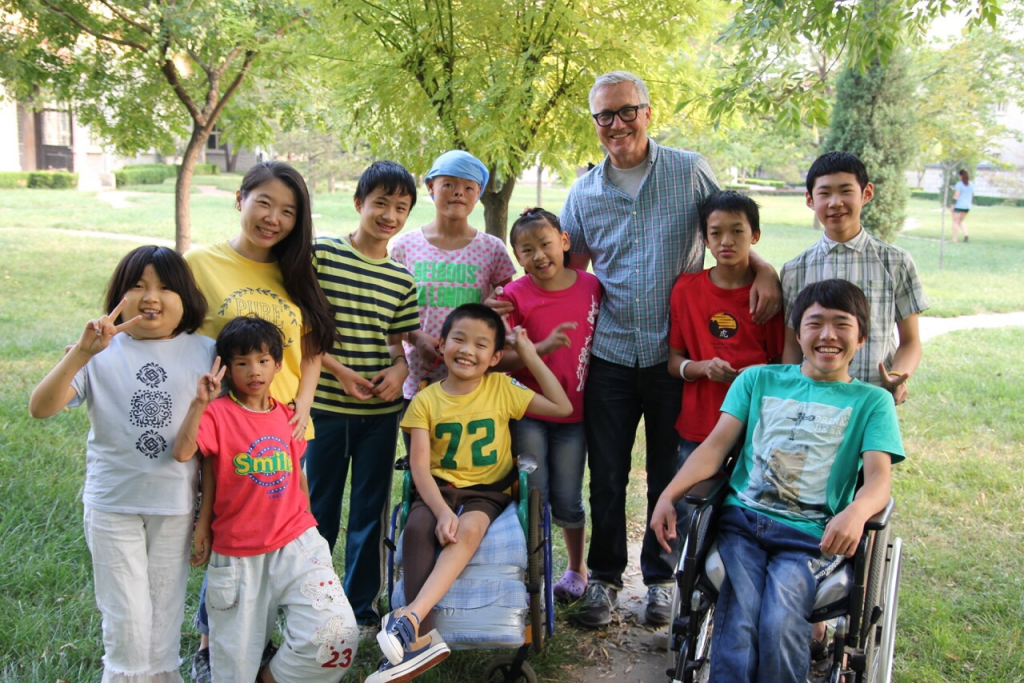
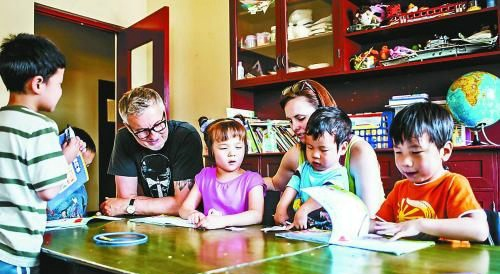
Companies donated materials. Professionals offered their skills. Others provided equipment, construction support, and financial assistance. What one family had started slowly became a community of compassion.
Perhaps the most touching part of Tim’s story is not the buildings or the numbers.

It is the children.

Tim once described how children often arrived with the sadness of abandonment written on their faces. But after receiving care and affection, something began to change.

Their eyes began to shine.

That simple image says so much.

Sometimes a child does not need someone to change the whole world.

They need someone to stay.

Someone to hold them.

Someone to feed them.

Someone to take them to the doctor.

Someone to tell them, through actions rather than words:

“You matter. You are not forgotten.”

In Buddhism, compassion—慈悲 (cí bēi)—is much more than feeling sorry for someone who is suffering.

Compassion begins when we recognize another being’s suffering and allow that suffering to touch our heart.

But true compassion does not stop with feeling.

It moves us toward action.

We ask:

“What can I do to help?”

This is why compassion is so closely connected with loving-kindness, wisdom, and action in Buddhist practice.

We may not be able to remove all suffering from the world. But we can lessen suffering where we are.

We can offer food to someone who is hungry.

Comfort someone who is lonely.

Care for a sick person.

Protect an animal.

Forgive instead of causing more hurt.

Or simply remain beside someone who is going through a difficult time.

Compassion does not always require extraordinary ability.

Sometimes it requires only that we do not turn away.

Tim was American.

The children were Chinese.

Their languages, cultures, and backgrounds were different.

But when a child is suffering, these differences become very small.

A hungry child does not ask where you were born.

A frightened child does not ask what language you speak.

A child simply needs love.

That is why stories like this are so important.

Our world often reminds us of everything that separates people.

But compassion reminds us of something deeper:

We are human before we are anything else.

What makes this story even more beautiful is that Tim and Pam did not do everything alone.

Their compassion inspired other people to participate.

One person donated.

Another volunteered.

Someone else offered professional skills.

Another opened a door.

Little by little, many small acts of kindness became something much larger.

This is how goodness spreads.

One person lights a candle, and another person uses that light to light another.

We may not be able to build a children’s village.

We may not be able to care for thousands of children.

But we can still participate in this chain of kindness.

We can help a neighbor.

Visit someone who is lonely.

Donate what we can.

Volunteer our time.

Care for an abandoned animal.

Speak gently when anger would be easier.

Notice someone who needs help instead of walking past.

These acts may seem small.

But we never know how far kindness will travel.

When I read stories like Tim Baker’s, I am reminded that there is still enormous goodness in this world.

There are people who quietly give without asking for recognition.

We do not have to change the whole world to make the world a better place.

We can begin with one person.

One child.

One animal.

One neighbor.

One act of kindness.

And perhaps that small light will reach someone else—and inspire them to pass it on.

Love does not become smaller when we give it away.

It becomes larger.

Perhaps this is what true compassion looks like—not asking, “What can I gain?” but quietly asking, “What can I do?”

May the kindness we receive become the kindness we give.

May compassion cross every border.

And may each of us, in our own small way, become a light for someone else.

Link:https://peacelilysite.com/2026/09/20/he-came-to-china-as-a-teacher-he-stayed-to-give-abandoned-children-a-home/

Source: https://chinasource.org/articles/wendy-blazes-a-trail/, https://www.npr.org/2003/09/11/1427329/a-village-for-chinese-orphans

The Doctor Who Chose Compassion Over Wealth

A quiet light in a noisy world

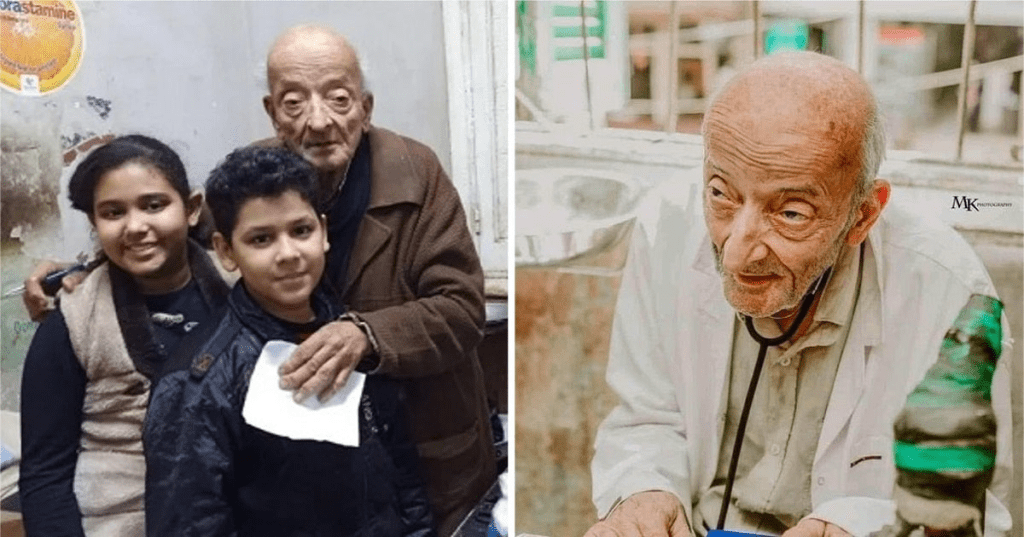
In a modest clinic in Tanta, there once sat a doctor whose life quietly redefined the meaning of success. His name was Mohamed Mashally, but to thousands of ordinary people, he was simply known as the doctor who would never turn them away.

For more than half a century, Dr. Mashally devoted himself to serving those who had nowhere else to go. While many pursue medicine as a path toward status or financial security, he chose a different road—one shaped by compassion, humility, and an unwavering sense of responsibility to others.

His clinic was simple, almost unremarkable. Yet outside its doors, long lines would form each day. Patients came not only because his fees were extraordinarily low—sometimes less than the cost of a meal—but because they knew they would be treated with dignity. And for those who could not pay at all, he quietly asked for nothing.

Behind this life of selfless service was a moment of deep sorrow that transformed his heart. Early in his career, Dr. Mashally treated a young boy suffering from diabetes. The child’s family could not afford the medicine he needed. When the boy passed away, it left a lasting imprint on the young doctor’s soul. From that day forward, he made a silent vow: no one should lose their life simply because they are poor.

And so, he began a lifelong practice of giving.

He worked long hours each day, often seeing patient after patient without rest. Opportunities came—offers to move to wealthier places, chances to build a more comfortable life—but he declined them all. He believed that his place was among those who needed him most.

Even when people, moved by his story, tried to offer him financial help, he would gently refuse. “Give it to the poor,” he would say. For him, kindness was not something to be redirected—it was something to be lived.

In a world often driven by gain and recognition, Dr. Mashally remained rooted in something deeper. He did not seek fame, yet his story spread across countries. He did not chase wealth, yet he became rich in something far more enduring—the gratitude of countless lives he touched.

When he passed away in 2020, many mourned not just a doctor, but a rare kind of human being—one who embodied the quiet truth that compassion, when practiced sincerely, becomes a force that transforms the world.

His life leaves us with a gentle but profound question:

What does it mean to truly succeed?

Perhaps success is not found in how much we accumulate, but in how much we are willing to give. Not in recognition, but in sincerity. Not in grand gestures, but in the small, consistent acts of care that ripple outward in ways we may never fully see.

Like a lamp that asks for no reward, yet brings light to all who pass by, Dr. Mashally’s life reminds us that each of us, in our own way, has the ability to ease suffering and bring warmth into the lives of others.

And sometimes, the greatest legacy we can leave behind is simply this:

That because we lived, someone else suffered a little less.

Link:https://peacelilysite.com/2026/04/20/the-doctor-who-chose-compassion-over-wealth/

The Cause of War and the Law of Karma

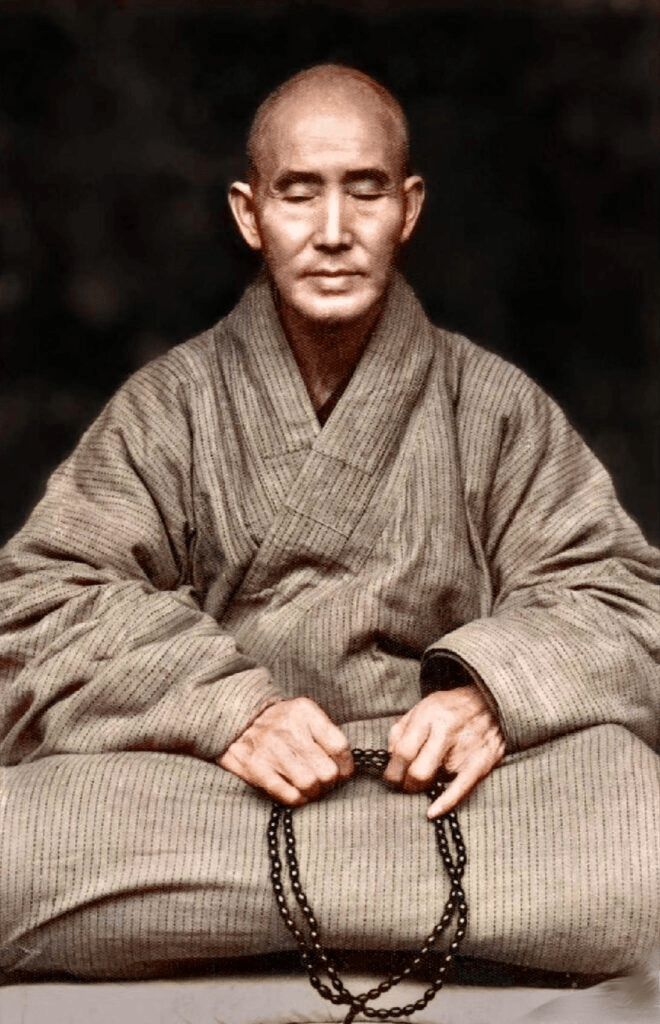
Xu (Hsu) Yun (1840-1959), Patriarch of Wei Yang, Lin Ji, Fa Yan, Cao Dong, and Yu Men Chan Schools

A teaching by the Great Zen Master Xuyun, delivered in 1947 at a middle school

In 1947, shortly after Japan’s surrender and withdrawal from China, the great Zen Master Xuyun (Empty Cloud) gave a profound speech at a middle school. The nation was still recovering from the devastation of war, and hearts were heavy with both relief and sorrow. With deep compassion, Master Xuyun used the timeless wisdom of the Buddha to explain the law of cause and effect (karma) — reminding people that wars do not arise by chance, but are the result of humanity’s collective actions.

He taught that true peace cannot be achieved through force or politics alone. Only by transforming our hearts and purifying our minds through virtue, compassion, and the practice of Buddhist teachings can we bring real and lasting peace to the world.

War does not arise by chance — it is the collective karma of all beings that brings it forth.

Dear friends, during the years of occupation, we endured immense suffering under the enemy’s oppression — our lives were steeped in water and fire, hardship and pain. Now that our nation has regained its light, we should feel endless gratitude and reflection. We must understand that the outbreak of war is not accidental; it is the result of the shared karma created by all individuals.

The ancient masters said, “If you wish to know the causes of your past lives, look at what you are experiencing in this life. If you wish to know the results of your future lives, look at what you are doing now.”
They also said, “Even after hundreds or thousands of eons, the karma one has created will not disappear. When the conditions ripen, the results will be experienced by oneself.”

When people lose their moral compass and commit all kinds of evil, they plant the seeds for calamities such as war, floods, fires, and famine. If we wish to change the will of Heaven and eliminate disasters, we must begin by transforming human hearts — by restoring virtue and morality. When everyone practices the Five Precepts and the Ten Good Deeds, cultivates upright minds and pure conduct, and lives with benevolence, trust, and righteousness, then the hearts of men and the will of Heaven will naturally align.

But if people persist in wrongdoing and refuse to repent, how can hostility and suffering ever be dissolved? The Buddha said, “The sea of suffering has no end, but when one turns around, there is the shore.” This means awakening from delusion and returning to goodness — the essential path to liberation.

We must truly believe in the law of cause and effect. It is not fiction but reality. If everyone understood that good deeds bring good results, and evil deeds bring suffering — that when one plants melons, one harvests melons; when one plants beans, one harvests beans — then no one would dare to act against conscience or break the law. Out of great compassion for all beings, Shakyamuni Buddha renounced his royal life and underwent arduous practice to save the world from ignorance and suffering.

If we understand the principle of cause and effect and wish to avoid future suffering, we must now create good causes. The hardships we experience today are the results of past evil actions. Therefore, we should now sow good seeds, and in time, we will naturally reap good fruits.

The scriptures speak of “Anuttara-samyak-sambodhi,” meaning “unsurpassed perfect enlightenment.” In its essence, it transcends the distinction of self and others — there is no “you” and “me.” But this state must be cultivated from one’s own heart. If our minds remain filled with greed, anger, and ignorance, unable to abandon all evil and practice all good, the barriers of self and ego become like iron mountains, preventing us from reaching the Pure Land or true harmony. This is the most crucial point — one we must all remember well.

The Sanskrit word “Buddha” means “the Awakened One.” Enlightenment has three aspects: awakening oneself, awakening others, and perfecting both understanding and conduct.

To awaken oneself is to realize that all experiences of good and evil, joy and suffering, arise from cause and effect. Once a person truly understands this, delusion fades, the four attachments dissolve, and one becomes enlightened.

To awaken others means recognizing that all living beings — whether born from the womb, from eggs, from moisture, or by transformation — all possess Buddha nature. They are called “sentient beings” only because they are deluded and unaware. We should therefore cherish and respect ourselves, and in keeping with the Buddha’s great vow of compassion and universal salvation, share these truths with others, guiding them out of the sea of suffering.

As stated in the Śūraṅgama Sūtra: “Regard all men as your fathers and all women as your mothers.” If we cultivate such deep reverence and love, especially for widows, orphans, and those who are lonely or destitute, and show them kindness and compassion through giving and aid, we can realize true equality and the ideal of great harmony.

To perfect both understanding and conduct means to live according to the Buddha’s teachings and precepts until one’s virtue and merit are complete. After the Buddha’s passing, he left behind the Three Baskets of Scriptures — Sutra, Vinaya, and Abhidharma — as our priceless raft to cross the sea of suffering. All the rules and precepts should be faithfully practiced. When one fulfills them completely, that is the perfection of wisdom and conduct.

Thus, the Buddha is the awakened one, while sentient beings are the deluded. The distinction between delusion and enlightenment marks the boundary between beings and Buddhas. To turn away from delusion and return to truth — that is awakening, and that is Buddhahood.

To further illustrate the law of karma, there is a story from one of Shakyamuni Buddha’s past lives.

Long ago, in the city of Rajagaha, there was a fishing village with a large pond. One year, a great drought struck, and the pond began to dry up. The villagers caught and ate almost all the fish, until only one giant fish remained, which was finally killed and eaten. Only one eight-year-old boy refused to eat the fish; he simply watched and laughed.

In his later life as the Buddha, King Prasenajit of Kosala, a devoted follower of the Buddha, married a princess of the Shakya clan, and they had a son named King Virudhaka. After ascending the throne, Virudhaka led his army to attack the Shakya capital of Kapilavastu and slaughtered all its inhabitants.

During that time, the Buddha suffered a severe headache for three days. His disciples begged him to use his powers to save the Shakya people, but he refused. Even when Maudgalyayana repeatedly pleaded, the Buddha said no. Maudgalyayana tried to rescue some survivors with his alms bowl, but when he put it down, all he found was a pool of blood.

When the disciples asked why, the Buddha revealed the cause: in a past life, during a great drought in Rajagaha, the villagers had killed and eaten the fish in that pond. The giant fish was reborn as King Virudhaka, and the villagers were reborn as the Shakyas who were killed. The young boy who merely watched and laughed was reborn as Shakyamuni Buddha himself. Because this karma had matured, the outcome was unchangeable.

The Buddha fully understood this karmic connection and taught it to his disciples as a warning. Chan Master Yuan Yun wrote in verse:

“For hundreds of years, the soup in your bowl
Is filled with deep hatred, hard to dissolve.
If you wish to know why wars arise,
Listen to the cries from the butcher’s gate at midnight.”

Reflect on this story and recite the verse, and you will awaken to the true causes of war and violence — and learn to guard your conduct with mindfulness.

If we wish to transform the world and move toward true harmony, everything must begin with our hearts. Students should study diligently, yet never forget the greater mission of saving the world. And the first step to saving the world is saving the heart — correcting one’s own wrong thoughts and firmly believing in the law of cause and effect, avoiding all evil paths.

By cultivating sincerity, righteousness, self-discipline, and harmony within the family, one can extend peace to the nation and the world. If all the people of every country sincerely believe in karma and practice the Eight Virtues and Ten Precepts, then oppression, violence, and wars will cease to arise. True peace, equality, and the Pure Land of Great Harmony will appear, free from the Five Defilements and all suffering.

For the original Chinese speech, please click here. This English translation is by Linda Chang and is provided for reference only.

Link:https://peacelilysite.com/2025/11/07/the-cause-of-war-and-the-law-of-karma/

H.H. Dodrupchen Rinpoche: The Pillar of Longchen Nyingthig Dharma and Compassionate Wisdom

THE WORLD’S SOLE HOLDER OF THE HIGHEST RAINBOW BODY ACCOMPLISHMENT DHARMA: H.H. DHARMA KING DODRUPCHEN

H.H. Dodrupchen Rinpoche stands as the supreme leader and sole lineage holder of the complete Great Perfection Longchen Nyingthig Dharma across the world. Every Longchen Nyingthig lineage practiced in the major monasteries worldwide traces its origins to the initiations and teachings of H.H. Great Dharma King Dodrupchen. Without his guidance, the highest esoteric dharma, Longchen Nyingthig Great Perfection, would not exist.

The Longchen Nyingthig transmissions of the Nyingma tradition, including those practiced in renowned monasteries like Kathok and Dzogchen, all flow from the empowerment of H.H. Dodrupchen Rinpoche.

The title “Dodrupchen” translates to “the great accomplished one from the Dokham Valley,” a name rooted in the legacy of the First Dodrupchen Rinpoche, who was born in the Upper Dokham Valley of the Golok region in eastern Tibet. When the First Dodrupchen Rinpoche met the great master Jigme Lingpa, he received the complete transmissions of the “Buddha’s Words” and the “Treasured Teachings.” Jigme Lingpa also recognized him as the sole root lineage holder of Longchen Nyingthig. Remarkably, when Dodrupchen Jigme Trinle Ozer, the reincarnation of Jigme Lingpa, encountered Dodrupchen Rinpoche, he saw him as Guru Padmasambhava. Over generations, the Dodrupchen Rinpoches have demonstrated profound wisdom and miraculous abilities, while also tirelessly transmitting Longchen Nyingthig teachings to those with the right karmic connections, nurturing many accomplished masters.

The Fourth Dodrupchen Rinpoche, Thubten Thrinle Lhawang Sangpo, was born in 1927 in the Tse village of the Serta Valley, Golok. Even before his birth, auspicious signs appeared, such as rainbows gracing the skies above his village almost daily and the protector deity Rahula being seen atop his rooftop nightly. A rare flower bloomed on his rooftop, similar to those cherished by the Third Dodrupchen during his retreat, even though it had never been seen in the region. His mother experienced miraculous phenomena throughout her pregnancy, such as the unborn child momentarily disappearing and a mysterious light accompanying her, enabling her to see in the dark without any need for illumination.

After Rinpoche was born, many miraculous events occurred. On one occasion, a Mani stone fell from a rock and struck Rinpoche, shattering many of his bones. However, just a few hours later, all signs of injury miraculously disappeared. Sometimes, young Rinpoche would be on the ground one moment, and in the blink of an eye, he would be on the rooftop or a mountain rock wall. Before the monks from Dodrupchen Monastery came to visit and identify the reincarnated lama, Rinpoche’s parents were unaware of their visit. Yet, Rinpoche told his parents, “Guests are coming today,” and joyfully began to sing.

When the search team presented items previously used by the previous Dodrupchen, such as books and prayer beads, mixed with items from other people, Rinpoche accurately selected his past life’s belongings, saying, “These are mine.” The Fifth Dzogchen Rinpoche personally recognized the young boy as the Fourth Dodrupchen Rinpoche.

As Rinpoche grew older, he rarely displayed miraculous powers, except in rare circumstances. Despite not needing to purify his mind or accumulate merit like ordinary practitioners, he sought teachings from various human masters and completed many years of retreat to set a true example of practice for all beings. By age fifteen, Rinpoche had already mastered mandala painting, calligraphy, pottery, architecture, and numerous other skills, as well as profound teachings like the supreme methods of seed syllables and karmic selection. Throughout his life, he interacted with others with unwavering peace, humility, and simplicity, without any pretense. His compassionate actions, in every moment and place, served as a guiding light for all beings.

The Fourth Dodrupchen Rinpoche’s status was elevated above many great Dharma kings, and his disciples spanned across all major lineages, many of whom became renowned masters, celebrated worldwide. Among them are illustrious lineage holders such as the Seventh Dzogchen Rinpoche, Sogyal Rinpoche, Rinchen Nyingma Rinpoche, H.H. Jigme Phuntsok Rinpoche, and H.H. Togdan Rinpoche, among others.

In December 2006, after reading A Treasury of True Buddha-Dharma, H.H. Dodrupchen Rinpoche was deeply moved by the accomplishments of H.H. Dorje Chang Buddha III Wan Ko Yeshe Norbu. In response, he promptly wrote a congratulatory letter, stating that the accomplishments of H.H. Dorje Chang Buddha III are miraculous and clearly demonstrate the absolute truth of Buddha-dharma.

Link: https://peacelilysite.com/2024/08/29/h-h-dodrupchen-rinpoche-the-pillar-of-longchen-nyingthig-dharma-and-compassionate-wisdom/

#DorjeChangBuddhaIII #HHDorjeChangBuddhaIII  #MasterWanKoYee #Buddha #HuaZangSi #InternationalBuddhismSanghaAssociation #IBSA #DodrupchenRinpoche #Nyingmatradition #LongchenNyingthig