Yun Sculpture, a groundbreaking form of art devised by H.H. Dorje Chang Buddha III for the global audience, stands unmatched in the annals of history. Since its inception, the world has borne witness to an artistic phenomenon that defies replication. Observers, captivated by the works of H.H. Dorje Chang Buddha III, often find themselves in awe, expressing sentiments from the depths of their hearts: “This is a treasure bestowed upon the world by a divine force,” “Sacred artifacts from the Buddha’s Pure Land,” “Captivating the soul with its unparalleled beauty,” and “Since the advent of Yun Sculpture, humanity’s jewelry pales in comparison, like stars around the bright moon—dim and lackluster.” Indeed, when contrasted with the most finely carved jade and opulent stone sculptures, the latter suddenly lose their luster and grandeur, revealing an insurmountable gap.
Yun Sculpture boasts several distinctive characteristics:
Firstly, these sculptures exude a multidimensional sense of space, intricately crafted with unparalleled complexity, displaying endless variations.
Secondly, Yun Sculptures burst forth in rich and vibrant colors, presenting scenes so dreamlike and fantastical that they remain unseen in this world.
Thirdly, many Yun Sculptures possess a sacred and mysterious quality that transcends ordinary comprehension, exemplified by pieces such as “Mysterious Boulder with Mist.” In these sculptures, a mysterious mist gracefully floats among intricately carved, seemingly shifting, and intriguingly interconnected hanging rock formations. Why are such pieces referred to as sculptures containing mysterious mist? The answer lies in the enigmatic and beautiful scenes depicted within these sculptures—a dance of auspicious mist swirling amid hanging rock formations, creating an ethereal ambiance.
Mysterious Boulder with Mist
These miraculous works can be seen and touched. However, they cannot be created by anyone who is not a being of the highest holiness.
Precious Place
Stepping into this precious place, Surveying the treasures hanging on all four walls, Pure white, inky green, brownish-yellow… A multitude of vibrant colors. Is this the magic of nature? No, it’s the crystallization of wisdom!
The Grand Entrance of Elegance
The grand entrance, adorned with intricate golden lace, Built upon a foundation of gemstones, Various wonders on display, Gleaming with dazzling radiance. The densely woven textures and folds, Alive with vivid details, Eagerly beckon one to step inside, And behold the magical scenes within the hall.
Dawn
This Yun Sculpture masterpiece interprets the natural landscape of dawn with a strong sense of color contrast and intricate contours. The magic of this artwork lies in the seamless transition between night and day, appearing remarkably natural without any artificiality. It is not just a unique Yun Sculpture piece but also a transmission of positive energy.
The shift from darkness to light is not merely a natural phenomenon but also signifies the awakening and transformation of human thought and consciousness. By sincerely experiencing this Yun Sculpture piece inspired by the dawn, you will feel the powerful energy embedded within.
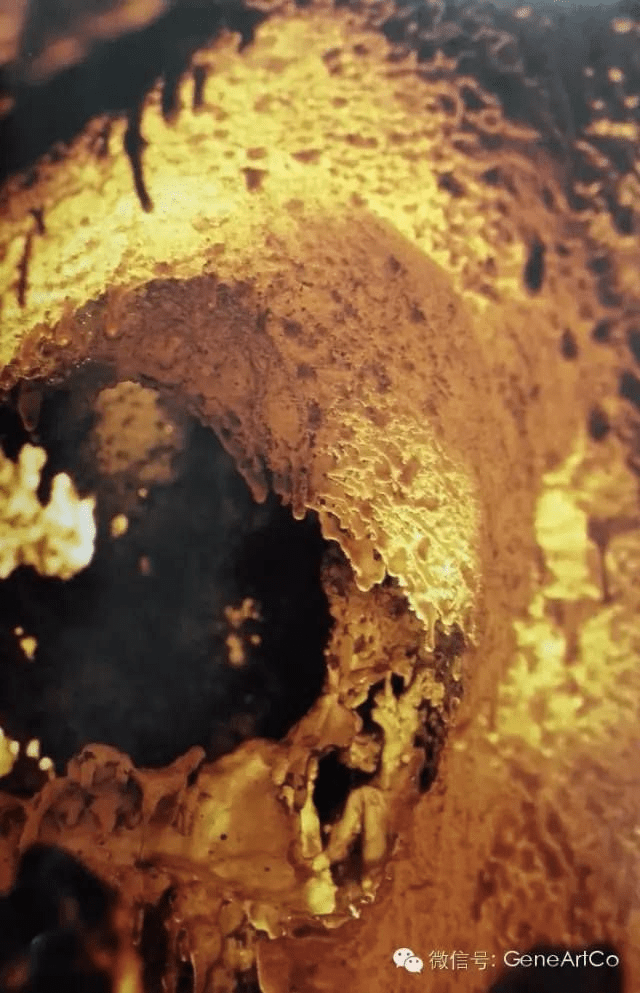
This Yun Sculpture piece resembles an ancient tree hollow, exuding a sense of mystery. Looking into the cave from its entrance, it appears bottomless, much like the human heart—profound and unfathomable.
Therefore, the term “tree hollow” now symbolizes the secrets hidden deep within. Psychologists propose that people need to learn to confide, to release their emotions. This artwork provides us with a window to express the unspeakable depths of our hearts, offering a means to alleviate stress through sharing.
A Rock of Horizontal Charm
Endless changes of spirit and feelings unfold Mysterious motions envelop wonders untold Only in heaven is such a presence found No handiwork of artisan earthly bound
The sculpture A Rock of Horizontal Charm is a masterpiece of Yun Sculpture, embodying the spirit of an art surpassing the beauty of nature, created by H.H. Dorje Chang Buddha III for humankind. Derived from an art form created by H.H. Dorje Chang Buddha III that possesses beauty beyond nature’s, it has attained a realm –never before seen in human history – of artistry transcending nature, originating an art form in this world that is irreplicable by any craftsman or high technology. This amazing beautiful sculpture is currently displayed in H.H. Dorje Chang Buddha IIICultural And Art Museum.
Coral from Heaven
This Yun Sculpture piece exudes a mysterious yet astonishing feeling. The meticulous handling of the subtle details precisely embodies the essence of this artwork. Dubbing it “Coral Descending from Heaven” aptly confirms its precious and distinctive qualities. It’s challenging to fathom how the artist applied colors, especially in certain tiny areas where ordinary individuals would be unable to do so. It is precisely because of such a mysterious, astonishing, and unique piece that it deserves this name.
Unusual Music from Beyond Heaven
Art of the Little Autumn
Hanging Withered Vines Embrace Ancient Stones
Loveliness
Deep Feeling: Vistas Beyond the Tranquil Valley
Discover a captivating array of Yun Sculptures at the permanent exhibition housed at The International Art Museum of America, located in downtown San Francisco. Additionally, immerse yourself in the extraordinary collection at the H.H. Dorje Chang Buddha IIICultural And Art Museum in West Covina, a treasure nestled in the vibrant cultural landscape of the greater Los Angeles area.
The abbess of Hua Zang Si is Venerable Ruo Hui RuZun (Golden Button Stage I). She is a disciple of H.H. Dorje Chang Buddha III. She is deeply and broadly proficient in the sutras, abides by the precepts with pure cultivation, upholds correct views, and possesses high and profound virtue and conduct.
Driven by her endowed wisdom and firm aspiration, Venerable Ruo Hui RuZun started learning Buddhism since her childhood. While she was a young person facing a splendid future, Venerable Ruo Hui RuZun decided without hesitation to abandon worldly life to become a monastic practitioner. She respectfully quested for the practice of Buddhism, studied the sutras deeply, and cherished the goal of benefiting living beings in her cultivation and practice. Additionally, she demonstrated outstanding virtue and talent in her diligent study and research in the academic arena and received a Master’s degree from the Department of Philosophy of Taiwan University. She made a vow to dedicate her life to grandly propagating Buddha-dharma and broadly saving living beings. She served as the dean of the Chien Fo Shan Girl Buddhist College in Taiwan in her early years and have been continuously making contributions to the education of Buddhist monastics. However, Venerable Ruo Hui RuZun was deeply aware of the widely prevalent chaotic phenomena in the current Buddhist world, such as confusing views, non-unified sects and schools advocating their own tenets, miscellaneous teachings that are complex but incomplete, and promoting false doctrines as authentic Buddhism. Consequently, pious Buddhist disciples are searching and questing in vain and still unable to learn the true dharma of the Tathagata. Their lifetimes are thus wasted! Therefore, Venerable Ruo Hui RuZun was continuously concerned about this situation day and night and eagerly beseeched to find the genuine lineage from the Buddha that transmits the true teachings of the Tathagata.
In 1996, Ruo Hui RuZun had the good fortune to listen respectfully to the recorded dharma discourses expounded by H.H. Dorje Chang Buddha III. At that time, she sensed strongly and received the bright manifestation of the supremely and perfectly enlightening Buddha-dharma from His Holiness the Buddha! Later, guided by the karmic affinity to true Buddha-dharma, she fulfilled her wish to become a disciple of H.H. Dorje Chang Buddha III. Since then, she eagerly and respectfully listened to the recorded dharma discourses expounded by His Holiness the Buddha day and night. Through studying deeply with reference to the sutras, she eventually became enlightened by the teaching! She also received a holy inner-tantric initiation from the Buddha Master, which enabled her to personally realize the absolute truth of Buddha-dharma as if seeing the blue sky after pushing the blocking dark clouds aside. Since then, Ruo Hui RuZun abided by the teachings to benefit living beings with loving compassion in cultivation and practice. Shortly after that, she was delighted to learn that the Buddha Master was grandly publicizing and propagating the true dharma of the Tathagata in the Western world. After deep thinking and careful pondering, Ruo Hui RuZun decided to resign from the duty of the Dean of the Buddhist College to take up the mission to serve living beings. She traveled across the ocean to the United States to follow her Buddha Master, H.H. Dorje Chang Buddha III. She piously and deeply cultivated in the authentic lineage of Buddhism and engaged in the undertaking of propagating the true dharma of the Tathagata to benefit living beings.
Through the many years, Ruo Hui RuZun received true Buddha-dharma transmitted by H.H. Dorje Chang Buddha III in person and realized the key attainment of the dharma. In the dharma mandala, she manifested deeply cultivated power and superior state of realization. Once, she fortunately attended a grand and magnificent Vajra obstruction-removing dharma assembly. At that time, dharma masters and abbots of many monasteries and rinpoches were present. When stepping forward to receive empowerment, almost all of them were subdued by the power of the Buddha-dharma to show a suffering appearance and unable to support themselves by their power of concentration. Only Ruo Hui RuZun remained firmly unperturbed and successfully went through the holy power of Samadhi. She handled the situation magnificently and perfectly by calm without even any change in her facial expression. For that, she was praised by H.H. Dorje Chang Buddha III! Additionally, Ruo Hui RuZun also received a dharma of state practice transmitted by the Buddha Master in person and attained the accomplishment of crown-opening within two hours.
Since the grand opening of Hua Zang Si in December 2004 to now, Ruo Hui RuZun has served at the positions of prior (warden), deputy abbess, and abbess at this temple, which is the first temple of true dharma of Buddhism established in the Western world by H.H. Dorje Chang Buddha III. Since the temple’s establishment, her responsibilities cover a wide range of the temple’s dharma affairs and operations including various dharma assemblies, training and education of the monastic personnel, defining the system and rules to manage the temple, and so on.
With her abundant and solid knowledge in the theory of Buddhism and the teaching of practicing in silence, experience in managing and operating a temple, as well as deeply cultivated power in meditative concentration, she continuously serves since the beginning as the karma monastic master in awarding the complete set of grand precepts through three dharma assemblies and the professor/teacher of various courses in precepts, rituals, meditation, group practice, education of monastics and others at the Academy of Exoteric Buddhism of Hua Zang Si. She also conducted teaching and training at Buddhist institutions in the United States and overseas. Many of the disciples she taught have now become dharma masters or monastic practitioners. Actually, quite a number of them have even become excellent managerial personnel at some temples in different countries.
Ruo Hui RuZun consistently maintains a low-key demeanor in her cultivation and practice, exemplifying patience in the pursuit of her significant mission. She remains humble and modest, avoiding self-promotion or publicity. Through her words and actions, she serves as an exemplary teacher for Buddhist disciples, embodying the principles of loving compassion. Devoting herself quietly to the welfare and joy of sentient beings, she seeks enlightenment for both herself and others.
Adhering to the teachings and true dharma of H.H. Dorje Chang Buddha III, Ruo Hui RuZun upholds principles, follows rules rigorously, and engages in concrete cultivation to guide disciples on the path of accomplishment and liberation. She is an accomplished and eminent Buddhist monk whose example we should emulate and learn from.
Since September 2015, Ruo Hui RuZun has officially served as the abbess of Hua Zang Si. Recognizing the immense responsibility entrusted to her, especially given that Hua Zang Si is not an ordinary temple but a true dharma temple established in the Western world by H.H. Dorje Chang Buddha III, her Buddha Master, she is acutely aware of the need for unwavering commitment. Determined to lead the monastics and lay followers, she strives to transform Hua Zang Si into a temple faithfully practicing the teachings of H.H. Dorje Chang Buddha III and Sakyamuni Buddha, benefitting and nurturing sentient beings. In pursuing this mission, Hua Zang Si aims to contribute tangibly to compassion, happiness, peace, and joy in America and worldwide, fostering the perfect good fortune and wisdom, liberation, and accomplishment of living beings. The temple is committed to meeting the high expectations of Buddhas, Bodhisattvas, and sentient beings alike.
On June 1st, 2002 Buddhist disciple Hou Yushan peacefully passed away at his home in Los Angeles. Witnessed by his wife, Hou Li Qingqiu, the celestial realm appeared before him as Shakyamuni, Amitabha Buddha, and Avalokiteshvara, guiding him towards the ultimate state of bliss. Prior to his passing, Hou Yushan expressed his unwavering determination to learn Buddhism in this lifetime under the guidance of his master.
Hou Liqingqiu, a devoted practitioner of Chinese medicine in California, addressed over 20 monks who gathered in their home for a Buddhist practice session in honor of Hou Yushan. She shared the remarkable journey of her husband, stating that he had dedicated many years to the study of Buddhism. Diagnosed with lung cancer four years ago, Hou Yushan had endured arduous and prolonged treatments. However, his life took a transformative turn a year and a half ago when he and his wife attended the Yiyungao International Cultural Foundation, where they listened to the enlightening teachings of Master Yiyungao (H.H. Dorje Chang Buddha III).
Deeply inspired by the teachings on the pre-recorded dharma discourse, Hou Yushan developed profound admiration and sincerity towards Great Master Yi. He actively participated in the group cultivation programs of the foundation, he never missed an opportunity to listen to the pre-recorded dharma discourse. Despite the advice of others to focus on rest and recovery, Hou Yushan insisted on continuing his full-time volunteer work at the foundation, driven by his desire to meet Master Yun Gao Yi as soon as possible.
In February of year 2002, Hou Yushan and his wife sought refuge under the guidance of Great Master Yi Yungao (H.H. Dorje Chang Buddha III) through the American Master Yiyungao International Cultural Foundation, led by Lobsang Gyatso Rinpoche. Upon meeting the revered master, they were pleasantly surprised to find that their preconceived notions were far from reality. Master Yi was not the distant figure they had imagined, instead, he displayed approachability and warmth. With utmost sincerity, they sought empowerment to learn the Dharma, presenting their offerings. However, Master Yi, without even glancing at them, humbly declined their offerings, explaining that he could not set such a precedent. Nonetheless, Great Master Yi graciously provided them with the empowerment and transmission of the Dharma. Hou Yushan diligently practiced the teachings and swiftly progressed, experiencing a sudden disappearance of his cancer pains.
Hou Yushan’s wife Hou Liqingqiu shared the incredible experience with the monastery
On the auspicious occasion of Buddha Bathing Day in May 2002, Hou Yushan and Hou Liqingqiu had the opportunity to reunite with Master Yi Yungao (H.H. Dorje Chang Buddha III). When asked about his wishes, despite his terminal illness, Hou Yushan expressed his sole desire to learn how to attain a stable rebirth in the Land of Ultimate Bliss. In response, Master Yi advised him to adopt a different practice method, specifically the Pure Land School’s method of reciting Buddha, with a particular emphasis on Amitabha. Additionally, Master Yi imparted a secret handprint of rebirth, promising that through this method, Hou Yushan would soon witness the state of Amitabha and be guided by Buddhas and Bodhisattvas to the Paradise of Ultimate Bliss. The compassion demonstrated by the master was profound, as he called Hou Yushan to his side and secretly shared the sacred handprint with him. Hou Yushan experienced indescribable excitement and joy upon receiving this precious gift—the profound Great Dharma of the Supreme PureLand Buddha Dharma.
Ever since Hou Yushan received the transmission of Amitabha Dharma on the Buddha Bathing Festival, his wife has witnessed a remarkable transformation in his condition. Hou Liqingqiu, the wife saw golden rays of yellow and red light radiating from his head and back at any given time. As a result, all the cancer-related pains in his body have vanished, along with the swelling. He no longer required the morphine painkillers prescribed by the hospital.
One day, Hou Yushan asked his daughter Lily, who worked as an anesthetist in the hospital, about his complexion. Lily responded, saying, “Dad, your complexion is genuinely vibrant, and your spirits are high. One would never guess that you are a patient.” On the morning of May 25, Hou Yushan shared with his wife that during his Dharma practice the previous night, he entered a state of samaya and visited the Land of Ultimate Bliss. He described the indescribable beauty of the paradise, filled with captivating shades of red, green, and purple.
Hou Liqingqiu eagerly inquired, “Can you provide me with an analogy to illustrate its beauty?” After a moment of contemplation, Hou Yushan responded, “The Paradise of Ultimate Bliss surpasses any scenery in this world. Do you recall our visit to West Lake when we were young? In the early morning, the misty air and the colorful reflections on the lake created a breathtaking view. However, the beauty of the Paradise surpasses even that. Furthermore, the Buddha informed me that he would come to fetch me in seven days, urging me to proclaim to the world that the greatest Dharma in existence is with our master.”
On May 31, Hou Yushan carefully settled all family matters and left final words for his daughter. He advised her, “Do not hold your mother responsible for everything in her life. However, there is one thing you can admonish her for: if your mother ever strays from Buddhism and deviates from following Vajra Master (Master Yi Yungao – H.H. Dorje Chang Buddha III), remind her to earnestly practice under our Master Yungao’s guidance without hesitation.” Then, he turned to his wife, Hou Li Qingqiu, and earnestly said, “In your life, it doesn’t matter if you make other mistakes, but there is one thing you must not falter in: wholeheartedly follow the Vajra Master in dedicated practice. Your success lies solely in following his guidance, as his Dharma is the true path.”
Hou Yushan informed his wife that he would pass away that night and advised her, “Pay close attention tonight. At the moment of my passing, I fear I may fall into drowsiness and enter a demonic realm. Do not sleep, but remind me to visualize the Vajra Master above my head and Amitabha Buddha atop my head, while reciting the mantra wholeheartedly.” That night, in their seaside home, Hou Li Qingqiu had already foreseen that her husband, Hou Yushan, would depart to the Buddhist realm. Therefore, she set four alarms to ring at different times, once every hour. True to her premonition, at 6:15 a.m. on June 1st, Hou Yushan’s pulse and breathing slowed down. Hou Li Qingqiu shook his bed, and together they chanted, “Namo Vajra Guru! Namo Amitabha!” Hou Yushan held the secret handprint taught by Master Yi Yungao.
At that moment, Hou Li Qingqiu heard heavenly music, and Hou Yushan’s body emitted increasingly powerful golden light. She witnessed the appearance of Shakyamuni Buddha, Amitabha Buddha, Guanyin Bodhisattva, and other Buddhas and Bodhisattvas in the sky by the seaside. The merging rays of light grew more potent. After about five minutes, the Buddhas and Bodhisattvas, along with the celestial splendor, disappeared. It was then that she remembered to check Hou Yushan’s pulse, which had ceased along with his heartbeat.
Zhang Tianyou, the president of the American Master Yi Yungao International Cultural Foundation, was the first to arrive at Hou Yushan’s residence after his passing. He observed Hou Yushan, who appeared peacefully asleep, with no signs of pain on his face. Hou Yushan’s hands held the secret handprint from his previous life.
The incident deeply moved Long Hui, the chairman of the International Federation of Buddhist Monks and Nuns and the abbot of Huazang Temple. She continuously praised the greatness of Master Yi, stating that she often witnessed the suffering experienced by lung cancer patients at the end of their lives. However, the Pure Land method of reciting Buddha taught by Master Yi could transform a lung cancer patient’s condition within a month, filling their surroundings with auspicious golden light and relieving their pain. This would ultimately lead them to be reborn in the Land of Ultimate Bliss under the guidance of Buddhas and Bodhisattvas. Long Hui marveled at the tremendous power of Tathagata-rectification, beyond the capacity of words to express.
On the night before his passing, Hou Yushan personally prepared gifts and $5,000, and said to his wife, “The master never accepts offerings. He did not accept my offerings. Tonight, as I pass away, tomorrow you shall make the offerings and send them to the master. Please ensure he accepts them.” On June 1st, Hou Li Qingqiu faithfully followed her husband’s final instructions and sent the offering package to Yi Yungao, kneeling on the ground with tears in her eyes. She implored Master Yi to accept the offering, shouting loudly, “My supreme Buddha Vajra Master!” The master replied, “Do not address me as such, for I am not a Buddha. I am merely an ordinary practitioner, just like everyone else.” Hou Li Qingqiu explained that it was Hou Yushan’s testamentary offering, to which the master responded, “It seems there is no other way. These relics of Layman Hou shall be displayed in the temple and not for individual use.” The master immediately transferred $6,000 from his personal funds for Layman Hou’s burial expenses and informed the masters of two prominent temples to offer their support in accumulating merit for the deceased.
The truth and the original nature of all conditioned and unconditioned phenomena in the universe are contained in the word Buddha-dharma. The Buddha-dharma is all causes and effects in the universe. To understand all causes and effects, yet not be controlled by cause and effect, is to realize liberation and the Buddha-dharma. No matter how many schools or sects there are, the Buddha-dharma has only one truth. It is the truth of the universe: the dharma of ending the cycle of birth and death! The Buddha-dharma is the life order of another world and dimension.
However, this rather abstract definition does not tell us how we realize or learn the Buddha-dharma. In a series of dharma discourses on learning Buddhism released in January 2016, H.H. Dorje Chang Buddha III gives such a practical definition. It is the dharma that we practice in the vajrayana form of Buddhism. It is the preliminary, main, and ending practice in their totality. The true Buddha-dharma emphasizes real practice and skills and is not merely theoretical Buddhist studies. The holy manifestations or miracles described on this website and in the book H.H. Dorje Chang Buddha IIIare evidence that the true Buddha-dharma, as practiced by Shakyamuni Buddha and the accomplished ones of the past, still exists in the world and that very high levels of spiritual accomplishment are possible for those who follow a true vajra master.
H.H. Dorje Chang Buddha III has said: “After you enter the door of Buddhism, you must cultivate yourself according to the dharma. Your three karmas of body, speech, and mind must correspond with the teachings of the Master. Only then will you be able to become accomplished. Conduct that is not in accord with the teachings of the Buddhas and Bodhisattvas must be corrected through concrete actions. You must make your conduct accord with the teachings contained in the Tripitaka and the states of morality, concentration, and wisdom. Yet, correcting your words and conduct must be carried out within everyday worldly life. That is because everyday worldly life (worldly or secular dharma) is the Buddha-dharma. There is no Buddha-dharma to accomplish apart from worldly or secular dharma. That is why you must use all mundane or worldly experiences to improve your self-cultivation. You must use worldly experiences to perfect your realization and conduct. If your basic worldly conduct is not proper, it is of no use to speak in a high-sounding way about emptiness or to speak boastfully and wish wildly.”
However, we must have patience in learning the Buddha-dharma. You cannot completely understand the principles of the dharma in a brief period of time. You must go though the sequence of first hearing the principles from your vajra master, gradually acting in accordance with these principles, walking the correct path and so on. You must advance step my step. You cannot expect that your negative karmic obstructions that have formed over many past lives can be purified in just one day. The tantric dharma that we receive when correctly practiced will enable us to overcome our obstructions, purify our three karmas, and enable us to progress on this path. Do not waste time on activities that do not lead to liberation and becoming a Buddha. DO NOT WAST TIME!!!
Recently, I stumbled upon breathtaking plum blossoms while taking a walk. These delicate flowers evoked feelings of warmth and joy, reminding me of the arrival of spring. In Chinese culture, plum blossoms, beyond just being a physical flower, have become a symbol of perseverance and resilience in the face of harsh winter conditions. This significance was achieved through the extensive descriptions, sublimations, and chanting by literati and scholars over the ages. In ancient China, plum blossoms were considered a lucky symbol and were welcomed as a sign of the arrival of spring during the New Year.
When I was a child, my father taught me to recite the poem “Ode to the Plum Blossom” by Zedong Mao, reminding me to be fearless and strong like the plum blossom that blooms amidst harsh winter conditions. I really like the poem, and can still remember it.
Ode to the Plum Blossom
—to the tune of Bu Suan Zi
By Zedong Mao, December 1961
Wind and rain escorted Spring’s departure,
Flying snow welcomes Spring’s return.
On the ice-clad rock rising high and sheer
A flower blooms sweet and fair.
Sweet and fair, she craves not Spring for herself alone,
To be the harbinger of Spring she is content.
When the mountain flowers are in full bloom
She will smile mingling in their midst.
But after many years of struggles, I realized that bravery and strength aren’t always enough, especially in managing relationships and family. As a wife and mother, I learned the importance of being magnanimous, compassionate, forbearing, and not rigid. I have since embraced the peaceful and compassionate philosophy of Buddhism.
H.H. Dorje Chang Buddha III, the contemporary Buddha, wrote a poem “Plum Fragrance in the Holy Land.” He broke from traditional poetry styles, instead opting for surreal techniques to directly convey spiritual essence.
To the Tune of “Jiang Jun Song”
Plum Fragrance in the Holy Realm
Reveal her icy bearing and proud bones,
See how plum blossom commands the scene,
The crowd of beauties suddenly lacks color,
Seductive peach has lost its looks.
A few casual strokes,
So many eons of wind and dust.
The smoke and fire of the human world all disappears,
Leaving only a pure fragrance from the paper,
It wafts over me, awakening my mind.
The smile of the enchanted dream still remains,
Buddha Vajradhara has come
Three times to this world.
To this Buddha Land of merciful compassion
That great one has brought purity,
Feelings of the brush,
Traces of the brush,
One smile in the wind and dust,
Now the wind and dust,
So many eons of wind and dust.
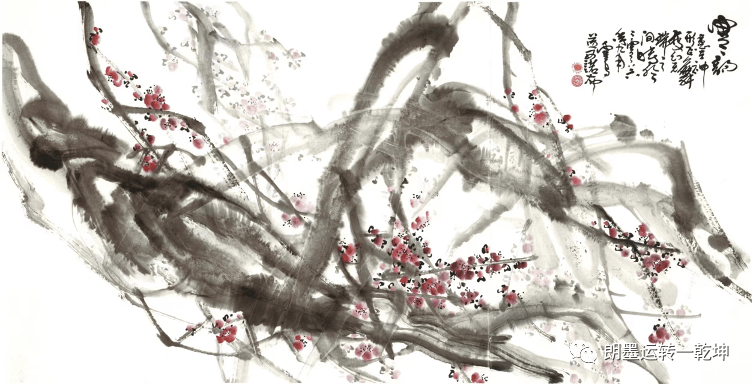
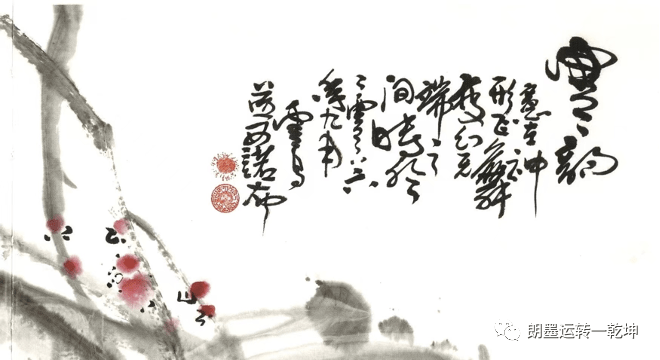
The Buddha also created an ink painting to accompany the poem. The poem delves deeper into the artist’s thoughts, while the painting provides a visual representation.
The plum blossoms depicted in the paintings symbolize the artist’s state of mind, embodying inner beauty refined from impurities. The brushwork, casually applied, was accomplished with an unfettered hand and detached mind, free of the slightest artificiality. It is a seemingly ever-changing work. Its charm, tone, transitions, and depictions represent the highest level of Eastern ink-and-wash paintings. A transparent layer of lighter ink on top of darker ink is clearly visible, imbuing the painting with a pure and fragrant air and providing the viewer with a feeling of comfort and ease.
The plum blossoms created by these skilled pens are eternal. While natural blooms may come and go, Buddha’s compassion remains steadfast.
When I was respectfully on my knees and holding my palms together in front of my kind Buddha Master’s dharma seat for the first time, as soon as I raised my eyebrows to have my eyesight in a light contact with the loving, compassionate, and benevolent eyes of my Buddha Master, I immediately had the belief that my Master is a Buddha! However, my Buddha Master never stated to anyone what holy being he was in past lifetimes. Conversely, he always claimed to be a servant of everyone.
During the past ten years, I closely attended by the side of my Buddha Master and also carried out quite a number of Buddhist deeds following my Buddha Master. The holy states and holy realizations manifested by my Buddha Master such as proficient in both exoteric and esoteric Buddhism, perfect and deep mastery of the Five Vidyas, and great wisdom unrivaled by any human or holy beings are unprecedented in the history of both exoteric and esoteric Buddhism.
My firm belief of “My master is a Buddha” that I had in my mind for years was finally confirmed from the treasure book of H. H. Dorje Chang Buddha IIIthat was presented to the Congress of the United States by the International Buddhism Shanga Association on April 3, 2008. The identity of my Buddha Master, known by people in the world as Master Wan Ko Yee, was revealed through either meditation or practice of the dharma in a profound state of supernatural vision by the first-class great holy virtuous ones, who are incarnations of Buddhas and Bodhisattvas. They announced the background of H.H. Wan Ko Yeshe Norbu, who was long ago recognized by H.H. Great Dharma King Zunsheng (the manifestation of Mahavairocana Buddha) as Buddha Vajradhara. Through strict practice of the dharma and meditation these holy monastics deeply entered the dharma realm and supernaturally saw the true source. The result was they learned that this being of great virtue and holiness is the second incarnation of Vimalakirti and the third incarnation of Dorje Chang Buddha. They wrote down their certificates of recognition according to the rules of Buddhism in which they recognized that H.H. Master Wan Ko Yee is H.H. Dorje Chang Buddha III — the highest ancient Buddha in exoteric, esoteric, Mahayana, Hinayana, and Vajrayana Buddhism; the master of the Five Buddhas in the five directions; and the master of the great mahasattva Vajrasattva. That is, they recognized that H.H. Master Wan Ko Yee is the Holiest Tathagata Wan Ko Yeshe Norbu, the current greatest leader of Buddhism in the entire dharma realm!
Those eminent monks and dharma kings also wrote words praising H.H. Dorje Chang Buddha III as being the highest and greatest holy being and the only one in the history of Buddhism who has truly exhibited before living beings item after item of accomplishments in the Five Vidyas.
From that, I realized the truth behind what I experienced quite a few years ago when a huge and gigantic material, in less than two hours of time, became a piece of extremely finely carved and crafted miraculously wondrous holy Yun sculpture artwork. Such holy realization was just a manifestation of the craftsmanship vidya of the Five Vidyas by my magnificent Buddha Master, due to the affinity of living beings.
My Grand Master, H.H. Great Dharma King Zunsheng, stated in a formal pronouncement about my great and kind Buddha Master that the realization of any eminent monastic or person of great virtue in the world today cannot rival the realization of Holiest Tathagata Wan Ko Yeshe Norbu. H.H. Great Dharma King Zunsheng also made the following vow of truth: “If any person or holy being is able to duplicate the mysterious sculpted treasures created by H.H. Wan Ko Yeshe Norbu, then this formal pronouncement of Great Dharma King Zunsheng has deceived the public.” (The mysterious sculpted treasures are “Enchanting Colors of Utmost Mystery,” “Mysterious Boulder with Mist,” and certain other Yun sculptures with specific names.)
Yun Sculpture by H.H. Dorje Chang Buddha III
According to the system and rules of Buddhism in this world, there are only two beings of great holiness whose expositions of the dharma can be categorized as sutras. One of them is Sakyamuni Buddha. The other is the holy and venerable Vimalakirti. Besides those two, all other expositions of the dharma can only be called commentary rather than sutras. This is true no matter how great the Bodhisattva who has expounded the dharma is.
Some people say that Hui Neng (the sixth patriarch master of the Zen School) gave the Platform Sutra of the Sixth Patriarch. Actually, the word sutra was used due to exaggerated praise given to Hui Neng by people of the world who did not understand the system and rules of Buddhism. The rank of the sixth patriarch was even lower than that of many Bodhisattvas. For example, Maitreya Bodhisattva is the next Buddha, who will conduct the Dragon Flower Assembly. The position of Maitreya Bodhisattva is very much higher than that of Hui Neng. However, expositions of the dharma given by Maitreya Bodhisattva cannot be called sutras. They can only be accepted as commentary. An example of this is the Yogācāra-bhūmi-śāstra. (Discourse on the Stages of Concentration Practice)
The holy and venerable Vimalakirti descended into this world during the time of Sakyamuni Buddha. He is the only ancient Buddha who transformed into a layman to expound the dharma. Sakyamuni Buddha personally taught the four types of disciples. Among them were the 500 monks who were difficult to teach and who did not want to arouse Mahayana bodhicitta. A skillful means was used to teach all of the monastics and 8,000 Bodhisattvas. After the ancient Buddha Dorje Chang expounded dharma in Abhirati (World of Wonderful Joy), the Buddha responded to karmic conditions by transforming into the holy and venerable Vimalakirti to help the Buddha teach the sangha, Bodhisattvas, and other disciples. The goal was to protect and uphold the Buddha-dharma taught by Sakyamuni Buddha. The level of realization attained by the holy and venerable Vimalakirti was the same as that attained by Sakyamuni Buddha. However, He did not want to assume the status of another leader of the religion in the human realm, thereby causing sectarianism and adding to the self-centeredness of practitioners. Considering that Sakyamuni Buddha became a Buddha in this earthly World, the holy and venerable Vimalakirti acknowledged Sakyamuni as Buddha and chose to assist Sakyamuni Buddha by manifesting as a Bodhisattva.
Thus, the holy and venerable Vimalakirti acted in the same way that the ancient Buddha Zheng Fa Ming (True Dharma Brightness) Tathagata acted when the Buddha transformed into Kuan Shi Yin Bodhisattva and also acted in the same way as Manjushri Bodhisattva, the Master of seven Buddhas, did to play the role of a Bodhisattva to support Sakyamuni Buddha. All of this was done to benefit living beings. If two Buddhas of the same rank appeared at the same time, it would cause worldly divisions. It would hinder the development of Buddha-dharma and the saving of living beings. Actually, Buddhas do not care who emerges as the leader of Buddhism. The Buddhas appear in whatever form and manner that best benefit living beings. Everything is done for the benefit of living beings based upon bodhicitta.
Therefore, people in general have no way of discovering that the realization and enlightenment of the holy and venerable Vimalakirti were that high and that He was the incarnation of Dorje Chang Buddha, the foremost ancient Buddha who existed before Sakyamuni Buddha. However, the dharma discourses of the holy and venerable Vimalakirti are sutras, just as the dharma discourses of the Buddha, not commentaries. In the system of Buddhism, one such discourse is called Vilmalakirti-nirdesa Sutra (The Sutra of Vimalakirti). That sutra came into being during the same time period Sakyamuni Buddha was giving sutras. It is a very important Buddhist sutra. The Vimalakirti-nirdesa Sutra has been studied and followed in both Mahayana Buddhism and Hinayana Buddhism that was mostly propagated in Southern Asia.
When H.H. Dorje Chang Buddha III was born, the beating of drums suddenly sounded in the sky, and beautiful, heavenly music could be heard. Three rainbows approximately forty to fifty meters (131-164 feet) apart appeared simultaneously in the sky. The middle one was primarily blue, the right one primarily red, and the left one primarily white. At birth, the entire body of His Holiness was dark blue. No cries from His Holiness could be heard. Rather, His Holiness opened his mouth and very clearly stated, “I have entered this world. I am completely proficient in exoteric and esoteric Buddhism and will wondrously manifest the Five Vidyas. Compare and you will know.” After speaking such words, His Holiness remained silent and appeared just like an ordinary child. The parents of His Holiness thought that they had given birth to a mysterious and extraordinary human being but did not tell anyone about this. His Holiness did not speak again until He was three years old.
When His Holiness was three years old, H.H. Mahavairocana Dharma King Zunsheng guided His Holiness in learning the Tripitaka. At that time, His Holiness was taught to recite the heart mantra of Dorje Chang Buddha seven times. This little child suddenly laughed heartily and immediately manifested the Three Bodies and Four Wisdoms. H.H. Great Dharma King Zunsheng at once tested His Holiness’s knowledge of the Tripitaka and the esoteric scriptures. The Dharma Prince child explained such writings with great facility. There was nothing in them that His Holiness did not understand. His Holiness had realized all of the doctrines and principles of such teachings.
H.H. Mahavairocana Dharma King Zunsheng then gave the following formal pronouncement: “Dorje Chang Buddha has come to this world a third time. The holy and venerable Vimalakirti has descended from the skies a second time. He completely understands the scriptures on the dharma. His Four Wisdoms are wonderfully perfect. He is an ancient Buddha upon whom living beings can rely. No master is qualified to teach Him. His mysterious sculpted treasures will be spectacular and unique in the world. He will be able to take mist that will stay inside His sculptures. He will manifest His realization and consummate skills. No holy person in the world will be able to duplicate such works. If anyone will be able to duplicate such works without differing from the original at all, my words have deceived the world. Vimalakirti Wan Ko is Buddha Vajradhara. He will cause the Buddhas to bestow nectar that many will see descend from the sky. He is of utmost benefit to sentient beings. He has the compassion and wisdom of an ancient Buddha. I hereby reveal these words to prove the veracity of my formal pronouncement.” H.H. Mahavairocana Dharma King Zunsheng also gave His Holiness the dharma name Yangwo Yizhi Dharma Prince, which means Dharma Prince supreme leader of Buddhism with the highest wisdom.
H.H. Mahavairocana Zunsheng then said, “During the Dharma-Ending Age in the earthly world, there will be many evil teachers and demons who will claim to be genuine holy persons. In order to distinguish the genuine from the false, I now make a strict formal pronouncement that will serve as the testing standard. The pronouncement is as follows: There will not be a fourth incarnation of Dorje Chang Buddha in this earthly realm within the next 5,000 years. The third Dorje Chang Buddha will be the only such holy being, and there will not be an incarnation of another Dorje Chang Buddha in this earthly realm for 5,000 years. Based on causes and conditions that accord with the dharma, I now lay out tests to determine whether a person is that true Buddha if he claims to be the true incarnation of that Buddha. He must successfully invoke the Buddhas to bestow nectar. He must be able to perform the Golden Vase Selection of Karmic Affinity and predict the results of that ceremony beforehand. He must be able to eliminate karmic obstructions in a clearly visible manner. He must be able to replicate wondrous multicolored sculptures. He must be able to take mist, place it inside a hollowed out sculpted boulder, and have the mist stay there. If a person is able to do all five of these things without exception, then he is the true fourth Dorje Chang Buddha. No matter how great a holy terton may be, no matter if a person leaves concave imprints on rocks with his hands or feet, no matter how vast a person’s manifold supernatural powers may be, if he cannot do these five holy things, then he certainly is not the true incarnation of Dorje Chang Buddha. An ancient Buddha who descends to this earthly realm will have no difficulty meeting these five tests. I leave these five observable tests to guard against those in the future who make false claims.”
The Dharma Prince was acting as the holy and venerable Vimalakirti did when Vimalakirti received different teachings and knowledge, took on the appearance of an ordinary person, and learned things tirelessly. No one knows why the Dharma Prince did so. At the age of sixteen, the Dharma Prince wrote a work on the dharma called A Monk Expounds the Absolute Truth to a Layperson. After that writing was buried, great master Hui Yong unearthed it. Renqing Luozhu and Suolang Danbu respectfully offered that writing to H.H. Mahavairocana Zunsheng Yeshe Norbu to evaluate. H.H. Zunsheng Yeshe Norbu personally promulgated that dharma called A Monk Expounds the Absolute Truth to a Layperson in front of the four types of Buddhist disciples. After He finished promulgating that dharma, He personally led the four types of Buddhist disciples in kneeling down and facing that writing on the dharma. He then made the following formal pronouncement: “An ancient Buddha has arrived in the east.” He recognized that the Dharma Prince was H.H. Dorje Chang Buddha III, conferred upon His Holiness the title Yangwo Wan Ko Yeshe Norbu, and said that His Holiness is the Holiest Tathagata. He also called that dharma A Monk Expounds the Absolute Truth to a Layperson Sutra.
There are certain time periods relating to H.H. Dorje Chang Buddha III ’s propagating the dharma and benefiting living beings. Before the age of eleven was the period during which His Holiness was engaged in the Tripitaka of exoteric Buddhism. From the age of eleven to fifteen was the period during which His Holiness was engaged in the esoteric dharma of the Kagyu school. During that time, he was called Dusum Khenpa Lion’s Roar Dharma Prince. After the age of fifteen was the period during which His Holiness was engaged in the esoteric teachings of the Geluk school. His Holiness was at that time called the reincarnation of Master Tsongkhapa. That was also the time period during which His Holiness flawlessly propagated the tantric scriptures of the Sakya, Nyingma, and all of the other schools. At this time, His Holiness was called the embodiment of the body, speech, and mind of Guru Padmasambhava.
Because my Buddha Master is an ancient Buddha who has come to this world again, His Holiness upholds the principles of “making no distinction between exoteric and esoteric Buddhism or among all of the sects and schools; teaching living beings according to their particular circumstances; and pervasively propagating the teachings of the Buddhas to all.” Thus, His Holiness is the Buddha Vajradhara Great Dharma King of the “Buddha Sect” who pervasively saves all living beings. My Buddha Master has repeatedly admonished everyone with the following counsel: “There is no differentiation among the various schools and sects in my mind. There is only Buddhism. However, for a dharma king, rinpoche, or acharya of any school or sect, as long as he or she does not commit violations in the 128 evil and erroneous views, abides by the teachings of the Buddha, attains liberation, and then saves other living beings based on their particular karmic conditions, he or she is worthy of praise.” Of course, The Supreme and Unsurpassable Mahamudra of Liberation is the greatest dharma among supreme great dharmas for cultivators to receive and practice. That is why my Buddha Master is the only one in this world possessing the realization of opening up the Niwan Daoguo for all kinds people to enable them to attain heavenly and holy states.
[Please respectfully read in detail the treasure book of H. H. Dorje Chang Buddha III to acquire great wisdom, accomplishment and liberation. If you have the affinity to receive and practice the dharma of The Supreme and Unsurpassable Mahamudra of Liberation, you will be certain to get great wisdom and attain great accomplishment and liberation.]
My husband and I have a son and a daughter. My daughter was employed in a bank and my son ran a chemical business in the bonded area. Although the competition was fierce, my son was smart and flexible, he made his career. Soon the children grew to the age for marriage, we bought a car and a big suite at the lake scenic area. Then we had a daughter-in-law, married our daughter. We became grandparents the second year. My husband and I learned Buddhism and cultivation while taking care of our grandchildren. We lived a full life and enjoyed the happiness of our family. After two years’happy life, my son wanted to switch to project contraction because of the hard competition and low profit in the chemistry business. No matter how we discouraged him, he didn’t change his mind. Finally, we urged him not to gamble or turn to high-risk lenders, he should think twice and keep wits on dealing matters. My son flew to different cities to struggle for business. The assets could reach to ten million at most. At the peak of his career, he undertook hundreds of millions of decoration projects and led hundreds of workers. We often asked him about the business, he always understated the situation and told us not to worry, he said what we need to do was learning Buddhism and taking good care of the grandchild. Later, my son came back home more and more frequently, and he avoided answering phones in front of us. We became nervous. It was after different people came for millions of debts that we knew what was a bolt from the blue. I used to hear that Jack was bankrupt, Tom was cheated and John had an accident, but I didn’t expect that it was our turn. It turned out that my son put a lot of money into the project, and he also borrowed millions of money for emergency. The first party has to pay some money after the project passed the acceptance checks, but it withheld the money and didn’t fulfill the contract. My son sued the first party after he failed to get the money back in several months. However, the creditors were demanding to be paid every day. It is compulsory to pay what you owe. We deeply knew that we couldn’t err on the causality, so we tried our best to help our son to settle debts, but the money we had was still far from enough. We borrowed money from all people we knew without caring about losing faces. However, people usually busily embroidering more flowers on the brocade rather than sending charcoal to the needy on a snowy winter day. In this situation, we sold the house and car to repay most of the debts.
During the process, I remembered what H.H Dorje Chang Buddha III taught us: everyone knows to cultivate themselves in prosperity, the problem is how to deal with it in adversity? When you rise with money and power, or when you’re down and out with pain, can you remain the inner peace no matter how the circumstances change? This is a litmus test for me and my family. Taking Buddhism makes me realize that the process of impermanence is the truth. Our body will go bad, the wealth we have will dwindle, so are the house and car, now they’re just gone in advance. It’s all about causality. As long as we can make ends meet, nothing weighs more than life and death. No matter how rough life is, you must move forward, to make choices between the gain and loss and be strong in the experience. We will experience all kinds of hardships in the way of practice. Only if you want to extricate yourself from suffering do you truly cultivate yourself. To establish a mind determined to leave the cycle of reincarnation helps us leave suffering and obtain happiness in the end.
Though we are difficult in material condition, we have a rich spiritual life. We are lucky to have H.H Dorje Chang Buddha III imparting Buddha dharma in this world, we happily took refuge to the Buddha, Dharma and Sangha, and we listen and learn from the recorded Buddha dharma discourses with great joy. These can’t be bought with gold and silver. Anyway the wind blows, doesn’t really matter to me. With the light of Buddhism, my family and I will walk down the path firmly. My son becomes mature after this setback. I believe the lesson is a supporting condition for his life. If we don’t study Buddhism and believe in causality, this disaster may push my family into a doomed vortex. Crying our eyes out, holding grudges, be in a violent rage, collapsed after the straits and trying to commit suicide? No, we don’t behave like that. We settle our debts in causality, and demand unpaid money from the first party through legal methods. Buddhism gives us wisdom and power to deal with everything reasonably and calmly. All negative karmic conditions and sufferings make me and my family to cherish Buddhism and the chance for incarnating as a human being, guiding us to the path of bodhi. I believe every struggle after the hardship is the chance to change fate.
Last Sunday, I was so blessed to have a chance to visit the treasure room in The International Art Museum of America. The room only open four times a year. Three big locks fully close the door. Three persons open locks at the same time. One museum staff accompanied me inside the room, introducing each artworks, and answering my questions. There are four pieces of extremely beautiful splendid Yun Sculptures inside the room.
From the introduction, I learned that Yun Sculpture is an art form created by H.H. Dorje Chang Buddha III. It is exquisite and mysterious, their beauty is astonishing and spellbinding, and structures are both exquisitely fine and sophisticated, with unanticipated variations. Unprecedented in history, H.H. Dorje Chang Buddha III’s Yun sculptures are the first form of art that cannot be replicated, regardless of the method used.
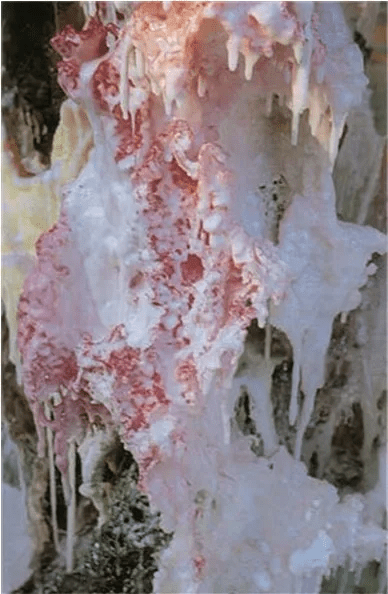
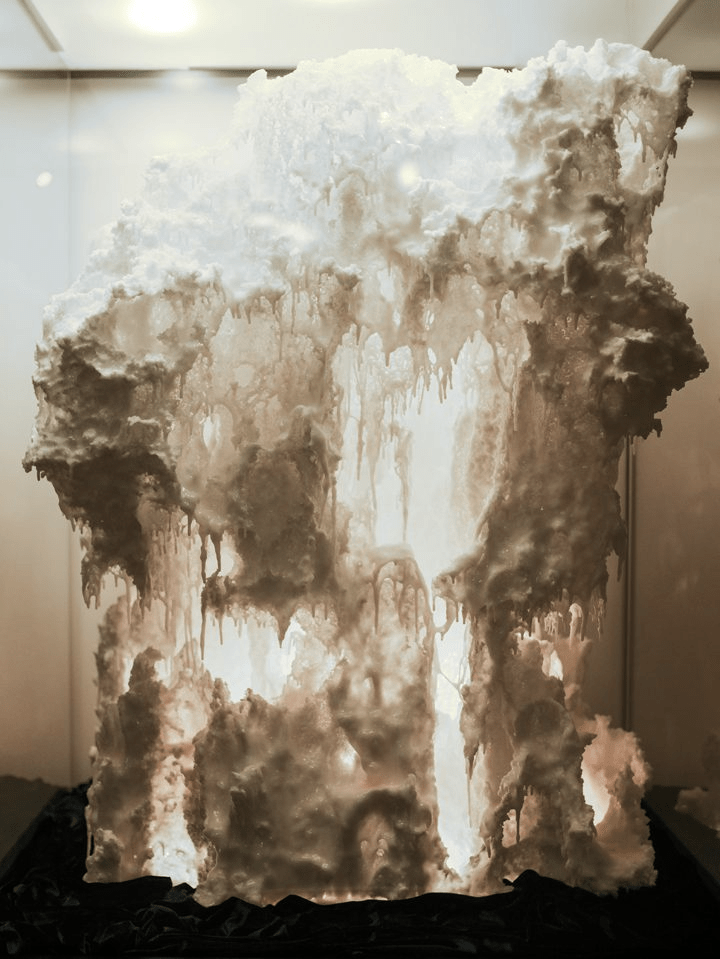
The first one I saw is called Holy Purity. Its color is soft and lustrous, like thin white silk. It looks as pure and noble as jade or ice, has an elegant hanging style, and is completely free of any flaw. This artwork, which is pleasing to the eye and comforting to the mind, fully deserves that name it was given, for it indeed possesses the qualities of holiness, purity, elegance, refinement, and white splendor.
Holy Purity
When look at different angles, I can see various remarkable sights, and light auspicious mist. I truly experienced a carefree and peaceful feeling that is difficult to describe. I felt my heart and soul are purified by this noble object. The pictures here are too dark, the whole sculpture is totally milky white.
Mystery of Lovely Colors
The second piece is called Mystery of Lovely Colors. Just like its name, it is a very vibrant and colorful artwork.
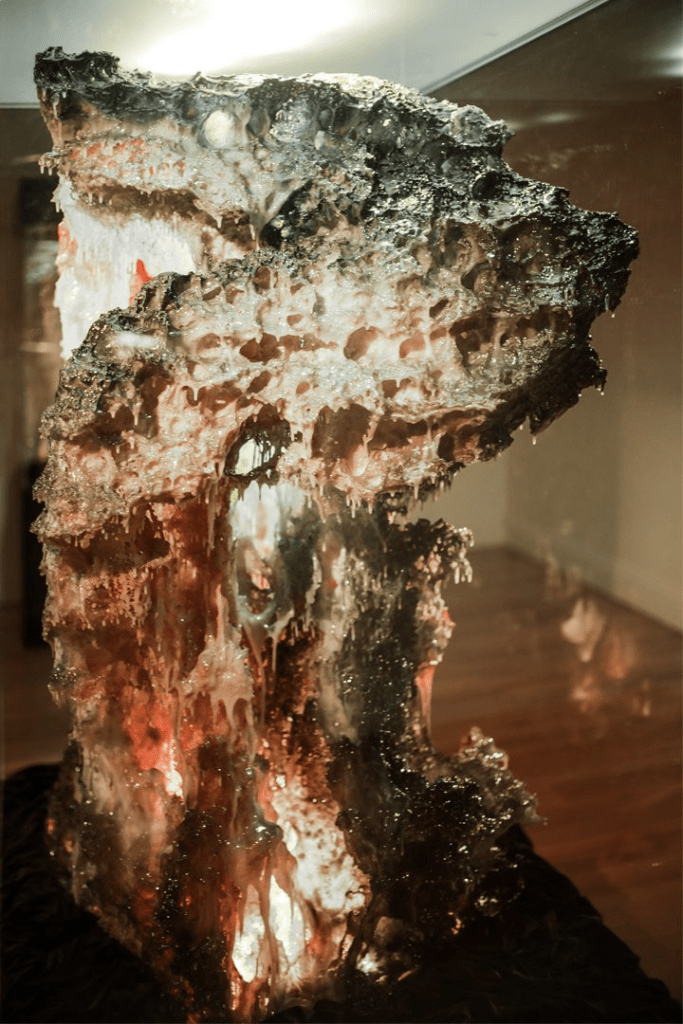
Mystery of Lovely Colors is a big Yun sculpture. Its structure and overall arrangement can only be described as “endlessly varied” and “unfathomably mysterious.” Phrases such as “swirling unusual colors,” “a mixture of emptiness and substance,” and “too beautiful to be absorbed all at once” are used to describe its grandeur, beauty, and elegance. When this exquisite sculpture is viewed from different angles, one can see various wonderful and fascinating sights that seem to be constantly changing.
The museum guide told me : “When this Yun sculpture was displayed in the Gold Room of the United States Capitol and at the Organization of American States, experts and scholars viewed it with admiration, praising it with words such as, “a gift from God to mankind,” “a treasure from a Buddha-land,” “captivatingly beautiful,’ and even “since the appearance of Yun sculptures, all treasures in this human world have become like stars in the sky that pale against a resplendent moon.”
Mysterious Mist Inside A Stone
Inside a small rome, there are two very special Yun sculpture pieces called Mysterious Mist in a Stone. One can see that mist is permanently sculpted in it like a miracle.
White jade-like gauze hangs inside a stone Unmatched sculpting produces emotion amid the mist Without words, a rare melody plays inside the cave Such heavenly scenery is difficult to duplicate
Mist is permanently sculpted in the cave of the Mysterious Mist in a Stone, an artwork that cannot be replicated
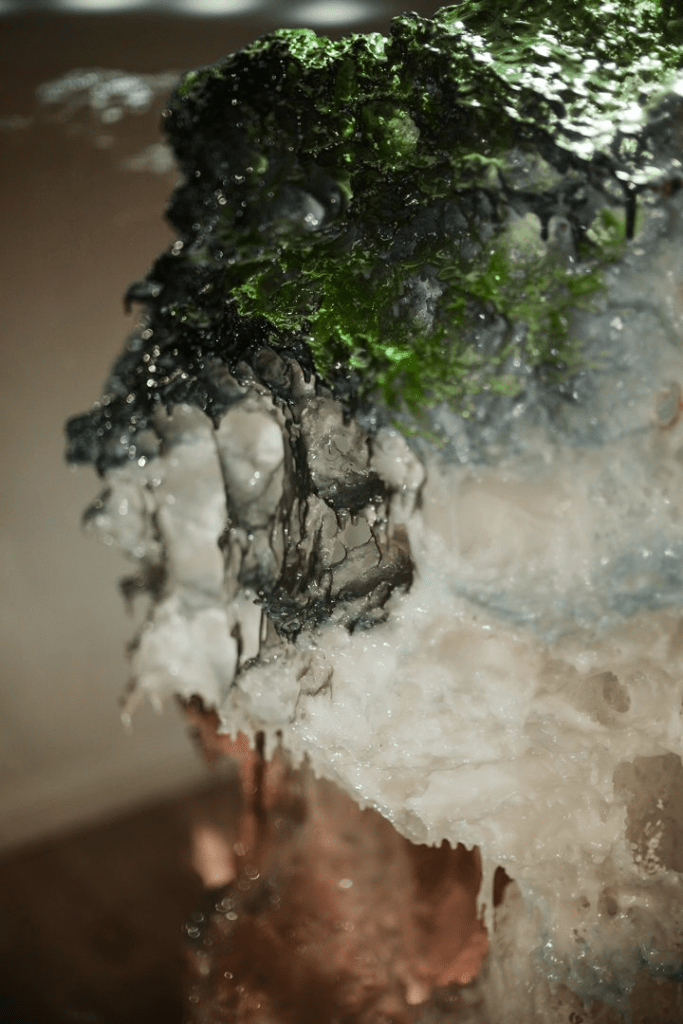
From its external appearance, one can see that “Mysterious Mist Inside a Stone” is an ordinary greenish rock that is a few feet long. However, the inside of it is a totally different world. Its interior contains layer upon layer of what appears to be peaks and hills, forming a beautiful crisscrossing network. Its scenes seem to change endlessly, giving it a profoundly mystical quality. In some parts of the stone’s interior, there is mist as exquisite as chiffon, while in other parts the mist is so thick it covers whatever is behind it. In the latter case, a lamplight that penetrates mist must be shone into the stone to view the background scenes. One can see mist circling upward.
Mysterious Boulder with Mist
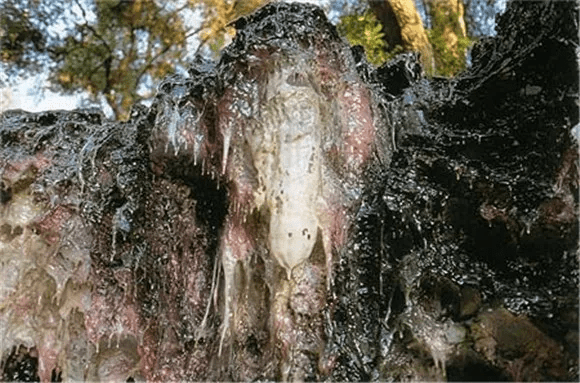
Right beside the Mysterious Mist Inside a Stone is another sculpture also has mist inside. It is called Mysterious Boulder with Mist. There are two grottoes inside the boulder, each of which contains its own scenery. When you look inside the right grotto, you will see thick mist enveloping everything. The structure of the carved scenery inside this hole is vague, since it cannot be clearly seen through the mist. You are left with the impression that the mist is a few dozen yards deep inside the hole when it is actually only three or four feet deep. When you look inside the left grotto, you will see that there is no mist at all. You will clearly see the structure of the carved scenery inside this hole. The material used to carve those two grottoes was the same, the colors applied to both of them were the same, and their depth is the same. The carving skills and inner-realization of H.H. Dorje Chang Buddha III caused this mysterious phenomenon of one side containing thick, enveloping mist and the other side containing no mist at all.
Sculptors throughout history have been able to produce material forms or images through sculpting. However, no one has been able to produce through sculpting something as insubstantial and formless as fog or mist. Nonetheless, there are sculptures of H.H. Dorje Chang Buddha III that combine both material form and mist.
While I was fascinated by those beautiful artworks, I seem to hear the works say, “I’m born on this earth in such a beautiful and exquisite way. Who or what kind of artist gave birth to me? I could not have been given life by a mundane person. “
H.H. Dorje Chang Buddha III’s Yun sculptures can truly be called peerless, priceless treasures. H.H. Dorje Chang Buddha III was able to create these treasures based upon his high state of realization, profound and extensive knowledge, as well as his penetration of the laws that underlie the birth, growth, and change of all things in the universe.
My son once shared a story about greed from his middle school textbook, by Leo Tolstoy. It was quite frightening, to realize the power that greed exerts over us all. Sometimes, it can even blind us to the threat of death itself.
The protagonist of the story is a peasant named Pahom, who overhears his wife and sister-in-law argue over the merits of town and peasant farm life. He thinks to himself “if I had plenty of land, I shouldn’t fear the Devil himself!”. Unbeknown to him, Satan is listening.
However, Pahom then becomes very possessive of his land, and this causes arguments with his neighbors. “Threats to burn his building began to be uttered.” Later, he moves to a larger area of land at another Commune. Here, he can grow even more crops and amass a small fortune, but he has to grow the crops on rented land, which irritates him. Finally, after buying and selling a lot of fertile and good land, he is introduced to the Bashkirs, and is told that they are simple-minded people who own a huge amount of land. Pahom goes to them to buy as much of their land for as low a price as he can negotiate. Their offer is very unusual: for a sum of one thousand rubles, Pahom can walk around as large an area as he wants, starting at daybreak, marking his route with a spade along the way. If he returns to his starting point by sunset that day, all the land his route encloses will be his, but if he does not reach his starting point, he will lose his money and receive no land. He is delighted, as he believes that he can cover a great distance and has chanced upon the bargain of a lifetime. That night, Pahom experiences a surreal dream in which he sees himself lying dead by the feet of the Devil, who is laughing.
He stays out as late as possible, marking out land until just before the sun sets. Toward the end, he realizes he is far from the starting point and runs back as fast as he can to the waiting Bashkirs. He finally arrives at the starting point just as the sun sets. The Bashkirs cheer his good fortune, but exhausted from the run, Pahom drops dead. His servant buries him in an ordinary grave only six feet long, thus answering the question posed in the title of the story.
After reading the story, I have come to truly understand why greed is the first of the three poisons in Buddhist teachings. Out of all these vices (greed, hatred, and delusion), it is perhaps the most seductive.
The contemporary Buddha H.H. Dorje Chang Buddha III teaches Buddhist disciples that greed can break one’s cultivation. True to his word, H.H. Dorje Chang Buddha III never takes any offerings from his students, no matter how big or small they are. His Holiness has set a great example for all his disciples. The videos below are the testimonies.
There is a rather famous tombstone in Westminster Abbey. There’s nothing so special about it, except for its inscription. I believe that many people have heard of it.
“When I was young and free and my imagination had no limits, I dreamed of changing the world. As I grew older and wiser, I discovered the world would not change, so I shortened my sights somewhat and decided to change only my country. But it, too, seemed immovable. As I grew into my twilight years, in one last desperate attempt, I settled for changing only my family, those closest to me, but alas, they would have none of it. And now, as I lie on my deathbed, I suddenly realize: If I had only changed myself first, then by example I would have changed my family. From their inspiration and encouragement, I would then have been able to better my country, and who knows, I may have even changed the world.”
It is said that many world dignitaries and celebrities were deeply moved when they saw these words Some people say that this is a teaching of life, some people say that it is a kind of introspection of the soul.
There are similar teachings and philosophies in Chinese traditional culture. The Great Learning is a compilation of Confucian teachings used to address deeply important social behavior. In The Great Learning says: “The ancients who wished to illustrate illustrious virtue throughout the kingdom, first ordered well their own States. Wishing to order well their States, they first regulated their families. Wishing to regulate their families, they first cultivated their persons.”
“From the Kings down to the mass of ordinary people, all must consider the cultivation of the person the root of everything besides. It cannot be, when the root is neglected, that what should spring from it will be well ordered.”
In Buddhism, self cultivation is heavily emphasized as well. The first thing for all buddhist disciples is constantly cultivating themselves. In What is Cultivation, His HolinessDorje Chang Buddha III provides detailed guidance on self-cultivation. Self-cultivation is the fundamental and essential in the learning of Buddhism. Through self-cultivation, one will not only live a happy life and contribute the best of oneself to the society, but also can reach enlightenment and liberation.






















 Peace LiLy