Last Sunday, I was so blessed to have a chance to visit the treasure room in The International Art Museum of America. The room only open four times a year. Three big locks fully close the door. Three persons open locks at the same time. One museum staff accompanied me inside the room, introducing each artworks, and answering my questions. There are four pieces of extremely beautiful splendid Yun Sculptures inside the room.
From the introduction, I learned that Yun Sculpture is an art form created by H.H. Dorje Chang Buddha III. It is exquisite and mysterious, their beauty is astonishing and spellbinding, and structures are both exquisitely fine and sophisticated, with unanticipated variations. Unprecedented in history, H.H. Dorje Chang Buddha III’s Yun sculptures are the first form of art that cannot be replicated, regardless of the method used.
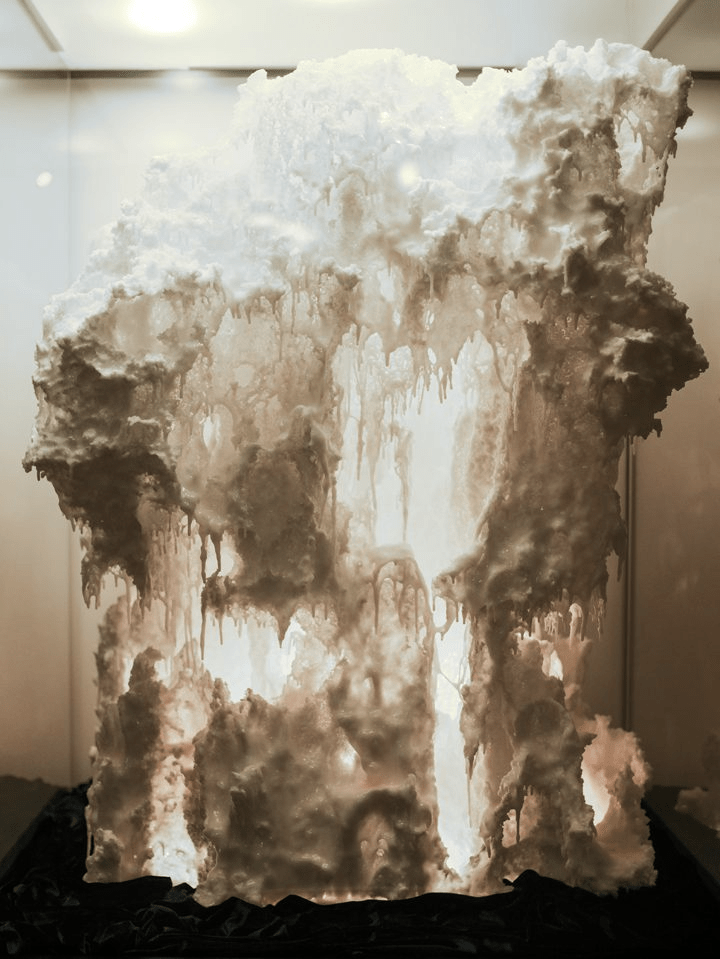
The first one I saw is called Holy Purity. Its color is soft and lustrous, like thin white silk. It looks as pure and noble as jade or ice, has an elegant hanging style, and is completely free of any flaw. This artwork, which is pleasing to the eye and comforting to the mind, fully deserves that name it was given, for it indeed possesses the qualities of holiness, purity, elegance, refinement, and white splendor.
Holy Purity
When look at different angles, I can see various remarkable sights, and light auspicious mist. I truly experienced a carefree and peaceful feeling that is difficult to describe. I felt my heart and soul are purified by this noble object. The pictures here are too dark, the whole sculpture is totally milky white.
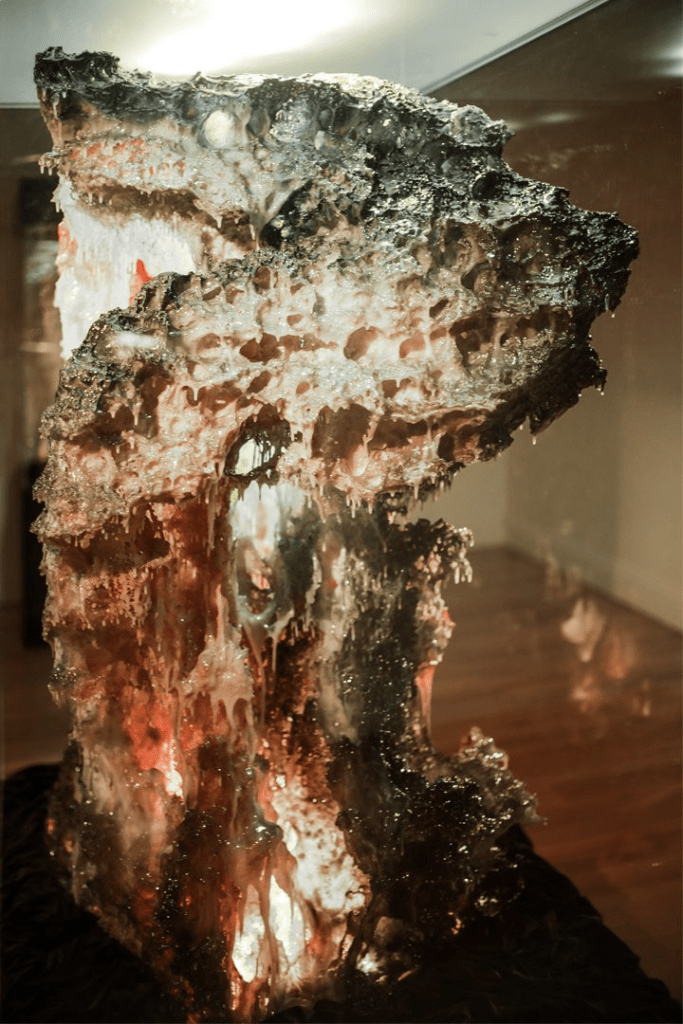
Mystery of Lovely Colors
The second piece is called Mystery of Lovely Colors. Just like its name, it is a very vibrant and colorful artwork.
Mystery of Lovely Colors is a big Yun sculpture. Its structure and overall arrangement can only be described as “endlessly varied” and “unfathomably mysterious.” Phrases such as “swirling unusual colors,” “a mixture of emptiness and substance,” and “too beautiful to be absorbed all at once” are used to describe its grandeur, beauty, and elegance. When this exquisite sculpture is viewed from different angles, one can see various wonderful and fascinating sights that seem to be constantly changing.
The museum guide told me : “When this Yun sculpture was displayed in the Gold Room of the United States Capitol and at the Organization of American States, experts and scholars viewed it with admiration, praising it with words such as, “a gift from God to mankind,” “a treasure from a Buddha-land,” “captivatingly beautiful,’ and even “since the appearance of Yun sculptures, all treasures in this human world have become like stars in the sky that pale against a resplendent moon.”
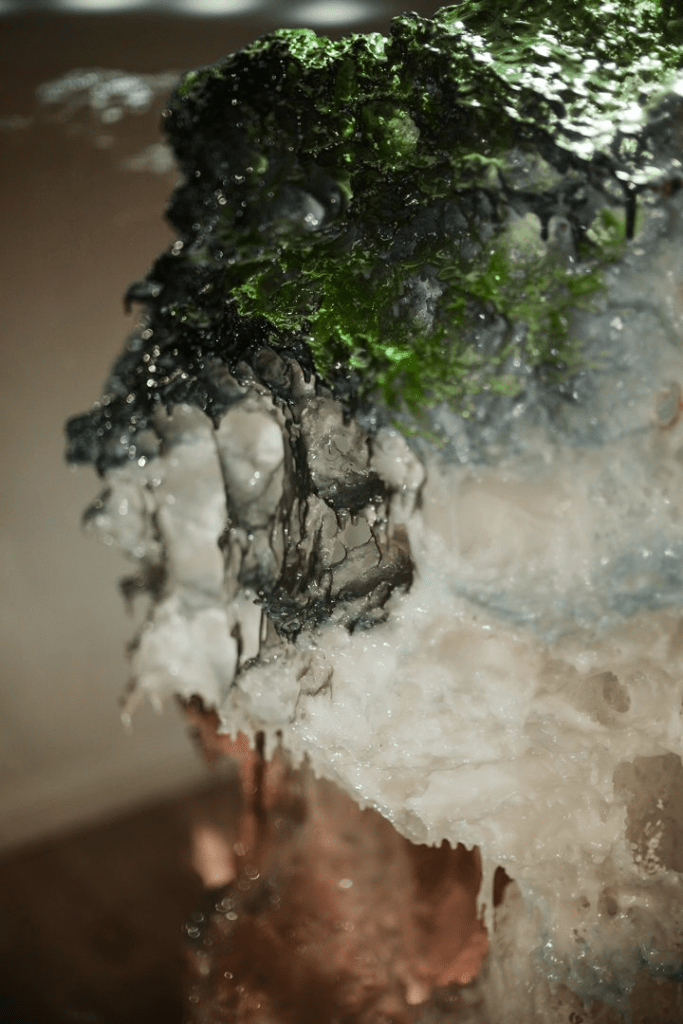
Mysterious Mist Inside A Stone
Inside a small rome, there are two very special Yun sculpture pieces called Mysterious Mist in a Stone. One can see that mist is permanently sculpted in it like a miracle.
White jade-like gauze hangs inside a stone Unmatched sculpting produces emotion amid the mist Without words, a rare melody plays inside the cave Such heavenly scenery is difficult to duplicate
Mist is permanently sculpted in the cave of the Mysterious Mist in a Stone, an artwork that cannot be replicated
From its external appearance, one can see that “Mysterious Mist Inside a Stone” is an ordinary greenish rock that is a few feet long. However, the inside of it is a totally different world. Its interior contains layer upon layer of what appears to be peaks and hills, forming a beautiful crisscrossing network. Its scenes seem to change endlessly, giving it a profoundly mystical quality. In some parts of the stone’s interior, there is mist as exquisite as chiffon, while in other parts the mist is so thick it covers whatever is behind it. In the latter case, a lamplight that penetrates mist must be shone into the stone to view the background scenes. One can see mist circling upward.
Mysterious Boulder with Mist
Right beside the Mysterious Mist Inside a Stone is another sculpture also has mist inside. It is called Mysterious Boulder with Mist. There are two grottoes inside the boulder, each of which contains its own scenery. When you look inside the right grotto, you will see thick mist enveloping everything. The structure of the carved scenery inside this hole is vague, since it cannot be clearly seen through the mist. You are left with the impression that the mist is a few dozen yards deep inside the hole when it is actually only three or four feet deep. When you look inside the left grotto, you will see that there is no mist at all. You will clearly see the structure of the carved scenery inside this hole. The material used to carve those two grottoes was the same, the colors applied to both of them were the same, and their depth is the same. The carving skills and inner-realization of H.H. Dorje Chang Buddha III caused this mysterious phenomenon of one side containing thick, enveloping mist and the other side containing no mist at all.
Sculptors throughout history have been able to produce material forms or images through sculpting. However, no one has been able to produce through sculpting something as insubstantial and formless as fog or mist. Nonetheless, there are sculptures of H.H. Dorje Chang Buddha III that combine both material form and mist.
While I was fascinated by those beautiful artworks, I seem to hear the works say, “I’m born on this earth in such a beautiful and exquisite way. Who or what kind of artist gave birth to me? I could not have been given life by a mundane person. “
H.H. Dorje Chang Buddha III’s Yun sculptures can truly be called peerless, priceless treasures. H.H. Dorje Chang Buddha III was able to create these treasures based upon his high state of realization, profound and extensive knowledge, as well as his penetration of the laws that underlie the birth, growth, and change of all things in the universe.
One of the most beloved flowers in China, the plum blossoms (méi-huā, 梅花) have been frequently depicted in Chinese painting and poetry for centuries. The Chinese see its blossoms as both a symbol of winter as well as a harbinger of spring. It is precisely for this reason that the blossoms are so beloved, as they bloom most vibrantly amidst the winter snow, after most other plants have shed their leaves, and before other flowers appear. They are seen as an example of resilience and perseverance in the face of adversity. Though neither the plum tree nor its blossoms are very striking, they manage to exude an otherworldly exquisiteness and beautiful elegance. The demeanor and character of the plum tree thereby serves as a metaphor for inner beauty and humble display under adverse conditions. Because they blossom in winter, the plum blossom is a member of the “Three Friends of Winter (歲寒三友)”, along with the pine and the bamboo. The plum blossom is also a member of the “Four Gentlemen (四君子)” in Chinese art (the others being orchid, bamboo, and chrysanthemum), symbolizing nobility. In China, there are over 300 recorded cultivars of mei, which can be broadly divided by color into white, pink, red, purple, and light green types.
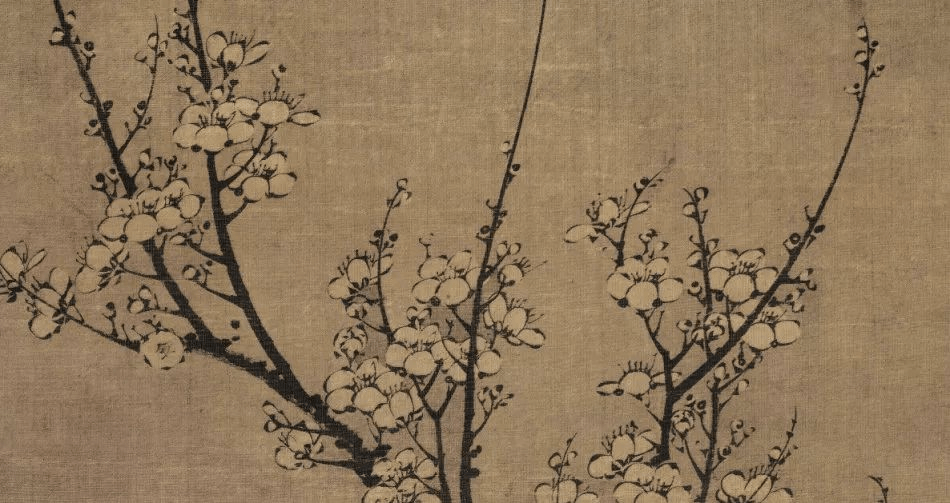
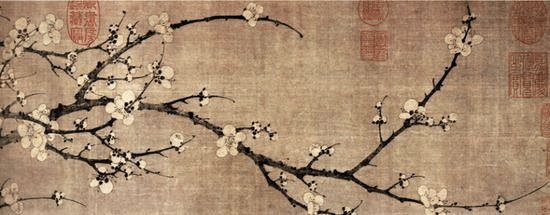
When we look through all of the ancient and modern books on plum blossom paintings, it is not difficult to discover that all of the famous master plum blossom painters had extensive knowledge, deep understanding of ancient and their own contemporary times, and immense talents. No artist in history can be found who lacked virtue and learning and still was capable of painting highly exquisite plum blossom paintings. The plum blossom paintings of ancient artists such as Mian Wang and Dongxin Jin and the modern artist Changshuo Wu are splendid works based upon the profound knowledge and virtue of their creators.
Mian Wang ( 1287-1359 ) : Early Spring at South Corner of Garden
Artist: Dongxin Jin (1687 – 1764)
Artist: Changshuo Wu (1844 – 1927)
As a contemporary artist, the Pop of Buddhist, H.H. Dorje Chang Buddha III has also painted dozens of masterpieces of plum blossom compositions. All in the book entitled Collected Plum Blossom Paintings, Calligraphy, Poems, and Songs. Wielding the brush with great facility, His Holiness creates paintings that are completely devoid of mundane garishness, have the exquisite look of ancient bronze and stone inscriptions, and are imbued with a scholarly air. His Holiness’s painting skills have surpassed the ordinary and reached the consummate mastery of a holy being. Below are several art works from the book. Some of the paintings are in the exhibition of The International Art Museum of America.
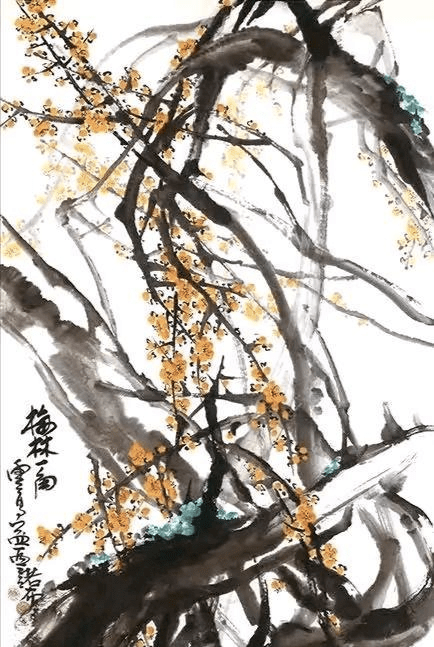
Small Portion of a Plum Grove
Yellow plum blossoms bloom in winter and are generally used during Chinese New Year celebrations as a symbol of great auspiciousness. The painting expresses beauty of a real plum blossom grove.
Drunk in a Green Garden
The turquoise plum blossom is a rare species of plum blossom. These elegant, sublime flowers have a strong resistance to coldness and a scent that is quite fresh and fragrant. This painting has a vigorous and firm style yet maintains great simplicity. The brushwork is bold, vigorous, and completely unconstrained. Large, dancing strokes of a casual hand and free mind bring to form branches and twigs.
Plum Fragrance in the Holy Realm
The brushwork, casually applied, was accomplished with an unfettered hand and detached mind, free of the slightest artificiality. It is a seemingly ever-changing work. Its charm, tone, transitions, and depictions represent the highest level of Eastern ink-and-wash paintings. A transparent layer of lighter ink on top of darker ink is clearly visible, imbuing the painting with a pure and fragrant air and providing the viewer with a feeling of comfort and ease.
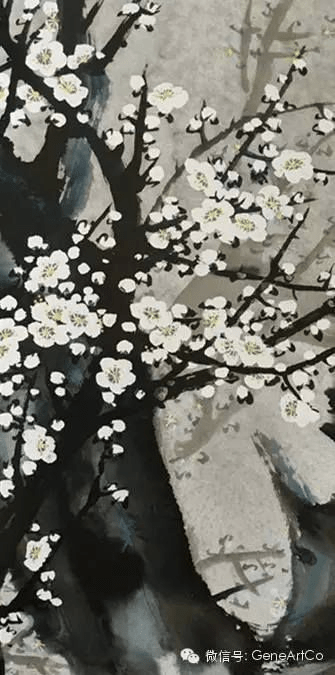
Winter Powder
A most elegant and valued plum flower called ‘Dong Fen” (winter powder). It is widely known to be the king of whiter plum blossoms. A strong contrast is presented by the graceful dense ink that was used to paint the tree trunk and the whiting used to form the flowers. The spatial effect of fairness adds to the charm of the picture, showing an awareness of both emptiness and form. A very special aspect of this painting is that the artist did not apply powerful, bold strokes of uneven contour and content. Rather, ink was applied through a gradual moistening process, manifesting the strong talent of the artist.
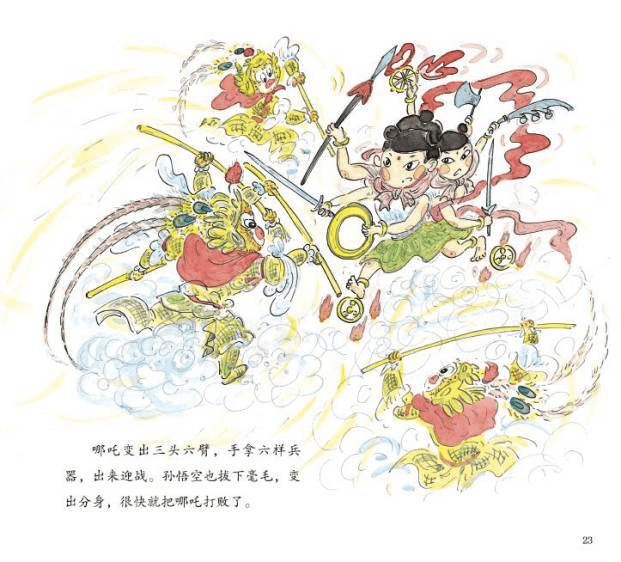
The monkey king in Journey to the West was such a thrilling, fascinating, and happy memory in my childhood. I have read the books, comic booklets, and watched the cartoon movies about it many times. The one I liked the most is “The Monkey King makes an Uproar in Heaven”. It ignited my imagination. I wished I could fly on the clouds just like the Monkey King.
The Monkey King is born on Flower Fruit Mountain from a stone egg that forms from an ancient rock created by the coupling of Heaven and Earth. He first distinguishes himself by bravely entering the Water Curtain Cave on the mountain; for this feat, his monkey tribe gives him the title of “Handsome Monkey King (美猴王).” After seeing a fellow monkey die because of old age, he decides to travel around the world to seek the Tao, and find a way to be able to live forever. He eventually found the “Grand Master of Bodhi (菩提祖師),” who taught him the 72 heavenly methods of transformation and a “sumersault cloud” which allows him to travel 108,000 chinese kilometer, almost instantaneously. The Grand Master also give him a name Sun Wukong. Sun is the Sir name, Wukong means “Awakened to Emptiness”.
After angering several gods and coming to the attention of the Jade Emperor, he is given a minor position in heaven as the Keeper of Horses (弼馬溫) so they can keep an eye on him. When Sun realizes that he was given the lowest position in heaven and is not considered a full-fledged god, he becomes very angry. Upon returning to his mountain, he puts up a flag and declares himself the “Great Sage Equal to Heaven (齊天大聖).” The Jade Emperor dispatches celestial soldiers to arrest Sun Wukong, but none succeed.
The Jade Emperor has no choice but to appoint him to be the guardian of the heavenly peach garden. The different varieties of peach trees in the garden bear fruit every 3,000, 6,000, and 9,000 years, and eating their flesh will bestow immortality and other gifts, so Sun Wukong eats nearly all of the ripe peaches. Later, after fairies who come to collect peaches for Xi Wangmu‘s heavenly peach banquet inform Sun Wukong he is not invited and make fun of him, he once again begins to cause trouble in Heaven, stealing heavenly wine from the peach banquet and eating Laozi‘s pills of immortality. He defeats an army of 100,000 celestial troops, led by the Four Heavenly Kings, Erlang Shen, and Nezha.
Eventually, the Jade Emperor appeals to the Buddha, who seals Wukong under a mountain called Five Elements Mountain after the latter loses a bet regarding whether he can leap out of the Buddha’s hand in a single somersault. Sun Wukong is kept under the mountain for 500 years and cannot escape because of a seal that was placed on the mountain. He is later set free when Tang Sanzang comes upon him during his pilgrimage and accepts him as a disciple.
When I grew up, I started my own journey in searching the truth and meaning of life and universe. I dabbled in different religions. Finally I became a buddhist. There were many supernormal manifestations in buddhist Sutras. Buddhas, Bodhisattvas and holy venerable ones, demonstrated much much more powers than the monkey king. Such as stories of Shariputra’s action power by wisdom, Mahamaudgalyayana’s supernatural power of going a long distance in a shot time, Master Mi Hong’s trip from Shigatse to ChengDu, etc…. In Buddhism teaching, every disciple who has received initiation has the potential to quickly obtain supernormal dharma powers through practice. One has the potential to easily assume an infinite variety of forms and obtain good worldly fortune.
In the dharma discourse Learning from Buddha, imparted by H.H.Dorje Chang Buddha III. I learned there is a Buddha Dharma called “Fine Horse Traversing the Sky Stepping on Clouds”. When a qualified disciple practice this Dharma, he can fly in the sky. Here is the true account of a fast-flying buddhist nun.
(Reported from Los Angeles) In September 2013, an event of supernatural phenomenon occurred in Los Angeles. Scientists have not been able to explain it. This was about a 49-year old Buddhist nun named Jian Hui, a disciple of H.H.Dorje Chang Buddha III, flying at a speed of 700 km per hour.
This event happened at a Buddhist assembly for beseeching auspiciousness, favorable weather, eliminating disasters, and increasing good fortune. The more than 50 attendees are all famous Buddhist figures. At the time, the ceremonial process required chanting a sutra and burning a letter of petition every 10 minutes. When the fifth letter of petition was to be burned, it was discovered that this letter of petition had been lost by this nun named Jian Hui. She was very sad and could not keep her from crying. Because the assembly could not be stopped and the steps of chanting sutras and burning letters of petition must be followed in the predefined order, it was decided that Jian Hui was to go to Hua Zang Si’s Southern-California satellite monastery located in Monterey Park to get this letter of petition. Some time had passed since Jian Hui left. People became very anxious and they called the satellite monastery to ask when the letter of petition can be brought back. The nuns at that monastery passed the phone to Jian Hui. Jian Hui was quite angry on the phone and said, “Don’t make a fuss! I will be back as soon as possible!” Sure enough, within three minutes after putting down the phone, Jian Hui returned to the site of the ceremony from the monastery that is 12 kilometers away. People at the site were all stunned. A nun at the site named Zheng Hui was very surprised and called the monastery to inquire the whereabouts of Jian Hui. The reply from the monastery was that Jian Hui left just three minutes ago. Further verification later also revealed that, after the phone conversation, Jian Hui also spent time to teach people chanting mantras before leaving for the site of the assembly. Based on the calculation that subtracted the time of delay, Jian Hui traveled this distance of 12 kilometers within at most one minute.
Zheng Hui planned to write this event in a book. To verify the facts, she went to the monastery to talk to the nuns there. They all confirmed, “When you called and said that she had returned to your place, it was just a very short while after she had left.” Zheng Hui then asked Zheng Xue, the nun who handed the phone to Jian Hui, where she was at the time. Zheng Xue took this question as distrusting her and was very upset. She kneeled down in front of the statue of Amitabha Buddha and took an oath against heavy consequences to swear that she received the phone call at the monastery and handed the phone to Jian Hui in person inside the Buddha hall of the monastery. If she told a lie, she is willing to descend into the hell realm. Zheng Hui also took an oath against heavy consequences to swear that, within three minutes after her phone conversation with Jian Hui, Jian Hui returned to the site of the assembly. She is also willing to descend into the hell realm if what she said is untrue. Moreover, eminent Buddhist monks including Gar Tongstan IV Ciren Gyatso, Kaichu, Akou Lamo, Shi Miao Kong, Shi Long Hui, Shi Jue Hui, Shi Kui Zhi and others also completely confirmed from their respective personal presences and witnesses at the two locations that the above event was completely true.
Buddhism from Sakyamuni Buddha has been propagating in the world for more than 2,000 years and has evolved into various sects and schools that emphasize different principles and customs. Patriarchs, eminent monastics, and great virtuous ones all state that they themselves possess the best teachings and dharmas. Each flaunts the ability to teach people to eventually attain accomplishment and liberation. The freedom from birth and death in Buddhism that entails one’s ability to control one’s birth and death freely has always been a legend.
Then, what are the results? Facts showed that, in the process of seeking liberation, very few people actually become accomplished in history. On the contrary, very many people did not attain accomplishment through practicing their dharmas. Examples of those who attained prominently well-known accomplishments include Bodhidharma, Hui Neng, Hanshan, and others. In more recent times, there were Xu Yun, Hui Ming, Sheng Qing, and other elderly dharma masters. Of course, there were also Guru Padmasambhava, Master Tsongkhapa, Master Karmapa, Venerable Atisa, Venerable Suchandra, and others. However, the fact is that such accomplished holy virtuous ones are so rare. Especially during the last 100 years or so, the curernt dharma-ending era becomes more penetrating and more deeply rooted. Ture dharma of the Tathagata has almost become lost from the lineages. Even leading figures of eminent monastics and great virtuous ones of the modern time with worldwide reputations had to pass away amid sufferings at the end of one’s life, unable to end the cycle of birth and death and with no accomplishment to speak of.
H.H. Dorje Chang Buddha III brought the great dharmas of Tathagatas to the human world and has restored the original teachings and dharmas of SaKyamuni Buddha. His Holiness the Buddha continues the lifeline of the wisdom of Buddhas and also leads people to the Buddhist principles and ways that deepen and facilitate cultivators’ accomplishment. Examples are The Supreme and Unsurpassable Mahamudra of Liberation, holy inner-tantric initiations of dharmas of state practice, incomparable rules and systematic ways of cultivation, and supreme and expedient dharmas leading to accomplishment. Such teachings and dharmas are unprecedented by any holy ones in history and cannot be exhaustively mentioned or described.
The accomplishments of H.H. Dorje Chang Buddha III at the pinnacles of the five vidyas and the holy realization of His Holiness the Buddha have all been widely known as real facts in the world. However, what is intimately relevant to us is the abilities of the Buddha in teaching people to become accomplished. Only this is the utmost important matter! Facts from actual practices show that people taught by H.H. Dorje Chang Buddha III attained prominent accomplishments.
At year 2018, a disciple of H.H. Dorje Chang Buddha III, Dharma King Gar Tongstan Ciren Gyatso who was the chairman of the World Buddhism Association Headquarters, demonstrated the world-astounding record of becoming free from birth and death!
Dharma King Gar Tongstan paid respect to and learned from many famous figures of Buddhism. Since he paid homage to and became a disciple of H.H. Dorje Chang Buddha III in 1995, his experience was like having found the most precious and rarest treasure. It was exactly like what Geshe Luosang Zhenzhou, who was the sole Larampa Geshe among the Han Chinese people, said in an interview with news media that his earlier experience of learning Buddhism for sixty years could not compare to what he learned from H.H. Dorje Chang Buddha III in one day. Can you imagine what these words entail!
After having learned the cultivation and dharmas transmitted by H.H. Dorje Chang Buddha III, Dharma King Gar Tongstan gave up all the dharmas that he had learned before and did not get effects from and dedicated himself to practicing the profound Buddha-dharma transmitted by H.H. Dorje Chang Buddha III. His realization advanced by leaps and bounds and he attained perfect good fortune and wisdom. In 2004, he demonstrated the Vajra power of a champion of majestic strength and lifted before a crowd of people the Buddha-bathing lotus tub weighing more than 4,000 pounds to fetch water at a holy Buddha-bathing dharma assembly (CLICK for article. The Dharma King was known as layman Ciren Jiacuo Gyatso then) for article. In 2009, he performed a dharma publicly to cause his spiritual consciousness to exit his body to take a Vajra pill placed at a distance away into his hand. Eventually he enlightened his mind and saw his original nature to realize his dharma body. His undertaking was recorded into the Dharma Discourses in Silver Box that have been widely distributed in the world.
In September 2018, Dharma King Gar Tongstan beseeched His beneficent Buddha Master, H.H. Dorje Chang Buddha III, to perform a session of grand offering of holy fire mandala. He said, “This highest and greatest dharma will prove whether those figures who put up the signs of lineages of schools and sects in society are mundane or holy and whether they are novices of Buddhism who have lost the lineages of true Buddha-dharma or not. Those who carry evil views are making big efforts on the internet and in social-media communities to undermine and slander the cultivation and Buddha-dharma from my beneficent Master H.H. Dorje Chang Buddha III. Only by doing this, can we remove the evils and manifest true Buddha-dharma!”
H.H. Dorje Chang Buddha III said, “You are wrong. One should not cause others to feel bad for one’s own sake. I am not able to perform this dharma. Even if I am to perform it, I can only chant according to the ritual.”
Dharma King Gar Tongstan beseeched again, “Even if the dharma is not to be performed for proving my beneficent Buddha Master, the dharma still needs to be performed for stopping disasters and praying for good fortune for living beings in the entire western world and also for me, Disciple Gar Tongstan Ciren Gyatso, to beseech true Buddha-dharma and perfect resources of cultivation!”
H.H. Dorje Chang Buddha III then said, “Since this is for the karmic conditions about the great event of true Buddha-dharma in the entire Western world to pray for good fortune to benefit sentient beings, you can take it easy. This dharma assembly has to be performed. Even if I do not do that, there will be a tremendously great holy virtuous one to perform the dharma.”
On September 17, a specialist of metallic manufacturing led a team of people to have a brass mandala stove made in time. On September 18, Sister Xuan Hui was brought the sandalwood pieces and charcoals to be used for burning homas during the fire offering. On September 19, the “Grand Dharma Assembly of Holy Fire Offering” was formally held with the grand opening of the mandala at the Holy Miracles Temple in the United States of America.
Grand Hall in Holy Miracles Temple
The “Dharma of Holy Fire Offering” is regarded as the king of dharmas for halting disasters and increasing good fortune. Such dharma was performed successfully only by Master Phapongka and Kangsa Rinpoche in Tibet about 80 years ago. Since then, the so-called fire-offering dharmas in both Tibet and regions of Han Chinese are only described as holy dharma practices in books and verbal words without the actual manifestation of any holy state. All is based on chanting the ritual and explicit practices of worldly ways.
On the contrary, during the Grand Dharma Assembly of Holy Fire Offering presided by a tremendously great holy virtuous one at the Holy Miracles Temple in America, Vajra Female Mahasattva arrived in person in the empty sky, emitting light throughout Her tall and huge blue-colored body. In an article published on the internet, someone said that with the pointing of a finger, Vajra Female Mahasattva ejected a ray of flashing light and flame began to burn inside the mandala stove.
They saw that Vajra Female Mahasattva manifested in the empty sky and She was very tall and extremely solemn and majestic. She acted with changing bodily movements and postures. There was a net of electric fire circling around Her body. As soon as the fire-igniting guard of the dharma assembly finished the beseeching prayer, a flash was emitted from between the eyebrows of Vajra Female Mahasattva into the mandala stove. A big blazing fire started to burn instantly! At that time, there were only five pieces of sandalwood chips inside the mandala stove. What caused such a big blazing fire immediately?
Next, the demons captured inside the Vajra demon-subduing bowl tried as much as they could to push up the bowl to escape. At the moment when the bowl was shaken, a light of fire was again emitted from between the eyebrows of Vajra Female Mahasattva toward the demon-subduing bowl. With a sound of “hong,” golden flame came from the demon-subduing bowl, turning the demons and the dark karmas of cultivators into crushed powders. Vajra Female Mahasattva then brought the souls of the demons to the Buddha-land to teach and transform them! The nearly 100 cultivators attending the dharma assembly were greatly astonished and all bowed continuously on their kneels to pay respect!
At the dharma assembly, the tremendously great holy virtuous one announced to cultivators that since this dharma assembly had been performed, Dharma King Gar Tongstan would very soon pass away in a perfectly liberated state.
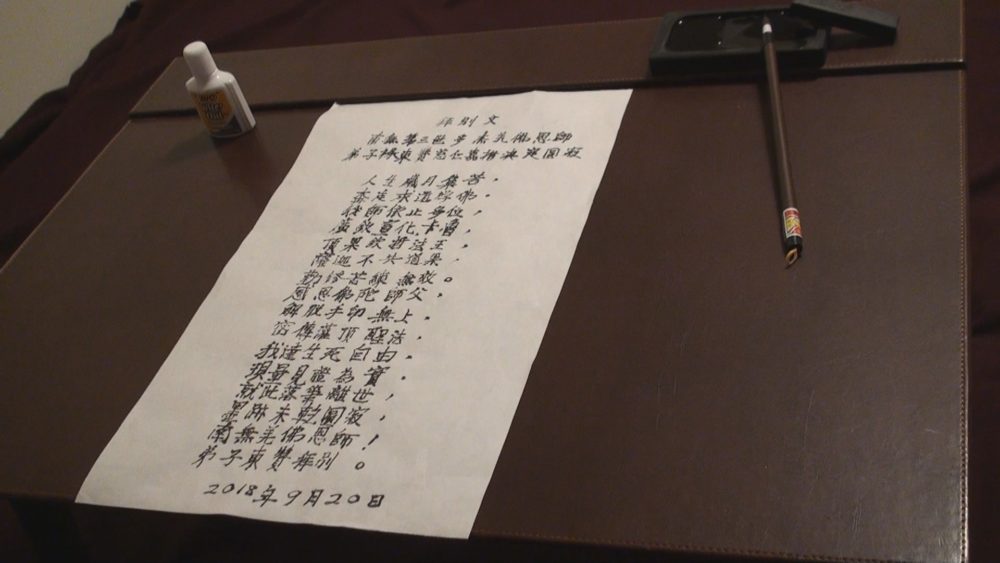
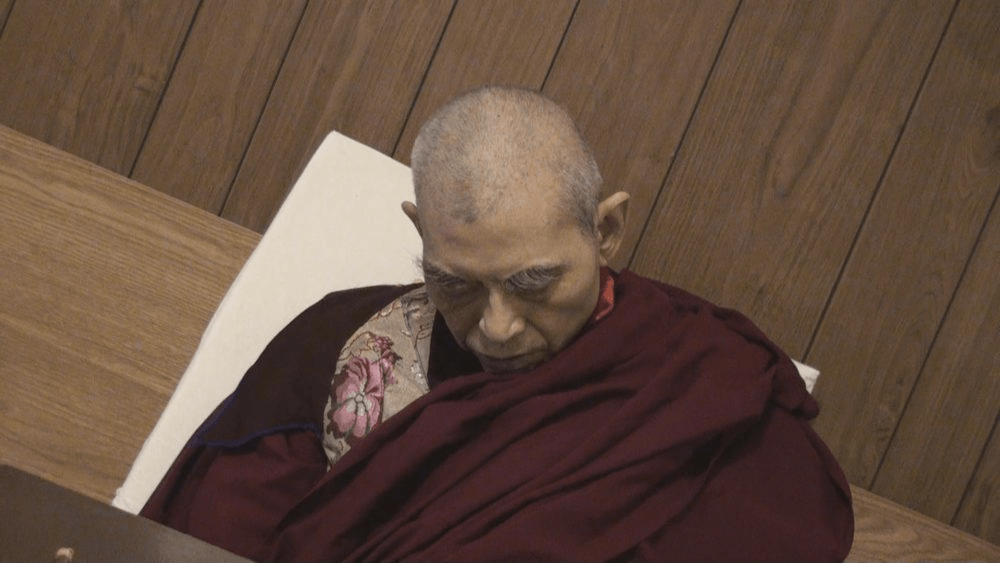
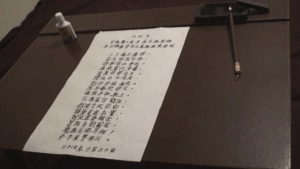
This dharma assembly was exactly the last dharma assembly that Dharma King Gar Tongstan was waiting for. Next day, after taking a bath and changing His garment, He entered His dharma practice. Then, a writing desk with pen, ink, paper, and white-out fluid placed on it was put in front of His dharma seat. He wrote a letter of respectful farewell to H.H. Dorje Chang Buddha III and then immediately sat down to pass away in a perfectly liberated state. When monastics from different temples arrived, they found that right after putting down the pen, the dharma king passed away in a perfectly liberated state with complete ease and without any hesitation. At that time, it suddenly dawned on everyone that the verse of respectful farewell that Dharma King Gar Tongstan wrote was to point out where the true dharma of the Tathagata is for living beings, which is upheld and controlled by H.H. Dorje Chang Buddha III and is the same as the Buddha-dharma of Sakyamuni Buddha that only belongs to Buddhism without any sectarian affiliation!
Dharma King Gar Tongstan passed away in a perfectly liberated state
Verses of Respectful Farewell
The following is the verse of respectful farewell written by Dharma King Gar Tongstan.
Dharma King Gar Tongstan’s Last Letter to Dorje Chang Buddha III
” Verse of Respectful Farewell“
”To my beneficent Master Namo Dorje Chang Buddha III,“
“I, Disciple Gar Tongstan Ciren Gyatso, decided to pass away in a perfectly liberated state.”
“Human life accumulates sufferings through the years and months. I went to various places to seek enlightenment through learning from Buddha. I followed and stayed with many masters to learn from them, including Guang Qin, Xuan Hua, Ka Lu, and Dharma King Dilgo Khyentse. I practiced diligently and worked hard on the unshared dharma of Path-Fruit of the Sakya Sect without effect. I gratefully thank my Buddha Master for the Mahamudra of Liberation that is supreme and unsurpassed. The holy dharma that I received from secretly transmitted initiation enabled me to achieve freedom from birth and death, with true realization attained on the spot. I now pen down my words and will then leave the world, passing away in a state of perfect accomplishment before the ink dries.”
Verses of Respectful Farewell
Namo beneficent Master, H.H. Dorje Chang Buddha III
Disciple Gar Tongstan Ciren Gyatso has decided to leave this world.
As life is filled with suffering,
I rushed about learning Buddhism and seeking enlightenment.
I have followed many masters:
Guang Qin, Xuan Hua, Kalu,
And Dharma King Dilgo Khyentse,
Diligently practicing their dharmas and the Sakya unshared LamDre Dharma,
All to no avail.
Thankfully, I met my Buddha Master.
Through the Mahamudra of Liberation that is supreme and unsurpassed,
And the secret initiations and transmissions of holy dharma from my Buddha Master,
I achieved control over my own birth and death.
My direct realization is reality.
I now put down my brush and leave this world,
Entering into the state of liberation before the ink dries.
Namo my beneficent Master, H.H. Dorje Chang Buddha III!
Disciple Tongstan respectfully bids farewell.
September 20, 2018
“Namo my beneficent Master Dorje Chang Buddha III!”*
My son once shared a story about greed from his middle school textbook, by Leo Tolstoy. It was quite frightening, to realize the power that greed exerts over us all. Sometimes, it can even blind us to the threat of death itself.
The protagonist of the story is a peasant named Pahom, who overhears his wife and sister-in-law argue over the merits of town and peasant farm life. He thinks to himself “if I had plenty of land, I shouldn’t fear the Devil himself!”. Unbeknown to him, Satan is listening.
However, Pahom then becomes very possessive of his land, and this causes arguments with his neighbors. “Threats to burn his building began to be uttered.” Later, he moves to a larger area of land at another Commune. Here, he can grow even more crops and amass a small fortune, but he has to grow the crops on rented land, which irritates him. Finally, after buying and selling a lot of fertile and good land, he is introduced to the Bashkirs, and is told that they are simple-minded people who own a huge amount of land. Pahom goes to them to buy as much of their land for as low a price as he can negotiate. Their offer is very unusual: for a sum of one thousand rubles, Pahom can walk around as large an area as he wants, starting at daybreak, marking his route with a spade along the way. If he returns to his starting point by sunset that day, all the land his route encloses will be his, but if he does not reach his starting point, he will lose his money and receive no land. He is delighted, as he believes that he can cover a great distance and has chanced upon the bargain of a lifetime. That night, Pahom experiences a surreal dream in which he sees himself lying dead by the feet of the Devil, who is laughing.
He stays out as late as possible, marking out land until just before the sun sets. Toward the end, he realizes he is far from the starting point and runs back as fast as he can to the waiting Bashkirs. He finally arrives at the starting point just as the sun sets. The Bashkirs cheer his good fortune, but exhausted from the run, Pahom drops dead. His servant buries him in an ordinary grave only six feet long, thus answering the question posed in the title of the story.
After reading the story, I have come to truly understand why greed is the first of the three poisons in Buddhist teachings. Out of all these vices (greed, hatred, and delusion), it is perhaps the most seductive.
The contemporary Buddha H.H. Dorje Chang Buddha III teaches Buddhist disciples that greed can break one’s cultivation. True to his word, H.H. Dorje Chang Buddha III never takes any offerings from his students, no matter how big or small they are. His Holiness has set a great example for all his disciples. The videos below are the testimonies.
Recently I have gotten a special pill from a Dharma Assembly at Hua Zang Si Temple in San Francisco. The pill was made through Buddha-dharma, and is capable of curing illnesses. And I was even more fortunate that I had a opportunity to watch a video about how these pills were made. The whole process was so incredible and astonishing.
There are two types of the healing pills. The one is made from conducting a dharma with the Medicine Buddha as the yidam and using the practice of tummo as the cause, it is called the Daba Buqiong Pill. Another kind made from a dharma with the Kuan Si Yin Bodhisattva, one of the five great Buddha Mothers, as the yidam is named the Kazhuo Ande Pill (also called the Black Jewel Medicine Pill). These pills are made by two types of methods, the highest or most magnificent way or worldly ways. In today’s Buddhism world, worldly ways are commonly used. The process is basically mixing all and only the required ingredients of medicine that are blessed by chanting the mantra of the dharma and then rubbing the mixture into pills. The magnificent inner tantric way of making these pills is completely different. The practice of tummo concentration must be used as the affinity of the dharma. The ingredients of the medicine are exactly the same. The blessing power of the pills is supreme and most magnificent. However, because of the loss of Buddha -dharma, the process of making these pills with the most magnificent (non-worldly) methods has almost become extinct.
The pills of Daba Buqiong and Kazhuo Ande made from the magnificent method are rare and hard to obtain. The first difficulty is that it is hard to find a true great virtuous one to conduct tummo concentration.
Many people have heard about the dharma of tummo concentration but it is extremely difficult to see a true manifestation of tummo power. Today, in Tibet, India and other places, there are still many lamas who practice tummo concentration. However, when they walk out of the closed room at the end of the extended practice in seclusion, very few of them can actually raise their body temperature. The most they were able to do is symbolically wear a wet blanket while walking around the temple. Those who attained such initial level are now called holy and venerable ones. This is just an indication that tantric dharmas are being lost from generation to generation.
Tummo concentration is a high-class Buddha-dharma of meditation. It is a rare holy dharma indispensable for cultivating the life power of the body, mind-wind and bright spot, and the accomplishment of a rainbow-light body. Regardless of what illness or disease one has, practicing tummo can eliminate it completely. Therefore, this dharma is the dead enemy of the demon of illness. Tummo concentration is a great dharma in the division of supreme yoga. The perfect accomplishment in the practice of this dharma combined with Vajra Body Substitution Meditation can lead to the accomplishment of becoming a Bodhisattva at the twelfth stage or higher.
There are two types of practices of tummo concentration. One is Yoga Tummo from Tibetan Esoteric Buddhism. The other is the Corpse-Laying Tummo regarded as “the King of Tummo.” When practicing tummo, the higher the body temperature can be raised to, the higher the realization power of the practitioner. The normal body temperature of humans is between 98.6°F and 99.5°F (37°C and 37.5°C). When the body temperature reaches a level between 104°F and 105.8°F (40°C and 41°C), one is regarded as having a high fever. A temperature above 41°C (about 106°F) can cause danger to one’s life. However, practitioners of tummo concentration can attain much higher temperatures than that.
The realization power from tummo concentration is defined by four steps. The first step is called the Initial Warmth Step. At this step, body temperature can be raised to between 115°F and 130°F but the ability of curing illnesses is not strong yet. The second step is the Joy of Heat from Meditation Step, with the body temperature raised to between 130°F and 150°F. The heat of tummo can be released at certain locations of the body to provide a relatively strong ability of curing illnesses. However, there are five illnesses that cannot be cured by this ability. Anyway, one will rarely become ill with the accomplishment at this step. The third step is the Step of Emptiness and Existence at High Temperature. The body temperature can be raised to between 150°F and 200°F. The heat of tummo can be distributed to any part of the body to heal illness by oneself, with the exception of two illnesses. The practitioner can collect the dark karma generated daily due to ignorance and burn it away with tummo. One can also move the heat of tummo outside of his body to cure illness and eliminate hindrance for other people or to subdue demons and evil spirits. The fourth step is the magnificent Delight at Extreme Temperature. The temperature will exceed 200°F and the heat of tummo will spread to the entire body. Master Milerapa used his realization power of this step to ignite his own body to attain the accomplishment of sambhogakaya, and nirmanakaya.
Although the true realization power of tummo is hard to find through the history of over one thousand years, fortunately Mozhi Rinpoches, a disciple of H.H. Dorje Chang Buddha III, is a great yoga master. He is the first-place master of tummo concentration in Tibetan Esoteric Buddhism. His body weight was reduced from 241.4 pounds (109.5 kg) to 124.6 pounds (56.5 kg) by practicing tummo concentration. He once practiced tummo concentration for seven months and three days, without eating and drinking. After that, all illnesses were eliminated.
The video I watched was the recording of The dharma assembly of making the pills of Kazhuo Ande. It was held at Los Angeles at year 2009. In the dharma assembly, Mozhi JiaoZun was the chief master to produce the heat of tummo. Other rinpoches would be his dharma-protecting assistants. He stated that the purpose of his coming here was not to compare his realization power with others and was not for making Kazhuo Ande pills. It was a coincidence that he met this cause. He regards it as his duty to do something for living beings.
A porcelain pot for frying the medicine was laid on his belly
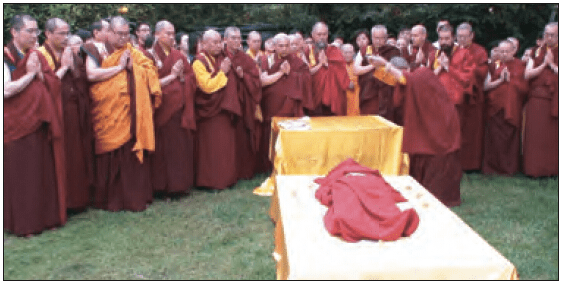
At the dharma assembly, Mozhi Rinpoche lay on the dharma board and had his head covered up so people would not know who was practicing tummo concentration. This great holy virtuous one with true realization of power and abilities never wanted to boast or praise himself. Everyone attending the dharma assembly was greatly moved and felt ashamed by such holy and pure style of humble self-cultivation.
When the great holy virtuous one was conducting the dharma, a porcelain pot for frying the medicine was laid on his belly. The high-temperature heat of tummo was strong and vicious and directly penetrated the thick porcelain pot. Rinpoches who used a finger to test the temperature were all scalded badly. They had to throw the medicine powder into the pot and get away quickly to protect their fingers from getting injured.
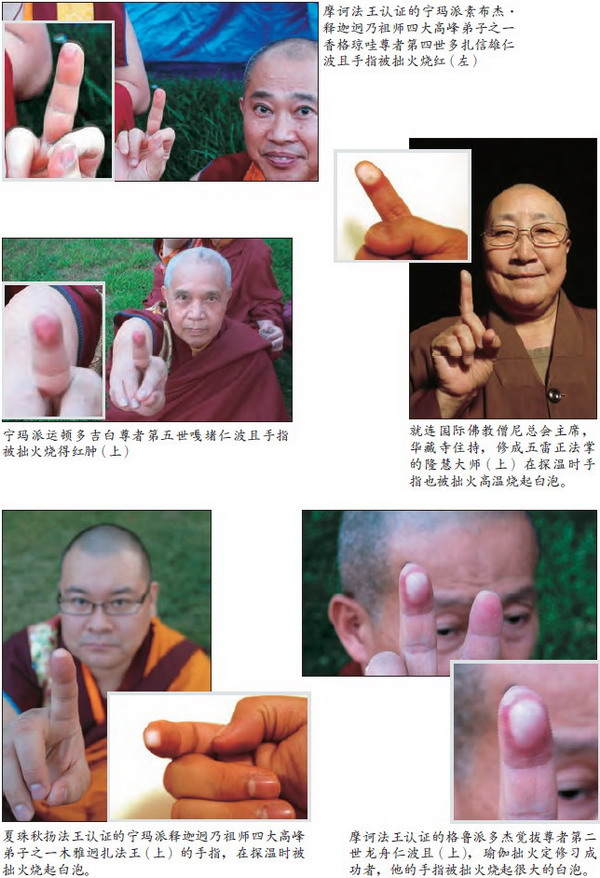
At the dharma assembly of making pills with the magnificent method, the heat from the Body-Laying (Corpse Pose) Tummo Concentration scalded rinpoches’ fingers so that they were red and swollen. Some had frowning eyebrows and were sweating all over their heads. Some had blisters form on their fingers. Some had the color of the swollen finger turned into white or black colors. Some had their whole finger scalded red and unable to bend. Some even had their face scorched red by the high heat of tummo.
Rinpoches used a finger to test the temperature
Rinpoches showing their burning fingers by the high temperature of tummo
I could not help from making a heart-felt praise: the true power of Corpse-Laying Tummo Concentration from The Supreme and Unsurpassable Mahamudra of Liberationis truly amazing!
There is a rather famous tombstone in Westminster Abbey. There’s nothing so special about it, except for its inscription. I believe that many people have heard of it.
“When I was young and free and my imagination had no limits, I dreamed of changing the world. As I grew older and wiser, I discovered the world would not change, so I shortened my sights somewhat and decided to change only my country. But it, too, seemed immovable. As I grew into my twilight years, in one last desperate attempt, I settled for changing only my family, those closest to me, but alas, they would have none of it. And now, as I lie on my deathbed, I suddenly realize: If I had only changed myself first, then by example I would have changed my family. From their inspiration and encouragement, I would then have been able to better my country, and who knows, I may have even changed the world.”
It is said that many world dignitaries and celebrities were deeply moved when they saw these words Some people say that this is a teaching of life, some people say that it is a kind of introspection of the soul.
There are similar teachings and philosophies in Chinese traditional culture. The Great Learning is a compilation of Confucian teachings used to address deeply important social behavior. In The Great Learning says: “The ancients who wished to illustrate illustrious virtue throughout the kingdom, first ordered well their own States. Wishing to order well their States, they first regulated their families. Wishing to regulate their families, they first cultivated their persons.”
“From the Kings down to the mass of ordinary people, all must consider the cultivation of the person the root of everything besides. It cannot be, when the root is neglected, that what should spring from it will be well ordered.”
In Buddhism, self cultivation is heavily emphasized as well. The first thing for all buddhist disciples is constantly cultivating themselves. In What is Cultivation, His HolinessDorje Chang Buddha III provides detailed guidance on self-cultivation. Self-cultivation is the fundamental and essential in the learning of Buddhism. Through self-cultivation, one will not only live a happy life and contribute the best of oneself to the society, but also can reach enlightenment and liberation.
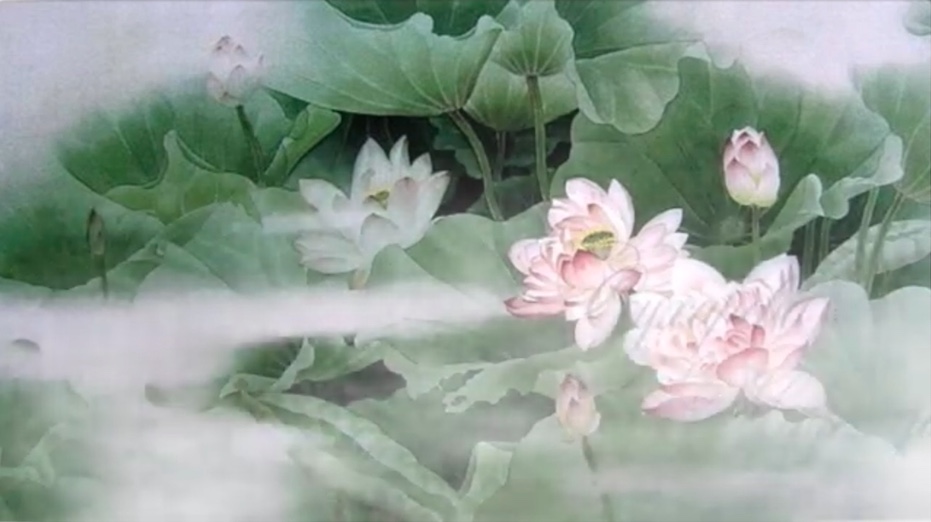
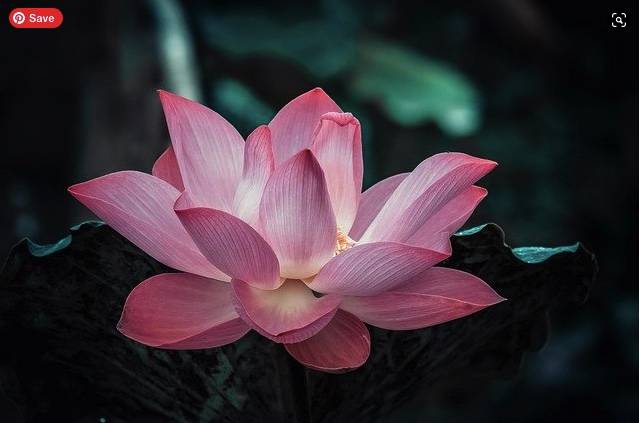
From ancient times, the lotus has been a divine symbol in Asian traditions. It is one of the Eight Auspicious Signs (Ashtamangala) pertaining to a number of Dharmic Traditions, such as Hinduism and Buddhism. In Buddhist symbolism, the lotus represents purity of the body, speech, and mind as if floating above the muddy waters of attachment and desire. Therefore, many deities of Asian religions are depicted as seated on a lotus flower. It is said that Gautama Buddha was born with the ability to walk, and lotus flowers bloomed everywhere he stepped.
In the classical written and oral literature of many Asian cultures, the lotus is present in figurative form, representing elegance, beauty, perfection, purity, and grace. Perhaps the most famous text is the poetic essay “On the Love of the Lotus” by Zhou Dunyi (1017-1073). As Zhou writes, “I love only the lotus, for rising from the mud yet remaining unstained; bathed by pure currents and yet not seductive.” The lotus is the “gentleman among flowers.” The term “gentleman” (junzi), of course, has since the time of Confucius been the ideal human being. So not surprisingly, the lotus flower is also a popular subject in Chinese paintings.
Zhang Daqian (張大千, 1899–1983), original name Zhang Yuan (張爰) and pseudonym Daqian, was one of the best-known and most prodigious Chinese artists of the twentieth century. He is also regarded by many art experts as one of the most gifted master forgers of the twentieth century. He is especially famous for his landscape, as well as lotus paintings.
As a child, Zhang Daqian was encouraged by his family to pursue painting. In 1917 his elder brother, Zhang Shanzi (an artist famous for his tiger paintings), accompanied him to Kyoto, Japan, to study textile dyeing. Two years later, Zhang Daqian went to Shanghai to receive traditional painting instruction from two famous calligraphers and painters of the time, Zeng Xi (曾熙) and Li Ruiqing (李瑞清). Through his association with these teachers, Zhang had the opportunity to study some works by ancient masters in detail. His early style attempted to emulate the Ming-Qing Individualists, including Tang Yin (唐寅), Chen Hongshou (陳洪綬), and Shitao (石濤). He meticulously studied and copied their works and began to make forgeries; his paintings after Shitao successfully deceived some of the best connoisseurs.
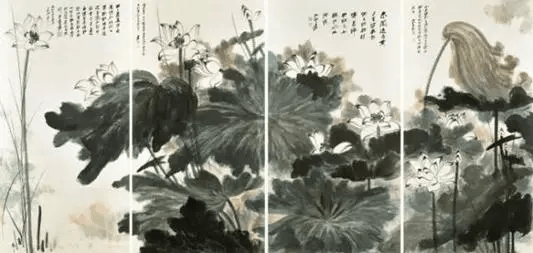
The lotus painted by Zhang Daqian is known as the “Daqian Lotus”, which is extremely popular in the auction market, and the price has repeatedly hit new highs. Among them, “Lotus Pond Wilderness” is particularly prominent. It was sold at HK$80.51 million (about $10 Million) at the 2013 Christie’s Spring Auction in Hong Kong, causing a sensation in the world.
A set of four hanging scrolls each more than five feet high and 2.5 feet wide – depict lotus flowers in various state of bloom. Completed in 1947. This masterpiece, however, despite its enormous size, is still well-organized. Within magnificence unfolds delicate tenderness; integrated artist early scholar-painter style and commitment to elegant, smooth brush strokes. Zhang vividly portrays the lotuses growing in nature, swaying in the summer breeze…. It truly is a fine example of the artist’s large scale lotus compositions.
Wilderness in a Lotus Pond
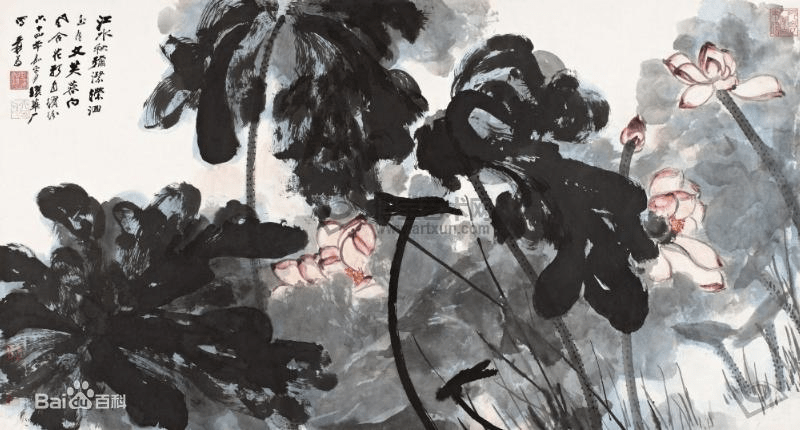
More lotus paintings by Zhang Daqian:
Zhang Daqian: Red Lotuses in Splashed Color (1981)
Ink Lotus by Zhang Daqian at 1976
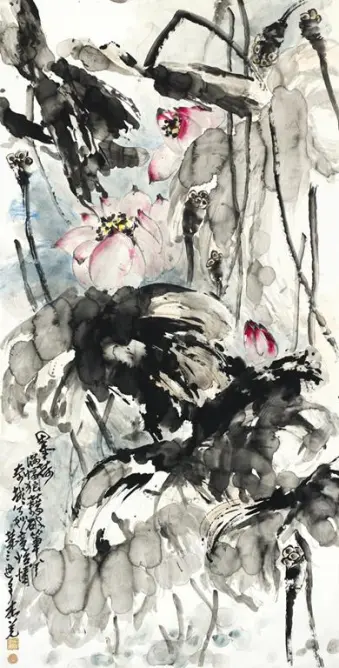
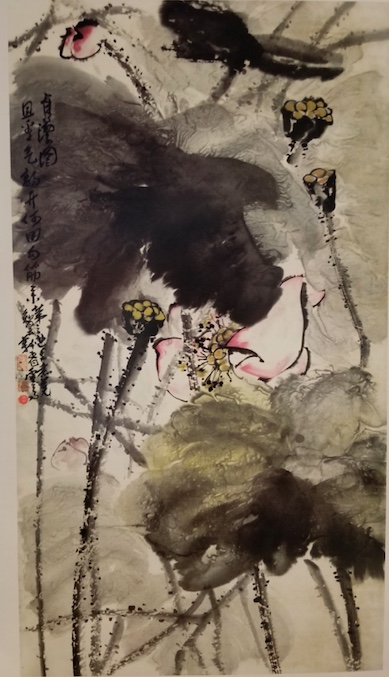
However, a Contemporary Painting “Ink Lotus” by H.H. Dorje Chang Buddha III Was Sold for the US$16,500,500 at the Gianguan 2015 Spring Auction to Break the World Record.
The ink-wash painting Lotus by H.H. Dorje Chang Buddha III has an uninhibited, natural, and spontaneous brushwork that is dense, bold, and robust, but also elegant and agile. It exhibits a charm that is like stone and bronze inscriptions. Flowing splash-ink on the scroll produces a vivid charm that evidences great ingenuity. There is an air of power and grandeur together without any trace of stiff, common, mundane artistry found in other lotus flower paintings. Overall, the whole painting manifests a harmonious and moving imagery, naturally emanating a lively vivaciousness and a carefree, spirited aura.
Su Shi was a writer, artist, calligrapher, pharmacologist, and statesman of the Song Dynasty, and one of the major poets of the era. His courtesy name was Zizhan and his pseudonym was Dongpo Jushi (東坡居士 “Resident of Dongpo”), and he is often referred to as Su Dong Po (蘇東坡). When we appreciate Chinese literature, Su Shi is widely regarded as one of the most accomplished figures, having produced some of the most well-known poems, lyrics, prose, and essays. His poetry has a long history of popularity and influence in China, Japan, and other areas in the near vicinity and is well known in the English-speaking parts of the world through the translations. Su Shi was the greatest writer of Song ci lyrics, often celebrating the joys of relaxed and transitory pleasures. This “To the Tone of Nian Nu Jiao Memories of the Past at Red Cliff” is one the most popular poems.
With his new bride, the Lord Qiao’s younger daughter,
Dashing and debonair,
Silk-capped, with feather fan,
He laughed and jested
While the dread enemy fleet was burned to ashes!
In fancy through those scenes of old I range,
My heart overflowing, surely a figure of fun.
A man grey before his time.
Ah, this life is a dream,
Let me drink to the moon on the river!
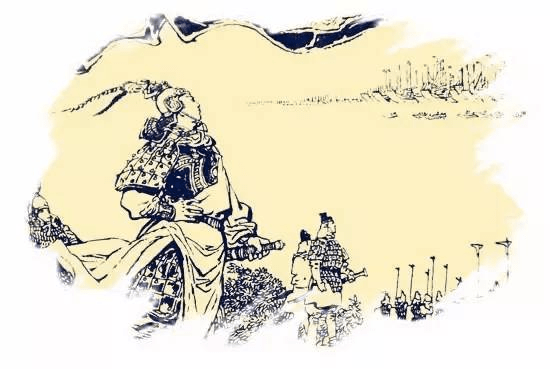
This poem was a tribute to the famous battle at Red Cliff, which took place on the Yangtze river in Sichuan at year 208 CE. Through the description of the magnificent scenery on the Moonlit Night River, he expressed the remembrance of the famous and heroic characters of that era. The lyrics are vigorous and create a majestic atmosphere. It is a powerful poem, and has been ranked as a masterpiece throughout the ages.
I heard a song recently, that touched me so deeply, I could not help but cry. The song uses the lyrics of a poem written by H.H. Dorje Chang Buddha III, with the same Song ci style as “To the Tune of Nian-Nu-Jiao”. The bold and unconstrained poem entitled “To the Tune of Nian-Nu-Jiao: Abruptly Entering the Universe” has a powerful spirit that moved me deeply. Here is the English translation.
To the Tune of Nian-Nu-Jiao : Abruptly Entering the Universe
Abruptly entering the universe, The universe of a billion worlds, Stand firmly against all hardships and obstacles. Seeing through glory and riches, I simply smile. The rooster crows announcing the dawn, The morning bell hurries the moon, The whole Soha world is revealed. Everybody bustles about to survive, Life, like smoke and snow, gone!
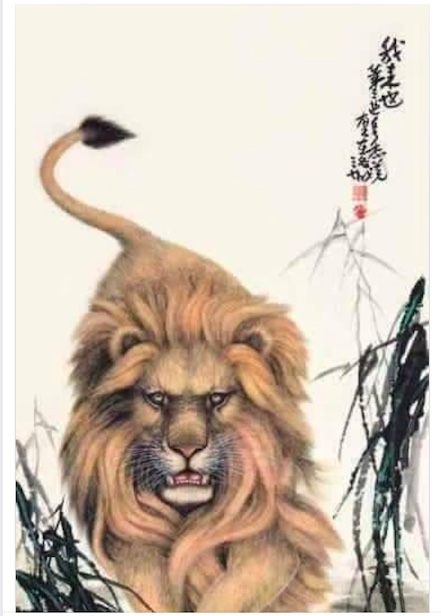
Recalling when I was young, I mastered the pen and the sword but liked Buddhism best. The lion’s roar of the Buddha shook the universe! Countless suffering patients visited me, Day and night I pondered their cures. Millions of strands of thoughts Slowly turn toward prajna wisdom, Swaying the three worlds. I wish that my remaining life Be devoted to the benefit of all sentient beings.
The mood of this poem is broad and vast, and filled with emotion. The poem manages to capture the massiveness of the universe and centuries of human affairs. It begins with aspiration soaring to the sky, and ends with a very down to the earth message: serving and helping all living beings with all that he has.
Comparing the two poems, it is evident that the work of H.H. Dorje Chang Buddha III not only provides a much broader view of the world and human existence, but also uplifts the reader to a much higher spiritual level. H.H. Dorje Chang Buddha III truly is an outstanding and timeless master of letters and also has boundless compassion and mercy to all living beings.
I also found an astonishing fact, based upon his extraordinary accomplishments in the areas of Buddhism, the humanities, painting, calligraphy and ethics, the World Poets and Culture Congress, which is composed of 5,612 experts and scholars from 48 different countries and regions, selected Master Wan Ko Yee (H.H. Dorje Chang Buddha III ) as the world’s only “Distinguished International Master.” The resolution conferring upon him this title was mailed to the People’s Republic of China and was made public in Hungary on September 15, 1994. The “Distinguished International Master” certificate was signed by the then President of the international Olympic Committee, Juan Antonio Samaranch.
#MasterWanKoYee #DorjeChangBuddhaIII #HHDorjeChangBuddhaIII#DorjeChangBuddha#SongCi#SuShi#Memories of the Past at Red Cliff#DistinguishedInternationalMaster
Recently I have visited H.H. Dorje Chang Buddha III Culture and Art Museum. It was very impressive, every composition there is world class. Especially the Yun sculptures, the colors of Yun sculptures are gorgeous, presenting a dreamlike and illusory scene not found in this world. Yun sculptures convey a sense of multidimensionality and are carved in extremely fine and complex detail, truly manifesting endless forms of variation. From the introduction, I learned that Yun Sculpture is a new form of art that H.H. Dorje Chang Buddha III created for humanity. It has never appeared before in history. Since the advent of Yun sculptures, artwork that can never be duplicated has appeared for the first time in the human world.
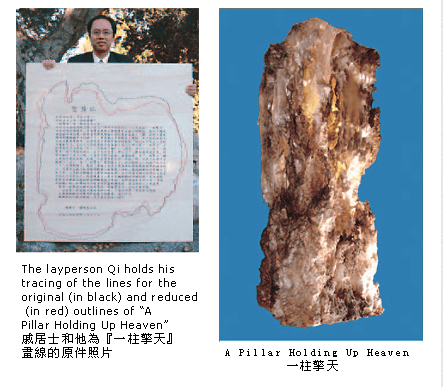
There is one called “A Pillar Holding Up Heaven “. About three meters tall, it truly is a holy and inconceivably wondrous treasure. The artwork is crystal-like bright with extremely fine details. Its beauty is more than eyes could capture. With the glass-like transparency, it is unbelievably touching and striking to see and the countless forms and variations within the structure are indescribable by words. The Yun sculpture is made from carving an acrylic material and then applying colors.
The story behind this Yun sculpture is even more astonishing. There is an account documented by a Buddhist disciple Qi, Pengzhi who personally witnessed the true event.
A Pillar Holding Up Heaven
“What I am about to say is about the Yun sculpture “A Pillar Holding Up Heaven” created by Master Wan Ko Yee (H.H. Dorje Chang Buddha III ), my Buddha Dharma King Master. One year and nine months ago, this holy work of art was completed and its shape finalized. At August 18, 2004, several of us decided to place the artwork “A Pillar Holding Up Heaven” into a display cabinet. First, the bottom edge of the artwork had to be closely traced on a baseboard. This was done to make sure that the sculpture would be centered. I personally traced a black line very carefully around the artwork. At that point, we all figured out that the size of the display cabinet which had previously been calculated and built was too small and the upper portion of the artwork would go beyond the baseboard. Because the body of the artwork was too large, it was impossible to fit in the display cabinet. H.H. Dorje Chang Buddha IIIstrictly criticized us, “Why didn’t you measure it right in the beginning? Will this display cabinet, worth thousands of dollars, now be discarded?” The Master faced “A Pillar Holding Up Heaven” and casually said to himself, “It would be nice if you could become smaller!” After the Master finished saying that, six of us lifted “A Pillar Holding Up Heaven” and placed it down on the floor. Because it was such a precious piece and worth so much, we all guarded the spot.
Approximately five hours passed. We then lifted it to the baseboard preparing to take a picture. Just as “A Pillar Holding Up Heaven” was moved up to the baseboard where I had previously traced the black line, a fellow disciple suddenly yelled, “Hey, it has become the magic stick of Sun Wu Kong (the Monkey King)!” Everyone looked. To our surprise, “A Pillar Holding Up Heaven” had actually shrunk. With only H.H. Buddha Dharma King’s words “Let it be smaller…”, it actually shrunk and now fit perfectly into the display cabinet. At this moment, I traced a red line around the bottom edge of the artwork once again on the same baseboard that showed the previously traced black line. When comparing the two lines, the widest part of the artwork had actually shrunk and the line was now more than two inches smaller than the previous line. The entire upper portion of the artwork shrank and fit perfectly into the area of the display cabinet. This inanimate piece of artwork which had already finalized its shape was truly magnificent and unbelievably amazing. “
“I am a Buddhist disciple. I would not fabricate false testimony which would violate the law of cause and effect. These two lines were traced by me that day based on the bottom edge of the actual artwork that day. Moreover, the artwork indeed shrank because of the Master’s words. If any of the above is falsely fabricated, I shall be punished, enter the three evil paths and become an animal. If this account of said facts is authentic, I will greatly gain good fortune and wisdom and dedicate the merit to the well-being of everyone.
Now, I have some honest words that come from my heart that I would like to give everyone. Everyone should think about just what level this great and authentic Buddha-dharma actually is on so that such power can be demonstrated. Shouldn’t we take this opportunity to take refuge and learn the authentic Buddha-dharma? “






















 Peace LiLy