In a world that often feels fragmented and fast-paced, many of us are searching for a compass—a way to live that feels both grounded and deeply ethical. Thich Nhat Hanh, the beloved Zen Master and founder of the Plum Village tradition, offered exactly that through the Five Mindfulness Trainings.
These aren’t rigid “commandments” or a list of “don’ts.” Instead, they are a modern, proactive framework for cultivating peace, protecting life, and nurturing happiness within ourselves and the world.
At their core, the trainings are a reinterpretation of traditional Buddhist precepts, designed for our modern, interconnected lives.
Reverence for Life This training is an invitation to cultivate compassion. It’s about more than just avoiding harm; it’s about actively protecting life and practicing nonviolence toward ourselves, our neighbors, and the natural world.
True Happiness We often chase wealth or fame, thinking they are the keys to joy. This training reminds us that true happiness is found in generosity and the ability to be content in the present moment. It encourages us to live simply and avoid exploiting others.
True Love In our relationships, integrity is everything. This training emphasizes responsibility and ensures that our most intimate connections are grounded in deep love, commitment, and respect for the harmony of families.
Loving Speech and Deep Listening Communication is a powerful tool for healing. By practicing deep listening without judgment and using speech that inspires hope and reconciliation, we can move mountains of misunderstanding and alleviate the suffering of those around us.
Nourishment and Healing What we “consume” isn’t just food. It’s the media we watch, the conversations we have, and the substances we use. This training focuses on mindful consumption to protect our mental and physical well-being from toxins and despair.
The beauty of the Five Mindfulness Trainings lies in how they address the complexities of the 21st century.
Interbeing: They are rooted in the understanding that we are not separate entities. What happens to the Earth happens to us. When we heal ourselves, we heal the world.
Universal Ethics: While born from Buddhist wisdom, these trainings are non-sectarian. They are accessible to anyone, regardless of their religious or spiritual background.
Transformation over Rules: This is an ongoing practice. The goal isn’t “perfection” but a continuous, mindful process of shifting our focus from self-interest to collective well-being.
Sangha (Community) Support: We don’t have to do this alone. These trainings are often practiced within a Sangha, a community of friends who support each other in staying mindful and compassionate.
The Five Mindfulness Trainings are a gift—a map that leads us back to our best selves. By embracing these guidelines, we contribute to a collective awakening, one mindful breath and one compassionate action at a time.
“The Five Mindfulness Trainings are the most concrete way to practice mindfulness. They show us how to live our lives in a way that brings peace and happiness to ourselves and to others.” — Thich Nhat Hanh
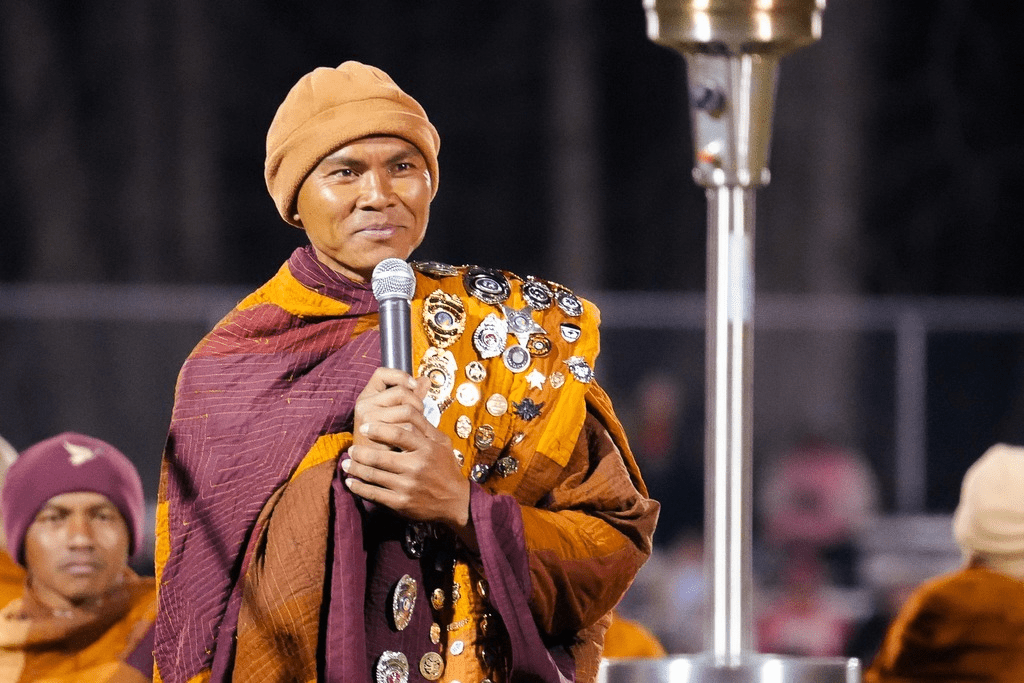
Siler City, NC – On Wednesday evening the “Walk for Peace” monks stopped for the day at Jordan-Matthews High School. This was an opportunity for one of the monks to speak to the crowd gathered at the football here. Below is a summary of the lessons he hoped to teach.
We fight a battle every day, but the enemy isn’t external. It’s the relentless hum of our own minds—the constant wandering to past regrets and future anxieties, the endless scroll of digital distractions, and the crushing pressure to always be doing more. In this unwinnable war for a quiet mind, we often feel like we’re losing ground.
But what if the pursuit of peace wasn’t an epic battle at all? What if it was simply a series of small, counter-intuitive shifts in perspective? In a recent talk, a monk shared a path to peace that doesn’t require struggle, but instead invites awareness and acceptance. This post shares the four most surprising and impactful lessons from that talk—practical wisdom that can be applied to your life, starting right now.
1. To Connect With Your Kids, Stop Trying to Fix Them
As parents, our deepest instinct is to protect and guide. We want the best for our children, so we try to fix their mistakes and teach them the “right” way. But the monk pointed out a painful paradox: the more we try to “fix” or “change” them, the more we inadvertently build a “war” between us, pushing them further away.
His surprising solution was to shift our role entirely: stop trying to teach and start sharing. By approaching a child as a friend, we transform the dynamic from a top-down lecture into a shared conversation. This shift is the key to getting them to listen, and more profoundly, it creates the safety for the ultimate connection. The monk explained that when children see you as a friend, “whenever obstacle when they run into trouble they will come back to you and lean on your shoulder and cry and ask for help… that is when your chance come to teach them.”
unless you make friend with them you see them as your friends not mother not the father but a friend A friends means the different way of talk, different way of teaching, sharing… and that is when they listen.
In a world of high-pressure, achievement-oriented parenting, this advice is a radical act of trust. It asks us to let go of micromanagement and have faith that building a foundation of friendship is the most effective way to stay connected, especially when our kids are more influenced by peers and technology than ever before.
2. The Enemy of Peace Isn’t Chaos—It’s Multitasking
The monk observed that in our modern world, a distracted, wandering mind has become the “normal” condition. Very few people, he noted, can truly focus. He then offered a memorable metaphor for the primary source of this distraction: our smartphones.
And now that we all all have our lovers along with us every single second, you know who is your lover is your cellphone…
His solution is profoundly simple yet radically counter-cultural: stop multitasking. He framed this not as a mere productivity hack, but as the fundamental practice for purifying the mind. Without concentration on a single task, he explained, there can be no real peace.
This advice directly challenges the modern glorification of being busy. We multitask because we treat busyness as a proxy for importance and self-worth. To single-task is therefore an act of rebellion against the “cult of productivity.” It’s a way to reclaim our presence and discover that true effectiveness and inner calm are found not in doing more, but in giving our full attention to one thing at a time. This practice of single-pointed concentration is the very tool we need for the next lesson: dealing with the internal chaos of our own minds.
3. Don’t Fight Your Anxious Thoughts. Just Look at Them.
When we try to find a moment of quiet, the mind inevitably rebels. Thoughts of the past and worries about the future “pop up” and disrupt our focus. But the monk’s wisdom extends beyond just anxious thoughts—it applies to every distraction, internal and external. The itch on your nose, the sound of a distant siren, a sudden memory—our common reaction is to fight these intrusions and scold ourselves for getting distracted.
The monk’s instruction is to do the exact opposite. The goal is not to create a blank, empty mind. The practice is to simply add awareness to your breath, and when any thought, sound, or physical sensation appears, you acknowledge it without judgment. You observe it for a moment, and then gently guide your attention back to your breathing.
When that thought pop up, instead of trying to eliminate or push it away, just acknowledge it, observe that thought and then come back to this breathing.
He warned that this requires immense patience because “we will fail over and over.” This insight is liberating. It reframes “failure” as a completely normal and expected part of the process. Each time you notice your mind has wandered and you gently bring it back, you are succeeding.
4. Learn to Shed Your Leaves Like a Tree
To illustrate the art of letting go, the monk shared a powerful analogy from nature. In the autumn, trees shed their leaves. They don’t do this because they are weak; they do it as a brilliant survival strategy to conserve energy through the winter, preparing for new growth in the spring.
He explained that humans, however, often do the opposite. We spend our lives collecting and holding onto our mental “trash”—bad habits, unhappy memories, stress, and anxiety. We cling to these dead leaves until we are completely overwhelmed by their weight.
We have collected all kind of trash in our mind. Bad habit, unhappy thing, undesirable, all those things happening in our life that we suffered. We collected it so many and we recorded in here and we didn’t know how to let it go. We don’t know how to shut it off just like those trees.
This metaphor recasts “letting go” not as a passive act of giving up, but as an active, wise process of conserving our vital energy. In a world facing an epidemic of burnout, this lesson becomes a crucial survival strategy. It teaches us to release what no longer serves us in order to preserve our strength for what truly matters—for the new growth that awaits.
Peace is a Practice, Not a Destination
The war for a quiet mind ends the moment you stop fighting. As the monk’s lessons reveal, peace is not a distant state you arrive at, but the result of small, conscious actions. It’s found in the choice to single-task, the gentle observation of a thought, and the courage to let go of control—both in our own minds and in our relationships. Becoming a friend to our children and a non-judgmental observer of our thoughts are both practices in releasing the need to fix everything. Single-tasking is the foundation that makes this awareness possible.
He offered a simple starting point: each morning, write down the statement, “Today is going to be my peaceful day,” and live with that intention. But he also added a note of urgency. Many of us say we will do it “later,” but, as he warned, “that later that moment never comes.”
Don’t wait. Peace is a daily practice, and the work begins now. Looking at the “leaves” you’ve been carrying, what is just one you can choose to let go of today?
Recently, I watched a short video that stayed with me far longer than I expected.
The scene took place in a small shop in Pakistan. A robber walked in, grabbed money and a phone, and prepared to leave. Sitting beside the shop owner was a little girl. She looked at the robber calmly, without screaming or hiding, and gently offered him the lollipop she was holding.
For a brief moment, everything seemed to stop.
The robber froze. He looked at the child, then slowly put the money and phone back down. Before leaving, he leaned over and kissed her on the forehead.
I don’t know whether the girl acted out of fear, nervousness, or pure instinct. But her simple, innocent gesture touched something deeply human in him. Perhaps, in that fleeting moment, his life took a different turn.
What moved me most was this realization: Even those who appear hardened or dangerous may still carry a seed of kindness within them. And sometimes, it only takes the smallest act to awaken it.
A single lollipop opened a door in the human heart.
Lately, I’ve been noticing more and more of these quiet sparks of goodness appearing around the world.
In the United States, a group of Buddhist monks has been walking on foot, praying for peace. Without slogans or confrontation, they offer presence, humility, and sincerity. Their journey has inspired many people to reflect on peace in a deeper way, and countless strangers have stepped forward to support them.
Guided by the teachings of Namo Dorje Chang Buddha III, and with deep respect for the great mercy and loving-kindness through which Buddhas and Bodhisattvas benefit all living beings, the World Buddhism Association Headquarters (W.B.A.H.), Holy Miracles Temple (at Pasadena CA) and Sanger Mission sincerely to carry out Charitable Acts to Benefit Our Community Together: 2026 Food and Goods Drive, to collectively plant goodness. All donations will be sent to support local food banks, homeless shelters, and animal shelters in the Los Angeles area.
I also read about Jon Stewart, who announced an extraordinary donation of $116 million to help address homelessness across the United States—providing housing and dignity to people who have long been forgotten by society. It was a reminder that compassion, when paired with courage, can bring real and lasting change.
And then there is the story that expanded my sense of hope even further.
Johan Eliasch, a Swedish billionaire, acquired approximately 400,000 acres of the Amazon rainforest by purchasing the company that held its logging rights. Instead of continuing operations for profit, he immediately halted all logging activities.
Just like that, the chainsaws stopped.
That vast stretch of forest was allowed to remain intact—continuing to absorb carbon, protect biodiversity, and sustain one of the planet’s most vital ecosystems. His action demonstrated something profound: that private ownership, when guided by conscience, can become a powerful force for environmental protection.
This act of kindness may not be immediately seen by everyone, yet it will have a profound impact on the Earth’s ecological balance—and it is, in its own quiet way, safeguarding a future our children and grandchildren will still be able to breathe in.
From a child offering a lollipop… to a monk walking for peace… to a philanthropist sheltering the homeless… to a forest saved from destruction—
These acts may differ in scale, but they arise from the same source: the human longing to protect, to heal, and to do what is right.
In Buddhist teachings, compassion is not passive emotion—it is action. It is wisdom expressed through kindness.
As a new year begins, I sincerely hope we will witness more of these compassionate and righteous choices—choices that quietly warm the world.
May we walk together, letting kindness extinguish the fires of war, allowing love to dissolve hatred and conflict, and using compassion to heal sorrow, fear, and pain.
The world does not change all at once. But every gentle act—no matter how small—adds light.
And sometimes, that light begins with something as simple as a child’s open hand.
The Buddhist monks from the Huong Dao Vipassana Bhavana Center in Fort Worth, who are undertaking a 2,300 mile pilgrimage of Walk for Peace, arrive for a welcome ceremony at Hong Kong City Mall in Houston Friday, Nov. 14, 2025. Houston Chronicle/Hearst Newspapers via Getty Images
In a world that often feels rushed, divided, and relentlessly loud, there is something quietly revolutionary about the act of walking.
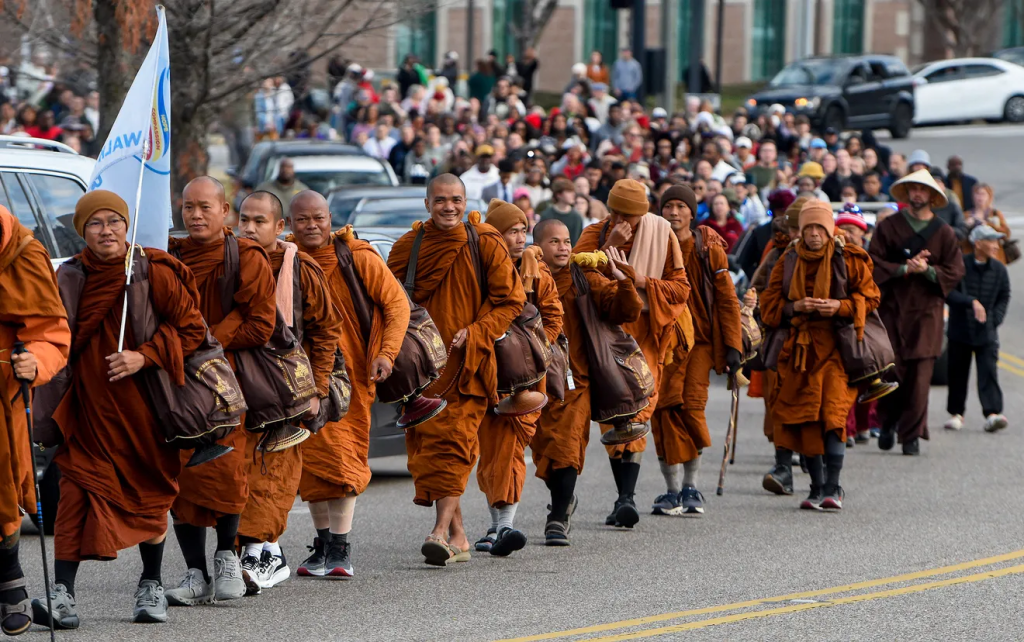
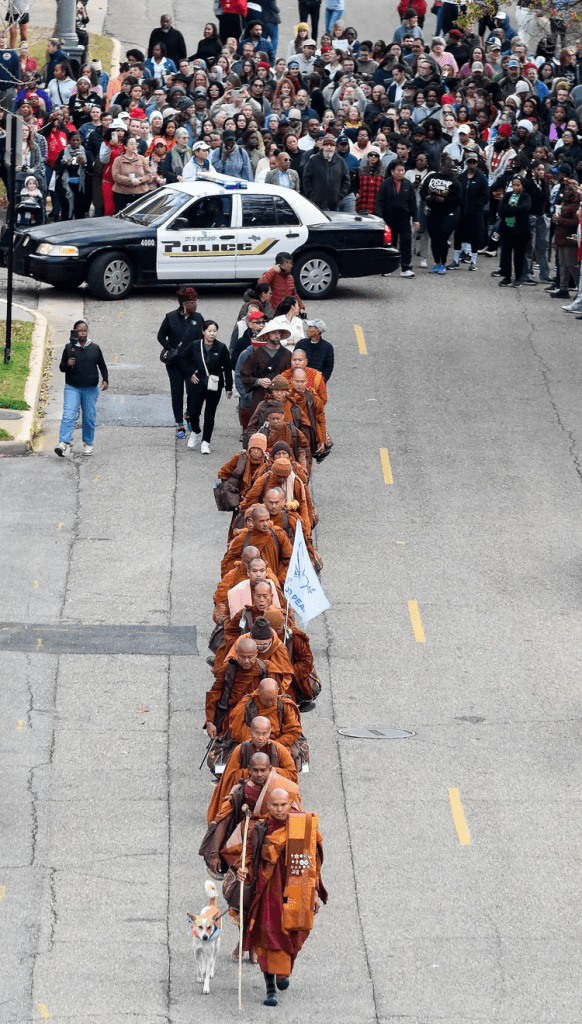
Recently, a group of Buddhist monks began a long, demanding pilgrimage across the United States. Their mission is simple yet profound: to promote peace. Their journey began in Fort Worth, Texas, on October 26. Since then, they have faced the literal “wear and tear” of the road, including a harrowing incident where two monks were injured after a truck struck their escort vehicle.
Yet, they did not stop.
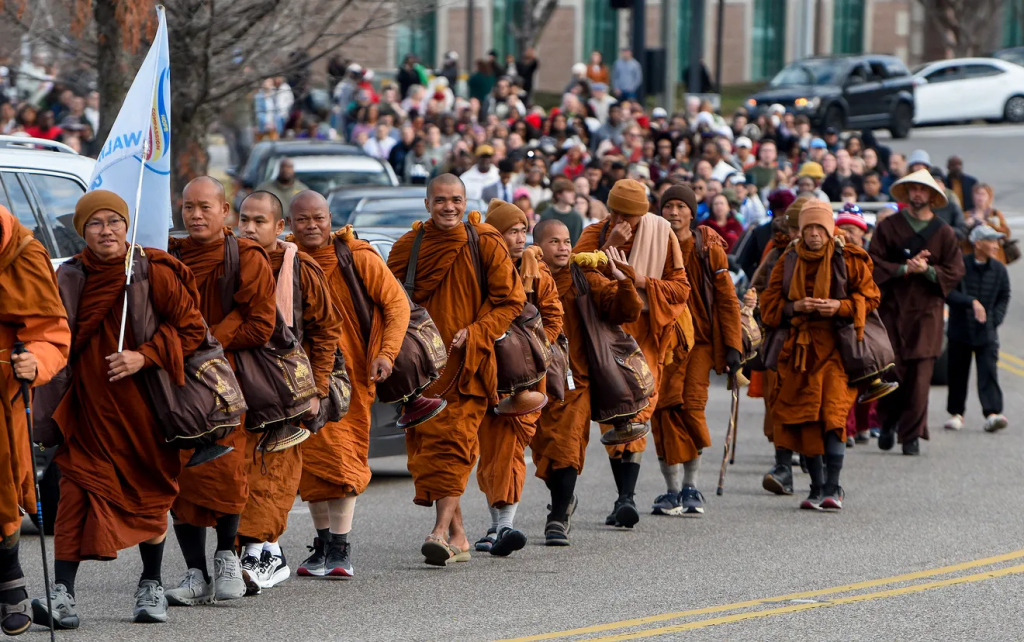
With perseverance and a calm, unshakable resolve, the group of two dozen monks has reached Georgia. They are still moving, one step at a time, toward their final destination in Washington, D.C. Their pace is slow, deliberate, and intentional—and that may be exactly what our world needs right now.
Buddhism has a long history of “engaged mindfulness”—the idea that compassion isn’t just felt in meditation, but lived in the world. These monks are not just praying for peace; they are embodying it.
As they navigate highways and back roads, they offer a living reminder that peace isn’t a destination we reach once and for all. It is a practice. It is something we choose moment by moment, breath by breath, step by step.
Watching their progress brings me back to a book I read nearly 30 years ago: Peace Pilgrim.
I remember being deeply moved by her story—how she walked across countries carrying almost nothing, guided by the conviction that peace begins within the individual. At the time, I wished I could have met her in person, just to thank her for the way her simplicity and courage planted a seed in my heart.
Though she is gone, her spirit feels remarkably present today. I see her legacy in the orange robes of these monks as they crest the hills of the American South.
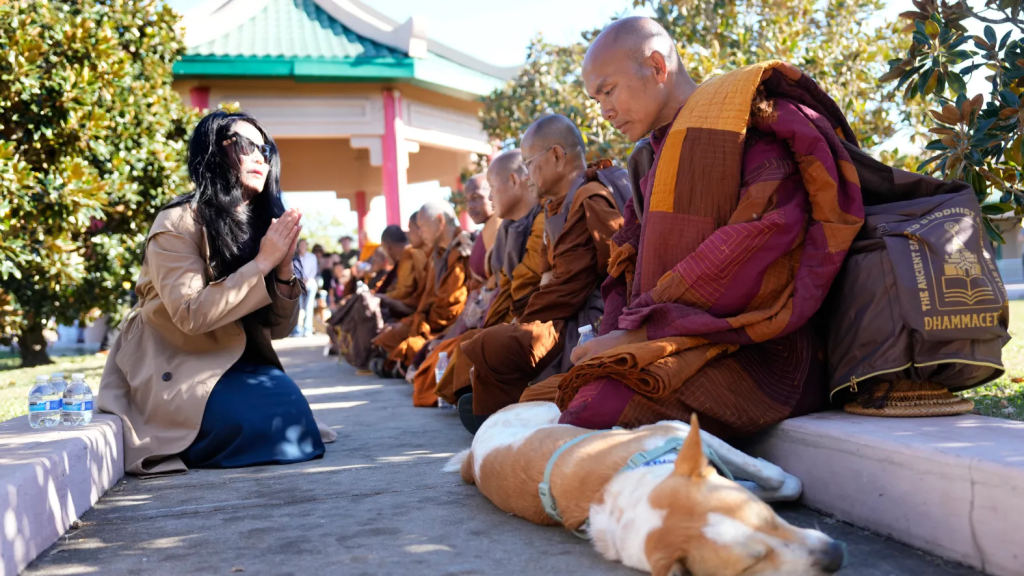
Monks rest at Hong Kong City Mall in Houston Friday, Nov. 14, 2025. Melissa Phillip/Houston Chronicle via Getty Images
Igniting Kindness, One Heart at a Time
There is something profoundly moving about a walking pilgrimage in the age of instant communication. There are no hashtags here. No viral outrage. Just human beings placing one foot in front of the other, trusting that their presence alone can soften the world.
And it works.
Along the way, the “ordinary” world reacts. Drivers slow down. Strangers stop to ask questions. People offer water, a meal, or a simple smile. In these small, unscripted exchanges, something gentle is awakened. We are reminded that beneath our political and social differences, we all share a basic human longing for safety, understanding, and harmony.
The monks may be the ones doing the walking, but the kindness they ignite along the way belongs to all of us. As they recently shared on their Facebook page:
“We do not walk alone. We walk together with every person whose heart has opened to peace, whose spirit has chosen kindness, whose daily life has become a garden where understanding grows.”
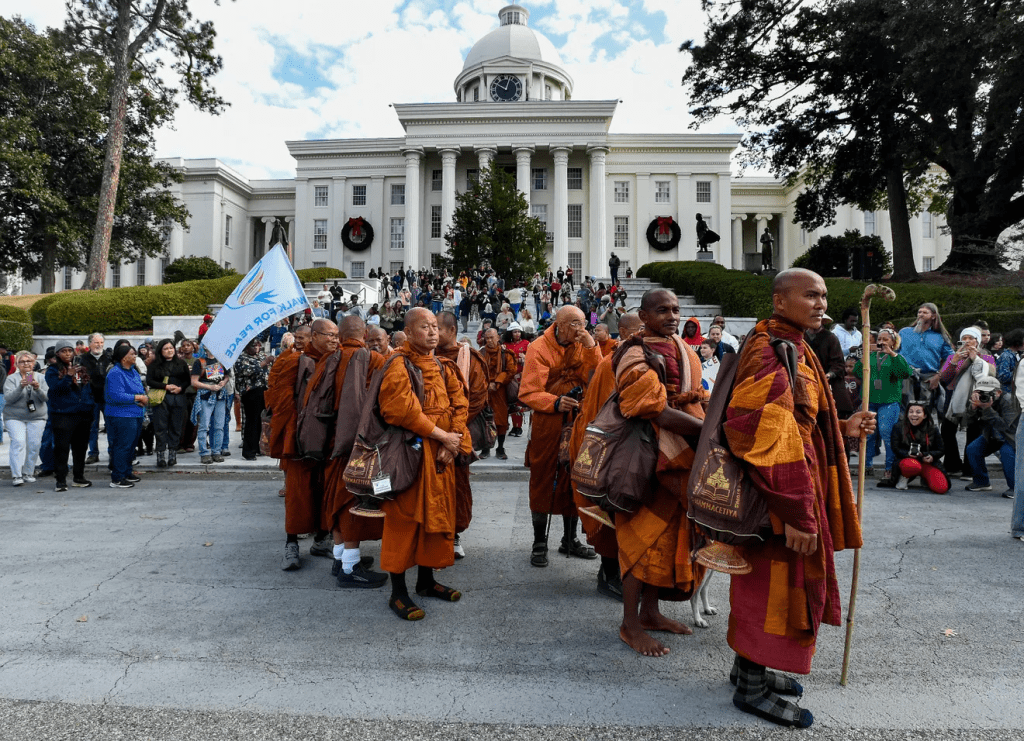
A group of Buddhist Monks and several hundred local community members take part in the Walk for Peace in Montgomery, Ala., on Tuesday December 23, 2025. The Monks are walking from Texas to Washington, D.C. to promote peace and compassion.
Most of us cannot drop everything to walk across a continent. But all of us can “walk for peace” in the geography of our own lives.
We can pause before we react in anger.
We can choose compassion over the reflex of judgment.
We can listen more deeply than we speak.
Watching these monks continue their journey despite injury and uncertainty reminds me that peace isn’t achieved through grand, sweeping gestures. It is built patiently through humility and love.
Step by step.
May their walk remind us to slow down, to soften our hearts, and to keep moving—together—toward a more peaceful world.
I recently came across a thought-provoking video that offered a profound insight into the root cause of social disorder. A newspaper invited submissions on the topic: “What is the root cause of social disorder?” One answer stood out for its simplicity yet profound depth: “It’s me.”
This response highlights a universal truth: the state of the world mirrors the state of each individual. If “I” embody qualities like sincerity, kindness, and a willingness to help, I can foster harmony in my family and community. Conversely, if “I” succumb to selfishness, greed, and deceit, disorder and instability are inevitable.
The peace and stability of society, our nation, and even the world rest on each of us. By reducing criticism of others and turning our attention inward—reflecting on our thoughts, words, and actions—we can become catalysts for harmony.
True greatness is not about outperforming others but about improving ourselves. By focusing on personal growth, we enrich our lives and contribute to a better world.
Mother Teresa’s Timeless Wisdom
Mother Teresa’s poem “Do It Anyway” offers profound guidance for navigating life’s challenges with integrity, kindness, and resilience. It reminds us to act according to our values, regardless of external circumstances:
People are unreasonable,illogical and self-centered
Love them anyway.
If you are kind,people may accuse you of selfish,ulterior motives;
Be kind anyway.
If you are successful,you will win some false friends and some true enemies;
Succeed anyway.
The good you do today will be forgotten tomorrow;
Do good anyway.
If you are honest and frank,people may cheat you;
Be honest and frank anyway.
People favor under dogs but follow only topdogs.
Fight for a few underdogs anyway.
What you spend years building may be destroyed overnight;
Build anyway.
If you find serenity and happiness,they may be jealous;
Be happy anyway.
People really need help but may attack you if you do help them.
Help people anyway.
Give the world the best you have,And it may never be enough;
Give the world the best you have anyway.
Her words teach us that life’s meaning lies in staying true to our values, not in others’ perceptions or responses. Ultimately, our actions reflect a dialogue with our conscience, not a transaction with others.
Personal growth begins with the courage to look inward. When frustration or dissatisfaction arises, take a moment for self-reflection. Ask yourself, “How can I improve?” This practice shifts focus from external blame to internal progress. Growth unfolds through small, manageable goals—whether it’s mastering a new skill, refining emotional resilience, or nurturing patience.
Kindness is another cornerstone of personal development. Choose compassion, even when faced with misunderstanding or adversity, because every person carries unseen struggles. Alongside kindness, maintain integrity and uphold what’s right, regardless of external validation. As Mother Teresa wisely said, “Give the world the best you have, and it may never be enough; give your best anyway.”
By weaving self-reflection, purposeful improvement, and compassionate action into daily life, we not only enhance ourselves but also contribute to a more harmonious world.
World peace begins with individual actions. Change doesn’t require grand gestures; it starts with small, deliberate acts of kindness—a warm smile, a kind word, or a helping hand.
When we each commit to self-growth, compassion, and mindfulness, we create ripples of positive change in our communities and beyond. Together, these ripples can form a wave of harmony that transforms the world.
Let us strive to become better versions of ourselves, nurturing peace and love in our hearts. By doing so, we can build a brighter, more peaceful future—one person at a time.
Yang Jiang, my favorite contemporary female writer, lived a life intertwined with the turbulence of her times, yet she remained as pure and free as a cloud in the sky. Her works not only reveal the beauty of literature but also inspire us on how to maintain inner peace and composure amidst the chaos of the world.
Yang Jiang’s translation of the poem, “I compete with no one, and I disdain competing with anyone; I warm my hands by the fire of life, and when it dims, I am ready to go,” reflects her entire life. In her quiet dignity and grace, she transformed the hardships of life into something serene and beautiful, never letting bitterness take root.
Her unassuming nature is perhaps her most remarkable quality. While many chase after fame and recognition, Yang Jiang focused purely on her love for knowledge. Her reading, writing, and translation work were not for the sake of recognition, but for the joy of learning. In her essay “The Invisibility Cloak,” she explains that humility is the best protection in a complicated world. By not seeking heights, one doesn’t fear falling; by avoiding ambition, one retains a sense of innocence and inner calm. Yang Jiang embodied this wisdom throughout her life. During the Cultural Revolution, when she was assigned the humbling task of cleaning toilets, she used the opportunity to find freedom in adversity, relishing the quiet moments to read and reflect.
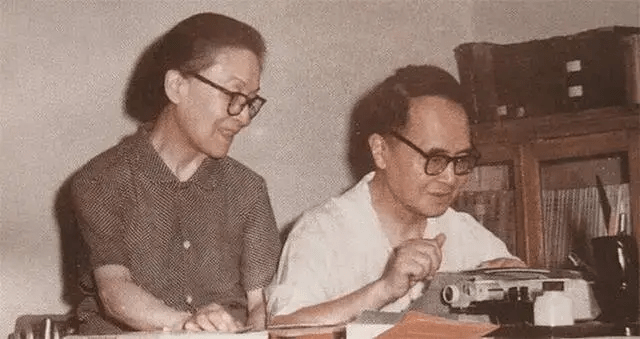
Yang Jiang and her husband Qian ZhongShu
“Simple living and a noble soul are the highest realms of life,” she once said. This was not just a belief but a guiding principle for Yang Jiang. She valued her time deeply, distancing herself from superficial socializing and instead focusing on self-cultivation. Together with her husband, Qian Zhongshu, they shared a simple, intellectual life, each respecting the other’s need for space and quiet to work. After her husband’s passing, Yang Jiang withdrew even further from the world, spending her days immersed in writing and editing.
At the age of 92, Yang Jiang published her essay collection We Three, which received widespread acclaim. Even at the age of 103, she was still active in compiling and publishing The Complete Works of Yang Jiang, a reflection of her lifelong dedication to literature.
It was her ability to remove herself from the distractions of life that allowed her to create works of such lasting value.
Her translation of the eight-volume Don Quixote, once the best-selling Chinese version, drew criticism at one point as a “negative example.” Many writers rushed to her defense, but Yang Jiang responded with characteristic humility: “I sincerely declare that I am a humble translator. I have revised my translation over and over, and still feel it’s not good enough. I hope the experts will offer their guidance.” Her modesty and openness to improvement reflect the calm confidence she carried throughout her life.
In her book Walking on the Edge of Life, she wrote, “We once yearned for the waves of fate, only to realize in the end that the most beautiful scenery in life is the inner calm and composure.” This sentence captures the essence of her wisdom. She knew that, amid the noise and complexity of the outside world, it is the peace we cultivate within that is the most precious.
Yang Jiang rarely wore makeup, preferring to show her natural face to the world. This was not just about simplicity in appearance but about a deeper confidence and acceptance of her true self. She believed that external beauty was far less important than the richness of one’s inner life. As she wisely said, “A woman’s greatest strength is not how beautifully she dresses, but the ability to make herself happy no matter what happens.”
Through her life, Yang Jiang has shown us that even in the face of life’s greatest challenges, it is possible to maintain elegance and beauty by nurturing simplicity and inner richness. Her wisdom and grace continue to inspire us to live with quiet strength, away from the distractions of the world, focused on what truly matters.
In 1984, a therapist in Hawaii achieved remarkable results over three years, healing mentally ill patients at the Hawaii State Hospital without resorting to clinical counseling or medication. Reviewing their records, he repeatedly recited four phrases to “clear” himself: “I’m sorry, please forgive me, thank you, I love you.”
This extraordinary tale intrigued Mr. Vitale, inspiring him to seek out this extraordinary therapist and learn from him. Vitale discovered that Dr. Hew Len employed these four sentences as part of a traditional Hawaiian healing technique known as “Hooponopono,” which translates to “to correct, to clear, to make right” in Hawaiian.
This method not only restored the health of mentally ill patients but also miraculously cured a woman who had suffered from asthma for 50 years overnight. Can four sentences really resolve all problems? Smooth out everything?
These four affirmations have the power to clear all negative energy, balance emotions, and enable you to return to the divine state of “zero limits” (a state of returning to zero, also known as emptiness in Buddhist philosophy, where nothing exists, and anything is possible). By embracing these four phrases, you can face your life more freely and elegantly, leading to health, wealth, and joy.
By approaching each day with an unrestricted perspective, repeating these four sentences concerning your mind, subconscious, experiences, people, and encountered problems with a sincere, repentant, and grateful heart, you will learn to love yourself, forgive yourself, and appreciate yourself. This practice will lead you to live a more fulfilling, wise, and abundant life.
Let us not only refrain from complaining but also say, “I love you!”
What is the Zero Limits method?
It’s straightforward—just four sentences: “I’m sorry, please forgive me, thank you, I love you.”
What do these four sentences represent? In simple terms:
“I’m sorry”: Acknowledge 100% responsibility for what has happened (because everything is created by oneself).
“Thank you”: Express gratitude, show trust, and believe that all problems will be resolved in the best way for everyone involved.
“I love you”: Invoke the power of divinity to clear related memories and heal all wounds.
Although these four sentences in Ho’oponopono therapy are simple, they encompass profound states and meanings. This is a convenient method that can be used at any time during our spiritual growth journey, transcending various spiritual practices.
How to use this method? It’s straightforward—whenever you encounter a problem, simply keep repeating these sentences (there’s no need to rush into belief or doubt; give it a try).
Fundamental Theory of Zero Limits:
You are not aware of what is happening.
Whether consciously or unconsciously, it is impossible to be aware of everything happening within and around you. At this very moment, your body and brain are self-adjusting without your conscious awareness. Countless invisible signals are transmitted through the air, from radio waves to thoughts and consciousness. All of this occurs unconsciously, and your consciousness is not aware of nor in control of this process. This is why you can think positively but still face challenges. In essence, you must understand that your consciousness is not the true creator of everything.
You cannot control everything
If you are unaware of what is happening, you certainly cannot control it. Believing that the world follows your commands is merely a manifestation of satisfying the desires of the ego. Since your ego cannot completely comprehend what is happening in the world, allowing the ego to decide what is best for you is obviously unwise. You can make choices, but you cannot control. You can use your consciousness to choose what you want to experience, but you must also learn to let go and not worry about how or when it will happen; surrender is the key.
You can heal everything that happens.
Regardless of what appears in your life and how it comes about, it requires healing. Because it is now within your perception, if you can feel it, you can heal it. If you see it in others and it troubles you, you must heal it. You may not understand why it appeared in your life or how it happened, but you can let go now. As you have become aware of it, the more you heal, the simpler it becomes to manifest your desires. By releasing blocked energy, you allow this energy to be used for other things.
You must take 100% responsibility for everything you experience.
The events in your life are not your fault, but they are your responsibility. This responsibility includes everything said, done, and thought, as well as everything said, done, and thought by others appearing in your life. If you take 100% responsibility for everything in your life, then when others have problems, those problems also become yours. In short, you cannot blame anyone or anything for your current situation. All you can do is take responsibility, accept it, embrace it, and love it. The deeper you heal, the more connected you become to the source of life.
The ticket to the state of Zero Limits is saying “I love you.”
To overcome the bottleneck of understanding, to obtain a pass from healing to manifestation, is that simple phrase “I love you.” Saying “I love you” to divinity clears everything within you, allowing you to experience the miracle of “Zero Limits.” The key is to love all things: love the excess fat, love the hidden pain, love the troublesome issues, love children with problems, or love neighbors and partners—in short, love everything. Love transforms and releases blocked energy, and by saying “I love you,” you can experience the power of divinity, just like saying “Open sesame.”
Inspiration is more important than thought.
Thoughts are toys of the mind, while inspiration is a directive from divinity. From a certain point onward, you will surrender and learn to listen instead of begging and waiting. Thought is an attempt by the ego to control life from a limited perspective, while inspiration is a reception of messages from divinity and taking action. Thought yields results, while inspiration produces miracles.
Even if you are not sure what is happening, you can still solve problems.
A part of the purpose of survival is to solve problems. To solve problems, you must first understand: Who am I? Who is actually in charge? The consciousness thinks that intellect is the problem solver, capable of controlling what happens, what one experiences, and when. However, in reality, decisions are made before the consciousness decides, and intellect is unaware of this. If it is not intellect or consciousness, then who is in charge?
It is your subconscious. The subconscious is dominated by replayed memories, and it imitates, repeats, and resonates with these memories. The actions, understanding, feelings, and decisions of the subconscious are entirely dictated by memory. Similarly, consciousness operates through replayed memories without awareness. Therefore, replayed memories dominate everything the subconscious and consciousness experience.
The subconscious is the repository of accumulated memories since the beginning. It constantly replays past memories, and the power of choice that consciousness possesses is the power to choose. Both the subconscious and consciousness do not create their own thoughts, feelings, or actions; rather, their experiences resonate with replayed memories and inspirations.
To solve problems, it is crucial to understand that the physical body and the world itself are not the issue; the problem lies in the replayed memories within the subconscious.
The universe comes from nothing and will return to nothing. The universe begins at zero and ends at zero.
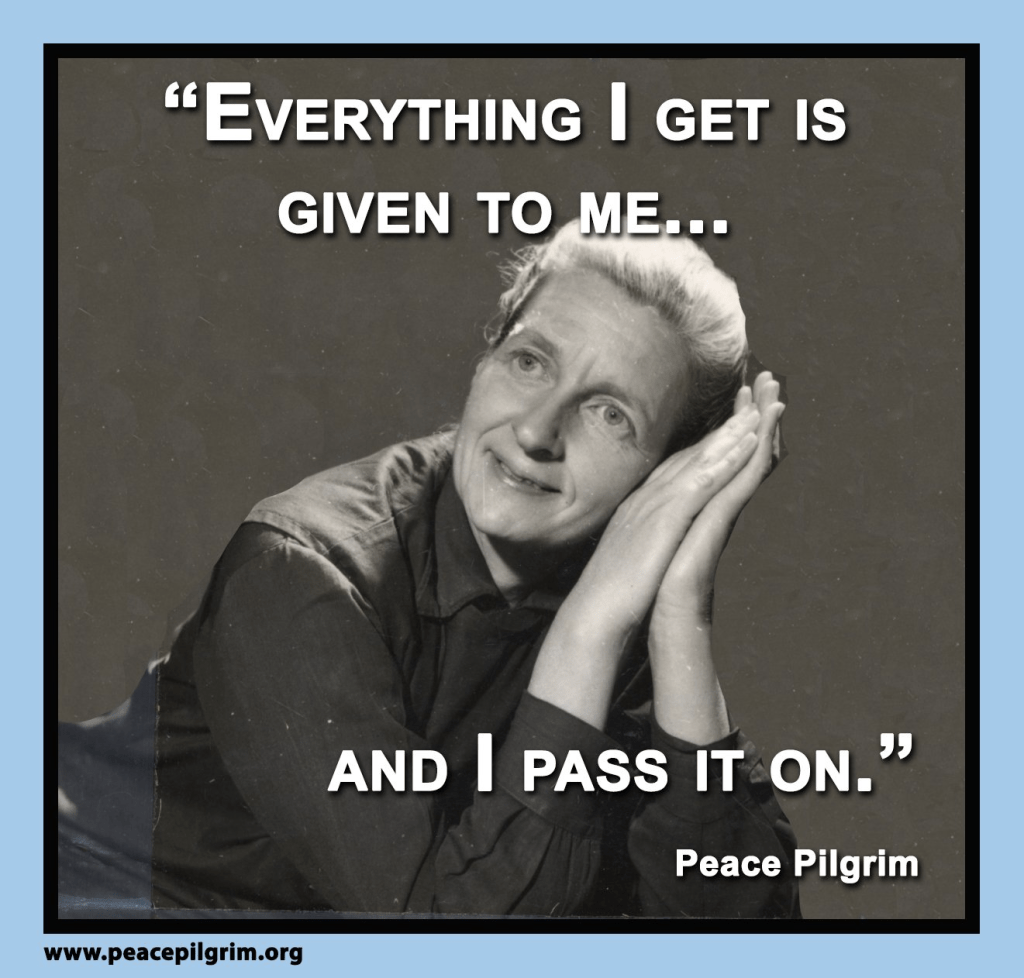
As we enter the holiday season, a time of reflection and celebration, the timeless wisdom of Peace Pilgrim offers profound insights into the true essence of life. “Now there is a living to give instead of to get,” she said, encouraging a shift from acquisition to sharing. Let’s delve into the transformative teachings of Peace Pilgrim, exploring how they can bring peace and fulfillment into our lives.
Peace Pilgrim’s philosophy centers on the joy of giving. Concentrating on the act of giving, she reveals that it becomes a reciprocal source of joy. Health, happiness, and inner peace flow abundantly when one gives selflessly. There’s a profound feeling of endless energy, a connection to the universal source that never seems to deplete.
A key theme in Peace Pilgrim’s teachings is taking control of one’s life. Contrasting the ego, driven by bodily desires and mental demands, with the higher nature governing body, mind, and emotions, she exemplifies the ability to command oneself. Through giving, she demonstrates the power to instruct the body to rest, the mind to focus, and the emotions to find stillness, even in challenging circumstances.
Quoting Thoreau, Peace Pilgrim introduces the concept of dancing to a different drummer—the higher nature instead of the lower. This alternative way of living is marked by aligning oneself with a deeper, more profound purpose. Choosing to follow the rhythm of the higher nature leads to a life driven by compassion, understanding, and a commitment to the well-being of others.
In her journey, Peace Pilgrim made crucial early discoveries. Initially, she found that making money was easy, but the meaninglessness of earning and spending frivolously became apparent. Out of a deep seeking for a meaningful life, she experienced a profound inner shift. Walking through the woods one night, she encountered a psychological hump—a point of no return. With complete willingness and no reservations, she dedicated her life to service.
As we navigate the holiday season, let’s carry the profound wisdom of Peace Pilgrim in our hearts. Embracing the spirit of giving not only enriches the lives of those around us but also brings a sense of fulfillment and purpose. Peace Pilgrim’s inner discovery serves as a poignant reminder that true abundance lies in the joy of giving, connecting us to an endless reservoir of universal energy.
Mildred Norman, later known as Peace Pilgrim, embarked on her peace pilgrimage in 1953, a journey that extended for decades. Her commitment to spreading the message of peace was unparalleled—she walked tirelessly, crisscrossing the United States six times. Remarkably, Peace Pilgrim covered over 25,000 miles during her pilgrimage, a feat she deemed too insignificant to keep precise count.
Her unconventional lifestyle reflected her profound dedication to her mission. Peace Pilgrim adhered to a minimalist philosophy, carrying neither money nor accepting any. She embraced a life of voluntary simplicity, often going without food until it was offered or found in the wild. Accommodations were simple and spontaneous, ranging from bus stations to cornfields when no one extended an invitation.
Peace Pilgrim’s journey became a testament to the transformative power of a singular commitment to a higher purpose. Her life exemplifies the possibility of living with purpose, prioritizing service over material pursuits, and finding fulfillment in the pursuit of peace. As we reflect on her remarkable life, we’re inspired to consider the ways we, too, can contribute to a more compassionate and harmonious world.
About 20 years ago, I participated in a retreat that focused on organic farming, nutrition, and spirituality, at Santa Barbara CA. While much of what I learned during the retreat has since slipped from my memory, one aspect of the experience has remained with me: my encounter with the beautiful soul known as Peace Pilgrim.
I never had the opportunity to meet Peace Pilgrim in person, but I was deeply moved by her book, “Peace Pilgrim: Step toward Inner Peace,” which I read in Chinese. I couldn’t believe that such an amazing and spiritual person existed. Peace Pilgrim’s journey across America to spread the message of peace, with nothing but the clothes on her back, was truly inspiring. The book left a lasting impression on me, and it actually started my spiritual journey.
Peace Pilgrim, born Mildred Lisette Norman, was a spiritual teacher and peace activist who walked across America several times in the 1950s and 1960s to spread the message of peace. She traveled on foot, carrying only a few possessions and wearing a tunic with the words “Peace Pilgrim” written on it.
During her journey, Peace Pilgrim spoke to thousands of people about the importance of inner peace and the role it plays in creating a more peaceful world. She believed that true peace could only be achieved when individuals found inner peace within themselves, and that this inner peace would radiate outwards to create a more peaceful society.
Peace Pilgrim’s message resonated with many people, and her simple, yet powerful words inspired many to work towards peace in their own lives and in the world. She wrote several books, including “Peace Pilgrim: Her Life and Work in Her Own Words,” which chronicled her journey and the lessons she learned along the way.
In a time of great turmoil and uncertainty, the message of Peace Pilgrim is more relevant than ever. Her teachings remind us that true peace begins within, and that each of us has the power to make a difference in the world by finding inner peace and living a life of compassion and kindness. Her spirit and teachings continue to inspire and guide many people, and her message of peace will continue to resonate for years to come.
In this pandemic and tough time, her message of inner peace could be a guiding light for many people. World will have true peace until each one of us find our inner peace. Her teachings and stories are an inspiration for all of us to work on peace for the whole world. May her spirit and teachings continue to guide and inspire us all to work towards a more peaceful world.
I recently realized that I live most of my waking hours in a state of perpetual striving. There’s a nagging voice at the back of my mind constantly adding new items to my to-do list. My phone is littered with notes made at odd times of the day and night, reminding me to email this person, pitch that idea, edit my website, write this blog post, make a healthier meal plan, and complete a complicated DIY craft project with my kids.
The lists spill out over the pages of my notebooks and diary, onto sticky notes and scraps of paper in my purse. The to-do list is an ever-evolving beast that is never satisfied, and leaves me feeling impatient, frustrated, and restless. Can you relate?
Overstimulation sets us up for failure
We crave peace — to be fully present in the here and now; to soak it all up; to be grateful for all that we have. But our minds constantly skip ahead to the next task. We barely notice when we reach or surpass one goal because we’re so focused on what we haven’t achieved yet.
We live in an unnaturally fast-paced culture, with a 24/7 digital connection to the rest of the world. With all the noise that surrounds us, we feel pressure to cram as much into our schedules and brains as possible.
One of the many consequences of this overstimulation can be that we end up holding ourselves to impossible standards and get impatient with our limitations and seemingly “slow” progress. There are so many things we could do, and we’re more aware of all our options and potential than ever. It can be hard to remember how impossible it would be to actually do it all.
Patience can unlock productivity and open the door to growth
Research shows multitasking damages our productivity and can negatively impact the way our brains process information. We know that rest is essential for our well-being and creativity. The benefits of disconnecting from our tech and making an intentional choice to slow down our lives are more and more widely discussed.
I’ve found in my own life, however, that understanding the benefits and actually internalizing those beliefs are two different things. One of the trickiest aspects of choosing to unplug and slow down is to tune out that frantic, impatient voice telling us that we’re not achieving enough fast enough. So what’s the solution?
Patience is the antidote to this sense of restless striving — especially learning to have patience with ourselves. Here are a few ideas to help you cultivate this in your own life.
Tips for cultivating patience
1. Understand that your energy will ebb and flow
Despite what our post-Industrial Revolution capitalist society would like us to think, we’re not machines, and our bodies have more in common with the natural world and the seasons than our constantly switched-on devices. Research shows that our brains rarely work well for long uninterrupted stretches of time, and, as Inc. put it, “An 8-hour workday only makes sense if you’re screwing in widgets on an assembly line.”
You’re probably already aware of your favorite time of day, and have a sense of whether you work better in the morning, afternoon, or evening. This applies to the seasons, as well — your productivity and whether or not you’re feeling at your best, in general, can be hugely influenced by other factors like your hormonal cycle, your health, and whatever is going on in your life at that particular time.
Remembering you’re not a machine and that your mood, abilities, and needs will be constantly shifting and changing can help you become more patient with yourself.
2. Grow in self-awareness
In their online course, A Seasonal Year, Maddy Lawson and Eleanor Cheetham suggest mapping out the year to find where your energy is naturally highest and where it’s lowest. Think about what kind of work fills you up, and what kind of work leaves you feeling more drained. Consider which seasons find you scribbling down new ideas like there’s no tomorrow, and which ones make you feel like hunkering down and staying firmly in your comfort zone.
Once you’ve learned to recognize your own patterns, you’ll be better placed to think creatively about how you can work with your tendencies, rather than against them. We don’t always have a choice about how much work we have on our plates or how we spend our days, but we usually have at least a little more choice than we think we do. And growing in self-awareness is the first step toward becoming more patient with yourself.
On my own journey towards self-awareness, for example, I’ve learned that my energy tends to be the lowest in the winter. So now I can prepare myself to be less ambitious and more patient with myself during that particular season.
3. Stay curious about your roadblocks
Nir Eyal, the author of Indistractable, encourages us to watch out for the moments when we start to procrastinate and question why we’re putting something off. He points out that there’s always a deeper emotion underneath the instinct to procrastinate — whether that’s fear of failing, not knowing how to do something, weariness and feeling too burnt out to engage with it, or just plain boredom.
When you cultivate a habit of observing the things that trip you up — that hold you back from making the progress you’d like to make without judgment — you can have more empathy for yourself instead of beating yourself up or calling yourself lazy. Keep in mind, though, that this isn’t about making excuses or trying to get out of doing the necessary work. When you can say, “That’s interesting, I’m trying to put off doing this thing because I’m really tired right now,” it’s easier to be patient with yourself. This allows you to find potential solutions — like rearranging your schedule in order to tackle a task later on with renewed focus and energy — rather than just getting frustrated with yourself.
4. Notice, celebrate, and cultivate gratitude for the good
I’m guilty of not taking the time to reflect on — or celebrate — the good things in my life. I recently achieved a dream I’d been harboring for years, and after about five minutes of feeling excited and happy about it, I went back to worrying about the next thing. This experience helped me realize that patience is a habit — a mindset that we have to cultivate — and that it’s intimately linked with gratitude.
It can feel kind of corny or egotistical to stop and pat yourself on the back when something goes well or you handle something in a way that you’re proud of, but as I get older I’m realizing how important it is to celebrate the small victories. Regularly refocusing on the bigger picture can help you see how far you’ve come, have a deeper sense of gratitude for where you’re at, and make peace with the time it takes to get anywhere good.
Patience is a virtue
Ultimately, having patience with ourselves helps us to develop deeper patience for others, and it all starts with understanding ourselves better. These tips will help you to self-assess, put patience into practice, and reap the benefits of increased self-awareness and productivity throughout your life. It might seem counterintuitive, but when things speed up, we should slow down — and watch the wonderful results that patience provides.























 Peace LiLy