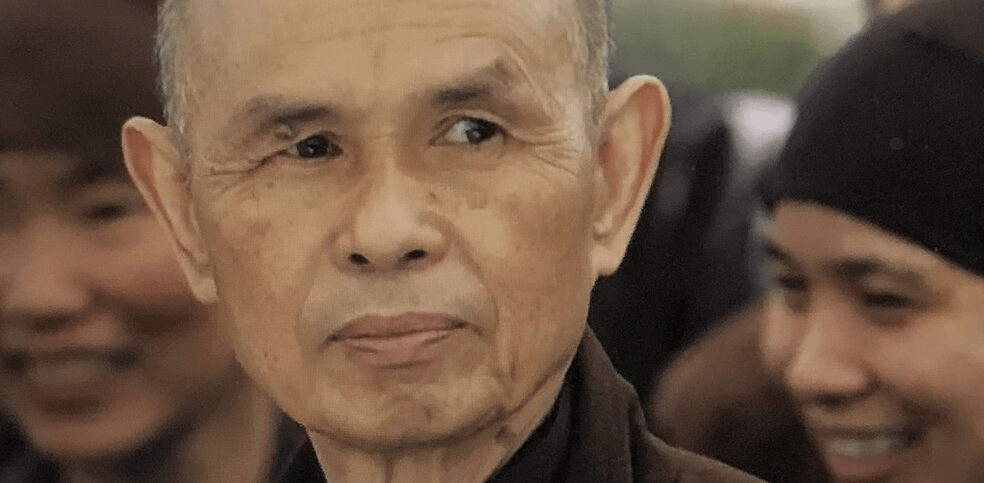
In times of uncertainty and turmoil, the voice of compassion becomes more precious than ever. Thich Nhat Hanh was a world-renowned Vietnamese Zen Buddhist monk, teacher, poet, author, and peace activist whose life embodied mindfulness and nonviolence. His profound influence reached far beyond the Buddhist community; he was nominated for the Nobel Peace Prize by Martin Luther King Jr., who recognized in him “an apostle of peace and nonviolence.”
Today, as the world feels divided and restless, his poem “Call Me by My True Names” invites us to look deeply into our shared humanity. It challenges us to see beyond separation—beyond “us” and “them”—and to recognize that within each of us lives both suffering and compassion. Reading his words now feels like a gentle but powerful reminder: true peace begins when we awaken to our interconnectedness.
Call Me by My True Names
Do not say that I’ll depart tomorrow because even today I still arrive.
Look deeply: I arrive in every second to be a bud on a spring branch, to be a tiny bird, with wings still fragile, learning to sing in my new nest, to be a caterpillar in the heart of a flower, to be a jewel hiding itself in a stone.
I still arrive, in order to laugh and to cry, in order to fear and to hope. The rhythm of my heart is the birth and death of all that are alive.
I am the mayfly metamorphosing on the surface of the river, and I am the bird which, when spring comes, arrives in time to eat the mayfly.
I am the frog swimming happily in the clear pond, and I am also the grass-snake who, approaching in silence, feeds itself on the frog.
I am the child in Uganda, all skin and bones, my legs as thin as bamboo sticks, and I am the arms merchant, selling deadly weapons to Uganda.
I am the twelve-year-old girl, refugee on a small boat, who throws herself into the ocean after being raped by a sea pirate, and I am the pirate, my heart not yet capable of seeing and loving.
I am a member of the politburo, with plenty of power in my hands, and I am the man who has to pay his “debt of blood” to, my people, dying slowly in a forced labor camp.
My joy is like spring, so warm it makes flowers bloom in all walks of life. My pain is like a river of tears, so full it fills the four oceans.
Please call me by my true names, so I can hear all my cries and laughs at once, so I can see that my joy and pain are one.
Please call me by my true names, so I can wake up, and so the door of my heart can be left open, the door of compassion.
Each time I read “Call Me by My True Names” by Thich Nhat Hanh, I feel both unsettled and awakened.
The poem asks us to see what we often refuse to see—that we are not separate from the suffering of the world. We are not only the compassionate helper, but also, in some deep and interconnected way, the frightened child, the victim, and even the one who causes harm. This is not an easy truth to hold. Yet it is a profoundly liberating one.
The poem gently dissolves the illusion of “us” and “them.” It invites us to return to our true humanity—tender, vulnerable, and deeply connected.
And perhaps, in remembering this, we take one small but meaningful step toward peace.
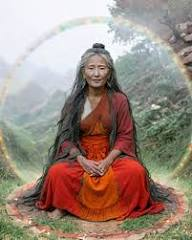
In the rich tapestry of Tibetan Buddhism, there are extraordinary practitioners whose lives themselves become teachings. Among them, Ayu Khandro (阿玉康卓) — also known by her Dharma name Dorje Peldron — stands as one of the most inspiring yoginis of the Nyingma tradition. Her life is not merely a story; it is a living example of devotion, perseverance, and profound realization.
Born in 1839 in the remote region of Kham, eastern Tibet, Ayu Khandro began her spiritual journey at a young age. She received teachings from many of the greatest masters of her time, including Jamyang Khyentse Wangpo, Jamgon Kongtrul, Chokgyur Lingpa, Nyala Pema Dundul, Adzom Drukpa, and Togden Rangrig — figures who were central to the non-sectarian Rimé movement in Tibetan Buddhism.
Unlike many who seek comfort or recognition, Ayu Khandro chose a life of renunciation and yogic discipline. She wandered widely across Tibet, lived in caves and hermitages, and devoted herself to decades of intense meditation. She spent more than fifty years in retreat, including prolonged periods of dark retreat, known in Tibetan as Yangti Nagpo — an advanced Dzogchen practice where the meditator withdraws from external light to focus inwardly on the nature of mind.
Dzogchen — The Great Perfection
Ayu Khandro’s life was profoundly rooted in Dzogchen (Great Perfection) — a teaching that points directly to the intrinsic, luminous nature of consciousness. Rather than seeking external accomplishments, she focused entirely on direct inner realization.
She was recognized as a terton — a revealer of hidden teachings — and was particularly known for transmitting sacred practices and giving initiations to practitioners, including the renowned master Chogyal Namkhai Norbu Rinpoche, who later wrote her biography based on her own oral account.
Ayu Khandro lived to the remarkable age of 115. In 1953, near the end of her life, she received visitors, gave away her precious possessions, and continued to teach and encourage those around her. After she passed away, it is reported in Tibetan Buddhist biography that her body remained in meditation posture for about two weeks before any signs of physical change occurred. By the end of this period, her body had shrunk to a fraction of its original size — an occurrence some traditions associate with deep spiritual attainment in Dzogchen practice, where the physical elements dissolve into subtler states.
This remarkable account, while extraordinary, is part of how her life has been transmitted in spiritual biographies — not as a spectacle, but as a sign of the depth and authenticity of her practice.
What makes Ayu Khandro’s life especially compelling is not just her longevity or her meditative achievements, but her steadfast devotion to the Dharma. She never sought fame or comfort. Instead, she walked the rugged paths of realization, teaching through action rather than words, presence rather than proclamation. Her retreats, pilgrimages, and meditation practices were not about escape, but about coming fully home to the true nature of mind.
Although few of us will ever undertake decades of meditation in darkness or faraway hermitages, Ayu Khandro’s life still speaks directly to modern seekers. In an era filled with distraction and ambition, her example invites us to ask:
What is true commitment?
How deeply can we trust the path we walk?
Can we place inner understanding above outer achievement?
Her life encourages us to remember that spiritual depth is not measured by loud accomplishments, but by quiet fidelity to practice.
Ayu Khandro remains a powerful reminder that liberation is not found on the surface of life, but in its quiet depths. Her unwavering dedication, her silent courage, and her embrace of the path offer inspiration — not as myth, but as a living reminder of what is humanly possible when devotion meets discipline.
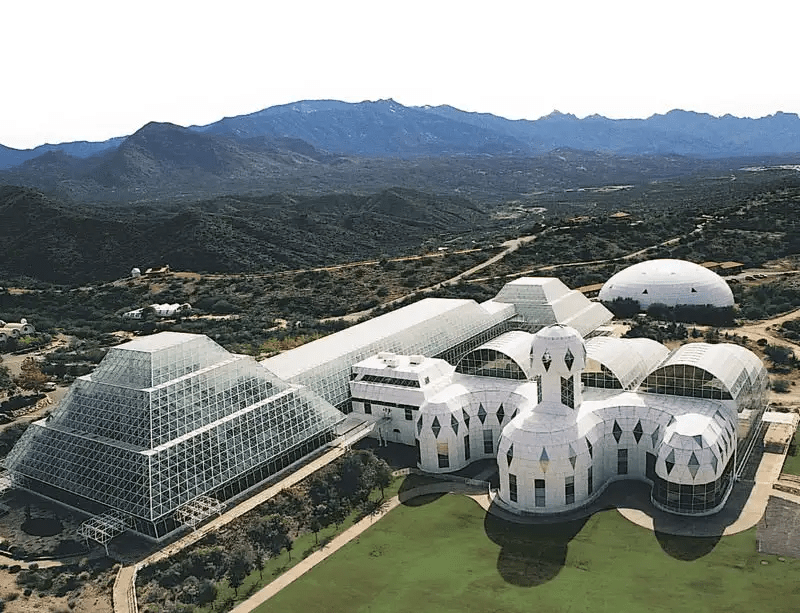
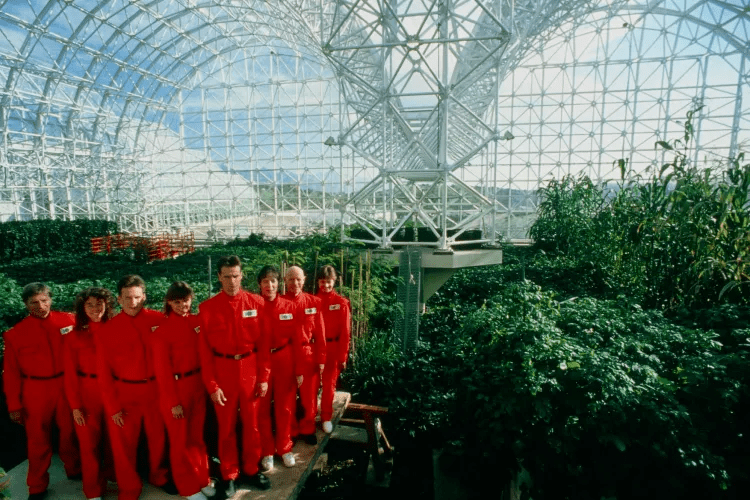
In 1991, deep in the Arizona desert, an unprecedented experiment quietly began—one that captured the imagination of the world and, in time, revealed a powerful lesson about humanity’s relationship with nature.
Eight people—four men and four women—were sealed inside a massive glass-and-steel structure known as Biosphere 2. Inside this enclosed world were recreated ecosystems meant to mirror Earth itself: a tropical rainforest, an ocean with coral reef, a desert, savanna, wetlands, farmland, and living quarters. For two full years, the inhabitants were to live completely self-sufficiently, growing their own food, recycling their air and water, and surviving without outside assistance.
The ambition was breathtaking. Biosphere 2 was envisioned as a blueprint for the future—an experiment to test whether humans could survive in closed ecosystems, potentially paving the way for space travel and the colonization of other planets. Behind this vision stood oil tycoon Edward Bass, who invested nearly $200 million into the project. It was, at once, a serious scientific endeavor and a meticulously choreographed public spectacle, drawing intense global attention from scientists, media, and the public alike.
Yet as the months passed, the experiment revealed something far more profound than plans for Mars.
Despite advanced engineering, cutting-edge technology, and idealistic human determination, the biosphere began to falter. Oxygen levels dropped unexpectedly. Crops failed. Certain species flourished too aggressively while others vanished. Tiny imbalances multiplied into serious problems. Even the soil—something often overlooked—absorbed oxygen in ways scientists had not fully anticipated.
What became clear was this: Earth’s ecological system is far more complex, delicate, and interconnected than human intelligence can fully replicate or control.
Biosphere 2 did not fail because of a lack of effort or intelligence. It faltered because nature is not a machine that can be perfectly engineered. It is a living, breathing system shaped by countless relationships that have evolved over billions of years. When humans attempt to dominate or redesign nature without deep humility, unforeseen consequences inevitably arise.
Looking back today, Biosphere 2 feels less like a rehearsal for escaping Earth and more like a gentle warning.
Rather than asking how we can leave this planet, perhaps the deeper question is how we can live more respectfully upon it. The experiment reminds us that technology, no matter how advanced, cannot replace the wisdom embedded in natural laws. Human ambition, when detached from reverence, can easily turn into overconfidence.
We are not masters of Earth—we are tenants.
To live well on this planet requires humility: listening to nature rather than overriding it, cooperating with ecological rhythms rather than forcing outcomes, and recognizing that every action ripples through an intricate web of life. True progress is not measured by how much we can control, but by how well we can coexist.
More than three decades later, Biosphere 2 still stands in the Arizona desert, now used for research and education. Its greatest contribution may not be scientific data alone, but the quiet reminder it offers to humanity:
Respect nature. Honor complexity. Live humbly. And follow the laws of the Earth that has always sustained us.
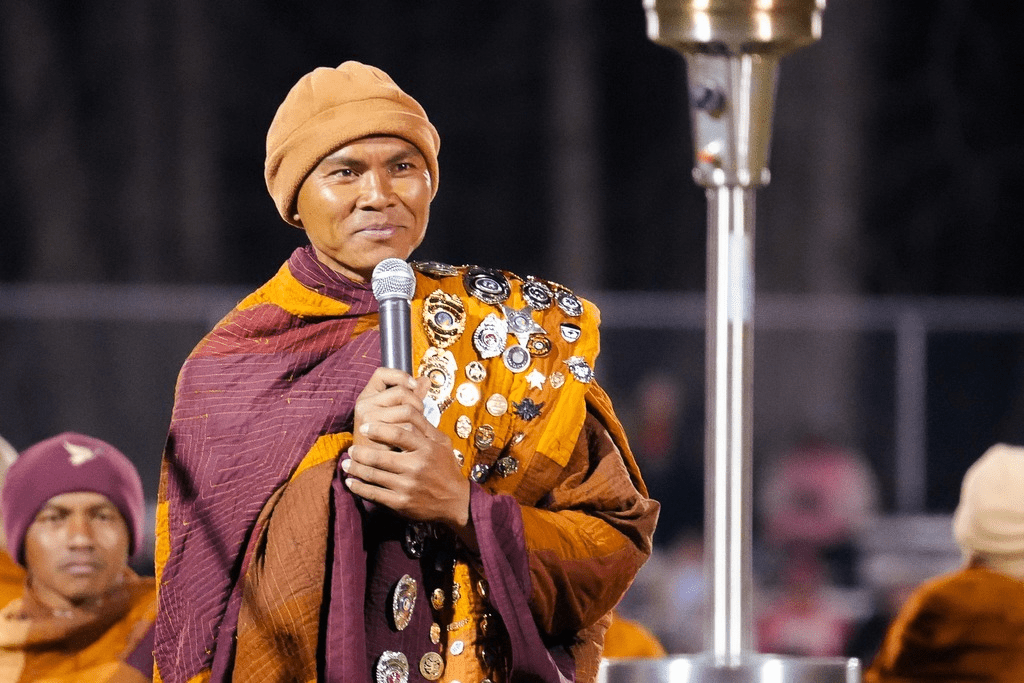
Siler City, NC – On Wednesday evening the “Walk for Peace” monks stopped for the day at Jordan-Matthews High School. This was an opportunity for one of the monks to speak to the crowd gathered at the football here. Below is a summary of the lessons he hoped to teach.
We fight a battle every day, but the enemy isn’t external. It’s the relentless hum of our own minds—the constant wandering to past regrets and future anxieties, the endless scroll of digital distractions, and the crushing pressure to always be doing more. In this unwinnable war for a quiet mind, we often feel like we’re losing ground.
But what if the pursuit of peace wasn’t an epic battle at all? What if it was simply a series of small, counter-intuitive shifts in perspective? In a recent talk, a monk shared a path to peace that doesn’t require struggle, but instead invites awareness and acceptance. This post shares the four most surprising and impactful lessons from that talk—practical wisdom that can be applied to your life, starting right now.
1. To Connect With Your Kids, Stop Trying to Fix Them
As parents, our deepest instinct is to protect and guide. We want the best for our children, so we try to fix their mistakes and teach them the “right” way. But the monk pointed out a painful paradox: the more we try to “fix” or “change” them, the more we inadvertently build a “war” between us, pushing them further away.
His surprising solution was to shift our role entirely: stop trying to teach and start sharing. By approaching a child as a friend, we transform the dynamic from a top-down lecture into a shared conversation. This shift is the key to getting them to listen, and more profoundly, it creates the safety for the ultimate connection. The monk explained that when children see you as a friend, “whenever obstacle when they run into trouble they will come back to you and lean on your shoulder and cry and ask for help… that is when your chance come to teach them.”
unless you make friend with them you see them as your friends not mother not the father but a friend A friends means the different way of talk, different way of teaching, sharing… and that is when they listen.
In a world of high-pressure, achievement-oriented parenting, this advice is a radical act of trust. It asks us to let go of micromanagement and have faith that building a foundation of friendship is the most effective way to stay connected, especially when our kids are more influenced by peers and technology than ever before.
2. The Enemy of Peace Isn’t Chaos—It’s Multitasking
The monk observed that in our modern world, a distracted, wandering mind has become the “normal” condition. Very few people, he noted, can truly focus. He then offered a memorable metaphor for the primary source of this distraction: our smartphones.
And now that we all all have our lovers along with us every single second, you know who is your lover is your cellphone…
His solution is profoundly simple yet radically counter-cultural: stop multitasking. He framed this not as a mere productivity hack, but as the fundamental practice for purifying the mind. Without concentration on a single task, he explained, there can be no real peace.
This advice directly challenges the modern glorification of being busy. We multitask because we treat busyness as a proxy for importance and self-worth. To single-task is therefore an act of rebellion against the “cult of productivity.” It’s a way to reclaim our presence and discover that true effectiveness and inner calm are found not in doing more, but in giving our full attention to one thing at a time. This practice of single-pointed concentration is the very tool we need for the next lesson: dealing with the internal chaos of our own minds.
3. Don’t Fight Your Anxious Thoughts. Just Look at Them.
When we try to find a moment of quiet, the mind inevitably rebels. Thoughts of the past and worries about the future “pop up” and disrupt our focus. But the monk’s wisdom extends beyond just anxious thoughts—it applies to every distraction, internal and external. The itch on your nose, the sound of a distant siren, a sudden memory—our common reaction is to fight these intrusions and scold ourselves for getting distracted.
The monk’s instruction is to do the exact opposite. The goal is not to create a blank, empty mind. The practice is to simply add awareness to your breath, and when any thought, sound, or physical sensation appears, you acknowledge it without judgment. You observe it for a moment, and then gently guide your attention back to your breathing.
When that thought pop up, instead of trying to eliminate or push it away, just acknowledge it, observe that thought and then come back to this breathing.
He warned that this requires immense patience because “we will fail over and over.” This insight is liberating. It reframes “failure” as a completely normal and expected part of the process. Each time you notice your mind has wandered and you gently bring it back, you are succeeding.
4. Learn to Shed Your Leaves Like a Tree
To illustrate the art of letting go, the monk shared a powerful analogy from nature. In the autumn, trees shed their leaves. They don’t do this because they are weak; they do it as a brilliant survival strategy to conserve energy through the winter, preparing for new growth in the spring.
He explained that humans, however, often do the opposite. We spend our lives collecting and holding onto our mental “trash”—bad habits, unhappy memories, stress, and anxiety. We cling to these dead leaves until we are completely overwhelmed by their weight.
We have collected all kind of trash in our mind. Bad habit, unhappy thing, undesirable, all those things happening in our life that we suffered. We collected it so many and we recorded in here and we didn’t know how to let it go. We don’t know how to shut it off just like those trees.
This metaphor recasts “letting go” not as a passive act of giving up, but as an active, wise process of conserving our vital energy. In a world facing an epidemic of burnout, this lesson becomes a crucial survival strategy. It teaches us to release what no longer serves us in order to preserve our strength for what truly matters—for the new growth that awaits.
Peace is a Practice, Not a Destination
The war for a quiet mind ends the moment you stop fighting. As the monk’s lessons reveal, peace is not a distant state you arrive at, but the result of small, conscious actions. It’s found in the choice to single-task, the gentle observation of a thought, and the courage to let go of control—both in our own minds and in our relationships. Becoming a friend to our children and a non-judgmental observer of our thoughts are both practices in releasing the need to fix everything. Single-tasking is the foundation that makes this awareness possible.
He offered a simple starting point: each morning, write down the statement, “Today is going to be my peaceful day,” and live with that intention. But he also added a note of urgency. Many of us say we will do it “later,” but, as he warned, “that later that moment never comes.”
Don’t wait. Peace is a daily practice, and the work begins now. Looking at the “leaves” you’ve been carrying, what is just one you can choose to let go of today?
Thus have I heard. At one time the Buddha was in Vārāṇasī, at the Deer Park in Ṛṣipatana.
At that time, the Bhagavān said to the bhikṣus, “Would a lady, said to be the most beautiful in the world, cause many people to gather together to see her?” The bhikṣus replied to the Buddha, “Certainly, Bhagavān.” The Buddha said to the bhikṣus, “If that lady, reputed to be most beautiful in the world, could perform all kinds of music, song, and dance, would many people gather together to watch?” The bhikṣus addressed the Buddha, saying, “Certainly, Bhagavān.”
The Buddha said to the bhikṣus, “Suppose there were a lady said to be the most beautiful in the world, and in this place there would be all kinds of entertainment with music, song, and dance. Moreover, a great crowd would converge upon this one place. Suppose there would be a gentleman, not foolish or stupid, preferring happiness to suffering, valuing life and fearing death. A person would say to him, ‘Sir, you should carry this bowl of oil, filled to the brim, and pass in between this world beauty and the crowd. There is a killer who will draw out his blade and follow you. If a single drop of oil is lost, he will cut off your head.’
“What do you think, bhikṣus? Would that man carrying the oil bowl be able to forget about the oil bowl, and forget about the killer, and watch that skillful lady and the large crowd of people?” The bhikṣus addressed the Buddha, saying, “No, Bhagavān. Why? Bhagavān, that man would be concerned about the man with his blade drawn out. He would think, ‘If I spill even one drop of oil, that man with his blade drawn will cut off my head.’ With that only thought, his mind would be fixated on the oil bowl. He would walk between the world beauty and the crowd and go past them, not daring to catch a glimpse.”
“Thusly, bhikṣus, if there is a śramaṇa or brāhmaṇa who is dignified in body and resolute in mind, not regarding voice and beauty, skillfully regarding all dharmas of the mind, abiding in mindfulness of the body, then this is my disciple who is in accordance with my teaching.
“What does it mean for a bhikṣu to be dignified in body and resolute in mind, not regarding voice and beauty, persevering in all dharmas of the mind, abiding in mindfulness of the body? Thusly, bhikṣus: mindful of the body, observing the body: ardent, correctly aware and mindful, setting aside worldly craving and sorrow.
“Abiding in the mindfulness of sensations… and of the mind… and of dharmas, observing dharmas, are also such as this.
“This is called a bhikṣu who is dignified in body, resolute in mind, not regarding voice and beauty, and skillfully regarding dharmas of the mind, abiding in the Four Bases of Mindfulness.”
At that time, the Bhagavān spoke a gāthā:
Focused and well-mindful, As if protecting an oil bowl: The mind protected this way Reaches the unprecedented— What is extremely difficult to reach, Supremely wondrous and subtle. Those things the Buddha speaks: That teaching is a sharp sword. With a resolute mind, Focusing and persevering— Not like an ordinary person, Negligent in affairs— One is able to enter thusly, Not neglecting the teaching.
After the Buddha had spoken this sūtra, the bhikṣus heard what the Buddha had said, and joyfully practiced in accordance.
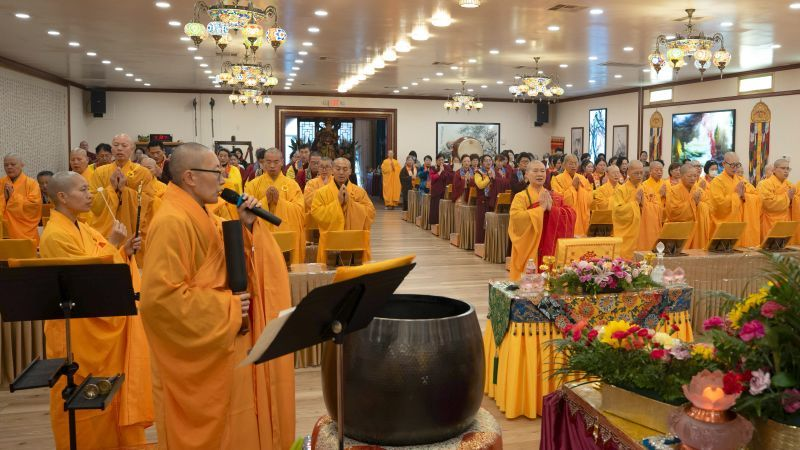
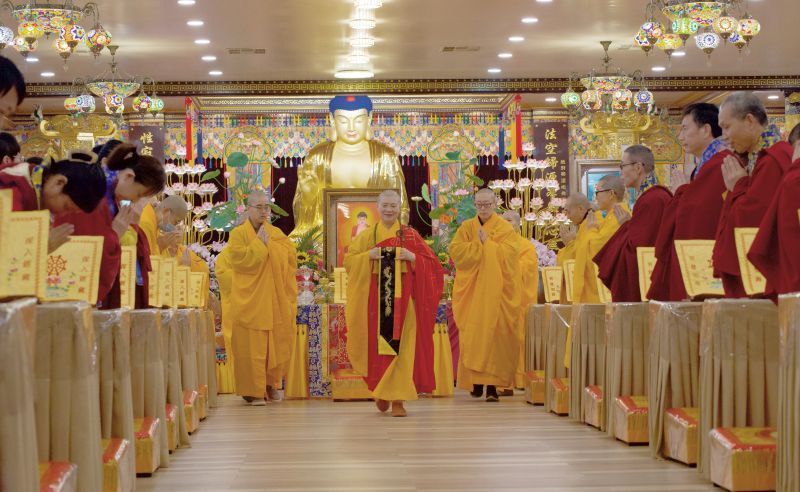
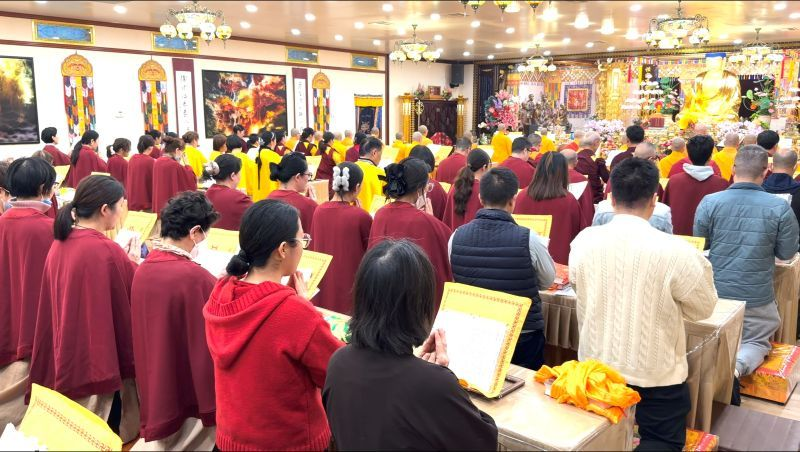
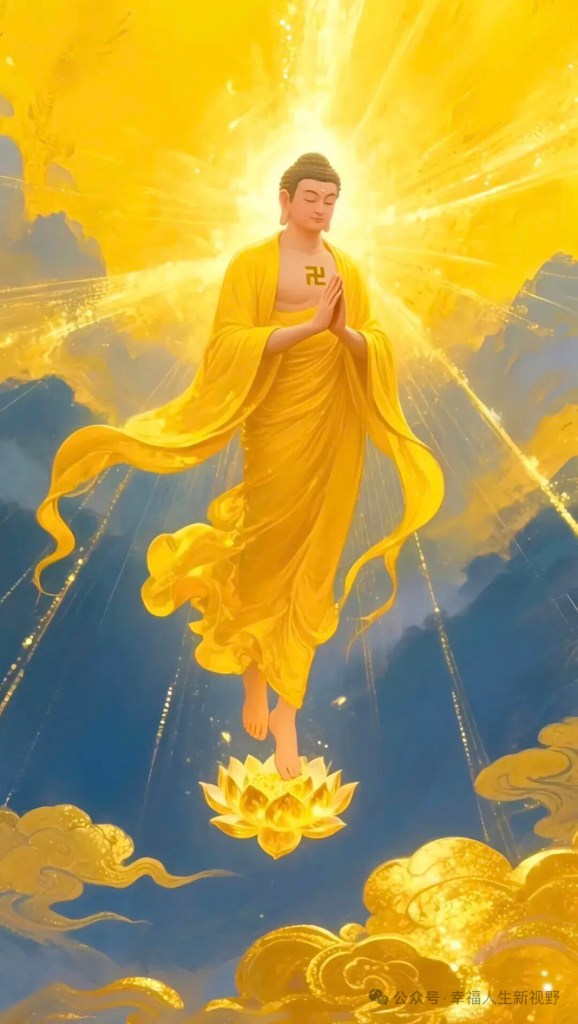
From January 4 to January 13, the Las Vegas Charity Temple solemnly hosted a ten-day “Grand Prayer Dharma Assembly for Reverently Listening to the Dharma Discourse of Namo Dorje Chang Buddha III and Celebrating the Sacred Birthday of Namo Amitabha Buddha.”
The assembly respectfully invited Venerable Shih Zhèng Dá, Vice Chairman of the World Buddhism Headquarters, to preside over the ceremonies. Under his compassionate guidance, participants reverently listened to the Dharma Discourse of Namo Dorje Chang Buddha III and took part in a series of profound and auspicious events, including:
The Prayer Dharma Assembly in Celebration of Namo Amitabha Buddha’s Birthday
The Great Compassion Avalokiteshvara Blessing Dharma Assembly
The Universal Deliverance and Requiem Dharma Assembly for the Deceased
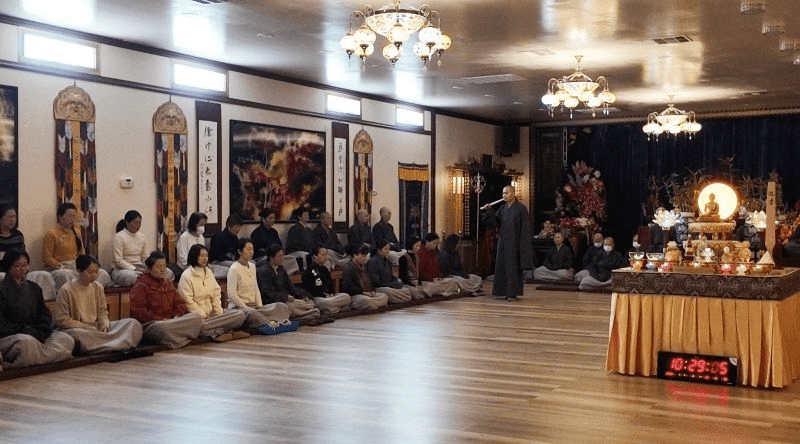
A One-Day Chan (Zen) Retreat
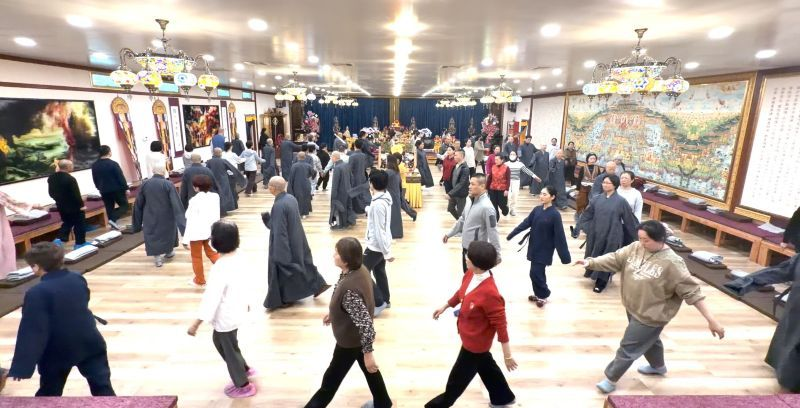
Group cultivation of the Vajra Yoga Perfected Practice
Acts of compassion such as life release, charitable donations, and aid for the poor
High-ranking monastics, rinpoches, respected community leaders, and devoted lay practitioners from across the United States, Canada, Thailand, Hong Kong, Taiwan, and other regions gathered to participate in this rare and殊勝 (supremely auspicious) event.
The Vast Resonance of the Buddha’s Voice, Blessing All Beings
At 9:00 a.m. on January 4, the Dharma Assembly for Reverently Listening to the Supreme Dharma Discourse of Namo Dorje Chang Buddha III officially commenced.
At the center of the mandala in the Grand Hall stood the sacred text “Explaining the Ultimate Truth through the Heart Sutra”, expounded by Namo Dorje Chang Buddha III. The altar was adorned with fresh flowers, the Eight Auspicious Offerings, colorful banners, incense, and lamps—radiating solemnity and auspiciousness.
Led by Venerable Zhèng Dá, dozens of monastics, rinpoches, and over a hundred distinguished guests and devotees respectfully welcomed the Buddha’s Dharma Discourse into the hall. Reverently listening to the Dharma Discourse of Namo Dorje Chang Buddha III formed the spiritual heart of the entire ten-day assembly and was complemented by in-depth study of the Collected Canon of Namo Dorje Chang Buddha III.
Venerable Zhèng Dá emphasized that true cultivation must follow the Buddha’s teachings through listening, contemplating, and practicing, integrating the Dharma into every detail of daily life. He encouraged participants to unite practice and understanding, allowing wisdom to arise naturally through consistent application.
After listening to the Buddha’s Dharma Discourse, many participants shared profound insights and transformative experiences. With sincere vows, they resolved to practice according to the Buddha’s teachings— refraining from all evil, practicing all good, and benefiting all beings— while jointly praying for world peace, national harmony, favorable weather, and the health and happiness of all sentient beings, so that wisdom and blessings may increase together.
Cultivating Body, Speech, and Mind—Receiving Great Benefit
During the assembly, Venerable Zhèng Dá also led group cultivation of the Vajra Yoga Perfected Practice and presided over the Great Compassion Avalokiteshvara Blessing Dharma Assembly. Many participants felt profound responses, sensing the compassionate presence of Namo Avalokiteshvara Bodhisattva at the mandala. Some experienced relief from illness, inner peace, and extraordinary joy.
The One-Day Chan Retreat was guided according to the Great Chan Meditation Practice transmitted by Namo Dorje Chang Buddha III. After completing ten meditation sessions, many participants reported physical healing, improved energy flow, enhanced concentration, and deep mental clarity. Some even experienced sacred meditative states without attachment, while the entire assembly was filled with the joy of Chan and Dharma bliss.
On January 13, as the Dharma listening sessions reached completion, participants engaged in a closing Dharma debate. The fourfold assembly divided into two groups, formulating questions and arguments based on Buddhist logic and authentic Dharma principles. Through reasoned discussion and lively exchange, participants demonstrated how daily cultivation leads to flexible understanding, deep insight, and genuine realization.
Releasing Life, Protecting Life—Dedicating All Merit Universally
This ten-day New Year Grand Prayer Dharma Assembly concluded in perfect auspiciousness. Acts of compassion—including life release and charitable donations to disaster-stricken areas—were carried out in succession, bringing the event to a wholesome and complete close.
Though more than ten days of intensive Dharma listening and group cultivation seemed to pass in an instant, the joy of the Dharma lingered in every heart. Participants made renewed vows to cultivate diligently, uphold the Buddha’s teachings, and bring benefit and happiness to all beings.
May the true Dharma of the Buddha spread throughout the world, may sentient beings enjoy long life and increasing blessings, may the winds and rains come in harmony, harvests be abundant, may nations prosper, and may lasting world peace prevail.
(This post is translated and adapted from a news report on 2026/01/15, originally published by the Las Vegas Chinese News Network. Translation by Linda Chang. For the original Chinese article, please see here.)
Unveiling the mystical realization state of esoteric Buddha-dharma—a true account of a grand assembly of esoteric Buddha-dharma
People think of Tibetan Buddhism in general as a far-away culture full of mystery. Especially when patriarchs from various sects manifested mystical phenomena and supernatural powers, people become curious about esoteric Buddha dharma.
Based on the descriptions of some lamas, there are various examinations for Buddhist practitioners in Tibet. One’s proficiency of Buddhism is examined by means of different scales of dialectical debates. The one who passes thousands of debates and is in first place is called Lharampa geshe. The ones in second place and third place are called geshes. Only after completion of tens of thousands of dialectical debates can geshes enter schools of Esoteric Buddhism to learn esoteric dharma.
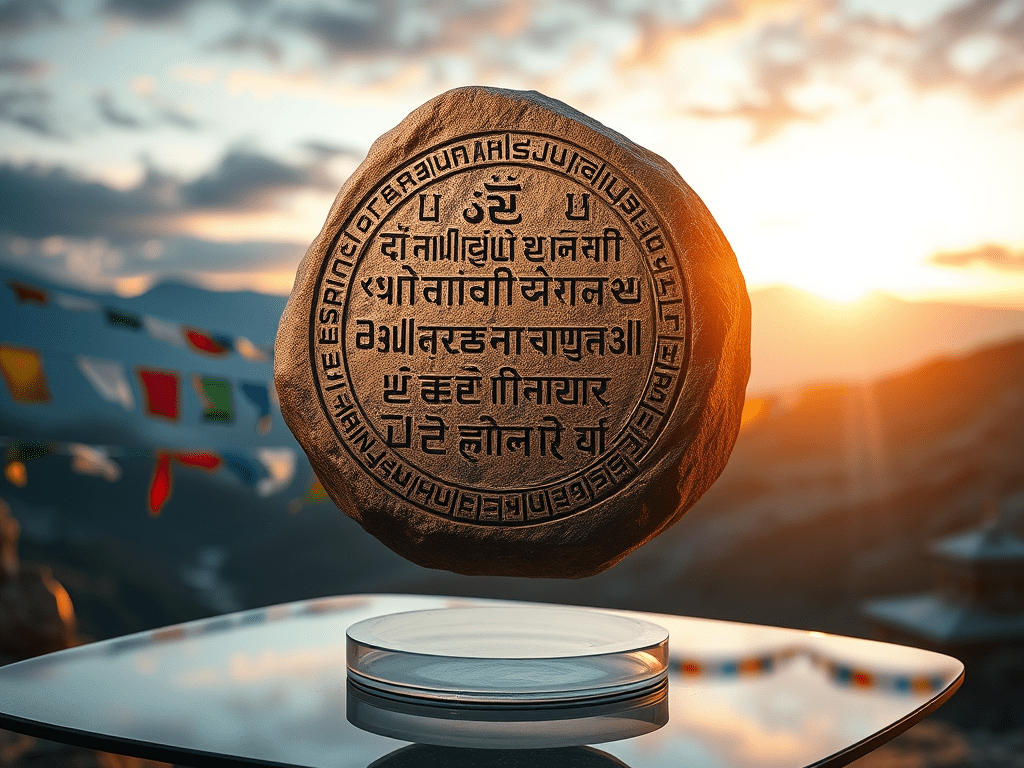
These lamas said that esoteric dharma emphasizes states of realization. In Esoteric Buddhism schools, mani stones are usually used to evaluate practitioners’ levels of realization. There are two types of mani stones.
The first type is stones that are inscribed with mantras by ordinary people and placed in mani stone mounds. This type of mani stone does not contain dharma power.
The second type is stones that are inscribed by great patriarchs from lineages of Tibetan Buddhism after practicing dharma. These stones are inscribed with images of Buddhas or seed syllables of mantras. They are placed in mani stone mounds to be used as empowerment to eliminate disasters and obstacles. The most important function of this type of mani stone with power is to test and measure levels of self-cultivation.
According to some accounts, only practitioners who have attained states of realization through self-cultivation are able to practice dharma that causes mani stones to move at a distance. Mani stones move in different ways: some move slowly, while others walk or fly. Ordinary people cannot make them move at all, no matter how much force they use or how many people recite mantras at the same time. These stories have added an element of mystery and significance to Tibetan esoteric dharma.
Recently, the reporter had the honor of attending a grand assembly in the United States where various states of realization were revealed. Attendees included great lamas and ordinary lamas from Tibet, as well as great dharma masters and ordinary dharma masters of Exoteric Buddhism.
The mantras recited included the Great Compassion Mantra, the Green Tara Heart Mantra, and the mantra of Vajrakila (Dorje Phurba). Some dharma masters were unable to cause the mani stone to move even after a prolonged period of practicing dharma. Several Exoteric Buddhist dharma masters recited mantras in unison and, across space, caused a 150-gram mani stone on a glass table to move. A great dharma master and a female lama were able to make a mani stone at a distance move as soon as they chanted mantras combined with mudras.
While the attendees marveled at these sights, a great female lama from Tibet arrived. Before the testing, she requested that the person videotaping not capture her face. She said that she was a self-cultivator who wished to attain liberation and realization, and that she did not intend to manifest Buddha-dharma to show off her powers. Soon after, something stunning happened.
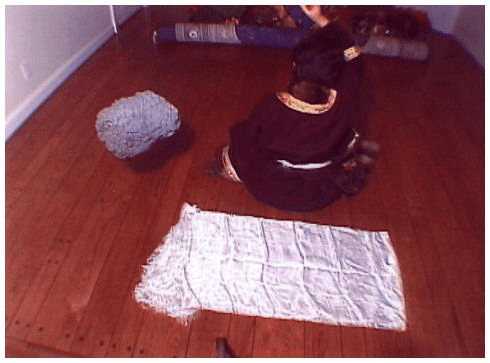
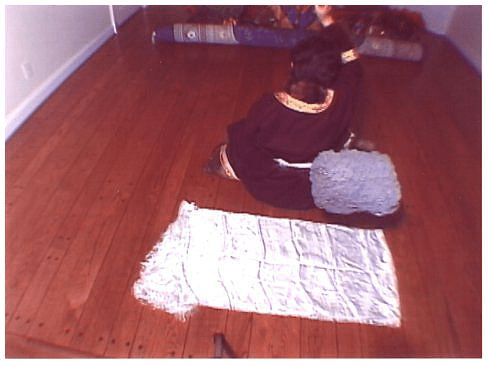
As soon as she recited mantras, a ninety-eight-pound stalactite stone surprisingly rose from the ground and circulated in the air following her hand gestures. This mani stone with supernatural powers stopped and trembled after rising into the air.
What was even more astonishing was that when the female lama sat on the wooden floor, the mani stone moved from behind her to the front in a split second. Witnesses felt that the ninety-eight-pound mani stone had moved in the blink of an eye, at such speed that it seemed to pass through her body.
Then the mani stone circled the great female lama twice, following her finger gestures. It moved up and down while trembling as it circled. When the mani stone moved to her back the second time, her index finger—forming a mudra above her head—pointed downward, and the stone immediately descended. Following the direction of her fingers, it paused briefly and then dropped onto the wooden floor with a heavy thump. The weight of the stone was evident, and it would be difficult to imagine such a scene without witnessing it firsthand.
The most famous gigantic stalactite mani stone, Duo Qie Xu from Tibet, was also included in the assembly. It weighs approximately 430 pounds, equivalent to about 200 kilograms, and was shipped from Tibet to the United States. It revealed great supernatural powers during the assembly.
The gigantic mani stone Duo Qie Xu is not an ordinary stone. It is a mani stone with a distinct identity, similar to the famous Cuiyu Cabbage (a renowned jade carving from the Qing Dynasty displayed at the National Palace Museum in Taipei). Most Tibetan Buddhist practitioners are familiar with Duo Qie Xu. During the testing involving Duo Qie Xu, even more incredible phenomena occurred.
When the great Tibetan female lama was about to test her powers on Duo Qie Xu, she again requested that her face not be captured on camera, for the same reasons as before. The video recordings were intended solely as keepsakes for those present and were not to be used for any form of promotion. Her strict adherence to the precepts deeply moved those in attendance.
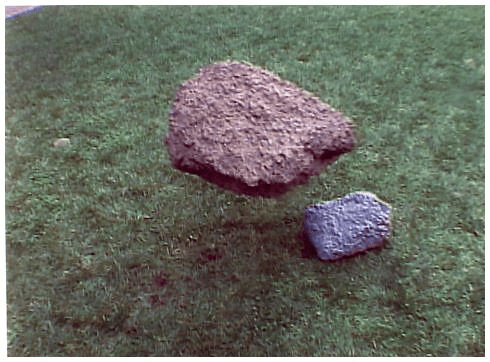
Then something extraordinary happened. The 430-pound Duo Qie Xu followed the hand gestures of the great Tibetan female lama, trembling as it rose from the lawn and flew into the air. The crowd was awestruck and suddenly felt the lawn move like ocean waves. Rooftops and trees also appeared to move simultaneously.
The mani stone flying in the air then returned and suddenly fell from a height of three feet above the ground, making a large dent in the lawn. Such an occurrence—normally found only in fiction—unfolded in real life. The lamas and dharma masters present stated that this holy feat demonstrated the magnificence and authenticity of Buddha-dharma, through which all things can be accomplished, including the transformation of mountains and oceans.
At the Exposing Buddha Statues to the Sun Dharma Assembly held at Chiang Kai-shek Memorial Hall in Taipei on January 13, 2002, there was a mound of stones inscribed with mantras from Lapuleng Temple in Gansu. It was a Mani Stone Mound consisting of mani stones.
Buddhism appears to be very dominant in some countries in Southeast Asia. However, many Buddhists there always regard “Arhat” as the highest status of accomplishment in Buddhism. To them, Bodhisattvas who are often mentioned in Mahayana sutras such as Manjushri Bodhisattva and Kuan Yin Bodhisattva are simply not comparable to Arhats. That is why during the past thousands of years Mahayana Buddhism has never been able to propagate and spread widely in those regions. Of course, such a situation is due to karmic conditions of the living beings.
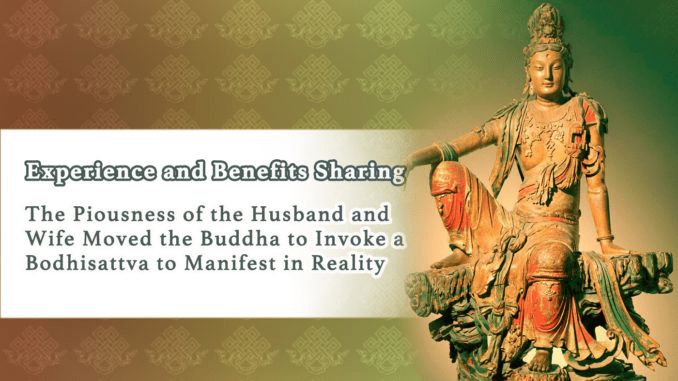
I am going to talk about a couple living in Thailand with family roots there for generations. The husband’s last name is Deng and the wife’s last name is Wang. Due to their hard working, honesty, and leading a plain and simple family life, they have long become well-known people with prominent fame in the business circle in Thailand. Meanwhile, they respectfully worship the Three Jewels, support the sangha, and engage in charities. Therefore, they are also praised by everyone as great and kind benefactors in the community. Though they possess deep root of kindness, due to the influence from some deviated views in the tradition of the Lessor Vehicle, they were unable to elevate their level of cultivation to enter deeply into the essence of the dharma principles contained in Mahayana. It was only until one day in 2004 when the karmic condition of their good fortune became mature. On that day, they were introduced by their friend to an opportunity of listening respectfully to the recorded dharma discourses expounded by H.H. Dorje Chang Buddha III. Only at that time, did they greatly awaken to the fact that true Buddha-dharma is so extensive, broad, precious, and profound.
The dharma expounded by H.H. Dorje Chang Buddha III is perfect and unimpeded, presenting the wonderful truth of true-suchness openly and widely. Mr. and Mrs. Deng admired wholeheartedly. They also deeply realized that the innumerable eminent monks and great virtuous ones that they had visited and consulted before in Thailand and Burma were so tiny, low, and insignificant with their shortcomings easily seen in comparison to H.H. Dorje Chang Buddha III. Though he was very busy in his business undertaking, Mr. Deng still flew across the Pacific Ocean often to beseech teachings from H.H. Dorje Chang Buddha III and spared no effort in the actions of propagating and spreading the true dharma of the Tathagata. However, deep in the couples’ mind through so many years, there was always an untied knot which was, “Are there really Bodhisattvas?”
One day, the couples finally summed up their courage and begged H.H. Dorje Chang Buddha III while kneeling on the ground, “Great Buddha Master, are there really Bodhisattvas? Can we ask for seeing Bodhisattvas?”
H.H. Dorje Chang Buddha III said expressionlessly, “When the karmic condition is mature, I will satisfy your wish.”
Time elapsed day by day. Long after that, they figured that H.H. Dorje Chang Buddha III had forgotten what they had asked for long ago and thus dared not mention it again. Furthermore, what if Bodhisattvas did not come even when invited?
Later, they had a chat with several fellow brothers who are rinpoches one day. Only then did they learn that the house that H.H. Dorje Chang Buddha III was living in was badly out of repair. Even the office space was just a small space next to a restroom and narrow stairs. Furthermore, the office desk was actually a very small table! They were greatly astounded after hearing the brothers’ descriptions! What was even more implausible to them was the fact that H.H. Dorje Chang Buddha III worked with His own hands to create artworks, not only to make the living but also help His disciples with their resources of cultivation as well as contribute to disaster relief efforts and benefit people.
The couples were deeply moved. They immediately made a decision to present a stock holding valued at 2.5 million US dollars as an offering to H.H. Dorje Chang Buddha III. However, H.H. Dorje Chang Buddha III said, “I have already said that I will only benefit living beings and will not accept any offerings. Therefore, I will not accept your offering.”
Although they begged very hard and repeatedly, H.H. Dorje Chang Buddha III was not persuaded at all and firmly refused to accept even a penny from that offering. Without any other choice, they could only transfer that stock holding entirely to the World Buddhism Association Headquarters.
H.H. Dorje Chang Buddha III was to determine their karmic conditions. Observing their piousness toward their Master, diligent cultivation and practice, and selflessly benefiting living beings, they truly have established undeniable merit of Bodhi. Therefore, His Holiness the Buddha decided to fulfill the wish they had for many years.
On the magnificent and auspicious day when His Holiness the Buddha was going to transmit the inner-tantric initiation, Laypersons Mr. and Mrs. Deng came to the open-air mandala at the holy site. The sky was completely clear without any cloud on that day. With beautiful green lawn, breeze blowing from time to time, singing and winging of bees and birds in the background, varieties of flowers contesting for beauty, and charming and attractive branches and shoots in the trees, the whole court was covered with splendid colors in addition to jade green.
Sitting on the Vajra dharma throne, H.H. Dorje Chang Buddha III said to the human and non-human disciples in the mandala, “I practice the dharma this time to invite and invoke a Bodhisattva for these two laypersons with their last names being Deng and Wang respectively. I do not have confidence! If it accidentally turns out to be successful, that would be due to the merit of Disciple Deng and Disciple Wang. However, you must absolutely pray and beseech with the most pious heart.”
Shortly after the discourse, H.H. Dorje Chang Buddha III immediately practiced the dharma. In less than 20 minutes, suddenly a beam of golden light flashed in the sky above. Next, countless light rays were emitted. A Vajra Bodhisattva with a height of about 16 feet suddenly appeared. The Bodhisattva was adorned with pearls necklace and looked extremely solemn and majestic, stepping on a lotus flower shape auspicious clouds of rainbow colors. In a few strides, the Bodhisattva descended into the mandala, standing in front of Mr. Deng and Mrs. Wang with a smile.
While they two were still stunned and astounded, the Bodhisattva took out the holy substance to empower them. With a finger snap, a five-colored light ray flew into the mouth of each of them. The taste was utmost delicious without comparison. They both felt relaxed and uninhibited throughout the body. An auspicious state manifested over the entire mandala at the holy site. Only then did the Vajra Bodhisattva merge into the brightness in the sky and disappear.
While everyone was still deeply enjoying the dharma joy and calming lightness occurring just moments ago, Mr. and Mrs. Deng excitedly described the personal feelings and experience that just happened to them, with hand gestures as they spoke. They two were extremely moved and bowed repeatedly to H.H. Dorje Chang Buddha III.
They saw a Bodhisattva! They truly saw a real Bodhisattva descending before them to meet with them! This is not a dream state and much less an illusory image. Though several years have passed, what really made us awaken is: Then, who is the Master who is living right before us and whom we follow closely to learn from? Good heavens! Have you forgotten? He is the supreme teacher of Bodhisattvas and Mahasattvas in the ten directions and even of all Buddhas! He is really the genuine incarnation of the holiest ancient Buddha in the dharma realm – Dorje Chang Buddha!
How fortunate living beings in the current dharma-ending era are to be able to meet this opportunity of H.H.Dorje Chang Buddha III descending to this earthly world. This is the great matter indicating the maturing of good fortune stemming from the karmic conditions since the beginning-less time. I sincerely, wholeheartedly, and eagerly hope that sentient beings in the six realms of the three spheres can all hear the dharma expounded by H.H. Dorje Chang Buddha III, to attain in the current lifetime perfect good fortune and wisdom, freedom from birth and death, holy status of liberation, and realization of great enlightenment!
There are moments in life when, despite our best intentions and most sincere efforts, things still feel profoundly unfair. Right and wrong seem reversed. The ground beneath us shifts, and our inner balance begins to tilt toward chaos. In those moments, our first instinct is often to react—to defend, to argue, to strike back.
Before you do, pause.
Take a breath. Return to your body. Listen to what is happening beneath the noise.
When we step into conflict fueled by “righteous anger,” wounded pride, or a desire for revenge, we rarely restore balance. More often, we simply exchange one form of turmoil for another. Peace quietly slips away.
Holding onto resentment or remaining lodged in the role of the victim keeps us circling the same pain, replaying the same arguments, long after the moment has passed. Whether we choose to walk away with a clear conscience or feel called to stand up for what feels just, one truth remains: every action—and every silence—creates ripples. They shape who we are becoming and touch the lives of those around us.
At first glance, the phrase Peaceful Warrior seems contradictory. Yet a life rooted in peace and integrity demands precisely this paradox.
To be peaceful does not mean to be passive. To be a warrior does not mean to be aggressive.
True strength lies in seeing beyond illusion and surface drama. It lies in choosing awareness over reflex, clarity over emotional momentum. A Peaceful Warrior does not drift from one reaction to the next; they choose their response with care.
Such a warrior knows how to step back and observe themselves in the heat of the moment. They are capable of decisive action, but their actions are guided by wisdom and oriented toward the greater good. Only genuine courage allows us to respond from the heart, rather than from outdated conditioning and habitual fear.
The next time you find yourself facing opposition, remember this: you can remain present. You can maintain your inner edge without surrendering to fear or hostility. You can stand firmly without hardening your heart.
You can be a Peaceful Warrior.
When life confronts us with injustice, it becomes a quiet test of our spiritual maturity. These reflections may help illuminate the path:
1. Discern Reaction from Response A reaction is automatic—rooted in survival, memory, and past wounds. A response is conscious, grounded in the present moment. When you feel that surge of heat in your chest, pause and ask: Is this my deeper wisdom speaking, or is it my ego defending its image?
2. Release Attachment to Outcomes The Bhagavad Gita teaches action without attachment to results. Spiritually, this means doing what is right not for victory or validation, but because it aligns with truth. When the need to “win” dissolves, a quieter, more enduring power emerges—one that cannot be taken from you.
3. Receive the Mirror Those who unsettle us most often reveal where we are still tender or unhealed. This does not excuse harmful behavior, but it offers insight. Let the discomfort become a question: What within me is asking for strength, clarity, or compassion?
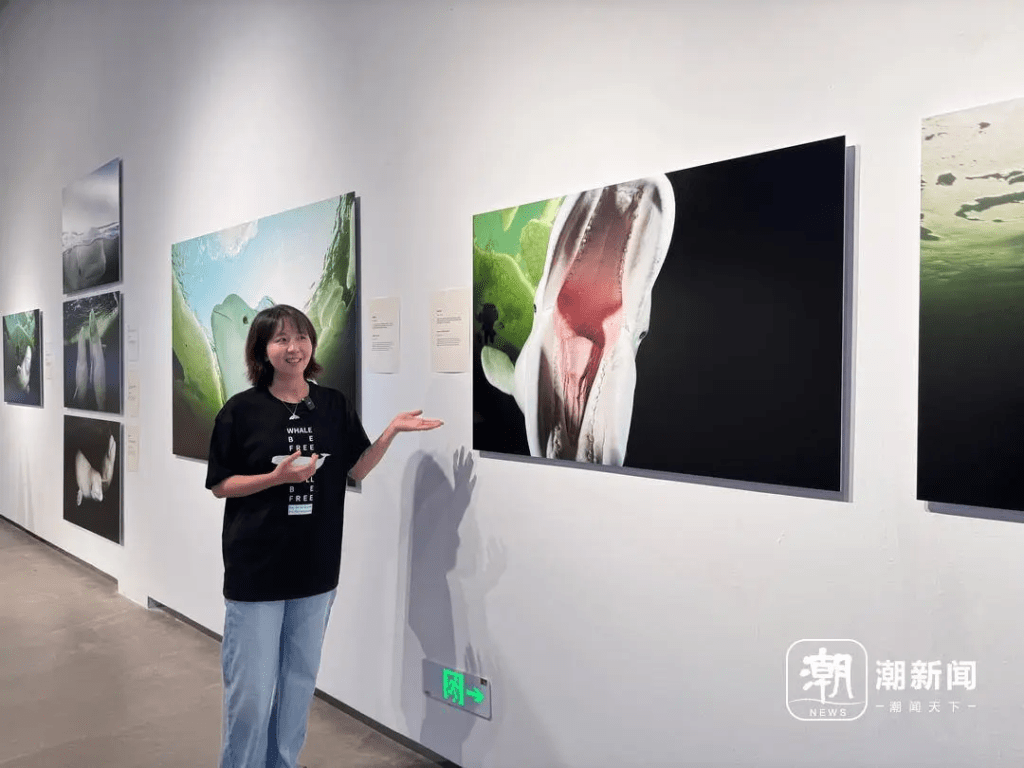
Standing before the massive screen at the exhibition, I raised my arm and waved upward.
On the screen, a white whale responded instantly—leaping out of the water. Its enormous body traced a graceful arc through the air before crashing back down, sending waves of spray in every direction.
At the recently concluded art exhibition in Shenzhen, Whale Room: A Blue Dream Confined, nearly every visitor briefly stepped into the role of a “whale trainer” through multimedia interaction.
What We Call Beauty May Be Their Burden
In the wild, white whales rarely leap repeatedly out of the water. Their heavy bodies are not meant for frequent, high jumps.
What humans describe as “graceful” or “awe-inspiring” may, for them, be exhausting, oppressive, even a cycle of repeated pain.
The exhibition’s founder, Shao Ran, once worked as a whale trainer for five years. She stood by the pool countless times, receiving applause and cheers.
This time, however, she chose to tear open the surface of the “blue dream.”
When the decorations are removed, steel and concrete are revealed beneath. No matter how vast an artificial pool may appear, to a whale, it is still an inescapable prison.
Their suffering is carefully packaged as entertainment.
When a Life Was Entrusted to a White Whale
What truly changed Shao Ran’s life was a moment of life and death beneath the water.
That day, she entered the pool to perform with a white whale named Sophie. Suddenly, Sophie lost control—clamping onto her foot and dragging her downward again and again.
Fear. Powerlessness. Suffocation. All magnified in that endless blue.
“The only thing I could do was wait,” she later said. “To gamble on her kindness.”
She did not escape—not out of bravery, but because for the first time, she fully understood:
In the water, she was no longer the one in control. She was utterly vulnerable.
She looked into Sophie’s eyes. No commands. No intimidation. Only one thought remained:
I want to live.
In the end, Sophie stopped. She slowly swam closer, lifted Shao Ran’s foot with her mouth, and gently pushed her back to shore.
In that moment, Shao Ran understood what compassion truly means.
Not weakness— but the choice not to harm, even within extreme injustice and oppression.
Who, Then, Is Truly Being Tamed?
Sophie was not the only one who resisted.
Another dolphin, Huahua, after enduring prolonged loneliness and stress, eventually chose to stop breathing.
That day, as Shao Ran sat beside Huahua’s body, she could no longer persuade herself with words like “work,” “regulations,” or “procedure.”
She began to see clearly:
So-called training does not only tame animals. It slowly tames the human heart as well.
When violence becomes institutionalized, when suffering is rationalized, when harm is renamed “normal work”—
Humans, like the captive animals, lose freedom and awareness.
There is a line in Buddhism: All beings suffer. Ignorance causes beings to harm one another.”
The Buddhist teaching of non-harming calls us to awaken from this very ignorance.
Walking the Path of Compassion in Another Way
Shao Ran left the marine park.
She no longer stands beside a pool, but walks into schools, bookstores, and quiet corners of the city, telling stories about animals.
No stage. No applause. Sometimes, only a handful of listeners.
Still, she speaks.
She founded a nature protection community called “Ran Ai Tong Sheng” (“All Beings, One Compassion”).
“Ran” is not her name. It means following what is natural— respecting the original state of all beings.
The image of that white whale pushing her gently back to shore has stayed with me ever since.
After long confinement and deprivation, it did not choose destruction— it chose kindness.
Buddhism teaches us:
Compassion is not a result—it is a direction.
If we consider ourselves more intelligent, more civilized, more faithful—
Then perhaps we should also learn:
Not to build our joy upon the suffering of others. Not to hide harm behind habit. Not to allow violence through silence.
Buddhist compassion is not mere sympathy. It is a lucid responsibility.
May we, toward every life, give rise to respect, and cultivate a heart of non-harming.
When non-harming becomes a choice, when compassion becomes action, only then can this world truly move toward freedom.


















 Peace LiLy