When I was a child, I heard a folk story that has stayed with me ever since.
One day, King Yama summoned two little spirits and said to them:
“I will let you be reborn as humans. One of you will be someone who always has things to give to others. The other will be someone who often receives things from others. It’s up to you—choose the kind of person you wish to become.”
As soon as Ghost A heard this, he dropped to his knees, clasped his hands, and pleaded earnestly:
“Your Majesty Yama! I beg you—please let me be the one who can receive things from others!”
Ghost B stood quietly for a moment, thinking it over. Finally, he said:
“Since my companion wishes to be the one who receives, I will choose to be the one who gives to others.”
King Yama struck his desk with a resounding clap and pronounced his judgment:
“I decree that Ghost A will be reborn as a beggar, so he may always ask others for help. Ghost B will be reborn into a wealthy family, so he may frequently give and support those in need.”
The two little spirits were stunned into silence.
This story reveals a truth many people overlook: in our world, most would rather take from others, believing that giving is a kind of loss. Yet the modern Buddhist master, Master Hongyi, once said:
“I don’t know exactly what makes a noble person, but I believe someone who is willing to suffer a loss in all things surely is one. I don’t know exactly what makes a petty person, but someone who always seeks an advantage must be one.”
In reality, a person with a grateful heart who is willing to share joy with others will discover even greater joy—because they can find happiness in the happiness of others.
The spirit of Buddhism elevates the practice of giving and receiving to its highest form. H.H. Dorje Chang Buddha III made this profound vow:
“All karmic offenses and sins created by sentient beings, I will bear. All the virtuous deeds and merits I have cultivated, I will give entirely to you.”
H.H. Dorje Chang Buddha III wishes to give all good things to sentient beings and to take upon Himself all their suffering and negativity.
Everything He thinks in His mind, speaks with His mouth, and does with His body is dedicated to one purpose: eradicating selfish attachment, relieving the suffering of all beings, bringing them happiness, and increasing their blessings and wisdom.
May our world be filled with kindness and peace. May all beings everywhere be safe, auspicious, and free from suffering.
The Buddha once taught at the Jeta Grove in Anathapindika’s Park in the kingdom of Shravasti. At that time, there lived a wealthy elder whose fortune was immeasurable. He had five intelligent daughters but no sons. Upon his passing, the law dictated that if no male heir existed, the family estate would be seized by the state. However, the elder’s wife was pregnant. His daughters humbly petitioned the king to delay the confiscation until the child was born.
Not long after, a baby boy was born. Yet to everyone’s shock, the child was severely deformed—he had no eyes, ears, tongue, hands, or feet, only male genitals. Despite this, the king acknowledged him as the rightful heir, saving the family’s wealth. The boy was named Mantuipili.
Puzzled by this karmic outcome, an elder approached the Buddha and asked, “Why would a child be born into such wealth, yet with such tragic physical deformities?”
The Buddha then revealed a powerful story from a distant past:
In a previous life, there were two noble brothers: Dhanavasita, the elder, and Shilavasita, the younger. Dhanavasita was known for his honesty and generosity from a young age. He gave freely to the poor and upheld moral integrity. Because of his character, the king appointed him as a judge, and people trusted his word above all else. At that time, written debt contracts were unnecessary—a judge’s witness sufficed.
One day, a merchant preparing for a sea voyage borrowed a large sum from Shilavasita. Bringing his young son and the money, Shilavasita went to Dhanavasita and asked, “Brother, this merchant has borrowed money. Please bear witness. If anything happens to me, ensure my son receives what is owed.”
Dhanavasita agreed. Soon after, Shilavasita passed away. The merchant’s ship was wrecked in a storm, and he barely survived, returning empty-handed. Out of compassion, Shilavasita’s son decided not to demand repayment while the merchant was destitute.
Years later, the merchant sailed again and returned wealthy. Believing the boy had forgotten or was too kind to collect the debt, the merchant decided to test him. He paraded into the city riding a jeweled horse, dressed in luxurious robes. Seeing this, the boy sent someone to request the repayment.
The merchant, seeking to avoid repayment, schemed to silence the judge. He offered a precious gem worth 100,000 silver coins to Dhanavasita’s wife, asking her to persuade the judge not to testify. She warned, “My husband is a man of virtue, but I’ll try.”
That evening, she told the judge. Dhanavasita was unwavering: “I was made a judge because of my honesty. I cannot speak even a single false word.” She returned the gem.
The merchant returned with a gem worth 200,000 silver coins, and the wife—overcome by greed—accepted. That night, she again tried to persuade her husband. He refused once more, saying, “If I lie, I will lose all honor in this life and suffer in future lives.”
In desperation, the wife threatened, “If you don’t comply, I’ll kill our child and take my own life!” Dhanavasita was heartbroken. He agonized: “If I refuse, I lose my child. If I agree, I lose my integrity and invite endless suffering.”
Overwhelmed, he gave in.
The merchant, emboldened, paraded through the streets again—this time on a jewel-adorned elephant. The boy approached him: “It’s time to repay the debt.”
Feigning confusion, the merchant said, “What debt? Who witnessed this?” The boy replied, “My father and I gave you the money, and my uncle, the judge, was the witness.” The two went before the judge. The boy recounted the event. To his shock, the judge responded, “I know nothing of this matter.” The boy cried out, “Uncle! You saw it with your own eyes and agreed to witness it. How can you deny this?” The judge replied coldly, “That never happened.”
In deep pain, the boy exclaimed, “You were trusted for your integrity and chosen to judge others. If you betray your own nephew, how many others have suffered injustice? The truth will be known in time.”
The Buddha then turned to the elder and said: “Do you know who that judge was? He is now the deformed child, Mantuipili. Because he uttered just one false word, he fell into the great hell realms and endured tremendous suffering. For five hundred lifetimes, he was born with severe deformities. Yet due to his past acts of generosity, he continued to be born into wealthy families.
This is the law of karma. Good and evil never cancel each other out—each brings its own result, no matter how long it takes.
Therefore, practice diligently. Guard your body, speech, and mind. Never create evil karma lightly.”
This profound tale offers a timeless lesson. A single dishonest act can result in unimaginable suffering, even over lifetimes. On the other hand, a heart inclined toward generosity continues to yield blessings, regardless of outer form.
Buddhism teaches us to live with integrity, mindfulness, and compassion—not only for the peace of this life, but for the well-being of lives to come.
When you grow up in a house where voices are always raised and love comes with conditions, where apologies never come and mistakes are blamed on you, it’s hard to understand what gentleness even means. I didn’t grow up with soft words or warm hugs. No one told me it was okay to make mistakes, or that I was still loved even when I failed. What I learned was to keep quiet, to survive, to toughen up.
I protected myself by building walls, not by opening up. I kept my emotions inside because showing them only led to being hurt or ignored. I became harsh with myself because that’s how others treated me. I thought strength meant being cold. I thought love had to hurt. I thought being kind to myself was weakness.
But somewhere inside, a quiet voice kept whispering “maybe there’s another way.”
It took years of breaking down and rebuilding myself. It took crying in silence and slowly learning how to listen to what my heart really needed. It meant letting go of old beliefs, painful habits, and the voices in my head telling me I wasn’t good enough.
I had to teach myself how to speak gently not just to others, but to myself.
I had to unlearn the idea that I deserved pain. I had to remind myself, again and again, that softness isn’t weakness. That it’s okay to be tender with a heart that’s been hurt too many times.
Gentleness became a daily choice—on angry days, broken days, on the days when the world told me to toughen up and stop caring.
I’ve learned that gentleness isn’t about pretending things don’t hurt. It’s about holding pain with care. It’s about choosing peace when your past only taught you chaos. It’s showing up with kindness, even when life hasn’t been kind to you.
Now I am gentle but it took everything — every scar, every sleepless night, every painful memory, every lonely moment. I lost myself. Then I found myself again.
So when others call me calm, kind, or soft, they don’t see the storms I survived. They don’t hear the silent nights or feel the weight I carried.
And that’s okay. I didn’t become gentle for others to understand me. I did it so I could breathe. So I could find peace. So I could love others the way I wish someone had loved me. Most of all, so I could finally love myself.
Nestled in the heart of Xinjiang, the Turpan Basin holds several extraordinary records: it’s the lowest geographical point in China, and during summer, it’s the hottest place in the country. With scorching sunlight, relentless winds, and almost no rainfall, Turpan earns its title as the “Land of Fire.”
In the peak of summer, the surface temperature in the surrounding Gobi Desert can soar to 82.3°C (180.1°F), while the air temperature often exceeds 49°C (120°F). Rain is almost nonexistent—Turpan receives an average of just 16.4 mm of rainfall annually, and in some years, as little as 4.3 mm. Yet, amidst this harsh, parched environment, an ancient miracle has quietly sustained life for over two thousand years: the Karez irrigation system.
A Miracle Beneath the Earth
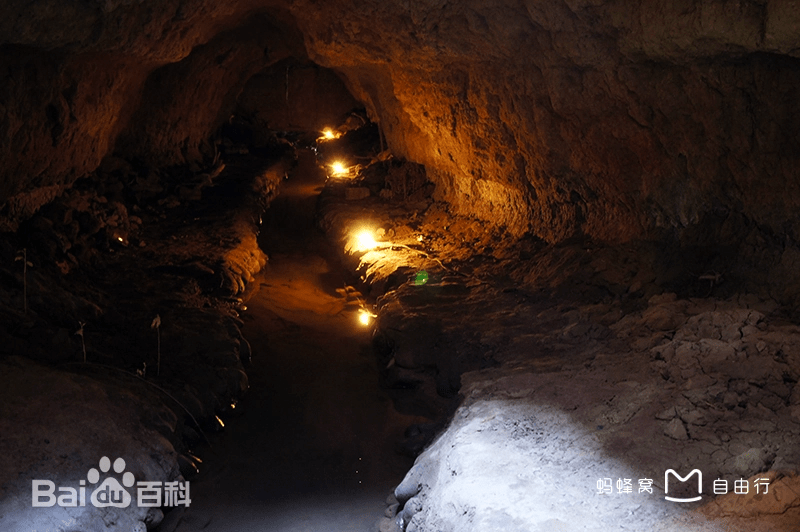
While nature was unforgiving above ground, it hid a gift below. Meltwater from the distant Tianshan Mountains seeps underground through coarse gravel and sand, eventually blocked by the Flaming Mountains and surfacing as springs. Ingenious local people found a way to capture and guide this underground treasure—thus, the Karez was born.
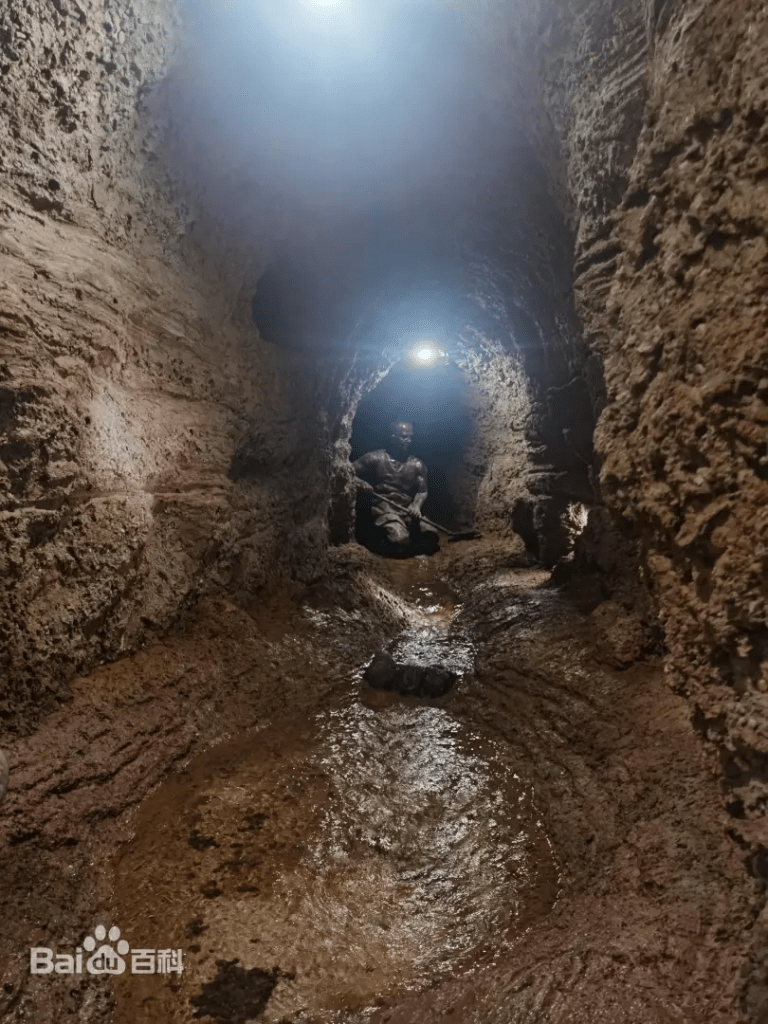
The Karez system channels water from mountain sources through a network of underground tunnels and vertical shafts, delivering it to the arid land without evaporation loss. Remarkably, this ancient system operates entirely without pumps, relying solely on gravity and terrain.
A complete Karez includes:
Vertical shafts for ventilation and maintenance
Underground tunnels to carry water
Open canals to distribute it
Storage ponds to hold it
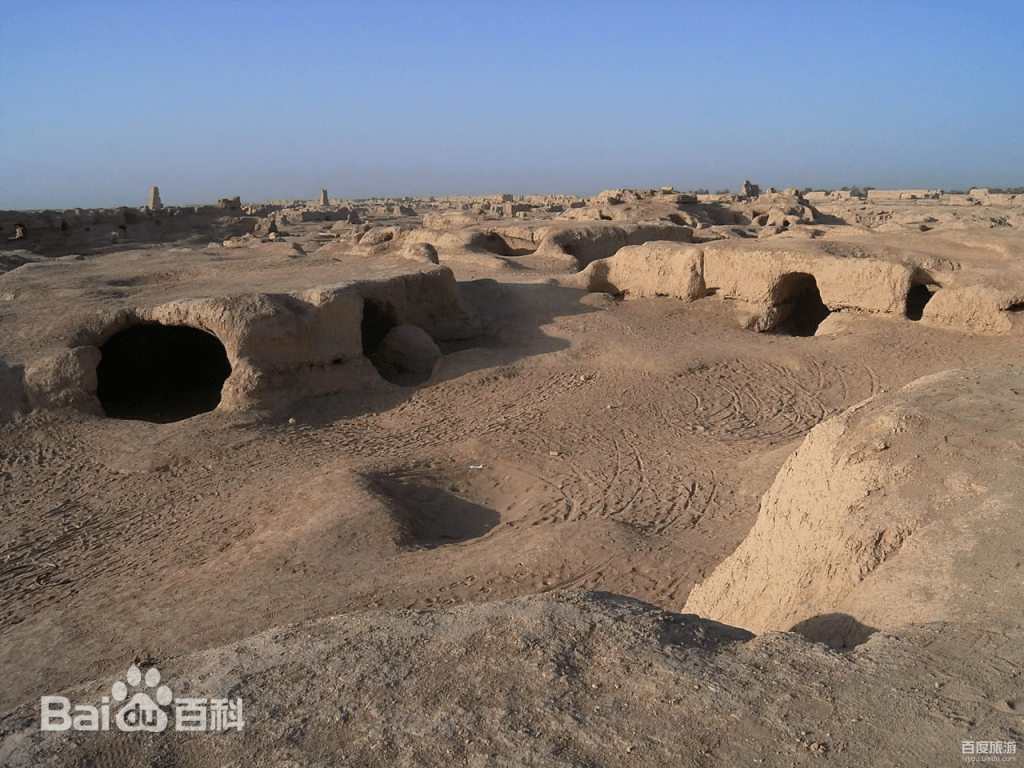
Across Turpan’s landscape, you can still see long rows of small mounds—each one marking a shaft, a glimpse into the remarkable infrastructure below.
A Testament to Ingenuity and Endurance
The origins of the Karez can be traced back to the Han Dynasty, over 2,000 years ago. Most of the surviving systems were built during the Qing Dynasty, including during historical moments like Lin Zexu’s fourth inspection of Turpan, when over 300 new Karez channels were added, and Zuo Zongtang’s campaigns, which saw nearly 200 more constructed.
At its peak in the 1950s, there were about 1,700 Karez systems in Turpan, stretching over 3,000 kilometers. Today, about 725 remain, a number slowly dwindling due to modernization, drought, and human impact.
The construction of each Karez was no small feat. Generations of laborers worked in dark, narrow tunnels, often barefoot in icy water, chiseling stone with simple tools and oil lamps. They carried earth and rock out by hand, surviving on dry flatbread and enduring brutal conditions.
A Culture of Water, Wisdom, and Survival
More than just a hydraulic system, the Karez represents a culture—a story of human resilience, harmony with nature, and intergenerational wisdom. In this water-scarce land, the Karez has nurtured lush vineyards, fertile fields, and diverse communities, offering life where none should thrive.
Today, many of these systems are dry or abandoned, relics of a past shaped by necessity and brilliance. But for those who walk among them, they are still very much alive—whispers from the earth, reminding us of what is possible when people respect and work with nature.
If you ever find yourself in Turpan, do not miss the chance to explore the Karez wells. They are more than ancient engineering marvels—they are monuments of perseverance, and living echoes of a civilization that made the desert bloom.
I’ve always enjoyed exploring new recipes, especially when they’re healthy, simple to prepare, and vegetarian. There’s something deeply satisfying about discovering fresh flavors that not only nourish the body but also bring joy to my family and friends.
Recently, I came across a collection of easy and wholesome recipes on Zhaxi Zhuoma’s website. These dishes are perfect for early summer—light, refreshing, and full of natural goodness. I’m excited to share a few of my favorites with you here. I hope they inspire you to enjoy healthy cooking as much as I do!
Tofu with Gochujang Sauce
I fell in love with gochujang and when I bought my first tub from Amazon, I tried it on everything—ok, I didn’t put it on ice cream, but I considered it. It is complex and good enough to just use by itself with a little oil or butter, maybe cut with miso or doenjang (Korean soybean paste) if it is too spicy. Different varieties vary in sweetness and heat, so go easy with it until you get the Goldilock spot for you. I use gochujang paste which keeps forever and is more concentrated. Sometimes it is sold as a sauce and comes with other ingredients like vinegar and sugar added. It is cheaper and can be used, but adjust the other ingredients you add accordingly.
The following is a wish list—use what you have on hand. I rarely have all the ingredients when I feel an urge for Korean flavors. You can use the sauce alone, too—without the tofu or with beans, chicken breasts, shrimp, hamburger, etc. There are some other options to consider.
GOCHUJANG SAUCE
1/4 cup soy sauce
1-2 tbsp gochujang (may be part Korean doenjang or Japanese miso)
1 tsp-2 tbsp maple syrup, brown sugar, honey, monk’s fruit, molasses
1 tbsp avocado or olive oil
1/2 tsp sesame oil
1 clove of garlic, minced or grated
1 inch ginger, minced or chopped
Lime juice & zest or rice vinegar to taste
1/2 tsp black pepper
Toasted sesame seeds sprinkled in
1-2 scallion chopped, white parts may be sauteed first
TOFU
1 tub firm tofu
Neutral oil for sauteing
TOPPINGS: Green scallions, Sesame seeds, Diced seeded tomatoes, Diced bell peppers, Diced Chili peppers, raw or canned or pickled, Grated cheese, Greek yogurt-whole milk best, Sour cream, Diced Avocados, Fresh raw corn cut off cob, Shredded crisp lettuce or other greens, Finely chopped parsley or cilantro leaves, Finely chopped nuts-walnuts, peanuts, cashews, Fried or poached egg, Baby Shrimp (non-vegetarian), Red onion pickle, etc.
SAUCE OPTIONS: If you can’t find gochujang, ketchup or tomato paste and chili powder is an option, but no substitute; Coconut milk; Fish sauce (non-vegetarian); Anchovies (non-vegetarian); Kimchi (often non-vegetarian); Grated apple or pear for sweetener; Chickpeas or beans.
Directions:
If you want to use grated cheese as a topping, and I do recommend it, try grating it from a brick and avoid the prepackaged grated cheese. I finally understood why—too often the commercial gratings are dusted with something to preserve shelf-life and they do not melt correctly.
TOFU-CRUMBLED or CUBED: If you use crumbled tofu, it is best to leave in tub in freezer overnight or longer. The ice crystals that form when frozen -thaw- and extract the water from within the tofu. You can squeeze the tofu like a sponge and it will expel the majority of the water. It then is very able to absorb whatever sauce you put on it. If you don’t have time to freeze and thaw it, you can still dry or press tofu to remove as much water as possible, then crumble unfrozen tofu with a fork or cut into bite-size cubes. Either way saute tofu until crispy in neutral oil and add sauce.
TOFU-AIRFRY: You may also cut tofu into slabs pressing out as much water as possible and then either just rub or spray slab with oil or first dip in starch/flour or Panko crumbs or egg or combination of these and then airfry at 400F for about 10 minutes on both sides or until golden.
Serve tofu with Gochujang Sauce on rice, noodles, polenta, or pasta with your choice of topping(s) or wrap a piece of tofu in lettuce leaves with topping(s) and eat like tiny tamales with your favorite dipping sauce.
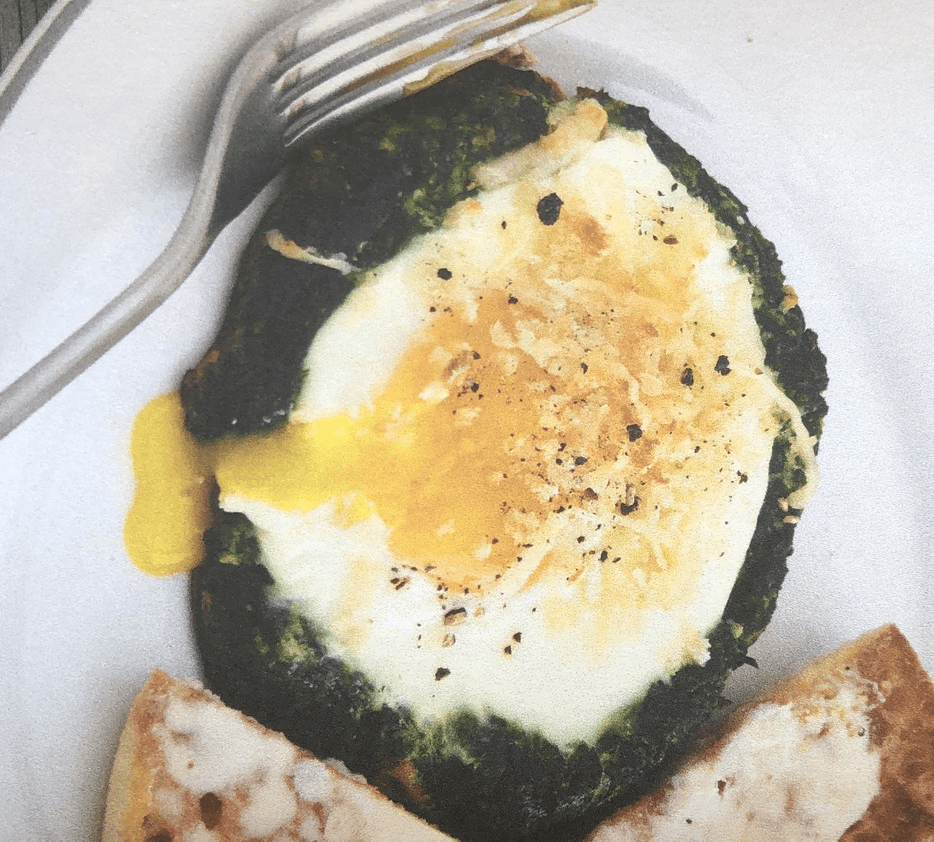
Eggs Florentine-Air Fryer or Oven
Eggs and spinach are always good together. This is just a contemporary version of a classic. I’m using my air fryer again as I am cooking in my cave instead of the temple kitchen. I do that when someone is doing a Solitary Retreat and needs the kitchen. I try to not have any contact with anyone on such a retreat, but I do sometimes forget, especially when the person doing the retreat is so quiet that I even forget they are also living here. Last week I heard someone shaking the screen door leading to the kitchen and I was sure it was our very pregnant Lucy Lentil trying to find a nest inside and I yelled. She had already ripped the screen and managed to get in before. I had forgotten to close the back door when I went to water the herbs and veggies. It was not Momma Lucy, but a very startled and thoughtful person trying her best to observe silence. Embarassed? Yes,very. Sorry.
Ingredients:
3 Cups Fresh or frozen spinach, thawed and drained,
1/4 Kosher salt,
1/2 Cup Ricotta cheese,
2 Tbsp Heavy cream or coconut cream,
2 Garlic cloves, minced (optional),
1/8 tsp Black pepper,
2 tsp Unsalted butter, melted,
3 Tbsp Grated parmesan cheese,
1/2 Cup Panko gluten-free crumbs,
4 Large eggs.
Directions:
Mix spinach, ricotta, cream, garlic (if used), salt & pepper. Also mix butter, cheese, and panko. Set aside. Scoop spinach mixture into individual serving circles on oiled air fryer basket or sheet pan. Set air fryer to AIR ROAST, set temperature to 375F degrees, and set time to 15 minutes select START/PAUSE to begin preheating. When preheated, slide basket or sheet pan into oven. After 8 minutes, press PAUSE and remove the pan. Make an indentation in each spinach serving, crack an egg into the indentation and sprinkle with panko mixture over the surface of the egg.
Return the pan to oven and push START to resume cooking. After 5 minutes, check eggs. Cook longer, if needed.
CONVENTIONAL OVEN: Set temperature at 400F degrees. May need to be cooked a few minutes more at each stage.
Chocolate Waffles
Ingredients
4 Eggs, whisked
1/3 Cup canned coconut milk
2 Tbsp maple syrup or raw honey (some kind of sweetener)
1 1/2 Cups almond meal/flour
2 Tbsp heaping unsweetened cocoa
1 tsp baking soda
1/4 Cup dark chocolate chips
1 tsp vanilla extract
Sprinkle of cinnamon
Pinch of salt
Toppings
Apple sauce, unsweetened creamy almond butter, Greek Yogurt coconut butter warmed to liquid state raw pecans chopped dark chocolate chopped blueberries
Directions:
Plug in waffle iron. Whisk eggs in a medium-large sized bowl. Add coconut milk and sweetener and whisk together with eggs. Next add almond flour and mix more! Then add cocoa powder, baking soda and mix together.
Lastly, add in your chocolate chips, vanilla, salt and cinnamon. Mix together thoroughly. Pour into waffle iron and cook until cooked through, about 4-5 minutes, until cooked through and crisped up.
4 Servings. I really liked them with the apple sauce toppings and Greek yogurt, but the more traditional maple syrup and butter are great, too. Enjoy!
Dharma Master Yongding was a direct disciple of H.H. Dorje Chang Buddha III, personally taught by His Holiness. A monk of true cultivation and realization, Dharma Master Yongding lived a life of noble deeds and profound spiritual accomplishments. He embodied the virtues of the ancient enlightened monks—pure in conduct, boundless in compassion, and unwavering in his commitment to benefiting all sentient beings.
Before becoming a monk, Dharma Master Yongding was known as Li Xiangchen, a kind-hearted and widely respected man from Dayi County in Sichuan Province. His compassion and moral character were already legendary even in his youth.
During a catastrophic drought, in Li Xiangchen‘s hometown, one the region hadn’t seen in a hundred years—Buddhist and Daoist masters prayed for rain for months, but to no avail. Not a single drop of water could be found.
Then, one night, two villagers had the same dream. A divine being told them that only with the signature of a man named Li Xiangchen could rain be summoned. The two searched everywhere and eventually found him. After they delivered his signed name to the altar and burned the paper, a torrential rain fell instantly, ending the long drought. The event left villagers in awe and firmly established Li Xiangchen’s reputation as a man of virtue and divine affinity.
During China’s devastating three-year famine in the 1960s, emergency food rations were being distributed. When officials asked Li how much his household needed, he replied that his family still had food and didn’t need any. His wife, stunned by this answer, brought the official to their home. There, they found only two catties (a little over two pounds) of rice left.
When asked why he had lied, Li quietly responded,
“So many people are starving. I just can’t bring myself to eat while others go hungry. I only feel at peace if everyone can survive this together.” His selflessness deeply moved everyone who heard his words.
In another act of compassion, while working at the Jin Dongzi Reservoir where laborers received rice rations, Li Xiangchen gave all his rice to his struggling friend Pei Yinchang, who was raising two young children. When Pei noticed that Li was growing increasingly frail, he begged him to keep some rice for himself. Li refused.
Pei later visited the reservoir to learn how Li was surviving. The workers there told him, “Mr. Li survives by digging wild roots and vegetables to make porridge. No one knows what happened to his rice.” Pei was stunned and moved to tears.
Later on, Li Xiangchen began studying Buddhism under a master. He observed the precepts with great discipline and practiced with a heart of sincerity and humility. His compassion became so palpable that even animals responded to it.
One day, while walking down a mountain, a vicious dog leapt at him. Calmly, he said:“Go ahead and bite me. This is a matter of karmic cause and effect.” As the dog neared, just two or three feet away, it suddenly stopped, yelped, tucked its tail, and ran away.
After becoming a Buddhist, Li Xiangchen adopted a vegetarian lifestyle. On one occasion, his master encouraged him to eat a little meat because he appeared thin and weak. But Li simply smiled and ate only plain rice.
When asked later why he didn’t follow his master’s advice, he replied:
“Please tell my master: First, I deeply respect Him, but I carry heavy karmic debts and dare not eat meat. Second, if gaining the Dharma and achieving liberation requires me to disregard the lives of sentient beings, then I would rather not attain liberation—I’d rather fall into hell. Third, I cannot harm others just to benefit myself. If I did, I would no longer be a true practitioner.”
His integrity and compassion deeply touched his master, who later transmitted to him the sacred practice of the Four-Armed Avalokiteshvara (Chenrezig). Through dedicated practice, he reached a level of spiritual realization said to rival the great Milarepa himself.
In 1990, when his karmic conditions ripened, Li Xiangchen became a disciple of Namo Dorje Chang Buddha III. His Holiness personally expounded to him the profound meaning of Prajna (transcendent wisdom). As a result, he awakened great wisdom and thoroughly realized the state of Prajna.
His attainments became unfathomably profound. He could connect with Buddhas and Bodhisattvas and had deep spiritual communion with heavenly realms.
When the Dayi County government began construction of the Master Yi Yungao (H.H. Dorje Chang Buddha III) Museum in 1994, Dharma Master Yongding consulted with the Heavenly Emperor about the upcoming three months of weather. Every day, he wrote forecasts in the worksite dining hall—and for three full months, not a single forecast was wrong.
On another occasion, with a mere wave of his hand, he split a tree trunk a kilometer away. The tree was so thick it would take two people to encircle it. Witnesses were astounded.
Dharma Master Yongding lived by the principle that the Dharma must be obtained through a pure and selfless heart, without the slightest trace of falsehood. He placed the interests of all living beings before his own and upheld the precepts with unwavering resolve.
He was a true practitioner of great compassion, an exemplar of moral discipline, and a living model for all Buddhist disciples. His life reminds us that genuine realization comes not from words, but from the way we live, love, and serve others.
The Enigma of Existence: Exploring Life After Death
The concept of life after death has intrigued humanity for centuries. Different cultures, philosophies, and religions have provided varying explanations, yet the mystery remains. Is there life after death, or does consciousness simply cease to exist when the body dies? In this article, we explore some of the most prominent beliefs and theories surrounding the enigma of existence after death, seeking to understand this profound question from multiple perspectives.
What Are the Most Common Beliefs About Life After Death?
Throughout history, many cultures and religions have proposed theories about life after death. Religious scholars suggest that the idea of an afterlife serves to give people comfort and meaning in the face of mortality. Christianity, Islam, Hinduism, and Buddhism all have distinct views on the afterlife, each offering unique insights into the question of what happens after death.
In Christianity, for example, life after death is often seen as either eternal life in heaven or eternal separation from God in hell. Researchers point out that many Christians believe that the soul lives on after the body dies, and that salvation or damnation is determined by one’s actions during their lifetime.
In Hinduism, the concept of reincarnation is central. According to this belief, the soul is reborn in a new body after death, and the circumstances of the new life are determined by the actions (karma) of the previous life. Philosophers argue that this cycle of death and rebirth is a form of spiritual evolution, with the ultimate goal being moksha, or liberation from the cycle of reincarnation.
Buddhism also supports the idea of reincarnation, but with an emphasis on achieving enlightenment to break free from the cycle of rebirth. Experts note that Buddhism teaches that attachment to the self is the source of suffering, and liberation occurs when one transcends the ego and achieves nirvana.
Scientific Views on Life After Death
From a scientific standpoint, the question of life after death is more complex. The majority of scientists assert that there is no empirical evidence to support the idea that consciousness survives after death. Neuroscientists argue that consciousness is a product of brain activity, and when the brain ceases to function, so does consciousness.
There are notable phenomena that have intrigued researchers. Medical professionals have documented instances of near-death experiences (NDEs), where individuals report vivid sensations, such as a sense of floating above their body, moving through a tunnel, or encountering deceased loved ones. While these experiences are often interpreted by some as evidence of life after death, psychologists suggest that they may be explained by the brain’s reaction to trauma, oxygen deprivation, or the release of chemicals like DMT.
While science cannot definitively answer the question of what happens after death, these experiences have raised questions about the nature of consciousness and whether it is entirely tied to the brain. The debate continues, and more research is needed to explore the mysteries of the human mind.
Near-Death Experiences: Are They Evidence of Life After Death?
Near-death experiences (NDEs) have become a focal point in discussions about life after death. People who have experienced NDEs often describe sensations of peace, floating outside their body, or meeting beings of light. Some researchers hypothesize that these experiences are the result of a brain in distress, attempting to make sense of its impending shutdown.
Many individuals who have experienced NDEs report feeling profound transformations in their lives afterward, including a greater sense of purpose or reduced fear of death. Experts in the field of psychology and consciousness studies suggest that these transformations could point to an experience beyond the physical brain, offering a glimpse into an afterlife.
The question remains: do these experiences represent glimpses into an afterlife, or are they simply a product of the brain’s complex workings during moments of trauma? The scientific community continues to study these occurrences, and while answers remain elusive, the personal testimonies of those who have undergone NDEs continue to fuel interest in the idea of life after death.
What Philosophical Theories Are There About Life After Death?
In addition to religious and scientific perspectives, philosophical theories about life after death explore the nature of existence and consciousness. Philosophers have long debated whether consciousness is purely a physical phenomenon or if it could exist independently of the body.
One of the most famous theories comes from the philosopher René Descartes, who posited that the mind and body are separate entities. According to Descartes’ dualism, the mind (or soul) can exist independently of the body and could potentially continue after death. Modern philosophers who follow dualistic thinking often suggest that consciousness may not be confined to the brain and could persist beyond the body’s death.
On the other hand, materialist philosophers argue that consciousness is entirely dependent on the brain, and once the brain ceases to function, consciousness ceases as well. These contrasting viewpoints continue to shape the ongoing philosophical discussion on the nature of life after death.
Can Science and Religion Coexist in Understanding Life After Death?
While science and religion often present differing views on life after death, some thinkers suggest that they need not be mutually exclusive. Interdisciplinary experts argue that the two perspectives can coexist, offering a fuller understanding of the mystery. Religion provides spiritual and moral frameworks for understanding the afterlife, while science explores the empirical, physical aspects of life and death.
In recent years, there has been a growing interest in integrating scientific and spiritual perspectives on consciousness. Some researchers are exploring the idea that consciousness might exist beyond the brain, and that this may have implications for understanding life after death. Scholars in the field of consciousness studies have suggested that more research is needed to bridge the gap between spiritual and scientific explanations of existence after death.
The enigma of life after death remains unsolved. Whether through religious beliefs, scientific inquiry, or philosophical speculation, humanity continues to seek answers to this profound question, driven by the desire to understand what happens after we take our final breath.
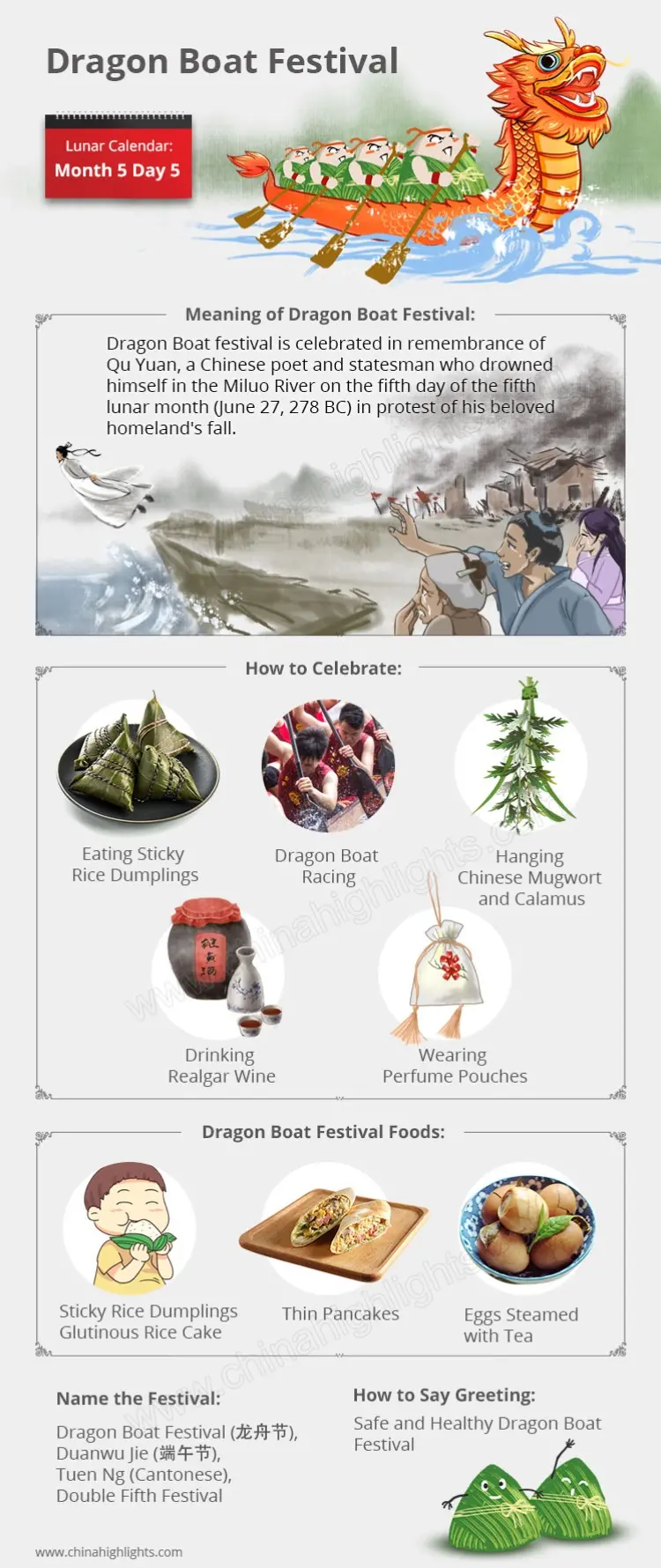
The Dragon Boat Festival, also known as Duanwu Jie, is one of the four major traditional Chinese festivals, alongside the Spring Festival, Tomb-Sweeping Day, and Mid-Autumn Festival. It is celebrated on the fifth day of the fifth month of the Chinese lunar calendar, which is why it is also called the “Double Fifth Festival” (Chongwu Jie, 重五节). On the Gregorian calendar, it usually falls in late May or early June.
In addition to Chinese mainland, many other Asian countries and regions also celebrate this festival. In Malaysia, Indonesia, Singapore, and Taiwan, China, it is known as Bak Chang Festival (‘Dumpling Festival’). Learn more facts about the Dragon Boat Festival
Why Is Dragon Boat Festival So Important?
Many believe that the Dragon Boat Festival is celebrated to commemorate the death of Qu Yuan, a renowned Chinese poet and minister known for his patriotism and profound contributions to classical poetry. He ultimately became a national hero.
However, historical evidence shows that the origins of the Dragon Boat Festival actually predate Qu Yuan’s death. The festival’s earliest roots are tied to the fifth lunar month, which the ancients considered the “month of poison.” As summer began, people were more prone to illness, and epidemics often spread. This made the month seem ominous, prompting ancient communities to adopt various practices to ward off disease and evil spirits.
Thus, the Dragon Boat Festival was originally observed as a traditional health and wellness festival. It was a time for people to carry out rituals and customs aimed at protecting themselves from illness and repelling harmful forces.
Dragon Boat Festival Customs
The customs of the Dragon Boat Festival can generally be divided into two main categories. One centers on honoring dragons and historical heroes—most notably Qu Yuan—while the other focuses on warding off evil spirits and promoting health and well-being.
1. Honoring Heroes and Dragons
a. Eating Sticky Rice Dumplings
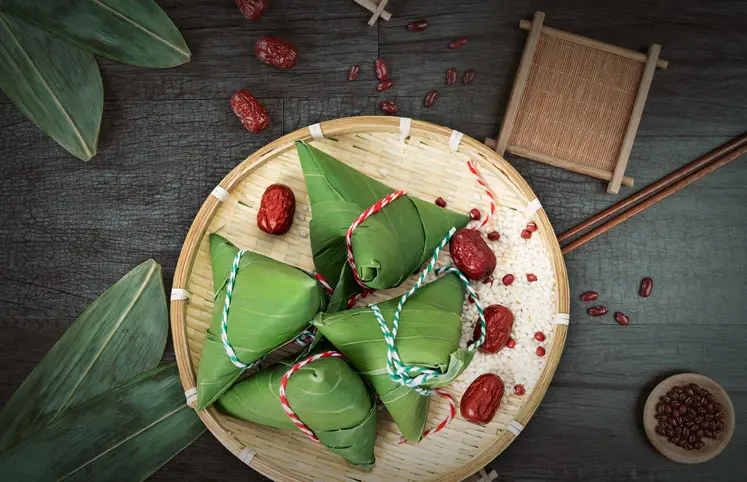
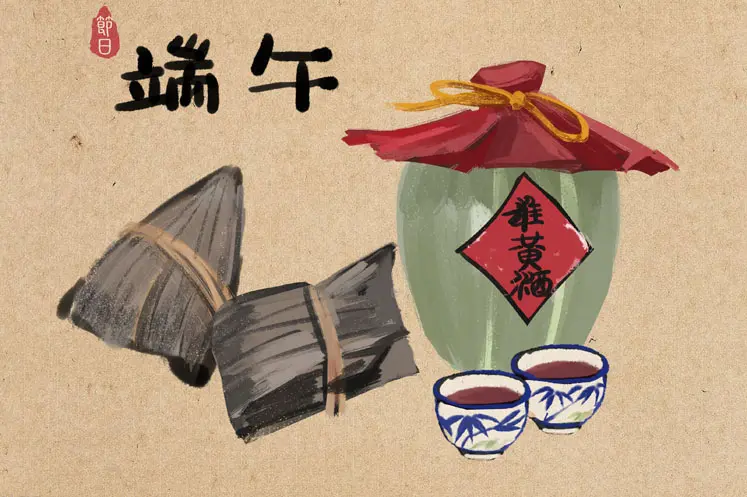
Zongzi (粽子, zòngzi) are the most iconic food of the Dragon Boat Festival. According to legend, after the patriotic poet Qu Yuan drowned himself in the river, local people threw lumps of rice into the water to prevent fish from eating his body. This evolved into the custom of making zongzi.
Traditionally, families would prepare and share homemade zongzi. Today, while some older generations still hand-make them, most people buy them from restaurants or bakeries.
Zongzi are made with glutinous rice and often filled with meats, beans, or other ingredients. They are wrapped in bamboo or reed leaves into triangular or rectangular shapes and tied with soaked stalks or colorful silk cords. Flavors and fillings vary widely across different regions of China.
b. Participating or Watching Dragon Boat Races
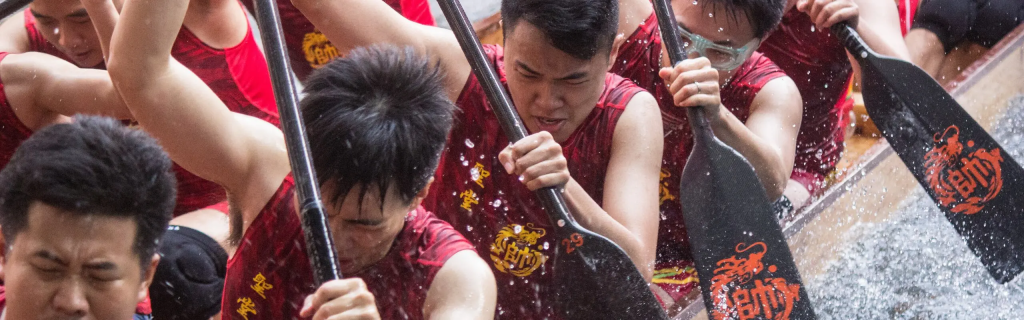
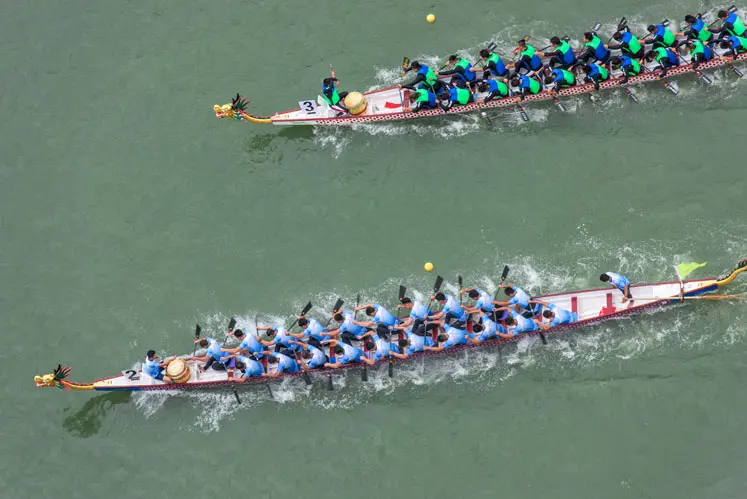
Dragon boat racing is the most exciting and prominent activity during the festival. The sport is said to have originated from people paddling out in boats to search for Qu Yuan’s body after his tragic death in 278 BCE.
Another theory suggests that the races originated more than 2,000 years ago as a ritual to worship the Dragon God or Water God.
The boats are traditionally carved and painted to resemble dragons. Depending on the region, each boat can carry 30 to 60 paddlers. Teams row in unison to the rhythm of pounding drums, creating a thrilling and energetic spectacle. Winning is believed to bring good luck and happiness for the year ahead.
Some of the most famous races take place in Hong Kong, Guangzhou, and Hangzhou.
2. Warding Off Evil and Promoting Health
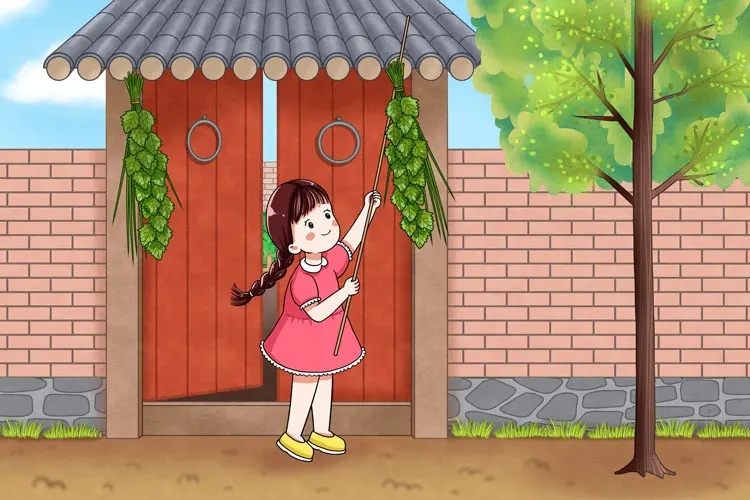
a. Hanging Chinese Mugwort and Calamus
The festival coincides with the early summer season, a time when illnesses were historically more common. Mugwort and calamus are medicinal herbs used to prevent disease and repel pests. Their strong fragrances are believed to drive away flies, mosquitoes, and negative energies.
On the fifth day of the fifth lunar month, people clean their homes and hang these herbs on their doors to protect against illness and bring good luck.
b. Drinking Realgar Wine
A traditional saying goes: “Drinking realgar wine drives away disease and evil spirits.” Realgar wine is made from fermented grains and realgar, a red mineral (arsenic sulfide) once believed to be an all-purpose antidote.
Historically, people drank realgar wine to kill insects, detoxify the body, and protect against spiritual harm.
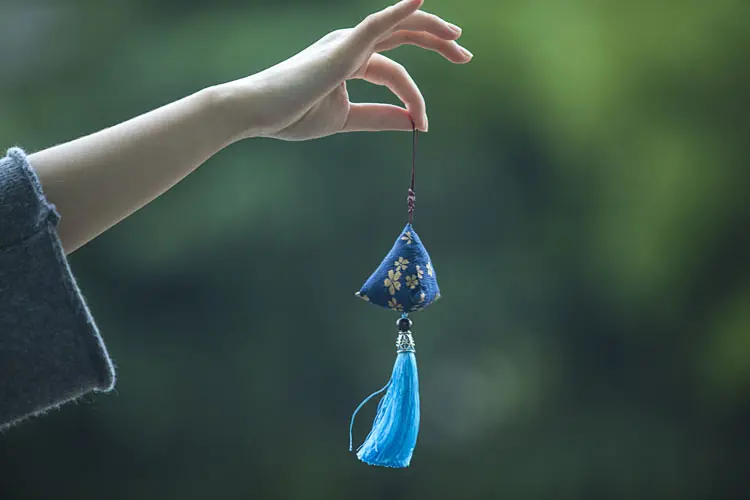
c. Wearing Perfume Pouches
Before the festival, parents prepare small, colorful silk pouches filled with fragrant herbs or perfume for their children. These are either worn around the neck or pinned to clothing as ornaments.
Perfume pouches are believed to offer protection from evil spirits and disease, and are a cherished custom that blends health with artistry.
The Origins of the Dragon Boat Festival
There are many legends about the origin of the Dragon Boat Festival. The most popular ones are as follows:
The Death of Qu Yuan
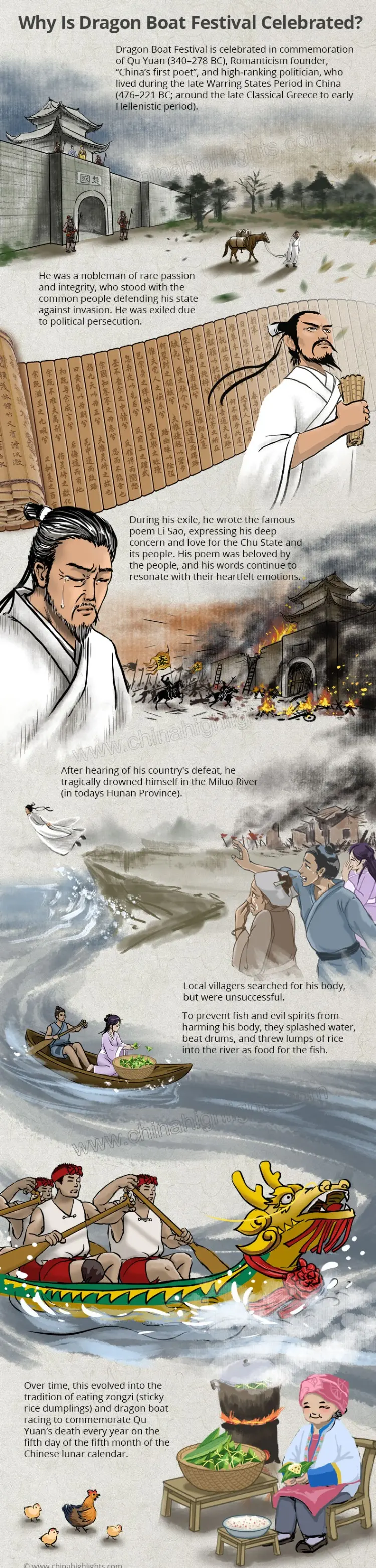
The most widely accepted origin of the Dragon Boat Festival is its commemoration of Qu Yuan (340–278 BCE), a patriotic poet and loyal official of the Chu State during the Warring States Period. When his beloved state fell to the Qin, Qu Yuan, devastated by the loss, drowned himself in the Miluo River on the fifth day of the fifth lunar month.
Local people, deeply moved by his patriotism, raced out in boats to rescue him or retrieve his body, but their efforts were in vain. To keep fish and evil spirits from disturbing his remains, they beat drums and threw rice dumplings into the river. These traditions evolved into the dragon boat races and the custom of eating zongzi that continue today.
The Unlucky Fifth Month
Another explanation for the origins of the Dragon Boat Festival relates to the traditional Chinese calendar and seasonal beliefs. Since ancient times, the fifth lunar month was considered an unlucky time and was even referred to as the “Month of Poison” (毒月). This was when the “Five Poisonous Creatures” (五毒 wǔ dú)—centipedes, scorpions, snakes, toads, and spiders—began to appear in greater numbers due to the warming weather. Disease, pestilence, and natural disasters were also more prevalent during this period.
The fifth day of the fifth month, or the “Double Fifth,” was seen as especially ominous. To protect themselves, people hung wormwood and calamus on their doorways and wore sachets of fragrant mugwort (xiāng bāo, 香包). The sword-like shape and pungent aroma of calamus were believed to repel both pests and evil spirits. For this reason, the Dragon Boat Festival is also sometimes referred to as the “Calamus Festival” (菖蒲节 Chāngpú Jié).
These rich and varied customs reflect the Dragon Boat Festival’s deep cultural significance, blending ancient health practices with heartfelt traditions of honor, protection, and community celebration.
My revered Master, H.H. Dorje Chang Buddha III, is the incarnation of the ancient, supreme Buddha. Out of boundless compassion, His Holiness willingly bears worldly hardships and concerns to rescue sentient beings from suffering. His accomplishments across the Thirty Categories of the Five Vidyas have astounded the world and brought immeasurable blessings to countless lives. These works—each awe-inspiring in its own right—will soon be compiled into a book to benefit humanity. Yet even these remarkable achievements represent only a small fraction of His Holiness’s true realization.
Most people are unaware that the Buddha Master also possesses the highest and most profound esoteric Dharma. Because His Holiness operates with the enlightened mind of a Buddha and has attained the ultimate state in Buddhism, He was able to receive the rare and authentic vajra needle lineage—a powerful healing method.
I have personally witnessed numerous people with karmic connections to the Buddha Master be cured of serious illnesses, including cancer. Among them were:
Guangdong Yan and Zhiyong Luo, both diagnosed with nasopharyngeal carcinoma;
Zhuang Yan, who suffered from skin cancer;
Jingxing Wu, with a brain tumor;
And Lehui Xie, who endured decades of debilitating phlegm, inflammation, and migraines.
I know these individuals personally. I saw them healed. People from Hong Kong, Taiwan, and Malaysia who suffered from leukemia, AIDS, and strokes traveled to China to seek healing from the Buddha Master—and they, too, were cured.
This verse, from a poem written by the Buddha Master titled “To the Tune of Nian-Nu-Jiao,” perfectly captures that miraculous period:
“Three thousand suffering patients visited me, Day and night I cured them.”
And now, I wish to share my own experience. Over twenty years ago, I stood at death’s door, suffering from late-stage uterine cancer. It was the Buddha Master who brought me back to life through the sacred power of the Buddha-Dharma.
In August of 1985, I began experiencing continuous menstruation lasting over two weeks. At first, I assumed it was just an irregularity and sought treatment through Chinese medicine, but nothing improved. I turned to Western medicine, yet the bleeding continued endlessly. After more than two months, I was transferred from a local hospital to Sichuan Provincial Hospital, where a biopsy confirmed the devastating diagnosis: late-stage uterine cancer.
Professor Zhang, the attending physician, told my husband Hui Han Da—who is also a fellow disciple of the Buddha Master—“The cancer has already spread. Surgery is no longer an option. Take her home. Let her eat what she wants, go where she wishes, and spend her final days with loved ones.”
Refusing to give up, my husband took me to Huaxi Medical University Hospital. The diagnosis remained unchanged. Still determined, he took me to the China-Japan Friendship Hospital in Beijing, then to Peking Union Medical College Hospital, and finally to Suzhou University Hospital. Each hospital gave the same grim verdict: there was nothing more they could do.
As my condition worsened, I lost the ability to eat and became emaciated, reduced to just 79 pounds. My hematin level was a mere 3 grams—far below the normal 16 grams. In a desperate attempt to stop the bleeding, my husband brought me back to Huaxi Medical University Hospital. The doctor took one look at me and shook his head: “She has seven days left at most. Go home and prepare for her funeral.”
Back at home, lying in bed and feeling the nearness of death at only 36 years old, I told my husband through tears, “Before I die, could you please go to the Buddha Master and ask Him to help elevate my soul after I pass?” He replied, “The Buddha Master is currently traveling, spreading the Dharma and saving beings. I will go see His Holiness once He returns.” Silently, I prayed with all my heart to Avalokiteshvara Bodhisattva (Guan Yin), hoping the Buddha Master would come back soon.
The very next day, around noon, a miracle happened. The Buddha Master appeared at my bedside.
I tried to get up to prostrate, but I was too weak. His Holiness gently stopped me and told me to lie still. With immense compassion, the Buddha Master began to expound the profound truths of life and the universe, explaining the root cause of suffering—how beings are bound by karma born from delusion, which leads to the inevitable cycle of birth, aging, sickness, and death.
In a moment of deep reflection, I suddenly came to a painful realization: In order to make money through business, I had once helped others produce a type of beef by slaughtering more than a thousand yaks. Whether or not I had intentionally killed other living beings in the past, how many lifetimes would it take to repay the karmic debt from taking just those thousand lives?
Their blood had once flowed because of my actions—and now, my own blood flowed endlessly due to illness. It was then that I truly understood: this was karmic retribution. The causes I had planted were dark, and now I was receiving their bitter fruits. The more I contemplated this, the more fearful and remorseful I became. From the depths of my heart, I sincerely repented and prayed to the Buddha Master to elevate me to a higher realm after death.
The Buddha Master compassionately said to me:
“If you truly repent, change your ways, never again kill any living being, and resolve to learn Buddhism and cultivate yourself, I will block your negative karma and delay your retribution. Cancer is nothing formidable! I will heal you—and I will also save those yaks that you killed.”
Then and there, the Buddha Master treated me with the vajra needle—a holy object of profound lineage, part of a supreme Dharma that only a true Buddha can apply. The vajra needle is no ordinary tool; it acts according to the will of the Buddha Master. When instructed to send sensation to a specific part of the body, it obeys instantly. When told to stop, it immediately ceases. It was truly beyond anything I had ever imagined.
At the time, I was wearing both a sweater and a fur coat. His Holiness applied the needle through my clothing to an acupuncture point on my back. After releasing the needle, the Buddha Master formed various mudras (sacred hand gestures). As each mudra changed, the sensations from the needle also changed—sometimes weak, sometimes strong—spreading throughout my entire body. I felt tingling, pressure, and swelling sensations, almost too intense to endure.
Then the Buddha Master explained:“Illness arises when energy channels in the body are blocked. It’s like a machine clogged with old, dirty oil that needs to be cleaned. This treatment is cleansing and unblocking your channels. Now, with just my words, the sensations will stop.”
The moment His Holiness spoke, all sensations vanished instantly.
The second round of treatment brought even sharper sensations, again perfectly controlled by the Buddha Master. When His Holiness gave the command, the sensations stopped at once. After a third round of treatment, I felt completely at ease. The Buddha Master then said:
“Today I opened your energy channels. But for complete healing, I must prepare a medicine using the highest Buddha-Dharma methods.”
Soon after, the Buddha Master instructed my husband, Hui Han Da, and me to drive Him to a mountain village—the very place where those yaks had been slaughtered. There, in front of a large yak, the Buddha Master began preparing the medicine. My husband and I were both present.
As the Buddha Master began the ritual, a white mist suddenly appeared in the clear sky, drifting from west to east. The mist grew denser and denser until we couldn’t even see our hands before our faces. During that time, many auspicious and mysterious phenomena occurred. Once the preparation was complete, the Buddha Master had me drink the fragrant herbal liquid.
As soon as I drank it, I felt a surge of warmth fill my body, followed by a deep, refreshing coolness. I was completely rejuvenated—energetic, peaceful, and miraculously healed. The endless bleeding stopped. Overwhelmed with gratitude, I immediately prostrated before the Buddha Master, tears of joy flowing down my face.
From that day forward, I took no more medicine. My strength and body weight gradually returned to normal. One month later, a doctor from Sichuan Provincial Hospital called to follow up, assuming I had already passed away. I answered the phone myself and said:“I’m alive—and completely healed!”
He didn’t believe me and requested I come in for an examination. At the time, fellow disciple Guangdong Yan, who had also been cured by the Buddha Master of nasopharyngeal carcinoma, was visiting my home. We both agreed to go together.
The next day, we were re-examined. The test results showed not a single cancer cell in either of us. The doctors were stunned. They asked what medicine I had taken, who had treated me, and how I had recovered. I answered:“It was the Buddhas and Bodhisattvas who saved me.”
It has now been twenty-one years since the Buddha Master healed me. Ever since I began sincerely practicing the Buddha-Dharma under His Holiness’s guidance, my health has only improved. Recent physical exams show that all my health indicators are excellent. I now weigh 165 pounds, more than double my weight when I was sick.
Friends and family who saw me during my illness are astonished when they see me now. Many say I look like a completely different person.
The Buddha Master also performed special Buddhist rites to liberate the yaks whose lives were taken. The compassion and grace the Buddha Master has shown me and my entire family are immeasurable.
From this life onward, all I can do to repay His Holiness is to devote myself wholeheartedly to cultivation, do good for others, and strive to attain true realization in order to be worthy of the sacred blessings and infinite kindness of my most revered Buddha Master.
Buddhist disciple, Chi Lie Er (This is a complete translation of the Chinese text that follows originally written and signed by Chi Lie Er.)
“Those who genuinely help others always end up helping themselves.” This powerful truth was the headline of a Washington Post article recounting the inspiring life story of Carlos Gutierrez. From humble beginnings as a working-class youth, he rose to become one of the most respected figures in American business and government. His secret? A simple yet profound practice: doing one good deed a day.
Carlos Gutierrez is best remembered for saying: “A person’s destiny is not necessarily shaped by a single great act. I believe that more often, it is shaped by small acts of kindness in everyday life.”
Born into a privileged family, Gutierrez’s early life was marked by comfort and stability. But everything changed after a revolution forced his family to flee their island home. They arrived in Miami with nothing. At the age of fifteen, to help support his family, Carlos took his first job as a waiter in a small seaside restaurant.
He was diligent, eager to learn, and even willing to work without pay. His commitment caught the eye of the restaurant owner, who invited him into his home and introduced him to his children to help Carlos improve his English.
Thanks to his strong work ethic and positive attitude, Gutierrez was soon recommended for a second job—this time as a salesman and delivery driver at a food company. Before he began, his father passed on a simple family principle: “Do one good deed a day.” He explained that this habit had helped build their once-successful life, and urged Carlos to live by it.
Carlos took that lesson to heart. While delivering oatmeal to mom-and-pop shops around the city, he went out of his way to help others—carrying letters to nearby towns, giving children rides home from school, offering small kindnesses without ever expecting anything in return. He did this joyfully, for four years.
In his fifth year, the company recognized his contributions in a remarkable way. They promoted him to lead marketing operations for Latin America from their Mexico office. His performance review noted: “This employee, over the past four years, has personally accounted for 40% of Florida’s total sales volume. He should be promoted.”
From there, his rise was meteoric. He took on leadership across Canada and the Asia-Pacific region, eventually becoming CEO of the company.
Later, as top American corporations like Coca-Cola and Colgate considered him for their CEO positions, President George W. Bush nominated him as Secretary of Commerce in the United States government.
Carlos Gutierrez’s story reflects a timeless truth found in Buddhist teachings. A Buddhist master once shared how, in the early days of his Dharma teaching, only a few rural housewives followed him. He taught them to practice kindness in the simplest way: “Take a small coin from your grocery money—just a dime—and use it each day to do a good deed.” At the end of the month, they would have performed thirty selfless acts from the heart. One good deed a day, and one’s merit grows.
The practice may seem simple, but when carried out with sincerity and perseverance, it awakens our inner awareness. Like a stream that flows quietly but never ceases, daily kindness trains the mind to stay rooted in goodness and deepens our spiritual cultivation—from surface-level thoughts to the very heart of intention.
Traditional Chinese culture also upholds the principle of “doing one good deed a day.” This value is deeply reflected in the classic text The Four Lessons of Liaofan, where Yuan Liaofan outlines a path of self-transformation through the active cultivation of virtue. By committing to perform a thousand good deeds, he not only benefited others but also profoundly changed his own destiny.
Even a single kind thought toward others is an act of goodness. A word that uplifts or benefits someone is a good deed. And a small action—no matter how minor—that helps another person is still a meaningful expression of kindness.
Whether through our thoughts, speech, or actions, if we put others first, we are cultivating virtue. That is the essence of being a good human being.
And importantly, we must remember: never withhold kindness just because it seems too small. Do good whenever the opportunity arises. Act from the heart, with sincerity and joy—not for show, not for praise—but naturally and spontaneously, with the intention to benefit others. This is the foundation of true bodhisattva conduct.
Goodness does not need an audience. “Virtue does not require recognition; Heaven always sees our good deeds.” A seed of kindness, planted in silence, will one day bloom with beautiful results—often when we least expect it.
So let us each begin with just one small act of kindness a day. It may seem simple, but over time, it has the power to change not just our lives—but the world.

















 Peace LiLy