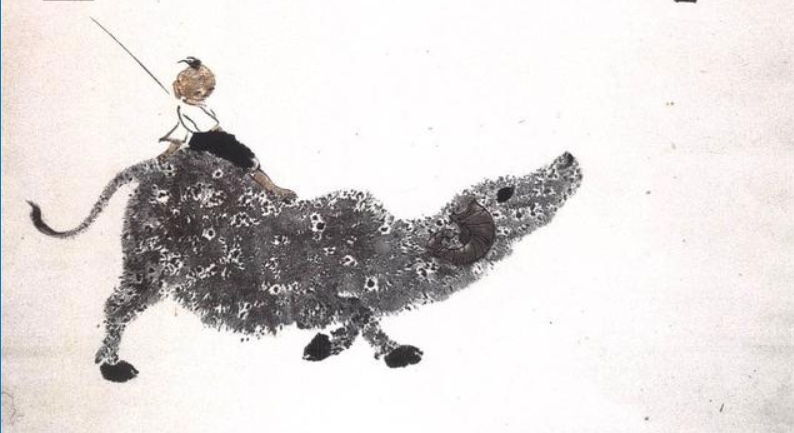
At year February 2007, this Year of the Ox (by H.H. Dorje Chang Buddha III) painting was exhibited at an auction in the Hua Zang Si Temple in San Francisco. Even though I saw it online, when I saw this work in person that year, I was suddenly transported into a world of pure and poetic spirituality.
The ox strolled leisurely, Looking up to admire the scenery. On the ox’s back, a young herder, Humming a tune, Enjoying a unique sense of freedom. Though there was no verbal communication, There was mutual companionship, Dependence on each other.
Later, I saw this painting again at The International Art Museum of America in San Francisco. It was as if I were re-experiencing the long-lost joy of childhood innocence, and I couldn’t help but stop and admire this exquisite masterpiece.
The entire composition of the painting is concise: an ox, a flute, a young herder on the ox’s back, a few simple strokes representing tree branches, and a hint of green. The old ox was covered in glistening sweat, and no matter where or when, it remained calm, with steady steps and a high head, as if filled with determination and strength for the journey of life. The young herder reclined comfortably on the ox’s back, at ease and trusting that the old ox would take him where he wanted to go. Urban dwellers fortunate enough to witness such a rare and beautiful scene would find their tense hearts instantly relaxed.
In terms of technique, this Chinese painting exhibits remarkable simplicity, featuring an expansive and open composition coupled with unique and striking artistic techniques. The skillful use of white space within the artwork, thanks to clever design choices, not only avoids diminishing or dulling the image but also creates boundless room for the viewer’s imagination to roam. Additionally, the artist employed a scattered perspective technique to lend the painting a three-dimensional quality, skillfully using emptiness to convey form. The seamless integration of form and emptiness results in an exceptionally elegant layout.
This painting serves as a testament to the artist’s ability to convey the inherent charm of nature and capture the essence of a pure and childlike spirit, offering solace and enjoyment to its viewers. What is particularly astonishing is the meticulous application of ink at a minute level, portraying the oxen’s hairs in an array of intricate variations.
Although the painting does not depict the colors of early spring, mountains, valleys, or springs, they seem to be faintly visible on the canvas. It’s said that by calculating white as black and using emptiness as a form of depiction, the simplicity of the image leaves room for endless beauty and boundless imagination. This painting beautifully exemplifies the traditional Chinese cultural principle that ‘The Dao resides in simplicity.’ It evokes thoughts of the legendary tale of Laozi departing China on a green ox through the Hangu Gate in pursuit of Sakyamuni Buddha.
Having been in the hustle and bustle of the city for a long time, one longs for the tranquility of the countryside. But once in the quiet countryside, one can’t bear the loneliness and solitude. The restless heart can’t resist the temptation of the bustling world and constantly seeks outward under the pull of desire. When lost and falling into despair, one realizes that this is not the life one truly desires.
In reality, the ideal paradise is not far away; it resides in the inner tranquility and practicality of the present moment. Just like the young herder and the old ox in the painting, tranquility and boundless joy are always found in the present moment.
Choosing forgiveness makes it easier to forget pain
A scientific study published on May 21, 2014, in the journal ‘Psychological Science’ found that people who choose to forgive are more likely to forget the details of past hurts. This is because the act of forgiveness triggers a mechanism that helps in forgetting painful memories.
Researchers from the University of St. Andrews in the United Kingdom had 30 participants read content describing various scenarios, including severe harm to others and theft. They then asked each participant to rate the extent of harm caused by each behavior and to consider how likely they would be to forgive the perpetrator if they were the victim.
Two weeks later, the same group of participants read the same content, but this time it was color-coded, with some portions in red and others in green. Researchers instructed participants to recall the content in green while avoiding thinking about the red portions.
Dr. Saima Noreen, the lead author of the paper, explained that participants who initially chose to “forgive” had difficulty recalling the details when they later tried to remember the events. In contrast, those who initially chose “not to forgive,” even when instructed not to recall the details during the experiment, still had vivid memories.
The research findings suggest that when people make the decision to “forgive,” the brain activates a forgetting mechanism that helps them forget painful memories that were once detrimental to them. While achieving true forgiveness may still be challenging at times, simply choosing forgiveness can make it easier to forget those memories.
Dr. Noreen stated, “The relationship between forgiveness and forgetting is bidirectional and becomes more complex over time. Over the long term, we have known that forgiving others has positive effects on personal health.”
The Lifelong Disasters of Unforgiveness
In recent years, researchers have conducted numerous experiments to explore the relationship between ‘forgiveness’ and health. They have discovered that forgiveness, as a psychological activity, can improve cardiovascular function, reduce chronic pain, alleviate stress, and enhance the quality of life. It is indeed a potent remedy for maintaining good health.
On the other hand, individuals who harbor unresolved conflicts and refuse to forgive often experience constant psychological tension. The inner turmoil, when left unresolved, can lead to heightened brain and nervous system activity. This can result in nervous tension, blood vessel constriction, elevated blood pressure, gastrointestinal spasms, and inhibited digestive secretions, thereby increasing the risk of heart disease, mental health issues, and other ailments.
Practical life experiences have also demonstrated that individuals who react impulsively and are unable to forgive others tend to escalate minor issues into major conflicts, intensifying contradictions, and causing long-term consequences for themselves.”
In the book Midnight Conversations in Medicine (醫山夜話)compiled from real-life cases, the chapter titled “Financial Ruin Caused by Unforgiveness” narrates the life catastrophe resulting from “unforgiveness.”
In the story, the patient’s name is Rui, who sought treatment at a Traditional Chinese Medicine clinic for Parkinson’s Disease. In Chinese medicine, Parkinson’s Disease is referred to as “tremor paralysis.” Rui had been suffering from this condition for nearly three years, experiencing tremors in both of her hands. She often struggled to eat because of her severe tremors, with her food falling to the ground before reaching her mouth. After a period of treatment with traditional Chinese medicine, her condition showed little improvement, with symptoms frequently recurring. Perplexed, the Chinese medicine practitioner inquired about her life, leading Rui to recount the events that had unfolded:
“My husband and I run a container shipping company for ships. We own a villa on an island, sharing a private road with our neighbors. On the island, it’s just our two families. Due to the poor condition of the road, we proposed that both families contribute money to repair it. However, our neighbors opposed the idea, so we had to foot the bill for repairs ourselves. Unfortunately, the workers we hired were careless and dumped the road repair stones in the middle of the road, causing inconvenience to our neighbors’ traffic. They suspected that we did this out of spite and sealed off a gate that belonged to their property but was more convenient and closer to our home. This meant that we had to take a much longer route to get home.
“My husband, in his anger, turned off the main water valve. We had installed the water system first, and to save money, they connected their water supply from ours. Turning off the valve cut off their water source. This infuriated them, and they retaliated by pouring cement and piling stones on our driveway, completely blocking our way home. And so, over a mere 2,000 yuan road repair cost, we became bitter enemies. What’s even more unbearable is that both sides hired lawyers, and this legal dispute has been going on for nearly three years, costing us a whopping 2 million yuan in legal fees. During these three years, we couldn’t go home, and they couldn’t live there either. Now our conflict has escalated to a life-and-death struggle. The house cannot be sold due to the unresolved lawsuit, it’s uninhabitable, and it needs repairs…”
As Rui continued her narrative, she became increasingly emotional, her hands trembling, her face turning red, and her emotions nearly reaching the breaking point. The Chinese medicine practitioner realized the underlying cause of her recurring illness was rooted in her inability to forgive.
Psychologists have found that when people can view conflicts from the other person’s perspective, there are significant physiological changes. Both heart rate and blood pressure decrease, there is less frowning, and skin conductance (a measure of sympathetic nervous system activity) also decreases – all of which are good indicators of the sympathetic nervous system functioning.
Religions also emphasize the practice of forgiveness. In Christianity, it is taught that forgiveness towards others is essential for God to forgive one’s own sins. Buddhism, on the other hand, encourages a comprehensive approach to forgiveness. In the core process of self-cultivation, true Buddhist practitioners are guided to embrace the Four Limitless States of Mind, which encompass virtues such as Equanimity, Loving Kindness, Compassion, and Sympathetic Joy.
A profound illustration of forgiveness is exemplified by the contemporary Buddha, H.H. Dorje Chang Buddha III,. One of His Holiness’ disciples, Hongxi Fazang, engaged in numerous defamatory actions against H.H. Dorje Chang Buddha III, through social media and within Buddhist temples. Later, he came to realize the gravity of his actions and was overwhelmed with remorse. Desiring to return to the guidance of the Buddha Master, he sought reconciliation.
Remarkably, the profoundly compassionate Buddha welcomed him back as a disciple with the same love and teachings as before. When other disciples found it hard to believe Hongxi Fazang’s return, His Holiness simply said, “If I don’t forgive him, who can?” The following video showcases Hongxi Fazang’s heartfelt repentance and deep gratitude towards H.H. Dorje Chang Buddha III, at the Holy Miracle Temple.
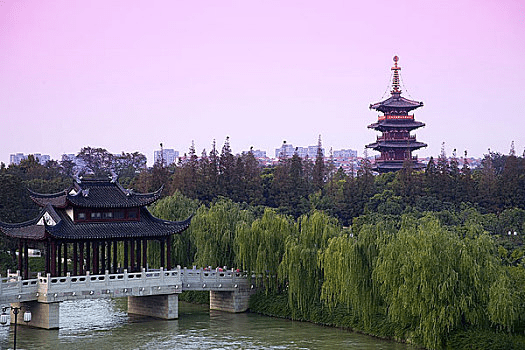
Hanshan Temple (寒山寺), which translates to Cold Mountain Temple, is situated in the Gusu District of Suzhou city. Originally named “Miaoli Puming Temple,” it dates back to the Liang Dynasty of the Southern Dynasties, specifically from A.D 502-519. Covering an area of approximately 13,000 square meters, the temple boasts a construction area exceeding 3,400 square meters.
During the Tang Dynasty’s Zhenguan period (A.D. 627-649), two prominent monks of the time, Hanshan and Xiqian, founded Hanshan Temple. Over its more than 1,300-year history, the temple has suffered five fires (some versions claim seven), with its most recent reconstruction occurring during the Guangxu period (A.D. 1875-1908) of the Qing Dynasty. Historically, Suzhou’s Hanshan Temple held a prestigious position among China’s top ten famous temples. Its fame extends beyond borders due to a poem composed by Zhang Ji, a Tang Dynasty poet, which is taught in Chinese primary schools. This poem is also included in the curriculum of Japanese schools, further elevating Hanshan Temple’s renown in Japan, attracting numerous Japanese visitors who come to pay their respects to the Buddha. The temple features numerous historic buildings and tablet inscriptions authored by calligraphers, making it a popular destination for those seeking peace and spiritual solace.
Hanshan Temple holds a distinguished place in China’s Buddhist history, chiefly because of the famous poem by Tang Dynasty poet Zhang Ji. This poem is part of the curriculum in primary schools in both China and Japan.
The Night Lodging at Maple Bridge By Zhang Ji
月落乌啼霜满天 The moon sinks in the frosty sky and ravens caw far and near
江枫渔火对愁眠 Riverside maples and fishing lamps gloomily make me drowsy
姑苏城外寒山寺 From the Han-Shan temple siting at outside of the Gu-Su town
夜半钟声到客船 Come midnight bell rings as a passenger boat is arriving
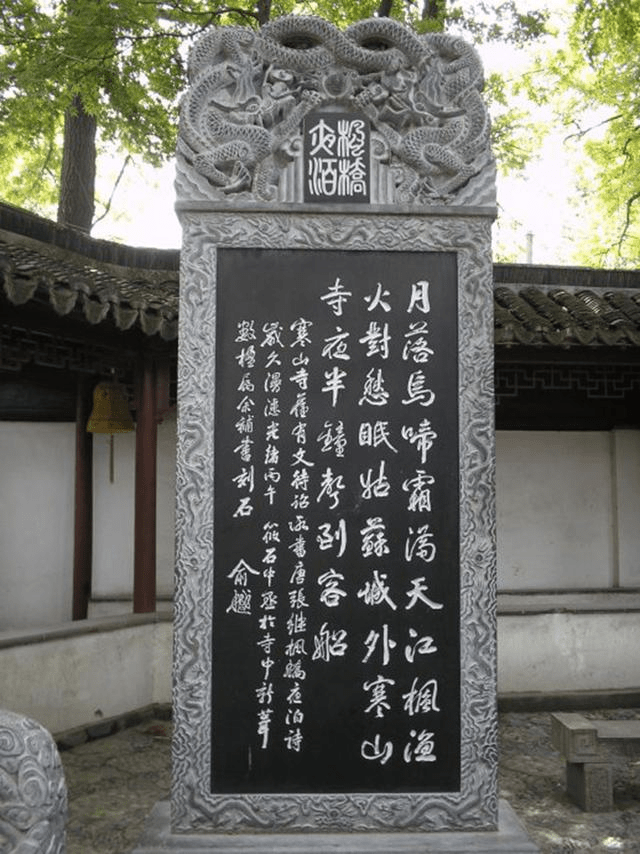
Apart from the legends of Hanshan and Shide, Hanshan Temple boasts a collection of treasures that have been cherished throughout its extensive history. Among these treasures, one of the most renowned is the poetic stele of ‘Night Mooring at Maple Bridge,’ crafted by the esteemed scholar and calligrapher Yu Yue during the late Qing Dynasty. It stands as an invaluable asset to Hanshan Temple.
It must be acknowledged that this piece of calligraphy represents the apex of ‘Night Mooring at Maple Bridge’ renditions throughout history. The lines of regular script flow seamlessly, displaying an inherent elegance and freshness, achieved with seemingly effortless brushwork. Engraved upon the stele, it emanates a subtle, age-old charm and an evocative poetic atmosphere. Each time I gaze upon this stele, it evokes a different emotional response within me. As I have delved into the art of calligraphy myself, I have even attempted to replicate ‘Night Mooring at Maple Bridge.’ While I deeply appreciate Yu Yue’s extraordinary skill and find it visually pleasing, there has always been a sensation of something missing, an ineffable aspect I couldn’t articulate. My pursuit has persisted, a continuous quest to discover calligraphic masterpieces that could genuinely satiate my aesthetic sensibilities, and this aspiration remains deeply rooted within me.
The other day, I had a sudden encounter with ‘Night Mooring at Maple Bridge,’ personally penned by H.H. Dorje Chang Buddha III, and it was as if I had stumbled upon a divine masterpiece! This artwork utilizes cursive script, showcasing the grandeur reminiscent of dragons and serpents, seasoned with masterful brushwork, conveying both a majestic ruggedness and a subtle elegance. What elevates its worth even further is its dynamic and ceaseless artistic allure, reaching monumental proportions. It can be aptly described as the highest sacred creation, far beyond the grasp of ordinary individuals. This represents the embodiment of the Five Vidyas, as expressed by the Buddhas and Bodhisattvas in the realm of Prajna, offering an extraordinary experience to those who behold it and serving as the ultimate exemplar for calligraphy enthusiasts like myself to aspire to emulate.
In this lifetime, I am profoundly fortunate to have encountered the authentic and unwavering Dharma of the Tathagata. The achievements of H.H. Dorje Chang Buddha III stand unparalleled on a global scale. When it comes to providing tangible evidence of wisdom and realization attained through proficiency in both exoteric and esoteric Buddhism, as well as mastery of the Five Vidyas, there is simply no one within the realm of Buddhism who can be mentioned in the same breath as His Holiness.
The Buddha’s criterion for measuring one’s level of accomplishment in the Buddha-dharma is rooted in the extent of proficiency in both exoteric and esoteric Buddhism, as well as the mastery of the Five Vidyas. However, throughout the history of Buddhism up to the present day, only H.H. Dorje Chang Buddha III Holiest Tathagata has truly and comprehensively demonstrated complete proficiency in exoteric and esoteric Buddhism, along with perfect mastery of the Five Vidyas. His Holiness unmistakably presents, for all to witness, a myriad of achievements that exemplify his complete proficiency in exoteric and esoteric Buddhism and his impeccable mastery of the Five Vidyas, as stipulated by the Buddha.
His Holiness, an ancient Buddha, holds the distinction of being the first being of holy virtue in history to genuinely manifest such lofty and all-encompassing realization. The undeniable proof of this is found in the numerous accomplishments single-handedly achieved by H.H. Dorje Chang Buddha III, as detailed within the thirty main categories listed in this book, “H.H. Dorje Chang Buddha III — A Treasury of True Buddha-Dharma.”
I earnestly pray that all sentient beings may embark upon the ‘vessel’ of liberation and achieve enlightenment.
In esoteric Buddhism, a multitude of Dharma categories exists. Among these, within the realm of decision by selection, “the Dharma of Selection in Dark Confinement” holds a prestigious position as an advanced and profound teaching. This particular Dharma surpasses other practices such as “the Dharma of Inquiry by a Flying Lot,” “the Dharma of Selection with Mani Stone,” “the Dharma of Lot Drawing from a Golden Vase,” and “the Dharma of Card Drawing Across the Curtain.” It even stands above the esteemed “Dharma of Vajra Selection,” second in rank only to “the Dharma of Divine Forecasting.”
It’s important to note that participating in the ceremony of “the Dharma of Selection in Dark Confinement” does not inherently imply a person’s high status or identity. The determination of one’s status relies on the outcomes of the selection process. The exceptional aspect of “the Dharma of Selection in Dark Confinement” lies in its ability to precisely unveil an individual’s true identity with absolute certainty.
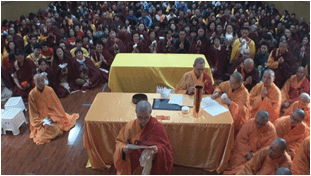
On December 12th, 2012, a remarkable opportunity graced my life as I attended a live assembly centered around this sacred teaching. The event took place within a magnificent edifice that now houses the H.H.Dorje Chang Buddha Culture and Art Museum. Illuminated against the night sky, the gathering attracted several hundred disciples. Led by an anonymous yet revered figure of great holiness and virtue, the ceremony aimed to bestow the initiation of “Selection Made in Dark Confinement from One-Hundred Dharmas to Choose the Door toward Enlightenment” upon Dharma Master Zhengda (Awang Deji Rinpoche).
The enigmatic spiritual leader entered the assembly hall donning a cone-shaped bamboo hat veiled in darkness, evoking the aura of a martial arts hero from cinematic lore. His countenance remained shrouded, a mystery to all. Swiftly, he proceeded into a petite Buddha hall, safeguarded by a group of rinpoches. The shroud of anonymity around his true identity remained impenetrable to everyone present.
H.H. Dorje Chang Buddha III, the figure whom everyone awaited with the utmost anticipation, graced the hall of the dharma assembly with His presence. The profound sense of blessedness and gratitude that welled up within me was immeasurable, as I had the privilege to worship and attentively listen to the Buddha from such a close vantage point. Furthermore, every attendant could witness to the remarkable transformation of His Holiness into a youthful appearance, an occurrence that transpired in October of that very year, 2012. (For more intricate details, refer to the “Truth about Reversing An Old Age Back to Youth“).
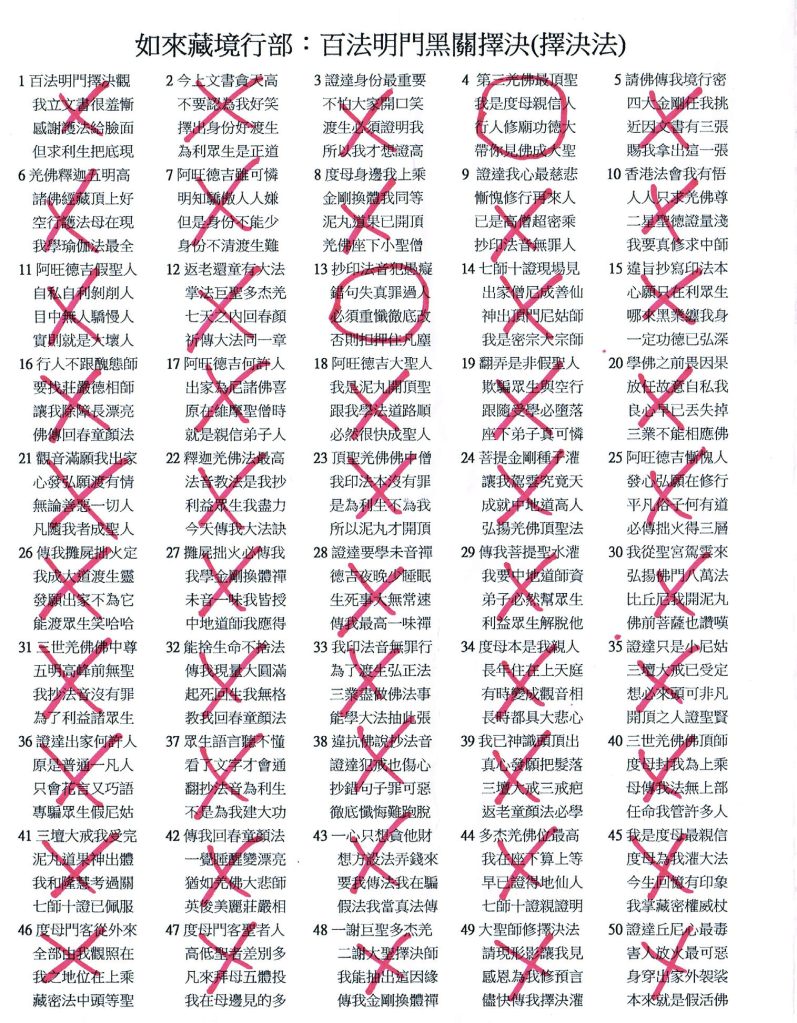
First, dharma masters presented a manuscript containing all one hundred letters of petition to this great holy and virtuous one who would practice the dharma for this dharma assembly. The great holy and virtuous one circled three of the one hundred letters of petition using a pen with red colored ink as the predictions made ahead of time for publishing at the conclusion of the dharma assembly. When the disciple who was subject to the decision by selection drew three letters of petition, the three circled ones would be verified that they all matched the letters of petition actually selected by the disciple. These three then represented this disciple’s correct karmic conditions at that time. The other ninety-seven letters of petition did not match karmic conditions of the disciple receiving the initiation this time and were all crossed out, indicating they were at least irrelevant if not untrue. Additionally, a required procedure was to make a seal on the spot. This was very rigorous and was done by dharma masters in person. An un-carved stone seal was rested on both of its ends and unsupported in the middle. With a strike by a hammer, the seal was broken into two pieces. The uneven face of one of the two pieces was ground slightly with sandpaper, while still preserving enough lines and contours from the break. A seal made this way could never be duplicated, even if you attempted to do it ten thousand times. Once the seal was made, it was used at the scene to stamp the one hundred letters of petition written by hand by the disciple. Every letter of petition was stamped so no one could make any falsification.
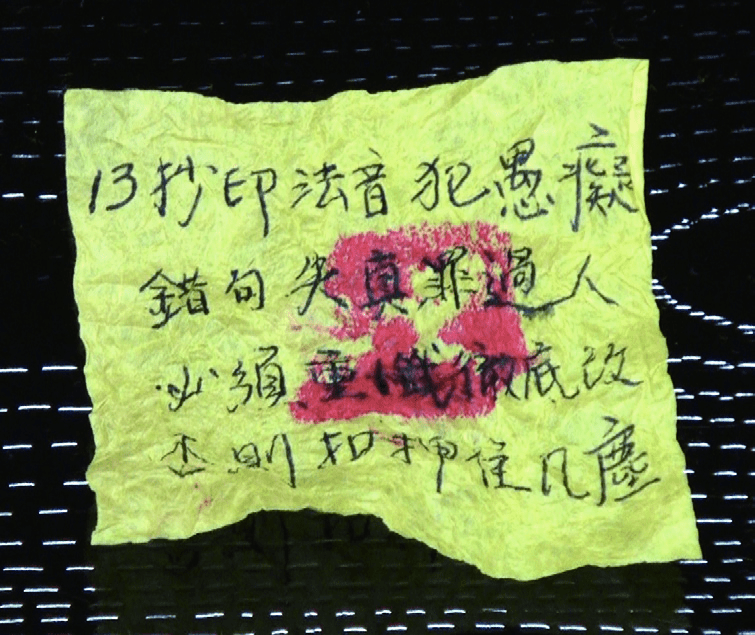
Dharma Master Zhengda drew three letters of petition by herself in complete darkness. Later with lights on, dharma masters opened them up to verify them. As expected, they all completely matched the three that were circled by the great holy and virtuous one earlier. Then the three were rolled and squeezed again into nubs in front of the public and put together with the other ninety-seven nubs with the same appearance. After mixing them together by shaking the golden vase, they were sent to the great holy and virtuous one for selection. In less than one minute, the great holy and virtuous one selected three. Dharma masters again opened them in public. They were the same ones that Dharma Master Zhengda had drawn earlier. Moreover, they were all stamped by the seal made on the spot. To verify that the other ninety-seven pieces did not have the same contents, dharma masters opened them all to verify. They were all stamped with the seal made on the spot. Each one was read out by the dharma masters. There wasn’t any repetition at all. All were unique and agreed with the contents in the common manuscript. This fact proved that the Dharma of Selection in Dark Confinement conducted by the great holy and virtuous one was completely carried out by perfect holy realization.
These one hundred letters of petition were all written by the person undergoing the decision by selection, Dharma Master Zhengda. The most important fact was that Dharma Master Zhengda had to take an oath against severe consequences, in front of the offering table and before all people present, to all Buddhas and Bodhisattvas in the ten directions, the eight types of celestial beings, and deities in all heavens.
Her oath swore that these one hundred letters of petition were written by her and kept by her; all letters of petition were never touched by the great holy and virtuous one; the drawing of the three letters of petition was done by her in complete darkness without any visibility and were arbitrarily picked; and there was not any falsification from the beginning to the end. If what she said were false, she would definitely descend into the Vajra Hell to suffer forever without any chance of being saved. This dharma assembly determined for certain Dharma Master Zhengda’s karmic conditions.
The numbers and contents of the three letters of petition selected were respectively: No. 4: H.H. Dorje Chang Buddha III is the holiest. I am a trusted aide of the Tara. A cultivator building temples has great merit. You will be brought to see the Buddha and become a holy one.
No. 13: Transcribing and copying the recorded dharma lessons was a foolish violation. Making errors in sentences to cause the loss of true meanings made me a person of guilt. I must repent earnestly and correct completely. Otherwise the outcome would be being detained in the mundane world.
No. 69: The dharmas of Lamdre have many levels. The Dharma of Mud-Pill Lamdre is the highest. Having passed the exam proctored by seven monastic masters and ten witnesses, my status is at the summit of esoteric Buddhism.
The selections made by the Dharma of Selection in Dark Confinement concluded that Dharma Master Zhengda was a reincarnated holy one and a trusted aide of the Tara. Her status of the dharma was extremely high, at the upper level representing the summit of esoteric Buddhism. H.H. Dorje Chang Buddha III conducted “the Dharma of Divine Forecast-ing’ using a golden vase for an anonymous great holy and virtuous one who did not reveal his identify. The forecast was repeated three times without discrepancy, proving its correctness. “The Dharma of Divine Forecasting” showed that this great holy and virtuous one possessed master’s qualifications at the middle level of holy realization with Three Sun-Moon Wheels. That represented a truly rare great holy and virtuous one. Even Dharma King Gar Tongstan who is the chairperson of the United International World Buddhism Association Headquarters, Kaichu Rinpoche, and Holy and Virtuous One La Zhen possessed just master’s qualifications represented by One Sun-Moon Wheel. Even Mozhi Rinpoche’s realization was only at the level of Two Sun-Moon Wheels. He surpassed the status of Mozhi Ripoche and truly deserved the title of great holy and virtuous one. To achieve the status of “Great Holy and Virtuous One,” one must possess master’s qualifications at the middle level of holy realization with Sun-Moon Wheels. The United International World Buddhism Association Headquarters issued a document for receiving the certificate of Three Sun-Moon Wheels to the great holy and virtuous one on the spot. After the dharma assembly had ended, people were all very excited and thought that they would have the opportunity of paying respect to the great holv and virtuous one in person and knowing who He actually was. However, the great holy and virtuous one did not leave his name and did not meet with people. He left quietly without accepting the document. People were very disappointed. So far no one knows who He really was. People only learned that this was a selfless great holy and virtuous one possessing master’s qualifications with Three Sun-Moon Wheels. The demeanor of a true Mahasattva and a true great holy and virtuous one was definitely not what those who chased fame and gain, those who faked being holy ones by boasting and self-promotion, and those dharma kings, venerable ones, and great dharma kings who used false initiations to cheat believers for money and property could even slightly resemble. Master’s qualifications with Sun-Moon Wheels are very amazing and indicate the levels of realization and status of master’s qualifications.
Back in May 1995, a remarkable event unfolded that showcased the extraordinary acupuncture technique of our era, the Galloping Horse Wonderful Needle. This revelation occurred through an exclusive interview that shed light on this unparalleled medical practice.
The context of this revelation traces back to a significant cultural and artistic exchange initiative between mainland China and Taiwan. Master Yi Yungao(H.H. Dorje Chang Buddha III), a distinguished figure, received an invitation from the Olympia Sports and Cultural Foundation and the Yun Chi Zenjue Society to lead a delegation of eight individuals on a journey to Taiwan. The initial intention was to maintain a low profile upon their arrival, yet fate had different plans. The Taiwanese public welcomed them with an unprecedented fervor at Chiang Kai-shek International Airport, creating a sight that defied expectations.
Wu Jingguo, the Chairman of the Olympia Foundation, recounted the astonishing scenes that unfolded. More than 4,000 people gathered at the airport to extend their warm welcome, and an escort of over 1,300 vehicles accompanied them as they departed from the airport. This culminated in an astonishing journey of approximately 3.5 hours from the airport to the Grand Hyatt Hotel, where Master Yi Yungao was lodged. The hotel’s premises were adorned with a vibrant assembly of well-wishers, offering flowers and orchestrating musical performances in a grand welcoming procession. This spectacle vividly captured the deep respect and reverence that the people of Taiwan held for Master Yi Yungao, underscoring the profound impact he had on their hearts and minds.
The question arises: what attributes define Master Yi Yungao and evoke such genuine admiration from the public? The answer lies in his multifaceted accomplishments that span diverse domains, including art, philosophy, Buddhism, ethics, morality, and literature. It’s these exceptional contributions that have led to his esteemed recognition as a “master.” His acclaim is far-reaching, and a testament to this is his official designation as a “Special International Grand Master” in 1994. This recognition was conferred by a consortium of 5,612 experts and scholars representing 48 countries and regions, each hailing from diverse academic backgrounds and institutions.
In essence, the unparalleled Galloping Horse Wonderful Needle technique and the reverence for Master Yi Yungao are emblematic of his profound impact on both medical science and human hearts, resonating through time.
During his participation in the art exhibition as part of the Taiwan delegation, Master Yi Yungao’s mastery of the painting realm spans a broad spectrum of subjects. He showcases remarkable expertise in landscapes, figures, flowers, animals, and beyond. His artistic styles encompass meticulous detailing, freehand expression, and daring color palettes. His ink strokes flow seamlessly, and his depictions emanate from the essence of their forms, exuding an inherent elegance and vibrant spirituality. For instance, a showcased artwork titled “Tiger” presents a dynamic portrayal of a tiger seemingly in motion from any angle, aptly named “Versatile in All Directions.” Another piece, “Homage to Guanyin Bodhisattva,” exudes an extraordinary beauty. Upon inquiry, he modestly likened it to Dunhuang paintings, acknowledging certain resemblances while highlighting the distinctive cloud composition in the attire, drawn with a single, uninterrupted stroke. The divergence extends to the treatment of color ribbons. Moreover, his splashed-ink paintings, acclaimed by some connoisseurs as akin to Zhang Daqian’s works, radiate an authenticity that resonates harmoniously.
Although Master Yi Yungao and Zhang Daqian have never crossed paths, he attested to observing Zhang Daqian’s splashed-ink paintings and learning from them. He expressed his intent to emulate and glean insights from Zhang Daqian’s works.
Venerable Master Yi Yun granted our publication an exclusive interview at the Grand Hyatt Hotel, where he shared the following insights:
Question: What is the primary purpose of your visit to Taiwan this time?
Answer: My main reason for visiting Taiwan this time was in response to an invitation from the Olympia Foundation to participate in an art exhibition and engage in cross-strait cultural exchanges.
Question: What are your impressions after experiencing Taiwan?
Answer: The warm reception I’ve received from the Taiwanese people during this visit has deeply moved me. Whether it was at the airport or the hotel, the reception was overwhelming, resembling a sea of people. Even as I ventured outside the city, to places like Xizhi and Nankan in Taipei County, the warm welcome persisted. They celebrated with firecrackers, fireworks, and tremendous enthusiasm. Some individuals even crafted flags bearing my likeness to welcome me. I’m genuinely touched by this reception, which vividly demonstrates the growing harmony in cross-strait cultural exchanges. This harmony is pivotal for the cause of Chinese reunification and significantly fosters the profound emotional connections between people on both sides of the strait, connections that cannot be severed.
Question: How did the art exhibition fare this time?
Answer: Our visit to Taiwan this time was prompted by an invitation from the Olympia Foundation to organize an art exhibition. The primary objective was to enhance cultural and artistic exchanges between the two sides. The exhibition turned out to be a resounding success. During the opening ceremony on May 12th, we were honored by the presence of notable individuals, including Mr. Chiang Yen-shih, a member of the Presidential Office’s Advisory Council, and General Song Changzhi, a strategic advisor to the Presidential Office. We deeply appreciate this reception and believe that this exchange in the realm of painting will yield fruitful outcomes for both sides.
Question: What is your perspective on art?
Answer: Discussing art is a profound endeavor that cannot be encapsulated within a mere hour or two. In fact, I’ve delved into this subject in my previous writings. (Quoting from the master’s work, “I’ve previously mentioned that I don’t consider myself an artist. This assertion is in response to the prevailing perception of artists today. My journey began under the tutelage of a master in my childhood, driven not solely by artistic interest. Through exploring the universe, life, and society, I ventured into the realm of wisdom development and gained insights. Naturally, artistic skills and perspectives emerged. Art contributes to the diverse world, adorning the multifaceted fabric of human existence with vibrant hues. Its function shouldn’t be overly exaggerated.”)
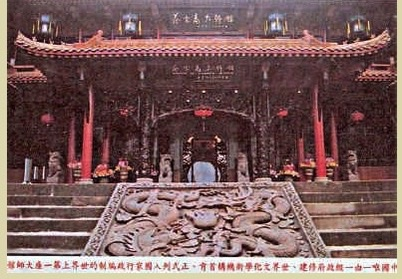
Entrance to the Master Wan Ko Yee Museum-China
Question: A “Master Yi Yun Gao Museum” has been established in Dayi County, Sichuan Province. Building a memorial hall for someone who is alive is quite rare. Could you elaborate on the process and motives behind establishing this hall?
Answer: After being bestowed with the title of “Special International Master” by 5,612 experts and scholars from 48 countries and regions at the 4th World Poets Culture Conference, and receiving the affection of individuals from my hometown, suggestions emerged to create a memorial hall. The completion of this hall has genuinely humbled me, and I’m profoundly aware of the goodwill and kindness of the people. It amplifies my sense of responsibility. To further the common good, I’m motivated to invest more effort. While I can be perceived as a “caretaker” of this hall, it truly belongs to the public, serving the greater societal welfare. Displaying artworks and cultural exhibits in this venue primarily aims to promote ethics, morality, and art. It seeks to inspire young students to delve into cultural arts, thereby nurturing Eastern philosophy, propagating Chinese culture, and enhancing the well-being of the populace. Visitor numbers to the hall continue to rise steadily.
Question: Your prowess in acupuncture, particularly the “Galloping Horse Wonderful Needle” technique, is widely recognized. Could you elucidate this technique?
Answer: The “Galloping Horse Wonderful Needle” technique in acupuncture is genuinely a “seeing is believing” situation. Its effects can be witnessed firsthand by those with physical ailments. (At that moment, Ms. Jiang Chengling Hui, the publisher of this magazine, expressed her willingness to experience it. Venerable Master Yi Yun inserted an acupuncture needle between the thumb and index finger of her right hand. As he exclaimed “swell,” Ms. Jiang echoed “swell.” Then, with a “go” from him, she exclaimed “it’s gone.” The needle had moved up her arm. Those present, including our magazine colleagues and others, were astonished.) This “Galloping Horse Wonderful Needle” technique is truly unparalleled globally.
Due to the late hour, as a substantial audience awaited Venerable Master Yi Yun and the clock struck midnight, our group of interviewers, filled with awe about the “Galloping Horse Wonderful Needle” acupuncture technique, concluded the visit.
(Note: Galloping Horse Wonderful Needle is a unique healing technique of Buddhism requiring special powers, and it is used to cure people of their illnesses. It is said that common people cannot master this technique. In order to apply this technique, one must have reached a very high state of training in the Vajra Fist Dharma of esoteric Buddhism. One must also have entered the phase that transcends the generation and completion phases. Through special skills, one produces a power that adjusts the “external four great elements.” (earth, water, fire, and wind) One then uses one’s concentration powers to bring about needle treatment reactions that course through the body like a galloping horse. Additionally, one must use thought to guide the “internal four great elements” of the patient’s body so that his body undergoes acute changes in an instant. Using the energy channels and acupuncture points, the obstructions of illness are expelled one after another. Why does that treatment produce such amazing effects? It has to do with the ultimate truths of the universe.)
Nick Best is an individual whose name resonates without the need for an introduction, a living legend whose influence spans decades. In the realm of strength sports, his accomplishments stand as a testament unmatched by any on this planet. With a legacy steeped in unrivaled achievements, Nick embodies a reservoir of wisdom, a testament to his years of triumph. Beyond his feats in the realm of lifting and coaching, Nick is a devoted family man, finding solace in the company of his beloved wife, Callie, and unwaveringly standing by his children, Dylan and Jessica.
Originating from the vibrant city of Las Vegas, Nevada, Nick Best’s tenure as a formidable Strongman competitor exceeds a decade. Revered as the “grandfather” of Strongman, he defies age with his storehouse of sagacity and experience. A veritable luminary among the competitors, Nick’s zeal for history burns fiercely. In the late 1990s, he reigned as the Powerlifting champion of the world, and etched his name in history with a world record in the Shield Carry event.
However, recent revelations have uncovered a dimension beyond his well-known accolades. A chance encounter with a YouTube video left me astonished. Beneath the veneer of triumph and robust musculature, lies a facet of Nick Best that is astonishing. As it turns out, he is a devoted Buddhist disciple, his connection to spirituality tracing back to childhood when he was identified as the reincarnation of Rinpoche. In the year 2002, he embarked on a transformative journey, becoming a disciple of H.H. Dorje Chang Buddha III. Under the tutelage of his revered Buddha Master, Nick delved into the realm of authentic supreme Buddha Dharma, a pursuit that wrought profound changes not only in his spiritual being but also manifested in his physical prowess, endowing him with extraordinary strength beyond imagination. Now he is known by buddhist disciples as Wangzha ShangZun.
After years of dedicated cultivation and practice, diligently following the Dharma teachings imparted by H.H. Dorje Chang Buddha III, Wangzha Shangzun (Nick Best) has ascended to the esteemed Bodhisattva stage, attaining the exalted status of Golden Button Level Three. His unwavering commitment is directed towards the salvation of sentient beings, embodying a profound dedication to their well-being.
Speaking of H.H. Dorje Chang Buddha III personally ordaining me, it is undoubtedly the most joyous event in my life. Sometimes, even in my nighttime dreams, laughter spontaneously escapes me. This occurrence represents the auspicious connection that has guided me from the worldly existence to embracing monkhood. The privilege of receiving ordination directly from the authentic chief Vajra-holder, undergoing head-shaving, and embarking on the path of a monk is not to be underestimated – it’s a journey that can’t be taken lightly.
Several years ago, I was granted the fortunate opportunity to become a disciple of H.H. Dorje Chang Buddha III. Initially, I perceived him as an approachable Dharma king. It wasn’t until this year (2007) that I serendipitously unveiled the truth. As circumstances matured, my aspiration to embrace monastic life grew stronger and stronger. Consequently, in collaboration with another senior practitioner, Hongxi Fazang, who shared the same intention, we formally petitioned the Dharma king for ordination. Astonishingly, His Holiness accepted our request and committed to ordain us.
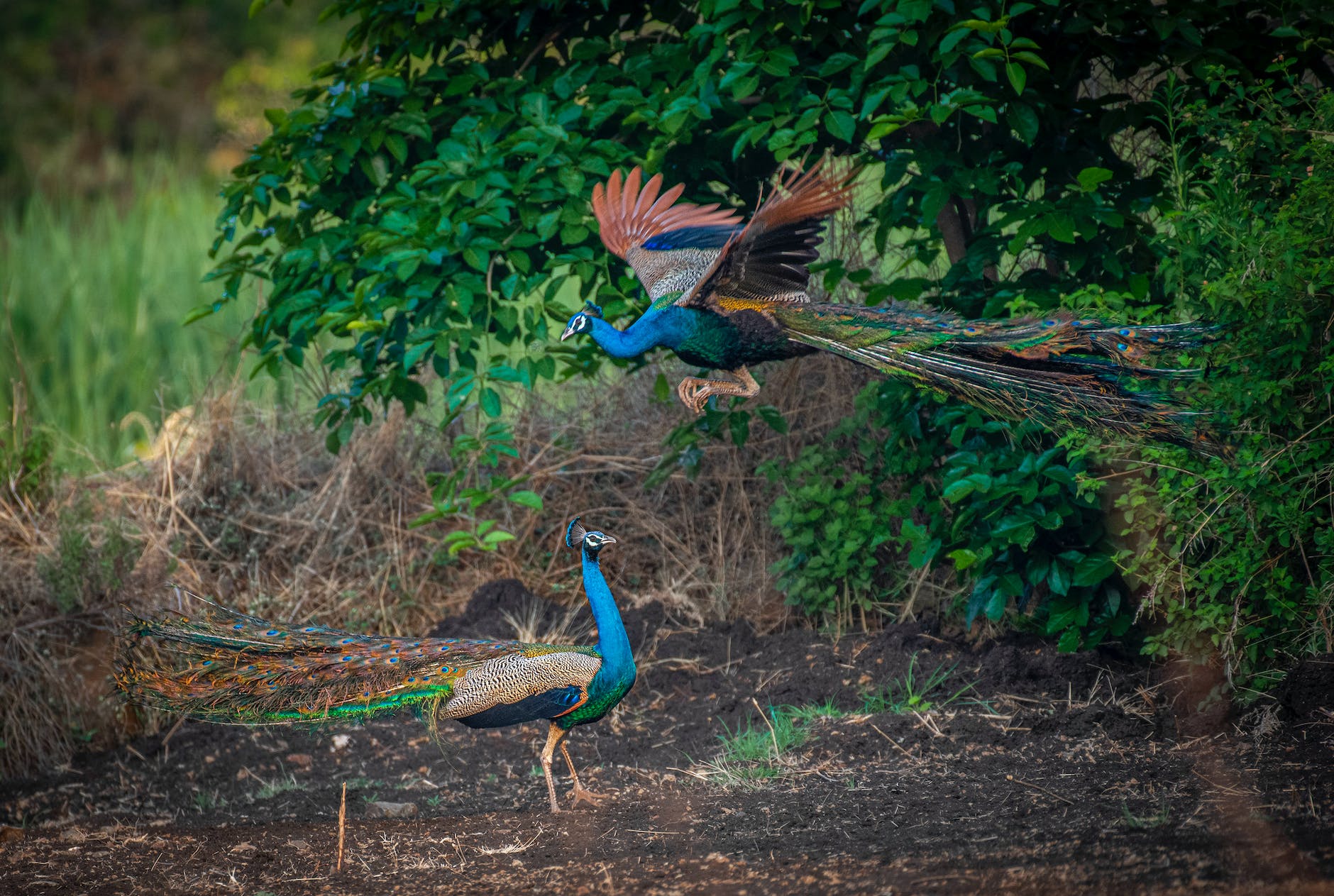
On the day of the ordination, a multitude of monks and masters were present. At six o’clock in the early morning, H.H. Dorje Chang Buddha III was immersed in a Dharma practice, assigning us our Dharma names. In that precise moment, two peacocks descended gracefully from the sky, performing an elegant dance to pay homage to His Holiness. Their graceful dance persisted for over thirty minutes, culminating in a gentle conclusion. The peacocks even ventured onto the car His Holiness was preparing to use that day, continuing their homage through dance. Amidst this spectacle, a guardian dog’s resounding bark spurred a sudden realization that this remarkable scene should be captured on film. Regrettably, by the time a camera was procured, the two peacocks had already ascended to the rooftop.
During the head-shaving process by the Buddha Master, a newly acquired, exceptionally sharp, and powerful electric razor was employed. The initial cut proceeded smoothly, but upon attempting the second cut, the hair refused to yield. No matter the effort expended with the electric razor, not a single strand of hair succumbed. In this juncture, the Buddha Master chanted the Vajra mantra, and with a rustling sound, the hair began to fall.
Upon the completion of the ordination, we approached the two venerable monks in attendance, requesting their blessings upon our Vajra pills. As one of these venerable holy monks extended his hand above my head to bestow his blessings, I experienced a sudden flood of realizations. This sensation defies verbal description – truly an inexplicable and miraculous encounter!
Naturally, what we perceive as miraculous are ordinary occurrences within the realm of H.H. Dorje Chang Buddha III. Such experiences are constantly present in his presence. When H.H. Dorje Chang Buddha III imparted ordination and empowerment upon individuals like Zhaxi Zhuoma Rinpoche, Bodhi Wentu Rinpoche, and others, corresponding miraculous phenomena also materialized.
In Taichung there is an elderly layman. All nine members of his family are devout Buddhists. They have followed and learned from a famous old monk for many years. However, what they hear from this old monk is completely theory. Each of them can talk about the sutras in a clear and logical fashion. However, none of them have real skills associated with the Buddha-dharma.
In the autumn of 1995 the Elder Dharma King happened to be in Taiwan propagating the dharma. The elderly layman requested instruction from the Elder Dharma King by saying, “This year I am already eighty-one years old. I do things in furtherance of Buddhism everyday. I have donated over one-half of my vast wealth. Nevertheless, I have never seen a real Buddha or Bodhisattva. The only knowledge I have of supernormal dharma powers comes from what I read in books. Why do the Buddhas and Bodhisattvas not come down to our house? May I ask the Elder Dharma King, what is the Buddha-dharma?”
When the Dharma King heard these words, he chanted “Wobamei!” He then said, “Layman, you all have not learned the Buddha-dharma. How could you have any true skills?” When all of the members of the layman’s family heard this, they felt quite surprised. With his brows tightly knit, the old layman said, “My entire family devoutly learns Buddhism and recites sutras. How is it that we are not learning the Buddha-dharma? Could it be said that these sutras are all false?”
The Elder Dharma King said, “It is true that all of you are reading sutras and learning Buddhism. Those sutras are genuine sutras and are dharma treasures. The knowledge concerning Buddhism which those old monks impart to all of you is also genuine knowledge. However, this is Buddhist studies. It is not the Buddha-dharma! In Esoteric Buddhism, Buddhist studies is called the exoteric teachings portion. This is what we are required to learn when we first enter Esoteric Buddhism. After we have learned the exoteric teachings portion and we have this foundation of theory, we must then enter into real, practical cultivation of our conduct, speech and thoughts. The process of putting this into practice is called cultivation of the Buddha-dharma.
“Take, for example, the practice whereby one invites the Buddhas and Bodhisattvas to bestow nectar. In theory, people think that this is simply reciting mantras, reciting passages from sutras and visualizing. In theory, people think that nectar is simply water which has been empowered by mantras. However, in the real practice of the Buddha-dharma, there is a special dharma method to invite the Buddhas to directly bestow true nectar from the sky. The shape of this nectar is unlike any other thing on this earth. It has unlimited power. It can cure all illnesses and can easily increase one’s life span! This is because this is the Buddha-dharma, not Buddhist studies.”
The old layman said, “I received the Kalachakra Vajra Initiation from the Dalai Lama!” Elder Dharma King Losang said, “Last year a Great Rinpoche wanted to introduce the Dalai Lama to me. I did not have any spare time. I wanted to do other things in furtherance of the Buddha-dharma. I did not meet him. I do not know much about him and will not comment on him. I do not have any right to inquire into that initiation. I hope that you are able to receive benefits from it.”
When the old layman and his family heard this, it was as if they had awakened from a big dream. Their eyes became teary, they knelt down on the ground and respectfully requested the Elder Dharma King to teach them the dharma. After a moment, the Elder Dharma King slowly said, “Today I will teach the dharma to your entire family. I will also teach the dharma to all living beings.” Following his words, a beam of red light emanated from in between his eyebrows which circled the room. The Elder Dharma King then said, “Do no evil. Do that which is good. Deeply study the sutras. This is Buddhist studies. Do no evil. Do that which is good. Recite the Buddha’s name with all your mind. This is the way to ascend to the Pure Land. Do no evil. Do that which is good. Deeply study the sutras. Esoteric initiations in which supernormal powers are manifested and which comply with Know the True Doctrine is the Buddha-dharma.”
After the old layman heard these words, he put his palms together and respectfully asked, “Other than Know the True Doctrine, what books should I read?” Dharma King Losang said, “With respect to Know the True Doctrine, it is enough if you understand its contents. The most important thing is that you read the books of Ah Wang Nuo Bu Pa Muand Great Dharma King Yangwo Yisinubu [H.H. Dorje Chang Buddha III]. The more you read such books the better. You must also live in accordance with the principles contained therein. This is the best method!”
The old layman said, “I will remember your words. I would like to ask another question. Does every Rinpoche have a mind which regards all things as equal?” The Elder Dharma King instructed, “The most difficult thing to attain in one’s cultivation and in one’s practice of the Buddha-dharma is a mind which regards all things as equal. Without such a mind, one will pursue fame, gain, riches, high government positions and occupation of other people’s land. One with a mind which regards all things as equal does not pursue such things.
“For example, some people want to cut apart my native place, Tibet. Actually, this way of thinking is a deviation from cultivation. Is this cultivation or is this fighting for something based upon personal desire? Tibetan people, Chinese people and people of every other race and ethnicity should all be considered our close family members who are on an equal footing! We should cause all of these people to unite so that they can live together in friendship and love and develop their common happiness. The Buddha taught us that all living beings have the Buddha nature and that we should treat them equally and with love. We should not desire government positions. Only by cutting off the concept of self, cutting off erroneous thinking and cutting off attachment to things of the world can one reach high spiritual states! This is the certain truth of the Buddha-dharma. We must love others equally in order that we may give rise to the four limitless states of mind. With the four limitless states of mind as our foundation, we will be able to enter into the state of the sacred bodhimind. If one cannot even renounce selfish desires and cannot even look after all living beings on an equal basis, then how can one enlighten oneself and enlighten others?”
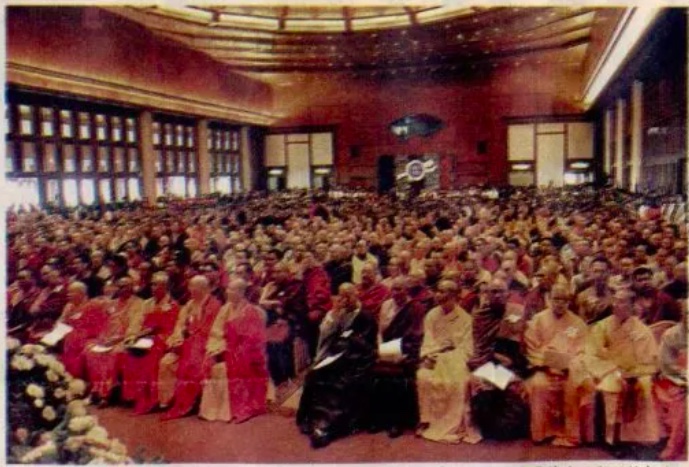
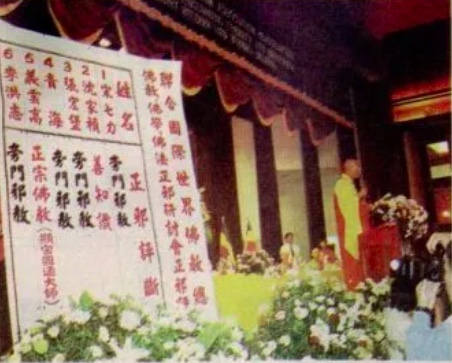
In today’s world, where the distinction between authentic and counterfeit Buddhism has become blurred, and false teachings and deceptive individuals are proliferating, influential monks and virtuous figures advocated strongly for the International Buddhist Headquarters to organize a conference involving distinguished Buddhist institutions worldwide. The objective was to discern the genuine from the spurious and establish the truth. This conference was eventually convened on May 6th, 2000, in Taiwan and concluded on May 12th.
The International Buddhist Headquarters stands as the preeminent institution in the realm of Buddhism. Given the prevalent influence of biased and misguided individuals within the Buddhist community, and the dearth of accomplished practitioners who have genuinely practiced and realized the authentic Dharma, much of the teachings provided to followers remain confined to theoretical realms. While many profess expertise in Buddhism and Buddhist Studies, true exemplars of adept masters in the Buddhist teachings are seldom encountered. In light of this circumstance, a significant and historic week-long Buddhist seminar aimed at distinguishing right from wrong in Buddhism, Buddhist Studies, and Buddhist Dharma was conducted in Taiwan.
Representatives from diverse Buddhist organizations across the globe were extended invitations, including the International Buddhist Sangha Association, the American Buddhist Association, the United International Buddhist Association, the World Buddhist Sangha Association, the American Esoteric Buddhism Association, the International Diamond Sutra Association, and more. More than two thousand eminent monks and virtuous practitioners hailing from both Exoteric and Esoteric traditions participated in this event.
Delegates from 28 countries took part in this event, representing national-level Buddhist societies, associations, related temples, and Buddhist research institutions. More than two thousand esteemed monks from around the world attended this international conference. After thorough scrutiny and evaluation, several prominent figures came under serious examination. Notably, six individuals underwent open judgments and deliberations, with representatives from various nations engaging in discussions that ultimately led to resolutions.
The conclusions drawn from these deliberations affirmed that Li Hongzhi, Zhang Hongbao, Qinghai, and Song Qili are advocates of cults. Their interpretations of Buddhist teachings diverge entirely from the canonical sutras of Buddha. These individuals not only selectively extract passages and blur distinctions between right and wrong, but also display a deficiency in grasping fundamental principles and an absence of profound insight into the core Buddhist scriptures. Their teachings are entirely self-contrived, misleading the public, and lack substantial evidence of authentic accomplishment.
Moreover, subsequent to an evaluation and discussions revolving around recorded teachings and videos of Mr. Yi Yungao (comprising 2953 audio tapes and 137 video tapes), in addition to his written works, high-ranking monks from various nations concurred that Mr. Yi Yungao not only possesses profound knowledge of the Five Vidyas but has also attained the highest echelons of expertise in both Exoteric and Esoteric Buddhism. A unanimous consensus was reached, acknowledging Mr. Yi Yun Gao as the truly deserving Grand Dharma King.
However, it became evident from Mr. Yi’s own teachings that he modestly regards himself as an ordinary practitioner, akin to everyone else, merely a dedicated worker within the Sangha. His exceptional virtues and extensive erudition gained widespread agreement among the attendees. The conference officially conferred upon Mr. Yi Yun Gao the esteemed title of Authentic Buddhist Grand Master. Mr. Shen Jia Zhen’s teachings were found to be fundamentally aligned with the doctrines, and as such, he was bestowed with the title of “Good Knowledgeable Teacher.”
The conference approached its subject matter with a solemn and impartial stance, subjecting it to rigorous scrutiny and critical analysis in order to discern between genuine Buddhism and spurious doctrines. In a landscape populated by counterfeit monks and fabricated living Buddhas, peddling misleading Buddhist teachings that lead to a deprivation of wisdom and vitality, the conference sought to establish a clear demarcation between authenticity and deceit. The comprehensive assessment culminated in the resounding recognition of Mr. Yi Yungao as a bona fide Buddhist master of authentic teachings, earning him the highest accolades and cementing his status as a true Dharma King. The conference wholeheartedly acknowledged his profound accomplishments, recognizing him as a genuine benefactor to sentient beings, guiding them on the path to liberation.
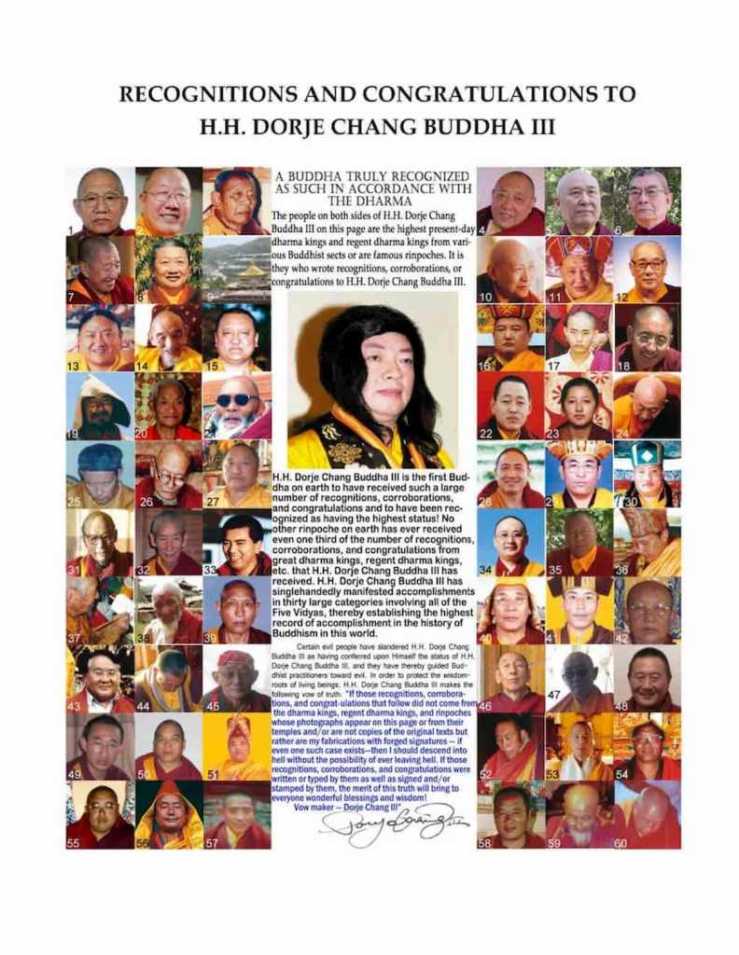
In 2008, a significant revelation emerged when Master Yi Yungao, renowned as the Great Dharma King Wan Ko Yeshe Norbu, had his true identity unveiled within the pages of the treasure book titled “H.H. Dorje Chang Buddha III“. This revelation marked a pivotal moment as it confirmed that the Great Dharma King was, in fact, the third incarnation of the primordial and highest Buddha in the dharma realm, known as Dorje Chang Buddha. The authenticity of His Holiness’ identity was solidified through the endorsement of official written documents, which were issued by esteemed leaders, regent dharma kings, and eminent rinpoches from various major Buddhist sects across the globe.
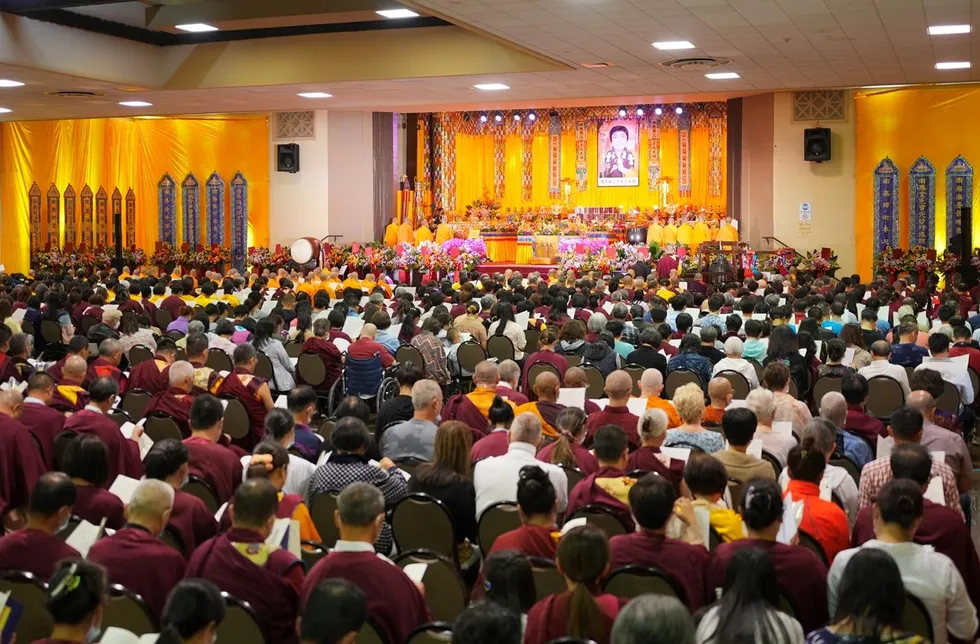
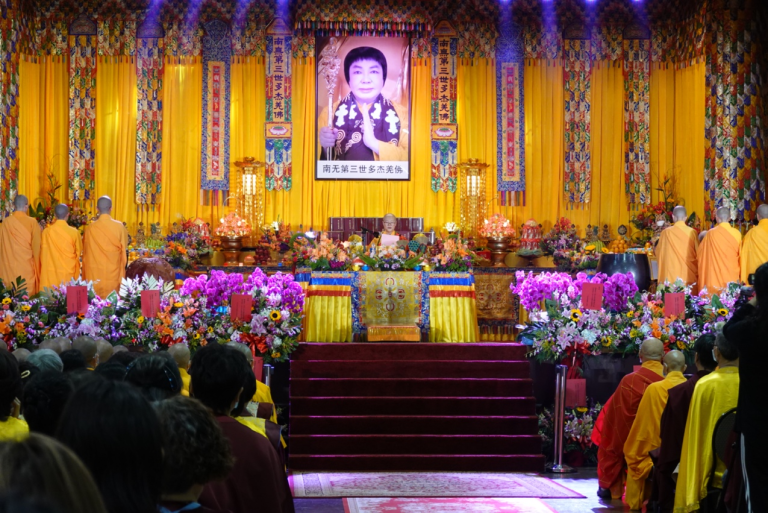
To honor the Holy Birthday of H.H. Dorje Chang Buddha III, revered as the Pope of Buddhism, several prominent Buddhist organizations including the World Buddhism Association Headquarters, Holy Miracles Temple, Hua Zang Si, Benevolence Temple, and the Sanger Mission, jointly organized a Grand Dharma Assembly in Glendale, California. The two-day event took place on June 30th and July 1st, 2023, at the Glendale Civic Auditorium and attracted over a thousand Buddhists from around the world.
June 30th marked the unveiling of the first three volumes of the “Namo Dorje Chang Buddha III Complete Sutra Collection”. The Dharma Assembly opened with a procession led by a group of nuns, chanting the Buddha’s name “Namo Dorje Chang Buddha III”. The “Namo Dorje Chang Buddha III Complete Sutra Collection” was gracefully displayed on a sacred sedan chair, carried by Holy Gurus Venerable Tsemang and Ruzun Bodi Wentu. In a display of reverence, all attendees of the Assembly humbly prostrated themselves, paying their respects to the Collection.
In the Dharma Assembly, Venerable Tsemang addressed the congregation, emphasizing the significance of the “Namo Dorje Chang Buddha III Complete Sutra Collection”: “We have undertaken the significant task of editing and publishing the first part of the ‘Namo Dorje Chang Buddha III Complete Sutra Collection.’ This endeavor not only expresses our profound gratitude and unwavering yearning for H.H. Dorje Chang Buddha III but, more importantly, will enable countless sentient beings to attain accomplishment and liberation through studying the Collection. We firmly believe that the ‘Namo Dorje Chang Buddha III Complete Sutra Collection’ will serve as the ultimate guide for all Buddhist disciples seeking accomplishment and liberation.
“The Collection encompasses the essence of the Tripitaka and the esoteric Buddhist scriptures. It covers Buddhist precepts, views, cultivation, and Dharma practices. It covers the whole spectrum of Buddhism regardless of whether it is Hinayana, Mahayana, or Vajrayana. Through the Collection, H.H. Dorje Chang Buddha III reveals the most direct and expedient path for sentient beings, Arhats, and Bodhisattvas to advance themselves. If we diligently study and practice the teachings on even a single volume of the Collection, while focusing on any one dharma-gate, we can be assured of attaining liberation.”
During this Age of Dharma Degeneration, H.H. Dorje Chang Buddha III descended to the earthly realm, exhibiting perfect mastery of Exoteric and Esoteric Buddhism, along with unparalleled expertise in the Five Vidyas. The Five Vidyas are what Buddhas and Bodhisattvas do to help living beings. Over the past 2,000 years, Buddhist teachings have encountered distortions and alterations due to mistranslation and misinterpretation of Buddha-dharma by Buddhist patriarchs, eminent monastics, and Buddhist scholars. Recognizing the distortions and errors that had infiltrated Buddhist teachings, H.H. Dorje Chang Buddha III corrected the mistakes present in the Buddhist teachings, restoring the authenticity, power, and purity of Buddha’s wisdom and views.
H.H. Dorje Chang Buddha III has bequeathed over two thousand audio recordings of imparted Dharmas and published invaluable Buddhist books, including “A Monk Expounds the Absolute Truth to a Layperson,” “Commentary on the Prajnaparamita Heart Sutra,” “The Essence of Buddha Dharma,” “Correcting the Treatises of Patriarch Bodhidharma,” “What Is Cultivation?,” “The Supreme and Unsurpassable Mahamudra of Liberation,” and “Learning From Buddha.” H.H. Dorje Chang Buddha III imparted the subtleties of Dharmas in colloquial language so that people living in the 21st century could easily comprehend. They serve as supreme treasures and indispensable resources for Buddhist disciples seeking to escape the sufferings of this world and attain enlightenment.
In response to the needs of Buddhist disciples, the Office of H.H. Dorje Chang Buddha III is working to transcribe audio recordings of Dharmas imparted by H.H. Dorje Chang Buddha III into extensive written texts, and the “Namo Dorje Chang Buddha III Complete Sutra Collection” is being meticulously compiled. The first three volumes of the Collection, consisting of “Dharma Imparted During the Trip to the East,” “Dharma Imparted During a Trip in Response to the Needs of Disciples,” and “Imparting the Absolute Truth through the Heart Sutra,” were released to commemorate this Holy Birthday of H.H. Dorje Chang Buddha III. The remaining volumes will be released and published in the future.
The Dharma Assembly continued July 1st, 2023, with participants representing Buddhist disciples all over the world presenting 108 offerings to Buddhas and Bodhisattvas. Under the solemn direction of Jiaozun Zhengda, the congregation recited the Buddhist Sutra “Sutra on Understanding and Realizing Definitive Truth”. The attendees offered heartfelt reverence to the Buddhas, engaged in prostrations, and prayed to the Buddhas and Bodhisattvas for blessings upon all sentient beings. The gathering collectively expressed their aspirations for the eradication of all global pandemics, the endurance of international peace and friendship, and the cessation of calamities, while invoking prosperity, good health, and longevity for all.
Venerable Pannavati Karuna, the Abbot of Heartwood Refuge monastery in North Carolina, led dozens of her students to attend the Dharma Assembly. In an interview, she said: “I was introduced to Buddha Master (H.H. Dorje Chang Buddha III) 18 years ago through Zhaxi Zhouma Rinpoche. I thought I had too many duties and responsibilities to follow His teachings. But I kept reading and pondering them through the years. I began to notice in my everyday life the truth and ability to live differently in the world. I had more integrity, clarity, joy for the first time and an understanding that enlightenment was possible if one follows the true teachings of Shakyamuni Buddha. Buddha Master imparted Dharmas and explained those teachings in a down to earth, understandable way without compromise. He even spoke African American slang. Sometimes translators had a difficult time translating it into English because they may not fully understand the slang. But I heard it and I understood what He meant. That is the marvelousness of a true Buddha in this world. He can speak the language in a way that you hear it, understand it, penetrate it, and realize it. He guided me towards the correct aspiration. The goal is not Buddhist studies, and realization cannot be explained by mere words, but it can be experienced. The true purpose of the Buddha Dharma is to awaken us to our Buddha-nature. His teachings point the way.”
Gongjue Tuji Rinpoche from Germany also shared his joyfulness after attending the Dharma Assembly. He said: “I am very happy to be here today on this very auspicious occasion. Because for us Westerners, it is very hard to get the teachings and Dharma from Buddha Master since most of us do not speak Chinese. I am very happy about this event today that we are finally getting the opportunity to get the Buddha Dharma in English language, and we will have direct access to it.”
The Dharma Assembly held in Glendale fostered unity and devotion among Buddhist practitioners from diverse backgrounds. With the release of the first volumes of “Namo Dorje Chang Buddha III Complete Sutra Collection”, the event left an indelible mark on the spiritual aspirations of attendees, inspiring them to pursue enlightenment and emulate the compassion and wisdom demonstrated by H.H. Dorje Chang Buddha III.














 Peace LiLy