Bodhisattva Ksitigarbha: A Beacon of Hope in Impermanence

The belief in Bodhisattva Ksitigarbha is deeply rooted in Asian folk religions, offering a profound message of compassion and salvation. Ksitigarbha, also known as “Earth Treasury” or “Earth Store,” is revered for his extraordinary vows and his unwavering commitment to alleviating suffering, particularly in hellish realms. In China, alongside Manjusri, Samantabhadra, and Avalokiteshvara, Bodhisattva Ksitigarbha is honored as one of the “Four Great Bodhisattvas.”

The “Sutra of the Bodhisattva Ksitigarbha’s Fundamental Vows” is a sacred scripture, attributed to Shakyamuni Buddha himself, that highlights the remarkable vow power of Bodhisattva Ksitigarbha. In this sutra, Ksitigarbha’s magnificent vow is eloquently praised: “Until the hells are empty, I will not attain Buddhahood, and I will only achieve enlightenment after saving all beings.” The text also provides insights into Ksitigarbha’s exemplary actions and deeds along his spiritual path.

A Tale of Filial Piety and Redemption: In one of his past lives, Bodhisattva Ksitigarbha incarnated as a woman named Guangmu. She exemplified unparalleled filial devotion, but her mother’s disbelief in karma led to her descent into hell after death. Learning of her mother’s plight, Guangmu selflessly sacrificed her most cherished possessions to accumulate merits on her mother’s behalf. Before the Buddha, she made a solemn vow: to secure her mother’s permanent liberation from the three evil paths and, only then, seek her own enlightenment. Through Guangmu’s selfless acts and immense vow, her mother swiftly attained liberation and ultimately achieved Buddhahood.

People place their faith in Bodhisattva Ksitigarbha due to his profound aspiration: “To save all sentient beings and attain enlightenment; I will not achieve Buddhahood until hell is empty.” This resolute vow has made him a beacon of hope for those seeking liberation in the afterlife.

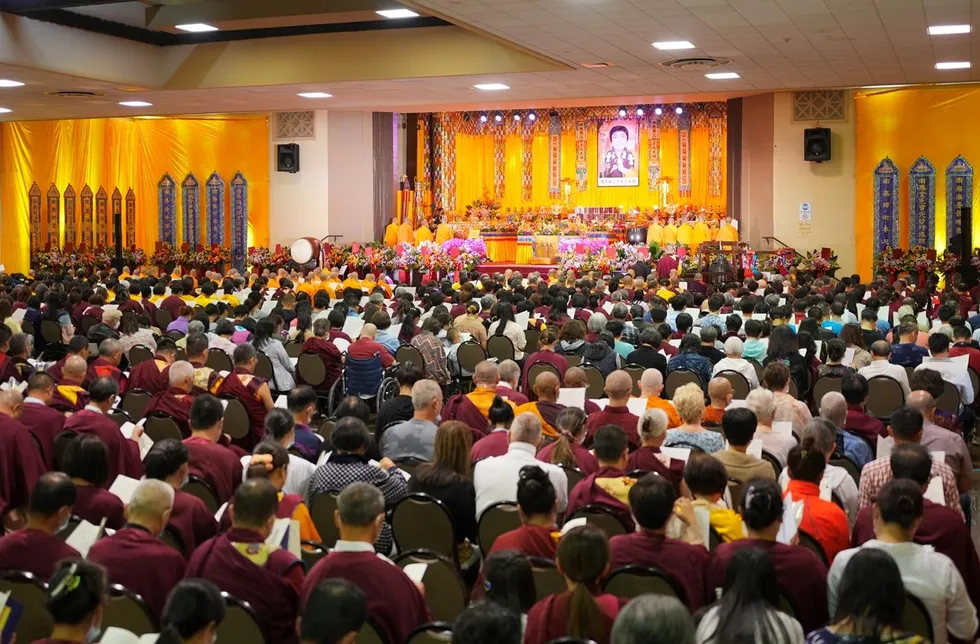
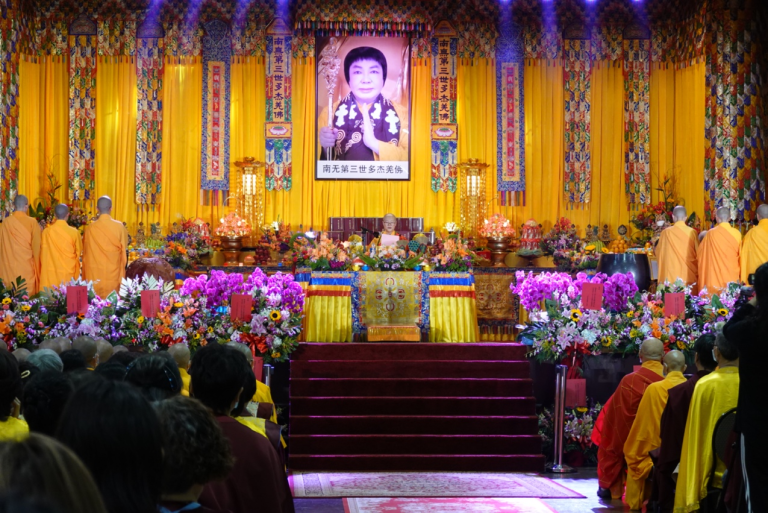
The holy birthday of Bodhisattva Ksitigarbha falls on the last day of July in the Chinese lunar calendar, which corresponds to September 14th this year. Buddhists worldwide come together to honor and memorialize Bodhisattva Ksitigarbha during special assemblies held in Buddhist temples. These gatherings serve not only to pray for the well-being of all living beings but also to beseech blessings for departed relatives and friends, hoping they will ascend to higher realms through the benevolent influence of Bodhisattva Ksitigarbha. This year, a special assembly was held at Hua Zang Si temple in San Francisco on September 10th.

Every year, my participation in the Ksitigarbha Dharma assembly evokes a mix of emotions. On one hand, I feel a deep sense of joy as I pray for the protection and blessings of the Buddhas and Bodhisattvas for all beings. On the other hand, a profound sadness envelops me as I witness my loved ones departing from this world one by one. The list of those to be transferred to a better realm, through prayers and rituals, continues to grow. This year, the passing of my uncle, the youngest brother of my father, added to the somber realization of life’s brevity and the swift nature of impermanence.

As I age, I keenly experience various illnesses, physical decline, and a slowing of my movements. These experiences have deepened my understanding of why H.H.  Dorje Chang Buddha III continually reminds us to cultivate the awareness of impermanence. In “What is Cultivation?” and in many pre-recorded Dharma discourses, His Holiness emphasizes that being mindful of impermanence is the cornerstone of our spiritual development. Without this awareness, one cannot establish the sincere commitment required to practice Buddhist Dharma earnestly and break free from the cycle of life and death.

Life has presented me with numerous unpredictable natural disasters and personal sufferings. Unless I persistently dedicate myself to spiritual practice, the looming specter of death may catch me unprepared, leading to a fate that is both pitiable and terrifying.
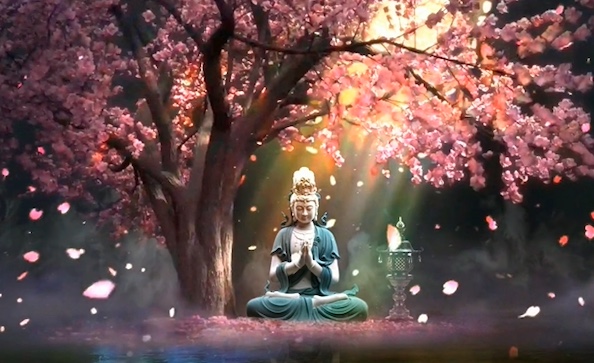
I earnestly pray that all Buddhas and Bodhisattvas, with a special invocation to Bodhisattva Ksitigarbha, bless all living beings with the wisdom to grasp the impermanence of life. May we all diligently cultivate ourselves, seeking liberation in this lifetime and guiding the departed souls to higher realms, where they can encounter the profound teachings of Buddhism and ultimately break free from the cycle of birth and death.

Bodhisattva Ksitigarbha: A Beacon of Hope in Impermanence

Link:https://peacelilysite.com/2023/09/22/bodhisattva-ksitigarbha-a-beacon-of-hope-in-impermanence/

#  DorjeChangBuddhaIII#HHDorjeChangBuddhaIII#HuaZangSi #Buddha #Buddhism #buddhist #Temple#BuddhismTemple#SanFrancisco#BodhisattvaKsitigarbha #Impermanence
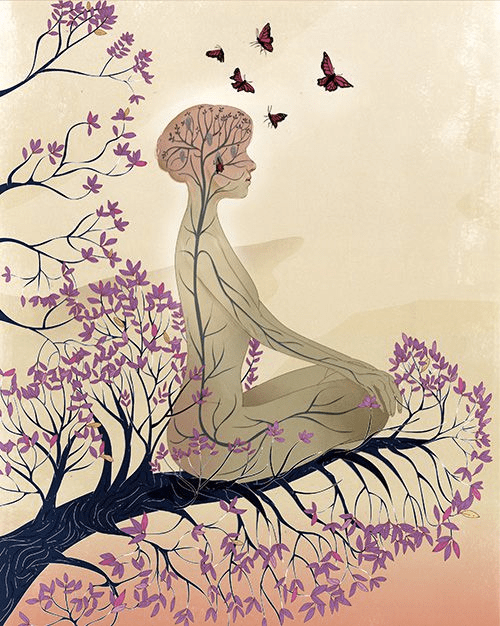
Scientific Discovery: Once You Choose Forgiveness, Your Brain Will Help You “Let Go” of Pain

Choosing forgiveness makes it easier to forget pain

A scientific study published on May 21, 2014, in the journal ‘Psychological Science’ found that people who choose to forgive are more likely to forget the details of past hurts. This is because the act of forgiveness triggers a mechanism that helps in forgetting painful memories.

Researchers from the University of St. Andrews in the United Kingdom had 30 participants read content describing various scenarios, including severe harm to others and theft. They then asked each participant to rate the extent of harm caused by each behavior and to consider how likely they would be to forgive the perpetrator if they were the victim.

Two weeks later, the same group of participants read the same content, but this time it was color-coded, with some portions in red and others in green. Researchers instructed participants to recall the content in green while avoiding thinking about the red portions.

Dr. Saima Noreen, the lead author of the paper, explained that participants who initially chose to “forgive” had difficulty recalling the details when they later tried to remember the events. In contrast, those who initially chose “not to forgive,” even when instructed not to recall the details during the experiment, still had vivid memories.

The research findings suggest that when people make the decision to “forgive,” the brain activates a forgetting mechanism that helps them forget painful memories that were once detrimental to them. While achieving true forgiveness may still be challenging at times, simply choosing forgiveness can make it easier to forget those memories.

Dr. Noreen stated, “The relationship between forgiveness and forgetting is bidirectional and becomes more complex over time. Over the long term, we have known that forgiving others has positive effects on personal health.”

The Lifelong Disasters of Unforgiveness

In recent years, researchers have conducted numerous experiments to explore the relationship between ‘forgiveness’ and health. They have discovered that forgiveness, as a psychological activity, can improve cardiovascular function, reduce chronic pain, alleviate stress, and enhance the quality of life. It is indeed a potent remedy for maintaining good health.

On the other hand, individuals who harbor unresolved conflicts and refuse to forgive often experience constant psychological tension. The inner turmoil, when left unresolved, can lead to heightened brain and nervous system activity. This can result in nervous tension, blood vessel constriction, elevated blood pressure, gastrointestinal spasms, and inhibited digestive secretions, thereby increasing the risk of heart disease, mental health issues, and other ailments.

Practical life experiences have also demonstrated that individuals who react impulsively and are unable to forgive others tend to escalate minor issues into major conflicts, intensifying contradictions, and causing long-term consequences for themselves.”

In the book Midnight Conversations in Medicine (醫山夜話)compiled from real-life cases, the chapter titled “Financial Ruin Caused by Unforgiveness” narrates the life catastrophe resulting from “unforgiveness.”

In the story, the patient’s name is Rui, who sought treatment at a Traditional Chinese Medicine clinic for Parkinson’s Disease. In Chinese medicine, Parkinson’s Disease is referred to as “tremor paralysis.” Rui had been suffering from this condition for nearly three years, experiencing tremors in both of her hands. She often struggled to eat because of her severe tremors, with her food falling to the ground before reaching her mouth. After a period of treatment with traditional Chinese medicine, her condition showed little improvement, with symptoms frequently recurring. Perplexed, the Chinese medicine practitioner inquired about her life, leading Rui to recount the events that had unfolded:

“My husband and I run a container shipping company for ships. We own a villa on an island, sharing a private road with our neighbors. On the island, it’s just our two families. Due to the poor condition of the road, we proposed that both families contribute money to repair it. However, our neighbors opposed the idea, so we had to foot the bill for repairs ourselves. Unfortunately, the workers we hired were careless and dumped the road repair stones in the middle of the road, causing inconvenience to our neighbors’ traffic. They suspected that we did this out of spite and sealed off a gate that belonged to their property but was more convenient and closer to our home. This meant that we had to take a much longer route to get home.

“My husband, in his anger, turned off the main water valve. We had installed the water system first, and to save money, they connected their water supply from ours. Turning off the valve cut off their water source. This infuriated them, and they retaliated by pouring cement and piling stones on our driveway, completely blocking our way home. And so, over a mere 2,000 yuan road repair cost, we became bitter enemies. What’s even more unbearable is that both sides hired lawyers, and this legal dispute has been going on for nearly three years, costing us a whopping 2 million yuan in legal fees. During these three years, we couldn’t go home, and they couldn’t live there either. Now our conflict has escalated to a life-and-death struggle. The house cannot be sold due to the unresolved lawsuit, it’s uninhabitable, and it needs repairs…”

As Rui continued her narrative, she became increasingly emotional, her hands trembling, her face turning red, and her emotions nearly reaching the breaking point. The Chinese medicine practitioner realized the underlying cause of her recurring illness was rooted in her inability to forgive.

Psychologists have found that when people can view conflicts from the other person’s perspective, there are significant physiological changes. Both heart rate and blood pressure decrease, there is less frowning, and skin conductance (a measure of sympathetic nervous system activity) also decreases – all of which are good indicators of the sympathetic nervous system functioning.

Religions also emphasize the practice of forgiveness. In Christianity, it is taught that forgiveness towards others is essential for God to forgive one’s own sins. Buddhism, on the other hand, encourages a comprehensive approach to forgiveness. In the core process of self-cultivation, true Buddhist practitioners are guided to embrace the Four Limitless States of Mind, which encompass virtues such as Equanimity, Loving Kindness, Compassion, and Sympathetic Joy.

A profound illustration of forgiveness is exemplified by the contemporary Buddha, H.H.  Dorje Chang Buddha III,. One of His Holiness’ disciples, Hongxi Fazang, engaged in numerous defamatory actions against H.H.  Dorje Chang Buddha III, through social media and within Buddhist temples. Later, he came to realize the gravity of his actions and was overwhelmed with remorse. Desiring to return to the guidance of the Buddha Master, he sought reconciliation.

Remarkably, the profoundly compassionate Buddha welcomed him back as a disciple with the same love and teachings as before. When other disciples found it hard to believe Hongxi Fazang’s return, His Holiness simply said, “If I don’t forgive him, who can?” The following video showcases Hongxi Fazang’s heartfelt repentance and deep gratitude towards H.H.  Dorje Chang Buddha III, at the Holy Miracle Temple.

Scientific Discovery: Once You Choose Forgiveness, Your Brain Will Help You “Let Go” of Pain

Link:https://peacelilysite.com/2023/09/13/scientific-discovery-once-you-choose-forgiveness-your-brain-will-help-you-let-go-of-pain/

#DorjeChangBuddhaIII #HHDorjeChangBuddhaIII #Forgivness #Christianity #HolyMiracleTemple

Source: https://www.tpcdct.org/article/4458#comment-1080

Religious Leaders Hold Dharma Assembly to Honor the Holy Birthday of H.H. Dorje Chang Buddha III 

Release of the first Volumes of “Namo Dorje Chang Buddha III Complete Sutra Collection

By Jon Stojan July 25 2023

To honor the Holy Birthday of H.H. Dorje Chang Buddha III, revered as the Pope of Buddhism, several prominent Buddhist organizations including the World Buddhism Association Headquarters, Holy Miracles Temple, Hua Zang Si, Benevolence Temple, and the Sanger Mission, jointly organized a Grand Dharma Assembly in Glendale, California. The two-day event took place on June 30th and July 1st, 2023, at the Glendale Civic Auditorium and attracted over a thousand Buddhists from around the world. 

June 30th marked the unveiling of the first three volumes of the “Namo Dorje Chang Buddha III Complete Sutra Collection”. The Dharma Assembly opened with a procession led by a group of nuns, chanting the Buddha’s name “Namo Dorje Chang Buddha III”. The “Namo Dorje Chang Buddha III Complete Sutra Collection” was gracefully displayed on a sacred sedan chair, carried by Holy Gurus Venerable Tsemang and Ruzun Bodi Wentu. In a display of reverence, all attendees of the Assembly humbly prostrated themselves, paying their respects to the Collection. 

In the Dharma Assembly, Venerable Tsemang addressed the congregation, emphasizing the significance of the “Namo Dorje Chang Buddha III Complete Sutra Collection”: “We have undertaken the significant task of editing and publishing the first part of the ‘Namo Dorje Chang Buddha III Complete Sutra Collection.’ This endeavor not only expresses our profound gratitude and unwavering yearning for H.H. Dorje Chang Buddha III but, more importantly, will enable countless sentient beings to attain accomplishment and liberation through studying the Collection. We firmly believe that the ‘Namo Dorje Chang Buddha III Complete Sutra Collection’ will serve as the ultimate guide for all Buddhist disciples seeking accomplishment and liberation. 

“The Collection encompasses the essence of the Tripitaka and the esoteric Buddhist scriptures. It covers Buddhist precepts, views, cultivation, and Dharma practices. It covers the whole spectrum of Buddhism regardless of whether it is Hinayana, Mahayana, or Vajrayana. Through the Collection, H.H. Dorje Chang Buddha III reveals the most direct and expedient path for sentient beings, Arhats, and Bodhisattvas to advance themselves. If we diligently study and practice the teachings on even a single volume of the Collection, while focusing on any one dharma-gate, we can be assured of attaining liberation.”  

During this Age of Dharma Degeneration, H.H. Dorje Chang Buddha III descended to the earthly realm, exhibiting perfect mastery of Exoteric and Esoteric Buddhism, along with unparalleled expertise in the Five Vidyas. The Five Vidyas are what Buddhas and Bodhisattvas do to help living beings. Over the past 2,000 years, Buddhist teachings have encountered distortions and alterations due to mistranslation and misinterpretation of Buddha-dharma by Buddhist patriarchs, eminent monastics, and Buddhist scholars. Recognizing the distortions and errors that had infiltrated Buddhist teachings, H.H. Dorje Chang Buddha III corrected the mistakes present in the Buddhist teachings, restoring the authenticity, power, and purity of Buddha’s wisdom and views. 

H.H. Dorje Chang Buddha III has bequeathed over two thousand audio recordings of imparted Dharmas and published invaluable Buddhist books, including “A Monk Expounds the Absolute Truth to a Layperson,” “Commentary on the Prajnaparamita Heart Sutra,” “The Essence of Buddha Dharma,” “Correcting the Treatises of Patriarch Bodhidharma,” “What Is Cultivation?,” “The Supreme and Unsurpassable Mahamudra of Liberation,” and “Learning From Buddha.” H.H. Dorje Chang Buddha III imparted the subtleties of Dharmas in colloquial language so that people living in the 21st century could easily comprehend. They serve as supreme treasures and indispensable resources for Buddhist disciples seeking to escape the sufferings of this world and attain enlightenment. 

 In response to the needs of Buddhist disciples, the Office of H.H. Dorje Chang Buddha III is working to transcribe audio recordings of Dharmas imparted by H.H. Dorje Chang Buddha III into extensive written texts, and the “Namo Dorje Chang Buddha III Complete Sutra Collection” is being meticulously compiled. The first three volumes of the Collection, consisting of “Dharma Imparted During the Trip to the East,” “Dharma Imparted During a Trip in Response to the Needs of Disciples,” and “Imparting the Absolute Truth through the Heart Sutra,” were released to commemorate this Holy Birthday of H.H. Dorje Chang Buddha III. The remaining volumes will be released and published in the future. 

The Dharma Assembly continued July 1st, 2023, with participants representing Buddhist disciples all over the world presenting 108 offerings to Buddhas and Bodhisattvas.  Under the solemn direction of Jiaozun Zhengda, the congregation recited the Buddhist Sutra “Sutra on Understanding and Realizing Definitive Truth”. The attendees offered heartfelt reverence to the Buddhas, engaged in prostrations, and prayed to the Buddhas and Bodhisattvas for blessings upon all sentient beings. The gathering collectively expressed their aspirations for the eradication of all global pandemics, the endurance of international peace and friendship, and the cessation of calamities, while invoking prosperity, good health, and longevity for all. 

Venerable Pannavati, some of her students, and other attendees at the Dharma Assembly

Venerable Pannavati Karuna, the Abbot of Heartwood Refuge monastery in North Carolina, led dozens of her students to attend the Dharma Assembly. In an interview, she said: “I was introduced to Buddha Master (H.H. Dorje Chang Buddha III) 18 years ago through Zhaxi Zhouma Rinpoche. I thought I had too many duties and responsibilities to follow His teachings. But I kept reading and pondering them through the years. I began to notice in my everyday life the truth and ability to live differently in the world. I had more integrity, clarity, joy for the first time and an understanding that enlightenment was possible if one follows the true teachings of Shakyamuni Buddha. Buddha Master imparted Dharmas and explained those teachings in a down to earth, understandable way without compromise. He even spoke African American slang. Sometimes translators had a difficult time translating it into English because they may not fully understand the slang. But I heard it and I understood what He meant. That is the marvelousness of a true Buddha in this world. He can speak the language in a way that you hear it, understand it, penetrate it, and realize it. He guided me towards the correct aspiration. The goal is not Buddhist studies, and realization cannot be explained by mere words, but it can be experienced. The true purpose of the Buddha Dharma is to awaken us to our Buddha-nature. His teachings point the way.” 

Gongjue Tuji Rinpoche from Germany also shared his joyfulness after attending the Dharma Assembly. He said: “I am very happy to be here today on this very auspicious occasion. Because for us Westerners, it is very hard to get the teachings and Dharma from Buddha Master since most of us do not speak Chinese. I am very happy about this event today that we are finally getting the opportunity to get the Buddha Dharma in English language, and we will have direct access to it.” 

The Dharma Assembly held in Glendale fostered unity and devotion among Buddhist practitioners from diverse backgrounds. With the release of the first volumes of “Namo Dorje Chang Buddha III Complete Sutra Collection”, the event left an indelible mark on the spiritual aspirations of attendees, inspiring them to pursue enlightenment and emulate the compassion and wisdom demonstrated by H.H. Dorje Chang Buddha III. 

Religious Leaders Hold Dharma Assembly to Honor the Holy Birthday of H.H. Dorje Chang Buddha III 

Link:https://peacelilysite.com/2023/08/04/religious-leaders-hold-dharma-assembly-to-honor-the-holy-birthday-of-h-h-dorje-chang-buddha-iii/

#DharmaAssembly #DorjeChangBuddhaIII #HHDorjeChangBuddhaIII#DorjeChangBuddha #GesangSuolangRinpoche #Buddha #ZhaxiZhuomaRinpoche #ReligiousLeaders # Glendale #VenerablePannavatiKaruna #AbbotHeartwoodRefugemonastery #North Carolina #NamoDorjeChangBuddhaIIIComplete Sutra Collection

Source: https://www.usatoday.com/story/special/contributor-content/2023/07/25/assembly-held-to-honor-the-birthday-of-h-h-dorje-chang-buddha-iii/70462586007/#:~:text=The%20two%2Dday%20event%20took,Buddha%20III%20Complete%20Sutra%20Collection%22.

Chinese Calligraphy: Intangible Cultural Heritage of Humanity

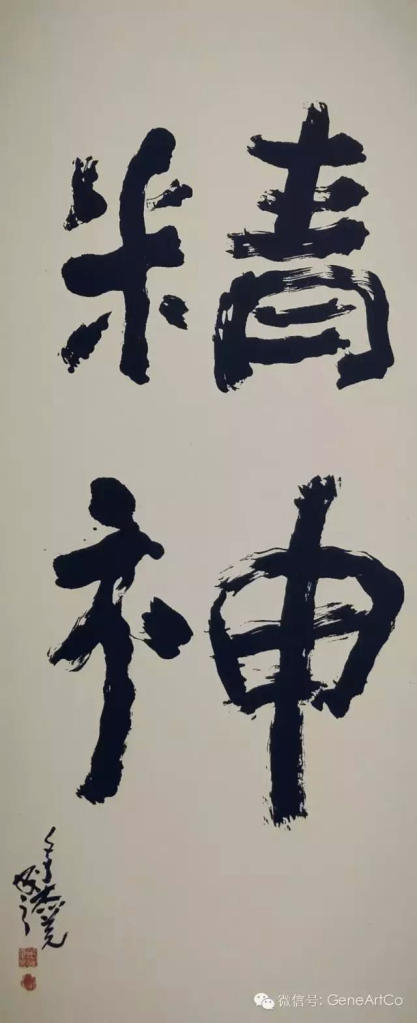
精神 Spirit by H.H. Dorje Chang Buddha III

H.H. Dorje Chang Buddha III Calligraphy Artworks

Chinese calligraphy has transcended its role as a mere communication tool and has become an art form highly esteemed even in an era dominated by ballpoint pens and computers. No longer limited to intellectuals and officials, calligraphy is now practiced by professional artisans and enthusiastic amateurs. Calligraphers employ brushes to beautifully ink five distinct styles of script: ‘seal’, ‘official’, ‘cursive’, ‘running’, and ‘regular’. While calligraphy can be found on various surfaces, even adorning the rocky walls of cliffs, it is most commonly seen on letters, scrolls, literary works, and fan coverings.

Throughout history, the Chinese have believed that no art form or field of study can truly reflect a person’s moral character and knowledge as effectively as calligraphy. The accomplishments or creations in other arts or fields often overshadow one’s shortcomings in knowledge and character. However, calligraphy stands apart from this convention. It functions as a three-dimensional mirror, projecting the depth of knowledge, moral character, and mental strength with each brushstroke. There is no hiding or concealing these qualities. When examining an individual’s ordinary handwriting of Chinese characters, one can often discern their level of education. This is even more evident when examining their calligraphy.

In the annals of history, there is no account of an unknowledgeable person making significant contributions to calligraphy. Profound and extensive knowledge does not necessarily guarantee expertise in calligraphy. However, great calligraphers possess both knowledge and skillful brushwork. Without exception, the renowned calligraphers of past generations were literary masters who possessed deep knowledge. Notable examples include Xizhi Wang, Su Huai, Shaoji He, Huaiguan Zhang, Fei Yue, and in more recent times, Youren Yu. Each of them was an erudite literary figure and exemplar of virtue.

Knowledge serves as the pillar and cornerstone of calligraphy, while moral character is reflected in the style and allure of the art form. Thus, calligraphy demands a combination of knowledge and moral character.


When one appreciate the calligraphy of H.H. Dorje Chang Buddha III, one can understand that why chinese believe that calligraphy combines one’s knowledge, moral character and mental strength .The calligraphy of H.H. Dorje Chang Buddha III Wan Ko Yeshe Norbu Holiest Tathagata is not bound by worldly conventions and is devoid of unnecessary flamboyance. It is highly refined and based upon ingenious artistic conception. His Holiness’s strokes are sometimes written in a swift curling style.
However, in an instant, His Holiness can express the innocent and natural charm of a child. There is wonder in even common strokes. His calligraphy is naturally graceful, exhibiting depth and brilliance. The calligraphy of His Holiness contains an invisible force that makes the characters seem much grander than they appear on a superficial level. His strokes look harmoniously smooth and unbroken. The Chinese characters may appear strong and vigorous, like a soaring dragon or mighty tiger. They may appear clear and gently elegant, like slowly floating clouds, cranes flying among pine trees, or dancing swans. They may appear simple and unadorned, like the free heart of a child. They are gracefully understated and completely devoid of any mundane quality. The calligraphy of H.H. Dorje Chang Buddha IlI is natural in quality and resonates with the true nature of the universe. A deep power underlies His Holiness’s strokes.

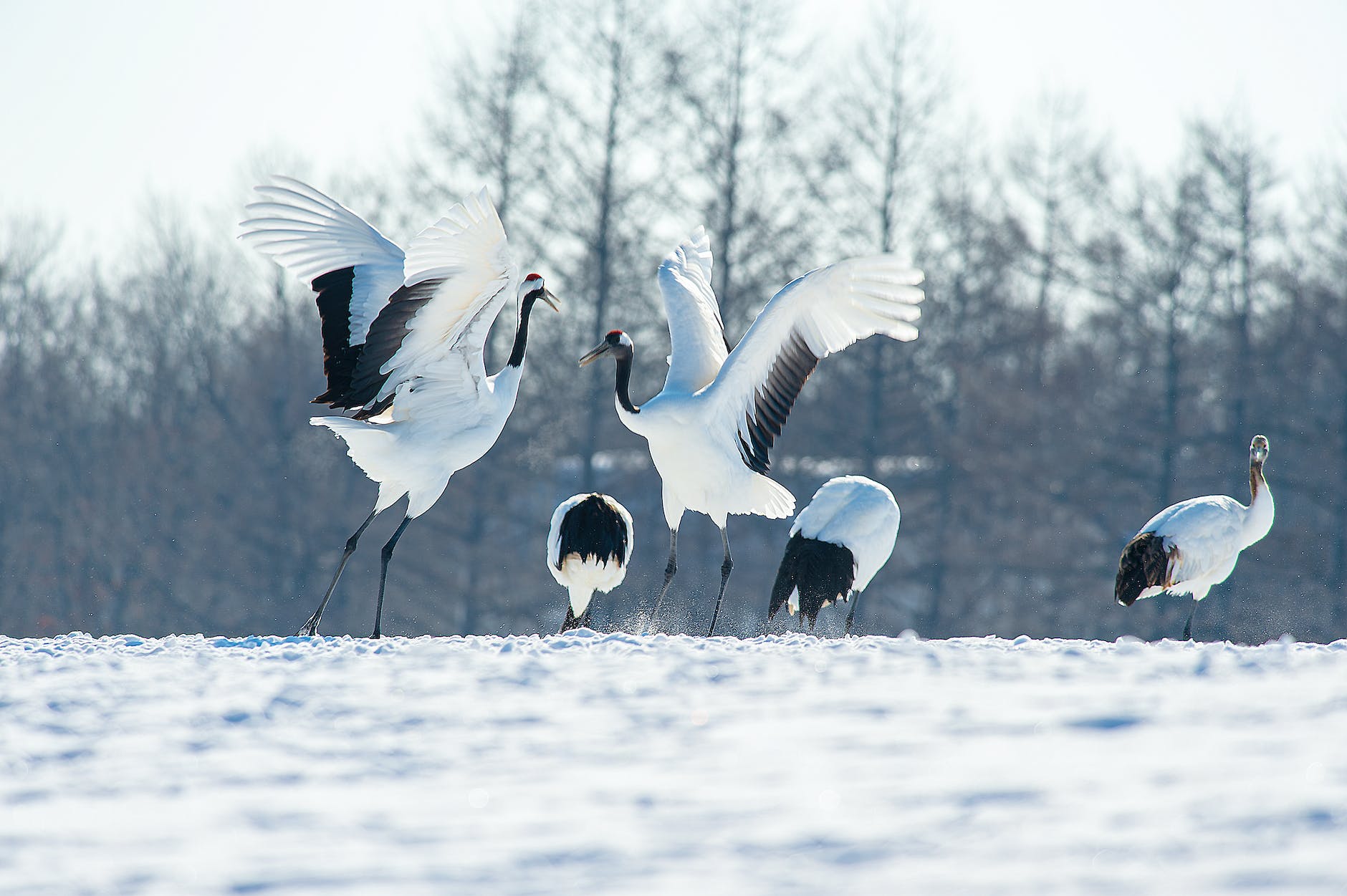
Photo by Klub Boks on Pexels.com
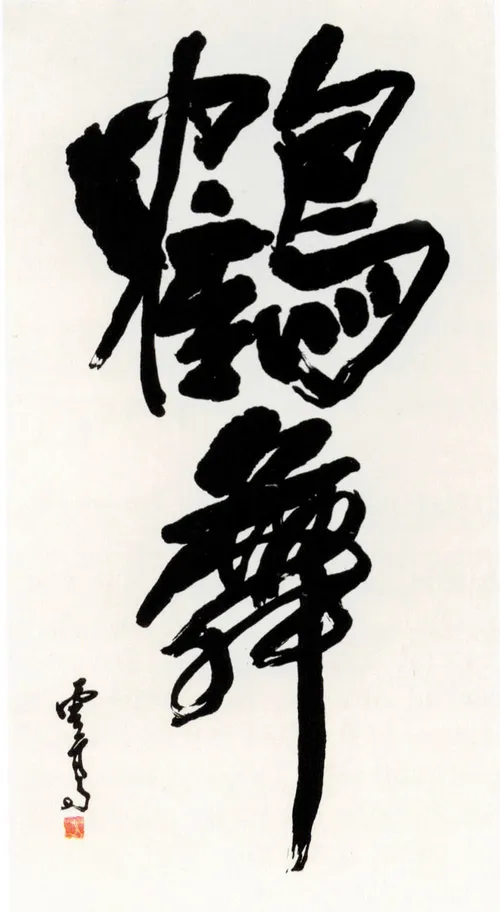
Crane Dance by H.H. Dorje Chang Buddha III at 1990

Red-crowned cranes tend not to build ness for themselves since they often stay in various places. When quiet, they frequently engage in meditational observation. When in motion, they frequently dance. Their nature is noble, pure, elegant and simple. They develop their virtue, are not attached to a specific abode, and take care of themselves so as to enjoy their natural lifespan. That is why since ancient times they have been praised for their longevity.


The ability of H.H. Dorje Chang Buddha III to reach such great heights in calligraphy is completely due to His Holiness’s vast knowledge and profound talents. Of course, His Holiness is extremely adept at learning from the styles of others since this is a simple matter for a Buddha. For example, even in the initial stage of learning calligraphy, H.H. Dorje Chang Buddha III had solid skills in the traditional cursive style of writing and also had extensive learning.

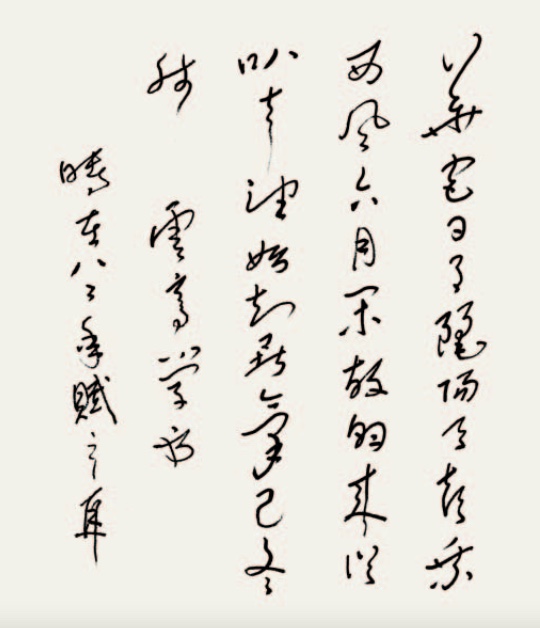
Calligraphy : A Qi jue poem (Thin Gold Cursive Style of Calligraphy)


Above is a qi jue poem written by H.H. Dorje Chang Buddha IIIat 1982. A qi jue poem is a four-line poem with seven characters to a line and a strict tonal pattern and rhyme scheme. The phonetic reading of the poem is as follows: “hua gong ri yue li yang tian, xi cheng xi feng liu yue xian, gu peng lai cong ba sheng wang, shi zhi shu qi yi dong can.” One can see that this work has surpassed all traces of the mundane and has transcended all earthly impurities. Its style is lofty and pure.
When that poem was written, H.H. Dorje Chang Buddha III was living in the seclusion of an ancient temple. His Holiness used his extraordinary realization to express his thoughts and feelings. The first line expresses that although His Holiness lived alone and secluded in the room of a temple, He governed the universe and bestowed blessings upon living beings.
The next line, “xi cheng xi feng liu yue xian,” conveys the scene that during the idle month of June H.H. Dorje Chang Buddha III bathed in the Buddha-state of coolness while under the scorching sun. His Holiness was free of all worldly cares and attachments, and his body merged with the universe. When friends came, His Holiness heard the horns of their cars, but He had already transcended the world, residing in quietude and non-action. H.H. Dorje Chang Buddha III kept no notion of the date, and His Holiness’s mind did not abide in anything whatsoever. The people of the world were ignorantly attached to the changing seasons and came in their cars and horses to inform H.H. Dorje Chang Buddha III that summer had long passed and the winter was about to end. The ancient Buddha acknowledged this and smiled.

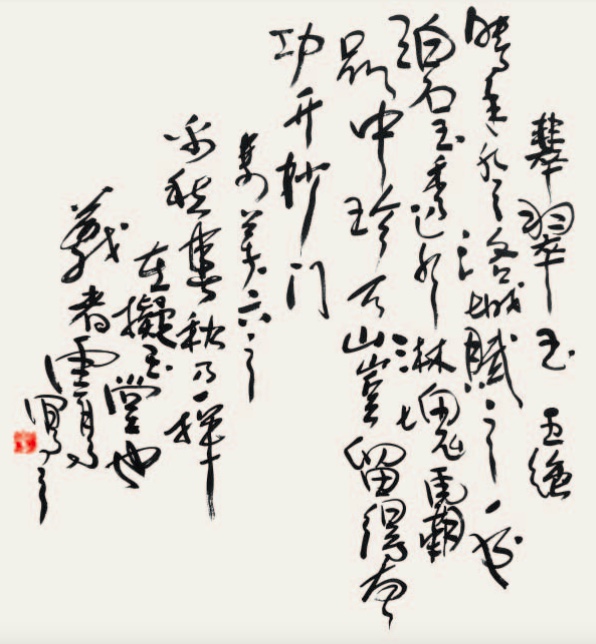
In recent years, there are works of H.H. Dorje Chang Buddha III that have been written in the cursive mode of calligraphy, showing a flowing and unobstructed style, and expressing even more than before the charm of this writing technique. For example, the work Fei Cui Jade expresses the spirit of an immortal or Buddha, thoroughly transcending the three worlds of reincarnation, standing proudly above the five elements of the universe. It is truly calligraphy beyond the category of calligraphy, expressing a feeling that incorporates the whole universe.

Fei Cui Jade: Created with an unfettered hand and unattached mind, it has the appearance of a celestial writing accomplished with a childlike mind and steady strokes of the brush.


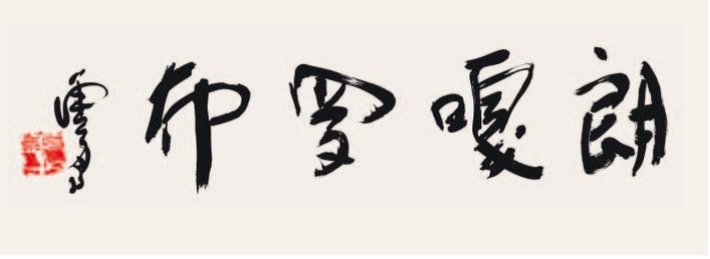
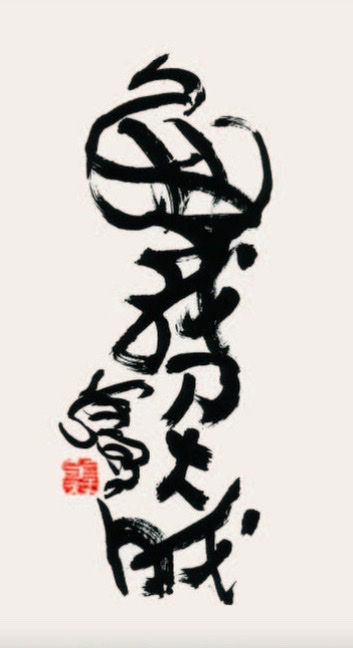
His Holiness’s calligraphy of the Chinese characters lang ga luo bu (Treasure of Heaven) excels the writing of calligraphers throughout history. It transcends all traces of worldliness. It expresses deep strength, like that which can break jade. The style of another calligraphic work called wu wo nai da cheng (No-Self Is Great Accomplishment), conveys the firmness and simplicity of steel and the vigor of a sharp knife. However, these same characters also contain delicate beauty. That calligraphic style truly surpasses styles of the past and present.

Lang ga luo bu (Treasure of Heaven)


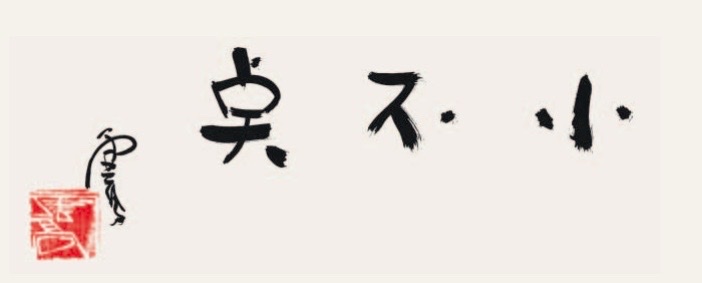
Another calligraphic style of H.H. Dorje Chang Buddha III is revealed in the writing of the Chinese characters xiao bu dian (Tiny). Such calligraphy shows the childlike innocence of a very old man, and its arrangement expresses the utmost ease and lack of rigid constraints. It is high-class calligraphy that does not even seem to be calligraphy. It is so elegant and refined that it completely transcends the mundane.

Tiny (Xiao bu dian)


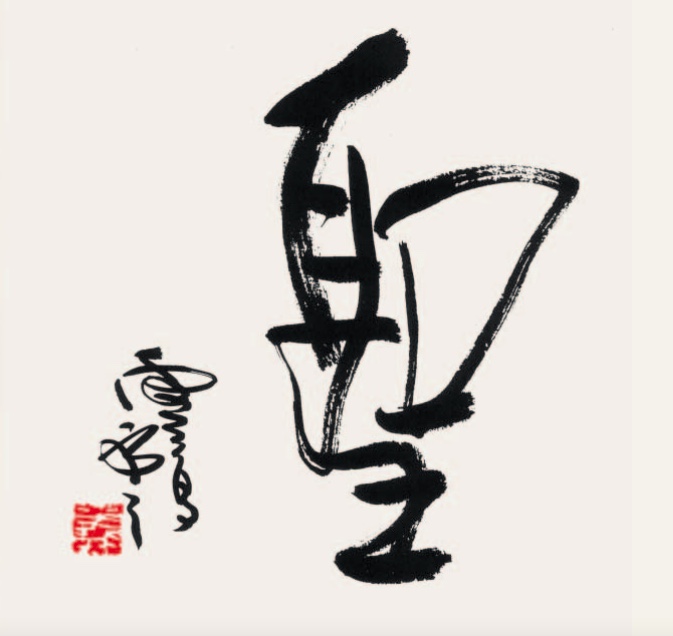
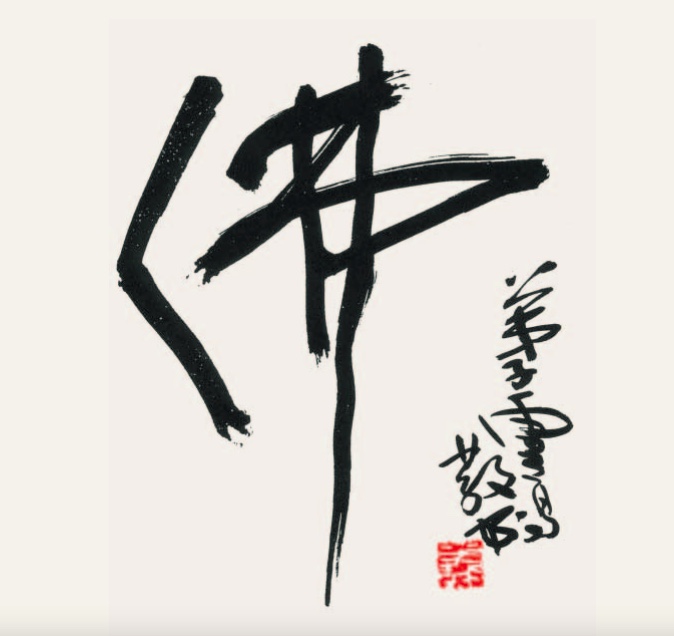
Beholding the character sheng (holy) written by His Holiness, one can see that it simultaneously embodies both the softness of ribbons and the inner-firmness of steel. Its inner beauty flows to the surface. Another example is the character fo, which means Buddha. The writing of that character demonstrates that His Holiness has truly attained the summit of calligraphic skills that the ancients extolled in the old saying, “the old pine branch cannot be weighed down by heavy snow; the might of a brush will lift a thousand-pound bronze cauldron.”

The Chinese character “sheng,” which means “holy.”
The Chinese character “fo,” which means “Buddha.”


In fact, the calligraphy of H.H. Dorje Chang Buddha III has a deep foundation and an internal richness. It embodies the manifold sensations that one could possibly experience in one lifetime. The essence of all things in the universe converges at the tip of His Holiness’s brush. With such a transcendent state of realization, the myriad things of the universe are in the palm of this Buddha. The calligraphy of H.H. Dorje Chang Buddha III is like a treasury. It can be vigorous, smooth, or naturally beautiful. His Holiness incorporates the best techniques of all of the schools of calligraphy. No words can really describe this!
His Holiness’s calligraphic skills have reached the highest degree of proficiency and naturalness that only a Buddha could reach!

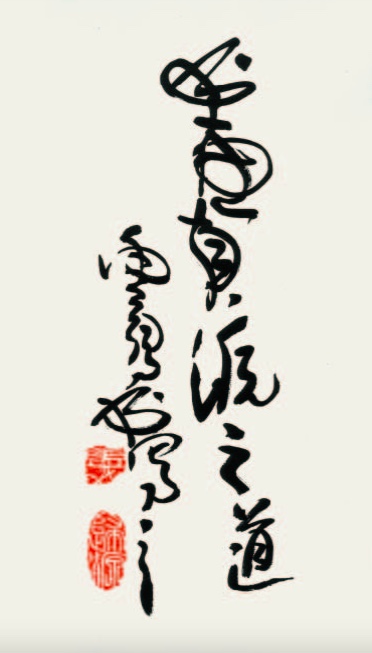
The Way to the True Source of Calligraphy and Painting
No-Self Is Great Accomplishment
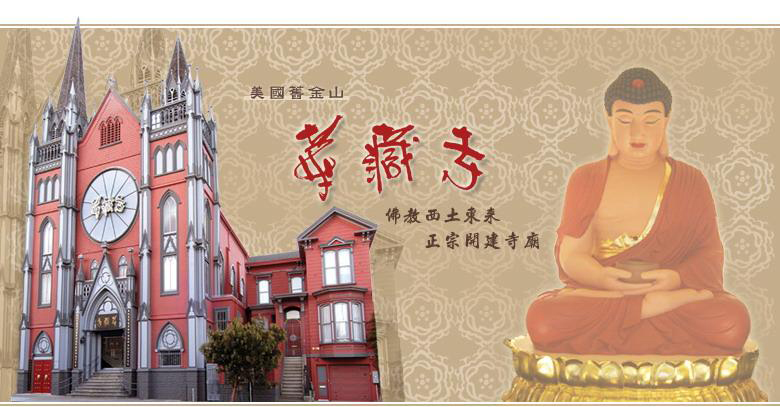
Hua Zang Si (Inscription of a Buddhist temple in San Francisco)

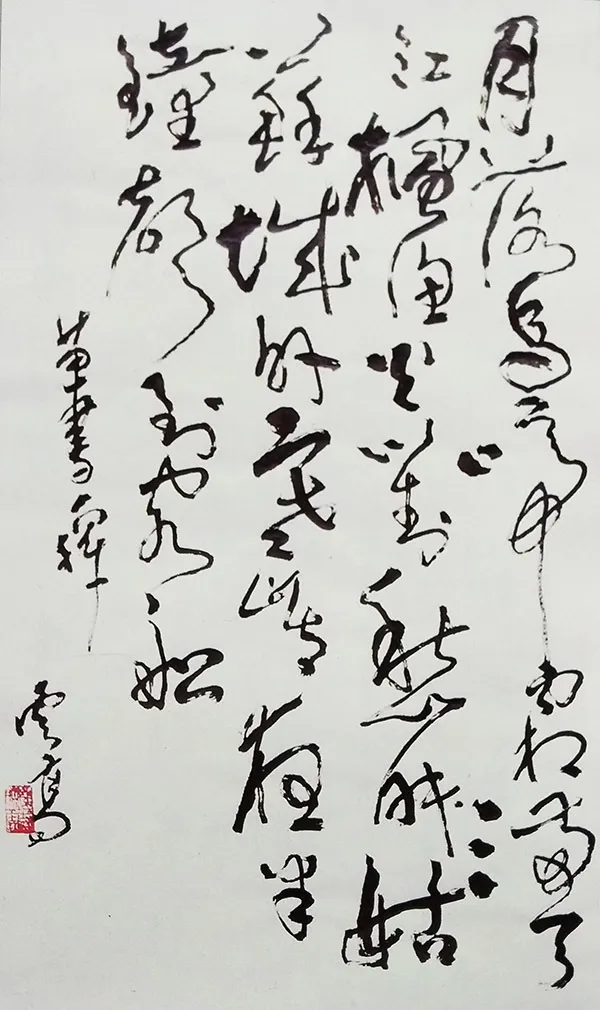
Chinese ancient poem Han Shan Si Temple in rapid cursive style by H.H. Dorje Chang Buddha III

You can discover a wealth of calligraphy artworks at The International Art Museum of America, situated in downtown San Francisco.

H.H. Dorje Chang Buddha III Calligraphy Artworks

Link:https://peacelilysite.com/2023/06/16/chinese-calligraphy-intangible-cultural-heritage-of-humanity/

#DorjeChangBuddhaIII #HHDorjeChangBuddhaIII#DorjeChangBuddha#IAMA#InternationalArtMuseumofAmerica#ChineseCalligraphy#Art

Dharma Assembly at Hua Zang Si — Holy Birthday of Maitreya Bodhisattva

Dharma Assembly at Hua Zang Si — Holy Birthday of Maitreya Bodhisattva

January 1st in the Chinese lunar calendar, is chinese Spring festival, it is the biggest holiday in china. It is also the holy birthday of Maitreya Bodhisattva – the next Buddha in the saha world. This is a special and joyful holiday that is celebrated by many. Hua Zang Si in San Francisco held a Dharma Assembly to celebrate this important occasion. It was the first Dharma Assembly of the year and it was held on a beautiful sunny day. Many laypersons participated in the event.

At the entrance of the temple is an oversize marvelous statue representation of a jolly, laughing Buddha: Maitreya Bodhisattva (the next Buddha in this Saha world). It is such a warm welcoming sign. The big belly not only means jolly, it also means tolerating the intolerable things in the world. So when you look at the statue, you will start to feel that learning Buddhism is happy and kind.

The Dharma Assembly was an opportunity for people to come together and celebrate the teachings of Maitreya Bodhisattva. It was a time for reflection and meditation, as well as a chance to learn more about the teachings of Buddhism. The atmosphere was filled with positivity and joy, as people came together to celebrate this important holiday.

In Chinese culture, Maitreya Bodhisattva is seen as a symbol of joy and tolerance. As practitioners of Buddhism, we are encouraged to strive to be like the Buddhas and Bodhisattvas by cultivating a broad mind, open heart, and great tolerance.

One of the key principles of Buddhism is patience and forbearance, particularly under insult. This is seen as a key aspect of self-cultivation and it is important to remember that everything in the dharma realms can change from ordinary to holy. This means that even difficult situations can be transformed and overcome through the practice of patience and tolerance.

Patience and tolerance are not just passive qualities, but rather active ones that require effort and practice. We must actively cultivate them in our daily lives and strive to maintain them even in difficult situations. Through this practice, we can transform our own minds and hearts, becoming more like the Buddhas and Bodhisattvas that we strive to emulate.

At the Dharma Assembly, we chanted the Eighty-eight holy Buddha name jeweled repentance sutra, in hopes that the Buddhas will wash away all of our sins and negative karmas. After the chanting, we offered a meal to the Buddhas and Bodhisattvas. The event concluded with a dharma talk given by Dharma Master Ruohui.

During her talk, Dharma Master Ruohui emphasized the importance of faith, vows, and actions for disciples of Buddhism. She explained that faith is the foundation of our practice, and that with strong faith, we will have the determination to follow the Buddha’s teachings and put them into action in our lives.

The Dharma Assembly was a meaningful event where participants not only had the opportunity to reflect on their own spiritual growth but also to make an impact on the world around them. During the assembly, the participants returned the merit to all living beings, holding the hope that they shall be rid of suffering, obtain happiness, and have the opportunity to listen to authentic Buddha Dharma.

The act of returning merit is an important aspect of Buddhist practice as it is believed that by dedicating the positive energy generated through our spiritual practice to the benefit of others, we can help bring about peace and prosperity in the world. By returning merit to all living beings, participants were able to contribute to the collective well-being of the world and make a positive impact on the lives of others.

Furthermore, the participants also held the hope that by listening to authentic Buddha Dharma, they will be able to perfect their fortune and wisdom, leading to a more prosperous and peaceful world for all. This is the ultimate goal of Buddhism, to help all beings to find inner peace, happiness and liberation from suffering.

Dharma Assembly at Hua Zang Si — Holy Birthday of Maitreya Bodhisattva

Link: https://peacelilysite.com/2023/01/26/dharma-assembly-at-hua-zang-si-holy-birthday-of-maitreya-bodhisattva/

#Buddha#Buddhism#BuddhistDisciple#MaitreyaBodhisattva#HuaZangSi#Tolerance#Cultivation#Assembly#ChineseLunarCalendar#ChineseNewYear

H.H. Dorje Chang Buddha III Day

H.H. Dorje Chang Buddha III Day

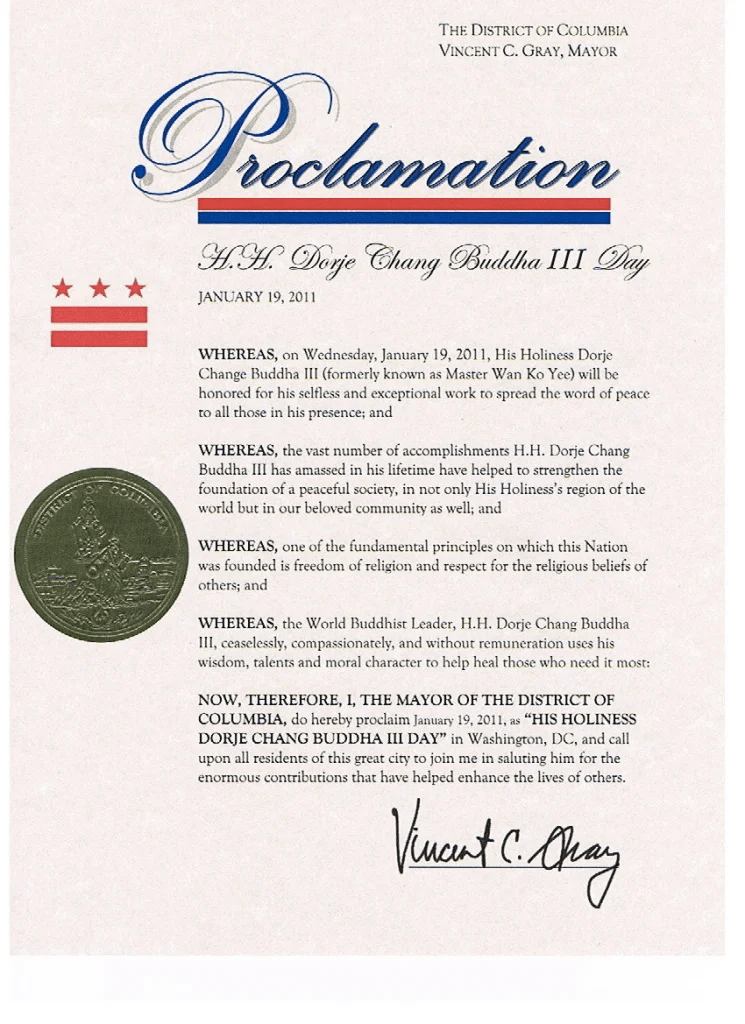
On January 19, 2011, Mayor Vincent C. Gray, the mayor of our nation’s capital Washington, DC, personally signed and issued a proclamation in which January 19, 2011 was proclaimed as His Holiness Dorje Chang Buddha III Day.

        In that proclamation, Mayor Gray called upon all residents of Washington, DC to join him in saluting H.H. Dorje Chang Buddha III! The mayor stated that H.H. Dorje Chang Buddha III has, through his selfless and exceptional work, spread the word of peace to all those in his presence. The mayor commended H.H. Dorje Chang Buddha III for his vast accomplishments that have helped to strengthen the foundation of a peaceful society, in not only His Holiness’s region of the world but in the Washington, DC community as well. Additionally, Mayor Gray praised H.H. Dorje Chang Buddha IIIas the World Buddhist Leader who ceaselessly, compassionately, and without remuneration uses his wisdom, talents and moral character to help those in need.

The video below has a brief introduction of H.H. Dorje Chang Buddha III, that helps you to know some great achievements and teachings of the Buddha.

Buddha taught that all living beings have Buddha-nature, and that we shall treat them as family members and relatives. To celebrate this very special day, Hua Zang Si held a Dharma Assembly to release captive lives and pray for blessings at a beautiful port in San Rafael CA , on January 19th 2023. Many laypersons in the bay area and central CA participated the event.

Namo H.H. Dorje Chang BuddhaIII and Namo Shakyamuni Buddha taught us :”No matter where it is and when it is, if we see living beings in horrible fears and calamitous adversity, we must save them. Therefore, for any lives that are facing the urgent and terrible fear of going to be hurt or killed, we shall save them out and release them into an environment that suits them, so as to let them regain the freedom and be free from fears. There is a phrase that says, ‘I love to see them live, and I dare not see them die.’ Based on our compassion and empathy, we want to endow living beings with happiness and rid them of sufferings.

With the Dharma Assembly, participants returned the merit to all living beings, holding the hope that they shall be rid of suffering, obtain happiness, and have the opportunity to listen to authentic Buddha Dharma, perfecting fortune and wisdom, and leading to prosperity and peace throughout the world.

H.H. Dorje Chang Buddha III Day

Link: https://peacelilysite.com/2023/01/20/h-h-dorje-chang-buddha-iii-day/

#DorjeChangBuddhaIII #HHDorjeChangBuddhaIII #FishRelease#HuaZangSi #HHDorjeChangBuddhaIIIDay

Amitabha Holy Birthday Assembly at Hua Zang Si

Amitabha Holy Birthday Assembly at Hua Zang Si

This December 4th, a Dharma Assembly for the Holy Birthday of Amitabha Buddha was held at Hua Zang Si, located at San Francisco. About two hundred people attended the assembly. The weather was very sunny, clean and fresh after heavy rain the day before. It was a very happy time. Ever since the pandemic period started, Hua Zang Si has been closed to the public. This was a precious opportunity for buddhist disciples to get together.

The main venue was held at the second floor of the temple, the Amitabha Buddha Hall. The twenty-one foot tall statue of Amitabha Buddha (designed by H.H. Dorje Chang Buddha III) has been generally recognized as the most majestic Buddhist statue in the world. It is an extremely solemn sight. The Buddha’s eyes seem alive, looking down at all beings full of compassion and love.

First we chanted Buddha Expounding Amitabha Sutra,then we made the meal offering to the Buddhas and Buddhisattvas, at the end Master RuoHui RuZun gave us a short Dharm speech and we all prayed to the Buddhas and Bodhisattvas to grant blessings and protections to all beings in the world.

Amitabha Holy Birthday Assembly at Hua Zang Si

I greatly enjoyed the assembly, so much so that after it ended I still didn’t want to leave. I stayed and helped to clean up the site. I also prostrated to the Amitabha Buddha and kneel down and pray wholeheartedly: Please Buddha save me from the birth-death cycle, please take me to the western paradise. 

I always wondered how this magnificent Amitabha Statue was installed in the hall. I found out an amazing story behind it. The sitting statue of Amitabha Buddha is inside the grand hall on the second floor. The statue of Amitabha Buddha was paid for with H.H. Dorje Chang Buddha III‘s money from selling his paintings. The molding of the statue was also based on the blueprint drawn by the Buddha. During the process of molding,  H.H. Dorje Chang Buddha III modified the model eight times in person. All places that did not conform to the stipulation of the dharma were corrected and re-molded. After the completion, this statue was judged to be the most solemn Buddha statue in the world. The height of the statue of Amitabha Buddha was 6.7 meters (22 feet) and two narrow stairways with 180-degree turns have to be passed to go upstairs, the manufactured Buddha statue had to be first cut into several pieces and reassembled together after moving onto the second floor. Therefore, this statue was divided into seven parts and shipped in three containers to Hua Zang Si (the temple).

After the Buddha statue was unloaded, everyone in the temple were participating in carrying each part of the statue respectfully and carefully to the second floor. We were surprised to find that the sizes of the seven components all fit correctly into the narrow space in the stairway and all turns were made smoothly on the way to the second floor. In addition, there was no damage to the surface paint coating or any other place of the Buddha statue, thanks to the blessings from all Buddhas and Bodhisattvas, as well as dharma protectors.

The process of installing the Buddha statues into seats and surface gold-gilding went very smoothly. There were no signs of reassembly. We all happily stood in front of the Buddha statues with unlimited reverence in our minds. Such solemn grand Buddha statue can only be seen at Hua Zang Si in San Francisco of America, because it was made under the personal guidance from  H.H. Dorje Chang Buddha III!

Namo H.H. Dorje Chang Buddha III !

Namo Amitabha !

Amitabha Holy Birthday Assembly at Hua Zang Si

Link: https://peacelilysite.com/2022/12/15/amitabha-holy-birthday-assembly-at-hua-zang-si/

#DorjeChangBuddhaIII #HHDorjeChangBuddhaIII #HuaZangSi#SanFrancisco#AmitabhaBuddha#WesternParadise#BuddhaStatue#BuddhaAssembly