Artful Resilience: The Timeless Elegance of Dr. Yuhua Shouzhi Wang’s Bamboo Paintings

Bamboo of Noble Integrity By Professor Yuhua Shouzhi Wang

Bamboo, as a plant with profound cultural significance, carries rich and diverse symbolism. It represents resilience, noble character, vitality, humility, modesty, harmony, and unity. With its graceful posture and vibrant green appearance, bamboo evokes a sense of freshness and refinement. Though its exterior is simple and unadorned, it embodies a noble inner quality. This unique temperament has made bamboo a symbol of integrity and uprightness. In ancient times, it often served as a metaphor in the writings of scholars and poets for individuals of high moral character and self-discipline.

For the Chinese, admiration for bamboo has endured throughout history. Countless poets and literati have celebrated its virtues, grouping it alongside plum blossoms, orchids, and chrysanthemums as one of the “Four Gentlemen,” embodying the character and aesthetic spirit of the Chinese people. Bamboo’s simplicity belies its profound cultural significance. In traditional Chinese culture, it is a symbol of auspiciousness and virtue, carrying layers of meaning that resonate deeply with the human spirit.

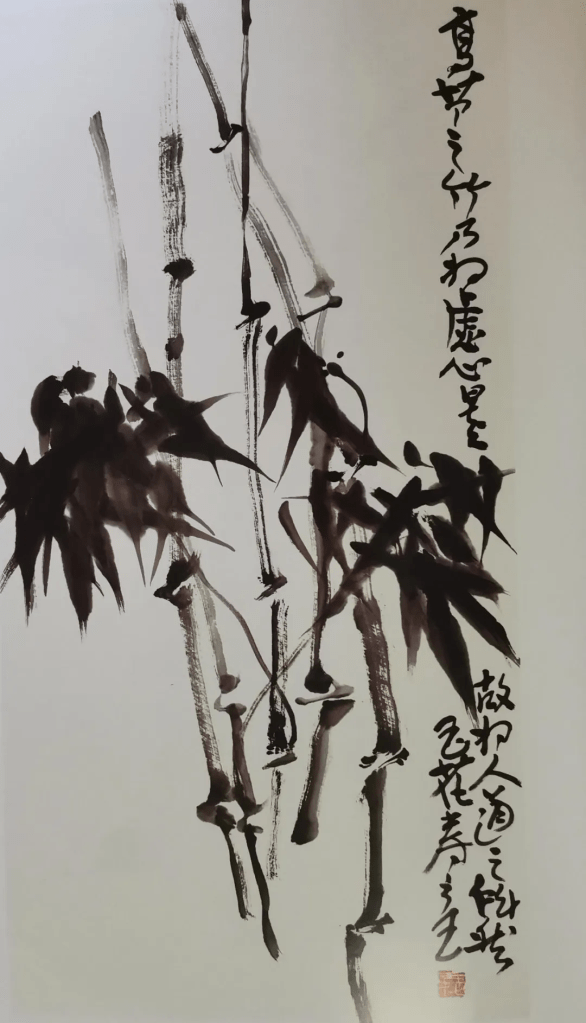
Professor Wang’s Chinese paintings of bamboo are a testament to her extraordinary ability to bring this cultural icon to life. Each stroke captures the essence of bamboo’s resilience and unyielding spirit while emphasizing its humility and integrity. Her works not only celebrate the elegant charm of bamboo but also evoke its vibrant vitality and enduring strength.

Professor Wang’s Artwork “Noble Spirit of Humility”
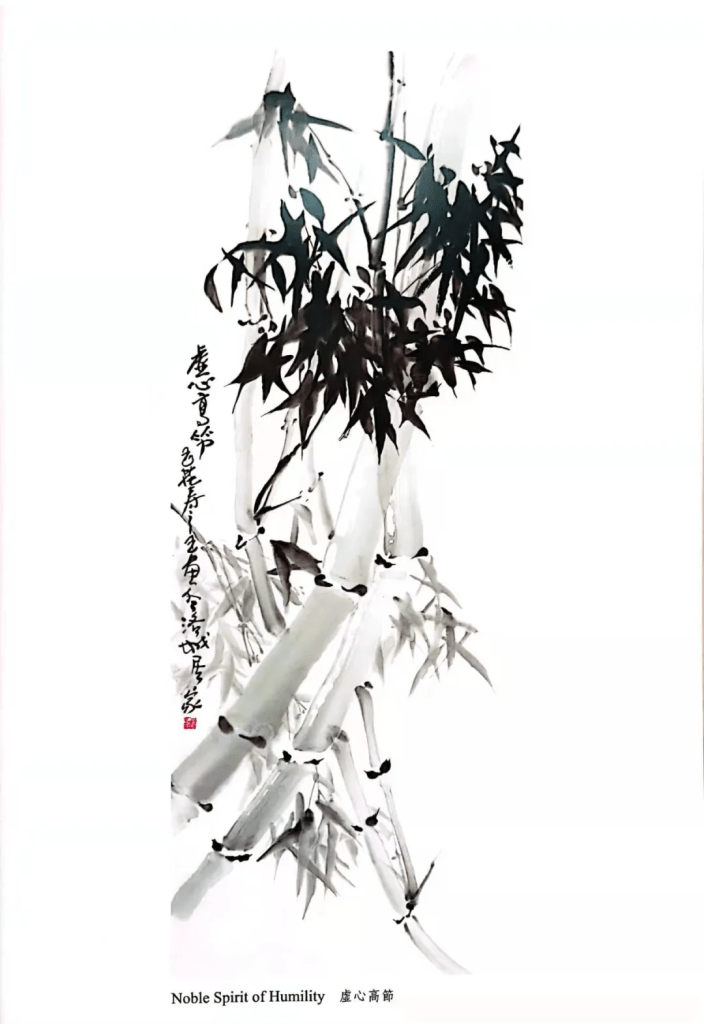
The artwork Noble Spirit of Humility depicts a cluster of bamboo deep within a dense forest. Two tall and robust bamboo stalks stand prominently in the foreground, their lush branches and leaves rendered in bold ink. Behind them, a few smaller bamboo stalks, delicately painted in lighter ink, appear to lean on the larger ones, as if embraced by Mother Earth. Together, they form a unified group, advancing and retreating in harmony.

Look closely, and you’ll see their branches intertwine amidst the clouds, and their roots tightly clasp together underground. Neither torrential rain nor fierce winds can break them down. The bamboo’s unyielding resilience is vividly and profoundly brought to life.

Dr. Yuhua Shouzhi Wang was recognized and chronicled in the United States Congressional Record as “a great artist and sculptor,” and “treasure of the world.” In 2013, President George Christophides of the World Federation of UNESCO Clubs, Centers, and Associations (WFUCA) conferred the title “2013WFUCA” to one of her artworks.

The artwork “The Charm of Bamboo” conveys the fresh and elegant essence of bamboo, exuding a gentle and harmonious beauty. It seems to remind us that in life and work, we should not only take responsibility but also foster an atmosphere of harmony and mutual respect. The use of varying ink tones, alternating between light and dark, strikes a balance of simplicity and ingenuity, greatly enhancing the dynamic energy of the piece.
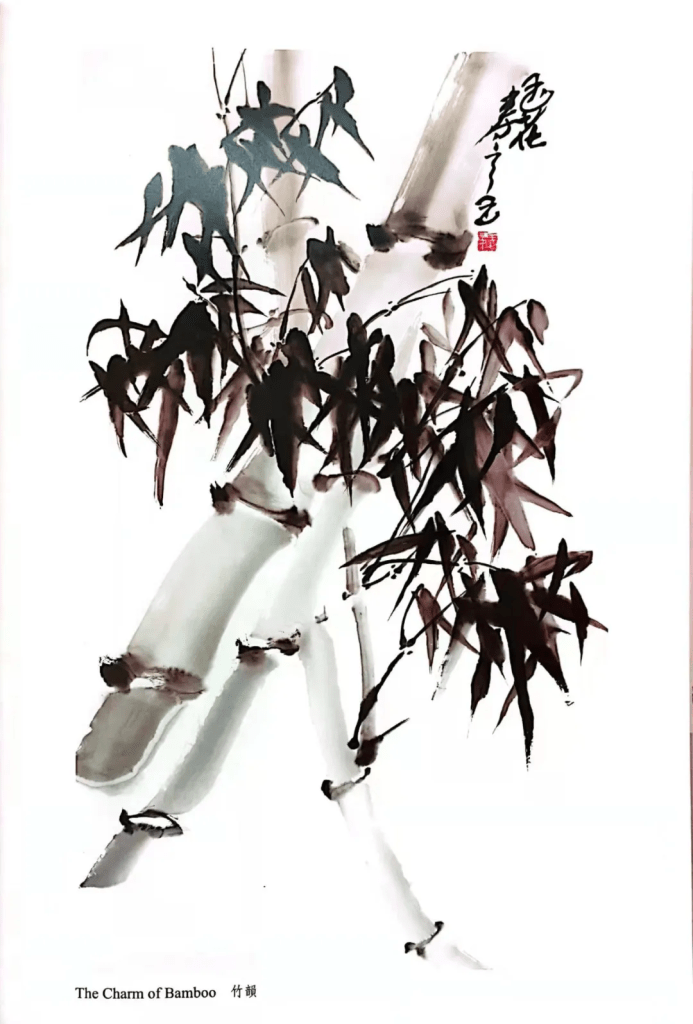
Dr. Yuhua Shouzhi Wang’s bamboo paintings are truly exceptional. Through her art, she vividly conveys bamboo’s noble qualities, leaving viewers with a deep appreciation for this remarkable plant and its timeless symbolism. Her work serves as a bridge between nature and art, reminding us of the profound lessons we can draw from the natural world.

Link:https://peacelilysite.com/2024/12/27/artful-resilience-the-timeless-elegance-of-dr-yuhua-shouzhi-wangs-bamboo-paintings/

The Profound Wisdom of Generosity

Generosity is an altruistic intention that brings joy to sentient beings and delight to all Buddhas. It involves considering others and giving up one’s own body, life, and possessions, even extending to the giving of the Dharma. In the very act of giving, one not only eliminates the habitual tendency of stinginess but also helps others overcome their difficulties. At the same time, one attains joy and freedom through a pure, selfless mind.

In Buddhist practice, generosity is the first of the six Pāramitās (perfections) that guide practitioners on the path to enlightenment. The Buddha teaches that acts of giving bring five kinds of merits:

  1. Longevity without misfortune.
  2. A dignified and pleasant appearance.
  3. Abundant energy and strength.
  4. Joy and freedom from worries.
  5. Wisdom and eloquence.

However, the intention behind giving is crucial. The thoughts and mindset of the giver determine the outcomes of their actions. The Buddha provided profound insight into this during a conversation with Venerable Sāriputta.

The Conversation Between the Buddha and Sāriputta

One time, Venerable Sāriputta asked Shakyamuni Buddha for clarification about the practice of generosity:

“Lord, is it possible that one person may give a gift of a certain kind, and it yields little fruit, while another gives the same kind of gift and yet it yields great fruit and benefit?”

The Blessed One replied, “Yes, Sāriputta, it is possible that a person may give a gift of a certain kind, and it does not bear great fruit, while another person gives the same kind of gift and it bears great fruit and benefit.”

“But Lord, what is the cause and reason for this difference? Why does one person’s gift bring small results while another’s yields much greater rewards, even when the gifts are of the same kind?”

The Blessed One explained, “Sāriputta, there are cases where a person gives a gift with a mind seeking personal profit, attached to the reward, hoping to enjoy it in the afterlife. Such a person may offer food, drink, clothing, vehicles, garlands, perfumes, ointments, bedding, shelter, or lamps to a contemplative or a brahmin. What do you think, Sāriputta? Could a person give a gift with such intentions?”

“Yes, Lord,” Sāriputta replied.

The Blessed One continued, “When such a person gives with a mind seeking personal gain, they may be reborn in the realm of the Four Great Kings. But after the results of that action are exhausted, they return to this world.

“However, there is another person who gives a gift not for personal profit, nor with a mind attached to the reward, but with the thought, ‘Giving is good.’ This person offers the same kinds of gifts to a contemplative or a brahmin. What do you think, Sāriputta? Could a person give in this way?”

“Yes, Lord,” Sāriputta affirmed.

“Such a person, on the break-up of the body after death, is reborn among the Devas of the Thirty-three. But once the result of that action has been exhausted, they, too, return to this world.

“Or a person may give with the thought, ‘This has been the custom of my family, handed down from my ancestors. I must uphold this tradition.’ When they pass away, they are reborn among the Devas of the Hours. Again, after the results of that action are exhausted, they return to this world.

“Alternatively, a person may give with the thought, ‘I am well-off, while others are not. It is only right that I share with those who have less.’ They are reborn among the Contented Devas, but eventually, they return to this world as well.

“Another person might give with the thought, ‘Just as the great sages of the past, such as Aṭṭhaka, Vāmaka, and others performed great sacrifices, so too will I distribute my gifts in this way.’ Upon death, they are reborn among the Devas who Delight in Creation, yet eventually return to this world.

“Or one may give a gift with the thought, ‘Giving brings serenity and joy to my mind.’ Such a person is reborn among the Devas Wielding Power over the Creations of Others. Still, after their merit is exhausted, they return.

“Finally, there is the person who gives not for future rewards, not out of custom, and not out of wealth or tradition, but with the thought, ‘This act of giving is an adornment and support for the mind.’ What do you think, Sāriputta? Could a person give in this way?”

“Yes, Lord,” Sāriputta answered.

The Blessed One said, “This person, upon the break-up of the body, is reborn among Brahmā’s Retinue. Having exhausted the results of their action, they do not return to this world but attain the state of non-return.

“This, Sāriputta, is the reason why one person’s gift may not bear great fruit, while another’s gift of the same kind may yield great fruit and benefit.”

The True Essence of Generosity

Generosity is not merely about the act of giving but also about the intention and mindset behind it. When one practices the virtue of giving with constant joy and unwavering determination, one cultivates all virtuous merits, attains pure samadhi, and gains clarity of insight. This clarity allows one to fully comprehend the origin of suffering, the cessation of suffering, and the path to liberation and happiness.

Therefore, one should always strive diligently and practice various virtuous deeds of giving, remembering that the purity of the heart and mind in the act of generosity determines its ultimate value and benefit—both for oneself and for the world.

Link: https://peacelilysite.com/2024/12/13/the-profound-wisdom-of-generosity/

Discovering Wisdom in Everyday Life: Sima Yi’s Timeless Philosophy

Have you ever found yourself judging someone based on their flaws, only to realize later that you missed seeing their good qualities? In a world where we’re quick to notice shortcomings, Sima Yi (司馬懿), a brilliant statesman and military strategist of ancient China, offers a refreshing perspective:

“If one focuses on others’ shortcomings, there will be no one in the world worthy of association; but if one looks at their strengths, everyone can be a teacher.”

Sima Yi was a towering figure of the Three Kingdoms period in Chinese history. Known for his brilliance as a statesman and military strategist, he served under three generations of Wei rulers—Cao Cao, Cao Pi, and Cao Rui. His simple yet profound insight encourages us to shift our focus from criticism to appreciation—a practice that can transform not only our relationships but also our outlook on life.


How This Wisdom Applies to Us Today

Let’s face it, we all navigate relationships daily—whether at work, with friends, or within our families. And let’s be honest, people can be frustrating! A colleague might miss a deadline, a friend might cancel plans last minute, or a family member might nag you endlessly. It’s easy to dwell on these shortcomings. But what if, instead, we made a conscious effort to notice their strengths?

That colleague might be a creative genius, your friend might have a generous heart, and your family member might only want the best for you. This small shift in perspective can turn frustration into appreciation and conflict into connection.


I know someone who has mastered this mindset. He’s one of those people who can walk into a room full of strangers and leave with everyone feeling uplifted. Curious about how he does it, I once asked him his secret. His response was striking:

“If one focuses on others’ shortcomings, there will be no one in the world worthy of association. But if one looks at their strengths, everyone can be a teacher.”

This principle is at the core of how he interacts with people, and it shapes his approach to life:

  • Learning from those stronger than him: When he meets someone successful, he doesn’t feel intimidated or envious. Instead, he actively seeks to learn from them. Once, at a networking event, he struck up a conversation with a prominent entrepreneur. While most people kept their distance, he walked away with new insights and a potential mentor.
  • Finding harmony with equals: In competitive environments, he doesn’t see peers as threats but as partners. By yielding a little when disagreements arise, he often finds ways to collaborate that benefit everyone involved.
  • Helping those less capable: He’s quick to lend a hand to someone struggling. Whether it’s helping a colleague with a difficult task or mentoring a junior team member, his generosity earns him respect and trust.
  • Respecting elders: He genuinely values the wisdom of those who’ve walked life’s path before him, always showing them gratitude and deference.

This approach to life isn’t just about being a “nice person.” It’s about creating opportunities for growth, connection, and happiness. When we focus on others’ strengths instead of their flaws, we:

  1. Build better relationships: People appreciate being valued for their good qualities.
  2. Learn and grow: Everyone has something to teach us, from practical skills to life lessons.
  3. Feel more positive: Seeing the good in others often helps us see the good in ourselves.

How to Practice Sima Yi’s Philosophy

Here’s how you can start applying this wisdom in your daily life:

  1. Pause before judging: The next time someone irritates you, take a moment to think about their strengths. What do they bring to the table?
  2. Ask questions: When you meet someone new, instead of focusing on surface-level impressions, ask about their experiences or skills. You might discover something inspiring.
  3. Be generous: Whether it’s a compliment, advice, or a helping hand, giving a little can create a lot of goodwill.
  4. Respect experience: Take time to listen to the stories of older generations. Their insights might surprise you.

Life is full of interactions, and every person you meet has a unique story, skill, or quality to offer. By shifting your perspective from criticism to appreciation, you’ll not only build stronger connections but also create a richer, more fulfilling life.

Sima Yi’s timeless wisdom reminds us that everyone we meet—whether a boss, a rival, or a stranger—can teach us something valuable. The next time you’re tempted to judge someone, ask yourself:

“What can I learn from this person?”

The answer might just change your life.

Link:https://peacelilysite.com/2024/12/12/discovering-wisdom-in-everyday-life-sima-yis-timeless-philosophy/

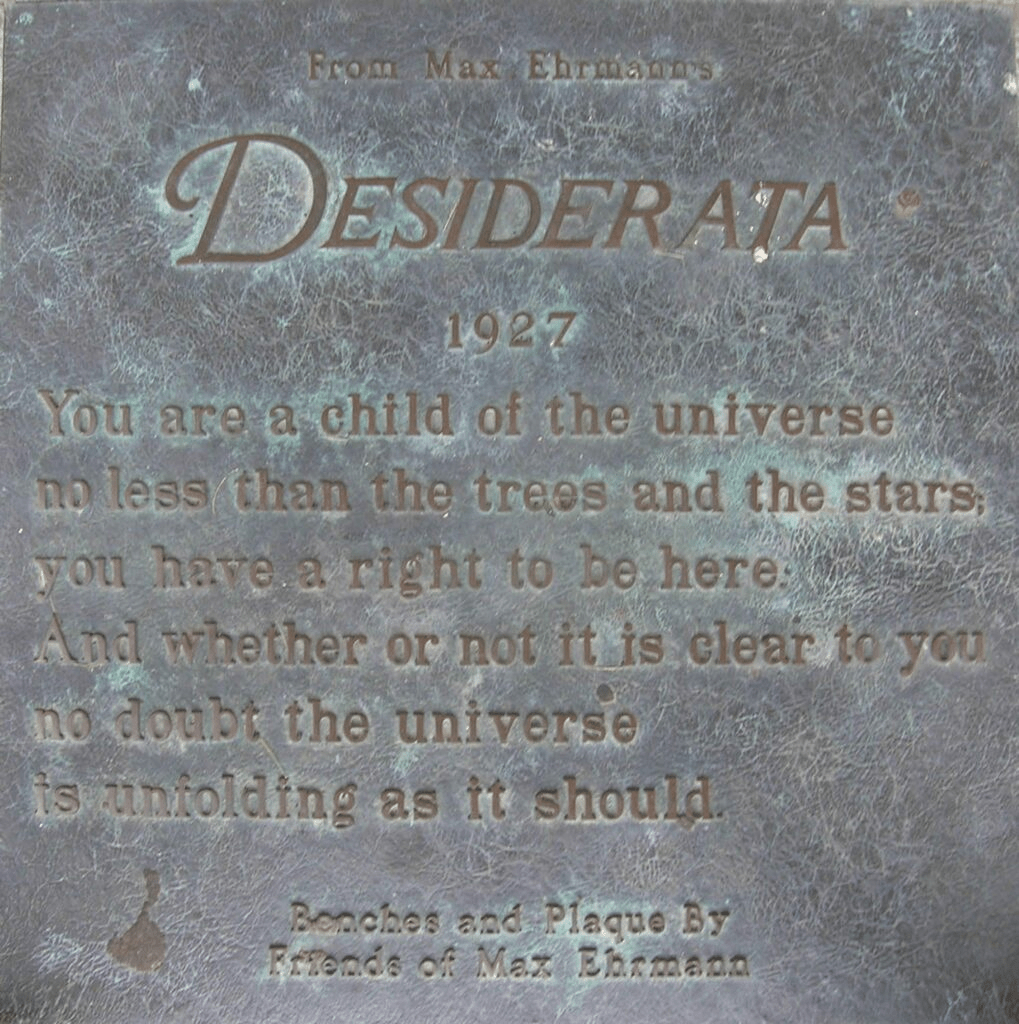
Desiderata

Go placidly amid the noise and haste,
and remember what peace there may be in silence.
As far as possible without surrender
be on good terms with all persons.
Speak your truth quietly and clearly;
and listen to others,
even the dull and the ignorant;
they too have their story.

Avoid loud and aggressive persons,
they are vexations to the spirit.
If you compare yourself with others,
you may become vain and bitter;
for always there will be greater and lesser persons than yourself.
Enjoy your achievements as well as your plans.

Keep interested in your own career, however humble;
it is a real possession in the changing fortunes of time.
Exercise caution in your business affairs;
for the world is full of trickery.
But let this not blind you to what virtue there is;
many persons strive for high ideals;
and everywhere life is full of heroism.

Be yourself.
Especially, do not feign affection.
Neither be cynical about love;
for in the face of all aridity and disenchantment
it is as perennial as the grass.

Take kindly the counsel of the years,
gracefully surrendering the things of youth.
Nurture strength of spirit to shield you in sudden misfortune.
But do not distress yourself with dark imaginings.
Many fears are born of fatigue and loneliness.
Beyond a wholesome discipline,
be gentle with yourself.

You are a child of the universe,
no less than the trees and the stars;
you have a right to be here.
And whether or not it is clear to you,
no doubt the universe is unfolding as it should.

Therefore be at peace with God,
whatever you conceive Him to be,
and whatever your labors and aspirations,
in the noisy confusion of life keep peace with your soul.

With all its sham, drudgery, and broken dreams,
it is still a beautiful world.
Be cheerful.
Strive to be happy.

Written in 1927 by American poet Max Ehrmann, Desiderata is a timeless poem that continues to inspire readers with its gentle, universal wisdom. The title, meaning “things desired” in Latin, perfectly reflects the poem’s themes of peace, authenticity, and compassion.

Ehrmann composed this prose poem to guide people in living a meaningful life. Though it gained widespread recognition only decades later, Desiderata resonates deeply with readers across generations. Its advice—such as staying calm amid chaos, embracing individuality, and showing kindness—feels especially relevant in today’s fast-paced world.

The poem also carries a spiritual undertone, encouraging acceptance of life’s challenges while celebrating its beauty. Its words remind us to live mindfully, cherish our unique paths, and find serenity in our connection to the larger universe.

In a world where noise and haste often dominate, Desiderata offers a calming presence and serves as a reminder to align our lives with values that bring lasting peace and joy. Whether you’re encountering it for the first time or revisiting its wisdom, this poem remains a meaningful touchstone for navigating modern life with grace.

Link: https://peacelilysite.com/2024/12/06/desiderata/

Source: https://www.cse.cuhk.edu.hk/~cslui/desiderata.html

I Am Me and I am Okay

I Am Me

by Virginia Satir

In all the world there is no one else exactly like me.

Everything that comes out of me is authentically mine because I choose it…

I own everything about me, my body, my feelings, my mouth, my voice, all my actions whether they be to others or to myself

I own my fantasies, my dreams, my hopes, my fears

I own all of my triumphs and successes, all of my failures and mistakes because I own all of me.

I become intimately acquainted with me by so doing, I can love me and be friendly with me in all my parts

I know there are aspects about myself that puzzle me and other aspects I do not know…

but as long as I am friendly and loving to myself, I can courageously and hopefully look for solutions to the puzzles and for ways to find out more about me…

however I look and sound whatever I say and do, and whatever I think and feel at a given moment in time is authentically me

if later some parts of how I looked, sounded, thought and felt turned out to be unfitting, I can discard that which is unfitting and keep the rest and invent something new for that which is I discard

I can see, hear, feel, think, say and do.

I have the tools to survive, to be close to others, to be productive, and to make sense and order out of the world of people and things outside of me…

I own me and therefore I can engineer me

I am me and I AM OKAY.

Satir’s beautiful and empowering poem “I Am Me” encapsulates her core belief in self-worth and individuality. Its heartfelt lines inspire readers to embrace their authentic selves, fostering inner peace and self-acceptance. Through her words, Satir invites us to celebrate who we truly are, reminding us that personal growth is both possible and transformative.

Link:https://peacelilysite.com/2024/11/25/i-am-me-and-i-am-okay/

I Want to Love You

Virginia Satir’s Wisdom on Love and Relationships

I want to love you without clutching,
Appreciate you without judging,
Join you without invading,
Invite you without demanding,
Leave you without guilt,
Criticize you without blaming,
And help you without insulting.
If I can have the same from you,
then we can truly meet and enrich each other.

Virginia Satir, a trailblazer in family therapy, is celebrated for her profound understanding of human emotions and relationships. Her timeless poem I Want to Love You encapsulates the essence of love in tender, insightful language. Satir invites us to redefine love as not merely an emotional bond but an intentional practice rooted in respect, understanding, and wisdom. (Photo from Wikimedia commons)

Satir emphasized the importance of nurturing love that is healthy, respectful, and boundaries. Her work reveals that true love fosters connection, trust, and mutual growth. This approach provides a blueprint for enriching relationships, particularly within families and marriages, where deep emotional bonds often coexist with challenges.

Love in Parent-Child Relationships

Satir’s therapeutic approach frequently emphasized parenting as a delicate balance of nurturing and letting go. One of her core principles was the importance of validating children’s emotions and individuality.

She often used metaphors to illustrate her points. For instance, she likened parenting to tending a garden: “You water the seeds, but you cannot decide how each flower will bloom.” This philosophy highlights the role of parents in providing unconditional support during early childhood while allowing space for independence as the child matures.

A famous anecdote from her work involved a mother who struggled with her teenage daughter’s rebellion. Satir encouraged the mother to write a letter expressing her love without judgment. This simple act fostered a renewed connection, demonstrating how acknowledgment and respect can rebuild bonds.

Parenting, as Satir taught, is about cultivating trust and allowing children to flourish as autonomous individuals, experiencing love as a source of empowerment rather than control.

Cultivating Love in Marital Bonds

Satir believed that love in marriage thrives on mutual respect, clear communication, and intentional effort. She often used her Family Sculpting technique to help couples visualize the dynamics of their relationship. By arranging family members to represent emotional closeness and distance, couples could see the need for adjustments in their behavior.

For instance, Satir once worked with a couple where the wife felt unheard. By “sculpting” the wife seated with her back to the husband, the couple visualized their emotional disconnection. This powerful exercise led to a heartfelt conversation where both partners committed to active listening and mutual validation.

In practice, Satir advocated for specific behaviors to nurture marital love:

  • A wife can replace nagging with encouragement and complaints with collaboration, creating a foundation of trust and partnership.
  • A husband can demonstrate responsibility through actions rather than words, replacing criticism with appreciation and patience.

These small, intentional changes can transform the atmosphere of a marriage, fostering harmony and mutual growth.

In all relationships—whether between parents and children or spouses—Satir emphasized equality, respect, and tolerance. She taught that love devoid of attachment, judgment, or control becomes a source of profound warmth and harmony.

Satir’s work inspires us to approach love as a life-affirming practice, one that enriches our connections and empowers personal growth. Whether through her transformative therapy sessions or the tender verses of her poetry, she reminds us that love is not just an emotion but a lifelong commitment to nurturing ourselves and those around us.

Link:https://peacelilysite.com/2024/11/21/i-want-to-love-you/

A Thought-Provoking Reflection: Building a Harmonious World Through Self-Growth

I recently came across a thought-provoking video that offered a profound insight into the root cause of social disorder. A newspaper invited submissions on the topic: “What is the root cause of social disorder?” One answer stood out for its simplicity yet profound depth: “It’s me.”

This response highlights a universal truth: the state of the world mirrors the state of each individual. If “I” embody qualities like sincerity, kindness, and a willingness to help, I can foster harmony in my family and community. Conversely, if “I” succumb to selfishness, greed, and deceit, disorder and instability are inevitable.

The peace and stability of society, our nation, and even the world rest on each of us. By reducing criticism of others and turning our attention inward—reflecting on our thoughts, words, and actions—we can become catalysts for harmony.

True greatness is not about outperforming others but about improving ourselves. By focusing on personal growth, we enrich our lives and contribute to a better world.

Mother Teresa’s Timeless Wisdom

Mother Teresa’s poem “Do It Anyway” offers profound guidance for navigating life’s challenges with integrity, kindness, and resilience. It reminds us to act according to our values, regardless of external circumstances:

People are unreasonable,illogical and self-centered

Love them anyway.

If you are kind,people may accuse you of selfish,ulterior motives;

Be kind anyway.

If you are successful,you will win some false friends and some true enemies;

Succeed anyway.

The good you do today will be forgotten tomorrow;

Do good anyway.

If you are honest and frank,people may cheat you;

Be honest and frank anyway.

People favor under dogs but follow only topdogs.

Fight for a few underdogs anyway.

What you spend years building may be destroyed overnight;

Build anyway.

If you find serenity and happiness,they may be jealous;

Be happy anyway.

People really need help but may attack you if you do help them.

Help people anyway.

Give the world the best you have,And it may never be enough;

Give the world the best you have anyway.

Her words teach us that life’s meaning lies in staying true to our values, not in others’ perceptions or responses. Ultimately, our actions reflect a dialogue with our conscience, not a transaction with others.

Personal growth begins with the courage to look inward. When frustration or dissatisfaction arises, take a moment for self-reflection. Ask yourself, “How can I improve?” This practice shifts focus from external blame to internal progress. Growth unfolds through small, manageable goals—whether it’s mastering a new skill, refining emotional resilience, or nurturing patience.

Kindness is another cornerstone of personal development. Choose compassion, even when faced with misunderstanding or adversity, because every person carries unseen struggles. Alongside kindness, maintain integrity and uphold what’s right, regardless of external validation. As Mother Teresa wisely said, “Give the world the best you have, and it may never be enough; give your best anyway.”

By weaving self-reflection, purposeful improvement, and compassionate action into daily life, we not only enhance ourselves but also contribute to a more harmonious world.

World peace begins with individual actions. Change doesn’t require grand gestures; it starts with small, deliberate acts of kindness—a warm smile, a kind word, or a helping hand.

When we each commit to self-growth, compassion, and mindfulness, we create ripples of positive change in our communities and beyond. Together, these ripples can form a wave of harmony that transforms the world.

Let us strive to become better versions of ourselves, nurturing peace and love in our hearts. By doing so, we can build a brighter, more peaceful future—one person at a time.

Virginia Satir: A Master of Family Therapy and the Healing Power of Her Words

When I Am Strong Enough Inside

Virginia Satir (1916–1988) was a trailblazer in the field of family therapy, earning worldwide recognition as a distinguished psychotherapist and one of America’s most influential family therapists. Dubbed “everybody’s family therapist” by Human Behavior magazine, Satir devoted her life to uncovering the complexities of human relationships and exploring the essence of what it means to be human. Her groundbreaking principles for fostering effective family communication continue to be revered and applied by professionals across the globe.

Satir’s legacy extends beyond therapy rooms. Her poetic insights capture the depth of her understanding of human nature and emotions. One of her most touching poems, “When I Am Strong Enough Inside,” serves as a mirror reflecting our inner strength and vulnerability. These verses remind us that the negative voices within us can often overshadow our resilience. However, by engaging with empowering words like hers, we can nurture psychological flexibility and cultivate a more compassionate perspective toward ourselves and others. Here is an excerpt from her poem that encapsulates her profound messag.

When I Am Strong Enough Inside

When I’m strong enough inside,
You blame me,
I feel your pain;
You flatter me,
I see you need approval;
You’re crazy,
I understand your vulnerability and fear;
You interrupt,
I know how much you want to be seen.

When I’m strong enough inside,
I no longer defend,
All the forces,
Free flow between us.
Grievance, depression, guilt, sadness, anger, pain,
When they flow freely.
I feel warm in sorrow,
Find strength in anger,
See hope in pain.

Screenshot

When I’m strong enough inside,
I will not attack.
I know,
When I stop hurting myself,
Then no one can hurt me.
I lay down my arms,
Open heart,
When my heart softens,
In love and compassion,
Meet you bright and warm.

Originally, let the heart strong,
All I need is,
Seeing myself,
Accept what I can’t do,
Appreciate what I’ve done.
And believe,
Through this journey,
Can live out their own, bloom their own.

In these lines, Satir masterfully conveys her belief in the transformative power of understanding the reasons behind others’ actions. Instead of reacting with judgment, she calls on us to see the humanity in others, even when their behavior is challenging.

Her poem continues with a heartfelt reminder that by releasing our own emotions—be it anger, sadness, or guilt—we can uncover strength, warmth, and hope. She encourages us to let go of self-defensiveness, to embrace compassion, and to see ourselves and others with clarity and acceptance.

When I encountered this poem, I was struck by Satir’s tender view of humanity. It eloquently sheds light on behaviors we often judge harshly—blaming, seeking approval, over-rationalizing, or interrupting. Yet, rather than condemning these actions, she invites us to see the vulnerability and pain behind them. This perspective challenged me to think: if my heart were stronger, if I could move beyond my own wounds, perhaps I too could approach the world with such gentle understanding.

Satir’s poem inspires a transformative journey of self-awareness and growth. To build inner strength, she suggests we:

  • See ourselves as we truly are, without judgment.
  • Accept our imperfections with kindness.
  • Appreciate our progress and achievements.
  • Trust in our ability to live authentically and bloom fully.

Her words serve as both a reminder and an invitation—to embrace our humanity, nurture our resilience, and extend the same understanding to others.

Even today, Virginia Satir’s work continues to inspire people to heal, connect, and thrive. Through her profound poetry and her legacy as a master therapist, she reminds us that inner strength and compassion are at the heart of meaningful relationships and a fulfilling life.

Link:https://peacelilysite.com/2024/11/12/virginia-satir-a-master-of-family-therapy-and-the-healing-power-of-her-words/

The Temple Way of Eating: Lessons in Gratitude, Simplicity, and Reducing Waste

During a visit to Holy Vajrasana Temple, I encountered the beautiful and meaningful practice of Oryoki. Often translated as “just the right amount,” Oryoki is a ritualized way of serving and eating food that combines efficiency, mindfulness, and gratitude. Its roots trace back to the Buddha’s time, embodying the Middle Way of taking neither too much nor too little—an ethos that resonates deeply with the principles of simplicity and compassion.

What Is Oryoki?

Oryoki originated during the Tang Dynasty in China and later influenced practices such as the Japanese tea ceremony. It is widely practiced in Zen monasteries as a way to unify daily life with spiritual practice. The ritual involves a meticulous series of hand gestures, silence, and mindfulness during the meal.

Monks sit in meditation posture, waiting to offer their empty bowls to servers, who portion food to the requested amount. Every movement is intentional, every crumb is appreciated, and every element is designed to minimize waste. Even the water used to wash the bowls is partially consumed and the remainder returned to the earth, often to nourish the garden.

Simple and Balanced Eating

The meals at Holy Vajrasana Temple reflect the Oryoki tradition, featuring fresh fruits, vegetables, whole grains, and tofu. With minimal spices or stimulants, these meals are designed to nourish the body while keeping the mind clear and alert. Every effort is made to include the five flavors—sweet, salty, sour, bitter, and umami—and the five colors—red, green, white, yellow or orange, and black, blue, or purple.

Chefs follow the principle of eating simply, allowing the natural flavors of ingredients to shine. Eating in silence encourages mindfulness, helping participants savor each bite and truly appreciate the food’s journey from soil to plate.

Lessons in Gratitude and Reducing Waste

One of the most profound lessons from Oryoki is its emphasis on gratitude and sustainability. The practice reminds us to take only what we need and waste nothing. Participants are encouraged to finish their meals completely, leaving no remnants.

This principle can extend to our daily lives, especially during the holiday season when overindulgence and waste are common. By being mindful of portion sizes, recycling food scraps, and making thoughtful purchasing decisions—like avoiding vegetables wrapped in plastic—we can honor the spirit of gratitude and reduce our environmental footprint.

A Holiday Reminder: Gratitude Over Excess

As the holiday season approaches, let us take inspiration from these temple traditions. Instead of overindulging, savor each meal with mindfulness and gratitude. Remember those around the world who face hunger daily, and let this awareness guide us to be more conscious and compassionate in our eating habits.

Wishing you a joyful, mindful, and healthy holiday season! Let us cherish the food on our plates, honor the hands that prepared it, and commit to a less wasteful, more compassionate way of living.

Link: https://peacelilysite.com/2024/11/08/the-temple-way-of-eating-lessons-in-gratitude-simplicity-and-reducing-waste/

Source: https://tricycle.org/magazine/eating-just-right-amount/

Sun Simiao: The “Medicine King” of China and His Legacy of Compassionate Healing

Sun Simiao’s achievements in traditional Chinese medicine and his noble medical ethics are regarded as exemplary in history. As a renowned medical scholar of the Tang Dynasty, he is honored by later generations as the “Medicine King,” and his contributions continue to have a lasting impact. Born into a poor family in Jingzhao Huayuan (now Yaoxian District, Tongchuan City, Shaanxi Province), Sun Simiao was frail and sickly as a child, and his family’s savings were nearly depleted to treat his illnesses. The people around him lived in similar poverty, and many lost their lives due to a lack of medical treatment. This inspired the young Sun Simiao to dedicate his life to studying medicine, vowing to tirelessly work to relieve people’s suffering. He believed that “human life is precious, worth more than a thousand pieces of gold. Saving a life surpasses all else in merit.” This belief guided him throughout his medical career.

A widely circulated story illustrates Sun Simiao’s deep sense of compassion and ethics: One day, while walking, he saw some village children who had captured a weary snake that was near death. Moved by compassion, Sun Simiao purchased the snake from them and released it into the water. Later, while meditating, a man dressed in green appeared and invited him to the legendary Crystal Palace. It turned out that the snake he had saved was the son of the Dragon King, the ruler of the sea. In gratitude, the Dragon King invited Sun Simiao to sit in the seat of honor at a banquet and said, “My son was captured while playing yesterday. If it weren’t for your help, he would have been killed!”

After the banquet, the Dragon King offered Sun Simiao precious treasures to thank him. However, Sun declined and said, “I have heard that the Dragon Palace has many secret medical formulas. If you could share them with me to help relieve the suffering of people, that would be far more valuable to me than any gold or jewels.” Touched by his selflessness, the Dragon King gifted him the “36 Jade Formulas,” which further enhanced Sun Simiao’s medical knowledge.

Sun Simiao devoted his life to the study of medicine, and his monumental work, Qian Jin Yao Fang (Essential Prescriptions Worth a Thousand Gold), is the first comprehensive encyclopedia of clinical medicine in Chinese history. Hailed as a “treasure of humanity,” the book covers everything from fundamental medical theories to clinical practices, integrating principles, methods, prescriptions, and herbal medicine. Not only did Sun Simiao compile the clinical experiences of past medical experts, but he also included many folk remedies and prescriptions, drawing from a wide range of sources. To this day, Qian Jin Yao Fang holds immense academic value and continues to guide practitioners in the field of traditional Chinese medicine. He also wrote two other influential books, Bei Ji Qian Jin Yao Fang and Qian Jin Yi Fang, which have had a significant impact on Chinese medicine to this day.

In addition to his remarkable medical skills, Sun Simiao is revered for his noble medical ethics. In his work Da Yi Jing Cheng (The Sincere Heart of a Great Physician), Sun clearly articulated that a truly great physician must be calm, free from desires, and compassionate. A doctor must have the determination to save lives, without discriminating based on wealth, status, age, beauty, personal relationships, ethnicity, or intelligence. All patients should be treated with the same care as one’s own family, without any hesitation or self-interest, and the physician must not shrink from hardships or dangers. Day and night, through cold or heat, hunger or exhaustion, the doctor should be fully devoted to the welfare of the patient, without seeking recognition or rewards. This high standard of medical ethics has been called the “Hippocratic Oath of the East” and has had a profound influence. Even today, many medical schools in China still use Da Yi Jing Cheng as an oath, reminding students to embody this spirit and serve patients wholeheartedly.

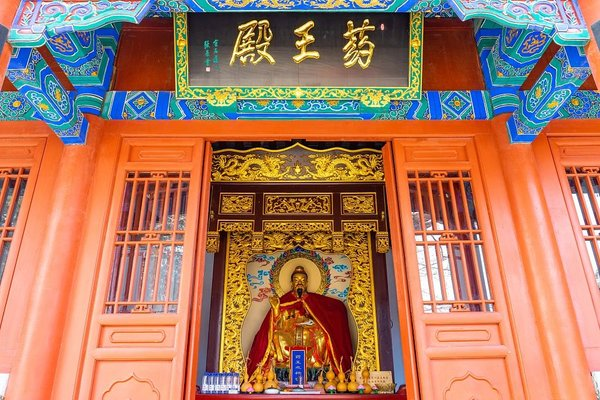
The Medicine King Temple in the Mount Tai Scenic Area in Shandong is dedicated to honoring Sun Simiao, the Medicine King. (Image source: Visual China)

Sun Simiao’s life was not only a beacon of excellence in the field of medicine but also a model of selflessness and moral integrity. His legendary stories and medical achievements have added a shining chapter to the history of Chinese medicine, inspiring generations of healers to follow in his footsteps.

Link:https://peacelilysite.com/2024/10/24/sun-simiao-the-medicine-king-of-china-and-his-legacy-of-compassionate-healing/