“An Amazing, Wondrous Moment”: Tibetan-born Musician and Artist Dechen Shak-Dagsay’s emaho

By Raymond Lam January 19, 2022

Dechen Shak-Dagsay is a Swiss-Tibetan musician and author. Over the past few decades, she has built a career in music by combining the Tibetan mantra transmissions passed down by her father, Ven. Dagsay Rinpoche, with innovative melodies and contemporary instrumental productions. She has also engaged in collaborative projects with other spirituality-inspired musicians. Having lived in Switzerland for most of her life, Dechen is one of the most prominent contemporary Tibetan singers in Europe today, and has also become globally recognized through various music awards, and for having performed songs from her albums Jewel and Day Tomorrow at Carnegie Hall in New York. Dechen is also the founder of the Dewa Che charity organization, which engages in social projects in Tibet.

Dechen’s newest album, emaho – The Story of Arya Tara, released in October 2021, is about the enlightened activity of the Vajrayana goddess Tara and contains a musical rendition of the “21 Praises of Tara.” BDG recently had a chance to speak with Dechen about her latest project.

BDG: You’ve sung about Tara on various albums before, but this new album is devoted specifically to her story. What do you find inspiring about this female buddha?

Dechen Shak-Dagsay: I have had a wish for many years now to share the extraordinary story of Goddess Arya Tara, the gentle-yet-indomitable princess who became a female buddha. The mythic story goes back many eons in ancient India, where she was called Princess Jhana-Chandra, which means Wisdom-Moon. In Tibetan, her name is Yischi Dawa, and it touches me profoundly that, out of a deep sense of compassion, she would not even eat breakfast before she had liberated hundreds of thousands of beings from samsara each day. She was a faithful disciple of her teacher Buddha Dundubhisvara, and her entire community admired her.

One day, the monks urged her to make an aspiration (vyakarana) to be reborn as a man in her next life in order to attain full enlightenment. The princess laughed at this sexist exhortation and replied: “There is no male, there is no female. To discriminate between male and female is the mind of a small being. There are neither men nor women, nor a self, nor beings.” She vowed to return again and again in a female form in order to help all beings from suffering and to reach enlightenment in female form. Therefore, her teacher, Dundubhisvara, gave her the name Tara, which means “Swift Liberator.”

Tara’s story reminds us every day that we are all equally beautiful beings blessed with great inner qualities, such as love, compassion, kindness, and clarity. These qualities are just waiting to be rediscovered and nurtured.

BDG: Your album emaho captures a profound thought: “What an amazing, wondrous moment when the mind awakens.” How does the music create a mood and ambience in which the listener can realize this moment for themselves?

DSD: Emaho is indeed not an ordinary word. It is found in ancient Tibetan spiritual texts and is an exclamation of joy and amazement when the obscured mind awakens and experiences the pure, clear, and bright shining light of the true nature of our mind.

Personally, I find that each of the eight pieces hold beautiful emaho moments for the listeners. As with all my previous albums, I received the texts for this exalted goddess from my dear father, Ven. Dagsay Rinpoche. It is a great blessing that Rinpoche gave me the transmissions for these beautiful “21 Praises of Tara,” which are practiced in all Tibetan traditions. I also had the privilege of working with Swiss producer Helge van Dyk, who also composed and produced the music of my two previous albums, Jewel and Day Tomorrow.

I said to Helge that I wished to represent the four enlightening activities of Tara in four musical pieces. I cannot thank Helge enough for creating the most sublime music to present the four skillful enlightening activities of Tara: the pacifying, enriching, magnetizing, and wrathful aspects.

When you listen to emaho – The Story of Arya Tara, my hope is that you will enter the wonderful, unique space and landscape of Tara’s buddha-field, and perceive her different fields of activities through the following musical compositions.

emaho – an Amazing One” – “The Wisdom of Tara” – Tara’s
magnetizing activities. Audio courtesy of VANDYKMUSIC
emaho – an Amazing One” –
Tara’s enriching activities. Audio courtesy of VANDYKMUSIC
emaho – an Amazing One” – “Magic Pulse” (of Prayer
Drumming) – Tara’s wrathful activities. Audio courtesy of VANDYKMUSIC

BDG: How do you think the spirit of emaho can help heal our fractured and hurting world, which is now immersed in COVID-19 and a range of other immense crises?

DSD: We generally believe in the great healing power of the Buddha’s teachings, especially when the world is going through a difficult time. We are still in a worldwide pandemic, and we constantly face threats of natural calamities and other crises.

The whole world has faced unprecedented challenges over the last two years, and we are still trying to find solutions for how to handle them. From a worldly point of view, these problems are simply devastating and are creating immense suffering for everyone. But from a Buddhist view, such challenges are exactly what we call “precious moments” for our minds to awaken and to encourage a total reset in our interior world and inner being. We call these moments precious because they allow us to open our hearts to the Buddha’s teachings, such as the Three Marks of Existence. Recalling them always has an instant healing effect on me:

• Impermanence (Skt: anitya): Nothing stays the same, everything is constantly changing.

• Whatever we experience is marked with some kind of suffering. As long as we identify ourselves with a sense of solid self, we will always suffer (dukkha).

• Everything around us and even our own person is empty of a self (anatman).

Dechen Shak-Dagsay. Image courtesy of VANDYKMUSIC

Together with Helge and other musicians, we created emaho in the hope that it will be a small contribution to helping us all through these troubled times together.

We hope to be able to bring calm and peace into people’s hearts. We will not be able to get rid of COVID-19, or the economic, social, and political fallout it has caused, but the music that carries the blessings of Arya Tara, the Swift Liberator, will help us all to overcome our fears, sadness, frustration, and pain to create some space in our hearts and to rebalance our minds. It is within this calm space that we will be able to tap into our innate beauty and strength. We all need this to transform our pain and negative thoughts, and to calmly face and embrace the difficult times ahead of us; to fully become aware of our own inner qualities.

The release of the new double album was followed by the release of my new book, Mantras, Musik & Magic Moments, in December 2021, in which I write about the healing aspects of the old Tibetan mantras, and why I chose music as a tool to reach people’s hearts. I also talk about how Tibetan healing symbols have carried sacred power for centuries. I began making mantra music about two decades ago, and I hope followers will enjoy this new perspective I am offering through my work.

BDG: Your music has been received very well worldwide and your profile has also been rising in Asia. Do you present your music as non-denominational and embracing of all Buddhist traditions, even while it expresses your Tibetan heritage?

DSD: Although I am very rooted in Tibetan or Vajrayana Buddhism, I embrace all Buddhist traditions. My dear father Dagsay Rinpoche, who lives in Chengdu, always reminded us that the essence of the Buddha’s teachings is non-violence and cultivating love and compassion for all beings. All Buddhist traditions, including the Tibetan heritage, are following this beautiful path. It is my wish to one day come to Asia to meet all my Asian friends and to perform my music in Asia together with the Jewel Ensemble.

In my third piece on disc two, called “Peace of Mind,” I sing a “Praise to the 21 Taras” in Chinese and in Tibetan. It is my deep wish to create a wonderful space of peace, respect, and reconciliation.

BDG: You’ve come together with various artists to create a fusion of music. These artists also tend to have a spiritual flavor to their work. How do you decide to work with an artist? How do you identify a potential collaboration?

DSD: Thank you for sensing what I see as a very special energy to our music. I am very thankful to Helge, who has a distinct talent in finding the right artists for a special collaboration that requires not only technical musical skills, but also an open heart that is fully inspired to play soulful music with us. He has carefully selected outstanding musicians to form the Jewel Ensemble, with whom we have played many concerts all around the world. I feel very privileged to have the following members of the Jewel Ensemble, as well as an extended ensemble that we shared the stage with when playing the Call for Peace concerts with the renowned Zurich Chamber Orchestra (ZKO).

I would like to take this opportunity to thank my Jewel Ensemble musicians and guest musicians from around the world for their beautiful contributions on emaho. It has been such an honor to work with all these outstanding artists, who committed their heartful work to this album.* I would like to thank BDG for opening the door to the story of Arya Tara. I would be very happy if this music finds its way across Asia, and I would like to thank all my musicians, my producer Helge, and my dear father Dagsay Rinpoche for letting me create such precious music. I hope it will help to remind people all around the world of their own inner strength and beauty.

Link:https://peacelilysite.com/2024/06/09/an-amazing-wondrous-moment-tibetan-born-musician-and-artist-dechen-shak-dagsays-emaho/

Source: https://www.buddhistdoor.net/features/an-amazing-wondrous-moment-tibetan-born-musician-and-artist-dechen-shak-dagsays-emaho/

The Monkey Trap: A Lesson in Letting Go

African indigenous hunters have a unique method for catching monkeys.

First, they find a hole just big enough for a monkey’s hand. They place food that monkeys like inside the hole. When a monkey passes by and sees the food, it reaches in to grab it. With its hand full of food, the monkey’s hand gets stuck in the hole. Most monkeys won’t let go of the food and instead try to pull it out from different angles.

When the hunters arrive, the monkey is still struggling and trapped, making it easy for the hunters to catch it.

Many people’s anxiety and suffering stem from holding on to too many things and being unwilling to let go, which prevents them from truly obtaining what they need.

In reality, letting go appropriately allows us to broaden our horizons, take time to adjust ourselves, and better engage in our current work.

The Young Man and the Zen Master: A Lesson in Detachment

Once upon a time, a young man visited a Zen temple to seek guidance from an old Zen master. On his way, he witnessed an interesting sight and decided to test the master. Upon arriving at the temple, he and the master chatted over tea. Suddenly, the young man asked, “What does ‘going round and round’ mean?”

“It’s because the rope hasn’t been cut,” the Zen master replied casually.

The young man was stunned and amazed. He said, “Master, I am surprised that you knew! Today, on my way here, I saw a cow tied to a tree. The cow wanted to go far to graze, but because the rope was through its nose, it kept going round and round, twisting itself without being able to break free. It was quite amusing. I thought that since you hadn’t seen it, you wouldn’t be able to answer. But you answered correctly right away.”

The Zen master laughed and said, “You asked about an event, and I answered with a principle. You asked about a cow tied by a rope and unable to break free; I answered about the mind being entangled by worldly matters and unable to find liberation. One principle can explain many situations.

“A kite, no matter how high it flies, cannot soar into the vast sky because it is tethered by a string. Similarly, what often binds us in life, preventing us from being free? A single win or loss can exhaust us; a gain or loss can cause us great anguish; an exam can keep us tossing and turning; a relationship can tie us in knots.

“For power and money, we run around in circles; for fame and desire, we are constantly entangled. Fame is a rope, desire is a rope, profit is a rope; the attachments and temptations of the world are all ropes. So the Zen master said, ‘All beings are like that cow, bound by many ropes of worries and sufferings, unable to achieve liberation throughout life and death.'”

The Wisdom of Living in the Present

A young monk once asked an old monk, “Master, what did you do when you were young?”

The master replied, “I chopped wood, fetched water, and cooked.”

The young monk asked, “And what do you do now that you’ve attained enlightenment?”

The master said, “I still fetch water, chop wood, and cook.”

The young monk, puzzled, asked, “What’s the difference? It seems like you haven’t made any progress in your entire life.”

The old monk explained, “You’re wrong. There is progress. When I was young, I would think about fetching water while chopping wood, and think about cooking while fetching water. Now that I am enlightened, when I chop wood, I chop wood; when I fetch water, I fetch water; and when I cook, I cook.”

Reflecting on myself, I often feel that I need to do something else while eating to avoid “wasting time.” So, I like to chat with others, watch TV, or think about other things while eating. No wonder I sometimes feel like “I don’t even know what I just ate.”

Enjoying the time spent eating and treating each bite with attention, I savor the sweetness of the rice, the freshness of the vegetables, and the richness of the soup. The world on my taste buds is indeed wonderful, bringing much joy to everyday life.

While walking, I now instinctively let my phone rest and focus on walking, feeling my feet propel my body, enjoying the natural comfort of the breeze, smelling the flowers, hearing the birds, and seeing the colorful flowers, green leaves, and various passersby. The scenery is infinitely beautiful, something I rarely appreciated before. Missing out and becoming numb was inevitable.

This series of practices has gradually cultivated the quality of “focus” in me. I increasingly embrace the concept of “living in the moment.” Of course, I know this is just the beginning; focus is a lifelong practice.

Link: https://peacelilysite.com/2024/05/30/the-monkey-trap-a-lesson-in-letting-go/

Source: https://gospelexpress.id/2023/01/20/%E6%9D%BE%E6%89%8B%E6%94%BE%E4%B8%8B/, http://his.newdu.com/m/view.php?aid=358718https://www.sohu.com/a/240312612_761892

The Swan’s Gift

The Swan’s Gift

By Brenda Seabrooke

Anton was a farmer who lived with his wife Rubina and their seven children at the edge of the forest. He worked hard and they were happy for many years. Then one spring, the rains didn’t fall and Anton’s wheat died in the fields. As winter came on, their food supply grew smaller and smaller. Soon, Anton’s shoulders were stooped with worry. Rubina’s plump apple cheeks withered. The children no longer sang or laughed or danced, for they were all too hungry.

Every day Anton went out to hunt for food but returned without firing a shot. And every day, Rubina added water to the onion soup until there was nothing in the pot but water. When Anton saw his family crying with hunger, he wanted to cry too.

But instead, he took his gun and went out again into the cold, cold night. He had to find something for them to eat: a bird or a rabbit. But the black branches were empty of birds and no rabbits crouched in the frozen shrub. The only tracks Anton saw were his own.

He came to a small hill and knew it was the last one he would be able to climb before his strength was gone. His feet were numb and his breath rasped in the freezing air. At the top of the rise, he stopped to rest, scanning the snow for tracks. In despair, Anton turned to go. Just then, he saw below him a lake that was not yet frozen over. Its edge was lacy with ice and at its center floated a swan of such dazzling beauty that Anton could not look away. Its stark white feathers gleamed against the dark water and as Anton watched, the swan seemed to grow larger until its image filled his eyes.

Suddenly, juices flowed into Anton’s mouth. He could taste succulent roast swan and see his children’s faces glowing as his family sat at the table eating again. He raised his gun and sighted down the long barrel. Anton put his finger on the trigger. The swan seemed to be looking at him, listening for the shot that would kill it. He lowered the gun. The swan was the most beautiful creature Anton had ever seen. As he watched, the swan fanned its magnificent wings.

Anton closed his eyes and thought of his family. Again, he raised his gun. Hours seemed to pass. The feathers on the swan’s breast moved gently with each beat of its heart, and Anton could feel his own heart beating. He lifted his heavy wet feet, walked a few steps, and then dropped to his knees. “I can’t do it,” he said.

“Why not?” asked a voice as soft as snow or feathers ruffling in a gentle wind.

“I cannot kill beauty. If I kill this swan, my family will have food for one or two meals. And then what? We will be hungry again and it will have been for nothing.”

Anton was too tired to be surprised that he was speaking to the swan or the wind or the night. He was too tired to walk back home. He bowed his head with sadness for his family.

With a cry, the swan lifted its wings, rose from the lake, and circled Anton, water dropping from its wing feathers.As the water hit the snow, it froze into crystals that sparkled in the moonlight. Anton reached out and touched one. It was hard, harder than ice, and did not melt in the warmth of his hand.

“A diamond!” Anton said. Quickly, he scooped up the diamonds that lay in a glittering circle around him. He filled his pockets with them and set off through the snow to a nearby village.

Anton was no longer tired. He no longer felt the cold. He woke up the innkeeper, calling, “I need food.”

“Your crops failed,” said the innkeeper. “Everyone knows you have no money.”

“I have a diamond,” said Anton.

“Where would the likes of you get a diamond?” the man scoffed.

“Let me in and I will explain.”

The innkeeper fed Anton cold venison and sweet dumplings while Anton told his story, and the innkeeper’s wife packed a sledge for him with roast chickens and cheeses and onions and turnips. Then they sent Anton on his way so that they could begin looking for the magic swan themselves.

Rubina met him at the door. “Did you find any food? Mischa has fainted.”

“No. But look what I have brought.” Anton showed her the sledge.

“But how did you get it?” she asked.

For answer, he spilled the diamonds onto the table.

“Oh,” cried Rubina, “you have turned to robbery!”

“No,” said Anton. And he told her all about the swan, and how it had circled him with the diamonds falling from its wings.

Anton and Rubina woke the children even though it was the middle of the night, and they all sat at the table eating slowly, enjoying the flavor of the food and wonderful feeling in their stomachs. Rubina’s black eyes sparkled as she filled her children’s bowls. Anton felt his strength returning. Several of the children hummed as they were put to bed.

Anton and Rubina and their children were never hungry again, for they used their diamonds wisely and well. News of the magic swan spread throughout the land and many people searched for it. But the swan was never found.

Sometimes when Anton was alone in the forest, the image of the swan rose before him. He saw again the gleam of its feathers, the coral glow of its beak, and the magnificent reach of its wings as it glided silently across the sky.

Link:https://peacelilysite.com/2024/05/20/the-swans-gift/

Source: https://files.schudio.com/st-marys-ce-primary-school/files/documents/year_2_reading_1(1).pdf

When I say I’m a Buddhist

Professor Richard Gombrich, who dedicated 40 years of his life to studying Buddhism and Pali language at Oxford University, shares his understanding of Buddhism.

When I say I’m a Buddhist, it doesn’t mean I’m purer and nicer than others. But it means I have too much ignorance and mental defilement to remove. I need Buddhas’ wisdom.

When I say I’m a Buddhist, it doesn’t mean I have more wisdom than others. But it means I have been occupied by too much arrogance. I need to learn to be humble and to develop a broader perspective.

When I say I’m a Buddhist, it is not because I am better or worse than others, but because I understand all beings are equal.

When I say I’m a Buddhist, I know I only love those to my taste, but Buddha loves even people he does not like, guiding them to be full of wisdom and compassion. That’s why I choose to follow Buddha’s teachings!

When I say I’m a Buddhist, it is not with the goal of getting what’s in my interest. But for letting go of my personal clinging to all worldly desires.

When I say I am a Buddhist, it is not because I pursue a smooth life. But for the calm acceptance of impermanence, and be calm and confident like a king in any adverse circumstances.

When I say I am a Buddhist, I do not mean to manipulate others with the motivation of self-interest. But with good use of wisdom, to benefit self and others while being empathetic to all sentient beings.

When I say I am a Buddhist, it is not because I want to escape from the world and pursue nothingness. But to know everyday life is within Dharma, and to live in the present is to practice.When I say I am a Buddhist, it does not mean that my life will no longer experience setbacks.

But with the Dharma, setbacks are transformed into a cause for my growth.

When I say I am a Buddhist, my heart is filled with endless gratitude. Just thinking I was born as a human and have the ability to practice in this life, with the opportunity to meet wise teachers and hear the Buddha’s teachings, I am deeply moved by this unbelievable karmic affinity.

When I say I am a Buddhist, it is not because there is a God outside of me. But that I find the true Buddha-nature of my own heart.

Link:https://peacelilysite.com/2024/05/16/when-i-say-im-a-buddhist/

Source: https://buddhistbugs.blogspot.com/2018/07/when-i-say-im-buddhist.html

Discovering Meaning in Adversity: Lessons from Viktor Frankl’s ‘Man’s Search for Meaning’

In his profound book “Man’s Search for Meaning,” psychologist Viktor Frankl imparts crucial lessons on finding meaning in our lives. The book is divided into two parts: the first half comprises the author’s semi-autobiographical narrative of life in a concentration camp, retaining insights and thoughts from the perspective of a refugee. Frankl, with the keen observational eye of a psychologist, categorizes the camp’s inhabitants into two main groups. Those who survived were invariably those who found meaning in life and clung to a shred of hope to keep moving forward, although many of them did not persevere until the end. Those who deemed life meaningless, lost the will to live, and had no hope, inevitably perished.

The second half delves into the fundamental concepts of logotherapy from a psychological perspective. Observations from the refugee camp are documented and internalized into the author’s own “logotherapy,” aiding patients—or ordinary people like us—in finding meaning in life and living their unique existence. The author advocates against determinism, emphasizing the importance of individual choice over environmental determinism.

Frankl, a Jewish psychiatrist imprisoned in the Auschwitz concentration camp, experienced a tumultuous journey of emotions. Before Christmas in 1944, rumors spread in Auschwitz that the war would end and everyone would be released, yet after Christmas passed without the anticipated victory, hopelessness descended, resulting in the death of 80% of the camp’s inhabitants—not from hunger and cold, but from the loss of hope. Frankl survived because two things mattered to him: his family, especially his love for his wife, which provided him with immense motivation during times of suffering, and his manuscript, his work on the psychological “logotherapy” he aimed to complete. These two things were bigger than himself, sustaining him through the ordeal.

This book stands out among numerous works because it encompasses both the author’s personal harrowing experiences and the detached observations of a scientist. From the outset, the author states his reluctance to write a mere chronicle of the concentration camp but rather aims to answer one question: “What psychological journey does an ordinary prisoner go through each day in the camp?” His observations focus on the silent, anonymous inmates’ reactions to their environment, including his own.

What fascinates me most is the author’s earnest yet transcendent perspective. Grounded in his own inner being, he strives for honesty without self-pity or complaint, maintaining a clinical detachment that rises above the harsh realities of the time. This writing style and attitude reveal both his resilient spirit and remarkable clarity of mind, as well as his profound understanding of his inhuman conditions, rendering emotional catharsis unnecessary.

At times, he detaches himself from his immediate surroundings, engaging in imaginary dialogues with his beloved wife, allowing love to fill his heart. The ability to detach oneself from reality using imagination is a unique human skill that aids survival in extreme adversity.

His theory posits that the search for meaning in life is the fundamental driving force of human existence. This meaning is unique and individual, requiring realization and practice by each person; only through this realization can one’s will to meaning be fulfilled. The aim of “logotherapy” is to aid individuals in uncovering the meaning in their lives. This meaning varies for each person and changes at different life stages, necessitating personal exploration. Once discovered, it provides hope for easing the neuroses arising from a lack of meaning in life. Meaning in life is concrete and tangible. For instance, a mother may find meaning in living for her children. I wholeheartedly concur with the author’s view that the meaning of life is not fixed. The sustenance it provides varies at different ages and stages of life. For instance, there was an elderly man who had been depressed for two years after losing his wife, seeking assistance from Frankl. When asked what his wife would do if he had passed away before her, the man responded that she would not be able to bear such pain. Frankl then remarked, “So, she left first. You can bear the pain for her to rest in peace. Isn’t that good?” The man felt relieved upon hearing this. He found the meaning of his life at that time.

According to author, there are three paths to finding meaning in life: 1. Creativity and work; 2. Recognizing values (such as love); 3. Suffering. Frankl firmly believes that everyone can find meaning in life, whether through creativity and work, experiencing something or loving someone, or, in extreme circumstances, when all joy is stripped away, unavoidable suffering itself becomes the meaning of life. From his experiences in the concentration camp, he realized the third path.

In extreme adverse conditions, when a person is reduced to nothing but their body and mind, they still retain the freedom to choose their attitude towards their environment. They can either actively and arduously utilize every condition to survive or succumb to the desire to die, yielding to fate. The choice of attitude is the only and complete dignity and meaning. And humans can choose to say “yes” to life.

Therefore, Frankl is a pessimistic optimist. He acknowledges that life itself is inherently meaningless, yet he is willing to inspire humanity to find meaning for themselves. His mission in existential psychiatry is to help patients find their own meaning in life through various methods. In contrast to psychoanalysis, which views humans as passive products of their environment, Frankl places human subjective will in a more significant position.

I cannot disagree with Frankl’s viewpoint. From my own half-century of life experience, I also believe that the attitude we adopt towards our environment, whether favorable or adverse, ultimately determines the trajectory of our lives. This is what I mean by “character determines destiny.” There are times of despair, hopelessness, and pessimism, of course, and there is no need to feel ashamed. We should learn to pull ourselves out of negative emotions and sincerely believe that “tomorrow will be better.” And indeed, tomorrow often turns out fine.

Nine powerful quotes from the book Man’s Search for Meaning

  1. Choose hope. We cannot always change our circumstances but we always have a choice about our attitude in any given situation. As Viktor Frankl writes, “When we are no longer able to change a situation, we are challenged to change ourselves.”*
  2. Know your why. Ask yourself: What am I living for? Every single day, we should ask ourselves why we are getting up and why we are here at all “Those who have a ‘why’ can bear with almost any ‘how’.”
  3. Learn how to cry. Tears are not a sign of weakness; they emanate from a soul that is not afraid to break: “But there was no need to be ashamed of tears, for tears bore witness that a man had the greatest courage, the courage to suffer.”
  4. Don’t just be part of the herd. The world is upside down; sometimes doing what everyone else is doing is what is insane. “An abnormal reaction to an abnormal situation is normal.”
  5. Live meaningfully. We create meaning by answering the questions life asks from us. “Ultimately, man should not ask what the meaning of his life is, but rather must recognize that it is he who is asked. In a word, each man is questioned by life and he can only answer to life by answering for his own life. It did not really matter what we expected of life, but rather what life expected of us.”
  6. Fill your day doing acts of kindness. There is purpose in kindness; there is meaning in the hundreds of small acts of giving that we have the opportunity to grasp each day. “We who lived in concentration camps can remember the men who walked through the huts comforting others, giving away their last piece of bread. They offer sufficient proof that everything can be taken from man but one thing: the last of the human freedoms-to choose one’s own way.”
  7. Move beyond yourself. We find true meaning when we transcend our own needs and limits. “The more one forgets himself – by giving himself to a cause to serve or another person to love – the more human he is and the more he actualizes himself.”
  8. Feel the pain of others. Suffering hurts no matter how irrelevant or ordinary it may seem to others. Be attuned to others’ grief even if doesn’t seem like a tragedy in the overall scheme of life. “Thus suffering completely fills the human soul and conscious mind, no matter whether the suffering is great or little. Therefore, the ‘size’ of human suffering is absolutely relative.”
  9. We can change even when life is hard. We can create meaningful lives full of depth and love and purpose. “Man does not simply exist but always decides what his existence will be, what he will become the next moment. By the same token, every human being has the freedom to change at any instant.”

Link:https://peacelilysite.com/2024/05/10/discovering-meaning-in-adversity-lessons-from-viktor-frankls-mans-search-for-meaning/

Source: https://aish.com/viktor-frankl-on-mans-search-for-meaning/?utm_source=googlegrants&utm_medium=cpc&utm_campaign=19561819333&utm_term=&gad_source=1&gclid=Cj0KCQjwxeyxBhC7ARIsAC7dS39s79sG7BUeoDswcsOBoRwlH6T6GmrNQQI4sy3uRqgCvyLnNNoEQooaAo9EEALw_wcB, https://book.douban.com/subject/5330333/reviews

What I Have Lived For

By Moiz, Sep 8, 2016

I have not lived for nothing as of yet I believe. At the age of ninety-five, I do not anticipate having too many more years to look forward to, but still at this point in time I believe I cannot answer the question as to what I have lived for as I am still living. Because if there is anything that I have learned it’s that I cannot see what is further ahead of me than the span of my arms. As a rider is to be approaching a cave, from a distance he may be deceived — especially in the night — and it may be the case that the cave is truly a rounded bridge of sorts. I do not pretend to know what is to come next so rather than explaining what I have lived for, I would much rather give you the words that would explain why I am still among the living.

I am still among the living for precisely this purpose: the joy it gives me to write — to explicate the answers to the questions of my heart — is greater than any worldly pleasure I have ever known of. The truth remains that I would like to have written more in the years that I have lived, but I am keen to continue as the tide never stops its charge despite how often it breaks at the shore.

Truthfully, I am alive for the people that this world has housed as their temporary abode. The men, the women, but most of all the children that I have had the truest honor of coming to understand as my companions — as friends — with whom I have created many meaningful memories and a body of magnificent works are my most profound reason for existence. The loving people I have encountered are to know that I am still alive for them; if it’s something that they forget in the course of our frightened retreats in our fleeting livelihoods then I pray that I remind them of this fact every day that I am blessed with living.

Finally, I live to meditate on the ecstasies of the universe — both of nothing and of everything. Neither is greater than the other, but as I have learned in my time here, they are nearly one and the same. The truth of the essence within me is the only part of me that I don’t regret keeping. Even at this age I have yet to let go to the extent that I know I must. Maybe it isn’t too long that I drift into oblivion.

But if that’s what must happen then I am glad to have been able to share these thoughts with you.

Link:https://peacelilysite.com/2024/05/07/what-i-have-lived-for/

Source: https://gloriouspublication.com/what-i-have-lived-for-66260ab87e32

A Journey into the Spiritual Realm

Have you ever stumbled upon a book that instantly captivates your attention, drawing you into its pages with an irresistible allure? That’s precisely what happened to me when I discovered the Chinese version of “The Boy Who Saw True.” From the moment I started reading, I was completely enthralled.

At the heart of this remarkable book is a young boy from England, born into privilege yet endowed with an extraordinary gift. Raised in a family where literature was cherished, he inherited his father’s passion for reading, immersing himself in books far beyond his tender years. Despite his mother’s attempts to steer him away from certain subjects, his determination to explore the literary world only grew stronger, infusing his writings with a delightful blend of wit and charm that is uniquely his own.

But what truly sets this young boy apart is his “third eye” – an innate ability to see truths hidden from ordinary sight. In his diary, he meticulously chronicles the myriad of peculiar phenomena he encounters in the spiritual realm. From envisioning himself as a monk in a secluded cave, imparting ancient Buddhist teachings to his disciples, to glimpsing his past life as a revered priest in ancient Egypt, seduced by the allure of worldly power – each revelation is as astonishing as it is profound, offering profound insights into the mysteries of human nature and the cosmic order.

Despite facing skepticism and misunderstanding from those around him, the boy’s unwavering insight into the spiritual realm remains unquestionable. His experiences, both mysterious and mesmerizing, serve as a beacon of inspiration, igniting a fervent curiosity in readers eager to unlock the secrets of the universe.

The author’s integrity shines through every page, as he never seeks to exploit his psychic abilities for personal gain. It’s this steadfast commitment to truth and authenticity that makes his diary a rare and precious gem, entrusted to the world by the esteemed editor, Mr. Cyril Scott, after the author’s passing.

What makes “The Boy Who Saw True” truly exceptional is its exploration of the spiritual realm through the innocent eyes of a child. Unlike other metaphysical books, it eschews complex theories in favor of a refreshingly simple and humorous narrative style, making it accessible to readers of all ages.

As I delved deeper into its pages, I couldn’t help but feel a profound sense of wonder and enlightenment. This book is more than just a literary masterpiece – it’s a journey of self-discovery and spiritual awakening that transcends the boundaries of time and space.

In conclusion, “The Boy Who Saw True” invites readers to embark on a transformative voyage into the unknown, where the boundaries between reality and imagination blur, and the truth reveals itself in the most unexpected of places. It’s a reminder that our lives are but a small part of a vast and wondrous universe, waiting to be explored and embraced with open hearts and minds.

Link:https://peacelilysite.com/2024/03/29/a-journey-into-the-spiritual-realm/

The Transformative Encounter: King Ajatasattu and the Buddha’s Teachings

King Ajatasattu, in order to seize the throne, murdered his own father, King Bimbisara. Afterwards, he felt constant pain and fear in his mind and body, seeking help from various physicians and religious experts but to no avail. Finally, at the urging of a monk named Jivaka, he went to seek the Buddha.

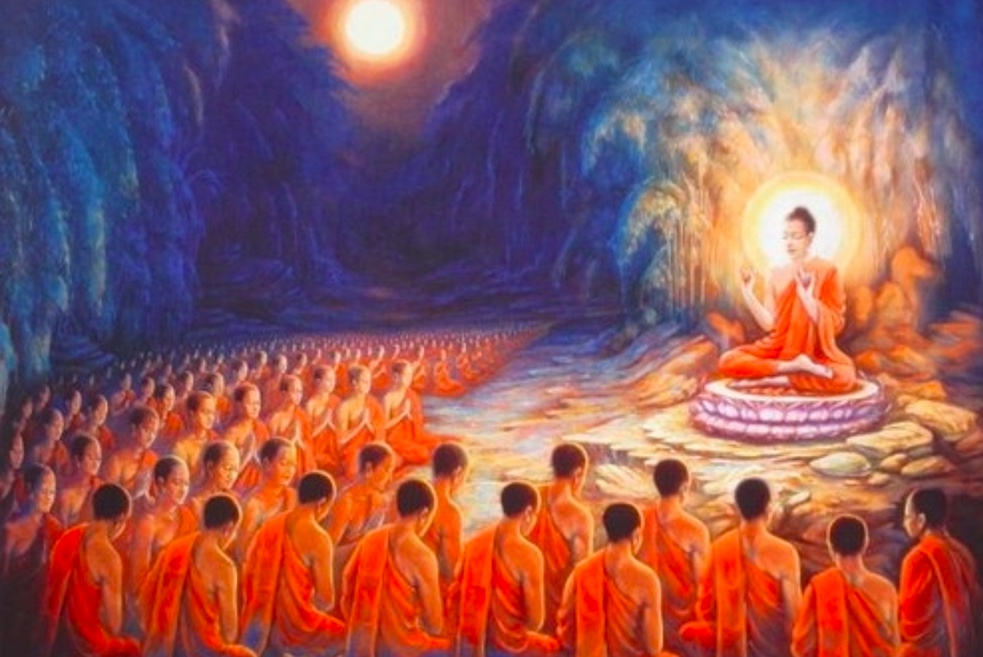
At that time, the Buddha was residing in a grove with a thousand monks. King Ajatasattu entered the assembly hall and saw a thousand monks sitting peacefully around the Buddha, not even the sound of rustling robes could be heard. King Ajatasattu had only briefly encountered the Buddha before, as he had never attended any of the Buddha’s teachings with his father. The Buddha invited them to sit down, and after bowing, the king said, “World-Honored One, I remember hearing you speak when I was young in the palace. Now I have a question for you: what practice can lead thousands of people to renounce worldly life and seek enlightenment?”

The Buddha asked if he had asked the same question to other teachers. King Ajatasattu said he had asked many different teachers, including Devadatta, but had never received a satisfactory answer. The Buddha said, “Your Majesty, tonight the Tathagata will explain to you the fruits of the true Dharma, some of which can be enjoyed in the present and some of which can be harvested in the future. You do not need to seek lofty answers; you just need to see clearly the mango you hold in your hand. Your Majesty, let me give you an analogy: a servant who obeys his master’s every command from morning till night. One day, he asks himself, ‘Why should I willingly be enslaved by my master?’ This servant decides to renounce his servitude and become a monk. He lives a life of celibacy, diligence, and mindfulness, eating only one meal a day, practicing walking and sitting meditation. His demeanor exudes peace and dignity in his actions and speech; he becomes a virtuous and respected monk. Although you know he was once a servant, when you see him now, would you say to him, ‘Come here, boy, I want you to serve me from morning till night, obeying all my orders’?”

King Ajatasattu said, “Certainly not, World-Honored One. I would never speak to him in such a manner. I would respectfully bow to him, offer him food, and ensure he receives the legal protections due to a monk.”

The Buddha said, “Your Majesty, this is the first fruit of the monk’s practice: he has liberated himself from prejudices of race, society, and class, and he has regained the dignity of being a human being.”

The Buddha continued, “Your Majesty, a person’s dignity is just the first fruit. A monk who observes the two hundred and fifty precepts can reside in a state of tranquility. Those who do not observe precepts are more prone to stray from the path; they may commit sins such as deception, intoxication, adultery, theft, or even murder. Such actions bring terrible punishments to their bodies and minds, and they may face severe penalties when caught. A monk who observes the precepts of non-killing, non-stealing, chastity, truthfulness, abstinence from intoxicants, and over two hundred other precepts finds it easier to live a psychologically freer life than ordinary people. This is another fruit that can be enjoyed in the present.

The Buddha continued, “Your Majesty, a monk possesses only three robes and an alms bowl. He never fears robbery nor needs to guard against thieves at night. He can sleep under a tree without worry. The freedom released from fear is the greatest joy. This is another fruit attained through practice. A monk’s life is very simple; although he eats only one meal a day, the food in his bowl comes from thousands of different households. He does not pursue fame or profit; he only uses what he truly needs, seeking nothing else. Dwelling in such unfettered freedom is a fruit that can be enjoyed at this moment.

King Ajatasattu said, “Truly remarkable, World-Honored One! Please continue.”

The Buddha said, “Your Majesty, if you understand how to cultivate mindfulness and contemplation of breathing, you can experience the joy of those who walk the path of practice. That is the bliss of meditation. A monk observes the six senses to overcome the five hindrances of desire, anger, delusion, sloth, and doubt. He attentively observes the breath to create joy nourishing body and mind, which helps him progress on the path to enlightenment. The pleasure derived from sensory experiences cannot compare with the joy obtained through meditation. The joy of meditation permeates body and mind, dispelling all anxieties, sorrows, and grief, allowing the practitioner to experience the true wonder of life. Your Majesty, this is one of the most important fruits of practice that can be enjoyed at this moment.”

The Buddha continued, “Your Majesty, because a monk consistently maintains mindfulness and adheres to the precepts, he can develop right concentration and insight into all phenomena. Through this insight, he sees the impermanent and selfless nature of all phenomena, thus no longer being bound by worldly affairs. He can then sever all entanglements of afflictions such as greed, anger, desire, sloth, doubt, attachment to views, speculative views, distorted views, and mistaking wrong views for right ones. After cutting off all these entanglements, the monk can attain liberation and freedom.”

“Your Majesty, liberation is true happiness and one of the greatest fruits of practice. Some of the monks sitting here tonight have already attained this fruit. Your Majesty, this is a fruit that can be realized in this very life.”

King Ajatasattu exclaimed, “Excellent, World-Honored One! I hope you can say more.”

The Buddha said, “Your Majesty, by illuminating the true nature of all phenomena, a monk knows that all phenomena are neither born nor extinguished, neither defiled nor pure, neither increasing nor decreasing, neither one nor many, neither coming nor going. With this understanding, a monk no longer discriminates; he regards all phenomena with equanimity, without hindrance. He rides the waves of birth and death to rescue sentient beings from the sea of suffering. He introduces sentient beings to the Great Way, allowing them to taste the joy of liberation. Your Majesty, helping others to break free from the maze of greed, anger, and delusion is the greatest joy. This joy extends from the present into the future as the supreme fruit of practice.

Your Majesty, in all his interactions, a monk never forgets the responsibility to guide others towards virtue and liberation. Monks do not engage in politics; they only contribute to the peace, morality, and happiness of society. The fruits of practice are not only for the benefit of monks; they are also the legacy that can be inherited by the people of the country.

The king stood up, sincerely clasping his hands together. He said, “Most Honored Teacher! World-Honored One! With your simple words, you have enlightened me, showing me the true value of the Dharma. World-Honored One, you have helped me rebuild what was shattered, revealed what was concealed. You have guided me back to the right path in my confusion, turning darkness into light. I beseech you, World-Honored One, to accept me as your disciple, just as you accepted my parents in the past.”

The king prostrated himself before the Buddha, who nodded in acceptance. He asked venerable Shariputra to teach king Ajatasattu the Three Refuges.

The meeting between the Buddha and King Ajatasattu was beneficial for all present, greatly alleviating the king’s mental torment. That night, he dreamt of his father smiling at him, healing all the wounds of the past. The king’s disposition completely changed, bringing infinite joy to his subjects. From then on, the king often visited the Buddha privately, no longer arriving on an elephant and without any guards. He climbed the meticulously carved stone steps up the mountain as his father had done in the past. In these conversations, King Ajatasattu confessed his innermost thoughts to the Buddha and repented for his past sins. The Buddha regarded him as his own son and advised the king to associate with virtuous people.

Link:https://peacelilysite.com/2024/03/28/the-transformative-encounter-king-ajatasattu-and-the-buddhas-teachings/

Unveiling the Potency of Willpower: Transforming Lives Through Self-Control

In 1996, a seemingly innocuous experiment conducted by Roy Baumeister and his team at Case Western Reserve University revealed a profound truth about human behavior: the power of will. Their study, which involved tempting participants with chocolate chip cookies only to have them resist and eat radishes instead, demonstrated the finite nature of willpower. This pioneering research laid the groundwork for understanding self-control as a resource that could be depleted, akin to a muscle that fatigues with exertion.

Photo by ROMAN ODINTSOV on Pexels.com

In the first part of the trial, Baumeister kept the 67 study participants in a room that smelled of freshly baked chocolate cookies and then teased them further by showing them the actual treats alongside other chocolate-flavored confections.

While some did get to indulge their sweet tooth, the subjects in the experimental condition, whose resolves were being tested, were asked to eat radishes instead. And they weren’t happy about it.

After the food bait-and-switch, Baumeister’s team gave the participants a second, supposedly unrelated exercise, a persistence-testing puzzle. The effect of the manipulation was immediate and undeniable. Those who ate radishes made far fewer attempts and devoted less than half the time solving the puzzle compared to the chocolate-eating participants and a control group that only joined this latter phase of the study. In other words, those who had to resist the sweets and force themselves to eat pungent vegetables could no longer find the will to fully engage in another torturous task. They were already too tired.

The experiment, while seemingly trivial, yielded crucial insights into the nature of self-regulation. Participants who exerted willpower to resist the tempting chocolates subsequently demonstrated diminished perseverance and performance on a subsequent task. This seminal finding underscored the broader significance of self-control across various domains of life, from mundane daily tasks to more significant challenges.

In the realm of psychology, this research sparked a cascade of studies exploring the multifaceted implications of willpower. It elucidated why individuals are drawn to indulgence after experiencing setbacks, such as seeking solace in retail therapy after heartbreak. Moreover, it provided valuable insights into behavior modification strategies, highlighting the importance of positive reinforcement and habit formation in fostering lasting change.

Understanding the concept of willpower empowers individuals to leverage it effectively in pursuit of their goals. Rather than relying solely on sheer determination, strategic planning plays a pivotal role in optimizing willpower utilization. Timing tasks to align with periods of peak mental and physical energy, such as the morning after a restful night’s sleep, can enhance performance and resilience.

Furthermore, recognizing willpower as a trainable attribute opens avenues for personal growth and development. Cultivating positive habits serves as a cornerstone for strengthening willpower and facilitating sustained behavior change. Initiating small, manageable goals allows individuals to acclimate gradually, paving the way for long-term success. For instance, committing to brief daily rituals, like reading for just two minutes, eating one fruit instead of a cookie, or embarking on a short morning walk, lays the groundwork for more significant lifestyle adjustments. As these habits become ingrained, individuals can incrementally expand their efforts, harnessing the cumulative impact of consistent practice. Joining a group of like-minded individuals can also provide invaluable support in reinforcing positive habits and maintaining motivation.

Additionally, cultivating positive bedtime routines fosters relaxation and promotes quality sleep. Instead of mindlessly scrolling through screens before bed, incorporating a five-minute practice of prayer, meditation, or reflection on gratitude can help unwind the mind and prepare for restorative rest. This intentional shift away from digital distractions not only supports mental well-being but also cultivates a deeper sense of connection with oneself and the present moment.

In essence, comprehending and harnessing the power of willpower is transformative. By integrating strategic approaches to task management, fostering positive habits, and nurturing a supportive network, individuals can unlock their potential for personal and professional fulfillment. As Baumeister’s pioneering research illustrated, the journey towards meaningful change commences with embracing the remarkable capacity of willpower.

Link:https://peacelilysite.com/2024/03/20/unveiling-the-potency-of-willpower-transforming-lives-through-self-control/

Source: https://www.theatlantic.com/health/archive/2012/04/the-chocolate-and-radish-experiment-that-birthed-the-modern-conception-of-willpower/255544

The World Without Complaint: A Journey to Positivity and Gratitude

In a world often overshadowed by negativity, encountering a book that challenges us to break free from the habit of complaining is like a breath of fresh air. “The World Without Complaint” by Well Bowen offers an insightful perspective on the harmful effects of constant complaints and provides practical strategies for fostering a mindset of gratitude and positivity.

We read because we crave insight, resonance, guidance, and growth. Have you ever found yourself caught in a cycle of complaints about the world, life, family, friends, or even strangers? Today, let’s explore some notes from “The World Without Complaint.” This bestselling book has reached readers in 80 countries, urging us to consider how a single book and a simple wristband can transform us from habitual complainers into ambassadors of positivity.


The Marvel of the Wristband
Have you ever participated in a lunchtime gripe session with colleagues or friends, only to find that venting seems to worsen your stress? It’s as if complaining adds fuel to the fire of our worries. The truth is, many of us are oblivious to our own negative attitudes and behaviors. While others may perceive the negativity in our speech, we often fail to recognize it ourselves. But can we change? Absolutely! By wearing the No Complaining wristband and committing to a 21-day challenge, we can become more aware of our complaints, their frequency, and ultimately, how to stop them.

The Secret to a Dream Life
The tool: The No Complaining wristband (or any accessory that reminds you to stay positive, like a fitness tracker). The secret: Consistency. As you practice the 21-day challenge and swap the wristband between your hands, you’ll start paying closer attention to your words and actions. This seemingly insignificant wristband becomes a beacon, helping you identify and release negative emotions you may not have been aware of before.

How to Use the Wristband

  • Wear the wristband on one wrist to start your 21-day journey.
  • When you catch yourself complaining, criticizing, gossiping, or being sarcastic, switch the wristband to the other hand and start over. Each time you switch, you reset your 21-day journey.
  • Keep going.

The Key to Success

  • Move the wristband with each complaint.
  • Keep track of your progress.
  • Focus on your own wristband; don’t worry about others’.
  • Don’t outsmart yourself.

Unconscious Incompetence
Complaining not only distracts us from our true desires but can also harm our health and relationships. Changing just one percent of the world’s population can create a ripple effect of positivity that uplifts everyone. Complaints never attract what we desire; instead, they reinforce what we don’t want. Our thoughts shape our lives, so let’s be fully present, steadfast, and strive to be better versions of ourselves.

Conscious Competence

  • Smile, breathe, take it slow. Our words have power. Changing what we say can change our lives.
  • Criticism and sarcasm are rarely productive. Focus on constructive feedback and encouragement.
  • Plant seeds of positivity in your interactions. Inspire others by embodying the change you wish to see.
  • Transform your mindset from one of complaint to one of gratitude. Every moment is an opportunity to create the life you desire.

Unconscious Competence

  • Transform your tools and methods into personal logic and theory.
  • The best time to plant a tree was ten years ago. The second-best time is now. Believe in your ability to change, and the solutions to all your problems will follow.

Complaining is more than just a fleeting expression of dissatisfaction; it’s a habit that can poison our minds and relationships. Continuously focusing on what’s wrong or lacking in our lives not only perpetuates a cycle of negativity but also reinforces feelings of helplessness and victimhood. Complaining can strain our relationships, as constant negativity can push others away and create a toxic environment.

Moreover, the energy we invest in complaining could be better utilized to find solutions to our problems or to appreciate the blessings we already have. Dwelling on complaints keeps us stuck in a state of discontentment, hindering personal growth and preventing us from fully embracing life’s joys.

Training Yourself to Avoid Complaints
Breaking the habit of complaining requires conscious effort and dedication. Bowen’s book offers practical techniques and exercises to help readers rewire their brains and cultivate a more positive outlook. From mindfulness practices to gratitude journaling, the book provides actionable steps to shift our focus from complaints to appreciation.

One effective strategy is to practice mindfulness and become more aware of our thoughts and emotions. By recognizing the patterns of negativity that lead to complaints, we can interrupt the cycle and choose a more constructive response. Additionally, cultivating a habit of gratitude can help us reframe our perspective and find joy in even the smallest blessings.

The Benefits of Embracing Positivity
Choosing not to complain has numerous benefits that extend beyond our personal well-being. By adopting a positive mindset, we become more resilient in the face of challenges and better equipped to navigate life’s ups and downs. Our relationships thrive in an environment of positivity, fostering deeper connections and mutual support.

Furthermore, a world without complaints has the potential to spark positive change on a larger scale. Imagine if just one percent of the population committed to refraining from complaints— the ripple effects would be profound. Communities would be filled with kindness and compassion, and collective efforts toward solving problems would be more effective and harmonious.

Link:https://peacelilysite.com/2024/03/15/the-world-without-complaint-a-journey-to-positivity-and-gratitude/