Nestled in the heart of Xinjiang, the Turpan Basin holds several extraordinary records: it’s the lowest geographical point in China, and during summer, it’s the hottest place in the country. With scorching sunlight, relentless winds, and almost no rainfall, Turpan earns its title as the “Land of Fire.”
In the peak of summer, the surface temperature in the surrounding Gobi Desert can soar to 82.3°C (180.1°F), while the air temperature often exceeds 49°C (120°F). Rain is almost nonexistent—Turpan receives an average of just 16.4 mm of rainfall annually, and in some years, as little as 4.3 mm. Yet, amidst this harsh, parched environment, an ancient miracle has quietly sustained life for over two thousand years: the Karez irrigation system.
A Miracle Beneath the Earth
While nature was unforgiving above ground, it hid a gift below. Meltwater from the distant Tianshan Mountains seeps underground through coarse gravel and sand, eventually blocked by the Flaming Mountains and surfacing as springs. Ingenious local people found a way to capture and guide this underground treasure—thus, the Karez was born.
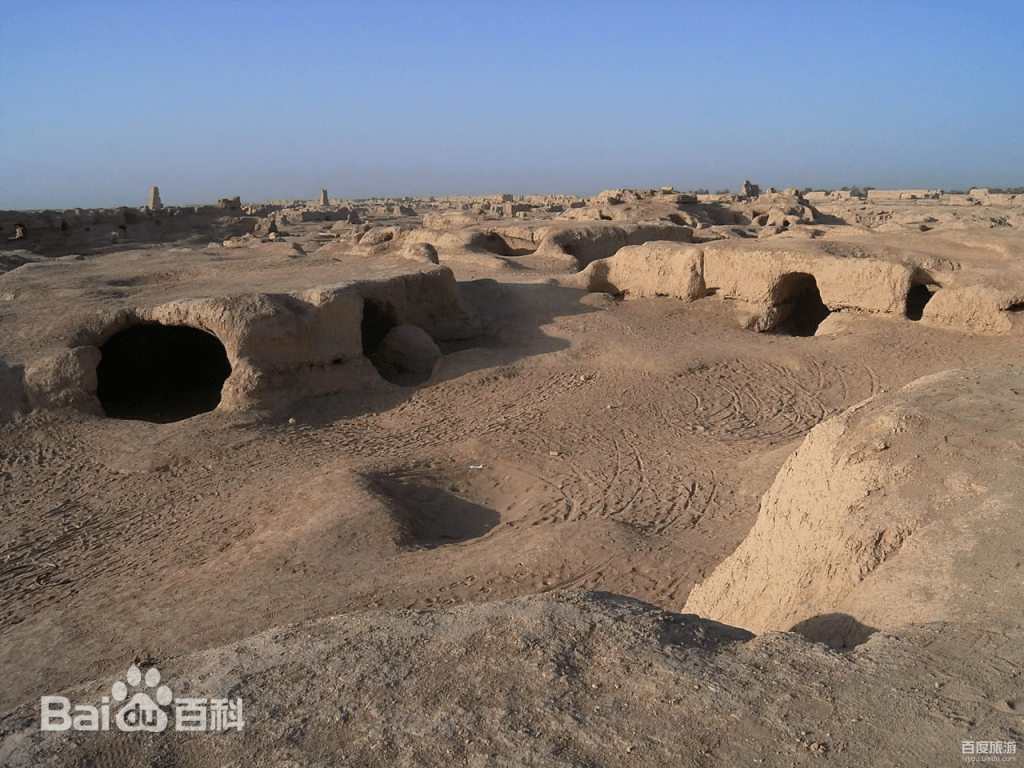
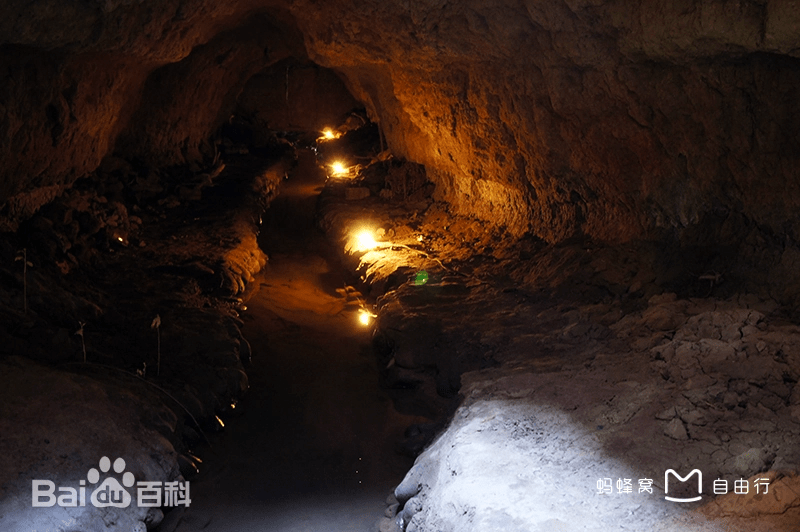
The Karez system channels water from mountain sources through a network of underground tunnels and vertical shafts, delivering it to the arid land without evaporation loss. Remarkably, this ancient system operates entirely without pumps, relying solely on gravity and terrain.
A complete Karez includes:
Vertical shafts for ventilation and maintenance
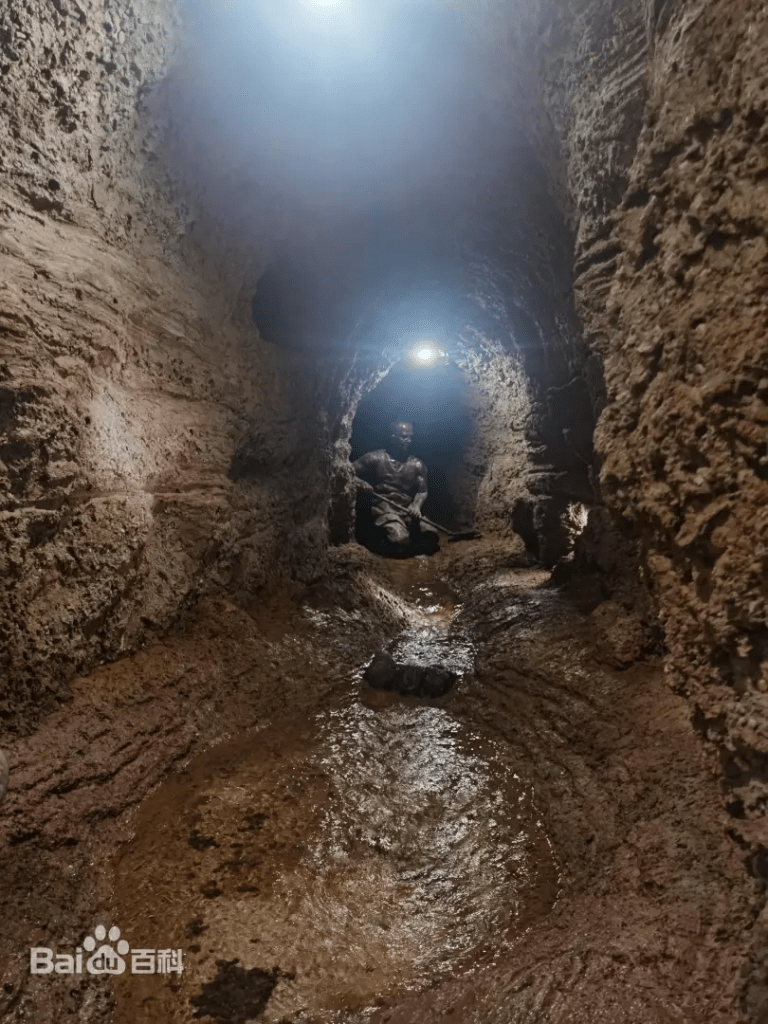
Underground tunnels to carry water
Open canals to distribute it
Storage ponds to hold it
Across Turpan’s landscape, you can still see long rows of small mounds—each one marking a shaft, a glimpse into the remarkable infrastructure below.
A Testament to Ingenuity and Endurance
The origins of the Karez can be traced back to the Han Dynasty, over 2,000 years ago. Most of the surviving systems were built during the Qing Dynasty, including during historical moments like Lin Zexu’s fourth inspection of Turpan, when over 300 new Karez channels were added, and Zuo Zongtang’s campaigns, which saw nearly 200 more constructed.
At its peak in the 1950s, there were about 1,700 Karez systems in Turpan, stretching over 3,000 kilometers. Today, about 725 remain, a number slowly dwindling due to modernization, drought, and human impact.
The construction of each Karez was no small feat. Generations of laborers worked in dark, narrow tunnels, often barefoot in icy water, chiseling stone with simple tools and oil lamps. They carried earth and rock out by hand, surviving on dry flatbread and enduring brutal conditions.
A Culture of Water, Wisdom, and Survival
More than just a hydraulic system, the Karez represents a culture—a story of human resilience, harmony with nature, and intergenerational wisdom. In this water-scarce land, the Karez has nurtured lush vineyards, fertile fields, and diverse communities, offering life where none should thrive.
Today, many of these systems are dry or abandoned, relics of a past shaped by necessity and brilliance. But for those who walk among them, they are still very much alive—whispers from the earth, reminding us of what is possible when people respect and work with nature.
If you ever find yourself in Turpan, do not miss the chance to explore the Karez wells. They are more than ancient engineering marvels—they are monuments of perseverance, and living echoes of a civilization that made the desert bloom.
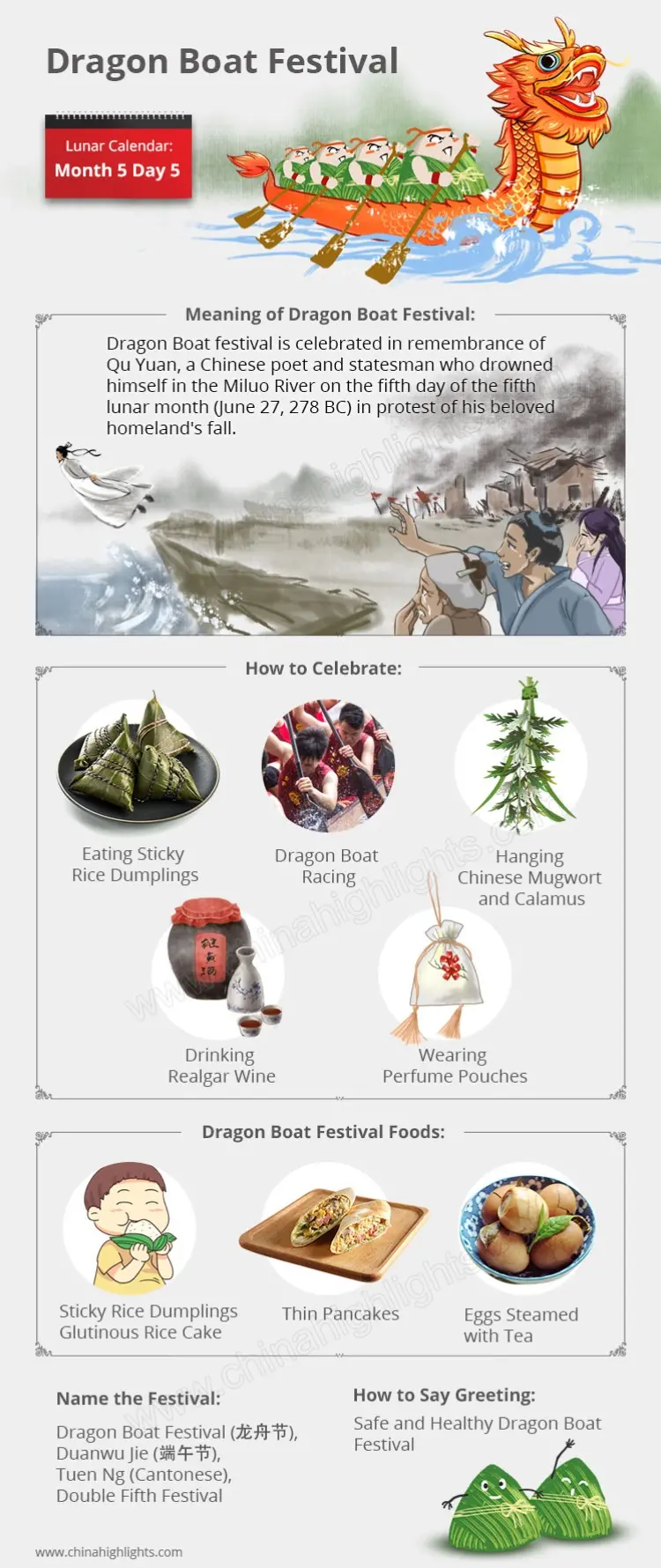
The Dragon Boat Festival, also known as Duanwu Jie, is one of the four major traditional Chinese festivals, alongside the Spring Festival, Tomb-Sweeping Day, and Mid-Autumn Festival. It is celebrated on the fifth day of the fifth month of the Chinese lunar calendar, which is why it is also called the “Double Fifth Festival” (Chongwu Jie, 重五节). On the Gregorian calendar, it usually falls in late May or early June.
In addition to Chinese mainland, many other Asian countries and regions also celebrate this festival. In Malaysia, Indonesia, Singapore, and Taiwan, China, it is known as Bak Chang Festival (‘Dumpling Festival’). Learn more facts about the Dragon Boat Festival
Why Is Dragon Boat Festival So Important?
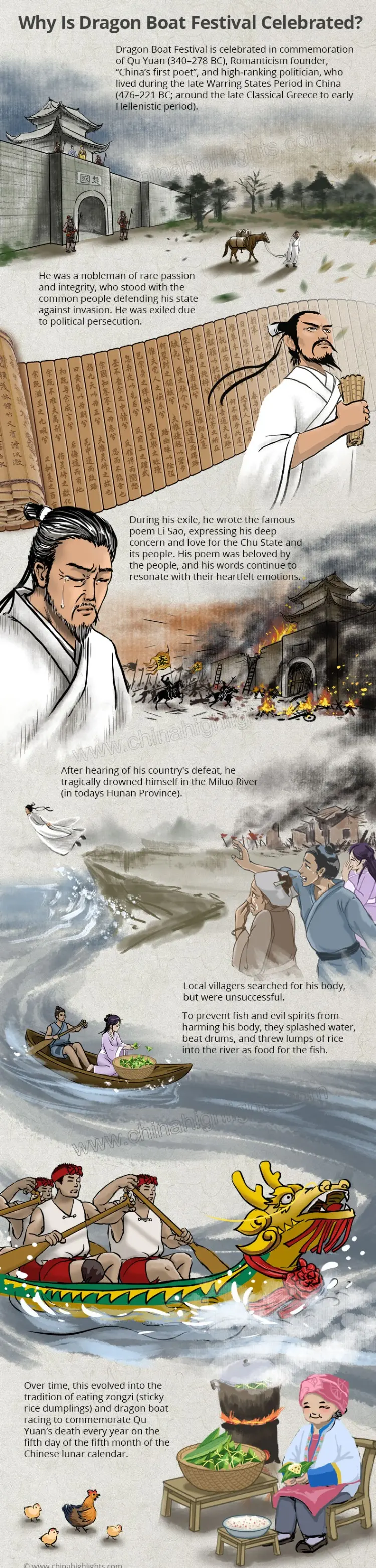
Many believe that the Dragon Boat Festival is celebrated to commemorate the death of Qu Yuan, a renowned Chinese poet and minister known for his patriotism and profound contributions to classical poetry. He ultimately became a national hero.
However, historical evidence shows that the origins of the Dragon Boat Festival actually predate Qu Yuan’s death. The festival’s earliest roots are tied to the fifth lunar month, which the ancients considered the “month of poison.” As summer began, people were more prone to illness, and epidemics often spread. This made the month seem ominous, prompting ancient communities to adopt various practices to ward off disease and evil spirits.
Thus, the Dragon Boat Festival was originally observed as a traditional health and wellness festival. It was a time for people to carry out rituals and customs aimed at protecting themselves from illness and repelling harmful forces.
Dragon Boat Festival Customs
The customs of the Dragon Boat Festival can generally be divided into two main categories. One centers on honoring dragons and historical heroes—most notably Qu Yuan—while the other focuses on warding off evil spirits and promoting health and well-being.
1. Honoring Heroes and Dragons
a. Eating Sticky Rice Dumplings
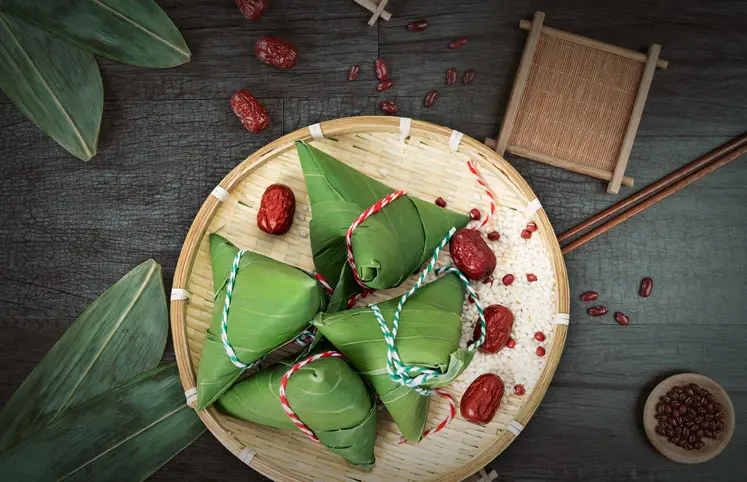
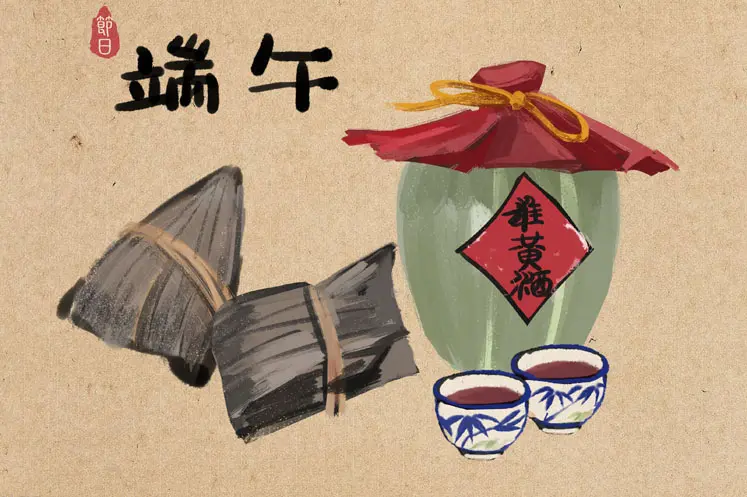
Zongzi (粽子, zòngzi) are the most iconic food of the Dragon Boat Festival. According to legend, after the patriotic poet Qu Yuan drowned himself in the river, local people threw lumps of rice into the water to prevent fish from eating his body. This evolved into the custom of making zongzi.
Traditionally, families would prepare and share homemade zongzi. Today, while some older generations still hand-make them, most people buy them from restaurants or bakeries.
Zongzi are made with glutinous rice and often filled with meats, beans, or other ingredients. They are wrapped in bamboo or reed leaves into triangular or rectangular shapes and tied with soaked stalks or colorful silk cords. Flavors and fillings vary widely across different regions of China.
b. Participating or Watching Dragon Boat Races
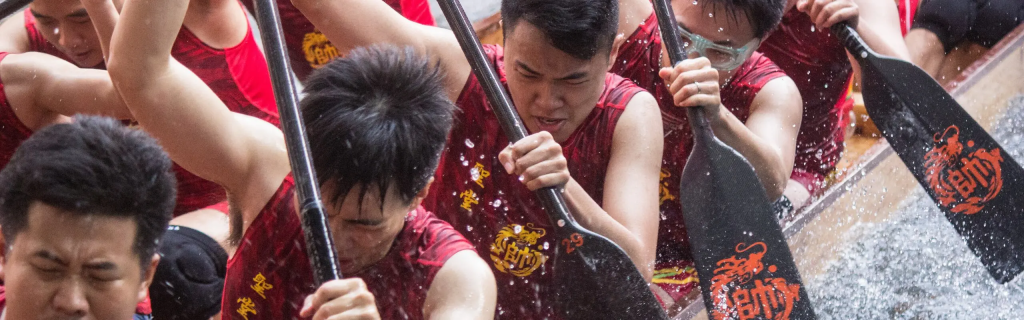
Dragon boat racing is the most exciting and prominent activity during the festival. The sport is said to have originated from people paddling out in boats to search for Qu Yuan’s body after his tragic death in 278 BCE.
Another theory suggests that the races originated more than 2,000 years ago as a ritual to worship the Dragon God or Water God.
The boats are traditionally carved and painted to resemble dragons. Depending on the region, each boat can carry 30 to 60 paddlers. Teams row in unison to the rhythm of pounding drums, creating a thrilling and energetic spectacle. Winning is believed to bring good luck and happiness for the year ahead.
Some of the most famous races take place in Hong Kong, Guangzhou, and Hangzhou.
2. Warding Off Evil and Promoting Health
a. Hanging Chinese Mugwort and Calamus
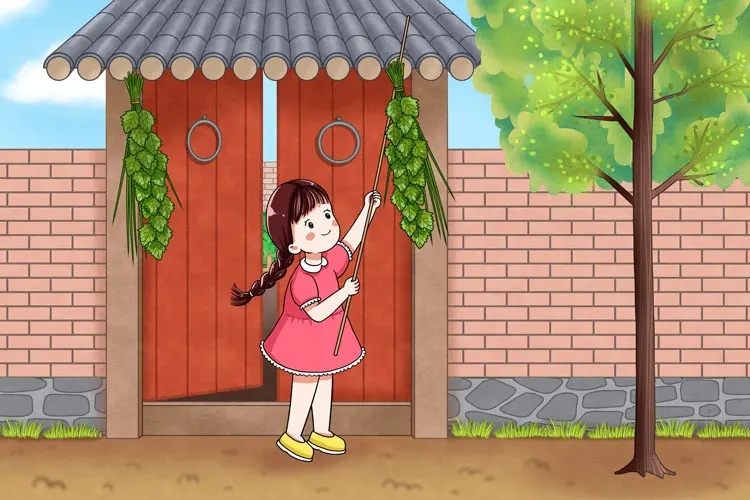
The festival coincides with the early summer season, a time when illnesses were historically more common. Mugwort and calamus are medicinal herbs used to prevent disease and repel pests. Their strong fragrances are believed to drive away flies, mosquitoes, and negative energies.
On the fifth day of the fifth lunar month, people clean their homes and hang these herbs on their doors to protect against illness and bring good luck.
b. Drinking Realgar Wine
A traditional saying goes: “Drinking realgar wine drives away disease and evil spirits.” Realgar wine is made from fermented grains and realgar, a red mineral (arsenic sulfide) once believed to be an all-purpose antidote.
Historically, people drank realgar wine to kill insects, detoxify the body, and protect against spiritual harm.
c. Wearing Perfume Pouches
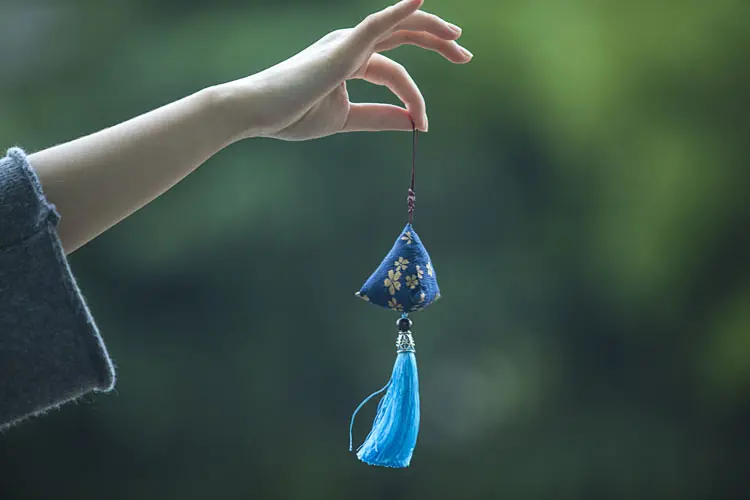
Before the festival, parents prepare small, colorful silk pouches filled with fragrant herbs or perfume for their children. These are either worn around the neck or pinned to clothing as ornaments.
Perfume pouches are believed to offer protection from evil spirits and disease, and are a cherished custom that blends health with artistry.
The Origins of the Dragon Boat Festival
There are many legends about the origin of the Dragon Boat Festival. The most popular ones are as follows:
The Death of Qu Yuan
The most widely accepted origin of the Dragon Boat Festival is its commemoration of Qu Yuan (340–278 BCE), a patriotic poet and loyal official of the Chu State during the Warring States Period. When his beloved state fell to the Qin, Qu Yuan, devastated by the loss, drowned himself in the Miluo River on the fifth day of the fifth lunar month.
Local people, deeply moved by his patriotism, raced out in boats to rescue him or retrieve his body, but their efforts were in vain. To keep fish and evil spirits from disturbing his remains, they beat drums and threw rice dumplings into the river. These traditions evolved into the dragon boat races and the custom of eating zongzi that continue today.
The Unlucky Fifth Month
Another explanation for the origins of the Dragon Boat Festival relates to the traditional Chinese calendar and seasonal beliefs. Since ancient times, the fifth lunar month was considered an unlucky time and was even referred to as the “Month of Poison” (毒月). This was when the “Five Poisonous Creatures” (五毒 wǔ dú)—centipedes, scorpions, snakes, toads, and spiders—began to appear in greater numbers due to the warming weather. Disease, pestilence, and natural disasters were also more prevalent during this period.
The fifth day of the fifth month, or the “Double Fifth,” was seen as especially ominous. To protect themselves, people hung wormwood and calamus on their doorways and wore sachets of fragrant mugwort (xiāng bāo, 香包). The sword-like shape and pungent aroma of calamus were believed to repel both pests and evil spirits. For this reason, the Dragon Boat Festival is also sometimes referred to as the “Calamus Festival” (菖蒲节 Chāngpú Jié).
These rich and varied customs reflect the Dragon Boat Festival’s deep cultural significance, blending ancient health practices with heartfelt traditions of honor, protection, and community celebration.
A walkway in Enshi Canyon, China’s Grand Canyon. Jean Spoljaric photos.
A Visit to the Chinese Grand Canyon in Enshi
By Jean Miller Spoljaric
My trip to the Hubei (Hu-bay) Province of Central China proved to be a real eye-opener. It was a culture shock for me, but life as they know it for them. I traveled from Beijing to Wuhan, China, and on to Enshi, the home to China’s Grand Canyon.
Enshi city was vibrant and alive, but nothing could have prepared me for the China I was about to see in the mountainous areas of Enshi Canyon. Several times during the trip, I reminded myself that, sometimes, ‘Less is More.’
Location
The view from the top of Enshi Canyon is breathtaking.
Enshi is the capital city of Hubei Province and is located inland, in the southwest region of Hubei. It’s an area of immense natural beauty with soaring mountains, deep canyons, meandering rivers, and great waterfalls. The mountain village is a two and a half-hour car ride from the bustling city.
The mountaintops are high above the skyline and the thousand-zhang waterfalls that tumble to the canyon floor below, feeding the underground rivers that flow through the Qungjiang River Valley of virgin forests and ancient villages.
Enshi proudly displays the peaks and valleys of what is known today as China’s Grand Canyon.
Enshi Grand Canyon
The Enshi Grand Canyon is located in Tunbao Village in the Town of Banqiao, high above the clouds. I climbed my way to the summit and experienced the views of a lifetime. Altogether, I hiked three of the five precipices in Enshi Canyon.
I was in awe as I gazed out toward the mystical land. The puffy clouds seemed close enough for me to touch and the precipices were like giant stalagmite stone fingers reaching toward the heavens.
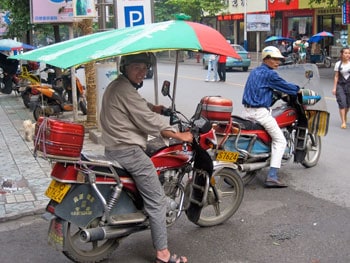
Free from the hustle and bustle of the rest of China, there were no beeping horns, no crazy mopeds; just the serene stillness and beauty of nature.
A 67-Mile Canyon
The Enshi Canyon has a total length of 108 km (67 miles) and the total area is more than 300 sq. km (about 74,000 acres, or 115.8 sq. miles). As it’s only 1.7 miles wide, it makes the canyon long and narrow.
By comparison, the American Grand Canyon (1,218,560 acres/ 1,904 sq. miles) could hold sixteen Enshi Grand Canyons.
The significant difference between the two is that Enshi Grand Canyon is lush as opposed to the barren desert-like topography of America’s Grand Canyon.
Still, all the splendor and physical features that one would find in America’s Grand Canyon are contained within this smaller area, so it makes it a great place to visit for a day trip or longer.
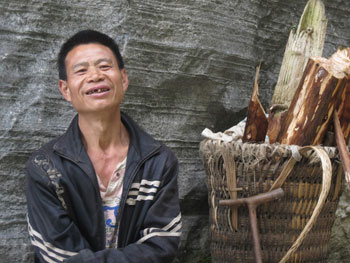
All hard work and smiles, always, in Enshi.
The Magic
As I climbed the steep ridges of the mountains, at each turn, I came across villagers selling cold drinks, cooked potatoes, and hard-boiled eggs soaking in tea. Not an easy day’s work!
I was amazed at how the elders set up camps every day, hiking up and down these mountains with large sacks strapped on their backs. Great exercise keeps them fit.
As I paused to drink my water and catch my breath, a woman twice my age, with a gentle smile on her face, passed me. I used the universal sign for a photo to ask if I could take a picture. Her look of concern was followed by a big smile.
Moments after snapping the image, I shared it with her and several others who had stopped to watch. They seemed amazed at seeing themselves in the viewfinder. It was magic and they wanted more pictures.
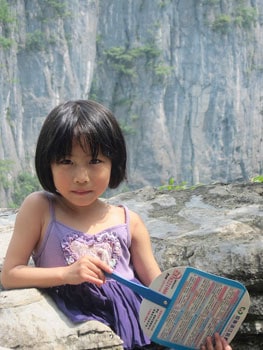
This pretty little girl hiked the Enshi Grand Canyon with her family. I was proud of her as she kept up with everyone!
Then, a little boy stopped and pointed to my iPod. I let him listen to a song and his face beamed with amazement! More magic!
And, just like that, any concerns were replaced with trusting smiles. As we smiled and laughed together, the language barrier seemed to disappear.
Giant Golden Panda
As a tall, blond, westerner, I felt the introspective eyes of the locals on me in the more urban areas, but nothing prepared me for my reception in the isolated mountain settlements.
For many of the mountain people of Enshi, it appeared to me that I was the first American they had ever seen.
The children surrounded me, seemingly mesmerized by my blonde hair and green eyes. Mothers shooed their children closer to get a better look; the shy little ones hid behind their mother’s skirt, peeking out just enough to fill their curiosity.
My tall stature and lightly colored hair had the men following my every move with their eyes. Women would gather around just to hear me speak.
I felt like a giant golden panda. I laughed to myself as I thought that I haven’t turned this many heads since I was nineteen!
They wanted to know everything about me: who I was, where I came from, why I was there! I’m happy to say, I think I left a lasting positive impression.
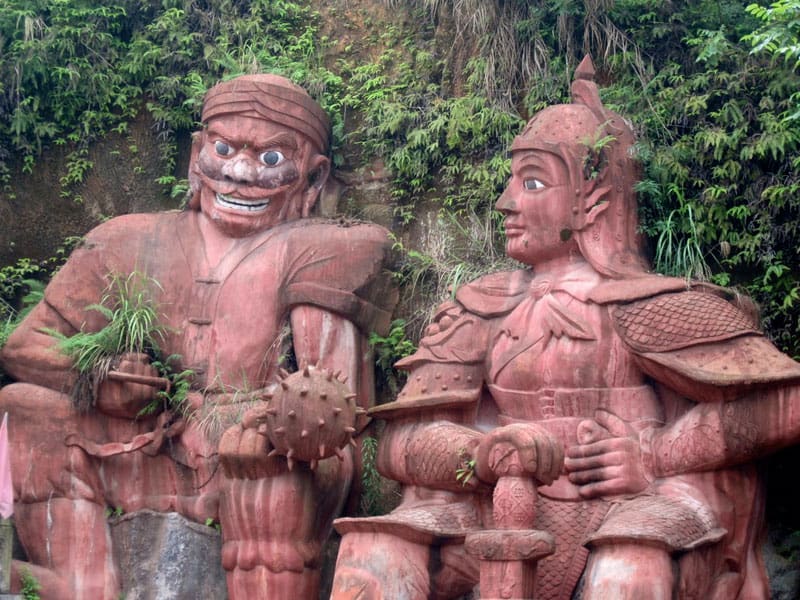
Large statues oversee the grounds at Tusi Castle in Enshi, China.
The People Of Enshi’s Mountains
The people of rural Enshi are kind, hard-working, self-sufficient, and very isolated from the world. They live a hard life off the land, but their big smiles never seem to fade.
They are farmers of vegetables and tea and are proud of their daily life with each other. There is no running water for most and squat toilets for all.
I saw children with no shoes or with one worn pair, and I thought about my children with too many shoes. I saw all the diseased and sick dogs lying in the comfortable shade of old, tired trees and wanted to rescue them all.
I guess it’s all relative. My daily life of iPods, cell phones, and laptops is a world away from the mountain people of Enshi. They are surrounded every day by trees, lakes, rivers, waterfalls, and beautiful lush green mountains. Maybe, they have it right!
The Other Enshi
There is another world below the mountains in the city of Enshi. By day, I would recommend a visit to Tusi Castle. It dates back to 700 AD and is a lesson in the culture of the area.
This Chieftain castle was destroyed by a fire in 2004 and perfectly restored soon after.
It is home to the largest archaized Pagoda style buildings in China.
As I wandered through the exhibits of architectural and decorative arts, I felt like I was walking through a living book. It tells the story of the Tujia folk cultures through sculptures, gardens, artwork, and furnishings.
Afterward, there is a must-see play that features the primitive reenactment of the local Chinese culture. It will make you feel as if you’ve been transported back in time.
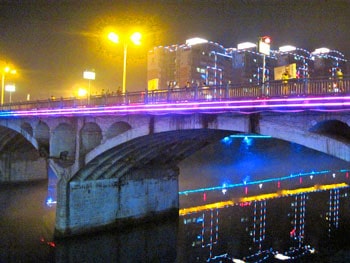
Enshi City is alive and beautiful in the evening.
Lunch in Dingshihui
Make sure you head to Dingshihui for lunch! During a long hot day, I was looking forward to lunch and a drink, but I could never have imagined the surprise that Dingshihui had in store for me.
As I followed my guide up the stairs, my eyes became wide with amazement.
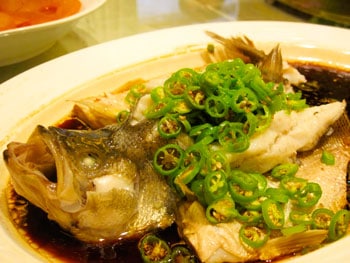
This fish dish is just one of the specialties at Dingshihui in Enshi City.
Dingshihui was like walking through a boutique-style hotel in Manhattan, and the food was incredible! I couldn’t believe that a luxurious oasis such as this existed in this city.
The city came alive in the evening. Neon lights lined the buildings and bridges in the Central Square and reflected off the river below.
There were men gathered in groups playing Mahjong and residents participating in a huge outdoor aerobics class.
The Lesson
The people of Enshi are an extended community where divisions of labor know no age and responsibilities are learned.
And who would have thought that the highlight of my trip to China would be the Grand Canyon of Enshi and the people who live there?
Enshi City
For all I thought I knew about China, it was all that I discovered I didn’t know that has added to the quality of my life. I want to return to this great experience and, if you’re as fortunate as I was, you’ll find a new world to discover.
Useful Information about Enshi China
Dried snake anyone?
For more information on travel in this area of China contact the CNTO- China National Tourist Office. They were extremely helpful and knowledgeable about all things China.
List of China tourism offices
While in Enshi I used Enshi Railway Travel Service Co., Ltd. They do not have a website so it makes it difficult to book anything in advance, but I assure you if you contact them directly upon your arrival in China they will make sure you have the time of your life.
They are located at No. 64 Hangkong Road, Enshi City. the phone number you can reach them at is (0086-718-) 8236262. Ask for Lucy to be your trusted guide; she will take wonderful care of you from start to finish.
To and From
I flew Air China from JFK Airport in NYC into Beijing Airport. I also flew China Southern throughout Hubei Province, Wuhan, and Enshi. Both airlines went out of their way to make me comfortable, the staff was friendly and the seating spacious.
The Enshi Dingshihui Dining Management Company, Ltd. Restaurant has no website. It remains a bit of a mystery. Ask your guide or taxi driver to bring you to the fanciest place to eat in Enshi City; I promise they will know. I do have phone numbers. Once you arrive in Enshi you can try your luck: 0718-8411717 or 0718-8495282.
While in Wuhan I was lucky to stay at the beautiful Shangri-La Hotel. The Shangri-La is located in the Hankou business area and is only 25 minutes from the Tianhe International Airport and only 15 minutes from the Yangtze River Pier.
Feng shui has long held a mysterious allure in Chinese traditional culture. For centuries, it has been highly respected and followed by many. Even in today’s modern society, interest in feng shui remains strong. From choosing a home to arranging furniture, people often seek out feng shui masters to predict their fortune or improve their luck. This enthusiasm has even spread beyond China, gaining popularity in many countries as a fashionable practice.
But have you ever wondered what kind of feng shui truly brings good fortune? The following story offers a fresh and enlightening perspective.
A wealthy man once bought a piece of land and built a luxurious villa. Because his wife loved lychees, he planted many lychee trees in the backyard. During the renovation, a friend suggested that he consult a feng shui master to ensure there were no negative formations. Though skeptical of feng shui, the wealthy man decided to give it a try and traveled to Hong Kong to invite a renowned master with over thirty years of experience.
After meeting the master at the train station and sharing lunch, they drove to the man’s home. Along the way, whenever another car tried to overtake them, the master noticed that the wealthy man would gently slow down and give way. “You’re a steady driver,” the master remarked.
The man smiled and replied, “Most of the people overtaking are probably in a hurry. I don’t want to hold them up.”
As they approached the town, the streets grew narrower, and the man slowed the car even more. Suddenly, a laughing child darted out from an alley. The man quickly hit the brakes. Instead of accelerating again, he kept watching the alley. Moments later, another child ran out, chasing the first.
“How did you know there was another child coming?” the master asked, surprised.
The man explained, “Kids always run in groups when playing. One laughing child usually means others are nearby.”
The master gave him a thumbs-up and said with a smile, “You’re very thoughtful.”
When they arrived at the villa, just as the man was about to unlock the door, several birds suddenly flew up from the backyard. He turned to the master and said, “Please wait a moment.”
“Is something wrong?” the master asked.
“There are probably children in the yard stealing lychees. If we go in now, they’ll panic. If they fall while trying to run, they might get hurt. Let’s give them a bit more time. We can wait here and let them enjoy the fruit.”
The master stood in silence for a while, then said, “Take me back to the train station. There’s no need to examine the feng shui of your house.”
The man was puzzled. “Why, Master?”
The master looked at him and said sincerely, “Wherever you are, that place already has the best feng shui.”
This story opens our eyes to a deeper truth: the most powerful feng shui isn’t found in the placement of objects or the direction of a door — it’s found within us. Our behavior, compassion, and moral integrity shape the energy we bring into the world.
Everyone desires good fortune and happiness, but many look for it in the wrong places. Some rely solely on feng shui arrangements or fortune tellers, hoping for shortcuts to a better life. But these are often just psychological comforts, lacking true substance.
The law of cause and effect governs all things: “Plant good causes to reap good results; avoid bad causes to prevent misfortune.” Only by performing good deeds and cultivating a kind heart can we attract blessings and peace. Relying purely on external feng shui while ignoring inner morality goes against this fundamental principle.
In truth, our actions and intentions are our personal feng shui. Kindness is the most powerful feng shui one can have.
As the saying goes: “A fortunate person lives in a fortunate place, and a fortunate place is inhabited by a fortunate person.” Here, “fortunate person” means someone with a kind and upright heart. A person’s energy — their “magnetic field” — reflects their character. Even the best feng shui cannot save someone with selfish or harmful intent, while a good-hearted person can transform even a less-than-ideal environment into a space of warmth and harmony.
When we live with compassion and integrity, we naturally draw good karma, success, and joy into our lives. At that point, we no longer need to search for feng shui — we are the feng shui.
Kindness is the best feng shui. May we all cultivate it from within.
After more than fifty years of experiencing life’s ups and downs, I have finally come to understand the profound importance of quieting down, reflecting, and learning how to truly love myself. It is only through self-love that we can genuinely love others.
“When I truly began to love myself, I started going to bed earlier and learned to enjoy exercise. I stopped getting lost in worries and anxieties. Instead, I became confident and pursued meaningful people and endeavors with passion. That was the moment my life truly began.”
Understanding another person is never easy. We must walk in their shoes, see the world through their eyes, and consider life from their perspective. Yet, this journey often brings sadness. But in that sadness, we discover clarity—we learn to focus on what truly matters.
Rather than wasting our time on trivial concerns and unfulfilling distractions, we should devote ourselves to nourishing pursuits: sleep, books, exercise, the beauty of nature, and, above all, the love we have for the world. When we consciously take control of our time, the tranquility of daily life emerges naturally, and anxiety fades away.
Kahlil Gibran once said, “If one day you stop searching for love and simply love; stop yearning for success and just do; stop pursuing empty growth and begin to cultivate your character, then your life will truly begin.” This wisdom reminds us that authentic living starts with our inner transformation.
Loving yourself means understanding that pain and emotional turmoil are often just reminders to live authentically. Unless it stems from physical illness, much of our suffering comes from misplaced values rather than objective reality. The things we cling to the most are often the very things that torment us, while those beyond our control are simply not worth our distress. True wisdom lies in knowing when to hold on and when to let go.
To be nurtured by others is a gift; to nurture others is an even greater act of cultivation.
May we have eyes that shine like stars, hearts as vast as the ocean, and lives that leave behind the fragrance of kindness wherever we go.
The Wisdom of Middle Age
Middle age teaches us the value of patience, restraint, and measured action. In our youth, we often equate eloquence with intelligence, only to later realize that true wisdom often lies in silence. As W. Somerset Maugham observed, “In a crowd, the quietest person is often the most powerful.”
In conversations, we should not rush to take center stage. Instead, we should listen more and speak less, exercising the grace of restraint. When others share, let us resist the urge to interrupt. When disagreements arise, let us not hastily refute. Instead of saying, “I think,” we can ask, “What do you think?” Instead of declaring, “You are wrong,” we can offer, “Perhaps there is another way to see this.” By replacing subjective judgment with open-minded awareness, we foster deeper understanding.
The world is not simply black and white. By speaking a beat slower and thinking a step faster, we cultivate clarity and wisdom in our lives.
In psychology, there is a concept called task separation: our emotions are our responsibility, while others’ reactions belong to them. The wisdom of softness lies in maintaining a gentle boundary between the two. It allows us to be vulnerable and to accept imperfection in ourselves and others. Harsh confrontation often leads to conflict, but a simple, “I understand your difficulties,” can resolve tensions effortlessly. As Alfred Adler wisely said, “True strength lies in the courage to expose one’s vulnerabilities.”
Try shifting from “I must win” to “We can solve this together.” Instead of “Why don’t you understand me?” consider, “Perhaps I need to express myself differently.” Softness is not weakness—it is a space that allows relationships to breathe and grow.
Kazuo Inamori once said, “What you hold in your heart is what you will encounter.” True generosity is not about calculated acts of kindness but instinctive goodwill. A small gesture—carrying a neighbor’s trash, offering a sincere compliment, or leaving a light on for a loved one—creates ripples that spread far beyond our immediate reach.
A generous heart does not tally whether kindness is repaid. As the Tao Te Ching states, “The more you give to others, the more you have yourself.” Every act of warmth we extend ultimately enriches our own lives.
As we journey through middle age, wisdom is cultivated through restraint. In youth, we may be like strong liquor—bold and fiery; with time, we become like fine tea—subtle yet deeply enriching. Speaking slowly allows us to reflect, gentleness fosters harmonious relationships, and generosity ensures lasting blessings.
These qualities of slow cultivation cannot be rushed or feigned. But with daily practice and yearly dedication, we will come to embody the depth of the old adage: “Still waters run deep.”
In the Buddhist scriptures of China, a profound story is recorded—one that illuminates the immeasurable merit of a sincere offering.
Once, there was a poor girl who survived by begging. She often watched wealthy young ladies, accompanied by attendants, visit the temple to offer alms and perform good deeds. Seeing their generosity, she felt a deep yearning to cultivate merit but had nothing to give. Determined, she worked tirelessly to save whatever she could. After much effort, she managed to save a single coin. Though small in value, it represented all she had. With unwavering devotion, she took her humble offering to the temple.
The abbot, upon learning of her sincerity, was deeply moved. He gathered his disciples and announced, “Today, I will personally preside over the offering and pray for this devout laywoman!”
Not long after, an extraordinary turn of events unfolded.
After the queen of the land passed away, the grieving king sank into sorrow. To lift his spirits, his ministers organized a hunting expedition. As the royal party rode through the forest, the king noticed a shimmering light ahead. Curious, he approached and discovered a breathtakingly beautiful young woman. Though her clothes were tattered, she radiated an ethereal grace.
Captivated by her presence, the king brought her back to the palace. Before long, she became his new queen.
Overjoyed by her newfound fortune, she reflected on her past: “This must be the reward of my small act of generosity! I only donated one coin, yet it planted the seed for such incredible merit. Now that I have wealth, I should return to the temple to express my gratitude with a much grander offering!”
Determined to make a grand gesture, she dressed in the finest attire, adorned herself with jewels, and loaded dozens of carts with silver and gold for donation. As she approached the temple, she thought, “Before, when I gave only one coin, the abbot personally prayed for me. Now that I bring such vast riches, surely the reception will be even greater!”
Upon her arrival, she expected an elaborate welcome. Yet, to her surprise, only a few monks came to receive her offerings, and the rituals were conducted in the usual manner.
Perplexed, she approached an elderly monk and asked, “Why is it that when I was poor and donated a single coin, the abbot himself prayed for me? Yet today, when I bring such wealth, only a few monks perform the prayers?”
The monk smiled gently and replied, “At that time, your single coin was all you had. You gave it with pure devotion and joy, holding nothing back. Now, though you bring great wealth, it is but a fraction of your fortune, and your heart is tainted with pride. The true merit of an offering comes not from its size but from the sincerity of the giver’s heart.”
Shakyamuni Buddha taught that for a donation to generate immense benefit, it must possess three essential qualities:
Before Giving – A Joyful Heart True generosity begins with happiness. The donor should give not out of duty, pressure, or expectation of reward, but with a heart full of joy, seeing giving as an opportunity to cultivate virtue and compassion.
While Giving – A Clear and Sincere Mind The act of giving should be free from hesitation, regret, or pride. A pure offering is made with an open heart, solely for the benefit of others, without seeking recognition or return.
After Giving – A Sense of Fulfillment Once the offering is made, the giver should not feel regret or attachment. Instead, they should feel a deep sense of satisfaction, knowing they have planted seeds of merit for the future.
This story serves as a timeless lesson: It is not the amount we give that determines the merit of our offering, but the purity of our heart. A sincere and joyful offering—no matter how small—carries boundless blessings.
So the next time you give, remember: True generosity is not measured in gold or silver, but in the depth of your sincerity.
My name is Guang-Fen Fu. Since I was young, I have been physically weak and often ill. When I became an adult, my mother told me, “Daughter! You have had a weak constitution since you were young. Go and learn medicine. This will be good for your health, and you will not become weary through exerting too much physical strength.”
In 1958, I began following a teacher to learn traditional Chinese medicine. Because my illnesses resulted from the power of karma accumulated through many lifetimes and eons, my illnesses did not decrease as my knowledge of medicine and my experience in practicing medicine grew. Disease constantly followed me wherever I went.
In 1978 and the following few years, I suffered from a gastric ulcer in which most of my stomach hemorrhaged. During that time, I also discharged blood when going to the bathroom and vomited blood. In 1981, I had no choice but to undergo surgery to cut out most of my stomach. My health was even worse after the surgery. My food intake lessened, my face became pale, I spoke without any vigor, my spirit was weak, my movements were slow, and I often could not go to work.
As a result of the care and assistance given to me by a friend, in 1987, I met my respected Buddha Master, H.H. Dorje Chang Buddha III Wan Ko Yeshe Norbu Holiest Tathagata. When His Holiness learned of my suffering from illness and my strained financial circumstances, His Holiness showed immense compassion and concern. His Holiness treated me with the holy vajra needle. H.H. Buddha Master asked me to show His Holiness the acupuncture point on my foot called Zu San Li. My respected Buddha Master then squatted down and applied that needle to me. After the needle was applied, my respected Buddha Master then said, “Pay attention! I will now apply my dharma power.”
When my respected Buddha Master put his hands into a mudra before me, I immediately began to feel numbness, swelling, and pain. My whole body emitted heat, and I was slightly perspiring. When my respected Buddha Master heard me repeatedly scream in pain, His Holiness released his hands from that mudra. I instantly felt that the numbness, swelling, and pain I had just experienced had disappeared. The only thing I felt was a relaxed and comfortable feeling that my body had never before experienced. My respected Buddha Master then said, “This needle was used to open your energy channels and chakras. You are too anemic.”
I had not yet become a Buddhist or learned Buddhism at that time. My respected Buddha Master treated me and all other living beings as his own family members, equally lending them a helping hand out of great compassion. In 1988, I knew that I wanted to convert to and learn Buddhism in order to leave suffering, attain happiness, and walk the path leading to accomplishment in the dharma and liberation from the cycle of reincarnation.
After following H.H. Buddha Master, my health has improved day by day; my complexion is ruddy, my spirit is clear, my voice is resonant, and I walk with vigor. I gradually understood just how magnificent H.H. Buddha Master is. I also came to comprehend the realness of Buddha Dharma gradually. Those who see me now say, “You have totally changed in the last two years. You don’t look so frail as you did before.” What they found most difficult to believe is that I returned from my trip to the plateaus of Tibet and Qinghai, which are places that lack oxygen without any adverse health effects.
Because I received H.H. Buddha Master’s teachings and empowerment, I advanced in the area of medicine. I took a countywide test and was the first to receive a certificate of qualification as a traditional Chinese medicine doctor. I took provincial and municipal tests and obtained certificates qualifying me as a “doctor-in-charge” who practices traditional Chinese medicine. The hospital put a sign up for me that read “expert outpatient service.” My patients have increased day by day. I have cured patients near and far of their difficult and complicated illnesses. As a result, I have a bit of fame in the local area where I live. Everything that I have is due to the teachings and empowerment that the Buddha Master bestowed upon me after I began learning Buddhism. The kindness and grace H.H. Buddha Master conferred upon me are as enormous as a mountain. Each and every bit of his kindness and grace is indelibly etched in my heart.
I remember one day around the year 1989. Zi-Fang Liu, a disciple of my respected Buddha Master, went to the home of my respected Buddha Master in the Nanxin District of Xindu. She beseeched my respected Buddha Master to save her. She said that her illness had lasted many years, was acutely painful, and was about to collapse. She had been to all of the major hospitals in China and had spent a lot of money, all to no avail. I saw that her complexion was unnaturally dark and that her whole body was rigid. She constantly complained about her unbearable pain.
Then, she suddenly fell to the ground and did not get up. She looked ghastly pale. My respected Buddha Master immediately treated her with the holy vajra needle in order to empower her. Because she was in a state of shock, she did not have any reaction when the needle was applied. After a short while, Sister Liu regained consciousness, stood up, and stated she was no longer in pain.
Every time I saw the wonders of my respected Buddha Master’s holy vajra needle, I had an even greater desire to learn how to apply that holy needle. One day I said to my respected Buddha Master, “Respected Buddha Master, teach me how to apply that amazing needle so that I may cure more patients.” My respected Buddha Master said in a soft voice, “Guang-Fen, your powers are insufficient. Let’s put that matter aside for the time being.” One time I saw Hsi Jao Ken Ten Rinpoche, who is from Taiwan, also ask my respected Buddha Master to teach him how to apply that amazing needle. My respected Buddha Master replied, “Your powers are insufficient. Let’s put that matter aside for the time being.”
I later learned that the source of the effectiveness of the holy vajra needle is my respected Buddha Master’s state of realization and virtue and the power of his merit. With a holy mind of enlightenment and great compassion, His Holiness assists living beings with physical illnesses, psychological illnesses, and living beings suffering due to the power of karma. Furthermore, His Holiness constantly and compassionately empowers living beings through his teachings, thereby enabling them to extricate themselves from suffering and find the key to curing and preventing disease.
I have followed H.H. Buddha Master for more than ten years. I, Guang-Fen, have evolved from a person who did not understand anything about learning Buddhism and self-cultivation to a Buddhist disciple striving to integrate wisdom, compassion, and skillful means and a person striving to be selfless. Based upon empowerment from my respected Master’s practice and from the lineage of great masters throughout generations, a type of merit of the fruit of Buddhahood exerts its influence, causing Buddhist disciples to walk the path toward liberation and accomplishment in the dharma. With the incomparable kindness and empowerment of my respected Buddha Master, Buddhist disciples give rise to bodhicitta and strive to enlighten themselves and others. The compassion, care, and protection my respected Buddha Master bestows upon his disciples and all living beings cannot be described in words. To know what I am saying, you have to experience it yourself.
I sincerely feel that the kindness and grace shown to me by my Buddha Master are difficult to repay. All I can do is resolve to be a disciple of the Buddha in all my future lives and devoutly and respectfully turn to and rely upon the eternal Buddha Master. Only a Buddha Master can lead Buddhist disciples out of the bitter sea of reincarnation and lead them toward liberation, accomplishment in the dharma, ending of the cycle of birth and death, becoming a Buddha, saving other living beings, undertaking the cause of the Buddhas and Bodhisattvas, and repaying the kindness of the Buddhas.
This year I have passed sixty-five years of age. What I have written above is my own true personal experience. I have not lied. If what I wrote above contains lies, I am willing to descend into the Avici Hell (hell of uninterrupted suffering). If what I wrote above is true, I offer the merit of this writing to my magnificent Buddha Master, who is like my father and mother. I also dedicate such merit to all of my vajra Brothers and Sisters so that they attain enlightenment soon and to all sentient beings on the six paths of reincarnation. Amitabha!
Written and respectfully submitted by a Buddhist disciple, Guang-Fen Fu
April 16, 2006
(This is a complete translation of the Chinese text that was initially written and signed by Guang-Fen Fu.)
In Traditional Chinese Medicine (TCM), the gallbladder plays a crucial role in maintaining overall health. While often overlooked, its function affects various aspects of well-being, from digestion to hair health and even fat distribution. By understanding the gallbladder meridian and learning simple techniques to stimulate it, you can enhance your body’s natural healing processes and promote long-term vitality.
The gallbladder meridian runs along both sides of the body, starting from the outer corner of the eye at the pupil’s ridge point and ending at the outer side of the tip of the fourth toe at the foot’s yin point. There are a total of 44 acupuncture points from head to toe.
Gallbladder Meridian(大纪元制图)
Signs of Poor Gallbladder Function
One of the most noticeable signs of poor gallbladder function is premature graying of hair. According to TCM wisdom, “Hair is the extension of blood,” meaning that when the body lacks sufficient nutrients and energy, hair health deteriorates. Without proper nourishment, hair may turn gray earlier than expected.
Another common indicator is excessively oily hair. This occurs when bile secretion is insufficient, preventing the body from effectively breaking down fats. Combined with excessive liver heat, this imbalance can result in an oily scalp and other digestive disturbances.
Poor gallbladder function can also manifest in fat accumulation, particularly along the outer thighs. When the gallbladder meridian becomes blocked, toxins and waste accumulate in this area, making weight loss more difficult. For those who exercise regularly, these “waste” deposits may shift downward, leading to thickened calves, also known as “radish legs”—a common concern for both men and physically active women.
One of the simplest and most effective ways to support gallbladder health is through tapping the gallbladder meridian. This practice helps stimulate bile secretion, improve nutrient absorption, and remove blockages along the meridian. Many people who consistently tap their gallbladder meridian for one to two months notice their pants fitting more loosely, making it a great natural approach to slimming the thighs and supporting digestion.
How to Tap the Gallbladder Meridian
The best part: You don’t need any special equipment—just your hands. Since the gallbladder meridian runs along both sides of the body, you can simply use your fists to tap along its path. Here’s a step-by-step guide:
Find a Comfortable Position – The best position is to stand up and rest your leg on a bench so that your thigh is parallel to the ground, or sit down on a chair while keeping your body relaxed.
Start from the Hip – Using your fist, gently but firmly tap along the outer thigh, working your way down to the knee.
Maintain a Steady Rhythm – Aim for about two taps per second with moderate pressure.
Repeat for 3-5 Minutes – Perform around 200 ot 300 taps per side, adjusting the intensity based on your body’s comfort level.
Be Consistent – For best results, practice daily and gradually increase the duration as needed.
Since the outer thigh is the only section where the gallbladder meridian runs alone, it is the most accessible and effective area for tapping. With consistent practice, you may notice improved digestion, increased energy, and a reduction in fat accumulation.
Consistency is key. In TCM, true healing doesn’t come from quick fixes but from nurturing the body over time. While medications and dietary changes can help, activating the body’s natural self-healing abilities is the most sustainable path to wellness. By regularly tapping the gallbladder meridian, you not only improve gallbladder function but also support overall circulation, detoxification, and vitality.
Take Charge of Your Health
Tapping the gallbladder meridian is a simple yet powerful wellness practice suitable for people of all ages. Whether you seek to improve digestion, promote liver health, or achieve a leaner physique, this ancient technique can help you reconnect with your body’s natural rhythm.
Remember: your health is in your hands. Start today and experience the transformative benefits of tapping the gallbladder meridian!
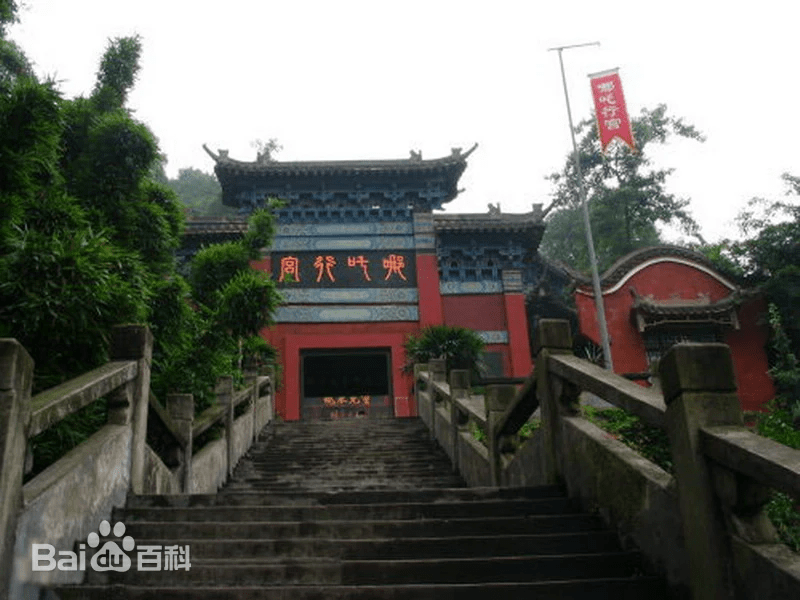
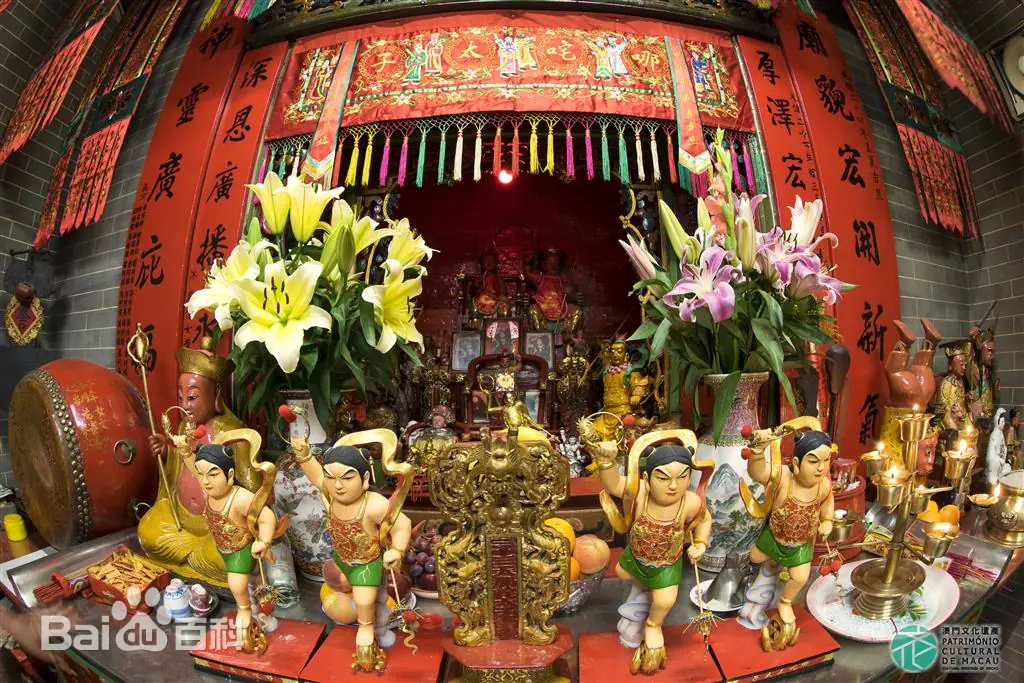
Recently, the animated film Nezha 2 has become incredibly popular, reaching the top spot in global box office earnings for animated movies. While many believe Nezha is a character from Chinese mythology, his origins can actually be traced back to Buddhist scriptures.
Vaisravana
Nezha’s name first appeared in Vajrayana Buddhist texts, where he is associated with the role of a Dharma protector. He is described as the third son of Vaisravana, one of the Four Heavenly Kings. According to The Ritual of Vaisravana, “The Heavenly King’s third son, Prince Nezha, holds a pagoda and always follows the King.” His duty is to assist his father in safeguarding the Dharma, driving away evil forces, and protecting humanity. In The Mantra of the Dharma Protector Following the Northern Vaisravana Heavenly King, translated by the eminent Tang Dynasty monk Amoghavajra, Nezha is again referred to as Vaisravana’s third son. Other Buddhist texts from the Tang Dynasty, such as The Awakening of Faith in the Mahayana and The Lotus Sutra, also mention Nezha.
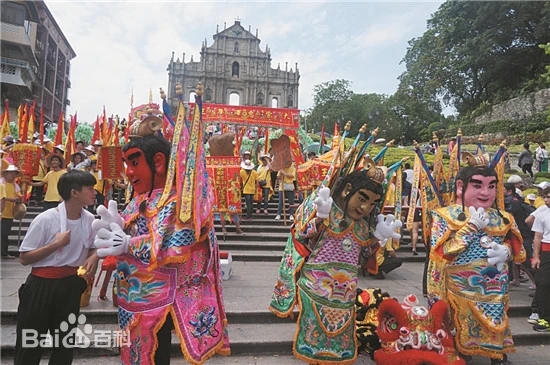
In Buddhism, Dharma protectors and yaksha deities often have fierce appearances, symbolizing their hatred of evil and fearless bravery. As a result, Nezha is typically depicted with a wrathful and intimidating image. As Buddhism spread to China, many Buddhist stories and figures gradually merged with local Chinese culture, giving rise to new belief systems. Over time, Nezha became integrated into Taoism and Chinese folk beliefs, forming a unique cultural phenomenon.
The story of Nezha is filled with many well-known and beloved episodes, such as his birth from a ball of flesh, cutting his flesh and bones to repay his parents, and being reborn from a lotus flower. Although this scene cannot be found in modern Buddhist scriptures, it became a popular topic among monks after the Song Dynasty. For example, Volume 1 of The Comprehensive Collection of Zen Verses on Ancient Cases mentions: “Prince Nezha offered his flesh to his mother and his bones to his father, then manifested his true form and used his divine power to preach to his parents.” This suggests that the story of Nezha sacrificing his flesh and bones likely originated from Buddhist texts. Although the exact cause and details are unclear, this story undoubtedly provided a prototype for later adaptations in folk literature.
As Buddhism spread throughout China, the assimilation of foreign religions by local culture and the evolution of folk beliefs gradually transformed Nezha’s image, steering it away from its original Buddhist context and toward a more Chinese identity. After the Tang Dynasty, the worship of Vaisravana (known as Bishamonten in Japan) reached its peak in China, gaining widespread recognition from both the imperial court and the common people. He was honored in official rituals and revered by many folk believers. Simultaneously, Li Jing, a prominent Tang Dynasty military general, became a popular figure of worship as a god of war. Renowned for his military campaigns against the Turks and Tuyuhun in the northwest, Li Jing was deified as early as the Tang Dynasty, with dedicated temples built in his honor during the Song Dynasty.
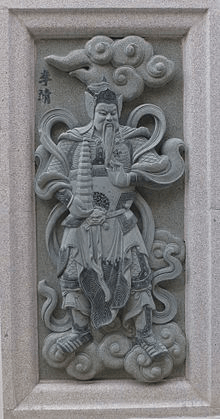
Li Jing’s temple wall statue
The broader and deeper the spread of a belief, the greater the possibility of its transformation and integration with other cultural elements. Over time, through public imagination and interpretation, the belief in Vaisravana merged with the worship of Li Jing, forming a new deity known as “Pagoda-Wielding Heavenly King Li” (Tuota Li Tianwang) by the Song Dynasty at the latest. From then on, Vaisravana took on the surname Li and became more secularized and localized within Chinese culture. Since Li Jing became identified with Vaisravana, it was only natural within folk beliefs to regard Nezha as Li Jing’s son. This marked Nezha’s departure from the cultural context of foreign religions and his integration into the Chinese pantheon.
This transformation made Nezha a more relatable and accessible figure, understood through the lens of native cultural concepts. As a result, Nezha’s story gained broader appeal, providing ample room for reinterpretation and adaptation in later generations.
Nezha holds an important place in ancient Chinese mythology. Under the influence of Taoism, he was endowed with more mythological attributes, portrayed as a young hero with powerful magical abilities who frequently battles demons and protects the people. His story further developed in classic literary works such as Journey to the West and Investiture of the Gods, where Nezha became a symbol of justice and courage.
























 Peace LiLy