On the 29th day of the ninth lunar month, Buddhist disciples worldwide honor the birthday of Bhaisajyaguru Buddha, known as the Medicine Buddha or the Great Medicine King. He is also referred to as the Buddha of Twelve Great Vows, embodying deep compassion and healing. Presiding over the Pure Land of Lapis Lazuli Light in the East, the Medicine Buddha has inspired countless practitioners with his transformative teachings and boundless compassion.
Buddhist communities celebrate this sacred day with ceremonies, reciting the Medicine Buddha Sutra, learning from his teachings, and making offerings. The Medicine Buddha Sutra recounts Shakyamuni Buddha’s dialogue with Manjusri Bodhisattva, where he reveals the profound virtues of the Medicine Buddha’s Pure Land and the twelve vows he made as a bodhisattva. These vows reflect his deep empathy for beings suffering from illness, poverty, and ignorance, and his wish to liberate them from these afflictions. This sutra is not only a sacred text but also a guide for overcoming life’s challenges, helping us gain inner peace, health, and happiness.
The sutra explains the Medicine Buddha’s teachings with a unique emphasis on relieving suffering in this life. By focusing on the here and now, the Buddha’s teachings encourage us to look at our lives with clarity, understand our challenges, and gain relief from worldly troubles. This practical orientation gives the Medicine Buddha Sutra a distinctive place in Buddhist practice, emphasizing the importance of compassionate action and wisdom in daily life.
The Twelve Great Vows of the Medicine Buddha
First: I vow to assist those impoverished and tormented by constant struggles. Those who come across my name, sincerely honor it, and practice Dharma to build their merit will see their wishes come true.
Second: I vow that my body shall shine as beams of brilliant light across this infinite, boundless world, freeing all beings from ignorance and worry through my teachings. May all beings attain a perfect state of character, integrity, and enlightenment, like the Buddha.
Third: I vow that my body shall be like flawless crystal, radiating splendid light to all corners, enlightening beings with wisdom. Through the blessings of compassion, may all beings gain spiritual power and physical strength to achieve their aspirations on a virtuous path.
Fourth: I vow to grant all beings the inexhaustible resources they need, freeing them from pain and guilt caused by material desires. While essentials such as clothing, food, shelter, and transport are needed, they should be wisely used. May they generously share these resources within the community to foster harmony.
Fifth: I vow to lead those who have strayed back to the path of righteousness, guiding them toward enlightenment on the Buddha way.
Sixth: I vow to enable all beings to uphold precepts of purity and morality. If they falter, they shall be guided to repent. Those who sincerely regret their wrongdoings and vow to change, with faith in the Buddha, shall be forgiven and regain purity.
Seventh: I vow that all beings who are physically disabled or ill will be blessed with both physical and mental health. Those who faithfully honor the Buddha will receive these blessings.
Eighth: I vow to alleviate the suffering of the poor and sick. May the ill be cured, the helpless supported, and the impoverished uplifted.
Ninth: I vow to relieve the suffering of women seeking transformation. By hearing my name, paying homage, and praying, may their wishes be fulfilled, leading them ultimately to Buddhahood.
Tenth: I vow to release all beings from harmful thoughts. I will guide them to righteousness and honor, so they may walk the Buddha way on a path of light.
Eleventh: I vow to save those who have sincerely repented, including prisoners and victims of natural disasters. Those who are sincere will receive my blessings and be freed from suffering.
Twelfth: I vow to relieve those facing starvation or committing crimes for survival. If they hear my name and hold it dear, I will lead them to the benefits of Dharma and favor them with the sustenance they need, helping them to lead peaceful, contented lives.
The Medicine Buddha’s great vows remind us of the healing power of compassion and inspire us to live with kindness and selflessness. Whether through reciting his name, chanting his mantras, or making offerings, we are encouraged to practice not only for our own relief but also for the welfare of all beings. By embodying the virtues outlined in the Medicine Buddha Sutra, we aim to carry forward the Buddha’s compassionate mission, helping ourselves and others find happiness, harmony, and well-being.
May we all find solace and empowerment through the compassionate vows of the Medicine Buddha and live our lives with health, joy, and a sense of unity with all beings.
Sun Simiao’s achievements in traditional Chinese medicine and his noble medical ethics are regarded as exemplary in history. As a renowned medical scholar of the Tang Dynasty, he is honored by later generations as the “Medicine King,” and his contributions continue to have a lasting impact. Born into a poor family in Jingzhao Huayuan (now Yaoxian District, Tongchuan City, Shaanxi Province), Sun Simiao was frail and sickly as a child, and his family’s savings were nearly depleted to treat his illnesses. The people around him lived in similar poverty, and many lost their lives due to a lack of medical treatment. This inspired the young Sun Simiao to dedicate his life to studying medicine, vowing to tirelessly work to relieve people’s suffering. He believed that “human life is precious, worth more than a thousand pieces of gold. Saving a life surpasses all else in merit.” This belief guided him throughout his medical career.
A widely circulated story illustrates Sun Simiao’s deep sense of compassion and ethics: One day, while walking, he saw some village children who had captured a weary snake that was near death. Moved by compassion, Sun Simiao purchased the snake from them and released it into the water. Later, while meditating, a man dressed in green appeared and invited him to the legendary Crystal Palace. It turned out that the snake he had saved was the son of the Dragon King, the ruler of the sea. In gratitude, the Dragon King invited Sun Simiao to sit in the seat of honor at a banquet and said, “My son was captured while playing yesterday. If it weren’t for your help, he would have been killed!”
After the banquet, the Dragon King offered Sun Simiao precious treasures to thank him. However, Sun declined and said, “I have heard that the Dragon Palace has many secret medical formulas. If you could share them with me to help relieve the suffering of people, that would be far more valuable to me than any gold or jewels.” Touched by his selflessness, the Dragon King gifted him the “36 Jade Formulas,” which further enhanced Sun Simiao’s medical knowledge.
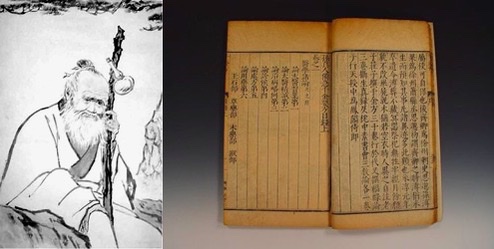
Sun Simiao devoted his life to the study of medicine, and his monumental work, Qian Jin Yao Fang (Essential Prescriptions Worth a Thousand Gold), is the first comprehensive encyclopedia of clinical medicine in Chinese history. Hailed as a “treasure of humanity,” the book covers everything from fundamental medical theories to clinical practices, integrating principles, methods, prescriptions, and herbal medicine. Not only did Sun Simiao compile the clinical experiences of past medical experts, but he also included many folk remedies and prescriptions, drawing from a wide range of sources. To this day, Qian Jin Yao Fang holds immense academic value and continues to guide practitioners in the field of traditional Chinese medicine. He also wrote two other influential books, Bei Ji Qian Jin Yao Fang and Qian Jin Yi Fang, which have had a significant impact on Chinese medicine to this day.
In addition to his remarkable medical skills, Sun Simiao is revered for his noble medical ethics. In his work Da Yi Jing Cheng (The Sincere Heart of a Great Physician), Sun clearly articulated that a truly great physician must be calm, free from desires, and compassionate. A doctor must have the determination to save lives, without discriminating based on wealth, status, age, beauty, personal relationships, ethnicity, or intelligence. All patients should be treated with the same care as one’s own family, without any hesitation or self-interest, and the physician must not shrink from hardships or dangers. Day and night, through cold or heat, hunger or exhaustion, the doctor should be fully devoted to the welfare of the patient, without seeking recognition or rewards. This high standard of medical ethics has been called the “Hippocratic Oath of the East” and has had a profound influence. Even today, many medical schools in China still use Da Yi Jing Cheng as an oath, reminding students to embody this spirit and serve patients wholeheartedly.
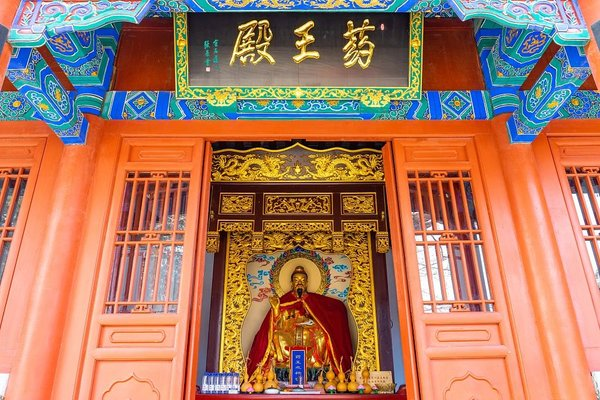
The Medicine King Temple in the Mount Tai Scenic Area in Shandong is dedicated to honoring Sun Simiao, the Medicine King. (Image source: Visual China)
Sun Simiao’s life was not only a beacon of excellence in the field of medicine but also a model of selflessness and moral integrity. His legendary stories and medical achievements have added a shining chapter to the history of Chinese medicine, inspiring generations of healers to follow in his footsteps.
Holy Miracles Temple, located at 1730 N. Raymond Ave., Pasadena, CA, serves as a sanctuary dedicated to teaching the true Dharma of the Tathagata, as transmitted by Namo H.H. Dorje Chang Buddha III and Shakyamuni Buddha, guiding disciples on their path to liberation and spiritual accomplishment. Grounded in the Buddha’s teachings and fueled by boundless compassion, the temple’s core mission is to selflessly serve humanity. Its hope is for people in America and across the globe to embrace Buddha Dharma, cultivating love for their country, fellow people, and the world. Through mutual support, peace, kindness, and auspiciousness, the temple envisions a strong nation with thriving citizens and a world brimming with joy and happiness.
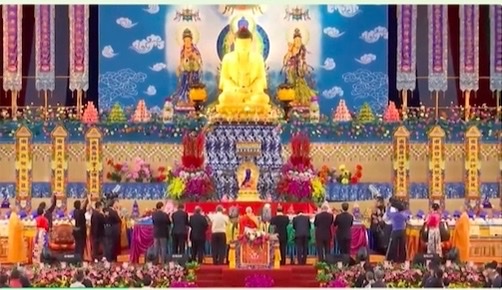
In these challenging times, when suffering and catastrophe touch so many, Buddhism’s compassionate spirit calls us to extend blessings to all sentient beings. On October 13, 2024, the Holy Miracles Temple held a Blessing and Peace Dharma Assembly, a response to the unprecedented hardships the world faces today. Devoted Buddhist disciples gathered to honor the teachings of Namo Dorje Chang Buddha III, coming together to send prayers for healing and hope to those affected by natural disasters, conflicts, and upheavals. This assembly reaffirmed the Buddhist commitment to easing the suffering of all.
The event featured a solemn chanting of the Universal Gate Chapter of the Lotus Sutra, dedicated to Avalokitesvara Bodhisattva, the embodiment of compassion. The gathering was led by Abbess Ruzun Ruohui from Hua Zang Si Temple, who guided attendees through the prayers.
This year has been marked by profound global calamities. In the United States, Hurricane Helene ravaged Texas and Louisiana in August, displacing thousands and flooding communities. Just weeks later, Hurricane Milton unleashed further destruction in Florida and Georgia. Recovery efforts faced tremendous challenges as these back-to-back disasters left homes shattered and lives in turmoil.
In Asia, Typhoon Dindo devastated the Philippines, causing severe flooding and landslides across Luzon in September. Thousands of people were forced to evacuate as the typhoon submerged entire neighborhoods. Nepal, too, was struck by tragedy when a powerful earthquake hit in June, resulting in widespread destruction and loss of life in remote regions.
The war in Ukraine, continuing its escalation throughout 2024, inflicted further suffering on cities like Kyiv and Mariupol, leaving behind a deepening humanitarian crisis. Meanwhile, renewed violence in Syria once again brought bloodshed to war-torn cities such as Aleppo and Damascus, compounding the plight of its weary people.
Europe was not spared from disaster either, as record-breaking floods struck in July. Torrential rains overwhelmed parts of Germany and Belgium, causing rivers to overflow and submerging entire towns. Meanwhile, the United States’ western regions grappled with annual wildfires of increasing magnitude, destroying homes and forests alike.
During the Dharma Assembly at Holy Miracles Temple, attendees united in spirit and purpose. As the sacred verses of the Universal Gate Chapter resonated through the temple, the prayers reached out to those suffering from this year’s tragedies, seeking to bring healing and relief. Prayers were offered for the displaced, the injured, and those who had lost everything. In the face of conflict and war, the community gathered to extend peace, comfort, and hope to all those impacted.
This powerful assembly embodied the compassionate essence of Avalokitesvara Bodhisattva, radiating light and healing to all beings affected by suffering. It was a profound reminder that through shared compassion and collective action, we can create a world where all beings may find peace, healing, and joy.
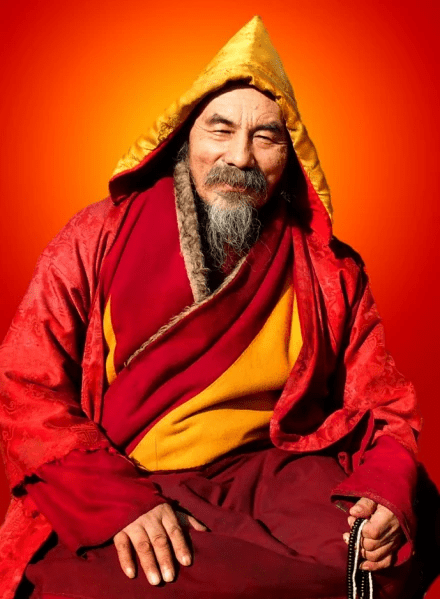
The most venerable H.E. Xiazhu Choying Rinpoche, also known as H.E. Xiazhu Qiuyang Rinpoche, is a highly accomplished Buddhist master from Guoluo, renowned for his spiritual achievements and mastery of Vajrayana teachings. Born in the winter of 1945, his birth was marked by extraordinary signs: thunder echoed across the sky, and colorful flowers blossomed spontaneously on the grasslands surrounding his birthplace. Many local herdsmen witnessed these rare and auspicious omens, heralding the arrival of an extraordinary being.
Renowned mantra master Regong, a revered monk, recognized the young child as the reincarnation of the venerable Chagailong Cichengdaji Rinpoche and the great master Naropa. From an early age, Rinpoche dedicated himself to the welfare of all sentient beings, living a life of simplicity and spiritual practice in the mountains. Throughout his life, H.E. Xiazhu Choying Rinpoche devoted himself to intense ascetic practice, receiving direct teachings from the supreme Vajrayogini and attaining profound realization. It is said that he could soar through the sky, using his monk robes as wings, a testament to his deep mastery of esoteric yoga.
At the age of fourteen, Rinpoche was ordained as a monk under the guidance of Xiari Huzuo Qintu Dannima. Over the years, he studied under more than 100 highly accomplished masters from all major Tibetan Buddhist schools, including:
H.H. the Tenth Panchen Lama and H.H. the Sixth Dharma King Gongtang Yongzeng from the Gelug sect.
H.H. Dodrupchen Rinpoche and Khenpo Mengse from the Nyingma sect.
Kanda Chiwa Gadan from the Sakya sect.
Lama Wangcai Kazhige from the Kagyu sect.
Jiana Bannan from the Jonang sect.
From these masters, H.E. Xiazhu Choying Rinpoche absorbed the essence of both exoteric and esoteric teachings. His spiritual journey led him to receive numerous secret mind-dharma teachings and unique empowerments, passed down without reservation, like water flowing freely from a vessel.
Rinpoche spent much of his life wandering through remote mountains and plains, sleeping in caves, eating cold rice and vegetables gathered from alms, and wearing discarded clothing. He lived humbly, indifferent to worldly praise or criticism, appearing at times like a wandering madman. For 25 years, he did not speak a single word, dedicating himself entirely to the practice of the Dharma, undisturbed by the distractions of the world. His rigorous practice took him to numerous sacred sites across Tibet, Qinghai, and India, where he engaged in solitary retreat, including seven years of intense meditation at a holy site in India.
Through these practices, Rinpoche achieved profound realization in the Dakini Dharma, the Great Perfection (Dzogchen) teachings, Kalachakra Vajra Dharma, and Green Tara Dharma. His deep connection with Vajrayogini from a young age allowed him to access highly secret dakini teachings. Buddhist masters of great virtue have recognized H.E. Xiazhu Choying Rinpoche as the true reincarnation of the great master Naropa, revered as the “venerable leader of 100,000 dakinis.”
In a historic event, the International Buddhism Sangha Association conducted an unprecedented Drawing Lots From a Golden Vase Ceremony, drawing one lot from 120 sealed lots. This ceremony affirmed that H.E. Xiazhu Choying Rinpoche is indeed the reincarnation of Patriarch Naropa, a recognition that had been previously confirmed by H.H. Dorje Chang Buddha III.
H.E. Xiazhu Choying Rinpoche has been praised by numerous revered masters, including H.H. the Tenth Panchen Lama, H.H. Dharma King Yongzeng, and H.H. Dharma King Jigme Phuntsok. Xiaridong Rinpoche, a master of the Yamantaka Dharma, described him as “a truly great master of the Dakini Dharma,” while H.H. Dharma King Jigme Phuntsok hailed him as “an extremely rare master who has perfected the Four Initiations Dharma.”
Despite his vast accomplishments, H.E. Xiazhu Choying Rinpoche remains humble and approachable, freely exercising his supernatural powers without attachment. Known for miraculous feats such as flying, multiplying his body, walking underwater, understanding multiple languages, foreseeing disasters and blessings, and reading people’s minds, Rinpoche is revered as “the unhindered rinpoche.” Clothing and personal items that Rinpoche has worn or used are said to be imbued with miraculous blessings. Many Tibetans have reported turning disasters into blessings, surviving dangerous situations, or recovering from serious illnesses after wearing or ingesting a small piece of his monk’s robe.
H.E. Xiazhu Choying Rinpoche’s legendary life and accomplishments have been widely recorded, including in books such as Holy Cultivation and Its Marvelous Fruits and Biographies of Ten Major Disciples of Dharma Kings. In Tibet, particularly in the Amdo region, almost everyone knows of his miraculous deeds. His life stands as a beacon of inspiration and a model of Dharma practice in this world of five defilements.
Upon reading A Treasury of True Buddha-Dharma, H.E. Xiazhu Choying Rinpoche immediately recognized H.H. Wan Ko Yeshe Norbu as the primordial Dorje Chang Buddha, the highest Buddha in Buddhism. His realization corroborated the recognition of other great holy dharma kings. H.E. Xiazhu Choying Rinpoche offered his heartfelt congratulations in a respectful letter, further acknowledging the sacred truth.
To the Most Revered and Holiest Wish-Fulfilling Jewel Dharma King:
I have learned that A Treasury of True Buddha-Dharma, is a sacred text about His Holiness, the supreme and most honored H.H. Dorje Chang Buddha III, is soon to be distributed worldwide. This book contains the highest, authentic Dharma that brings immense benefit to all sentient beings.
Master Dodrupchen, who is universally recognized as the second Guru Padmasambhava and the highest holy being within Tibetan esoteric Buddhism, expressed his astonishment in his formal congratulations. He praised the accomplishments of the Holiest Wan Ko Wish-Fulfilling Jewel Dharma King as truly extraordinary—unimaginable and miraculous, transcending the ordinary. These achievements express both the describable and indescribable absolute truth of the Buddha-Dharma.
We shall proclaim and praise the accomplishments of His Holiness throughout the Dharma realm. We express our deepest gratitude to His Holiness, the ancient Buddha, for His boundless and great compassion in coming to this world once again to benefit all sentient beings!
Xiazhu Qiuyang Rinpoche May 1, 2007
▲Original congratulatory letter from Xiazhu Choying in Tibetan
During the Buddha’s lifetime, there was a time when he was teaching on the far side of a river. Eager to hear his wisdom, many monks wished to cross the river, but there was only one boat available. The boatman warned them, “My boat is very old, and with so many of you on board, it could be dangerous!” Yet, in their eagerness to reach the Buddha, the monks ignored the boatman’s caution and all climbed aboard. Reluctantly, the boatman set sail.
As they reached the middle of the river, the monks noticed water seeping into the bottom of the boat, and panic began to spread. The boatman calmly said, “I told you this boat is old, but you didn’t listen. Now, if you can’t stay calm, the boat will sink even faster.”
Upon hearing this, the monks stilled themselves and did not dare move. Thankfully, the boatman’s experience guided them safely to the other shore.
When the monks arrived and recounted the incident to the Buddha, he offered this teaching: “When you were in the boat, you feared for your safety. But in daily life, you fail to realize that danger is ever-present. Many people worry about the uncertainty of the future, yet neglect the most important thing — being mindful of the present moment. Focus on this life, this moment. Pay attention to your thoughts and purify your mind of the five poisons: greed, anger, ignorance, pride, and doubt.”
The Buddha continued, “Our bodies are like that old, leaky boat. We must reduce its burden, and the heaviest load is the weight of greed, anger, ignorance, pride, and doubt. Just like in the boat, if we don’t repair our minds and lighten our burdens, we risk sinking. Only by addressing these burdens can we safely reach the other shore.”
“Do not be preoccupied with the thought of being reborn in the Western Pure Land in your next life. Instead, focus on your present condition. Are you free from afflictions in this very moment? Do you act with an open heart? Can you humble yourself in the eyes of others? These are the true questions we must face in life.”
The contemporary Buddha H.H. Dorje Chang Buddha III has also imparted timeless wisdom on cultivation. His Holiness teaches that true cultivation stems from the depths of your heart, from your bodhicitta — the awakened mind of compassion. Be genuinely friendly and loving to your spouse, your brothers, and your sisters. Foster harmony with your friends, act cooperatively with others, and extend care and help to all sentient beings. Apply the Four Limitless States of Mind — loving-kindness, compassion, joy, and equanimity — and cultivate bodhicitta in every action. Constantly reflect on yourself: How do you treat others with your words? With your thoughts? With your actions?
The conduct of Buddhas and great Bodhisattvas is marked by complete disregard for personal gain. When interests conflict, they give way to others, willingly taking fewer benefits or even none. You must remind yourself, “When others harm or slander me, I will not be disturbed. Even to those who harm me, I will wish them well, sincerely hoping for their happiness. Furthermore, I will take practical steps to help them, even offering financial aid — without letting them know that I am doing so.”
By living in accordance with these teachings, we become holy ones at the causal stage. Without a doubt, such cultivation leads to the perfection of wisdom and virtue. Achieving liberation and accomplishment becomes as simple as turning over one’s hand!
One day, a little girl, full of innocence and joy, picked some roses. As she wandered down the road, she saw a poor beggar lying by the roadside. She paused, glanced at the flowers in her hand, and gently placed the most beautiful rose beside the sleeping man. She smiled to herself, thinking, “When he wakes up, he’ll be so happy.” With that, she skipped away, her heart light and joyful.
The sweet fragrance of the rose stirred the beggar from his slumber. Groggily, he opened his eyes and saw the delicate flower in his hand. “Did someone really give this to me? Could something so wonderful happen to someone like me? It’s like the sun rising in the west,” he thought, bewildered. “The person who gave me this flower must be a truly kind and beautiful soul.”
Overcome with emotion, the beggar decided to return to his shabby home. He rummaged through a dusty corner and found an old, dirty bottle. Filling it with water, he placed the rose inside. For a moment, he admired the flower, but then something nagged at him. “Wait,” he thought, “This beautiful rose can’t be in such a filthy bottle.”
He carefully removed the flower, washed the bottle thoroughly, and then placed the rose back inside. But as he looked again, he noticed the dusty table beneath it. “How could such a clean flower sit on such a dirty table?” He set to work, cleaning the table until it gleamed.
As he stepped back to admire the scene, he suddenly realized: “How can this beautiful rose, in a clean bottle, on a spotless table, exist in such a cluttered, dirty room?” He made a bold decision then and there – he would clean the entire house! With renewed energy, he swept away the dust, arranged his belongings neatly, and cleared out all the trash.
With every corner he cleaned, the house became warmer, cozier. A sense of peace filled the room. It was then that he caught his reflection in the mirror – his disheveled hair, his dirty face, his ragged clothes.
“Is that really me?” he asked himself.
Without hesitation, he took a bath, put on his best (though still worn) clothes, shaved, and tidied himself up from head to toe. When he looked in the mirror again, he smiled. “Hmm, I don’t look so bad!”
“Why should I remain a beggar? Tomorrow, I will find work,” he resolved.
Unbothered by hard or dirty work, and unpicky about the job, he soon found employment.
“Someone gave me a flower, and it turns out I’m not worthless after all,” became his daily mantra. It motivated him to work diligently, and as the years passed, he found success. But more than that, he discovered a new purpose.
“A single flower changed my life,” he thought. “I must help others in the same way.” And so, whenever he encountered someone in need, he offered a helping hand. Over time, the number of people he helped grew, and within a few years, he became a respected philanthropist, known far and wide for his kindness.
The story doesn’t end here. Those he helped went on to spread kindness to others, creating a ripple effect that touched countless lives.
In truth, we all need a beautiful flower – a small act of kindness – to remind us of our worth. And that flower? It’s something we all possess and can give freely.
Isn’t it true?
In public, we can hold the door for someone behind us.
When we see someone feeling down, we can offer them a smile.
We can give a genuine compliment to brighten someone’s day.
On a rainy day, we can drive a little slower to avoid splashing water on pedestrians.
We can pick up a stray nail on the ground to prevent someone from getting hurt.
We can speak with kindness and warmth to everyone we meet.
These are simple actions, right? They require little effort, yet they have the power to transform lives. Just like that unnoticed rose changed the beggar’s life, our small acts of kindness can change the world, one person at a time.
In our daily lives, we often believe that once something is done, it’s over. Once words are spoken, they disappear. But in reality, it’s far from over. A kind word, a smile, a simple gesture – these can brighten someone’s day, create ripples of happiness, and leave a lasting impact.
Giving someone a rose, literal or figurative, not only leaves a lingering fragrance in their heart, but it also brings joy back into our own lives. Today, when we plant a seed of kindness, it may grow into a tree in ten years. In a hundred years, it could become a small forest. And in a thousand years, that forest may provide blessings to generations yet to come.
Nothing we do, say, or think ends at the moment. Whether good or bad, everything continues to spread, shaping the world around us.
In a world often torn apart by conflict and suffering, the power of sincere and selfless faith can become a beacon of hope. This was powerfully demonstrated by two of the greatest spiritual figures in history: Mother Teresa and Buddha Shakyamuni. Their lives and actions remind us that peace is not just the absence of conflict but the presence of compassion, wisdom, and unwavering commitment to doing good.
Mother Teresa’s deep compassion and faith brought peace to countless lives. Her work wasn’t just about charity; it was about embodying love and compassion in a way that transcended cultural boundaries. One of the most remarkable examples of her spiritual power occurred during the Kosovo War in Yugoslavia. In the midst of intense fighting, women and children were trapped in the conflict zone. Determined to help, Mother Teresa approached the war commander, pleading for a ceasefire. Though sympathetic, the commander explained that he couldn’t stop the fighting because the opposing side refused to halt their attacks.
Mother Teresa’s response was simple and profound: “Well, then I’ll go.”
She walked directly into the war zone. Word quickly spread that Sister Teresa was present, and miraculously, both sides ceased fire. It wasn’t diplomacy or force that halted the violence but the sheer power of her presence. After she safely escorted the women and children out of danger, the fighting resumed. This extraordinary event eventually reached the United Nations, where Secretary-General Kofi Annan expressed his amazement. “Even I couldn’t achieve that,” he remarked. Despite numerous attempts by the UN to mediate peace, the civil war had raged on—until Mother Teresa stepped in.
Similarly, in Buddhist scriptures, we find the story of Buddha Shakyamuni using wisdom and compassion to prevent bloodshed. After King Virudhaka of the Kosala Kingdom ascended to the throne, he led an army to attack Buddha’s homeland, the Kingdom of Kapilavastu. Although Buddha knew that this was the collective karma of the people of Kapilavastu ripening, he still wanted to do his utmost to protect them. He sat in meditation under a withered tree by the roadside where King Virudhaka’s army would pass.
When King Virudhaka saw Buddha from afar, despite his reluctance, he got out of his carriage and paid his respects. He asked, “Buddha! There is a lush tree not far ahead that could provide you with shade from the sun. Why did you choose to meditate under this withered tree?” Buddha replied, “What you say is true, but the shade of one’s own kin is greater than any other shade.” Moved by Buddha’s words, King Virudhaka led his army back to his kingdom, choosing peace over conflict.
These stories remind us that true peace requires more than just the cessation of violence. It requires the inner strength to let go of hatred and prejudice, to see others not as enemies but as fellow human beings deserving of compassion. In today’s world, people of all different religious beliefs and backgrounds should take inspiration from these examples. Let us all do our part to uphold peace, so that we can live in harmony and happiness.
The path to peace begins with each of us, in our hearts and in our actions. As we work towards a more peaceful world, may we carry the lessons of Mother Teresa and Buddha Shakyamuni with us, allowing their examples to guide us toward a future filled with love, compassion, and understanding.
When I was young, I often accompanied my grandfather to church for prayers.
One day, while my grandfather was bowing reverently in prayer, a few coins fell out of his coat pocket and landed on the floor with a faint clink. My grandfather, deeply engrossed in his prayers, didn’t notice the coins slipping out. However, a stranger nearby saw what had happened. Taking advantage of everyone’s closed eyes during prayer, he quickly picked up the coins and slipped them into his own pocket before retreating to a corner of the church.
I witnessed the entire incident but remained silent. After my grandfather finished his prayers, I quietly whispered to him what had just occurred. Upon hearing my account, his gentle smile turned calm and compassionate. He leaned down and softly said in my ear, “Dear child, please don’t tell anyone about this, and don’t tell me who took the coins—I don’t want to know. But I do hope you’ll remember who it was.”
I, still a child, protested, “Grandfather, your money was taken, and it happened in a church! That person is a thief! How can he still pray in the church?”
At that moment, my grandfather interrupted me, his expression growing serious. He said to me solemnly, “Child, try to see things from a different perspective. If someone does such a thing in a church, it must mean they are in a very difficult situation. Their heart may be suffering even more. We must not be quick to judge such a person. In the eyes of God, we are all children who make mistakes, but that doesn’t prevent us from becoming His children in the future. We must not allow a few coins to define God’s judgment of a person.”
In the days that followed, my grandfather instructed me to discreetly deliver packages of daily necessities to that person every month, without letting them know who the sender was. Over time, that person moved away from the small town.
Many years later, my grandfather passed away, and I grew up. The church that had been a part of my wonderful childhood became overgrown and dilapidated due to lack of funds for maintenance. Then one day, a businessman donated a large sum of money to expand and restore the church. The century-old church was revitalized, becoming even more majestic and sacred.
The people of the town were deeply grateful to the person who had made such a generous contribution. It wasn’t until the day of the church’s reopening that the donor revealed himself. I recognized him immediately—it was the man who had taken my grandfather’s coins, the very person we had helped all those years ago.
I stared in astonishment as he stood on the podium and told the congregation a story about those coins.
“At the most desperate time of my life, right here in this small town, a messenger of God offered me great help and spiritual comfort, helping me overcome my difficulties and despair. I am deeply grateful to that old man and the child whose kindness saved my life. Though that child recognized me at the time, they chose to keep my secret until today. It was the hardest time of my life. They not only helped me selflessly but also protected my dignity. I can never forget this kind town, nor can I forget this church. I want to leave the most beautiful church for everyone in this town.”
To honor his contribution, the townspeople inscribed his name in the most prominent place in the church. However, the name that was ultimately inscribed was that of my grandfather.
As it is written in James 4:17: “If anyone, then, knows the good they ought to do and doesn’t do it, it is sin for them.”
This story teaches us that kindness is a quality, a virtue, and a strength. It is like a light—you never know who will find their way out of darkness through your light. Please hold on to the kindness in your heart, for you never know who might find their way out of despair through your kindness. May each of us live like a light, radiating all of our goodness.
Avalokiteshvara Bodhisattva, from beginningless eons, has been tirelessly saving countless sentient beings with his immense compassionate power. Despite his boundless efforts, he felt a sense of inadequacy. Thus, from the power of samadhi born of great compassion, he formed an immense compassionate force. This force, combined with the great compassionate power of Buddhas from the ten directions, resulted in a drop of green tear flowing from his eye, transforming into the infinitely majestic green female Bodhisattva, known as Green Tara. Due to this origin, Tara’s power to save is boundless and infinite.
Green Tara is revered as the Great Compassionate One and the Holy Savior Mother Buddha. The practice of the Green Tara ritual has a rich history that originated in India and later spread to China, Tibet, Japan, and beyond. The sacred roots of this practice trace back to Green Tara herself, who was initially the ancient Buddha Pravartaka and an incarnation of Avalokiteshvara Bodhisattva.
Chanting the Green Tara mantra even once, with focused contemplation of Tara’s sacred image, brings immense merit. Such merit is equivalent to chanting the names of seventy-two billion Buddhas and Bodhisattvas as numerous as the sands of the Ganges. Both the exoteric and esoteric traditions have extensive practices based on this ritual, and many practitioners have achieved great success and benefit from it.
Over time, the original texts and mandalas related to this profound practice have suffered from omissions and distortions in their transmission. For the past two hundred years, these deviations have increasingly moved away from the authentic regulations. In recent decades, the practice has nearly completely lost its true essence. Furthermore, the representations of Green Tara have deteriorated in form, lacking the dignity of the authentic appearance. This includes discrepancies in hand mudras, attire, and overall sacred depiction, resulting in a significant loss for the Buddhist community.
The Green Tara Perfect Practice Ritual and Thangka by H.H. Dorje Chang Buddha III
In response to these issues, H.H. Dorje Chang Buddha III transmitted the “Green Tara Perfect Practice Ritual” and personally supervised the creation of the Green Tara mandala thangka.
This three-dimensional thangka is not only lightweight and portable, making it easy to carry, but also presents the mandala clearly and vividly, ensuring that it remains etched in memory. Additionally, it possesses several extraordinary merits:
Authenticity and Compliance: The Green Tara mandala presented in the thangka fully complies with the regulations of the “Green Tara Perfect Practice Ritual.” This ensures that the practice remains true to its original form.
Historical and Miraculous Significance: Tara had already attained Buddhahood countless eons ago, her divine power is illustrious, and her sacred deeds are well-documented. Today, in the “Tara Hall” in Nethang, Tibet, the sacred statue of Tara once spoke to Atisha, instructing him, further propagating her holy name and Dharma power across China and Tibet. During the creation of this three-dimensional thangka, many miraculous occurrences were witnessed. For example, the sacred image of Tara, originally looking straight ahead, appeared differently in subsequent photographs taken from the same angle: one showed her looking up at the sky, while the other depicted her looking down at sentient beings. This clearly demonstrates Avalokiteshvara Bodhisattva’s extraordinary vow power: above, he shares the same compassionate force with all Buddhas and Bodhisattvas; below, he joins in compassionate aspiration with all sentient beings in the six realms. Additionally, when viewed from different angles, the main deity of Green Tara always faces the observer, and the seed syllables in the sky behind her follow her movement, appearing above her head. Furthermore, the colorful clouds, initially close to the sun and moon, seem to remain stationary while the sun and moon move vividly between the clouds from different perspectives.
Majestic and Unmatched Representation: The sacred image of Green Tara in the thangka is exceptionally majestic and perfect, unrivaled in both China and Tibet throughout history. The twenty Taras, each with different postures, exhibit supreme Dharma power, arranged behind the main deity, appearing and disappearing miraculously. Notably, standing in different positions reveals the Great Brahma Deva, the primary protector, initially as one, then suddenly as two, and then back to one again, a phenomenon unprecedented in history! Meanwhile, the Four Great Heavenly Kings and the Eight Dragon Kings remain unchanged. Additionally, Indra, the Four Great Heavenly Kings, and the retinue of the Eight Dragon Kings, wielding their divine weapons and instruments, surround and protect Tara with unmatched divine transformation. Visualizing this thangka makes the practice highly effective and rapidly fruitful.
Validation and Praise
Upon the completion of the “Green Tara Perfect Mandala Thangka,” Buddha Master specifically instructed disciples to bring all existing Green Tara statues of various materials from around the world to the Vajra Dharma Circle for public verification. They were to determine which one is the most orthodox and perfect thangka. The Vajra marbles immediately entered the mandala thangka, confirming that the Buddhas and Dharma protectors of the ten directions unanimously endorsed it.
Many of the seven classes of Buddhist disciples, upon practicing with this three-dimensional thangka, experienced unprecedented and unique realms. High monks, living Buddhas, and even Dharma Kings from around the world have all respectfully praised and recommended this rare and precious sacred image. In truth, among all the existing Green Tara images, none can compare to the perfection and majesty of this mandala thangka. Its blessing power is extraordinarily miraculous; a single glance imprints it deeply in the mind, leaving a lasting impression.
The Green Tara Perfect Practice Ritual and its accompanying thangka, as transmitted and supervised by H.H. Dorje Chang Buddha III, represent a revival of the authentic practice of Green Tara. This thangka not only restores the true essence of the practice but also enhances the spiritual experience for practitioners worldwide, offering unparalleled blessings and merits.
Namo H.H. Dorje Chang Buddha III is the only certified Buddha in our world and the first in history to truly manifest the great accomplishments of the Five Vidyas according to the highest standards of Buddhism, encompassing both exoteric and esoteric teachings. Additionally, he is the only Buddha, apart from Shakyamuni Buddha, to have a government proclamation of ‘Buddha Day’ worldwide. As the true embodiment of the Supreme Dharma Lord, Namo H.H. Dorje Chang Buddha III is the highest leader of the entire Buddhist faith.
Many highly realized Buddhist leaders including Bodhisattva Dharma Kings and the leaders of major sects and schools have recognized H.H. Dorje Chang Buddha III as the third true incarnation in this world of the original samboghakaya dharma king. A full listing of the Dharma Kings and other Rinpoches with their letters of recognition and congratulation may be found in the treasure book H.H. Dorje Chang Buddha III.
Namo H.H. Dorje Chang Buddha III is the unprecedented great sage who embodies selfless virtue, being the first to altruistically benefit all sentient beings without accepting any offerings.
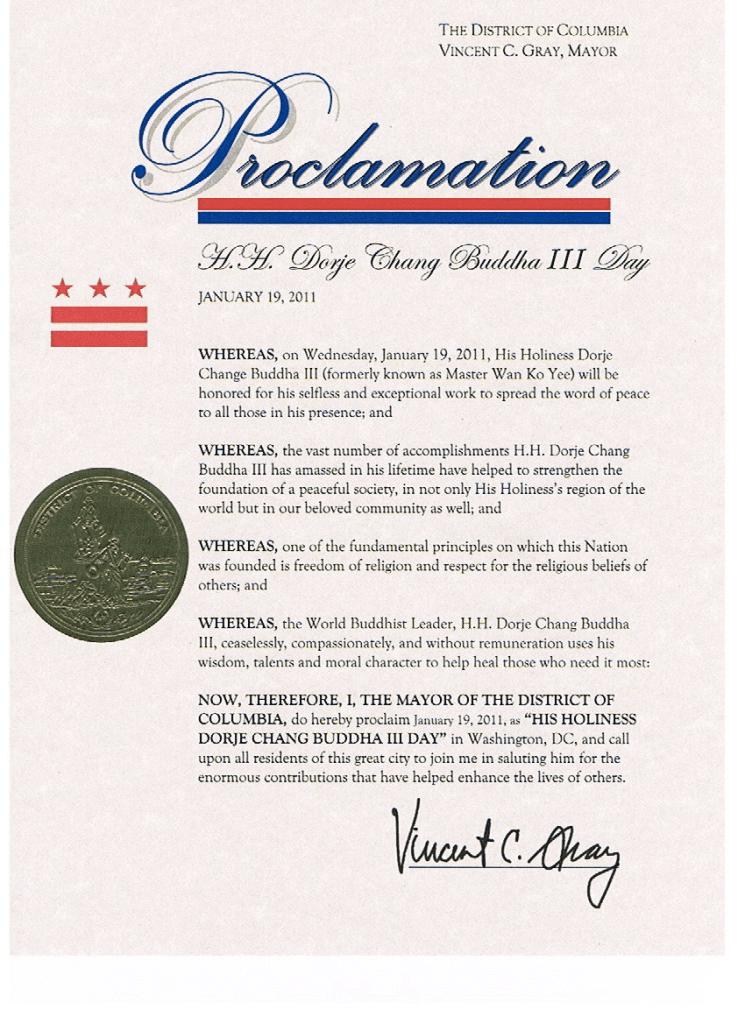
The awards and honors bestowed upon H.H. Dorje Chang Buddha III are numerous. For instance, the Mayor of Washington, D.C., proclaimed January 19, 2011, as ‘H.H. Dorje Chang Buddha III Day,’ urging people to pay homage to him. The U.S. Congress Lantos Foundation for Human Rights and Justice issued an open letter praising the esteemed Buddhist leader H.H. Dorje Chang Buddha III for his outstanding contributions to humanity, supporting his tireless efforts to enhance moral civilization, promote prosperity in the United States, and foster world peace.
In February 2011, the entire U.S. Congress, along with the Chairman of the National Prayer Breakfast, extended an invitation to H.H. Dorje Chang Buddha III as a religious leader to participate in the prayer breakfast led by President Obama, attended by the highest authorities of the executive, legislative, and judicial branches. Moreover, H.H. Dorje Chang Buddha III received the ‘Presidential Gold Medal’ from President Bush on behalf of the Asian Pacific American Advisory Committee, the ‘International Service and Leadership Award’ from the Martin Luther King Legacy Association, and 56 other major awards from senators, representatives, governors, and various levels of government.
The World Peace Prize was awarded the highest honor to H.H. Dorje Chang Buddha III in 2011!
In June 2011, Namo the Third Supreme Tathagata received the highest honor of the World Peace Prize in the U.S. Congress. This prestigious award is presented by the ‘World Peace Mission.’ Since its establishment in 1989, the World Peace Prize has been awarded to individuals dedicated to mediating political disputes, international and economic matters, contributing to the safety and stability of human society. The World Peace Mission is an international evangelical missionary organization with the goal of promoting peace, upholding the spirit of equality, and fostering cooperation among religions.
Recipients of the highest honor of the World Peace Prize include the 40th President of the United States, Ronald Reagan; the revered Mahatma Gandhi of India; the 12th President of the Philippines, Ramos; the fourth President of Indonesia, Wahid; former Egyptian President Mubarak; former President Nakamura of Palau; the first President of Mongolia, Punsalmaagiin Ochirbat; the first President of South Korea, Lee Seung-won; former Israeli Prime Minister Rabin; former Nigerian President Yakubu Gowon; Ethiopian Prime Minister Meles Zenawi, among others. The World Peace Prize was co-founded by former U.S. Congressman Robert Leggett and evangelical religious leader Dr. Han Min-su. Guided by the principle of benefiting others, they promote religious cooperation and uphold human peace. The World Peace Prize Committee comprises outstanding judges from different countries, backgrounds, races, and beliefs, demonstrating the spirit of human unity.
H.H. Dorje Chang Buddha III has been recognized by the World Peace Prize Committee for selflessly dedicating himself globally, saving others. His wisdom and compassionate embrace encompass all races, ethnicities, cultures, and religions, bringing goodness, peace, and harmony to everyone. Wherever he goes, his humility and compassion unite people. His contributions to human society, including teachings, healing, and charitable work, truly embody the compassion of Buddha, becoming a role model for all. His sublime character shines through his teachings, healing, charity work, leading people onto the paths of morality and charity. Simultaneously, he is an outstanding artist, pointing out a non-violent, charitable, and loving path for humanity through his teachings, practices, arts, and poetry.
United States Senate Resolution No. 614
In December 2012, the 112th United States Congress Senate unanimously passed Resolution 614, commending the World Peace Prize and its recipients. In this resolution, the U.S. Senate not only acknowledged the World Peace Mission as an organization with a sublime core spirit but also recognized the World Peace Prize as a prestigious award presented by the World Peace Mission to honor individuals who have made significant contributions to peace and human enlightenment. The Senate also affirmed the World Peace Prize Evaluation Committee’s recognition of H.H. Dorje Chang Buddha III for his contributions to a wide range of humanitarian activities benefiting people in various communities worldwide. Additionally, the Senate acknowledged the numerous awards bestowed upon H.H. Dorje Chang Buddha III, including the Presidential Gold Medal presented by President George W. Bush on behalf of the Asian Pacific American Advisory Committee, recognizing his outstanding contributions to art, medicine, morality, Buddhism, spiritual leadership, and American society.
The Senate resolution uses ‘H.H.’ to title and honor H.H. Dorje Chang Buddha III, indicating the highest esteem of the U.S. Congress for his supreme and unparalleled status. Simultaneously, the Senate resolution records explicitly express the U.S. Congress’s recognition of the World Peace Prize Evaluation Committee as a sublime and honorable international organization.”
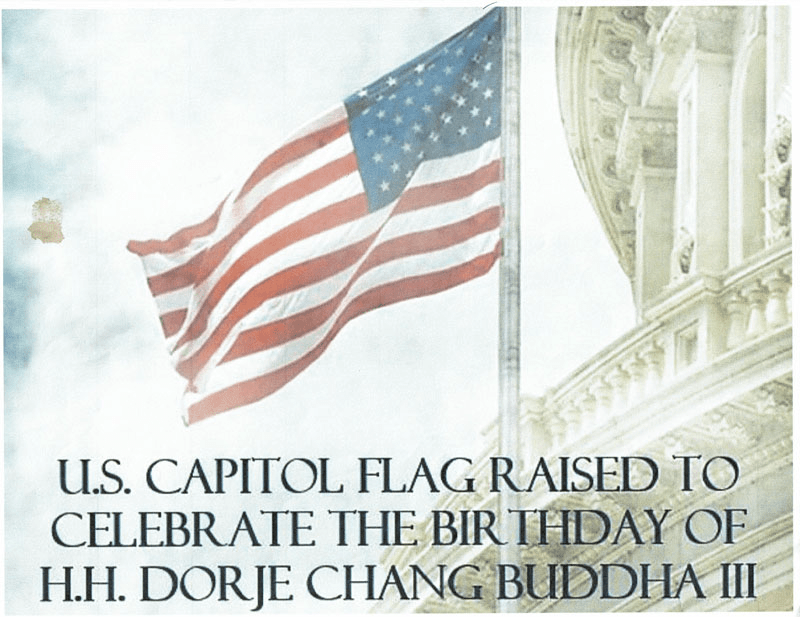
In May 2018, the U.S. Congress raised the flag in tribute to H.H. Dorje Chang Buddha III!
On May 15, 2018, the American flag was hoisted at the Capitol building in Washington, D.C., waving in the air to specially celebrate the happy birthday of H.H. Dorje Chang Buddha III! The flag-raising statement from the U.S. Congress reads: ‘On the occasion of the birthday of H.H. Dorje Chang Buddha III, the American flag flies over the Capitol, paying tribute to the supreme leader of all Buddhists, H.H. Dorje Chang Buddha III.
In 2018, the World Peace Prize Committee bestowed upon H.H. Dorje Chang Buddha III the title and staff of ‘World Buddhist Pope.’ Faced with this pinnacle honor and position in the world, H.H. Dorje Chang Buddha III refused to accept it. Despite repeated pleas from the World Buddhist Headquarters, His Holiness adamantly declined. In the end, due to circumstances, the title was accepted on his behalf. His Holiness solemnly stated, ‘I am just a practitioner. What is this about a World Buddhist Pope? In Buddhist history, there are Buddhas, Bodhisattvas, Vajras, Arhats, Elders, Dharma Kings, Geshe, Khenpo, Abbots, and Head Monks, but never have I seen a Buddhist Pope. Even if they confer the title today, so what? The term ‘Pope’ may be invaluable to others, but for me, a humble practitioner, it is nothing more than a joke! I am merely a servant of sentient beings, doing practical things for their benefit. Though my abilities are limited, can’t I contribute a bit of goodwill? The World Buddhist Headquarters accepted the Pope’s staff on my behalf; it was not my delegation. It was received by the headquarters, their affair, and I have no right to intervene. I remain myself. At the headquarters, I saw the top of the staff adorned with the presence of Shakyamuni Buddha. At that moment, I raised the staff above my head in reverence to Shakyamuni Buddha – the Lord of Buddhism. I am, as always, a humble practitioner.’
His Holiness Dorje Chang Buddha III’s words and actions embody the unparalleled enlightenment of a true Buddha. Regardless of praise or criticism, His Holiness remains undisturbed, dedicating all vows and actions to the liberation and benefit of sentient beings. Upholding the true Buddhist Dharma, free from sectarian distinctions, he imparts teachings to disciples such as Hou Yu Shan and Lin Liu Hui Xiu, guiding them to the Pure Land, meeting Amitabha Buddha, returning to the human world prepared, and attaining rebirth at the right time. His Holiness invited Amitabha Buddha to transmit teachings to Zhao Yu Sheng, and disciples like Hai Lao Monk and Lu Dong Zan have achieved remarkable results, demonstrating the effectiveness of his teachings.
H.H. Dorje Chang Buddha III has received numerous worldly honors, introducing unparalleled Yun Sculpture art to the world. Nurturing disciples who have attained liberation and genuine accomplishments in the sacred teachings of Buddhism, His Holiness has also left sacred traces globally. These achievements attract officials, celebrities, and Buddhist disciples worldwide, seeking to meet and learn from him. The H.H. Dorje Chang Buddha III Culture and Art Museum houses His Holiness’s masterpieces, including the revered ‘Yun Sculpture.’ This new form of sculptural art is considered an invaluable creation that transcends replication in the human world. The museum proudly preserves the first piece of Yun Sculpture, ‘One Stone Horizontal Charm.’
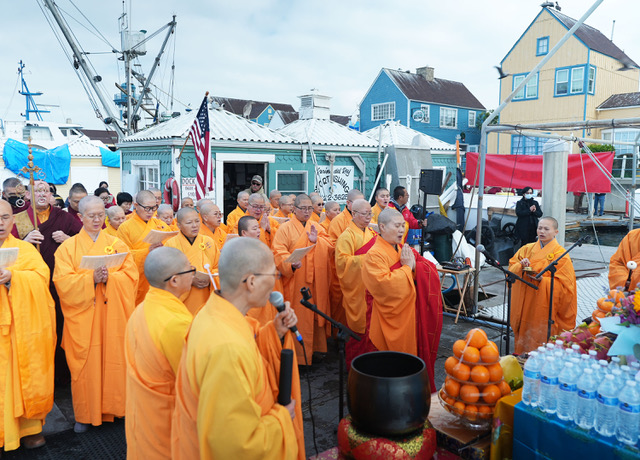
To commemorate January 19th as ‘H.H. Dorje Chang Buddha III Day,’ the H.H. Dorje Chang Buddha III Culture and Art Museum organized a grand blessing and liberation event on January 14, 2024, at the Marina Del Rey waterfront in Los Angeles. The ceremony was presided over by Venerable Shi Zhengda, Vice Chairman of the World Buddhist Headquarters. Over 300 participants from various states in the United States, Canada, Hong Kong, and other regions attended the event. Globally, Buddhist temples and centers joined in activities such as liberation ceremonies, disaster relief, education assistance, and aid for the impoverished to celebrate this auspicious day. The activities sought blessings, wisdom, well-being, disaster relief, national peace, and world peace amid the challenges of today’s global society.






















 Peace LiLy