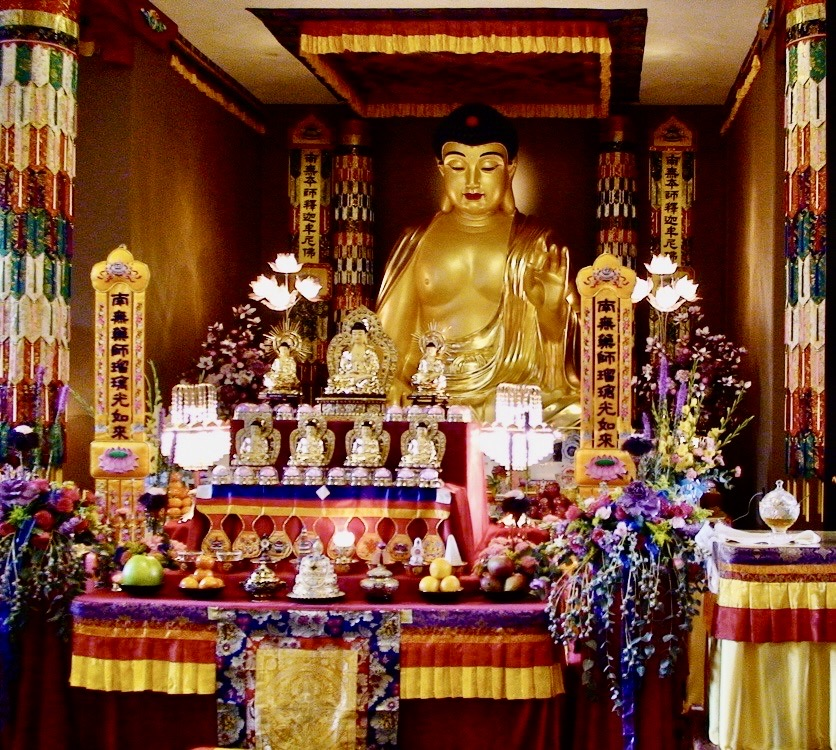
The Medicine Buddha is a great teacher who purifies all obstacles and brings healing to the world. When the Medicine Buddha was practicing the Bodhisattva path in past lives, he made twelve great vows to relieve the suffering of sentient beings and bring them happiness including curing physical disabilities, relieving poverty, providing material needs, guiding those astray, and liberating prisoners. He is associated with a pure land in the East called Vaiḍūryanirbhāsa, or “Pure Lapis Lazuli”.
On the 29th day of the ninth lunar month, Buddhist disciples worldwide honor the birthday of Bhaisajyaguru Buddha, known as the Medicine Buddha or the Great Medicine King. He is also referred to as the Buddha of Twelve Great Vows, embodying deep compassion and healing. Presiding over the Pure Land of Lapis Lazuli Light in the East, the Medicine Buddha has inspired countless practitioners with his transformative teachings and boundless compassion.
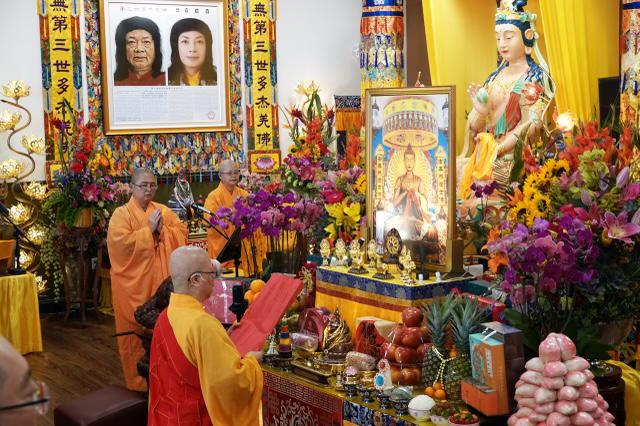
Hua Zang Si, a Buddhist temple in the Mission District of San Francisco, California, held a Namo Medicine Buddha Holy Birthday Dharma Assembly on November 16, 2025. The next scheduled Dharma assembly will be the Namo Amitabha Buddha Dharma Assembly to be held on December 28, 9:30 am.
Holy Miracles Temple, located at 1730 N. Raymond Ave., Pasadena, CA, serves as a sanctuary dedicated to teaching the true Dharma of the Tathagata, as transmitted by Namo H.H. Dorje Chang Buddha III and Shakyamuni Buddha, guiding disciples on their path to liberation and spiritual accomplishment. Grounded in the Buddha’s teachings and fueled by boundless compassion, the temple’s core mission is to selflessly serve humanity. Its hope is for people in America and across the globe to embrace Buddha Dharma, cultivating love for their country, fellow people, and the world. Through mutual support, peace, kindness, and auspiciousness, the temple envisions a strong nation with thriving citizens and a world brimming with joy and happiness.
In these challenging times, when suffering and catastrophe touch so many, Buddhism’s compassionate spirit calls us to extend blessings to all sentient beings. On October 13, 2024, the Holy Miracles Temple held a Blessing and Peace Dharma Assembly, a response to the unprecedented hardships the world faces today. Devoted Buddhist disciples gathered to honor the teachings of Namo Dorje Chang Buddha III, coming together to send prayers for healing and hope to those affected by natural disasters, conflicts, and upheavals. This assembly reaffirmed the Buddhist commitment to easing the suffering of all.
The event featured a solemn chanting of the Universal Gate Chapter of the Lotus Sutra, dedicated to Avalokitesvara Bodhisattva, the embodiment of compassion. The gathering was led by Abbess Ruzun Ruohui from Hua Zang Si Temple, who guided attendees through the prayers.
This year has been marked by profound global calamities. In the United States, Hurricane Helene ravaged Texas and Louisiana in August, displacing thousands and flooding communities. Just weeks later, Hurricane Milton unleashed further destruction in Florida and Georgia. Recovery efforts faced tremendous challenges as these back-to-back disasters left homes shattered and lives in turmoil.
In Asia, Typhoon Dindo devastated the Philippines, causing severe flooding and landslides across Luzon in September. Thousands of people were forced to evacuate as the typhoon submerged entire neighborhoods. Nepal, too, was struck by tragedy when a powerful earthquake hit in June, resulting in widespread destruction and loss of life in remote regions.
The war in Ukraine, continuing its escalation throughout 2024, inflicted further suffering on cities like Kyiv and Mariupol, leaving behind a deepening humanitarian crisis. Meanwhile, renewed violence in Syria once again brought bloodshed to war-torn cities such as Aleppo and Damascus, compounding the plight of its weary people.
Europe was not spared from disaster either, as record-breaking floods struck in July. Torrential rains overwhelmed parts of Germany and Belgium, causing rivers to overflow and submerging entire towns. Meanwhile, the United States’ western regions grappled with annual wildfires of increasing magnitude, destroying homes and forests alike.
During the Dharma Assembly at Holy Miracles Temple, attendees united in spirit and purpose. As the sacred verses of the Universal Gate Chapter resonated through the temple, the prayers reached out to those suffering from this year’s tragedies, seeking to bring healing and relief. Prayers were offered for the displaced, the injured, and those who had lost everything. In the face of conflict and war, the community gathered to extend peace, comfort, and hope to all those impacted.
This powerful assembly embodied the compassionate essence of Avalokitesvara Bodhisattva, radiating light and healing to all beings affected by suffering. It was a profound reminder that through shared compassion and collective action, we can create a world where all beings may find peace, healing, and joy.
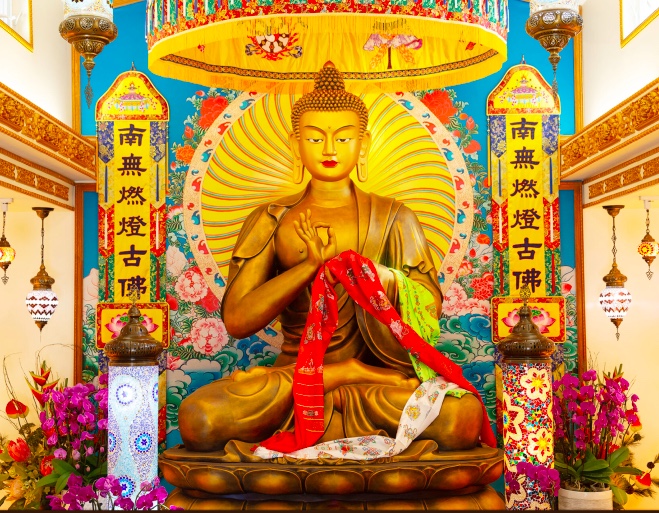
On Sunday, September 22, 2024, The Holy Miracles Temple in Pasadena hosted the grand “Dharma Assembly to Welcome the Birthday of Namo Dipankara Buddha.” This auspicious event was co-organized by the World Buddhism Association Headquarters, The Holy Miracles Temple, and the Saint Grong Lecture Hall. The assembly was led by the abbot of Hua Zang Si, Venerable Ru Hui Ru Zun, a Holy Virtuous One of Gold Button Level 1, who presided over the sacred ceremonies.
Namo Dipankara Buddha, a revered incarnation of Namo Dorje Chang Buddha, holds a special place in the hearts of Buddhist disciples. In ancient times, he prophesied that Shakyamuni Buddha would one day attain enlightenment and become a Buddha. The site of the “Dipankara Buddha Hall” at The Holy Miracles Temple is significant—it marks the location of the first-ever publication of The True Meaning of the Heart Sutra as Expounded by H.H. Dorje Chang Buddha III, where profound teachings of the Buddha were revealed.
A particularly memorable moment in this location occurred on March 7, 2014, during a Dharma assembly when a miraculous event unfolded. Buddha descended from the sky, manifesting in a divine form, blessing the gathering with three-colored nectar—a clear and undeniable testament to the authenticity of the teachings in Expounding the Absolute Truth through the Heart Sutra. Following this sacred event, the Dipankara Buddha Hall was constructed on this blessed site, where devotees from all directions come to light lamps and offer their reverence to the Buddha.
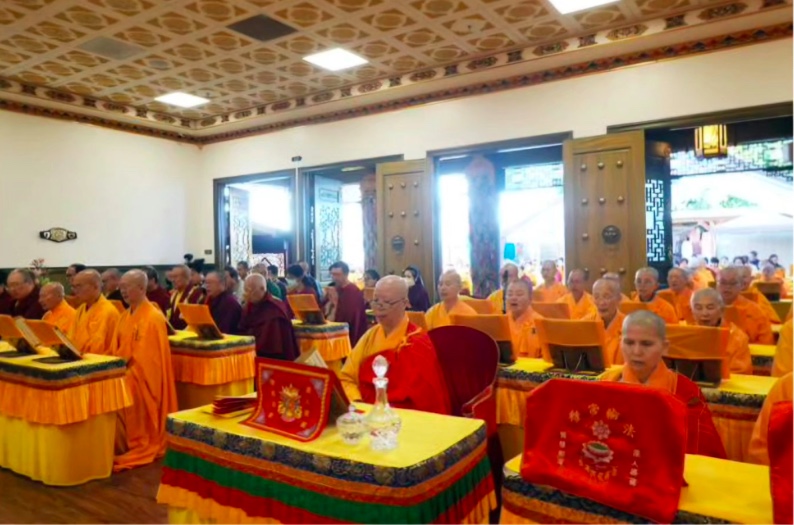
This year’s Dharma assembly began with great reverence in the Grand Hall, filled with the solemn chanting of Buddhist hymns. Under the guidance of Venerable Ru Hui Ru Zun and the monastic community, participants respectfully recited the Diamond Sutra, bowed to the Buddha, performed repentance, and conducted a grand offering before the Buddha. The assembly’s merits were dedicated to celebrating the Buddha’s birthday, with the intention to increase the blessings and wisdom of all beings, dispel ignorance and darkness, and bring forth prayers for world peace, national prosperity, and a harmonious society.
The Dharma assembly invited Venerable Ru Hui Ru Zun, the abbess of Hua Zang Si and a Holy Virtuous One, to preside over the ceremony
During an interview, Venerable Ru Hui Ru Zun shared the origin of the Buddha’s name: “The name ‘Namo Dipankara Buddha’ comes from the illumination that surrounded Him at birth, shining like a lamp. Today, we light lamps, chant scriptures, and offer prayers, hoping to bring the light of the Dharma to the world, and to bless humanity with peace and auspiciousness.”
The assembly also brought touching personal reflections. Ms. Tam, a long-time attendee, shared, “Every year, our family lights the annual offering lamp at the Dipankara Buddha Hall. It has brought us great blessings, and everything in our lives has been smooth and auspicious.” Benjamin Hong reflected on his family’s deeper connection to Buddhism: “When my uncle was diagnosed with cancer, our family sought ways to help him. This journey led us to encounter the true teachings of the Tathagata. Through the teachings of Namo Dorje Chang Buddha, we gained a profound understanding of what Buddhism truly is. It was this experience that helped our family through the toughest times and brought us to the path of Buddhism.”
At the conclusion of the Dharma assembly, Venerable Ru Hui Ru Zun blessed the congregation by sprinkling holy water for empowerment
This Dharma assembly beautifully honored the legacy of Namo Dipankara Buddha. It served as a living bridge between ancient wisdom and the contemporary aspirations of the Buddhist community, uniting all participants in a shared vision of enlightenment, peace, and harmony for the world.
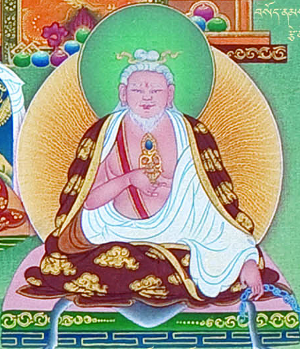
H.E. Tangtong Gyalpo is a greatly accomplished person within Tibetan esoteric Buddhism who attained the rainbow body. He is a great Bodhisattva known and respected by one and all in Tibet.
He is also an extremely holy person who has made huge contributions to the Tibetan people. It was this great Bodhisattva who was the father of medicine, ferryboats, bridges, and operas in Tibet. He has brought to the living beings of Tibet limitless blessings. To this day, Tibetan temples and families continue to worship H.E. Tangtong Gyalpo Bodhisattva.
The first Tangtong Gyalpo left the household life to become a monk when he was very young. He studied the sutras and treatises and became good at debating the sutras. Although he possessed the Five Vidyas, he remained modest, simple, and down-to-earth. In order to provide a model of self-cultivation, H.E. Tangtong Gyalpo followed and learned under many people of great virtue.
He also engaged in solitary, quiet cultivation for a long period of time at the Eri Temple. Later, he received teachings directly from Dakini Niguma and became a person greatly accomplished in the dharma. People praised H.E. Tangtong Gyalpo with the following words: “In the vast realm of emptiness, there is a yogi who intensively studies emptiness and who is like the King of Fearlessness. His name is Tangtong Gyalpo.” He has also been respectfully called Zhibai Wangxiu Tangtong Gyalpo, which means the accomplished, free and unhindered Tangtong Gyalpo!
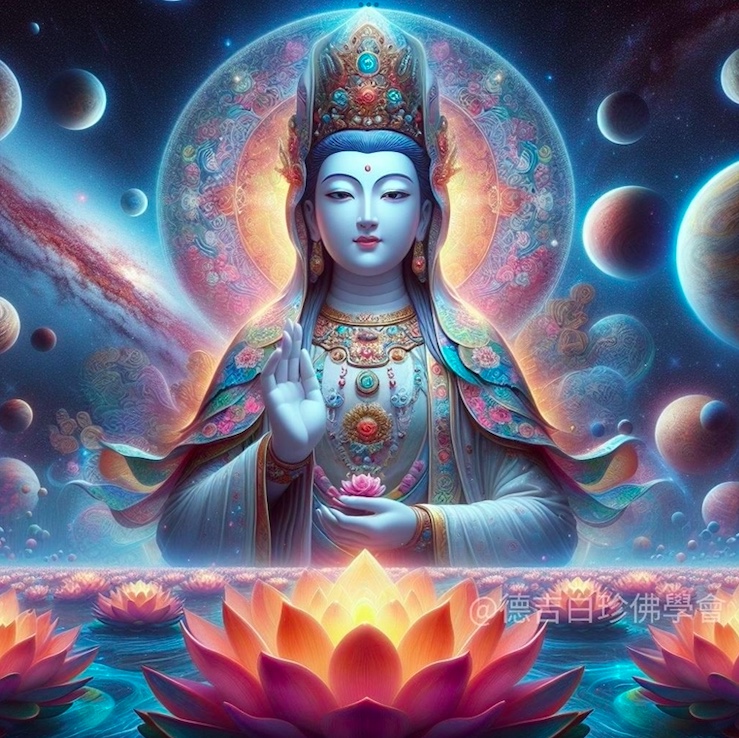
During a certain year in history, there was a serious drought and famine in Tibet. H.E. Tangtong Gyalpo conducted a Dharma Assembly in front of the Sakyamuni Buddha statue in the Jo-khan Temple in Lhasa. At that Dharma Assembly, he wrote “A Prayer to Eliminate Famine.” Many people then saw Kuan Yin Bodhisattva in the sky disseminating various grains. The famine ended not long after that.
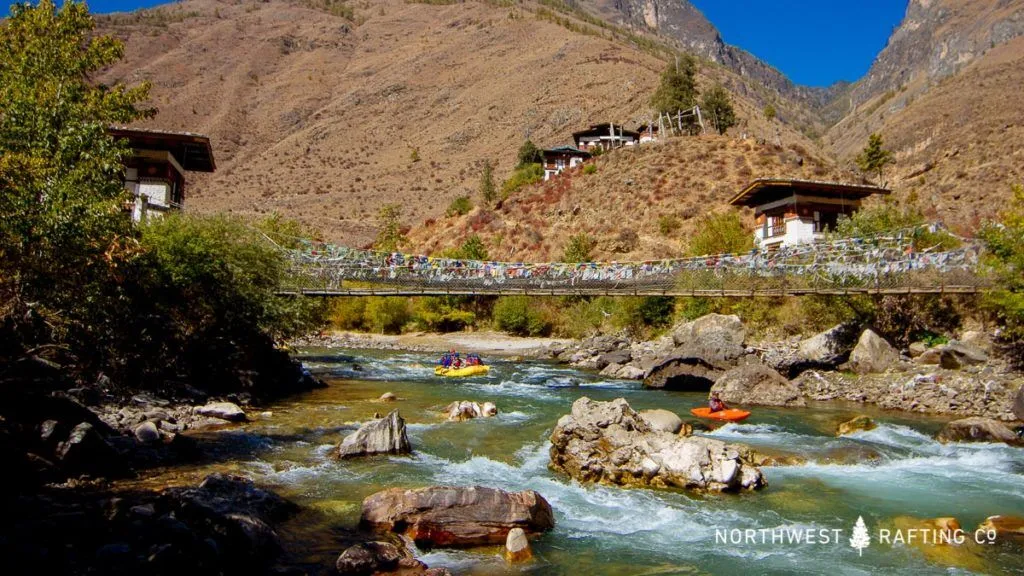
There was another time when war and chaos occurred in the Muya district of Kham in Tibet, causing people to leave their homes and wander about. H.E. Tangtong Gyalpo made a vow and wrote “A Prayer to End War and Chaos.” People in that area very soon after that ended their mutual hatred and instead treated one another in a peaceful, friendly, and loving manner. There was another year when a pestilence broke out in a large area covering a religious site of the Sakya sect, causing countless deaths. The chanting of mantras and the offering of sacrifices could not end the pestilence. Thus, H.E. Tangtong Gyalpo again practiced dharma and wrote “A Prayer to End the Disaster of Illness.” As a result, the pestilence disappeared forthwith. In previous times in Tibet, it was very difficult for people to cross rivers. The river waters mercilessly took away people’s lives as they attempted to cross the rivers. Thus, H.E. Tangtong Gyalpo made improvements to ferryboats and began building bridges. In that lifetime, he built fifty iron-chain bridges, sixty wooden bridges, and many temples. One of those temples was the Tangge Lakong (the Tangtong Gyalpo Temple), which was the first temple in the Derge region. With respect to medicine, H.E.Tangtong Gyalpo established the Medicine King Temple at Jiabori in Lhasa, invented a white pill that cured all kinds of internal medical diseases, and invented a red pill that cured epidemic diseases. Thus, he became the founder of Tibetan medicine. That white pill and red pill are used in Tibetan medicine even to this very day to relieve the sufferings of living beings.
This 600 year old bridge crosses the Paro Chhu (Paro River) and was traditionally restored in 2005 after being washed away during a 1969 flood. The bridge was originally built by the legendary Thangtong Gyalpo
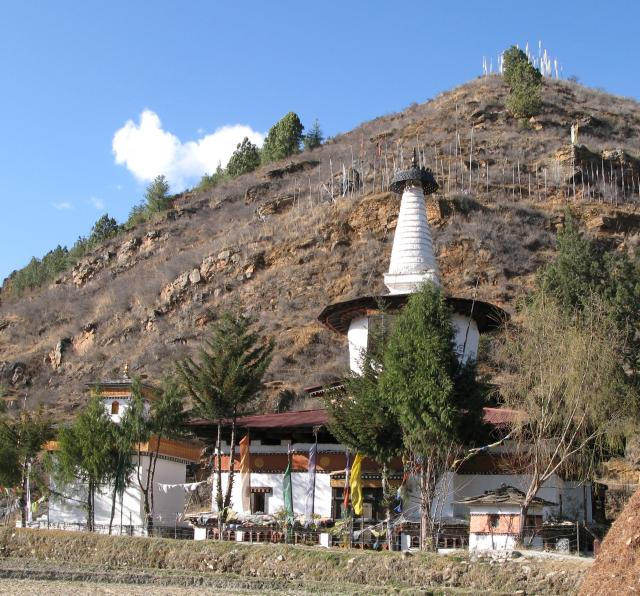
Dungtse Lhakhang, a temple in form of a chörten near Paro in Bhutan was built by Thangtong Gyalpo. The roof construction is made of iron.
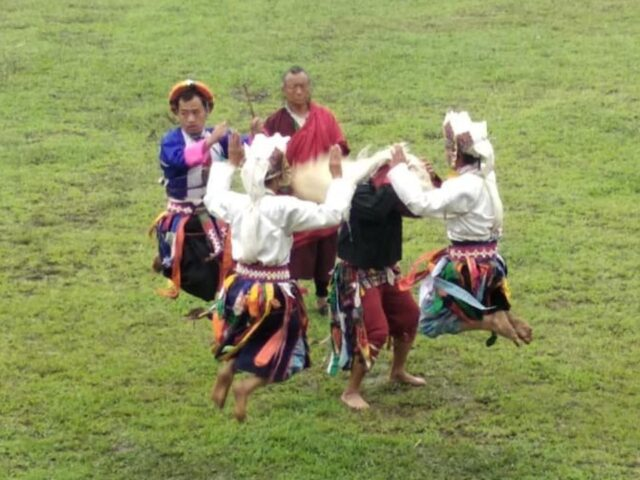
H.E. Tangtong Gyalpo Bodhisattva also wrote many Tibetan operas and established the Ache Lhamo opera troupe, the members of which acted out Tibetan historical stories through song and dance and pioneered Tibetan operas. The Achi Lhamo opera, with the starting troupe of seven sisters who worked on the saint’s bridges, is still performed and enjoyed hugely to these days during the new year celebration and on festive occasions.
Achi Lhamo Opera Composed by Thang Tong Gyalpo Still Prevalent in Bhutan
H.E. Tangtong Gyalpo was the supreme leader of four esoteric sects within India, Bhutan, Sikkim, Mongolia, and Eastern Tibet. He possessed teachings from many dharma lineages, the most remarkable of which were the lineage to extend one’s life and the lineage to bring in wealth and change one’s fortune. Everyone in Tibet, no matter what sect he or she belonged to, believed in and practiced such lineages and scriptures. Countless disciples of H.E. Tangtong Gyalpo became accomplished in the dharma under his teachings and attained great supernatural powers, wisdom and great compassion. More than one hundred disciples of his attained the rainbow body or the transformation rainbow body. All Tibetan people know that H.E. Tangtong Gyalpo is truly a great patriarch of Tibetan esoteric Buddhism and a great Bodhisattva. Later, each time H.E. Tangtong Gyalpo incarnated into this world. He was a great patriarch who spread the dharma, liberated living beings, and pervasively benefited people.
Thang Tong Gyalpo Present Reincarnation
H.E. the sixteenth Tangtong Gyalpo Bodhisattva (Thangtrul Rinpoche) took birth in Bhutan. His physical appearance resembles that of Guru Padmasambhava. Even when he sleeps, his eyes remain open. He saw H.H. Wan Ko Yeshe Norbu (Dorje Chang Buddha III) during a Dharma Assembly that took place in 2005 at Hua Zang Si in San Francisco, U.S.A. In a supernatural state of samadhi, he instantly saw that H.H. Dorje Chang Buddha, the highest ancient Buddha in the dharma realm, had already come to this world again. He at once formally acknowledged H.H. Dorje Chang Buddha III Wan Ko Yeshe Norbu as his master. H.H. Dorje Chang Buddha III asked him, “Did you follow and learn dharma under Guru Padmasambhava? Why have you come here?”H.E. Tangtong Gyalpo answered that he had received teachings directly from Guru Padmasambhava and from H.H. Sakya Trizin who is the nirmanakaya of Manjushri Bodhisattva. He also said that he had come to request the highest dharma in order to save living beings. H.H. Dorje Chang Buddha III immediately snapped His fingers, and a dharma bowl manifested awesome power. H.H. Dorje Chang Buddha III then accepted H.E. Tangtong Gyalpo as one of his disciples who is on the level of a great venerable one and performed an initiation for him. H.E. Tangtong Gyalpo took that dharma bowl back to his home country.
He later learned that the book A Treasury of True Buddha-Dharma about the H.H. Dorje Chang Buddha III Wan Ko Yeshe Norbu Holiest Tathagata was about to be published. He thereupon organized many rinpoches to practice the Kuan Yin Dharma one billion times as an offering to His Holiness Dorje Chang Buddha III. He also sent his written congratulations stating that His Holiness is the master of Buddhas, the magnificence of His Holiness is supreme and that in this world no other holy being in history can compare with His Holiness.
H.H. Dorje Chang Buddha III accepted H.E. Tangtong Gyalpo as his disciple at Hua Zang Si temple San Francisco
The abbess of Hua Zang Si is Venerable Ruo Hui RuZun (Golden Button Stage I). She is a disciple of H.H. Dorje Chang Buddha III. She is deeply and broadly proficient in the sutras, abides by the precepts with pure cultivation, upholds correct views, and possesses high and profound virtue and conduct.
Driven by her endowed wisdom and firm aspiration, Venerable Ruo Hui RuZun started learning Buddhism since her childhood. While she was a young person facing a splendid future, Venerable Ruo Hui RuZun decided without hesitation to abandon worldly life to become a monastic practitioner. She respectfully quested for the practice of Buddhism, studied the sutras deeply, and cherished the goal of benefiting living beings in her cultivation and practice. Additionally, she demonstrated outstanding virtue and talent in her diligent study and research in the academic arena and received a Master’s degree from the Department of Philosophy of Taiwan University. She made a vow to dedicate her life to grandly propagating Buddha-dharma and broadly saving living beings. She served as the dean of the Chien Fo Shan Girl Buddhist College in Taiwan in her early years and have been continuously making contributions to the education of Buddhist monastics. However, Venerable Ruo Hui RuZun was deeply aware of the widely prevalent chaotic phenomena in the current Buddhist world, such as confusing views, non-unified sects and schools advocating their own tenets, miscellaneous teachings that are complex but incomplete, and promoting false doctrines as authentic Buddhism. Consequently, pious Buddhist disciples are searching and questing in vain and still unable to learn the true dharma of the Tathagata. Their lifetimes are thus wasted! Therefore, Venerable Ruo Hui RuZun was continuously concerned about this situation day and night and eagerly beseeched to find the genuine lineage from the Buddha that transmits the true teachings of the Tathagata.
In 1996, Ruo Hui RuZun had the good fortune to listen respectfully to the recorded dharma discourses expounded by H.H. Dorje Chang Buddha III. At that time, she sensed strongly and received the bright manifestation of the supremely and perfectly enlightening Buddha-dharma from His Holiness the Buddha! Later, guided by the karmic affinity to true Buddha-dharma, she fulfilled her wish to become a disciple of H.H. Dorje Chang Buddha III. Since then, she eagerly and respectfully listened to the recorded dharma discourses expounded by His Holiness the Buddha day and night. Through studying deeply with reference to the sutras, she eventually became enlightened by the teaching! She also received a holy inner-tantric initiation from the Buddha Master, which enabled her to personally realize the absolute truth of Buddha-dharma as if seeing the blue sky after pushing the blocking dark clouds aside. Since then, Ruo Hui RuZun abided by the teachings to benefit living beings with loving compassion in cultivation and practice. Shortly after that, she was delighted to learn that the Buddha Master was grandly publicizing and propagating the true dharma of the Tathagata in the Western world. After deep thinking and careful pondering, Ruo Hui RuZun decided to resign from the duty of the Dean of the Buddhist College to take up the mission to serve living beings. She traveled across the ocean to the United States to follow her Buddha Master, H.H. Dorje Chang Buddha III. She piously and deeply cultivated in the authentic lineage of Buddhism and engaged in the undertaking of propagating the true dharma of the Tathagata to benefit living beings.
Through the many years, Ruo Hui RuZun received true Buddha-dharma transmitted by H.H. Dorje Chang Buddha III in person and realized the key attainment of the dharma. In the dharma mandala, she manifested deeply cultivated power and superior state of realization. Once, she fortunately attended a grand and magnificent Vajra obstruction-removing dharma assembly. At that time, dharma masters and abbots of many monasteries and rinpoches were present. When stepping forward to receive empowerment, almost all of them were subdued by the power of the Buddha-dharma to show a suffering appearance and unable to support themselves by their power of concentration. Only Ruo Hui RuZun remained firmly unperturbed and successfully went through the holy power of Samadhi. She handled the situation magnificently and perfectly by calm without even any change in her facial expression. For that, she was praised by H.H. Dorje Chang Buddha III! Additionally, Ruo Hui RuZun also received a dharma of state practice transmitted by the Buddha Master in person and attained the accomplishment of crown-opening within two hours.
Since the grand opening of Hua Zang Si in December 2004 to now, Ruo Hui RuZun has served at the positions of prior (warden), deputy abbess, and abbess at this temple, which is the first temple of true dharma of Buddhism established in the Western world by H.H. Dorje Chang Buddha III. Since the temple’s establishment, her responsibilities cover a wide range of the temple’s dharma affairs and operations including various dharma assemblies, training and education of the monastic personnel, defining the system and rules to manage the temple, and so on.
With her abundant and solid knowledge in the theory of Buddhism and the teaching of practicing in silence, experience in managing and operating a temple, as well as deeply cultivated power in meditative concentration, she continuously serves since the beginning as the karma monastic master in awarding the complete set of grand precepts through three dharma assemblies and the professor/teacher of various courses in precepts, rituals, meditation, group practice, education of monastics and others at the Academy of Exoteric Buddhism of Hua Zang Si. She also conducted teaching and training at Buddhist institutions in the United States and overseas. Many of the disciples she taught have now become dharma masters or monastic practitioners. Actually, quite a number of them have even become excellent managerial personnel at some temples in different countries.
Ruo Hui RuZun consistently maintains a low-key demeanor in her cultivation and practice, exemplifying patience in the pursuit of her significant mission. She remains humble and modest, avoiding self-promotion or publicity. Through her words and actions, she serves as an exemplary teacher for Buddhist disciples, embodying the principles of loving compassion. Devoting herself quietly to the welfare and joy of sentient beings, she seeks enlightenment for both herself and others.
Adhering to the teachings and true dharma of H.H. Dorje Chang Buddha III, Ruo Hui RuZun upholds principles, follows rules rigorously, and engages in concrete cultivation to guide disciples on the path of accomplishment and liberation. She is an accomplished and eminent Buddhist monk whose example we should emulate and learn from.
Since September 2015, Ruo Hui RuZun has officially served as the abbess of Hua Zang Si. Recognizing the immense responsibility entrusted to her, especially given that Hua Zang Si is not an ordinary temple but a true dharma temple established in the Western world by H.H. Dorje Chang Buddha III, her Buddha Master, she is acutely aware of the need for unwavering commitment. Determined to lead the monastics and lay followers, she strives to transform Hua Zang Si into a temple faithfully practicing the teachings of H.H. Dorje Chang Buddha III and Sakyamuni Buddha, benefitting and nurturing sentient beings. In pursuing this mission, Hua Zang Si aims to contribute tangibly to compassion, happiness, peace, and joy in America and worldwide, fostering the perfect good fortune and wisdom, liberation, and accomplishment of living beings. The temple is committed to meeting the high expectations of Buddhas, Bodhisattvas, and sentient beings alike.
The belief in Bodhisattva Ksitigarbha is deeply rooted in Asian folk religions, offering a profound message of compassion and salvation. Ksitigarbha, also known as “Earth Treasury” or “Earth Store,” is revered for his extraordinary vows and his unwavering commitment to alleviating suffering, particularly in hellish realms. In China, alongside Manjusri, Samantabhadra, and Avalokiteshvara, Bodhisattva Ksitigarbha is honored as one of the “Four Great Bodhisattvas.”
The “Sutra of the Bodhisattva Ksitigarbha’s Fundamental Vows” is a sacred scripture, attributed to Shakyamuni Buddha himself, that highlights the remarkable vow power of Bodhisattva Ksitigarbha. In this sutra, Ksitigarbha’s magnificent vow is eloquently praised: “Until the hells are empty, I will not attain Buddhahood, and I will only achieve enlightenment after saving all beings.” The text also provides insights into Ksitigarbha’s exemplary actions and deeds along his spiritual path.
A Tale of Filial Piety and Redemption: In one of his past lives, Bodhisattva Ksitigarbha incarnated as a woman named Guangmu. She exemplified unparalleled filial devotion, but her mother’s disbelief in karma led to her descent into hell after death. Learning of her mother’s plight, Guangmu selflessly sacrificed her most cherished possessions to accumulate merits on her mother’s behalf. Before the Buddha, she made a solemn vow: to secure her mother’s permanent liberation from the three evil paths and, only then, seek her own enlightenment. Through Guangmu’s selfless acts and immense vow, her mother swiftly attained liberation and ultimately achieved Buddhahood.
People place their faith in Bodhisattva Ksitigarbha due to his profound aspiration: “To save all sentient beings and attain enlightenment; I will not achieve Buddhahood until hell is empty.” This resolute vow has made him a beacon of hope for those seeking liberation in the afterlife.
The holy birthday of Bodhisattva Ksitigarbha falls on the last day of July in the Chinese lunar calendar, which corresponds to September 14th this year. Buddhists worldwide come together to honor and memorialize Bodhisattva Ksitigarbha during special assemblies held in Buddhist temples. These gatherings serve not only to pray for the well-being of all living beings but also to beseech blessings for departed relatives and friends, hoping they will ascend to higher realms through the benevolent influence of Bodhisattva Ksitigarbha. This year, a special assembly was held at Hua Zang Si temple in San Francisco on September 10th.
Every year, my participation in the Ksitigarbha Dharma assembly evokes a mix of emotions. On one hand, I feel a deep sense of joy as I pray for the protection and blessings of the Buddhas and Bodhisattvas for all beings. On the other hand, a profound sadness envelops me as I witness my loved ones departing from this world one by one. The list of those to be transferred to a better realm, through prayers and rituals, continues to grow. This year, the passing of my uncle, the youngest brother of my father, added to the somber realization of life’s brevity and the swift nature of impermanence.
As I age, I keenly experience various illnesses, physical decline, and a slowing of my movements. These experiences have deepened my understanding of why H.H. Dorje Chang Buddha III continually reminds us to cultivate the awareness of impermanence. In “What is Cultivation?” and in many pre-recorded Dharma discourses, His Holiness emphasizes that being mindful of impermanence is the cornerstone of our spiritual development. Without this awareness, one cannot establish the sincere commitment required to practice Buddhist Dharma earnestly and break free from the cycle of life and death.
Life has presented me with numerous unpredictable natural disasters and personal sufferings. Unless I persistently dedicate myself to spiritual practice, the looming specter of death may catch me unprepared, leading to a fate that is both pitiable and terrifying.
I earnestly pray that all Buddhas and Bodhisattvas, with a special invocation to Bodhisattva Ksitigarbha, bless all living beings with the wisdom to grasp the impermanence of life. May we all diligently cultivate ourselves, seeking liberation in this lifetime and guiding the departed souls to higher realms, where they can encounter the profound teachings of Buddhism and ultimately break free from the cycle of birth and death.
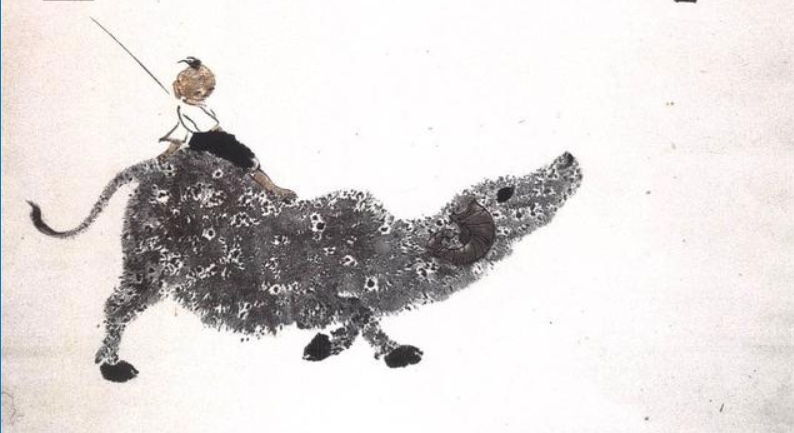
At year February 2007, this Year of the Ox (by H.H. Dorje Chang Buddha III) painting was exhibited at an auction in the Hua Zang Si Temple in San Francisco. Even though I saw it online, when I saw this work in person that year, I was suddenly transported into a world of pure and poetic spirituality.
The ox strolled leisurely, Looking up to admire the scenery. On the ox’s back, a young herder, Humming a tune, Enjoying a unique sense of freedom. Though there was no verbal communication, There was mutual companionship, Dependence on each other.
Later, I saw this painting again at The International Art Museum of America in San Francisco. It was as if I were re-experiencing the long-lost joy of childhood innocence, and I couldn’t help but stop and admire this exquisite masterpiece.
The entire composition of the painting is concise: an ox, a flute, a young herder on the ox’s back, a few simple strokes representing tree branches, and a hint of green. The old ox was covered in glistening sweat, and no matter where or when, it remained calm, with steady steps and a high head, as if filled with determination and strength for the journey of life. The young herder reclined comfortably on the ox’s back, at ease and trusting that the old ox would take him where he wanted to go. Urban dwellers fortunate enough to witness such a rare and beautiful scene would find their tense hearts instantly relaxed.
In terms of technique, this Chinese painting exhibits remarkable simplicity, featuring an expansive and open composition coupled with unique and striking artistic techniques. The skillful use of white space within the artwork, thanks to clever design choices, not only avoids diminishing or dulling the image but also creates boundless room for the viewer’s imagination to roam. Additionally, the artist employed a scattered perspective technique to lend the painting a three-dimensional quality, skillfully using emptiness to convey form. The seamless integration of form and emptiness results in an exceptionally elegant layout.
This painting serves as a testament to the artist’s ability to convey the inherent charm of nature and capture the essence of a pure and childlike spirit, offering solace and enjoyment to its viewers. What is particularly astonishing is the meticulous application of ink at a minute level, portraying the oxen’s hairs in an array of intricate variations.
Although the painting does not depict the colors of early spring, mountains, valleys, or springs, they seem to be faintly visible on the canvas. It’s said that by calculating white as black and using emptiness as a form of depiction, the simplicity of the image leaves room for endless beauty and boundless imagination. This painting beautifully exemplifies the traditional Chinese cultural principle that ‘The Dao resides in simplicity.’ It evokes thoughts of the legendary tale of Laozi departing China on a green ox through the Hangu Gate in pursuit of Sakyamuni Buddha.
Having been in the hustle and bustle of the city for a long time, one longs for the tranquility of the countryside. But once in the quiet countryside, one can’t bear the loneliness and solitude. The restless heart can’t resist the temptation of the bustling world and constantly seeks outward under the pull of desire. When lost and falling into despair, one realizes that this is not the life one truly desires.
In reality, the ideal paradise is not far away; it resides in the inner tranquility and practicality of the present moment. Just like the young herder and the old ox in the painting, tranquility and boundless joy are always found in the present moment.
January 1st in the Chinese lunar calendar, is chinese Spring festival, it is the biggest holiday in china. It is also the holy birthday of Maitreya Bodhisattva – the next Buddha in the saha world. This is a special and joyful holiday that is celebrated by many. Hua Zang Si in San Francisco held a Dharma Assembly to celebrate this important occasion. It was the first Dharma Assembly of the year and it was held on a beautiful sunny day. Many laypersons participated in the event.
At the entrance of the temple is an oversize marvelous statue representation of a jolly, laughing Buddha: Maitreya Bodhisattva (the next Buddha in this Saha world). It is such a warm welcoming sign. The big belly not only means jolly, it also means tolerating the intolerable things in the world. So when you look at the statue, you will start to feel that learning Buddhism is happy and kind.
The Dharma Assembly was an opportunity for people to come together and celebrate the teachings of Maitreya Bodhisattva. It was a time for reflection and meditation, as well as a chance to learn more about the teachings of Buddhism. The atmosphere was filled with positivity and joy, as people came together to celebrate this important holiday.
In Chinese culture, Maitreya Bodhisattva is seen as a symbol of joy and tolerance. As practitioners of Buddhism, we are encouraged to strive to be like the Buddhas and Bodhisattvas by cultivating a broad mind, open heart, and great tolerance.
One of the key principles of Buddhism is patience and forbearance, particularly under insult. This is seen as a key aspect of self-cultivation and it is important to remember that everything in the dharma realms can change from ordinary to holy. This means that even difficult situations can be transformed and overcome through the practice of patience and tolerance.
Patience and tolerance are not just passive qualities, but rather active ones that require effort and practice. We must actively cultivate them in our daily lives and strive to maintain them even in difficult situations. Through this practice, we can transform our own minds and hearts, becoming more like the Buddhas and Bodhisattvas that we strive to emulate.
At the Dharma Assembly, we chanted the Eighty-eight holy Buddha name jeweled repentance sutra, in hopes that the Buddhas will wash away all of our sins and negative karmas. After the chanting, we offered a meal to the Buddhas and Bodhisattvas. The event concluded with a dharma talk given by Dharma Master Ruohui.
During her talk, Dharma Master Ruohui emphasized the importance of faith, vows, and actions for disciples of Buddhism. She explained that faith is the foundation of our practice, and that with strong faith, we will have the determination to follow the Buddha’s teachings and put them into action in our lives.
The Dharma Assembly was a meaningful event where participants not only had the opportunity to reflect on their own spiritual growth but also to make an impact on the world around them. During the assembly, the participants returned the merit to all living beings, holding the hope that they shall be rid of suffering, obtain happiness, and have the opportunity to listen to authentic Buddha Dharma.
The act of returning merit is an important aspect of Buddhist practice as it is believed that by dedicating the positive energy generated through our spiritual practice to the benefit of others, we can help bring about peace and prosperity in the world. By returning merit to all living beings, participants were able to contribute to the collective well-being of the world and make a positive impact on the lives of others.
Furthermore, the participants also held the hope that by listening to authentic Buddha Dharma, they will be able to perfect their fortune and wisdom, leading to a more prosperous and peaceful world for all. This is the ultimate goal of Buddhism, to help all beings to find inner peace, happiness and liberation from suffering.
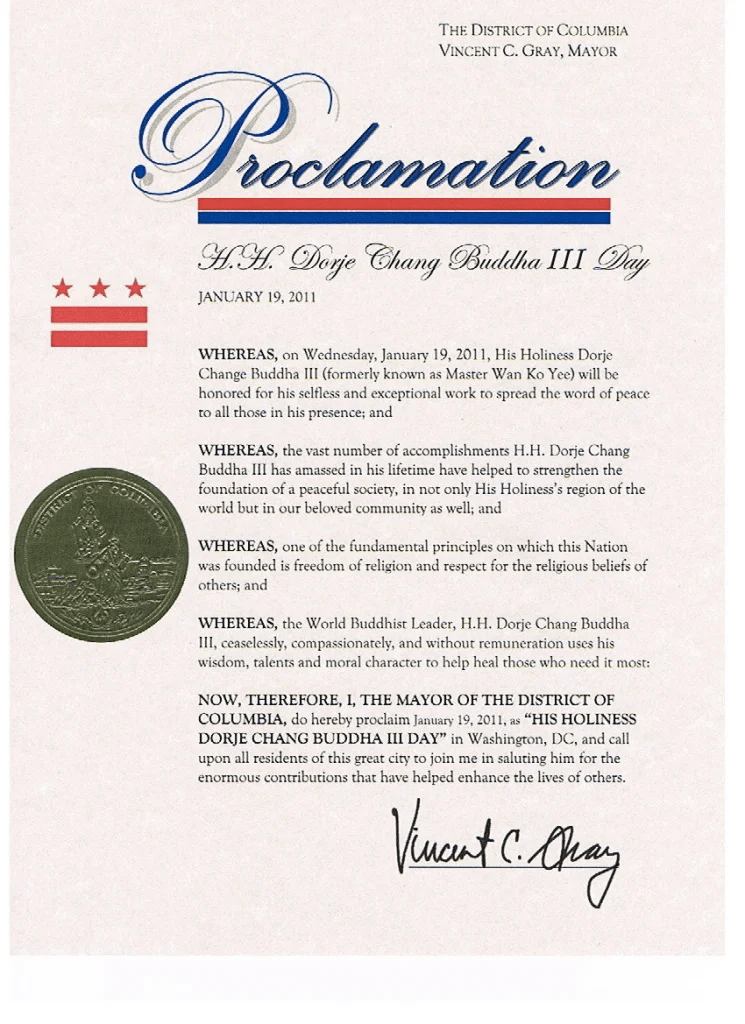
On January 19, 2011, Mayor Vincent C. Gray, the mayor of our nation’s capital Washington, DC, personally signed and issued a proclamation in which January 19, 2011 was proclaimed as His Holiness Dorje Chang Buddha III Day.
In that proclamation, Mayor Gray called upon all residents of Washington, DC to join him in saluting H.H. Dorje Chang Buddha III! The mayor stated that H.H. Dorje Chang Buddha III has, through his selfless and exceptional work, spread the word of peace to all those in his presence. The mayor commended H.H. Dorje Chang Buddha III for his vast accomplishments that have helped to strengthen the foundation of a peaceful society, in not only His Holiness’s region of the world but in the Washington, DC community as well. Additionally, Mayor Gray praised H.H. Dorje Chang Buddha IIIas the World Buddhist Leader who ceaselessly, compassionately, and without remuneration uses his wisdom, talents and moral character to help those in need.
The video below has a brief introduction of H.H. Dorje Chang Buddha III, that helps you to know some great achievements and teachings of the Buddha.
Buddha taught that all living beings have Buddha-nature, and that we shall treat them as family members and relatives. To celebrate this very special day, Hua Zang Si held a Dharma Assembly to release captive lives and pray for blessings at a beautiful port in San Rafael CA , on January 19th 2023. Many laypersons in the bay area and central CA participated the event.
Namo H.H. Dorje Chang BuddhaIII and Namo Shakyamuni Buddha taught us :”No matter where it is and when it is, if we see living beings in horrible fears and calamitous adversity, we must save them. Therefore, for any lives that are facing the urgent and terrible fear of going to be hurt or killed, we shall save them out and release them into an environment that suits them, so as to let them regain the freedom and be free from fears. There is a phrase that says, ‘I love to see them live, and I dare not see them die.’ Based on our compassion and empathy, we want to endow living beings with happiness and rid them of sufferings.
With the Dharma Assembly, participants returned the merit to all living beings, holding the hope that they shall be rid of suffering, obtain happiness, and have the opportunity to listen to authentic Buddha Dharma, perfecting fortune and wisdom, and leading to prosperity and peace throughout the world.
This December 4th, a Dharma Assembly for the Holy Birthday of Amitabha Buddha was held at Hua Zang Si, located at San Francisco. About two hundred people attended the assembly. The weather was very sunny, clean and fresh after heavy rain the day before. It was a very happy time. Ever since the pandemic period started, Hua Zang Si has been closed to the public. This was a precious opportunity for buddhist disciples to get together.
The main venue was held at the second floor of the temple, the Amitabha Buddha Hall. The twenty-one foot tall statue of Amitabha Buddha (designed by H.H. Dorje Chang Buddha III) has been generally recognized as the most majestic Buddhist statue in the world. It is an extremely solemn sight. The Buddha’s eyes seem alive, looking down at all beings full of compassion and love.
First we chanted Buddha Expounding Amitabha Sutra,then we made the meal offering to the Buddhas and Buddhisattvas, at the end Master RuoHui RuZun gave us a short Dharm speech and we all prayed to the Buddhas and Bodhisattvas to grant blessings and protections to all beings in the world.
Amitabha Holy Birthday Assembly at Hua Zang Si
I greatly enjoyed the assembly, so much so that after it ended I still didn’t want to leave. I stayed and helped to clean up the site. I also prostrated to the Amitabha Buddha and kneel down and pray wholeheartedly: Please Buddha save me from the birth-death cycle, please take me to the western paradise.
I always wondered how this magnificent Amitabha Statue was installed in the hall. I found out an amazing story behind it. The sitting statue of Amitabha Buddha is inside the grand hall on the second floor. The statue of Amitabha Buddha was paid for with H.H. Dorje Chang Buddha III‘s money from selling his paintings. The molding of the statue was also based on the blueprint drawn by the Buddha. During the process of molding, H.H. Dorje Chang Buddha III modified the model eight times in person. All places that did not conform to the stipulation of the dharma were corrected and re-molded. After the completion, this statue was judged to be the most solemn Buddha statue in the world. The height of the statue of Amitabha Buddha was 6.7 meters (22 feet) and two narrow stairways with 180-degree turns have to be passed to go upstairs, the manufactured Buddha statue had to be first cut into several pieces and reassembled together after moving onto the second floor. Therefore, this statue was divided into seven parts and shipped in three containers to Hua Zang Si (the temple).
After the Buddha statue was unloaded, everyone in the temple were participating in carrying each part of the statue respectfully and carefully to the second floor. We were surprised to find that the sizes of the seven components all fit correctly into the narrow space in the stairway and all turns were made smoothly on the way to the second floor. In addition, there was no damage to the surface paint coating or any other place of the Buddha statue, thanks to the blessings from all Buddhas and Bodhisattvas, as well as dharma protectors.
The process of installing the Buddha statues into seats and surface gold-gilding went very smoothly. There were no signs of reassembly. We all happily stood in front of the Buddha statues with unlimited reverence in our minds. Such solemn grand Buddha statue can only be seen at Hua Zang Si in San Francisco of America, because it was made under the personal guidance from H.H. Dorje Chang Buddha III!












 Peace LiLy