In the middle of a storm, most people look for shelter. But a rare few choose to stand in the rain to keep someone else’s home from washing away.
In 1942, the United States was a place of fear and suspicion. Following the attack on Pearl Harbor, Executive Order 9066 forced thousands of Japanese-American citizens into internment camps. They were given just days to pack what they could carry, leaving behind their businesses, their homes, and their life’s work.
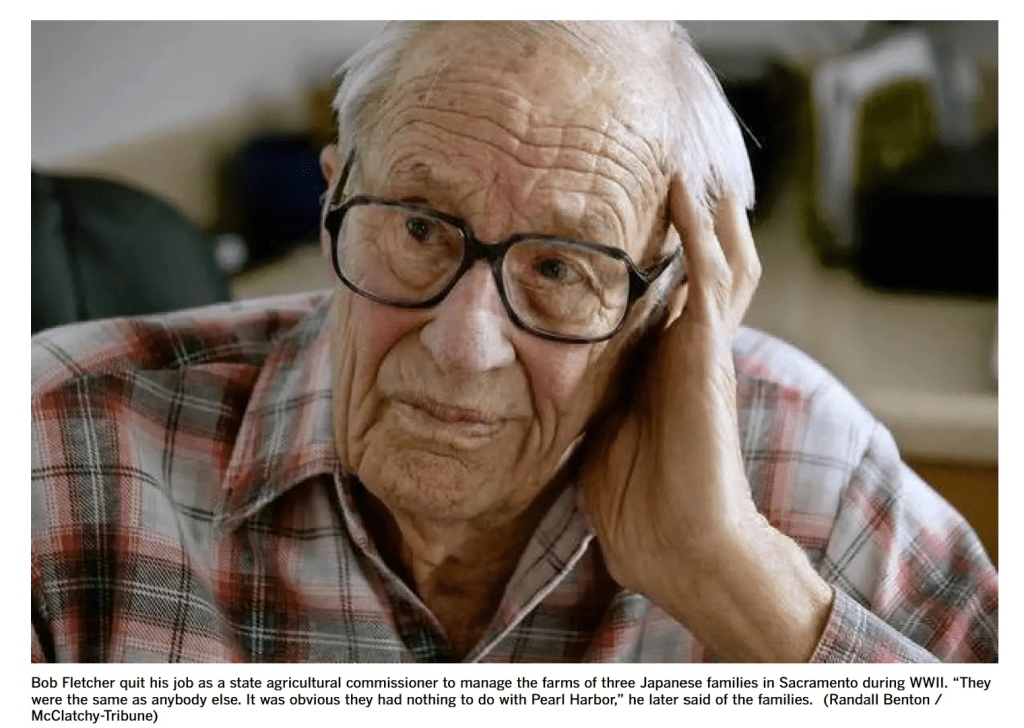
In Florin, California, most people looked away as their neighbors were taken. But an agricultural inspector named Bob Fletcher did something different. He stepped forward.
Note 1
Bob Fletcher was 31 years old when his neighbors—the Tsukamoto, Nitta, and Okamoto families—were ordered to leave. They were strawberry and grape farmers who faced losing everything to foreclosure.
They asked Bob if he would manage their farms while they were gone. Bob didn’t just say yes; he quit his stable job with the state to become a full-time farmer for people who weren’t even allowed to be there.
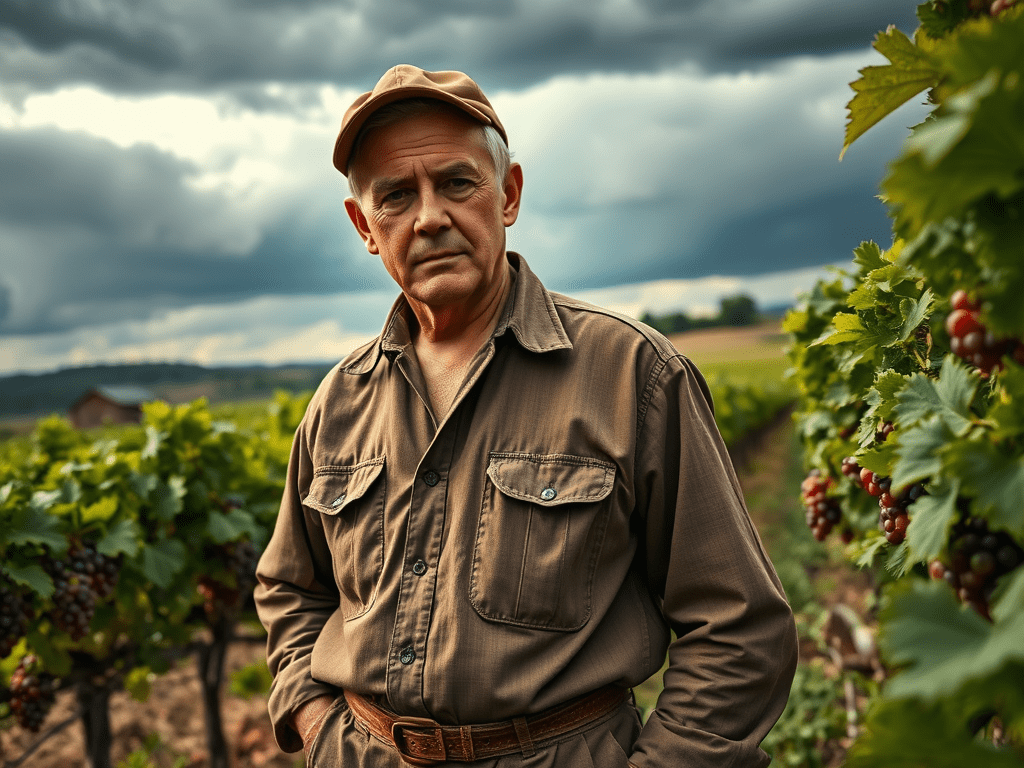
For three years, Bob worked 18-hour days. He managed 90 acres of flame tokay grapes across three different farms.
The Cost of Doing the Right Thing
Doing the “right thing” is rarely easy. Bob wasn’t seen as a hero by his community at the time. He was called names, shunned by neighbors, and at one point, someone even fired a shot into the barn where he was working.
But Bob had a quiet, iron-clad integrity. He lived in the migrant bunkhouses rather than the families’ main homes. He paid their mortgages, their taxes, and their bills. When the families finally returned in 1945, they didn’t return to ruins—they returned to thriving farms and a bank account full of the profits Bob had saved for them.
Bob Fletcher lived to be 101 years old. For decades, he deflected praise, often saying:
“I don’t know about being a hero. I just did what I thought was right.”
His life leaves us with enduring lessons:
Integrity is a verb. It is not what we believe in private, but what we practice when no one is watching—and when it costs us something.
One person is enough. Bob couldn’t stop a national injustice, but he saved three families. Sometimes protecting one corner of the world is exactly what we are called to do.
Moral courage is quiet. It doesn’t announce itself. Sometimes it looks like long days, dirty hands, and the refusal to surrender compassion to fear.
We may not be living through a world war, but we all face moments where it is easier to go along with the crowd than to stand up for a neighbor. Bob Fletcher’s life asks us: Who are we looking out for? What are we willing to protect?
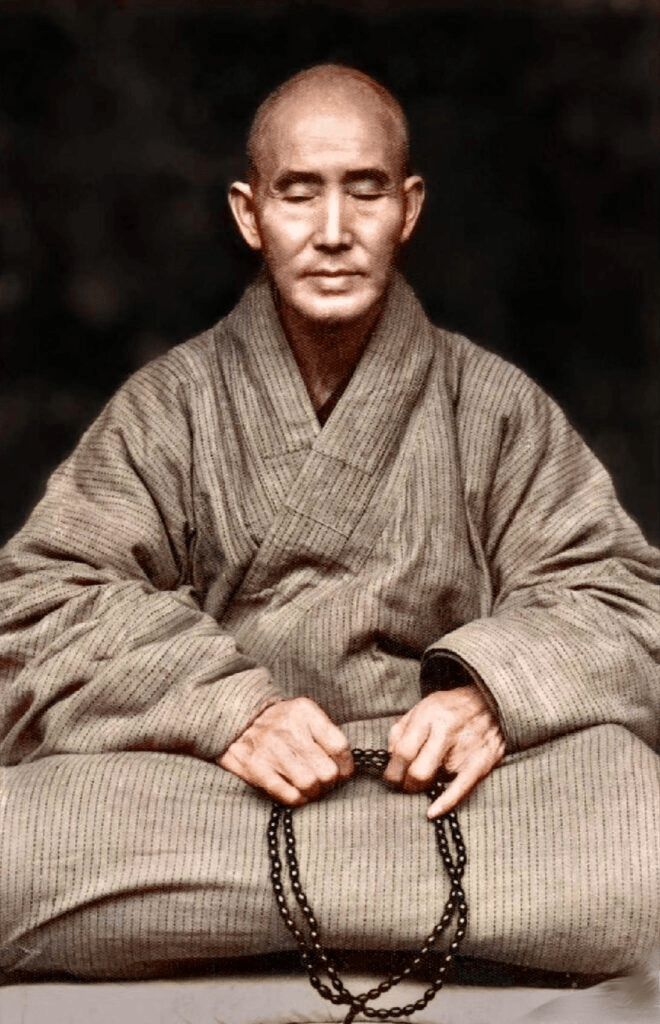
In 1947, shortly after Japan’s surrender and withdrawal from China, the great Zen Master Xuyun (Empty Cloud) gave a profound speech at a middle school. The nation was still recovering from the devastation of war, and hearts were heavy with both relief and sorrow. With deep compassion, Master Xuyun used the timeless wisdom of the Buddha to explain the law of cause and effect (karma) — reminding people that wars do not arise by chance, but are the result of humanity’s collective actions.
He taught that true peace cannot be achieved through force or politics alone. Only by transforming our hearts and purifying our minds through virtue, compassion, and the practice of Buddhist teachings can we bring real and lasting peace to the world.
War does not arise by chance — it is the collective karma of all beings that brings it forth.
Dear friends, during the years of occupation, we endured immense suffering under the enemy’s oppression — our lives were steeped in water and fire, hardship and pain. Now that our nation has regained its light, we should feel endless gratitude and reflection. We must understand that the outbreak of war is not accidental; it is the result of the shared karma created by all individuals.
The ancient masters said, “If you wish to know the causes of your past lives, look at what you are experiencing in this life. If you wish to know the results of your future lives, look at what you are doing now.” They also said, “Even after hundreds or thousands of eons, the karma one has created will not disappear. When the conditions ripen, the results will be experienced by oneself.”
When people lose their moral compass and commit all kinds of evil, they plant the seeds for calamities such as war, floods, fires, and famine. If we wish to change the will of Heaven and eliminate disasters, we must begin by transforming human hearts — by restoring virtue and morality. When everyone practices the Five Precepts and the Ten Good Deeds, cultivates upright minds and pure conduct, and lives with benevolence, trust, and righteousness, then the hearts of men and the will of Heaven will naturally align.
But if people persist in wrongdoing and refuse to repent, how can hostility and suffering ever be dissolved? The Buddha said, “The sea of suffering has no end, but when one turns around, there is the shore.” This means awakening from delusion and returning to goodness — the essential path to liberation.
We must truly believe in the law of cause and effect. It is not fiction but reality. If everyone understood that good deeds bring good results, and evil deeds bring suffering — that when one plants melons, one harvests melons; when one plants beans, one harvests beans — then no one would dare to act against conscience or break the law. Out of great compassion for all beings, Shakyamuni Buddha renounced his royal life and underwent arduous practice to save the world from ignorance and suffering.
If we understand the principle of cause and effect and wish to avoid future suffering, we must now create good causes. The hardships we experience today are the results of past evil actions. Therefore, we should now sow good seeds, and in time, we will naturally reap good fruits.
The scriptures speak of “Anuttara-samyak-sambodhi,” meaning “unsurpassed perfect enlightenment.” In its essence, it transcends the distinction of self and others — there is no “you” and “me.” But this state must be cultivated from one’s own heart. If our minds remain filled with greed, anger, and ignorance, unable to abandon all evil and practice all good, the barriers of self and ego become like iron mountains, preventing us from reaching the Pure Land or true harmony. This is the most crucial point — one we must all remember well.
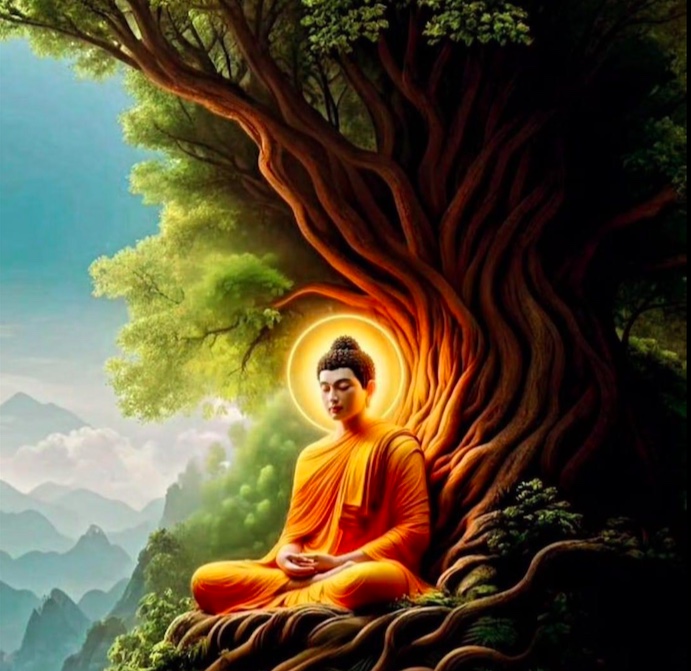
The Sanskrit word “Buddha” means “the Awakened One.” Enlightenment has three aspects: awakening oneself, awakening others, and perfecting both understanding and conduct.
To awaken oneself is to realize that all experiences of good and evil, joy and suffering, arise from cause and effect. Once a person truly understands this, delusion fades, the four attachments dissolve, and one becomes enlightened.
To awaken others means recognizing that all living beings — whether born from the womb, from eggs, from moisture, or by transformation — all possess Buddha nature. They are called “sentient beings” only because they are deluded and unaware. We should therefore cherish and respect ourselves, and in keeping with the Buddha’s great vow of compassion and universal salvation, share these truths with others, guiding them out of the sea of suffering.
As stated in the Śūraṅgama Sūtra: “Regard all men as your fathers and all women as your mothers.” If we cultivate such deep reverence and love, especially for widows, orphans, and those who are lonely or destitute, and show them kindness and compassion through giving and aid, we can realize true equality and the ideal of great harmony.
To perfect both understanding and conduct means to live according to the Buddha’s teachings and precepts until one’s virtue and merit are complete. After the Buddha’s passing, he left behind the Three Baskets of Scriptures — Sutra, Vinaya, and Abhidharma — as our priceless raft to cross the sea of suffering. All the rules and precepts should be faithfully practiced. When one fulfills them completely, that is the perfection of wisdom and conduct.
Thus, the Buddha is the awakened one, while sentient beings are the deluded. The distinction between delusion and enlightenment marks the boundary between beings and Buddhas. To turn away from delusion and return to truth — that is awakening, and that is Buddhahood.
To further illustrate the law of karma, there is a story from one of Shakyamuni Buddha’s past lives.
Long ago, in the city of Rajagaha, there was a fishing village with a large pond. One year, a great drought struck, and the pond began to dry up. The villagers caught and ate almost all the fish, until only one giant fish remained, which was finally killed and eaten. Only one eight-year-old boy refused to eat the fish; he simply watched and laughed.
In his later life as the Buddha, King Prasenajit of Kosala, a devoted follower of the Buddha, married a princess of the Shakya clan, and they had a son named King Virudhaka. After ascending the throne, Virudhaka led his army to attack the Shakya capital of Kapilavastu and slaughtered all its inhabitants.
During that time, the Buddha suffered a severe headache for three days. His disciples begged him to use his powers to save the Shakya people, but he refused. Even when Maudgalyayana repeatedly pleaded, the Buddha said no. Maudgalyayana tried to rescue some survivors with his alms bowl, but when he put it down, all he found was a pool of blood.
When the disciples asked why, the Buddha revealed the cause: in a past life, during a great drought in Rajagaha, the villagers had killed and eaten the fish in that pond. The giant fish was reborn as King Virudhaka, and the villagers were reborn as the Shakyas who were killed. The young boy who merely watched and laughed was reborn as Shakyamuni Buddha himself. Because this karma had matured, the outcome was unchangeable.
The Buddha fully understood this karmic connection and taught it to his disciples as a warning. Chan Master Yuan Yun wrote in verse:
“For hundreds of years, the soup in your bowl Is filled with deep hatred, hard to dissolve. If you wish to know why wars arise, Listen to the cries from the butcher’s gate at midnight.”
Reflect on this story and recite the verse, and you will awaken to the true causes of war and violence — and learn to guard your conduct with mindfulness.
If we wish to transform the world and move toward true harmony, everything must begin with our hearts. Students should study diligently, yet never forget the greater mission of saving the world. And the first step to saving the world is saving the heart — correcting one’s own wrong thoughts and firmly believing in the law of cause and effect, avoiding all evil paths.
By cultivating sincerity, righteousness, self-discipline, and harmony within the family, one can extend peace to the nation and the world. If all the people of every country sincerely believe in karma and practice the Eight Virtues and Ten Precepts, then oppression, violence, and wars will cease to arise. True peace, equality, and the Pure Land of Great Harmony will appear, free from the Five Defilements and all suffering.
For the original Chinese speech, please click here. This English translation is by Linda Chang and is provided for reference only.
Hidden in the quiet county of Yixian in northern China, Fengguo Temple has stood for over a thousand years as a living testament to ancient Chinese wisdom and spiritual devotion. Its magnificent Mahavira Hall, the largest single-story wooden structure of its time, houses seven colossal clay Buddhas that have miraculously survived the centuries. This temple is not only an architectural marvel but also a sacred symbol of harmony, resilience, and faith that continues to inspire all who visit.
A Thousand Years of Faith and Architecture
Beyond the Shanhai Pass, in the northern part of Jinzhou City, Liaoning Province, stands the quiet county of Yixian, home to one of China’s most magnificent ancient temples — Fengguo Temple. This remarkable site, founded over a millennium ago, is not only a masterpiece of Liao Dynasty Buddhist architecture but also a living testament to the extraordinary ingenuity of ancient Chinese builders and the enduring power of faith.
In 2020, Fengguo Temple celebrated its thousandth anniversary. Through a thousand years of wind, snow, wars, and earthquakes, its grand Mahavira Hall still stands tall — a miracle in both architecture and spirituality.
The Majestic Great Hall
The heart of Fengguo Temple is its Mahavira Hall (Great Buddha Hall), one of the Eight Great Structures of the Liao Dynasty. Built in 1020 CE, it measures 49.5 meters wide, 26.6 meters deep, and 19.9 meters high, covering an area of 1,317 square meters. Standing on a 3.2-meter-high platform, the hall is the largest single-story wooden structure of ancient China — magnificent, solemn, and breathtaking.
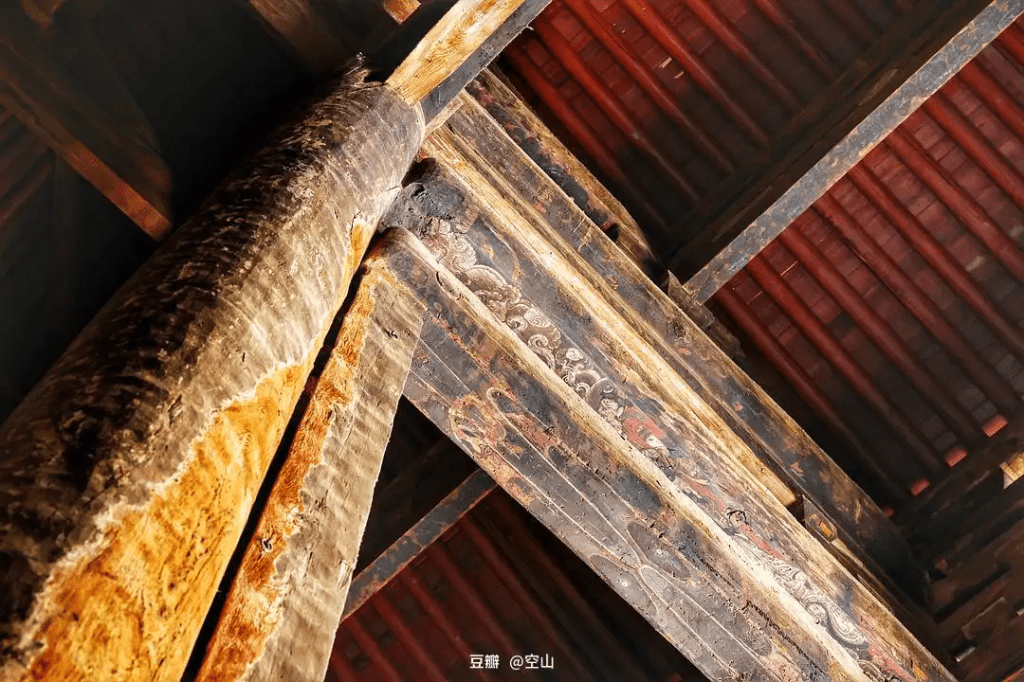
Ingeniously designed, the hall uses a “reduced-column” method to maximize interior space while maintaining perfect stability. Ancient builders applied advanced techniques known as “side-foot” and “rising beam”, ensuring the building’s balance and graceful proportions. The massive bracket sets under the eaves are bold yet refined, exuding strength and elegance.
Thanks to its precise structural mechanics, the Great Hall has remained perfectly upright for a thousand years, without any sign of warping or tilting — an unparalleled achievement in the history of wooden architecture.
The Seven Buddhas: Eternal Clay Sculptures
Inside the Great Hall, seven colossal clay Buddha statues, each about nine meters tall, sit side by side upon a brick platform. From east to west, they are: Kashyapa Buddha, Krakucchanda Buddha, Sikhin Buddha, Vipashyin Buddha, Visvabhu Buddha, Kanakamuni Buddha, and Shakyamuni Buddha.
These are the “Seven Buddhas of the Past” mentioned in Buddhist scriptures, symbolizing the eternal cycle of enlightenment in our world. Each Buddha exudes solemn dignity, with serene expressions and graceful postures, reflecting the Liao Dynasty’s continuation of Tang-style Buddhist artistry. Two bodhisattvas stand beside each Buddha, adding vitality and compassion to this sacred tableau.
This magnificent ensemble is the oldest and largest group of colored clay Buddha statues in the world. Despite being made of fragile clay, they have miraculously survived for over a thousand years, their colors still soft and luminous. This endurance is nothing short of a miracle — a union of artistic mastery and the blessings of faith.
The Legend of the Buddha Catching a Shell
During the Liaoshen Campaign in the late 1940s, Yixian became a battlefield. Amid the chaos, a shell pierced through the roof of the Great Hall and fell directly into the right hand of the Shakyamuni Buddha statue. Miraculously, the shell did not explode.
Locals still tell this story as “The Buddha Caught the Shell with His Hand.” Whether fact or legend, it adds an aura of mystery and divine protection to the temple’s long history — as if the Buddhas themselves were silently safeguarding their sacred home.
The Flying Devas of Liao
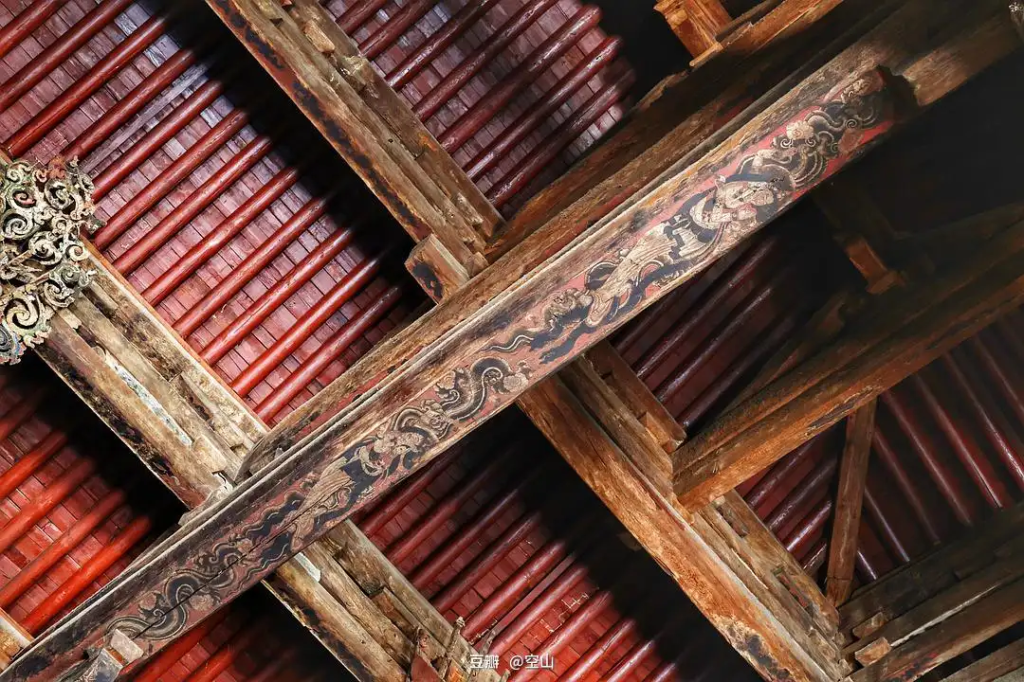
The beams and rafters inside the Great Hall are adorned with over 4,000 square meters of original Liao Dynasty murals. Among them, the heavenly maidens — the Flying Devas — are the most enchanting. With radiant faces and flowing ribbons, they drift gracefully through clouds, offering flowers and fruits to the Seven Buddhas below.
Their movement contrasts beautifully with the Buddhas’ stillness, creating a breathtaking scene of divine harmony and devotion. The surrounding walls also preserve Yuan and Ming dynasty murals depicting ten Buddhas, eight Bodhisattvas, and the Eleven-Faced Avalokiteshvara, adding even more layers of spiritual and artistic richness to this timeless sanctuary.
A Thousand Years of Wonder
Standing before this majestic hall — a wooden structure that has endured a millennium — and gazing upon the clay Buddhas whose serene faces have survived a thousand winters, one cannot help but wonder:
How can a wooden palace withstand ten centuries of storms and wars? How can clay sculptures remain whole and radiant after a thousand years?
Is it the wisdom of the ancients? The strength of art? Or the blessing of the Dharma itself?
Perhaps the answer lies within every beam, every brushstroke, and every tranquil smile of the Buddhas.
May the Buddhas and Bodhisattvas bless all beings with peace, compassion, and happiness. Namo Amitabha.
Bamboo of Noble Integrity By Professor Yuhua Shouzhi Wang
Bamboo, as a plant with profound cultural significance, carries rich and diverse symbolism. It represents resilience, noble character, vitality, humility, modesty, harmony, and unity. With its graceful posture and vibrant green appearance, bamboo evokes a sense of freshness and refinement. Though its exterior is simple and unadorned, it embodies a noble inner quality. This unique temperament has made bamboo a symbol of integrity and uprightness. In ancient times, it often served as a metaphor in the writings of scholars and poets for individuals of high moral character and self-discipline.
For the Chinese, admiration for bamboo has endured throughout history. Countless poets and literati have celebrated its virtues, grouping it alongside plum blossoms, orchids, and chrysanthemums as one of the “Four Gentlemen,” embodying the character and aesthetic spirit of the Chinese people. Bamboo’s simplicity belies its profound cultural significance. In traditional Chinese culture, it is a symbol of auspiciousness and virtue, carrying layers of meaning that resonate deeply with the human spirit.
Professor Wang’s Chinese paintings of bamboo are a testament to her extraordinary ability to bring this cultural icon to life. Each stroke captures the essence of bamboo’s resilience and unyielding spirit while emphasizing its humility and integrity. Her works not only celebrate the elegant charm of bamboo but also evoke its vibrant vitality and enduring strength.
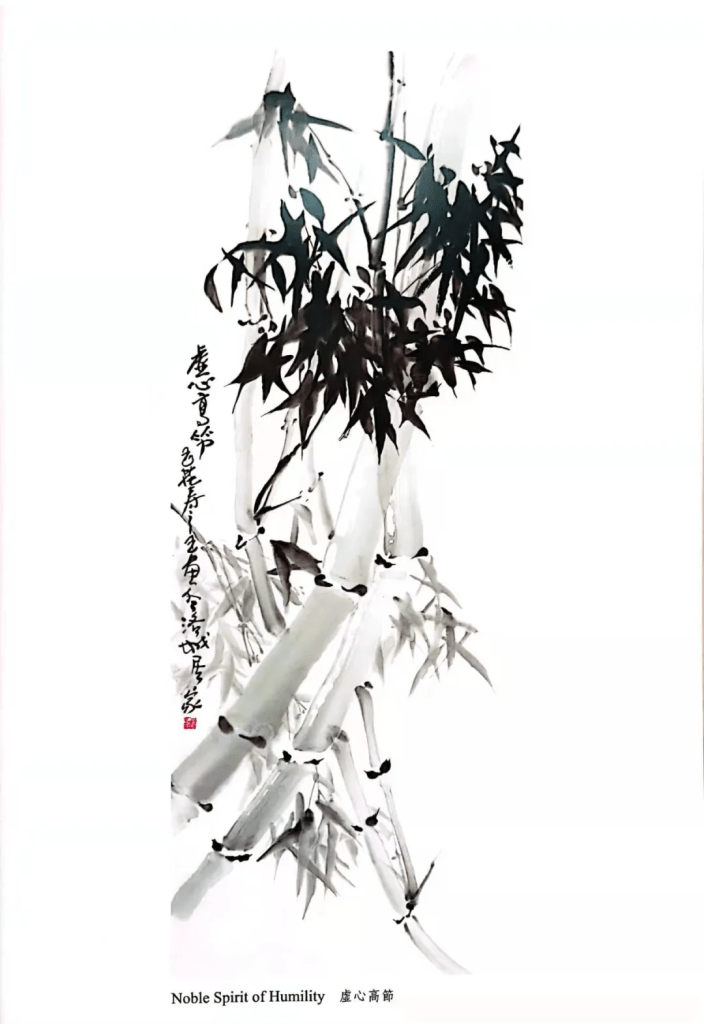
Professor Wang’s Artwork “Noble Spirit of Humility”
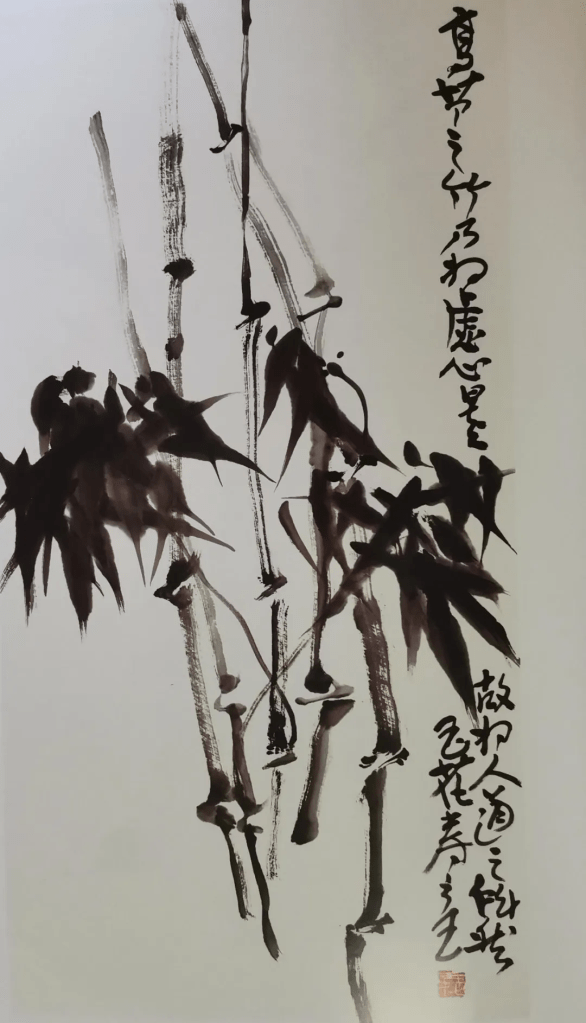
The artwork “Noble Spirit of Humility“ depicts a cluster of bamboo deep within a dense forest. Two tall and robust bamboo stalks stand prominently in the foreground, their lush branches and leaves rendered in bold ink. Behind them, a few smaller bamboo stalks, delicately painted in lighter ink, appear to lean on the larger ones, as if embraced by Mother Earth. Together, they form a unified group, advancing and retreating in harmony.
Look closely, and you’ll see their branches intertwine amidst the clouds, and their roots tightly clasp together underground. Neither torrential rain nor fierce winds can break them down. The bamboo’s unyielding resilience is vividly and profoundly brought to life.
Dr. Yuhua Shouzhi Wang was recognized and chronicled in the United States Congressional Record as “a great artist and sculptor,” and “treasure of the world.” In 2013, President George Christophides of the World Federation of UNESCO Clubs, Centers, and Associations (WFUCA) conferred the title “2013WFUCA” to one of her artworks.
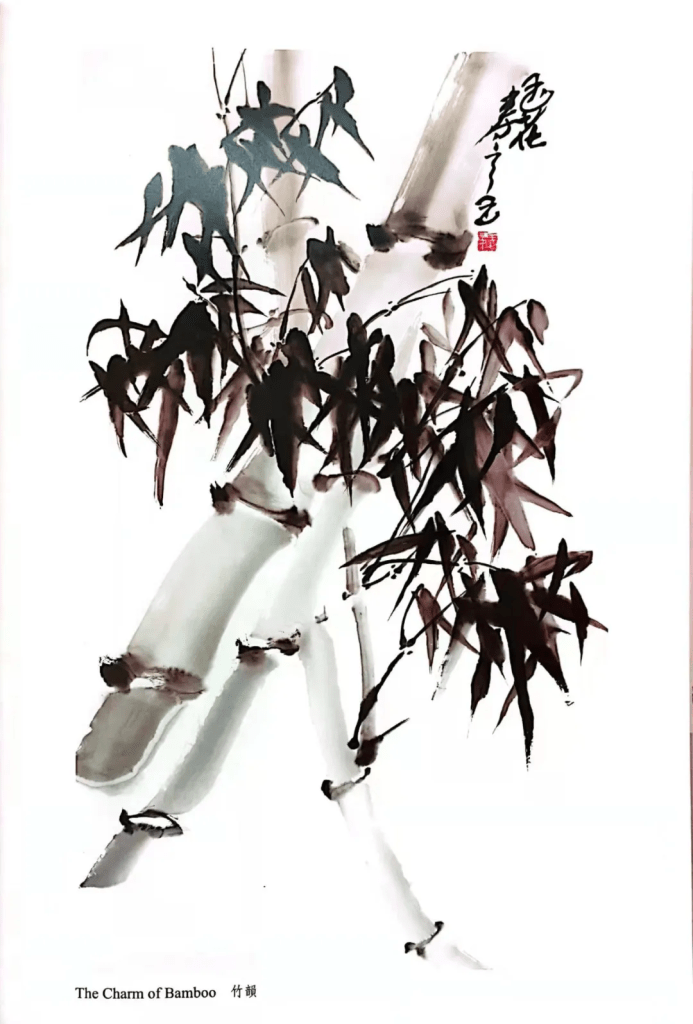
The artwork “The Charm of Bamboo” conveys the fresh and elegant essence of bamboo, exuding a gentle and harmonious beauty. It seems to remind us that in life and work, we should not only take responsibility but also foster an atmosphere of harmony and mutual respect. The use of varying ink tones, alternating between light and dark, strikes a balance of simplicity and ingenuity, greatly enhancing the dynamic energy of the piece.
Dr. Yuhua Shouzhi Wang’s bamboo paintings are truly exceptional. Through her art, she vividly conveys bamboo’s noble qualities, leaving viewers with a deep appreciation for this remarkable plant and its timeless symbolism. Her work serves as a bridge between nature and art, reminding us of the profound lessons we can draw from the natural world.
Every year in March and April, the most beautiful season arrives in Yili, Xinjiang!
This is a legacy from the fifteenth and sixteenth Centuries,
The largest primitive apricot forest,
Concentrated on the north bank of the GongJiShi river,
Covering an area of over 30,000 mu.
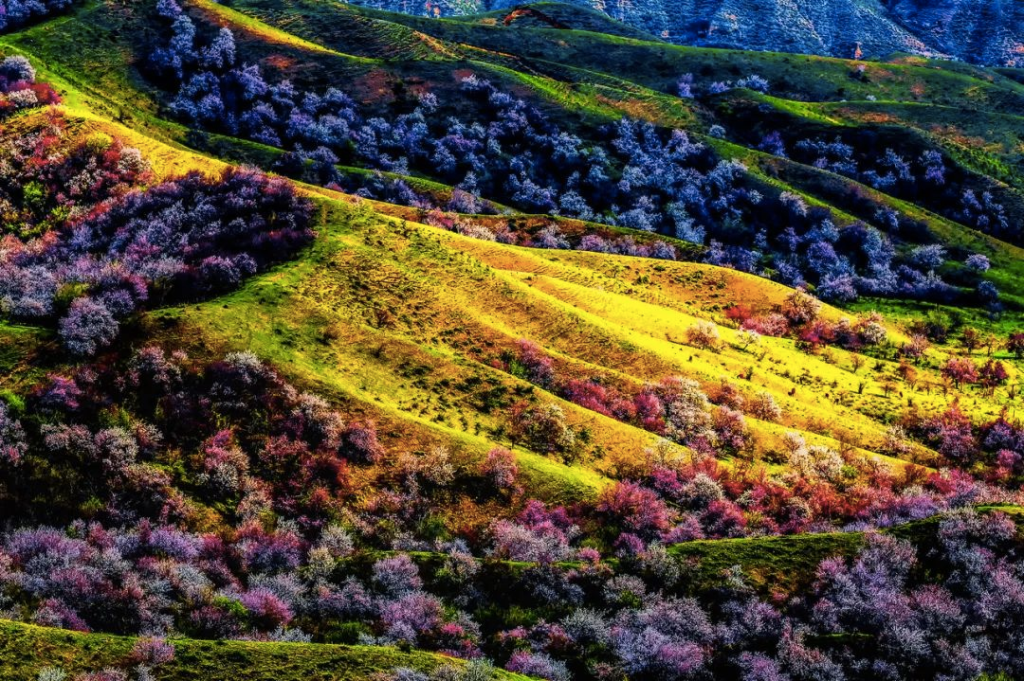
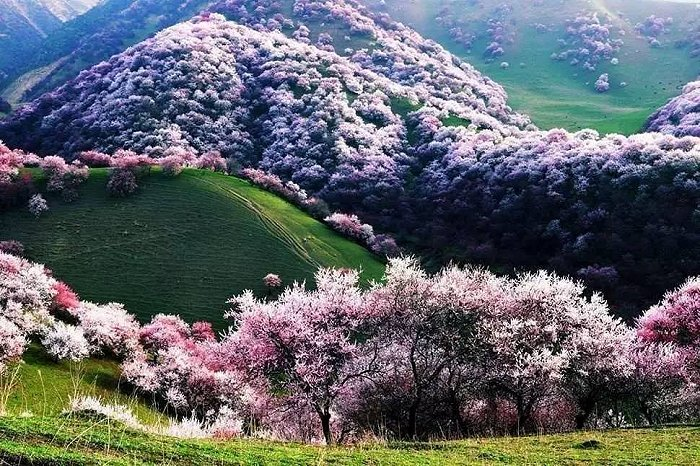
The beauty of Yili’s apricot blossom gully is not the deliberate beauty of artificial planting and processing, but the natural beauty of “natural and unadorned”. On the rolling hillsides covered with layers of grass, there are apricot blossom forests in purple, red, and pink, magnificent and dreamlike, which makes people feel excited at first sight. Mentioning Yili, the vast image of the grassland with the words “the sky is vast, the wilderness is vast, and the wind blows the grass low to see the cattle and sheep” comes to mind. Little do people know, here also has the beautiful scenery of “apricot blossoms fill the gully, and the spring scenery intoxicates people”. The apricot blossoms covering the mountains and plains make people indulge in the sea of flowers, lingering and forgetting to return. Most of the visitors who come here all year round are photographers, painters, poets, and so on, who come for fame.
Yili has picturesque grassland, sacred snow-capped mountains, and a splendid sea of flowers… Any one of them is enough to conquer you!
Apricot Blossom Valley, naturally formed,
Becomes a paradise every spring.
The air is filled with the fragrance of apricot blossoms,
The valley is adorned in the robe of spring.
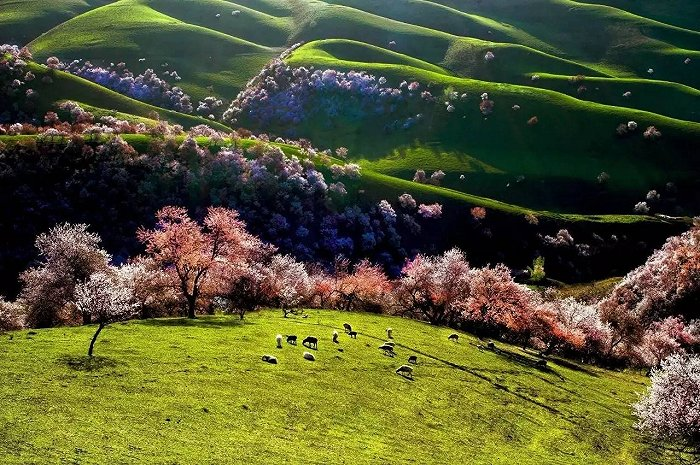
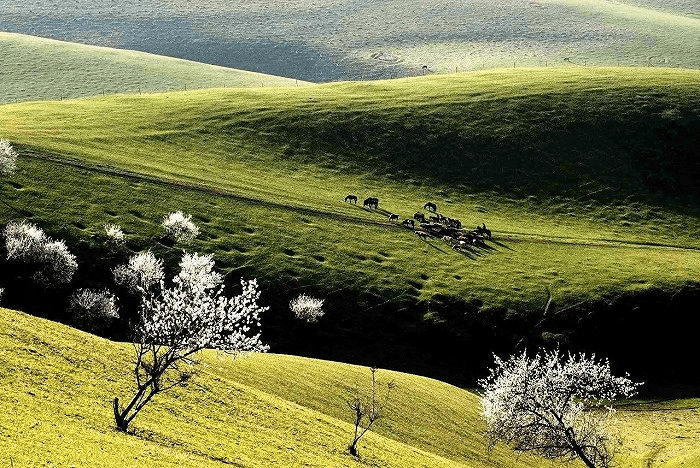
On both sides of the Yili River Valley in the foothills of the Tianshan Mountains, various ancient wild fruit trees are distributed. As April arrives and the weather warms up, wild apricots are the first to sense the temperature change, eagerly adorning their branches with blossoms, heralding the beginning of the entire apricot blossom season in the Yili Valley. In the northern part of Tuge Township in Xinyuan County, the scene of apricot blossoms in full bloom is the most spectacular in the Yili River Valley. The apricot blossoms surge like a torrential tide, climbing up the hillsides and deep into the valleys. The fresh green of the grasslands, coupled with the delicate pink of the apricot blossoms, adorned with the pastoral huts and leisurely cattle and sheep, depicts spring in an exaggerated yet perfect manner.
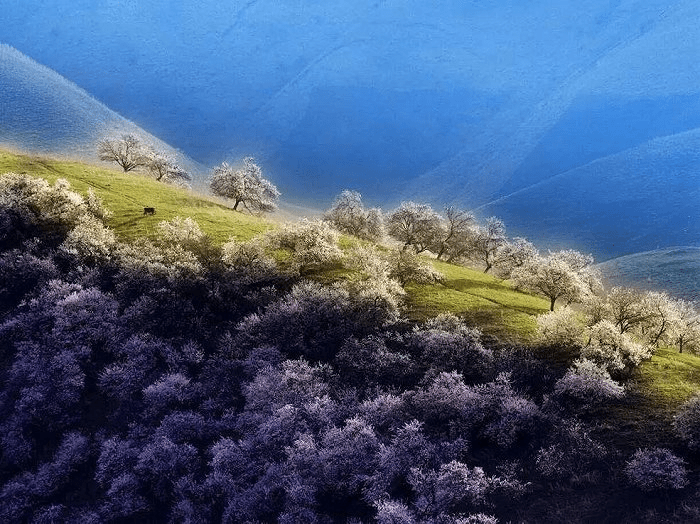
Entering April marks the most beautiful and romantic season in the Yili River Valley. The first to bloom are the pink apricot blossoms. In Xinyuan County, April is full of spring vitality, with willows budding and hillsides covered in green carpets. Most striking are the rolling hillsides on the north bank of the Gongjisi River, where wild apricot blossoms compete to bloom. The flowering wild apricot trees are snow-white or pink, exuding a bright and fresh fragrance that can be smelled several kilometers away.
Thanks to the influence of the humid climate of the Yili Basin and the nourishment from the abundant glacial meltwater from the Tianshan Mountains, the tens of thousands of mu of primitive apricot trees in the Apricot Blossom Valley have grown wild for hundreds of years, flourishing endlessly.
In April, the Yili region experiences frequent spring rains, gentle like silk. Under the rendering of the rain, the Apricot Blossom Valley appears even more like a hidden paradise, fresh and mysterious. Standing on a hillside and looking out, in the undulating valleys, wild apricot trees dot the landscape between the valleys and hillsides. The lush green of the valleys clashes with the purple-red of the apricot blossoms, creating a visually striking scene! The undulating lines of the valleys amidst the vast expanse of sky and earth present a majestic spectacle, with beautiful light and shadows refracted by the sunlight, creating a rare visual feast.
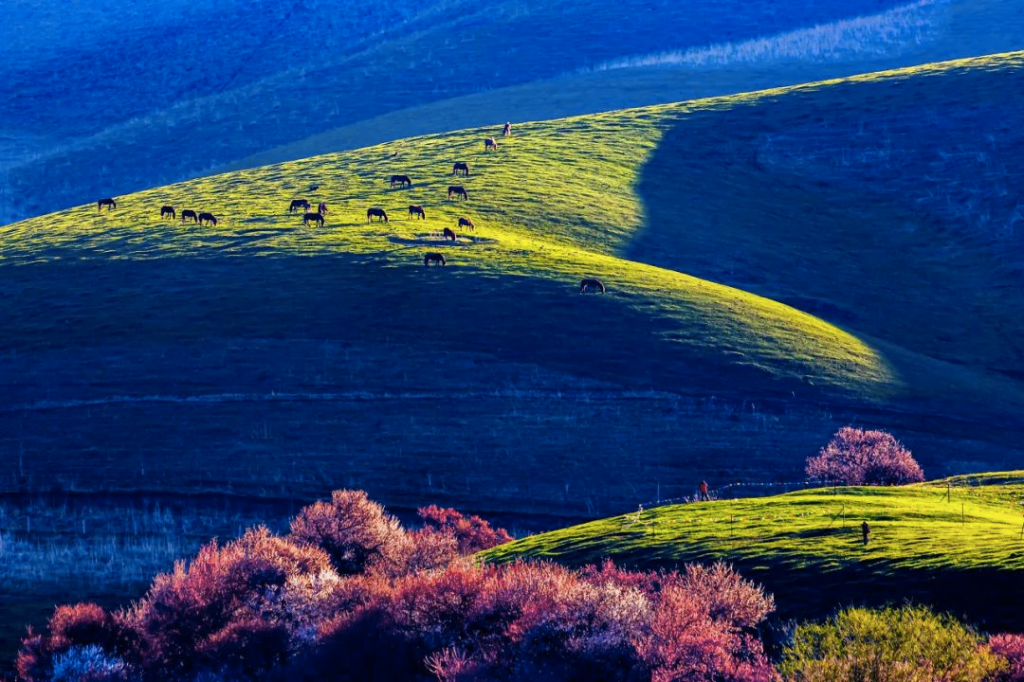
In spring, the Narat Grassland is a subalpine meadow plant area, renowned as a famous pasture since ancient times. The picturesque grassland scenery combines with the local Kazakh folk customs, with valleys, peaks, deep gorges, and forests complementing each other in harmony!













 Peace LiLy