Recently, I had the opportunity to visit the Triton Museum of Art, a cultural gem nestled in the heart of Santa Clara, California. Surrounded by a peaceful park, the museum offers a quiet and welcoming space where visitors can slow down, reflect, and experience the beauty and creativity of contemporary art.
Founded in 1965, the Triton Museum has long been dedicated to showcasing artists connected to California and beyond. What I appreciate most about this museum is its openness—it is free to the public, making art accessible to everyone in the community. Walking through the galleries, one can feel how art becomes a bridge connecting cultures, ideas, and human experiences.
Encountering the Art of Emanuel Harris‑Sintamarian
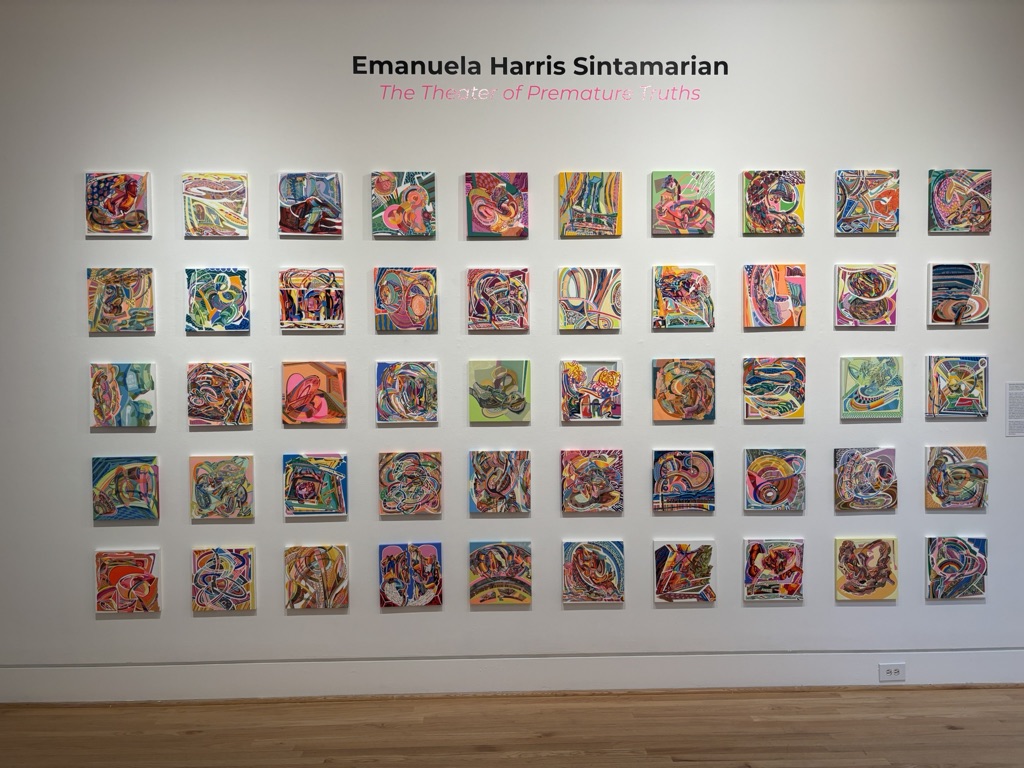
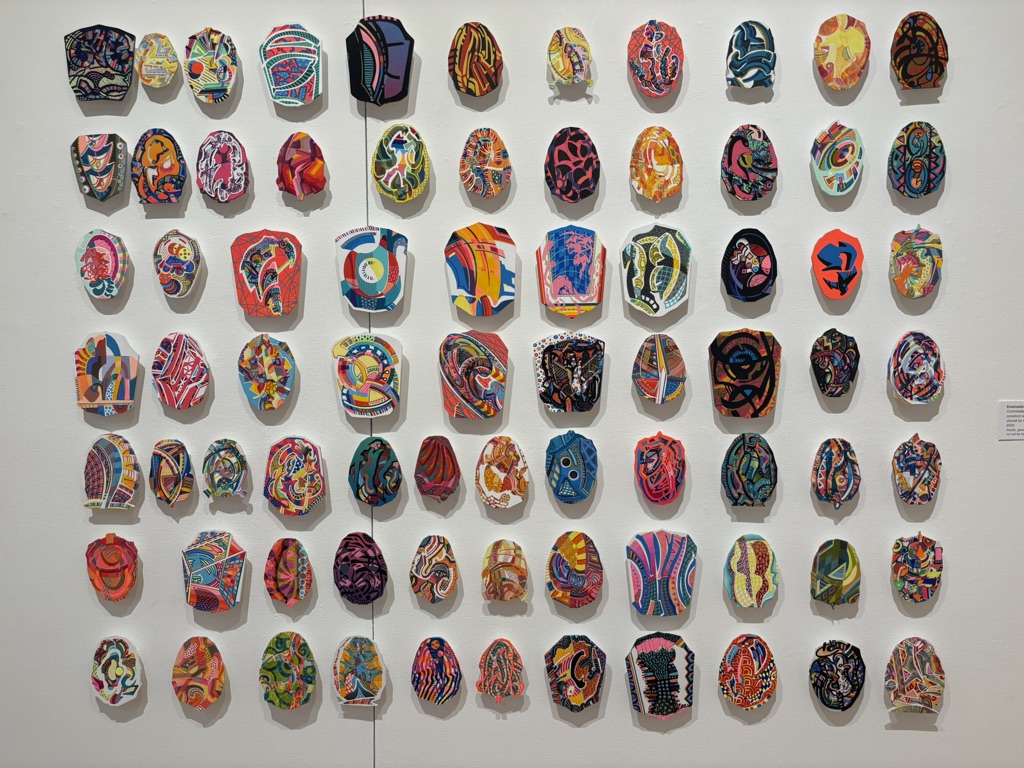
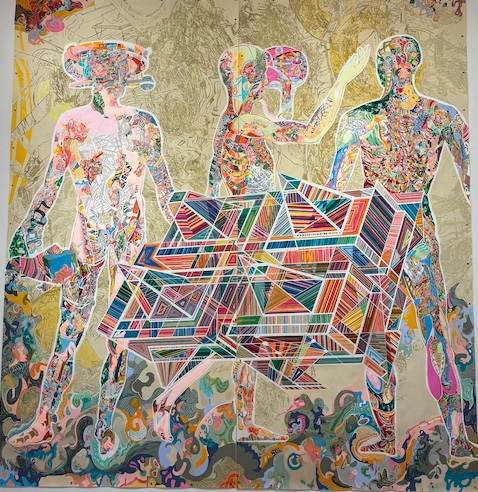
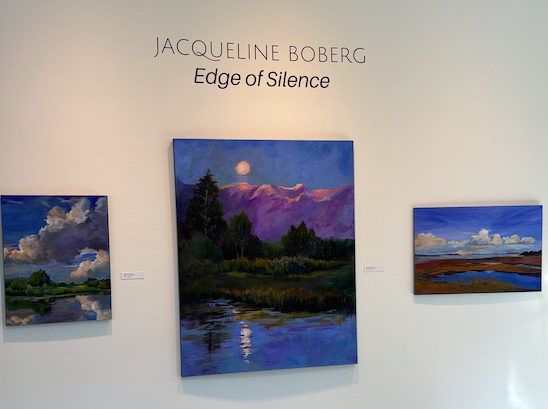
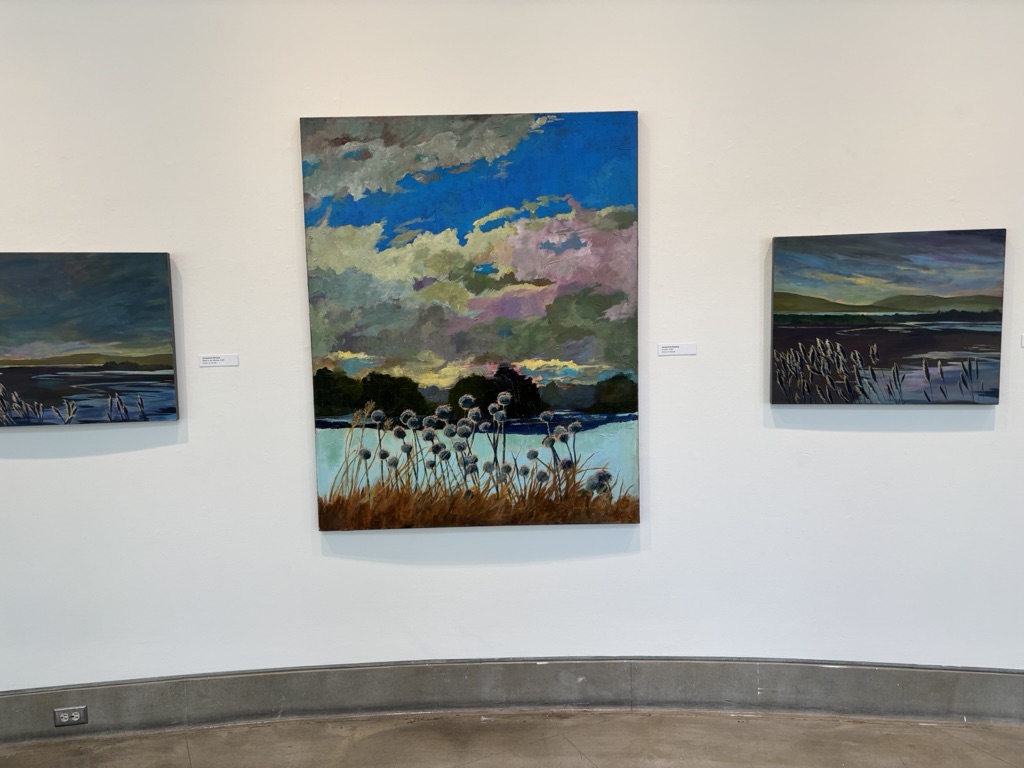
During my visit, one exhibition that particularly captured my attention featured the work of Romanian artist Emanuel Harris‑Sintamarian. His paintings immediately drew me in with their unique textures, layered compositions, and deeply expressive forms.
There is something both mysterious and meditative about his work. The colors and shapes seem to flow organically across the canvas, inviting viewers to pause and explore their own interpretations. Rather than presenting a straightforward image, his art feels like a visual journey—one that encourages contemplation and emotional reflection.
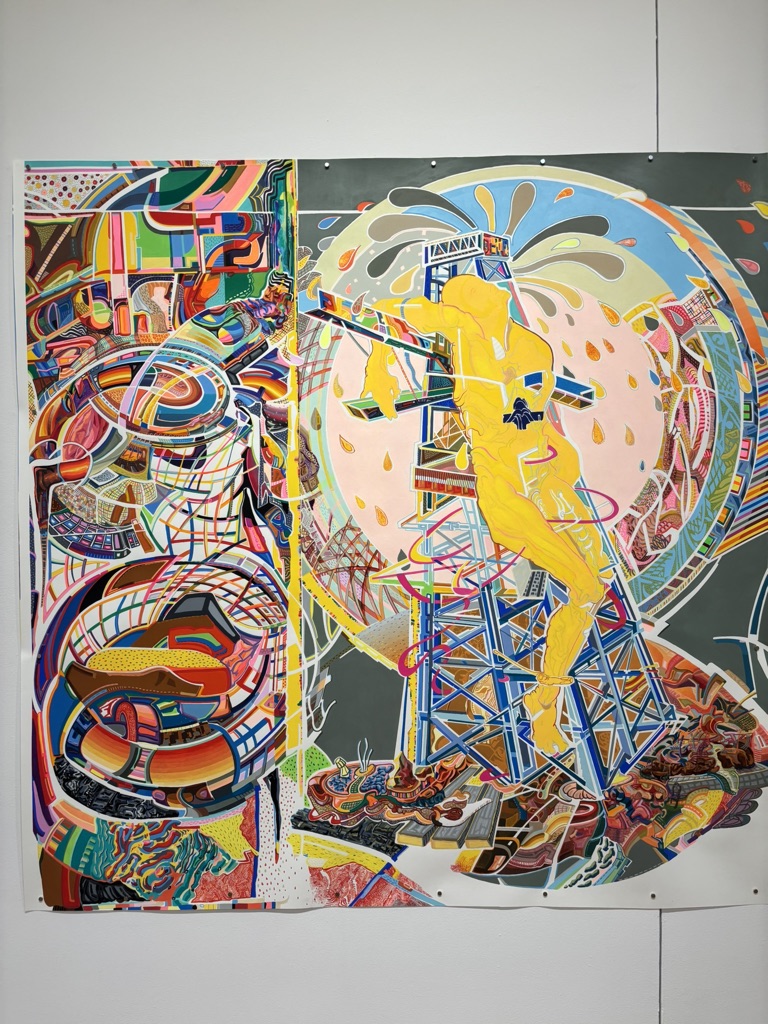
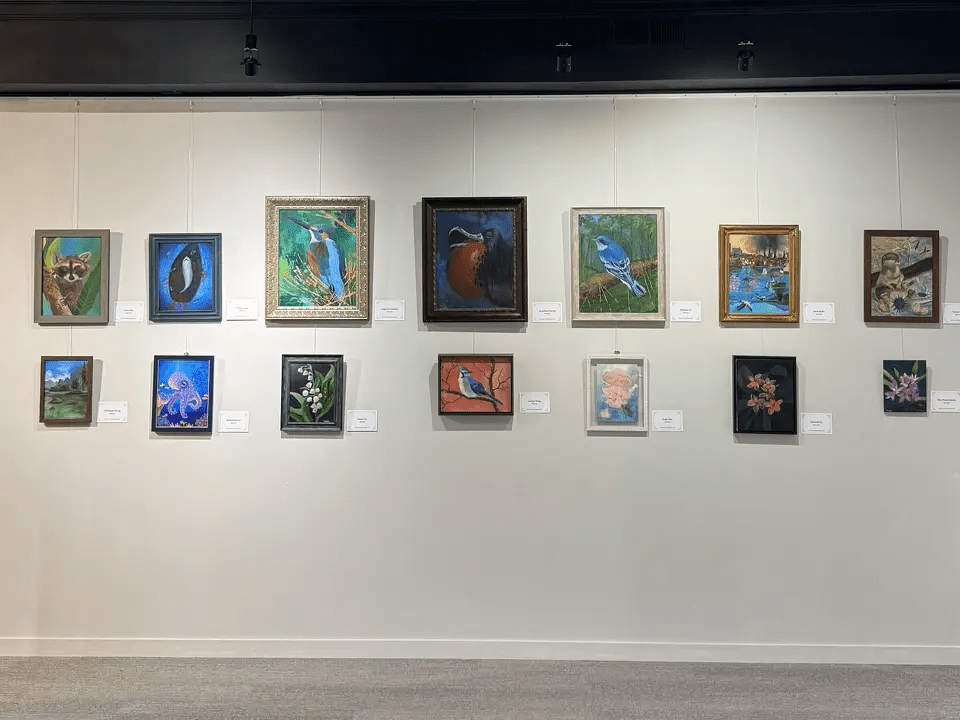
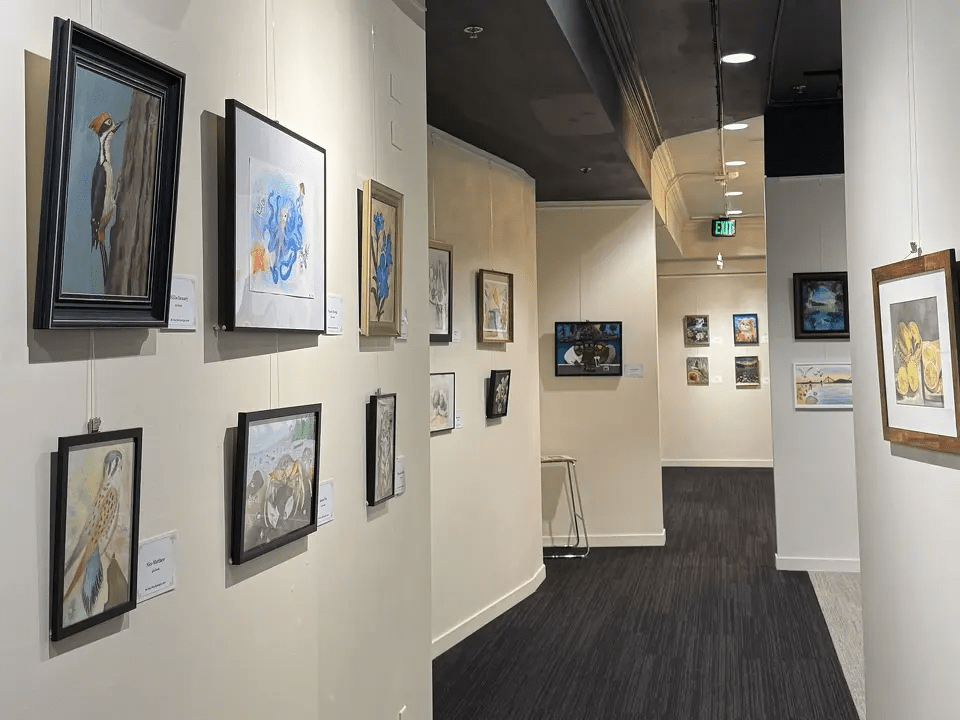
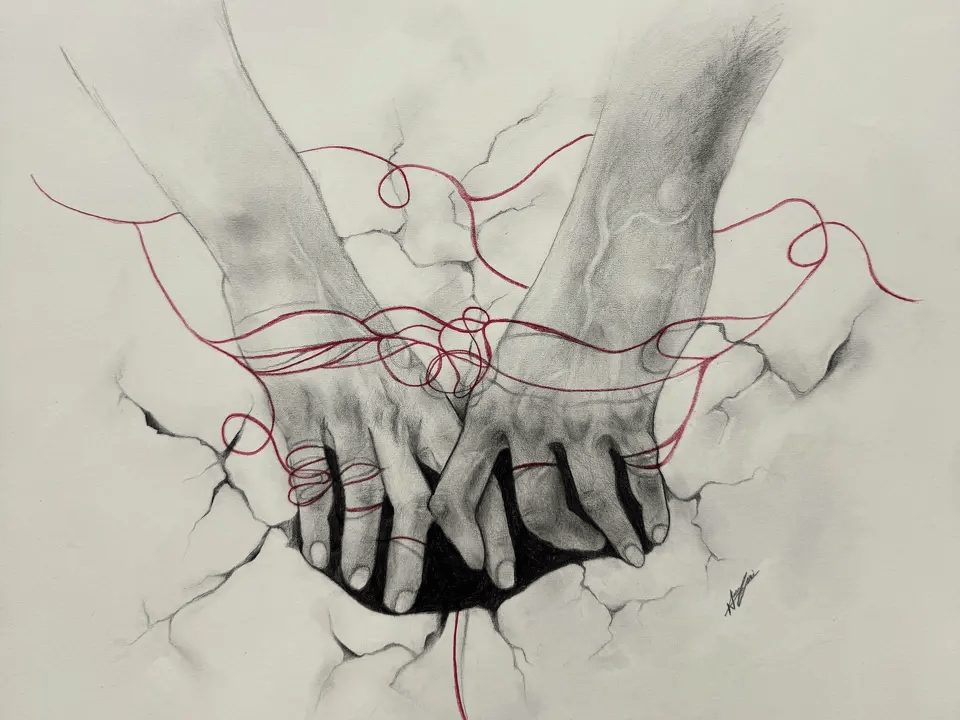
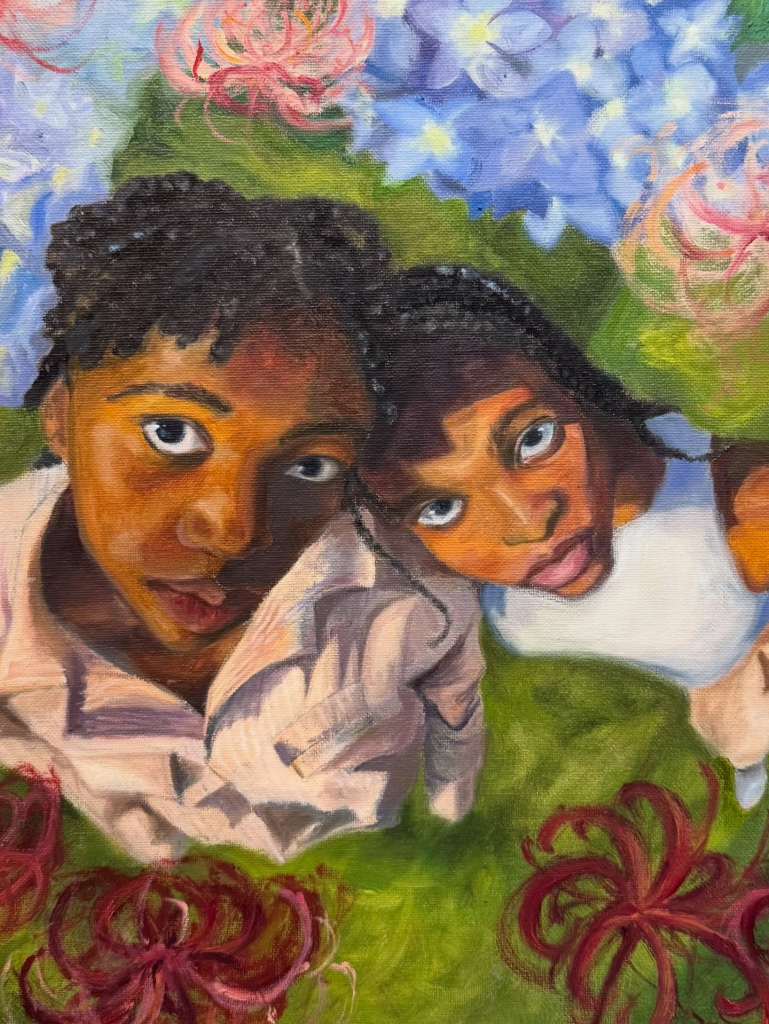
During my visit, I took several photos of the exhibition that I would like to share here. These images capture only a small glimpse of the atmosphere inside the gallery, but they reflect the creativity and thoughtful spirit of the artists on display.
Jesus, Popcorn and other details 2024 Acrylic, gouache on paper In Jesus, Popcorn and Other Details, I bring the sacred into direct contact with systems of spectacle, labor, and consumption. Jesus is not placed above the world, but embedded within it – caught in scaffolding, color, and movement – where belief collides with industry and visual excess. Popcorn becomes both image and metaphor, standing in for abundance, distraction, and the way meaning is consumed, repeated, and ritualized I intentionally built a dense, restless composition that resists hierarchy or stillness, reflecting how faith, entertainment, and production compete for attention in contemporary life. Rather than offering reverence or critique alone, the painting holds these tensions in place, asking the viewer to sit inside the noise and consider where meaning survives.
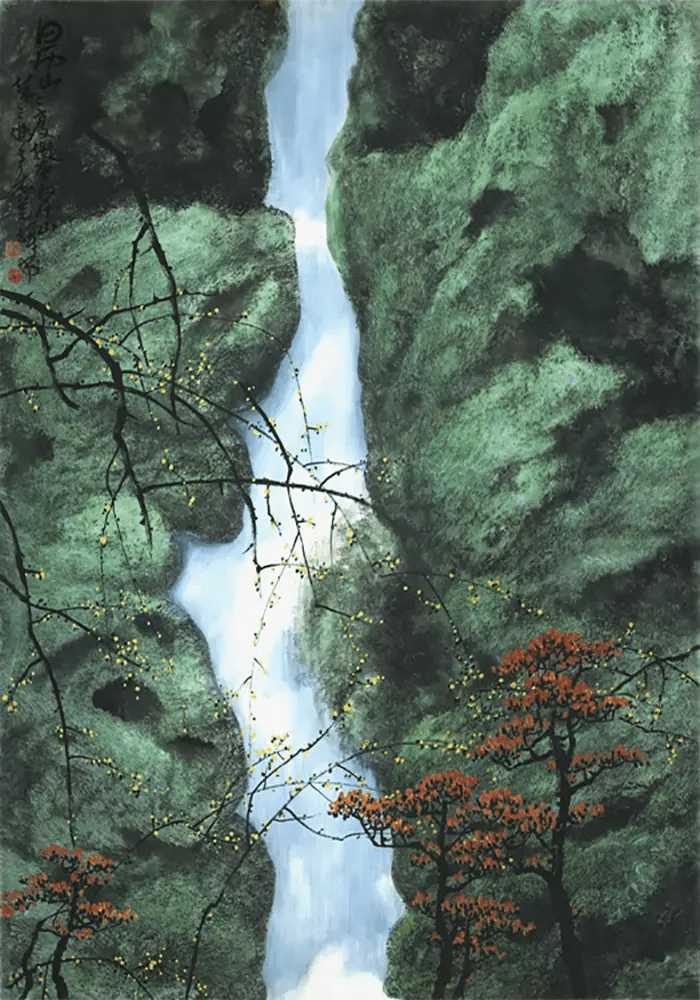
Created in 1993, Xing Garden at Mount Rili stands as a masterful expression of the artist’s profound understanding of nature and brushwork. The painting presents a dramatic world of steep cliffs and cascading water, inviting the viewer into a landscape that feels both monumental and intimate.
Dominated by vibrant greens, the work vividly captures moss and grasses spreading freely across rocky surfaces. These lush tones breathe life into the cliffs, softening their ruggedness while emphasizing the quiet vitality that thrives within seemingly harsh terrain. Nature here is not static; it pulses with energy and renewal.
The painting employs the refined “Miaoxie” (妙写) technique—a style that reveals its true depth through careful observation. At first glance, the composition appears fluid and effortless. Yet upon closer inspection, the brushstrokes intertwine like delicate wires, layered and interwoven with extraordinary precision. These subtle lines create constant movement and variation, generating emotional richness and visual intrigue through their complexity.
One of the most captivating aspects of this work lies in its masterful use of illusory watery ink, where solidity and transparency coexist. Ink seems to flow and dissolve at the same time, offering a boundless sense of depth and atmosphere. Whether viewed from afar or examined up close, the painting reveals a bottomless waterfall, rendered with meticulous detail yet infused with powerful momentum.
What is especially striking is the contrast between refinement and strength. From a distance, the scene appears serene and orderly; yet when the viewer studies the brushwork closely, the strokes reveal unexpected vigor and boldness. Within apparent emptiness, there is substance; within seeming chaos, there is profound order. This balance embodies the highest level of artistic cultivation.
Through free yet disciplined brushwork, the artist transforms a simple natural motif—a waterfall between two cliffs—into a scene of extraordinary aesthetic depth. The power of each stroke carries both physical strength and spiritual presence, allowing the painting to transcend mere representation and enter the realm of lived experience.
Xing Garden at Mount Rili is more than a landscape painting. It is a quiet dialogue between nature and the artist’s inner world, revealing how true mastery lies not in excess, but in the ability to uncover profound beauty within simplicity.
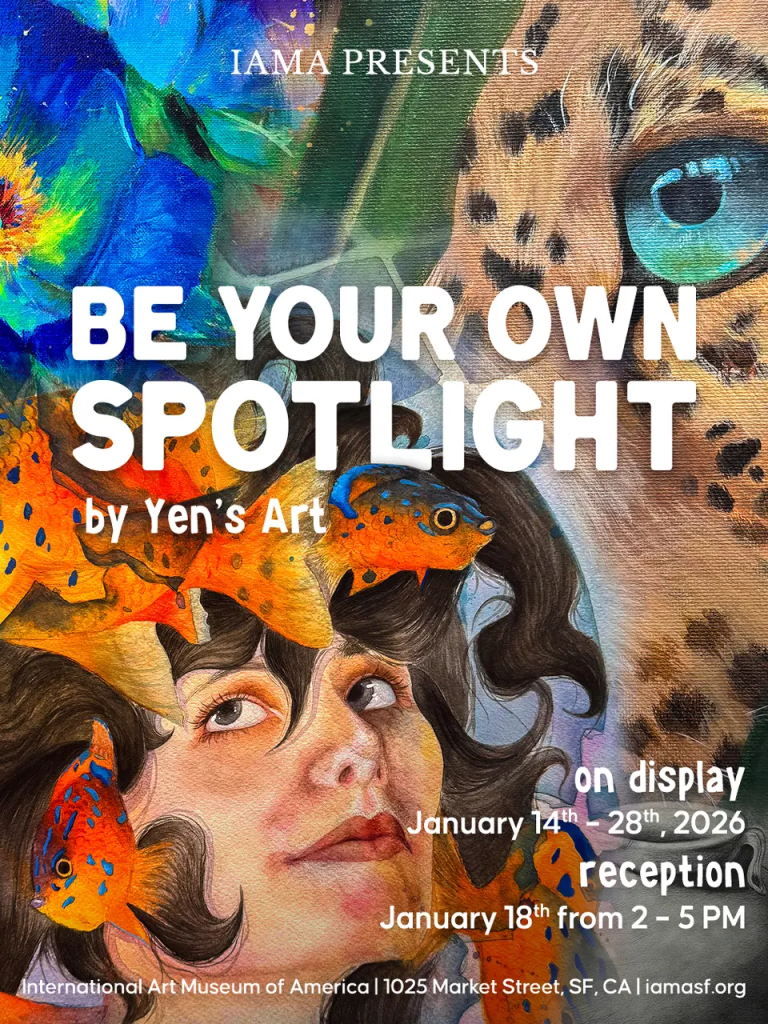
IAMA presents Be Your Own Spotlight by Yen’s Art Studio
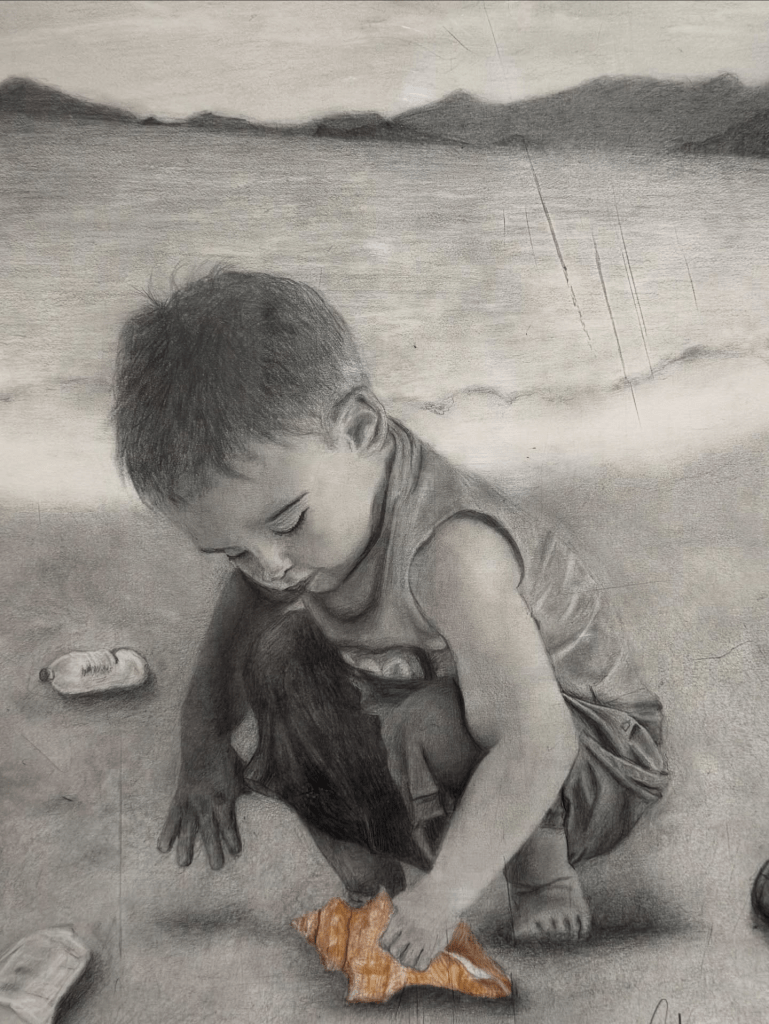
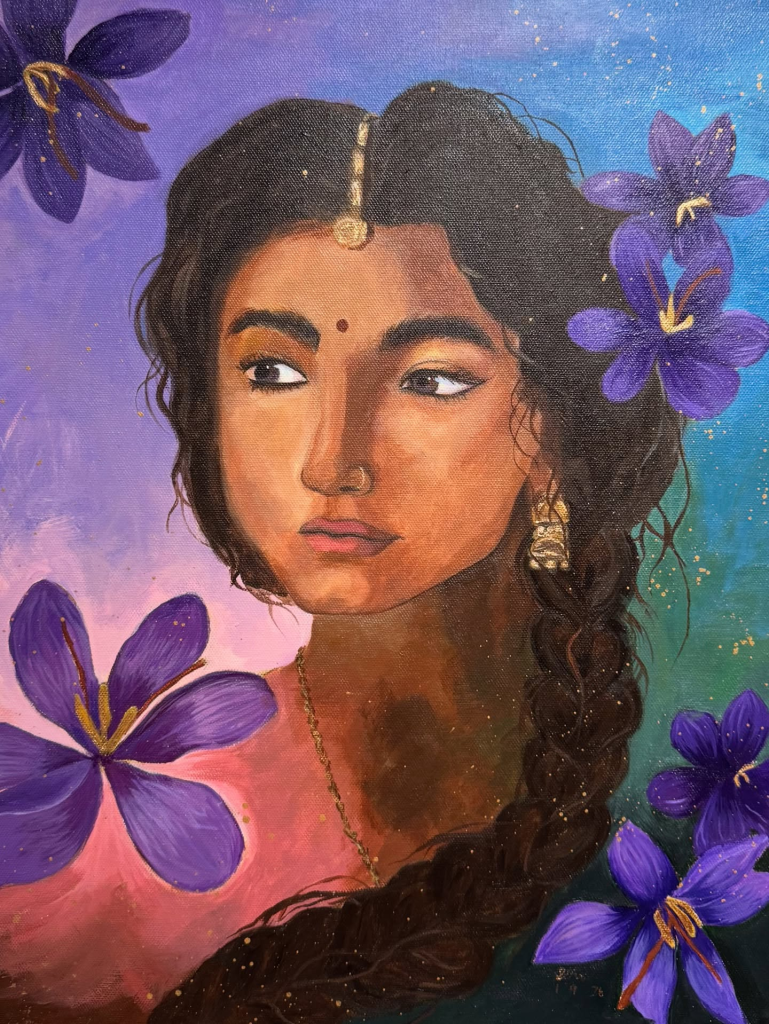
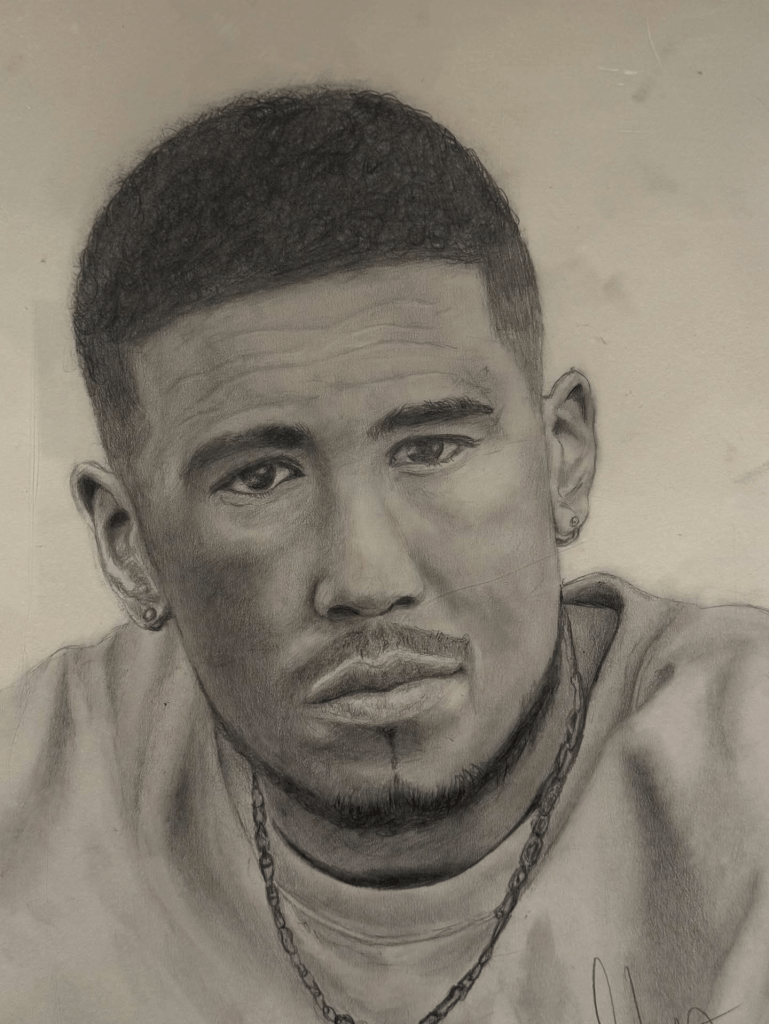
Walking into Be Your Own Spotlight, presented by Yen’s Art Studio, at IAMA (The international Art Museum of America), I didn’t feel like I was entering a typical student art exhibition. Instead, it felt more like stepping into 150 honest conversations—each one visual, brave, and deeply personal.
The exhibition features 150 outstanding works by young students, created across a wide range of mediums—acrylic, watercolor, pencil, and mixed media. But what moved me most was not the variety of techniques; it was the sense that every piece quietly declared: this is who I am right now.
These students are not just learning how to paint or draw. They are learning how to trust their voices, how to take up space, and how to stand behind what they create. Their works reflect growth, self-discovery, and the joy—and sometimes uncertainty—of becoming. Whether you are a parent, an educator, a collector, or simply someone searching for inspiration, this exhibition offers something meaningful to feel, not just something pleasant to see.
As I moved through the gallery, I was delighted by the sheer range of imagination: striking portraits, fantastical worlds, playful animals in sunglasses, thoughtful reflections on global issues, and moments of pure joy. The diversity of themes reminded me of a beautiful truth that Yen’s Art Studio expresses so well: “In the world of art, there are no boundaries of age or race. Children’s artwork can reach—and sometimes surpass—the technical ability and creative understanding typically associated with adults.”
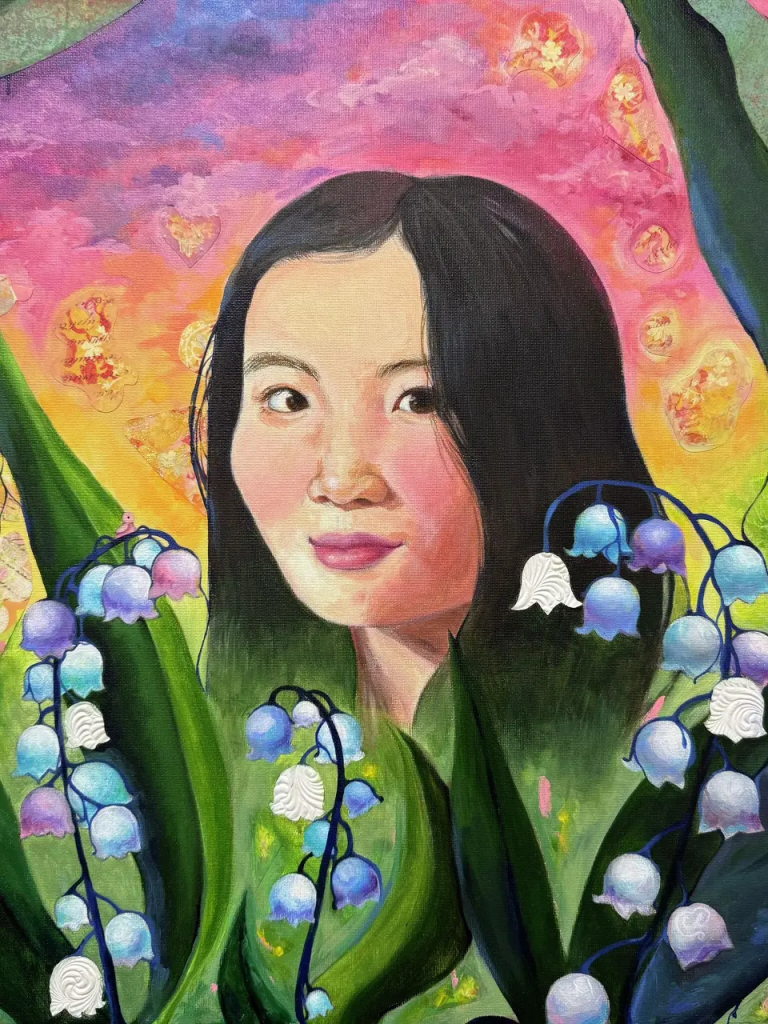
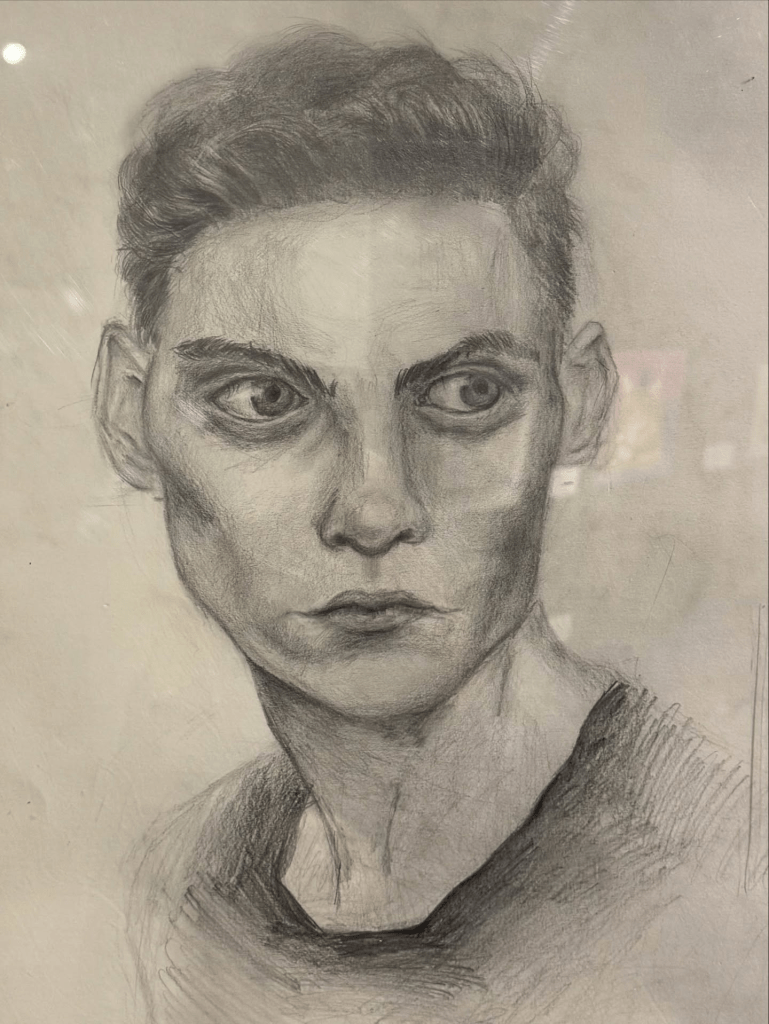
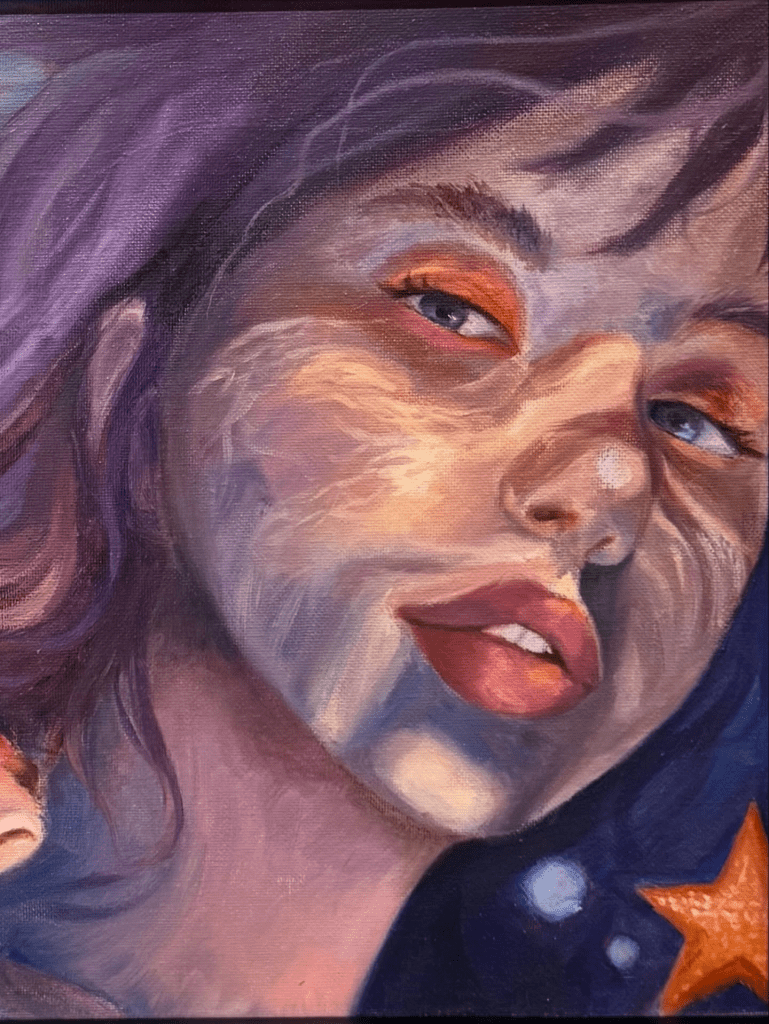
One piece that stayed with me was a self-portrait by 8th-grade student Cynthia Liu. It stood out not only for its technical sensitivity, but for its emotional depth. Cynthia is known for her perfectionist nature, something many of us—artists or not—can relate to. Her work quietly reflects a universal truth: no artwork is ever truly finished. Without a clear endpoint, a piece can be revised endlessly, sometimes at the cost of the original vision.
Self-Portrait by Cynthia Liu, 8th grade Yen’s Art Studio
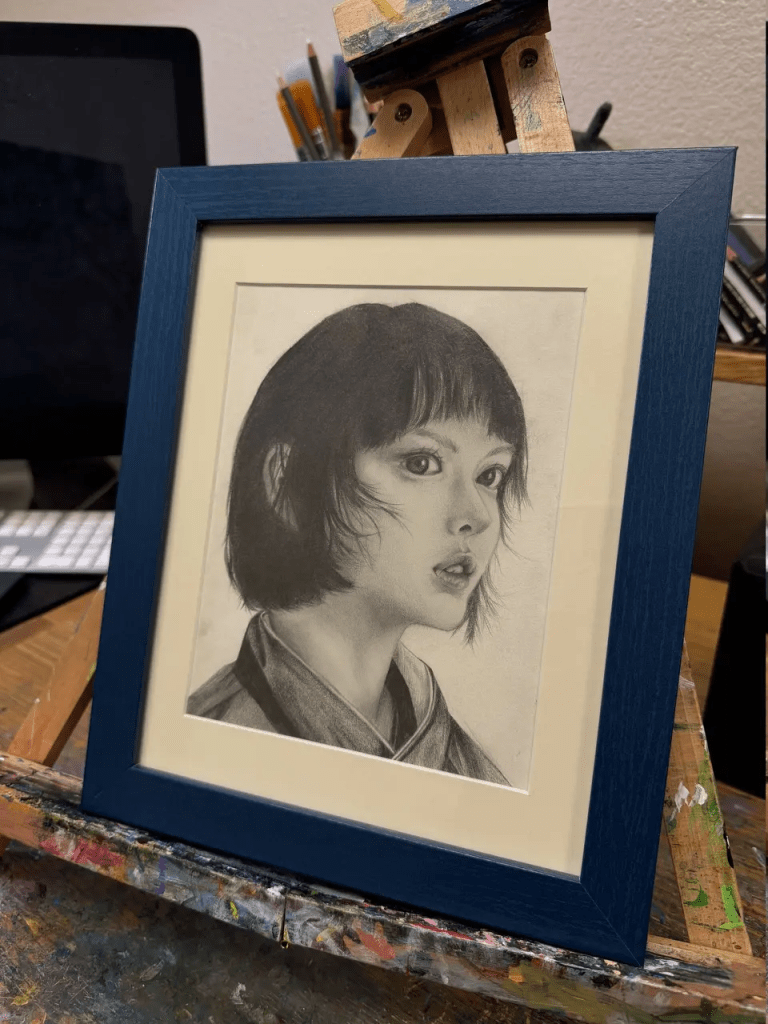
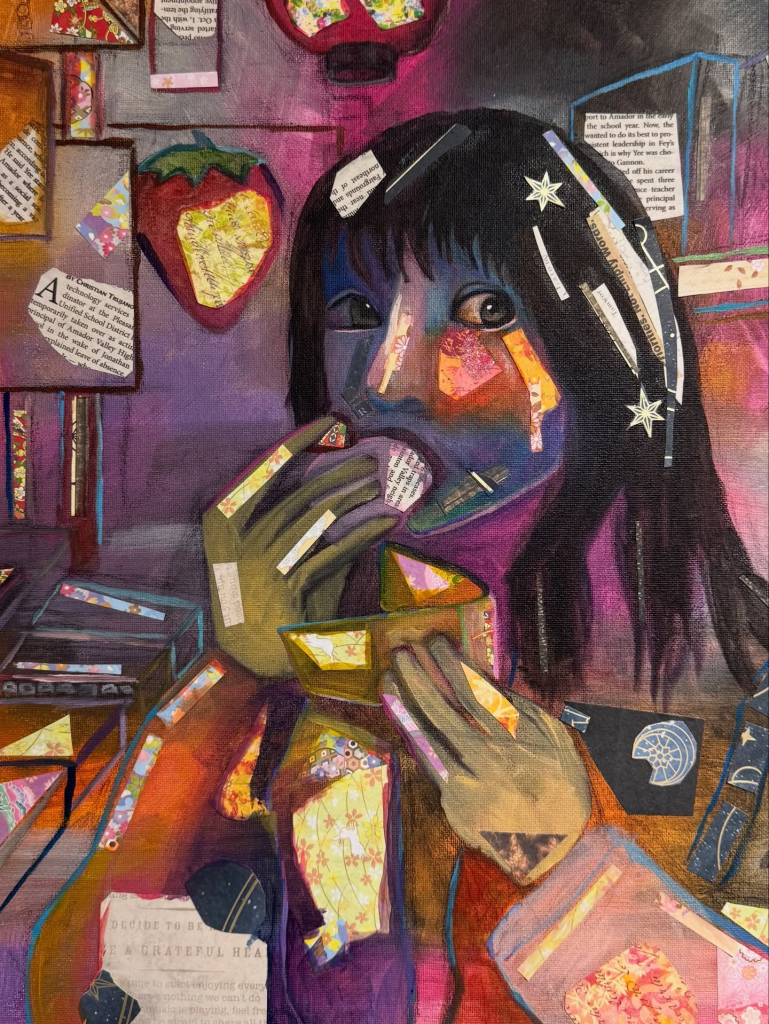
Hanni from Newjeans by Sophie Sun, 9th grade. Yen’s Art Studio
Another story that deeply touched me was Sophie’s. Once a shy student who nearly gave up on art altogether, she found her way back through the creative process at the studio. Through painting, Sophie rediscovered calmness, confidence, and inner strength—one of the most meaningful transformations I learned about in this exhibition. Her journey reflects the studio’s commitment not only to technical excellence, but to nurturing the inner lives of its students.
Lovers by Nova Cui, 9th grade Yen’s Art Studio
Among the more than 150 works, one painting stood out to me for its quiet presence rather than immediate visual impact. Created by Nova, a student dedicated to becoming a professional ballet dancer, the piece carries a sense of discipline, restraint, and inner resolve. Acknowledging the intensity of her dance training, her art education focused less on technical display and more on observation, sensitivity, and emotional understanding.
Her painting reveals genuine emotion and determination, qualities she will undoubtedly carry into her future as a dancer, where movement and art meet as a shared language of expression.
Be Your Own Spotlight is ultimately not just about showcasing talent. It is about honoring courage—especially the quiet kind. It reminds us that every young artist is learning not only how to create, but how to believe in themselves. And as viewers, we are fortunate to witness these moments of bravery, growth, and becoming.
Don’t miss the museum’s permanent exhibition, where world-class artworks offer far more than visual beauty. Here, art becomes a quiet refuge—inviting tranquility, reflection, and a subtle elevation of the spirit. Especially moving are the paintings by H.H. Dorje Chang Buddha III, whose works gently awaken the mind, soothe the heart, and leave the soul deeply inspired long after you depart.
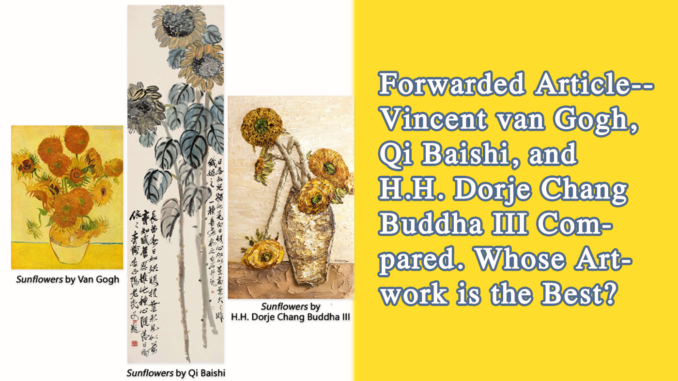
Please see below the answer of whose work is the best amongVincent van Gogh, Qi Baishi, and H.H. Dorje Chang Buddha III
I have spent more than 60 years of my professional life in the field of painting. During the many decades of practice and experiences, I have come to know many famous painters. That is especially the case since I became the Head Consultant for authenticating paintings and calligraphy at the National Museum of China in Beijing. As an appraiser and authentication officer of paintings and calligraphy, the bulk of my work is to verify the authenticity of Eastern and Western paintings. I have reviewed tens of thousands of famous paintings, especially the rare and precious works of the maestro Vincent van Gogh of the Netherlands, and those of the champion of Eastern paintings, Qi Baishi of China.
Both Van Gogh and Qi Baishi were great world-renowned masters in art. One represented the apex of Western art and the other was a master of an extreme class in the field of Eastern paintings. Both artists had drawn from the essence of the classical traditions of their respective cultures. They created new styles of art and new ways of seeing the universe. They broke new grounds and became pioneers of new eras, each becoming a creative guru of his time, developing a distinct style of his own and leading new trends that inspired later generations. Their works reflect the different essences of the Eastern and Western traditions. To what extent can their works influence the artistic civilization of the world? What kind of artistry did they achieve that made them upright monuments in art history and admired by so many people?
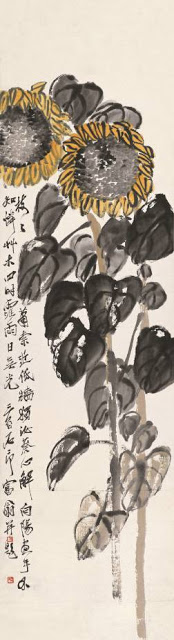
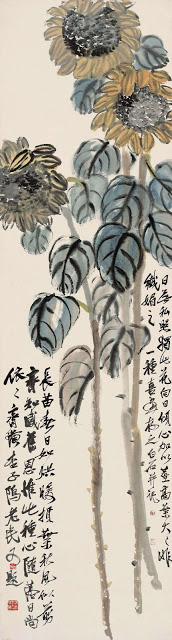
Some art critics compared the works of Van Gogh and Qi Baishi to see which of them reached a higher level of accomplishment. They concluded that both have their own merit, both are undefeated champions in the art and both reached the pinnacle of artistry. Recently, some art critics also brought up the oil painting Sunflowers and the ink-wash painting Sunflowers, both created by H.H. Dorje Chang Buddha III, and gave them rave reviews. They went on to compare the works by Vincent van Gogh and Qi Baishi with the works by H.H. Dorje Chang Buddha III, trying to establish which of the three artists is the champion of the champions. The result of comparing the works by Van Gogh, Qi Baishi and H.H Dorje Chang Buddha III is tremendously inspiring.
Ever since the Renaissance, Western artists had placed emphases on rational analysis and the realist portrayal of forms. They used light, texture and details to present the realistic, three-dimensional perspective. A few centuries later, Van Gogh rejected the monotony of such use of light and shadow and the realistic portrayal of figures. He pioneered the movement of impressionism that suited him well by applying a mix of colorful, brilliant, splendid and vigorous brushstrokes. He became a great master of his time and his name was forever etched onto the monument of Western civilization and art.
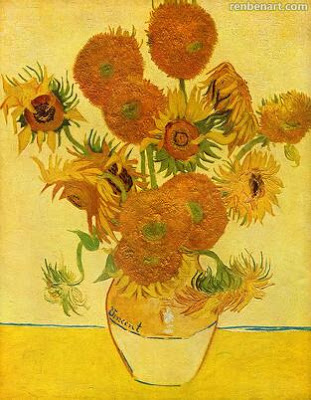
Whenever people think of Van Gogh, they think of his unique character, the sparkles in his eyes that emit lightning, his vigor and his incessant pursuit of inspiration in art without any regard to external hardships. Van Gogh was an artist by birth. He was of exceptional confidence and was somewhat neurotic. Having such traits, he pursued the art that he loved without any reservation or hesitation. He loved his works and regarded everything else with disdain. He preferred to be a loner in the world and did not care to make acquaintance of other painters of his time. His works are full of luminous colors, the brushstrokes are like rising winds and racing clouds in the sky. In his art, he depicted pasture, figures, flowers and other subject matters with brisk colors. Every brushstroke was transformed from his inner emotions. Such emotions were fully and colorfully captured in his Self-Portrait as well as in the transcendental Sunflowers that he painted. These works contain an animated spirit that is deeply moving.
From Van Gogh’s artistic spirit and intent, we can detect that he was profoundly knowledgeable about Chinese ink-wash paintings. Precisely because of this, while depicting forms and applying colors, he employed the skills of using the center tip of the brush and parallel brushstrokes. His Still Life with Bible was created with parallel brushstrokes. In his Self-Portrait, he portrayed his face filled with lines and plaques that are extraordinary. It is not hard for us to discover that he drew inspirations from the substance and essence of Chinese painting in those brushstrokes. That is why Van Gogh is such a distinguished, unparalleled artist of his time and his works are superior to those by the other Western oil painters such as Cezanne, Gauguin or Picasso of the same era.
Van Gogh’s artistic style was closely linked not only to Chinese civilization in the East, but also to the classical Renaissance art, Pointillism, German Expressionism, and Impressionism in the West. Toward the end of his life, he came into oneness with the universe and immersed himself in a carefree state of mind to “follow wherever nature might lead.” As such, he was no longer aware of his own existence. In his mind, there was only the art and the universe. “Following where the nature may lead” is the essence of the ideology of the Chinese philosopher Laozi. Van Gogh cut off his ear with a knife. He lost himself completely in painting. That was his unspoken resentment and rejection of the unfair treatment imposed on him by the society.
Qi Baishi was profoundly knowledgeable about impressionist, fauvist, and realist paintings. By adopting the essence of Western painting and incorporating the traditional spirit of Eastern art, he developed his unique style and became the master of Chinese painting of the twentieth century. His brushstrokes were solid and poised, evincing a sense of power that went all the way through the paper. Using sheep-hair brushes, he elicited calligraphic skills to create his paintings. Qi Baishi’s lines are bold and robust, embodying a forceful spirit that can move mountains. At the same time, these lines are flexible, sturdy and round, with similar qualities to the lines of wire-drawing. His compositions emerged naturally from the spontaneous movement of the brushes. Such compositions are accompanied by vigorous calligraphy resembling the strength, power and fluidity of stone inscriptions.
The artistic concept of spontaneously “following where nature may lead” is precisely derived from Laozi’s philosophy and the artistic civilization of the Chinese ethnicity. Qi Baishi favored the use of white space in his paintings. The white space in black-and-white Chinese ink-wash paintings is considered a solid color. Ink can be differentiated in nine shades (or five shades according to ancient Chinese text.) That is to say, the white of the paper per se and the black of the ink are all considered as colors. There is a sense of meticulous precision in the artworks by Qi Baishi. He depicted insects such as grasshoppers, mantises and butterflies in meticulous and vividly colorful ways. In some of his artworks, the artist was able to express his ideas by putting down just a few brushstrokes without any conscious intent, while arriving at a state of oblivion of his own existence. Anything depicted by his brushes was vivid and vibrant, with the subject matter coming alive on the paper. There is an aura that moves our heart and soul. All in all, Qi Baishi’s paintings were executed with a confident brushwork that naturally achieved a kind of childlike charm.
Recently, some people compared the works by Van Gogh and Qi Baishi with the works by H.H. Dorje Chang Buddha III to see whose works are more superior and outstanding, or will have a broader and more far-reaching influence on later generations. I have viewed quite a lot of the artworks by Van Gogh, Qi Baishi and H.H. Dorje Chang Buddha III. I started the study and appreciation of the paintings by Qi Baishi under the enlightening guidance of my teacher when I was 9, and when I was 14, I began to study and appreciate the works by Van Gogh. It has since been several decades!
At the same time, since I have admired the art of H.H. Dorje Chang Buddha III for a long time, to satisfy my desire and wishes I flew from New York to San Francisco to visit the International Art Museum of America, and to Los Angeles to visit the H.H. Dorje Chang Buddha III Cultural and Art Museum in order to see their collections. I was profoundly impressed by the architecture of both museums which is grand and dignified. Both museums have a collection of the authentic works by H.H. Dorje Chang Buddha III. There are various artworks that are created with different kinds of material. Some are bold and forthright, some are charmingly meticulous and astounding. The oeuvre is not made up of just one single style.
Yet, the only artwork that was not available for viewing is the Sunflowers painted by H.H Dorje Chang Buddha III. When I hear that some art critics are comparing the works by Van Gogh and Qi Baishi with the works by H.H. Dorje Chang Buddha III, I naturally feel, from my experience of having studied the works by Van Gogh and Qi Baishi for a number of decades, that although their artistry are similar in levels, it is possible to say who is the best if we are just to compare the sunflowers painted by the three artists, when we include in the compositions, colors, brushwork, lines, vitality, spirit and so on. With all these elements in consideration, it is possible to do the comparison and conclude who painted the best, or in other words, whose works can bring the most joy and delight to people, or whose art will be most influential to the philosophy, artistic concept and entire civilization of this world.
Therefore, without any ambiguity, we concluded. In terms of character and morality, Van Gogh would be the last of the three. In terms of level of skills, Qi Baishi would also be ahead of Van Gogh, who is, however, already the cream of the crop in western civilization. Being the Buddha living in the current century,H.H. Dorje Chang Buddha III saves living beings with great loving compassion. He is not embodied in an ordinary being. Needless to say, the level of cultivation of the Buddha is superior to that of Van Gogh and Qi Baishi. In terms of creativity and painting skills, how can any ordinary being even hold a candle to the Buddha? In this way, the comparison result is immediately determined.
When those art critics carried out the detailed research of the Sunflowers by Van Gogh and Qi Baishi as well as H.H. Dorje Chang Buddha III, they copied the artworks by all three artists. After copying the works by Van Gogh and Qi Baishi, they felt deeply that through hands-on practice, they indeed gained more understanding of their works. It would not be easy but not so difficult either for one to really reach their artistic level. As for the Sunflowers by H.H. Dorje Chang Buddha III, they found it rather difficult to copy. Even though they tried many times, they had a hard time just copying the form, let alone the spirit.
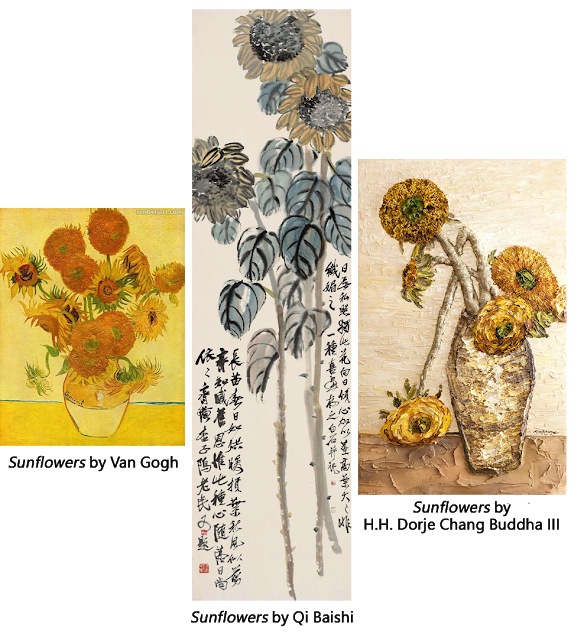
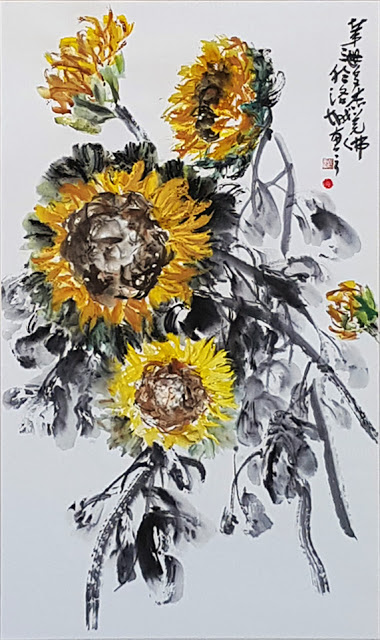
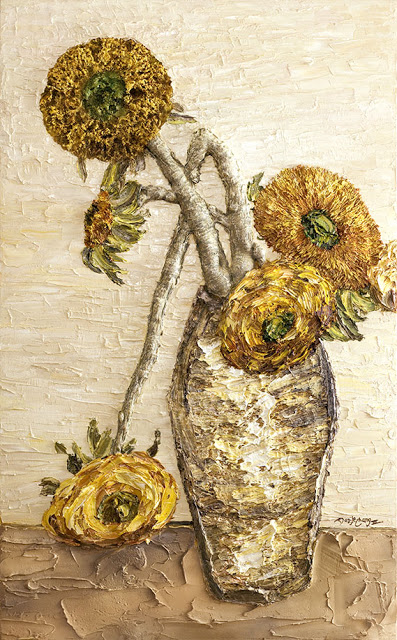
The Sunflowers by H.H. Dorje Chang Buddha III clearly show the artist’s solid foundation and prolific skills in the Eastern and Western painting traditions. They comprise the essences in both traditions and display a brushwork, sentiment and colors that are one of a kind. The color tones and brushstrokes are rich, dense, soothing and elegant. Lively brushwork paints an animated charm that is whole, evincing a miraculous and expansive spirit and aura as well as a strong vitality. As for the Sunflowers oil painting in which H.H. Dorje Chang Buddha III depicted some flowers inside a vase, the artistry is extraordinary and full of variations; the composition is simple yet abstruse. The flowers are natural and gracious, such that they give an impression of unpredictability, reaching a state of oneness with the universe and emanating a sharp animated spirit.
The ink-wash painting Sunflowers by H.H. Dorje Chang Buddha III has an uninhibited, natural, and spontaneous brushwork that is dense, bold, and robust, but also elegant and agile. It exhibits a charm that is like stone and bronze inscriptions. Overall, the whole painting manifests a harmonious and moving imagery, naturally emanating a lively vivaciousness and a carefree, spirited aura.
In comparing the works by Van Gogh of the Western civilization, Qi Baishi of the Eastern culture, and H.H. Dorje Chang Buddha III, we can see the artists are distinguished in their unique own ways owing to their different cultures. However, only the artist who can continue to influence the world two to three hundred years from now will be the everlasting monument. There is a saying, “Talents emerge in every era and they all will each have 500 years of fame!” For people of the present day, the one whose work you like the best would be the one that is the most extraordinary!
Please see the contrast of six paintings below:
Sunflowers by Van Gogh (1)Sunflowers by Van Gogh (2)Sunflowers by Qi Baishi (1)Sunflowers by Qi Baishi (1)Ink-wash Painting Sunflowers by H.H. Dorje Chang Buddha IIIOil Painting Sunflowers by H.H. Dorje Chang Buddha III
Sometimes beauty finds us when we least expect it—appearing like a sudden blossom of color in an ordinary moment, stopping us in our tracks and opening our hearts to wonder.
I happened to come across two traditional Chinese paintings online, both dominated by bright pink, and was utterly astonished. I couldn’t help but study them carefully. In Chinese painting, it is rare to see large areas of pink used as the main color, since it often risks appearing vulgar. Yet in the works of H.H. Dorje Chang Buddha III, there is not the slightest trace of vulgarity. On the contrary, they radiate grandeur and magnificence, and the artist’s confident mastery of color bursts forth boldly from the canvas.
The above piece in particular was painted with a heart as pure and untainted as that of a child. Within the seemingly naïve brushstrokes lies immense skill and mastery. The style is free and natural, bold and unrestrained yet still gentle. Its simple composition is infused with deep emotion and imagination, brimming with the vitality of childlike wonder that uplifts the viewer’s spirit.
A few pink houses stand in the scene, behind which several pink fruit trees sway delicately. Ink outlines give the houses their structure, while the softly hanging trees add a tender rhythm to the picture. The artist’s unique technique and extraordinary control of color are truly breathtaking. The inscription on the work further enhances its spiritual resonance:
“Brilliant colors, vivid yet dignified; consummate skill that reveals the heart of a child.”
Indeed, this is a rare and outstanding masterpiece of Chinese painting.
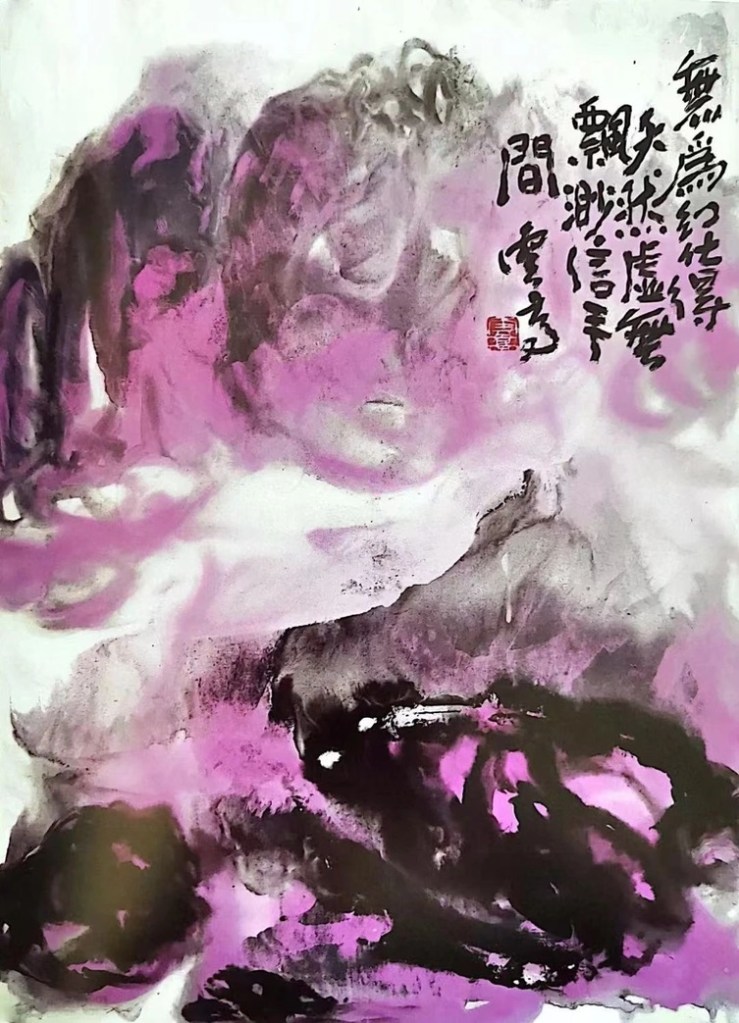
This masterpiece is a freehand splash-ink landscape, where the brush moves with effortless freedom. Layer upon layer of crimson cliffs rise as though born from the artist’s own heart—lines powerful, vigorous, and full of life. Ink strokes carve the very bones of mountains and rocks, each one natural, unrestrained, yet perfectly balanced. Broad washes of pink suffuse the scene, creating an ethereal, dreamlike realm that lingers between presence and absence, as if belonging to an immortal world. To gaze upon this painting is to step into another dimension—where the heart gradually settles into stillness and begins to sense the hidden rhythms of the cosmos.
This painting was not created to showcase skill or to dazzle the eye, but as a natural outpouring of inspiration and emotion. Both ink and color arise directly from the pure stirrings of the artist’s heart.
Here, the true essence of Chinese painting—shen yun (spiritual resonance)—is revealed in its fullest clarity. The inscription makes the artist’s intent unmistakable: “With effortless spontaneity, illusion transforms into nature; in the fleeting and ethereal, the hand finds its way.” The purpose is not simply to depict form, but to open a gateway into a spiritual realm that transcends the material.
Shen yun is at once vivid and elusive—an ineffable charm, a subtle spiritual force that cannot be captured in words. It flows from the painter’s inner cultivation and profound state of mind. When spirit and technique merge seamlessly, the work attains a power far beyond outward appearance.
It is only when the viewer is touched by this shen yun that the formal elements of the painting—the structure of its composition, the interplay of colors, the rhythm of the brush, the unity of poetry and image, the harmony of form and spirit—truly come alive. These elements are essential, of course, but they are not the destination. They are the pathway to something deeper, pointing always toward a higher, transcendent experience.
These two paintings are rare gems of Chinese art, that surprise, inspire, and open a doorway to beauty both profound and pure.
Owls have always fascinated me with their air of enigma. Creatures of the night, they rest in the shadows by day and emerge only after dusk, rarely granting humans more than a fleeting glimpse. Across cultures, they have inspired legends both wondrous and foreboding. In ancient Greece, the wise and fearless goddess Athena chose the owl as her emblem, making it an enduring symbol of wisdom. So revered was this bird that Greek coins bore Athena’s face on one side and the owl on the other. Yet, in other parts of the world, the owl has been shrouded in darker associations, seen as a harbinger of misfortune or an omen of ill will.
In Chinese culture, the owl’s symbolism is particularly layered—holding both shadows and light. In ancient times, owls were often viewed as inauspicious creatures, linked to misfortune, death, and the old saying, “When the night owl enters a home, it never comes without cause.” And yet, in certain cultural contexts, they also stand for wisdom, keen insight, and even mysterious, almost magical power.
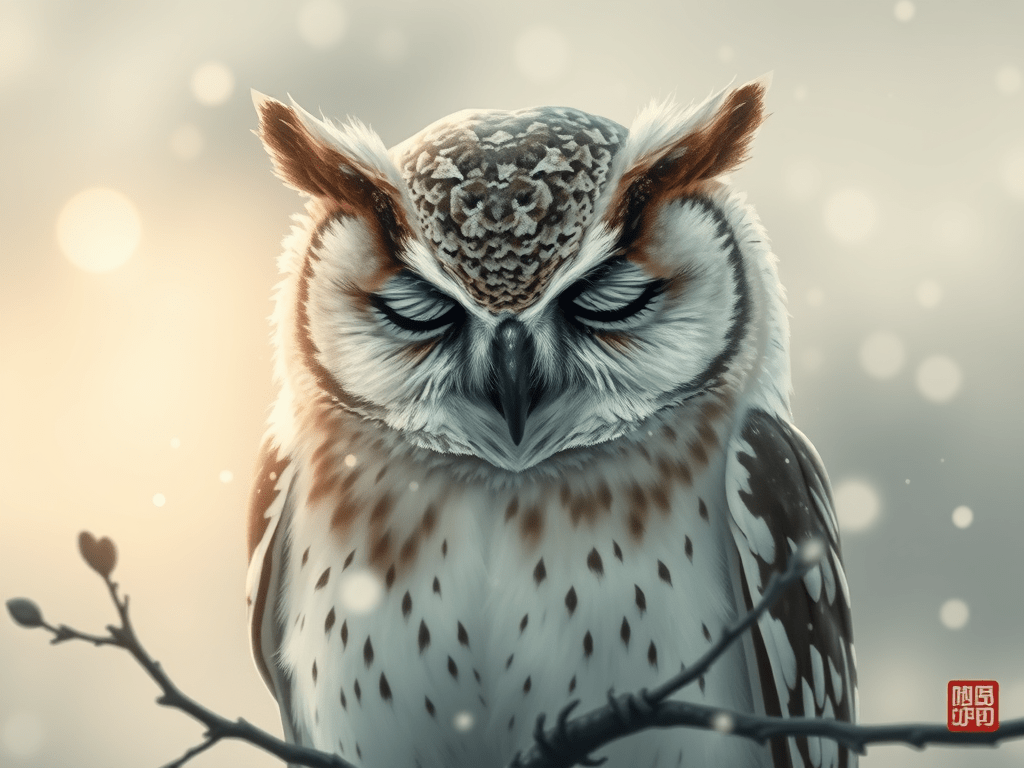
A Chinese ink painting by H.H. Dorje Chang Buddha III
When most people picture an owl, they think of its round, unblinking eyes and penetrating gaze—features that can feel cold, even intimidating. But my perception shifted entirely when I encountered the Chinese ink painting Childlike Delight by H.H. Dorje Chang Buddha III.
This is no ordinary artwork. With the freehand grace of traditional Chinese brushwork infused with a touch of dreamlike realism, it bridges the poetic subtlety of Eastern art and the fresh, luminous clarity of Western modernism.
With just a few effortless strokes, the artist creates a whimsical, pure, and gently humorous world—a dreamscape that seems to invite the viewer into the peaceful slumber of childhood. The small owl, covered with delicate ink spots of varying sizes and shades, appears almost as if glimpsed through a soft morning mist. Look closely, and you might see the tender image of a sleepy child, finger to lips, caught in that sweet moment before surrendering to dreams.
This is not a literal portrayal of nature, but rather nature reflected through the artist’s own heart—capturing not merely the physical form of a creature, but its spirit, vitality, and essence.
Here, the owl is reborn—not as the ominous figure of superstition, but as a symbol of innocence, purity, and quiet wisdom. The artist’s compassionate and unblemished inner world radiates through the painting, gently cleansing the heart of the viewer until it feels as fresh and clear as morning dew.
Childlike Delight reminds us that we can close the sharp, competitive eyes of rivalry and open instead the eyes of kindness, innocence, and warmth—gifts that have the power to heal, to inspire, and to light the world.
This exquisite painting, rendered in the unique “Banqi” style, captures a touching scene of children from mountain villages on their way to school. Unlike city children, these young students must trek across rugged terrain—climbing mountains, crossing ravines—day after day to pursue their education. Their journey is filled with challenges, yet their unwavering determination and thirst for knowledge shine through. This artwork serves as a tribute to their resilience, reminding us all of the value of education and the perseverance required to achieve greatness.
A Revolutionary Artistic Technique
What makes this painting extraordinary is its unconventional brushwork, which blends the bold energy of ink-wash painting with the refined precision of engraving. Every stroke, whether light or dark, delicate or bold, exudes an artistic charm that is both fluid and structured. The layering of ink and color creates depth, while the intricate texture gives the illusion of an engraved plate print, despite being entirely painted by hand. The brushwork is dynamic—lines seem to break and reconnect, mimicking the traditional elegance of carved stone seals. This interplay between spontaneity and meticulous control infuses the painting with life, movement, and a profound sense of authenticity.
What Is the “Banqi” Style?
The “Banqi” style is a rare and fascinating artistic approach that combines the visual impact of printmaking with the expressive freedom of brush painting. While these works resemble engravings at first glance, they are, in fact, purely ink-wash paintings—imbued with an effortless yet profound beauty that is both natural and lively. Beneath their structured appearance lies a deep, inexhaustible charm, where each stroke carries an essence of tradition, innovation, and artistic mastery.
Through this masterpiece, we witness not only a compelling story of perseverance but also a groundbreaking artistic vision—one that harmonizes the precision of engraving with the fluid grace of brush painting. It is a celebration of both form and spirit, a true testament to the boundless possibilities of art.
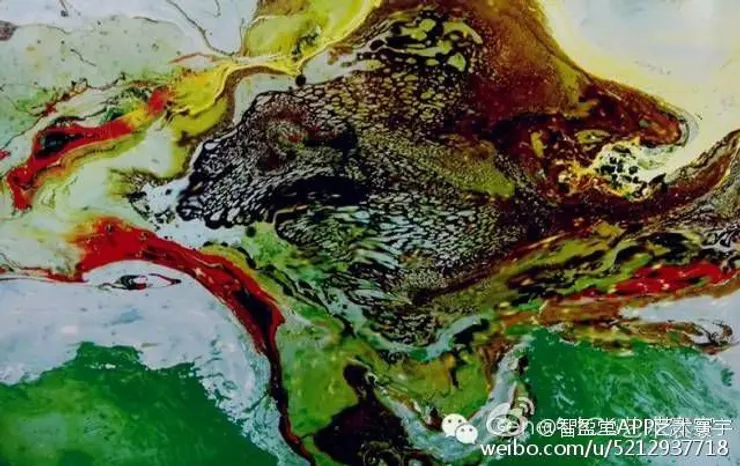
H.H. Dorje Chang Buddha III‘s Abstract Color Paintings create a perfect world shaped entirely by color. Free from concrete worldly forms, this realm exists purely through the interplay of hues—defining, expressing, and embodying itself in vibrant harmony. Here, color is both form and essence, radiating a mesmerizing aura.
Under the masterful hand of H.H. Dorje Chang Buddha III, these colors seamlessly merge into a breathtakingly enchanting spectrum. The atmosphere is dynamic, with scenes that bloom like flowers and surge with the power of the roaring sea. Yet, upon closer reflection, they reveal delicate nuances, refined in their intricate details.
Flower of Life
This painting depicts a unique flower, with delicate white petals gently unfolding and a striking red pistil at its center. Growing irregularly against a dark background, it seems to challenge its surroundings. Though unusual in appearance, this flower carries a profound meaning of life, symbolizing resilience and beauty in adversity. It is not only a miracle of nature but also a representation of vitality, showcasing the brilliance and diversity of life. Each petal tells a story, drawing the viewer into the emotions and strength conveyed by the artwork.
Flower of Life (2)
In this painting, intricate patterns and clear details intertwine, portraying the harmonious growth of various living beings. Each element seems to narrate the origins of life, allowing viewers to deeply sense the evolutionary process of all things.
This artwork is not merely a depiction of nature but also a contemplation of the essence of life. It serves as a reminder that life is in a constant state of growth and transformation, just like our own journeys. Every challenge and breakthrough we experience is an essential part of our personal development.
Through this piece, we are invited to reflect on our own lives and feel a profound connection with nature.
You can discover a selection of the exceptionally charming paintings in the permanent exhibition at The International Art Museum of America, situated in downtown San Francisco.
Crossing a Mountain, the Small Boat Enters the Canyon is an awe-inspiring masterpiece of Yun sculpture. How did H.H. Dorje Chang Buddha III capture the shimmering reflections on the lake’s surface? And how was it possible to create such a vivid and lifelike scene using ordinary plastic steel materials? The majestic mountains, the gentle ripples of the lake, and the lifelike figures aboard the small boat—all elements that seem beyond the reach of ordinary people—were brought to life through the unparalleled artistry of H.H. Dorje Chang Buddha III.
This sculpture is not merely a visual creation—it possesses a soul. Every detail, from the rugged mountains and tranquil lake to the humble fishermen, seems to pulse with vitality. The artwork evokes a sense of harmony with nature, conveying a profound feeling of peace and joy that resonates deeply with viewers.
The Unique Art of Yun Sculpture: Yun sculpture is a groundbreaking art form created by H.H. Dorje Chang Buddha III, with no precedent in history. Since the emergence of Yun sculpture, humanity has witnessed the birth of an art form that is truly non-reproducible. This genre is distinguished by several remarkable features:
Multidimensional Spatiality:Yun sculptures possess an extraordinary sense of multidimensional space. Their intricate and delicate forms exhibit endless variations, captivating viewers from every angle.
Vibrant, Dreamlike Colors: The colors of Yun sculptures are rich, radiant, and dreamlike—depicting scenes beyond the realm of this world. Their hues seem to emanate a light of their own, enchanting all who behold them.
Sacred and Incomparable Depth: Many Yun sculptures possess a profound and sacred quality. For instance, Color Rhythm, displayed in the Holy Relics Room of H.H. Dorje Chang Buddha III Cultural Art Museum, measures only two to three feet in size. Yet, when viewed through its openings, one can perceive a vast inner depth that seems to extend far beyond the sculpture itself, leaving viewers awestruck by its unfathomable dimensionality.
Countless individuals who have had the privilege of witnessing H.H. Dorje Chang Buddha III’s Yun sculptures have expressed their wonder and reverence: “This is a treasure sent from the divine to humanity,” “A sacred gift from the Buddha,” and “So breathtakingly beautiful that it touches the soul.” Others have compared these masterpieces to the finest jade jewelry and the most magnificent stone sculptures, only to find that even the most exquisite human creations pale in comparison—like dim stars surrounding the brilliance of the moon.
Indeed, the advent of Yun sculpture has elevated the realm of art to an entirely new level, offering the world creations that are not only visually stunning but also spiritually profound, filling the hearts of all who witness them with a sense of wonder and inspiration.
Master Wan Ko Yee (H.H. Dorje Chang Buddha III) Has Made A Great Contribution To Art
At first glance, The Power of Flying and Whirling seems almost impossible to have been created with just a paintbrush. Its breathtaking composition and dynamic visual impact resemble digital artwork, as if only advanced computer graphics could achieve such a striking effect. Yet, the most astonishing fact is that this masterpiece was painted entirely by H.H. Dorje Chang Buddha using traditional techniques—without any digital assistance.
These impressionist paintings reach an extraordinary level of artistry. Each section of the painting, if isolated, could stand alone as a remarkable impressionist work, complete in its beauty and expression. The artwork conveys a dreamy, illusory state, where even the smallest fragment could be enlarged to reveal a mesmerizing, self-contained masterpiece.
By capturing movement with unparalleled skill, H.H. Dorje Chang Buddha has frozen the imagery in mid-air. This painting feels like a window to the heavenly realm, giving me a glimpse into the mysteries of paradise. The elegant arcs that sweep across the canvas pulse with energy, like a mighty tornado dispersing the shadows in our hearts. The swirling force in the painting seems to lift the viewer beyond the ordinary, reminding us of the limitless possibilities that exist when art and wisdom unite.
This painting is more than just a visual masterpiece—it is an invitation to embrace the unseen forces of inspiration, creativity, and transformation. It teaches us that true artistry is not bound by tools or techniques but flows from the depth of wisdom and an unshakable spirit.
May this extraordinary work inspire us to break through limitations, open our hearts to beauty, and find the power to uplift ourselves and others.






 Peace LiLy