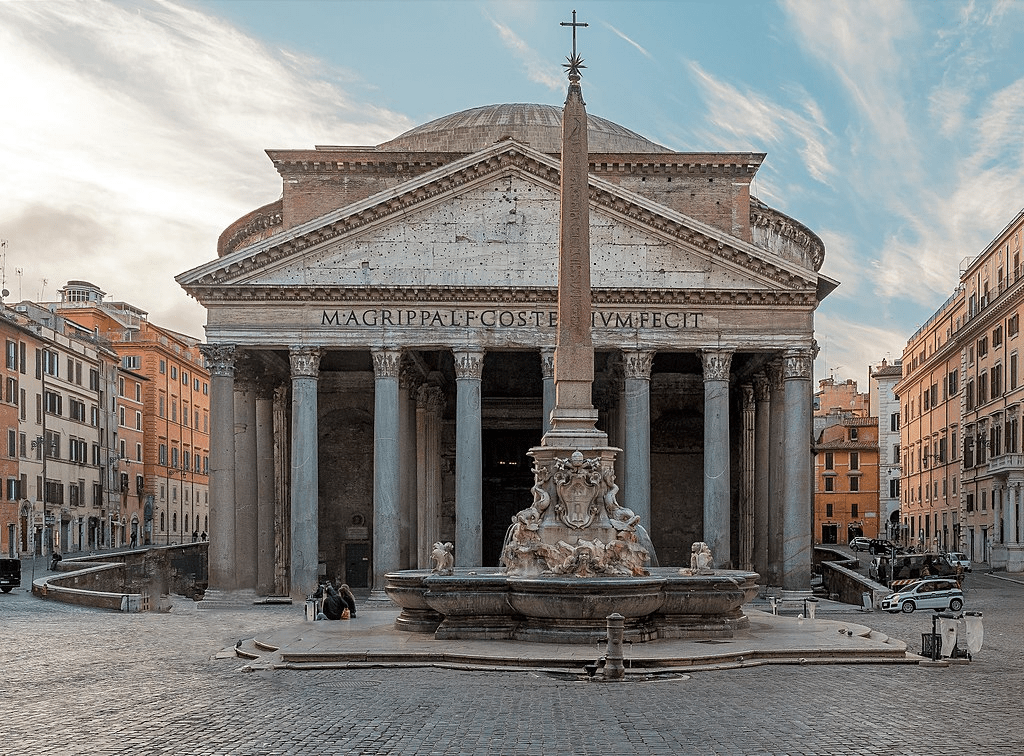
Have you ever stood before the Pantheon in Rome or looked up at the towering aqueducts from ancient times and thought: “How are these structures—built over 2,000 years ago—still standing strong, while modern buildings crack, rust, and collapse in just a few decades?”
It’s not a miracle. It’s ancient wisdom and material science far ahead of its time.
Unlike the Portland cement we use today, ancient Roman concrete was made with volcanic ash (pozzolana), lime, water, and volcanic rock. This special mix triggered a chemical reaction known as the pozzolanic reaction, which formed a remarkably stable and durable material.
This volcanic ash came from regions like Campi Flegrei near Naples, rich in silica and alumina. When mixed with lime and water, it formed bonds that strengthened over time—rather than weakened.
🌊 Stronger with Time—Even Underwater
Even more amazing? Roman concrete exposed to sea water didn’t erode—it grew stronger. Scientists discovered that seawater reacted with the volcanic materials to create a rare mineral called tobermorite, which reinforced the concrete’s internal structure.
This is why many ancient Roman ports and sea walls still stand intact after 2,000 years—even without modern rebar or waterproofing.
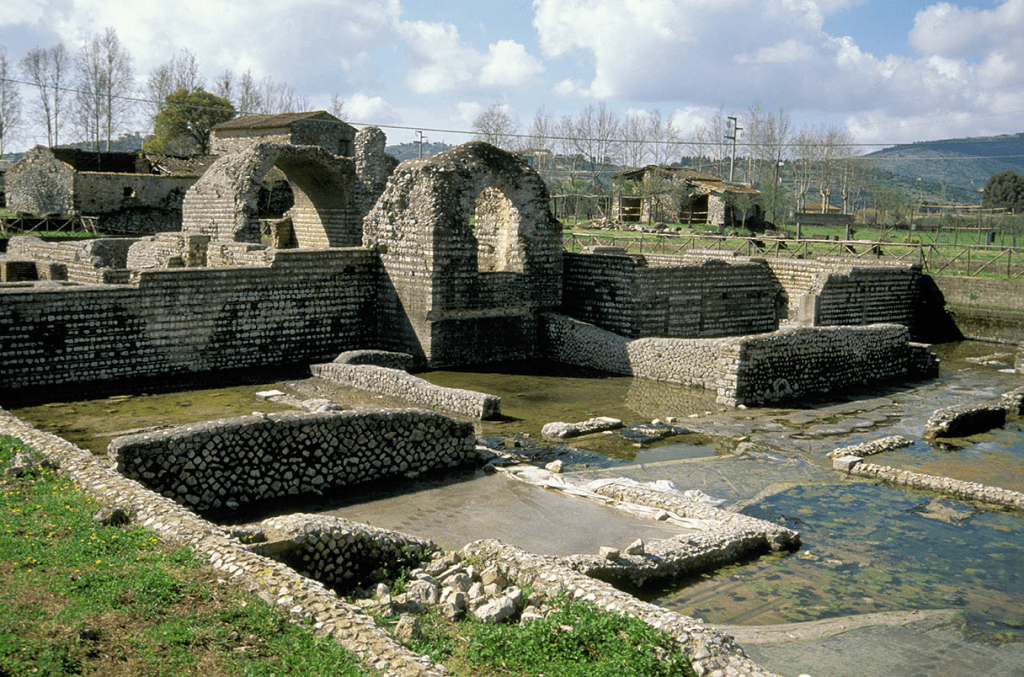
Ruins in Privernum, near Rome, where researchers collected ancient concrete samples from a bordering city wallREDA & CO srl/Alamy
🔧 Self-Healing Capabilities
Roman concrete even had a kind of “self-healing” ability. When small cracks formed, water seeping into the cracks would trigger new chemical reactions, filling the gaps with more binding minerals and sealing the damage naturally.
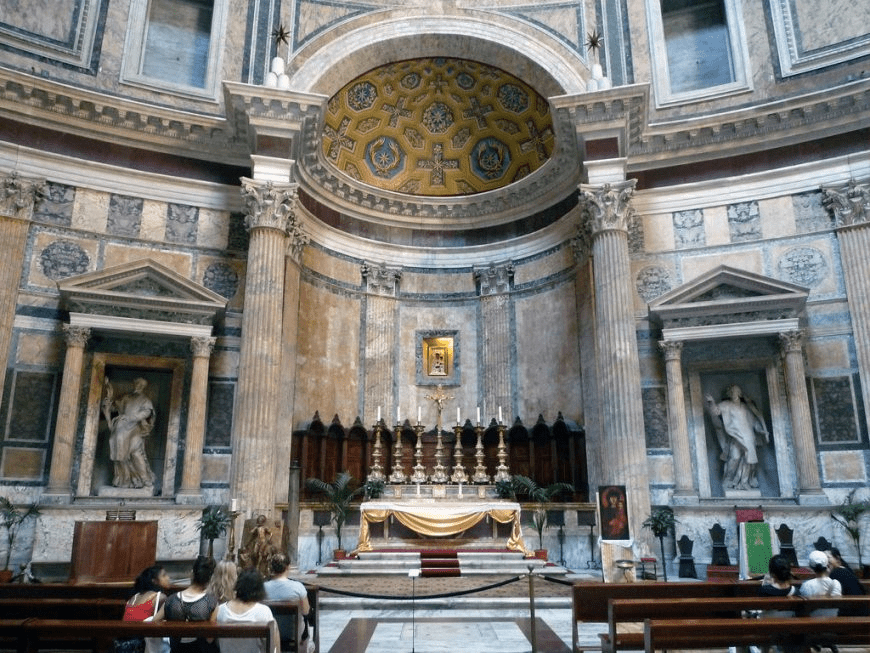
No wonder structures like the Pantheon’s massive unreinforced concrete dome—still the largest in the world—have stood strong for two millennia.
Today’s concrete (Portland cement) is fast to produce and easy to use—but it’s not built to last. It’s vulnerable to carbonization, water infiltration, and the corrosion of internal steel reinforcements. Many modern buildings begin to deteriorate in as little as 50 to 100 years.
What’s more, many structures are built with thinner supports and cheaper materials to cut costs and speed up construction—further sacrificing long-term durability.
Ancient Roman builders weren’t just engineers—they were environmental designers who worked with nature rather than against it. Their materials were local, natural, and synergistic. They designed for longevity, not just appearance or convenience.
Modern architecture, for all its technological advancements, could learn a powerful lesson: Durability is a form of sustainability.
We often assume that more advanced technology means better quality. But perhaps what truly makes a structure strong isn’t just engineering—it’s wisdom, respect for nature, and a mindset rooted in harmony and longevity.
If we embrace these ancient insights, maybe our future buildings won’t just house us—they’ll endure for generations.
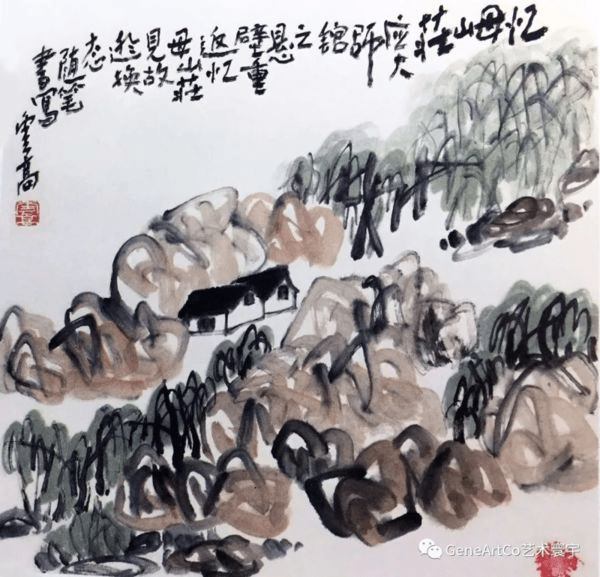
This is a deeply moving landscape painting by H.H.Dorje Chang Buddha III, marked by smooth, flowing brushwork and a natural rhythm. The undulating crimson cliffs seem to rise freely from the artist’s heart, while the vigorous lines brim with vitality and strength. Ink strokes form the skeletal structure of the mountains and rocks, while delicate willows hang softly across the scene, adding a quiet touch of green serenity. The overall palette is vivid but never garish, exuding a warm and nostalgic atmosphere.
In the painting, two thatched cottages nestle beside the mountains and water. Their deep-set doors and silent windows seem to hold untold, quiet stories. It was under these eaves, by these doors, that a loving mother once stood—sending her children off into the world with silent heartache, and waiting countless times in patient hope for their return. That wordless farewell, those tears of longing, have gently seeped into the fabric of time. Among all human emotions, none is greater than a mother’s love. Our memory of that love stirs an innate sense of gratitude—a sacred emotion that transcends the ordinary.
This work embodies the style known as the “Childlike Native School”, which embraces the beauty of rural life through the innocence of a child’s heart. Though the brushstrokes appear naïve and spontaneous, they conceal great depth and mastery. The painting style is free and unrestrained, exuding both boldness and tenderness. The soft, flowing lines connect seamlessly—like a mother’s love, endlessly enduring, gentle yet firm. Its simple composition holds rich emotional meaning and invites the viewer’s imagination to wander. The scene pulses with a childlike liveliness that fills the heart with joy.
The painting’s pure and innocent imagery evokes a return to the carefree days of childhood. No matter where you are, simply gazing at this piece can bring the scene and its emotions vividly before your eyes, awakening the deepest tenderness and longing in your soul.
In creating Mountain Village with Memories of Mother, the artist approached the work with the pure heart of a child, yet painted with the maturity and finesse of a seasoned master. The brush technique draws from traditional Chinese calligraphy—guided by the wrist, powered by the arm—each stroke flowing naturally with graceful spontaneity. This painting was not created for show or technical display, but as a sincere outpouring of emotion and inspiration. Every application of ink and color arises from genuine feeling.
What is art? At its essence, art is the ability to immediately evoke inner peace, comfort, joy, or spiritual fulfillment in the viewer. But where does this feeling come from? Is it merely the subject matter or visual beauty of the work? Certainly not. A painting does not become great simply because it looks pleasing.
In the context of Chinese painting, the true heart of art lies in a quality called “spiritual resonance” (shen yun). It is vivid, yet elusive—a mysterious charm and subtle power that cannot be described with words. It is born when the artist’s personal cultivation, emotional depth, and spiritual awareness infuse the work, allowing spirit and technique to merge. The result is an artistic vitality that transcends mere form.
Only when viewers are moved by this spiritual resonance do they begin to explore the painting’s formal elements—its composition, color palette, brush technique, balance between painting and calligraphy, and the portrayal of the subject in both spirit and form. While these aspects matter, they ultimately serve a deeper, more profound experience.
In Chinese art, the true value of a painting—its ability to soothe the soul—does not depend on technical skill alone. It lies in whether the work can touch the heart and stir the spirit. Mountain Village with Memories of Mother beautifully embodies this artistic spirit. Every brushstroke gently stirs the viewer’s emotions, evoking tender memories and inviting the soul to linger in its serene beauty.
This exceptional work is housed in the permanent collection of the International Art Museum of America, located in San Francisco—a fitting home for a piece that speaks a universal language of love, nostalgia, and spiritual beauty.
In 1985, a drunken promise set a young woman on a path that would change not only her life, but the fate of an entire desert.
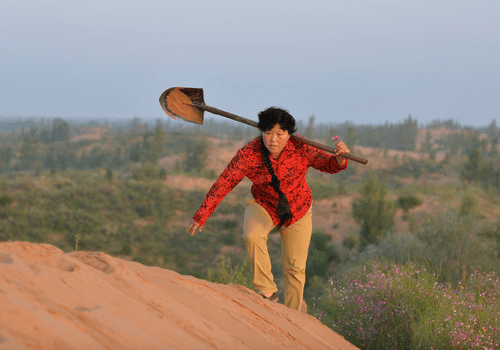
At just 19 years old, Yin Yuzhen was forced to marry Bai Wanxiang, a man living deep in China’s Mu Us Desert.
On her wedding night, while Bai lay down early to rest, Yin Yuzhen sat awake until dawn, her eyes red from weeping. When she looked out from her tiny dugout home, she saw nothing but endless waves of yellow sand stretching to the horizon. She felt as if her life had ended before it began.
Her new home was a four-square-meter pit carved into a sand dune. To enter, she had to stoop under a doorway so low it nearly grazed her back. Inside, there was nothing but a bed of dry twigs and straw.
Her husband was four years older and came from a family who had battled the desert for generations. Years earlier, Yin’s father had been saved by Bai’s father when a sandstorm left him lost in the dunes. Grateful, the men became sworn brothers, and in a haze of alcohol, her father vowed to give his daughter to the Bai family. Though he regretted it once sober, he felt bound to keep his word.
Life was brutal. There was no electricity or running water. Summers scorched and winters froze. They survived on millet, wild plants, and the occasional scavenged animal carcass. For forty days after her wedding, Yin Yuzhen saw no one but her husband—until, at last, a wandering herder passed by.
The isolation was unbearable. In her loneliness, she would cover footprints in the sand with a basin, pretending someone was still there.
Seven times she tried to flee, and seven times she became lost in the swirling sand. Once, she walked for two days and nights, only to find herself back where she started. That was when she realized the desert was not going to let her go.
At her lowest point, she contemplated ending her life. But in that moment, she remembered her mother’s tearful face the day she left home—and she stepped back from the edge. If she couldn’t escape, she decided, she would have to find a way to survive.
Hope arrived in the form of two poplar saplings she brought home from a visit to her parents. Miraculously, one took root. That little sprig of green whispered a possibility: maybe the desert wasn’t completely invincible.
In 1986, Yin Yuzhen made a bold choice. She sold their only “three-legged sheep”—a wounded animal that was still precious—and used the money to buy 600 young trees.
That spring, she and Bai planted each sapling in the sand around their cellar.
The challenges were immediate. Every day, they walked kilometers to fetch water. Under the searing sun, most of the saplings withered. By summer’s end, fewer than 100 remained. But for Yin Yuzhen, that was enough to keep going.
From then on, reclaiming the desert became her life’s purpose. Bai took work wherever he could to buy more trees, while she stayed behind to plant, water, and protect them.
Every morning she rose at 4 a.m. and worked until late into the night.
Through years of trial and error, she devised a three-layer planting method: shrubs to anchor the sand, trees to form a windbreak, and fruit trees to sustain their livelihood. This innovation transformed survival rates.
But the desert kept testing her resolve.
In 1989, a monstrous sandstorm struck while they were returning with new saplings. The wind tore the trees from their cart and buried them. Yin Yuzhen clung to their ox’s tail, stumbling forward in the blinding grit. When they finally reached home, she didn’t rest—she planted every surviving sapling that same night.
Setbacks never stopped coming.
They flattened kilometers of sand to make water channels, only to watch them swallowed again and again.
She went into premature labor from exhaustion. He developed pneumonia. But neither ever quit.
For the first ten years, the progress was almost invisible. The trees grew painfully slowly, and the dunes kept advancing. Still, she believed that if she didn’t give up, someday the desert would yield.
In the fifteenth year, signs of hope appeared. The dunes near their home began to stabilize. The wind softened. Small animals returned.
After twenty years, their desolate hollow had transformed into an oasis that drew neighbors to settle nearby.
Today, after thirty-six years of relentless labor, Yin Yuzhen and Bai Wanxiang have reclaimed more than 70,000 acres of desert.
They have planted over 20 million trees—forming a vast green barrier against the sands.
Their perseverance has inspired 84 families to join in the mission, proving that even the harshest landscapes can be transformed.
Yin Yuzhen’s story has captured global attention. She has won over 100 honors, including “National Model Worker” and “Green China Person of the Year.” She was the first Chinese woman nominated for the Nobel Peace Prize, and the United Nations has praised her work as a model of ecological restoration.
What began as a forced marriage became the catalyst for a transformation no one imagined possible.
The young bride who wept in despair became a legend—China’s Desert-Conquering Queen.
Standing in her thriving “green kingdom,” she often reflects on her journey from hopelessness to triumph.
“At first, I only wanted to survive,” she says. “Later, it became my life’s mission.”
Today, the cellar where she once had to crawl inside has been replaced by a bright brick house surrounded by orchards and forests. That place—once a symbol of despair—has become a destination where people come to learn, to marvel, and to be inspired.
Yin Yuzhen’s life is a powerful reminder that in the most unforgiving environments, the strongest life force can grow.
One woman’s 36-year battle against the desert ended in a victory of green.
Longxing Temple, also known as the Great Buddha Temple, is one of China’s oldest, largest, and best-preserved Buddhist temples. This extraordinary complex is not only a sacred site but also a magnificent testament to the architectural genius and spiritual devotion of ancient China.
Located at No. 109 Zhongshan East Road in Zhengding County, Shijiazhuang, Hebei Province, Longxing Temple sprawls across an impressive 82,500 square meters.
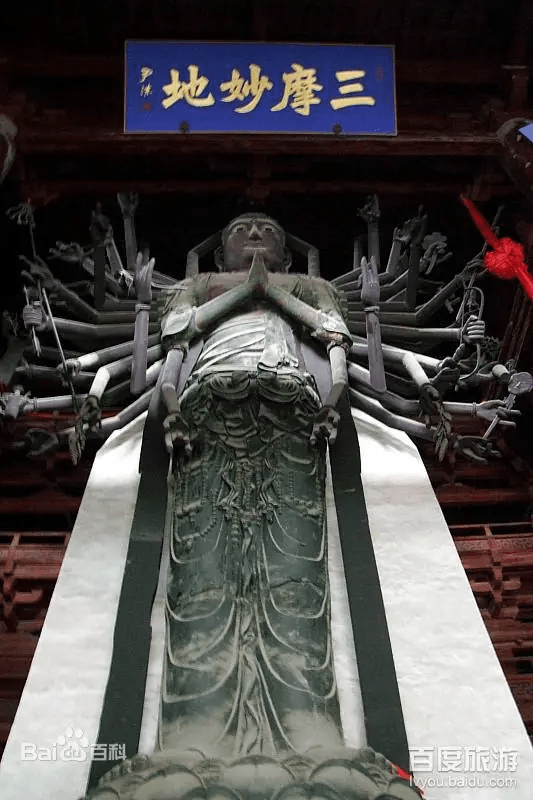
Originally established in 586 CE during the Sui Dynasty under the name Longcang Temple, it was later renamed Longxing Temple during the Tang Dynasty. In 971 CE, Emperor Taizu of the Northern Song Dynasty issued an edict to cast an enormous bronze Thousand-Armed Avalokiteshvara Bodhisattva and build the splendid Hall of Great Compassion to house it.
This marked the beginning of large-scale expansion, culminating in a grand Song Dynasty architectural complex centered on the hall. Through the Jin, Yuan, and Ming Dynasties, the temple saw continued renovation and growth. In the Qing Dynasty, both Kangxi and Qianlong Emperors decreed extensive rebuilding, shaping the temple’s current layout:
The eastern section served as monks’ quarters
The central axis hosted Buddhist ceremonies
The western area functioned as the imperial palace quarters
In 1710, Emperor Kangxi personally inscribed the name “Longxing Temple,” an honor that reflects its enduring importance.
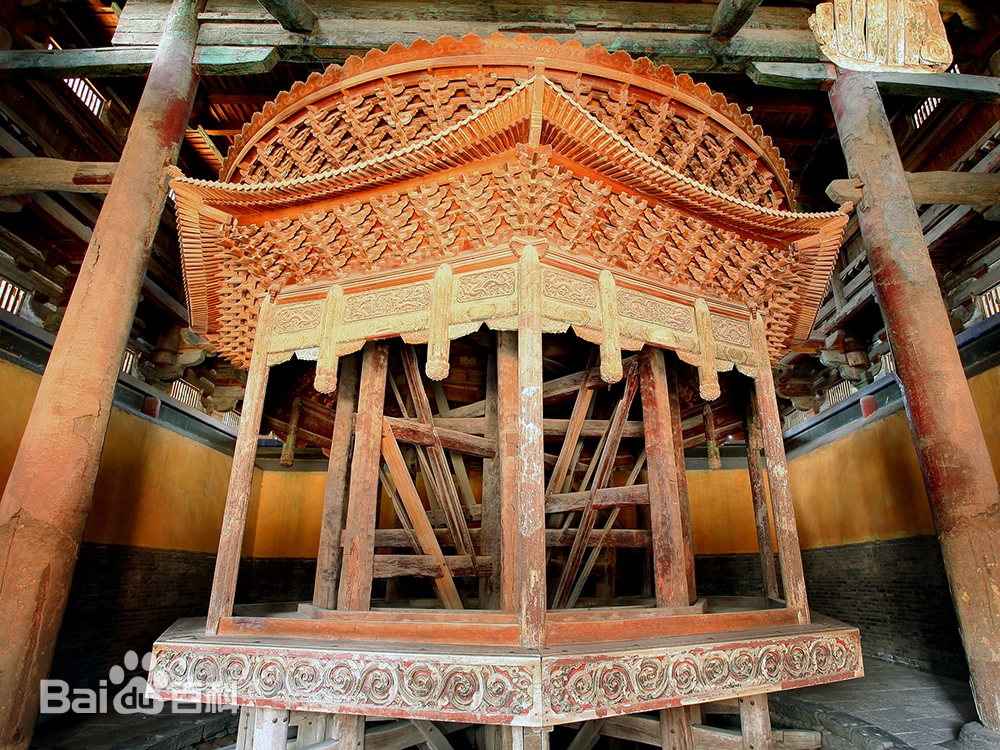
Today, visitors can trace a north–south axis that passes through a series of majestic structures: the Hall of Heavenly Kings, Mani Hall, the Ordination Altar, the Revolving Sutra Library, and more than a dozen other halls and pavilions. The complex is celebrated as a textbook example of ancient Chinese Buddhist temple design.
Recognized among China’s ten most famous temples, Longxing Temple was declared a Major National Historical and Cultural Site in 1961 and later designated a National AAAA Tourist Attraction.
Highlights Not to Miss
Hall of Heavenly Kings
First built in the Northern Song Dynasty, this is the oldest surviving structure of its kind within the temple. Even after a major renovation in 1780, its main timber frame remains original.
Above the entrance, plaques bearing the calligraphy of the Kangxi Emperor read:
“Imperially Established Longxing Temple” “Hall of Heavenly Kings”
Inside stands the famous Big-Bellied Maitreya Buddha, a Jin Dynasty wood carving over 800 years old. Thoroughly localized in Chinese style, this smiling figure derives from the legendary monk Qici, known for his benevolence and laughter.
On either side stand the Four Great Heavenly Kings, each symbolizing auspicious natural forces:
Wind (Southern King, with a sword)
Harmony (Eastern King, with a lute)
Rain (Northern King, with a precious umbrella)
Compliance (Western King, with a coiled snake)
Together, they express the blessing of abundant harvests and national peace.
Mani Hall
Built in 1052, Mani Hall has an unusual cross-shaped floor plan created by four gabled annexes extending from its square central chamber.
Inside, five golden clay Buddha statues preside over the altar, with Shakyamuni Buddha at the center.
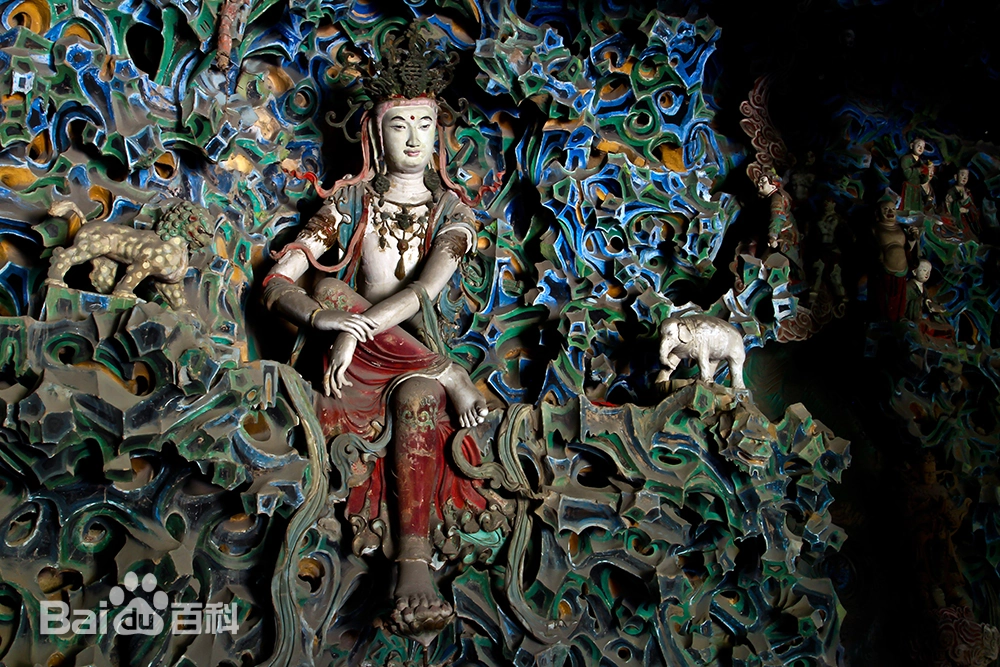
The hall’s north wall showcases a breathtaking polychrome relief nearly 16 meters long, depicting swirling clouds, celestial beings, and Avalokiteshvara stepping onto a lotus—symbolizing the entrance to the Western Pure Land.
At the heart of this scene sits the Backward-Facing Avalokiteshvara, so named because she faces north instead of south. Far from a supernatural image, this Avalokiteshvara appears as a serene, youthful woman with an expression so vivid and gentle it moves all who gaze upon her.
Visitors often remark:
“How beautiful—how extraordinary! She sits so naturally, one leg casually crossed, her eyes meeting yours wherever you stand. Her smile is as enigmatic as the Mona Lisa—truly ‘The Most Beautiful Avalokiteshvara.’”
Ordination Altar
Reserved for the most important temples, the Ordination Altar was where monks received their vows.
Inside the altar stands a unique double-sided bronze Buddha statue. Facing south is Amitabha Buddha, and facing north is Medicine Buddha. The two figures share a single body, seated back to back in lotus posture.
The statues are depicted in full lotus position, wearing five-leaf crowns, with round, gentle faces. Their necks are adorned with necklaces and their arms with bangles, while flowing sashes drape gracefully from their shoulders. Amitabha’s hands form the meditation mudra, while Medicine Buddha’s hands display the gesture of compassion.
Their expressions are serene and tranquil, exuding a quiet dignity and solemn beauty in their elegant simplicity.
Longteng Garden
To the northeast lies Longteng Garden, a Ming and Qing–style garden combining cultural heritage and tranquil scenery.
Here you’ll find:
Northern Dynasties stone statues
A Jin Dynasty scripture pillar
A Yuan Dynasty mural tomb
The Ming Dynasty Longquan Well Pavilion
The “Three Generations of Vice Ministers” stone archway
Meandering through its pavilions, terraces, and lush paths feels like stepping into a living scroll of history.
Cultural Traditions
Imperial Buddhist Ceremony Performance
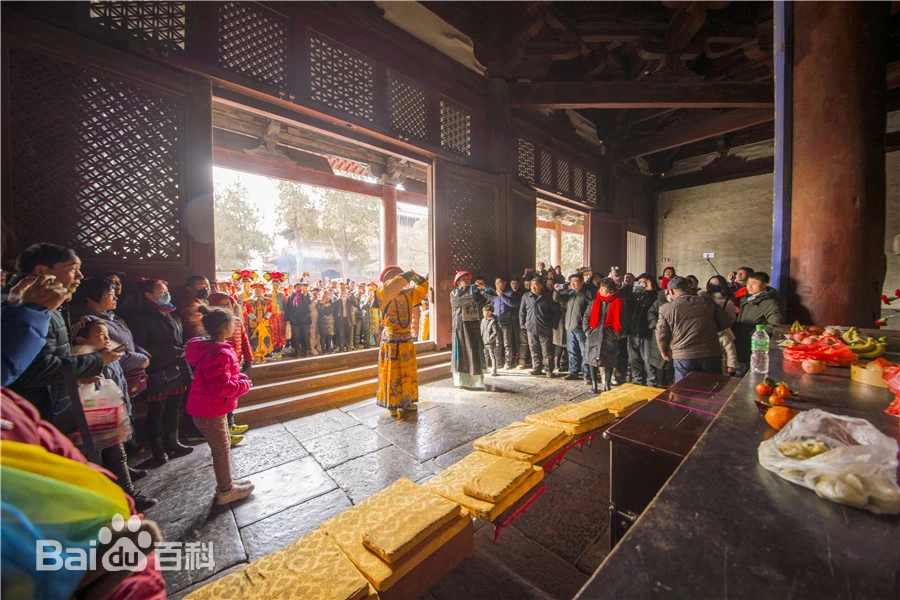
Zhengding’s Longxing Temple is an imperial temple that was visited and funded for repairs by emperors over many dynasties. According to The Chronicles of Longxing Temple, in the 49th year of Emperor Kangxi’s reign (1710 CE), the emperor ordered funds to be allocated from the national treasury to restore Longxing Temple. After the renovations were completed, Emperor Kangxi personally came to pay homage and bestowed 19 inscribed plaques, including one reading “Longxing Temple Constructed by Imperial Decree,” all handwritten by himself.
At the end of 2011, drawing on historical records, the Cultural Heritage Office re-created the Grand Imperial Buddhist Ceremony, reenacting the scene of Emperor Kangxi’s arrival at Longxing Temple, the local officials welcoming the imperial entourage, and the emperor bestowing plaques, offering incense, and performing rituals to honor the Buddha.
Thousand-Armed Avalokiteshvara Performance
Inside the Great Compassion Pavilion of Zhengding’s Longxing Temple stands a bronze statue of the Thousand-Armed, Thousand-Eyed Avalokiteshvara, measuring 21.3 meters in height. Cast in the 4th year of the Kaibao era of the Northern Song Dynasty (971 CE), this towering bronze figure is remarkable both for its immense size and its exquisite craftsmanship.
It is the tallest and oldest ancient bronze Buddha statue of its kind in the world. It is not only a symbol of Longxing Temple but also an emblem of the ancient city of Zhengding.
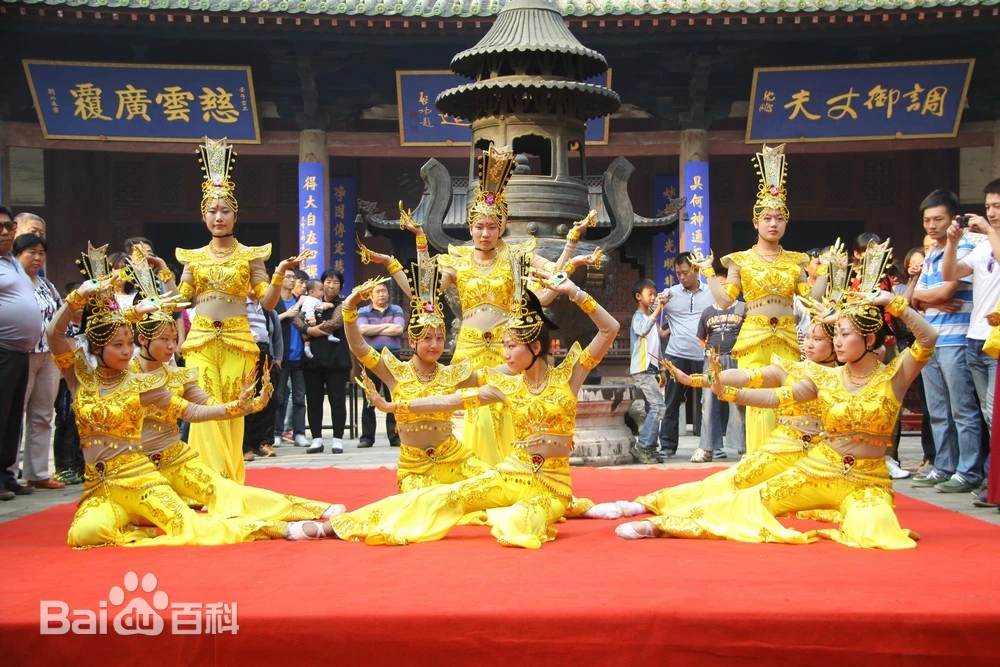
The Thousand-Armed Avalokiteshvara Performance features graceful melodies and captivating dance that vividly convey the divine presence and compassion of the bodhisattva.
Longxing Temple is more than a historical monument—it is a living symbol of Chinese Buddhist art, architecture, and spirituality. Whether you come for quiet reflection, cultural discovery, or simply to stand before centuries of devotion, this magnificent temple will leave a lasting impression on your heart.
Nestled in the heart of Xinjiang, the Turpan Basin holds several extraordinary records: it’s the lowest geographical point in China, and during summer, it’s the hottest place in the country. With scorching sunlight, relentless winds, and almost no rainfall, Turpan earns its title as the “Land of Fire.”
In the peak of summer, the surface temperature in the surrounding Gobi Desert can soar to 82.3°C (180.1°F), while the air temperature often exceeds 49°C (120°F). Rain is almost nonexistent—Turpan receives an average of just 16.4 mm of rainfall annually, and in some years, as little as 4.3 mm. Yet, amidst this harsh, parched environment, an ancient miracle has quietly sustained life for over two thousand years: the Karez irrigation system.
A Miracle Beneath the Earth
While nature was unforgiving above ground, it hid a gift below. Meltwater from the distant Tianshan Mountains seeps underground through coarse gravel and sand, eventually blocked by the Flaming Mountains and surfacing as springs. Ingenious local people found a way to capture and guide this underground treasure—thus, the Karez was born.
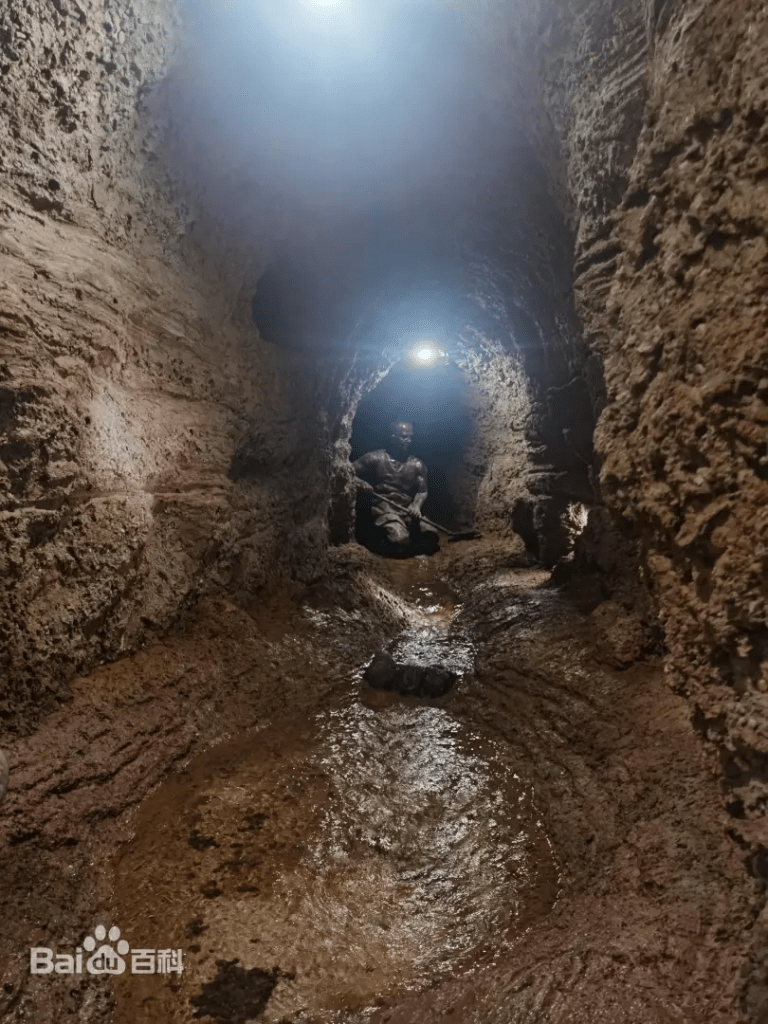
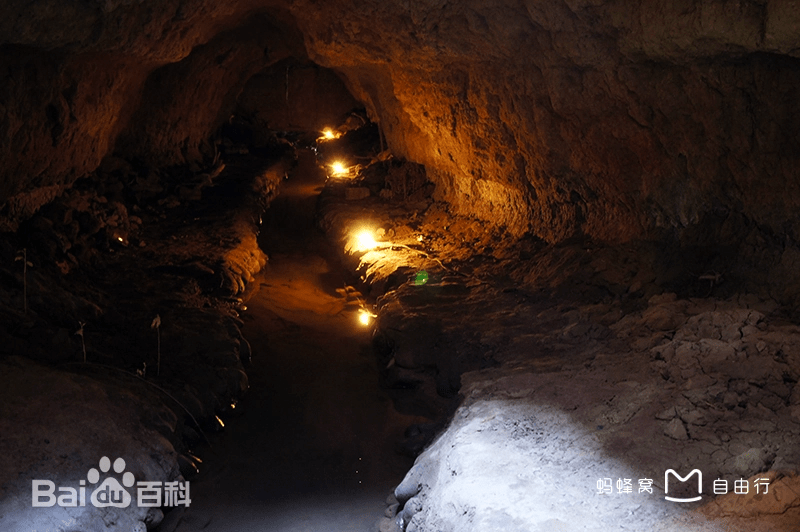
The Karez system channels water from mountain sources through a network of underground tunnels and vertical shafts, delivering it to the arid land without evaporation loss. Remarkably, this ancient system operates entirely without pumps, relying solely on gravity and terrain.
A complete Karez includes:
Vertical shafts for ventilation and maintenance
Underground tunnels to carry water
Open canals to distribute it
Storage ponds to hold it
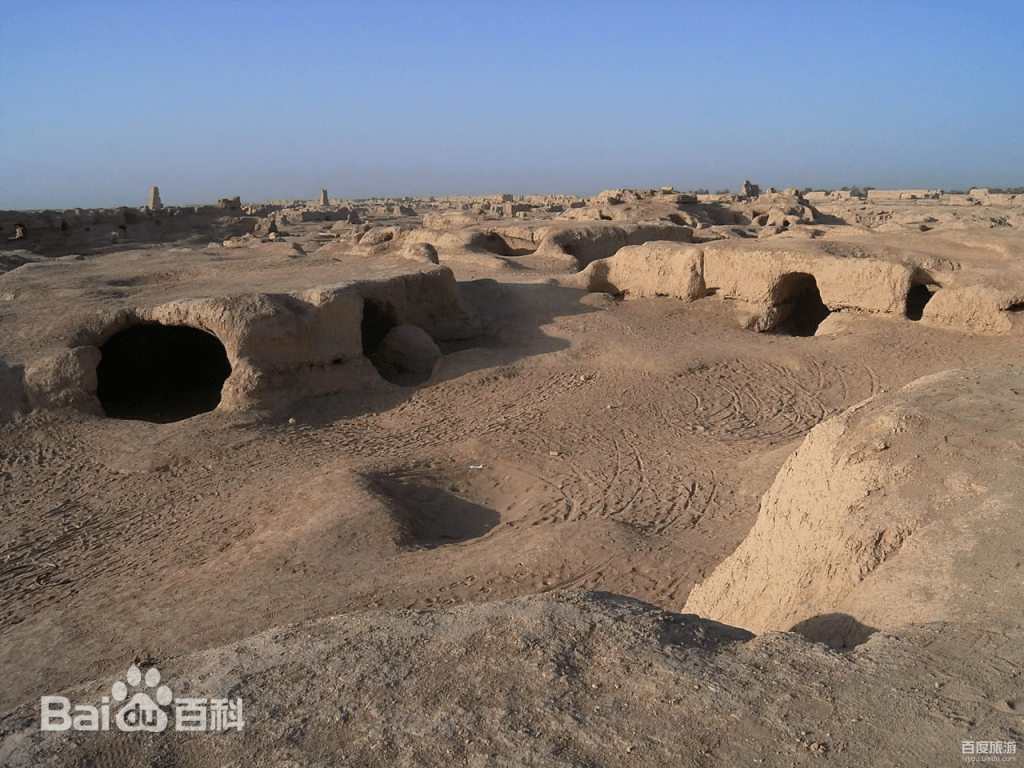
Across Turpan’s landscape, you can still see long rows of small mounds—each one marking a shaft, a glimpse into the remarkable infrastructure below.
A Testament to Ingenuity and Endurance
The origins of the Karez can be traced back to the Han Dynasty, over 2,000 years ago. Most of the surviving systems were built during the Qing Dynasty, including during historical moments like Lin Zexu’s fourth inspection of Turpan, when over 300 new Karez channels were added, and Zuo Zongtang’s campaigns, which saw nearly 200 more constructed.
At its peak in the 1950s, there were about 1,700 Karez systems in Turpan, stretching over 3,000 kilometers. Today, about 725 remain, a number slowly dwindling due to modernization, drought, and human impact.
The construction of each Karez was no small feat. Generations of laborers worked in dark, narrow tunnels, often barefoot in icy water, chiseling stone with simple tools and oil lamps. They carried earth and rock out by hand, surviving on dry flatbread and enduring brutal conditions.
A Culture of Water, Wisdom, and Survival
More than just a hydraulic system, the Karez represents a culture—a story of human resilience, harmony with nature, and intergenerational wisdom. In this water-scarce land, the Karez has nurtured lush vineyards, fertile fields, and diverse communities, offering life where none should thrive.
Today, many of these systems are dry or abandoned, relics of a past shaped by necessity and brilliance. But for those who walk among them, they are still very much alive—whispers from the earth, reminding us of what is possible when people respect and work with nature.
If you ever find yourself in Turpan, do not miss the chance to explore the Karez wells. They are more than ancient engineering marvels—they are monuments of perseverance, and living echoes of a civilization that made the desert bloom.
Photo Courtesy: Shawn Liu (A two-day Dharma Assembly at the Glendale Civic Auditorium drew over a thousand Buddhists globally to honor the Holy Birthday of H.H. Dorje Chang Buddha III.)
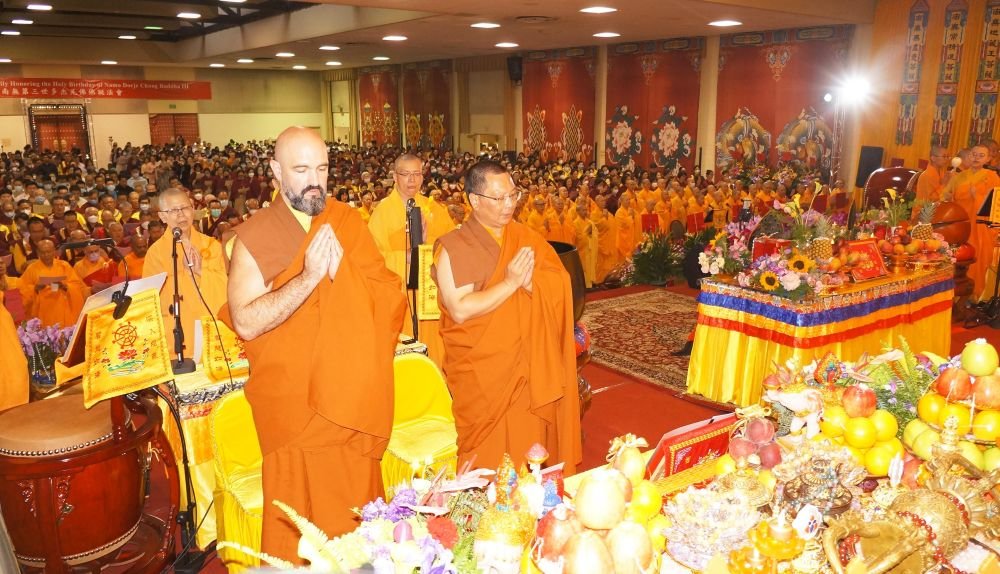
Glendale, CA — May 30-31, 2025 — In a profound expression of global devotion, more than a thousand Venerables, Dharma Masters, Rinpoches, and lay practitioners gathered at the Glendale Civic Auditorium in Los Angeles County to honor the Holy Birthday of H.H. Dorje Chang Buddha III, the Pope of Buddhism.
In the solemn Dharma Assembly, the spiritual sounds of bells, drums, and other Dharma instruments created an atmosphere of reverence throughout the venue. With participants from diverse cultural backgrounds and nationalities, the assembly highlighted unity through spiritual harmony. The rituals—including scripture recitation, invocations, and ceremonial offerings—provided a transformative spiritual experience for all attendees.
A momentous highlight of the event was the presentation of five newly published volumes of the Namo Dorje Chang Buddha III Complete Sutra Collection, symbolizing the growth of the True Buddha Dharma. The congregation celebrated the invaluable teachings expounded by H.H. Dorje Chang Buddha III, whose profound wisdom continues to inspire disciples in their pursuit of liberation.
Speaking at the Dharma Assembly, Venerable Tsemang, Director of the Office of H.H. Dorje Chang Buddha III, emphasized that the ultimate goal of every Buddhist disciple is enlightenment and liberation. He noted that H.H. Dorje Chang Buddha III has expounded the authentic Buddha Dharma to guide sentient beings across the ocean of suffering, urging practitioners to uphold steadfast devotion, diligent study, ethical precepts, sincere practice, and deep introspection.
The event welcomed spiritual leaders, scholars, dignitaries, practitioners, and many non-religious individuals from around the globe, united by a shared respect for the compassionate wisdom of H.H. Dorje Chang Buddha III.
Photo Courtesy: Shawn Liu (Venerable Mozhi and Venerable Tsemang guided the congregation in the Dharma Assembly.)
Venerable Chadima, founder of the Nagananda International Institute for Buddhist Studies in Sri Lanka, offered heartfelt homage and shared his experiences of receiving teachings from H.H. Dorje Chang Buddha III.
Zhaxi Zhuoma Rinpoche, president of the Xuanfa Institute and abbot of the Holy Vajrasana Temple and Retreat Center, spoke about her journey of looking for an experience of Buddhism that was similar to the Buddhism in ancient times when Shakyamuni Buddha was here. After many years of searching, she described finding the same kind of experience when she met H.H. Dorje Chang Buddha III.
Ven. Bhikkhuni Dr. Pannavati, abbot of Heartwood Refuge Monastery in North Carolina, shared her joy in getting together with brothers and sisters in the Dharma who study under H.H. Dorje Chang Buddha III. She expressed that it felt as though they were one big family, despite coming from all corners of the world.
During the Dharma Assembly, participants respectfully chanted the Sutra on Understanding and Realizing Definitive Truth and made meal offerings to the Buddhas. Through religious rituals—Sutra recitation, invocation chanting, mantra practice, and devotion—attendees collectively prayed for the flourishing of the True Dharma, the swift liberation of all sentient beings, and the realization of lasting peace, prosperity, and happiness throughout the world.
To honor the occasion, the H.H. Dorje Chang Buddha III Cultural and Art Museum in Covina, CA, presented an exclusive Dharma recording expounded by H.H. Dorje Chang Buddha III, which had previously not been available to the public, alongside a life-release event dedicated to benefiting living beings.
Buddhist communities in Canada, Germany, Malaysia, China, Sri Lanka, Peru, Japan, Thailand and other countries and regions across the globe also commemorated this day with Dharma Assemblies, life-release ceremonies, charitable events, and educational aid initiatives. These activities illustrate the expansive reach of H.H. Dorje Chang Buddha III’s compassionate influence and the shared aspiration among all beings for enlightenment and liberation.
Photo Courtesy: Shawn Liu (Venerable Chandima, Venerable Pannavati, Buddhist professors and scholars from Sri Lanka, and others attended the Dharma Assembly to honor the Holy Birthday of H.H. Dorje Chang Buddha III.)
This worldwide commemoration not only showcases the deep unity of devotees in upholding the True Buddha Dharma but also reinforces the enduring spiritual inspiration of H.H. Dorje Chang Buddha III—a guiding light of compassion, wisdom, and boundless blessings for our world.
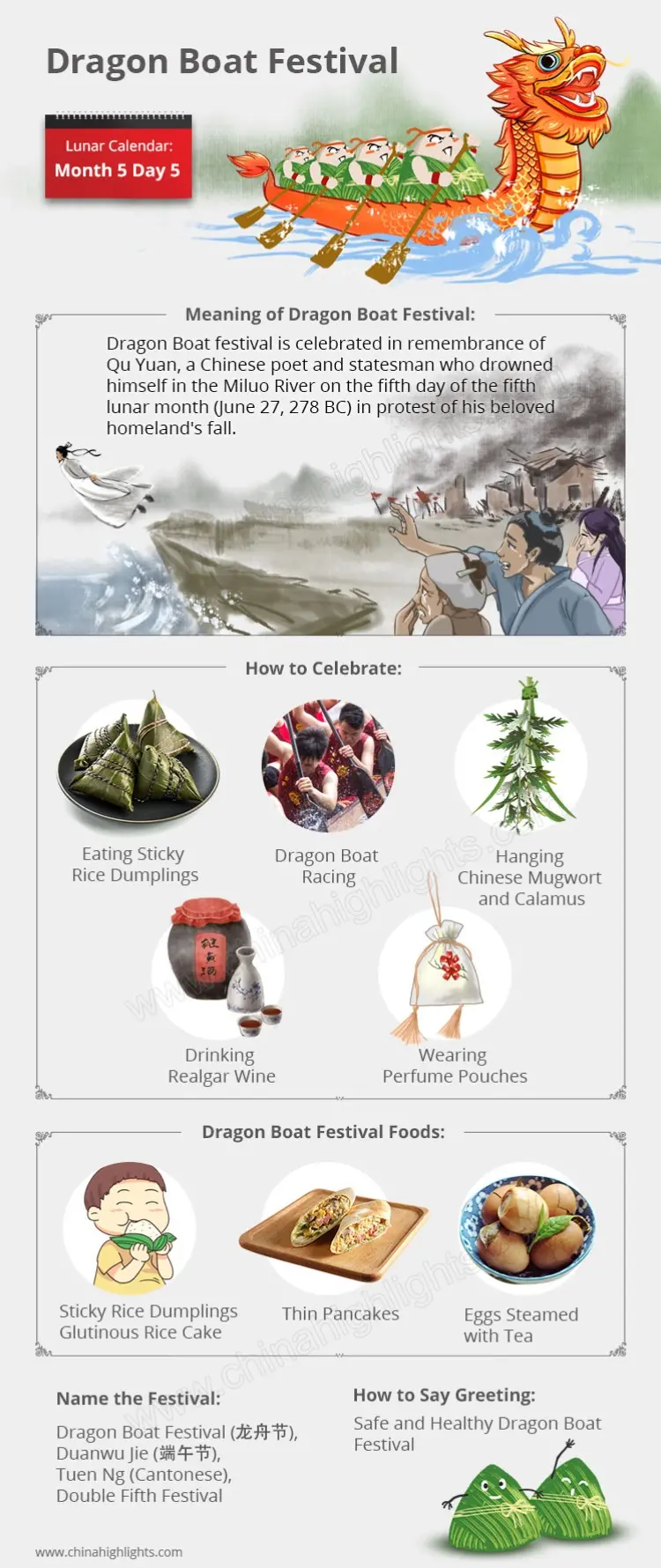
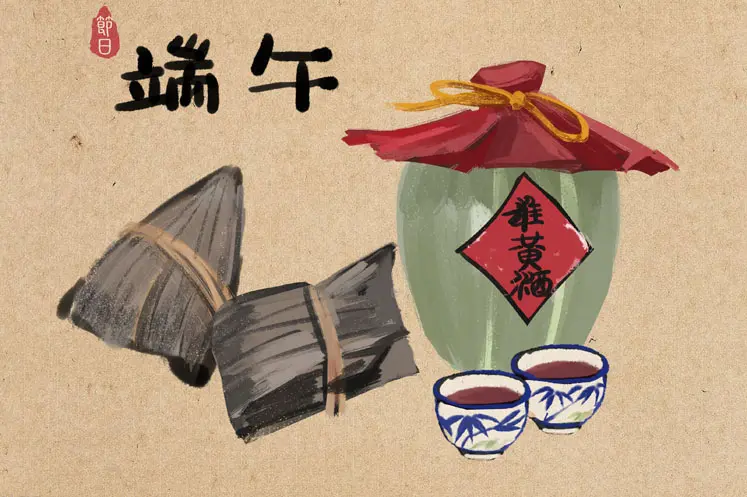
The Dragon Boat Festival, also known as Duanwu Jie, is one of the four major traditional Chinese festivals, alongside the Spring Festival, Tomb-Sweeping Day, and Mid-Autumn Festival. It is celebrated on the fifth day of the fifth month of the Chinese lunar calendar, which is why it is also called the “Double Fifth Festival” (Chongwu Jie, 重五节). On the Gregorian calendar, it usually falls in late May or early June.
In addition to Chinese mainland, many other Asian countries and regions also celebrate this festival. In Malaysia, Indonesia, Singapore, and Taiwan, China, it is known as Bak Chang Festival (‘Dumpling Festival’). Learn more facts about the Dragon Boat Festival
Why Is Dragon Boat Festival So Important?
Many believe that the Dragon Boat Festival is celebrated to commemorate the death of Qu Yuan, a renowned Chinese poet and minister known for his patriotism and profound contributions to classical poetry. He ultimately became a national hero.
However, historical evidence shows that the origins of the Dragon Boat Festival actually predate Qu Yuan’s death. The festival’s earliest roots are tied to the fifth lunar month, which the ancients considered the “month of poison.” As summer began, people were more prone to illness, and epidemics often spread. This made the month seem ominous, prompting ancient communities to adopt various practices to ward off disease and evil spirits.
Thus, the Dragon Boat Festival was originally observed as a traditional health and wellness festival. It was a time for people to carry out rituals and customs aimed at protecting themselves from illness and repelling harmful forces.
Dragon Boat Festival Customs
The customs of the Dragon Boat Festival can generally be divided into two main categories. One centers on honoring dragons and historical heroes—most notably Qu Yuan—while the other focuses on warding off evil spirits and promoting health and well-being.
1. Honoring Heroes and Dragons
a. Eating Sticky Rice Dumplings
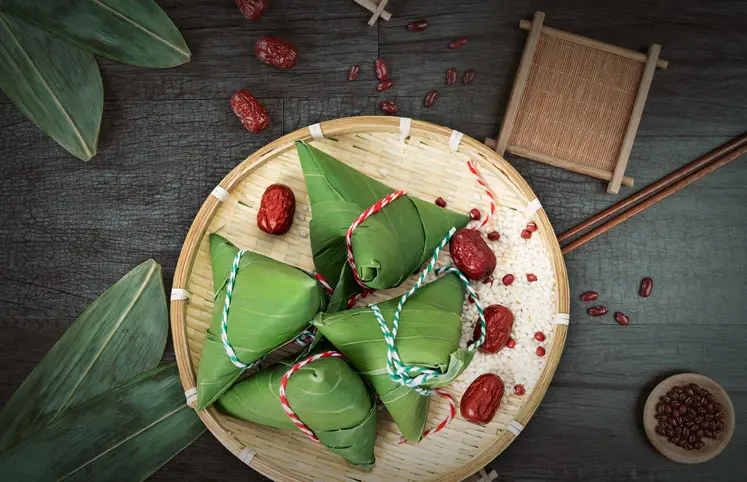
Zongzi (粽子, zòngzi) are the most iconic food of the Dragon Boat Festival. According to legend, after the patriotic poet Qu Yuan drowned himself in the river, local people threw lumps of rice into the water to prevent fish from eating his body. This evolved into the custom of making zongzi.
Traditionally, families would prepare and share homemade zongzi. Today, while some older generations still hand-make them, most people buy them from restaurants or bakeries.
Zongzi are made with glutinous rice and often filled with meats, beans, or other ingredients. They are wrapped in bamboo or reed leaves into triangular or rectangular shapes and tied with soaked stalks or colorful silk cords. Flavors and fillings vary widely across different regions of China.
b. Participating or Watching Dragon Boat Races
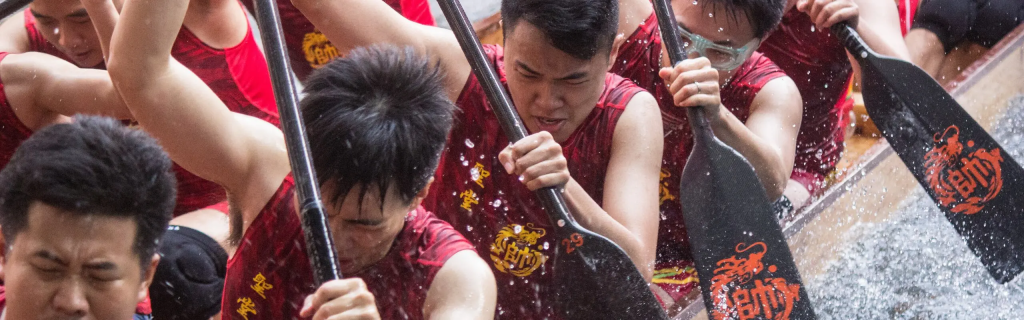
Dragon boat racing is the most exciting and prominent activity during the festival. The sport is said to have originated from people paddling out in boats to search for Qu Yuan’s body after his tragic death in 278 BCE.
Another theory suggests that the races originated more than 2,000 years ago as a ritual to worship the Dragon God or Water God.
The boats are traditionally carved and painted to resemble dragons. Depending on the region, each boat can carry 30 to 60 paddlers. Teams row in unison to the rhythm of pounding drums, creating a thrilling and energetic spectacle. Winning is believed to bring good luck and happiness for the year ahead.
Some of the most famous races take place in Hong Kong, Guangzhou, and Hangzhou.
2. Warding Off Evil and Promoting Health
a. Hanging Chinese Mugwort and Calamus
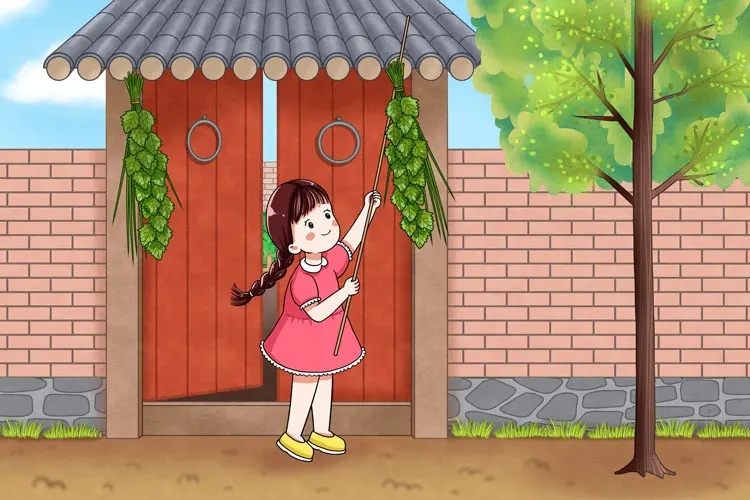
The festival coincides with the early summer season, a time when illnesses were historically more common. Mugwort and calamus are medicinal herbs used to prevent disease and repel pests. Their strong fragrances are believed to drive away flies, mosquitoes, and negative energies.
On the fifth day of the fifth lunar month, people clean their homes and hang these herbs on their doors to protect against illness and bring good luck.
b. Drinking Realgar Wine
A traditional saying goes: “Drinking realgar wine drives away disease and evil spirits.” Realgar wine is made from fermented grains and realgar, a red mineral (arsenic sulfide) once believed to be an all-purpose antidote.
Historically, people drank realgar wine to kill insects, detoxify the body, and protect against spiritual harm.
c. Wearing Perfume Pouches
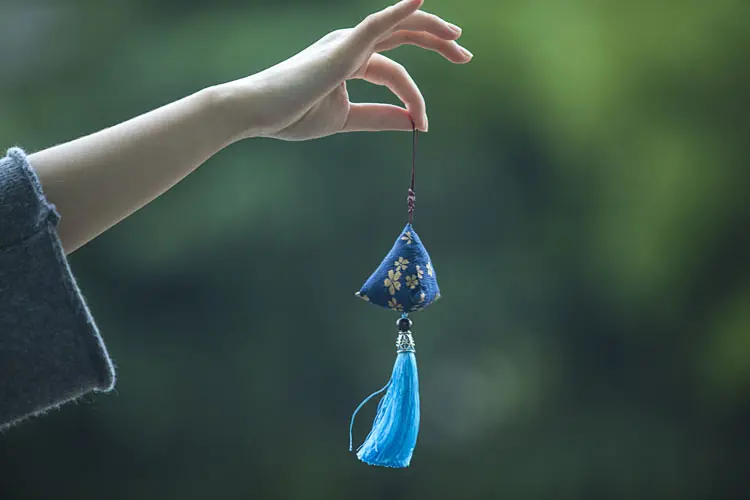
Before the festival, parents prepare small, colorful silk pouches filled with fragrant herbs or perfume for their children. These are either worn around the neck or pinned to clothing as ornaments.
Perfume pouches are believed to offer protection from evil spirits and disease, and are a cherished custom that blends health with artistry.
The Origins of the Dragon Boat Festival
There are many legends about the origin of the Dragon Boat Festival. The most popular ones are as follows:
The Death of Qu Yuan
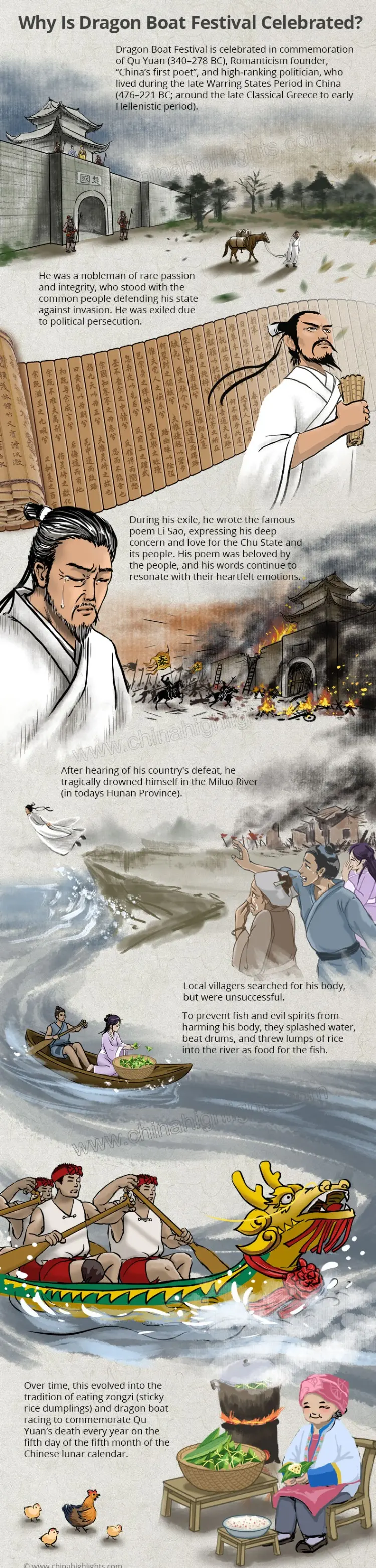
The most widely accepted origin of the Dragon Boat Festival is its commemoration of Qu Yuan (340–278 BCE), a patriotic poet and loyal official of the Chu State during the Warring States Period. When his beloved state fell to the Qin, Qu Yuan, devastated by the loss, drowned himself in the Miluo River on the fifth day of the fifth lunar month.
Local people, deeply moved by his patriotism, raced out in boats to rescue him or retrieve his body, but their efforts were in vain. To keep fish and evil spirits from disturbing his remains, they beat drums and threw rice dumplings into the river. These traditions evolved into the dragon boat races and the custom of eating zongzi that continue today.
The Unlucky Fifth Month
Another explanation for the origins of the Dragon Boat Festival relates to the traditional Chinese calendar and seasonal beliefs. Since ancient times, the fifth lunar month was considered an unlucky time and was even referred to as the “Month of Poison” (毒月). This was when the “Five Poisonous Creatures” (五毒 wǔ dú)—centipedes, scorpions, snakes, toads, and spiders—began to appear in greater numbers due to the warming weather. Disease, pestilence, and natural disasters were also more prevalent during this period.
The fifth day of the fifth month, or the “Double Fifth,” was seen as especially ominous. To protect themselves, people hung wormwood and calamus on their doorways and wore sachets of fragrant mugwort (xiāng bāo, 香包). The sword-like shape and pungent aroma of calamus were believed to repel both pests and evil spirits. For this reason, the Dragon Boat Festival is also sometimes referred to as the “Calamus Festival” (菖蒲节 Chāngpú Jié).
These rich and varied customs reflect the Dragon Boat Festival’s deep cultural significance, blending ancient health practices with heartfelt traditions of honor, protection, and community celebration.
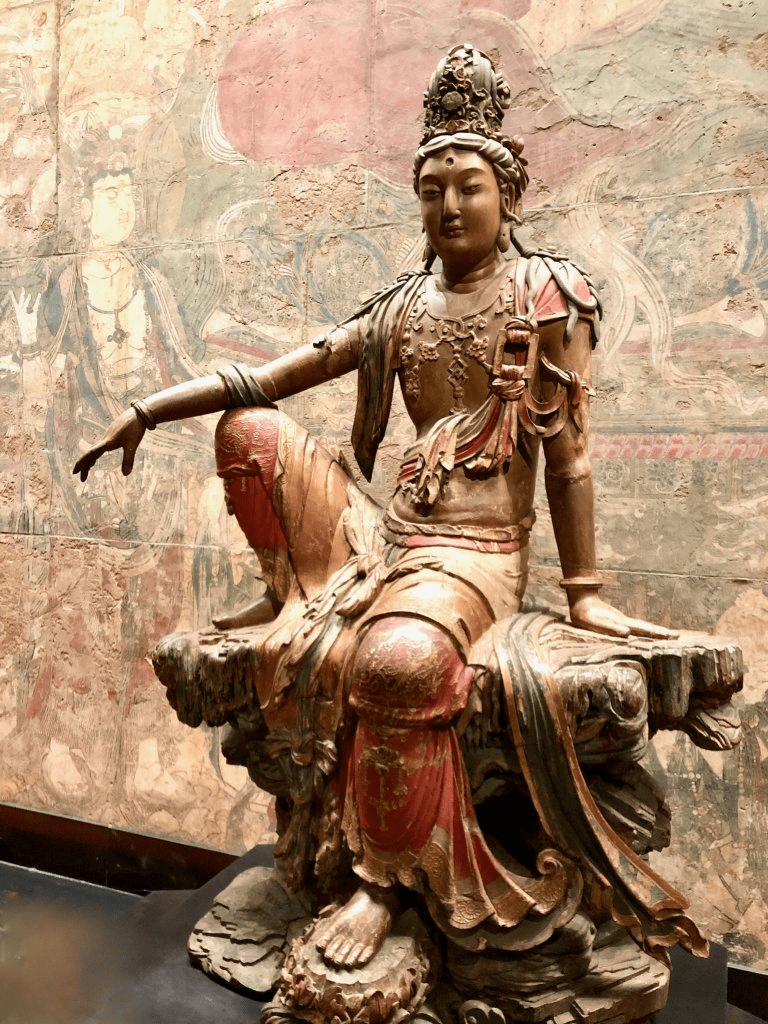
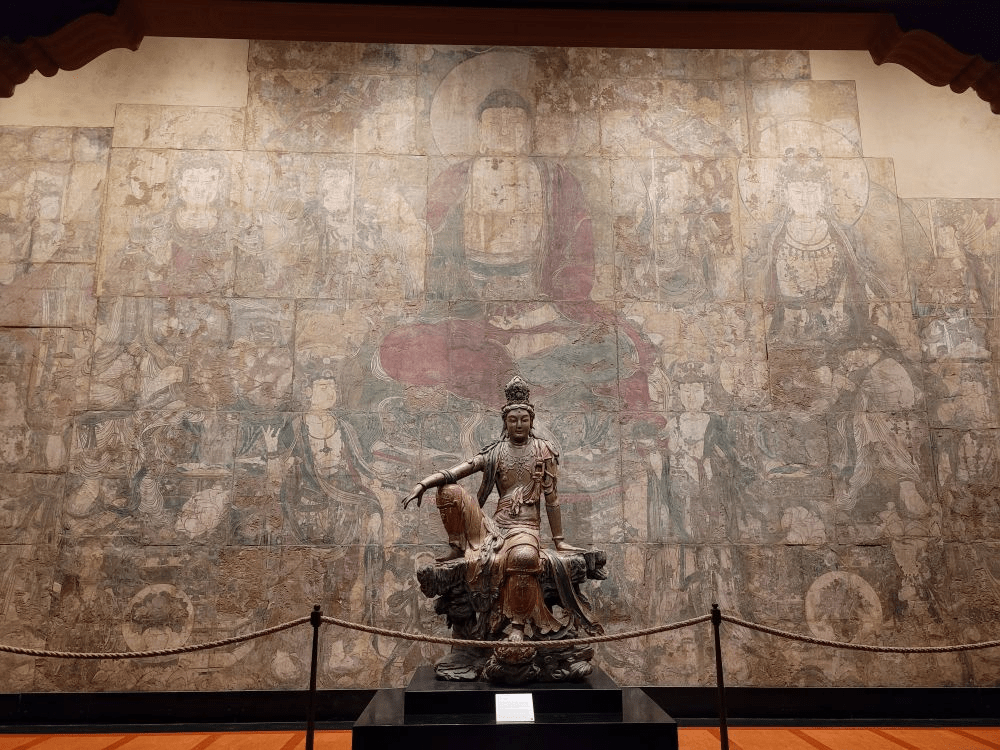
Tucked within the tranquil halls of the Nelson-Atkins Museum of Art stands a breathtaking wooden sculpture of Water-Moon Guanyin from the Liao Dynasty—a work hailed as “the most magnificent surviving sculpture in China” and “a triumph of religion and aesthetics.” It has also been honored by the media as “one of the thirty finest works held in American public institutions.”
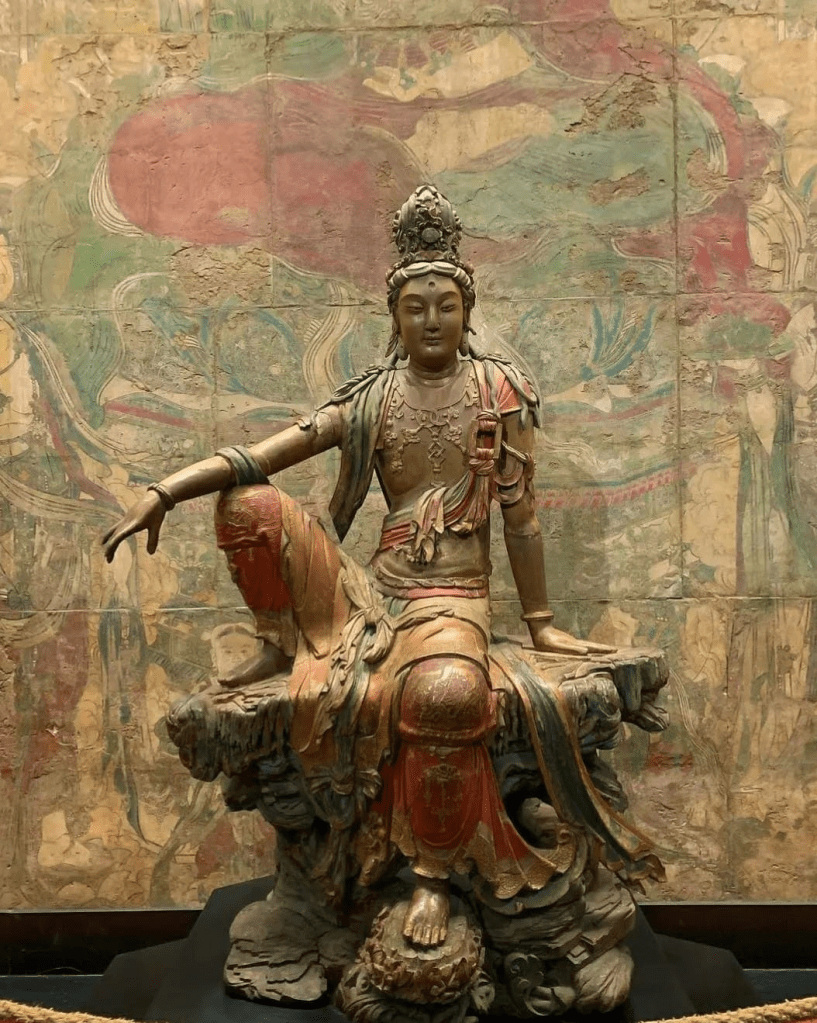
Officially labeled by the museum as “Guanyin of the Southern Sea,” this statue rises to an impressive height of 2.4 meters. Aside from the right forearm, the entire figure—including its base—was masterfully carved from a single block of wood. Dating back to the 11th or 12th century (Liao or Jin Dynasty), the sculpture has been remarkably well-preserved over the centuries.
This Guanyin is an extraordinary example of religious artistry. Her face is gently sculpted with refined features—serene, graceful, and quietly majestic. Adorned with a jeweled crown, her eyes are softly closed, gazing downward in meditation and compassion. The statue’s pose reflects the elegance and wisdom traditionally associated with the feminine form, especially in the flowing hand gestures—while still retaining some subtle masculine traits in the upper body, a nod to Guanyin’s transcendent nature.
In classic iconography, Water-Moon Guanyin is often portrayed seated on a rock or lotus throne, gazing compassionately at the world. In this sculpture, she sits with one leg bent and the other gracefully draped downward. Her right arm rests lightly on her knee, fingers gently curved, as she gazes diagonally downward with a calm smile—evoking the image of the moon reflected in water. This visual metaphor powerfully symbolizes a core Buddhist teaching: the illusion of form and the essence of emptiness.
Every aspect of the statue—the proportions, the flowing posture, the tranquil expression—conveys a sense of effortless grace, inner freedom, and compassionate presence. It is a piece that invites quiet reflection, stirring something deep within the soul of the viewer.
The Legend Behind the Water-Moon Guanyin
The form of Water-Moon Guanyin, also known as “Auspicious Water Guanyin” or “Auspicious Water Bodhisattva,” is one of the most beloved among the thirty-three manifestations of Guanyin in Chinese Buddhist tradition. Interestingly, the name “Water-Moon” does not come from early Buddhist scriptures, but rather from Chinese folklore—born of the fusion between Buddhism and indigenous Chinese culture.
According to legend, Guanyin once appeared in Suzhou during a time of war, where she witnessed the brutal slaughter of civilians by the Jin army. Out of great compassion, she transformed into a beautiful woman, built a ritual platform, and began chanting sutras to deliver the souls of the dead. When her recitation was complete, someone among the crowd recognized her divine aura and asked to see her true form.
The Bodhisattva pointed to the riverbank. There, reflected in the still waters, was the image of a radiant full moon, within which her sacred figure appeared—graceful and ethereal. Among the witnesses was a talented artist named Qiu Zijing, who quickly sketched the vision. As his painting circulated, this image came to be known and venerated as the Water-Moon Guanyin.
A Space Worthy of the Divine
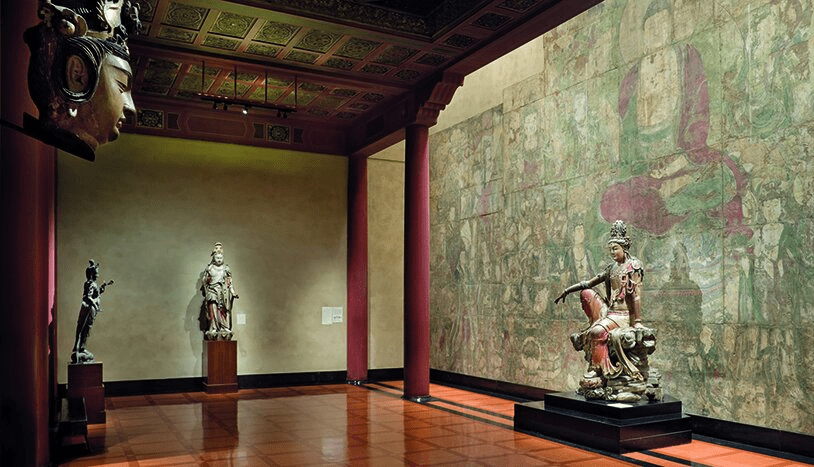
To properly honor this extraordinary statue, the Nelson-Atkins Museum created an expansive Chinese Temple Gallery. Behind Guanyin stands a Yuan Dynasty mural titled “Assembly of the Radiant Buddha,” originally from Guangsheng Temple in Shanxi Province. Above hangs a carved Ming Dynasty coffered ceiling adorned with dragons, while in front, finely carved lattice doors from a Qing Dynasty official’s residence in Beijing complete the immersive setting.
This harmonious environment allows visitors to experience the sculpture not just as a museum piece, but as a living expression of faith, beauty, and timeless spiritual insight.
The Water-Moon Guanyin at the Nelson-Atkins Museum is more than an ancient sculpture—it is a sacred embodiment of compassion, artistry, and transcultural storytelling. Whether viewed through the lens of religion, history, or aesthetics, it stands as a serene reminder of the enduring power of beauty to transcend time and touch the human spirit.
A walkway in Enshi Canyon, China’s Grand Canyon. Jean Spoljaric photos.
A Visit to the Chinese Grand Canyon in Enshi
By Jean Miller Spoljaric
My trip to the Hubei (Hu-bay) Province of Central China proved to be a real eye-opener. It was a culture shock for me, but life as they know it for them. I traveled from Beijing to Wuhan, China, and on to Enshi, the home to China’s Grand Canyon.
Enshi city was vibrant and alive, but nothing could have prepared me for the China I was about to see in the mountainous areas of Enshi Canyon. Several times during the trip, I reminded myself that, sometimes, ‘Less is More.’
Location
The view from the top of Enshi Canyon is breathtaking.
Enshi is the capital city of Hubei Province and is located inland, in the southwest region of Hubei. It’s an area of immense natural beauty with soaring mountains, deep canyons, meandering rivers, and great waterfalls. The mountain village is a two and a half-hour car ride from the bustling city.
The mountaintops are high above the skyline and the thousand-zhang waterfalls that tumble to the canyon floor below, feeding the underground rivers that flow through the Qungjiang River Valley of virgin forests and ancient villages.
Enshi proudly displays the peaks and valleys of what is known today as China’s Grand Canyon.
Enshi Grand Canyon
The Enshi Grand Canyon is located in Tunbao Village in the Town of Banqiao, high above the clouds. I climbed my way to the summit and experienced the views of a lifetime. Altogether, I hiked three of the five precipices in Enshi Canyon.
I was in awe as I gazed out toward the mystical land. The puffy clouds seemed close enough for me to touch and the precipices were like giant stalagmite stone fingers reaching toward the heavens.
Free from the hustle and bustle of the rest of China, there were no beeping horns, no crazy mopeds; just the serene stillness and beauty of nature.
A 67-Mile Canyon
The Enshi Canyon has a total length of 108 km (67 miles) and the total area is more than 300 sq. km (about 74,000 acres, or 115.8 sq. miles). As it’s only 1.7 miles wide, it makes the canyon long and narrow.
By comparison, the American Grand Canyon (1,218,560 acres/ 1,904 sq. miles) could hold sixteen Enshi Grand Canyons.
The significant difference between the two is that Enshi Grand Canyon is lush as opposed to the barren desert-like topography of America’s Grand Canyon.
Still, all the splendor and physical features that one would find in America’s Grand Canyon are contained within this smaller area, so it makes it a great place to visit for a day trip or longer.
All hard work and smiles, always, in Enshi.
The Magic
As I climbed the steep ridges of the mountains, at each turn, I came across villagers selling cold drinks, cooked potatoes, and hard-boiled eggs soaking in tea. Not an easy day’s work!
I was amazed at how the elders set up camps every day, hiking up and down these mountains with large sacks strapped on their backs. Great exercise keeps them fit.
As I paused to drink my water and catch my breath, a woman twice my age, with a gentle smile on her face, passed me. I used the universal sign for a photo to ask if I could take a picture. Her look of concern was followed by a big smile.
Moments after snapping the image, I shared it with her and several others who had stopped to watch. They seemed amazed at seeing themselves in the viewfinder. It was magic and they wanted more pictures.
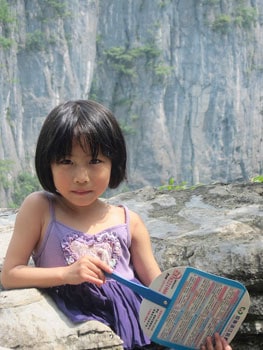
This pretty little girl hiked the Enshi Grand Canyon with her family. I was proud of her as she kept up with everyone!
Then, a little boy stopped and pointed to my iPod. I let him listen to a song and his face beamed with amazement! More magic!
And, just like that, any concerns were replaced with trusting smiles. As we smiled and laughed together, the language barrier seemed to disappear.
Giant Golden Panda
As a tall, blond, westerner, I felt the introspective eyes of the locals on me in the more urban areas, but nothing prepared me for my reception in the isolated mountain settlements.
For many of the mountain people of Enshi, it appeared to me that I was the first American they had ever seen.
The children surrounded me, seemingly mesmerized by my blonde hair and green eyes. Mothers shooed their children closer to get a better look; the shy little ones hid behind their mother’s skirt, peeking out just enough to fill their curiosity.
My tall stature and lightly colored hair had the men following my every move with their eyes. Women would gather around just to hear me speak.
I felt like a giant golden panda. I laughed to myself as I thought that I haven’t turned this many heads since I was nineteen!
They wanted to know everything about me: who I was, where I came from, why I was there! I’m happy to say, I think I left a lasting positive impression.
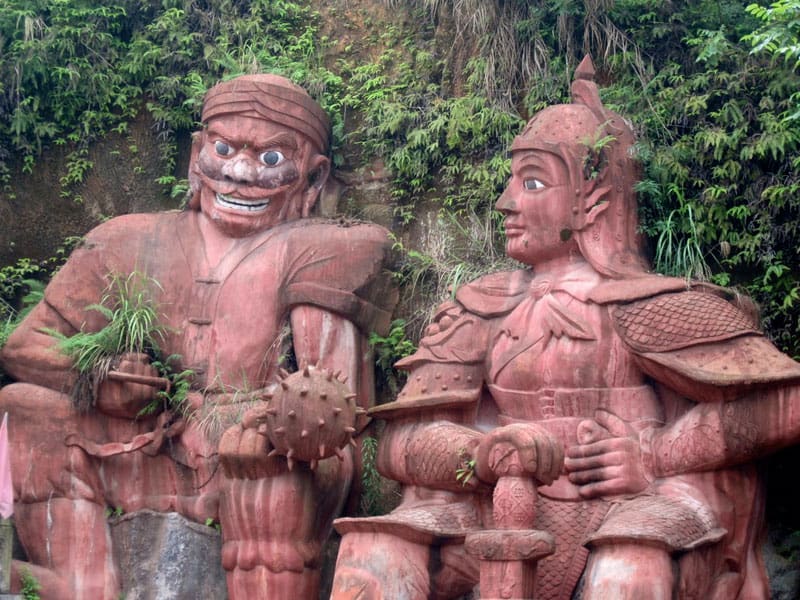
Large statues oversee the grounds at Tusi Castle in Enshi, China.
The People Of Enshi’s Mountains
The people of rural Enshi are kind, hard-working, self-sufficient, and very isolated from the world. They live a hard life off the land, but their big smiles never seem to fade.
They are farmers of vegetables and tea and are proud of their daily life with each other. There is no running water for most and squat toilets for all.
I saw children with no shoes or with one worn pair, and I thought about my children with too many shoes. I saw all the diseased and sick dogs lying in the comfortable shade of old, tired trees and wanted to rescue them all.
I guess it’s all relative. My daily life of iPods, cell phones, and laptops is a world away from the mountain people of Enshi. They are surrounded every day by trees, lakes, rivers, waterfalls, and beautiful lush green mountains. Maybe, they have it right!
The Other Enshi
There is another world below the mountains in the city of Enshi. By day, I would recommend a visit to Tusi Castle. It dates back to 700 AD and is a lesson in the culture of the area.
This Chieftain castle was destroyed by a fire in 2004 and perfectly restored soon after.
It is home to the largest archaized Pagoda style buildings in China.
As I wandered through the exhibits of architectural and decorative arts, I felt like I was walking through a living book. It tells the story of the Tujia folk cultures through sculptures, gardens, artwork, and furnishings.
Afterward, there is a must-see play that features the primitive reenactment of the local Chinese culture. It will make you feel as if you’ve been transported back in time.
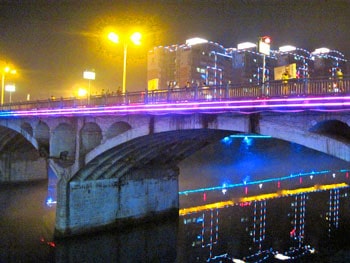
Enshi City is alive and beautiful in the evening.
Lunch in Dingshihui
Make sure you head to Dingshihui for lunch! During a long hot day, I was looking forward to lunch and a drink, but I could never have imagined the surprise that Dingshihui had in store for me.
As I followed my guide up the stairs, my eyes became wide with amazement.
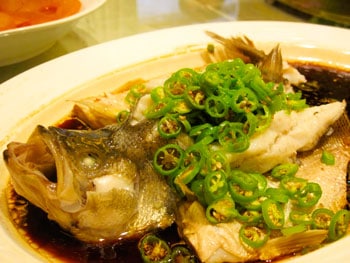
This fish dish is just one of the specialties at Dingshihui in Enshi City.
Dingshihui was like walking through a boutique-style hotel in Manhattan, and the food was incredible! I couldn’t believe that a luxurious oasis such as this existed in this city.
The city came alive in the evening. Neon lights lined the buildings and bridges in the Central Square and reflected off the river below.
There were men gathered in groups playing Mahjong and residents participating in a huge outdoor aerobics class.
The Lesson
The people of Enshi are an extended community where divisions of labor know no age and responsibilities are learned.
And who would have thought that the highlight of my trip to China would be the Grand Canyon of Enshi and the people who live there?
Enshi City
For all I thought I knew about China, it was all that I discovered I didn’t know that has added to the quality of my life. I want to return to this great experience and, if you’re as fortunate as I was, you’ll find a new world to discover.
Useful Information about Enshi China
Dried snake anyone?
For more information on travel in this area of China contact the CNTO- China National Tourist Office. They were extremely helpful and knowledgeable about all things China.
List of China tourism offices
While in Enshi I used Enshi Railway Travel Service Co., Ltd. They do not have a website so it makes it difficult to book anything in advance, but I assure you if you contact them directly upon your arrival in China they will make sure you have the time of your life.
They are located at No. 64 Hangkong Road, Enshi City. the phone number you can reach them at is (0086-718-) 8236262. Ask for Lucy to be your trusted guide; she will take wonderful care of you from start to finish.
To and From
I flew Air China from JFK Airport in NYC into Beijing Airport. I also flew China Southern throughout Hubei Province, Wuhan, and Enshi. Both airlines went out of their way to make me comfortable, the staff was friendly and the seating spacious.
The Enshi Dingshihui Dining Management Company, Ltd. Restaurant has no website. It remains a bit of a mystery. Ask your guide or taxi driver to bring you to the fanciest place to eat in Enshi City; I promise they will know. I do have phone numbers. Once you arrive in Enshi you can try your luck: 0718-8411717 or 0718-8495282.
While in Wuhan I was lucky to stay at the beautiful Shangri-La Hotel. The Shangri-La is located in the Hankou business area and is only 25 minutes from the Tianhe International Airport and only 15 minutes from the Yangtze River Pier.
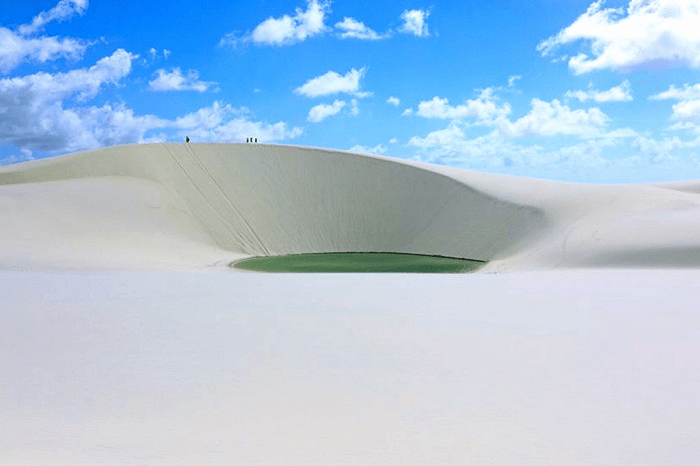
The world is vast and full of wonders—astonishing and rare phenomena that defy the imagination. One such marvel lies in Brazil: a desert with white sand dunes, turquoise and blue-green lagoons so clear you can see the bottom, filled with fish and shrimp, and set against the backdrop of breathtaking sunsets. This place seems like a paradise on Earth. It’s called Lençóis Maranhenses National Park, often hailed as “the most beautiful desert in the world.”
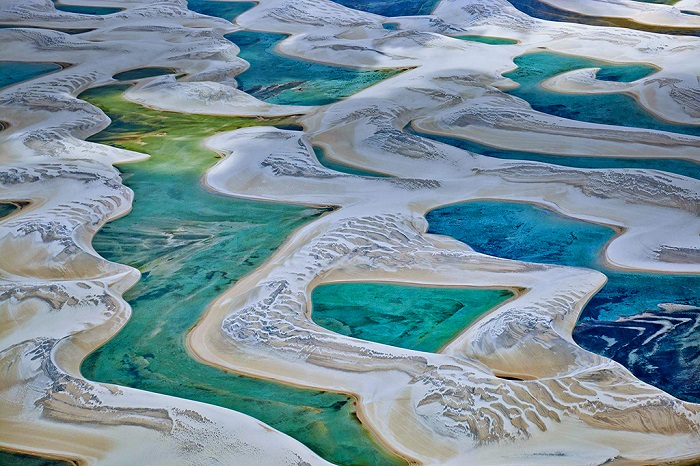
Unlike typical deserts, this one is dotted with thousands of lagoons formed during the rainy season, creating an extraordinary landscape of white dunes and vivid blue lakes—a natural masterpiece that amazes all who see it. You may have been lucky enough to visit, or perhaps not, and maybe you’ll never get the chance to go. But today, I’m bringing this distant beauty to you. Even if you never travel 80,000 miles around the globe, you can still enjoy the most spectacular visual experience.
A Celestial Land on Earth — The Desert of a Thousand Lakes
When people think of deserts, they often picture vast, lifeless stretches of yellow sand under a scorching sun. Water is scarce in deserts, and the sight of numerous lakes teeming with aquatic life is almost unheard of. Yet, such a magical place does exist on Earth—a place where endless deserts and crystal-clear water coexist. In this desolate land, fish and shrimp thrive. Aptly named the “Desert of a Thousand Lakes,” it is the wettest desert in the world and will completely change your perception of what a desert can be.
Located in Maranhão state in northern Brazil, just east of São José Bay and bordering the Atlantic Ocean, this desert spans 1,500 square kilometers. Despite its abundant rainfall, it has little vegetation, making it a rare desert landscape in northern South America. Scattered across the white sea of sand are countless lagoons of various sizes and colors. Fish and crabs can be seen swimming in the water, and the location is perfect for watching the sunset. Immersed in this surreal landscape, one visitor said: “So eerily beautiful, it’s breathtaking.”
How the Desert Lakes Are Formed
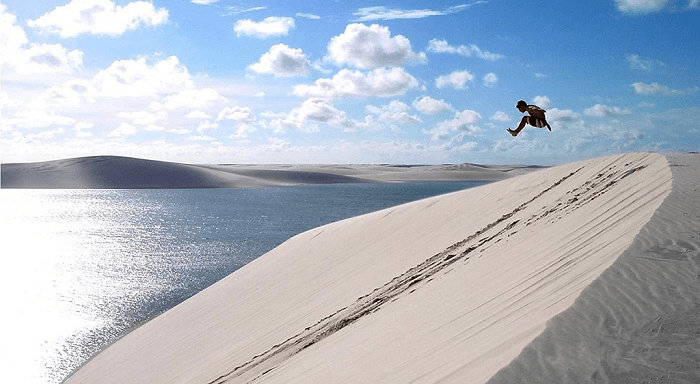
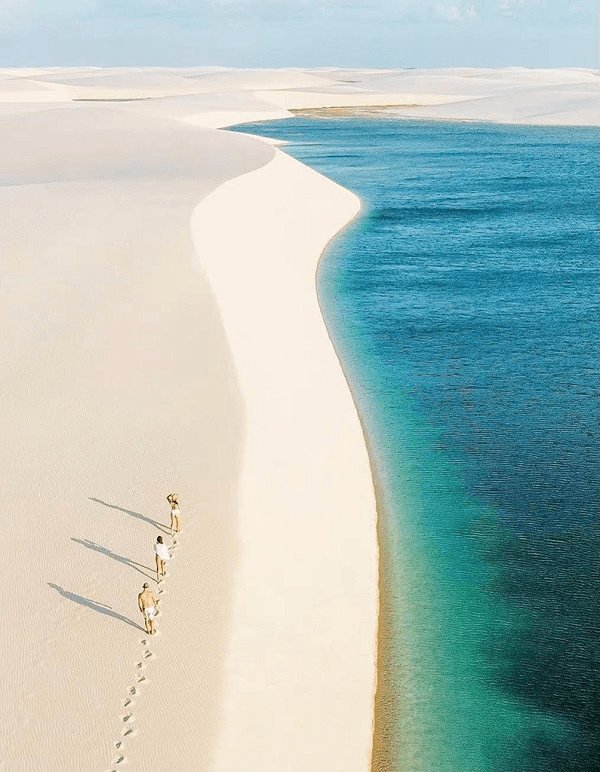
During the rainy season, valleys between dunes fill with rainwater, creating temporary lagoons that can reach depths of up to 3 meters. Every year, thousands of tourists from around the world flock here to witness this rare phenomenon. The white dunes and turquoise lagoons interlace like a massive piece of emerald from afar. Sparkling fish swim in the clear waters, while shepherds lead flocks over tall dunes and fishermen head out to sea under star-filled skies.
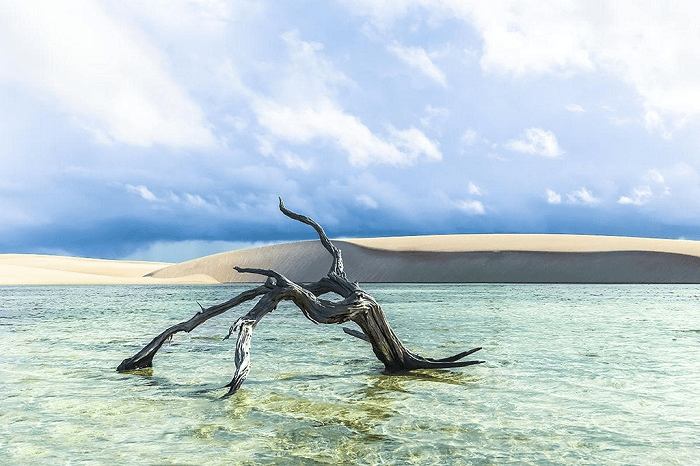
As the rainy season ends, the equatorial heat begins to evaporate the water. The lagoons can lose up to a meter of water per month, and during the dry season, they vanish completely, leaving only dry sand. Yet the dry season has its own unique beauty, with shimmering white waves of sand stretching to the horizon. From above, the crescent-shaped dunes resemble giant, sun-bleached linen sheets—hence the name “Lençóis Maranhenses,” meaning “sheets of Maranhão” in Portuguese.
This unique landscape is the result of geography and weather. With an annual rainfall of 1,600 mm—300 times more than the Sahara—rainwater is trapped beneath the sand by an impermeable rock layer, forming lagoons in shades of blue, green, and black. Nearby rivers carry heavy sediment, which is deposited at their mouths. In the dry season, strong coastal winds blow the dry sand inland, gradually creating this desert over time.
Situated along Brazil’s northeastern coast, Lençóis Maranhenses benefits from the country’s high rainfall, thanks to the world’s largest tropical rainforest. This abundance of water gives rise to the unique scenery that makes it the most beautiful desert on Earth.
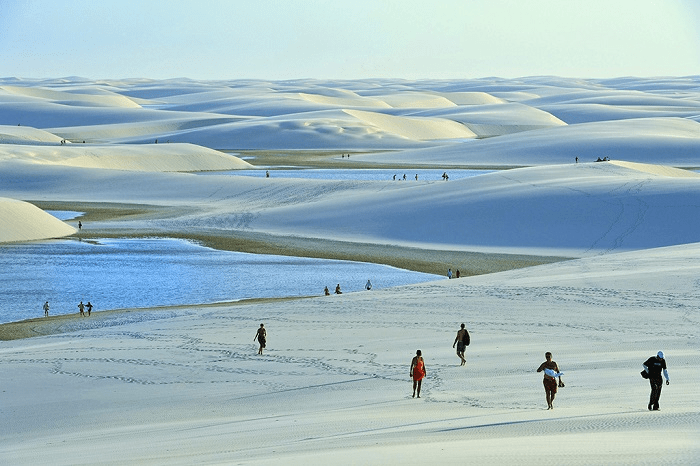
Originally called Lençóis Maranhenses, the desert is now more popularly known as the “Desert of a Thousand Lakes” and has been designated as a national park. Covering over 1,500 square kilometers, it stretches 50 kilometers inland from the dunes to the beach. The landscape is so striking that it captivates every visitor. In this place, where you would expect lifeless sand, there is water, fish, and thriving life. It’s a dream for photographers—every snapshot is like a cinematic masterpiece. You can hike with a backpack, camp, and swim in the lake that catches your eye. As the sun sets, the colorful clouds create a scene of pure magic.
A popular way to explore is by helicopter, which offers a 35-minute aerial tour across the desert. However, this misses the chance for a close-up experience. The best way is still to go in person.
From the state capital São Luís, it takes about 5 hours by car to reach Barreirinhas, the town closest to the desert. There are four daily bus services despite the high number of tourists. Barreirinhas is the main gateway into the heart of the desert.
We chose to enter the desert by water and exit by land. Riding a speedboat, we stopped at various scenic spots along the way. At a small town dock, we sampled a local fruit wine made from simply fermented mixed fruits—refreshing and unique, only $2 per glass.
At the desert’s edge, mangroves thrive, home to crabs, clams, and birds. The white sand dunes and blue lagoons make this place seem like paradise. It’s perhaps the world’s most surreal desert—where extremes meet: desert and lake, dry and wet. From afar, the landscape looks like a massive jade in white and green.
Nature’s Secrets of the Desert
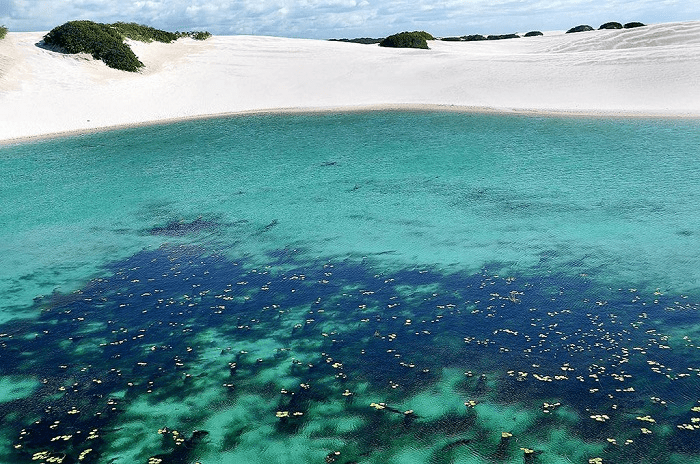
From January to June, heavy rainstorms occur almost daily. Instead of soaking into the sand, the rainwater collects in valleys between the dunes. These clear, sky-colored lagoons can appear bright blue, turquoise, or even golden at sunset. Teeming with fish and shrimp, people come here to fish, swim, or just enjoy the view.
Vegetation is sparse, as the sand has buried most of it over millennia. Under intense sun, surface temperatures can reach 80°C. The local name “Lençóis Maranhenses” captures the look of the dunes—like stretched, sun-dried linen sheets.
A Paradise of Adventure and Beauty
Thousands of lakes with different shapes and depths dot the desert, each reflecting a different color—deep blue, light green, or even reddish-brown when covered in algae. Locals give the lakes poetic names like Blue Lake, Love Lake, and Lake of Hope, reflecting their dreams and sentiments.
The most popular lakes, Blue Lake and Green Lake, are near Barreirinhas. Known locally as the “big sheet” and “small sheet,” Blue Lake is the largest, deepest, and most vibrant—and full of fish and crabs. Swimming here is not only refreshing but also offers a playful interaction with the aquatic life.
By day, the desert becomes a massive water park. You can pose for stunning photos, go on desert hikes, ride off-road jeeps with guides, or climb a dune and race down for thrills. You can even enjoy natural water slides and rafting in lake channels.
At peak water levels, adrenaline-seekers come here for kite surfing—an extreme sport powered by large kites that’s challenging but exhilarating. As dusk falls, the desert becomes a living oil painting.
Aerial Views and Jungle Adventures
For a different perspective, take a helicopter tour (about $130 USD per person) to see the lunar landscape of crescent dunes from the sky. It truly looks like linen sheets blowing in the wind.
Besides the lakes and dunes, you can explore nearby rainforests by boat, visit playful monkeys, climb lighthouses for panoramic views, or ride ATVs across the dunes, sip fresh coconuts, and savor uniquely flavored Brazilian grilled shrimp.
Final Thoughts
The Desert of a Thousand Lakes is a once-in-a-lifetime experience. During the rainy season, it transforms into an otherworldly wonder, where desert and water form a surreal harmony. But this miracle lasts only a few months each year—June and July are the best times to visit, as the lagoons are at their fullest before they begin to evaporate with the arrival of the dry season.
This desert defies logic and reshapes your understanding of the Earth. If you ever have the chance to go, don’t hesitate. It’s not just a journey—it’s a revelation.





























 Peace LiLy