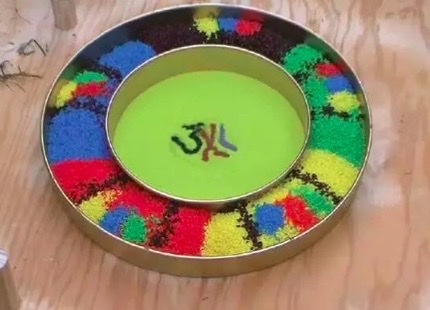
I have Attained A very Special and Sacred Assembly

The Dharma of Selection in Dark Confinement

In esoteric Buddhism, a multitude of Dharma categories exists. Among these, within the realm of decision by selection, “the Dharma of Selection in Dark Confinement” holds a prestigious position as an advanced and profound teaching. This particular Dharma surpasses other practices such as “the Dharma of Inquiry by a Flying Lot,” “the Dharma of Selection with Mani Stone,” “the Dharma of Lot Drawing from a Golden Vase,” and “the Dharma of Card Drawing Across the Curtain.” It even stands above the esteemed “Dharma of Vajra Selection,” second in rank only to “the Dharma of Divine Forecasting.”

It’s important to note that participating in the ceremony of “the Dharma of Selection in Dark Confinement” does not inherently imply a person’s high status or identity. The determination of one’s status relies on the outcomes of the selection process. The exceptional aspect of “the Dharma of Selection in Dark Confinement” lies in its ability to precisely unveil an individual’s true identity with absolute certainty.

On December 12th, 2012, a remarkable opportunity graced my life as I attended a live assembly centered around this sacred teaching. The event took place within a magnificent edifice that now houses the H.H.Dorje Chang Buddha Culture and Art Museum. Illuminated against the night sky, the gathering attracted several hundred disciples. Led by an anonymous yet revered figure of great holiness and virtue, the ceremony aimed to bestow the initiation of “Selection Made in Dark Confinement from One-Hundred Dharmas to Choose the Door toward Enlightenment” upon Dharma Master Zhengda (Awang Deji Rinpoche).

The enigmatic spiritual leader entered the assembly hall donning a cone-shaped bamboo hat veiled in darkness, evoking the aura of a martial arts hero from cinematic lore. His countenance remained shrouded, a mystery to all. Swiftly, he proceeded into a petite Buddha hall, safeguarded by a group of rinpoches. The shroud of anonymity around his true identity remained impenetrable to everyone present.

H.H. Dorje Chang Buddha III, the figure whom everyone awaited with the utmost anticipation, graced the hall of the dharma assembly with His presence. The profound sense of blessedness and gratitude that welled up within me was immeasurable, as I had the privilege to worship and attentively listen to the Buddha from such a close vantage point. Furthermore, every attendant could witness to the remarkable transformation of His Holiness into a youthful appearance, an occurrence that transpired in October of that very year, 2012. (For more intricate details, refer to the “Truth about Reversing An Old Age Back to Youth“).


First, dharma masters presented a manuscript containing all one hundred letters of petition to this great holy and virtuous one who would practice the dharma for this dharma assembly. The great holy and virtuous one circled three of the one hundred letters of petition using a pen with red colored ink as the predictions made ahead of time for publishing at the conclusion of the dharma assembly. When the disciple who was subject to the decision by selection drew three letters of petition, the three circled ones would be verified that they all matched the letters of petition actually selected by the disciple. These three then represented this disciple’s correct karmic conditions at that time.
The other ninety-seven letters of petition did not match karmic conditions of the disciple receiving the initiation this time and were all crossed out, indicating they were at least irrelevant if not untrue.
Additionally, a required procedure was to make a seal on the spot. This was very rigorous and was done by dharma masters in person. An un-carved stone seal was rested on both of its ends and unsupported in the middle. With a strike by a hammer, the seal was broken into two pieces. The uneven face of one of the two pieces was ground slightly with sandpaper, while still preserving enough lines and contours from the break. A seal made this way could never be duplicated, even if you attempted to do it ten thousand times. Once the seal was made, it was used at the scene to stamp the one hundred letters of petition written by hand by the disciple. Every letter of petition was stamped so no one could make any falsification.


Dharma Master Zhengda drew three letters of petition by herself in complete darkness. Later with lights on, dharma masters opened them up to verify them. As expected, they all completely matched the three that were circled by the great holy and virtuous one earlier. Then the three were rolled and squeezed again into nubs in front of the public and put together with the other ninety-seven nubs with the same appearance. After mixing them together by shaking the golden vase, they were sent to the great holy and virtuous one for selection. In less than one minute, the great holy and virtuous one selected three. Dharma masters again opened them in public. They were the same ones that Dharma Master Zhengda had drawn earlier. Moreover, they were all stamped by the seal made on the spot.
To verify that the other ninety-seven pieces did not have the same contents, dharma masters opened them all to verify. They were all stamped with the seal made on the spot. Each one was read out by the dharma masters. There wasn’t any repetition at all. All were unique and agreed with the contents in the common manuscript. This fact proved that the Dharma of Selection in Dark Confinement conducted by the great holy and virtuous one was completely carried out by perfect holy realization.


These one hundred letters of petition were all written by the person undergoing the decision by selection, Dharma Master Zhengda. The most important fact was that Dharma Master Zhengda had to take an oath against severe consequences, in front of the offering table and before all people present, to all Buddhas and Bodhisattvas in the ten directions, the eight types of celestial beings, and deities in all heavens.

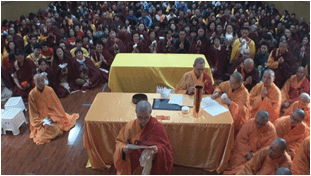
Her oath swore that these one hundred letters of petition were written by her and kept by her; all letters of petition were never touched by the great holy and virtuous one; the drawing of the three letters of petition was done by her in complete darkness without any visibility and were arbitrarily picked; and there was not any falsification from the beginning to the end. If what she said were false, she would definitely descend into the Vajra Hell to suffer forever without any chance of being saved.
This dharma assembly determined for certain Dharma Master Zhengda’s karmic conditions.

The numbers and contents of the three letters of petition selected were respectively:
No. 4: H.H. Dorje Chang Buddha III is the holiest. I am a trusted aide of the Tara. A cultivator building temples has great merit. You will be brought to see the Buddha and become a holy one.


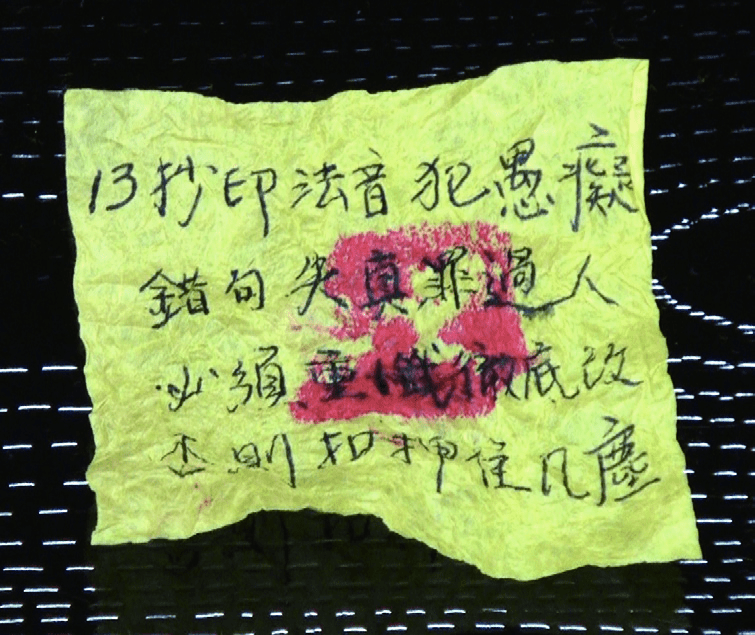
No. 13: Transcribing and copying the recorded dharma lessons was a foolish violation. Making errors in sentences to cause the loss of true meanings made me a person of guilt. I must repent earnestly and correct completely. Otherwise the outcome would be being detained in the mundane world.
No. 69: The dharmas of Lamdre have many levels. The Dharma of Mud-Pill Lamdre is the highest. Having passed the exam proctored by seven monastic masters and ten witnesses, my status is at the summit of esoteric Buddhism.

The selections made by the Dharma of Selection in Dark Confinement concluded that Dharma Master Zhengda was a reincarnated holy one and a trusted aide of the Tara. Her status of the dharma was extremely high, at the upper level representing the summit of esoteric Buddhism.
H.H. Dorje Chang Buddha III conducted “the Dharma of Divine Forecast-ing’ using a golden vase for an anonymous great holy and virtuous one who did not reveal his identify. The forecast was repeated three times without discrepancy, proving its correctness. “The Dharma of Divine Forecasting” showed that this great holy and virtuous one possessed master’s qualifications at the middle level of holy realization with Three Sun-Moon Wheels. That represented a truly rare great holy and virtuous one. Even Dharma King Gar Tongstan who is the chairperson of the United International World Buddhism Association Headquarters, Kaichu Rinpoche, and Holy and Virtuous One La Zhen possessed just master’s qualifications represented by One Sun-Moon Wheel. Even Mozhi Rinpoche’s realization was only at the level of Two Sun-Moon Wheels. He surpassed the status of Mozhi Ripoche and truly deserved the title of great holy and virtuous one. To achieve the status of “Great Holy and Virtuous One,” one must possess master’s qualifications at the middle level of holy realization with Sun-Moon Wheels.
The United International World Buddhism Association Headquarters issued a document for receiving the certificate of Three Sun-Moon Wheels to the great holy and virtuous one on the spot. After the dharma assembly had ended, people were all very excited and thought that they would have the opportunity of paying respect to the great holv and virtuous one in person and knowing who He actually was.
However, the great holy and virtuous one did not leave his name and did not meet with people. He left quietly without accepting the document. People were very disappointed. So far no one knows who He really was. People only learned that this was a selfless great holy and virtuous one possessing master’s qualifications with Three Sun-Moon Wheels. The demeanor of a true Mahasattva and a true great holy and virtuous one was definitely not what those who chased fame and gain, those who faked being holy ones by boasting and self-promotion, and those dharma kings, venerable ones, and great dharma kings who used false initiations to cheat believers for money and property could even slightly resemble.
Master’s qualifications with Sun-Moon Wheels are very amazing and indicate the levels of realization and status of master’s qualifications.

The Dharma of Selection in Dark Confinement

Link:https://peacelilysite.com/2023/08/31/i-have-attained-a-very-special-and-sacred-assembly/

#Buddha ##HHDorjeChangBuddhaIII #DorjeChangBuddhaIII #BuddhaDharma #MasterZhengDa #H.H.DorjeChangBuddhacultureandartmuseum #EsotericBuddhism

Lessons from Orchids: Finding Serenity Amidst Life’s Challenges

Photo by Tayla Walsh on Pexels.com

In the tranquil solitude of a monastery, an old monk devoted his time to cultivating a pot of delicate orchids. Each day, he lavished care upon these tender blooms, diligently tending to their needs by watering and weeding them with unwavering dedication.

As a result of the old monk’s meticulous attention, the orchids flourished under his care, displaying an elegant and breathtaking beauty that mirrored his own inner peace.

One day, the old monk found himself with a commitment that required him to leave the monastery to meet with friends. In his absence, he entrusted the nurturing of the cherished orchids to a young monk. He handed over the responsibility, emphasizing the importance of their care.

With a sense of honor and respect for the elder monk’s teachings, the young monk embraced his duty wholeheartedly. He approached the task just as the old monk had, showing genuine care and tenderness towards the orchids. Under his watchful eye, the orchids continued to thrive and bloom.

However, fate took an unexpected turn. On a day when the young monk had diligently watered the orchids and positioned them on a windowsill to soak in the sunlight, a sudden and fierce rainstorm struck. Powerful winds knocked the orchids from their perch, causing them to shatter upon impact.

Upon his return, the young monk was met with the heartbreaking sight of the shattered remnants of the once-beautiful orchids. He was overwhelmed with sorrow, dreading the old monk’s reaction and fearing his reprimand for failing in his entrusted duty.

Several days later, the old monk returned to the monastery. The young monk gathered the courage to confess the unfortunate incident, ready to face whatever consequence may arise from his actions.

Surprisingly, the old monk responded with silence. This unexpected reaction left the young monk puzzled and uncertain. After a moment, the old monk’s serene countenance broke into a calm smile, and he uttered words that carried profound wisdom, “I don’t cultivate orchids to get angry.”

In that simple and sincere statement, the old monk revealed a profound truth about his serene attitude towards life. The cultivation of the orchids was not about breeding frustration or anger; rather, it represented a deeper pursuit—the nurturing of one’s character and inner qualities. The orchids, though precious, were symbolic of the journey to refine one’s life and embrace noble virtues.

Life, much like a bustling marketplace, presents us with an array of experiences, people, and emotions. Some individuals exhibit unwavering positivity and joy, while others grapple with restlessness and anxiety. Our perspectives differ, our thought processes vary, and as a consequence, our approaches to problem-solving diverge greatly.

So, how can we navigate the sea of life’s challenges and find solace amidst the chaos? The answer lies in the simple yet profound art of detachment. By relinquishing our attachments and embracing life’s imperfections, we can begin to comprehend the transient nature of all things. Just as clouds swiftly drift across the sky, life’s moments are fleeting and subject to the universal cycle of existence.

The key lies in cultivating a mindset of detachment and releasing the grip of selfish desires. In doing so, we can expand our hearts, broaden our perspectives, and uncover a sense of tranquility that transcends the storms of life. Through this journey of self-discovery, we can learn from the wisdom of the orchids and the serenity of the old monk—finding beauty not just in the blooms, but in the growth of our own souls.

Lessons from Orchids: Finding Serenity Amidst Life’s Challenges

Link:https://peacelilysite.com/2023/08/29/lessons-from-orchids-finding-serenity-amidst-lifes-challenges/

#Orchids #Serenity #Monk #BuddhistWisdom #BuddhistTeaching

Decades ago, Master Yi Yungao Embarked on a Visit to Taiwan and was Greeted with an Unprecedented and Fervent Welcome

Unveiling the Unparalleled Acupuncture Technique of Our Time: The Galloping Horse Wonderful Needle – An Exclusive Interview

Back in May 1995, a remarkable event unfolded that showcased the extraordinary acupuncture technique of our era, the Galloping Horse Wonderful Needle. This revelation occurred through an exclusive interview that shed light on this unparalleled medical practice.

The context of this revelation traces back to a significant cultural and artistic exchange initiative between mainland China and Taiwan. Master Yi Yungao(H.H. Dorje Chang Buddha III), a distinguished figure, received an invitation from the Olympia Sports and Cultural Foundation and the Yun Chi Zenjue Society to lead a delegation of eight individuals on a journey to Taiwan. The initial intention was to maintain a low profile upon their arrival, yet fate had different plans. The Taiwanese public welcomed them with an unprecedented fervor at Chiang Kai-shek International Airport, creating a sight that defied expectations.

Wu Jingguo, the Chairman of the Olympia Foundation, recounted the astonishing scenes that unfolded. More than 4,000 people gathered at the airport to extend their warm welcome, and an escort of over 1,300 vehicles accompanied them as they departed from the airport. This culminated in an astonishing journey of approximately 3.5 hours from the airport to the Grand Hyatt Hotel, where Master Yi Yungao was lodged. The hotel’s premises were adorned with a vibrant assembly of well-wishers, offering flowers and orchestrating musical performances in a grand welcoming procession. This spectacle vividly captured the deep respect and reverence that the people of Taiwan held for Master Yi Yungao, underscoring the profound impact he had on their hearts and minds.

The question arises: what attributes define Master Yi Yungao and evoke such genuine admiration from the public? The answer lies in his multifaceted accomplishments that span diverse domains, including art, philosophy, Buddhism, ethics, morality, and literature. It’s these exceptional contributions that have led to his esteemed recognition as a “master.” His acclaim is far-reaching, and a testament to this is his official designation as a “Special International Grand Master” in 1994. This recognition was conferred by a consortium of 5,612 experts and scholars representing 48 countries and regions, each hailing from diverse academic backgrounds and institutions.

In essence, the unparalleled Galloping Horse Wonderful Needle technique and the reverence for Master Yi Yungao are emblematic of his profound impact on both medical science and human hearts, resonating through time.

During his participation in the art exhibition as part of the Taiwan delegation, Master Yi Yungao’s mastery of the painting realm spans a broad spectrum of subjects. He showcases remarkable expertise in landscapes, figures, flowers, animals, and beyond. His artistic styles encompass meticulous detailing, freehand expression, and daring color palettes. His ink strokes flow seamlessly, and his depictions emanate from the essence of their forms, exuding an inherent elegance and vibrant spirituality. For instance, a showcased artwork titled “Tiger” presents a dynamic portrayal of a tiger seemingly in motion from any angle, aptly named “Versatile in All Directions.” Another piece, “Homage to Guanyin Bodhisattva,” exudes an extraordinary beauty. Upon inquiry, he modestly likened it to Dunhuang paintings, acknowledging certain resemblances while highlighting the distinctive cloud composition in the attire, drawn with a single, uninterrupted stroke. The divergence extends to the treatment of color ribbons. Moreover, his splashed-ink paintings, acclaimed by some connoisseurs as akin to Zhang Daqian’s works, radiate an authenticity that resonates harmoniously.

Although Master Yi Yungao and Zhang Daqian have never crossed paths, he attested to observing Zhang Daqian’s splashed-ink paintings and learning from them. He expressed his intent to emulate and glean insights from Zhang Daqian’s works.

Venerable Master Yi Yun granted our publication an exclusive interview at the Grand Hyatt Hotel, where he shared the following insights:

Question: What is the primary purpose of your visit to Taiwan this time?

Answer: My main reason for visiting Taiwan this time was in response to an invitation from the Olympia Foundation to participate in an art exhibition and engage in cross-strait cultural exchanges.

Question: What are your impressions after experiencing Taiwan?

Answer: The warm reception I’ve received from the Taiwanese people during this visit has deeply moved me. Whether it was at the airport or the hotel, the reception was overwhelming, resembling a sea of people. Even as I ventured outside the city, to places like Xizhi and Nankan in Taipei County, the warm welcome persisted. They celebrated with firecrackers, fireworks, and tremendous enthusiasm. Some individuals even crafted flags bearing my likeness to welcome me. I’m genuinely touched by this reception, which vividly demonstrates the growing harmony in cross-strait cultural exchanges. This harmony is pivotal for the cause of Chinese reunification and significantly fosters the profound emotional connections between people on both sides of the strait, connections that cannot be severed.

Question: How did the art exhibition fare this time?

Answer: Our visit to Taiwan this time was prompted by an invitation from the Olympia Foundation to organize an art exhibition. The primary objective was to enhance cultural and artistic exchanges between the two sides. The exhibition turned out to be a resounding success. During the opening ceremony on May 12th, we were honored by the presence of notable individuals, including Mr. Chiang Yen-shih, a member of the Presidential Office’s Advisory Council, and General Song Changzhi, a strategic advisor to the Presidential Office. We deeply appreciate this reception and believe that this exchange in the realm of painting will yield fruitful outcomes for both sides.

Question: What is your perspective on art?

Answer: Discussing art is a profound endeavor that cannot be encapsulated within a mere hour or two. In fact, I’ve delved into this subject in my previous writings. (Quoting from the master’s work, “I’ve previously mentioned that I don’t consider myself an artist. This assertion is in response to the prevailing perception of artists today. My journey began under the tutelage of a master in my childhood, driven not solely by artistic interest. Through exploring the universe, life, and society, I ventured into the realm of wisdom development and gained insights. Naturally, artistic skills and perspectives emerged. Art contributes to the diverse world, adorning the multifaceted fabric of human existence with vibrant hues. Its function shouldn’t be overly exaggerated.”)

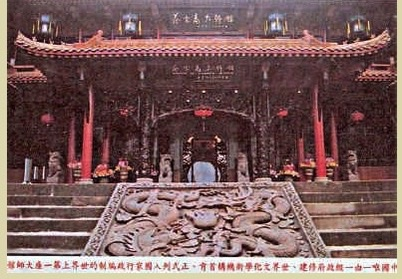
Entrance to the Master Wan Ko Yee Museum-China

Question: A “Master Yi Yun Gao Museum” has been established in Dayi County, Sichuan Province. Building a memorial hall for someone who is alive is quite rare. Could you elaborate on the process and motives behind establishing this hall?

Answer: After being bestowed with the title of “Special International Master” by 5,612 experts and scholars from 48 countries and regions at the 4th World Poets Culture Conference, and receiving the affection of individuals from my hometown, suggestions emerged to create a memorial hall. The completion of this hall has genuinely humbled me, and I’m profoundly aware of the goodwill and kindness of the people. It amplifies my sense of responsibility. To further the common good, I’m motivated to invest more effort. While I can be perceived as a “caretaker” of this hall, it truly belongs to the public, serving the greater societal welfare. Displaying artworks and cultural exhibits in this venue primarily aims to promote ethics, morality, and art. It seeks to inspire young students to delve into cultural arts, thereby nurturing Eastern philosophy, propagating Chinese culture, and enhancing the well-being of the populace. Visitor numbers to the hall continue to rise steadily.

Question: Your prowess in acupuncture, particularly the “Galloping Horse Wonderful Needle” technique, is widely recognized. Could you elucidate this technique?

Answer: The “Galloping Horse Wonderful Needle” technique in acupuncture is genuinely a “seeing is believing” situation. Its effects can be witnessed firsthand by those with physical ailments. (At that moment, Ms. Jiang Chengling Hui, the publisher of this magazine, expressed her willingness to experience it. Venerable Master Yi Yun inserted an acupuncture needle between the thumb and index finger of her right hand. As he exclaimed “swell,” Ms. Jiang echoed “swell.” Then, with a “go” from him, she exclaimed “it’s gone.” The needle had moved up her arm. Those present, including our magazine colleagues and others, were astonished.) This “Galloping Horse Wonderful Needle” technique is truly unparalleled globally.

Due to the late hour, as a substantial audience awaited Venerable Master Yi Yun and the clock struck midnight, our group of interviewers, filled with awe about the “Galloping Horse Wonderful Needle” acupuncture technique, concluded the visit.

(Note: Galloping Horse Wonderful Needle is a unique healing technique of Buddhism requiring special powers, and it is used to cure people of their illnesses. It is said that common people cannot master this technique. In order to apply this technique, one must have reached a very high state of training in the Vajra Fist Dharma of esoteric Buddhism. One must also have entered the phase that transcends the generation and completion phases. Through special skills, one produces a power that adjusts the “external four great elements.” (earth, water, fire, and wind) One then uses one’s concentration powers to bring about needle treatment reactions that course through the body like a galloping horse. Additionally, one must use thought to guide the “internal four great elements” of the patient’s body so that his body undergoes acute changes in an instant. Using the energy channels and acupuncture points, the obstructions of illness are expelled one after another. Why does that treatment produce such amazing effects? It has to do with the ultimate truths of the universe.)

Decades ago, Master Yi Yungao Embarked on a Visit to Taiwan and was Greeted with an Unprecedented and Fervent Welcome

Link:https://peacelilysite.com/2023/08/25/decades-ago-master-yi-yungao-embarked-on-a-visit-to-taiwan-and-was-greeted-with-an-unprecedented-and-fervent-welcome/

Source: https://hzbi.org/10928.html

Chinese Valentine’s Day

Qixi Festival when Niulang and Zhinu Meet Once a Year

Valentine’s Day, observed worldwide on February 14th, is a celebration dedicated to love, inspired by the legacy of Saint Valentine. This global festival serves as an emblem of affection and connection. Similarly, in China, a comparable event pays homage to an enamored couple.

Known as the Qixi Festival, also referred to as the Qiqiao Festival and colloquially named “Chinese Valentine’s Day” in Western culture, this festival possesses a captivating historical narrative. The Qixi Festival commemorates the age-old tale of Zhinu and Niulang. Zhinu, an ethereal weaver, and Niulang, a humble cowherd, compose this mesmerizing love story. According to legend, their love was thwarted by the Milky Way, allowing them a solitary annual reunion—on the night of Qixi.

The celestial pairing of Zhinu and Niulang is immortalized as radiant stars in the expanse of the galaxy. A passage connecting their realms materializes each year, expertly crafted by magpie birds in anticipation of their rendezvous.

The Qixi Festival, rooted in the Lunar Calendar, unfolds on the seventh day of the seventh month. Transitioning to the Gregorian calendar, this momentous occasion occupies the eighth month, specifically August. In the year 2023, the Qixi Festival is slated for celebration on Tuesday, August 22nd.

Buddhism offers a multifaceted lens through which to view human emotions and relationships. Rooted in the concept of the “Twelve Links of Dependent Origination,” Buddhism elucidates the cyclical nature of birth and death, attributing this cycle to ignorance and attachment. Humans, characterized as “sentient beings,” are intricately tied to these attachments. While Buddhism does not oppose love and marriage, it does caution against excessive attachment and an undue grasp on emotions, as they can impede the path to liberation.

Within Buddhism, emotions are not dismissed but embraced. Modern perceptions sometimes label Buddhism as detached and unfeeling. There’s a notion that embarking on a monastic journey necessitates forsaking family and worldly ties, an outlook perceived as callous. This misconception paints monastics as “heartless.”

Yet, the reality of Buddhism diverges from this stereotype. The monastic life, as envisioned by Buddhism, doesn’t mandate the abandonment of all emotions.

It’s essential to recognize the transient nature of the intense romantic love that often consumes us. Such love possesses a fleeting existence, its novelty waning with time. Buddhism offers intricate insights into this ephemeral sentiment, highlighting that all desires are impermanent and tinged with suffering, stemming from irrational attachments of sentient beings. An in-depth exploration of Buddhist teachings can foster a profound comprehension of these principles.

In the ebb and flow of relationships, cherish the connections when they emerge and gracefully embrace their absence when they dissipate. Buddhism advocates for mastering the art of detachment, discouraging the clutching onto emotions. This isn’t an endorsement of emotional callousness, but rather a perspective that perceives the unions and separations inherent in love and marriage as natural transitions dictated by circumstances. These transitions can be viewed as shared opportunities for growth, mutual enrichment, and learning—cornerstones of companionship on the journey to enlightenment.

Buddhism champions the elevation of emotions through the channels of compassion and wisdom. It fosters an environment where spouses treat each other with reverence and intimacy, colleagues extend assistance and forgiveness, and friends place a premium on their connections. This culminates in embodying “great compassion without attachment” and “great mercy as a shared essence.” In essence, personal love evolves into a universal compassion for all sentient beings—an embodiment of empathy that transcends the confines of the individual.

Chinese Valentine’s Day

Link:https://peacelilysite.com/2023/08/25/chinese-valentines-day/

#Valentine #ChineseCulture #QixiFestival#Buddhism #GreatCompassion

Source: https://economictimes.indiatimes.com/news/international/us/when-is-qixi-festival-2023-all-about-the-chinese-valentines-day-legend-of-lovers-zhinu-and-niulang/articleshow/102917179.cms?from=mdr

Fanjing Mount

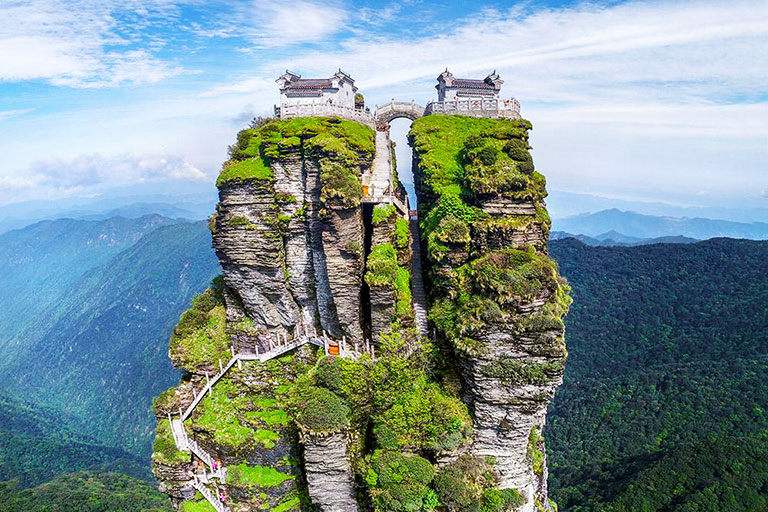
A view of the New Golden Summit, looking west. Costfoto / Barcroft Media via Getty

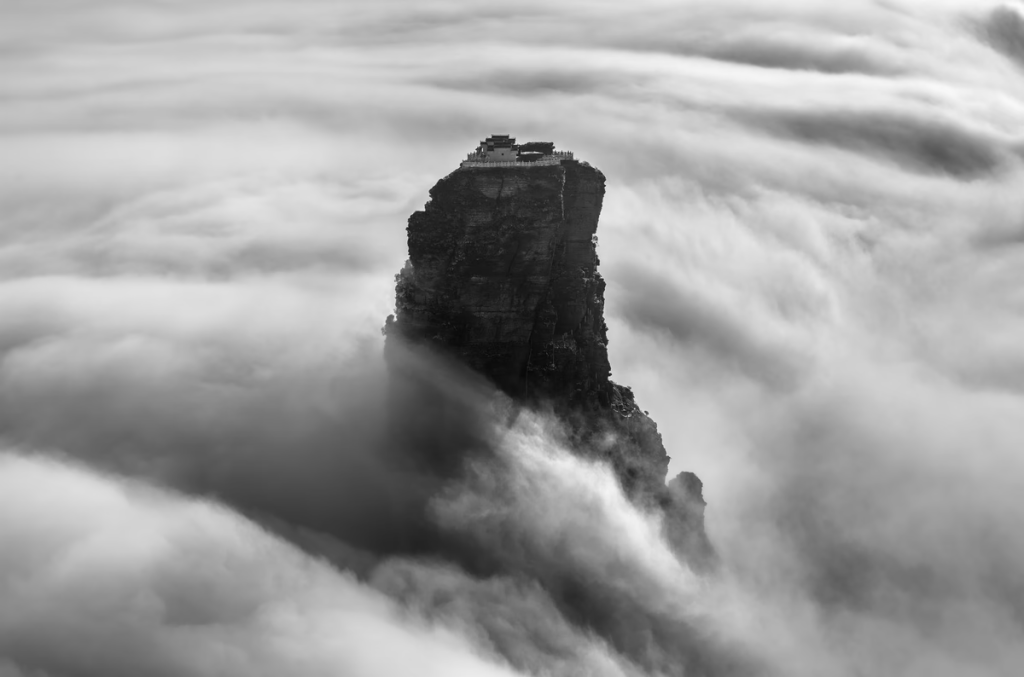
Clouds roll past the New Golden Summit on Mount Fanjing.  Clkraus / Shutterstock

Fanjingshan, also known as Mount Fanjing, is situated in the eastern part of Guizhou Province, China, within Tongren City. It is positioned approximately 248 kilometers away from Guiyang and 220 kilometers from Zhangjiajie. Mount Fanjing proudly claims the title of being the highest peak within the Wuling Mountains, with an impressive elevation of 2572 meters. The mountain stands adorned with primitive vegetation, its landscape characterized by majestic peaks, a continuous succession of towering summits, babbling streams interwoven with cascading waterfalls.

Moreover, Fanjingshan holds great spiritual significance as a revered Buddhist site. It’s widely believed among Buddhists that Fanjingshan is a place where spiritual enlightenment akin to that of Maitreya Buddha can be attained.

The appellation “Fanjing” finds its origins in “Fantian Jingtu,” a Buddhist term that translates to “Brahma’s Pure Land.” This hallowed mountain has been acclaimed as China’s Fifth Buddhist Mountain, a distinction following the likes of Mount Wutai in Shanxi Province, Mount Putuo in Zhejiang Province, Mount Emei in Sichuan Province, and Mount Jiuhua in Anhui Province. With a history spanning over 2000 years, embellished by extraordinary rock formations and abundant biodiversity, Mount Fanjing unveils itself as a serene, distinct haven. A sojourn to this tranquil expanse offers a revitalizing and spiritual respite from the bustling clamor of urban life.

Unique geological landforms, including the “Mushroom Stone” at right. Sanyanwuji / Shutterstock

In geological terms, Mount Fanjing assumes the form of a “fold belt,” an arrangement akin to stacked layers of rock resembling an assemblage of intricate shapes, an occurrence seldom witnessed elsewhere. The Mushroom Stone serves as a prime exemplar, where layers of rock have taken on the semblance of a towering mushroom.

Throughout antiquity, Fanjing Mountain stood as a venerable hub of Buddhist culture within the Wuling Mountain range. Historical records attest to the proliferation of numerous Buddhist temples along its slopes, catering to pilgrims from around the world. Yet, during the 16th century in the Ming Dynasty, a substantial number of these temples met destruction, effectively suppressing Fanjing Mountain’s renown. The subsequent Qing Dynasty saw a revival of fortunes, with governmental initiatives aimed at temple reconstruction and expansion along the mountain’s pathway to the “Red Clouds Golden Summit.” Notable temples such as Cheng’en Temple and Baoguo Temple were erected. By 1896, the fifth phase of Fanjingshan Temple reconstruction reached its culmination, bestowing upon Fanjing Mountain an esteemed status in the global Buddhist sphere and solidifying its position as China’s “No. 5 Great Buddhist Mountain.”

Mount Fanjing boasts three soaring summits that pierce the heavens – the Red Clouds Golden Summit (2336 meters), the Old Golden Summit (2493 meters), and the Phoenix Golden Summit (2572 meters). From these majestic pinnacles, visitors are treated to breathtaking panoramic vistas of Mount Fanjing’s expansive landscape. Crowning the preeminent “Red Clouds Golden Peak” stands the remarkable Fanjingshan Temple, perched at a daring elevation of 2,336 meters above sea level. Nestled atop the columnar peak, this temple’s elusive location beckons travelers to witness its ethereal presence firsthand and capture mesmerizing, novel photographs.

Fanjingshan Temple, encompassing the revered Temple of the Buddha (释迦殿) and the Maitreya Temple (弥勒殿), graces the summit of the “Red Clouds Golden Summit” (also known as the New Golden Summit) on Fanjing Mountain. The former is dedicated to the worship of Sakyamuni, symbolizing the present, while the latter venerates Maitreya, representing the future. These two temples trace their origins back to the Yongle period of the Ming Dynasty, over five centuries ago. Presently, they have been meticulously reconstructed to echo their original splendor, their structures fortified with iron tiles to withstand the mountain’s formidable winds. Each temple is embodied by a single hall, constructed from meticulously arranged stone pieces measuring 5.4 meters in width and 5.55 meters in depth. A bridge gracefully connects the two temples, spanning the depths of the Gold Sword Gorge.

For pilgrims journeying to Fanjingshan, the ascent involves ascending thousands of steps to initially reach the Temple of the Buddha on the southern facet. Subsequently, crossing the bridge leads to the Maitreya Temple on the northern side of the “Red Clouds Golden Summit.” This sequence mirrors the Buddhist concept of transition from the present (Sakyamuni) to the future (Maitreya). As the “Red Clouds Golden Summit” often finds itself enshrouded by mist and enveloped in sea of clouds, standing upon the terrace outside Fanjingshan Temple offers a surreal experience of gazing upon the world from above, capturing an otherworldly perspective amidst the natural elements.

Much like the iconic Avatar Hallelujah Mountain in Zhangjiajie National Forest Park, Fanjingshan stands as a towering pinnacle, slender and vertically oriented, evoking the image of a pencil standing upright on a desk. Scaling its summit requires ascending over 8,000 steps or opting for a cable car ride up from the road below. Most visitors opt for a full day to thoroughly explore this remarkable sacred mountain. Its attractions span a diverse range, encompassing the Red Cloud Golden Peak, Old Golden Summit, Ten-Thousand Sleeping Buddha, Mushroom Stone, Jiulong Pond, Fenghuang Mountain, Numerous Rolls of Books, and more.

Situated in the mountainous expanse of Guizhou Province, Fanjingshan falls within the ambit of a subtropical humid monsoon climate, distinctly marked by four seasons. Throughout the year, the average annual temperature oscillates between 13.1°C and 14.7°C. July witnesses the hottest days, with an average temperature hovering around 24°C, while January holds the chilliest nights, registering an average temperature of approximately 4.6°C. On the whole, Fanjingshan enjoys a temperate climate, graced by ample sunlight and rainfall. Summers remain moderate, and winters remain mild, with neither excessive heat nor biting cold. Rainfall predominantly occurs from May to October, while the frost-free period spans a generous 270 to 278 days annually.

The prime window to explore Mount Fanjing extends from March to November. For those seeking to capture stunning photographs, the early morning hours are particularly enchanting. The aftermath of rain unveils captivating spectacles, such as the Sea of Clouds, Zen Fog, Buddha Light, and breathtaking sunrises, which contribute to the mountain’s mystique and allure.

Fanjing Mount

Link: https://peacelilysite.com/2023/08/22/fanjing-mount/

#FanjingMount# MountFanjing #Zhangjiajie #Buddha #BuddhistTemple #MaitreyaBuddha #FanTieJingTu #China #Travel #TravelChina #GuiZhou

Source: https://www.chinadiscovery.com/guizhou/fanjingshan.html, https://www.theatlantic.com/photo/2019/04/a-photo-visit-to-mount-fanjing/586879/, https://www.chinadiscovery.com/guizhou/fanjingshan/fanjingshan-temple.html

The Longest Study on Human Happiness

The Secret to Having a Long and Happy Life

For over 75 years, Harvard’s Grant and Glueck study has tracked the physical and emotional well-being of two populations: 456 poor men growing up in Boston from 1939 to 2014 (the Grant Study), and 268 male graduates from Harvard’s classes of 1939-1944 (the Glueck study).

Due to the length of the research period, this has required multiple generations of researchers. Since before WWII, they’ve diligently analyzed blood samples, conducted brain scans (once they became available), and pored over self-reported surveys, as well as actual interactions with these men, to compile the findings.

The conclusion? According to Robert Waldinger, director of the Harvard Study of Adult Development, one thing surpasses all the rest in terms of importance:

“The clearest message that we get from this 75-year study is this: Good relationships keep us happier and healthier. Period.”

Not how much is in your 401(k). Not how many conferences you spoke at–or keynoted. Not how many blog posts you wrote or how many followers you had or how many tech companies you worked for or how much power you wielded there or how much you vested at each.

No, the biggest predictor of your happiness and fulfillment overall in life is, basically, love.

Specifically, the study demonstrates that having someone to rely on helps your nervous system relax, helps your brain stay healthier for longer, and reduces both emotional as well as physical pain.

The data is also very clear that those who feel lonely are more likely to see their physical health decline earlier and die younger.

“It’s not just the number of friends you have, and it’s not whether or not you’re in a committed relationship,” says Waldinger. “It’s the quality of your close relationships that matters.”

What that means is this: It doesn’t matter whether you have a huge group of friends and go out every weekend or if you’re in a “perfect” romantic relationship (as if those exist). It’s the quality of the relationships–how much vulnerability and depth exists within them; how safe you feel sharing with one another; the extent to which you can relax and be seen for who you truly are, and truly see another.

According to George Vaillant, the Harvard psychiatrist who directed the study from 1972 to 2004, there are two foundational elements to this: “One is love. The other is finding a way of coping with life that does not push love away.”

When the study began, nobody cared about empathy or attachment. But the key to healthy aging is relationships, relationships, relationships. ” — George Vaillant

Photo by Pixabay on Pexels.com

Thus, if you’ve found love (in the form of a relationship, let’s say) but you undergo a trauma like losing a job, losing a parent, or losing a child, and you don’t deal with that trauma, you could end up “coping” in a way that pushes love away.

This is a very good reminder to prioritize not only connection but your own capacity to process emotions and stress. If you’re struggling, get a good therapist. Join a support group. Invest in a workshop. Get a grief counselor. Take personal growth seriously so you are available for connection.

Because the data is clear that, in the end, you could have all the money you’ve ever wanted, a successful career, and be in good physical health, but without loving relationships, you won’t be happy.

The next time you’re scrolling through Facebook instead of being present at the table with your significant other, or you’re considering staying late at the office instead of getting together with your close friend, or you catch yourself working on a Saturday instead of going to the farmer’s market with your sister, consider making a different choice.

“Relationships are messy and they’re complicated,” acknowledges Waldinger. But he’s adamant in his research-backed assessment:

“The good life is built with good relationships.”

The Secret to Having a Long and Happy Life

Link:https://peacelilysite.com/2023/08/18/the-longest-study-on-human-happiness/

#Harvard#HumanResearch#AdultDevelopment #Happy #healthy #Longlife #Relationship #Love #LongestStudy

Source: https://www.inc.com/melanie-curtin/want-a-life-of-fulfillment-a-75-year-harvard-study-says-to-prioritize-this-one-t.html

51. King Goodness the Great [Perseverance]

51. King Goodness the Great [Perseverance]

Once upon a time, in Benares in northern India, the Enlightenment Being was born into the royal family. When he became king he was called Goodness the Great. He had earned this title by trying to do good all the time, even when the results might not benefit him. For example, he spent much of the royal treasury on the building and running of six houses of charity. In these houses good and aid were given freely to all the poor and needy who came along, even to unknown travellers. Soon King Goodness the Great became famous for his patience, loving-kindness and compassion. It was said that he loved all beings just like a father loves his young children.

Of course King Goodness observed the holy days by not eating. And naturally he practiced the ‘Five Training Steps’, giving up the five unwholesome actions. These are: destroying life, taking what is not given, doing wrong in sexual ways, speaking falsely, and losing one’s mind from alcohol. So his gentle kindness became more and more pure.

Since he wished to harm no one, King Goodness the Great even refused to imprison or injure wrongdoers. Knowing this, one of his highest ministers tried to take advantage of him. He cooked up a scheme to cheat some of the women in the royal harem. Afterwards it became known by all and was reported to the king.

He called the bad minister before him and said, ‘I have investigated and found that you have done a criminal act. Word of it has spread and you have dishonoured yourself here in Benares. So it would be better for you to go and live somewhere else. You may take all your wealth and your family. Go wherever you like and live happily there. Learn from this lesson.’

Then the minister took his family and al his belongings to the city of Kosala. Since he was very clever indeed, he worked his way up and became a minister of the king. In time he became the most trusted adviser to the King of Kosala. One day he said, ‘My lord, I came here from Benares. The city of Benares is like a beehive where the bees have no stingers! The ruling king is very tender and weak. With only a very small army you can easily conquer the city and make it yours.’

The king doubted this, so he said, “You are my minister, but you talk like a spy who is leading me into a trap!’ He replied “No my lord. If you don’t believe me, send your best spies to examine what I say. I am not lying. When robbers are brought to the King of Benares, he gives them money, advises them not to take what is not given, and then lets them go free,”

The king decided to find out if this was true. So he sent some robbers to raid a remote border village belonging to Benares. The villagers caught the looters and brought them to King Goodness the Great. He asked them, “Why do you want to do this type of crime?”

The robbers answered, “Your worship, we are poor people. There is no way to live without money. As your kingdom has plenty of workers, there is no work for us to do. So we had to loot the country in order to survive.” Hearing this, the king gave them gifts of money, advised them to change their ways, and let them go free.

When the King of Kosala was told of this, he sent another gang of bandits to the streets of Benares itself. They too looted the shops and even killed some of the people. When they were captured and brought to king Goodness, he treated them just the same as the first robbers.

Learning of this, the King of Kosala began marching his troops and elephants towards Benares.

In those days the King of Benares had a mighty army which included very brave elephants. There were many ordinary soldiers, and also some that were as big as giants. It was known that they were capable of conquering all India.

The giant soldiers told King Goodness about the small invading army from Kosala. They asked permission to attack and kill them all.

But King Goodness the Great would not send them into battle. He said, “My children, do not fight just so I may remain king. If we destroy the lives of others we also destroy our own peace of mind. Why should we kill others? Let them have the kingdom if they want it so badly. I do not wish to fight.”

The royal ministers said, “Our Lord, we will fight them ourselves. Don’t worry yourself. Only give us the order.” But again he prevented them.

Meanwhile the King of Kosala sent him a warning, telling him to give up the kingdom or fight. King Goodness the Great sent this reply: “I do not want you to fight with me, and you do not want me to fight with you. If you want the country, you can have it. Why should we kill people just to decide the name of the king? What does it matter even the name of the country itself?”

Hearing this, the ministers came forward and pleaded, “Our Lord, let us go out with our mighty army. We will beat them with our weapons and capture them all. We are much stronger than they are. We would not have to kill any of them. And besides, if we surrender the city, the enemy army would surely kill us all!”

But King Goodness would not be moved. He refused to cause harm to anyone. He replied, “Even if you do not wish to kill, by fighting many will be injured. By accident some may die. No one knows the future – whether our attackers will kill us or not. But we do know whether our present actions are right or wrong. Therefore I will not harm, or cause others to harm, any living being!”

Then King Goodness ordered the city gates be opened up for the invaders. He took his ministers to the top floor of the palace and advised them, “Say nothing and try to remain calm.”

The King of Kosala entered the city of Benares and saw that no one was against him. So he and his soldiers entered and went up to the top floor. They capture the innocent King Goodness the Great. The soldiers tied the hands of the defeated king and all of his ministers.

Then they were taken to the cemetery outside the city. They were buried up to their necks, standing straight up, with only their heads above ground. But even while the dirt was being trampled down around his neck, the Great Being remained without anger in his mind and said nothing.

Their discipline and obedience to King Goodness were so great that not a single minister spoke a word against anyone. But the King of Kosala had no mercy. He said roughly, “Come night time, let the jackals do as they please!”

And so it came to pass that, at midnight, a large band of jackals wandered into the cemetery. They could smell a feast of human flesh waiting for them.

Seeing them coming, King Goodness and his ministers shouted all at once and scared the jackals away. Twice more this happened. Then the clever jackals realised, “These men must have been put here for us to kill and eat.” No longer afraid, they ignored the shouts. The jackal king walked right up to the face of King Goodness.

The king offered his throat to the beast. But before he could bite into him, the king grabbed the jackal’s chin with his teeth. No harming him, King Goodness gripped him tightly so the jackal king howled in fear. This frightened his followers and they all ran away.

Meanwhile the jackal king thrashed back and forth, trying madly to free himself from the might jaws of the human king. In so doing, he loosened the dirt packed around the king’s neck and shoulders. Then King Goodness released the screaming jackal. He was able to wiggle himself free from the loosened earth and pull himself up onto the ground. Then he freed all his frightened ministers.

Nearby there was a dead body. It just so happened that it was lying on the border of the territories claimed by two rival demons. They were arguing over the division of the body, insulting each other in ways that only demons can.

Then one demon said to the other, “Why should we continue quarrelling instead of eating? Right over there is King Goodness the Great of Benares. He is famous in all worlds for his righteousness. He will divide the dead body for us.

They dragged the body to the king and asked him to divide it between them fairly. He said, ‘My friends, I would be glad to divide this for you. But I am filthy and dirty, I must clean myself first.”

The two demons used their magic powers to bring scented water, perfume, clothing, ornaments and flowers from the king’s own palace in Benares. He bathed, perfumed himself, dressed, and covered himself with ornaments and flower garlands.

The demons asked King Goodness if there was anything else they could do. He replied that he was hungry. So, again by their magic powers, the demons brought the most delicious flavoured rice in a golden bowl and perfumed drinking water in a golden cup — also from the royal palace in Benders.

When he was satisfied, king Goodness asked them to bring him the sword of state from the pillow of the King of Kosala, who was sleeping in the palace in Benares. With magic that too was easily done. Then the king used the sword to cut the dead boy into two halves, right down the spine. He washed the sword of state and strapped it to his side.

The hungry demons happily gobbled up the fairly divided dead body. Then they gratefully said to King Goodness, “Now that our bellies are full, is there anything else we can do to please you?”

He replied, “By your magic, set me in my own bedroom in the palace next to the King of Kosala. In addition, put all these my ministers back in their homes.” Without a word, the demons did exactly as the king had asked.

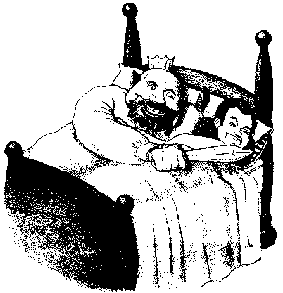
At that moment the King of Kosala was fast asleep in the royal bedchamber. King Goodness the Great gently touched the belly of the sleeping king with the sword of state. The king awoke in great surprise. In the dim lamplight he was frightened to see King Goodness leaning over him with sword in hand. He had to rub his eyes to make sure he was not having a nightmare!”

Then he asked the great king, “My lord how did you come here in spite of all my guards? You were buried up to your neck in the cemetery — how is it you are spotlessly clean, sweet smelling, dressed in your own royal robes, and decorated with fine jewellery and the loveliest flowers?”

King Goodness told him the story of his escape from the band of jackals. He told of the two demons that came to him to settle their quarrel. And he told how they gratefully helped him with their magic powers.

On hearing this, the King of Kosala was overcome by his own shame. He bowed his head to King Goodness the Great and cried, “Oh great king, the stupid ferocious demons, who live by eating the flesh and drinking the blood of dead bodies — they recognised your supreme goodness. But I, who was lucky enough to be born as an intelligent and civilised human being — I have been too foolish to see how wonderful your pure goodness is.

“I promise never again to plot against you, my lord —- you who have gained such perfect harmlessness. And I promise to serve you forever as the truest of friends. Please forgive me, great king.” Then, as if he were a servant, the King of Kosala laid King Goodness the Great down on the royal bed, while he himself lay on a small couch.

The next day the King of Kosala called all his soldiers into the palace courtyard. There he publicly praised the king of Benares and asked his forgiveness once again. He gave back the kingdom and promised that he would always protect King Goodness. Then he punished his adviser, the criminal minister, and returned to Kosala with all his troops and elephants.

King Goodness the Great was sitting majestically on his golden throne, with its legs like those of a gazelle. He was shaded from the sun by the pure white royal umbrella. He taught his loyal subjects saying, “People of Benares wholesomeness begins with giving up the five unwholesome actions once and for all. The highest qualities of the good person, whether ruler or subject, are loving-kindness and compassion. Filled with these qualities, one cannot harm another —- no matter what the reason or the cost. No matter how dangerous the threat, one must persevere until the greatness of the good heart wins in the end.”

Throughout the rest of his reign, the people of Benares lived peacefully and happily. King Goodness the Great continued performing wholesome works. Eventually he died and was reborn as he deserved.

The moral is: Refusing to harm others, the good heart wins over all.

51. King Goodness the Great [Perseverance]

Link:https://hhdorjechangbuddhaiiiinfo.com/2023/08/15/king-goodness-the-great-perseverance/

#Buddhisttalesforyoungandold #Buddhiststories #storiesforkids #moralstories #Buddha #Jatakastories #PansiyaPanasJataka

Nick Best Grandfather of Strongman

Nick Best is an individual whose name resonates without the need for an introduction, a living legend whose influence spans decades. In the realm of strength sports, his accomplishments stand as a testament unmatched by any on this planet. With a legacy steeped in unrivaled achievements, Nick embodies a reservoir of wisdom, a testament to his years of triumph. Beyond his feats in the realm of lifting and coaching, Nick is a devoted family man, finding solace in the company of his beloved wife, Callie, and unwaveringly standing by his children, Dylan and Jessica.

Originating from the vibrant city of Las Vegas, Nevada, Nick Best’s tenure as a formidable Strongman competitor exceeds a decade. Revered as the “grandfather” of Strongman, he defies age with his storehouse of sagacity and experience. A veritable luminary among the competitors, Nick’s zeal for history burns fiercely. In the late 1990s, he reigned as the Powerlifting champion of the world, and etched his name in history with a world record in the Shield Carry event.

However, recent revelations have uncovered a dimension beyond his well-known accolades. A chance encounter with a YouTube video left me astonished. Beneath the veneer of triumph and robust musculature, lies a facet of Nick Best that is astonishing. As it turns out, he is a devoted Buddhist disciple, his connection to spirituality tracing back to childhood when he was identified as the reincarnation of Rinpoche. In the year 2002, he embarked on a transformative journey, becoming a disciple of H.H. Dorje Chang Buddha III. Under the tutelage of his revered Buddha Master, Nick delved into the realm of authentic supreme Buddha Dharma, a pursuit that wrought profound changes not only in his spiritual being but also manifested in his physical prowess, endowing him with extraordinary strength beyond imagination. Now he is known by buddhist disciples as Wangzha ShangZun.

After years of dedicated cultivation and practice, diligently following the Dharma teachings imparted by H.H. Dorje Chang Buddha III, Wangzha Shangzun (Nick Best) has ascended to the esteemed Bodhisattva stage, attaining the exalted status of Golden Button Level Three. His unwavering commitment is directed towards the salvation of sentient beings, embodying a profound dedication to their well-being.

Nick Best Grandfather of Strongmen

Link:https://peacelilysite.com/2023/08/15/nick-best-grandfather-of-strongman/

#DorjeChangBuddhaIII #HHDorjeChangBuddhaIII  #Buddhism #Buddhist #Strongman #Worldchampion #Powerlifting #Grandfather #NickBest #Rinpoche #Reincarnation #WangzhaShangzun

Source: https://www.strengthletecollective.com/nick, https://www.history.com/shows/the-strongest-man-in-history/cast/nick-best

A Western Disciple’s Miraculous Experience


H.H. Dorje Chang Buddha III Ordained Me

Speaking of H.H. Dorje Chang Buddha III personally ordaining me, it is undoubtedly the most joyous event in my life. Sometimes, even in my nighttime dreams, laughter spontaneously escapes me. This occurrence represents the auspicious connection that has guided me from the worldly existence to embracing monkhood. The privilege of receiving ordination directly from the authentic chief Vajra-holder, undergoing head-shaving, and embarking on the path of a monk is not to be underestimated – it’s a journey that can’t be taken lightly.

Several years ago, I was granted the fortunate opportunity to become a disciple of H.H. Dorje Chang Buddha III. Initially, I perceived him as an approachable Dharma king. It wasn’t until this year (2007) that I serendipitously unveiled the truth. As circumstances matured, my aspiration to embrace monastic life grew stronger and stronger. Consequently, in collaboration with another senior practitioner, Hongxi Fazang, who shared the same intention, we formally petitioned the Dharma king for ordination. Astonishingly, His Holiness accepted our request and committed to ordain us.

On the day of the ordination, a multitude of monks and masters were present. At six o’clock in the early morning, H.H. Dorje Chang Buddha III was immersed in a Dharma practice, assigning us our Dharma names. In that precise moment, two peacocks descended gracefully from the sky, performing an elegant dance to pay homage to His Holiness. Their graceful dance persisted for over thirty minutes, culminating in a gentle conclusion. The peacocks even ventured onto the car His Holiness was preparing to use that day, continuing their homage through dance. Amidst this spectacle, a guardian dog’s resounding bark spurred a sudden realization that this remarkable scene should be captured on film. Regrettably, by the time a camera was procured, the two peacocks had already ascended to the rooftop.

Photo by Rajukhan Pathan on Pexels.com

During the head-shaving process by the Buddha Master, a newly acquired, exceptionally sharp, and powerful electric razor was employed. The initial cut proceeded smoothly, but upon attempting the second cut, the hair refused to yield. No matter the effort expended with the electric razor, not a single strand of hair succumbed. In this juncture, the Buddha Master chanted the Vajra mantra, and with a rustling sound, the hair began to fall.

Upon the completion of the ordination, we approached the two venerable monks in attendance, requesting their blessings upon our Vajra pills. As one of these venerable holy monks extended his hand above my head to bestow his blessings, I experienced a sudden flood of realizations. This sensation defies verbal description – truly an inexplicable and miraculous encounter!

Naturally, what we perceive as miraculous are ordinary occurrences within the realm of H.H. Dorje Chang Buddha III. Such experiences are constantly present in his presence. When H.H. Dorje Chang Buddha III imparted ordination and empowerment upon individuals like Zhaxi Zhuoma Rinpoche, Bodhi Wentu Rinpoche, and others, corresponding miraculous phenomena also materialized.

Puti Duxi at July 4th 2007

H.H. Dorje Chang Buddha III Ordained Me

Link:https://peacelilysite.com/2023/08/13/a-western-disciples-miraculous-experience/

#DorjeChangBuddhaIII #HHDorjeChangBuddhaIII  #Buddhism #Buddhist #PutiDuxi #Ordination

Source: Translate from https://mp.weixin.qq.com/s/xpDekicfKW49KbbgZ0-fIg

Buddha-dharma, Buddhist Studies And Popular Buddhism

Buddha-dharma, Buddhist Studies And Popular Buddhism

 In Taichung there is an elderly layman. All nine members of his family are devout Buddhists. They have followed and learned from a famous old monk for many years. However, what they hear from this old monk is completely theory. Each of them can talk about the sutras in a clear and logical fashion. However, none of them have real skills associated with the Buddha-dharma.

            In the autumn of 1995 the Elder Dharma King happened to be in Taiwan propagating the dharma.  The elderly layman requested instruction from the Elder Dharma King by saying, “This year I am already eighty-one years old.  I do things in furtherance of Buddhism everyday.  I have donated over one-half of my vast wealth.  Nevertheless, I have never seen a real Buddha or Bodhisattva.  The only knowledge I have of supernormal dharma powers comes from what I read in books.  Why do the Buddhas and Bodhisattvas not come down to our house?  May I ask the Elder Dharma King, what is the Buddha-dharma?”

When the Dharma King heard these words, he chanted “Wobamei!”  He then said, “Layman, you all have not learned the Buddha-dharma.  How could you have any true skills?” When all of the members of the layman’s family heard this, they felt quite surprised.  With his brows tightly knit, the old layman said, “My entire family devoutly learns Buddhism and recites sutras. How is it that we are not learning the Buddha-dharma? Could it be said that these sutras are all false?”

The Elder Dharma King said, “It is true that all of you are reading sutras and learning Buddhism.  Those sutras are genuine sutras and are dharma treasures.  The knowledge concerning Buddhism which those old monks impart to all of you is also genuine knowledge.  However, this is Buddhist studies.  It is not the Buddha-dharma!  In Esoteric Buddhism, Buddhist studies is called the exoteric teachings portion.  This is what we are required to learn when we first enter Esoteric Buddhism.  After we have learned the exoteric teachings portion and we have this foundation of theory, we must then enter into real, practical cultivation of our conduct, speech and thoughts.  The process of putting this into practice is called cultivation of the Buddha-dharma.

“Take, for example, the practice whereby one invites the Buddhas and Bodhisattvas to bestow nectar. In theory, people think that this is simply reciting mantras, reciting passages from sutras and visualizing.  In theory, people think that nectar is simply water which has been empowered by mantras. However, in the real practice of the Buddha-dharma, there is a special dharma method to invite the Buddhas to directly bestow true nectar from the sky. The shape of this nectar is unlike any other thing on this earth. It has unlimited power. It can cure all illnesses and can easily increase one’s life span! This is because this is the Buddha-dharma, not Buddhist studies.”

The old layman said, “I received the Kalachakra Vajra Initiation from the Dalai Lama!”  Elder Dharma King Losang said, “Last year a Great Rinpoche wanted to introduce the Dalai Lama to me.  I did not have any spare time.  I wanted to do other things in furtherance of the Buddha-dharma.  I did not meet him.  I do not know much about him and will not comment on him.  I do not have any right to inquire into that initiation.  I hope that you are able to receive benefits from it.”

When the old layman and his family heard this, it was as if they had awakened from a big dream.  Their eyes became teary, they knelt down on the ground and respectfully requested the Elder Dharma King to teach them the dharma.  After a moment, the Elder Dharma King slowly said, “Today I will teach the dharma to your entire family.  I will also teach the dharma to all living beings.”  Following his words, a beam of red light emanated from in between his eyebrows which circled the room.  The Elder Dharma King then said, “Do no evil.  Do that which is good.  Deeply study the sutras. This is Buddhist studies.  Do no evil.  Do that which is good.  Recite the Buddha’s name with all your mind.  This is the way to ascend to the Pure Land.  Do no evil. Do that which is good.  Deeply study the sutras.  Esoteric initiations in which supernormal powers are manifested and which comply with Know the True Doctrine is the Buddha-dharma.”

After the old layman heard these words, he put his palms together and respectfully asked, “Other than Know the True Doctrine, what books should I read?”  Dharma King Losang said, “With respect to Know the True Doctrine, it is enough if you understand its contents.  The most important thing is that you read the books of Ah Wang Nuo Bu Pa Muand Great Dharma King Yangwo Yisinubu [H.H. Dorje Chang Buddha III].  The more you read such books the better.  You must also live in accordance with the principles contained therein.  This is the best method!”

The old layman said, “I will remember your words. I would like to ask another question.  Does every Rinpoche have a mind which regards all things as equal?” The Elder Dharma King instructed, “The most difficult thing to attain in one’s cultivation and in one’s practice of the Buddha-dharma is a mind which regards all things as equal.  Without such a mind, one will pursue fame, gain, riches, high government positions and occupation of other people’s land.  One with a mind which regards all things as equal does not pursue such things.

“For example, some people want to cut apart my native place, Tibet.  Actually, this way of thinking is a deviation from cultivation.  Is this cultivation or is this fighting for something based upon personal desire?  Tibetan people, Chinese people and people of every other race and ethnicity should all be considered our close family members who are on an equal footing!  We should cause all of these people to unite so that they can live together in friendship and love and develop their common happiness.  The Buddha taught us that all living beings have the Buddha nature and that we should treat them equally and with love.  We should not desire government positions.  Only by cutting off the concept of self, cutting off erroneous thinking and cutting off attachment to things of the world can one reach high spiritual states!  This is the certain truth of the Buddha-dharma.  We must love others equally in order that we may give rise to the four limitless states of mind.   With the four limitless states of mind as our foundation, we will be able to enter into the state of the sacred bodhi mind.  If one cannot even renounce selfish desires and cannot even look after all living beings on an equal basis, then how can one enlighten oneself and enlighten others?”

Link: https://wisdomtea.org/2023/08/11/buddha-dharma-buddhist-studies-and-popular-buddhism/