I have not lived for nothing as of yet I believe. At the age of ninety-five, I do not anticipate having too many more years to look forward to, but still at this point in time I believe I cannot answer the question as to what I have lived for as I am still living. Because if there is anything that I have learned it’s that I cannot see what is further ahead of me than the span of my arms. As a rider is to be approaching a cave, from a distance he may be deceived — especially in the night — and it may be the case that the cave is truly a rounded bridge of sorts. I do not pretend to know what is to come next so rather than explaining what I have lived for, I would much rather give you the words that would explain why I am still among the living.
I am still among the living for precisely this purpose: the joy it gives me to write — to explicate the answers to the questions of my heart — is greater than any worldly pleasure I have ever known of. The truth remains that I would like to have written more in the years that I have lived, but I am keen to continue as the tide never stops its charge despite how often it breaks at the shore.
Truthfully, I am alive for the people that this world has housed as their temporary abode. The men, the women, but most of all the children that I have had the truest honor of coming to understand as my companions — as friends — with whom I have created many meaningful memories and a body of magnificent works are my most profound reason for existence. The loving people I have encountered are to know that I am still alive for them; if it’s something that they forget in the course of our frightened retreats in our fleeting livelihoods then I pray that I remind them of this fact every day that I am blessed with living.
Finally, I live to meditate on the ecstasies of the universe — both of nothing and of everything. Neither is greater than the other, but as I have learned in my time here, they are nearly one and the same. The truth of the essence within me is the only part of me that I don’t regret keeping. Even at this age I have yet to let go to the extent that I know I must. Maybe it isn’t too long that I drift into oblivion.
But if that’s what must happen then I am glad to have been able to share these thoughts with you.
Karma, in Sanskrit known as ‘karma,’ is the creator of deeds of body, speech, and mind, producing both good and evil without forgetting. It is also like the causes created by the three activities, which manifest as their results.
The force of karma leads to the consequences of suffering or happiness based on its nature, whether good or evil. Therefore, there is also the doctrine of karma and its consequences. Karma accumulated in the past is referred to as past karma; karma in the present is referred to as present karma.
The law of karma is a special instance of the law of cause and effect, according to which all our actions of body, speech and mind are causes and all our experiences are their effects. Certainly, perhaps some people might ask, “This ‘karma’ you speak of, I can neither see it nor touch it. Does it really exist?”
The law of karma explains why each individual has a unique mental disposition, a unique physical appearance and unique experiences. These are the various effects of the countless actions that each individual has performed in the past. We cannot find any two people who have created exactly the same history of actions throughout their past lives, and so we cannot find two people with identical states of mind, identical experiences or identical physical appearances. Each person has different individual karma. Some people enjoy good health while others are constantly ill. Some people are seen as very beautiful while others are seen as very ugly. Some people have a happy disposition that is easily pleased while others have a sour disposition and are rarely delighted by anything. Some people easily understand the meaning of spiritual teachings while others find them difficult and obscure.
Master Milarepa was renowned for his profound spiritual practice amidst the snowy plateaus of Tibet.
In his youth, Milarepa engaged in regrettable actions that resulted in negative karma. He resorted to sorcery, causing a house to collapse and resulting in the deaths of 35 people, including his adversaries. Additionally, he summoned hailstorms that devastated his uncle’s crops and the entire village.
There are accounts of Master Milarepa experiencing the consequences of his actions. In the later stages of spreading the Dharma for the benefit of all beings, a monk observed the reverence and admiration directed towards Venerable Milarepa by the crowd. Although outwardly respectful, the monk harbored intense jealousy and disdain, viewing the Venerable as understanding nothing and merely a hypocritical, arrogant, and conceited individual.
Once when the Venerable Milarepa fell seriously ill, this monk, pretending to be concerned, went to visit him and said:
“A great master like you who has attained enlightenment should not be so gravely ill, yet here you are sick! If there were a way to share this illness, to distribute some of it among your disciples. If there were a method to transfer it, for example, I could share some of it, but unfortunately, there seems to be no solution. What can be done?”
The Venerable smiled gently and replied, “I should not be ill by nature, but illness is beyond my control.”
The monk continued, “If only I knew the cause of your illness. I suppose no reason can be found? If it could be transferred, I would willingly take on some of it.”
The Venerable responded, “I could indeed share some of this illness with you, but you would not withstand it even for a moment. Therefore, it’s better not to transfer it.”
The monk thought to himself that perhaps the illness couldn’t be transferred, so he persisted more earnestly, saying, “Please, in any case, transfer the illness onto me!”
The Venerable then said, “Very well, but you will not bear it.”
Subsequently, the Venerable transferred the illness onto the door of the silent room, causing the door to creak and shake as if it were about to collapse. Despite this display, the monk remained skeptical, wondering if it was all an illusion, and he once again requested, “This is truly extraordinary! Please transfer it onto me.”
The Venerable agreed, warning him, “You will not endure it.”
He then withdrew the illness from the door and transferred it onto the monk. Instantly, the monk collapsed in pain, unable to move, breathe, or nearly fainting. Seeing this, the Venerable quickly withdrew the illness back, telling the monk, “I only transferred half of the illness to you.”
At that moment, the monk felt profound remorse and sincerely placed the Venerable’s feet on his forehead, tears streaming down in genuine emotion…
Thus, in the realm of karma, distinctions of wealth, poverty, status, or identity dissolve; there are only individuals confronting the unfiltered repercussions of their actions, whether virtuous or malevolent. Like an ever-present shadow, karma unfailingly trails behind, and when it matures, one experiences the consequences firsthand, feeling both its warmth and coldness.
Every action we perform leaves an imprint, or potentiality, on our very subtle mind, and each imprint eventually gives rise to its own effect. Our mind is like a field, and performing actions is like sowing seeds in that field. Virtuous actions sow seeds of future happiness and non-virtuous actions sow seeds of future suffering. These seeds remain dormant in our mind until the conditions for them to ripen occur, and then they produce their effect. In some cases, this can happen many lifetimes after the original action was performed.
The compassionate teachings of the contemporary Buddha, H.H. Dorje Chang Buddha III, instruct us to accumulate wholesome karma and avoid unwholesome karma; through practice, we can transform causes and effects. Only in this way can we allow our good karma to ripen first, keep evil deeds at bay, break free from the bondage of karmic forces, and truly escape the ocean of suffering. The supreme practice method taught by the Buddha, in “What is cultivation“, when followed diligently, brings boundless benefits.
Therefore, only through genuine repentance from the heart and earnest adherence to the teachings, can we eliminate karmic obstacles and allow the fruits of our wholesome actions to mature swiftly. Conversely, if we do not follow this path, we will only confirm the truth of the saying “We can’t take anything with us, only karma accompanies us,” and thus cycle endlessly in samsara.
In life, the journey towards success often mirrors the growth of bamboo and the emergence of cicadas. These natural phenomena teach us valuable lessons about perseverance, endurance, and the importance of staying committed to our goals.
Imagine the bamboo, taking four long years to grow just three centimeters above the ground. For those initial years, its roots were quietly spreading underground, preparing a strong foundation for future growth. Then, in the fifth year, something remarkable happens—bamboo shoots skyward at an astonishing rate of thirty centimeters per day, eventually reaching a towering height of fifteen meters in a mere six weeks. This phenomenal growth was not sudden; it was the result of years of patient root development. (Photo by Daniel Klein)
Success, like the bamboo’s rapid growth, often appears sudden to others but is actually the culmination of persistent effort and preparation over time. Every day contributes to the foundation upon which monumental achievements are built.
Similarly, consider the cicada, a creature that spends seventeen years underground, feeding on tree roots in utter darkness and solitude. When the time is right—after enduring years of dormancy and patiently waiting for optimal conditions—the cicadas emerge. They climb the branches, shed their old shells, and bask in the sunlight, announcing their triumph over the long period of darkness. (Right: Chinese Ink painting Song of Cicada by H.H.Dorje Chang Buddha III)
The story of the cicada reminds us that endurance and patience are vital virtues on the path to success. Just as the cicada breaks through the darkness to embrace the light, so too must we persevere through challenging times and wait for our moment to shine.
In contrast, those who stray from their goals or give up prematurely are akin to individuals who prefer the comfort of their current situation over the potential for growth and self-improvement.
People without perseverance may never exceed the three-centimeter mark of bamboo growth or endure the seventeen years of darkness like cicadas. However, those with determination and resilience can remain focused, establish strong roots, and steadily accumulate progress towards their goals.
It’s essential to recognize that achieving greatness requires either the perseverance of a snail or the strength of an eagle. The snail advances slowly but steadily towards its destination, while the eagle soars to great heights with sheer strength. Both approaches teach us that success comes to those who are determined and resolute in their pursuit.
Let the stories of bamboo and cicadas inspire us to persevere through challenges, endure periods of darkness, and stay committed to our aspirations. Success may take time, but with unwavering determination and patience, we can break through obstacles and reach new heights in our lives.
Translated from the account recorded by Long Zhou Rinpoche
In the summer of 1998, I had the great honor and privilege of accompanying His Holiness Dorje Chang Buddha III Wan Ko Yeshe Norbu Holiest Tathagata on a journey to propagate and spread the Buddha-dharma. We formed a large group and were driving along Highway One, the Pacific Coast Highway, towards San Francisco.
As our motorcade navigated the winding mountain roads, His Holiness Dorje Chang Buddha III instructed the driver to turn off the air conditioning and open the windows to let in the fresh air. The Buddha Master asked, “How do you like the air here compared to Los Angeles?” “Of course, the air here is better,” we all replied in unison. “Why?” asked the Buddha Master.Brother Chang, who holds a Master’s degree in chemical engineering, quickly responded, “Buddha Master, this is because in places with dense trees or close to the sea, the air contains a large amount of negative ions, which…” He began explaining the chemical properties. His Holiness Dorje Chang Buddha III patiently waited for him to finish and then asked, “What do negative ions look like?” We were all at a loss for words. The Buddha Master smiled but said nothing. A few minutes later, a ray of blue light suddenly entered the vehicle through the windshield, filling the air with a fresh and sweet scent. We were all left bewildered, not knowing what had just occurred. The Buddha Master turned to us and said, “Now do you know what negative ions look like? As practitioners, you cannot stay confined to theoretical discussions.”
When we reached the Big Sur area, we were captivated by the breathtaking views. Suddenly, the Buddha Master directed us to drive onto a small road and stop. He walked towards a pavilion near the cliff’s edge and told us solemnly, “Demons will come to disturb us soon. Let us all calm our minds and recite the Heart Mantra of Avalokiteshvara Bodhisattva without conversing or getting distracted.” At that moment, the sky was clear, and the sea was calm. Where would the demons come from? His Holiness gazed at the sky and performed mudras. Within minutes, strong winds began to blow, carrying sand and dust into the air, causing rocks to move. The tranquil sea turned into roaring waves, crashing against the shore, splashing as high as hundreds of feet. Even small rocks were thrown into the sky. It was a frightening scene. Witnessing this, we focused on our practice and recited the mantra loudly. Eventually, peace returned after His Holiness subdued the demons. He then imparted a teaching, “Among our group on this dharma propagation journey, there are rinpoches, great dharma teachers, and officers of the Institute and publishing house. Demons fear that the correct Buddha-dharma will benefit beings in the Western world, so they will do everything to obstruct us. However, there is no need to worry; the demons cannot harm you.”
Our journey continued into the night. The mountain roads were rugged, and it was dark. We sought a motel to stay for the night but faced difficulties finding one with available rooms. We even tried negotiating with the manager to let us stay in the lobby but were refused. We returned to the parking lot, feeling tired and cold. The temperature was around -2 degrees Celsius (29 degrees Fahrenheit).
His Holiness suddenly rolled down the window and warned us, “The demons are coming to harm you again. Quickly get into the vehicles and concentrate on reciting the mantra.” Before we could settle back into our seats, we heard eerie howls from the forest, drawing closer and closer.
We were chilled to the bone, our bodies shaking. At that moment, hunger and cold became insignificant as we focused solely on reciting the mantra. After a few minutes, we were startled by frantic knocking on the window. I looked out and saw His Holiness gesturing for me to come outside. He led me towards the forest, where he performed mudras towards dark shadows. “These shadows are demons. They are constantly seeking opportunities to attack us,” he explained. It took nearly half an hour to subdue the demons. By then, it was well past midnight, and His Holiness continued practicing dharma silently inside the vehicle. We still had not found a place to stay. Just as we were unsure of our next move, a Caucasian man approached us and kindly offered the use of his mansion. We were overjoyed and eventually arrived at the mansion after driving through the dark. Some of us prepared food in the kitchen, finding exactly fourteen sets of dinnerware and fourteen seats in the dining room—miraculously matching the number of people in our group. We were amazed by this inexplicable occurrence.
Early the next morning, we gathered on the mansion’s balcony, our fright and fatigue from the previous night vanished. The surrounding scenery was stunning, with valleys stretching endlessly and peaks surrounded by swirling clouds and mist. From east to west, the horizon was adorned with the silver light of the sea, waves crashing against the shore. As we enjoyed breakfast, we attributed our survival the previous night to the protection of dharma deities. His Holiness asked, “Is this what you disciples believe?”
Our journey continued, fraught with dangers and crises as demons continued to pursue us. Fortunately, under the protection of His Holiness, we faced and overcame these challenges each time. Normally, the journey from Los Angeles to San Francisco takes a day or less, but this time it took us seven days and seven nights. Even if I spent seven days and nights recounting His Holiness’s merit and holy deeds, it would not suffice. Therefore, I have composed the following poem to express my profound gratitude:
The Supreme Buddha Vajradhara of all sects, Honored one with boundless unimaginable merit; His Holiness expounds the esoteric scriptures of the Tathagata, With great compassion, benefiting all sentient beings.
The roars of the Vajra Lion shake the Three Spheres, Praised by holy and virtuous dharma kings; Guiding master of humans and celestial beings, Never hesitating to save the suffering.
The Buddha Master’s kindness is as grand as Mount Sumeru, I can never repay his boundless favors; I pray for His Holiness to remain in this world forever, Manifesting a sacred realm within samsara!
Humble disciple, Long Zhou Recording the truth in this account
Milarepa was the most famous disciple of the Kagyu lineage patriarch, Great Master Marpa, in Tibetan Buddhism. Renowned for his ascetic practices, Milarepa was celebrated as a prominent yogi, master of tantra, ascetic monk, and poet.
Milarepa was born in 1052 in Gongtang, Tibet, with the secular name Milarepa Tönpa. His family was very wealthy. However, at the age of seven, his father passed away due to illness, and the family’s estate was seized by his uncle and aunt, plunging them into poverty. Milarepa, his mother, and his three-year-old sister were treated as slaves by his relatives, going from being wealthy to destitute beggars, subjected to the cold stares of former friends and relatives.
This turn of events filled his mother with resentment. When Milarepa grew older, she sent him to learn sorcery for revenge. After mastering his skills, at his uncle’s wedding feast, Milarepa used sorcery to cause the house to collapse, killing 35 people, including his enemies. Later, he also summoned hailstorms that destroyed the crops of his uncle and the entire village. However, instead of finding satisfaction in revenge, Milarepa felt deep remorse for his actions, experiencing sleepless nights filled with regret. Eventually, he vowed to seek liberation through studying Buddhist teachings.
Later on, guided by others, Milarepa sought out Marpa as his teacher. To test Milarepa’s resolve to repent and to help him cleanse his negative karma, Marpa intentionally subjected him to various forms of arduous labor as a form of “torture.”
Marpa Lotsawa repeatedly instructed Milarepa to build houses on different mountains, and all the building materials—stones and wood—had to be carried by Milarepa himself. Then, intentionally, when the houses were nearly completed, Marpa would order them to be demolished, and all the materials had to be carried back to their original places. Due to the prolonged carrying of stones, Milarepa’s back was rubbed raw, covered with scars that would heal and then be rubbed raw again.
The arduous labor caused Milarepa immense suffering, but due to his intense desire for teachings, he continued to obey his teacher’s orders with gritted teeth. During this time, whenever Milarepa sought teachings, he would often be scolded by his master, which left him feeling hopeless. Yet, it was in this seemingly painful torment that Milarepa’s karmic obstacles were gradually purified.
About six years later, Milarepa finally received teachings from his master and, following his instructions, began to meditate in a mountain cave. Having learned the technique of “Tummo Concentration” from his master, Milarepa could withstand the cold wearing only a single piece of cloth in winter. Hence, people called him “Milarepa,” meaning “the one from the Mila family who wears a cloth garment.” After nine years of austere meditation in a mountain cave, Milarepa finally attained enlightenment. He became a highly acclaimed practitioner of actual realization in the snowy plateau of Tibet.
At that time, there was a venerable master who had been lecturing on scriptures and teachings in a temple for many years. Upon hearing the revered name of Milarepa, this master was unimpressed and insisted on inviting Milarepa to come for a debate.
Milarepa said, “Let’s not debate yet. Do you understand what emptiness is?” The master immediately began eloquently explaining various theories of emptiness. At that moment, Milarepa pointed to a pillar in the temple and sighed, “All that you are saying is theoretical. Tell me, is this pillar empty or substantial?” The master replied, “The pillar is substantial; how could it be empty?” Milarepa responded, “You say it’s substantial, but I say it’s empty.” With that, he used his hand to gesture through the pillar as if the pillar didn’t exist at all. The master was astonished.
Milarepa then pointed to the empty space and asked the master, “Is this empty space substantial or empty?” The master quickly answered, “It’s empty.” However, Milarepa countered, “I say it’s substantial,” and proceeded to walk into the empty space to demonstrate. He confidently walked step by step as if on solid ground, moving around in the empty space effortlessly.
The master was at a loss for words, feeling deeply ashamed of his arrogance and ignorance.
This encounter helps us understand that theoretical discussions or worldly-wise understandings of emptiness are entirely different from the realized emptiness of the enlightened beings. There is a fundamental distinction. Whether one can demonstrate the realm of “form is emptiness, emptiness is form” signifies the difference between the sacred and the mundane. Milarepa, revered as a great saint who realized emptiness, established the profound wisdom of “form is emptiness, emptiness is form” based on actual realization of the unity of appearance and emptiness.
The Venerable Milarepa has long departed this world, and we are unable to personally receive his teachings. However, we are incredibly fortunate to have witnessed the emanation of the primordial Buddha – Dorje Chang Buddha III, who descended to this saha world, bringing forth the correct and unbiased true Dharma for all sentient beings.
H.H. Dorje Chang Buddha III expounded the Dharma with profound clarity and precision. “The Supreme and Unsurpassable Mahamudra of Liberation” and “The Absolute Truth Through the Heart Sutra” represent the first appearance of such excellent treasures of Buddhist scriptures, the supreme essence classics, in thousands of years of Buddhist history.
“The Absolute Truth Through the Heart Sutra” elucidates the teachings based on the phrases and principles of the Heart Sutra, as expounded by H.H. Dorje Chang Buddha III. It clarifies the relationship between mind, Buddha, and sentient beings, explaining the definitions of the impermanent and non-impermanent nature of life, the universe, and sentient beings, as well as the truth of form, dwelling, decay, and emptiness. What is a Buddha? What is the connection between sentient beings and Buddhas? What does liberation from birth and death entail?
The Buddha Dharma spoken by H.H. Dorje Chang Buddha III is presented in the most direct, accessible language, elucidating the profound truths of the Buddha Dharma for everyone to understand. During the inaugural empowerment ceremony for “The Absolute Truth Through the Heart Sutra,” Buddhas manifested in the empty sky and bestowed three-colored nectar, confirming that this teaching is the true Dharma spoken by the Tathagata. Those who sincerely practice “The Supreme and Unsurpassable Mahamudra of Liberation” and thoroughly understand “The Absolute Truth Through the Heart Sutra” can truly embark on the swift path to liberation and accomplishment.
H.E. Tangtong Gyalpo , the iron man of Bhutan, the Leonardo da Vinci of the Himalayas, the king of empty fields, artisan, engineer, composer, poet, soldier, merchant and more. He is a repertoire matched only by his own achievements. He is none other than H.E. Tangtong Gyalpo, the great wandering scholar and accomplished yogi saint- and all the above.
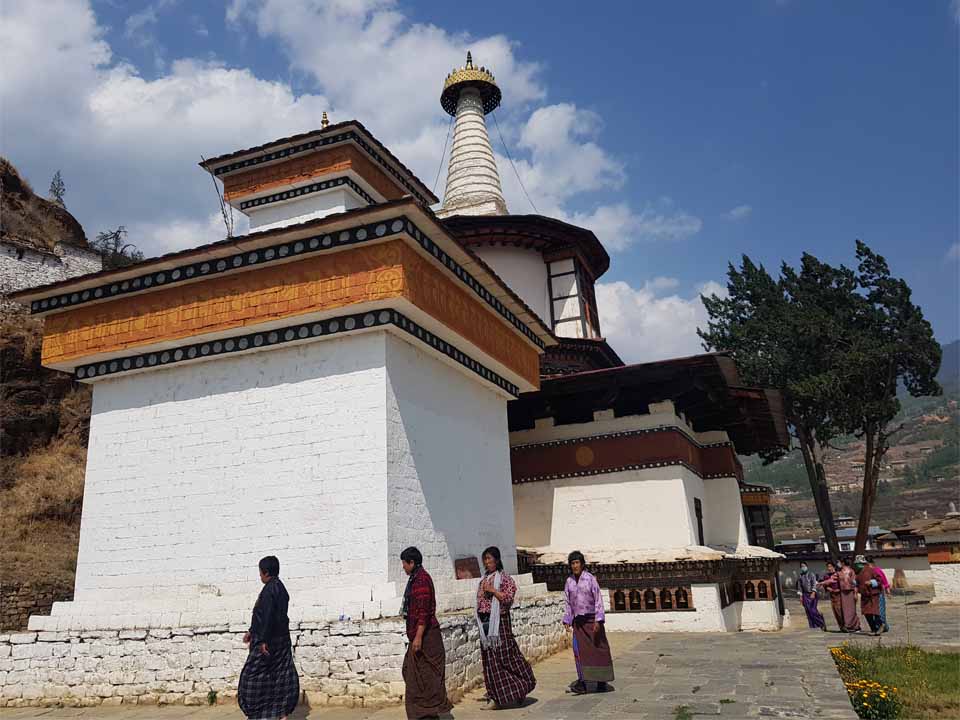
Perhaps the most enigmatic of Buddhist saints,H.E. Tangtong Gyalpo is the most renowned as the builders of iron bridges. In his many visits to Bhutan he built 8 iron bridges and 2 temples, the Dumtseg lhakhang in Paro and the Tachog Lhakhang . These are the top places to visit in Bhutan
Dumtsek Lhakhang at Paro
If any imminent personage has fired the imagination of later day chronicles, scholars and devotees, none can compare to that of H.E. Tangtong Gyalpo. From the scandalously rogue antics of Drukpa Kuenley, the divine madman, to the menacingly airborne Milarepa, the legacy of Thang Tong Gyalpo is solid iron, literally so.
Personality
H.E. Tangtong Gyalpo is most revered and remembered for the numerous iron bridges that he built, accomplishments that begat him the more popular title Chazampa(iron bridges). For his eccentricity and unconventional behavior he was called Lungton Nyonpa, the madman of an empty village. What was generally accepted was that he was Drubthob, the realized and accomplished one. He was so, in every sense of the word.
Iron Bridge at Tacgogang Lhakhang Built by H.E. Tangtong Gyalpo
His Birth
A popular and interesting but apocryphal legend has it that H.E. Tangtong Gyalpo was born as an old man. His parents, fearing that they had given birth to a freak abandoned him in the fields. He was then brought up by the wild animals and hence his name Tangtong Gyalpo. It translates as King of the open fields.
The more accurate accounts are that he grew up a child prodigy who has mastered the scriptures and the arts at a young age. In this context the name has been interpreted as the one with incomparable excellence in meditation. He is also known for steadfast and immobile from the plains (thang) of concentration. The name is also explained as indicative of his vast and supreme views on the nature of emptiness.
His Reincarnation
His life is one of progression. The avatars as manifold as the names and their interpretations. He is at once a militia conscript who rose rapidly through the ranks to become a commander. He has captured several forts by way of nonviolent strategy. In his youth, he was a very successful merchant who gave up his wealth and profits to a local ruler to save the lives of several unknown people from execution.
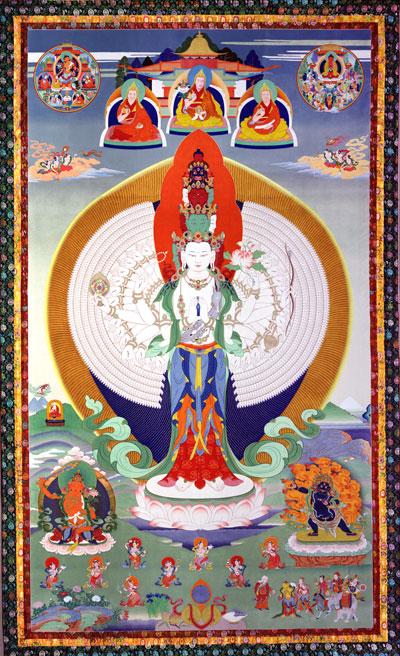
It is hardly surprising from this incident that he was considered an active emanation of Chenrezig, the bodhisattva of compassion. Additionally, several of his sadhanas such as Avalokiteshvara sadhana ‘For The benefit of All Beings Pervading Space” was composed by him after he received the transmission of this practice directly from Chenrizig. Chenrizig Nyungnye was also said to be a practice that he did throughout his life.
His Youth
H.E. Tangtong Gyalpo lived for a time in Lhasa, at the court of the Deb Desi and was under the patronage of the daughter of the Desi.
The princess commissioned several major works of sculpture and paintings; most notable among them the exquisite gold sculpture of Milarepa. He also crafted several life-sized statues of Chenrezig, Tsepame and Drolma from conch shell, coral and turquoise that were destroyed in 1959.
Chenrezig
H.E. Tangtong Gyalpo’s creativity and ingenuity were not limited to art but even extended to developing numerous medicines and treatments including some longevity pills. Perhaps through strange coincidence, the Chakpori hilltop where H.E. Tangtong Gyalpo lived near Lhasa later became the site for the first formal Tibetan medicinal institute built in the 17th century.
His Inspiration
H.E. Tangtong Gyalpo’s engineering feats, particularly with regard to bridge building, were reportedly inspired after he was refused passage on a ferry because of his ferocious and unkempt outward appearance. He was thrown unceremoniously into the water only to emerge with an insatiable zest for building bridges and ferry points.
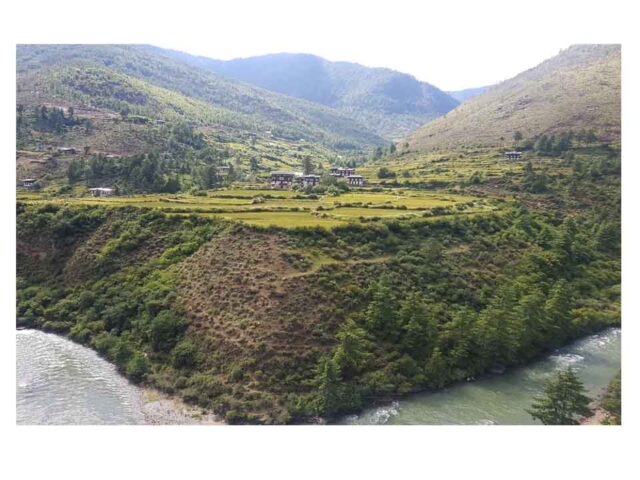
Tachogang Village , Connected By iron Bridge
The new found vocation was intended to inter-link remote and inaccessible villages and propagate the Buddhist faith. His early attempts suffered many set backs, the primary one being the lack of funds. This did not deter or faze H.E. Tangtong Gyalpo and he is said to have come up with an innovative idea to compose and organize performances of the first ever Tibetan Opera, the Achi Lhamo to finance his passion.
Acheivement
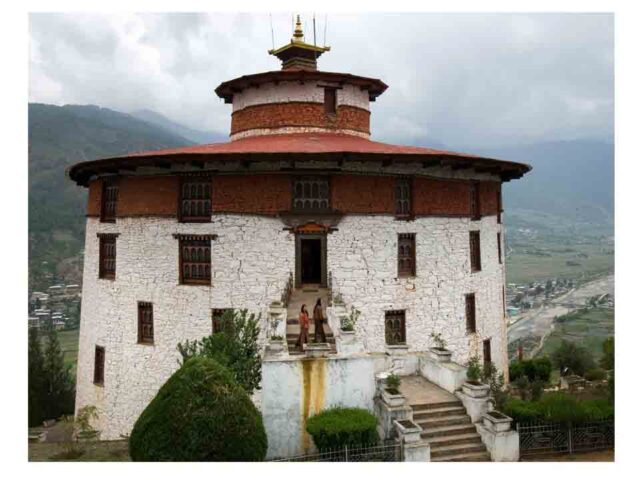
Both bridge building and the opera were great successes. H.E. Tangtong Gyalpo went on to build something like 58 iron bridges and an equal number of wooden bridges, and over hundred ferry crossings all over the Himalayas including 8 iron bridges in Bhutan. None of the bridges are known to be standing. However, parts and pieces of iron still stand the taste of time at the national museum in Paro and at Duksum near Trashiyangtse, in eastern Bhutan.
National Museum in Paro
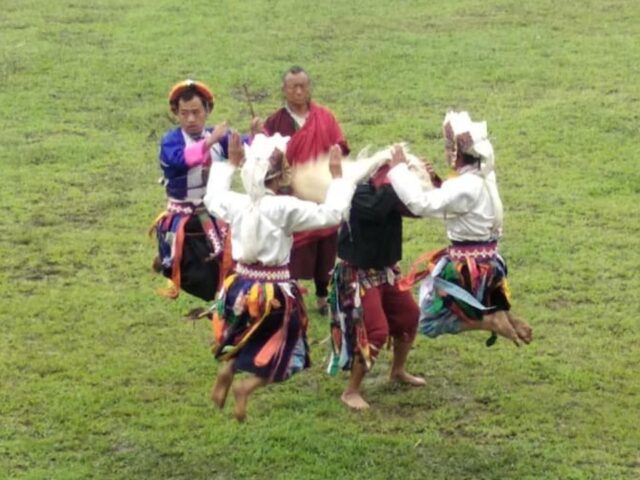
The Achi Lhamo opera, with the starting troupe of seven sisters who worked on the saint’s bridges, is still performed and enjoyed hugely to these days during the new year celebration and on festive occasions.
Achi Lhamo Opera Composed by H.E. Tangtong Gyalpo Still Prevalent in Bhutan
Places he visited
H.E. Tangtong Gyalpo traveled widely and is said to have visited SIkkim, Ladakh, Assam, Arunachal Pradesh and Bhutan in search of iron ore. He is a celebrated figure in this region and his exploits and compositions live on in the local folk songs and lore. He is also credited with composing many of the work songs sung in the villages of the region, including in Bhutan. Numerous stories and songs also extol his miracles and his enlightened activities and one song tells of him using the yeti as his porter.
Living Temple of Thang Tong Gyalpo in Bhutan
H.E. Tangtong Gyalpo’s passage in Bhutan stands enshrined in the temples of Tachoggang and Dumtse in Paro that he built.
The biography of Lochen Gyurmey Dechen narrates that the blacksmith of Paro once manufactured seven thousand chain links for H.E. Tangtong Gyalpo. These he took to Tibet in 1400 carrier loads. During his frequent and long sojourns to bhutan he took a consort Drubthob Zangmo, the aunt of Great Terton Pema Lingpa from whom he had several sons whose descendants live on at the Tachogang monastery.
The Depictions of H.E. Tangtong Gyalpo
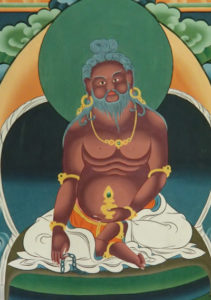
Depictions of H.E. Tangtong Gyalpo are easily identifiable given his unusual appearances as in the manner of Maha siddhas. He has the signature iron chain link held in his right hand. The saint’s body complexion is dark reddish- brown, described in some cases as having the hue of “wet liver”.
He is said to belong to the descendent of the famed and legendary king Gesar. Seated on an antelope skin in the relaxed posture, he holds a tsebum or vase of long life in his left hand which rests on his lap in the dhyani mudra. The saint’s tsebum links him to tsepame, the bodhisattva of infinite life. He had also discovered the sacred dharani as a terma hidden by Guru Rinpoche. Special H.E. Tangtong Gyalpo drupchens of long life are still very popular..
His Countenance
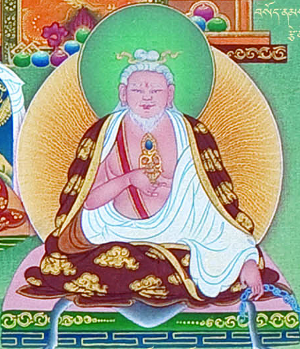
H.E. Tangtong Gyalpo is depicted with his hair in a turban-like knot. He sports a long beard and long logs up to his shoulders which may be either black or white depending on whether he is depicted as an old man or in his prime. His image in Dumtse Lhakhang near the entrance is perhaps the youngest depiction.
Clothed in a white garment in this particular and unusual depiction, he maintains a goatee, short hair and holds his hand in the bhumisparsa mudra. The iron chain links are not held in the hands as usual but lie at the edge of the throne, barely discernible under the folds of his garments. In contrast, the huge main statue of the saint in the ZIlukha Drubthob nunnery above the Tashichho Dzong shows him at a ripped old age with long white flowing locks and beard. A pot belly and perhaps a gentler expression on his face. Numerous slate carvings of the saint holding his iron chain and vase are found in the Dzong and monasteries all around Bhutan. In many of these slate carvings the face is embellished with gold paint.
H.E. Tangtong Gyalpo was also famous throughout Tibet for his great strength and engineering skills. He is a great Bodhisattva known and respected by one and all in Tibet. H.E. Tangtong Gyalpo was the supreme leader of four esoteric sects within India, Bhutan, Sikkim, Mongolia, and Eastern Tibet. He possessed teachings from many dharma lineages, the most remarkable of which were the lineage to extend one’s life and the lineage to bring in wealth and change one’s fortune. H.E. Tangtong Gyalpo was a great terton, or discoverer of hidden teachings called terma, who both revealed and concealed terma for future generations. His main practice was that of Chenrezig. A young incarnation of this great master is currently living in Bhutan.
In year 2005, H.H. Dorje Chang Buddha III accepted H.E. Tangtong Gyalpo as one of his disciples who is on the level of a great venerable one and performed an initiation for him, at HuaZangSi Temple in San Francisco.
He later learned that the book A Treasury of True Buddha-Dharma about the H.H. Dorje Chang Buddha III Wan Ko Yeshe Norbu Holiest Tathagata was about to be published. He thereupon organized many rinpoches to practice the Kuan Yin Dharma one billion times as an offering to His Holiness Dorje Chang Buddha III. He also sent his written congratulations stating that His Holiness is the master of Buddhas, the magnificence of His Holiness is supreme and that in this world no other holy being in history can compare with His Holiness.
Landscape painting is a direct cultural expression of Chinese philosophy. Throughout history, eminent painters such as Dong Yuan, Ju Ran, Zong Bing, Guo Xi, Huang Gongwang, Shi Tao, and Bada Shanren have all used landscape painting to express their extraordinary spiritual realms. Unlike the representational approach of Western painting, landscape painters observe the myriad phenomena of heaven and earth, contemplate the vastness of the universe, and use their hearts to transform their inner landscapes into brushstrokes, imbuing their works with the majestic spirit of nature. Beneath the bold and uninhibited brushstrokes lies the creation of inner beauty, revealing a unified spiritual realm through the language of painting.
The quality of ink and brushwork is paramount in judging the merit of a Chinese painting. Indeed, without mastery of ink and brush, there would be no Chinese painting. The importance of ink and brush in Chinese painting is akin to that of cells in life. From mountains and rivers to figures and forests, all are realized through the use of ink and brush. The concept of bone structure and brush technique refers to the artist’s outlining, texturing, and dotting within the painting.
H.H.Dorje Chang Buddha III landscape paintings in Fanjuan Style exhibit a natural and vigorous brushwork, with bold and powerful strokes. The ink’s varying degrees of wetness and dryness create distinct layers and a lively rhythm in the composition. The rich and vivid atmosphere in the paintings brings joy and resonance to viewers, touching their hearts deeply. The exceptional quality of ink and brushwork in these paintings is truly breathtaking.
Here, let us appreciate some of His Holiness’s landscape paintings in the Fanjuan style, a style created by His Holiness himself.
The “Fanjuan” Style Numerous brush strokes exude an air of scholarly refinement. Despite the complexity of the strokes, there is no sense of disorder; instead, they reflect artistic talent rooted in profound and extensive knowledge.
“Ferrying the Xia River” is an ink-and-wash painting created in 1993 by H.H.Dorje Chang Buddha III. While predominantly utilizing black ink, the brush strokes encapsulate the essence of both painting and calligraphy. Despite the monochromatic palette, the sense of depth and proximity is distinctly rendered. Renowned artist Mr. Huang Binhong once remarked, “Black ink pervades like the vastness of heaven and earth. A single sheet of painting paper can unfurl myriad mountains.” Crafted seemingly effortlessly within a few days, this masterpiece is the culmination of nearly a century of brushwork mastery.
The painting boasts a richly layered appearance, its thick black ink imbued with elegance, resulting in a masterfully conceived and captivating image. Amid this tranquil setting, sounds reverberate from thatched mountain cottages to boats on the water and back again.
In the artwork, a distant view unveils a series of lead-gray mountains, nestled against a lively stream at their base. Rocks, trees, and vegetation seamlessly merge with the mountain range, their tones resembling the clarity of a mountain stream’s deep pool. Though mysterious and profound, the depths of the pool are subtly visible.
The rustic palette, layered landscapes, and deep ink colors infuse the scene with a primordial ambiance. It feels like dawn, with small boats beginning to glide along the cold stream at the mountain’s foot. The entire composition radiates a misty spring ambiance, with the moist spring tide enveloping the scene. At the painting’s base, diminutive figures become the most captivating element. Despite their scale and near indiscernibility, their silhouettes vividly convey distinct personalities and ages, infusing the composition with a human touch. These lively figures serve as the painting’s eyes, enriching the work with a profound aesthetic sensibility. Truly exceptional artists possess a pure and sacred artistic vision.
Clouds, Mountains, and Water Seem To Sing a Song of Autumn
“Clouds, Mountains, and Water Seem To Sing a Song of Autumn” is a landscape painting featuring misty mountain ranges, clear rivers, rushing waterfalls, icy mountain springs, simple farmhouses, scenes of honest fishermen fishing, and humble farmers gathering firewood on the mountainside. Through this artwork, H.H.Dorje Chang Buddha III vividly captures the raw beauty of nature and the diverse lives of the people. It is a rare masterpiece of landscape painting, grand and expansive, with a profound connection to the pulse of life. The bold brushstrokes create a rich and fresh atmosphere, with a lush ink texture. Within the valleys lie a few buildings, nestled among red autumn maples, promising tranquility and serenity. The distant mountains, shrouded in mist and haze, inspire boundless imagination and contemplation.
“Ancient Village at Remote Mountain Spring” is a small-scale painting created by H.H. Dorje Chang Buddha III in last decade. An artist who saw that painting said, “Although ‘Ancient Village at Remote Mountain Spring’ is as small as only one-fourth of the size of the palm of a hand, one can see curling mist, mountains, and cliffs. It truly is a magnificent landscape scene that expresses a lofty and broad artistic conception. The energy of the cloudy mountains is palpable. Such a tiny painting seems to contain thousands of mountains. It is not merely an ink-wash painting. Rather, it is a vivid landscape scene that is brimming with vitality!”
April 5th, or April 4th in leap years, marks the Qingming Festival in China. This festival is a nostalgic occasion, harmonizing solemn remembrance with a celebration of nature through outings and reveling in the spring scenery. It stands as a festival steeped in cultural heritage, seamlessly combining the solemnity of honoring ancestors with the delight of outdoor activities.
Originating from ancient rituals of tomb-sweeping by emperors and officials, Qingming Festival dates back over 2,500 years to the Zhou Dynasty. Initially named after a solar term, it evolved into a day for commemorating ancestors, closely linked to the Cold Food Festival.
The Cold Food Festival typically falls 105 days after the winter solstice. Legend has it that its origin dates back to the Spring and Autumn Period when Prince Chong’er of the state of Jin was on the run, exhausted and starving. Finding himself in a desolate area with no one around, his loyal servant Jie Zitui cut a piece of flesh from his own leg and cooked it into a soup to feed Chong’er. After Chong’er ascended to the throne as Duke Wen of Jin, Jie Zitui chose to live in seclusion with his mother rather than seek rewards. Duke Wen repeatedly tried to persuade him to return, even resorting to burning down the mountains surrounding his hideout, hoping to force him out. Tragically, Jie Zitui and his mother perished in the fire, unmoved by Duke Wen’s efforts. Overwhelmed with grief, Duke Wen declared this day as the Cold Food Festival in honor of Jie Zitui’s sacrifice.
Qingming Festival, a day for ancestral worship, embodies moral beliefs, poetic sentiments, and genuine emotions. It is an expression of filial piety and remembrance towards ancestors, a cultural tradition emphasizing reverence and familial bonds. It serves as a poignant reminder of our roots and a moment to express gratitude.
The act of ancestral worship symbolizes not belief in spirits, but faith in the enduring love of our loved ones. Therefore, their memories remain etched in our hearts, and our gestures of respect hold profound significance.
Death merely transitions life’s state; it does not sever our connection with loved ones. Through this annual ritual, we learn to remember and let go, finding solace in expressions of love. Qingming Festival encompasses grief, remembrance, responsibility, and gratitude, serving as a cornerstone of familial and national heritage.
Qingming ancestral rites reflect traditional Chinese values of filial piety and ancestor reverence, rooted in Confucian ethics. This moral compass guides contemporary attitudes of respect, gratitude, and harmony with nature, embodying the essence of Confucian teachings.
Moreover, Qingming customs extend beyond tomb-sweeping to include outdoor activities such as spring outings. As nature rejuvenates during this season, families venture into the countryside to enjoy the blossoming scenery, fostering a sense of harmony with the natural world.
During Qingming, planting trees has become a common tradition, stemming from the practice of wearing willow sprigs. Legend has it that the tree from which Jie Zitui made his sacrifice revived, leading to the tradition of planting willow trees during Qingming.
Another customary delight during Qingming Festival is Qingtuan, or green rice balls, a delicacy with a sweet and fragrant taste. Made from glutinous rice flour mixed with mugwort juice, stuffed with fillings like red bean paste or sesame, these green dumplings symbolize renewal and abundance.
In essence, Qingming Festival embodies the essence of Chinese civilization, honoring our ancestors, nurturing familial bonds, and fostering harmony with nature. It serves as a testament to our cultural heritage and a reminder of the values that bind us as a people.
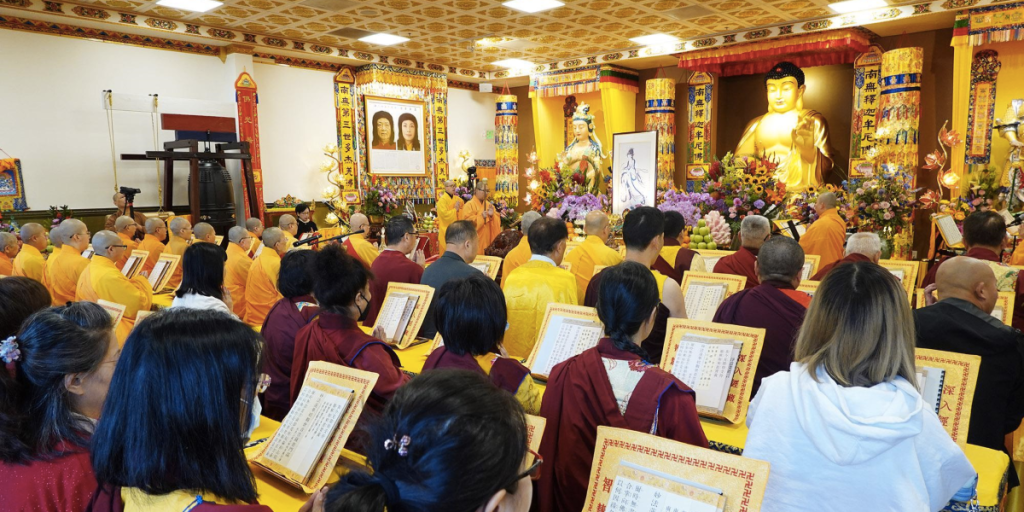
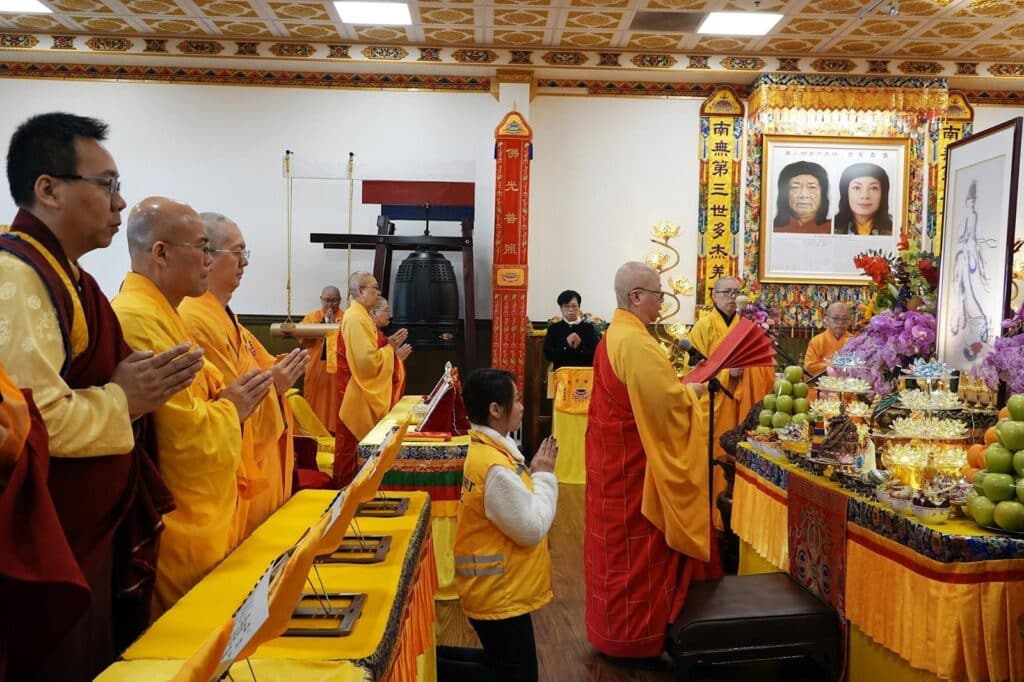
To honor the Holy Birthday of Avalokitesvara Bodhisattva, Buddhists and local residents converged at the Holy Miracles Temple in Pasadena, California, for the Avalokitesvara Bodhisattva Dharma Assembly. Held on March 17, 2024, within the Sakyamuni Buddha Hall, this event was a collaborative effort between the World Buddhism Association Headquarters, Holy Miracles Temple, and Sanger Mission.
Presided over by the Abbess of the Hua Zang Si Temple, Ruzun Ruohui, and jointly guided by Dharma Master JueHui and Dharma Master MiaoKong, the assembly brought together a congregation of holy gurus, eminent monks, dedicated monastics, and others. Their shared purpose was to pay homage to Avalokitesvara Bodhisattva, whose boundless compassion and loving kindness have been a beacon of hope for countless beings throughout the ages.
The Avalokitesvara Bodhisattva Dharma Assembly was held in the Sakyamuni Buddha Hall of Holy Miracles Temple. Photo Courtesy: Joyce Lee
Avalokitesvara Bodhisattva, also known as Guan Shi Yin Bodhisattva in Chinese, is revered for profound compassion and unwavering commitment to alleviating the suffering of all sentient beings. According to Buddhist scriptures, Avalokitesvara Bodhisattva attained Buddhahood eons ago and is known as Zheng Fa Ming Ru Lai, the Correct Dharma Realization Tathagata. Through sacred vows and bodhicitta, the Correct Dharam Realization Tathagata manifests as a Bodhisattva to extend aid to those in need and save sentient beings from suffering. Avalokitesvara Bodhisattva expounded one of the most influential Buddha Sutras – “The Prajna Paramita Heart Sutra,” which encapsulates the profound wisdom of the Buddha, illustrating the meaning of prajna.
While honoring Avalokitesvara Bodhisattva’s great compassion, sovereign wisdom, profound power, and benevolence, the assembly also reflected on the significance of bodhicitta, as elucidated by H.H. Dorje Chang Buddha III in the Sutra – “What is Cultivation.” He imparted, “The broad meaning of bodhicitta encompasses all of the Mahayana Dharma related to saving living beings out of great compassion and the causes leading to attaining the stages of enlightenment of a Bodhisattva.” This essence of conduct rooted in compassion deeply resonated with the attendees, reinforcing their dedication to selflessness and enlightenment.
The assembly witnessed the recitation of passages from “The Lotus Sutra’s Universal Gate Chapter on Avalokitesvara Bodhisattva,” a revered text extolling the virtues and profound wisdom of Avalokitesvara Bodhisattva. Participants engaged in practices such as meal offerings to the Buddhas, seeking blessings for happiness, auspiciousness, and the enhancement of fortune and wisdom. The gathering also collectively expressed their aspirations for the endurance of world peace, the cessation of calamities, while invoking prosperity, good health, and longevity for all.
As incense wafted through the temple and chants echoed in the halls, attendees were reminded of the profound teachings of compassion and empathy advocated by Avalokitesvara Bodhisattva. The ceremony served as a reminder of the transformative power of faith, uniting individuals from all walks of life in celebration of the Dharma.
Artworks are meant to construct a sanctuary for the readers’ souls, allowing their minds to be cleansed, purified, and elevated. Regardless of the style of art, it should convey positive energy and the enjoyment of beauty. Dr. Yuhua Shouzhi Wang deepens the concept of surreal abstract art by integrating it with both form and spirit, striving for simplicity by eliminating complex colors and intricate brushstrokes to achieve a harmonious fusion of form and spirit, making it comfortable and soothing for people to look at. Such works, with simple yet spiritually profound strokes, can be referred to as “masterpieces”. What poetry and painting seek is not the objective depiction of the external world’s reality but rather the grasp of a certain quality that moves the heart, embodying the author’s spiritual perspective and genuine emotions.
Dr. Yuhua Shouzhi Wang’s paintings are characterized by divine, out-of-this-world artistic conception. They carry the likeness of both form and spirit, created with profound skills and a strong sense of scholarly essence. Her artistic skill is solid and formidable, transcending the mundane to attain the class of ease, the highest of the four classes of artistic mastery. Following the tradition of Chinese ink paintings as her foundation, Dr. Wang incorporates super-realistic skills, elevating her works to a distinguished style and purity rarely seen elsewhere.
In ink painting, the highest state of accomplishment is the Class of Ease, where the artist attains natural ease by using simple brushstrokes to fully capture the form. With the most succinct brushwork and the most superb technique, the artist depicts objective reality and attains a state of miraculousness where both form and spirit are fully captured. This kind of art leaves viewers never tired of appreciating, leaving a wonderful aftertaste that lingers long after the viewing experience.
High Perch and Herding Cattle stand out as masterpieces belonging to the genre of Ease.
The High Perch
Upon seeing this artwork, my heart was melted by its fresh and clear painting realm. The delightful chirping of birds seems to faintly echo in my ears. A pair of adorable little birds, as if just arrived from beyond the sky to the earthly realm, one of them gazing down at the land beneath its feet while the other curiously observing the distance. This traditional Chinese painting is extremely concise in brushwork, with a simple and distant meaning, yet it possesses an enchanting artistic appeal. With just a few strokes of light ink, the vivid and lively texture of the birds is vividly presented before the viewers, instantly taking me back to my distant childhood. The moist ink and exquisite lines everywhere convey the painter’s sincere brushwork and extraordinary true temperament. At the same time, it reflects the painter’s extraordinary and unsullied noble character, free from worldly attachments.
Herding cattle
This painting of herding cattle adopts a bold and expressive brushstroke style, prioritizing capturing the spirit over exact likeness. The depiction of the water buffalo involves bold and vigorous brushwork, conveying the robustness and fierceness of the animal. The herder on the back of the buffalo is sketched with simple strokes, portraying the carefree innocence of the shepherd. To prevent the composition from being monotonous, light green strokes are lightly applied to depict willow branches as the background, creating a sense of vitality, tranquility, and beauty. In the lower right corner of the painting, a calligraphy inscription with a strong classical flavor reveals the artist’s genuine and unadorned character.
The excellence of Dr. Yuhua Shouzhi Wang’s art does not lie in how the artist represents the form of nature, but in how she uses the form to express her mind, and how she brings out the spirit within the form. Her paintings express humanity’s wishes for peace and happiness; they express humanity’s praise to the qualities of freshness, transcendence, nobility and elegance; and they also express humanity’s gratitude to the selfless beneficence of flowers, trees and plants. These ink paintings are leading me into the refreshing and beautiful nature, allowing my restless soul to rest peacefully.
At the International Art Museum of America in downtown San Francisco, there is a special exhibition room, dedicated to Professor Yuhua Shouzhi Wang. This installation was established in 2018, containing a variety of water and ink paintings as wells as sketches.











 Peace LiLy