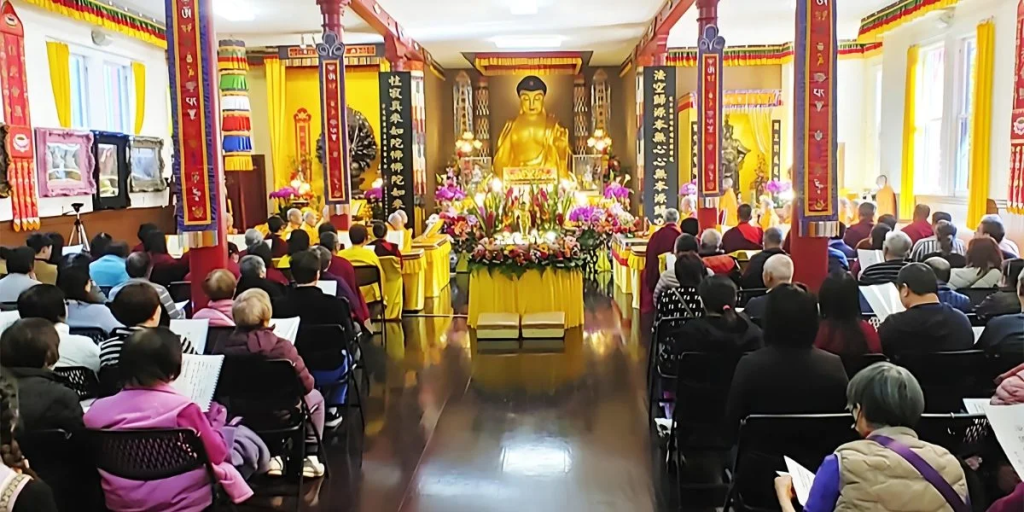
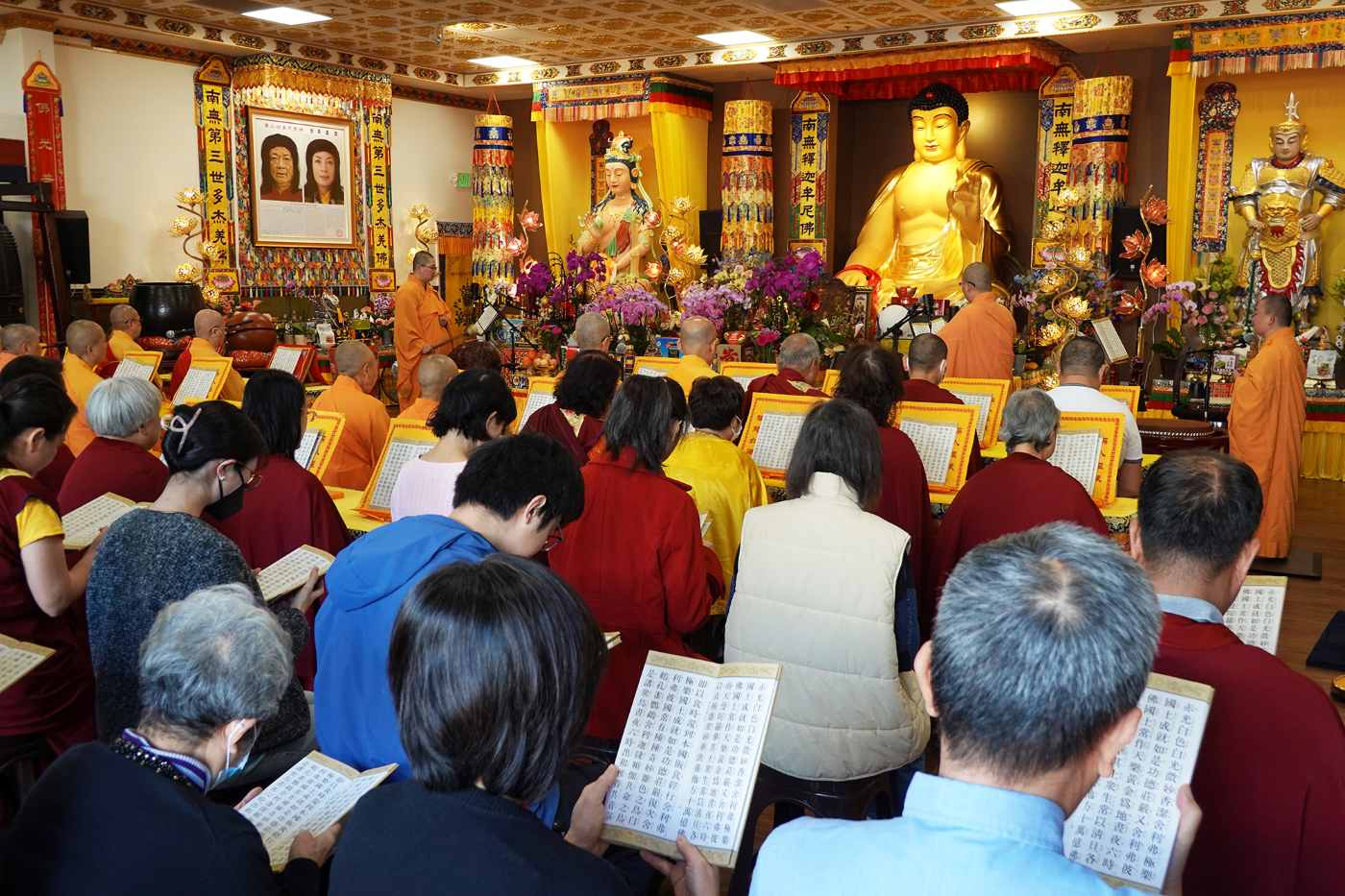
Photo Courtesy: Catherine Song | Hua Zang Si temple‘s serene atmosphere fostered reverence as attendees honored Shakyamuni Buddha’s Holy Birthday.
San Francisco, CA – On Sunday, May 4, 2025 (Sunday) – Hua Zang Si, a renowned Buddhist temple in San Francisco, solemnly hosted the Bathing the Buddha Dharma Assembly, welcoming local residents and visitors from diverse cultural and religious backgrounds. This sacred gathering commemorated the Holy Birthday of Shakyamuni Buddha, the World-Honored One, offering attendees a profound spiritual experience.
Organized by the World Buddhism Association Headquarters (W.B.A.H.), Hua Zang Si, and Sanger Mission, the event offered profound spiritual enrichment and served as a harmonious celebration that united the community in shared reverence and joy.
Under the guidance of Abbess of Hua Zang Si Temple, Ruzun Ruohui, the ceremony commenced in the temple’s majestic Grand Hall, where attendees chanted “The Heart Sutra” and the “Bathing the Buddha Verse” in unison, seeking blessings, wisdom, and spiritual purification. At the Bathing the Buddha Pavilion, participants held ritual ladles and poured fragrant water over the statue of the infant Prince Siddharta Gautama — later known as Shakyamuni Buddha —accompanied by heartfelt prayers:
“Today, I bathe the Buddha with a wholeheartedly pious, seeking blessings and wisdom from the Buddha. May I and all sentient beings be free from obstacles and together attain the realization of the Pure Land.”
The rituals serve as a reminder of Buddha’s profound teachings on mindfulness and self-cultivation, inspiring all individuals—regardless of their beliefs—to cultivate compassion, reflect on their actions, and strive for a harmonious and meaningful life. Blessings were offered for all sentient beings to be freed from defilements and burdens, fostering a compassionate force to bring harmony and stability to society. The merit of this ceremony was dedicated to alleviating global disasters and pandemics, ending conflicts, bringing happiness to all living beings, and a prosperous and peaceful nation.
Photo Courtesy: Catherine Song | Attendees poured fragrant water over the infant Prince Siddhartha Gautama statue with ritual ladles, seeking blessings and wisdom from the Buddha.
According to Buddhist scriptures, following the birth of Prince Siddhartha Gautama, nine dragons poured streams of fragrant water to bathe Him—which later became a tradition upheld globally in commemoration of His holy birth. The “Sutra on the Merits Accrued from Bathing the Buddha” details the blessings associated with this sacred practice, including health, longevity, spiritual fulfillment, and familial harmony. The ceremony concluded with the distribution of fragrant water to devotees, filling them with immense joy and spiritual bliss.
Founded on December 26, 2004, in San Francisco’s Mission District, Hua Zang Si has become a prominent center for authentic Buddhist teachings, guided by the teachings of H.H. Dorje Chang Buddha III and Shakyamuni Buddha. Throughout the year, the temple hosts Blessing Dharma Assemblies, providing a welcoming and inclusive space for individuals to engage with the profound teachings of Buddhism.
In addition to its spiritual mission, Hua Zang Si remains deeply committed to humanitarian efforts. Over the years, the temple has organized Lunar New Year celebrations at nursing homes, assisted with hospital relocations, provided meals to those affected by disasters, and conducted charity sales to support underserved populations. Recent initiatives have included fundraising for animal rescue centers, assisting low-income families, donating to local food banks, and delivering essential supplies to wildfire-affected areas. Hua Zang Si continues to embody the principles of compassion, unity, and service, fostering hope and harmony throughout the community.
I have always heard certain quotes attributed to Albert Einstein concerning what he believed about Buddhism including one that implied that if he were a religious man he would be a Buddhist. There does not seem to be any evidence that he said that, but I found the following to be useful. The first part is an article by Kang Na, Assistant Professor of Religion at Westminister College that provides context for the essay and additional quotes by Einstein.
Certainly no one in 1879 in Ulm, Germany, could have guessed that one of their own born that year would someday receive global praise for his undisputed genius, meriting recently the coveted title “person of the century” (Time magazine). Likewise, international fame was probably not what Albert Einstein himself anticipated in 1895 when he failed the entrance exam for the Federal Polytechnical Institute in Zurich, Switzerland. Even as he worked and was being promoted at the Swiss Patent Office in Bern, Switzerland (1902–08), Einstein was far from becoming a household name, let alone the most renowned Nobel Prize winner in physics, which he received in 1921 not for his special theory of relativity (of E=MC2 fame) that inaugurated the atomic age in 1905, but for his discovery of the photoelectric effect (the hypothesis he proposed also in 1905 that electromagnetic radiation interacts with matter as if the radiation had a granular structure or particles).
Shortly thereafter, when Einstein’s reputation in academia waxed toward worldwide celebrity, no one could have presaged that in 1952 the newly established state of Israel would offer him the presidency, which he declined. That invitation, however, points out that he was not only perpetually engaged in the subtle mysteries of the universe but also as outspoken in the political arena as a Zionist who detested the Nazis’ rise to power, as a prophet who insisted that Jews make peace with Arabs, and as a pacifist, who, in his famous letter to President Roosevelt (1939), warned against the potential abuses of atomic energy, despite his support for the development of the A-bomb. Even days before his death on April 18, 1955, he wrote his last signed letter to the philosopher Bertrand Russell expressing his intention to sign a joint manifesto insisting that all nations renounce nuclear weapons. By then his brilliant mark on human history was as unquestionable as his unkempt hair was uniquely recognizable.
It is this larger-than-life Einstein who wrote the following essay on the proper relationship between science and religion, part one in 1939 and part two in 1941. It is also here in the latter part of the essay that we find his often quoted dictum, “Science without religion is lame, religion without science is blind.” He wrote “Science and Religion” as a contribution to a symposium held in New York in 1941 on what roles science, philosophy, and religion played in the cause of American democracy. Thus, the essay recommends itself to the multi-disciplinary approach that Inquiry takes within the liberal arts program at Westminster.
Although Einstein read the Bible often, spoke quite freely about God, and was unapologetically religious, the essay discloses a religious disposition not quite like that of an ordinary religious person. He believed “in Spinoza’s God who reveals himself in the harmony of all that exists, but not in a God who concerns himself with the fate and actions of human beings” (Einstein Archive 33-272). Hence Einstein declared, “My religion consists of a humble admiration of the illimitable superior spirit who reveals himself in the slight details we are able to perceive with our frail and feeble minds. That deeply emotional conviction of the presence of a superior reasoning power, which is revealed in the incomprehensible universe, forms my idea of God” (quoted in the New York Times obituary, April 19, 1955). Furthermore, as the essay makes clear, Einstein’s emphasis on the moral and altruistic dimensions of religion was unequivocal: “Humanity has every reason to place the proclaimers of high moral standards and values above the discoverers of objective truth. What humanity owes to personalities like Buddha, Moses, and Jesus ranks for me higher than all the achievements of the inquiring constructive mind” (Dukas and Hoffmann, Albert Einstein, the Human Side, 70). Perhaps it is only ironically fitting that it is precisely the inquiring constructive mind of Einstein that destined him for the cover of Time and for an honored place among those rare spirits whose extraordinary genius and creativity punctuated and graced the progression of human history.
(Biographical information taken from Alice Calaprice’s The Quotable Einstein, 1996)
Essay on Science and Religion
Albert Einstein
PART I (1939)
During the last century, and part of the one before, it was widely held that there was an unreconcilable conflict between knowledge and belief. The opinion prevailed among advanced minds that it was time that belief should be replaced increasingly by knowledge; belief that did not itself rest on knowledge was superstition, and as such had to be opposed. According to this conception, the sole function of education was to open the way to thinking and knowing, and the school, as the outstanding organ for the people’s education, must serve that end exclusively.
One will probably find but rarely, if at all, the rationalistic standpoint expressed in such crass form; for any sensible man would see at once how one-sided is such a statement of the position. But it is just as well to state a thesis starkly and nakedly, if one wants to clear up one’s mind as to its nature.
It is true that convictions can best be supported with experience and clear thinking. On this point one must agree unreservedly with the extreme rationalist. The weak point of his conception is, however, this, that those convictions which are necessary and determinant for our conduct and judgments, cannot be found solely along this solid scientific way.
For the scientific method can teach us nothing else beyond how facts are related to, and conditioned by, each other. The aspiration toward such objective knowledge belongs to the highest of which man is capable, and you will certainly not suspect me of wishing to belittle the achievements and the heroic efforts of man in this sphere. Yet it is equally clear that knowledge of what is does not open the door directly to what should be. One can have the clearest and most complete knowledge of what is, and yet not be able to deduct from that what should be the goal of our human aspirations. Objective knowledge provides us with powerful instruments for the achievements of certain ends, but the ultimate goal itself and the longing to reach it must come from another source. And it is hardly necessary to argue for the view that our existence and our activity acquire meaning only by the setting up of such a goal and of corresponding values. The knowledge of truth as such is wonderful, but it is so little capable of acting as a guide that it cannot prove even the justification and the value of the aspiration towards that very knowledge of truth. Here we face, therefore, the limits of the purely rational conception of our existence.
But it must not be assumed that intelligent thinking can play no part in the formation of the goal and of ethical judgments. When someone realizes that for the achievement of an end certain means would be useful, the means itself becomes thereby an end. Intelligence makes clear to us the interrelation of means and ends. But mere thinking cannot give us a sense of the ultimate and fundamental ends. To make clear these fundamental ends and valuations, and to set them fast in the emotional life of the individual, seems to me precisely the most important function which religion has to perform in the social life of man. And if one asks whence derives the authority of such fundamental ends, since they cannot be stated and justified merely by reason, one can only answer: they exist in a healthy society as powerful traditions, which act upon the conduct and aspirations and judgments of the individuals; they are there, that is, as something living, without its being necessary to find justification for their existence. They come into being not through demonstration but through revelation, through the medium of powerful personalities. One must not attempt to justify them, but rather to sense their nature simply and clearly.
The highest principles for our aspirations and judgments are given to us in the Jewish- Christian religious tradition. It is a very high goal which, with our weak powers, we can reach only very inadequately, but which gives a sure foundation to our aspirations and valuations. If one were to take that goal out of its religious form and look merely at its purely human side, one might state it perhaps thus: free and responsible development of the individual, so that he may place his powers freely and gladly in the service of all mankind.
There is no room in this for the divinization of a nation, of a class, let alone of an individual. Are we not all children of one father, as it is said in religious language? Indeed, even the divinization of humanity, as an abstract totality, would not be in the spirit of that ideal. It is only to the individual that a soul is given. And the high destiny of the individual is to serve rather than to rule, or to impose himself in any other way.
If one looks at the substance rather than at the form, then one can take these words as expressing also the fundamental democratic position. The true democrat can worship his nation as little as can the man who is religious, in our sense of the term.
What, then, in all this, is the function of education and of the school? They should help the young person to grow up in such a spirit that these fundamental principles should be to him as the air which he breathes. Teaching alone cannot do that.
If one holds these high principles clearly before one’s eyes, and compares them with the life and spirit of our times, then it appears glaringly that civilized mankind finds itself at present in grave danger. In the totalitarian states it is the rulers themselves who strive actually to destroy that spirit of humanity. In less threatened parts it is nationalism and intolerance, as well as the oppression of the individuals by economic means, which threaten to choke these most precious traditions.
A realization of how great is the danger is spreading, however, among thinking people, and there is much search for means with which to meet the danger—means in the field of national and international politics, of legislation, of organization in general. Such efforts are, no doubt, greatly needed. Yet the ancients knew something which we seem to have forgotten. All means prove but a blunt instrument, if they have not behind them a living spirit. But if the longing for the achievement of the goal is powerfully alive within us, then shall we not lack the strength to find the means for reaching the goal and for translating it into deeds.
PART II (1941)
It would not be difficult to come to an agreement as to what we understand by science. Science is the century-old endeavor to bring together by means of systematic thought the perceptible phenomena of this world into as thorough-going an association as possible. To put it boldly, it is the attempt at the posterior reconstruction of existence by the process of conceptualization. But when asking myself what religion is I cannot think of the answer so easily. And even after finding an answer which may satisfy me at this particular moment I still remain convinced that I can never under any circumstances bring together, even to a slight extent, all those who have given this question serious consideration.
At first, then, instead of asking what religion is I should prefer to ask what characterizes the aspirations of a person who gives me the impression of being religious: A person who is religiously enlightened appears, to the best of his ability, liberated himself from the fetters of his selfish desires and is preoccupied with thoughts, feelings, and aspirations to which he clings because of their super-personal value. It seems to me that what is important is the force of this super-personal content and the depth of the conviction concerning its overpowering meaningfulness, regardless of whether any attempt is made to unite this content with a divine Being, for otherwise it would not be possible to count Buddha and Spinoza as religious personalities. Accordingly, a religious person is devout in the sense that he has no doubt of the significance and loftiness of those super-personal objects and goals which neither require nor are capable of rational foundation. They exist with the same necessity and matter-of- factness as he himself. In this sense religion is the age-old endeavor of mankind to become clearly and completely conscious of these values and goals and constantly to strengthen and extend their effect. If one conceives of religion and science according to these definitions then a conflict between them appears impossible. For science can only ascertain what is, but not what should be, and outside of its domain value judgments of all kinds remain necessary. Religion, on the other hand, deals only with evaluations of human thought and action: it cannot justifiably speak of facts and relationships between facts. According to this interpretation the well-known conflicts between religion and science in the past must all be ascribed to a misapprehension of the situation which has been described.
For example, a conflict arises when a religious community insists on the absolute truthfulness of all statements recorded in the Bible. This means an intervention on the part of religion into the sphere of science; this is where the struggle of the Church against the doctrines of Galileo and Darwin belongs. On the other hand, representatives of science have often made an attempt to arrive at fundamental judgments with respect to values and ends on the basis of scientific method, and in this way have set themselves in opposition to religion. These conflicts have all sprung from fatal errors.
Now, even though the realms of religion and science in themselves are clearly marked off from each other, nevertheless there exist between the two strong reciprocal relationships and dependencies. Though religion may be that which determines the goal, it has, nevertheless, learned from science, in the broadest sense, what means will contribute to the attainment of the goals it has set up. But science can only be created by those who are thoroughly imbued with the aspiration towards truth and understanding. This source of feeling, however, springs from the sphere of religion. To this there also belongs the faith in the possibility that the regulations valid for the world of existence are rational, that is, comprehensible to reason. I cannot conceive of a genuine scientist without that profound faith. The situation may be expressed by an image: Science without religion is lame, religion without science is blind.
Though I have asserted above that in truth a legitimate conflict between religion and science cannot exist I must nevertheless qualify this assertion once again on an essential point, with reference to the actual content of historical religions. This qualification has to do with the concept of God. During the youthful period of mankind’s spiritual evolution human fantasy created gods in man’s own image, who, by the operations of their will were supposed to determine, or at any rate to influence the phenomenal world. Man sought to alter the disposition of these gods in his own favor by means of magic and prayer. The idea of God in the religions taught at present is a sublimation of that old conception of the gods. Its anthropomorphic character is shown, for instance, by the fact that men appeal to the Divine Being in prayers and plead for the fulfillment of their wishes.
Nobody, certainly, will deny that the idea of the existence of an omnipotent, just and omnibeneficent personal God is able to accord man solace, help, and guidance; also, by virtue of its simplicity it is accessible to the most undeveloped mind. But, on the other hand, there are decisive weaknesses attached to this idea in itself, which have been painfully felt since the beginning of history. That is, if this being is omnipotent then every occurrence, including every human action, every human thought, and every human feeling and aspiration is also His work; how is it possible to think of holding men responsible for their deeds and thoughts before such an almighty Being? In giving out punishment and rewards He would to a certain extent be passing judgment on Himself. How can this be combined with the goodness and righteousness ascribed to Him?
The main source of the present-day conflicts between the spheres of religion and of science lies in this concept of a personal God. It is the aim of science to establish general rules which determine the reciprocal connection of objects and events in time and space. For these rules, or laws of nature, absolutely general validity is required—not proven. It is mainly a program, and faith in the possibility of its accomplishment in principle is only founded on partial successes. But hardly anyone could be found who would deny these partial successes and ascribe them to human self-deception. The fact that on the basis of such laws we are able to predict the temporal behavior of phenomena in certain domains with great precision and certainty is deeply embedded in the consciousness of the modern man, even though he may have grasped very little of the contents of those laws. He need only consider that planetary courses within the solar system may be calculated in advance with great exactitude on the basis of a limited number of simple laws. In a similar way, though not with the same precision, it is possible to calculate in advance the mode of operation of an electric motor, a transmission system, or of a wireless apparatus, even when dealing with a novel development.
To be sure, when the number of factors coming into play in a phenomenological complex is too large scientific method in most cases fails us. One need only think of the weather, in which case prediction even for a few days ahead is impossible. Nevertheless no one doubts that we are confronted with a causal connection whose causal components are in the main known to us. Occurrences in this domain are beyond the reach of exact prediction because of the variety of factors in operation, not because of any lack of order in nature.
We have penetrated far less deeply into the regularities obtaining within the realm of living things, but deeply enough nevertheless to sense at least the rule of fixed necessity. One need only think of the systematic order in heredity, and in the effect of poisons, as for instance alcohol, on the behavior of organic beings. What is still lacking here is a grasp of connections of profound generality, but not a knowledge of order in itself.
The more a man is imbued with the ordered regularity of all events the firmer becomes his conviction that there is no room left by the side of this ordered regularity for causes of a different nature. For him neither the rule of human nor the rule of divine will exists as an independent cause of natural events. To be sure, the doctrine of a personal God interfering with natural events could never be refuted, in the real sense, by science, for this doctrine can always take refuge in those domains in which scientific knowledge has not yet been able to set foot.
But I am persuaded that such behavior on the part of the representatives of religion would not only be unworthy but also fatal. For a doctrine which is able to maintain itself not in clear light but only in the dark, will of necessity lose its effect on mankind, with incalculable harm to human progress. In their struggle for the ethical good, teachers of religion must have the stature to give up the doctrine of a personal God, that is, give up that source of fear and hope which in the past placed such vast power in the hands of priests. In their labors they will have to avail themselves of those forces which are capable of cultivating the Good, the True, and the Beautiful in humanity itself. This is, to be sure, a more difficult but an incomparably more worthy task. After religious teachers accomplish the refining process indicated they will surely recognize with joy that true religion has been ennobled and made more profound by scientific knowledge.
If it is one of the goals of religion to liberate mankind as far as possible from the bondage of egocentric cravings, desires, and fears, scientific reasoning can aid religion in yet another sense. Although it is true that it is the goal of science to discover rules which permit the association and foretelling of facts, this is not its only aim. It also seeks to reduce the connections discovered to the smallest possible number of mutually independent conceptual elements. It is in this striving after the rational unification of the manifold that it encounters its greatest successes, even though it is precisely this attempt which causes it to run the greatest risk of falling a prey to illusions. But whoever has undergone the intense experience of successful advances made in this domain, is moved by profound reverence for the rationality made manifest in existence. By way of the understanding he achieves a far-reaching emancipation from the shackles of personal hopes and desires, and thereby attains that humble attitude of mind towards the grandeur of reason incarnate in existence, and which, in its profoundest depths, is inaccessible to man. This attitude, however, appears to me to be religious, in the highest sense of the word. And so it seems to me that science not only purifies the religious impulse of the dross of its anthropomorphism but also contributes to a religious spiritualization of our understanding of life.
The further the spiritual evolution of mankind advances, the more certain it seems to me that the path to genuine religiosity does not lie through the fear of life, and the fear of death, and blind faith, but through striving after rational knowledge. In this sense I believe that the priest must become a teacher if he wishes to do justice to his lofty educational mission.
During the time of Namo Shakyamuni Buddha, there was an old man who heard that by renouncing the worldly life and practicing cultivation, one could be free from suffering, attain happiness, and achieve liberation and ease. Filled with joy, he went to the monastic dwelling, hoping to take refuge under the Buddha.
When the old man arrived at the monastery, he learned that the Buddha had already gone out to teach and transform beings. He thought to himself, “Although the World-Honored One is not here, I’ve heard that Venerable Shariputra is foremost in wisdom—why not ask him to allow me to become a monk?”
Shariputra silently observed the old man to see whether he had the necessary virtuous roots. After careful contemplation, he discovered that this person, in this life and even through countless past kalpas, lacked sufficient virtuous roots and blessings.
When the other monks heard that even the most wise Venerable Shariputra had declined him, they said, “If even Venerable Shariputra will not accept you, you must have some grave shortcomings. How can we possibly let you enter monastic life? You’d better leave.”
The old man felt deeply ashamed and heartbroken. Through tear-filled eyes, he suddenly felt an incredibly gentle hand caressing his head, as tenderly as a loving parent would touch their child. The figure before him radiated a pure and gentle light—it was none other than the Buddha, beloved and revered by all.
The Buddha compassionately asked the old man why he was crying. The old man replied, “I wish to renounce the worldly life, learn the Buddha’s teachings, and cultivate the path, but the monks all refused my request. They said my causes and conditions are not yet sufficient, so I feel very sad.”
“Who said that you lack the causes and conditions to become a monk?” the Buddha asked.
The old man replied, “It was Venerable Shariputra, who is foremost in wisdom.”
The Buddha then turned to ask Venerable Shariputra. Shariputra answered, “World-Honored One, I observed his past life causes and conditions and found that he truly does not have even the slightest virtuous root.”
The Buddha said to Shariputra, “You must not think this way. This person’s virtuous roots are extremely subtle. A long, long time ago, in an eon far in the past, there was a poor man who went into the deep mountains to gather firewood. He encountered a tiger, and in his panic and terror, he cried out, ‘Namo Buddha!’ That one utterance of the Buddha’s name planted the seed for his future aspiration to learn the Dharma and attain liberation. That poor man is the old man in this life. Because the seed of his virtuous root has now matured, he has the conditions to renounce the world and cultivate the path.”
So the old man was ordained under the Buddha’s guidance and received personal instruction from the Buddha himself. Through continuous diligence and effort in his cultivation, he ultimately attained corresponding realization and achievement.
In the Dharma discourses of Namo Dorje Chang Buddha III, there is also a story (a gong’an, or spiritual case) that was told. Once, while Namo Shakyamuni Buddha was expounding the Dharma, seven tall beings suddenly appeared. These were exceptionally tall figures who entered and immediately prostrated before the Buddha, saying:
“Oh Buddha! Great Holy One! You have liberated us—we are deeply, deeply grateful!”
At that moment, Maitreya Bodhisattva saw them and thought: “How could these people be disciples of the Buddha? They’re clearly not!” Maitreya Bodhisattva, known for his incredible abilities to see into countless past and future kalpas, believed they were lying and said:
“Why are you speaking falsehoods? You must not lie! You are clearly not disciples of the Buddha!”
Hearing this, the seven tall beings had no choice but to explain: “We became his disciples in past lifetimes. We are disciples of the World-Honored One. If you don’t believe us, ask the Buddha.”
So Maitreya Bodhisattva turned to the Buddha and said: “Rare and wondrous World-Honored One, can you tell us—are these people truly your disciples?”
The Buddha replied: “They have not spoken falsely.”
From this story, we can understand that even a Bodhisattva of equal enlightenment like Maitreya could not perceive the subtle karmic causes and conditions of these seven beings. This shows just how profoundly deep and inconceivably subtle the true nature of karma is—only a Buddha of unsurpassed, perfect enlightenment can fully understand it.
In fact, there are many similar gong’an (spiritual cases). On one occasion, Namo Shakyamuni Buddha was transmitting the Dharma to a tall person who had been that way since beginningless kalpas. When the Buddha designated a particular yidam (personal deity) to guide him, the yidam refused. The Buddha asked, “Why won’t you teach him?”
The yidam replied, “This person has serious problems. He lacks virtuous roots.”
The Buddha asked, “How do you know?”
The yidam said, “As soon as you pointed to him, I immediately observed his karmic history over many kalpas. He has no virtuous roots and is incapable of learning the Dharma—he’ll only turn into a bad person.”
The Buddha said, “Let’s ask Manjushri Bodhisattva.”
Manjushri then said, “This person does have virtuous roots. In the previous kalpa known as the Worthy Eon (Xian Jie), he was a crab. At that time, he committed many evil acts—catching and eating shrimp and other crabs. But later, he encountered the Dharma in the Dragon Palace and repented his sins. From that moment, he vowed to become vegetarian and made a great aspiration: from that moment until beginningless time, he would never again harm any living being. Gradually, through the force of that vow, he was reborn as a human in this lifetime. So, he does indeed possess wholesome karma.”
At that point, Namo Shakyamuni Buddha said to Manjushri Bodhisattva, “You should take the yidam to witness that past life.”
The yidam then said to the Buddha, “There’s no need. Since a Bodhisattva has verified it, and what the Buddha says is to be followed without question, I’ll abide by it. I simply didn’t see that part before—my cultivation is still shallow, and I feel deeply ashamed.”
Thereafter, the yidam vowed to accept the person as a disciple.
From this, we can see that only the enlightened state of a Buddha can, in a single thought, fully perceive the true reality of all beings’ karmic causes and effects. Therefore, to cultivate and learn the Buddha’s teachings, one must begin with understanding karma—cause and effect—as it is the very root and essence of the Dharma.
As Namo Dorje Chang Buddha III has taught: “One must know that all phenomena are governed by causality. With good causes, you receive good retributions. Good retributions yield good fruits. Good fruits enable you to receive the true Dharma. Relying on the Dharma, you can achieve perfect good fortune and wisdom. Then you can step into the state of accomplishment, break away from the sufferings that living beings experience, cease transmigrating in the cycle of birth and death, and accomplish the perfect enlightenment of a Buddha!“
We should uphold the precepts of Buddhism, develop firm faith in karma, and never err in understanding cause and effect. Only through proper and lawful cultivation can we transform our karma, perfect our blessings and wisdom, ultimately see through and fully realize karma, and attain the sacred path of bodhi enlightenment.
Feng shui has long held a mysterious allure in Chinese traditional culture. For centuries, it has been highly respected and followed by many. Even in today’s modern society, interest in feng shui remains strong. From choosing a home to arranging furniture, people often seek out feng shui masters to predict their fortune or improve their luck. This enthusiasm has even spread beyond China, gaining popularity in many countries as a fashionable practice.
But have you ever wondered what kind of feng shui truly brings good fortune? The following story offers a fresh and enlightening perspective.
A wealthy man once bought a piece of land and built a luxurious villa. Because his wife loved lychees, he planted many lychee trees in the backyard. During the renovation, a friend suggested that he consult a feng shui master to ensure there were no negative formations. Though skeptical of feng shui, the wealthy man decided to give it a try and traveled to Hong Kong to invite a renowned master with over thirty years of experience.
After meeting the master at the train station and sharing lunch, they drove to the man’s home. Along the way, whenever another car tried to overtake them, the master noticed that the wealthy man would gently slow down and give way. “You’re a steady driver,” the master remarked.
The man smiled and replied, “Most of the people overtaking are probably in a hurry. I don’t want to hold them up.”
As they approached the town, the streets grew narrower, and the man slowed the car even more. Suddenly, a laughing child darted out from an alley. The man quickly hit the brakes. Instead of accelerating again, he kept watching the alley. Moments later, another child ran out, chasing the first.
“How did you know there was another child coming?” the master asked, surprised.
The man explained, “Kids always run in groups when playing. One laughing child usually means others are nearby.”
The master gave him a thumbs-up and said with a smile, “You’re very thoughtful.”
When they arrived at the villa, just as the man was about to unlock the door, several birds suddenly flew up from the backyard. He turned to the master and said, “Please wait a moment.”
“Is something wrong?” the master asked.
“There are probably children in the yard stealing lychees. If we go in now, they’ll panic. If they fall while trying to run, they might get hurt. Let’s give them a bit more time. We can wait here and let them enjoy the fruit.”
The master stood in silence for a while, then said, “Take me back to the train station. There’s no need to examine the feng shui of your house.”
The man was puzzled. “Why, Master?”
The master looked at him and said sincerely, “Wherever you are, that place already has the best feng shui.”
This story opens our eyes to a deeper truth: the most powerful feng shui isn’t found in the placement of objects or the direction of a door — it’s found within us. Our behavior, compassion, and moral integrity shape the energy we bring into the world.
Everyone desires good fortune and happiness, but many look for it in the wrong places. Some rely solely on feng shui arrangements or fortune tellers, hoping for shortcuts to a better life. But these are often just psychological comforts, lacking true substance.
The law of cause and effect governs all things: “Plant good causes to reap good results; avoid bad causes to prevent misfortune.” Only by performing good deeds and cultivating a kind heart can we attract blessings and peace. Relying purely on external feng shui while ignoring inner morality goes against this fundamental principle.
In truth, our actions and intentions are our personal feng shui. Kindness is the most powerful feng shui one can have.
As the saying goes: “A fortunate person lives in a fortunate place, and a fortunate place is inhabited by a fortunate person.” Here, “fortunate person” means someone with a kind and upright heart. A person’s energy — their “magnetic field” — reflects their character. Even the best feng shui cannot save someone with selfish or harmful intent, while a good-hearted person can transform even a less-than-ideal environment into a space of warmth and harmony.
When we live with compassion and integrity, we naturally draw good karma, success, and joy into our lives. At that point, we no longer need to search for feng shui — we are the feng shui.
Kindness is the best feng shui. May we all cultivate it from within.
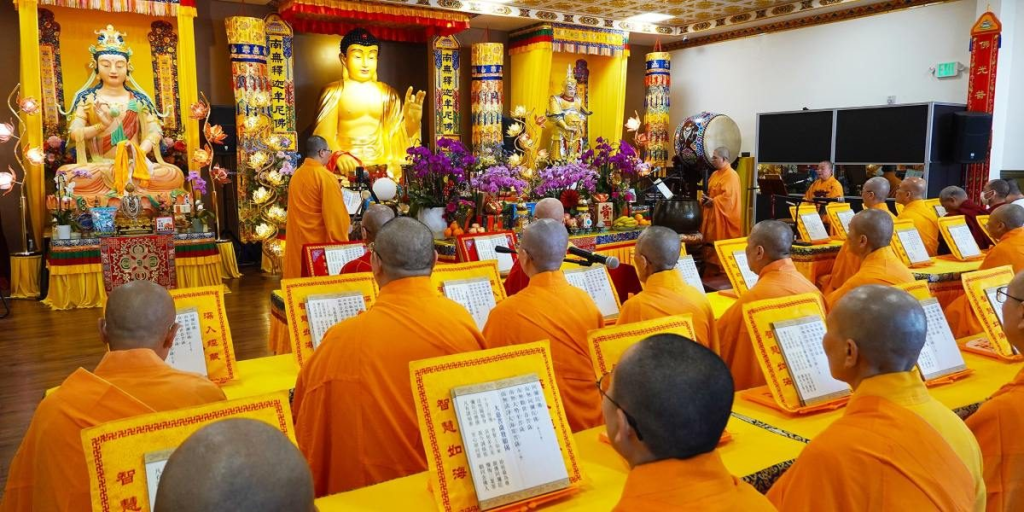
Photo Courtesy: Joyce Lee (The Holy Miracles Temple in Pasadena, Southern California, conducted a series of noteworthy Buddhist prayer ceremonies.)
In a heartfelt endeavor to bring solace and hope to those suffering worldwide, the Holy Miracles Temple in Pasadena, Southern California, conducted a series of noteworthy Buddhist prayer ceremonies.
Organized by the World Buddhism Association Headquarters, Holy Miracles Temple, and Jen Chen Buddhism Sanger Mission, these gatherings saw a substantial turnout of local community members. Together, they chanted “The Lotus Sutra’s Universal Gate Chapter on Avalokitesvara Bodhisattva” and “The Buddha Speaks of Amitabha Sutra” with a shared intention for peace and relief for all life forms enduring hardships globally. Participants expressed reverence and sought the blessings of all Buddhas and Bodhisattvas, hoping to ease suffering, support peaceful conditions, reduce conflicts, and encourage global harmony.
In recent years, the world has faced numerous challenges: ongoing conflicts, earthquakes in Japan’s Noto Peninsula and Myanmar, frequent wildfires in California and Australia, floods in southern China and Indonesia due to heavy rains, and outbreaks of dengue fever and new viral diseases in Africa and Central and South America. These events have heightened a sense of shared adversity globally. Holy Miracles Temple endeavors, through these Buddhist rituals, to offer spiritual support for the departed souls’ ascension to the Pure Land, encourage the swift reconstruction of disaster-affected areas, and provide a space for those in distress to find emotional relief, courage, and renewed hope.
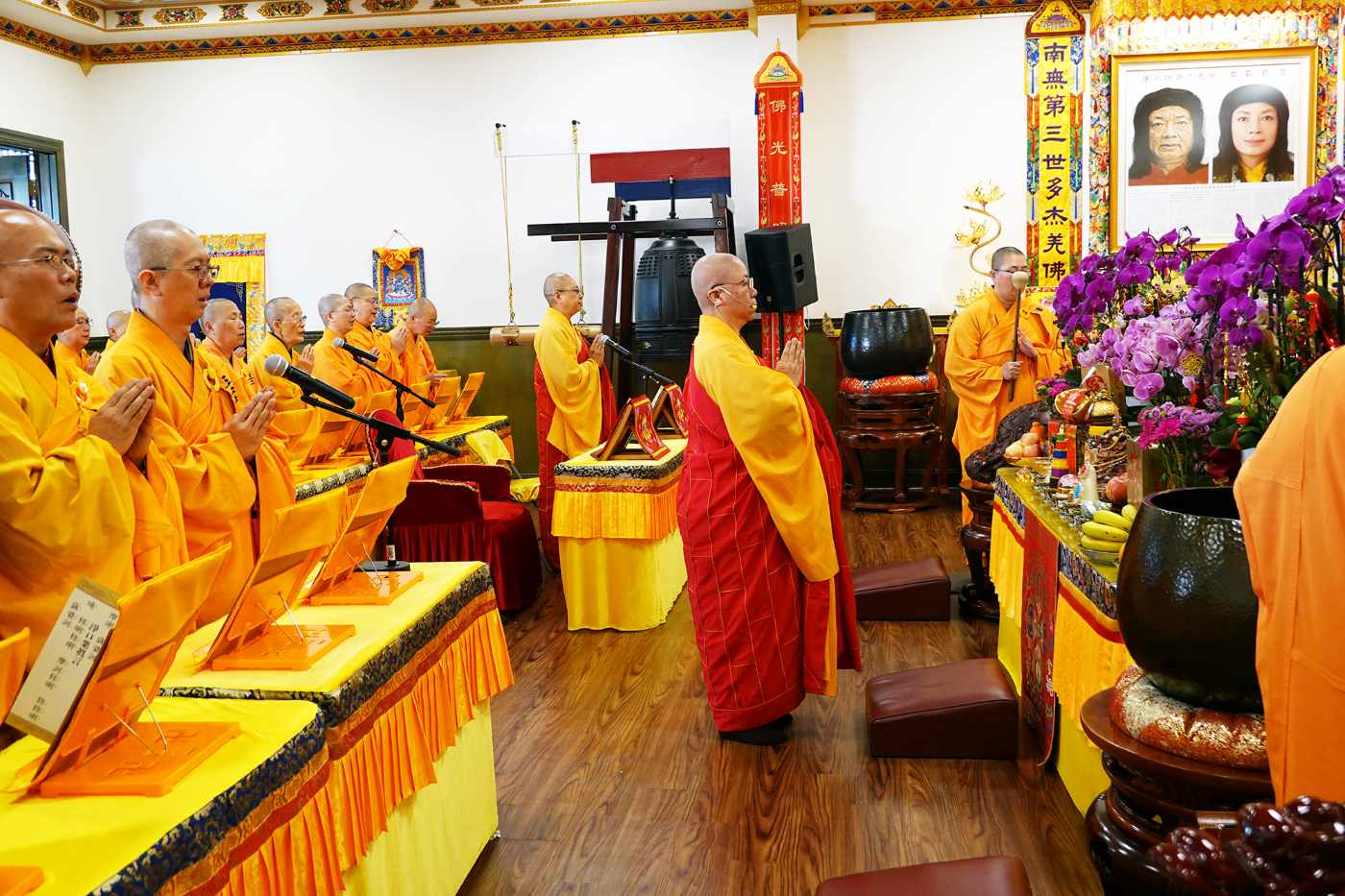
Photo Courtesy: Joyce Lee
The Holy Miracles Temple upholds the teachings of H.H. Dorje Chang Buddha III, highlighting the core Buddhist values of striving for the liberation and well-being of sentient beings.
The ceremonies were both solemn and heartwarming, with the collective expressions of goodwill and chanting symbolically extending beyond geographical boundaries. This gathering served as a meaningful demonstration of community unity, generating a sense of positive intention and a shared commitment to facing difficulties through compassion. Participants noted that attending the prayer ceremony at Holy Miracles Temple allowed them to engage in prayerful reflection for victims, emphasizing Buddhism’s contributions to fostering inner peace and societal harmony.
This initiative reinforces Holy Miracles Temple’s commitment to the teachings of H.H. Dorje Chang Buddha III, highlighting the core Buddhist values of striving for the liberation and well-being of sentient beings. It underscores the essential qualities of cultivators: the Four Immeasurable States of Mind—kindness, compassion, joy, and almsgiving. In addition to regularly donating essential goods to local welfare organizations, the World Buddhism Association Headquarters has called for continued compassion and material support for Myanmar’s earthquake victims, combining humanitarian concern with religious practice and encouraging public participation in relief and blessing efforts.
To address the dire situation in Myanmar following the earthquake, where numerous families have been displaced amid ongoing civil strife and infrastructure damage, a donation appeal has been issued. The residents in the devastated areas urgently need humanitarian aid. The World Buddhism Association Headquarters encourages everyone to contribute to organizations like the United Nations World Food Programme, International Committee of the Red Cross, International Rescue Committee, Médecins Sans Frontières, and United Nations High Commissioner for Refugees. These organizations are actively involved in relief efforts. It is recommended that everyone conduct due diligence before donation to ensure appropriate contributions.
Photo Courtesy: Joyce Lee
A substantial turnout of local community members participated in the gatherings organized by the World Buddhism Association Headquarters, Holy Miracles Temple, and Jen Chen Buddhism Sanger Mission.
The Holy Miracles Temple emphasizes that everyone can contribute to a better world by cultivating goodwill. In the face of impermanence and disaster, even a single act of kindness—be it a blessing, a chant, or a good deed—can help uplift others and serve as a beacon of hope. The temple plans to continue organizing similar sutra chanting and prayer events, encouraging broader public participation to help inspire a more peaceful and stable world through collective compassion and mindful action. The series of prayer ceremonies also serves as a reminder to the world that fortune and misfortune are ever-changing, and life is fragile. Only through the purification of the mind guided by the principles of the Buddha’s teachings, along with actual practice, can one’s misfortune truly be transformed. In this ever-changing and impermanent world, it is a way to find genuine peace and light, and to move toward a future of harmony and sustainability.
During the time of the Buddha, King Fugasya and King Bimbisāra of Magadha were close friends. One day, King Fugasya gifted King Bimbisāra a magnificent flower crafted from seven kinds of treasures—gold, silver, and glazed tiles among them. Realizing that King Fugasya had never encountered the Buddha’s teachings, King Bimbisāra decided to offer the exquisite flower to the Buddha instead.
He said to the Buddha, “My good friend, King Fugasya, gave me this precious flower. I now offer it to the World-Honored One, wishing that the merit from this offering may help open his heart. May he let go of his attachments, come to revere the Three Jewels, and seek the Dharma. However, I am unsure what I can offer him in return.”
The Buddha replied, “Write down the Sutra of the Twelve Links of Dependent Origination and give it to him. Once he receives this sutra, he will surely begin to develop faith and understanding.”
King Bimbisāra immediately copied the sutra and sent it to King Fugasya with a message: “You have given me a priceless flower of treasures; I now return a flower of Dharma. If you contemplate its meaning, you will understand the truth of dependent origination and karmic consequences. I hope you will recite it sincerely, and experience the taste of the Dharma.”
Upon receiving the sutra, King Fugasya read it repeatedly and deeply contemplated its meaning. The teachings resonated with him. He exclaimed, “This Dharma is truly subtle and profound! It calms the mind and brings peace to the nation. Wealth, desire, fame, food, and sleep—these worldly pursuits are the root of suffering. For countless lifetimes I have been lost in delusion, but now I finally see the true nature of existence. There is nothing in this world worth clinging to.”
With this realization, King Fugasya gathered his ministers, announced his abdication, and passed the throne to the crown prince. Then he shaved his head, donned robes, and left the worldly life behind.
He set out on foot to seek the Buddha in Rājagṛha, determined to receive the precepts and deepen his cultivation. When he arrived at the outskirts of the city in the evening, he decided to rest overnight at a potter’s house. The next morning, he planned to go on alms-round and visit the monastery.
However, the Buddha, with His all-seeing wisdom, knew that King Fugasya’s life would end the next day—he would not live to meet the Buddha or hear the Dharma in the conventional way. Out of great compassion, the Buddha manifested as an ordinary monk and went to the potter’s house seeking shelter.
The potter said, “There’s already a monk here tonight. He’s resting in the kiln cave—you may stay with him.”
The Buddha took some dry grass, entered the kiln cave, and sat in a corner. He gently asked the monk, “Where are you from? Who is your teacher? What brought you to the monastic path? Have you ever seen the Buddha?”
King Fugasya replied, “I have never seen the Buddha. I only read the Sutra of the Twelve Links of Dependent Origination. It inspired me to renounce the world and seek the path. Tomorrow, I plan to go into the city for alms, then visit the monastery to meet the Buddha and request the precepts.”
The Buddha responded with heartfelt words: “Human life is fragile—impermanence arrives without warning. This body is made of the four elements—earth, water, fire, and wind—and when death comes, they simply return to their natural state. There is no need to fear. Keep your mind clear, let go of deluded thoughts, and place your trust in the Three Jewels. Practice generosity and maintain pure precepts with sincerity. If you understand the truth of impermanence in this way, it is as if you have already seen the Buddha. Do not cling to the idea of seeing Him tomorrow, for true benefit lies in your present awareness.”
Then, the Buddha expounded the profound truths of suffering, emptiness, and impermanence. King Fugasya listened with deep concentration, entered meditative absorption, and swiftly attained the Anāgāmi (Non-returner) stage. Recognizing his realization, the Buddha revealed His true, radiant form.
Overwhelmed with joy and reverence, King Fugasya prostrated and received a final teaching: “When impermanence comes, do not be afraid.”
He vowed to uphold the Dharma faithfully.
The next morning, while going into the city for alms, King Fugasya was fatally gored by a mother cow protecting her newborn calf. Because he had already attained realization, his rebirth was in the Anāgāmi Heaven.
The Buddha, upon hearing of his passing, instructed the disciples to cremate his body and build a stupa in his honor. He then solemnly reminded them: “Be ever mindful, for the root of all karmic offenses lies in carelessness.”
This world of samsara is full of the inevitable sufferings of birth, aging, sickness, and death. For those attached to fleeting worldly pleasures, this story is a powerful reminder to awaken.
By placing faith in the Dharma, recognizing our inherent pure Buddha-nature, contemplating impermanence, practicing wholesome deeds, and accumulating both merit and wisdom, we can transcend the pain of impermanence and attain lasting peace and happiness.
During my school days, I unknowingly picked up the bad habit of smoking. After entering the workforce as a designer, the nature of my job required prolonged thinking, which led me to smoke incessantly. Sometimes, I would smoke over 60 cigarettes a day, staining my fingers a light yellow. The smell of tobacco lingered on my hands, and even when I brought them close to my nose, I could still sense the scent. Despite knowing how harmful smoking was to my health, I simply couldn’t quit.
I always felt that smoking was a form of enjoyment. Being frugal, I would smoke cheaper cigarettes when alone and keep a better pack for social occasions. Smoking also came with a significant financial cost. In my early working years, money was tight, and I couldn’t always afford cigarettes. Often, I bought just one or two loose cigarettes. Sometimes, I would smoke a cigarette in multiple sittings—lighting it, taking a couple of puffs, extinguishing it, and repeating the process. When I had no cigarettes, I would secretly pick up discarded cigarette butts to smoke. Occasionally, I even picked up others’ cigarette butts—how miserable it was just to satisfy my smoking habit! Even now, an old classmate of mine still teases me about how, back in the day, I would visit him for a meal when I was broke. After eating, I would crave a cigarette and would blurt out, “A cigarette after a meal is better than being an immortal!” This classmate, who never smoked, still brings up this incident to mock me.
Later on, although I could afford cigarettes, I knew deep down that smoking was not a good thing. The numerous “No Smoking” signs everywhere made it clear that smoking was frowned upon. I couldn’t smoke freely in public and had to step outside no-smoking areas when I couldn’t resist the urge. Even at home, I couldn’t smoke at ease. To avoid annoying my family and exposing them to secondhand smoke, I had to hide away on the balcony to smoke. This furtive way of smoking made me feel like a thief, carrying a constant sense of guilt.
“You’re just taking a puff of smoke into your lungs and then exhaling it—what’s the point?” My wife often said this to me. She was right; there was no real meaning to it. I was spending money to harm my own health. So, I made up my mind to quit smoking!
However, quitting a habit cultivated over twenty years was no easy task. I tried every quitting method I heard of—keeping snacks in my pocket to replace cigarettes, writing a quit-smoking journal, telling people I was quitting so they could hold me accountable, and even just holding a cigarette without lighting it. I experimented with all these strategies. At best, I lasted four or five days; my longest attempt lasted three to four months. But I always ended up relapsing. Every time I finished a cigarette, I immediately regretted it and resolved to quit again. This cycle repeated endlessly—I quit, then smoked again, and then quit again. I both hated and loved smoking. I wanted to quit but just couldn’t. Quitting smoking was truly not easy.
After so many failed attempts, no one believed I could do it anymore. People would just smile knowingly when I mentioned quitting, and even I lost hope in myself. But then, due to an extraordinarily auspicious connection, I encountered the Buddha Dharma as taught by H.H. Dorje Chang Buddha III, who is no different from Shakyamuni Buddha. This profoundly touched my heart. I realized that this bad habit was leading me toward degeneration, so I firmly resolved to quit smoking.
I started using the money I would have spent on cigarettes to buy fruits as offerings to the Buddhas and Bodhisattvas, increasing my merits. Sometimes, I used it to release captive animals or to show filial respect to my parents. This time, quitting smoking felt surprisingly effortless. My wife was amazed and praised the power of Buddha Dharma, marveling at how I had truly succeeded in quitting.
Once, a Dharma brother was setting up a Buddhist shrine in his factory. A highly virtuous master traveled from afar to lead the ceremony. More than thirty of us gathered to celebrate, and everything was prepared—except that we couldn’t find a lighter to light the lamps. No one in the group smoked, so no one had a lighter. Eventually, someone had to step outside to borrow one. At that moment, I was struck by how remarkable Buddhist disciples were—out of so many people, not a single one smoked. I thought, Surely, many of them, like me, must have quit smoking. When I asked a fellow practitioner if he had a lighter, he just smiled knowingly and shook his head.
After quitting smoking, I no longer coughed or felt nauseous when brushing my teeth in the morning. I felt lighter, both physically and mentally. However, the habit formed over nearly thirty years didn’t just disappear overnight. For a long time—sometimes even one or two years later—after dinner, I would pace back and forth on the balcony, feeling like I was supposed to be doing something but not knowing what. Only after thinking for a while would I realize, Oh! It’s the old smoking habit. This proved just how difficult it is to break ingrained habits. Truly, “A leopard cannot change its spots.”
Yet, after much effort, I finally broke the long-standing smoking habit. I realized that smoking was simply a habit, and not smoking was also a habit. H.H. Dorje Chang Buddha IIIteaches: “All phenomena become natural through habit.” That is why we must be cautious not to develop bad habits, as they can easily become ingrained. Instead, we should cultivate good habits, no matter how small, and continue to practice them.
After I quit smoking, my old friends were impressed: “You have incredible willpower!”“You’re so determined!” Receiving praise naturally felt good—much better than being criticized. I would joyfully reply, “Yes, I quit! I know this was the power of Buddha Dharma.”
Indeed, life is like a puff of smoke—it quickly vanishes into thin air. No matter how enjoyable, it is nothing more than fleeting mist. Only by maintaining good health can we have a future. Now, whenever I hold a cigarette in my hand, I smile at my past ignorance and feel grateful for my present success.
Today, as I embark on a new journey, how could I ever harm myself again? I shall light an eternal lamp in my heart, illuminating the path of my Buddhist practice with the radiant light of wisdom.
Written by: Ming Xun Edited by: Bodhi Seed & Others
Once upon a time in a small village, an old man spread a rumor that his neighbor was a thief. The accusation quickly circulated, and the young man was arrested. However, after a thorough investigation, the truth emerged—the young man was innocent. Though he was released, the damage had already been done. As he walked home, shame and humiliation clung to him like a heavy shadow. In pain and frustration, he took the old man to court for defamation.
In court, the old man defended himself, saying, “They were just comments. I didn’t mean any real harm.”
The judge paused and then said, “Before I pass judgment, I want you to do something. Write down everything you said about this young man on a piece of paper. Then cut the paper into small pieces, and on your way home, scatter them to the wind. Tomorrow, return for your sentence.”
The old man did as he was told. The next day, he stood before the judge once again.
“Before I deliver your sentence,” the judge said, “go out and gather every piece of paper you threw away yesterday.”
“But that’s impossible!” the old man protested. “The wind has carried them far and wide—I’ll never be able to get them all back.”
The judge nodded gravely. “Exactly. Just like those pieces of paper, your careless words have been scattered beyond recall. A few simple comments have the power to destroy a person’s honor and reputation—damage that can be nearly impossible to undo.”
The old man bowed his head in shame and asked for forgiveness.
This story speaks to a deep truth: our words, once spoken, can never be fully taken back.
Benjamin Franklin once said, “Fool’s hearts are in their mouths; wise men’s mouths are in their hearts.” These timeless words caution us against speaking recklessly. A wise person thinks carefully before they speak—choosing words with care, filtering emotion through understanding, and weighing their potential impact. Such restraint not only prevents misunderstandings and harm but also reflects emotional maturity and compassion.
Think more. Speak less.
In Buddhist teachings, this idea is beautifully echoed through the precepts on right speech. Practitioners are taught to be mindful of their word karma and to avoid four kinds of harmful speech:
Lying
Harsh speech
Divisive speech
Idle chatter
Each of these can sow seeds of suffering—for others and for ourselves.
Let’s remind ourselves daily: Be the master of your mouth, so you’re not a slave to your words.
Gossip can be more damaging than theft—it steals a person’s dignity, honor, and credibility, none of which are easy, or even possible, to restore. A wise saying puts it well: “When your feet slip, you can recover your balance. But when your tongue slips, you can never recover your words.”
Let us choose silence over harm, kindness over carelessness, and wisdom over impulse. Because our words, like our actions, carry the power to build—or break—the world around us.
A few years ago, I visited a well-known Chan (Zen) practice center and began what I thought would be a meaningful journey into Chan meditation as a lay Buddhist disciple. Alongside the physically demanding daily farm work, I occasionally joined meditation sessions—but instead of clarity or insight, they often left me feeling drowsy and disoriented. I also listened to recordings of teachings by an elderly monk, but they felt dry and uninspiring. At the time, I thought this was all Chan practice had to offer. Disappointment quietly took root in my heart.
As I spent more time at the center, I began to notice that some of the Buddhist nuns displayed strange and unsettling behavior. I was told that their mental disturbances had arisen during meditation and, without proper guidance or support, their conditions had never improved. The idea that meditation—supposedly a path to peace—could lead to such outcomes deeply frightened me. I couldn’t help but worry: Would I end up like them? My own practice was already filled with drowsiness and confusion. Each time I sat for meditation, their presence weighed heavily on me. What had gone wrong? Why did their practice lead to such distress?
One memory remains especially vivid. During a seven-day retreat, the presiding master criticized the decision to take the temple’s elderly abbot to the hospital when he fell critically ill. The master insisted that the abbot should have remained in the temple, reciting Amitabha Buddha’s name to seek rebirth in the Western Pure Land. He questioned why anyone would try to prolong life at the time of death, suggesting that doing so only prolonged suffering. Many attendees agreed, believing the abbot’s passing was natural and that emergency medical care was unnecessary. I was shocked. Something felt inherently wrong with that view. I wasn’t a monastic, just a lay practitioner, yet I couldn’t help but ask: When someone is in a coma, completely unconscious, can they still recite “Amitabha” with sincere intent? Can they truly attain rebirth in the Pure Land just by wishing so? Logically, this didn’t make sense to me.
Later, I heard of a monk who made a solemn vow to realize his true nature through three years of Chan meditation—and if he failed, he would return to lay life. Sadly, three years passed, and the result was heartbreaking. He had gained no realization.
After this string of disheartening events, I lost my passion for Buddhist practice. I felt lost, as if I’d reached a spiritual dead end. I even began questioning the purpose of monastic life: If there’s no true goal or path to liberation, what’s the point? Reluctantly, I considered giving up and returning to a mundane life.
But just when I stood at this crossroads, I encountered the Dharma discourses of H.H. Dorje Chang Buddha III. It was like a brilliant light breaking through the darkness—suddenly, all the disappointment, fear, and confusion that had weighed on me vanished. At that moment, I made a resolute decision to let go of my doubts and wholeheartedly follow the path illuminated by the Buddha’s true teachings. Eventually, my wish was fulfilled.
What I shared here are just my personal experiences—perhaps not yet the true path of Chan—but they reflect challenges that many practitioners face in their spiritual pursuit. Fortunately, I came across the book Concentration and Visualization—The Essence of the Right Path by Pamu, and the profound teachings of The Supreme Dharma of Chan imparted online by H.H. Dorje Chang Buddha III. For the first time, I received complete and correct teachings and truly understood what Chan meditation is meant to be.
Furthermore, through reading H.H. Dorje Chang Buddha III’sExpounding the Absolute Truth through the Heart Sutra (specifically page 216), I finally understood why those nuns had lost their way. Their mental disturbances stemmed from becoming attached to illusions produced by the manas consciousness, mistakenly believing those illusions were real. They had failed to comprehend the profound truth that all forms are illusory and false. Caught in delusion, they strayed into a demonic path.
The retreat master’s complaints about the abbot’s emergency care were also misguided. As stated in the article “Lay Buddhist Zhao Yusheng’s Transmission of the Dharma is Genuine, Not False”, if someone truly possesses the realization and power of H.H. Dorje Chang Buddha III—to the extent that the yidam Amitabha Buddha manifests and receives the deceased into the Pure Land—then yes, there would be no need for emergency treatment. But how many people have such realization? Did that master?
And what about the monk who gave up after three years? He didn’t know that there exists a supreme and ultimate Buddha Dharma—one so profound that it can open the crown chakra in just two hours. When opened, the space is vast and expansive like an eggshell, and consciousness can freely enter and exit the body, even engage in practice outside the body. With such realization, seeing one’s true nature is not a distant goal but a near certainty.
Looking back, I feel deep compassion for those nuns. They longed for true Dharma and liberation, but without authentic teachings or proper guidance, and weighed down by attachments and karmic hindrances, they couldn’t achieve realization. Tragedies like this still happen today. It’s heartbreaking.
The most authentic and supreme Buddha Dharma is that which comes from H.H. Dorje Chang Buddha III, yet many sentient beings remain unaware of it. Even those with karmic affinity who encounter the teachings may still fail to receive them due to karmic obstacles or worldly pressures—missing their rare chance to escape the endless cycle of birth and death.
All I can do is sigh deeply and reflect: The true Dharma of the Buddha is so rare, so precious—harder to encounter than one might in millions of kalpas. I am incredibly fortunate to have this karmic opportunity to respectfully listen to and study the Dharma discourses of H.H. Dorje Chang Buddha III.
Dr. Tiller, a professor emeritus of materials science and engineering at Stanford University, tells us that “the term Psychoenergetics[1] was coined by the Russians in the Soviet era or 1950-1970. This was done to provide a strongly materialistic flavor to the fields of parapsychology and spiritual-related phenomena in order to make research in these areas palatable to the communist party’s worldview.” Dr. Tiller started his work to find a rigorous framework for scientifically understanding this class of phenomena during this period and until the present time.
He expanded on Einstein’s revolutionary work in this area even expanding Einstein’s famous E=mc2 to incorporate the evolutionary concept of consciousness. He even devised formulae, based upon careful experimental research, that link “subtle energies” to those of mainstream science and which expand the present-day formation of quantum mechanics. He noted that there “…was a class of truly weird phenomena that had been visible for more than a century and was somehow related to various processes associated with the application of human consciousness in our world. On the other hand, there still exists today, a very long-held, underlying assumption of conventional science that ‘No human qualities of consciousness, intention, emotion, mind or spirit can significantly influence a well-designed target experiment in physical reality.’ Something is very wrong here!”
He noted that “…the first Copernican revolution of thought lifted humanity from an earth-centric, theocratic-inspired, model of our solar system, which was largely qualitative in terms of details, to a local solar system which was sun-centered.” This, in turn, with the contribution of Galileo, Newton, and others, expanded our world-view and provided the framework for the great technological advancements of our modern era. He also provided his intuitive hypothesis on the link of our physical reality within the context of our higher [or spiritual] dimensional nature”…that this new, second Copernican-type revolution will, in terms of scale, be at least as significant for the progress of humankind as the first one!”
Not all scientists are there yet, or even close, but this beginning is hopeful. Much of what he writes is vastly beyond my capacity to absorb and, frankly, my interest. However, I believe that it is very relevant to our practice and is consistent with the teachings of the Buddha, albeit in a different language and perspective and with a different goal although Dr. Tiller holds that the underlying principle of all is “love.” You may ask how I can talk of dragons and yidams and all sorts of strange things and still be interested in science? I know a very bright young man, who was brought up as a religion-scorning communist, who thought that monks were parasites of the people and begrudged the donations his pious mother gave them. After several business failures, he took some time off to reflect on what had gone wrong in his life and started reading books by some on his favorite scientists and mathematicians. At the end of one such work, a scientist whom he admired greatly, said something after explaining an evolved scientific finding, “Of course, the Buddha told us all of this over 2,500 years ago.” He then decided to reconsider the works of the Buddha and is now a great master as well as a successful scientist. I too believe that science will eventually catch up with the Buddha or at least come closer to explaining what is now unkown and mysterious and the world will be better for it. I also believe that like unlocking the power of the atom through the work of Einstein et al came with great risks and potential for disaster, likewise our research into consciousness and our higher natures must be based in the evolution of our character. Correct Cultivation is essential on so many levels.
[1] Psychoenergetic Science relates to the relationship between human consciousness and subtle energy.















 Peace LiLy