The Butterfly and the Struggle: A Lesson in Growth

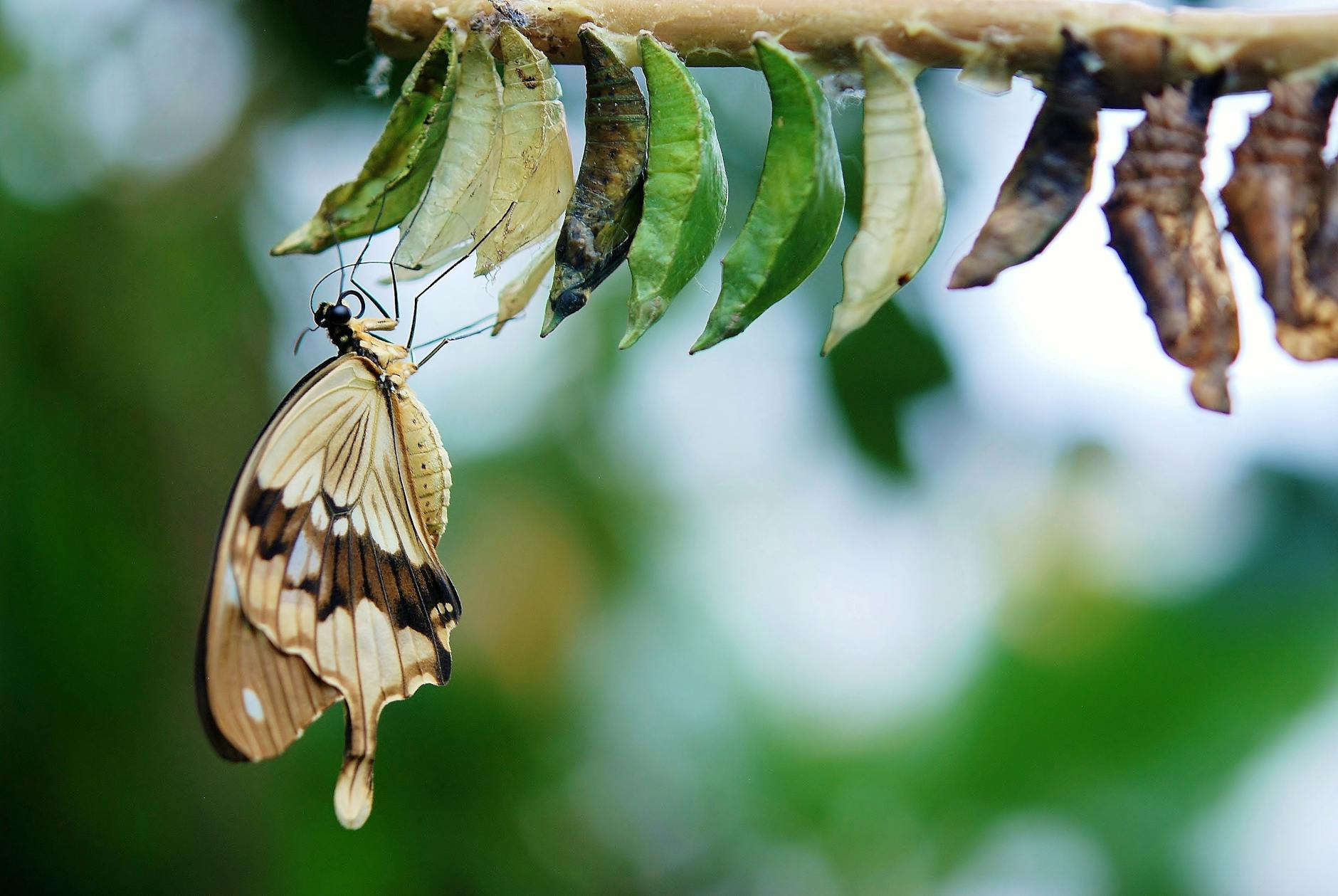
Photo by Pixabay on Pexels.com

One day, someone stumbled upon a butterfly chrysalis. Fascinated by nature’s beauty, he decided to observe it closely. A few days later, he noticed a small hole had appeared in the chrysalis. Intrigued, he paused to watch what would unfold.

Over the course of several hours, he witnessed the butterfly inside struggling with its tiny body, trying to squeeze through the small opening. Despite its best efforts, there seemed to be no progress. The butterfly appeared exhausted, unable to break free.

Nature, however, has a marvelous design. The butterfly’s “struggle” to emerge from the chrysalis is not a mere obstacle—it is a vital process. This challenge prepares the butterfly, equipping it with the strength and resilience it needs to soar into the skies.

Struggles in life are not meant to break us but to build us. If life allowed us to move through everything effortlessly, we might never grow stronger or discover our true potential. Challenges shape our character, nurture our perseverance, and enable us to achieve heights we never imagined.

So when we face hardships or setbacks, we should view them as opportunities for growth. These trials may be Heaven’s way of strengthening us, of preparing us to spread our wings and fly.

A Well-Intentioned Mistake

The man, moved by the butterfly’s apparent struggle, decided to help. He took a pair of scissors and carefully cut open the chrysalis, making it easier for the butterfly to emerge. As expected, the butterfly slipped out effortlessly.

However, something was amiss. The butterfly’s body was swollen and bloated, and its wings were small and weak. The man continued to watch, believing the wings would expand and the body would shrink in time. But this never happened.

For the rest of its life, the butterfly dragged its heavy body and fragile wings, unable to take flight. It remained grounded, never experiencing the freedom of soaring through the air.

What the kind-hearted man did not understand was that the butterfly needed to struggle. The act of squeezing through the small opening in the chrysalis forces fluid from the butterfly’s body into its wings, giving them the strength and nourishment required for flight. Without this critical process, the butterfly could not develop the ability to fly.

Embracing Life’s Challenges

This story serves as a powerful metaphor for our own lives. Just as the butterfly’s struggle is essential for its transformation, our struggles are necessary for our growth. Avoiding hardship may provide temporary relief, but it robs us of the opportunity to become stronger and more resilient.

In raising children, this lesson is particularly important. As parents or guardians, we must resist the urge to shield them from every difficulty. It is natural to want to protect them, but overprotection can hinder their growth. By allowing them to face challenges and learn from their struggles, we give them the tools they need to navigate life’s complexities.

So, the next time you encounter a challenge, remember the butterfly. Embrace the struggle, knowing that it is shaping you into someone stronger, wiser, and ready to take flight.

Link:https://peacelilysite.com/2024/12/27/the-butterfly-and-the-struggle-a-lesson-in-growth/
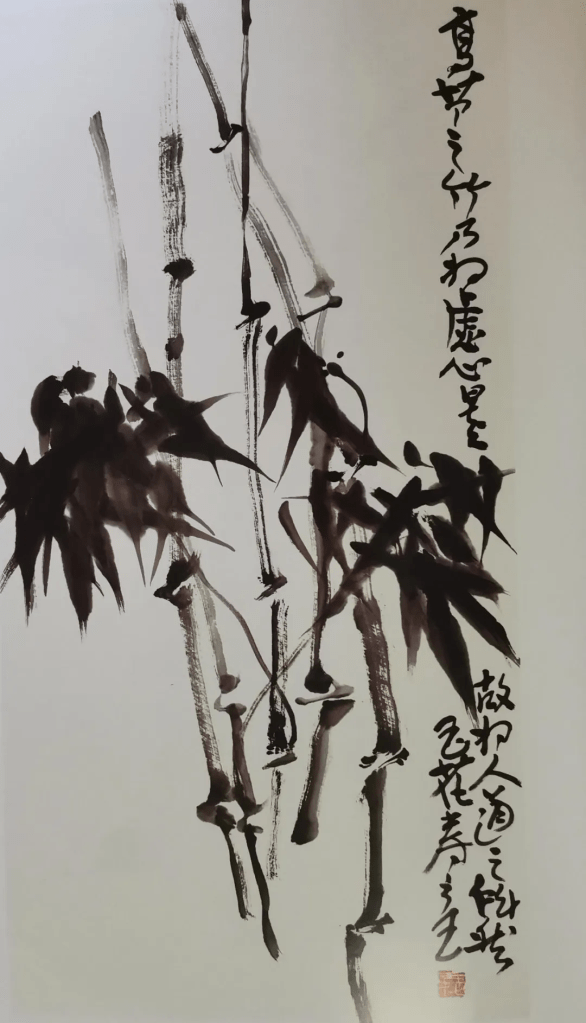
Artful Resilience: The Timeless Elegance of Dr. Yuhua Shouzhi Wang’s Bamboo Paintings

Bamboo of Noble Integrity By Professor Yuhua Shouzhi Wang

Bamboo, as a plant with profound cultural significance, carries rich and diverse symbolism. It represents resilience, noble character, vitality, humility, modesty, harmony, and unity. With its graceful posture and vibrant green appearance, bamboo evokes a sense of freshness and refinement. Though its exterior is simple and unadorned, it embodies a noble inner quality. This unique temperament has made bamboo a symbol of integrity and uprightness. In ancient times, it often served as a metaphor in the writings of scholars and poets for individuals of high moral character and self-discipline.

For the Chinese, admiration for bamboo has endured throughout history. Countless poets and literati have celebrated its virtues, grouping it alongside plum blossoms, orchids, and chrysanthemums as one of the “Four Gentlemen,” embodying the character and aesthetic spirit of the Chinese people. Bamboo’s simplicity belies its profound cultural significance. In traditional Chinese culture, it is a symbol of auspiciousness and virtue, carrying layers of meaning that resonate deeply with the human spirit.

Professor Wang’s Chinese paintings of bamboo are a testament to her extraordinary ability to bring this cultural icon to life. Each stroke captures the essence of bamboo’s resilience and unyielding spirit while emphasizing its humility and integrity. Her works not only celebrate the elegant charm of bamboo but also evoke its vibrant vitality and enduring strength.

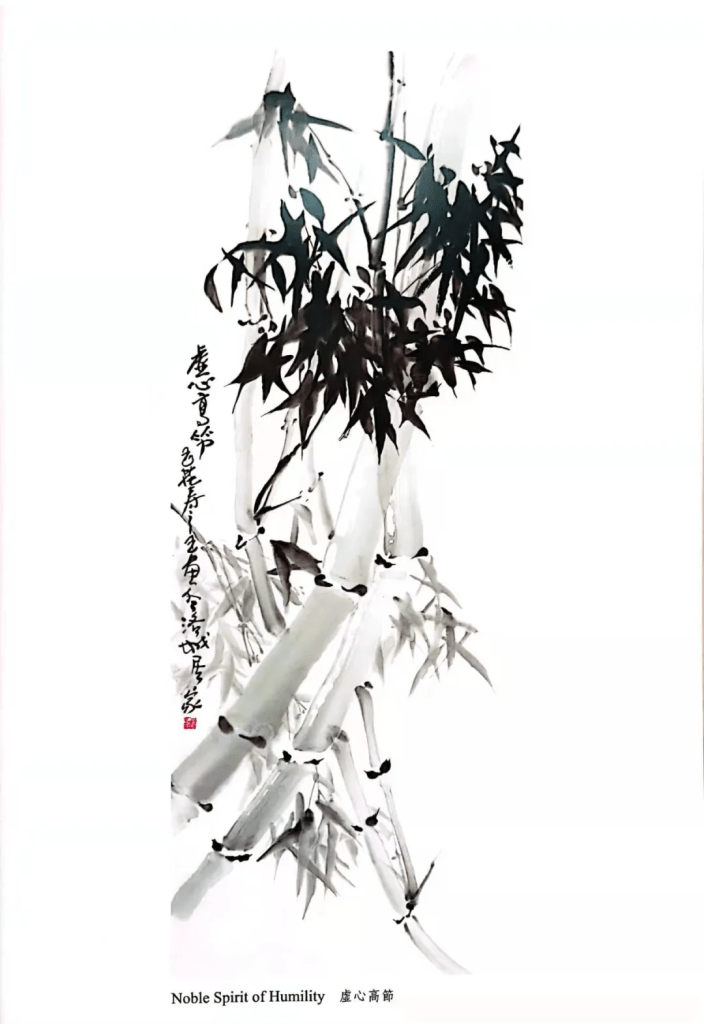
Professor Wang’s Artwork “Noble Spirit of Humility”

The artwork Noble Spirit of Humility depicts a cluster of bamboo deep within a dense forest. Two tall and robust bamboo stalks stand prominently in the foreground, their lush branches and leaves rendered in bold ink. Behind them, a few smaller bamboo stalks, delicately painted in lighter ink, appear to lean on the larger ones, as if embraced by Mother Earth. Together, they form a unified group, advancing and retreating in harmony.

Look closely, and you’ll see their branches intertwine amidst the clouds, and their roots tightly clasp together underground. Neither torrential rain nor fierce winds can break them down. The bamboo’s unyielding resilience is vividly and profoundly brought to life.

Dr. Yuhua Shouzhi Wang was recognized and chronicled in the United States Congressional Record as “a great artist and sculptor,” and “treasure of the world.” In 2013, President George Christophides of the World Federation of UNESCO Clubs, Centers, and Associations (WFUCA) conferred the title “2013WFUCA” to one of her artworks.

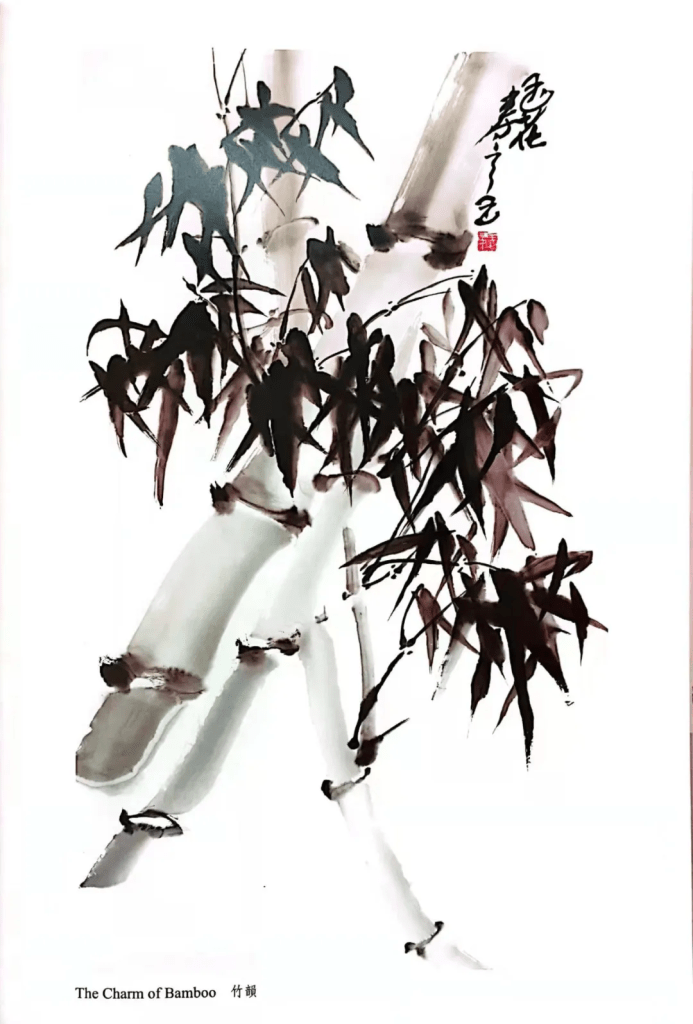
The artwork “The Charm of Bamboo” conveys the fresh and elegant essence of bamboo, exuding a gentle and harmonious beauty. It seems to remind us that in life and work, we should not only take responsibility but also foster an atmosphere of harmony and mutual respect. The use of varying ink tones, alternating between light and dark, strikes a balance of simplicity and ingenuity, greatly enhancing the dynamic energy of the piece.

Dr. Yuhua Shouzhi Wang’s bamboo paintings are truly exceptional. Through her art, she vividly conveys bamboo’s noble qualities, leaving viewers with a deep appreciation for this remarkable plant and its timeless symbolism. Her work serves as a bridge between nature and art, reminding us of the profound lessons we can draw from the natural world.

Link:https://peacelilysite.com/2024/12/27/artful-resilience-the-timeless-elegance-of-dr-yuhua-shouzhi-wangs-bamboo-paintings/

The Profound Wisdom of Generosity

Generosity is an altruistic intention that brings joy to sentient beings and delight to all Buddhas. It involves considering others and giving up one’s own body, life, and possessions, even extending to the giving of the Dharma. In the very act of giving, one not only eliminates the habitual tendency of stinginess but also helps others overcome their difficulties. At the same time, one attains joy and freedom through a pure, selfless mind.

In Buddhist practice, generosity is the first of the six Pāramitās (perfections) that guide practitioners on the path to enlightenment. The Buddha teaches that acts of giving bring five kinds of merits:

  1. Longevity without misfortune.
  2. A dignified and pleasant appearance.
  3. Abundant energy and strength.
  4. Joy and freedom from worries.
  5. Wisdom and eloquence.

However, the intention behind giving is crucial. The thoughts and mindset of the giver determine the outcomes of their actions. The Buddha provided profound insight into this during a conversation with Venerable Sāriputta.

The Conversation Between the Buddha and Sāriputta

One time, Venerable Sāriputta asked Shakyamuni Buddha for clarification about the practice of generosity:

“Lord, is it possible that one person may give a gift of a certain kind, and it yields little fruit, while another gives the same kind of gift and yet it yields great fruit and benefit?”

The Blessed One replied, “Yes, Sāriputta, it is possible that a person may give a gift of a certain kind, and it does not bear great fruit, while another person gives the same kind of gift and it bears great fruit and benefit.”

“But Lord, what is the cause and reason for this difference? Why does one person’s gift bring small results while another’s yields much greater rewards, even when the gifts are of the same kind?”

The Blessed One explained, “Sāriputta, there are cases where a person gives a gift with a mind seeking personal profit, attached to the reward, hoping to enjoy it in the afterlife. Such a person may offer food, drink, clothing, vehicles, garlands, perfumes, ointments, bedding, shelter, or lamps to a contemplative or a brahmin. What do you think, Sāriputta? Could a person give a gift with such intentions?”

“Yes, Lord,” Sāriputta replied.

The Blessed One continued, “When such a person gives with a mind seeking personal gain, they may be reborn in the realm of the Four Great Kings. But after the results of that action are exhausted, they return to this world.

“However, there is another person who gives a gift not for personal profit, nor with a mind attached to the reward, but with the thought, ‘Giving is good.’ This person offers the same kinds of gifts to a contemplative or a brahmin. What do you think, Sāriputta? Could a person give in this way?”

“Yes, Lord,” Sāriputta affirmed.

“Such a person, on the break-up of the body after death, is reborn among the Devas of the Thirty-three. But once the result of that action has been exhausted, they, too, return to this world.

“Or a person may give with the thought, ‘This has been the custom of my family, handed down from my ancestors. I must uphold this tradition.’ When they pass away, they are reborn among the Devas of the Hours. Again, after the results of that action are exhausted, they return to this world.

“Alternatively, a person may give with the thought, ‘I am well-off, while others are not. It is only right that I share with those who have less.’ They are reborn among the Contented Devas, but eventually, they return to this world as well.

“Another person might give with the thought, ‘Just as the great sages of the past, such as Aṭṭhaka, Vāmaka, and others performed great sacrifices, so too will I distribute my gifts in this way.’ Upon death, they are reborn among the Devas who Delight in Creation, yet eventually return to this world.

“Or one may give a gift with the thought, ‘Giving brings serenity and joy to my mind.’ Such a person is reborn among the Devas Wielding Power over the Creations of Others. Still, after their merit is exhausted, they return.

“Finally, there is the person who gives not for future rewards, not out of custom, and not out of wealth or tradition, but with the thought, ‘This act of giving is an adornment and support for the mind.’ What do you think, Sāriputta? Could a person give in this way?”

“Yes, Lord,” Sāriputta answered.

The Blessed One said, “This person, upon the break-up of the body, is reborn among Brahmā’s Retinue. Having exhausted the results of their action, they do not return to this world but attain the state of non-return.

“This, Sāriputta, is the reason why one person’s gift may not bear great fruit, while another’s gift of the same kind may yield great fruit and benefit.”

The True Essence of Generosity

Generosity is not merely about the act of giving but also about the intention and mindset behind it. When one practices the virtue of giving with constant joy and unwavering determination, one cultivates all virtuous merits, attains pure samadhi, and gains clarity of insight. This clarity allows one to fully comprehend the origin of suffering, the cessation of suffering, and the path to liberation and happiness.

Therefore, one should always strive diligently and practice various virtuous deeds of giving, remembering that the purity of the heart and mind in the act of generosity determines its ultimate value and benefit—both for oneself and for the world.

Link: https://peacelilysite.com/2024/12/13/the-profound-wisdom-of-generosity/

Discovering Wisdom in Everyday Life: Sima Yi’s Timeless Philosophy

Have you ever found yourself judging someone based on their flaws, only to realize later that you missed seeing their good qualities? In a world where we’re quick to notice shortcomings, Sima Yi (司馬懿), a brilliant statesman and military strategist of ancient China, offers a refreshing perspective:

“If one focuses on others’ shortcomings, there will be no one in the world worthy of association; but if one looks at their strengths, everyone can be a teacher.”

Sima Yi was a towering figure of the Three Kingdoms period in Chinese history. Known for his brilliance as a statesman and military strategist, he served under three generations of Wei rulers—Cao Cao, Cao Pi, and Cao Rui. His simple yet profound insight encourages us to shift our focus from criticism to appreciation—a practice that can transform not only our relationships but also our outlook on life.


How This Wisdom Applies to Us Today

Let’s face it, we all navigate relationships daily—whether at work, with friends, or within our families. And let’s be honest, people can be frustrating! A colleague might miss a deadline, a friend might cancel plans last minute, or a family member might nag you endlessly. It’s easy to dwell on these shortcomings. But what if, instead, we made a conscious effort to notice their strengths?

That colleague might be a creative genius, your friend might have a generous heart, and your family member might only want the best for you. This small shift in perspective can turn frustration into appreciation and conflict into connection.


I know someone who has mastered this mindset. He’s one of those people who can walk into a room full of strangers and leave with everyone feeling uplifted. Curious about how he does it, I once asked him his secret. His response was striking:

“If one focuses on others’ shortcomings, there will be no one in the world worthy of association. But if one looks at their strengths, everyone can be a teacher.”

This principle is at the core of how he interacts with people, and it shapes his approach to life:

  • Learning from those stronger than him: When he meets someone successful, he doesn’t feel intimidated or envious. Instead, he actively seeks to learn from them. Once, at a networking event, he struck up a conversation with a prominent entrepreneur. While most people kept their distance, he walked away with new insights and a potential mentor.
  • Finding harmony with equals: In competitive environments, he doesn’t see peers as threats but as partners. By yielding a little when disagreements arise, he often finds ways to collaborate that benefit everyone involved.
  • Helping those less capable: He’s quick to lend a hand to someone struggling. Whether it’s helping a colleague with a difficult task or mentoring a junior team member, his generosity earns him respect and trust.
  • Respecting elders: He genuinely values the wisdom of those who’ve walked life’s path before him, always showing them gratitude and deference.

This approach to life isn’t just about being a “nice person.” It’s about creating opportunities for growth, connection, and happiness. When we focus on others’ strengths instead of their flaws, we:

  1. Build better relationships: People appreciate being valued for their good qualities.
  2. Learn and grow: Everyone has something to teach us, from practical skills to life lessons.
  3. Feel more positive: Seeing the good in others often helps us see the good in ourselves.

How to Practice Sima Yi’s Philosophy

Here’s how you can start applying this wisdom in your daily life:

  1. Pause before judging: The next time someone irritates you, take a moment to think about their strengths. What do they bring to the table?
  2. Ask questions: When you meet someone new, instead of focusing on surface-level impressions, ask about their experiences or skills. You might discover something inspiring.
  3. Be generous: Whether it’s a compliment, advice, or a helping hand, giving a little can create a lot of goodwill.
  4. Respect experience: Take time to listen to the stories of older generations. Their insights might surprise you.

Life is full of interactions, and every person you meet has a unique story, skill, or quality to offer. By shifting your perspective from criticism to appreciation, you’ll not only build stronger connections but also create a richer, more fulfilling life.

Sima Yi’s timeless wisdom reminds us that everyone we meet—whether a boss, a rival, or a stranger—can teach us something valuable. The next time you’re tempted to judge someone, ask yourself:

“What can I learn from this person?”

The answer might just change your life.

Link:https://peacelilysite.com/2024/12/12/discovering-wisdom-in-everyday-life-sima-yis-timeless-philosophy/

Desiderata

Go placidly amid the noise and haste,
and remember what peace there may be in silence.
As far as possible without surrender
be on good terms with all persons.
Speak your truth quietly and clearly;
and listen to others,
even the dull and the ignorant;
they too have their story.

Avoid loud and aggressive persons,
they are vexations to the spirit.
If you compare yourself with others,
you may become vain and bitter;
for always there will be greater and lesser persons than yourself.
Enjoy your achievements as well as your plans.

Keep interested in your own career, however humble;
it is a real possession in the changing fortunes of time.
Exercise caution in your business affairs;
for the world is full of trickery.
But let this not blind you to what virtue there is;
many persons strive for high ideals;
and everywhere life is full of heroism.

Be yourself.
Especially, do not feign affection.
Neither be cynical about love;
for in the face of all aridity and disenchantment
it is as perennial as the grass.

Take kindly the counsel of the years,
gracefully surrendering the things of youth.
Nurture strength of spirit to shield you in sudden misfortune.
But do not distress yourself with dark imaginings.
Many fears are born of fatigue and loneliness.
Beyond a wholesome discipline,
be gentle with yourself.

You are a child of the universe,
no less than the trees and the stars;
you have a right to be here.
And whether or not it is clear to you,
no doubt the universe is unfolding as it should.

Therefore be at peace with God,
whatever you conceive Him to be,
and whatever your labors and aspirations,
in the noisy confusion of life keep peace with your soul.

With all its sham, drudgery, and broken dreams,
it is still a beautiful world.
Be cheerful.
Strive to be happy.

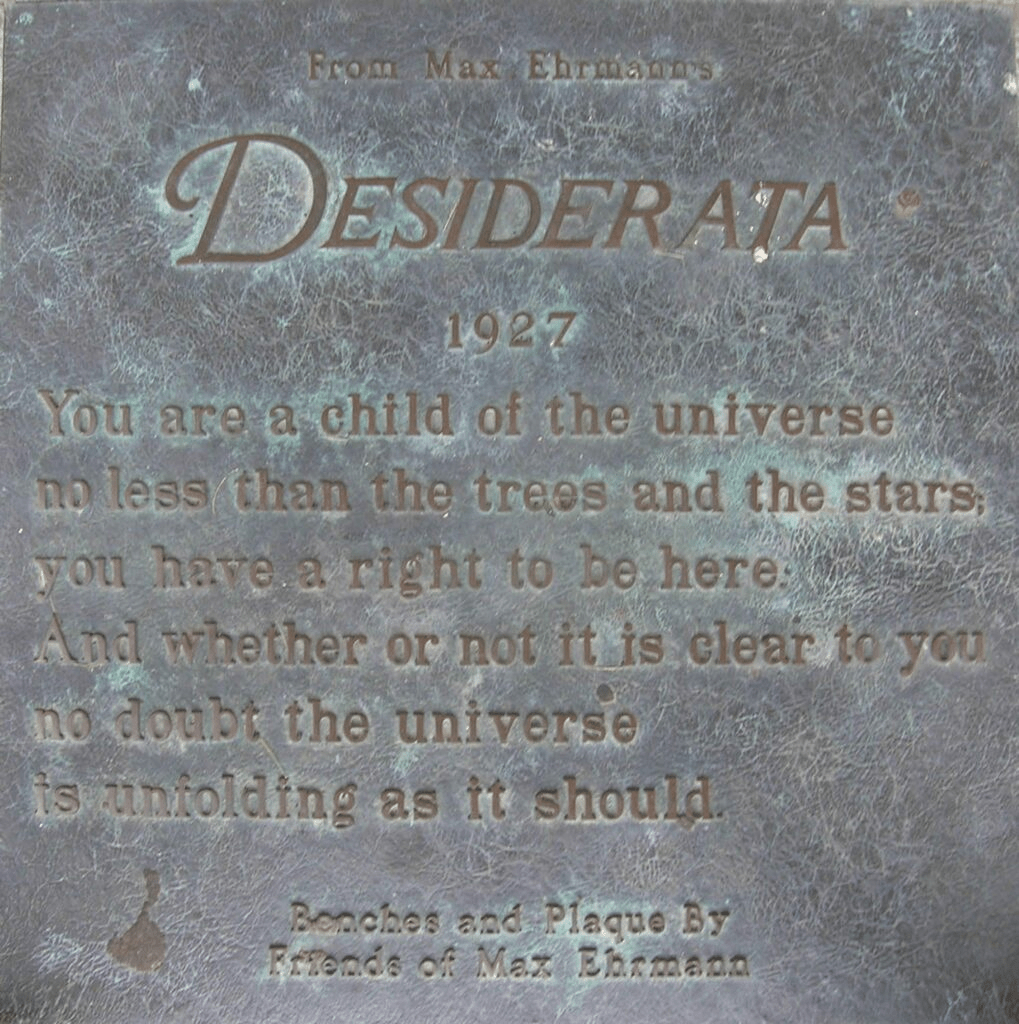
Written in 1927 by American poet Max Ehrmann, Desiderata is a timeless poem that continues to inspire readers with its gentle, universal wisdom. The title, meaning “things desired” in Latin, perfectly reflects the poem’s themes of peace, authenticity, and compassion.

Ehrmann composed this prose poem to guide people in living a meaningful life. Though it gained widespread recognition only decades later, Desiderata resonates deeply with readers across generations. Its advice—such as staying calm amid chaos, embracing individuality, and showing kindness—feels especially relevant in today’s fast-paced world.

The poem also carries a spiritual undertone, encouraging acceptance of life’s challenges while celebrating its beauty. Its words remind us to live mindfully, cherish our unique paths, and find serenity in our connection to the larger universe.

In a world where noise and haste often dominate, Desiderata offers a calming presence and serves as a reminder to align our lives with values that bring lasting peace and joy. Whether you’re encountering it for the first time or revisiting its wisdom, this poem remains a meaningful touchstone for navigating modern life with grace.

Link: https://peacelilysite.com/2024/12/06/desiderata/

Source: https://www.cse.cuhk.edu.hk/~cslui/desiderata.html

Hair Sariras of H.H. Dorje Chang Buddha III

In Buddhist scriptures, relics are broadly classified into two types. The first type, known as Dharma-body relics, refers to the teachings and scriptures spoken by the Buddha, representing his spiritual essence and wisdom. The second type, physical relics, comprises the solid remains left after the Buddha’s cremation. These physical relics are traditionally described as being of three kinds: white bone relics, red flesh relics, and black hair relics. They are noted for their luminous, pristine appearance, unbreakable nature, and incomparable beauty, far surpassing worldly jewels.

It is also believed that Bodhisattvas and Arhats may leave behind similar relics. According to Buddhist teachings, relics naturally crystallize in those who have achieved enlightenment and sincerely practiced devotion to the Buddha. They are considered extraordinary and unattainable by ordinary individuals.

H.H. Dorje Chang Buddha III is recognized as the true reincarnation of the Primordial Buddha. His Holiness has demonstrated extraordinary miracles, including the manifestation of hair sariras. Below are authentic accounts from Buddhist disciples detailing their experiences and discoveries of the hair sariras of H.H. Dorje Chang Buddha III.

Hair Sariras (1)

H.H. Dorje Chang Buddha III Wan Ko Yeshe Norbu Holiest Tathagata usually cuts His own hair. However, there have been several occasions when I respectfully accompanied His Holiness to a barber shop. Each time, out of reverence, I carefully swept away the floor and removed other people’s hair before the haircut began. After the Buddha Master’s haircut was finished, I would gather His hair from the floor, wrap it carefully in paper, and place it on my Buddhist altar upon returning home. Gradually, I began collecting and keeping some of the hair.

I still remember what happened on June 1, 2003. On that day, I took out several unopened paper packs and organized them, intending to wash the hair. Because the individual hairs were very fine, I had paid special attention and placed them on a screen. While soaking them in water, I saw three small round red beads among the hair. The entire cleaning process was handled by me, and I did not touch anything else during that time. I felt this to be very strange and wondered where those red beads came from. I intended to press them with my finger to see if they were hard or soft and even took a magnifying glass to carefully exam them. Suddenly, a thought occurred to me. Could they be sariras? I realized if I did this, it would be too disrespectful.
Hurriedly, I placed the three small beads in a small white box and took them to H.H. Dorje Chang Buddha III to inquire of their origin. I asked, “May I know what these things are?” The Buddha Master said, “Where did you get these? These are sariras!” Afterwards, the Buddha Master practiced dharma and chanted mantras to prove the authenticity of those sariras. I reported to the Buddha Master that they were wrapped in paper and appeared from the cut hair of His Holiness.

Later, the Buddha Master gave us a special discourse in which His Holiness stated, “This has happened because of conditions and the level of fortune of all sentient beings. It does not matter where they come from. Perhaps they originated from the empowerment of the Buddhas and Bodhisattvas. It actually does not matter what the disciples think concerning how or where they come from. If they can appear out of nothing, then they can disappear out of nothing. The important thing is the cultivation of each one of us and the need to live in accordance with the teachings and abide by the principles of Buddhism.”
That night, I carefully placed those three red sariras in a small tightly covered Tibetan box and cushioned them with white cotton. The next day, a fellow disciple requested to view them. I thought about placing the sariras in a crystal bottle that I had just bought. When I opened the small box and looked inside–how could it be that there were only two sariras left? I did not touch any other things anymore! I shredded and tore the cotton, but could only find two sariras. It was really upsetting! This proves and corresponds to what H.H. Dorje Chang Buddha III previously expounded: “If they can
appear out of nothing, then they can disappear out of nothing.”

This extraordinary occurrence reminded me of a fellow disciple’s personal testimony of witnessing sariras falling from the Buddha Master. This time, I experienced it firsthand, and it was truly a wonderful and auspicious sign.

Everything I have recounted above is true and authentic. If there are any falsehoods, may I suffer all evil retribution. If they are genuine facts, may living beings receive the dharma teachings of H.H. Dorje Chang Buddha III Wan Ko Yeshe Norbu Holiest Tathagata, be liberated from the cycle of life and death, and attain wisdom and good fortune.

Buddhist disciple,
Hsuan Hui

(This is a complete translation of the Chinese text that follows, originally written and signed by Hsuan Hui.)

Hair Sariras (2)

I established a Buddhist altar in my home in Thailand on January 16, 2005. On that day, a fellow disciple brought me a small glass bottle containing several individual strands of the hair sariras of my Buddha Master, Dorje Chang Buddha III Wan Ko Yeshe Norbu Holiest Tathagata. Each strand was approximately one centimeter long. Out of reverence, I placed a blue semi-precious stone inside the bottle and set it on my altar.

A few months later, I decided to replace the glass bottle with a Venetian crystal one. When I opened the glass bottle, I noticed something astonishing: the originally short hairs had grown longer. Although surprised, I did not dwell on it initially. However, the hairs continued to grow, and recently the change has become undeniable. Some strands have grown to five or six times their original length, now measuring five or six centimeters. Remarkably, some of the hairs, pinned down on both ends by the stone, have grown in their middle sections, forming loops. How truly extraordinary!

From a scientific perspective, hair cells die once cut, making it inexplicable how short, severed hairs could continue to grow. Let this miraculous phenomenon strengthen our faith and conviction. It is a genuine manifestation of the power of the Buddha-dharma!

Buddhist disciple,
Shu-Hui Chen

(This is a complete translation of the Chinese text that follows, originally written and signed by Shu-Hui Chen.)

Link:https://peacelilysite.com/2024/12/06/hair-sariras-of-h-h-dorje-chang-buddha-iii/

Source: https://www.tpcdct.org/sites/default/files/media/194.pdf

The Supernatural Beauty of the Yun Sculptural Art by H.H. Dorje Chang Buddha III: Yellowstone National Park

Amid the vibrant colors of mountains, rocks, canyons, and rivers lies a land shaped by tectonic shifts, creating countless graceful ridges and valleys. The limestone formations add a kaleidoscope of colors to the earth’s surface. In the valleys, there is a crystal-clear emerald hot spring, sparkling and serene. Shrouded in a faint mist, the scene resembles a silent dreamland, nurturing boundless hope and vitality in its tranquil beauty.

Perhaps responding to the aspirations of all beings, the world witnessed the emergence of a cultural giant embodying both philosophy and art. This visionary introduced a groundbreaking art form that symbolizes the truth of the universe: the sculptural art of H.H. Dorje Chang Buddha III. These magnificent and mysterious creations, enveloped in auspicious mist, exude an expansive breath that resonates with the cosmos.

This Yun Sculpture is an extraordinary creation by H.H. Dorje Chang Buddha III, a testament to the seamless fusion of artistic mastery and spiritual depth. Made from fiberglass-reinforced plastic—an unforgiving medium that hardens within moments—the work demands incredible precision. Yet, within this fleeting time frame, H.H. Dorje Chang Buddha III creates mountains, springs, peaks, and stones with unparalleled detail, capturing the essence of nature itself.

Every element appears as if naturally formed, devoid of any artificial touch. The brilliance lies not only in the execution but in the profound wisdom and authentic Buddha Dharma infused within the process. It feels as though time stretches infinitely during its creation, allowing for the sculpted forms and vivid colors to come alive with divine elegance.

This sublime work transcends human limitations, leaving viewers in awe of the spiritual and artistic depth it embodies. It stands as a testament to the boundless possibilities of enlightenment and creativity.

Yun Sculpture, a groundbreaking form of art stands unmatched in the annals of history. Since its inception, the world has borne witness to an artistic phenomenon that defies replication. 

Unlike the sulfur-heavy hot springs of this earthly realm, this spring reflects the compassionate and gentle heart of a great artistic mind. It is as delicate as floral mist, as fleeting as morning dew, capturing the universe in its palm while transcending time and space.

This sacred spring of warmth and clarity carries a message of hope, embedding itself into the memory of life. It invites the steaming warmth and tears of repentance to wash away primal desires and inner shadows, extinguishing the fire of ignorance in the heart. In this way, springtime appears radiant, summer breezes refresh the soul, the autumn moon shines with unparalleled clarity, and winter snow unites heaven and earth in a crystal-pure sanctity.

Link:https://peacelilysite.com/2024/11/29/the-supernatural-beauty-of-the-yun-sculptural-art-by-h-h-dorje-chang-buddha-iii-yellowstone-national-park/

Source: https://www.toutiao.com/i6628378035835896324/

Yaqing Monastery: A Sacred Haven for Female Practitioners

Yaqing Monastery, located in Achang Township, Chatai District, Baiyu County, Sichuan Province, is a prominent monastery of the Nyingma tradition in Tibetan Buddhism. Established in 1985 by Jamyang Lungtok Gyaltsen Rinpoche (Achuk Lama), this spiritual sanctuary is nestled in the tranquil Changqu River Valley, surrounded by verdant mountains. The Changqu River divides the monastery, creating “Nuns’ Island,” the world’s largest monastic community exclusively for female practitioners, known as chömos (nuns).

Achuk Lama, a revered Nyingma master, revitalized the lineage through profound teachings, especially the Dzogchen Great Perfection practice. Concerned about the lack of spiritual opportunities for women in Tibetan Buddhism, he established Yaqing Monastery as a space for equality and enlightenment. His efforts granted chömos a platform for rigorous training, embodying the compassionate and egalitarian principles of the Buddha’s teachings.

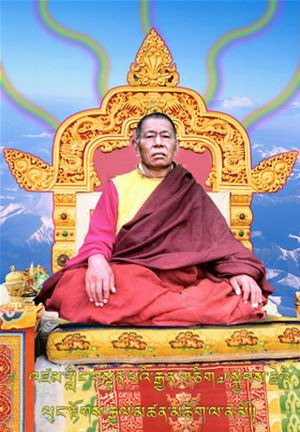
Achuk Dharma King

Yaqing Monastery is renowned for the intense dedication of its practitioners. The chömos are celebrated for their strict retreats, such as the famed “Hundred-Day Retreat,” where they meditate in small wooden huts with minimal provisions, focusing entirely on spiritual purification and self-realization. This disciplined way of life reflects their unwavering devotion and sets Yaqing Monastery apart as a beacon of spiritual depth and discipline.

Though young in its establishment, Yaqing Monastery has become a vital site for Tibetan Buddhism. Its unique role as a center for female monastics and its connection to the profound teachings of the Great Perfection have drawn pilgrims and practitioners from across the globe. Achuk Lama’s wisdom and compassion, coupled with the exceptional spiritual commitment of the chömos, have elevated Yaqing Monastery into a symbol of devotion, equality, and spiritual excellence.

Through its rich history, natural beauty, and spiritual depth, Yaqing Monastery continues to inspire countless individuals on their path to enlightenment, offering a sacred space where the wisdom of the Nyingma lineage flourishes.

This image has an empty alt attribute; its file name is image-7.png

This image has an empty alt attribute; its file name is image-20.png

This image has an empty alt attribute; its file name is image-9.png

This image has an empty alt attribute; its file name is image-10.png

This image has an empty alt attribute; its file name is image-11.png

On the slopes near Nuns’ Island, there are small huts known as “matchbox houses,” created from single wooden boxes just large enough for one person to sit inside. These structures are scattered across the hills and serve as meditation spaces for monks and nuns during the winter “Hundred-Day Retreat,” a period of intense spiritual practice and seclusion.

This image has an empty alt attribute; its file name is image-13.png

This image has an empty alt attribute; its file name is image-17.png

This image has an empty alt attribute; its file name is image-15.png

Each practitioner here embodies solitude and quiet perseverance. Every morning at sunrise, the lamas and chömos of Yaqing Monastery walk towards the surrounding mountains, beginning their daily practice of kora—circumambulation. Their steps are unwavering, driven by their devotion to the Buddha. From sunrise to sunset, their journey is not just a physical one but a spiritual pilgrimage, symbolizing the pursuit of liberation and the transformation of future lives.

Yaqing Monastery, with its unique geographical setting, profound spiritual significance, and the compassionate aspirations of Achuk Rinpoche, provides humanity with a sacred haven filled with light and hope for the soul.

Link:https://peacelilysite.com/2024/11/29/yaqing-monastery-a-sacred-haven-for-female-practitioners/

Souce: https://www.wforum.com/news/outdoors/2024/06/07/445816.html

Photos from:  https://www.yeeyi.com/news/details/2542667/

I Am Me and I am Okay

I Am Me

by Virginia Satir

In all the world there is no one else exactly like me.

Everything that comes out of me is authentically mine because I choose it…

I own everything about me, my body, my feelings, my mouth, my voice, all my actions whether they be to others or to myself

I own my fantasies, my dreams, my hopes, my fears

I own all of my triumphs and successes, all of my failures and mistakes because I own all of me.

I become intimately acquainted with me by so doing, I can love me and be friendly with me in all my parts

I know there are aspects about myself that puzzle me and other aspects I do not know…

but as long as I am friendly and loving to myself, I can courageously and hopefully look for solutions to the puzzles and for ways to find out more about me…

however I look and sound whatever I say and do, and whatever I think and feel at a given moment in time is authentically me

if later some parts of how I looked, sounded, thought and felt turned out to be unfitting, I can discard that which is unfitting and keep the rest and invent something new for that which is I discard

I can see, hear, feel, think, say and do.

I have the tools to survive, to be close to others, to be productive, and to make sense and order out of the world of people and things outside of me…

I own me and therefore I can engineer me

I am me and I AM OKAY.

Satir’s beautiful and empowering poem “I Am Me” encapsulates her core belief in self-worth and individuality. Its heartfelt lines inspire readers to embrace their authentic selves, fostering inner peace and self-acceptance. Through her words, Satir invites us to celebrate who we truly are, reminding us that personal growth is both possible and transformative.

Link:https://peacelilysite.com/2024/11/25/i-am-me-and-i-am-okay/

I Want to Love You

Virginia Satir’s Wisdom on Love and Relationships

I want to love you without clutching,
Appreciate you without judging,
Join you without invading,
Invite you without demanding,
Leave you without guilt,
Criticize you without blaming,
And help you without insulting.
If I can have the same from you,
then we can truly meet and enrich each other.

Virginia Satir, a trailblazer in family therapy, is celebrated for her profound understanding of human emotions and relationships. Her timeless poem I Want to Love You encapsulates the essence of love in tender, insightful language. Satir invites us to redefine love as not merely an emotional bond but an intentional practice rooted in respect, understanding, and wisdom. (Photo from Wikimedia commons)

Satir emphasized the importance of nurturing love that is healthy, respectful, and boundaries. Her work reveals that true love fosters connection, trust, and mutual growth. This approach provides a blueprint for enriching relationships, particularly within families and marriages, where deep emotional bonds often coexist with challenges.

Love in Parent-Child Relationships

Satir’s therapeutic approach frequently emphasized parenting as a delicate balance of nurturing and letting go. One of her core principles was the importance of validating children’s emotions and individuality.

She often used metaphors to illustrate her points. For instance, she likened parenting to tending a garden: “You water the seeds, but you cannot decide how each flower will bloom.” This philosophy highlights the role of parents in providing unconditional support during early childhood while allowing space for independence as the child matures.

A famous anecdote from her work involved a mother who struggled with her teenage daughter’s rebellion. Satir encouraged the mother to write a letter expressing her love without judgment. This simple act fostered a renewed connection, demonstrating how acknowledgment and respect can rebuild bonds.

Parenting, as Satir taught, is about cultivating trust and allowing children to flourish as autonomous individuals, experiencing love as a source of empowerment rather than control.

Cultivating Love in Marital Bonds

Satir believed that love in marriage thrives on mutual respect, clear communication, and intentional effort. She often used her Family Sculpting technique to help couples visualize the dynamics of their relationship. By arranging family members to represent emotional closeness and distance, couples could see the need for adjustments in their behavior.

For instance, Satir once worked with a couple where the wife felt unheard. By “sculpting” the wife seated with her back to the husband, the couple visualized their emotional disconnection. This powerful exercise led to a heartfelt conversation where both partners committed to active listening and mutual validation.

In practice, Satir advocated for specific behaviors to nurture marital love:

  • A wife can replace nagging with encouragement and complaints with collaboration, creating a foundation of trust and partnership.
  • A husband can demonstrate responsibility through actions rather than words, replacing criticism with appreciation and patience.

These small, intentional changes can transform the atmosphere of a marriage, fostering harmony and mutual growth.

In all relationships—whether between parents and children or spouses—Satir emphasized equality, respect, and tolerance. She taught that love devoid of attachment, judgment, or control becomes a source of profound warmth and harmony.

Satir’s work inspires us to approach love as a life-affirming practice, one that enriches our connections and empowers personal growth. Whether through her transformative therapy sessions or the tender verses of her poetry, she reminds us that love is not just an emotion but a lifelong commitment to nurturing ourselves and those around us.

Link:https://peacelilysite.com/2024/11/21/i-want-to-love-you/