Written By Olivia Sarkar| Last Updated: Jan 06, 2025, 04:52 PM IST|Source: Bureau
After enjoying a hearty meal, it’s not uncommon to feel uncomfortable or sluggish. Digestive issues like bloating, indigestion, or an uneasy feeling can linger long after the last bite. Fortunately, there are simple after-dinner rituals that can support your digestion and help prevent bloating, leaving you feeling lighter and more at ease. Below are eight effective practices that can make a world of difference to your digestive health.
1. Take a Gentle Walk After a meal, taking a light walk can be one of the most beneficial things for your digestive system. A short 10-15 minute stroll helps stimulate the digestive process by encouraging the stomach to empty more quickly, reducing bloating and discomfort. It also promotes the movement of food through the intestines, preventing constipation.
2. Sip Warm Water or Herbal Tea Drinking warm water or herbal tea, such as peppermint, ginger, or chamomile, can greatly improve digestion. These teas have natural properties that soothe the stomach, reduce bloating, and promote the movement of food through your digestive system. Ginger, in particular, can help reduce nausea and gas, while chamomile works as a calming agent to relax your stomach muscles.
3. Avoid Lying Down Immediately Though it might feel tempting to lounge on the couch after a large meal, lying down too soon can actually slow down the digestive process. Gravity helps food and acid stay in the stomach, and lying flat can increase the risk of acid reflux and bloating. Wait at least 30 minutes to an hour before reclining to allow your body time to process the food.
4. Practice Deep Breathing After eating, try engaging in deep breathing exercises. This helps stimulate the parasympathetic nervous system (also known as the “rest and digest” system), encouraging optimal digestion. Deep breathing can also reduce stress, which can otherwise impair digestion and cause bloating or discomfort.
5. Massage Your Abdomen Gentle self-massage can aid in digestion by stimulating the movement of food through the intestines. Use your fingertips to massage your stomach in a clockwise motion (the direction of digestion) for a few minutes. This simple act can help ease bloating, relieve gas, and promote digestion.
6. Incorporate Probiotics Probiotics are beneficial bacteria that support gut health and digestion. After dinner, consider consuming foods rich in probiotics, such as yogurt, kefir, or fermented vegetables. Alternatively, a probiotic supplement may help maintain a healthy balance of gut bacteria, reducing bloating and improving overall digestion.
7. Stay Hydrated, But Avoid Over Drinking Drinking water throughout the day aids digestion, but drinking too much water immediately after a meal can dilute stomach acid, impairing your body’s ability to break down food. Try sipping water in moderation after dinner, but avoid excessive consumption right away. This ensures proper digestive function without overwhelming your stomach.
8. Avoid Carbonated Drinks Carbonated drinks, including sodas and sparkling water, introduce gas into your stomach, which can lead to bloating. After dinner, it’s best to skip the bubbles. Stick to still water or herbal teas, which are far more conducive to smooth digestion.
Fennel seeds are a natural remedy for boosting digestion. Try chewing some after your meal to see if they work for you. From taking a short walk to sipping herbal tea and massaging your abdomen, these habits can make a significant difference in how you feel after dinner. Your digestive health is a reflection of your lifestyle, so taking small, consistent steps can lead to long-term benefits, allowing you to enjoy your meals without the aftermath of discomfort.
In recent years, nutrigenomics—the scientific study of how genes influence our body’s response to food—has gained significant attention. As research in genetics and nutrition continues to advance, this field is paving the way for more personalized health strategies, particularly in the areas of diet and weight management. Understanding how genes affect our reactions to specific foods provides deeper insights into individual health needs, driving the development of personalized wellness approaches.
At the core of nutrigenomics lies the principle that our genetic makeup plays a crucial role in food metabolism. For instance, some individuals may be genetically predisposed to metabolize carbohydrates more efficiently, while others tend to store fat more easily. These insights empower health professionals to design customized dietary plans based on genetic testing rather than relying on generalized nutritional recommendations.
Recent studies have shown that genetic variations can influence how nutrients are absorbed, how efficiently the body burns calories, and even how hunger is experienced. For example, specific variations in the FTO gene have been linked to a higher risk of obesity, as some individuals gain weight more easily due to the way their bodies process food. Similarly, variations in genes like PPARG can impact fat metabolism, further emphasizing the potential of personalized nutrition strategies based on genetic data.
Nutrigenomics introduces a revolutionary approach to weight management. Traditional diets often follow a “one-size-fits-all” model, which may not be effective for everyone. By using genetic data, nutritionists and health experts can develop personalized dietary plans tailored to an individual’s metabolic needs, resulting in more effective weight management.
For example, genetic testing can reveal a person’s sensitivity to fats or carbohydrates, guiding the ideal macronutrient balance for their body. If someone’s genetic profile indicates a higher risk of insulin resistance, a low-glycemic diet may be recommended to help prevent blood sugar spikes and support weight loss. This tailored strategy often proves more effective than generic diets that overlook individual differences.
The Advantages of Personalized Diet Plans
Nutrigenomics brings a significant advantage to dietary planning: personalization. Rather than relying on generalized advice or fleeting diet trends, nutrigenomics empowers individuals to approach health management scientifically. By integrating genetic testing with dietary adjustments, people can achieve better health outcomes and a deeper understanding of their own bodies.
Key benefits of personalized diets include:
Improved Metabolic Health: Tailored diets help optimize the body’s ability to process food and maintain a healthy weight.
Precise Nutrient Recommendations: Instead of guessing which foods are most beneficial, personalized nutrition ensures individuals receive the nutrients their body specifically needs.
Sustainable Weight Management: Nutrigenomics-based diets promote long-term healthy habits by aligning with genetic predispositions rather than short-term trends.
Additionally, nutrigenomics may support preventive health strategies. Genetic testing can identify predispositions to conditions such as heart disease, diabetes, or nutrient deficiencies, allowing individuals to make proactive dietary changes for long-term wellness.
The future of health management is becoming increasingly personalized, with nutrigenomics at the forefront of this transformation. As the field continues to evolve, more health centers are likely to offer genetic testing services to help individuals create personalized nutrition and wellness plans. This data-driven approach reflects a broader trend where people are empowered to take greater control of their health through scientific insights.
While the potential of nutrigenomics is promising, it remains a developing science. Experts emphasize the need for further research to fully understand the complex relationship between genes and diet. Additionally, as the field matures, ethical considerations and privacy concerns must be carefully addressed to ensure individuals are fully informed and protected when sharing their genetic data.
Nutrigenomics represents a powerful fusion of genetic science and nutrition, offering the potential for health strategies tailored to individual genetic profiles. This emerging science can help design diets that promote optimal weight loss, improve metabolic health, and prevent chronic illnesses.
Though still in its early stages, nutrigenomics has the potential to revolutionize health management, making weight control and wellness strategies more effective and sustainable. As research continues to expand, genetic testing could become a key tool in unlocking healthier, more personalized lifestyles for everyone.
In all the world there is no one else exactly like me.
Everything that comes out of me is authentically mine because I choose it…
I own everything about me, my body, my feelings, my mouth, my voice, all my actions whether they be to others or to myself
I own my fantasies, my dreams, my hopes, my fears
I own all of my triumphs and successes, all of my failures and mistakes because I own all of me.
I become intimately acquainted with me by so doing, I can love me and be friendly with me in all my parts
I know there are aspects about myself that puzzle me and other aspects I do not know…
but as long as I am friendly and loving to myself, I can courageously and hopefully look for solutions to the puzzles and for ways to find out more about me…
however I look and sound whatever I say and do, and whatever I think and feel at a given moment in time is authentically me
if later some parts of how I looked, sounded, thought and felt turned out to be unfitting, I can discard that which is unfitting and keep the rest and invent something new for that which is I discard
I can see, hear, feel, think, say and do.
I have the tools to survive, to be close to others, to be productive, and to make sense and order out of the world of people and things outside of me…
I own me and therefore I can engineer me
I am me and I AM OKAY.
Satir’s beautiful and empowering poem “I Am Me” encapsulates her core belief in self-worth and individuality. Its heartfelt lines inspire readers to embrace their authentic selves, fostering inner peace and self-acceptance. Through her words, Satir invites us to celebrate who we truly are, reminding us that personal growth is both possible and transformative.
I want to love you without clutching, Appreciate you without judging, Join you without invading, Invite you without demanding, Leave you without guilt, Criticize you without blaming, And help you without insulting. If I can have the same from you, then we can truly meet and enrich each other.
Virginia Satir, a trailblazer in family therapy, is celebrated for her profound understanding of human emotions and relationships. Her timeless poem I Want to Love You encapsulates the essence of love in tender, insightful language. Satir invites us to redefine love as not merely an emotional bond but an intentional practice rooted in respect, understanding, and wisdom. (Photo from Wikimedia commons)
Satir emphasized the importance of nurturing love that is healthy, respectful, and boundaries. Her work reveals that true love fosters connection, trust, and mutual growth. This approach provides a blueprint for enriching relationships, particularly within families and marriages, where deep emotional bonds often coexist with challenges.
Love in Parent-Child Relationships
Satir’s therapeutic approach frequently emphasized parenting as a delicate balance of nurturing and letting go. One of her core principles was the importance of validating children’s emotions and individuality.
She often used metaphors to illustrate her points. For instance, she likened parenting to tending a garden: “You water the seeds, but you cannot decide how each flower will bloom.” This philosophy highlights the role of parents in providing unconditional support during early childhood while allowing space for independence as the child matures.
A famous anecdote from her work involved a mother who struggled with her teenage daughter’s rebellion. Satir encouraged the mother to write a letter expressing her love without judgment. This simple act fostered a renewed connection, demonstrating how acknowledgment and respect can rebuild bonds.
Parenting, as Satir taught, is about cultivating trust and allowing children to flourish as autonomous individuals, experiencing love as a source of empowerment rather than control.
Cultivating Love in Marital Bonds
Satir believed that love in marriage thrives on mutual respect, clear communication, and intentional effort. She often used her Family Sculpting technique to help couples visualize the dynamics of their relationship. By arranging family members to represent emotional closeness and distance, couples could see the need for adjustments in their behavior.
For instance, Satir once worked with a couple where the wife felt unheard. By “sculpting” the wife seated with her back to the husband, the couple visualized their emotional disconnection. This powerful exercise led to a heartfelt conversation where both partners committed to active listening and mutual validation.
In practice, Satir advocated for specific behaviors to nurture marital love:
A wife can replace nagging with encouragement and complaints with collaboration, creating a foundation of trust and partnership.
A husband can demonstrate responsibility through actions rather than words, replacing criticism with appreciation and patience.
These small, intentional changes can transform the atmosphere of a marriage, fostering harmony and mutual growth.
In all relationships—whether between parents and children or spouses—Satir emphasized equality, respect, and tolerance. She taught that love devoid of attachment, judgment, or control becomes a source of profound warmth and harmony.
Satir’s work inspires us to approach love as a life-affirming practice, one that enriches our connections and empowers personal growth. Whether through her transformative therapy sessions or the tender verses of her poetry, she reminds us that love is not just an emotion but a lifelong commitment to nurturing ourselves and those around us.
Autumn is often called “Golden Autumn,” a name inspired by the vibrant yellow hues of trees and plants that adorn the season. Among them, the ginkgo tree stands out, its radiant golden leaves creating a spectacle often described as “magnificent” and “resplendent.” This season marks the peak of the ginkgo tree’s beauty, transforming landscapes into breathtaking golden vistas.
A Living Fossil of Resilience
The ginkgo tree, also known as Ginkgo biloba or the “maidenhair tree,” is a living fossil, dating back over 150 million years. It is the sole survivor of an ancient plant lineage, standing tall as a testament to nature’s endurance. With its unique fan-shaped, two-lobed leaves that turn brilliant yellow in fall, the ginkgo has earned its place as a symbol of both beauty and longevity.
This ancient tree boasts remarkable regenerative powers. Mature ginkgo trees often give rise to thriving saplings, symbolizing vitality and the continuation of life. In Chinese culture, this resilience is likened to familial prosperity, embodying aspirations for blessings and generational success.
Medicinal Value and Modern Research
Beyond its aesthetic appeal, the ginkgo has significant medicinal properties. Traditional Chinese Medicine (TCM) uses its leaves and seeds for various remedies. Today, modern science highlights ginkgo leaf extract for its rich antioxidant content and potential benefits for brain function, circulation, and overall well-being.
A Sacred Symbol in Buddhism
In Chinese tradition, the ginkgo tree holds deep cultural and spiritual meaning. It symbolizes purity, endurance, and good fortune. Within Buddhism, the ginkgo is revered as the “Buddha tree,” representing enlightenment and spiritual resilience. Its longevity and abundant fruit make it a substitute for the sacred Bodhi tree in many temples.
During autumn, the ginkgo’s golden canopy creates a serene atmosphere in temple grounds, harmonizing with the red walls and golden roofs. This visual splendor evokes reverence and awe, inspiring mindfulness and devotion among practitioners.
ws.cc/zh-my/travel/3jqb9gy.html
Ginkgo Tree at Xi’an’s Guanyin Zen Temple: A 1,400-Year-Old Beauty
The Thousand-Year-Old Ginkgo Tree at Tanzhe Temple, titled the “Emperor Tree” by Emperor Qianlong of the Qing Dynasty, is an extraordinary natural treasure. Standing over 24 meters tall with a trunk diameter exceeding 4 meters, it takes six or seven people joining hands to encircle its massive base. The tree’s canopy spans an area of more than 600 square meters, providing ample shade. Estimated to be over 1,300 years old, this tree is a testament to resilience and history.
Ginkgo Tree at Tanzhe Temple
Dinghui Temple, a favorite spot for Suzhou residents to photograph ginkgo trees, is home to two towering, century-old ginkgo trees standing prominently in front of the main hall. In autumn, their golden leaves cascade to the ground, creating a dazzling and picturesque scene. (photos from https://news.qq.com/rain/a/20231105A07FBH00)
Suzhou City: DingHui Temple
At the ancient Huiji Temple, Nanjing City, three venerable ginkgo trees, each over 1,500 years old, grace the temple grounds. As autumn arrives, their golden leaves blanket the treetops, creating a breathtaking contrast against the temple’s white walls and dark-tiled roofs. The scene resembles a magnificent ink-wash painting, captivating visitors with its timeless beauty. (photos from https://news.qq.com/rain/a/20231105A07FBH00)
Artistic and Symbolic Significance
The ginkgo tree’s durable and fine-grained wood is prized for carving Buddha statues, earning it the moniker “Buddha’s fingernail.” Its leaves, resembling flames, symbolize light and warmth. In Buddhist tradition, the golden hue of ginkgo leaves reflects the nobility and purity of the Buddha’s body, which represents eternal light and wisdom.
The Buddha’s golden body, seen as untainted and impervious to worldly suffering, mirrors the ginkgo’s enduring nature. Similarly, the Buddha’s radiance is believed to dispel darkness, illuminate ignorance, and guide all beings toward compassion and enlightenment.
A Tree of Light and Legacy
The ginkgo tree, with its awe-inspiring beauty and profound cultural significance, is more than just a tree—it is a symbol of life, hope, and spiritual awakening. Its golden leaves remind us of the light within, inspiring resilience and reverence for nature’s timeless wisdom.
As we marvel at the ginkgo tree’s breathtaking beauty and the profound symbolism it holds, let it also serve as a gentle reminder of our responsibility to protect the natural world. These ancient trees, along with the countless wonders of nature, depend on our collective efforts to preserve their existence. By cherishing and safeguarding our planet, we ensure that future generations can continue to experience and draw inspiration from the harmonious balance and enduring wisdom of nature.
In Traditional Chinese Medicine (TCM), the “kidney” is not just associated with the organ itself, but is considered the center of multiple bodily functions, overseeing everything from physical strength and vitality to bone growth. (Photo from sohu.com)
The kidneys are seen as the foundation of life, and when kidney energy, or kidney qi, is abundant, the body remains strong and full of life. However, when kidney qi is depleted, it leads to weakness, fatigue, premature aging, and is often linked to chronic illnesses.
The Importance of Kidney Qi in TCM In TCM, maintaining a balanced flow of energy is essential for overall health. The kidney meridian plays a crucial role in regulating the balance of yin and yang within the body. Kidney yin and kidney yang are considered the fundamental energies that support the entire body’s internal organs. When kidney qi is nourished, the body remains strong, and all other organs function properly. Therefore, keeping the kidney energy well-maintained is vital for longevity and overall well-being.
While diet and herbal supplements are commonly used in TCM to support kidney health, a simple and effective method is through regular meridian stimulation. By massaging and promoting energy flow along the kidney meridian, we can help maintain smooth circulation of energy (qi) and blood throughout the body, promoting vitality and longevity.
Winter: The Season for Kidney Care In TCM, winter is the season most closely associated with kidney health. It’s a time to focus on replenishing and strengthening the kidneys, as the colder months are believed to affect the body’s energy levels. To help support kidney health during this time, TCM practitioners recommend incorporating certain practices into your daily routine.
Dr. Hu Haiya’s Kidney-Rubbing Technique One of the most accessible and effective ways to nourish kidney qi is through a simple technique known as the kidney-rubbing exercise, shared by the esteemed TCM doctor Hu Haiya. Dr. Hu, who lived to the age of 95 with remarkable health, became a symbol of vitality and longevity. When asked about the secret to his longevity, many expected him to mention some rare, mystical remedy. Instead, he smiled and explained, “There is no magical remedy; the true remedy lies within your own body.”
Dr. Hu then shared the kidney-rubbing technique he practiced regularly. The primary benefit of this exercise is to stimulate and invigorate the kidney qi, which is the foundation of energy and vitality in TCM. When the kidneys are nourished with abundant qi, the body becomes more energetic, the muscles and bones grow stronger, and life expectancy increases.
How to Perform the Kidney-Rubbing Technique
Position your hands: Make loose fists with both hands, leaving the centers of your fists slightly hollow (as shown in the figure).
Place your hands on your lower back: Position your fists over the kidney area, near the waist (Shenshu points). There’s no need to precisely find acupuncture points; just placing the fists on the lower back is sufficient.
Gentle motion: Keep the fists still and use your knees to gently bounce up and down. This will cause your body to move, which creates friction between the fists and the kidney area.
Repetition: Perform this exercise for 500 repetitions or until you feel a slight warmth in your lower back.
Photo 1
Photo 2
Tips for Effective Practice
If you’re new to this technique and find it difficult to do all 500 repetitions in one go, don’t worry. Start gradually by breaking it into 2-3 sets and work on building leg strength.
Eventually, aim for 500 repetitions in one continuous set. You’ll notice the body begins to feel warm, signaling improved circulation and energized kidney qi.
The Path to Longevity Starts with Kidney Health By incorporating practices like kidney-rubbing into your routine, you can nurture your kidney health and enhance your overall vitality. In TCM, vitality and longevity are directly linked to the state of our kidney qi. Strengthening this vital energy is key to achieving a healthy, balanced life.
Start today—because true health comes from within.
I recently came across a thought-provoking video that offered a profound insight into the root cause of social disorder. A newspaper invited submissions on the topic: “What is the root cause of social disorder?” One answer stood out for its simplicity yet profound depth: “It’s me.”
This response highlights a universal truth: the state of the world mirrors the state of each individual. If “I” embody qualities like sincerity, kindness, and a willingness to help, I can foster harmony in my family and community. Conversely, if “I” succumb to selfishness, greed, and deceit, disorder and instability are inevitable.
The peace and stability of society, our nation, and even the world rest on each of us. By reducing criticism of others and turning our attention inward—reflecting on our thoughts, words, and actions—we can become catalysts for harmony.
True greatness is not about outperforming others but about improving ourselves. By focusing on personal growth, we enrich our lives and contribute to a better world.
Mother Teresa’s Timeless Wisdom
Mother Teresa’s poem “Do It Anyway” offers profound guidance for navigating life’s challenges with integrity, kindness, and resilience. It reminds us to act according to our values, regardless of external circumstances:
People are unreasonable,illogical and self-centered
Love them anyway.
If you are kind,people may accuse you of selfish,ulterior motives;
Be kind anyway.
If you are successful,you will win some false friends and some true enemies;
Succeed anyway.
The good you do today will be forgotten tomorrow;
Do good anyway.
If you are honest and frank,people may cheat you;
Be honest and frank anyway.
People favor under dogs but follow only topdogs.
Fight for a few underdogs anyway.
What you spend years building may be destroyed overnight;
Build anyway.
If you find serenity and happiness,they may be jealous;
Be happy anyway.
People really need help but may attack you if you do help them.
Help people anyway.
Give the world the best you have,And it may never be enough;
Give the world the best you have anyway.
Her words teach us that life’s meaning lies in staying true to our values, not in others’ perceptions or responses. Ultimately, our actions reflect a dialogue with our conscience, not a transaction with others.
Personal growth begins with the courage to look inward. When frustration or dissatisfaction arises, take a moment for self-reflection. Ask yourself, “How can I improve?” This practice shifts focus from external blame to internal progress. Growth unfolds through small, manageable goals—whether it’s mastering a new skill, refining emotional resilience, or nurturing patience.
Kindness is another cornerstone of personal development. Choose compassion, even when faced with misunderstanding or adversity, because every person carries unseen struggles. Alongside kindness, maintain integrity and uphold what’s right, regardless of external validation. As Mother Teresa wisely said, “Give the world the best you have, and it may never be enough; give your best anyway.”
By weaving self-reflection, purposeful improvement, and compassionate action into daily life, we not only enhance ourselves but also contribute to a more harmonious world.
World peace begins with individual actions. Change doesn’t require grand gestures; it starts with small, deliberate acts of kindness—a warm smile, a kind word, or a helping hand.
When we each commit to self-growth, compassion, and mindfulness, we create ripples of positive change in our communities and beyond. Together, these ripples can form a wave of harmony that transforms the world.
Let us strive to become better versions of ourselves, nurturing peace and love in our hearts. By doing so, we can build a brighter, more peaceful future—one person at a time.
Virginia Satir (1916–1988) was a trailblazer in the field of family therapy, earning worldwide recognition as a distinguished psychotherapist and one of America’s most influential family therapists. Dubbed “everybody’s family therapist” by Human Behavior magazine, Satir devoted her life to uncovering the complexities of human relationships and exploring the essence of what it means to be human. Her groundbreaking principles for fostering effective family communication continue to be revered and applied by professionals across the globe.
Satir’s legacy extends beyond therapy rooms. Her poetic insights capture the depth of her understanding of human nature and emotions. One of her most touching poems, “When I Am Strong Enough Inside,” serves as a mirror reflecting our inner strength and vulnerability. These verses remind us that the negative voices within us can often overshadow our resilience. However, by engaging with empowering words like hers, we can nurture psychological flexibility and cultivate a more compassionate perspective toward ourselves and others. Here is an excerpt from her poem that encapsulates her profound messag.
When I Am Strong Enough Inside
When I’m strong enough inside, You blame me, I feel your pain; You flatter me, I see you need approval; You’re crazy, I understand your vulnerability and fear; You interrupt, I know how much you want to be seen.
When I’m strong enough inside, I no longer defend, All the forces, Free flow between us. Grievance, depression, guilt, sadness, anger, pain, When they flow freely. I feel warm in sorrow, Find strength in anger, See hope in pain.
Screenshot
When I’m strong enough inside, I will not attack. I know, When I stop hurting myself, Then no one can hurt me. I lay down my arms, Open heart, When my heart softens, In love and compassion, Meet you bright and warm.
Originally, let the heart strong, All I need is, Seeing myself, Accept what I can’t do, Appreciate what I’ve done. And believe, Through this journey, Can live out their own, bloom their own.
In these lines, Satir masterfully conveys her belief in the transformative power of understanding the reasons behind others’ actions. Instead of reacting with judgment, she calls on us to see the humanity in others, even when their behavior is challenging.
Her poem continues with a heartfelt reminder that by releasing our own emotions—be it anger, sadness, or guilt—we can uncover strength, warmth, and hope. She encourages us to let go of self-defensiveness, to embrace compassion, and to see ourselves and others with clarity and acceptance.
When I encountered this poem, I was struck by Satir’s tender view of humanity. It eloquently sheds light on behaviors we often judge harshly—blaming, seeking approval, over-rationalizing, or interrupting. Yet, rather than condemning these actions, she invites us to see the vulnerability and pain behind them. This perspective challenged me to think: if my heart were stronger, if I could move beyond my own wounds, perhaps I too could approach the world with such gentle understanding.
Satir’s poem inspires a transformative journey of self-awareness and growth. To build inner strength, she suggests we:
See ourselves as we truly are, without judgment.
Accept our imperfections with kindness.
Appreciate our progress and achievements.
Trust in our ability to live authentically and bloom fully.
Her words serve as both a reminder and an invitation—to embrace our humanity, nurture our resilience, and extend the same understanding to others.
Even today, Virginia Satir’s work continues to inspire people to heal, connect, and thrive. Through her profound poetry and her legacy as a master therapist, she reminds us that inner strength and compassion are at the heart of meaningful relationships and a fulfilling life.
During a visit to Holy Vajrasana Temple, I encountered the beautiful and meaningful practice of Oryoki. Often translated as “just the right amount,” Oryoki is a ritualized way of serving and eating food that combines efficiency, mindfulness, and gratitude. Its roots trace back to the Buddha’s time, embodying the Middle Way of taking neither too much nor too little—an ethos that resonates deeply with the principles of simplicity and compassion.
What Is Oryoki?
Oryoki originated during the Tang Dynasty in China and later influenced practices such as the Japanese tea ceremony. It is widely practiced in Zen monasteries as a way to unify daily life with spiritual practice. The ritual involves a meticulous series of hand gestures, silence, and mindfulness during the meal.
Monks sit in meditation posture, waiting to offer their empty bowls to servers, who portion food to the requested amount. Every movement is intentional, every crumb is appreciated, and every element is designed to minimize waste. Even the water used to wash the bowls is partially consumed and the remainder returned to the earth, often to nourish the garden.
Simple and Balanced Eating
The meals at Holy Vajrasana Temple reflect the Oryoki tradition, featuring fresh fruits, vegetables, whole grains, and tofu. With minimal spices or stimulants, these meals are designed to nourish the body while keeping the mind clear and alert. Every effort is made to include the five flavors—sweet, salty, sour, bitter, and umami—and the five colors—red, green, white, yellow or orange, and black, blue, or purple.
Chefs follow the principle of eating simply, allowing the natural flavors of ingredients to shine. Eating in silence encourages mindfulness, helping participants savor each bite and truly appreciate the food’s journey from soil to plate.
Lessons in Gratitude and Reducing Waste
One of the most profound lessons from Oryoki is its emphasis on gratitude and sustainability. The practice reminds us to take only what we need and waste nothing. Participants are encouraged to finish their meals completely, leaving no remnants.
This principle can extend to our daily lives, especially during the holiday season when overindulgence and waste are common. By being mindful of portion sizes, recycling food scraps, and making thoughtful purchasing decisions—like avoiding vegetables wrapped in plastic—we can honor the spirit of gratitude and reduce our environmental footprint.
A Holiday Reminder: Gratitude Over Excess
As the holiday season approaches, let us take inspiration from these temple traditions. Instead of overindulging, savor each meal with mindfulness and gratitude. Remember those around the world who face hunger daily, and let this awareness guide us to be more conscious and compassionate in our eating habits.
Wishing you a joyful, mindful, and healthy holiday season! Let us cherish the food on our plates, honor the hands that prepared it, and commit to a less wasteful, more compassionate way of living.
Recently, I visited the Holy Vajrasana Temple in Fresno, CA, and was deeply impressed by their delicious vegetarian meals. The flavors were unforgettable, and I’m thrilled to share some of these favorite healthy, vegetarian recipes with you to bring extra joy and flavor to your Thanksgiving holiday!
The temple offers retreat sessions, providing a nurturing experience for both body and spirit. With a garden on-site, the monastery uses the freshest organic vegetables for meal preparation, resulting in incredibly tasty dishes. For anyone interested in learning more about their retreats, you can find details here.
Stay tuned for some of the delightful recipes inspired by this visit, perfect for a healthy, delicious holiday spread!
Grilled Slaw With Mint
Cabbage is one of the most useful vegetables. I love it in slaw, in stews, in mashed potatoes, etc., and here we have a recipe that grills it. I think you could serve this hot for the cold days we are now having, although the recipe cools the cabbage to serve as salad. Enjoy!
Ingredients for 4 Servings
1 1/2 Tbsp cider or rice vinegar, plus more to taste
1 1/2 Tbsp maple syrup, plus more to taste
1 1/2 Tbsp avocado or grape seed oil
1 1/2 tsp Dijon-style mustard
1/2 tsp caraway seeds
Kosher salt and freshly ground black pepper to taste
1/2 head savoy or other green cabbage quartered, lengthwise through core
2 Tbsp thinly sliced fresh mint
Directions
Light a charcoal or wood-burning grill and let the coals burn down to glowing embers. May also be grilled in an iron skillet or indoor grill.
Meanwhile, make the dressing: In a large bowl, whisk the vinegar and maple syrup. Whisk in the oil, followed by the mustard and caraway seeds. Season to taste with salt and pepper.
Lay the cabbage quarter(s) directly on the grill and roast until all sides are charred, turning with tongs, about 2 minutes per side. Transfer to a sheet pan and let cool.
Discard the tough core of the cabbage then thinly slice the cabbage crosswise. Add the sliced cabbage to the dressing and toss to coat. Season with more salt, maple syrup, and vinegar to taste. Refrigerate until serving and serve within a couple hours of mixing. Just before serving, stir in the mint.
Broccoli Slaw
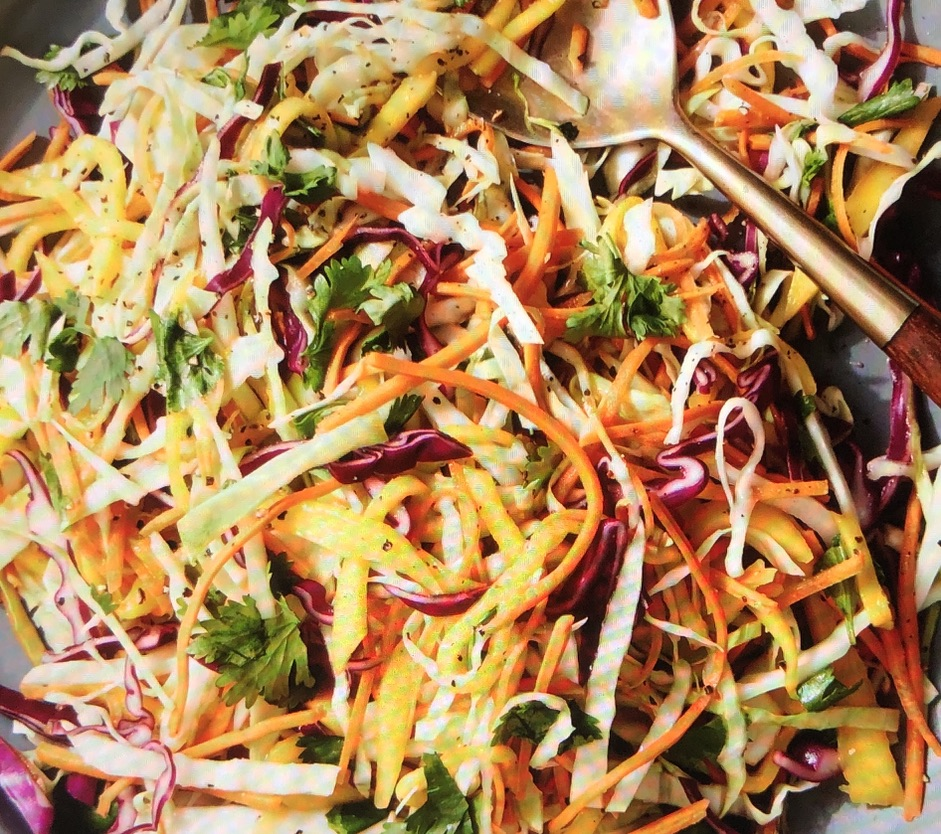
This is a very easy, colorful and delicious salad or slaw that uses shredded raw broccoli stalks instead of cabbage and usually carrots and red cabbage or radicchio for color. You can find packaged broccoli slaw at most markets now or make your own.
3 cups broccoli slaw (shredded broccoli stalks, carrots, red cabbage)
finely chopped green onions (optional)
¼ cup dried figs, dates, unsweetened cranberries or other dried fruit; cjopped mang, apple, pears also good
1/3 cup chopped roasted macadamia or hazel nuts
5 radishes, thinly sliced
½ chopped red, green, and/or yellow chopped bell peppers
chopped avocado
chopped parsley, cilantro, mint, dill, or other herbs
hemp, flax, or poppy seeds
Dressing
¼ cup red wine vinegar
2 Tablespoons olive or avocado oil
1-2 dates, chopped or seasonal fruit like pears or apples, but most fruit would work
salt & black pepper to taste
1/2 tsp turmeric power
toasted sesame seeds, grated ginger (optional)
Blend dressing, if dates or other fruits are used, otherwise, just mix ingredients.
Toss all ingredients, except nuts, and refrigerate for several hours to blend flavors. Add nuts and serve. Nuts may be served separately as some may have nut allergy.
NON-VEGAN: Add can of drained chicken or tuna or grated cheese or other leftover protein. Tofu also may be marinated in dressing to give it more flavor.
DRESSING OPTIONS: Lemon juice and zest good with avocado oil mayo, black pepper, turmeric, curry, chimichurri, or za’atar spices. Korean gochujang would also be good.
Carrot Cake Paleo Waffles
These delicious breakfast (or any time) treats are healthy and nutrient dense. They can be fried as pancakes, if you don’t have a waffle iron and you can make a big batch and freeze them to be reheated in your toaster or oven. Enjoy!
Toppings
Butter, sour cream, maple syrup, coconut butter
Yogurt, applesauce, more pecans or walnuts
Waffles
2 Eggs
1/3 Cup Plain yogurt
1/2 Cup Almond or coconut milk
1 tsp Vanilla
1 Cup Almond meal or flour
2 Tbsp Coconut sugar or maple syrup
1 1/2 tsp Cinnamon
1/2 tsp Nutmeg
1/2 tsp Grated ginger
1/2 Baking powder
1/4 tsp Salt
1/2 Cup Grated carrot
1/4 Cup chopped walnuts or pecans
1/4 Cup chopped dates or raisins
2 Tbsp Coconut, shredded
Oil spray
Whisk the eggs, yogurt, milk and vanilla together. Mix the dry ingredients in a separate bowl, add to egg mixture, and whisk until smooth. Fold in the carrots, walnuts, dates and coconut. If batter is still very thick add a few splashes of milk. Spray waffle iron with oil. Place 1/4-1/2 cup of the batter (depends on size of waffle iron) into hot waffles iron and cook according to waffle iron instructions. Top with toppings of choice and serve warm.
4 waffles. Can also be cooked as pancakes.
Bombay Frittata
This is a spicy Indian omelette with herbs and cheese that would be good for breakfast or any meal.
12 large eggs
½ cup crème fraiche or sour cream
½ cup finely chopped red onion or celery
2 scallions, white and green parts, thinly sliced (optional or serve as condiment)
2 garlic cloves, thinly sliced (optional)
¼ cup tightly packed fresh cilantro or parsley leaves
½ teaspoon garam masala
½ teaspoon fine sea salt
½ teaspoon black pepper
½ teaspoon ground turmeric
¼ teaspoon red-pepper flakes
2 tablespoons ghee, butter, or coconut oil
¼cup crumbled paneer or feta cheese
Position a rack in the upper third of the oven and heat the oven to 350 degrees.
In a large bowl, combine the eggs, crème fraiche or sour cream, onion or celery, scallions & garlic (if used), cilantro, garam masala, salt, pepper, turmeric and red-pepper flakes and beat with a whisk or fork until just combined.
Heat the ghee or oil in a 12-inch ovenproof skillet, such as cast iron, over medium-high heat, tilting the skillet to coat it evenly. When the ghee bubbles, pour the eggs into the center of the skillet, shaking to distribute evenly. Cook, undisturbed, until the frittata starts to firm up on the bottom and along the sides but is still slightly jiggly on top, about 5 minutes. Sprinkle with the paneer and transfer the skillet to the oven. Cook until frittata is golden brown and has reached desired doneness, 15 to 25 minutes. Serve warm with toast, rice, or salad.
Serves 6.
Sweet Potato and Kale Soup
It is a Caribbean treat that can be cooked and served several ways. It could be a great soup for Thanksgiving dinner.
INGREDIENTS:
3 Tbsp olive oil 2 Tbsp brewers yeast 2 minced carrots 3 Tbsp minced ginger 2 large garlic cloves, minced 4 medium sweet potatoes, peeled and cubed 1 Tbsp fresh (or 1/2 that dried ) thyme 2 tsp allspice 1 tsp nutmeg 1 tsp cinnamon 1 tsp chili sauce or Korean chili powder or flakes 1 tsp turmeric black pepper 2 cans diced tomatoes 5 cups water or broth 14 oz coconut milk 19 oz white or garbanzo kidney beans or cauliflower florets Stevia or maple syrup to taste 9 cups kale 2 Tbsp lime juice and zest
Fresh thyme for garnish
DIRECTIONS:
In a large saucepan or stockpot, heat olive oil over medium-low heat. Add brewer’s yeast, minced carrots, minced garlic, and minced ginger. Sauté for 4 to 5 minutes, stirring often.
Add the peeled and cubed sweet potatoes, thyme, allspice (if not available use more nutmeg, cinnamon, and mace), nutmeg, cinnamon, and chili sauce or flakes. Cook, stirring often, for another 3 or 4 minutes.
Stir in the diced tomatoes, salt, black pepper, vegetable broth or water. Turn heat to high and bring to a boil. Once boiling, immediately turn heat to low, cover and let simmer for about 25 to 30 minutes, or until the sweet potatoes are tender. Can be cooked in a large crock pot on high for 3-4 hours.
Add the coconut milk, cauliflower florets (or beans-drained & rinsed, and sweetener to taste) to soup. Turn heat up a little bit to medium-low. When soup returns to boil, add chopped kale (thick stems removed & washed) and let cook uncovered for another 5 minutes or until the kale is limp and tender.
Remove from heat and stir in the 2 Tablespoons lime juice and zest. If needed, season to taste with extra salt, pepper, sugar, or chili sauce or flakes. Garnish with fresh thyme leaves. Half batch fills 6 cup cooker.
Gochujang and Maple Syrup Glazed Roasted Brussels Sprouts
Here’s an easy and quick way to cook Brussels sprouts that the whole family will enjoy!
INGREDIENTS:
1 lb Brussels sprouts uniform size ½ teaspoon onion powder* ½ teaspoon garlic powder* ¼ teaspoon black pepper powder 1 tablespoon olive oil vegetable olive oil 1 tablespoon soy sauce or coconut aminos 1 tablespoon honey or maple syrup or to taste ½ teaspoon sriracha or Gochujang sauce. more. used 1 Tablespoon. 1 fresh lime optional
DIRECTIONS:
Wash, rinse, and dry the Brussels sprouts. Trim off the ends and cut them in half or quarters. Try and keep all pieces the same size. You can also include the individual leaves off of the sprouts. Mix together onion, garlic and pepper powders, soy sauce, sriracha, honey and oil in a small bowl. Transfer the Brussels sprouts to a medium bowl and coat them with some of the seasonings, making sure all surfaces are covered.
Spray pan with oil. Air-fry 14 minutes at 375F or roast in conventional oven at 400F for 16 minutes. Watch closely as they may burn.
Squeeze lime juice in sprouts and serve.
Cranberry-Orange-Date Relish
This is the best cranberry relish I have found. No cooking, easy. Makes about eight generous servings and freezes well.
INGREDIENTS:
12 oz Raw cranberries 1 Navel orange 1/4 Cup Vegan sugar or dates OPTIONAL: chopped pecans
DIRECTIONS:
Process cleaned and sorted cranberries and one navel orange (include peel) that has been cut into eighths in food processor. Add vegan sugar or dates. Toasted pecans are good added just before serving.





































 Peace LiLy