On Sunday, September 22, 2024, The Holy Miracles Temple in Pasadena hosted the grand “Dharma Assembly to Welcome the Birthday of Namo Dipankara Buddha.” This auspicious event was co-organized by the World Buddhism Association Headquarters, The Holy Miracles Temple, and the Saint Grong Lecture Hall. The assembly was led by the abbot of Hua Zang Si, Venerable Ru Hui Ru Zun, a Holy Virtuous One of Gold Button Level 1, who presided over the sacred ceremonies.
Namo Dipankara Buddha, a revered incarnation of Namo Dorje Chang Buddha, holds a special place in the hearts of Buddhist disciples. In ancient times, he prophesied that Shakyamuni Buddha would one day attain enlightenment and become a Buddha. The site of the “Dipankara Buddha Hall” at The Holy Miracles Temple is significant—it marks the location of the first-ever publication of The True Meaning of the Heart Sutra as Expounded by H.H. Dorje Chang Buddha III, where profound teachings of the Buddha were revealed.
A particularly memorable moment in this location occurred on March 7, 2014, during a Dharma assembly when a miraculous event unfolded. Buddha descended from the sky, manifesting in a divine form, blessing the gathering with three-colored nectar—a clear and undeniable testament to the authenticity of the teachings in Expounding the Absolute Truth through the Heart Sutra. Following this sacred event, the Dipankara Buddha Hall was constructed on this blessed site, where devotees from all directions come to light lamps and offer their reverence to the Buddha.
This year’s Dharma assembly began with great reverence in the Grand Hall, filled with the solemn chanting of Buddhist hymns. Under the guidance of Venerable Ru Hui Ru Zun and the monastic community, participants respectfully recited the Diamond Sutra, bowed to the Buddha, performed repentance, and conducted a grand offering before the Buddha. The assembly’s merits were dedicated to celebrating the Buddha’s birthday, with the intention to increase the blessings and wisdom of all beings, dispel ignorance and darkness, and bring forth prayers for world peace, national prosperity, and a harmonious society.
The Dharma assembly invited Venerable Ru Hui Ru Zun, the abbess of Hua Zang Si and a Holy Virtuous One, to preside over the ceremony
During an interview, Venerable Ru Hui Ru Zun shared the origin of the Buddha’s name: “The name ‘Namo Dipankara Buddha’ comes from the illumination that surrounded Him at birth, shining like a lamp. Today, we light lamps, chant scriptures, and offer prayers, hoping to bring the light of the Dharma to the world, and to bless humanity with peace and auspiciousness.”
The assembly also brought touching personal reflections. Ms. Tam, a long-time attendee, shared, “Every year, our family lights the annual offering lamp at the Dipankara Buddha Hall. It has brought us great blessings, and everything in our lives has been smooth and auspicious.” Benjamin Hong reflected on his family’s deeper connection to Buddhism: “When my uncle was diagnosed with cancer, our family sought ways to help him. This journey led us to encounter the true teachings of the Tathagata. Through the teachings of Namo Dorje Chang Buddha, we gained a profound understanding of what Buddhism truly is. It was this experience that helped our family through the toughest times and brought us to the path of Buddhism.”
At the conclusion of the Dharma assembly, Venerable Ru Hui Ru Zun blessed the congregation by sprinkling holy water for empowerment
This Dharma assembly beautifully honored the legacy of Namo Dipankara Buddha. It served as a living bridge between ancient wisdom and the contemporary aspirations of the Buddhist community, uniting all participants in a shared vision of enlightenment, peace, and harmony for the world.
Every year in May, the Bathing Buddha ceremony is held to commemorate the birth of Prince Siddhartha Gautama, who was born in northeastern India over 2500 years ago into the Shakya clan. Upon attaining enlightenment, the Prince became known as Shakyamuni Buddha. During the sacred celebration of Shakyamuni Buddha’s birthday, participants in the Dharma Assembly of Bathing the Buddha offer prayers and make offerings to establish a connection with the Buddhas, seeking their blessings and invoking peace and well-being. As they ritually bathe the image of the Buddha with auspicious water, they vow to purify their three karmas (body, speech, and mind) across past, present, and future.
While many of these assemblies are ordinary ceremonies without any extraordinary occurrences, a remarkable event took place on May 26th, 2004—the “Highest Form of Bathing the Buddha Dharma Assembly” in Los Angeles, on the Buddha’s birthday. Led by H.H. Wan Ko Yeshe Norbu (H.H. Dorje Chang Buddha III), the supreme leader of exoteric and esoteric Buddhism, this assembly was unlike any other. Gathered on the lawn of a religious site surrounded by majestic blue curtain screens forming a dignified mandala, renowned Rinpoches, Huo-Fos, Dharma Teachers, and laypersons from around the world came together. It was an unprecedented and extraordinary event, far removed from the usual temple ceremonies. During this assembly, the conductor must possess the realization of a Buddha or Great Bodhisattva to invoke holy supernatural phenomena. On that day, Buddha appeared, Dharma-protecting Bodhisattvas displayed sacred sights, and celestial dragons and other deities of the Dharma laughed in the sky. It was a grand assembly where various holy scenes, unimaginable to ordinary people, manifested. Led by Supreme Vajradhara H.H. Wan Ko Yeshe Norbu (H.H. Dorje Chang Buddha III), this assembly was conducted and practiced with utmost reverence and devotion.
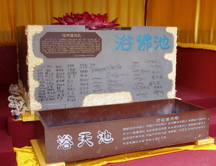
Lotus tub used to bathe the Buddha, 3 feet high, square, and weighed 700 pounds itself
The Dharma Assembly was divided into an internal mandala and external mandala. The internal mandala was the central area where the Buddha was bathed. The external mandala was the dharma realm of accomplishment. Eminent monastics and persons of great virtue attended the Dharma Assembly. Those who were part of the internal mandala included Akou Lamo Great Rinpoche, Zhaxi Zhuoma Rinpoche, Dharma Teacher Long Hui, Dharma Teacher Jue Hui, Dage Gongla Rinpoche, Bodi Wentu Rinpoche, Dharma Teacher Kui Zhi, Dharma Teacher Ruo Hui, layman Ciren Jiacuo (Gyatso), Dharma Teacher Miao Kong, Dharma Teacher Baolian, and others. Those who were part of the external mandala included Fuzang Wanghu Great Rinpoche, Yan Long Great Rinpoche, Awang Nuobu Great Rinpoche, Kang Qin Great Rinpoche, Xijao Zhibenge Rinpoche, Yixi Kanbu, Dharma Teacher Cikong, Dharma Teacher Fahai, Dharma Teacher Cixin, Dharma Teacher Haoling, and others.
The dharma stipulates that the purpose of a Highest Form of Bathing the Buddha Dharma Assembly is pouring dharma water that has been used to bathe the Buddha. The ability to pour such dharma water is based upon one’s true level of realization. Pouring such water bathes the celestial beings in the various heavenly realms. It shows that the Buddha blessed the celestial beings in the various heavenly realms, the dharma protecting deities, and the seven types of disciples. Thus, there must be a successful “pouring of water based upon one’s true realization.” Otherwise, it is not a Highest Form of Bathing the Buddha Dharma Assembly.
Additionally, at that Dharma Assembly all seven holy states were manifested. The seven types of holy states are: (1) Wind Celebrates the Mandala, (2) Flowers Rain from a Tree, (3) A Dharma Object Manifests Holiness, (4) A Cloud Provides an Umbrella-Like Covering, (5) Celestial Dragons Laugh Joyfully, (6) A Lama is Given a Sign, and (7) The Color of Dharma Water Is Received.
The successful “pouring of water based upon one’s true realization” is the most important part of such a Dharma Assembly. It is the key aspect of a Highest Form of Bathing the Buddha Dharma Assembly. It is why the name of such a Dharma Assembly contains the words “Highest Form.” Three to five thousand pounds of dharma water are used to bathe the Buddha. After the Buddha is bathed, this water is used to bathe the celestial beings in the various heavenly realms. When bathing the celestial beings, the dharma water must be poured down from the lotus tub used to bathe the Buddha into the tub used to bathe the celestial beings. During the pouring process, one cannot touch the dharma water with any part of one’s body, nor can one use any type of container to be filled with water. That is because the human body and containers are soiled by unclean dust and dirt. People are only allowed to tilt the entire lotus tub used to bathe the Buddha so that water is poured downward.
With such a heavy amount of dharma water in the lotus tub used to bathe the Buddha, how could anyone tilt that tub to pour the water down into the tub used to bathe the celestial beings? One must rely upon one’s Buddha-dharma state of realization. But no more than ten people can attempt to lift the lotus tub used to bathe the Buddha. Otherwise, it would not be regarded as the Highest Form of Bathing the Buddha Dharma Assembly. If the dharma water is not successfully poured into the tub used to bathe the celestial beings, then no matter what types of supernatural holy sights may appear at the Dharma Assembly, it cannot be called a “Highest Form of Bathing the Buddha Dharma Assembly.”
FLOWERS RAIN FROM A TREE
The atmosphere that day at the mandala to bathe the Buddha was holy and solemn. H.H. Wan Ko Yeshe Norbu (H.H. Dorje Chang Buddha III) wore his golden brocade and jeweled robe. His Holiness had an extremely dignified-looking appearance. A golden bronze statue of Dharma Prince Siddhartha stood in the mandala. In the middle of the mandala was a lotus tub used to bathe the Buddha that was 3 feet high, square, and weighed 700 pounds itself without water. Over the middle of that tub was a beautiful lotus flower about the size of a car wheel. Below and adjoining that lotus tub used to bathe the Buddha was a rectangular, one-foot high tub used to bathe the celestial beings. Ninety buckets of fragrant water were also placed in the mandala to be used to bathe the Buddha. The offering water in those buckets was light brown due to the sandalwood, eaglewood, saffron, and other scents that were boiled and added to the water.
At the beginning of the Dharma Assembly, His Holiness practiced Dharma according to Buddhist scriptures. As soon as the Buddha Master began practicing dharma, a tree full of jacarandas (a pale purple flower) immediately began raining flowers. The jacarandas drifted in the golden sunlight and fell all over the mandala and into the ninety buckets of water. Auspicious clouds rolled through the sky. It seemed that the mandala was no longer part of this world. Rather, it seemed like a holy Buddha-land. Flowers rained for more than three hours continuously, starting from the beginning of the Dharma Assembly. Those flowers floated down upon everyone. However, not one petal touched the Buddha Master. When the Dharma Assembly ended, the flowers instantly stopped raining.
A DHARMA OBJECT MANIFESTS HOLINESS
In order to express the unity of exoteric and esoteric Buddha Dharma, the Buddha Master did not select a highest-level practitioner of great virtue or a highest-level Great Rinpoche to announce and conduct the rituals and ceremonies of that Dharma Assembly. Rather, His Holiness selected Great Dharma Teacher Long Hui to announce the rituals and ceremonies. Great Dharma Teacher Long Hui is Han Chinese and is Chairperson of the International Buddhism Sangha Association. His Holiness also selected Great Dharma Teacher Jue Hui, Great Dharma Teacher Kui Zhi, Great Dharma Teacher Ruo Hui, and Dharma Teacher Miao Kong to conduct the rituals and ceremonies.
When Great Dharma Teacher Long Hui announced that all Buddhist disciples in attendance should pour fragrant water into the tub used to bathe the Buddha, all of the Rinpoches and Huo-Fos, Dharma Teachers, and laypersons in attendance quickly poured the ninety buckets of light brown fragrant water into the tub used to bathe the Buddha, filling it up completely. Everyone then returned to their seats and respectfully requested that His Holiness consecrate the fragrant water in the lotus tub. The Buddha Master was then seen holding a white Vajra Wheel.
During the Highest or Ultimate Form of Bathing the Buddha Dharma Assembly, some people saw the Vajra Dharma Wheel float up, sink down, and move around in the water. Some also saw the appearance of eight Dharma protecting deities. Additionally, some people saw two Dharma protecting deities, Mahakala and Sri-maha-devi, supernaturally change their forms. In an instant, the two Dharma protecting Bodhisattvas appeared. In an instant, they disappeared from the Vajra Wheel without a trace. In the photos, the Vajra Wheel turned into the shape of a lotus leaf floating on the water. From the size of the Vajra Wheel’s shadow, one can know the height of its position in the water.
His Holiness approached the lotus tub used to bathe the Buddha and placed that Dharma object (i.e. the Vajra Wheel) into the water. That dharma object is half as thick as a coin and as large as the palm of the hand. The Buddha-dharma stipulates that only a Supreme Vajradhara Dharma King may possess such a Vajra Wheel. After the Supreme Vajradhara Dharma King’s empowerment, the dharma protecting Bodhisattvas in the sky descended upon that dharma object. That dharma object can move around in the dharma water used to bathe the Buddha. It can rise up in the water and sink down into the water. After it does this, the practice of the Highest Form of Bathing the Buddha Dharma Assembly may begin.
Everyone surrounded the lotus tub to see that dharma object. One or two minutes later, everyone indeed saw the Vajra Wheel moving in the water. No one touched the lotus tub. While in the water, that dharma object moved forward and backward, to the left and the right, all on its own. One moment, it sank downward; the next moment it floated to the surface of the water. When the Vajra Wheel was approaching the bottom of the water, many saw red light emanate from the bottom of the Vajra Wheel. That red light was the true fire of samadhi. Many people saw eight dharma protecting bodhisattvas standing on that dharma object. There were also those who saw Mahakala and Sri-maha-devi supernaturally change their forms on that Vajra Wheel. Everyone present was full of dharma joy.
WIND CELEBRATES THE MANDALA
After a dharma object manifested holiness, everyone began to respectfully recite the invocation text. Suddenly, a strong wind began blowing from the west. Trees began to sway and things began to shake in the once peaceful mandala. Jacarandas flew through the air. Everyone was amazed. Indescribable and auspicious dharma joy filled the entire assembly. The world-honored Buddha had arrived in the sky above the mandala to manifest the dharma! Everyone chanted a mantra in unison to respectfully welcome the arrival of the Buddha. That strong wind from the west blew for a period of time and then abruptly stopped. The quietude of the mandala was restored.
An auspicious atmosphere filled the mandala. Amid the sound of everyone chanting a mantra, the holy ritual of bathing the Buddha formally began. Great Dharma Teacher Kui Zhi respectfully lifted the statue of Dharma Prince Siddhartha off the altar and put it on the lotus flower in the middle of the lotus tub. Everyone then respectfully requested that H.H. Wan Ko Yeshe Norbu bathe the Buddha. After His Holiness bathed the Buddha and practiced Dharma, each of the attendees bathed the Buddha three times. Great Dharma Teachers Jue Hui and Ruo Hui wiped dry the statue of the Buddha with a white silk scarf, put a robe on the statue of the Buddha, and placed it back on the altar.
POURING OF WATER BASED UPON ONE’S BUDDHA DHARMA REALIZATION
After the Buddha is bathed, according to the rules and rituals of the Buddha-dharma, it is time to pour fragrant water from the lotus tub used to bathe the Buddha into the lower tub used to bathe the celestial beings. At that time, His Holiness must practice dharma to bathe the celestial beings. According to fixed dharma, the bathing of celestial beings must take place in order for it to be a real Highest Form of Bathing the Buddha Dharma Assembly. Otherwise, the words “Highest Form” should not be used. This is the key factor in determining whether the Dharma Assembly will be completely successful.
Dharma Teacher Long Hui announced the ritual and requested that everyone attempt to lift the lotus tub used to bathe the Buddha so that its fragrant water would pour into the tub used to bathe the celestial beings. All of the attendees stepped forward one after another and attempted to lift it in groups of ten. However, no matter how hard they tried, they could not lift that lotus tub. Later, in violation of the rules, fourteen strong men together attempted to lift that tub. They assumed various postures and used all of their strength to tilt that lotus tub while shouting out a mantra. In the end, their faces turned red, they became exhausted, and they gave up in frustration. They were not able to move that lotus tub one bit. With awkward smiles on their faces, they went back to their seats.
That lotus tub used to bathe the Buddha weighs more than seven hundred pounds. When 90 buckets of fragrant water used to bathe the Buddha were added to this weight, the total weight was 4,260 pounds. Only a large crane could lift that tub. Even world-class musclemen would have no chance of lifting it.
Everyone looked at the lotus tub and felt the situation was hopeless. Great Dharma Teacher Long Hui did not know whether to cry or laugh. She could not announce that the ritual was successfully completed. Under these circumstances, the Dharma Teacher thought of a disciple of His Holiness by the name of Akou Lamo Rinpoche. That Rinpoche is from Tibet and can cause a mani stone to fly through the air. Great Dharma Teacher Long Hui asked Akou Lamo Rinpoche to test her strength and attempt to lift the lotus tub. Akou Lamo Rinpoche said, “I want to select someone to assist me.” She then invited an elder layman who lives in the Unites States, Ciren Jiacuo, to step forward and assist her. Elder layman Ciren Jiacuo has realized the state of prajna emptiness. He constantly abides in the dharmakaya state. His state of realization is extraordinary. He is a person of great accomplishment spoken of in the tapes contained in the silver box.
Bathing Buddha ceremony is annually performed to honor the birth of Prince Siddhartha Gautama who was born in north-eastern India over 2500 years ago of the Shakya clan. The Prince, upon enlightenment, became Shakyamuni Buddha. On the holy birthday of Shakyamuni Buddha, followers who participate in the Dharma Assembly of Bathing the Buddha make offerings to establish their karmic conditions with the buddhas and also to wholeheartedly beseech the empowerment of the buddhas and to pray for peace and well being. While bathing the image of the Buddha with auspicious water, they vow to cultivate themselves in attaining the purity of their three karmas (body, speech, and mind) in the past, present, and future. However most of these assembly are ordinary ceremony, there were no holy states appearing.
Akou Lamo and Ciren Jiacuo each held one side of the lotus tub. Upon Akou Lamo’s uttering the mantra “Ong Ah Hong,” they lifted their shoulders. With a roaring sound of cascading water, the lotus tub tilted upward. Holy water used to bathe the Buddha was poured into the tub used to bathe the celestial beings. Upon another uttering of the mantra “Ong Ah Hong,” the two of them again lifted the lotus tub. Like a silver pillar, dharma water poured into the tub used to bathe the celestial beings.
All of the attendees were astonished! They sat there dumbfounded. Fourteen men using all their strength in concert could not move that more than four thousand-pound lotus tub. However, to everyone’s surprise, a young woman and an elderly man seventy years old exhibited their states of realization and lifted that lotus tub for all to see! What a wonderful expression of the true Buddha-dharma, of the power of Vajra! Neither of them has any innate spiritual powers. Under Holiest Tathagatha Wan Ko Yeshe Norbu, they have practiced and learned the true Dharma and have reached a high level of Buddha-dharma realization. That is why they were able to successfully complete the key ritual of the Dharma Assembly— pouring water based upon one’s Buddha-dharma realization. All of the attendees were surprised and praised the two of them highly. Everyone was moved and joyful. That Highest Form of Bathing the Buddha Dharma Assembly was successful precisely because of this holy event.
CELESTIAL DRAGONS LAUGH JOYFULLY
After pure water used to bathe the celestial beings was successfully poured, the His Holiness began practicing the dharma to bathe the celestial beings. As soon as all of the attendees chanted in unison one time the verses relating to bathing the celestial beings, suddenly, a strong wind began swirling. The curtain screens began to bulge and rumble. The tankas hanging on the curtain screens flew upward in a ninety-degree angle from the ground. The poles holding up those curtain screens creaked in the wind as if they were about to break. Even the sandbags used to anchor the curtain screens were turned over and moved by the wind. Two-thirds of the people there heard very loud, low and deep dragon’s roars explode in the air accompanied by the clap of rolling thunder. One-third of the people there only heard the sound of the wind but did not hear the sound of thunder. This all the more proves the magnificence of the Buddha-dharma, since different karmic states manifested at the same time.
At that time, the hot sun was high in the sky. It seemed as if the joyful roars of the celestial dragons shook the sun so that it shined even more brilliantly! The dharma protecting deities came to the mandala where the Buddha was bathed and received a dharma bathing bestowed by the Buddha! At this time, people remembered that a few days before the Dharma Assembly when the curtain screens and dharma altar were being erected, the Buddha Master personally arrived. His Holiness repeatedly instructed everyone to fasten well the foundational support for the dharma altar and curtain screens so that the altar and screens would not be blown over by the wind. A layperson whose last name is Hsu said to the Buddha Master, “The weather station forecasted that there will be no rain or wind for the next seven or eight days.” His Holiness then told everyone, “At the Dharma Assembly, of course it will not rain. However, when I practice the Dharma, a strong wind will blow. There will be strong gusts of wind, especially when all of the Dharma protecting deities arrive and manifest their powerful spirits. Therefore, the foundational support must be fastened firmly.” It is very fortunate that the buddha Master made such a prediction. On the day of the Dharma Assembly, the dharma protecting deities joyfully laughed in the sky. Although there were strong gusts of wind, the dharma altar and curtain screens did not fall.
A RINPOCHE IS GIVEN A SIGN
After the Buddha Master practiced dharma to bathe the celestial beings and the dharma protecting deities, His Holiness instructed everyone to look inside the water to see whether the Vajra Wheel was moving. People were amazed to see that even though those two people with holy virtue and high states of realization lifted the lotus tub and thereby poured Dharma water from a tub weighing more then 4,000 pounds downward into the tub used to bathe the celestial beings, the Vajra Wheel surprisingly did not move in the slightest. The Vajra Wheel remained in its original position. Many people saw eight dharma protecting bodhisattvas standing on that dharma object blowing air upward.
At this time, a rinpoche who weighs 280 pounds beseeched the Vajra Wheel to manifest its powers and eliminate his remaining karmic hindrances. His Holiness agreed to this request and put the Vajra Wheel on that rinpoche ’s chest. At first, that rinpoche felt that the temperature of the Vajra Wheel was cool. His Holiness then began intoning a mantra. With his fingers pointing to the sky, His Holiness lightly snapped his fingers. That rinpoche suddenly let out a miserable scream. He was in such pain his face turned pale. Like the power the Incantation of the Golden Hoop had over the Monkey King in Journey To The West, the Buddha Master’s mantra caused the solemn face of the rinpoche to become distorted from pain he could not endure. It seemed that the rinpoche could not endure the pain. As a result of His Holiness practicing a certain dharma, the Vajra Wheel emitted the true fire of samadhi. Its temperature quickly rose to an extremely high degree. Of course, that rinpoche could not endure such heat.
H.H. Wan Ko Yeshe Norbu(H.H. Dorje Chang Buddha III) then snapped his fingers again, and the true fire of samadhi instantly disappeared. The Vajra Wheel suddenly became cold. That rinpoche immediately returned to his normal condition. He was not injured in the least. However, there remained an imprint of the Vajra Wheel on his chest. His Holiness predicted that after one week a three-dimensional dharma object in relief would grow out of the imprint on that rinpoche ’s chest. That rinpoche was full of dharma joy and thanked His Holiness for eliminating his karmic hindrances. That rinpoche then vowed to do his utmost to benefit living beings.
A CLOUD PROVIDES AN UMBRELA-LIKE COVERING
From the beginning of the Dharma Assembly all the way to its end, a beautiful cloud continuously floated in the sky above the mandala. The shadow of that cloud continuously covered the bronze statue of Dharma Prince Siddhartha. The Dharma Assembly lasted more than three hours. The sun moved westward. That cloud moved together with the sun. It was like an umbrella that served to block the sunlight from the statue of Dharma Prince Siddhartha. However, the sun continued to shine upon the area of the dharma altar only two or three inches from the statue of Dharma Prince Siddhartha.
THE COLOR OF DHARMA WATER IS RECEIVED
The Dharma Assembly ended solemnly. Everyone took some dharma water from the tub used to bathe the Buddha and the tub used to bathe the celestial beings. Suddenly, someone said in a surprised manner, “The Dharma water is changing!” Everyone rushed over to see. They discovered that the ninety buckets of light-brown fragrant Dharma water taken from the tub instantly became clear water. The Buddha and the celestial beings received the merit of that fragrant water. The merit of the Dharma Assembly was wonderful and complete. All of the attendees prostrated and uttered words of praise.
H.H. Wan Ko Yeshe Norbu (H.H. Dorje Chang Buddha III) conducted this Highest Form of Bathing the Buddha Dharma Assembly, a respected event in the history of Buddhism. His Holiness practiced the dharma during this assembly. All seven holy states were manifested. Water was poured based upon the states of realization of those who poured it. Those two people thereby exhibited their extraordinary powers. The Buddhas and Bodhisattvas and the heavenly dharma protecting deities personally arrived at the mandala and received bathing water bestowed by the Buddha. Various holy states of the Buddha-dharma appeared one after the other. Only this type of magnificent Bathing the Buddha Dharma Assembly is a true Bathing the Buddha Dharma Assembly as stipulated in the dharma. This grand event in Buddhism took place as a result of the good fortune of living beings.
After the Dharma Assembly, one of the two persons with high states of realization who lifted that lotus tub, Akou Lamo Great Rinpoche, requested that the holy lotus tub used to bathe the Buddha be transported to Tibet so that it could serve as an offering in furtherance of Tibetan Buddhism. Great layperson Ciren Jiacuo requested that it be kept in the United States as an offering. In order to be fair, His Holiness had everyone vote on the matter. Akou Lamo Great Rinpoche lost the vote by a ratio of three to two. The United International World Buddhism Association Headquarters will keep that lotus tub used to bathe the Buddha. It will be kept in the United States as an offering. The tub is currently stored at Hua Zang Si Temple at San Francisco.
H.E. Tangtong Gyalpo , the iron man of Bhutan, the Leonardo da Vinci of the Himalayas, the king of empty fields, artisan, engineer, composer, poet, soldier, merchant and more. He is a repertoire matched only by his own achievements. He is none other than H.E. Tangtong Gyalpo, the great wandering scholar and accomplished yogi saint- and all the above.
Perhaps the most enigmatic of Buddhist saints,H.E. Tangtong Gyalpo is the most renowned as the builders of iron bridges. In his many visits to Bhutan he built 8 iron bridges and 2 temples, the Dumtseg lhakhang in Paro and the Tachog Lhakhang . These are the top places to visit in Bhutan
Dumtsek Lhakhang at Paro
If any imminent personage has fired the imagination of later day chronicles, scholars and devotees, none can compare to that of H.E. Tangtong Gyalpo. From the scandalously rogue antics of Drukpa Kuenley, the divine madman, to the menacingly airborne Milarepa, the legacy of Thang Tong Gyalpo is solid iron, literally so.
Personality
H.E. Tangtong Gyalpo is most revered and remembered for the numerous iron bridges that he built, accomplishments that begat him the more popular title Chazampa(iron bridges). For his eccentricity and unconventional behavior he was called Lungton Nyonpa, the madman of an empty village. What was generally accepted was that he was Drubthob, the realized and accomplished one. He was so, in every sense of the word.
Iron Bridge at Tacgogang Lhakhang Built by H.E. Tangtong Gyalpo
His Birth
A popular and interesting but apocryphal legend has it that H.E. Tangtong Gyalpo was born as an old man. His parents, fearing that they had given birth to a freak abandoned him in the fields. He was then brought up by the wild animals and hence his name Tangtong Gyalpo. It translates as King of the open fields.
The more accurate accounts are that he grew up a child prodigy who has mastered the scriptures and the arts at a young age. In this context the name has been interpreted as the one with incomparable excellence in meditation. He is also known for steadfast and immobile from the plains (thang) of concentration. The name is also explained as indicative of his vast and supreme views on the nature of emptiness.
His Reincarnation
His life is one of progression. The avatars as manifold as the names and their interpretations. He is at once a militia conscript who rose rapidly through the ranks to become a commander. He has captured several forts by way of nonviolent strategy. In his youth, he was a very successful merchant who gave up his wealth and profits to a local ruler to save the lives of several unknown people from execution.
It is hardly surprising from this incident that he was considered an active emanation of Chenrezig, the bodhisattva of compassion. Additionally, several of his sadhanas such as Avalokiteshvara sadhana ‘For The benefit of All Beings Pervading Space” was composed by him after he received the transmission of this practice directly from Chenrizig. Chenrizig Nyungnye was also said to be a practice that he did throughout his life.
His Youth
H.E. Tangtong Gyalpo lived for a time in Lhasa, at the court of the Deb Desi and was under the patronage of the daughter of the Desi.
The princess commissioned several major works of sculpture and paintings; most notable among them the exquisite gold sculpture of Milarepa. He also crafted several life-sized statues of Chenrezig, Tsepame and Drolma from conch shell, coral and turquoise that were destroyed in 1959.
Chenrezig
H.E. Tangtong Gyalpo’s creativity and ingenuity were not limited to art but even extended to developing numerous medicines and treatments including some longevity pills. Perhaps through strange coincidence, the Chakpori hilltop where H.E. Tangtong Gyalpo lived near Lhasa later became the site for the first formal Tibetan medicinal institute built in the 17th century.
His Inspiration
H.E. Tangtong Gyalpo’s engineering feats, particularly with regard to bridge building, were reportedly inspired after he was refused passage on a ferry because of his ferocious and unkempt outward appearance. He was thrown unceremoniously into the water only to emerge with an insatiable zest for building bridges and ferry points.
Tachogang Village , Connected By iron Bridge
The new found vocation was intended to inter-link remote and inaccessible villages and propagate the Buddhist faith. His early attempts suffered many set backs, the primary one being the lack of funds. This did not deter or faze H.E. Tangtong Gyalpo and he is said to have come up with an innovative idea to compose and organize performances of the first ever Tibetan Opera, the Achi Lhamo to finance his passion.
Acheivement
Both bridge building and the opera were great successes. H.E. Tangtong Gyalpo went on to build something like 58 iron bridges and an equal number of wooden bridges, and over hundred ferry crossings all over the Himalayas including 8 iron bridges in Bhutan. None of the bridges are known to be standing. However, parts and pieces of iron still stand the taste of time at the national museum in Paro and at Duksum near Trashiyangtse, in eastern Bhutan.
National Museum in Paro
The Achi Lhamo opera, with the starting troupe of seven sisters who worked on the saint’s bridges, is still performed and enjoyed hugely to these days during the new year celebration and on festive occasions.
Achi Lhamo Opera Composed by H.E. Tangtong Gyalpo Still Prevalent in Bhutan
Places he visited
H.E. Tangtong Gyalpo traveled widely and is said to have visited SIkkim, Ladakh, Assam, Arunachal Pradesh and Bhutan in search of iron ore. He is a celebrated figure in this region and his exploits and compositions live on in the local folk songs and lore. He is also credited with composing many of the work songs sung in the villages of the region, including in Bhutan. Numerous stories and songs also extol his miracles and his enlightened activities and one song tells of him using the yeti as his porter.
Living Temple of Thang Tong Gyalpo in Bhutan
H.E. Tangtong Gyalpo’s passage in Bhutan stands enshrined in the temples of Tachoggang and Dumtse in Paro that he built.
The biography of Lochen Gyurmey Dechen narrates that the blacksmith of Paro once manufactured seven thousand chain links for H.E. Tangtong Gyalpo. These he took to Tibet in 1400 carrier loads. During his frequent and long sojourns to bhutan he took a consort Drubthob Zangmo, the aunt of Great Terton Pema Lingpa from whom he had several sons whose descendants live on at the Tachogang monastery.
The Depictions of H.E. Tangtong Gyalpo
Depictions of H.E. Tangtong Gyalpo are easily identifiable given his unusual appearances as in the manner of Maha siddhas. He has the signature iron chain link held in his right hand. The saint’s body complexion is dark reddish- brown, described in some cases as having the hue of “wet liver”.
He is said to belong to the descendent of the famed and legendary king Gesar. Seated on an antelope skin in the relaxed posture, he holds a tsebum or vase of long life in his left hand which rests on his lap in the dhyani mudra. The saint’s tsebum links him to tsepame, the bodhisattva of infinite life. He had also discovered the sacred dharani as a terma hidden by Guru Rinpoche. Special H.E. Tangtong Gyalpo drupchens of long life are still very popular..
His Countenance
H.E. Tangtong Gyalpo is depicted with his hair in a turban-like knot. He sports a long beard and long logs up to his shoulders which may be either black or white depending on whether he is depicted as an old man or in his prime. His image in Dumtse Lhakhang near the entrance is perhaps the youngest depiction.
Clothed in a white garment in this particular and unusual depiction, he maintains a goatee, short hair and holds his hand in the bhumisparsa mudra. The iron chain links are not held in the hands as usual but lie at the edge of the throne, barely discernible under the folds of his garments. In contrast, the huge main statue of the saint in the ZIlukha Drubthob nunnery above the Tashichho Dzong shows him at a ripped old age with long white flowing locks and beard. A pot belly and perhaps a gentler expression on his face. Numerous slate carvings of the saint holding his iron chain and vase are found in the Dzong and monasteries all around Bhutan. In many of these slate carvings the face is embellished with gold paint.
H.E. Tangtong Gyalpo was also famous throughout Tibet for his great strength and engineering skills. He is a great Bodhisattva known and respected by one and all in Tibet. H.E. Tangtong Gyalpo was the supreme leader of four esoteric sects within India, Bhutan, Sikkim, Mongolia, and Eastern Tibet. He possessed teachings from many dharma lineages, the most remarkable of which were the lineage to extend one’s life and the lineage to bring in wealth and change one’s fortune. H.E. Tangtong Gyalpo was a great terton, or discoverer of hidden teachings called terma, who both revealed and concealed terma for future generations. His main practice was that of Chenrezig. A young incarnation of this great master is currently living in Bhutan.
In year 2005, H.H. Dorje Chang Buddha III accepted H.E. Tangtong Gyalpo as one of his disciples who is on the level of a great venerable one and performed an initiation for him, at HuaZangSi Temple in San Francisco.
He later learned that the book A Treasury of True Buddha-Dharma about the H.H. Dorje Chang Buddha III Wan Ko Yeshe Norbu Holiest Tathagata was about to be published. He thereupon organized many rinpoches to practice the Kuan Yin Dharma one billion times as an offering to His Holiness Dorje Chang Buddha III. He also sent his written congratulations stating that His Holiness is the master of Buddhas, the magnificence of His Holiness is supreme and that in this world no other holy being in history can compare with His Holiness.
To honor the Holy Birthday of Avalokitesvara Bodhisattva, Buddhists and local residents converged at the Holy Miracles Temple in Pasadena, California, for the Avalokitesvara Bodhisattva Dharma Assembly. Held on March 17, 2024, within the Sakyamuni Buddha Hall, this event was a collaborative effort between the World Buddhism Association Headquarters, Holy Miracles Temple, and Sanger Mission.
Presided over by the Abbess of the Hua Zang Si Temple, Ruzun Ruohui, and jointly guided by Dharma Master JueHui and Dharma Master MiaoKong, the assembly brought together a congregation of holy gurus, eminent monks, dedicated monastics, and others. Their shared purpose was to pay homage to Avalokitesvara Bodhisattva, whose boundless compassion and loving kindness have been a beacon of hope for countless beings throughout the ages.
The Avalokitesvara Bodhisattva Dharma Assembly was held in the Sakyamuni Buddha Hall of Holy Miracles Temple. Photo Courtesy: Joyce Lee
Avalokitesvara Bodhisattva, also known as Guan Shi Yin Bodhisattva in Chinese, is revered for profound compassion and unwavering commitment to alleviating the suffering of all sentient beings. According to Buddhist scriptures, Avalokitesvara Bodhisattva attained Buddhahood eons ago and is known as Zheng Fa Ming Ru Lai, the Correct Dharma Realization Tathagata. Through sacred vows and bodhicitta, the Correct Dharam Realization Tathagata manifests as a Bodhisattva to extend aid to those in need and save sentient beings from suffering. Avalokitesvara Bodhisattva expounded one of the most influential Buddha Sutras – “The Prajna Paramita Heart Sutra,” which encapsulates the profound wisdom of the Buddha, illustrating the meaning of prajna.
While honoring Avalokitesvara Bodhisattva’s great compassion, sovereign wisdom, profound power, and benevolence, the assembly also reflected on the significance of bodhicitta, as elucidated by H.H. Dorje Chang Buddha III in the Sutra – “What is Cultivation.” He imparted, “The broad meaning of bodhicitta encompasses all of the Mahayana Dharma related to saving living beings out of great compassion and the causes leading to attaining the stages of enlightenment of a Bodhisattva.” This essence of conduct rooted in compassion deeply resonated with the attendees, reinforcing their dedication to selflessness and enlightenment.
The assembly witnessed the recitation of passages from “The Lotus Sutra’s Universal Gate Chapter on Avalokitesvara Bodhisattva,” a revered text extolling the virtues and profound wisdom of Avalokitesvara Bodhisattva. Participants engaged in practices such as meal offerings to the Buddhas, seeking blessings for happiness, auspiciousness, and the enhancement of fortune and wisdom. The gathering also collectively expressed their aspirations for the endurance of world peace, the cessation of calamities, while invoking prosperity, good health, and longevity for all.
As incense wafted through the temple and chants echoed in the halls, attendees were reminded of the profound teachings of compassion and empathy advocated by Avalokitesvara Bodhisattva. The ceremony served as a reminder of the transformative power of faith, uniting individuals from all walks of life in celebration of the Dharma.
H.E. Tangtong Gyalpo is a greatly accomplished person within Tibetan esoteric Buddhism who attained the rainbow body. He is a great Bodhisattva known and respected by one and all in Tibet.
He is also an extremely holy person who has made huge contributions to the Tibetan people. It was this great Bodhisattva who was the father of medicine, ferryboats, bridges, and operas in Tibet. He has brought to the living beings of Tibet limitless blessings. To this day, Tibetan temples and families continue to worship H.E. Tangtong Gyalpo Bodhisattva.
The first Tangtong Gyalpo left the household life to become a monk when he was very young. He studied the sutras and treatises and became good at debating the sutras. Although he possessed the Five Vidyas, he remained modest, simple, and down-to-earth. In order to provide a model of self-cultivation, H.E. Tangtong Gyalpo followed and learned under many people of great virtue.
He also engaged in solitary, quiet cultivation for a long period of time at the Eri Temple. Later, he received teachings directly from Dakini Niguma and became a person greatly accomplished in the dharma. People praised H.E. Tangtong Gyalpo with the following words: “In the vast realm of emptiness, there is a yogi who intensively studies emptiness and who is like the King of Fearlessness. His name is Tangtong Gyalpo.” He has also been respectfully called Zhibai Wangxiu Tangtong Gyalpo, which means the accomplished, free and unhindered Tangtong Gyalpo!
During a certain year in history, there was a serious drought and famine in Tibet. H.E. Tangtong Gyalpo conducted a Dharma Assembly in front of the Sakyamuni Buddha statue in the Jo-khan Temple in Lhasa. At that Dharma Assembly, he wrote “A Prayer to Eliminate Famine.” Many people then saw Kuan Yin Bodhisattva in the sky disseminating various grains. The famine ended not long after that.
There was another time when war and chaos occurred in the Muya district of Kham in Tibet, causing people to leave their homes and wander about. H.E. Tangtong Gyalpo made a vow and wrote “A Prayer to End War and Chaos.” People in that area very soon after that ended their mutual hatred and instead treated one another in a peaceful, friendly, and loving manner. There was another year when a pestilence broke out in a large area covering a religious site of the Sakya sect, causing countless deaths. The chanting of mantras and the offering of sacrifices could not end the pestilence. Thus, H.E. Tangtong Gyalpo again practiced dharma and wrote “A Prayer to End the Disaster of Illness.” As a result, the pestilence disappeared forthwith. In previous times in Tibet, it was very difficult for people to cross rivers. The river waters mercilessly took away people’s lives as they attempted to cross the rivers. Thus, H.E. Tangtong Gyalpo made improvements to ferryboats and began building bridges. In that lifetime, he built fifty iron-chain bridges, sixty wooden bridges, and many temples. One of those temples was the Tangge Lakong (the Tangtong Gyalpo Temple), which was the first temple in the Derge region. With respect to medicine, H.E.Tangtong Gyalpo established the Medicine King Temple at Jiabori in Lhasa, invented a white pill that cured all kinds of internal medical diseases, and invented a red pill that cured epidemic diseases. Thus, he became the founder of Tibetan medicine. That white pill and red pill are used in Tibetan medicine even to this very day to relieve the sufferings of living beings.
This 600 year old bridge crosses the Paro Chhu (Paro River) and was traditionally restored in 2005 after being washed away during a 1969 flood. The bridge was originally built by the legendary Thangtong Gyalpo
Dungtse Lhakhang, a temple in form of a chörten near Paro in Bhutan was built by Thangtong Gyalpo. The roof construction is made of iron.
H.E. Tangtong Gyalpo Bodhisattva also wrote many Tibetan operas and established the Ache Lhamo opera troupe, the members of which acted out Tibetan historical stories through song and dance and pioneered Tibetan operas. The Achi Lhamo opera, with the starting troupe of seven sisters who worked on the saint’s bridges, is still performed and enjoyed hugely to these days during the new year celebration and on festive occasions.
Achi Lhamo Opera Composed by Thang Tong Gyalpo Still Prevalent in Bhutan
H.E. Tangtong Gyalpo was the supreme leader of four esoteric sects within India, Bhutan, Sikkim, Mongolia, and Eastern Tibet. He possessed teachings from many dharma lineages, the most remarkable of which were the lineage to extend one’s life and the lineage to bring in wealth and change one’s fortune. Everyone in Tibet, no matter what sect he or she belonged to, believed in and practiced such lineages and scriptures. Countless disciples of H.E. Tangtong Gyalpo became accomplished in the dharma under his teachings and attained great supernatural powers, wisdom and great compassion. More than one hundred disciples of his attained the rainbow body or the transformation rainbow body. All Tibetan people know that H.E. Tangtong Gyalpo is truly a great patriarch of Tibetan esoteric Buddhism and a great Bodhisattva. Later, each time H.E. Tangtong Gyalpo incarnated into this world. He was a great patriarch who spread the dharma, liberated living beings, and pervasively benefited people.
Thang Tong Gyalpo Present Reincarnation
H.E. the sixteenth Tangtong Gyalpo Bodhisattva (Thangtrul Rinpoche) took birth in Bhutan. His physical appearance resembles that of Guru Padmasambhava. Even when he sleeps, his eyes remain open. He saw H.H. Wan Ko Yeshe Norbu (Dorje Chang Buddha III) during a Dharma Assembly that took place in 2005 at Hua Zang Si in San Francisco, U.S.A. In a supernatural state of samadhi, he instantly saw that H.H. Dorje Chang Buddha, the highest ancient Buddha in the dharma realm, had already come to this world again. He at once formally acknowledged H.H. Dorje Chang Buddha III Wan Ko Yeshe Norbu as his master. H.H. Dorje Chang Buddha III asked him, “Did you follow and learn dharma under Guru Padmasambhava? Why have you come here?”H.E. Tangtong Gyalpo answered that he had received teachings directly from Guru Padmasambhava and from H.H. Sakya Trizin who is the nirmanakaya of Manjushri Bodhisattva. He also said that he had come to request the highest dharma in order to save living beings. H.H. Dorje Chang Buddha III immediately snapped His fingers, and a dharma bowl manifested awesome power. H.H. Dorje Chang Buddha III then accepted H.E. Tangtong Gyalpo as one of his disciples who is on the level of a great venerable one and performed an initiation for him. H.E. Tangtong Gyalpo took that dharma bowl back to his home country.
He later learned that the book A Treasury of True Buddha-Dharma about the H.H. Dorje Chang Buddha III Wan Ko Yeshe Norbu Holiest Tathagata was about to be published. He thereupon organized many rinpoches to practice the Kuan Yin Dharma one billion times as an offering to His Holiness Dorje Chang Buddha III. He also sent his written congratulations stating that His Holiness is the master of Buddhas, the magnificence of His Holiness is supreme and that in this world no other holy being in history can compare with His Holiness.
H.H. Dorje Chang Buddha III accepted H.E. Tangtong Gyalpo as his disciple at Hua Zang Si temple San Francisco
The book H.H. Dorje Chang Buddha III contains a more detailed explanation by Gadu Rinpoche of what happened when H.H. Dorje Chang Buddha III gave the discourse “What Is Cultivation?” However, I would like to give my own personal testimonial of what I experienced. Like Gadu Rinpoche, I was very fortunate to be present when these holy events occurred. Since I have followed my Buddha Master, H.H. Dorje Chang Buddha III, I have seen many awesome and unbelievable events and been blessed by being able to participate in and witness many Buddhist ceremonies and receive dharma empowerments and initiations. This experience was truly amazing and was also an example of how different people saw or experienced different things. This is often the case when we witness holy states. Our karma is different, so the manifestation of holy states appear to us differently.
These lights first appeared when we were sitting and respectfully listening to a dharma discourse. I had requested that my Buddha Master give us a discourse on “What is Cultivation?” and His Holiness had graciously consented. We knew this would be a special discourse, since it was being recorded and many great dharma teachers and rinpoches had been summoned to attend. Suddenly there appeared a bright flashing light. I thought someone was using a flash camera, only that seemed very disrespectful and this was much brighter and dazzling and had a more golden color than that of a camera. I very rudely looked around. There was no camera nor apparent source. My second thought was that I was just imagining it. Of course no one else was showing any signs of seeing anything–they were all so engrossed in our Buddha Master’s discourse, and much too well behaved to respond. The lights came again many times–I lost count after the third, but I know it was more than three times. They were very bright and quite distinct. No sooner had the Buddha Master ended the discourse and we had paid our respects, did everyone begin talking at once. Even though it was in Chinese I could gather from the hand gestures and excitement that they had seen the same thing I saw. I believe all of this was recorded on the CD of this discourse. Ven. Gadu Rinpoche, whose English is quite good, explained what he had seen as did several others. It appeared that everyone present had seen something. There was no doubt that holy beings had come to listen to this very important discourse (it is printed in the book H.H. Dorje Chang Buddha III and included on this web-site) and they were very pleased and showed their joy by blessing us with their presence.
For a short period of time after that, these lights would miraculously appear. Once they flashed most auspiciously when the Buddha Master was talking to Ven. Gadu Rinpoche. At that time the Holy Beings were indicating approval of the design proposed for the cover of A Treasury of True Buddha-Dharma (the manuscript version of H.H. Dorje Chang Buddha III). They also flashed one Sunday morning at the hermitage where I live when I was reading one of His Holiness’s discourses in preparation for a class that would be taught later on that day. They came at another time when the Buddha Master was giving a discourse, but this time I was told to not be distracted and pay attention to the Buddha Master. I am pretty sure that was also included in the recording, but I must confess that before I was reprimanded, I searched the mandala thoroughly for any possible sources of light. There were none. These were truly blessings from another dimension. These were the manifestation of the Buddhas and Bodhisattvas who came to show their respect to our great Buddha Master!
There is no doubt that the book H.H. Dorje Chang Buddha III is an extraordinary work. Not only does it introduce H.H. Dorje Chang Buddha III to the world and share the reactions to the book of the leading Buddhists in the world today, it also documents a few of the awe inspiring accomplishments of this magnificent Holy Buddha the most important of which are the many teachings that can lead many beings to liberation. Since most of the book will be published in English as well as Chinese, it is truly a most auspicious blessing to the entire world. It represents the dissemination of the true Buddha-dharma for this time and age and in the Western and Asian worlds.
The abbess of Hua Zang Si is Venerable Ruo Hui RuZun (Golden Button Stage I). She is a disciple of H.H. Dorje Chang Buddha III. She is deeply and broadly proficient in the sutras, abides by the precepts with pure cultivation, upholds correct views, and possesses high and profound virtue and conduct.
Driven by her endowed wisdom and firm aspiration, Venerable Ruo Hui RuZun started learning Buddhism since her childhood. While she was a young person facing a splendid future, Venerable Ruo Hui RuZun decided without hesitation to abandon worldly life to become a monastic practitioner. She respectfully quested for the practice of Buddhism, studied the sutras deeply, and cherished the goal of benefiting living beings in her cultivation and practice. Additionally, she demonstrated outstanding virtue and talent in her diligent study and research in the academic arena and received a Master’s degree from the Department of Philosophy of Taiwan University. She made a vow to dedicate her life to grandly propagating Buddha-dharma and broadly saving living beings. She served as the dean of the Chien Fo Shan Girl Buddhist College in Taiwan in her early years and have been continuously making contributions to the education of Buddhist monastics. However, Venerable Ruo Hui RuZun was deeply aware of the widely prevalent chaotic phenomena in the current Buddhist world, such as confusing views, non-unified sects and schools advocating their own tenets, miscellaneous teachings that are complex but incomplete, and promoting false doctrines as authentic Buddhism. Consequently, pious Buddhist disciples are searching and questing in vain and still unable to learn the true dharma of the Tathagata. Their lifetimes are thus wasted! Therefore, Venerable Ruo Hui RuZun was continuously concerned about this situation day and night and eagerly beseeched to find the genuine lineage from the Buddha that transmits the true teachings of the Tathagata.
In 1996, Ruo Hui RuZun had the good fortune to listen respectfully to the recorded dharma discourses expounded by H.H. Dorje Chang Buddha III. At that time, she sensed strongly and received the bright manifestation of the supremely and perfectly enlightening Buddha-dharma from His Holiness the Buddha! Later, guided by the karmic affinity to true Buddha-dharma, she fulfilled her wish to become a disciple of H.H. Dorje Chang Buddha III. Since then, she eagerly and respectfully listened to the recorded dharma discourses expounded by His Holiness the Buddha day and night. Through studying deeply with reference to the sutras, she eventually became enlightened by the teaching! She also received a holy inner-tantric initiation from the Buddha Master, which enabled her to personally realize the absolute truth of Buddha-dharma as if seeing the blue sky after pushing the blocking dark clouds aside. Since then, Ruo Hui RuZun abided by the teachings to benefit living beings with loving compassion in cultivation and practice. Shortly after that, she was delighted to learn that the Buddha Master was grandly publicizing and propagating the true dharma of the Tathagata in the Western world. After deep thinking and careful pondering, Ruo Hui RuZun decided to resign from the duty of the Dean of the Buddhist College to take up the mission to serve living beings. She traveled across the ocean to the United States to follow her Buddha Master, H.H. Dorje Chang Buddha III. She piously and deeply cultivated in the authentic lineage of Buddhism and engaged in the undertaking of propagating the true dharma of the Tathagata to benefit living beings.
Through the many years, Ruo Hui RuZun received true Buddha-dharma transmitted by H.H. Dorje Chang Buddha III in person and realized the key attainment of the dharma. In the dharma mandala, she manifested deeply cultivated power and superior state of realization. Once, she fortunately attended a grand and magnificent Vajra obstruction-removing dharma assembly. At that time, dharma masters and abbots of many monasteries and rinpoches were present. When stepping forward to receive empowerment, almost all of them were subdued by the power of the Buddha-dharma to show a suffering appearance and unable to support themselves by their power of concentration. Only Ruo Hui RuZun remained firmly unperturbed and successfully went through the holy power of Samadhi. She handled the situation magnificently and perfectly by calm without even any change in her facial expression. For that, she was praised by H.H. Dorje Chang Buddha III! Additionally, Ruo Hui RuZun also received a dharma of state practice transmitted by the Buddha Master in person and attained the accomplishment of crown-opening within two hours.
Since the grand opening of Hua Zang Si in December 2004 to now, Ruo Hui RuZun has served at the positions of prior (warden), deputy abbess, and abbess at this temple, which is the first temple of true dharma of Buddhism established in the Western world by H.H. Dorje Chang Buddha III. Since the temple’s establishment, her responsibilities cover a wide range of the temple’s dharma affairs and operations including various dharma assemblies, training and education of the monastic personnel, defining the system and rules to manage the temple, and so on.
With her abundant and solid knowledge in the theory of Buddhism and the teaching of practicing in silence, experience in managing and operating a temple, as well as deeply cultivated power in meditative concentration, she continuously serves since the beginning as the karma monastic master in awarding the complete set of grand precepts through three dharma assemblies and the professor/teacher of various courses in precepts, rituals, meditation, group practice, education of monastics and others at the Academy of Exoteric Buddhism of Hua Zang Si. She also conducted teaching and training at Buddhist institutions in the United States and overseas. Many of the disciples she taught have now become dharma masters or monastic practitioners. Actually, quite a number of them have even become excellent managerial personnel at some temples in different countries.
Ruo Hui RuZun consistently maintains a low-key demeanor in her cultivation and practice, exemplifying patience in the pursuit of her significant mission. She remains humble and modest, avoiding self-promotion or publicity. Through her words and actions, she serves as an exemplary teacher for Buddhist disciples, embodying the principles of loving compassion. Devoting herself quietly to the welfare and joy of sentient beings, she seeks enlightenment for both herself and others.
Adhering to the teachings and true dharma of H.H. Dorje Chang Buddha III, Ruo Hui RuZun upholds principles, follows rules rigorously, and engages in concrete cultivation to guide disciples on the path of accomplishment and liberation. She is an accomplished and eminent Buddhist monk whose example we should emulate and learn from.
Since September 2015, Ruo Hui RuZun has officially served as the abbess of Hua Zang Si. Recognizing the immense responsibility entrusted to her, especially given that Hua Zang Si is not an ordinary temple but a true dharma temple established in the Western world by H.H. Dorje Chang Buddha III, her Buddha Master, she is acutely aware of the need for unwavering commitment. Determined to lead the monastics and lay followers, she strives to transform Hua Zang Si into a temple faithfully practicing the teachings of H.H. Dorje Chang Buddha III and Sakyamuni Buddha, benefitting and nurturing sentient beings. In pursuing this mission, Hua Zang Si aims to contribute tangibly to compassion, happiness, peace, and joy in America and worldwide, fostering the perfect good fortune and wisdom, liberation, and accomplishment of living beings. The temple is committed to meeting the high expectations of Buddhas, Bodhisattvas, and sentient beings alike.
The belief in Bodhisattva Ksitigarbha is deeply rooted in Asian folk religions, offering a profound message of compassion and salvation. Ksitigarbha, also known as “Earth Treasury” or “Earth Store,” is revered for his extraordinary vows and his unwavering commitment to alleviating suffering, particularly in hellish realms. In China, alongside Manjusri, Samantabhadra, and Avalokiteshvara, Bodhisattva Ksitigarbha is honored as one of the “Four Great Bodhisattvas.”
The “Sutra of the Bodhisattva Ksitigarbha’s Fundamental Vows” is a sacred scripture, attributed to Shakyamuni Buddha himself, that highlights the remarkable vow power of Bodhisattva Ksitigarbha. In this sutra, Ksitigarbha’s magnificent vow is eloquently praised: “Until the hells are empty, I will not attain Buddhahood, and I will only achieve enlightenment after saving all beings.” The text also provides insights into Ksitigarbha’s exemplary actions and deeds along his spiritual path.
A Tale of Filial Piety and Redemption: In one of his past lives, Bodhisattva Ksitigarbha incarnated as a woman named Guangmu. She exemplified unparalleled filial devotion, but her mother’s disbelief in karma led to her descent into hell after death. Learning of her mother’s plight, Guangmu selflessly sacrificed her most cherished possessions to accumulate merits on her mother’s behalf. Before the Buddha, she made a solemn vow: to secure her mother’s permanent liberation from the three evil paths and, only then, seek her own enlightenment. Through Guangmu’s selfless acts and immense vow, her mother swiftly attained liberation and ultimately achieved Buddhahood.
People place their faith in Bodhisattva Ksitigarbha due to his profound aspiration: “To save all sentient beings and attain enlightenment; I will not achieve Buddhahood until hell is empty.” This resolute vow has made him a beacon of hope for those seeking liberation in the afterlife.
The holy birthday of Bodhisattva Ksitigarbha falls on the last day of July in the Chinese lunar calendar, which corresponds to September 14th this year. Buddhists worldwide come together to honor and memorialize Bodhisattva Ksitigarbha during special assemblies held in Buddhist temples. These gatherings serve not only to pray for the well-being of all living beings but also to beseech blessings for departed relatives and friends, hoping they will ascend to higher realms through the benevolent influence of Bodhisattva Ksitigarbha. This year, a special assembly was held at Hua Zang Si temple in San Francisco on September 10th.
Every year, my participation in the Ksitigarbha Dharma assembly evokes a mix of emotions. On one hand, I feel a deep sense of joy as I pray for the protection and blessings of the Buddhas and Bodhisattvas for all beings. On the other hand, a profound sadness envelops me as I witness my loved ones departing from this world one by one. The list of those to be transferred to a better realm, through prayers and rituals, continues to grow. This year, the passing of my uncle, the youngest brother of my father, added to the somber realization of life’s brevity and the swift nature of impermanence.
As I age, I keenly experience various illnesses, physical decline, and a slowing of my movements. These experiences have deepened my understanding of why H.H. Dorje Chang Buddha III continually reminds us to cultivate the awareness of impermanence. In “What is Cultivation?” and in many pre-recorded Dharma discourses, His Holiness emphasizes that being mindful of impermanence is the cornerstone of our spiritual development. Without this awareness, one cannot establish the sincere commitment required to practice Buddhist Dharma earnestly and break free from the cycle of life and death.
Life has presented me with numerous unpredictable natural disasters and personal sufferings. Unless I persistently dedicate myself to spiritual practice, the looming specter of death may catch me unprepared, leading to a fate that is both pitiable and terrifying.
I earnestly pray that all Buddhas and Bodhisattvas, with a special invocation to Bodhisattva Ksitigarbha, bless all living beings with the wisdom to grasp the impermanence of life. May we all diligently cultivate ourselves, seeking liberation in this lifetime and guiding the departed souls to higher realms, where they can encounter the profound teachings of Buddhism and ultimately break free from the cycle of birth and death.
Choosing forgiveness makes it easier to forget pain
A scientific study published on May 21, 2014, in the journal ‘Psychological Science’ found that people who choose to forgive are more likely to forget the details of past hurts. This is because the act of forgiveness triggers a mechanism that helps in forgetting painful memories.
Researchers from the University of St. Andrews in the United Kingdom had 30 participants read content describing various scenarios, including severe harm to others and theft. They then asked each participant to rate the extent of harm caused by each behavior and to consider how likely they would be to forgive the perpetrator if they were the victim.
Two weeks later, the same group of participants read the same content, but this time it was color-coded, with some portions in red and others in green. Researchers instructed participants to recall the content in green while avoiding thinking about the red portions.
Dr. Saima Noreen, the lead author of the paper, explained that participants who initially chose to “forgive” had difficulty recalling the details when they later tried to remember the events. In contrast, those who initially chose “not to forgive,” even when instructed not to recall the details during the experiment, still had vivid memories.
The research findings suggest that when people make the decision to “forgive,” the brain activates a forgetting mechanism that helps them forget painful memories that were once detrimental to them. While achieving true forgiveness may still be challenging at times, simply choosing forgiveness can make it easier to forget those memories.
Dr. Noreen stated, “The relationship between forgiveness and forgetting is bidirectional and becomes more complex over time. Over the long term, we have known that forgiving others has positive effects on personal health.”
The Lifelong Disasters of Unforgiveness
In recent years, researchers have conducted numerous experiments to explore the relationship between ‘forgiveness’ and health. They have discovered that forgiveness, as a psychological activity, can improve cardiovascular function, reduce chronic pain, alleviate stress, and enhance the quality of life. It is indeed a potent remedy for maintaining good health.
On the other hand, individuals who harbor unresolved conflicts and refuse to forgive often experience constant psychological tension. The inner turmoil, when left unresolved, can lead to heightened brain and nervous system activity. This can result in nervous tension, blood vessel constriction, elevated blood pressure, gastrointestinal spasms, and inhibited digestive secretions, thereby increasing the risk of heart disease, mental health issues, and other ailments.
Practical life experiences have also demonstrated that individuals who react impulsively and are unable to forgive others tend to escalate minor issues into major conflicts, intensifying contradictions, and causing long-term consequences for themselves.”
In the book Midnight Conversations in Medicine (醫山夜話)compiled from real-life cases, the chapter titled “Financial Ruin Caused by Unforgiveness” narrates the life catastrophe resulting from “unforgiveness.”
In the story, the patient’s name is Rui, who sought treatment at a Traditional Chinese Medicine clinic for Parkinson’s Disease. In Chinese medicine, Parkinson’s Disease is referred to as “tremor paralysis.” Rui had been suffering from this condition for nearly three years, experiencing tremors in both of her hands. She often struggled to eat because of her severe tremors, with her food falling to the ground before reaching her mouth. After a period of treatment with traditional Chinese medicine, her condition showed little improvement, with symptoms frequently recurring. Perplexed, the Chinese medicine practitioner inquired about her life, leading Rui to recount the events that had unfolded:
“My husband and I run a container shipping company for ships. We own a villa on an island, sharing a private road with our neighbors. On the island, it’s just our two families. Due to the poor condition of the road, we proposed that both families contribute money to repair it. However, our neighbors opposed the idea, so we had to foot the bill for repairs ourselves. Unfortunately, the workers we hired were careless and dumped the road repair stones in the middle of the road, causing inconvenience to our neighbors’ traffic. They suspected that we did this out of spite and sealed off a gate that belonged to their property but was more convenient and closer to our home. This meant that we had to take a much longer route to get home.
“My husband, in his anger, turned off the main water valve. We had installed the water system first, and to save money, they connected their water supply from ours. Turning off the valve cut off their water source. This infuriated them, and they retaliated by pouring cement and piling stones on our driveway, completely blocking our way home. And so, over a mere 2,000 yuan road repair cost, we became bitter enemies. What’s even more unbearable is that both sides hired lawyers, and this legal dispute has been going on for nearly three years, costing us a whopping 2 million yuan in legal fees. During these three years, we couldn’t go home, and they couldn’t live there either. Now our conflict has escalated to a life-and-death struggle. The house cannot be sold due to the unresolved lawsuit, it’s uninhabitable, and it needs repairs…”
As Rui continued her narrative, she became increasingly emotional, her hands trembling, her face turning red, and her emotions nearly reaching the breaking point. The Chinese medicine practitioner realized the underlying cause of her recurring illness was rooted in her inability to forgive.
Psychologists have found that when people can view conflicts from the other person’s perspective, there are significant physiological changes. Both heart rate and blood pressure decrease, there is less frowning, and skin conductance (a measure of sympathetic nervous system activity) also decreases – all of which are good indicators of the sympathetic nervous system functioning.
Religions also emphasize the practice of forgiveness. In Christianity, it is taught that forgiveness towards others is essential for God to forgive one’s own sins. Buddhism, on the other hand, encourages a comprehensive approach to forgiveness. In the core process of self-cultivation, true Buddhist practitioners are guided to embrace the Four Limitless States of Mind, which encompass virtues such as Equanimity, Loving Kindness, Compassion, and Sympathetic Joy.
A profound illustration of forgiveness is exemplified by the contemporary Buddha, H.H. Dorje Chang Buddha III,. One of His Holiness’ disciples, Hongxi Fazang, engaged in numerous defamatory actions against H.H. Dorje Chang Buddha III, through social media and within Buddhist temples. Later, he came to realize the gravity of his actions and was overwhelmed with remorse. Desiring to return to the guidance of the Buddha Master, he sought reconciliation.
Remarkably, the profoundly compassionate Buddha welcomed him back as a disciple with the same love and teachings as before. When other disciples found it hard to believe Hongxi Fazang’s return, His Holiness simply said, “If I don’t forgive him, who can?” The following video showcases Hongxi Fazang’s heartfelt repentance and deep gratitude towards H.H. Dorje Chang Buddha III, at the Holy Miracle Temple.
To honor the Holy Birthday of H.H. Dorje Chang Buddha III, revered as the Pope of Buddhism, several prominent Buddhist organizations including the World Buddhism Association Headquarters, Holy Miracles Temple, Hua Zang Si, Benevolence Temple, and the Sanger Mission, jointly organized a Grand Dharma Assembly in Glendale, California. The two-day event took place on June 30th and July 1st, 2023, at the Glendale Civic Auditorium and attracted over a thousand Buddhists from around the world.
June 30th marked the unveiling of the first three volumes of the “Namo Dorje Chang Buddha III Complete Sutra Collection”. The Dharma Assembly opened with a procession led by a group of nuns, chanting the Buddha’s name “Namo Dorje Chang Buddha III”. The “Namo Dorje Chang Buddha III Complete Sutra Collection” was gracefully displayed on a sacred sedan chair, carried by Holy Gurus Venerable Tsemang and Ruzun Bodi Wentu. In a display of reverence, all attendees of the Assembly humbly prostrated themselves, paying their respects to the Collection.
In the Dharma Assembly, Venerable Tsemang addressed the congregation, emphasizing the significance of the “Namo Dorje Chang Buddha III Complete Sutra Collection”: “We have undertaken the significant task of editing and publishing the first part of the ‘Namo Dorje Chang Buddha III Complete Sutra Collection.’ This endeavor not only expresses our profound gratitude and unwavering yearning for H.H. Dorje Chang Buddha III but, more importantly, will enable countless sentient beings to attain accomplishment and liberation through studying the Collection. We firmly believe that the ‘Namo Dorje Chang Buddha III Complete Sutra Collection’ will serve as the ultimate guide for all Buddhist disciples seeking accomplishment and liberation.
“The Collection encompasses the essence of the Tripitaka and the esoteric Buddhist scriptures. It covers Buddhist precepts, views, cultivation, and Dharma practices. It covers the whole spectrum of Buddhism regardless of whether it is Hinayana, Mahayana, or Vajrayana. Through the Collection, H.H. Dorje Chang Buddha III reveals the most direct and expedient path for sentient beings, Arhats, and Bodhisattvas to advance themselves. If we diligently study and practice the teachings on even a single volume of the Collection, while focusing on any one dharma-gate, we can be assured of attaining liberation.”
During this Age of Dharma Degeneration, H.H. Dorje Chang Buddha III descended to the earthly realm, exhibiting perfect mastery of Exoteric and Esoteric Buddhism, along with unparalleled expertise in the Five Vidyas. The Five Vidyas are what Buddhas and Bodhisattvas do to help living beings. Over the past 2,000 years, Buddhist teachings have encountered distortions and alterations due to mistranslation and misinterpretation of Buddha-dharma by Buddhist patriarchs, eminent monastics, and Buddhist scholars. Recognizing the distortions and errors that had infiltrated Buddhist teachings, H.H. Dorje Chang Buddha III corrected the mistakes present in the Buddhist teachings, restoring the authenticity, power, and purity of Buddha’s wisdom and views.
H.H. Dorje Chang Buddha III has bequeathed over two thousand audio recordings of imparted Dharmas and published invaluable Buddhist books, including “A Monk Expounds the Absolute Truth to a Layperson,” “Commentary on the Prajnaparamita Heart Sutra,” “The Essence of Buddha Dharma,” “Correcting the Treatises of Patriarch Bodhidharma,” “What Is Cultivation?,” “The Supreme and Unsurpassable Mahamudra of Liberation,” and “Learning From Buddha.” H.H. Dorje Chang Buddha III imparted the subtleties of Dharmas in colloquial language so that people living in the 21st century could easily comprehend. They serve as supreme treasures and indispensable resources for Buddhist disciples seeking to escape the sufferings of this world and attain enlightenment.
In response to the needs of Buddhist disciples, the Office of H.H. Dorje Chang Buddha III is working to transcribe audio recordings of Dharmas imparted by H.H. Dorje Chang Buddha III into extensive written texts, and the “Namo Dorje Chang Buddha III Complete Sutra Collection” is being meticulously compiled. The first three volumes of the Collection, consisting of “Dharma Imparted During the Trip to the East,” “Dharma Imparted During a Trip in Response to the Needs of Disciples,” and “Imparting the Absolute Truth through the Heart Sutra,” were released to commemorate this Holy Birthday of H.H. Dorje Chang Buddha III. The remaining volumes will be released and published in the future.
The Dharma Assembly continued July 1st, 2023, with participants representing Buddhist disciples all over the world presenting 108 offerings to Buddhas and Bodhisattvas. Under the solemn direction of Jiaozun Zhengda, the congregation recited the Buddhist Sutra “Sutra on Understanding and Realizing Definitive Truth”. The attendees offered heartfelt reverence to the Buddhas, engaged in prostrations, and prayed to the Buddhas and Bodhisattvas for blessings upon all sentient beings. The gathering collectively expressed their aspirations for the eradication of all global pandemics, the endurance of international peace and friendship, and the cessation of calamities, while invoking prosperity, good health, and longevity for all.
Venerable Pannavati Karuna, the Abbot of Heartwood Refuge monastery in North Carolina, led dozens of her students to attend the Dharma Assembly. In an interview, she said: “I was introduced to Buddha Master (H.H. Dorje Chang Buddha III) 18 years ago through Zhaxi Zhouma Rinpoche. I thought I had too many duties and responsibilities to follow His teachings. But I kept reading and pondering them through the years. I began to notice in my everyday life the truth and ability to live differently in the world. I had more integrity, clarity, joy for the first time and an understanding that enlightenment was possible if one follows the true teachings of Shakyamuni Buddha. Buddha Master imparted Dharmas and explained those teachings in a down to earth, understandable way without compromise. He even spoke African American slang. Sometimes translators had a difficult time translating it into English because they may not fully understand the slang. But I heard it and I understood what He meant. That is the marvelousness of a true Buddha in this world. He can speak the language in a way that you hear it, understand it, penetrate it, and realize it. He guided me towards the correct aspiration. The goal is not Buddhist studies, and realization cannot be explained by mere words, but it can be experienced. The true purpose of the Buddha Dharma is to awaken us to our Buddha-nature. His teachings point the way.”
Gongjue Tuji Rinpoche from Germany also shared his joyfulness after attending the Dharma Assembly. He said: “I am very happy to be here today on this very auspicious occasion. Because for us Westerners, it is very hard to get the teachings and Dharma from Buddha Master since most of us do not speak Chinese. I am very happy about this event today that we are finally getting the opportunity to get the Buddha Dharma in English language, and we will have direct access to it.”
The Dharma Assembly held in Glendale fostered unity and devotion among Buddhist practitioners from diverse backgrounds. With the release of the first volumes of “Namo Dorje Chang Buddha III Complete Sutra Collection”, the event left an indelible mark on the spiritual aspirations of attendees, inspiring them to pursue enlightenment and emulate the compassion and wisdom demonstrated by H.H. Dorje Chang Buddha III.
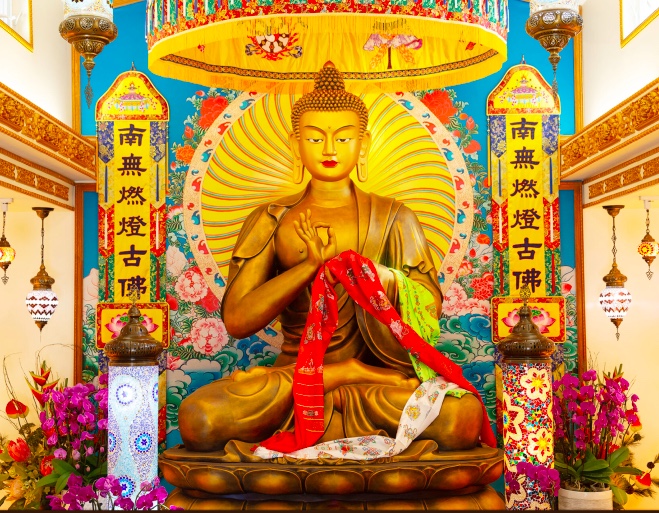
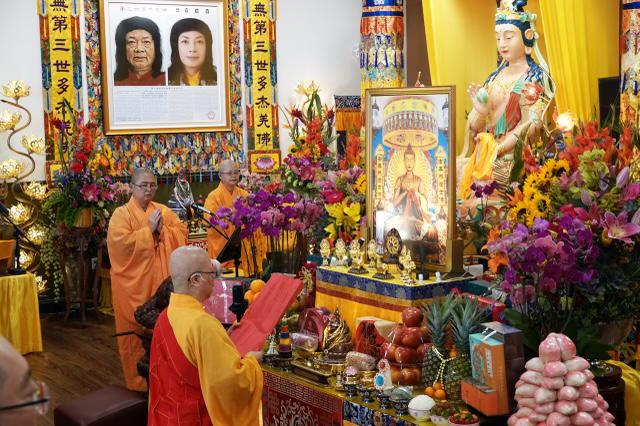
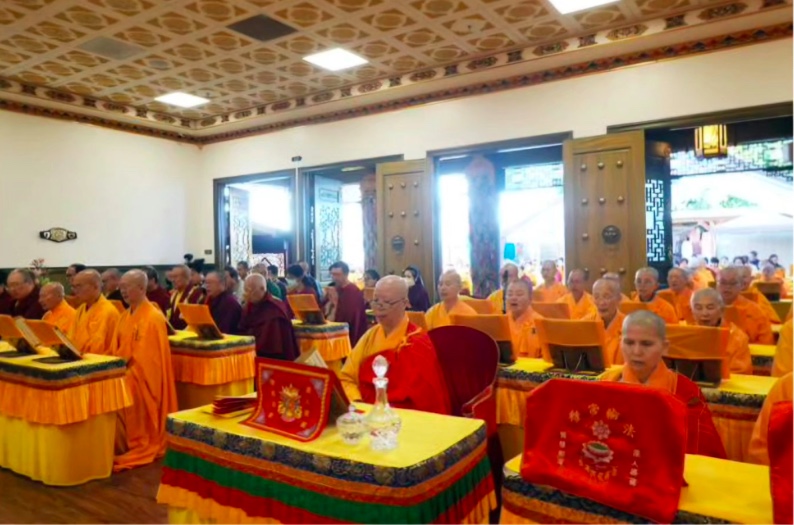


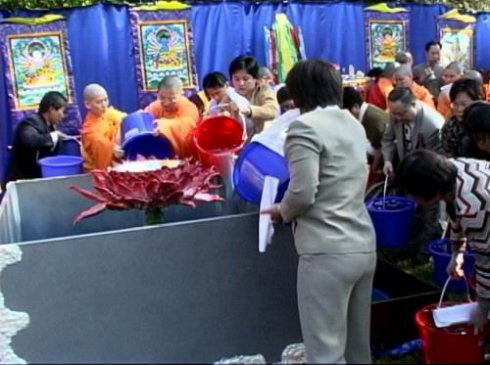


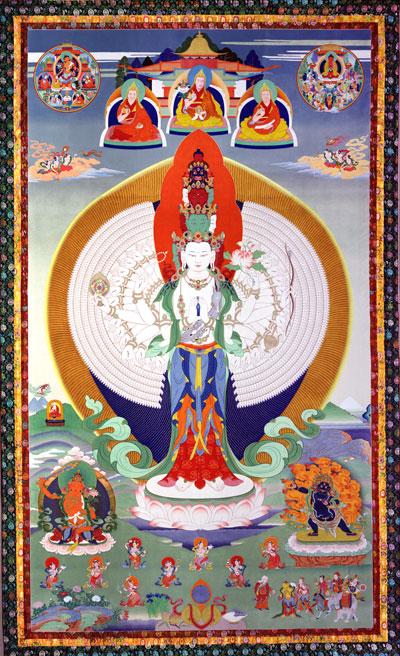
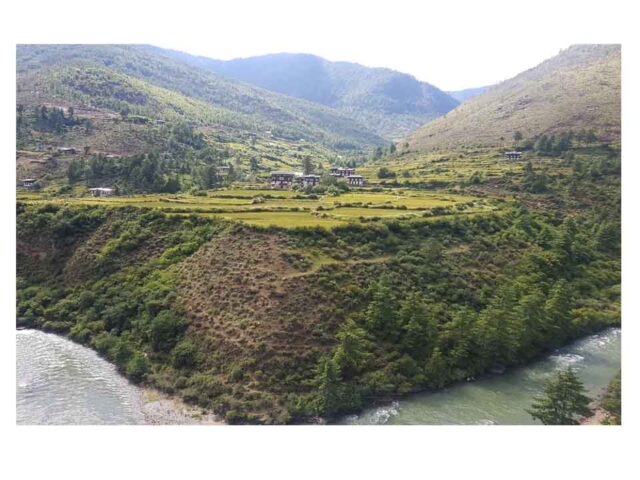
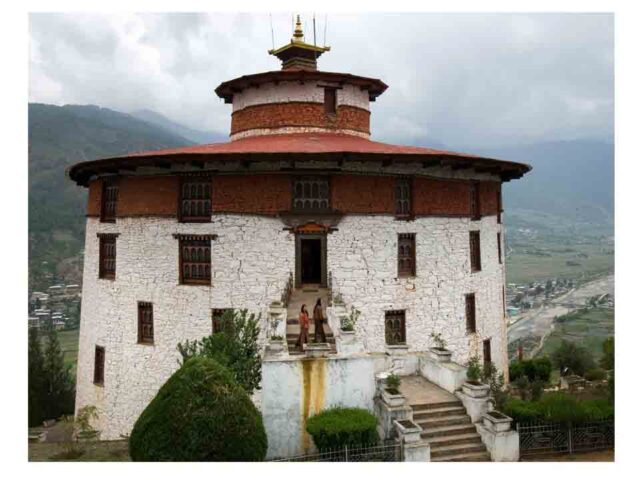
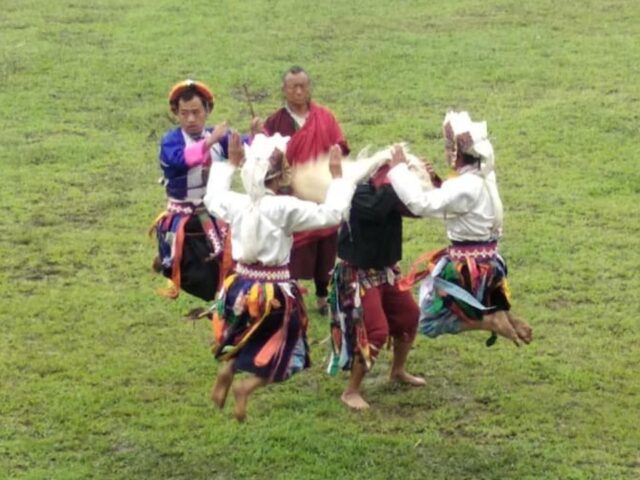
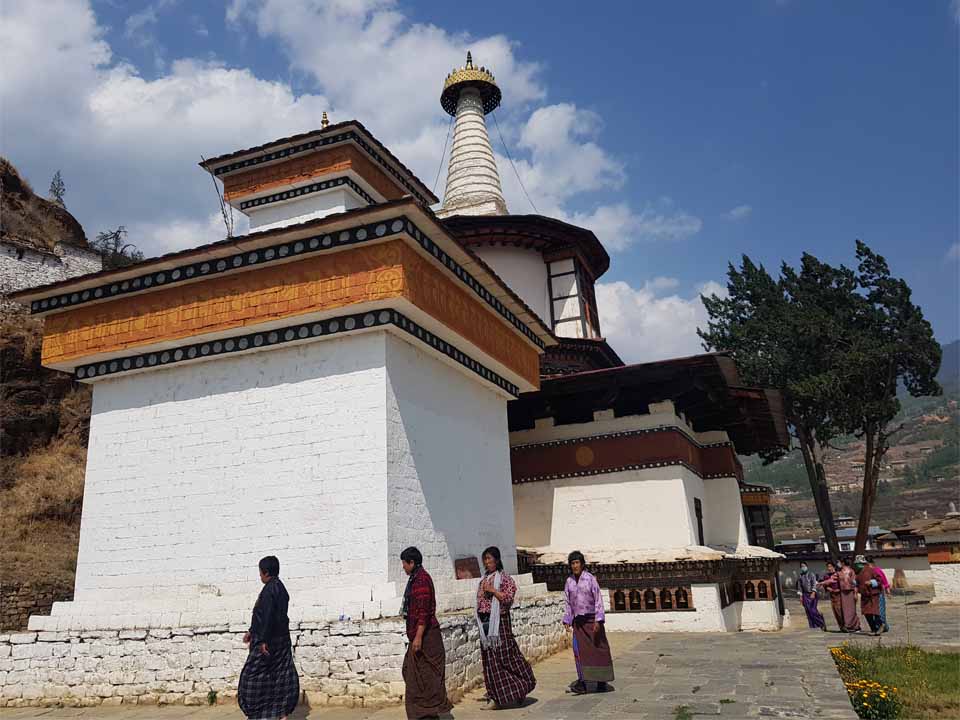
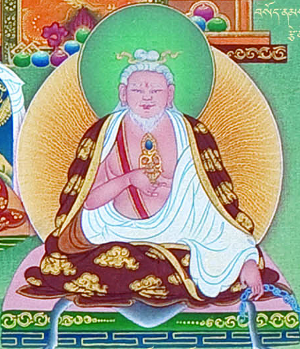
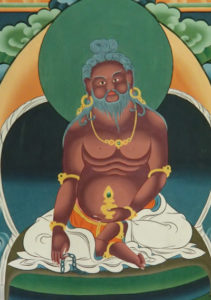


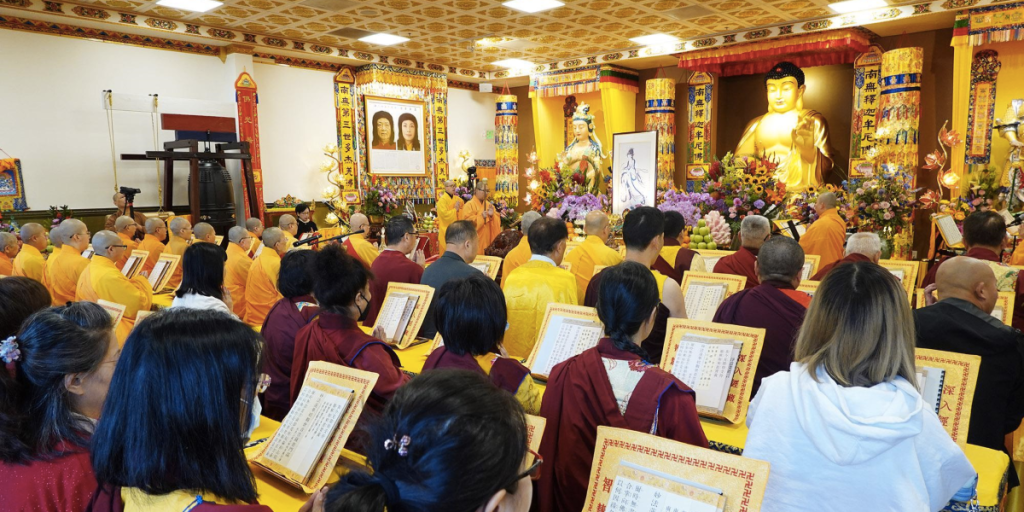
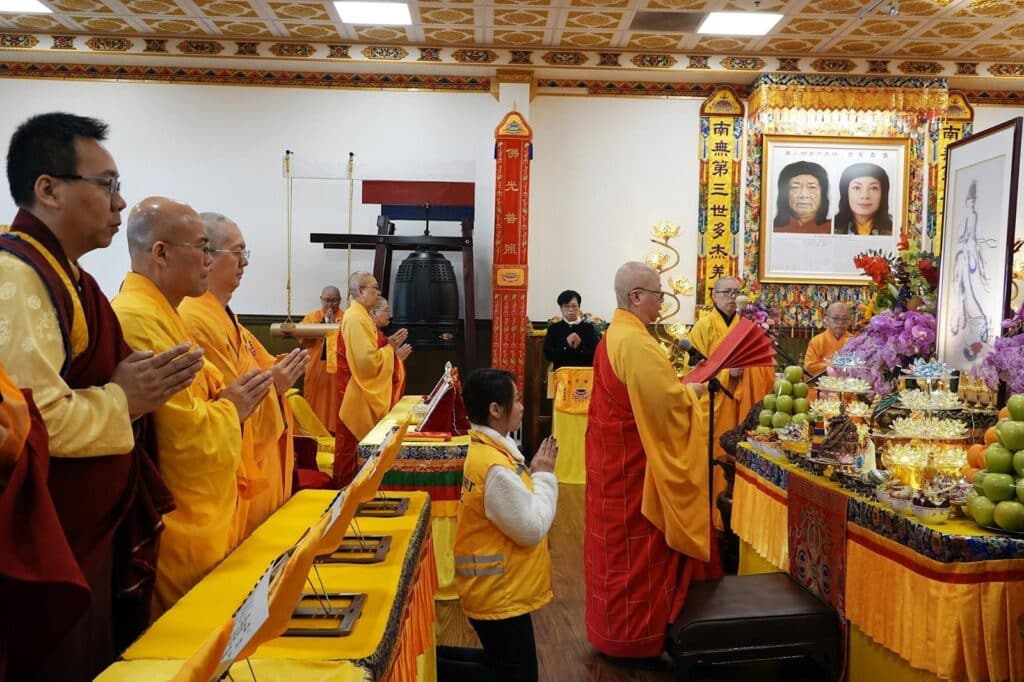

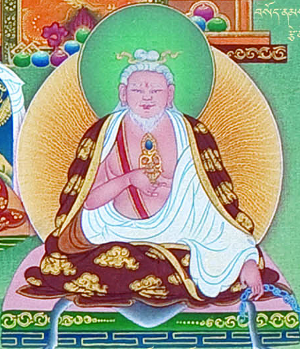
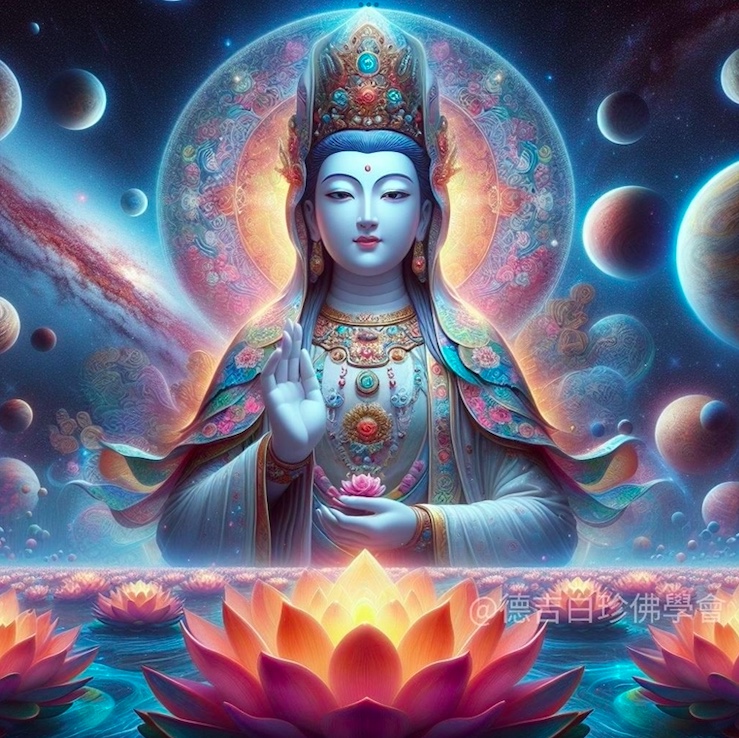
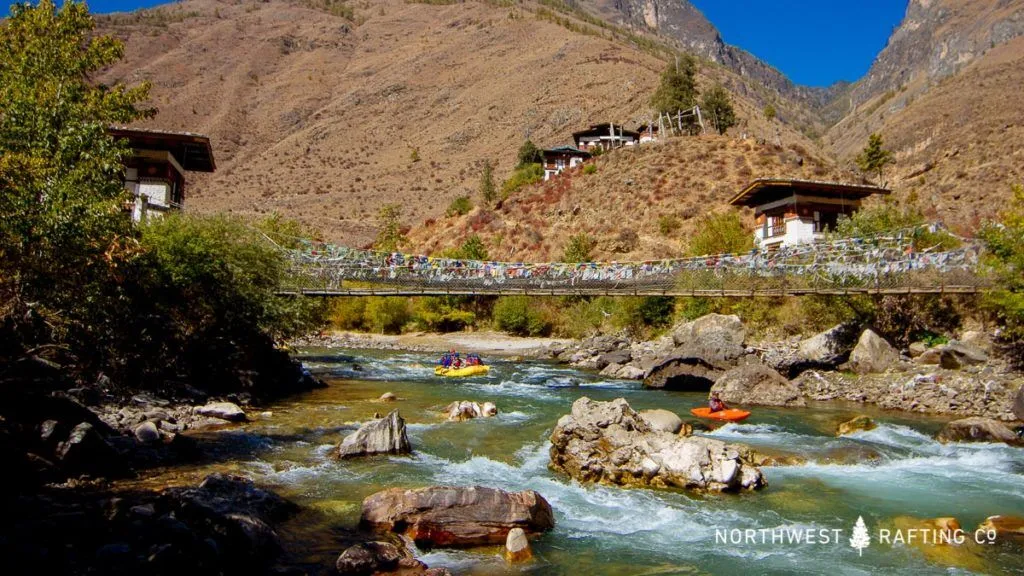
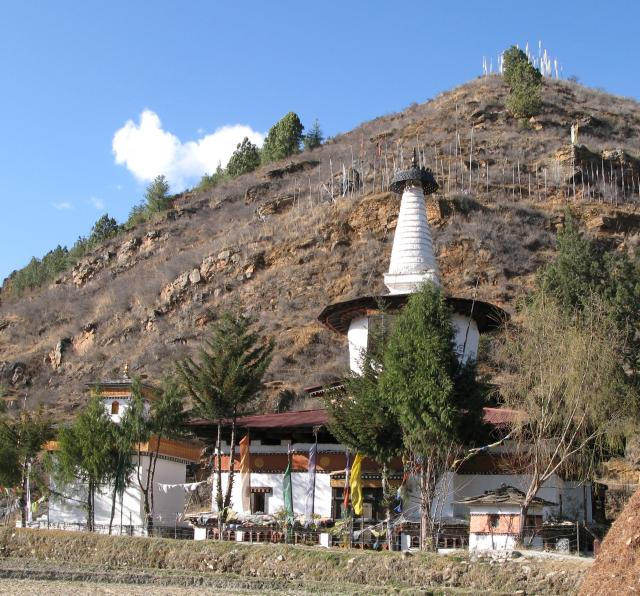
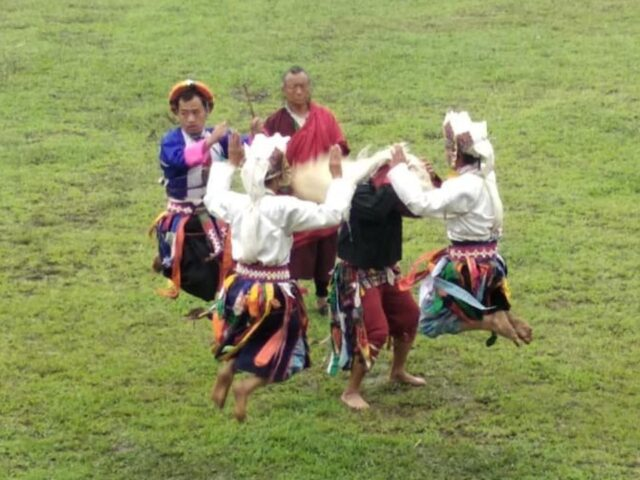
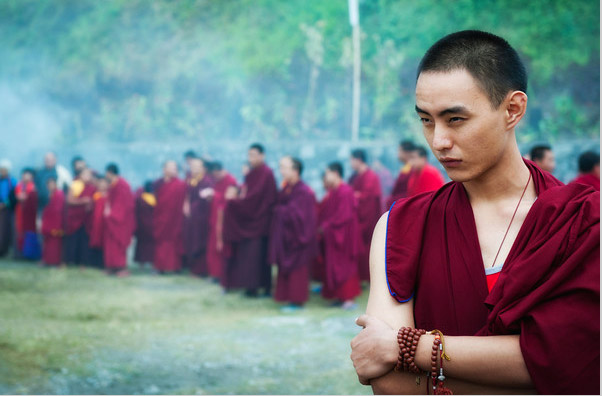




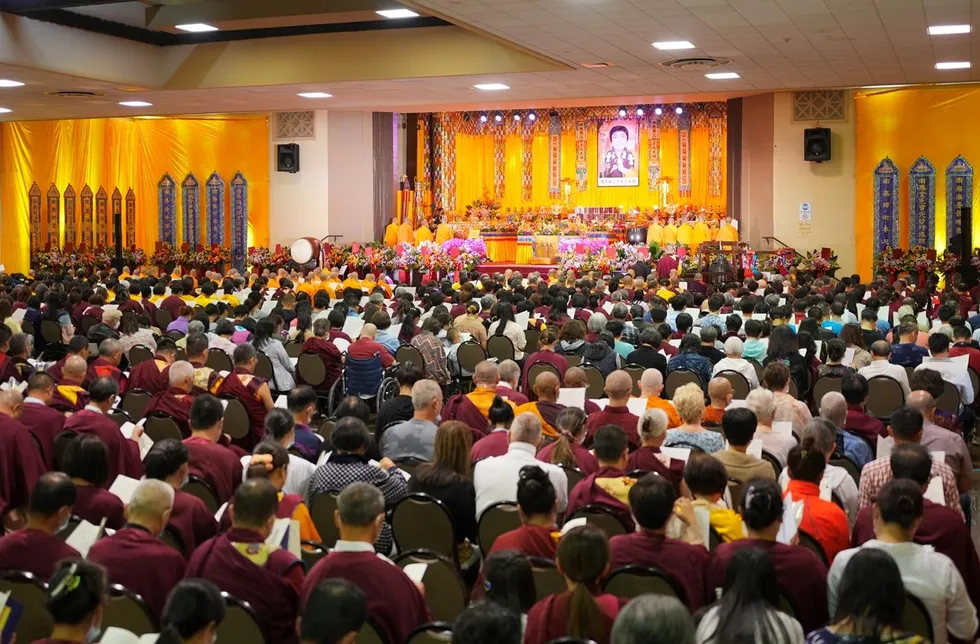
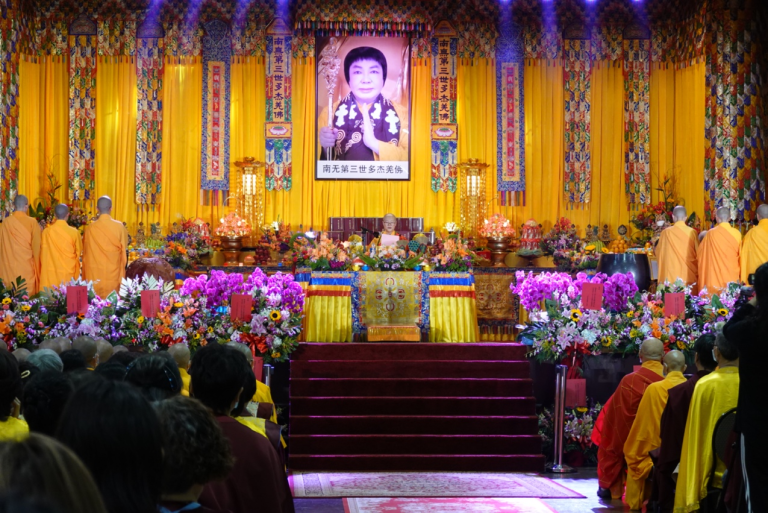

 Peace LiLy