Nadia Murad: One Woman’s Courage Can Change the World
In a world often shaken by violence and injustice, the story of Nadia Murad reminds us that even in the darkest moments, the human spirit can rise with extraordinary courage.
Murad was born in a small Yazidi village in northern Iraq. Like many young women, she once dreamed of living a quiet and simple life. She hoped to open a beauty salon in her hometown and build a peaceful future with her family.
But in 2014, her life was shattered when the extremist group Islamic State of Iraq and Syria (ISIS) attacked her village. Many members of her family were killed, and she, along with thousands of Yazidi women and girls, was captured and subjected to unspeakable violence.
After months of captivity, Murad managed to escape. Her survival alone was extraordinary, but what she chose to do next required even greater courage.
Rather than remain silent, she decided to tell the world what had happened. Speaking before global leaders at the United Nations, she courageously shared her story and spoke on behalf of thousands of victims who could not speak for themselves.
As she once said:
“I want to be the last girl in the world with a story like mine.”
These simple but powerful words express her deepest mission—to ensure that no other woman or girl must endure the suffering she experienced.
Murad continued her advocacy for survivors of human trafficking and wartime sexual violence, calling on the world to pursue justice and accountability. Her bravery and determination were recognized globally when she was awarded the Nobel Peace Prize in 2018.
Yet Murad’s work has never been about personal recognition. Her goal has always been to restore dignity and hope to those whose lives have been torn apart by violence.
In another moving statement, she said:
“There is no greater honor than being able to speak on behalf of those who have been silenced.”
Her life demonstrates how even the deepest suffering can be transformed into compassion and purpose. Instead of allowing pain to define her, she chose to turn her experience into a force for justice and healing.
Murad also reminds the world that silence allows injustice to continue:
“If the world had listened earlier, perhaps this tragedy could have been avoided.”
Her words challenge us all—not only to listen, but to act.
Today, Nadia Murad’s voice has become a symbol of resilience, courage, and hope. From a small village in Iraq to the global stage, she has shown that one person’s courage can awaken the conscience of humanity. Her story is not only a testimony of survival—it is a call for compassion.
From a deeper spiritual perspective, her journey also reminds us of the universal law of cause and effect—what many traditions call karma. Violence, hatred, and cruelty create suffering that ripples across generations, while compassion, courage, and moral responsibility create healing and hope. When individuals like Nadia Murad choose truth over silence and compassion over hatred, they help restore moral balance in the world. Her courage encourages each of us to cultivate kindness, protect the vulnerable, and act with integrity in our own lives. In this way, even small acts of compassion can become powerful seeds of positive karma, helping to guide humanity toward a more peaceful and just future.
(Reported by the Taiwan Times) On September 5, 2015, an unprecedented dharma assembly of “Determining the Status of a Buddha by the Dharma of Jin Gang Fa Man Ze Jue (Jin Gang Fa Man Ze Jue is a dharma in Tibetan Esoteric Buddhism for determining the result sought through selection)” was held in the United States of America with the attendance of several dozens of venerable ones, dharma kings and rinpoches, who are from Tibetan Esoteric Buddhism, and dharma masters. The dharma practice was led by Great Rinpoche Wang Zha from Tibet, who once practiced in solitary retreat for 46 years in Tibet and has the realization of Golden Button Grade 3 (having three Sun-Moon wheels) in Buddha-dharma. The decisions by the Dharma of Jin Gang Fa Man Ze Jue determined that Sakyamuni Buddha is a true Buddha, H.H. Dorje Chang Buddha III is a true Buddha, and Master Hui Neng, the sixth patriarch of the Ch’an (Zen) School, was not a Buddha but was the incarnation of a great Bodhisattva.
At what level is a dharma assembly of determination by the Dharma of Jin Gang Fa Man Ze Jue? According to the explanation provided by the United International World Buddhism Association Headquarters (UIWBAH) who sponsored the two sessions of the dharma assembly to determine the status of a Buddha, the Dharma of Jin Gang Fa Man Ze Jue is one of the holy supreme great dharmas and can be used to determine the true or false status of any holy being. In this world, this dharma and the Dharma of Forecasting the Future (announcing events that will happen in the future ahead of time) are the co-champions among the dharmas of decision by selection. The dharma ranked next is the holy inner-tantric dharma of “Bai Fa Ming Men Hei Guan Ze Jue (a dharma specifically used to determine the correct or wrong result).” The next lower dharma is the dharma of dropping divine pieces to receive divine instruction, which is at the inner-tantric level. Then, there are lower, outer-tantric dharmas of lot-drawing from a golden vase, rotating a tsampa ball, watching a sacred lake to see the result, and others. This Dharma of Jin Gang Fa Man Ze Jue and the Dharma of Forecasting the Future are the highest dharmas among dharmas of decision by selection to determine the status of either “another person” or “self.” This dharma can only be possessed and commanded by holy ones at the level of great Mahasattvas or higher. Therefore, no great dharma king or venerable one who is not an extremely great holy one can hold and practice this dharma. Even great dharma kings and great venerable ones at the level of Jiao Zun who have the ability of performing inner-tantric initiations do not have the qualification to hold and practice this dharma. Mo Zhi Jiao Zun said, “Although I have just entered the door of holding and performing inner-tantric initiations, I have not touched even the edge of the Dharma of Jin Gang Fa Man Ze Jue. Only a holy one who has the realization of performing holy inner-tantric initiations that are close to the level of state practice can perform the Dharma of Jin Gang Fa Man Ze Jue. Otherwise, one is merely dreaming and far away from doing it.”
Why was this dharma assembly held to determine the status of a Buddha by the Dharma of Jin Gang Fa Man Ze Jue? According to a writing describing the fact by the UIWBAH, the karmic condition rose from the fact that many Buddhists in the world wished to respectfully beseech the contrasting photos of H.H. Dorje Chang Buddha III showing His returning from an aged appearance to a youthful person three years ago. However, H.H. Dorje Chang Buddha III did not agree to that. He thought that these were just ordinary photos and were meaningless for people to have. The discussion lasted three years to 2015. The UIWBAH finally got the agreement from H.H. Dorje Chang Buddha III. His Holiness the Buddha donated the two photos of His to the UIWBAH free of charge with a requirement that the UIWBAH can only sell the photo at a low price to those who wish to get it and must not profit from selling the photo. At the end of October of 2015, the UIWBAH published the contrasting photos of H.H. Dorje Chang Buddha III showing His returning from an aged appearance to a youthful person to the world. This provided people with auspicious and magnificent feelings and abundant joy of Buddha-dharma.
Unfortunately, H.H. Dorje Chang Buddha III wrote a note for the photos and demanded it to be printed at the lower part of the photo sheet. The note mainly stated that He is an ordinary person like everyone else, He is not a holy person, He has no advantage over other people, He does not know the dharma of returning from an aged appearance to a youthful person, and what people saw was a temporary phenomenon due to a medicine given by an elder virtuous one. On the other hand, UIWBAH stated that many people witnessed the real fact that Wang Zha Shang Zun, who is an outstanding one among great dharma kings, publicly practiced a dharma of empowerment. After a short period of a little over 10 minutes, an elder person whose age was over 60 changed into an appearance of a person who was about 30 years old. Wang Zha Shang Zun used this demonstration to show the fact that the dharma of returning from an aged appearance to a youthful person does exist within the realm of Buddha-dharma. Wang Zha Shang Zun said, “My Buddha Master is the universe. I am only a small piece of stone. Even I can empower a cultivator to return from an aged appearance to a youthful person temporarily. H.H. Dorje Chang Buddha III’s realization is millions of times higher than mine. Can you believe that the Buddha Master is an ordinary person?”
Although Wang Zha Shang Zun made the above proof, the speech by His Holiness the Buddha saying that He is an ordinary person just like everyone else made many Buddhist disciples in the world, whose good roots and intelligence are not strong enough, hesitate and be at a loss. They are unsure, with pressure on their mind. All can tell that, in terms of science and causality, how can there exists any miraculous medicine that can completely change a person’s facial features in a short period of a little over 10 minutes? Furthermore, three years have already passed and there is still not even one winkle in H.H. Dorje Chang Buddha III’s face. The skin and flesh on His face are clean and tender with a light ruddy complexion. His appearance is extremely beautiful, handsome, and majestic. Other than a Buddha, how can a Bodhisattva have such extremely beautiful magnificence and how can any medicine create such an effect? Additionally, H.H. Dorje Chang Buddha III’s accomplishments of perfect mastery in both exoteric Buddhism and esoteric Buddhism and at the acme of the Five Vidyasare unmatched and incomparable by any holy one throughout the history of Buddhism. Not even one can be found from looking through history, searching the internet, and exhaustive investigations! How could H.H. Dorje Chang Buddha III not have advantage over others? Ordinary people do not bear any remote resemblance to H.H. Dorje Chang Buddha III. Then, how could H.H. Dorje Chang Buddha III be an ordinary person? On the other hand, should we not listen to His Holiness the Buddha’s speech? Therefore, unintelligent and deluded people feel muddle-headed and do not know what is right.
Considering this situation of cultivators being pressured, the UIWBAH had discussions and decided to provide Buddhists a correct conclusion. For the sake of benefiting living beings, an action that may not respect His Holiness the Buddha has to be taken. Wang Zha Shang Zun, an extremely great holy one at the level of Golden Button Grade 3 or higher, took the lead to practice the Dharma of Jin Gang Fa Man Ze Jue to determine fundamentally whether the Buddha’s status is true or false. Many cultivators wish to know the situation of the dharma assembly that determined the Buddha’s status by the Dharma of Jin Gang Fa Man Ze Jue. The following is a report on that dharma assembly:
On September 5, 2015, the historic grand dharma assembly to determine the status of the Buddha using the Dharma of Jin Gang Fa Man Ze Jue began in a solemn and majestic scene. Wang Zha Shang Zun’s holy arrival was welcomed by Great Holy and Virtuous One Mo Zhi Jiao Zun, Chairman of the UIWBAH Dharma King Gar Tongstan, UIWBAH’s Secretary General Kai Chu Ru Zun, Chief Abbot of the International Buddhism Sangha Association Dharma Master Zhengda, Great Rinpoche Akou Lamo, and several dozens of eminent monks, rinpoches, and dharma masters who were to serve as observing witnesses. They held palms together to greet each other and were seated on the dharma rostrum.
To be fair, the decision by selection was first conducted to verify the status of Sakyamuni Buddha. The beseeching dharma document wrote, “We respectfully beseech a verification from the decision by selection. If Sakyamuni Buddha is truly a Buddha, a crown made by strands of hair will be put on the head. If not, there will be no crown.” First, a portrait of Sakyamuni Buddha was laid on an ordinary four-legged flat table of dark-brown color. Then, a pinch of sand from the Ganges River with the color of light camel wool was picked up and put on the portrait at a spot of hair at the top of the Buddha’s head. Wang Zha Shang Zun began to practice the dharma at a dharma rostrum which was about 13 feet away from the table. After the ritual of knocking the wood fish, ringing the bell, waving the Vajra, performing mudras, and chanting mantras, twelve documents written on yellow papers were burnt. All observing witnesses saw with their own eyes that the sand placed at the spot of hair at the top of the Buddha’s head began to disperse with inconceivable changes. Every grain of sand seemed to be alive. All sand grains moved individually with miraculous transformations to form a crown made of strands of hair, which very naturally and wonderfully stood up above the top of Sakyamuni Buddha’s head. A scene of adding a crown of strands of hair to the Buddha’s top-knot was manifested, proving that Sakyamuni Buddha is a true Buddha.
Immediately after and on the same table, the decision by selection was conducted for H.H. Dorje Chang Buddha III. The beseeching dharma document wrote, “We respectfully beseech a verification from the decision by selection. If H.H. Dorje Chang Buddha III is the incarnation of the primordial Sambhogakaya-Buddha Dorje Chang Buddha, a crown made by strands of hair will be put on the head. If not, there will be no crown.” Wang Zha Shang Zun practiced the dharma following exactly the same ritual as before. After the twelve documents were burnt, the sand of the Ganges River with the color of light camel wool that had been flatly put on the spot of hair at the top of H.H. Dorje Chang Buddha III’s head suddenly had the miraculous transformation of being elevated upward. Sand grains connected with each other to form strands of hair standing in the air. The strands of hair then automatically formed a crown of hair. A 3-dimensional crown was put on the head of H.H. Dorje Chang Buddha III in the portrait, proving that H.H. Dorje Chang Buddha III is a true Buddha coming to the world!
The last decision by selection was to verify whether the Sixth Patriarch Master Hui Neng was a Buddha’s nirmanakaya (meaning emanated body). The beseeching dharma document wrote, “We respectfully beseech a verification from the decision by selection. If the Sixth Patriarch Master Hui Neng is a Buddha’s nirmanakaya, a crown made by strands of hair will be put on the head. If not, there will be no crown.” As before, Wang Zha Shang Zun practiced the dharma following the same ritual and the twelve documents were burnt. Everyone saw that the sand of the Ganges River with the color of light camel wool placed at the top of Patriarch Master Hui Neng’s head had no movement or change at all. Therefore, the conclusion was that Patriarch Master Hui Neng was not a Buddha’s nirmanakaya. So a lower-level status had to be verified by the decision by selection, i.e. to determine whether Patriarch Master Hui Neng was an incarnation of a great Bodhisattva or not. The beseeching dharma document wrote, “We respectfully beseech a verification from the decision by selection. If the Sixth Patriarch Master Hui Neng is an incarnation of a great Bodhisattva, a crown made by strands of hair will be put on the head. If he was not at the level of a Bodhisattva, there will be no crown.” After Wang Zha Shang Zun practiced the dharma, a dharma crown was put on Master Hui Neng’s head. Sand grains formed a crown of hair. However, because Patriarch Master Hui Neng was not a Buddha or a Bodhisattva with universal or wonderful enlightenment, as stipulated by the dharma, the crown of hair did not stand up into the air and become a 3-dimensional crown, but was formed on a flat plane. However, it was very naturally structured and absolutely not something that can be made by humans.
The two sessions of the dharma assembly lasted more than five hours. To show the magnificence and extremely truthful nature of the crowning process through determination by the Dharma of Jin Gang Fa Man Ze Jue, each of the venerable ones, dharma kings, rinpoches, great dharma masters, dharma masters, great laypersons, and others attending the dharma assembly took a test to crown the visage using the sand from the Ganges River. As it turned out, none of the holy and virtuous ones present who are at the levels of Golden Button Grade 2, Golden Button Grade 1, and Blue Button Grade 3 were able to crown the Buddha’s portrait with sand from the Ganges River. There was no manifestation of power of Buddha-dharma to cause miraculous changes. This proved that the great dharma of Jin Gang Fa Man Ze Jue can only be practiced by extremely great holy and virtuous ones at the level of Golden Button Grade 3 or higher. No one else possesses the realization to practice the dharma successfully.
Wang Zha Shang Zun was very dissatisfied with himself for the first session. He said that his cultivationwas shallow and lacked merit and virtue and that his own karmic forces caused him not to practice this dharma of decision by selection perfectly. The reality was that a few people in the observing crowd had their karmic forces become visible during the dharma assembly. They caused disturbance in the Buddha hall when they could not control their excitement upon seeing holy states. They shouted loudly and pushed others. Such disrespect toward the holy dharma kept the outcome from being completely perfect. For this reason, Wang Zha Shang Zun decided to hold a second session of the dharma assembly. Before the second dharma assembly started, Dharma King Gar Tongstan made the rules on behalf of Wang Zha Shang Zun. He announced that onlookers could get closer to watch but no one was allowed to speak loudly or push others. All must have the mind focusing on being respectful before moving closer. Then Wang Zha Shang Zun practiced the dharma. The second dharma assembly had a perfect success with extremely magnificent manifestations, proving again that Sakyamuni Buddha is a true Buddha and H.H. Dorje Chang Buddha III is the incarnation of the primordial Sambhogakaya-Buddha Dorje Chang Buddha. In the process, the sand of the Ganges River of the light camel wool color placed at the top of the head exhibited unimaginably miraculous transformation. A lose-hair crown changed into a head-covering crown and a thick-hair crown changed into a thin-hair crown. The strands of hair gathered or separated as required at different places to knit into a naturally perfect crown. Every sand grain had its own independent life. Some walked extremely fast; some wandered around casually; some followed twisted paths; some traveled past the boundary and then came back; and some climbed from the bottom to the top. The sand grains followed each other one by one to form strands of hair that stood into the air without falling. Eventually, a knot was formed to create a perfect crown for the Sambhogakaya-Buddha. Then, Wang Zha Shang Zun snapped a finger to perform a mudra and the strands of hair fell into a pile of sand with no trace left of the crown. Wang Zha Shang Zun issued a dharma decree to distribute the sand of the Ganges River (which became Vajra Sand after the dharma was performed) to all who were present. Every attendee received a share of the Vajra Sand that manifested the holy crown worn by the genuine incarnation of the Buddha.
The situation at the time was that the dharma was practiced with the same table, at the same position, following the same ritual, and using the same sand of the Ganges River. However, the three hair crowns created were completely different. There was one Bodhisattva two-dimensional crown and there were two Buddha hair crowns that were three-dimensional and stood into the air. The latter two were also different from each other in terms of shape and structure.
All attendees on the dharma assembly on that day took an oath to testify for the above reported true facts, “We all attended the dharma assembly for determining the status of the Buddha by the Dharma of Jin Gang Fa Man Ze Jue as practiced by Wang Zha Shang Zun. We clearly understand and believe in the law of cause and effect. What was stated above is true and without any false statement. If we lied to deceive people, we not only will not become accomplished but also will descend into the three lower realms to undergo extremely miserable suffering. If what was stated above is all true, we wish and pray that all living beings be able to learn the true dharma of the Tathagata from H.H. Dorje Chang Buddha III and Sakyamuni Buddha, attain perfect good fortune and wisdom, and become accomplished and liberated to benefit countless living beings.”
(Translated from a news report in Chinese published by Taiwan Times)
She was eight years old when her father gambled her away in a card game. Her older sister had three hours to win her back before the debt collector came.
Deadwood, Dakota Territory. 1877. A place where law came slow, danger came fast, and survival belonged to the ruthless.
Thomas Garrett had lost everything—his mining stake, his wages, his self-respect—and now, in a drunken haze at the Gem Saloon, he’d lost something far worse:
his daughter.
The man who won her was Bullock— not the sheriff, but a labor trafficker who “supplied” children to mining camps. Kids as young as six spent twelve-hour days sorting ore until their lungs failed or their fingers gave out. Most didn’t live past fourteen.
Thomas signed the paper without hesitation. Bullock would collect little Emma at noon.
When fifteen-year-old Sarah came home from the laundry and learned what her father had done, she didn’t cry. Didn’t scream. Didn’t fall apart.
She simply asked, “When?”
“Tomorrow. Noon.”
Three hours until dawn. Three hours to save her sister.
And Sarah had something her father never had:
clarity.
She knew Bullock.
Everyone did. A cruel man who hid behind paperwork and respectability.
He’d made her father sign a contract— which meant it could be challenged.
And Deadwood had something else:
A new federal judge who’d publicly declared that parents could not use their children to pay debts.
Sarah didn’t sleep. She didn’t blink.
At dawn she was already standing in the courthouse, breathless, determined.
The clerk tried to dismiss her— fifteen-year-old girls didn’t talk law.
But Sarah did.
Because before drink ruined him, her father had been a clerk… and she’d read every law book he left lying around.
She laid out the case with the precision of a trained lawyer:
The contract violated territorial labor laws.
It constituted debt bondage of a minor.
Thomas Garrett was legally incapacitated due to intoxication.
The clerk stared. Then nodded.
He woke the judge.
Judge Isaac Parker—who would one day be known as the “Hanging Judge”—read the contract, listened to Sarah, and did something extraordinary:
He issued an emergency injunction, blocking the transfer and summoning both Bullock and Thomas Garrett to court that afternoon.
When Bullock arrived at the Garrett cabin at noon, two men at his back, he found Sarah waiting on the porch.
Not shaking.
Not pleading.
Holding a federal court order in her hand.
Bullock turned red with fury but wasn’t stupid enough to defy a judge.
At the hearing, Judge Parker didn’t hesitate.
He voided the contract. Declared it an illegal attempt to traffic a minor. Warned Bullock that any further attempt to collect “payment” would end with him in chains.
Then he turned to Thomas Garrett.
A father who gambled his children away forfeits the right to be a father.
Parker stripped him of parental rights and— in a move that shocked the entire Dakota Territory— appointed fifteen-year-old Sarah as her sister’s legal guardian.
But victory didn’t fill their stomachs.
Sarah now had an eight-year-old to raise, no money, no home, and only her laundry work to survive.
What she did next became legend.
She went to five different businesswomen in Deadwood— laundry owners, seamstresses, boarding house keepers— and proposed a deal:
“I’ll work for reduced wages. You house and feed my sister and me. I’ll take the hardest jobs and the longest hours.”
Four said no.
The fifth— a widow named Martha Bullock (no relation to the trafficker)— said yes.
For the next three years, Sarah worked sixteen-hour days. Emma went to school— Sarah insisted on it.
She saved every coin.
By 1880, she’d saved enough to lease a small building and open her own laundry.
By 1882, she owned it.
She employed six women. Paid fair wages. Offered housing to those in need.
Emma, thirteen, kept the books.
When Emma turned eighteen, Sarah paid— entirely from her business profits— for her to attend normal school and become a teacher.
Emma later became a school principal and one of the fiercest advocates for child labor reform in the state.
Sarah never married.
“I raised one child already,” she’d say with a half-smile. “Did a better job than most with half the resources.”
She ran her business until 1910, providing work for over a hundred women across three decades.
Emma retired as the first female superintendent in her county.
When Sarah died in 1923, her obituary mentioned her “successful business career.”
Emma told the real story:
A fifteen-year-old girl who had three hours, a law book, and the unwavering conviction that her sister’s life was not for sale.
Judge Parker later said:
“Justice isn’t only about punishing the guilty. Sometimes it’s about recognizing competence where no one else looks for it.”
The line between tragedy and triumph is thin. Sometimes it’s nothing more than a teenage girl who refuses to accept that her sister can be traded like poker chips—
and who’s smart enough to find the one legal lever that can stop it.
Sarah Garrett didn’t have money. Didn’t have weapons. Didn’t have allies.
She had time running out. A mind trained by desperation. And love hard enough to fight the world.
How Abraham Lincoln’s words remind us that perseverance begins within.
“Always bear in mind that your own resolution to succeed is more important than any other.” — Abraham Lincoln
Abraham Lincoln is remembered not only as one of America’s greatest presidents but also as a timeless symbol of perseverance, moral strength, and inner conviction. His life was marked by hardship and failure, yet through every setback, Lincoln never lost sight of his determination to rise above circumstance and serve a higher purpose.
Born in a humble log cabin in Kentucky in 1809, Lincoln’s path was anything but easy. He had little formal education, often studying by firelight after long days of farm work. Throughout his early years, he faced financial difficulties, career failures, and deep personal losses — including the death of his beloved mother and, later, two of his children.
He failed in business, lost several elections, and faced harsh criticism from both supporters and opponents. Yet each time, he stood back up. His perseverance was not fueled by ego or ambition, but by a steadfast belief in purpose — the belief that doing what is right matters more than comfort or success.
Lincoln’s life reminds us that greatness is not born of ease, but of endurance.
“Your Own Resolution Is More Important Than Any Other”
When Lincoln spoke these words, he wasn’t offering mere encouragement — he was revealing a universal truth about the power of inner determination.
In life, we will always face opinions, expectations, and pressures from the world around us. People may doubt us, situations may discourage us, and even our own fears may whisper that we are not enough. But Lincoln reminds us: what truly determines our path is not what others think, but what we resolve to do.
Our resolution — that unwavering inner decision to keep moving forward — becomes the compass that guides us through storms.
It is what pushes a student to keep learning after failing an exam, an artist to keep creating despite rejection, or a parent to keep loving and protecting despite exhaustion. It is what allows ordinary people to do extraordinary things.
In today’s world of instant gratification and constant comparison, Lincoln’s wisdom feels more relevant than ever. We often measure ourselves by the world’s standards — success, wealth, recognition — and forget that true strength comes from within.
When we cultivate resolution, we learn to stand firm in uncertainty. We begin to trust our purpose more than our fears. We stop seeking validation from others, and start building quiet confidence from persistence and integrity.
Lincoln’s life teaches us that no matter how dark the moment, perseverance can bring light. His story shows that success is not defined by how often we win, but by how often we rise after falling.
To live by Lincoln’s words is to live with courage — not the absence of fear, but the determination to act despite it. It means believing in our capacity to grow, to change, and to make a difference, no matter how small our beginnings.
When challenges arise — whether in our work, relationships, or personal goals — we can remind ourselves of Lincoln’s steady faith in resolution. The world may test us, but as long as we hold our own conviction close, we will find a way forward.
Lincoln’s words have always spoken deeply to me. Whenever I face uncertainty or moments of self-doubt, I remind myself of his quiet strength — how he stood tall not because life was kind, but because his heart was steady.
His quote, “Your own resolution to succeed is more important than any other,” reminds me that motivation is not something we wait for — it is something we choose, moment by moment. And in choosing it, we slowly build the courage to move forward again, with hope and purpose.
At one time Buddha was living in Jetavanārāma. At that time the king of Kosala had a Brahmin who could tell whether a sword was lucky by smelling it. When smiths would bring their swords, if they had given bribes, he said, “It is good.” To those who did not give bribes, he said to them, “It is bad.” All in the course of time knew the deceptive nature of this man. Knowing his nature, one smith made a sword and making it very sharp, put it in a sheath filled with hot chili powder. He brought it to the king. The king summoned the Brahmin and requested him to tell them the goodness or badness of the sword.
The Brahmin, in accord with the order of the king, took the sword out from the sheath and placing it near his nose tried to smell it. Immediately, before he could say anything, the chili powder smelled by him caused him to sneeze. He could not remove the sword from his nose quickly enough, so when he sneezed, the sword cut off the tip of his nose. This story spread everywhere and eventually it reached even the monks in the preaching hall.
One day in the preaching hall of Jetavanārāma the assembled monks were speaking about this. When the Buddha visited there, the monks paid respect to the Buddha.
The Buddha asked, “Oh monks, what were you discussing before I came here?” Then the monks related the story of the Brahmin who smelled swords for the king of Kosala. Buddha said, “Not only today this man faced this mishap, but also in the past he faced the same fate.” The monks requested the Buddha to disclose the past story. The Buddha spoke then the past story:
At one time, a king called Brahmadatta ruled in Benares. He had a fortune-telling Brahmin who by smelling swords could tell their goodness or badness. He took bribes from the sword smiths. He condemned the work of those smiths who had not given bribes because they had not given him bribes.
Once a certain trickster smith made a good sword and made it well sharpened. He applied hot chili powder to it and took it to the king. The king summoned the Brahmin to examine the sword. As it was covered with hot chili powder, when he smelled it, he sneezed before he was able to remove the sword from his nose. The tip of his nose was cut off, and he was ashamed because of this. The king became very sad because of this and requested his craftsmen to make a fake tip for the Brahmin’s nose with wax. And the Brahmin again asked to work for the king.
At this time the king had a nephew at his palace, and also his daughter. The two of them since they were very young, had grown up together. When they got older, they fell in love with each other. The king did not know this secret love. The king and his ministers one day discussed the marriage of the princess. The king said, “I will give my daughter to a prince of another kingdom. If I do so, I will gain two new supporters, the prince and his father, to defend my kingdom.” Since then, the princess was not allowed to see the nephew with whom she had grown up so as to try to prevent them from falling in love. This strengthened their love for one another. And the nephew wanted to marry the princess as they both were now grown up.
The nephew therefore made a stratagem to marry the princess. He met the servant woman of the princess and gave her a bribe of a thousand gold coins. He requested her to keep the princess away for one day from the palace so that he could get to her. The woman said, “Do not worry. I will do it. I will take responsibility for that.”
Thinking of a stratagem, she went to the king and said, “Your lordship, your daughter is under the influence of an evil spirit. She is becoming unlucky and emaciated. Therefore, we will have to remove the evil spirit from her body.” The king asked, “What can we do for that?” The woman said, “In such-and-such a place there is a certain cemetery. There you need to make a stage. Keep a corpse on top of it, and cover it placing a bed over the dead body. We will place the princess on the bed and bathe her. Then the evil spirit will leave her.”
Hearing this, the king ordered her to do all these things and gave her all she had requested. She then undertook the task. She also tied some dried chili powder in a cloth, and she hid it near the bed so the nephew would be able to take it. She requested the nephew to go there and lie under the bed as the dead body. She explained to the nephew how to carry this off. The woman said to the caretakers, “When I come to the cemetery and wash the princess, the dead body will sneeze two or three times, come out from under the bed, and seize and devour the first one whom he sees. Therefore, be warned. Run away.” This was also mentioned to the nephew and princess, and the nephew was told, “When the caretakers run away, take the princess out of the cemetery, and after taking a bath with her, go wherever you like.”
On the day they set to have the service, the nephew went early and lay down under the bed she had prepared. The woman mentioned again to all the caretakers in the cemetery, “When the dead body sneezes, you will have to be ready for the death of the first one he seizes.” When, as she said, the nephew started to sneeze, all the caretakers laying their weapons down beside them, ran away from the cemetery screaming loudly. The retinue and other dignitaries who had come to witness this also all ran away.
When the nephew came out from under the bed, he took the princess, took a good bath, and went to his house with her. Hearing this news, the king became happy and he gave his daughter to the nephew.
Finalizing this story the Buddha said, “At that time the fortune-telling Brahmin who was skilled in sniffing swords was this fortune-telling Brahmin of today. The nephew prince of the king of Benares was I who am the Buddha.”
The moral: “What causes a loss for one person, may cause a gain for someone else.”
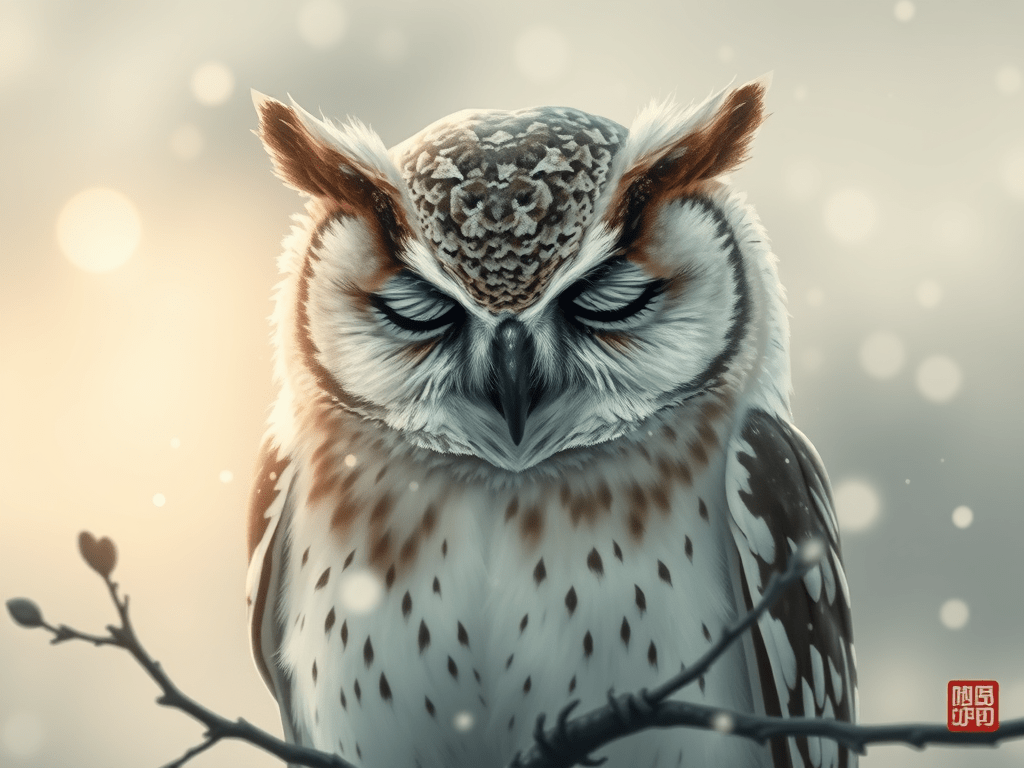
Owls have always fascinated me with their air of enigma. Creatures of the night, they rest in the shadows by day and emerge only after dusk, rarely granting humans more than a fleeting glimpse. Across cultures, they have inspired legends both wondrous and foreboding. In ancient Greece, the wise and fearless goddess Athena chose the owl as her emblem, making it an enduring symbol of wisdom. So revered was this bird that Greek coins bore Athena’s face on one side and the owl on the other. Yet, in other parts of the world, the owl has been shrouded in darker associations, seen as a harbinger of misfortune or an omen of ill will.
In Chinese culture, the owl’s symbolism is particularly layered—holding both shadows and light. In ancient times, owls were often viewed as inauspicious creatures, linked to misfortune, death, and the old saying, “When the night owl enters a home, it never comes without cause.” And yet, in certain cultural contexts, they also stand for wisdom, keen insight, and even mysterious, almost magical power.
A Chinese ink painting by H.H. Dorje Chang Buddha III
When most people picture an owl, they think of its round, unblinking eyes and penetrating gaze—features that can feel cold, even intimidating. But my perception shifted entirely when I encountered the Chinese ink painting Childlike Delight by H.H. Dorje Chang Buddha III.
This is no ordinary artwork. With the freehand grace of traditional Chinese brushwork infused with a touch of dreamlike realism, it bridges the poetic subtlety of Eastern art and the fresh, luminous clarity of Western modernism.
With just a few effortless strokes, the artist creates a whimsical, pure, and gently humorous world—a dreamscape that seems to invite the viewer into the peaceful slumber of childhood. The small owl, covered with delicate ink spots of varying sizes and shades, appears almost as if glimpsed through a soft morning mist. Look closely, and you might see the tender image of a sleepy child, finger to lips, caught in that sweet moment before surrendering to dreams.
This is not a literal portrayal of nature, but rather nature reflected through the artist’s own heart—capturing not merely the physical form of a creature, but its spirit, vitality, and essence.
Here, the owl is reborn—not as the ominous figure of superstition, but as a symbol of innocence, purity, and quiet wisdom. The artist’s compassionate and unblemished inner world radiates through the painting, gently cleansing the heart of the viewer until it feels as fresh and clear as morning dew.
Childlike Delight reminds us that we can close the sharp, competitive eyes of rivalry and open instead the eyes of kindness, innocence, and warmth—gifts that have the power to heal, to inspire, and to light the world.
What is love? What is marriage? What is happiness?
These are questions that have echoed through time. The Greek philosopher Plato once asked his teacher Socrates these very questions. The answers he received were not in the form of lectures or definitions, but through simple, thought-provoking experiences that revealed profound truths about life.
What Is Love?
When Plato asked, “What exactly is love?” Socrates didn’t reply with words. Instead, he told Plato to walk through a wheat field and pick the biggest, fullest ear of wheat he could find. There was only one rule: he could pick only once, and he couldn’t turn back.
Plato returned empty-handed.
“I saw some very large and golden ears of wheat,” he explained, “but I kept thinking that there might be an even better one ahead, so I didn’t pick any. As I walked further, none of the wheat looked as good as what I had already passed. In the end, I walked out with nothing.”
Socrates smiled and said, “That is love. We often think something better lies ahead, so we pass by the one who may have been most right for us. And when we finally realize it, it’s too late to turn back.”
What Is Marriage?
Next, Plato asked, “Then what is marriage?”
Socrates responded, “Walk through the forest and cut down the biggest, strongest tree to use as a Christmas tree. Remember—you may only choose once, and you cannot turn back.”
This time, Plato returned with a tree that wasn’t the tallest or thickest, but still sturdy and pleasing.
When Socrates asked why he had picked it, Plato said, “I remembered the lesson from the wheat field. When I saw this tree and thought it was good enough, I cut it down. I was afraid that if I kept looking, I’d again end up with nothing. It may not be the best, but it’s mine—and I’m content with it.”
Socrates nodded and said, “That is marriage. It may not be perfect, but it’s real, reliable, and something you can walk through life with.”
What Is Happiness?
Finally, Plato asked, “What is happiness?”
Socrates told him to walk through a meadow and pick the most beautiful flower he could find, again under the same rule: choose only once, and no turning back.
After some time, Plato returned with a lovely flower in his hand.
Socrates asked, “Is this the most beautiful flower you saw?”
Plato answered with certainty: “When I saw this flower, I felt it was the most beautiful, so I picked it. Even though I saw other beautiful flowers later, I didn’t regret my choice. I stayed firm in my decision. This one, to me, is the most beautiful.”
Socrates smiled and said, “That is happiness. When you choose to see something as your happiness and cherish it, happiness is already yours.”
Through these three simple parables, Plato came to understand love, marriage, and happiness—not as things to chase endlessly, but as choices to recognize, embrace, and be content with.
Love is like the perfect ear of wheat you keep hoping to find ahead, only to realize—often too late—that what you passed by may have been the best match for you.
Marriage is like the tree that may not be flawless, but stands strong with you through the everyday winds and storms of life.
Happiness isn’t about always having the best. It’s about choosing something, valuing it, and finding contentment in it.
In a world driven by comparison, desire, and constant pursuit of “more,” true happiness arises when we stop looking outward and begin appreciating what we already have. When we make peace with our choices and nurture them with gratitude, we come to see: we already possess love, marriage, and happiness in their truest forms.
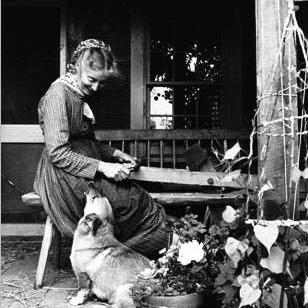
At 92 years old, Tasha Tudor lived a life that seemed lifted from the pages of a fairy tale. A beloved American picture book author and illustrator, her world was filled with charm, creativity, and a profound connection to nature. Her quiet, pastoral lifestyle captured the imagination of many, and a documentary about her life gained widespread acclaim in both the United States and Japan—earning her the title of one of the most admired women of her time.
Tasha was born into a prominent family, surrounded by great minds and cultural icons—her home once welcomed the likes of Albert Einstein and Mark Twain. Growing up in such an environment may have nurtured her early independence and vivid imagination. While others her age dreamed of parties and popularity, Tasha longed for a simpler dream: to own a cow and live close to nature.
At just 15, she left formal schooling to follow her passion for art and farming. This bold decision marked the beginning of a remarkable artistic journey. Over her lifetime, Tasha created more than 80 beautifully illustrated children’s books, winning the prestigious Caldecott Medal and receiving the Queen’s Lifetime Achievement Award. Her delicate, nostalgic illustrations shaped the childhoods of generations.
At 23, she married and raised four children. But when her unconventional lifestyle became too difficult for her husband to accept, they separated. Tasha pressed on, supporting herself through her art and craftsmanship.
When she was 57, and her children had grown, Tasha embraced the life she had always dreamed of. She moved to the hills of Vermont and built a cottage modeled after an 18th-century farmhouse. There, she lived without electricity, running water, or modern conveniences—choosing instead to return to the rhythms of a bygone era.
Her days were filled with meaningful simplicity: raising chickens and sheep, growing vegetables, preparing meals by hand. She wove and sewed her own clothes—elegant dresses and colorful scarves—always taking pride in her appearance, even in solitude.
Tasha found deep joy in the natural world. She built a lush, secret garden where flowers bloomed in every season, and she tended it with love. Whether watering plants or walking through her fields, she embraced each moment with a grateful heart.
Though she lived alone, she was never lonely. Her cats and dogs kept her company, and her grandchildren visited often. Her home radiated warmth, creativity, and quiet joy.
“Letting go is a kind of strength,” she once said.
In an age obsessed with material gain, Tasha Tudor’s life reminds us that true richness lies in simplicity. She let go of the noise and temptations of modern life, choosing instead a path of peace, beauty, and authenticity.
Tasha Tudor didn’t just illustrate magical worlds—she lived in one. And through her life and work, she continues to inspire us to slow down, appreciate the everyday, and create beauty from the inside out.
My friend Wendy used to be very emotional and overly cautious. But in recent years, she has undergone an astonishing transformation.
One day, when we met up, she shared a story that showed me just how much she has changed.
At the end of last year, Wendy finally decided to buy her daughter-in-law the new car she had dreamed of for so long. The whole family welcomed the New Year with excitement and joy.
That day, her daughter-in-law drove the car out to register it, while Wendy stayed home reading stories to her granddaughter.
Not long after, the phone rang. On the other end, her daughter-in-law’s voice trembled with panic:
“While turning, I got hit by a truck going straight. The entire front bumper is smashed. It’s all our fault. Mom, I’m too scared to come home—your son is going to be furious.”
Wendy replied calmly, “As long as you’re okay, that’s what matters. Just come home.”
A while later, her son returned from work. Before he could react, Wendy sent her granddaughter over to ask him to tell her a story about a carpenter.
He couldn’t resist her pleading eyes and began reading in an animated voice:
“There was a kind-hearted carpenter who, though already old, still had no house and couldn’t find a wife. His elderly mother was terribly worried. Finally, a young woman agreed to marry him—but only if he could provide a home.
So the carpenter worked tirelessly, chopping and hammering for two months until he built a beautiful wooden house. One day, while he was out, a fire broke out next door and burned his house to the ground.
People thought he would collapse in despair, but instead, he searched through the charred remains. Everyone was puzzled—what could he possibly be looking for? At last, he found an unburned axe and exclaimed with relief, ‘I finally found you!’
People thought he must be crazy—his house was gone, and he was happy just to find an axe? The carpenter said, ‘As long as I’m here and I have my axe, why would I worry about not having a house?’”
Just then, the daughter-in-law slipped quietly back into the house, looking like a child who had done something wrong.
When her son learned what had happened, he exploded:
“You’re such a spendthrift! No brains at all! So careless—on the very first day, you wrecked a car worth hundreds of thousands!”
Wendy looked at her son calmly and asked:
“Are you done yet? The car is already damaged—will shouting fix it?
Just a minute ago, you were telling your daughter that as long as you have an axe, you can build another house. Now you’ve turned into a chameleon—how will you teach her in the future?
What’s more important: people or cars? A damaged car can be repaired or replaced. But if something had happened to your wife, this family would be over.
It’s the New Year. What matters most is that we are safe, healthy, and together. Everything else is just material. You should be grateful she came home without a scratch. So many people are facing life-and-death partings right now. Be content.”
Her son made a face and joked, “Mom, ever since you started practicing Buddhism, you’ve changed. You’re always siding with your daughter-in-law—have you forgotten you have a son? I feel like I’m adopted!”
Wendy rolled her eyes at him, and the whole family burst into laughter as they sat down to dinner.
Later, Wendy told me that after studying Buddhism, she finally understood how to let go of the suffering that comes from clinging to the self and how to transform afflictions into wisdom.
I watched in amazement as what could have been a chaotic family argument dissolved effortlessly in her hands. In the end, everyone was able to celebrate the New Year in peace and joy.
Life will always bring troubles and joys. A grateful and content mindset makes happiness bloom everywhere, while a lack of appreciation can turn even good fortune into heartache.
Hearing Wendy’s story reminded me how powerful a positive mindset can be in times of conflict. I hope more families can draw on the wisdom of the Dharma to transform challenges into understanding, live long lives free from illness, and enjoy peace, prosperity, and lasting happiness.
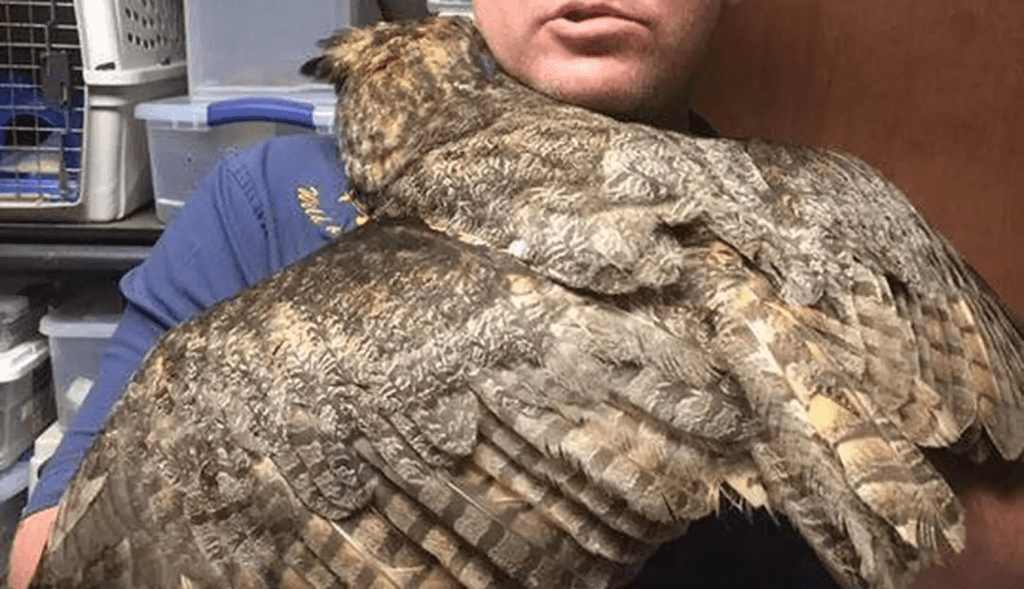
In a world where every creature carries a spirit, we often find ourselves reminded of the profound connections we can share with the beings around us. This truth was beautifully illustrated in the story of GiGi, a majestic great horned owl who faced the brink of death but found hope through the kindness of a stranger.
GiGi’s journey began in May, 2016 when she was brought to the Wild at Heart Rescue in Mississippi after suffering severe head trauma, likely from a car accident. She arrived with a massive concussion, weight loss, and a serious respiratory condition known as aspergillosis. Missy Dubuisson, the founder and director of Wild at Heart, described GiGi’s condition as one of the most critical the rescue had ever encountered.
Despite her dire situation, there was one person at the rescue who could help GiGi regain her strength: Douglas “Doug” Pojeky, affectionately known as the “birds of prey whisperer.” Dubuisson noted, “In all my years of working with birds of prey, I have never seen someone with such a bond with these magnificent birds.” Under Pojeky’s dedicated care, GiGi began her remarkable recovery, transitioning from a fragile state to regaining her independence.
The bond between GiGi and Pojeky deepened as she learned to trust him. When he returned from a trip to Michigan, the reunion was nothing short of magical. GiGi’s excitement was palpable; she bobbed her head and danced on his arm before making her way to his chest for a heartfelt embrace. In that moment, with her head resting on his shoulder and her wings wrapped around him, it was clear that their connection transcended words.
Pojeky shared that GiGi’s embrace held a special significance for him. Growing up, a great horned owl often perched on his family barn, a symbol of comfort and connection. On the morning of his father’s passing, that same owl was spotted overlooking their farmhouse. “For some reason when that bird was hugging me, all I could think of was my dad,” he reflected, highlighting the deep emotional ties that can exist between humans and animals.
As GiGi continued her recovery, she was eventually released back into the wild. Yet, she had Pojeky by her side—a testament to the love and compassion that can thrive even in the face of adversity. Dubuisson remarked, “It literally brings tears to my eyes to watch him interact with these birds. They absolutely know him and trust him. It’s the trust that you see in her face.”
GiGi’s story serves as a powerful reminder that every being has a spirit and that our efforts to help and protect others—whether human or animal—bring profound joy and fulfillment. Let us strive to extend our hands and hearts to those in need, for in doing so, we not only uplift others but also enrich our own lives in ways we may never fully comprehend.
















 Peace LiLy