Hong Kong’s superstar Jacky Cheung has achieved numerous successes in the entertainment industry and is widely recognized as a superstar. However, few people know about his dedication to studying Buddhism. Jacky Cheung’s master is H.H. Dorje Chang Buddha III, an internationally acclaimed master in arts, philosophy, and culture. He was awarded the International Master of Arts and Culture by the World Cultural Conference, comprising experts from 48 countries and regions. Additionally, the Chinese government built a grand museum in his honor in Dayi County, Sichuan, highlighting his unique achievements and contributions.
Around 1995, at the earnest request of many disciples, including Jacky Cheung, H.H. Dorje Chang Buddha III composed a unique masterpiece called “Rare Supreme Chant.” The lyrics, composition, singing, and chanting were all personally handled by the master.
The song’s melody is rich, and its sound changes are exquisite, ranging from powerful and resonant to gentle and intricate. It includes lion’s roars, sacred chants, deep contemplations, and even modern rock and rap elements. The singing techniques transcend traditional vocal resonance, harmonizing with the cosmic realm. This “Rare Supreme Chant” not only broadens the listener’s auditory experience, allowing them to hear various sounds, but also elevates the mind, nurtures moral strength, and purifies body and soul through the blessings of H.H. Dorje Chang Buddha III’s voice.
According to those who provided musical accompaniment for H.H. Dorje Chang Buddha III, his lyrics and melodies are filled with ancient charm and profound knowledge. His voice is versatile and spontaneous, making it difficult to complement with our limited cultural and musical expertise. While they believe his unaccompanied voice is superior, they fear that without accompaniment, the music might be too challenging for listeners to appreciate, thus missing the compassionate intention behind its creation. Despite these challenges, they made an effort to provide accompaniment, hoping listeners would understand and appreciate the master’s work. Listeners are encouraged to attentively enjoy and experience the profound benefits of the music.
The Great Bright Six Syllable Mantra is a very popular Buddhist song, with many audiotapes and CDs distributed worldwide. However, His Holiness’s rendition of the Great Bright Six Syllable Mantra is entirely different from all others I have heard. It is in a powerful vajra style, and at the end of the song, His Holiness uses the lion’s roar voice, with a bursting energy that seems to penetrate the universe and awaken all living beings.
The great bright six syllable mantra
The song “Guo Ping Chang” describes the scenery and feelings of His Holiness passing through Ping Chang (a place in Sichuan).
The sound of the flute sends me across Pingqiang, The boat docks at Wuyou, filled with lantern-lit halls. The spring breeze warmly welcomes visitors, Mist colors the dusk, but the mountains remain evergreen.
This song was sung in an opera style. It has four lines of lyrics, which the Buddha sang using four different Peking Opera styles. This fully demonstrates the Buddha’s profound vocal skills, leaving listeners deeply moved and with a lasting impression.
Passing through PingQiang
H.H. Dorje Chang Buddha III, has even composed a unique masterpiece, in modern rock and rap style, the energetic and festive song “Chinese Dragon,” showcasing the dragon’s cultural significance. This song demonstrates the Buddha’s ability to effortlessly and masterfully handle any musical form.
Chinese Dragon
The Prajnaparamita Heart Sutra is a very important Buddhist scripture. The Buddha composed an elegant and beautiful yet powerful melody for this sutra. His voice is rich and clear, strong yet gentle, as if bringing the compassionate love of the Buddhas and Bodhisattvas to every sentient being.
Jeffrey Hopkins, a brilliant scholar, author, teacher, and translator who founded one of the largest Tibetan Buddhist Studies programs in the West, died on July 1 in Vancouver, Canada. He was 83.
For more than three decades, beginning in 1973, Hopkins was a leading light at the University of Virginia. He directed UVA’s Center for South Asian Studies for twelve years and taught Tibetan Buddhist studies and Tibetan language for thirty-two years, but his signature achievement was the Tibetan Buddhist studies doctoral program he established in 1975, which became the largest in North America. Among its graduates are some of the most esteemed academics in the field today, including Anne C. Klein of Rice University, Donald Lopez of the University of Michigan, Georges Dreyfus of Williams College, and Bryan Cuevas of Florida State University. Hopkins’s program, by placing Tibetan Buddhism (rather than Indian, Chinese, or Japanese Buddhism) at its center and bringing prominent Tibetan masters from India to Charlottesville to teach the classic texts of that tradition, “changed the way Buddhism is taught in the American academy,” Donald Lopez says.
Hopkins’s singular force was evident from the moment he arrived at UVA in 1973. Lopez, a senior when Hopkins joined the faculty, remembers:
Despite being a newly arrived assistant professor, he immediately gained a large following among the “Be Here Now” crowd. By the second semester, students were walking around campus wearing buttons that said, “Buddha’s Slogan: Dependent Arising.” In a men’s room on campus one day I noticed something written on a urinal. Assuming it said “R. Mutt” [as Marcel Duchamp had signed his urinal artwork, “The Fountain”], I went closer and saw that it was four words stamped in red letters: “DOES NOT INHERENTLY EXIST.” Inspired by such visions, I wrote my senior thesis, master’s thesis, and doctoral dissertation under Hopkins’s direction.
Convinced that scholars of Tibet must be able to both read classical Tibetan and speak modern Tibetan, Hopkins established the first Tibetan language program at UVA and coauthored a comprehensive language course, Fluent Tibetan: A Proficiency Oriented Learning System. He also compiled a 900-page Tibetan-Sanskrit-English dictionary of Buddhist terms that is posted online.
During his career, Hopkins also held visiting professorships at the University of Hawaii and the University of British Columbia. After he retired from UVA, he focused on translating. He was the founder and president of the UMA (Union of the Modern and Ancient) Institute for Tibetan Studies and from 2011 directed its Great Books Translation Project, set up to make Tibetan texts freely available.
Hopkins was also a peace and human rights activist and published The Art of Peace, edited from talks at a conference of Nobel laureates he organized in 1998 for UVA and the Institute for Asian Democracy, a Washington, D.C.-based non-profit that promoted self-governance in Asia, particularly in Burma. Hopkins was president of the institute from 1994 to 2000.
One of the most respected Tibetologists of his generation, Hopkins authored, edited, or translated more than fifty books. His extensive published work includes scholarly books on emptiness and tantra, as well as translations of works by such famed figures as Nagarjuna, Chandrakirti, and Tsongkhapa. His first and most influential work was his massive 1973 doctoral dissertation, Meditation on Emptiness, which provided the first detailed presentation of the Geluk synthesis of philosophy and practice. After circulating widely as a bound Xerox copy, it was published by Wisdom Publications in 1983. A fortieth-anniversary edition will be published next year. Much of Hopkins’s work was devoted to the Geluk founder Tsongkhapa, translating major sections of his massive exposition on tantra, Stages of the Path of Mantra. Later he turned to Tsongkhapa’s most beloved work among Geluk scholars, Essence of Eloquence, a text recited from memory by the monks of Ganden Monastery at his funeral in 1419. Although Tsongkhapa’s text is rather brief, Hopkins devoted three large volumes to it: Emptiness in the Mind-Only School, Reflections on Reality: The Three Natures and Non-Natures in the Mind-Only School, and Absorption in No External World.
In 1979, Hopkins was instrumental in arranging His Holiness the Dalai Lama’s first visit to the United States and served as his chief translator from 1979 to 1989 on tours of the US, Canada, Europe, Southeast Asia, and Australia. Hopkins translated and edited His Holiness’s teachings for sixteen books, including The Dalai Lama at Harvard, along with titles aimed at a general audience, such as Kindness, Clarity and Insight; How to See Yourself As You Really Are; How to Practice: The Way to a Meaningful Life, Mind of Clear Light, Mind of Clear Life: Advice on Living Well and Dying Consciously; How to Be Compassionate; and How to Expand Love: Widening the Circle of Loving Relationships.
Hopkins collaborated with the tulkus Lati Rinpoche and Denma Locho Rinpoche on Meditative States in Tibetan Buddhism, based on a text by the Geluk master Panchen Sonam Drakpa. With the Nyingma lama Khetsun Sangpo he published Tantric Practice in Nyingma, a translation of a famous work by Patrul Rinpoche that would later be translated as Words of My Perfect Teacher.
Born Paul Jeffrey Hopkins in 1940, he grew up in Barrington, Rhode Island. A rebellious youth, he was a member of what he later described as a “suburban gang . . . disgusted by the aims that were being presented to us: merely making money and so forth.” Hopkins was then sent to Pomfret, a prep school in Connecticut, where he thrived. During his freshman year at Harvard, he read Thoreau’s Walden and retreated to the woods of Vermont, where he lived in a one-room cabin, wrote poetry, and “began finding my own integrity,” he later told an interviewer. Further inspired by Herman Melville’s Typee and W. Somerset Maugham’s The Moon and Sixpence, he hopped a freighter to Tahiti. It was during this period that Hopkins began meditating—in a fashion.
Hopkins returned to Harvard after a year and a half, then between his junior and senior years, took off again. While floating down a river in Oklahoma, he saw a dead man propped up on a bank. It was a turning point. “I suddenly realized that his last perception in this lifetime would be no fuller than any of his other perceptions,” he recalled. “I began to recognize the ultimate futility of external activities and to turn my attention inward, to a light within. When I returned to Harvard in the fall of 1962, it was as if a coffin had been opened. I had been living my life in a coffin and had not recognized the presence of the sky.”
During Christmas vacation from college that year, a classmate drove Hopkins to Freewood Acres, New Jersey, to meet Geshe Wangyal, a Kalmyk Mongolian Tibetan Buddhist who had established a monastery there in 1958. In 1963, after graduating magna cum laude from Harvard—an English major, Hopkins won the Leverett House Poetry Prize for his translation of the Anglo-Saxon poem “The Wanderer”—Hopkins spent seven years studying with Geshe Wangyal in New Jersey. After a false start in graduate school at the University of Pennsylvania, he enrolled in the doctoral program at the University of Wisconsin-Madison.
Later, Hopkins called his time in the Buddhist Studies program at Wisconsin as “thrilling in many ways and . . . certainly a crucial choice for my career.” At Hopkins’s urging, Richard Robinson, the head of the Buddhist Studies program, hired Geshe Lhundup Sopa, a Geluk scholar who had been living at the Kalmyk monastery in New Jersey. He was instrumental in the hiring of renowned tantric master Kensur Ngawang Lekden, former abbot of the Tantric College of Lower Lhasa. Anne Klein, then a master’s candidate at Wisconsin, recalls that Hopkins, with Robinson, “founded Tibet House on a farm outside Madison, where Kensur, Jeffrey, and grad students could live, learn Tibetan, and share kitchen duties. Jeffrey served ice cream on small, flat plates, which, as Kensur demonstrated with delight, meant you could lick them clean.” Hopkins read with Kensur daily, Klein remembers, material that formed his dissertation, Meditation on Emptiness.
Throughout his career, Hopkins’s interest in Buddhist studies was broad, encompassing South Asia, Tibet, and East Asia. He was the recipient of three Fulbright fellowships and made twelve trips to India and five to Tibet for research.
As a translator, Hopkins had an approach unusual among his peers at the time: working closely with Tibetan scholars and regarding them not as “native informants” but as collaborative partners. “I thought it was . . . extremely important to treat every Tibetan scholar fairly, to give them credit for their part in producing any book,” he said. “If I couldn’t understand the text without somebody informing me of its meaning, then that person has played an equal role in its translation even if they don’t know English.”
In 1991, Hopkins suffered a debilitating, near-fatal case of Lyme disease that temporarily left him partially paralyzed with noticeable mental gaps. He recovered, but “I had to reconstruct my mind,” he later told Tibetan Buddhist nun Robina Courtin. “In any field, I had to consciously make a logical connection, and then once the connection had been made, that area was reopened.” What saved him, he ventured, was a habit formed in his years at the monastery in New Jersey: repeating the intelligence mantra of Manjushri, bodhisattva of wisdom, aimed at enhancing mental acuity: Om ah ra pa tsa na dhih. “I overheard Geshe Wangyal tell one Mongolian boy who was having trouble memorizing it, ‘Then do dhih dhih dhih . . . endlessly,’ ” he recalled.
Dechen Shak-Dagsay is a Swiss-Tibetan musician and author. Over the past few decades, she has built a career in music by combining the Tibetan mantra transmissions passed down by her father, Ven. Dagsay Rinpoche, with innovative melodies and contemporary instrumental productions. She has also engaged in collaborative projects with other spirituality-inspired musicians. Having lived in Switzerland for most of her life, Dechen is one of the most prominent contemporary Tibetan singers in Europe today, and has also become globally recognized through various music awards, and for having performed songs from her albums Jewel and Day Tomorrow at Carnegie Hall in New York. Dechen is also the founder of the Dewa Che charity organization, which engages in social projects in Tibet.
Dechen’s newest album, emaho – The Story of Arya Tara, released in October 2021, is about the enlightened activity of the Vajrayana goddess Tara and contains a musical rendition of the “21 Praises of Tara.” BDG recently had a chance to speak with Dechen about her latest project.
BDG: You’ve sung about Tara on various albums before, but this new album is devoted specifically to her story. What do you find inspiring about this female buddha?
Dechen Shak-Dagsay: I have had a wish for many years now to share the extraordinary story of Goddess Arya Tara, the gentle-yet-indomitable princess who became a female buddha. The mythic story goes back many eons in ancient India, where she was called Princess Jhana-Chandra, which means Wisdom-Moon. In Tibetan, her name is Yischi Dawa, and it touches me profoundly that, out of a deep sense of compassion, she would not even eat breakfast before she had liberated hundreds of thousands of beings from samsara each day. She was a faithful disciple of her teacher Buddha Dundubhisvara, and her entire community admired her.
One day, the monks urged her to make an aspiration (vyakarana) to be reborn as a man in her next life in order to attain full enlightenment. The princess laughed at this sexist exhortation and replied: “There is no male, there is no female. To discriminate between male and female is the mind of a small being. There are neither men nor women, nor a self, nor beings.” She vowed to return again and again in a female form in order to help all beings from suffering and to reach enlightenment in female form. Therefore, her teacher, Dundubhisvara, gave her the name Tara, which means “Swift Liberator.”
Tara’s story reminds us every day that we are all equally beautiful beings blessed with great inner qualities, such as love, compassion, kindness, and clarity. These qualities are just waiting to be rediscovered and nurtured.
BDG: Your album emaho captures a profound thought: “What an amazing, wondrous moment when the mind awakens.” How does the music create a mood and ambience in which the listener can realize this moment for themselves?
DSD:Emaho is indeed not an ordinary word. It is found in ancient Tibetan spiritual texts and is an exclamation of joy and amazement when the obscured mind awakens and experiences the pure, clear, and bright shining light of the true nature of our mind.
Personally, I find that each of the eight pieces hold beautiful emaho moments for the listeners. As with all my previous albums, I received the texts for this exalted goddess from my dear father, Ven. Dagsay Rinpoche. It is a great blessing that Rinpoche gave me the transmissions for these beautiful “21 Praises of Tara,” which are practiced in all Tibetan traditions. I also had the privilege of working with Swiss producer Helge van Dyk, who also composed and produced the music of my two previous albums, Jewel and Day Tomorrow.
I said to Helge that I wished to represent the four enlightening activities of Tara in four musical pieces. I cannot thank Helge enough for creating the most sublime music to present the four skillful enlightening activities of Tara: the pacifying, enriching, magnetizing, and wrathful aspects.
When you listen to emaho – The Story of Arya Tara, my hope is that you will enter the wonderful, unique space and landscape of Tara’s buddha-field, and perceive her different fields of activities through the following musical compositions.
“emaho – an Amazing One” – “The Wisdom of Tara” – Tara’s magnetizing activities. Audio courtesy of VANDYKMUSIC
“emaho – an Amazing One” – Tara’s enriching activities. Audio courtesy of VANDYKMUSIC
“emaho – an Amazing One” – “Magic Pulse” (of Prayer Drumming) – Tara’s wrathful activities. Audio courtesy of VANDYKMUSIC
BDG: How do you think the spirit of emaho can help heal our fractured and hurting world, which is now immersed in COVID-19 and a range of other immense crises?
DSD: We generally believe in the great healing power of the Buddha’s teachings, especially when the world is going through a difficult time. We are still in a worldwide pandemic, and we constantly face threats of natural calamities and other crises.
The whole world has faced unprecedented challenges over the last two years, and we are still trying to find solutions for how to handle them. From a worldly point of view, these problems are simply devastating and are creating immense suffering for everyone. But from a Buddhist view, such challenges are exactly what we call “precious moments” for our minds to awaken and to encourage a total reset in our interior world and inner being. We call these moments precious because they allow us to open our hearts to the Buddha’s teachings, such as the Three Marks of Existence. Recalling them always has an instant healing effect on me:
• Impermanence (Skt: anitya): Nothing stays the same, everything is constantly changing.
• Whatever we experience is marked with some kind of suffering. As long as we identify ourselves with a sense of solid self, we will always suffer (dukkha).
• Everything around us and even our own person is empty of a self (anatman).
Dechen Shak-Dagsay. Image courtesy of VANDYKMUSIC
Together with Helge and other musicians, we created emaho in the hope that it will be a small contribution to helping us all through these troubled times together.
We hope to be able to bring calm and peace into people’s hearts. We will not be able to get rid of COVID-19, or the economic, social, and political fallout it has caused, but the music that carries the blessings of Arya Tara, the Swift Liberator, will help us all to overcome our fears, sadness, frustration, and pain to create some space in our hearts and to rebalance our minds. It is within this calm space that we will be able to tap into our innate beauty and strength. We all need this to transform our pain and negative thoughts, and to calmly face and embrace the difficult times ahead of us; to fully become aware of our own inner qualities.
The release of the new double album was followed by the release of my new book, Mantras, Musik & Magic Moments, in December 2021, in which I write about the healing aspects of the old Tibetan mantras, and why I chose music as a tool to reach people’s hearts. I also talk about how Tibetan healing symbols have carried sacred power for centuries. I began making mantra music about two decades ago, and I hope followers will enjoy this new perspective I am offering through my work.
BDG: Your music has been received very well worldwide and your profile has also been rising in Asia. Do you present your music as non-denominational and embracing of all Buddhist traditions, even while it expresses your Tibetan heritage?
DSD: Although I am very rooted in Tibetan or Vajrayana Buddhism, I embrace all Buddhist traditions. My dear father Dagsay Rinpoche, who lives in Chengdu, always reminded us that the essence of the Buddha’s teachings is non-violence and cultivating love and compassion for all beings. All Buddhist traditions, including the Tibetan heritage, are following this beautiful path. It is my wish to one day come to Asia to meet all my Asian friends and to perform my music in Asia together with the Jewel Ensemble.
In my third piece on disc two, called “Peace of Mind,” I sing a “Praise to the 21 Taras” in Chinese and in Tibetan. It is my deep wish to create a wonderful space of peace, respect, and reconciliation.
BDG: You’ve come together with various artists to create a fusion of music. These artists also tend to have a spiritual flavor to their work. How do you decide to work with an artist? How do you identify a potential collaboration?
DSD: Thank you for sensing what I see as a very special energy to our music. I am very thankful to Helge, who has a distinct talent in finding the right artists for a special collaboration that requires not only technical musical skills, but also an open heart that is fully inspired to play soulful music with us. He has carefully selected outstanding musicians to form the Jewel Ensemble, with whom we have played many concerts all around the world. I feel very privileged to have the following members of the Jewel Ensemble, as well as an extended ensemble that we shared the stage with when playing the Call for Peace concerts with the renowned Zurich Chamber Orchestra (ZKO).
I would like to take this opportunity to thank my Jewel Ensemble musicians and guest musicians from around the world for their beautiful contributions on emaho. It has been such an honor to work with all these outstanding artists, who committed their heartful work to this album.* I would like to thank BDG for opening the door to the story of Arya Tara. I would be very happy if this music finds its way across Asia, and I would like to thank all my musicians, my producer Helge, and my dear father Dagsay Rinpoche for letting me create such precious music. I hope it will help to remind people all around the world of their own inner strength and beauty.
A commonly held view is that the body houses the soul—but have you ever thought that the soul could live elsewhere? I have experienced that feeling. Although my body was born in 1981 to my German mother in Brazil, where I grew up, 18 years later I had an “encounter” with my soul’s home in Mongolia. For almost a year, my family and I traveled east by motorhome from Germany and right across Russia. Reaching the border between Russia and western Mongolia, it took days just to receive permission to cross. Stuck in the middle of nowhere, we feared we might never make it! Finally a drunken general provided the necessary authorization and we drove freely onwards into Mongolia, sometimes without a visible road in front of us.
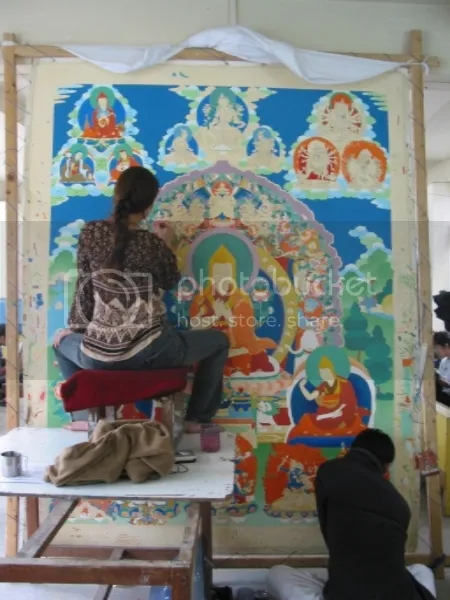
Beneath the expansive blue sky that crowned the arid landscape, my happy tears fell like rain. Those tears nourished a hungry artistic seed within me that desired to grow in the direction of the sunshine; to follow a path to spiritual liberation through art. I believed in such a path and it made sense to me, but until then I hadn’t known how to go about following it. Once in Mongolia, however, I was introduced by a monk at Gandantegchinlen Monastery in Ulaanbaatar to the sacred art of thangka painting, which depicts the various Buddhas, spirits, enlightened beings, and spiritual worlds of Tibetan Buddhism. I had been seeking an artistic discipline of some kind that would guide me to the divine, and this was it!
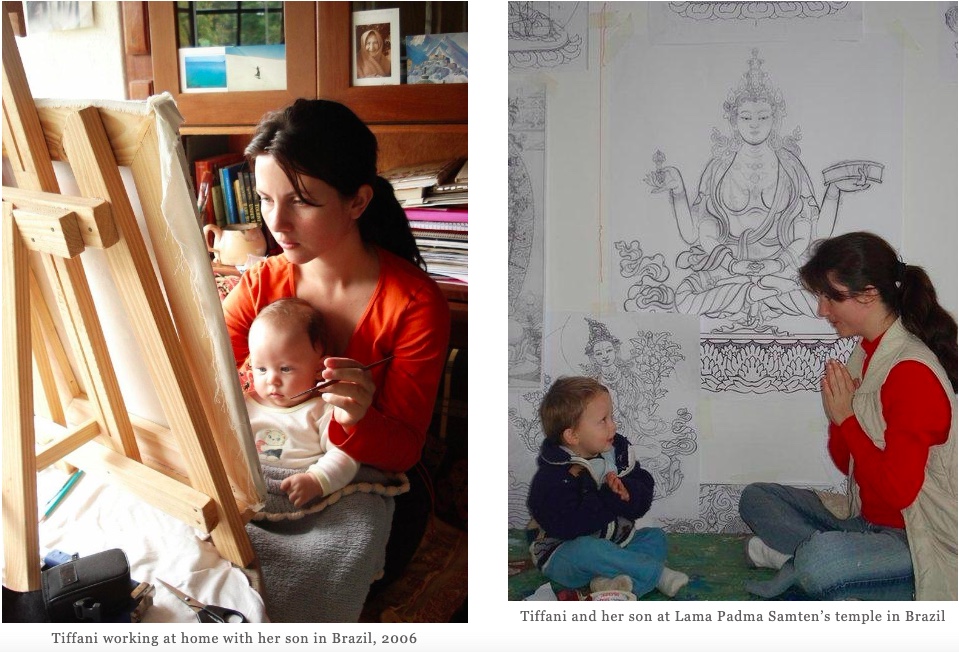
One of the paintings by Tiffani at Lama Padma Samten’s temple in Brazil
Nevertheless, it was a long road before I was accepted three years later as the first Western student at the Norbulingka Institute, founded by His Holiness the Dalai Lama, near Dharamsala in northern India. I have traveled all my life—even living for a few months with an aborigine community in the Australian outback, and spending a couple of years on a sailboat on the Brazilian coast during my teens—but India was beyond anything I could have imagined. I was sick for the first three months I spent there, during which time the school was unsure whether to accept me or not. Even my mother urged me to go home. But something inside me was unmoved by all these “tests.” I felt that if I went back, my soul would abandon my body.
I was finally accepted as a student at the Norbulingka Institute in September 2003. All the wise and holy artists I had expected to meet turned out to be mostly teenagers eager to meet a girl—a blond girl—in the studio at last. Gen-la, the master, was initially somewhat reticent, and we didn’t even share a common language. He gestured towards a Buddha face made up of many symmetrical lines and then pointed to a blank sheet of paper, so I sat on the floor near him and started to sketch. The first word I learned in Tibetan from Gen-la was “again!”—do it again! And so I did, for weeks, the same drawing over and over again until Gen-la would give me my next project.
Painting class at the Norbulingka Institute, 2005
My apprenticeship during the three years I spent there was very slow and painstaking. It was essentially this atmosphere that molded my predisposition to understand that painting a thangka is a spiritual practice in itself; the thangka is there for you to give your time and attention to, and to house your soul. It is a sacred art with a unique function. If you do not have that understanding in the very depth of your being, you will soon abandon the training. Some do not even consider thangka painting to be art, but a practice involving paint that has the same aim as any other Buddhist practice. It was a year before Gen-la even called me by my name; until then he just called me “intchi bhumo,” or “foreign girl.” And it was more than a year before I actually even touched paint, and then only because one of my classmates hid me behind a big canvas and started to teach me himself. Gen-la was actually proud of my boldness when he found out, and finally guided me on my first proper painting. Those were precious times; I was truly happy despite the difficulties I experienced, and my certainty of being on the right track never wavered.
In 2006 I returned to Brazil to discover that I was pregnant. In October that year, a little boy of Tibetan-Brazilian-German heritage was born. His father came over and we lived together for a few years until he moved to the United States to join a larger Tibetan community. Back in Brazil I was fearful that I would have to stop painting—I was 24 with a baby and no money, and all I knew how to do was paint. Afraid that such worries would make me lose my path, I continued to paint my thangkas, my son held close to my body.
When my son was only a few months old, I was contacted by a Brazilian lama—Lama Padma Samten, a disciple of Chagdud Tulku Rinpoche, who had already established a huge sangha. He had heard about me through a mutual friend and sent my son and me tickets to visit his new temple in the south of Brazil. When I finally arrived I was amazed by the size of the temple, which was built to accommodate 300. As I stood there sleep-deprived and perfumed with milk and diapers, he asked me if I would paint the interior walls. I was astonished—but I agreed!
For a month I stood gazing at those terrifyingly huge white walls in fear. I really had no idea how to start! I could not call anyone in India because of the language barrier, and the materials available in Brazil for painting murals wouldn’t be the same as those I was familiar with. So I began slowly, as Gen-la had taught me. First, I met with a local artist to learn more about the proper materials. I learned about the specific deities and mandalas that Lama Samten wished to incorporate. The members of his sangha were very supportive, and many came to help. Those who could give more of their time I trained to paint. Those who couldn’t paint, I asked to massage our aching shoulders, play some instrument or other, give yoga lessons, or even bake a cake for our tea breaks. I felt that everyone should be included. The project took five challenging years to complete, all guided by Lama Samten’s blessings.
As mentioned earlier, those tears in Mongolia had fed the artist within, and now the artist was awake. I soon had the feeling that thangka painting was a “safe zone” for me as the work is all done according to rules that, if followed, offer some guarantee of success. So, in a way, I felt that thangkas had given me discipline and now, only now, was I ready to risk expressing myself. So I began to take more seriously the opportunity to try a more intuitive kind of painting, especially when my personal life was a mess. I was allowed to explode on the canvas, I was allowed to make mistakes . . . I needed to be able to be wrong yet acceptable.
Accumulating a body of art pieces during my free time while painting the temple, with some trepidation I presented my work to Tibet House in New York. I was relieved when they accepted my work and agreed to produce my first show, in 2012—a solo exhibition titled Mystic Nostalgia, in which I sought to express that longing for a lost “home.” Not necessarily a real place; the work is more about our inner landscape . . . a mystic longing. My second exhibition will open at Tibet House on 23 October this year.
Since completing my work at the temple at the end of 2012, I have focused on holding thangka workshops, producing thangkas to order, and taking part in workshops and retreats to teach the intuitive process of self-expression through paint, movement, and writing. I believe the key is maintaining the approach of an apprentice—the beginner’s mind. I feel that I’m learning each time I teach, each time I listen to people, each time I encounter another culture or eat a different food. I learned the benefits of discipline and following rules from the thangka tradition, and when I walk into the unknown with my wild self that sometimes wants its own way, I continue to learn.
Tradition provides us with the roots and structure through which we express ourselves like a hundred branches growing in the air, catching the breeze with their lush leaves. Nourish discipline as much as you nourish your freedom and you’ll soon discover that they are one.
Tiffani Gyatso is a traditional Buddhist thangka painter and a member of the Dakini As Art Collective. To learn more about Tiffani, her work, and Dakini As Art, please visitDakini As Art.
African indigenous hunters have a unique method for catching monkeys.
First, they find a hole just big enough for a monkey’s hand. They place food that monkeys like inside the hole. When a monkey passes by and sees the food, it reaches in to grab it. With its hand full of food, the monkey’s hand gets stuck in the hole. Most monkeys won’t let go of the food and instead try to pull it out from different angles.
When the hunters arrive, the monkey is still struggling and trapped, making it easy for the hunters to catch it.
Many people’s anxiety and suffering stem from holding on to too many things and being unwilling to let go, which prevents them from truly obtaining what they need.
In reality, letting go appropriately allows us to broaden our horizons, take time to adjust ourselves, and better engage in our current work.
The Young Man and the Zen Master: A Lesson in Detachment
Once upon a time, a young man visited a Zen temple to seek guidance from an old Zen master. On his way, he witnessed an interesting sight and decided to test the master. Upon arriving at the temple, he and the master chatted over tea. Suddenly, the young man asked, “What does ‘going round and round’ mean?”
“It’s because the rope hasn’t been cut,” the Zen master replied casually.
The young man was stunned and amazed. He said, “Master, I am surprised that you knew! Today, on my way here, I saw a cow tied to a tree. The cow wanted to go far to graze, but because the rope was through its nose, it kept going round and round, twisting itself without being able to break free. It was quite amusing. I thought that since you hadn’t seen it, you wouldn’t be able to answer. But you answered correctly right away.”
The Zen master laughed and said, “You asked about an event, and I answered with a principle. You asked about a cow tied by a rope and unable to break free; I answered about the mind being entangled by worldly matters and unable to find liberation. One principle can explain many situations.
“A kite, no matter how high it flies, cannot soar into the vast sky because it is tethered by a string. Similarly, what often binds us in life, preventing us from being free? A single win or loss can exhaust us; a gain or loss can cause us great anguish; an exam can keep us tossing and turning; a relationship can tie us in knots.
“For power and money, we run around in circles; for fame and desire, we are constantly entangled. Fame is a rope, desire is a rope, profit is a rope; the attachments and temptations of the world are all ropes. So the Zen master said, ‘All beings are like that cow, bound by many ropes of worries and sufferings, unable to achieve liberation throughout life and death.'”
The Wisdom of Living in the Present
A young monk once asked an old monk, “Master, what did you do when you were young?”
The master replied, “I chopped wood, fetched water, and cooked.”
The young monk asked, “And what do you do now that you’ve attained enlightenment?”
The master said, “I still fetch water, chop wood, and cook.”
The young monk, puzzled, asked, “What’s the difference? It seems like you haven’t made any progress in your entire life.”
The old monk explained, “You’re wrong. There is progress. When I was young, I would think about fetching water while chopping wood, and think about cooking while fetching water. Now that I am enlightened, when I chop wood, I chop wood; when I fetch water, I fetch water; and when I cook, I cook.”
Reflecting on myself, I often feel that I need to do something else while eating to avoid “wasting time.” So, I like to chat with others, watch TV, or think about other things while eating. No wonder I sometimes feel like “I don’t even know what I just ate.”
Enjoying the time spent eating and treating each bite with attention, I savor the sweetness of the rice, the freshness of the vegetables, and the richness of the soup. The world on my taste buds is indeed wonderful, bringing much joy to everyday life.
While walking, I now instinctively let my phone rest and focus on walking, feeling my feet propel my body, enjoying the natural comfort of the breeze, smelling the flowers, hearing the birds, and seeing the colorful flowers, green leaves, and various passersby. The scenery is infinitely beautiful, something I rarely appreciated before. Missing out and becoming numb was inevitable.
This series of practices has gradually cultivated the quality of “focus” in me. I increasingly embrace the concept of “living in the moment.” Of course, I know this is just the beginning; focus is a lifelong practice.
In the course of benefiting sentient beings in this world, H.H. Dorje Chang Buddha III Wan Ko Yeshe Norbu Holiest Tathagata has inadvertently revealed His state of virtue and realization. This has profoundly enriched our understanding of the realization, boundless compassion, enlightenment, and sublime conduct of a Buddha. Sacred phenomena manifest wherever H.H. Dorje Chang Buddha III goes. These phenomena occur during His Holiness’s initiation ceremonies for esteemed monastics, rinpoches, dharma kings, and even renowned Bodhisattvas. They also arise when His Holiness delivers discourses on the dharma to His disciples or when He bestows blessings upon sentient beings to enhance their fortune and wisdom.
In this post, I would like to share some examples.
Dragon-Fish Stand Straight Up on the Surface of the Water and Pay Respect to H.H. Dorje Chang Buddha III by Bowing to His Holiness
On November 6th, 1999, at Puttamonton, Thailand, a group of around thirty people accompanied H.H. Dorje Chang Buddha III. After prostrating before the holy image of Sakyamuni Buddha, they gathered under a bodhi tree beside a serene lake, where H.H. Dorje Chang Buddha III sat. One of the Rinpoches respectfully beseeched H.H. Dorje Chang Buddha III to give a discourse on how an Arhat can realize the state of a Bodhisattva, how a Bodhisattva can attain the supreme and complete enlightenment of a Buddha, and why a Buddha must rely on saving sentient beings to attain Buddhahood.
At that moment, various birds flew over from all directions and perched themselves on the tree, while different types of wild fish in the lake swam over to them. Two wild dogs even approached and joined the group in front of H.H. Dorje Chang Buddha III’s seat, creating an extraordinary scene.
As H.H. Dorje Chang Buddha III began expounding the highest wondrous dharma, waves suddenly surged from the calm waters of the lake, accompanied by a loud sound. A black dragon transformed into a large black and gold fish, emerging vertically from the water’s surface and bowing its head toward H.H. Dorje Chang Buddha III after each movement.
This remarkable display lasted about twenty seconds, with other fish, both white and black, also emerging to pay their respects to H.H. Dorje Chang Buddha III.
Witnessing this unprecedented spectacle, the disciples were filled with wonder, understanding that these fish were dragon-spirits transformed to receive the dharma and pay homage. H.H. Dorje Chang Buddha III, however, remained humble, stating, “This is a response evoked by the Buddha-dharma. One should practice the Buddha-dharma with a heart of humility. Amazing feats are like dreams and illusions, like clouds and smoke that pass in an instant. One must not be attached to them. They are not worth mentioning.”
Indeed, when great saints expound the wondrous dharma, both humans and non-humans pay their respects, a testament to the merit and realization of a Buddha.
A Wild Squirrel Offered Avocadoes to H.H. Dorje Chang Buddha III
In the afternoon of April 24th, 2000, disciples Long Zhi and Juehai walked along the swimming pool in the outer area of the mandala with H.H. Dorje Chang Buddha III Wan Ko Yeshe Norbu Holiest Tathagata. H.H. Dorje Chang Buddha III pointed to an avocado tree and said, “I want everyone to try the fruits.” So H.H. Dorje Chang Buddha III instructed Long Zhi to get a fruit catcher. Long Zhi searched but couldn’t find one. H.H. Dorje Chang Buddha III then said, “We have to pick some avocados.”
Moments later, a brown squirrel descended from an old pine tree. H.H. Dorje Chang Buddha III instructed everyone, “Don’t chase the squirrel away. It came to help.” The squirrel skillfully climbed the avocado tree, searching for ripe fruit. Jumping from branch to branch and sometimes hanging upside down, it located the avocados hidden amidst the dense foliage. Within minutes, the squirrel retrieved six avocados. H.H. Dorje Chang Buddha III deemed it sufficient.
Addressing the squirrel, Long Zhi said, “Hey, squirrel, you have worked diligently. Your offering has accumulated ample merit. It is enough.” The squirrel paused on a branch, holding its paws together, acknowledging H.H. Dorje Chang Buddha III. These six avocados were offerings to H.H. Dorje Chang Buddha III from the squirrel.
As H.H. Dorje Chang Buddha III prepared to leave, the squirrel performed one prostration before the Buddha Master and then departed slowly. Since then, the nuns residing at the holy mandala have observed squirrels climbing the avocado tree but no longer witness avocados being offered as offerings.
The Buddhas Praise H.H. Dorje Chang Buddha III’s Discourse; Buddha Light Blessing Illuminates the Lecture Hall
In April 2006, the Buddha Master was in the lecture hall delivering a discourse on “What Is Cultivation” in response to a question from Zhaxi Zhuoma Rinpoche. As the Buddha Master began, a beam of sparkling iridescent light suddenly appeared, circling the indoor lecture hall with the force of lightning. The sight was dazzling and auspicious! Throughout the discourse, this radiant Buddha light appeared and illuminated the hall as many as five times.
Approximately twenty Rinpoches and masters were present, witnessing the phenomenon. However, not all disciples perceived the same colors and number of Buddha lights due to their varying levels of cultivation and karmic conditions. Some witnessed Buddha lights appearing six times, while others saw them twice. The colors varied as well, with some seeing red, others white, and still others witnessing iridescent Buddha lights sparkling in the hall. The Buddha Master’s discourse on the Buddha-dharma, along with the praise and blessings of the Buddhas and Bodhisattvas, filled all present with joy.
These Buddha lights were special manifestations with underlying causes. They appeared when the Buddha Master discussed the karmic conditions behind the publication of the book “A Treasury of True Buddha-Dharma.” Dazzling Buddha lights flashed in the mandala, as the Buddhas and Bodhisattvas used them to celebrate the birth of this book, which would provide countless beings in the earthly realm with a path to practice the true dharma. As proclaimed by many great dharma kings and rinpoches, the karmic conditions for beings to experience good fortune have matured!
One time, Shakyamuni Buddha and King Prasenajit engaged in a profound and comprehensive discussion about love and compassion.
“Master Gautama,” King Prasenajit began, “some people say you taught them not to love. They argue that the more you advocate for love, the more pain and sorrow there is. Though I can discern a grain of truth in this, I’ve always harbored a bit of unease about that perspective. Life without love feels devoid of meaning. Please enlighten me on this matter.”
The Buddha regarded the King with kindness and responded, “Your Majesty, that’s an insightful question, one from which many can benefit. Love, indeed, manifests in various forms, each requiring careful examination. While love is indispensable in life, it must not be rooted in lust, obsession, or prejudice. There is another form of love urgently needed in life. This entails love and compassion, or great kindness and great compassion. What people commonly perceive as love is often confined to mutual affection among family members and citizens. However, such love, tethered to notions of ‘me’ and ‘mine,’ fosters attachment and separation.”
“People primarily yearn to love those within their immediate circle—parents, spouses, children, grandchildren, relatives, and fellow citizens,” he elaborated. “However, love imbued with partiality breeds bias, leading to indifference or discrimination toward those outside one’s circle. Attachment and separation, therefore, perpetuate suffering for oneself and others.”
“The love that humanity truly craves is one rooted in love and compassion,” the Buddha emphasized. “Great kindness and compassion extend universally to all beings, transcending distinctions of ‘mine’ and ‘not mine.’ Devoid of attachment, they bring about happiness and alleviate suffering.”
“In great kindness and compassion, there lies no trace of differentiation,” he concluded. “They serve as the path to liberation from distress.”
The King bowed his head in thought. “I have a family and a country to take care of,” he said. “If I don’t love my family and my country, how can I take care of them? Please clarify this for me.”
The Buddha reassured him, saying, “Of course, you should love your family and your people, but your love can extend beyond them. Your present limited love can be transformed into an all-embracing love, and the young people of this country will become your sons and daughters. This is the true meaning of compassion.”
The King asked again, “This is something that can actually be done, especially where you live. It’s much easier. What about young people in other countries?”
The Buddha replied, “Though they are not in your country, that doesn’t stop you from thinking about the youth of other countries, just as you treat your own children. You love your people; that’s no reason why you can’t love other people.”
The King said, “But when they’re not under my jurisdiction, how can I show my love for them?”
The Buddha looked at the King and spoke, “The prosperity and security of a nation should not be gained at the expense of the weakness and turmoil of other countries. Your Majesty, lasting peace relies on the cooperation of all nations moving towards the common good. Kaushambi Salo will remain safe if you strive for it. You do not wish for your young men to perish on the battlefield; therefore, you must aid in stabilizing other nations. For genuine peace, foreign and economic policies must be guided by compassion. While you prioritize the well-being of your own people, you must also extend love and care to neighboring kingdoms such as Magadha, Gashi, Vitiha, Shakya, and Khalil.”
The King exclaimed with enthusiasm, “Wonderful! This is profound! Your words deeply resonate with me. Surely, you possess true enlightenment! I promise to ponder your teachings diligently and understand their wisdom thoroughly. However, I have a simple question for you. General love, as you mentioned, often involves separation, desire, and attachment, leading to sorrow and misery. But how can one love without desire or attachment? How can I, for example, love my children without succumbing to worry and pain?”
“In the path of enlightenment, love cannot exist without understanding,” the Buddha continued. “Love is born out of understanding. You cannot truly love someone unless you know them. Couples who are unfamiliar with each other will struggle to foster love. Similarly, parents and children who lack understanding of each other will find it challenging to cultivate love. If you desire the happiness of the one you love, you must make an effort to comprehend their concerns and aspirations. True love stems from this understanding. Conversely, if you merely seek to impose your own desires onto them, disregarding their needs, it is not genuine love but rather a desire for control and self-gratification. When everyone experiences peace, happiness, and joy, you will also come to understand these states. This is the essence of love on the path of awareness.”
The King, profoundly touched, conveyed his gratitude, stating, “I am truly grateful for the profound wisdom you have shared with me. However, I still find myself grappling with a lingering question. You assert that love rooted in attachment leads to pain and turmoil, while compassionate love brings peace and happiness. Although I perceive compassionate love as altruistic and selfless, I still harbor concerns that it may entail suffering.”
“Compassion is indeed the fruit of understanding,” the Buddha replied. “To tread the path of awareness is to bear witness to the reality of life—a reality characterized by impermanence. In everything, there exists no eternal or individual self. One day, all of this will be behind us.”
“When one comprehends the impermanence of existence, their perspective becomes tranquil and harmonious,” he continued. “The presence of impermanence does not disturb their mind and body; hence, the poignant feeling induced by compassion is unparalleled in its bitterness. Yet, the anguish of compassion serves to fortify one’s resolve.”
Moved deeply by the teachings, the King of Persia realized that no spiritual teacher or Brahmin priest had ever succeeded in opening his heart to such profound understanding. He considered the presence of the Buddha as a divine blessing bestowed upon the country. Filled with reverence, he expressed his wish to become a disciple of the Buddha.
One day Ananda, the Buddha’s assistant, approached a well to have a drink. A woman, a member of the untouchable caste, was drawing water and Ananda asked her for some. The woman was surprised that she had been asked to give anything to a monk as the caste laws stated that anything given by one who is considered unclean would also be unclean. However, Ananda persisted and eventually she gave in and gave him a drink.
The woman was so moved by this experience which had never happened before that she felt a strong affection for Ananda and made up her mind to serve him. Thus, she went to the Buddha and asked if she might be Ananda’s assistant.
The Buddha asked her why she wanted to do this. She told him. The Buddha replied that what she had fallen in love with was not Ananda but his kindness. Also, that this kindness was present in her own heart and that if she were to cultivate it within she would be able to serve both kings and queens.
This is a lovely story about the power of goodwill or ‘metta’ to affect the heart. The Buddha taught that the most important element of any act is the motivation behind it. All of us are capable of ‘doing the right thing’ but this is not really enough; the motivation behind the action determines the outcome. A common Buddhist practice is the practice of acquiring merit in order to ensure a good future re-birth. This is akin to the old Christian view of doing good so as to go to heaven after death. However, if I am doing good solely for the outcome to myself then the act is already flawed. What is more it shows itself to others in time. We all know the stereotype of the do-gooder who is so caught up in bringing about some future good that he ignores whether or not the other person requires help in this way. The problem with trying to do good for others when in fact I am looking for something for myself is that I fail to see what it is that others really do need right now. Both self-concern and regard for others are two very different way of seeing the same situation.
When the heart has for a moment forgotten ‘I’ and ‘my concerns’, and this does happen more often than realised, then it opens up and reflects the situation. What is more, not only does it see clearly, but, because it is a human heart, it responds with the warmth of humanity. This happens, not because it wants anything, but because it is its nature to do so. Humans have the capacity to put themselves in the other’s shoes and thus respond without intending something just for myself. This is also reflected in Jesus Christ’s admonition to ‘Love thy neighbour as thyself’. In other words, by forgetting myself I forget the separation from others too. Thus, a true ‘fellow feeling’ is born and this is the root of metta and of compassion .
Milarepa was the most famous disciple of the Kagyu lineage patriarch, Great Master Marpa, in Tibetan Buddhism. Renowned for his ascetic practices, Milarepa was celebrated as a prominent yogi, master of tantra, ascetic monk, and poet.
Milarepa was born in 1052 in Gongtang, Tibet, with the secular name Milarepa Tönpa. His family was very wealthy. However, at the age of seven, his father passed away due to illness, and the family’s estate was seized by his uncle and aunt, plunging them into poverty. Milarepa, his mother, and his three-year-old sister were treated as slaves by his relatives, going from being wealthy to destitute beggars, subjected to the cold stares of former friends and relatives.
This turn of events filled his mother with resentment. When Milarepa grew older, she sent him to learn sorcery for revenge. After mastering his skills, at his uncle’s wedding feast, Milarepa used sorcery to cause the house to collapse, killing 35 people, including his enemies. Later, he also summoned hailstorms that destroyed the crops of his uncle and the entire village. However, instead of finding satisfaction in revenge, Milarepa felt deep remorse for his actions, experiencing sleepless nights filled with regret. Eventually, he vowed to seek liberation through studying Buddhist teachings.
Later on, guided by others, Milarepa sought out Marpa as his teacher. To test Milarepa’s resolve to repent and to help him cleanse his negative karma, Marpa intentionally subjected him to various forms of arduous labor as a form of “torture.”
Marpa Lotsawa repeatedly instructed Milarepa to build houses on different mountains, and all the building materials—stones and wood—had to be carried by Milarepa himself. Then, intentionally, when the houses were nearly completed, Marpa would order them to be demolished, and all the materials had to be carried back to their original places. Due to the prolonged carrying of stones, Milarepa’s back was rubbed raw, covered with scars that would heal and then be rubbed raw again.
The arduous labor caused Milarepa immense suffering, but due to his intense desire for teachings, he continued to obey his teacher’s orders with gritted teeth. During this time, whenever Milarepa sought teachings, he would often be scolded by his master, which left him feeling hopeless. Yet, it was in this seemingly painful torment that Milarepa’s karmic obstacles were gradually purified.
About six years later, Milarepa finally received teachings from his master and, following his instructions, began to meditate in a mountain cave. Having learned the technique of “Tummo Concentration” from his master, Milarepa could withstand the cold wearing only a single piece of cloth in winter. Hence, people called him “Milarepa,” meaning “the one from the Mila family who wears a cloth garment.” After nine years of austere meditation in a mountain cave, Milarepa finally attained enlightenment. He became a highly acclaimed practitioner of actual realization in the snowy plateau of Tibet.
At that time, there was a venerable master who had been lecturing on scriptures and teachings in a temple for many years. Upon hearing the revered name of Milarepa, this master was unimpressed and insisted on inviting Milarepa to come for a debate.
Milarepa said, “Let’s not debate yet. Do you understand what emptiness is?” The master immediately began eloquently explaining various theories of emptiness. At that moment, Milarepa pointed to a pillar in the temple and sighed, “All that you are saying is theoretical. Tell me, is this pillar empty or substantial?” The master replied, “The pillar is substantial; how could it be empty?” Milarepa responded, “You say it’s substantial, but I say it’s empty.” With that, he used his hand to gesture through the pillar as if the pillar didn’t exist at all. The master was astonished.
Milarepa then pointed to the empty space and asked the master, “Is this empty space substantial or empty?” The master quickly answered, “It’s empty.” However, Milarepa countered, “I say it’s substantial,” and proceeded to walk into the empty space to demonstrate. He confidently walked step by step as if on solid ground, moving around in the empty space effortlessly.
The master was at a loss for words, feeling deeply ashamed of his arrogance and ignorance.
This encounter helps us understand that theoretical discussions or worldly-wise understandings of emptiness are entirely different from the realized emptiness of the enlightened beings. There is a fundamental distinction. Whether one can demonstrate the realm of “form is emptiness, emptiness is form” signifies the difference between the sacred and the mundane. Milarepa, revered as a great saint who realized emptiness, established the profound wisdom of “form is emptiness, emptiness is form” based on actual realization of the unity of appearance and emptiness.
The Venerable Milarepa has long departed this world, and we are unable to personally receive his teachings. However, we are incredibly fortunate to have witnessed the emanation of the primordial Buddha – Dorje Chang Buddha III, who descended to this saha world, bringing forth the correct and unbiased true Dharma for all sentient beings.
H.H. Dorje Chang Buddha III expounded the Dharma with profound clarity and precision. “The Supreme and Unsurpassable Mahamudra of Liberation” and “The Absolute Truth Through the Heart Sutra” represent the first appearance of such excellent treasures of Buddhist scriptures, the supreme essence classics, in thousands of years of Buddhist history.
“The Absolute Truth Through the Heart Sutra” elucidates the teachings based on the phrases and principles of the Heart Sutra, as expounded by H.H. Dorje Chang Buddha III. It clarifies the relationship between mind, Buddha, and sentient beings, explaining the definitions of the impermanent and non-impermanent nature of life, the universe, and sentient beings, as well as the truth of form, dwelling, decay, and emptiness. What is a Buddha? What is the connection between sentient beings and Buddhas? What does liberation from birth and death entail?
The Buddha Dharma spoken by H.H. Dorje Chang Buddha III is presented in the most direct, accessible language, elucidating the profound truths of the Buddha Dharma for everyone to understand. During the inaugural empowerment ceremony for “The Absolute Truth Through the Heart Sutra,” Buddhas manifested in the empty sky and bestowed three-colored nectar, confirming that this teaching is the true Dharma spoken by the Tathagata. Those who sincerely practice “The Supreme and Unsurpassable Mahamudra of Liberation” and thoroughly understand “The Absolute Truth Through the Heart Sutra” can truly embark on the swift path to liberation and accomplishment.
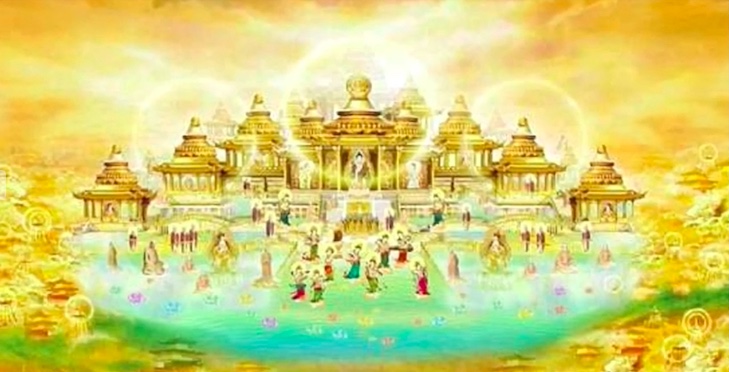
When Zhaxi Zhuoma’s close relative died, she asked H.H. Dorje Chang Buddha III, “What should I do?” As a result of her sincere request, H.H. Dorje Chang Buddha III performed a very wonderful and amazing ceremony that enabled her to see her relative, actually go to the Western Paradise of Ultimate Bliss (Sukhavati). This is a very high ritual of the Supreme Yoga Vajra Division, which cannot be discussed in detail with those who have not received initiation. However, she was able to report that she actually witnessed with her own eyes the miraculous scene where this person was transported to the sixth level of this Buddha-land that is beyond the worldly realms of suffering and sorrow. There are nine levels all together in the Western Paradise of Ultimate Bliss. This is the highest tier of the middle level, known as the Zhong Pin Shang Sheng in Chinese.
The picture of this person quivered in her hands as the ceremony began. It seemed that he could hardly wait. Or was this in response to the extraordinary dharma powers of the H.H. Dorje Chang Buddha III? It was a glorious and marvelous sight! There are no words that can express the joy she experienced when this event took place. His Holiness explained that this was because she was able to obtain a “glimpse” of the bliss that occurs in the Western Paradise. There is no other Dharma King or master who can do this! It was incredible!
Earlier H.H.Dorje Chang Buddha III allowed Zhaxi Zhuoma to see the sufferings of Hell. Now she was able to experience the bliss of the Western Paradise. The Petitioning the Western Paradise of Ultimate Bliss Dharma is a very high and special dharma that is rarely practiced in this world. Many people want to go to the Western Paradise, but can’t. They would like to receive this dharma or have it performed for their loved ones, but can’t. Zhaxi Zhuoma said, “I have been with H.H.Dorje Chang Buddha III for six years and seen him perform very many forms of inner tantric initiations and received some, but this is the first time that I have seen him perform this particular dharma. It was only through the maturing of certain causes and conditions that this ritual was successfully performed.“
“My dear relative, who was ninety when he died, had been a good Christian man, but knew nothing of Buddhism. His only contact with Buddhism had been through knowing me, although he had also met my younger vajra sister, Ven. Akou Lamo Rinpoche, in 2003 when we briefly visited him while on tour of the U.S.. Ven. Akou Lamo Rinpoche is a great rinpoche from Tibet and also a close disciple of H.H.Dorje Chang Buddha III . I am sure we were the only Buddhists he had ever even heard of, let alone met. “ This person had lived a good life and was very kind and generous, being willing to go to great lengths to help those who needed help. His immediate family, who are all also good Christians, were quite certain that he would go to the Christian heaven, but who would have thought that he would have had the good fortune to escape the realm of reincarnation altogether?
He had, after all, also been an avid hunter and fisherman and had killed many living beings in his life. With such negative karma, how could he be reborn in heaven? Needless to say, it would be even more impossible for him to go to the Western Paradise. But H.H. Dorje Chang Buddha III’s Buddha-dharma is so magnificent! I could actually witness my relative going to this superb Buddha-land and enjoying the incomparable happiness one finds there. His Holiness told me, ‘You are a rinpoche. That is why you can see this.’
“I was horrified when the minister giving the eulogy at my relative’s funeral praised him for teaching his grandchildren how to fish. I wanted to cry out “How can you praise someone for teaching children how to kill?” but I held my tongue and remained silent. In this rural community and this culture, hunting and fishing are very important, both for food and for pleasure. They do not understand the principles of either reincarnation or karma. It is only through the incredible merit, dharma skills, and great compassion of the H.H.Dorje Chang Buddha III that this could happen.
“Just eleven days after my relative left this world, his wife also left. She was also ninety. H.H. Dorje Chang Buddha III was also able to raise her consciousness so that she could join her husband in the Western Paradise. I saw the Buddhas and Bodhisattvas come to the sacred mandala to receive her and witnessed their acceptance of her into the Western Paradise. This was a different ceremony held at a different mandala. At first it looked as though she might not be able to make it. H.H. Dorje Chang Buddha III went back and practiced the dharma a second time. This time he was able to send her to this paradise of eternal joy and happiness.
She, too, had been a good Christian, but knew nothing about Buddhism. She also did not have the good fortune to meet Ven. Akou Lamo Rinpoche. However, she was still able to go to the Western Paradise. It was so amazing. This was because of the incredible compassion and Buddha-dharma powers of H.H. Dorje Chang Buddha III Wan Ko Yeshe Norbu Holiest Tathagata. The Buddha-dharma is magnificent!”
In 2004 H.H.Dorje Chang Buddha III performed another ceremony to raise the consciousness of Zhaxi Zhuoma’s non-Buddhist parents, Carl and Elsie Welker, to a higher realm as well. At that time she saw the Dharma Protecting Deities come to perform this rite. She was very, very grateful to her vajra master for his kindness and compassion in blessing her dear relatives. These miraculous Buddha-dharma events, performed for those who had not practiced or known anything about Buddhism, were all due to the amazing merit and compassion of H.H. Dorje Chang Buddha III Wan Ko Yeshe Norbu. He was willing and able to share his boundless merit with these non-Buddhist to enable them to enjoy the blessings of Amitabha Buddha’s Western Paradise. This was a great teaching on compassion and true equanimity.
REINCARNATION:
H.H. Dorje Chang Buddha III reminded us that we must realize that reincarnation is not something that just exists for Buddhists or easterners. It existed before the coming of the Buddha or before Jesus and continues to exist even after they have left this realm. It is a fact based on the principles of cause and effect. It does not exist because people believe in it or talk about it—it just exists. Nor does reincarnation cease to exist just because people do not accept it or believe in it. Only the Buddha was able to see how the cycle of reincarnation worked and to realize the method for escaping the suffering that is inherent in continual rebirth in the six realms of existence. Only a Buddha is capable of understanding the workings of karma.
Some concept of “heaven” or a “happy hunting ground” or “paradise” is held by most religions. Buddhism recognizes these realms as well, but does not hold the various heavens or abodes of the gods (devas or angels) and other celestial beings to be the goal of spiritual practice. They could be viewed as a “rest stop” or a nice vacation site, as one can surely go to these wonderful places if one lives a good life, avoids evil, and accumulates sufficient “merit.” However, even in heaven, when one’s merit is used up (and it is very hard to accumulate more merit while in those realms—the pleasures are just too great), one must still be reborn and repay one’s karmic debts.
There is even no guarantee that living a good life is enough to enable you to have a good next life, for your karma from past lives may catch up with you on your next round. Only by becoming a holy or enlightened being (or saint), can one escape the cycle of reincarnation and the suffering of existence. The early Christians also believed in reincarnation, as do many Christians today, but it is not accepted as Christian dogma. There are two dharmas whereby one can go to the Western Paradise. One dharma involves repeatedly reciting Amitabha Buddha’s name. The other is Petitioning the Western Paradise of Ultimate Bliss Dharma, which is a very high and special dharma that very few people who have lived in this world could perform. Shakyamuni Buddha and the Ugyen Second Buddha, Great Dharma King Padmasambhava, could do it, as could great holy dharma kings after them. H.H. Dorje Chang Buddha III Wan Ko Yeshe Norbu, however, is more accomplished than any of these dharma kings.
No wonder H.E. Tangtong Gyalpo Great Bodhisattva, who was once the leader of the four main sects of esoteric Buddhism, wrote a congratulatory letter highly praising H.H. Dorje Chang Buddha III Wan Ko Yeshe Norbu’s proficiency in both esoteric and exoteric Buddhism and his wonderful mastery of the five vidyas. That letter also praised His Holiness as being the first person in history to accomplish this. Zhaxi Zhuoma said that “to my knowledge, His Holiness is the only living vajra master who can perform such a ceremony involving great dharma and have the Buddhas and Bodhisattvas come to the sacred altar to help the deceased reach this high level of achievement. We are very fortunate to have such a holy one with us here in America.”















 Peace LiLy