The Art of Graceful Living: Lessons from Yang Jiang on Simplicity and Inner Peace

Yang Jiang, my favorite contemporary female writer, lived a life intertwined with the turbulence of her times, yet she remained as pure and free as a cloud in the sky. Her works not only reveal the beauty of literature but also inspire us on how to maintain inner peace and composure amidst the chaos of the world.

Yang Jiang’s translation of the poem, “I compete with no one, and I disdain competing with anyone; I warm my hands by the fire of life, and when it dims, I am ready to go,” reflects her entire life. In her quiet dignity and grace, she transformed the hardships of life into something serene and beautiful, never letting bitterness take root.

Her unassuming nature is perhaps her most remarkable quality. While many chase after fame and recognition, Yang Jiang focused purely on her love for knowledge. Her reading, writing, and translation work were not for the sake of recognition, but for the joy of learning. In her essay “The Invisibility Cloak,” she explains that humility is the best protection in a complicated world. By not seeking heights, one doesn’t fear falling; by avoiding ambition, one retains a sense of innocence and inner calm. Yang Jiang embodied this wisdom throughout her life. During the Cultural Revolution, when she was assigned the humbling task of cleaning toilets, she used the opportunity to find freedom in adversity, relishing the quiet moments to read and reflect.
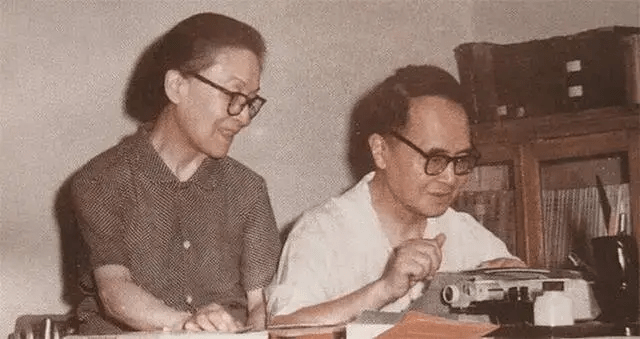
Yang Jiang and her husband Qian ZhongShu

“Simple living and a noble soul are the highest realms of life,” she once said. This was not just a belief but a guiding principle for Yang Jiang. She valued her time deeply, distancing herself from superficial socializing and instead focusing on self-cultivation. Together with her husband, Qian Zhongshu, they shared a simple, intellectual life, each respecting the other’s need for space and quiet to work. After her husband’s passing, Yang Jiang withdrew even further from the world, spending her days immersed in writing and editing.

At the age of 92, Yang Jiang published her essay collection We Three, which received widespread acclaim. Even at the age of 103, she was still active in compiling and publishing The Complete Works of Yang Jiang, a reflection of her lifelong dedication to literature.

It was her ability to remove herself from the distractions of life that allowed her to create works of such lasting value.

Her translation of the eight-volume Don Quixote, once the best-selling Chinese version, drew criticism at one point as a “negative example.” Many writers rushed to her defense, but Yang Jiang responded with characteristic humility: “I sincerely declare that I am a humble translator. I have revised my translation over and over, and still feel it’s not good enough. I hope the experts will offer their guidance.” Her modesty and openness to improvement reflect the calm confidence she carried throughout her life.

In her book Walking on the Edge of Life, she wrote, “We once yearned for the waves of fate, only to realize in the end that the most beautiful scenery in life is the inner calm and composure.” This sentence captures the essence of her wisdom. She knew that, amid the noise and complexity of the outside world, it is the peace we cultivate within that is the most precious.

Yang Jiang rarely wore makeup, preferring to show her natural face to the world. This was not just about simplicity in appearance but about a deeper confidence and acceptance of her true self. She believed that external beauty was far less important than the richness of one’s inner life. As she wisely said, “A woman’s greatest strength is not how beautifully she dresses, but the ability to make herself happy no matter what happens.”

Through her life, Yang Jiang has shown us that even in the face of life’s greatest challenges, it is possible to maintain elegance and beauty by nurturing simplicity and inner richness. Her wisdom and grace continue to inspire us to live with quiet strength, away from the distractions of the world, focused on what truly matters.

Link: https://peacelilysite.com/2024/10/03/the-art-of-graceful-living-lessons-from-yang-jiang-on-simplicity-and-inner-peace/

#YangJiang #QianZhongShu #WeThree #WalkingontheEdgeofLife #InnerPeace #Wisdom #Simplicity

The Seven Treasures of True Wealth

In this world, which sentient being does not desire great wealth? Which of us does not seek blessings and fortune? But what truly defines wealth? Most people measure it by the amount of money they have, the assets they own—be it real estate, cars, or stocks. These tangible things may seem like wealth, but they are easy to lose.

Money and jewels cannot provide lasting security—they can be stolen by thieves.
Reputation and status cannot guarantee stability—enemies can destroy them.
Family and friends are not unshakable—they can change as people’s hearts do.
Illness, aging, and death remind us that the body itself is fragile and impermanent.
Fate and fortune cannot be relied upon—karma follows us, shaping our circumstances.

So, what is the true wealth that we can hold onto in this fleeting lifetime?

Over 2,500 years ago, Shakyamuni Buddha illuminated the path to real wealth—wealth that transcends the material and leads to lasting peace and wisdom. He shared the Seven Treasures of Life, invaluable treasures that guide us to inner fulfillment and enlightenment. These treasures cannot be stored in vaults or spent like gold and jewels. They are the true treasures that nurture the soul.

The Seven Treasures:

  1. The Treasure of Faith
    This is the deep trust a disciple places in the Buddha’s awakening. It is unwavering confidence in the truth of the Buddha’s enlightenment and teachings. Faith is the compass that keeps a person on the path of liberation, a guiding light through life’s trials.
  2. The Treasure of Integrity
    Integrity means living in alignment with one’s highest principles. It manifests as abstaining from harmful actions—whether through speech, thought, or deed. A person with integrity refrains from violence, stealing, falsehood, and indulgence in intoxicants. Integrity is the treasure of a life well-lived with honesty, respect, and compassion for all beings.
  3. The Treasure of Self-Respect
    This treasure is found in the heart of those who uphold their dignity and honor. Self-respect means feeling shame at the thought of misconduct and avoiding actions that degrade one’s character. A person who treasures self-respect lives with a deep sense of morality and avoids causing suffering.
  4. The Treasure of Responsibility
    This treasure reflects an understanding of the consequences of one’s actions. It is a profound sense of accountability for one’s choices, knowing that every action—whether good or bad—impacts oneself and others. Responsibility is driven by a genuine concern for well-being, not out of fear, but from love and care.
  5. The Treasure of Learning
    Learning is the treasure of an eager and inquisitive mind. It is the pursuit of wisdom through listening, reflecting, and studying the teachings. A disciple who treasures learning delves into the Dharma, growing in understanding, and cultivating insight that transforms their perception of life.
  6. The Treasure of Generosity
    This treasure resides in an open and giving heart. It is the joy of sharing wealth, time, and kindness without clinging to material things. A generous person delights in helping others and is always ready to support those in need. Generosity brings happiness both to the giver and the receiver, and it enriches the soul beyond measure.
  7. The Treasure of Wisdom
    Wisdom is the crown jewel of all treasures. It is the deep understanding of life’s impermanence and the realization that clinging to fleeting things leads only to suffering. With wisdom, one sees the world as it truly is, cultivating peace, detachment, and the ability to make decisions that lead to lasting happiness.

True Wealth Beyond Material Possessions

Shakyamuni Buddha shared these seven treasures with his disciples, emphasizing that true wealth is not measured by material abundance but by these inner riches. Whether man or woman, young or old, those who possess these treasures are truly wealthy. Their lives are meaningful, filled with purpose, and unshaken by the ups and downs of worldly fortunes.

So, what can we learn from these timeless teachings?

Cultivate faith and integrity,
Grow in generosity and wisdom,
Walk the path with responsibility and learning,
Always remembering the teachings of the Buddhas,
for they are the guideposts to inner peace, fulfillment, and the truest wealth.

Link:https://peacelilysite.com/2024/09/26/the-seven-treasures-of-true-wealth/

Source: https://wisdomtea.org/2024/09/13/treasure/

The Legacy of Dou Yanshan: A Story of Kindness, Virtue, and the Law of Cause and Effect

When I was a child, I read The Three Character Classic (三字经) and came across a verse: “Dou Yanshan, of righteous conduct, taught five sons, all became famous.” At the time, I didn’t realize how much meaning was packed into these simple lines. Later, I learned that they tell a profound story. Dou Yanshan’s life and deeds provide undeniable proof of the law of cause and effect, offering a timeless moral lesson for the world. I would like to share Dou Yanshan’s story with you.

Dou Yujun, also known as Yanshan due to his home in Youzhou (part of the Yan region), lived during the Later Jin period of the Five Dynasties. He lost his father at a young age, and was raised solely by his mother, to whom he showed deep filial respect, never daring to disobey her. At that time, most men married in their twenties, and by the age of thirty, if they had no children, they would worry about their lineage. Dou Yujun, still childless in his thirties, was deeply concerned about his future.

One night, Dou had a dream where his deceased grandfather appeared and said, “Yujun, your past life’s negative karma is heavy, which is why in this life, you are not only childless but also destined for a short life. My dear grandson, turn your heart toward goodness. Perform acts of kindness and help others. Perhaps by doing so, you may change your fate.” Upon waking, Dou remembered every word of his grandfather’s message. From that moment, he vowed to avoid all evil and pursue only good deeds.

One example of his kindness involved a servant who had stolen twenty thousand taels of silver. Fearing punishment, the servant wrote a bond stating that he was selling his young daughter to repay the debt and then fled. When Dou discovered this, instead of punishing the girl, he burned the bond and raised her as his own. When she grew up, he even arranged a marriage for her, providing a dowry.

On New Year’s Day, Dou went to Yanqing Temple to pray and found 200 taels of silver and 30 taels of gold near a meditation cushion. Believing it to be someone’s lost property, he waited in the temple for the owner to return. After some time, a man arrived, crying in distress. Dou asked him what was wrong, and the man explained, “My father has been captured by bandits, and after much effort, I gathered 200 taels of silver and 30 taels of gold to ransom him. But now I’ve lost everything!” Dou, realizing this man was the rightful owner, returned all the silver and gold and even gave him additional travel money. The man left, filled with gratitude.

Dou Yujun was known for his many acts of kindness. When friends or relatives couldn’t afford coffins for their deceased, he provided them. When children of poor families had no means to marry, he paid for their weddings. He lent money to those in need so they could start businesses, helping countless people survive. Despite his generosity, Dou lived a frugal life. Each year, after setting aside the necessary expenses for his family, he used the rest of his income to help others. He even established forty schools, collected thousands of books, and hired teachers of high moral character to educate the youth. He paid the tuition of poor students, helping cultivate many outstanding individuals.

One night, Dou had another dream in which his grandfather appeared again, saying, “You have done many good deeds. Because of your great virtue, Heaven has extended your life by thirty-six years and will bless you with five noble sons, all of whom will achieve great success. When your time comes, you will ascend to Heaven.” His grandfather added, “The law of cause and effect is absolute. The consequences of good and evil deeds may appear in this life, in the next, or in the lives of your descendants. Heaven’s justice is unerring.”

After this, Dou Yujun continued to cultivate virtue with even greater diligence. Eventually, he had five sons, and due to his strict and righteous upbringing, they were all disciplined, harmonious, and filial. All five sons passed the imperial examinations and achieved high positions: his eldest, Dou Yi, became a Minister of State; his second, Dou Yan, became a Hanlin Academician; his third, Dou Cheng, served as Deputy Prime Minister; his fourth, Dou Kan, was an Imperial Chronicler; and his youngest, Dou Xi, became Assistant to the Minister of the Left. Even his eight grandsons achieved prominence. To honor Dou’s achievements, the imperial official Feng Dao wrote a poem:
“Yanshan’s Dou family, with righteous teachings, raised five sons, all blossoming like red laurels.”

Dou himself lived to the age of eighty-two. He predicted the time of his passing, bid farewell to his friends, bathed, dressed in clean clothes, and passed away peacefully.

The law of cause and effect is undeniable. Whether the consequences of good deeds are seen in this life, in the lives of one’s descendants, or in future reincarnations, they are inevitable. Dou Yujun not only enjoyed a long life and wealth, but his descendants also prospered, and his peaceful death is a testament to the blessings awaiting him in his next life. His vast and profound kindness brought him blessings in this life, in the lives of his descendants, and in the afterlife.

The renowned Song Dynasty scholar, Fan Zhongyan, used Dou Yujun’s story to teach his own children about the importance of good deeds, leading to the prosperity of the Fan family. While many people knew about Dou Yujun’s deeds, few truly acted on them. It is like entering a treasure mountain and leaving empty-handed. What a missed opportunity that would be!

Link:

A True Friend

Once, in a quiet monastery nestled in the hills, the Buddha sat before his disciples. The evening sun painted the sky in hues of gold and crimson, and the air was filled with a profound stillness, broken only by the occasional rustling of leaves in the gentle breeze. The monks, eager for wisdom, sat in reverence as the Buddha began to speak.

“Monks,” the Buddha said, “in this world, there are many who come and go in our lives. Some pass by like the wind, leaving no trace, while others remain, their presence felt deeply in our hearts. Among those who remain, there is a rare kind of person, a true friend, who is like a shelter from life’s storms, a beacon of light in the darkest of times. Such a friend is endowed with seven precious qualities, and these qualities are worth cultivating, for a friend like this is rare indeed.”

The monks listened attentively as the Buddha continued, “Which seven qualities are these? First, a true friend gives what is hard to give. He does not withhold generosity, even when it is difficult. Whether it be his time, his effort, or his possessions, he offers them freely, without hesitation. This kind of giving is rare, for many are willing to give when it is convenient, but few give when it costs them something.”

The Buddha paused, letting his words sink in, then added, “Second, he does what is hard to do. A true friend will go beyond his comfort zone for the sake of his companion. He will stand by you when others shy away, face challenges with you, and make sacrifices when needed, not for his own gain, but for the sake of friendship.”

The monks reflected on this as the Buddha continued, “Third, he endures what is hard to endure. Life is not always easy. There are times of joy, but also times of suffering and hardship. A true friend remains steadfast during the difficult times. He does not flee when the winds of adversity blow; instead, he endures alongside you, bearing the weight of the struggle as if it were his own.”

Then, the Buddha smiled softly and said, “Fourth, he reveals his secrets to you. Trust is the foundation of true friendship. A true friend does not hide behind a mask or shield himself with falsehoods. He shares his heart with you, revealing his vulnerabilities, knowing that in doing so, the bond of trust between you will grow ever stronger.”

“Fifth,” the Buddha continued, “he keeps your secrets. Just as he trusts you with his, so too does he honor your trust. He safeguards what you confide in him, never betraying your confidence, never allowing the winds of gossip to carry away what you have entrusted to him.”

The Buddha’s voice softened as he spoke of the sixth quality. “When misfortunes strike, he doesn’t abandon you. Life is unpredictable, and at times, suffering may come upon you like a sudden storm. A true friend does not turn his back on you in these moments. He stands beside you, offering support, comfort, and strength. He is like a tree with deep roots, unshaken by the winds of fate.”

Finally, the Buddha said, “The seventh quality is this: When you’re down and out, he doesn’t look down on you. In times of failure or disgrace, when the world seems to turn its back on you, a true friend remains by your side, never judging, never scorning. He sees you not for your misfortune, but for who you truly are. His respect for you does not waver, even when you are at your lowest.”

The monks, inspired by these words, bowed their heads in gratitude as the Buddha’s voice grew gentle. “Such a friend, endowed with these seven qualities, is a rare and precious gift. He gives what is beautiful yet hard to give, does what is hard to do, and endures the bitter words that life may bring. His heart is open to you, and he protects your heart in turn. In the darkest of times, he will not leave you, and even when you falter, his love for you does not falter.”

The Buddha paused for a moment, letting the weight of his words fill the air before continuing, “To cultivate such a friendship is a blessing for both parties. A friend like this is not just a companion but a guide, a mirror that reflects your virtues and helps you grow. Such a bond nurtures the spirit and brings peace to the heart. Therefore, monks, seek to be such a friend. Cultivate these seven qualities within yourself, and you will draw others of similar virtue to your side.”

The monks looked at one another with renewed purpose, understanding now that friendship was not a simple matter of convenience or shared interests but a profound practice of giving, endurance, and trust. The Buddha’s words had opened their hearts to the deeper meaning of companionship, and they resolved to embody the qualities of a true friend in their own lives.

And so, as the evening deepened and the stars began to appear in the sky, the monks rose, filled with a sense of peace. They knew that in cultivating these seven qualities, they would not only find true friends but would become true friends themselves—vessels of compassion and wisdom in a world often marked by fleeting connections.

The Buddha smiled as he watched them depart, knowing that the seeds of his teaching had taken root in their hearts, and that in time, they would bear the fruits of deep and enduring friendships, blessed with the seven qualities of a true friend.

Link: https://wisdomtea.org/2024/09/05/a-friend/

The Green Tara Perfect Practice Ritual and Thangka: A Marvel of Compassion and Artistry

The Revered Practice of Green Tara: A Journey Through Time

Avalokiteshvara Bodhisattva, from beginningless eons, has been tirelessly saving countless sentient beings with his immense compassionate power. Despite his boundless efforts, he felt a sense of inadequacy. Thus, from the power of samadhi born of great compassion, he formed an immense compassionate force. This force, combined with the great compassionate power of Buddhas from the ten directions, resulted in a drop of green tear flowing from his eye, transforming into the infinitely majestic green female Bodhisattva, known as Green Tara. Due to this origin, Tara’s power to save is boundless and infinite.

Green Tara is revered as the Great Compassionate One and the Holy Savior Mother Buddha. The practice of the Green Tara ritual has a rich history that originated in India and later spread to China, Tibet, Japan, and beyond. The sacred roots of this practice trace back to Green Tara herself, who was initially the ancient Buddha Pravartaka and an incarnation of Avalokiteshvara Bodhisattva.

Chanting the Green Tara mantra even once, with focused contemplation of Tara’s sacred image, brings immense merit. Such merit is equivalent to chanting the names of seventy-two billion Buddhas and Bodhisattvas as numerous as the sands of the Ganges. Both the exoteric and esoteric traditions have extensive practices based on this ritual, and many practitioners have achieved great success and benefit from it.

Over time, the original texts and mandalas related to this profound practice have suffered from omissions and distortions in their transmission. For the past two hundred years, these deviations have increasingly moved away from the authentic regulations. In recent decades, the practice has nearly completely lost its true essence. Furthermore, the representations of Green Tara have deteriorated in form, lacking the dignity of the authentic appearance. This includes discrepancies in hand mudras, attire, and overall sacred depiction, resulting in a significant loss for the Buddhist community.

The Green Tara Perfect Practice Ritual and Thangka by H.H. Dorje Chang Buddha III

In response to these issues, H.H. Dorje Chang Buddha III transmitted the “Green Tara Perfect Practice Ritual” and personally supervised the creation of the Green Tara mandala thangka.

This three-dimensional thangka is not only lightweight and portable, making it easy to carry, but also presents the mandala clearly and vividly, ensuring that it remains etched in memory. Additionally, it possesses several extraordinary merits:

  1. Authenticity and Compliance: The Green Tara mandala presented in the thangka fully complies with the regulations of the “Green Tara Perfect Practice Ritual.” This ensures that the practice remains true to its original form.
  2. Historical and Miraculous Significance: Tara had already attained Buddhahood countless eons ago, her divine power is illustrious, and her sacred deeds are well-documented. Today, in the “Tara Hall” in Nethang, Tibet, the sacred statue of Tara once spoke to Atisha, instructing him, further propagating her holy name and Dharma power across China and Tibet. During the creation of this three-dimensional thangka, many miraculous occurrences were witnessed. For example, the sacred image of Tara, originally looking straight ahead, appeared differently in subsequent photographs taken from the same angle: one showed her looking up at the sky, while the other depicted her looking down at sentient beings. This clearly demonstrates Avalokiteshvara Bodhisattva’s extraordinary vow power: above, he shares the same compassionate force with all Buddhas and Bodhisattvas; below, he joins in compassionate aspiration with all sentient beings in the six realms. Additionally, when viewed from different angles, the main deity of Green Tara always faces the observer, and the seed syllables in the sky behind her follow her movement, appearing above her head. Furthermore, the colorful clouds, initially close to the sun and moon, seem to remain stationary while the sun and moon move vividly between the clouds from different perspectives.
  3. Majestic and Unmatched Representation: The sacred image of Green Tara in the thangka is exceptionally majestic and perfect, unrivaled in both China and Tibet throughout history. The twenty Taras, each with different postures, exhibit supreme Dharma power, arranged behind the main deity, appearing and disappearing miraculously. Notably, standing in different positions reveals the Great Brahma Deva, the primary protector, initially as one, then suddenly as two, and then back to one again, a phenomenon unprecedented in history! Meanwhile, the Four Great Heavenly Kings and the Eight Dragon Kings remain unchanged. Additionally, Indra, the Four Great Heavenly Kings, and the retinue of the Eight Dragon Kings, wielding their divine weapons and instruments, surround and protect Tara with unmatched divine transformation. Visualizing this thangka makes the practice highly effective and rapidly fruitful.

Validation and Praise

Upon the completion of the “Green Tara Perfect Mandala Thangka,” Buddha Master specifically instructed disciples to bring all existing Green Tara statues of various materials from around the world to the Vajra Dharma Circle for public verification. They were to determine which one is the most orthodox and perfect thangka. The Vajra marbles immediately entered the mandala thangka, confirming that the Buddhas and Dharma protectors of the ten directions unanimously endorsed it.

Many of the seven classes of Buddhist disciples, upon practicing with this three-dimensional thangka, experienced unprecedented and unique realms. High monks, living Buddhas, and even Dharma Kings from around the world have all respectfully praised and recommended this rare and precious sacred image. In truth, among all the existing Green Tara images, none can compare to the perfection and majesty of this mandala thangka. Its blessing power is extraordinarily miraculous; a single glance imprints it deeply in the mind, leaving a lasting impression.

The Green Tara Perfect Practice Ritual and its accompanying thangka, as transmitted and supervised by H.H. Dorje Chang Buddha III, represent a revival of the authentic practice of Green Tara. This thangka not only restores the true essence of the practice but also enhances the spiritual experience for practitioners worldwide, offering unparalleled blessings and merits.

Link:https://peacelilysite.com/2024/08/01/the-green-tara-perfect-practice-ritual-and-thangka-a-marvel-of-compassion-and-artistry/

Source: https://www.brxuefo.com/5970.html , https://www.brxuefo.com/6849.html

Listening to the Dharma

Listening to the Dharma

There are these five rewards in listening to the Dharma. Which five?

Firstly, one hears what one has not heard before. By listening to the teachings, individuals are exposed to new insights and wisdom that they had not previously encountered, enriching their understanding and broadening their perspective.

Secondly, one clarifies what one has heard before. The act of listening allows individuals to deepen their comprehension and gain clarity on teachings they may have heard previously but did not fully understand. This repetition and elaboration help solidify their grasp of the concepts.

Thirdly, one gets rid of doubt. The Dharma provides answers and explanations that resolve uncertainties and questions in the listener’s mind. Through the teachings, one finds reassurance and a clearer path forward, dispelling confusion and hesitation.

Fourthly, one’s views are made straight. Listening to the Dharma helps align one’s thoughts and beliefs with the truth. It corrects misconceptions and guides the listener toward right understanding, ensuring that their views are in harmony with the teachings.

Lastly, one’s mind grows serene. The wisdom imparted through the Dharma brings peace and tranquility to the mind. As one absorbs and reflects on the teachings, the agitation and restlessness of the mind diminish, leading to a state of calm and serenity.

These are the five rewards in listening to the Dharma. Each reward contributes to the listener’s spiritual growth and well-being, making the practice of attentive listening profoundly beneficial.

Link: https://wisdomtea.org/2024/07/11/listening-to-the-dharma/

Discovering Meaning in Adversity: Lessons from Viktor Frankl’s ‘Man’s Search for Meaning’

In his profound book “Man’s Search for Meaning,” psychologist Viktor Frankl imparts crucial lessons on finding meaning in our lives. The book is divided into two parts: the first half comprises the author’s semi-autobiographical narrative of life in a concentration camp, retaining insights and thoughts from the perspective of a refugee. Frankl, with the keen observational eye of a psychologist, categorizes the camp’s inhabitants into two main groups. Those who survived were invariably those who found meaning in life and clung to a shred of hope to keep moving forward, although many of them did not persevere until the end. Those who deemed life meaningless, lost the will to live, and had no hope, inevitably perished.

The second half delves into the fundamental concepts of logotherapy from a psychological perspective. Observations from the refugee camp are documented and internalized into the author’s own “logotherapy,” aiding patients—or ordinary people like us—in finding meaning in life and living their unique existence. The author advocates against determinism, emphasizing the importance of individual choice over environmental determinism.

Frankl, a Jewish psychiatrist imprisoned in the Auschwitz concentration camp, experienced a tumultuous journey of emotions. Before Christmas in 1944, rumors spread in Auschwitz that the war would end and everyone would be released, yet after Christmas passed without the anticipated victory, hopelessness descended, resulting in the death of 80% of the camp’s inhabitants—not from hunger and cold, but from the loss of hope. Frankl survived because two things mattered to him: his family, especially his love for his wife, which provided him with immense motivation during times of suffering, and his manuscript, his work on the psychological “logotherapy” he aimed to complete. These two things were bigger than himself, sustaining him through the ordeal.

This book stands out among numerous works because it encompasses both the author’s personal harrowing experiences and the detached observations of a scientist. From the outset, the author states his reluctance to write a mere chronicle of the concentration camp but rather aims to answer one question: “What psychological journey does an ordinary prisoner go through each day in the camp?” His observations focus on the silent, anonymous inmates’ reactions to their environment, including his own.

What fascinates me most is the author’s earnest yet transcendent perspective. Grounded in his own inner being, he strives for honesty without self-pity or complaint, maintaining a clinical detachment that rises above the harsh realities of the time. This writing style and attitude reveal both his resilient spirit and remarkable clarity of mind, as well as his profound understanding of his inhuman conditions, rendering emotional catharsis unnecessary.

At times, he detaches himself from his immediate surroundings, engaging in imaginary dialogues with his beloved wife, allowing love to fill his heart. The ability to detach oneself from reality using imagination is a unique human skill that aids survival in extreme adversity.

His theory posits that the search for meaning in life is the fundamental driving force of human existence. This meaning is unique and individual, requiring realization and practice by each person; only through this realization can one’s will to meaning be fulfilled. The aim of “logotherapy” is to aid individuals in uncovering the meaning in their lives. This meaning varies for each person and changes at different life stages, necessitating personal exploration. Once discovered, it provides hope for easing the neuroses arising from a lack of meaning in life. Meaning in life is concrete and tangible. For instance, a mother may find meaning in living for her children. I wholeheartedly concur with the author’s view that the meaning of life is not fixed. The sustenance it provides varies at different ages and stages of life. For instance, there was an elderly man who had been depressed for two years after losing his wife, seeking assistance from Frankl. When asked what his wife would do if he had passed away before her, the man responded that she would not be able to bear such pain. Frankl then remarked, “So, she left first. You can bear the pain for her to rest in peace. Isn’t that good?” The man felt relieved upon hearing this. He found the meaning of his life at that time.

According to author, there are three paths to finding meaning in life: 1. Creativity and work; 2. Recognizing values (such as love); 3. Suffering. Frankl firmly believes that everyone can find meaning in life, whether through creativity and work, experiencing something or loving someone, or, in extreme circumstances, when all joy is stripped away, unavoidable suffering itself becomes the meaning of life. From his experiences in the concentration camp, he realized the third path.

In extreme adverse conditions, when a person is reduced to nothing but their body and mind, they still retain the freedom to choose their attitude towards their environment. They can either actively and arduously utilize every condition to survive or succumb to the desire to die, yielding to fate. The choice of attitude is the only and complete dignity and meaning. And humans can choose to say “yes” to life.

Therefore, Frankl is a pessimistic optimist. He acknowledges that life itself is inherently meaningless, yet he is willing to inspire humanity to find meaning for themselves. His mission in existential psychiatry is to help patients find their own meaning in life through various methods. In contrast to psychoanalysis, which views humans as passive products of their environment, Frankl places human subjective will in a more significant position.

I cannot disagree with Frankl’s viewpoint. From my own half-century of life experience, I also believe that the attitude we adopt towards our environment, whether favorable or adverse, ultimately determines the trajectory of our lives. This is what I mean by “character determines destiny.” There are times of despair, hopelessness, and pessimism, of course, and there is no need to feel ashamed. We should learn to pull ourselves out of negative emotions and sincerely believe that “tomorrow will be better.” And indeed, tomorrow often turns out fine.

Nine powerful quotes from the book Man’s Search for Meaning

  1. Choose hope. We cannot always change our circumstances but we always have a choice about our attitude in any given situation. As Viktor Frankl writes, “When we are no longer able to change a situation, we are challenged to change ourselves.”*
  2. Know your why. Ask yourself: What am I living for? Every single day, we should ask ourselves why we are getting up and why we are here at all “Those who have a ‘why’ can bear with almost any ‘how’.”
  3. Learn how to cry. Tears are not a sign of weakness; they emanate from a soul that is not afraid to break: “But there was no need to be ashamed of tears, for tears bore witness that a man had the greatest courage, the courage to suffer.”
  4. Don’t just be part of the herd. The world is upside down; sometimes doing what everyone else is doing is what is insane. “An abnormal reaction to an abnormal situation is normal.”
  5. Live meaningfully. We create meaning by answering the questions life asks from us. “Ultimately, man should not ask what the meaning of his life is, but rather must recognize that it is he who is asked. In a word, each man is questioned by life and he can only answer to life by answering for his own life. It did not really matter what we expected of life, but rather what life expected of us.”
  6. Fill your day doing acts of kindness. There is purpose in kindness; there is meaning in the hundreds of small acts of giving that we have the opportunity to grasp each day. “We who lived in concentration camps can remember the men who walked through the huts comforting others, giving away their last piece of bread. They offer sufficient proof that everything can be taken from man but one thing: the last of the human freedoms-to choose one’s own way.”
  7. Move beyond yourself. We find true meaning when we transcend our own needs and limits. “The more one forgets himself – by giving himself to a cause to serve or another person to love – the more human he is and the more he actualizes himself.”
  8. Feel the pain of others. Suffering hurts no matter how irrelevant or ordinary it may seem to others. Be attuned to others’ grief even if doesn’t seem like a tragedy in the overall scheme of life. “Thus suffering completely fills the human soul and conscious mind, no matter whether the suffering is great or little. Therefore, the ‘size’ of human suffering is absolutely relative.”
  9. We can change even when life is hard. We can create meaningful lives full of depth and love and purpose. “Man does not simply exist but always decides what his existence will be, what he will become the next moment. By the same token, every human being has the freedom to change at any instant.”

Link:https://peacelilysite.com/2024/05/10/discovering-meaning-in-adversity-lessons-from-viktor-frankls-mans-search-for-meaning/

Source: https://aish.com/viktor-frankl-on-mans-search-for-meaning/?utm_source=googlegrants&utm_medium=cpc&utm_campaign=19561819333&utm_term=&gad_source=1&gclid=Cj0KCQjwxeyxBhC7ARIsAC7dS39s79sG7BUeoDswcsOBoRwlH6T6GmrNQQI4sy3uRqgCvyLnNNoEQooaAo9EEALw_wcB, https://book.douban.com/subject/5330333/reviews

Karma cannot be Seen or Touched. Does It Really Exist?

What is karma?

Karma, in Sanskrit known as ‘karma,’ is the creator of deeds of body, speech, and mind, producing both good and evil without forgetting. It is also like the causes created by the three activities, which manifest as their results.

The force of karma leads to the consequences of suffering or happiness based on its nature, whether good or evil. Therefore, there is also the doctrine of karma and its consequences. Karma accumulated in the past is referred to as past karma; karma in the present is referred to as present karma.

The law of karma is a special instance of the law of cause and effect, according to which all our actions of body, speech and mind are causes and all our experiences are their effects. Certainly, perhaps some people might ask, “This ‘karma’ you speak of, I can neither see it nor touch it. Does it really exist?”

The law of karma explains why each individual has a unique mental disposition, a unique physical appearance and unique experiences. These are the various effects of the countless actions that each individual has performed in the past. We cannot find any two people who have created exactly the same history of actions throughout their past lives, and so we cannot find two people with identical states of mind, identical experiences or identical physical appearances. Each person has different individual karma. Some people enjoy good health while others are constantly ill. Some people are seen as very beautiful while others are seen as very ugly. Some people have a happy disposition that is easily pleased while others have a sour disposition and are rarely delighted by anything. Some people easily understand the meaning of spiritual teachings while others find them difficult and obscure.

Master Milarepa’s Story

Master Milarepa was renowned for his profound spiritual practice amidst the snowy plateaus of Tibet.

In his youth, Milarepa engaged in regrettable actions that resulted in negative karma. He resorted to sorcery, causing a house to collapse and resulting in the deaths of 35 people, including his adversaries. Additionally, he summoned hailstorms that devastated his uncle’s crops and the entire village.

There are accounts of Master Milarepa experiencing the consequences of his actions. In the later stages of spreading the Dharma for the benefit of all beings, a monk observed the reverence and admiration directed towards Venerable Milarepa by the crowd. Although outwardly respectful, the monk harbored intense jealousy and disdain, viewing the Venerable as understanding nothing and merely a hypocritical, arrogant, and conceited individual.

Once when the Venerable Milarepa fell seriously ill, this monk, pretending to be concerned, went to visit him and said:

“A great master like you who has attained enlightenment should not be so gravely ill, yet here you are sick! If there were a way to share this illness, to distribute some of it among your disciples. If there were a method to transfer it, for example, I could share some of it, but unfortunately, there seems to be no solution. What can be done?”

The Venerable smiled gently and replied, “I should not be ill by nature, but illness is beyond my control.”

The monk continued, “If only I knew the cause of your illness. I suppose no reason can be found? If it could be transferred, I would willingly take on some of it.”

The Venerable responded, “I could indeed share some of this illness with you, but you would not withstand it even for a moment. Therefore, it’s better not to transfer it.”

The monk thought to himself that perhaps the illness couldn’t be transferred, so he persisted more earnestly, saying, “Please, in any case, transfer the illness onto me!”

The Venerable then said, “Very well, but you will not bear it.”

Subsequently, the Venerable transferred the illness onto the door of the silent room, causing the door to creak and shake as if it were about to collapse. Despite this display, the monk remained skeptical, wondering if it was all an illusion, and he once again requested, “This is truly extraordinary! Please transfer it onto me.”

The Venerable agreed, warning him, “You will not endure it.”

He then withdrew the illness from the door and transferred it onto the monk. Instantly, the monk collapsed in pain, unable to move, breathe, or nearly fainting. Seeing this, the Venerable quickly withdrew the illness back, telling the monk, “I only transferred half of the illness to you.”

At that moment, the monk felt profound remorse and sincerely placed the Venerable’s feet on his forehead, tears streaming down in genuine emotion…

Thus, in the realm of karma, distinctions of wealth, poverty, status, or identity dissolve; there are only individuals confronting the unfiltered repercussions of their actions, whether virtuous or malevolent. Like an ever-present shadow, karma unfailingly trails behind, and when it matures, one experiences the consequences firsthand, feeling both its warmth and coldness.

Every action we perform leaves an imprint, or potentiality, on our very subtle mind, and each imprint eventually gives rise to its own effect. Our mind is like a field, and performing actions is like sowing seeds in that field. Virtuous actions sow seeds of future happiness and non-virtuous actions sow seeds of future suffering. These seeds remain dormant in our mind until the conditions for them to ripen occur, and then they produce their effect. In some cases, this can happen many lifetimes after the original action was performed.

The compassionate teachings of the contemporary Buddha, H.H. Dorje Chang Buddha III, instruct us to accumulate wholesome karma and avoid unwholesome karma; through practice, we can transform causes and effects. Only in this way can we allow our good karma to ripen first, keep evil deeds at bay, break free from the bondage of karmic forces, and truly escape the ocean of suffering. The supreme practice method taught by the Buddha, in “What is cultivation“, when followed diligently, brings boundless benefits.

Therefore, only through genuine repentance from the heart and earnest adherence to the teachings, can we eliminate karmic obstacles and allow the fruits of our wholesome actions to mature swiftly. Conversely, if we do not follow this path, we will only confirm the truth of the saying “We can’t take anything with us, only karma accompanies us,” and thus cycle endlessly in samsara.

Link:https://peacelilysite.com/2024/04/25/karma-cannot-be-seen-or-touched-does-it-really-exist/

#DorjeChangBuddhaIII #HHDorjeChangBuddhaIII#DorjeChangBuddha#MasterMilarepa #Buddhism #Karma #causeandeffect

Master Milarepa Manifested the True Meaning of Emptiness in Heart Sutra

Milarepa was the most famous disciple of the Kagyu lineage patriarch, Great Master Marpa, in Tibetan Buddhism. Renowned for his ascetic practices, Milarepa was celebrated as a prominent yogi, master of tantra, ascetic monk, and poet.

Milarepa was born in 1052 in Gongtang, Tibet, with the secular name Milarepa Tönpa. His family was very wealthy. However, at the age of seven, his father passed away due to illness, and the family’s estate was seized by his uncle and aunt, plunging them into poverty. Milarepa, his mother, and his three-year-old sister were treated as slaves by his relatives, going from being wealthy to destitute beggars, subjected to the cold stares of former friends and relatives.

This turn of events filled his mother with resentment. When Milarepa grew older, she sent him to learn sorcery for revenge. After mastering his skills, at his uncle’s wedding feast, Milarepa used sorcery to cause the house to collapse, killing 35 people, including his enemies. Later, he also summoned hailstorms that destroyed the crops of his uncle and the entire village. However, instead of finding satisfaction in revenge, Milarepa felt deep remorse for his actions, experiencing sleepless nights filled with regret. Eventually, he vowed to seek liberation through studying Buddhist teachings.

Later on, guided by others, Milarepa sought out Marpa as his teacher. To test Milarepa’s resolve to repent and to help him cleanse his negative karma, Marpa intentionally subjected him to various forms of arduous labor as a form of “torture.”

Marpa Lotsawa repeatedly instructed Milarepa to build houses on different mountains, and all the building materials—stones and wood—had to be carried by Milarepa himself. Then, intentionally, when the houses were nearly completed, Marpa would order them to be demolished, and all the materials had to be carried back to their original places. Due to the prolonged carrying of stones, Milarepa’s back was rubbed raw, covered with scars that would heal and then be rubbed raw again.

The arduous labor caused Milarepa immense suffering, but due to his intense desire for teachings, he continued to obey his teacher’s orders with gritted teeth. During this time, whenever Milarepa sought teachings, he would often be scolded by his master, which left him feeling hopeless. Yet, it was in this seemingly painful torment that Milarepa’s karmic obstacles were gradually purified.

About six years later, Milarepa finally received teachings from his master and, following his instructions, began to meditate in a mountain cave. Having learned the technique of “Tummo Concentration” from his master, Milarepa could withstand the cold wearing only a single piece of cloth in winter. Hence, people called him “Milarepa,” meaning “the one from the Mila family who wears a cloth garment.” After nine years of austere meditation in a mountain cave, Milarepa finally attained enlightenment. He became a highly acclaimed practitioner of actual realization in the snowy plateau of Tibet.

At that time, there was a venerable master who had been lecturing on scriptures and teachings in a temple for many years. Upon hearing the revered name of Milarepa, this master was unimpressed and insisted on inviting Milarepa to come for a debate.

Milarepa said, “Let’s not debate yet. Do you understand what emptiness is?” The master immediately began eloquently explaining various theories of emptiness. At that moment, Milarepa pointed to a pillar in the temple and sighed, “All that you are saying is theoretical. Tell me, is this pillar empty or substantial?” The master replied, “The pillar is substantial; how could it be empty?” Milarepa responded, “You say it’s substantial, but I say it’s empty.” With that, he used his hand to gesture through the pillar as if the pillar didn’t exist at all. The master was astonished.

Milarepa then pointed to the empty space and asked the master, “Is this empty space substantial or empty?” The master quickly answered, “It’s empty.” However, Milarepa countered, “I say it’s substantial,” and proceeded to walk into the empty space to demonstrate. He confidently walked step by step as if on solid ground, moving around in the empty space effortlessly.

The master was at a loss for words, feeling deeply ashamed of his arrogance and ignorance.

This encounter helps us understand that theoretical discussions or worldly-wise understandings of emptiness are entirely different from the realized emptiness of the enlightened beings. There is a fundamental distinction. Whether one can demonstrate the realm of “form is emptiness, emptiness is form” signifies the difference between the sacred and the mundane. Milarepa, revered as a great saint who realized emptiness, established the profound wisdom of “form is emptiness, emptiness is form” based on actual realization of the unity of appearance and emptiness.

The Venerable Milarepa has long departed this world, and we are unable to personally receive his teachings. However, we are incredibly fortunate to have witnessed the emanation of the primordial Buddha – Dorje Chang Buddha III, who descended to this saha world, bringing forth the correct and unbiased true Dharma for all sentient beings.

H.H. Dorje Chang Buddha III expounded the Dharma with profound clarity and precision. “The Supreme and Unsurpassable Mahamudra of Liberation” and “The Absolute Truth Through the Heart Sutra” represent the first appearance of such excellent treasures of Buddhist scriptures, the supreme essence classics, in thousands of years of Buddhist history.

“The Absolute Truth Through the Heart Sutra” elucidates the teachings based on the phrases and principles of the Heart Sutra, as expounded by H.H. Dorje Chang Buddha III. It clarifies the relationship between mind, Buddha, and sentient beings, explaining the definitions of the impermanent and non-impermanent nature of life, the universe, and sentient beings, as well as the truth of form, dwelling, decay, and emptiness. What is a Buddha? What is the connection between sentient beings and Buddhas? What does liberation from birth and death entail?

The Buddha Dharma spoken by H.H. Dorje Chang Buddha III is presented in the most direct, accessible language, elucidating the profound truths of the Buddha Dharma for everyone to understand. During the inaugural empowerment ceremony for “The Absolute Truth Through the Heart Sutra,” Buddhas manifested in the empty sky and bestowed three-colored nectar, confirming that this teaching is the true Dharma spoken by the Tathagata. Those who sincerely practice “The Supreme and Unsurpassable Mahamudra of Liberation” and thoroughly understand “The Absolute Truth Through the Heart Sutra” can truly embark on the swift path to liberation and accomplishment.

Link:https://peacelilysite.com/2024/04/19/master-milarepa-manifested-the-true-meaning-of-emptiness-in-heart-sutra/

Source: https://www.jinbodhi.org/cn/67702

Relatives of Western Disciple of H.H. Dorje Chang Buddha III Wan Ko Yeshe Norbu Go to Western Paradise of Ultimate Bliss

When Zhaxi Zhuoma’s close relative died, she asked H.H. Dorje Chang Buddha III, “What should I do?” As a result of her sincere request, H.H. Dorje Chang Buddha III performed a very wonderful and amazing ceremony that enabled her to see her relative, actually go to the Western Paradise of Ultimate Bliss (Sukhavati). This is a very high ritual of the Supreme Yoga Vajra Division, which cannot be discussed in detail with those who have not received initiation. However, she was able to report that she actually witnessed with her own eyes the miraculous scene where this person was transported to the sixth level of this Buddha-land that is beyond the worldly realms of suffering and sorrow. There are nine levels all together in the Western Paradise of Ultimate Bliss. This is the highest tier of the middle level, known as the Zhong Pin Shang Sheng in Chinese.

The picture of this person quivered in her hands as the ceremony began. It seemed that he could hardly wait. Or was this in response to the extraordinary dharma powers of the H.H. Dorje Chang Buddha III? It was a glorious and marvelous sight! There are no words that can express the joy she experienced when this event took place. His Holiness explained that this was because she was able to obtain a “glimpse” of the bliss that occurs in the Western Paradise. There is no other Dharma King or master who can do this! It was incredible!

Earlier H.H.Dorje Chang Buddha III  allowed Zhaxi Zhuoma to see the sufferings of Hell. Now she was able to experience the bliss of the Western Paradise. The Petitioning the Western Paradise of Ultimate Bliss Dharma is a very high and special dharma that is rarely practiced in this world. Many people want to go to the Western Paradise, but can’t. They would like to receive this dharma or have it performed for their loved ones, but can’t. Zhaxi Zhuoma said, “I have been with H.H.Dorje Chang Buddha III  for six years and seen him perform very many forms of inner tantric initiations and received some, but this is the first time that I have seen him perform this particular dharma. It was only through the maturing of certain causes and conditions that this ritual was successfully performed.“

“My dear relative, who was ninety when he died, had been a good Christian man, but knew nothing of Buddhism. His only contact with Buddhism had been through knowing me, although he had also met my younger vajra sister, Ven. Akou Lamo Rinpoche, in 2003 when we briefly visited him while on tour of the U.S.. Ven. Akou Lamo Rinpoche is a great rinpoche from Tibet and also a close disciple of H.H.Dorje Chang Buddha III . I am sure we were the only Buddhists he had ever even heard of, let alone met. “ This person had lived a good life and was very kind and generous, being willing to go to great lengths to help those who needed help. His immediate family, who are all also good Christians, were quite certain that he would go to the Christian heaven, but who would have thought that he would have had the good fortune to escape the realm of reincarnation altogether?

He had, after all, also been an avid hunter and fisherman and had killed many living beings in his life. With such negative karma, how could he be reborn in heaven? Needless to say, it would be even more impossible for him to go to the Western Paradise. But H.H. Dorje Chang Buddha III’s Buddha-dharma is so magnificent! I could actually witness my relative going to this superb Buddha-land and enjoying the incomparable happiness one finds there. His Holiness told me, ‘You are a rinpoche. That is why you can see this.’

“I was horrified when the minister giving the eulogy at my relative’s funeral praised him for teaching his grandchildren how to fish. I wanted to cry out “How can you praise someone for teaching children how to kill?” but I held my tongue and remained silent. In this rural community and this culture, hunting and fishing are very important, both for food and for pleasure. They do not understand the principles of either reincarnation or karma. It is only through the incredible merit, dharma skills, and great compassion of the H.H.Dorje Chang Buddha III  that this could happen.

“Just eleven days after my relative left this world, his wife also left. She was also ninety. H.H. Dorje Chang Buddha III was also able to raise her consciousness so that she could join her husband in the Western Paradise. I saw the Buddhas and Bodhisattvas come to the sacred mandala to receive her and witnessed their acceptance of her into the Western Paradise. This was a different ceremony held at a different mandala. At first it looked as though she might not be able to make it. H.H. Dorje Chang Buddha III went back and practiced the dharma a second time. This time he was able to send her to this paradise of eternal joy and happiness.

She, too, had been a good Christian, but knew nothing about Buddhism. She also did not have the good fortune to meet Ven. Akou Lamo Rinpoche. However, she was still able to go to the Western Paradise. It was so amazing. This was because of the incredible compassion and Buddha-dharma powers of H.H. Dorje Chang Buddha III Wan Ko Yeshe Norbu Holiest Tathagata. The Buddha-dharma is magnificent!”

In 2004 H.H.Dorje Chang Buddha III  performed another ceremony to raise the consciousness of Zhaxi Zhuoma’s non-Buddhist parents, Carl and Elsie Welker, to a higher realm as well. At that time she saw the Dharma Protecting Deities come to perform this rite. She was very, very grateful to her vajra master for his kindness and compassion in blessing her dear relatives. These miraculous Buddha-dharma events, performed for those who had not practiced or known anything about Buddhism, were all due to the amazing merit and compassion of H.H. Dorje Chang Buddha III Wan Ko Yeshe Norbu. He was willing and able to share his boundless merit with these non-Buddhist to enable them to enjoy the blessings of Amitabha Buddha’s Western Paradise. This was a great teaching on compassion and true equanimity.

REINCARNATION:

H.H. Dorje Chang Buddha III reminded us that we must realize that reincarnation is not something that just exists for Buddhists or easterners. It existed before the coming of the Buddha or before Jesus and continues to exist even after they have left this realm. It is a fact based on the principles of cause and effect. It does not exist because people believe in it or talk about it—it just exists. Nor does reincarnation cease to exist just because people do not accept it or believe in it. Only the Buddha was able to see how the cycle of reincarnation worked and to realize the method for escaping the suffering that is inherent in continual rebirth in the six realms of existence. Only a Buddha is capable of understanding the workings of karma.

Some concept of “heaven” or a “happy hunting ground” or “paradise” is held by most religions. Buddhism recognizes these realms as well, but does not hold the various heavens or abodes of the gods (devas or angels) and other celestial beings to be the goal of spiritual practice. They could be viewed as a “rest stop” or a nice vacation site, as one can surely go to these wonderful places if one lives a good life, avoids evil, and accumulates sufficient “merit.” However, even in heaven, when one’s merit is used up (and it is very hard to accumulate more merit while in those realms—the pleasures are just too great), one must still be reborn and repay one’s karmic debts.

There is even no guarantee that living a good life is enough to enable you to have a good next life, for your karma from past lives may catch up with you on your next round. Only by becoming a holy or enlightened being (or saint), can one escape the cycle of reincarnation and the suffering of existence. The early Christians also believed in reincarnation, as do many Christians today, but it is not accepted as Christian dogma. There are two dharmas whereby one can go to the Western Paradise. One dharma involves repeatedly reciting Amitabha Buddha’s name. The other is Petitioning the Western Paradise of Ultimate Bliss Dharma, which is a very high and special dharma that very few people who have lived in this world could perform. Shakyamuni Buddha and the Ugyen Second Buddha, Great Dharma King Padmasambhava, could do it, as could great holy dharma kings after them. H.H. Dorje Chang Buddha III Wan Ko Yeshe Norbu, however, is more accomplished than any of these dharma kings.

No wonder H.E. Tangtong Gyalpo Great Bodhisattva, who was once the leader of the four main sects of esoteric Buddhism, wrote a congratulatory letter highly praising H.H. Dorje Chang Buddha III Wan Ko Yeshe Norbu’s proficiency in both esoteric and exoteric Buddhism and his wonderful mastery of the five vidyas. That letter also praised His Holiness as being the first person in history to accomplish this. Zhaxi Zhuoma said that “to my knowledge, His Holiness is the only living vajra master who can perform such a ceremony involving great dharma and have the Buddhas and Bodhisattvas come to the sacred altar to help the deceased reach this high level of achievement. We are very fortunate to have such a holy one with us here in America.”

Link:https://peacelilysite.com/2024/04/12/relatives-of-western-disciple-of-h-h-dorje-chang-buddha-iii-wan-ko-yeshe-norbu-go-to-western-paradise-of-ultimate-bliss/

#DorjeChangBuddhaIII #HHDorjeChangBuddhaIII#DorjeChangBuddha#WesternParadise #Buddhism