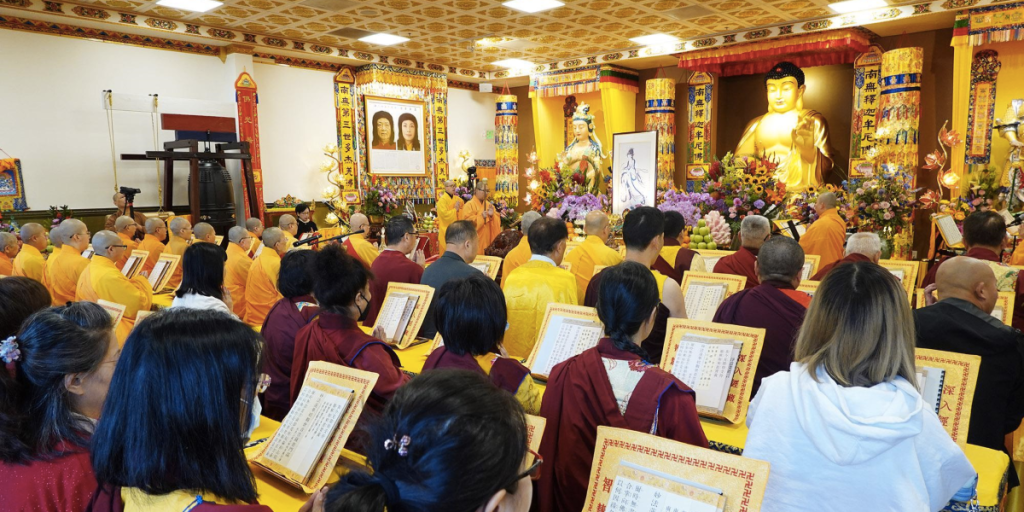
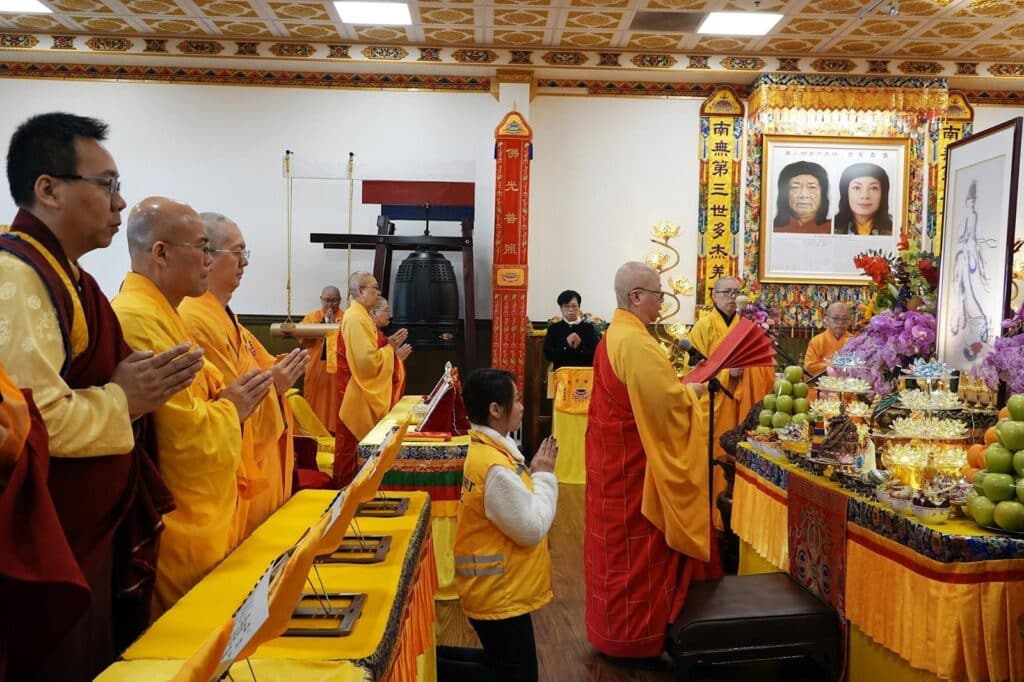
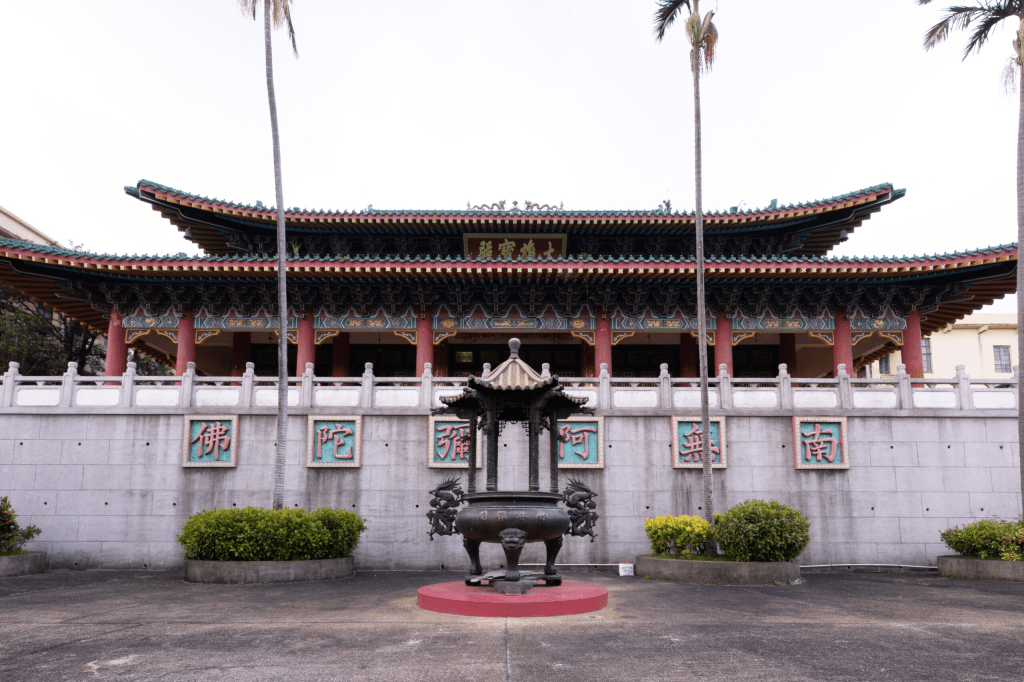
To honor the Holy Birthday of Avalokitesvara Bodhisattva, Buddhists and local residents converged at the Holy Miracles Temple in Pasadena, California, for the Avalokitesvara Bodhisattva Dharma Assembly. Held on March 17, 2024, within the Sakyamuni Buddha Hall, this event was a collaborative effort between the World Buddhism Association Headquarters, Holy Miracles Temple, and Sanger Mission.
Presided over by the Abbess of the Hua Zang Si Temple, Ruzun Ruohui, and jointly guided by Dharma Master JueHui and Dharma Master MiaoKong, the assembly brought together a congregation of holy gurus, eminent monks, dedicated monastics, and others. Their shared purpose was to pay homage to Avalokitesvara Bodhisattva, whose boundless compassion and loving kindness have been a beacon of hope for countless beings throughout the ages.
The Avalokitesvara Bodhisattva Dharma Assembly was held in the Sakyamuni Buddha Hall of Holy Miracles Temple. Photo Courtesy: Joyce Lee
Avalokitesvara Bodhisattva, also known as Guan Shi Yin Bodhisattva in Chinese, is revered for profound compassion and unwavering commitment to alleviating the suffering of all sentient beings. According to Buddhist scriptures, Avalokitesvara Bodhisattva attained Buddhahood eons ago and is known as Zheng Fa Ming Ru Lai, the Correct Dharma Realization Tathagata. Through sacred vows and bodhicitta, the Correct Dharam Realization Tathagata manifests as a Bodhisattva to extend aid to those in need and save sentient beings from suffering. Avalokitesvara Bodhisattva expounded one of the most influential Buddha Sutras – “The Prajna Paramita Heart Sutra,” which encapsulates the profound wisdom of the Buddha, illustrating the meaning of prajna.
While honoring Avalokitesvara Bodhisattva’s great compassion, sovereign wisdom, profound power, and benevolence, the assembly also reflected on the significance of bodhicitta, as elucidated by H.H. Dorje Chang Buddha III in the Sutra – “What is Cultivation.” He imparted, “The broad meaning of bodhicitta encompasses all of the Mahayana Dharma related to saving living beings out of great compassion and the causes leading to attaining the stages of enlightenment of a Bodhisattva.” This essence of conduct rooted in compassion deeply resonated with the attendees, reinforcing their dedication to selflessness and enlightenment.
The assembly witnessed the recitation of passages from “The Lotus Sutra’s Universal Gate Chapter on Avalokitesvara Bodhisattva,” a revered text extolling the virtues and profound wisdom of Avalokitesvara Bodhisattva. Participants engaged in practices such as meal offerings to the Buddhas, seeking blessings for happiness, auspiciousness, and the enhancement of fortune and wisdom. The gathering also collectively expressed their aspirations for the endurance of world peace, the cessation of calamities, while invoking prosperity, good health, and longevity for all.
As incense wafted through the temple and chants echoed in the halls, attendees were reminded of the profound teachings of compassion and empathy advocated by Avalokitesvara Bodhisattva. The ceremony served as a reminder of the transformative power of faith, uniting individuals from all walks of life in celebration of the Dharma.
King Ajatasattu, in order to seize the throne, murdered his own father, King Bimbisara. Afterwards, he felt constant pain and fear in his mind and body, seeking help from various physicians and religious experts but to no avail. Finally, at the urging of a monk named Jivaka, he went to seek the Buddha.
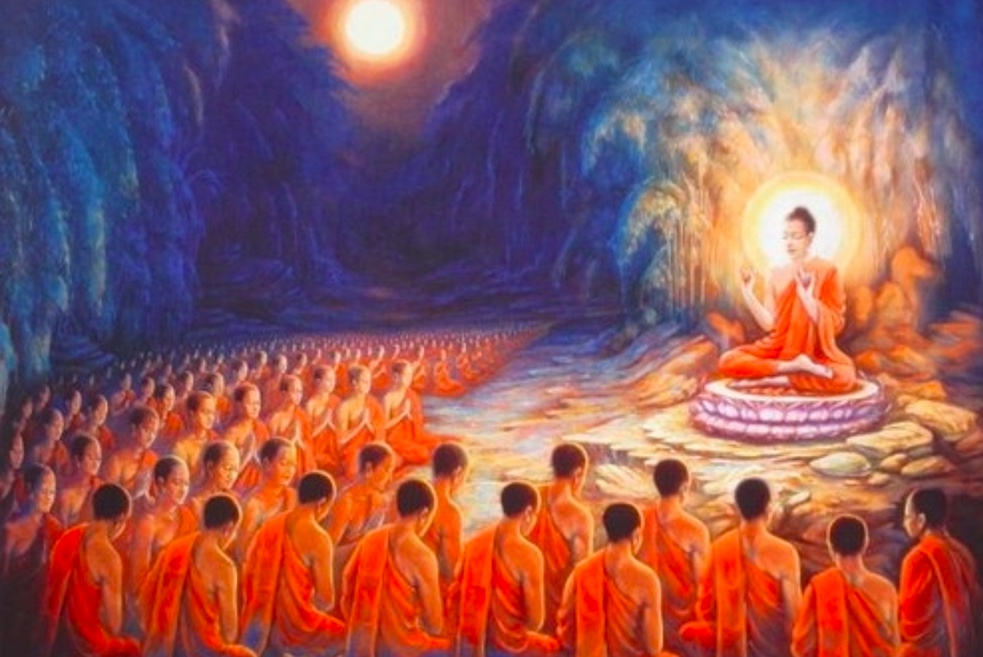
At that time, the Buddha was residing in a grove with a thousand monks. King Ajatasattu entered the assembly hall and saw a thousand monks sitting peacefully around the Buddha, not even the sound of rustling robes could be heard. King Ajatasattu had only briefly encountered the Buddha before, as he had never attended any of the Buddha’s teachings with his father. The Buddha invited them to sit down, and after bowing, the king said, “World-Honored One, I remember hearing you speak when I was young in the palace. Now I have a question for you: what practice can lead thousands of people to renounce worldly life and seek enlightenment?”
The Buddha asked if he had asked the same question to other teachers. King Ajatasattu said he had asked many different teachers, including Devadatta, but had never received a satisfactory answer. The Buddha said, “Your Majesty, tonight the Tathagata will explain to you the fruits of the true Dharma, some of which can be enjoyed in the present and some of which can be harvested in the future. You do not need to seek lofty answers; you just need to see clearly the mango you hold in your hand. Your Majesty, let me give you an analogy: a servant who obeys his master’s every command from morning till night. One day, he asks himself, ‘Why should I willingly be enslaved by my master?’ This servant decides to renounce his servitude and become a monk. He lives a life of celibacy, diligence, and mindfulness, eating only one meal a day, practicing walking and sitting meditation. His demeanor exudes peace and dignity in his actions and speech; he becomes a virtuous and respected monk. Although you know he was once a servant, when you see him now, would you say to him, ‘Come here, boy, I want you to serve me from morning till night, obeying all my orders’?”
King Ajatasattu said, “Certainly not, World-Honored One. I would never speak to him in such a manner. I would respectfully bow to him, offer him food, and ensure he receives the legal protections due to a monk.”
The Buddha said, “Your Majesty, this is the first fruit of the monk’s practice: he has liberated himself from prejudices of race, society, and class, and he has regained the dignity of being a human being.”
The Buddha continued, “Your Majesty, a person’s dignity is just the first fruit. A monk who observes the two hundred and fifty precepts can reside in a state of tranquility. Those who do not observe precepts are more prone to stray from the path; they may commit sins such as deception, intoxication, adultery, theft, or even murder. Such actions bring terrible punishments to their bodies and minds, and they may face severe penalties when caught. A monk who observes the precepts of non-killing, non-stealing, chastity, truthfulness, abstinence from intoxicants, and over two hundred other precepts finds it easier to live a psychologically freer life than ordinary people. This is another fruit that can be enjoyed in the present.
The Buddha continued, “Your Majesty, a monk possesses only three robes and an alms bowl. He never fears robbery nor needs to guard against thieves at night. He can sleep under a tree without worry. The freedom released from fear is the greatest joy. This is another fruit attained through practice. A monk’s life is very simple; although he eats only one meal a day, the food in his bowl comes from thousands of different households. He does not pursue fame or profit; he only uses what he truly needs, seeking nothing else. Dwelling in such unfettered freedom is a fruit that can be enjoyed at this moment.
King Ajatasattu said, “Truly remarkable, World-Honored One! Please continue.”
The Buddha said, “Your Majesty, if you understand how to cultivate mindfulness and contemplation of breathing, you can experience the joy of those who walk the path of practice. That is the bliss of meditation. A monk observes the six senses to overcome the five hindrances of desire, anger, delusion, sloth, and doubt. He attentively observes the breath to create joy nourishing body and mind, which helps him progress on the path to enlightenment. The pleasure derived from sensory experiences cannot compare with the joy obtained through meditation. The joy of meditation permeates body and mind, dispelling all anxieties, sorrows, and grief, allowing the practitioner to experience the true wonder of life. Your Majesty, this is one of the most important fruits of practice that can be enjoyed at this moment.”
The Buddha continued, “Your Majesty, because a monk consistently maintains mindfulness and adheres to the precepts, he can develop right concentration and insight into all phenomena. Through this insight, he sees the impermanent and selfless nature of all phenomena, thus no longer being bound by worldly affairs. He can then sever all entanglements of afflictions such as greed, anger, desire, sloth, doubt, attachment to views, speculative views, distorted views, and mistaking wrong views for right ones. After cutting off all these entanglements, the monk can attain liberation and freedom.”
“Your Majesty, liberation is true happiness and one of the greatest fruits of practice. Some of the monks sitting here tonight have already attained this fruit. Your Majesty, this is a fruit that can be realized in this very life.”
King Ajatasattu exclaimed, “Excellent, World-Honored One! I hope you can say more.”
The Buddha said, “Your Majesty, by illuminating the true nature of all phenomena, a monk knows that all phenomena are neither born nor extinguished, neither defiled nor pure, neither increasing nor decreasing, neither one nor many, neither coming nor going. With this understanding, a monk no longer discriminates; he regards all phenomena with equanimity, without hindrance. He rides the waves of birth and death to rescue sentient beings from the sea of suffering. He introduces sentient beings to the Great Way, allowing them to taste the joy of liberation. Your Majesty, helping others to break free from the maze of greed, anger, and delusion is the greatest joy. This joy extends from the present into the future as the supreme fruit of practice.
Your Majesty, in all his interactions, a monk never forgets the responsibility to guide others towards virtue and liberation. Monks do not engage in politics; they only contribute to the peace, morality, and happiness of society. The fruits of practice are not only for the benefit of monks; they are also the legacy that can be inherited by the people of the country.
The king stood up, sincerely clasping his hands together. He said, “Most Honored Teacher! World-Honored One! With your simple words, you have enlightened me, showing me the true value of the Dharma. World-Honored One, you have helped me rebuild what was shattered, revealed what was concealed. You have guided me back to the right path in my confusion, turning darkness into light. I beseech you, World-Honored One, to accept me as your disciple, just as you accepted my parents in the past.”
The king prostrated himself before the Buddha, who nodded in acceptance. He asked venerable Shariputra to teach king Ajatasattu the Three Refuges.
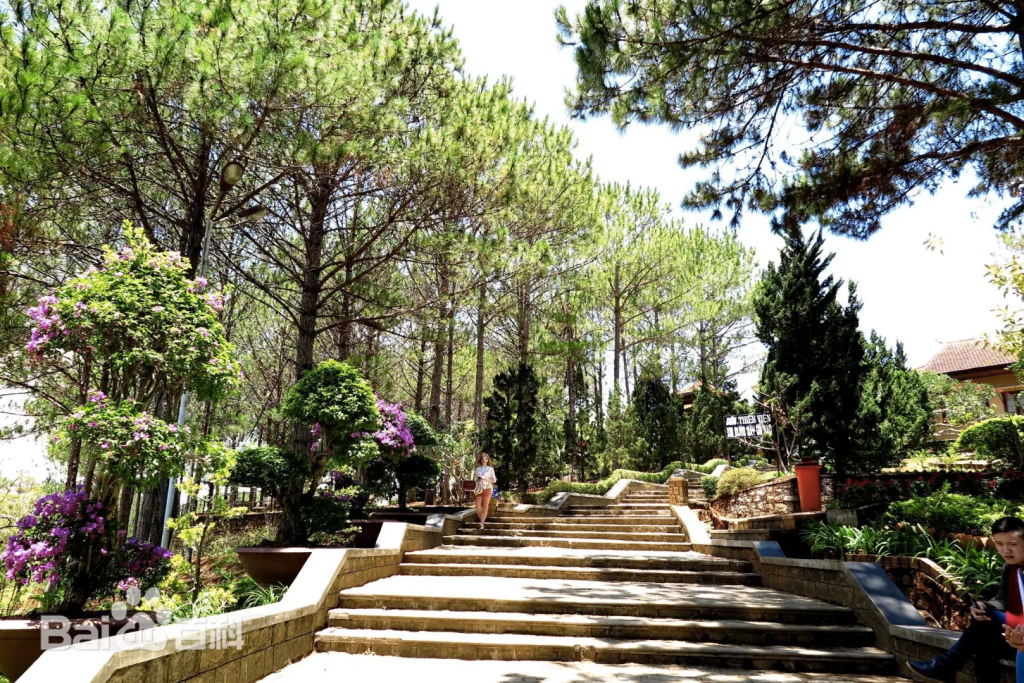
The meeting between the Buddha and King Ajatasattu was beneficial for all present, greatly alleviating the king’s mental torment. That night, he dreamt of his father smiling at him, healing all the wounds of the past. The king’s disposition completely changed, bringing infinite joy to his subjects. From then on, the king often visited the Buddha privately, no longer arriving on an elephant and without any guards. He climbed the meticulously carved stone steps up the mountain as his father had done in the past. In these conversations, King Ajatasattu confessed his innermost thoughts to the Buddha and repented for his past sins. The Buddha regarded him as his own son and advised the king to associate with virtuous people.
Painting is the artist’s pursuit of passion, and the artist’s spiritual realm and artistic insight determine the quality of the work. H.H. Dorje Chang Buddha III once said, “Every artist must tread the path of learning from the past while innovating for the future. Learning from the past embodies tradition, while innovation demands the fusion of Eastern and Western art, philosophy, aesthetics, and literature into a unified whole. This entails grasping the true essence, understanding the inner and outer spirit of the subject, navigating the transitions between the internal and external, the virtual and the real, and infusing rhythm into one’s creations. The result is a work that flows freely, exudes power, and embodies both familiarity and uniqueness. It conceals craftsmanship while remaining wild yet disciplined, possessing a distinct personality and charm. Upon reaching this stage, one can embark on the pursuit of egolessness and the true essence of emptiness and colorlessness. This journey leads to a profound, rich, elevated, and vibrant artistic realm that offers people the joy of beauty. With such mastery, Chinese painting can take a significant leap forward and ultimately stand as a world-class masterpiece.”
Let’s appreciate two masterpieces painted by H.H. Dorje Chang Buddha III and gain deep insights into innovation rooted in tradition.
Ancient Style Emergence
The landscape painting “Ancient Style Emergence” captivates viewers at first sight with its unique style and transcendent meaning. The simple and unadorned lines depict rugged cliffs, hills, forests, and cottages. Layers of ink washes render the rocks thick and the mountain mists hazy. The clustering mountains and overlapping peaks evoke the ancient charm of Yuan dynasty landscape paintings while also embodying a contemporary innocence. Beneath the moistened ink, clouds flicker and smoke swirls. The tree crowns, mountain shadows, and distant peaks are rendered in a nearly pale ink-like gray-green hue, creating a rich and deep landscape. The sunlit sides of the hills and rocks are lightly tinted with a bright ochre, resembling vermillion, which contrasts vividly with the large areas of gray-green, lending the painting a magnificent and ancient beauty.
The pristine and dust-free atmosphere depicted in the painting stands in stark contrast to the noisy scenes of the mundane world, perhaps serving as a reminder for viewers to awaken to the beauty of life.
The brushstrokes in the painting are highly calligraphic, lively, and modern, diverging significantly from traditional landscape depictions. It represents a landscape of the heart, created purely through brush and ink.
While lacking the specific forms of traditional paintings that one can wander and inhabit, it possesses a more authentic and dynamic charm of modern art, particularly evident in its abstract qualities, which resonate deeply with contemporary audiences.
This landscape painting is created by H.H. Dorje Chang Buddha III, characterized by its straightforward and lively brushwork, as well as its modern sensibility.
Setting Sail to the East
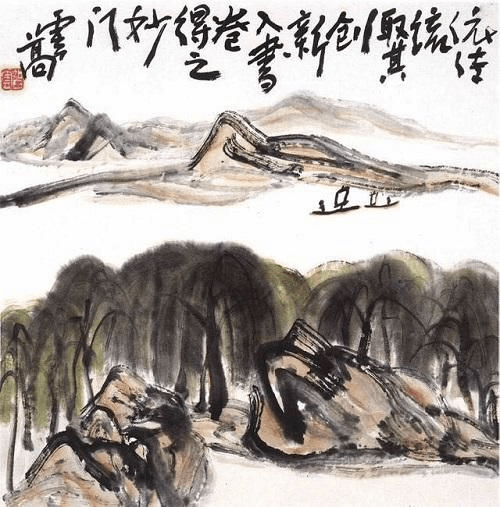
“Setting Sail to the East,” this painting employs thirsty brush and light ink, with free and bold strokes, abandoning the meticulousness of carving. Horizontal and vertical brushstrokes appear to be dragging mud and water, yet they possess the strength to carry a heavy weight. The brushwork is seasoned and heavy, yet balanced between reality and illusion.
In the foreground, there is a poetic dense willow forest, where two stubborn rocks seem to be “nodding” to each other, engaged in intimate conversation, perhaps narrating the endless past and future of the mundane world. In the middle ground, there are two simple small boats, leisurely passing through the river, seemingly minimalist yet imbuing the scene with a rich humanistic atmosphere. In the distance, distant mountains are depicted with dry brush and thirsty ink, subtly rendered with a watery light ochre, evoking the elegant beauty of classical Chinese paintings, reminiscent of the dry autumn wind and the moist spring rain, yet with a strong modern painting atmosphere.
This is a masterpiece of landscape painting with profound underlying themes and innovative imagery. Its lofty style, deep meaning, grand momentum, and charming spirit all stem from H.H. Dorje Chang Buddha III’s profound philosophical thoughts and masterful brushwork. The inscription on the painting reads: “Drawing on tradition for innovation, entering the wonderful realm of the written scroll.” The brushwork is arranged in a skillful and coherent manner, serving as the backbone of the painting and the soul of the entire composition.
The term “vivid charm” embodies the artistic realm of the calligrapher and painter. H.H. Dorje Chang Buddha III‘s landscape painting art transcends the ordinary and mundane, achieving a level of artistry that is beyond compare, with a spiritual realm that has become a benchmark in contemporary painting art.
H.E. Tangtong Gyalpo is a greatly accomplished person within Tibetan esoteric Buddhism who attained the rainbow body. He is a great Bodhisattva known and respected by one and all in Tibet.
He is also an extremely holy person who has made huge contributions to the Tibetan people. It was this great Bodhisattva who was the father of medicine, ferryboats, bridges, and operas in Tibet. He has brought to the living beings of Tibet limitless blessings. To this day, Tibetan temples and families continue to worship H.E. Tangtong Gyalpo Bodhisattva.
The first Tangtong Gyalpo left the household life to become a monk when he was very young. He studied the sutras and treatises and became good at debating the sutras. Although he possessed the Five Vidyas, he remained modest, simple, and down-to-earth. In order to provide a model of self-cultivation, H.E. Tangtong Gyalpo followed and learned under many people of great virtue.
He also engaged in solitary, quiet cultivation for a long period of time at the Eri Temple. Later, he received teachings directly from Dakini Niguma and became a person greatly accomplished in the dharma. People praised H.E. Tangtong Gyalpo with the following words: “In the vast realm of emptiness, there is a yogi who intensively studies emptiness and who is like the King of Fearlessness. His name is Tangtong Gyalpo.” He has also been respectfully called Zhibai Wangxiu Tangtong Gyalpo, which means the accomplished, free and unhindered Tangtong Gyalpo!
During a certain year in history, there was a serious drought and famine in Tibet. H.E. Tangtong Gyalpo conducted a Dharma Assembly in front of the Sakyamuni Buddha statue in the Jo-khan Temple in Lhasa. At that Dharma Assembly, he wrote “A Prayer to Eliminate Famine.” Many people then saw Kuan Yin Bodhisattva in the sky disseminating various grains. The famine ended not long after that.
There was another time when war and chaos occurred in the Muya district of Kham in Tibet, causing people to leave their homes and wander about. H.E. Tangtong Gyalpo made a vow and wrote “A Prayer to End War and Chaos.” People in that area very soon after that ended their mutual hatred and instead treated one another in a peaceful, friendly, and loving manner. There was another year when a pestilence broke out in a large area covering a religious site of the Sakya sect, causing countless deaths. The chanting of mantras and the offering of sacrifices could not end the pestilence. Thus, H.E. Tangtong Gyalpo again practiced dharma and wrote “A Prayer to End the Disaster of Illness.” As a result, the pestilence disappeared forthwith. In previous times in Tibet, it was very difficult for people to cross rivers. The river waters mercilessly took away people’s lives as they attempted to cross the rivers. Thus, H.E. Tangtong Gyalpo made improvements to ferryboats and began building bridges. In that lifetime, he built fifty iron-chain bridges, sixty wooden bridges, and many temples. One of those temples was the Tangge Lakong (the Tangtong Gyalpo Temple), which was the first temple in the Derge region. With respect to medicine, H.E.Tangtong Gyalpo established the Medicine King Temple at Jiabori in Lhasa, invented a white pill that cured all kinds of internal medical diseases, and invented a red pill that cured epidemic diseases. Thus, he became the founder of Tibetan medicine. That white pill and red pill are used in Tibetan medicine even to this very day to relieve the sufferings of living beings.
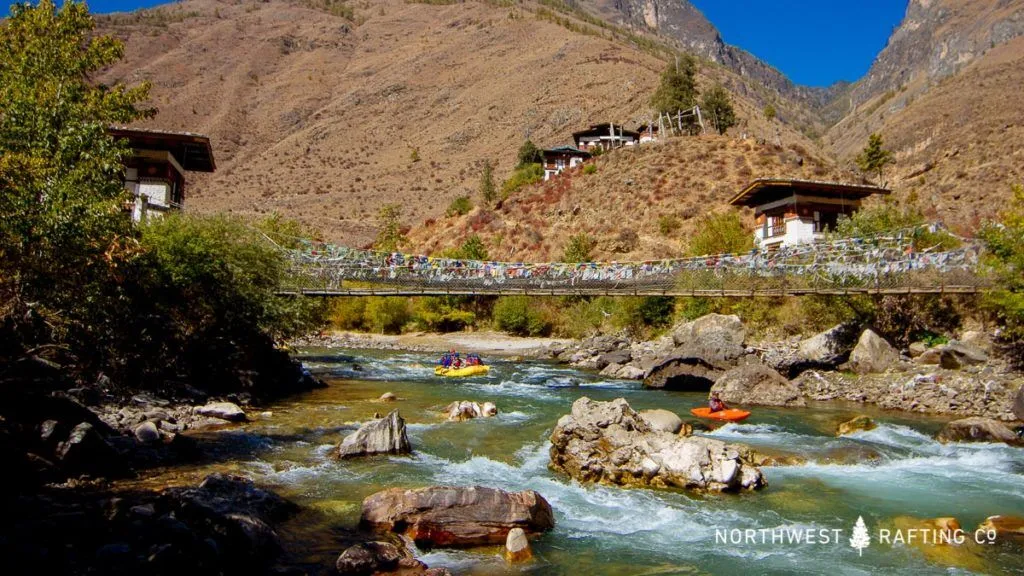
This 600 year old bridge crosses the Paro Chhu (Paro River) and was traditionally restored in 2005 after being washed away during a 1969 flood. The bridge was originally built by the legendary Thangtong Gyalpo
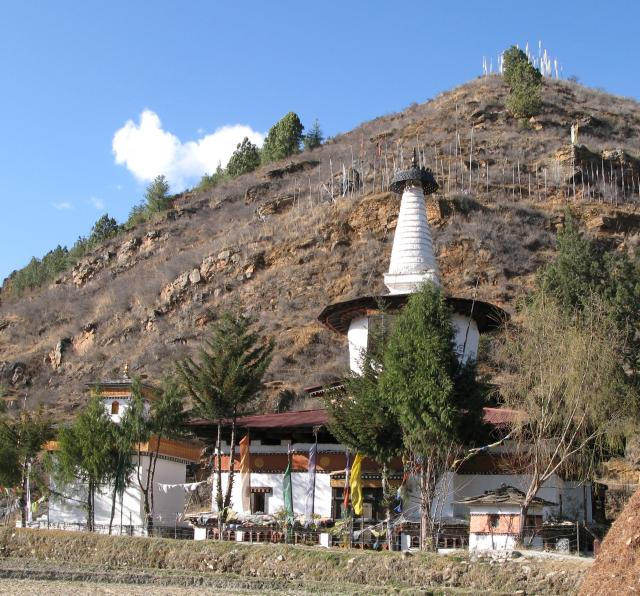
Dungtse Lhakhang, a temple in form of a chörten near Paro in Bhutan was built by Thangtong Gyalpo. The roof construction is made of iron.
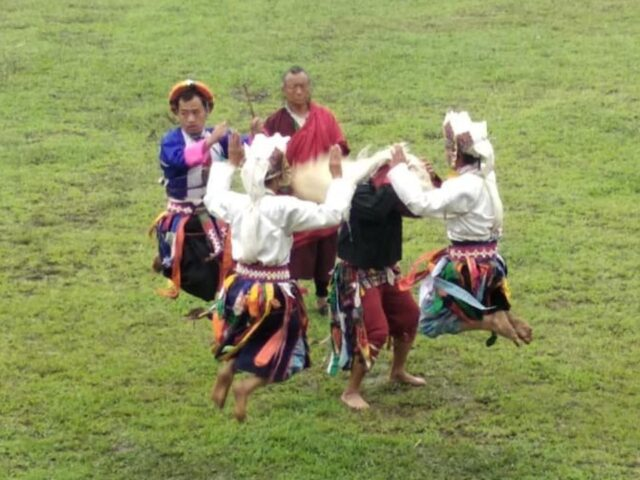
H.E. Tangtong Gyalpo Bodhisattva also wrote many Tibetan operas and established the Ache Lhamo opera troupe, the members of which acted out Tibetan historical stories through song and dance and pioneered Tibetan operas. The Achi Lhamo opera, with the starting troupe of seven sisters who worked on the saint’s bridges, is still performed and enjoyed hugely to these days during the new year celebration and on festive occasions.
Achi Lhamo Opera Composed by Thang Tong Gyalpo Still Prevalent in Bhutan
H.E. Tangtong Gyalpo was the supreme leader of four esoteric sects within India, Bhutan, Sikkim, Mongolia, and Eastern Tibet. He possessed teachings from many dharma lineages, the most remarkable of which were the lineage to extend one’s life and the lineage to bring in wealth and change one’s fortune. Everyone in Tibet, no matter what sect he or she belonged to, believed in and practiced such lineages and scriptures. Countless disciples of H.E. Tangtong Gyalpo became accomplished in the dharma under his teachings and attained great supernatural powers, wisdom and great compassion. More than one hundred disciples of his attained the rainbow body or the transformation rainbow body. All Tibetan people know that H.E. Tangtong Gyalpo is truly a great patriarch of Tibetan esoteric Buddhism and a great Bodhisattva. Later, each time H.E. Tangtong Gyalpo incarnated into this world. He was a great patriarch who spread the dharma, liberated living beings, and pervasively benefited people.
Thang Tong Gyalpo Present Reincarnation
H.E. the sixteenth Tangtong Gyalpo Bodhisattva (Thangtrul Rinpoche) took birth in Bhutan. His physical appearance resembles that of Guru Padmasambhava. Even when he sleeps, his eyes remain open. He saw H.H. Wan Ko Yeshe Norbu (Dorje Chang Buddha III) during a Dharma Assembly that took place in 2005 at Hua Zang Si in San Francisco, U.S.A. In a supernatural state of samadhi, he instantly saw that H.H. Dorje Chang Buddha, the highest ancient Buddha in the dharma realm, had already come to this world again. He at once formally acknowledged H.H. Dorje Chang Buddha III Wan Ko Yeshe Norbu as his master. H.H. Dorje Chang Buddha III asked him, “Did you follow and learn dharma under Guru Padmasambhava? Why have you come here?”H.E. Tangtong Gyalpo answered that he had received teachings directly from Guru Padmasambhava and from H.H. Sakya Trizin who is the nirmanakaya of Manjushri Bodhisattva. He also said that he had come to request the highest dharma in order to save living beings. H.H. Dorje Chang Buddha III immediately snapped His fingers, and a dharma bowl manifested awesome power. H.H. Dorje Chang Buddha III then accepted H.E. Tangtong Gyalpo as one of his disciples who is on the level of a great venerable one and performed an initiation for him. H.E. Tangtong Gyalpo took that dharma bowl back to his home country.
He later learned that the book A Treasury of True Buddha-Dharma about the H.H. Dorje Chang Buddha III Wan Ko Yeshe Norbu Holiest Tathagata was about to be published. He thereupon organized many rinpoches to practice the Kuan Yin Dharma one billion times as an offering to His Holiness Dorje Chang Buddha III. He also sent his written congratulations stating that His Holiness is the master of Buddhas, the magnificence of His Holiness is supreme and that in this world no other holy being in history can compare with His Holiness.
H.H. Dorje Chang Buddha III accepted H.E. Tangtong Gyalpo as his disciple at Hua Zang Si temple San Francisco
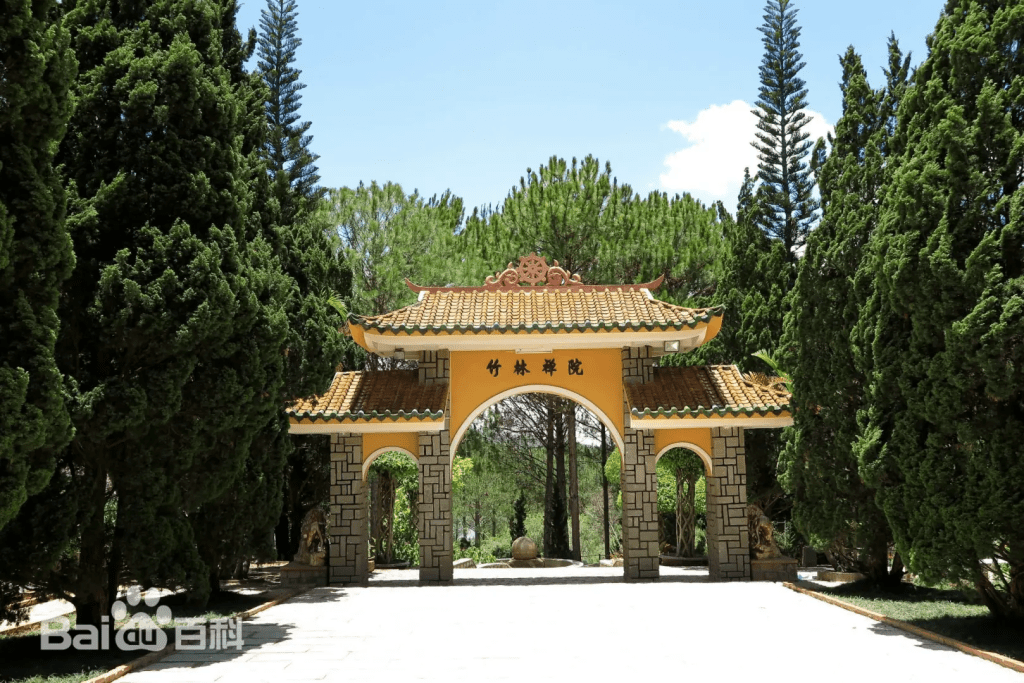
Standing on Fuyung Mountain Road in Tsuen Wan, Hong Kong, Zhulin Temple (also known as Chuk Lam Sim Yuen) proudly upholds the lineage of the Linji School of Zen Buddhism. Rooted in tradition, the temple seamlessly integrates teachings from the Tiantai and Pure Land traditions, thereby spreading the Buddha’s wisdom far and wide. Nestled within the heart of the Fragrant Harbour, it fosters a unique spiritual atmosphere known as the “Bamboo Grove Family Style,” where the Dharma is generously shared, benefiting both locals and visitors alike, serving as a haven for Buddhist study and practice.
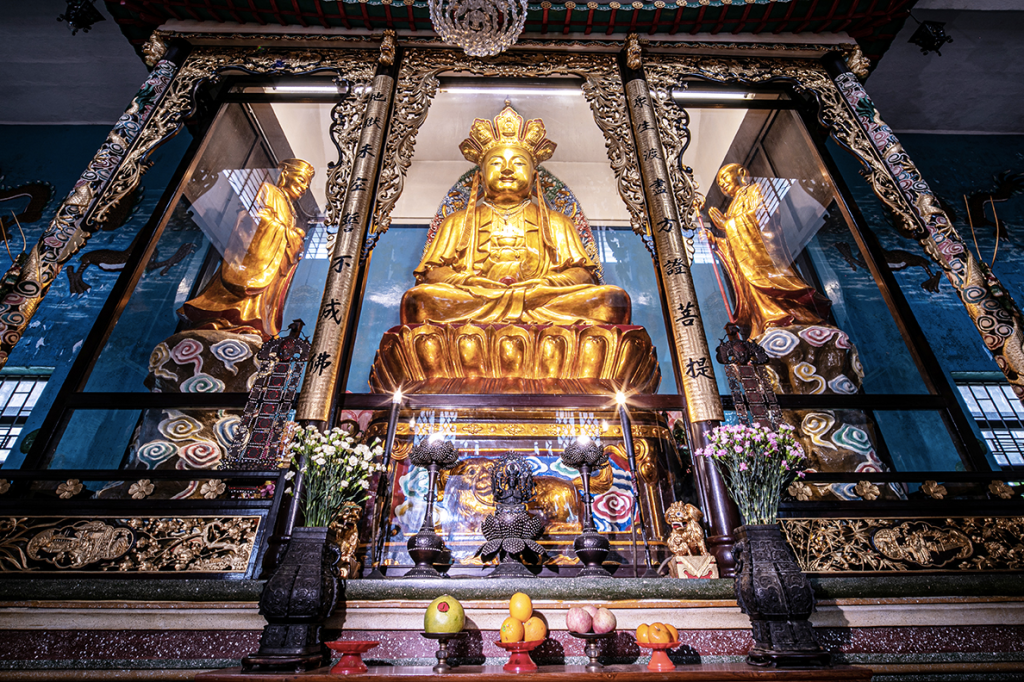
Encompassing an expansive area exceeding 400,000 square feet, Zhulin Temple commands a serene and majestic presence, making it one of the largest and most beautiful temples in Hong Kong. Its origins trace back to 1928 when the founding master, prompted by three visionary dreams from Bodhisattva Ksitigarbha, embarked on the mission to erect a temple on Fuyung Mountain. Inspired by unwavering Bodhi resolve, six devoted followers generously donated funds to procure the land and construct the temple. Drawing inspiration from the architectural marvels of ancient Chinese mountain temples, the Pagoda Hall was completed on October 23, 1932, housing the largest statue of Ksitigarbha Bodhisattva on a lotus throne in Hong Kong. Thus, Zhulin Temple was formally inaugurated, marking the beginning of its sacred journey to illuminate sentient beings.
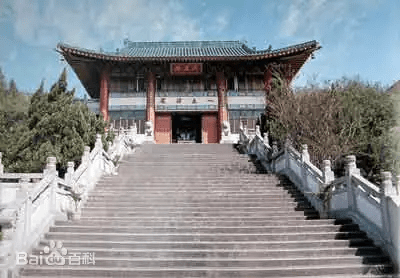
The architectural layout of Zhulin Temple embraces a harmonious three-section courtyard design. Upon crossing the mountain gate, visitors are greeted by the monastery’s serene courtyard garden, offering a space for worshippers to procure incense, candles, flowers, and fruits for offerings. Ascending the steps leads to the grand Hall of Heavenly Kings, where the jovial Maitreya Buddha stands at the central entrance, extending a warm welcome to all. Within the hall, the Four Heavenly Kings stand guard, with the central altar adorned by Bodhisattva Virūpākṣa, safeguarding the monastery under the benevolent gaze of Maitreya Buddha.
steps leads to the Grand Hall of Heavenly Kings,
Maitreya Bodhisattva
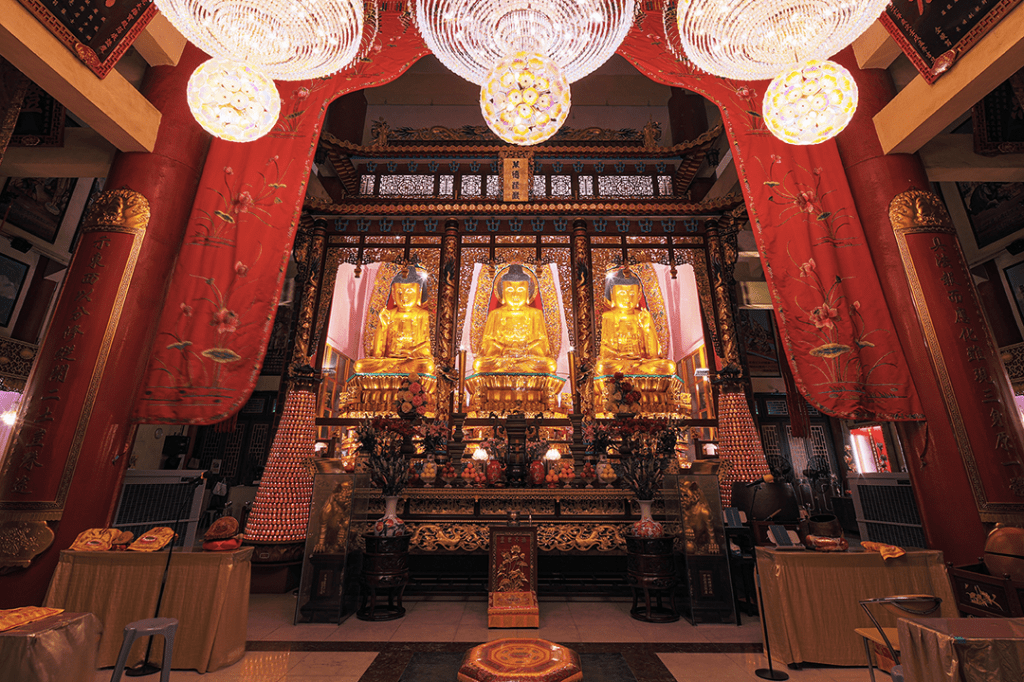
Further beyond lies a spacious courtyard flanked by a bell tower and drum tower. Ascending the stairs unveils the majestic Grand Hall, where the Triple Gem (Amitābha Buddha, Śākyamuni Buddha, and Bhaiṣajyaguru Buddha) resides on the central altar, accompanied by eighteen Arhats on either side. Adorning the rear of the Triple Gem altar is a depiction of the transformative scene from the Avalokiteśvara Sūtra, illustrating the manifestation of Avalokiteśvara Bodhisattva.
Bell Tower and Drum Tower
The Grand Hall
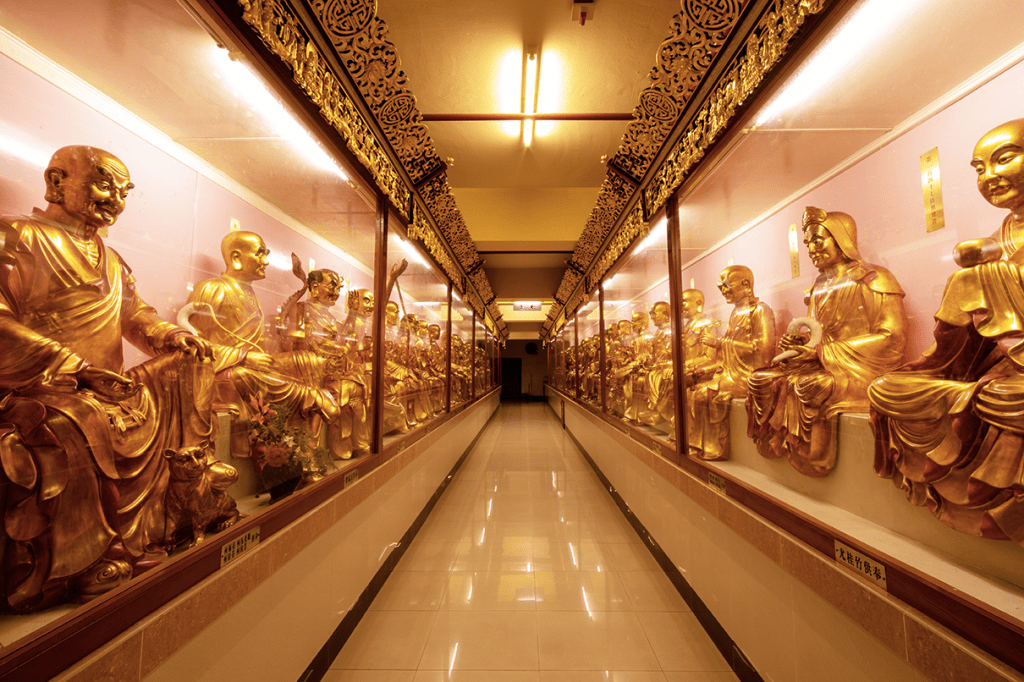
Adjacent to the main hall, worshippers find solace in a pavilion, while the Guan Yin Hall and Jade Buddha Hall flank its sides. Upstairs, the Pagoda Hall, now known as the Ksitigarbha Hall, stands adjacent to the Ancestral Hall and the Kitchen. Surrounding the monastery are additional halls including the Five Hundred Arhats Hall, the Dharma Hall, the Chan Hall, and the Scripture Repository, nestled along the outskirts and mountain slopes.
Guan Yin Hall
Ksitigarbha Hall
Five Hundred Arhats Hall
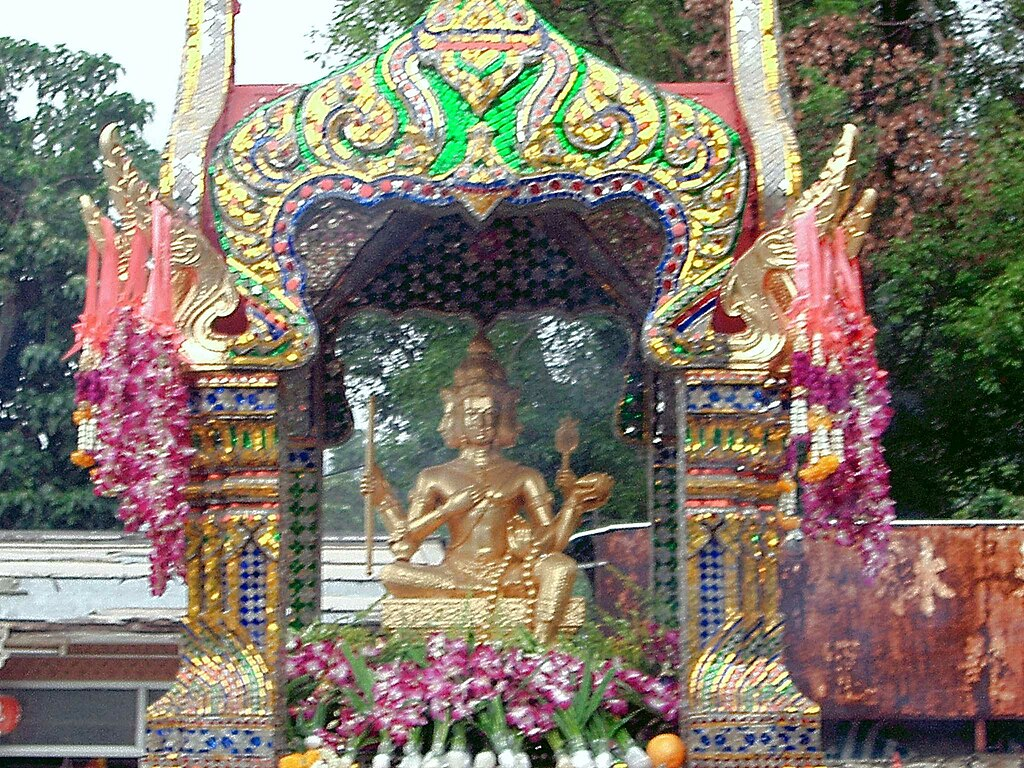
Four faced Buddha Statue 由Hkgalbert – 自己的作品,公有领域,https://commons.wikimedia.org/w/index.php?curid=9932768
Throughout its century-long history, Zhulin Temple has been overseen by five abbots. Notably, the fourth Abbot Master YiZhao emerged as an eminent monk of his time. Venerable Dharma Master Yizhao (1927-2013), born in Guangdong, China, embarked on his spiritual journey by joining Zhulin Zen Monastery in Hong Kong in 1940, formally becoming a monastic in 1941.
Under the guidance of Master Xuyun, he received the transmission of Viyana at Nanhua Temple in 1944, subsequently inheriting the Linji (Rinzai) Dharma lineage and becoming its 44th holder. Establishing the Guyan Pure Monastery in 1952, he later returned to Zhulin Temple to assist in its renovation, eventually assuming the role of abbot. He peacefully passed away in 2013, leaving behind a legacy of enlightenment and compassion.
Master YiZhao (left) and Master XuYun (right) were together at KaiYuan Temple in ChaoZhou, GuangDong , in 1946
Venerable Dharma Master Yizhao, the successor to H.E. Dharma Master Xuyun, exemplifies profound virtue within contemporary Zen Buddhism. Having attained the supreme state of Bodhi, he relinquished all ties to further reincarnation long ago. Inspired by the compassionate vow of Ksitigarbha Bodhisattva, he pledged “As long as there is any living being in the earthly realm, I vow not to become a Buddha.” Renowned as the nirmanakaya of Ksitigarbha Bodhisattva, he received the Amrit Empowerment Initiation from H.H. Dorje Chang Buddha III, lauded as an exceptional monk who ardently upholds precepts.
In June 2000, Venerable Dharma Master Yizhao seized the opportunity to participate in the Buddhas Bestowing Nectar Dharma Assembly presided over by H.H. Dorje Chang Buddha III. (The very left in the photo is Master Yizhao)
Zhulin Temple stands as a testament to beauty and sanctity, inviting visitors to immerse themselves in Buddhist culture, prayers, and blessings, offering a profound spiritual experience.
In the tranquil setting of one afternoon, Sariputra and Maudhara, the first disciples of the Shakyamuni Buddha, introduce an ascetic named Tigaro to the profound teachings of enlightenment. Little did they know that this encounter would unveil a tapestry of insights and narratives, offering timeless wisdom that transcends doctrines and narrow beliefs.
Upon meeting the Buddha, Tigaro’s skepticism manifests through his query: “What exactly is your doctrine?” His disdain for theories is palpable as he voices his disbelief. However, the Buddha, with a serene countenance, responds with an unexpected question, challenging Tigaro’s perspective: “Then you don’t believe yourself? What about those who don’t believe in any theory? Do you believe in unbeliefism?” This exchange sets the stage for an enlightening discourse on the nature of truth and belief.
With a calm and understanding demeanor, the Buddha delves into his teachings, addressing the perils of rigid doctrines. He elucidates how attachment to perceived truths stifles freedom and engenders conflict. Through poignant storytelling, exemplified by the narrative of a young widower and his son, the Buddha illustrates the consequences of attachment and false perceptions.
In the heartrending tale, a young widower cherishes his 5-year-old son deeply. However, tragedy strikes when one day the father must depart on business, leaving his son alone. Bandits ravage the village on that very day, and upon his return, the widower discovers his home burned and his son presumed dead. Overwhelmed by grief, he cremates what he believes to be his son’s remains and carries the ashes with him daily, a poignant symbol of his attachment.
A month later, the son miraculously returns, only to find his father clinging to the ashes. Despite his son’s pleas and knocking on the door, the widower, consumed by his attachment to his perceived reality, remains oblivious. In a heartbreaking moment, the son departs once more, unable to break through his father’s delusion. The narrative poignantly illustrates the impermanence of existence and the tragedy of clinging to false perceptions.
The essence of Buddha’s teachings transcends philosophical abstraction. Rooted in direct experience and empirical truth, Buddhism offers a profound understanding of oneself and the world. The Buddha invites practitioners to explore the depths of their minds, guiding them toward liberation from suffering.
The Buddha employs a metaphorical finger pointing to the moon to elucidate the nature of his teachings. He emphasizes that his teachings serve as a guide, directing attention toward ultimate truth rather than being the truth itself. This analogy underscores the importance of experiencing reality directly, beyond the confines of doctrinal interpretations.
As Tigaro seeks guidance on overcoming painful feelings, the Buddha imparts practical wisdom. He elucidates the nature of feelings and their origins, offering a pathway to transcend suffering through awareness and understanding.
In the presence of disciples such as Sariputra and Maudhara, the Buddha’s teachings resonate as a beacon of wisdom and self-discovery. The narrative serves as an invitation to embark on a journey beyond doctrines and limiting beliefs, toward a profound understanding of reality. In embracing the impermanence of existence and cultivating awareness, individuals can unlock the profound truth that lies within—an eternal truth accessible to all who seek it with an open heart.
THE PRE-EMINENT GREATLY VIRTUOUS ONE IN PRESENT-DAY TIBET: H.H. DHARMA KING ACHUK
Dharma King Omniscience Jamyang Lungdok Gyaltsen Achuk Lama is a great Dharma Master in the Nyingma sect of Tibetan Buddhism. He is the incarnation of Venerable Longsal Nyingpo, one of the twenty-five great disciples of Guru Padmasambhava. Dharma King Omniscience is one of the greatest and most accomplished leaders of contemporary Buddhism.
In the summer of 2006, Dharma King Omniscience encountered “A Treasury of True BuddhaDharma” and was profoundly impressed. Recognizing the unparalleled accomplishments and wisdom revealed in the book, he pondered the identity of the extraordinary individual behind such realization. Utilizing his supernatural powers, he peered into the dharmadhatu and unveiled the remarkable truth. It became evident that the acknowledgment made by Urgyen Xirao, Guru Padmasambhava’s dharma prince, was entirely accurate.
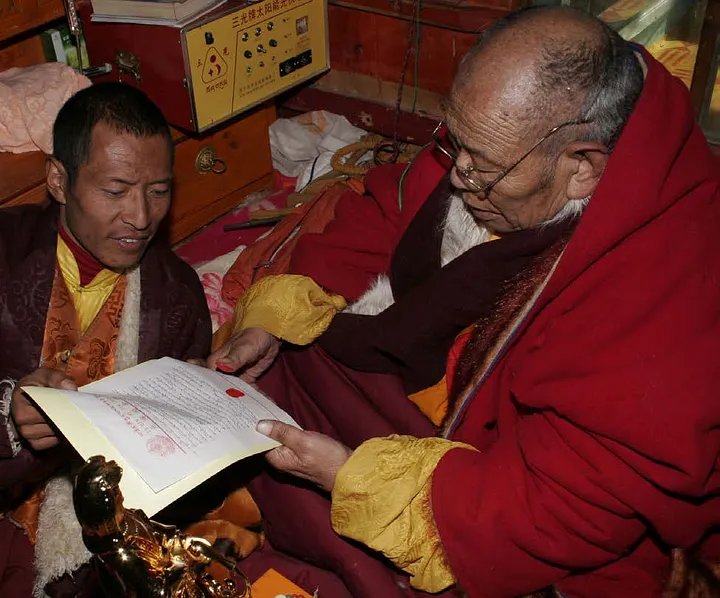
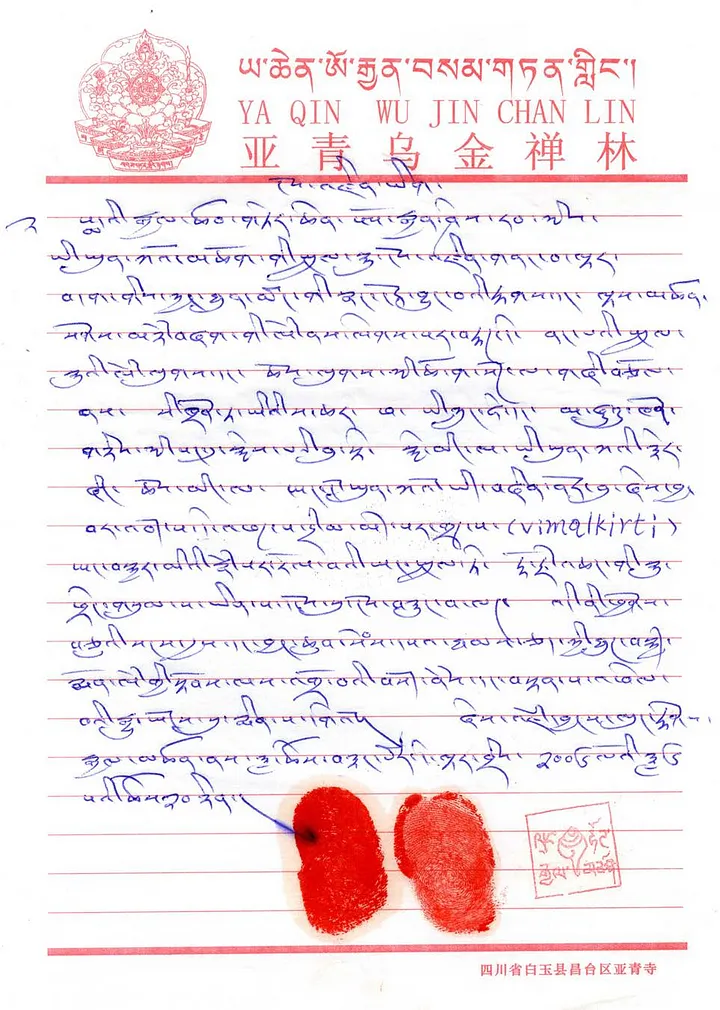
Urgyen Xirao had asserted in the recognition that His Holiness Yangwo Wan Ko Yeshe Norbu Great Dharma King is a sublime being of immense holiness. Dharma King Omniscience, fully concurring, proceeded to compose his own certificate of recognition, affixing his precious red seal upon it. The certificate declared His Holiness Yangwo Wan Ko Yeshe Norbu as the paramount leader of Buddhism.
Certificate of Recognition (in Tibetan)
Here is the English translation:
Based upon the recognition of Urgyen Xirao, the dharma prince of Guru Padmasambhava, and following the system and religious rituals of Tibetan Buddhism for determining the reincarnation of Rinpoches, I entered samadhi to observe the truth. I now solemnly recognize that H.H. Master Wan Ko Yee, who is the son of father Zhonghai Yee and mother Kunfang Xu from Dayi County in Sichuan Province, is the incarnation of Vimalakirti (that is, Vimalakirti has again come to this world), is Dorje Chang Buddha III and has the dharma name of H.H. Yangwo Wan Ko Yeshe Norbu. This is the maturing of the karmic conditions of living beings relating to good fortune and wisdom. We are grateful for this blessing bestowed by the Buddhas. I hereby recognize.
Dharma King Jamyang Lungdok Gyaltsen June 20, 2006
BRIEF INTRODUCTION TO JAMYANG LUNGDOK GYALTSEN RINPOCHE
Dharma King Omniscience Jamyang Lungdok Gyaltsen Achuk Lama is a great Dharma Master in the Nyingma sect of Tibetan Buddhism. He is the incarnation of Venerable Longsal Nyingpo, one of the twenty-five great disciples of Guru Padmasambhava. Because people had different views on the reincarnated identity of Dharma King Omniscience, on a holy day in 2007 at Hua Zang Si in San Francisco, the International Buddhism Sangha Association beseeched H.H. Dorje Chang Buddha III Holiest Tathagata to recognize the true identity of Dharma King Jamyang Lungdok Gyaltsen. In the end, that association did receive such recognition from H.H. Dorje Chang Buddha III. H.H. Dharma King Jamyang Lungdok Gyaltsen was recognized by H.H. Dorje Chang Buddha III as the true incarnation of Venerable Longsal Nyingpo. The International Buddhism Sangha Association then held the holy form of Drawing Lots From a Golden Vase Dharma Assembly. One lot was drawn from among 120 sealed lots. After a curtain was removed and after that lot was unsealed and opened in front of all those present, it was discovered that H.H. Dharma King Jamyang Lungdok Gyaltsen is indeed the true incarnation of Venerable Longsal Nyingpo. Not only was the true identity of Jamyang Lungdok Gyaltsen personally recognized by the Holiest Tathagata, the Drawing Lots From a Golden Vase Ceremony confirmed that he is a great holy being who is the true reincarnation of Venerable Longsal Nyingpo. Yerba Rinpoche, who has demonstrated his supernatural powers over many lifetimes, personally discovered evidence throughout the six realms that Dharma King Omniscience never for a moment ceased striving to bring living beings to salvation and enlightenment.
The person in the middle is Dharma King Omniscience Jamyang Lungdok Gyaltsen. To his left is Dharma King Jigme Phuntok and to his right is Asong Rinpoche.
Dharma King Omniscience was born in 1927 amidst rare and auspicious signs. The dharma protecting deities transformed into various physical forms to protect him when he was a child, which is something only experienced by beings of great holiness. He understood without impediment all scriptures and sutras. At 12, he entered the order of monks. Beginning at 18, he followed his vajra master Arik Vajradhara, a great accomplished one, into 43 years of solitary meditation. He received from Sela Yangzhi a complete transmission of the teachings he learned in his prior life. Sela Yangzhi was a true incarnation of Padmasambhava. Dharma King Omniscience manifested the ultimate essence of all the dharma and turned into a rainbow body of Great Perfection. He has entered the dharmadhatu’s non-attachment state and Four Wisdoms state. He has attained the state of the four divisions of initiations. He has accomplished the cutting off of all defilements related to the six sense organs. His once ordinary body has become a rainbow-light body. The dharma king’s body is able at any time to manifest rainbows, crystal pagodas, Buddha images, Tibetan seed characters, hand-held pennants, etc. The wrinkles of the skin of his entire body have formed the image of a mandala filled with pictures of all the Buddhas and Bodhisattvas. Sariras naturally pour forth from his body.
Among all Buddhas in the Dharma realm, Dorje Chang Buddha is the Primordial Buddha, the first Buddha with form, and the only Supreme Lord of Buddhism throughout the entire universe. Dorje Chang Buddha propagated Dharma throughout the universe, hence, all other Buddhas and Great Mahasattvas learned Dorje Chang Buddha’s Dharma and cultivation to attain holy state and liberation, and eventually became Buddhas and Great Bodhisattvas. Dorje Chang Buddha is the primordial ancestor of all Buddhas and Bodhisattvas. Samantabhadra, the Dharmakaya from which Dorje Chang Buddha perfectly manifested, is the Tathagata that has no form at all. The words and deeds of Dorje Chang Buddha are the compass and guiding principles of cultivation for all ordinary and holy beings in the universe.
To help Shakyamuni Buddha, Namo Dorje Chang Buddha II —Venerable Virmalakirti—applied His supreme wisdom and limitless supernormal power to edify Hinayana Arhats who then advanced themselves and eventually became Mahayana Bodhisattvas who helped living beings attain liberation. And, innumerable living beings attained liberationby learning the teachings of Venerable Virmalakirti.
After coming to the sahā world with the Buddha level enlightenment of the Primordial Sambhogakaya Buddha, His Holiness Dorje Chang Buddha III established countless number one records in the world, every one of which was for the sake of benefiting living beings. At a very young age, He saved others without any regard to His own life and was honored with the title “Young Hero.” As He grew older, His Holiness Dorje Chang Buddha III applied His inherent Healing Vidya to heal the sick, purely on a voluntary basis. More than 500 patients used to seek His help every day. His Holiness Dorje Chang Buddha III never accepted one penny from them. Plaques and pennants with words of gratitude sent by the recovered piled up in the Buddha’s house.
As His Holiness Dorje Chang Buddha III continued to benefit living beings on a larger scale, the Central Newsreels and Documentary Studio of China produced a documentary, “One Who Is Dedicated to Advance Himself,” about His life and work. The film was shown nationwide.
In 1987, the highly respected young His Holiness Dorje Chang Buddha III was named Chairman of the Chinese Painting Research Association of the National Commission of China for UNESCO. Honorary chairpersons of the Association included Liao Jingdan 廖井丹, Li Wenqing 李文清, Lü Ji 呂驥, Yuan Xiaoyuan 袁曉園, Wu Zhangshu 吳丈蜀, Qian Juntao 錢君匋, Xie Zhiliu 謝稚柳, and others. Advisors to the Association included Luo Zhanglong 羅章龍, Zhang Kejia 臧克家, and so forth.
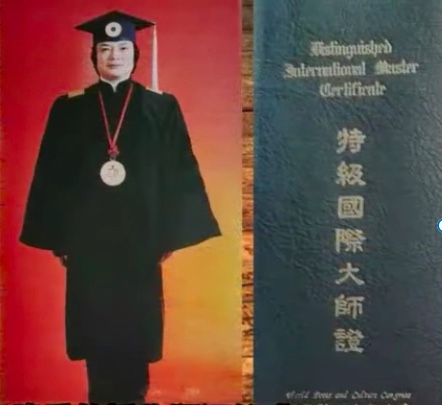
In 1992, His Holiness Dorje Chang Buddha III was accorded the “Art Maestro of the East” title. In 1994, during the fourth conference of the World Poets and Culture Congress held in Hungary, 5,612 experts and scholars unanimously voted to confer the “Preeminent Distinguished International Master” title, which was a Head of State level honor, to His Holiness Dorje Chang Buddha III.
The conferment certificate was signed by Juan Antonio Samaranch, the then President of the International Olympic Committee. In the same year, the Museum of Master Yi Yungao officially opened in Dayi 大邑, the hometown of His Holiness Dorje Chang Buddha III in Sichuan. That was the first memorial museum in China, or even in the world, being built by a government for a living person.
In 1995, when His Holiness Dorje Chang Buddha III went from Mainland China to visit Taiwan for the first time, Taiwanese people spontaneously gave His Holiness Dorje Chang Buddha III an overwhelmingly ceremonious welcome. More than 20,000 people went to the airport to greet and pay respect to His Holiness Dorje Chang Buddha III. A motorcade of more than 1,700 cars followed the lead of police motorcycles to escort His Holiness Dorje Chang Buddha III from the airport to the hotel. That became the largest welcoming event in human history. Within the short three weeks that His Holiness Dorje Chang Buddha III stayed in Taiwan, General Chiang Wei-kuo 蔣緯國, former Secretary-General of the Taiwan National Security Council, and many other high level government officials formally requested to become disciples of His Holiness Dorje Chang Buddha III. They expressed that they wanted to truly emulate the noble morality, humanistic ethics, thoughts, and deeds of His Holiness Dorje Chang Buddha III.
After His Holiness Dorje Chang Buddha III moved to the United States, His noble morality and unparalleled achievements won the love and admiration of the American people from all walks of life. In 2002, His Holiness Dorje Chang Buddha III was presented with the “Presidential Gold Medal” by the Commissioner to the President’s Advisory Commission on Asian Americans, on behalf of President Bush.
In 2003, the Organization of American States, composing of 34 countries including the United States, Canada, and Mexico,organized the Master Wan Ko Yee Yun Sculpture Exhibition in Washington D.C. at the Capitol of the United States.
The Master Wan Ko Yee Yun Sculpture Exhibition was also held at the Congressional Office Building. That was the first time the U.S. Congress held an art exhibition in their Congressional Office Building. Visitors expressed their praises in the guest book, exclaiming that the exhibition was “unprecedented,” and that the artworks were “treasures brought to the human realm by God.”
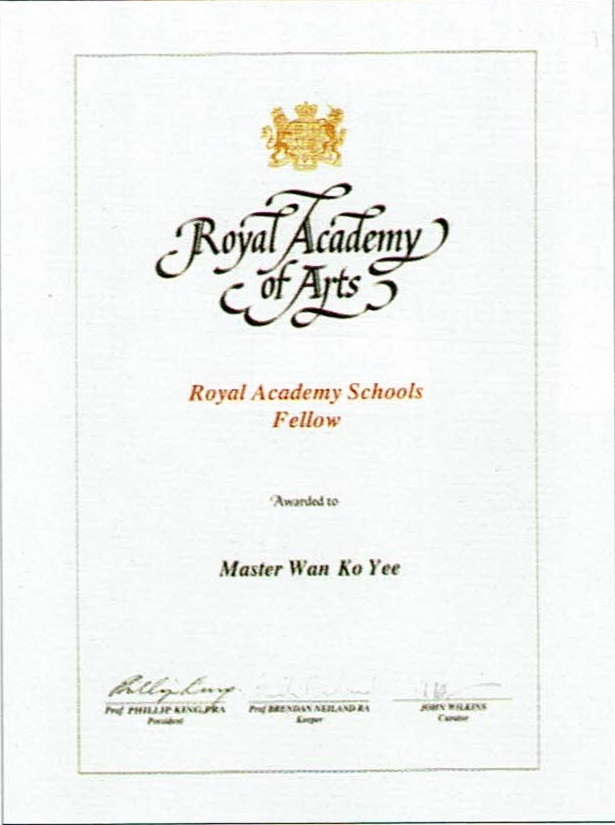
In 2004, His Holiness Dorje Chang Buddha III was named “Fellow” of the Royal Academy of Arts in the U.K.. Professor Phillip King, President of the Royal Academicians of the Royal Academy of Arts, presented the certificate to His Holiness Dorje Chang Buddha III at the British Embassy in Washington D.C., capital of the United States. The Cultural Attaché of the British Embassy personally attended the ceremony. Professor Phillip King stated that His Holiness Dorje Chang Buddha III was the first artist ever accorded this title in their renowned academy’s more than 200-year history.
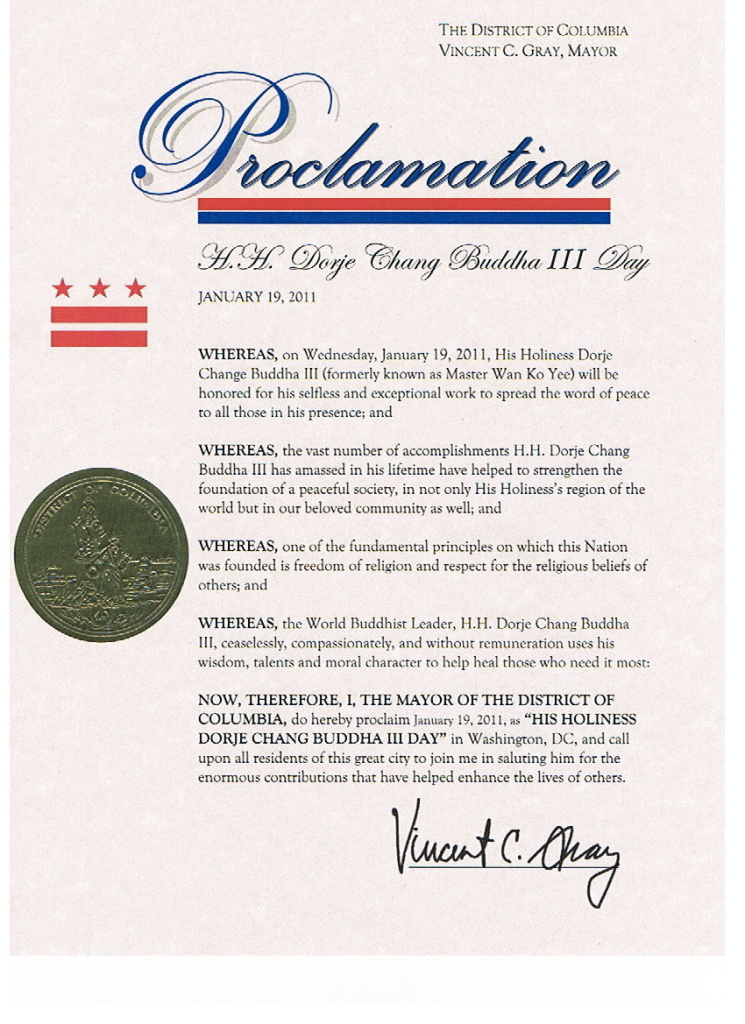
The mayor of the U.S. capital Washington D.C.pronounced January 19, 2011 as “His Holiness Dorje Chang Buddha III Day” and called on people to salute to His Holiness Dorje Chang Buddha III.
His Holiness Dorje Chang Buddha III was also accorded the “King Legacy Award for International Service & Leadership” by An International Salute to The Life and Legacy of Dr. Martin Luther King, Jr.. Dozens of great honors have also been presented to His Holiness Dorje Chang Buddha III by U.S. senators, members of the House of Representatives, governors, and governments of all levels.
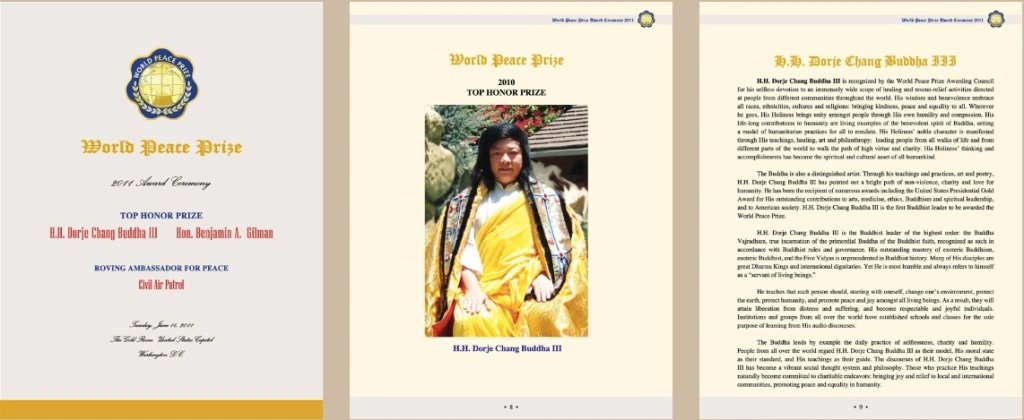
More remarkably exceptional, Namo Dorje Chang Buddha III was awarded the 2010 World Peace Prize Top Honor Prize, presented to Him at the United States Congress on June 14, 2011 at the U.S. Capitol. On occasions of the holy birthday of His Holiness Dorje Chang Buddha III, the U.S. Congress has held ceremonies to raise the national flag to celebrate, and President Trump and President Biden have sent personal congratulations.
In 2018, the World Peace Prize Awarding Council and the World Peace Prize Religious Leader Title Awarding Council resolved that His Holiness Dorje Chang Buddha III was the Pope of Buddhism of this world and decided to present the Pope of Buddhism Scepter to Him. Namo Dorje Chang Buddha III, however, did not accept the Scepter, but returned it instead. In September 2020, the World Peace Prize Awarding Council and the World Peace Prize Religious Leader Title Awarding Council made a joint resolution that solemnly stated, “The title, status, and authority of the Pope of Buddhism belong only to His Holiness Dorje Chang Buddha III and cannot be exercised by anyone else. This is a permanent and unalterable determination!” The two Councils also entrusted the World Buddhism Association Headquarters to present the Pope of Buddhism Scepter on their behalf to His Holiness Dorje Chang Buddha III.
Upon coming to this world, His Holiness Dorje Chang Buddha III immediately started teaching and saving living beings. He has always called Himself a “nameless cultivator.” His Holiness Dorje Chang Buddha III voluntarily served living beings and did not accept any offerings. One incident clearly shows how Namo Dorje Chang Buddha III taught and saved living beings selflessly. At the Heart Sutra Mandala on Xinhua West Road, Chengdu, Dharma Master Guozhang 果章法師 once recounted to some people that when he received initiation from His Holiness Dorje Chang Buddha III on Paoma Mountain 跑馬山, His Holiness the Buddha was only two and a half years old! After the identity of Namo Dorje Chang Buddha III being the true incarnation of the Primordial Buddha was formally recognized by Dharma kings, regent Dharma kings, and great rinpoches of major Buddhist sects in written congratulations and corroboration letters, His Holiness Dorje Chang Buddha III continued, as always, to teach and save living beings solely on a voluntary basis, and whole-heartedly devoted Himself to serving living beings. Whenever people made offerings to His Holiness Dorje Chang Buddha III, whether they were big or small offerings, in amounts as little as one dollar or as large as a few million US dollars, in the form of 37 acres of land in the city of San Francisco, or even a planeload or a shipload of gold, Namo Dorje Chang Buddha III categorically refused to accept. His Holiness Dorje Chang Buddha III was whole-heartedly dedicated to serving living beings voluntarily.
In the many years that His Holiness Dorje Chang Buddha III was propagating Dharma to save living beings, He imparted more than 2,000 Dharma Discourses in response to living beings’ levels and karmic conditions. Not only did His Holiness Dorje Chang Buddha III reveal the truth about humanity and the universe, He also elucidated the truths relevant to various stages of practices, from elementary to profound accomplishment levels.
Those Dharma Discourses were audio-recorded, and some of which such as What Is Cultivation 什麽叫修行, Sutra on Understanding and Realizing Definitive Truth 了義經, Imparting the Absolute Truth Through the Heart Sutra 藉心經說真諦, and Learning from Buddha 學佛, have been published into books.
In restoring Buddhist texts to their original meaning, His Holiness Dorje Chang Buddha III pointed out that the morning and evening chants used in Buddhist temples nowadays had been tampered with by the descendants of Mara, and those texts are filled with evil views and fallacies. Namo Dorje Chang Buddha III has corrected many errors made by patriarchs and translators in their interpretations of Dharma principles, and directly revealed the chaotic phenomena in Buddhism during this Dharma Ending Era. His Holiness Dorje Chang Buddha III pointed out the path that everyone who wants to attain liberation must take: That is to build our foundation on practicing cultivation. After cultivating ourselves well, we can then learn Dharma, and naturally attain liberation and accomplishment. The correct truths and Dharmas imparted by His Holiness Dorje Chang Buddha III enable listeners to develop their wisdom and good fortune, to help each other, care about each other, and be compassionate to all living beings.
In different countries, Namo Dorje Chang Buddha III has performed great Dharmas including Holy Amrita Bestowed by Buddhas 佛降甘露, Xianliang Great Perfection 現量大圓滿, Holy Fire Offering 勝義火供, Vajra Faman Determination by Holy Selection 金剛法曼擇決, Hayagrīva Raja Water Mandala Bead Divination 馬頭明王水壇珠卦, Determination by Holy Selection on the Regression or Progression on the Bodhi Path 菩提道損減增益法, Guaranteed Delivery to Buddha Land Dharma 保送法, Vajra Array 金剛陣, and Eight Wind Array 八風陣, all of which manifested authentic holy states, enabling living beings to see with their own eyes that Buddha Dharmas are scientific, have veritable power, and absolutely are not just empty talk or theory. More importantly, Namo Dorje Chang Buddha III has brought The Supreme and Unsurpassable Mahamudra of Liberation to living beings in the sahā world, showing humanity the shortcut to attaining liberation. The Supreme and Unsurpassable Mahamudra of Liberation is the highest Dharma that Dorje Chang Buddha transmitted to Amitabha Buddha as well as Buddhas and Great Bodhisattvas in the ten directions during their cultivation stage.
In The Supreme and Unsurpassable Mahamudra of Liberation, His Holiness Dorje Chang Buddha III has made the biggest and highest vow in the entire Dharma realm, “I bear all the sinful karma for living beings, I give living beings all the good karma and merit that I have planted.” Namo Dorje Chang Buddha III has actualized the greatest and holiest vow, sacrificed His life to save the lives of numerous living beings, and returned to the Sambhogakaya Buddha Land!
The unprecedented records established by Namo Dorje Chang Buddha III in this world:
Namo Dorje Chang Buddha III was, historically, the first Buddha to have received the largest, unprecedented number of status-recognition and congratulatory letters by top level great Dharma kings and rinpoches.
Namo Dorje Chang Buddha III was recognized with the highest status in history: an Ancient Buddha.
Namo Dorje Chang Buddha III is the first Ancient Buddha who manifested perfect mastery in Exoteric and Esoteric Buddhism, and perfection of the Five Vidyas. No one else has been able to accomplish the same in the past few thousand years.
Namo Dorje Chang Buddha III manifested Buddha-level wisdom in the creation of Yun Sculpture, which nobody has been able to replicate. Historically, this is the first art form that cannot be replicated.
Namo Dorje Chang Buddha III is the first Ancient Buddha throughout history who only benefited others but did not accept any offerings.
Namo Dorje Chang Buddha III is, historically, the first Ancient Buddha who manifested the most holy miracles.
Namo Dorje Chang Buddha III is, historically, the only Buddha who could offer the kind of Buddha Dharma that enables disciples to attain liberation within two hours: Xianliang Great Perfection, the quickest path to successfully enter the Buddha Land.
Namo Dorje Chang Buddha III had the largest number of disciples who attained accomplishments; for example: Dharma King Daxila of the Tsalpa Kagyu Sect attained the rainbow body; respected layperson Wang Lingze 王靈澤 and Dharma King Gar Tongstan attained freedom from death and rebirth and passed away in a sitting meditative pose; Dharma Master Puguan 普觀法師 and Elder Monk Wuming 悟明長老 attained incorruptible flesh bodies; the Elder Monk Yizhao 意昭老和尚 vowed to return to the sahā world to save living beings; and many others.
Namo Dorje Chang Buddha III has transmitted Dharma to disciples and invoked Avalokiteshvara Bodhisattva to come at a specific time to take the disciple to the Buddha Land; even non-Buddhists saw with their own eyes when the disciple Zhao Yusheng 趙玉勝 was taken away by Avalokiteshvara Bodhisattva. Some disciples, such as Hou Yushan 侯欲善 and Lin Liu Hui-Hsiu 林劉惠秀, were able to visit the World of Ultimate Bliss, then return to the human world before ascending at a specific time to the Buddha Land. The above listed are just a few examples of the numerous Buddhist disciples who followed Namo Dorje Chang Buddha III and attained liberation.
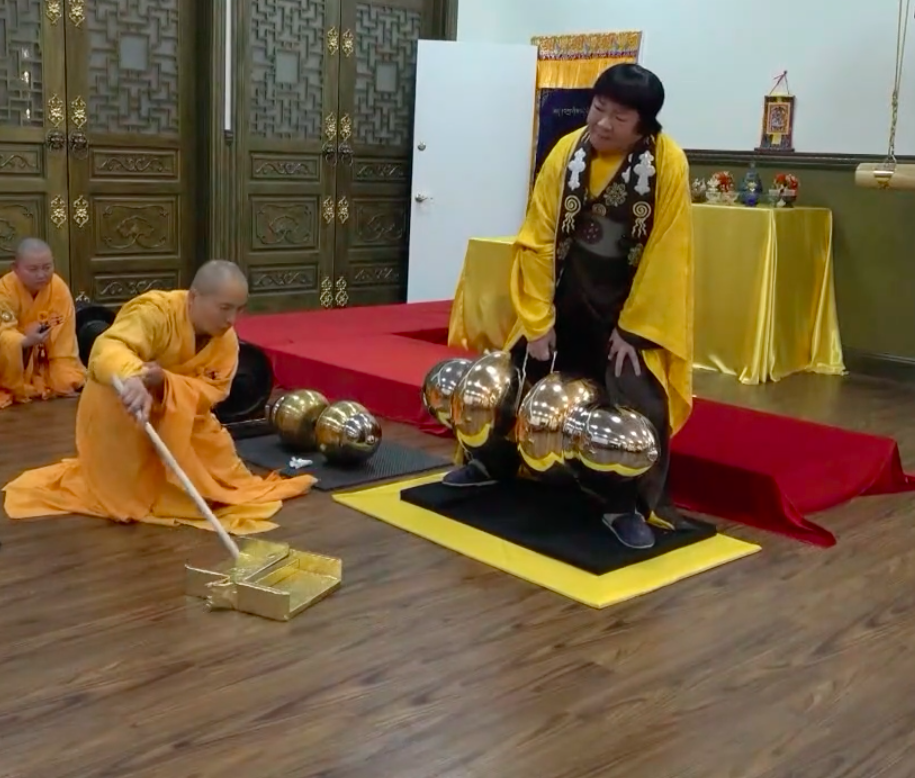
Namo Dorje Chang Buddha III possessed Buddha-level physical constitution and physical strength that are unmatched in the world. Just about a little more than a month ago, on December 23, 2021, at the Holy Miracles Temple, His Holiness Dorje Chang Buddha III lifted the Supreme Holy Vajra Pestle that weighs 437.2 pounds, by using just four fingers to hook on to the Pestle, lifted it up, and held it for more than 13 seconds, surpassing His own base weight standard by 72 levels. Taizun Poshan Waxiang 破山瓦象太尊 asserted: “In this world, from the ancient past up to now, and even before Maitreya Bodhisattva attain Buddhahood, no ordinary or holy being will be able to lift the Buddha Pestle that Namo Dorje Chang Buddha III lifted, surpassing His own base weigh standard by 72 levels!”
The morality of Namo Dorje Chang Buddha III is so noble, His accomplishments so great, and the holy miracles He performed so numerous that it is impossible for us to list them all. What was listed above was just a drop in the ocean. If we were to tell you about all the magnificent feats of His Holiness Dorje Chang Buddha III, it would take more than ten days and ten nights. The magnificent greatness of Namo Dorje Chang Buddha III is not limited to His well-respected humanistic ethics, His noble personality and morality, His erudition, His distinguished accomplishments, His selfless compassion toward humanity and all living beings, and His passion in teaching and actualizing the practice of Buddha Dharma.Through altruistic endeavors, His Holiness Dorje Chang Buddha III truthfully, sincerely, and persistently actualized the principle of compassion, and He diligently worked toward the development of world peace. Many people are moved and motivated by His Holiness Dorje Chang Buddha III. Many people in this world aspire to Namo Dorje Chang Buddha III as their model, referencing His state of morality as their standard, and using His teachings as guidance to elevate their own morality and to benefit living beings. In doing so, not only have they fulfilled happiness in their lives, but many of them have ascended to the Buddha Land, attained freedom from death and rebirth, or attained even higher states of realization and accomplishments.
More importantly, Namo Dorje Chang Buddha III pointed out a bright path for humanity to stay far away from violence, a path that leads to benevolence and loving kindness, successful endeavors, happy families, peace in humanity, and prosperity in societies. Throughout different countries and regions in the world, more and more people of different ethnicities and cultures are actively learning and following the teachings of Namo Dorje Chang Buddha III to cultivate themselves and benefit living beings. Consequently, they have greatly elevated the level of morality in society, advanced human civilization, motivating more and more people in this world to become good, kind, and ethical people, and enabling the world to become an auspicious and green planet. These are the tremendous and inexhaustible contributions that Namo Dorje Chang Buddha III has brought to all human and other sentient beings in this world, so they may increase their happiness.
The book H.H. Dorje Chang Buddha III contains a more detailed explanation by Gadu Rinpoche of what happened when H.H. Dorje Chang Buddha III gave the discourse “What Is Cultivation?” However, I would like to give my own personal testimonial of what I experienced. Like Gadu Rinpoche, I was very fortunate to be present when these holy events occurred. Since I have followed my Buddha Master, H.H. Dorje Chang Buddha III, I have seen many awesome and unbelievable events and been blessed by being able to participate in and witness many Buddhist ceremonies and receive dharma empowerments and initiations. This experience was truly amazing and was also an example of how different people saw or experienced different things. This is often the case when we witness holy states. Our karma is different, so the manifestation of holy states appear to us differently.
These lights first appeared when we were sitting and respectfully listening to a dharma discourse. I had requested that my Buddha Master give us a discourse on “What is Cultivation?” and His Holiness had graciously consented. We knew this would be a special discourse, since it was being recorded and many great dharma teachers and rinpoches had been summoned to attend. Suddenly there appeared a bright flashing light. I thought someone was using a flash camera, only that seemed very disrespectful and this was much brighter and dazzling and had a more golden color than that of a camera. I very rudely looked around. There was no camera nor apparent source. My second thought was that I was just imagining it. Of course no one else was showing any signs of seeing anything–they were all so engrossed in our Buddha Master’s discourse, and much too well behaved to respond. The lights came again many times–I lost count after the third, but I know it was more than three times. They were very bright and quite distinct. No sooner had the Buddha Master ended the discourse and we had paid our respects, did everyone begin talking at once. Even though it was in Chinese I could gather from the hand gestures and excitement that they had seen the same thing I saw. I believe all of this was recorded on the CD of this discourse. Ven. Gadu Rinpoche, whose English is quite good, explained what he had seen as did several others. It appeared that everyone present had seen something. There was no doubt that holy beings had come to listen to this very important discourse (it is printed in the book H.H. Dorje Chang Buddha III and included on this web-site) and they were very pleased and showed their joy by blessing us with their presence.
For a short period of time after that, these lights would miraculously appear. Once they flashed most auspiciously when the Buddha Master was talking to Ven. Gadu Rinpoche. At that time the Holy Beings were indicating approval of the design proposed for the cover of A Treasury of True Buddha-Dharma (the manuscript version of H.H. Dorje Chang Buddha III). They also flashed one Sunday morning at the hermitage where I live when I was reading one of His Holiness’s discourses in preparation for a class that would be taught later on that day. They came at another time when the Buddha Master was giving a discourse, but this time I was told to not be distracted and pay attention to the Buddha Master. I am pretty sure that was also included in the recording, but I must confess that before I was reprimanded, I searched the mandala thoroughly for any possible sources of light. There were none. These were truly blessings from another dimension. These were the manifestation of the Buddhas and Bodhisattvas who came to show their respect to our great Buddha Master!
There is no doubt that the book H.H. Dorje Chang Buddha III is an extraordinary work. Not only does it introduce H.H. Dorje Chang Buddha III to the world and share the reactions to the book of the leading Buddhists in the world today, it also documents a few of the awe inspiring accomplishments of this magnificent Holy Buddha the most important of which are the many teachings that can lead many beings to liberation. Since most of the book will be published in English as well as Chinese, it is truly a most auspicious blessing to the entire world. It represents the dissemination of the true Buddha-dharma for this time and age and in the Western and Asian worlds.
This complex world is neither exclusively rosy nor entirely thorny. The rose, soft, beautiful, and fragrant, grows on a stem filled with thorns. What is rosy remains so, and what is thorny persists. One should not interfere with the thorns due to the presence of the rose, nor disparage the rose because of the thorns.
To an optimist, the world appears absolutely rosy; to a pessimist, it seems entirely thorny. However, a realist views the world neither as entirely rosy nor wholly thorny. From a realistic perspective, the world is a blend of beautiful roses and prickly thorns.
An understanding person appreciates the rose’s beauty without becoming infatuated, acknowledging the thorns’ nature and taking precautions not to be wounded.
Similar to a pendulum swinging between right and left, four inevitable conditions prevail in life — gain and loss, fame and defame, praise and blame, happiness and pain.
Gain and Loss: Businesspeople experience both gain and loss. While it’s natural to be pleased with profits, one must exhibit moral courage and maintain a balanced mind in the face of losses. Anticipating losses and being prepared helps reduce disappointment.
Fame and Defame: Fame and defame are inevitable in life. Seeking undue praise or avoiding criticism can lead to unfulfillment. True greatness is indifferent to external approbation.
Praise and Blame: Wise individuals remain unaffected by praise or blame, recognizing that opinions vary. The Buddha’s teachings emphasize responding to false accusations with patience and understanding.
Happiness and Pain: Genuine happiness is not solely derived from material possessions, power, or external circumstances. Inner happiness is found in non-attachment and leading a blameless life.
Facing pain, whether from old age, disease, separation, or death, requires equanimity. The Buddha himself endured physical suffering but maintained a balanced mind. Death, inevitable for all, should be faced with perfect equanimity.
Amidst these dualities, a balanced mind is crucial. The Buddha’s teachings encourage cultivating equanimity in the face of worldly conditions.



















 Peace LiLy