Miraculous Healing Through Repentance and the Blessings of H.H. Dorje Chang Buddha III

My revered Master, H.H. Dorje Chang Buddha III, is the incarnation of the ancient, supreme Buddha. Out of boundless compassion, His Holiness willingly bears worldly hardships and concerns to rescue sentient beings from suffering. His accomplishments across the Thirty Categories of the Five Vidyas have astounded the world and brought immeasurable blessings to countless lives. These works—each awe-inspiring in its own right—will soon be compiled into a book to benefit humanity. Yet even these remarkable achievements represent only a small fraction of His Holiness’s true realization.

Most people are unaware that the Buddha Master also possesses the highest and most profound esoteric Dharma. Because His Holiness operates with the enlightened mind of a Buddha and has attained the ultimate state in Buddhism, He was able to receive the rare and authentic vajra needle lineage—a powerful healing method.

I have personally witnessed numerous people with karmic connections to the Buddha Master be cured of serious illnesses, including cancer. Among them were:

  • Guangdong Yan and Zhiyong Luo, both diagnosed with nasopharyngeal carcinoma;
  • Zhuang Yan, who suffered from skin cancer;
  • Jingxing Wu, with a brain tumor;
  • And Lehui Xie, who endured decades of debilitating phlegm, inflammation, and migraines.

I know these individuals personally. I saw them healed. People from Hong Kong, Taiwan, and Malaysia who suffered from leukemia, AIDS, and strokes traveled to China to seek healing from the Buddha Master—and they, too, were cured.

This verse, from a poem written by the Buddha Master titled “To the Tune of Nian-Nu-Jiao,” perfectly captures that miraculous period:

“Three thousand suffering patients visited me,
Day and night I cured them.”

And now, I wish to share my own experience. Over twenty years ago, I stood at death’s door, suffering from late-stage uterine cancer. It was the Buddha Master who brought me back to life through the sacred power of the Buddha-Dharma.

In August of 1985, I began experiencing continuous menstruation lasting over two weeks. At first, I assumed it was just an irregularity and sought treatment through Chinese medicine, but nothing improved. I turned to Western medicine, yet the bleeding continued endlessly. After more than two months, I was transferred from a local hospital to Sichuan Provincial Hospital, where a biopsy confirmed the devastating diagnosis: late-stage uterine cancer.

Professor Zhang, the attending physician, told my husband Hui Han Da—who is also a fellow disciple of the Buddha Master—“The cancer has already spread. Surgery is no longer an option. Take her home. Let her eat what she wants, go where she wishes, and spend her final days with loved ones.”

Refusing to give up, my husband took me to Huaxi Medical University Hospital. The diagnosis remained unchanged. Still determined, he took me to the China-Japan Friendship Hospital in Beijing, then to Peking Union Medical College Hospital, and finally to Suzhou University Hospital. Each hospital gave the same grim verdict: there was nothing more they could do.

As my condition worsened, I lost the ability to eat and became emaciated, reduced to just 79 pounds. My hematin level was a mere 3 grams—far below the normal 16 grams. In a desperate attempt to stop the bleeding, my husband brought me back to Huaxi Medical University Hospital. The doctor took one look at me and shook his head:
“She has seven days left at most. Go home and prepare for her funeral.”

Back at home, lying in bed and feeling the nearness of death at only 36 years old, I told my husband through tears, “Before I die, could you please go to the Buddha Master and ask Him to help elevate my soul after I pass?”
He replied, “The Buddha Master is currently traveling, spreading the Dharma and saving beings. I will go see His Holiness once He returns.”
Silently, I prayed with all my heart to Avalokiteshvara Bodhisattva (Guan Yin), hoping the Buddha Master would come back soon.

The very next day, around noon, a miracle happened. The Buddha Master appeared at my bedside.

I tried to get up to prostrate, but I was too weak. His Holiness gently stopped me and told me to lie still. With immense compassion, the Buddha Master began to expound the profound truths of life and the universe, explaining the root cause of suffering—how beings are bound by karma born from delusion, which leads to the inevitable cycle of birth, aging, sickness, and death.

In a moment of deep reflection, I suddenly came to a painful realization: In order to make money through business, I had once helped others produce a type of beef by slaughtering more than a thousand yaks. Whether or not I had intentionally killed other living beings in the past, how many lifetimes would it take to repay the karmic debt from taking just those thousand lives?

Their blood had once flowed because of my actions—and now, my own blood flowed endlessly due to illness. It was then that I truly understood: this was karmic retribution. The causes I had planted were dark, and now I was receiving their bitter fruits. The more I contemplated this, the more fearful and remorseful I became. From the depths of my heart, I sincerely repented and prayed to the Buddha Master to elevate me to a higher realm after death.

The Buddha Master compassionately said to me:

“If you truly repent, change your ways, never again kill any living being, and resolve to learn Buddhism and cultivate yourself, I will block your negative karma and delay your retribution. Cancer is nothing formidable! I will heal you—and I will also save those yaks that you killed.”

Then and there, the Buddha Master treated me with the vajra needle—a holy object of profound lineage, part of a supreme Dharma that only a true Buddha can apply. The vajra needle is no ordinary tool; it acts according to the will of the Buddha Master. When instructed to send sensation to a specific part of the body, it obeys instantly. When told to stop, it immediately ceases. It was truly beyond anything I had ever imagined.

At the time, I was wearing both a sweater and a fur coat. His Holiness applied the needle through my clothing to an acupuncture point on my back. After releasing the needle, the Buddha Master formed various mudras (sacred hand gestures). As each mudra changed, the sensations from the needle also changed—sometimes weak, sometimes strong—spreading throughout my entire body. I felt tingling, pressure, and swelling sensations, almost too intense to endure.

Then the Buddha Master explained:“Illness arises when energy channels in the body are blocked. It’s like a machine clogged with old, dirty oil that needs to be cleaned. This treatment is cleansing and unblocking your channels. Now, with just my words, the sensations will stop.”

The moment His Holiness spoke, all sensations vanished instantly.

The second round of treatment brought even sharper sensations, again perfectly controlled by the Buddha Master. When His Holiness gave the command, the sensations stopped at once. After a third round of treatment, I felt completely at ease. The Buddha Master then said:

“Today I opened your energy channels. But for complete healing, I must prepare a medicine using the highest Buddha-Dharma methods.”

Soon after, the Buddha Master instructed my husband, Hui Han Da, and me to drive Him to a mountain village—the very place where those yaks had been slaughtered. There, in front of a large yak, the Buddha Master began preparing the medicine. My husband and I were both present.

As the Buddha Master began the ritual, a white mist suddenly appeared in the clear sky, drifting from west to east. The mist grew denser and denser until we couldn’t even see our hands before our faces. During that time, many auspicious and mysterious phenomena occurred. Once the preparation was complete, the Buddha Master had me drink the fragrant herbal liquid.

As soon as I drank it, I felt a surge of warmth fill my body, followed by a deep, refreshing coolness. I was completely rejuvenated—energetic, peaceful, and miraculously healed. The endless bleeding stopped. Overwhelmed with gratitude, I immediately prostrated before the Buddha Master, tears of joy flowing down my face.

From that day forward, I took no more medicine. My strength and body weight gradually returned to normal. One month later, a doctor from Sichuan Provincial Hospital called to follow up, assuming I had already passed away. I answered the phone myself and said:“I’m alive—and completely healed!”

He didn’t believe me and requested I come in for an examination. At the time, fellow disciple Guangdong Yan, who had also been cured by the Buddha Master of nasopharyngeal carcinoma, was visiting my home. We both agreed to go together.

The next day, we were re-examined. The test results showed not a single cancer cell in either of us. The doctors were stunned. They asked what medicine I had taken, who had treated me, and how I had recovered. I answered:“It was the Buddhas and Bodhisattvas who saved me.”

It has now been twenty-one years since the Buddha Master healed me. Ever since I began sincerely practicing the Buddha-Dharma under His Holiness’s guidance, my health has only improved. Recent physical exams show that all my health indicators are excellent. I now weigh 165 pounds, more than double my weight when I was sick.

Friends and family who saw me during my illness are astonished when they see me now. Many say I look like a completely different person.

The Buddha Master also performed special Buddhist rites to liberate the yaks whose lives were taken. The compassion and grace the Buddha Master has shown me and my entire family are immeasurable.

From this life onward, all I can do to repay His Holiness is to devote myself wholeheartedly to cultivation, do good for others, and strive to attain true realization in order to be worthy of the sacred blessings and infinite kindness of my most revered Buddha Master.

Buddhist disciple,
Chi Lie Er
(This is a complete translation of the Chinese text that follows originally written
and signed by Chi Lie Er.)

Link: https://peacelilysite.com/2025/06/05/miraculous-healing-through-repentance-and-the-blessings-of-h-h-dorje-chang-buddha-iii/

The Power of Small Good Deeds

Kindness Is Destiny

“Those who genuinely help others always end up helping themselves.”
This powerful truth was the headline of a Washington Post article recounting the inspiring life story of Carlos Gutierrez. From humble beginnings as a working-class youth, he rose to become one of the most respected figures in American business and government. His secret? A simple yet profound practice: doing one good deed a day.

Carlos Gutierrez is best remembered for saying:
“A person’s destiny is not necessarily shaped by a single great act. I believe that more often, it is shaped by small acts of kindness in everyday life.”

Born into a privileged family, Gutierrez’s early life was marked by comfort and stability. But everything changed after a revolution forced his family to flee their island home. They arrived in Miami with nothing. At the age of fifteen, to help support his family, Carlos took his first job as a waiter in a small seaside restaurant.

He was diligent, eager to learn, and even willing to work without pay. His commitment caught the eye of the restaurant owner, who invited him into his home and introduced him to his children to help Carlos improve his English.

Thanks to his strong work ethic and positive attitude, Gutierrez was soon recommended for a second job—this time as a salesman and delivery driver at a food company. Before he began, his father passed on a simple family principle: “Do one good deed a day.”
He explained that this habit had helped build their once-successful life, and urged Carlos to live by it.

Carlos took that lesson to heart. While delivering oatmeal to mom-and-pop shops around the city, he went out of his way to help others—carrying letters to nearby towns, giving children rides home from school, offering small kindnesses without ever expecting anything in return. He did this joyfully, for four years.

In his fifth year, the company recognized his contributions in a remarkable way. They promoted him to lead marketing operations for Latin America from their Mexico office. His performance review noted:
“This employee, over the past four years, has personally accounted for 40% of Florida’s total sales volume. He should be promoted.”

From there, his rise was meteoric. He took on leadership across Canada and the Asia-Pacific region, eventually becoming CEO of the company.

Later, as top American corporations like Coca-Cola and Colgate considered him for their CEO positions, President George W. Bush nominated him as Secretary of Commerce in the United States government.

Carlos Gutierrez’s story reflects a timeless truth found in Buddhist teachings. A Buddhist master once shared how, in the early days of his Dharma teaching, only a few rural housewives followed him. He taught them to practice kindness in the simplest way:
“Take a small coin from your grocery money—just a dime—and use it each day to do a good deed.”
At the end of the month, they would have performed thirty selfless acts from the heart. One good deed a day, and one’s merit grows.

The practice may seem simple, but when carried out with sincerity and perseverance, it awakens our inner awareness. Like a stream that flows quietly but never ceases, daily kindness trains the mind to stay rooted in goodness and deepens our spiritual cultivation—from surface-level thoughts to the very heart of intention.

Traditional Chinese culture also upholds the principle of “doing one good deed a day.” This value is deeply reflected in the classic text The Four Lessons of Liaofan, where Yuan Liaofan outlines a path of self-transformation through the active cultivation of virtue. By committing to perform a thousand good deeds, he not only benefited others but also profoundly changed his own destiny.

Even a single kind thought toward others is an act of goodness. A word that uplifts or benefits someone is a good deed. And a small action—no matter how minor—that helps another person is still a meaningful expression of kindness.

Whether through our thoughts, speech, or actions, if we put others first, we are cultivating virtue. That is the essence of being a good human being.

And importantly, we must remember: never withhold kindness just because it seems too small.
Do good whenever the opportunity arises. Act from the heart, with sincerity and joy—not for show, not for praise—but naturally and spontaneously, with the intention to benefit others.
This is the foundation of true bodhisattva conduct.

Goodness does not need an audience. “Virtue does not require recognition; Heaven always sees our good deeds.”
A seed of kindness, planted in silence, will one day bloom with beautiful results—often when we least expect it.

So let us each begin with just one small act of kindness a day. It may seem simple, but over time, it has the power to change not just our lives—but the world.

Link:https://peacelilysite.com/2025/06/05/the-power-of-small-good-deeds/

A Serene Masterpiece: The Water-Moon Guanyin at the Nelson-Atkins Museum

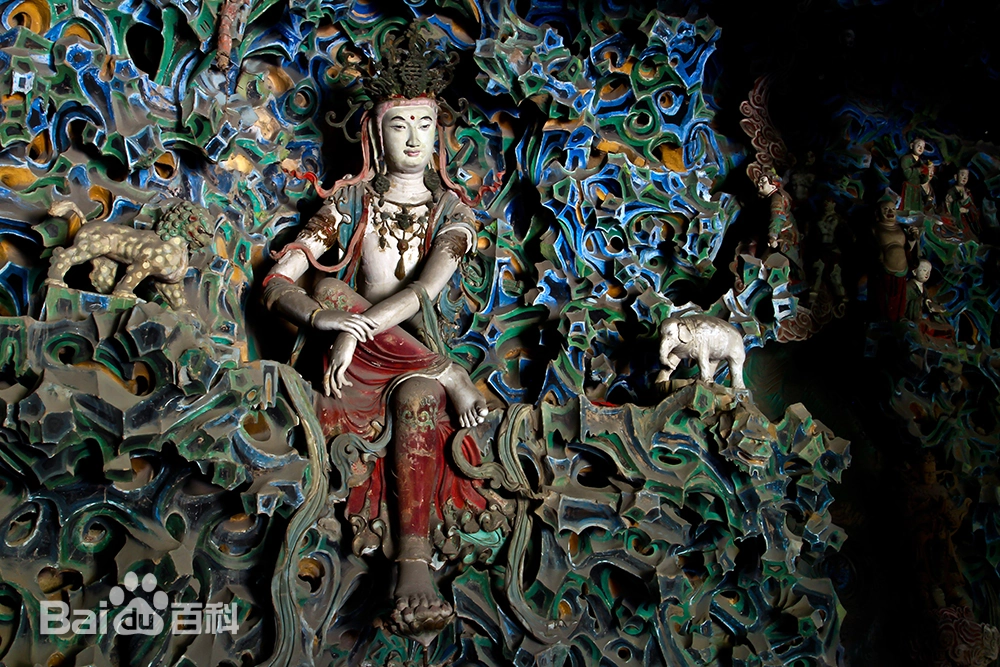
Tucked within the tranquil halls of the Nelson-Atkins Museum of Art stands a breathtaking wooden sculpture of Water-Moon Guanyin from the Liao Dynasty—a work hailed as “the most magnificent surviving sculpture in China” and “a triumph of religion and aesthetics.” It has also been honored by the media as “one of the thirty finest works held in American public institutions.”

Officially labeled by the museum as “Guanyin of the Southern Sea,” this statue rises to an impressive height of 2.4 meters. Aside from the right forearm, the entire figure—including its base—was masterfully carved from a single block of wood. Dating back to the 11th or 12th century (Liao or Jin Dynasty), the sculpture has been remarkably well-preserved over the centuries.

This Guanyin is an extraordinary example of religious artistry. Her face is gently sculpted with refined features—serene, graceful, and quietly majestic. Adorned with a jeweled crown, her eyes are softly closed, gazing downward in meditation and compassion. The statue’s pose reflects the elegance and wisdom traditionally associated with the feminine form, especially in the flowing hand gestures—while still retaining some subtle masculine traits in the upper body, a nod to Guanyin’s transcendent nature.

In classic iconography, Water-Moon Guanyin is often portrayed seated on a rock or lotus throne, gazing compassionately at the world. In this sculpture, she sits with one leg bent and the other gracefully draped downward. Her right arm rests lightly on her knee, fingers gently curved, as she gazes diagonally downward with a calm smile—evoking the image of the moon reflected in water. This visual metaphor powerfully symbolizes a core Buddhist teaching: the illusion of form and the essence of emptiness.

Every aspect of the statue—the proportions, the flowing posture, the tranquil expression—conveys a sense of effortless grace, inner freedom, and compassionate presence. It is a piece that invites quiet reflection, stirring something deep within the soul of the viewer.

The Legend Behind the Water-Moon Guanyin

The form of Water-Moon Guanyin, also known as “Auspicious Water Guanyin” or “Auspicious Water Bodhisattva,” is one of the most beloved among the thirty-three manifestations of Guanyin in Chinese Buddhist tradition. Interestingly, the name “Water-Moon” does not come from early Buddhist scriptures, but rather from Chinese folklore—born of the fusion between Buddhism and indigenous Chinese culture.

According to legend, Guanyin once appeared in Suzhou during a time of war, where she witnessed the brutal slaughter of civilians by the Jin army. Out of great compassion, she transformed into a beautiful woman, built a ritual platform, and began chanting sutras to deliver the souls of the dead. When her recitation was complete, someone among the crowd recognized her divine aura and asked to see her true form.

The Bodhisattva pointed to the riverbank. There, reflected in the still waters, was the image of a radiant full moon, within which her sacred figure appeared—graceful and ethereal. Among the witnesses was a talented artist named Qiu Zijing, who quickly sketched the vision. As his painting circulated, this image came to be known and venerated as the Water-Moon Guanyin.

A Space Worthy of the Divine

To properly honor this extraordinary statue, the Nelson-Atkins Museum created an expansive Chinese Temple Gallery. Behind Guanyin stands a Yuan Dynasty mural titled “Assembly of the Radiant Buddha,” originally from Guangsheng Temple in Shanxi Province. Above hangs a carved Ming Dynasty coffered ceiling adorned with dragons, while in front, finely carved lattice doors from a Qing Dynasty official’s residence in Beijing complete the immersive setting.

This harmonious environment allows visitors to experience the sculpture not just as a museum piece, but as a living expression of faith, beauty, and timeless spiritual insight.

https://www.orientations.com.hk/highlights/creating-spaces-for-asian-art-c-t-loo-and-the-nelson-atkins-museum-of-art

https://www.orientations.com.hk/highlights/creating-spaces-for-asian-art-c-t-loo-and-the-nelson-atkins-museum-of-art

The Water-Moon Guanyin at the Nelson-Atkins Museum is more than an ancient sculpture—it is a sacred embodiment of compassion, artistry, and transcultural storytelling. Whether viewed through the lens of religion, history, or aesthetics, it stands as a serene reminder of the enduring power of beauty to transcend time and touch the human spirit.

Link:https://peacelilysite.com/2025/05/21/a-serene-masterpiece-the-water-moon-guanyin-at-the-nelson-atkins-museum/

Enshi: China’s Grand Canyon

A walkway in Enshi Canyon, China’s Grand Canyon. Jean Spoljaric photos.

A Visit to the Chinese Grand Canyon in Enshi

By Jean Miller Spoljaric

My trip to the Hubei (Hu-bay) Province of Central China proved to be a real eye-opener. It was a culture shock for me, but life as they know it for them. I traveled from Beijing to Wuhan, China, and on to Enshi, the home to China’s Grand Canyon.

Enshi city was vibrant and alive, but nothing could have prepared me for the China I was about to see in the mountainous areas of Enshi Canyon. Several times during the trip, I reminded myself that, sometimes, ‘Less is More.’

Location

The view from the top of Enshi Canyon is breathtaking.

Enshi is the capital city of Hubei Province and is located inland, in the southwest region of Hubei. It’s an area of immense natural beauty with soaring mountains, deep canyons, meandering rivers, and great waterfalls. The mountain village is a two and a half-hour car ride from the bustling city.

The mountaintops are high above the skyline and the thousand-zhang waterfalls that tumble to the canyon floor below, feeding the underground rivers that flow through the Qungjiang River Valley of virgin forests and ancient villages.

Enshi proudly displays the peaks and valleys of what is known today as China’s Grand Canyon.

Enshi Grand Canyon

The Enshi Grand Canyon is located in Tunbao Village in the Town of Banqiao, high above the clouds. I climbed my way to the summit and experienced the views of a lifetime. Altogether, I hiked three of the five precipices in Enshi Canyon.

I was in awe as I gazed out toward the mystical land. The puffy clouds seemed close enough for me to touch and the precipices were like giant stalagmite stone fingers reaching toward the heavens.

Free from the hustle and bustle of the rest of China, there were no beeping horns, no crazy mopeds; just the serene stillness and beauty of nature.

A 67-Mile Canyon

The Enshi Canyon has a total length of 108 km (67 miles) and the total area is more than 300 sq. km (about 74,000 acres, or 115.8 sq. miles). As it’s only 1.7 miles wide, it makes the canyon long and narrow.

By comparison, the American Grand Canyon (1,218,560 acres/ 1,904 sq. miles) could hold sixteen Enshi Grand Canyons.

The significant difference between the two is that Enshi Grand Canyon is lush as opposed to the barren desert-like topography of America’s Grand Canyon.

Still, all the splendor and physical features that one would find in America’s Grand Canyon are contained within this smaller area, so it makes it a great place to visit for a day trip or longer.

All hard work and smiles, always, in Enshi.

The Magic

As I climbed the steep ridges of the mountains, at each turn, I came across villagers selling cold drinks, cooked potatoes, and hard-boiled eggs soaking in tea. Not an easy day’s work!

I was amazed at how the elders set up camps every day, hiking up and down these mountains with large sacks strapped on their backs. Great exercise keeps them fit.

As I paused to drink my water and catch my breath, a woman twice my age, with a gentle smile on her face, passed me. I used the universal sign for a photo to ask if I could take a picture. Her look of concern was followed by a big smile.

Moments after snapping the image, I shared it with her and several others who had stopped to watch. They seemed amazed at seeing themselves in the viewfinder. It was magic and they wanted more pictures.

This pretty little girl hiked the Enshi Grand Canyon with her family. I was proud of her as she kept up with everyone!

Then, a little boy stopped and pointed to my iPod. I let him listen to a song and his face beamed with amazement! More magic!

And, just like that, any concerns were replaced with trusting smiles. As we smiled and laughed together, the language barrier seemed to disappear.

Giant Golden Panda

As a tall, blond, westerner, I felt the introspective eyes of the locals on me in the more urban areas, but nothing prepared me for my reception in the isolated mountain settlements.

For many of the mountain people of Enshi, it appeared to me that I was the first American they had ever seen.

The children surrounded me, seemingly mesmerized by my blonde hair and green eyes. Mothers shooed their children closer to get a better look; the shy little ones hid behind their mother’s skirt, peeking out just enough to fill their curiosity.

My tall stature and lightly colored hair had the men following my every move with their eyes. Women would gather around just to hear me speak.

I felt like a giant golden panda. I laughed to myself as I thought that I haven’t turned this many heads since I was nineteen!

They wanted to know everything about me: who I was, where I came from, why I was there! I’m happy to say, I think I left a lasting positive impression.

Large statues oversee the grounds at Tusi Castle in Enshi, China.

The People Of Enshi’s Mountains

The people of rural Enshi are kind, hard-working, self-sufficient, and very isolated from the world. They live a hard life off the land, but their big smiles never seem to fade.

They are farmers of vegetables and tea and are proud of their daily life with each other. There is no running water for most and squat toilets for all.

I saw children with no shoes or with one worn pair, and I thought about my children with too many shoes. I saw all the diseased and sick dogs lying in the comfortable shade of old, tired trees and wanted to rescue them all.

I guess it’s all relative. My daily life of iPods, cell phones, and laptops is a world away from the mountain people of Enshi. They are surrounded every day by trees, lakes, rivers, waterfalls, and beautiful lush green mountains. Maybe, they have it right!

The Other Enshi

There is another world below the mountains in the city of Enshi. By day, I would recommend a visit to Tusi Castle. It dates back to 700 AD and is a lesson in the culture of the area.

This Chieftain castle was destroyed by a fire in 2004 and perfectly restored soon after.

It is home to the largest archaized Pagoda style buildings in China.

As I wandered through the exhibits of architectural and decorative arts, I felt like I was walking through a living book. It tells the story of the Tujia folk cultures through sculptures, gardens, artwork, and furnishings.

Afterward, there is a must-see play that features the primitive reenactment of the local Chinese culture. It will make you feel as if you’ve been transported back in time.

Enshi City is alive and beautiful in the evening.

Lunch in Dingshihui

Make sure you head to Dingshihui for lunch! During a long hot day, I was looking forward to lunch and a drink, but I could never have imagined the surprise that Dingshihui had in store for me.

As I followed my guide up the stairs, my eyes became wide with amazement.

This fish dish is just one of the specialties at Dingshihui in Enshi City.

Dingshihui was like walking through a boutique-style hotel in Manhattan, and the food was incredible! I couldn’t believe that a luxurious oasis such as this existed in this city.

The city came alive in the evening. Neon lights lined the buildings and bridges in the Central Square and reflected off the river below.

There were men gathered in groups playing Mahjong and residents participating in a huge outdoor aerobics class.

The Lesson

The people of Enshi are an extended community where divisions of labor know no age and responsibilities are learned.

And who would have thought that the highlight of my trip to China would be the Grand Canyon of Enshi and the people who live there?

Enshi City
Enshi City

For all I thought I knew about China, it was all that I discovered I didn’t know that has added to the quality of my life. I want to return to this great experience and, if you’re as fortunate as I was, you’ll find a new world to discover.

Useful Information about Enshi China

Dried snake anyone?
Dried snake anyone?

For more information on travel in this area of China contact the CNTO- China National Tourist Office. They were extremely helpful and knowledgeable about all things China.

List of China tourism offices

While in Enshi I used Enshi Railway Travel Service Co., Ltd. They do not have a website so it makes it difficult to book anything in advance, but I assure you if you contact them directly upon your arrival in China they will make sure you have the time of your life.

They are located at No. 64 Hangkong Road, Enshi City. the phone number you can reach them at is (0086-718-) 8236262. Ask for Lucy to be your trusted guide; she will take wonderful care of you from start to finish.

To and From

I flew Air China from JFK Airport in NYC into Beijing Airport. I also flew China Southern throughout Hubei Province, Wuhan, and Enshi. Both airlines went out of their way to make me comfortable, the staff was friendly and the seating spacious.

Places To Go

Hubei Provincal Museum in Wuhan Ruibom Tea Factory Store in Enshi City

Information about Enshi Caynon

Information on Enshi City

Information about Tusi Castle

The Enshi Dingshihui Dining Management Company, Ltd. Restaurant has no website. It remains a bit of a mystery. Ask your guide or taxi driver to bring you to the fanciest place to eat in Enshi City; I promise they will know. I do have phone numbers. Once you arrive in Enshi you can try your luck: 0718-8411717 or 0718-8495282.

Lodging

While in Enshi City I stayed at the centrally located The Yihe International Hotel.

While in Wuhan I was lucky to stay at the beautiful Shangri-La Hotel. The Shangri-La is located in the Hankou business area and is only 25 minutes from the Tianhe International Airport and only 15 minutes from the Yangtze River Pier.

Source: https://www.gonomad.com/2172-enshi-china-chinas-grand-canyon

The Wisdom of the Empty Boat: Ancient Chinese Insight for Inner Peace

Chinese Painting by Henggong Yi

In the Mountain Tree chapter of the ancient Taoist classic Zhuangzi, there’s a simple yet profound story:

A man was crossing a river in a small boat when he noticed another boat drifting straight toward him. He shouted several times to warn the oncoming boat, but received no reply. Furious, he began cursing the other “reckless” person. But when the boats collided, he realized the other vessel was completely empty. In that moment, his anger vanished into thin air.

This story reveals a timeless truth: Often, what triggers our anger isn’t real harm but our judgment about the intention behind an event—our belief that someone shouldn’t have acted a certain way, or that people like that shouldn’t exist.

Imagine the same situation, but this time with a person steering the other boat. Most of us would react with outrage: “What’s wrong with you? Watch where you’re going!” A conflict would likely erupt. But when we know the boat is empty, we simply steer around it and move on.

This is beautifully explained in psychology by the ABC model:

  • A stands for the Activating event
  • B is our Belief about the event
  • C is the Consequence—our emotional response

It’s not the event itself that causes our reaction, but how we interpret it. Change your mindset, and your entire emotional response changes with it.

“The weak blame, the strong adjust, the wise let go.”
How you choose to interpret the world shapes the emotional and spiritual life you live.

Zhuangzi’s parable invites us to practice a mental shift: what if we saw others as “empty boats”? When a coworker unintentionally bumps into you, instead of assuming hostility, think, “Maybe they were just distracted.” When a friend speaks harshly, perhaps they’re struggling with something you don’t know. Instead of reacting with pain or revenge, consider that it may not have been personal.

Seeing others as “empty boats” helps us release resentment, practice compassion, and expand our emotional resilience. It allows us to heal ourselves faster, without getting trapped in cycles of blame and victimhood.

German philosopher Arthur Schopenhauer once said:

“To be angry at someone’s behavior is as foolish as being angry at a rock blocking your path.”
True wisdom lies in seeing through the illusion of control, and responding with tolerance rather than judgment.

When life doesn’t go our way, it’s easy to fall into the trap of self-pity: “Why is this happening to me?” But such thoughts only darken our mood and invite more misery.

The real shift happens when we stop blaming others and start examining our own mindset. By applying the “Empty Boat” perspective, we reduce conflict, soothe emotional storms, and gain a wider, calmer view of life. This isn’t just emotional regulation—it’s a deeper level of personal growth.

Zhuangzi also wrote:

“If a person can empty themselves and move through the world with humility, who can harm them?”

When we’re too attached to ego—too quick to feel offended, too focused on saving face—we inevitably clash with others. But if we release pride, prejudice, and the need to control, we become unshakable. No one can truly hurt us when we no longer take things personally.

Our mindset is the foundation of how we face adversity. Approach life with a peaceful, open heart, and life will respond in kind. Let go of the need for constant validation. Don’t let others’ words disturb your inner calm.

The journey of life is like sailing through mist—we never know what lies ahead. Complaining or getting angry doesn’t change reality; it only slows us down. But when we practice acceptance and face life with serenity, we go farther, and with greater ease.

Imagine all the unpleasant people or events in your life as “empty boats.” Let go of resentment and emotional baggage. You’ll find that forgiveness is not weakness, but a deep, penetrating wisdom. No longer a slave to your emotions, you become the true master of your mind.

May you carry an empty and serene heart, navigating life’s storms with grace, and holding on to peace amid the noise of the world.

Link: https://peacelilysite.com/2025/05/16/the-wisdom-of-the-empty-boat-ancient-chinese-insight-for-inner-peace/

Stop Comparing. Start Living.

As the saying goes, “Don’t be afraid of not knowing the quality of something—be afraid of comparing one thing with another.” Comparison is a double-edged sword. Without it, there is no disappointment. But once we begin measuring ourselves against others, dissatisfaction creeps in. Comparison is one of the root causes of suffering, and often the very reason happiness eludes us. Much of our pain in life arises not from reality itself, but from our attachments and the distinctions we draw in our minds.

I recently came across a thought-provoking story:
A king once posed a question to a wise man—“If I draw a line on a piece of paper and you’re not allowed to shorten it, how can you make it appear shorter?”
The wise man calmly stepped forward and drew a longer line next to it. Suddenly, the original line seemed shorter, not because it changed, but because of the comparison.

This simple parable reveals a profound truth: dissatisfaction often comes not from our actual circumstances, but from comparing them to someone else’s.

Take a look at real life. I weigh 170 pounds and carry a round belly. But if I constantly compare myself to someone who weighs 140 pounds and is lean and fit, I’ll label myself as “fat.” If I live on $2,000 a month and compare my lifestyle to someone spending $20,000, I’ll think I’m “poor.” But what if I didn’t compare? What if I simply appreciated what I had?

Survival is only part of life’s weight. The heavier burden is comparison. Many people spend their whole lives chasing after what others were born with, only to realize too late that what they’ve always had was someone else’s lifelong dream.

In the classic novel Demi-Gods and Semi-Devils, the character Murong Fu dedicates his entire life to a goal that Duan Yu was born into. Ironically, the woman Duan Yu longs for is someone Murong Fu already had from the beginning. And Ding Chunqiu, who went to great lengths and harmed countless people to get what he wanted, lost in the end to Xuzhu—who gained it all effortlessly, through virtue and sincerity.

We come into this world busying ourselves, striving, chasing after happiness. Yet we become trapped in appearances, constantly looking outward for fulfillment. We complain about stress and pressure, but when we pause to reflect, we often find that we’ve created most of that pressure ourselves—through endless comparison and unrealistic expectations.

It’s unwise—and even harmful—to judge the value of your own life by someone else’s standards. In life, not everything goes our way. If we spend all day comparing ourselves to others, we’ll always feel like something’s missing. But what if we started each day with gratitude instead?

Try this: When you wake up, take three minutes to feel content. Say to yourself with sincerity: “I am grateful for what I have right now. I am content. I am thankful.”
It’s a small act, but it can change your entire mindset.

Comparison doesn’t have to be harmful. It can also be a mirror for growth—if we use it wisely. Rather than feeling inferior and falling into envy or resentment, we can choose to let comparison inspire self-improvement. Let it motivate us to become a better version of ourselves.

And most importantly, compare yourself to your past self.
As a Buddhist disciple, I ask myself daily:

  • Have I improved my spiritual practice compared to yesterday?
  • Have I reduced negative thoughts and actions?
  • Have I done more good today than I did yesterday?

Over time, these small reflections add up. Bit by bit, we grow in virtue, in clarity, in compassion. And when we live this way—progressing each day, anchored in gratitude—we naturally find peace. We naturally move toward liberation and fulfillment.

Be thankful for what you have, right here, right now. Don’t compare. Don’t compete. Contentment is the true path to lasting happiness.

Fill your life with kindness and righteousness. Strengthen your heart and spirit. In a world full of comparisons, choose instead to grow, to give, and to be deeply, joyfully alive.

Link:https://peacelilysite.com/2025/05/14/stop-comparing-start-living/

Kindness Is the Best Feng Shui

Feng shui has long held a mysterious allure in Chinese traditional culture. For centuries, it has been highly respected and followed by many. Even in today’s modern society, interest in feng shui remains strong. From choosing a home to arranging furniture, people often seek out feng shui masters to predict their fortune or improve their luck. This enthusiasm has even spread beyond China, gaining popularity in many countries as a fashionable practice.

But have you ever wondered what kind of feng shui truly brings good fortune? The following story offers a fresh and enlightening perspective.


A wealthy man once bought a piece of land and built a luxurious villa. Because his wife loved lychees, he planted many lychee trees in the backyard. During the renovation, a friend suggested that he consult a feng shui master to ensure there were no negative formations. Though skeptical of feng shui, the wealthy man decided to give it a try and traveled to Hong Kong to invite a renowned master with over thirty years of experience.

After meeting the master at the train station and sharing lunch, they drove to the man’s home. Along the way, whenever another car tried to overtake them, the master noticed that the wealthy man would gently slow down and give way. “You’re a steady driver,” the master remarked.

The man smiled and replied, “Most of the people overtaking are probably in a hurry. I don’t want to hold them up.”

As they approached the town, the streets grew narrower, and the man slowed the car even more. Suddenly, a laughing child darted out from an alley. The man quickly hit the brakes. Instead of accelerating again, he kept watching the alley. Moments later, another child ran out, chasing the first.

“How did you know there was another child coming?” the master asked, surprised.

The man explained, “Kids always run in groups when playing. One laughing child usually means others are nearby.”

The master gave him a thumbs-up and said with a smile, “You’re very thoughtful.”

When they arrived at the villa, just as the man was about to unlock the door, several birds suddenly flew up from the backyard. He turned to the master and said, “Please wait a moment.”

“Is something wrong?” the master asked.

“There are probably children in the yard stealing lychees. If we go in now, they’ll panic. If they fall while trying to run, they might get hurt. Let’s give them a bit more time. We can wait here and let them enjoy the fruit.”

The master stood in silence for a while, then said, “Take me back to the train station. There’s no need to examine the feng shui of your house.”

The man was puzzled. “Why, Master?”

The master looked at him and said sincerely, “Wherever you are, that place already has the best feng shui.”


This story opens our eyes to a deeper truth: the most powerful feng shui isn’t found in the placement of objects or the direction of a door — it’s found within us. Our behavior, compassion, and moral integrity shape the energy we bring into the world.

Everyone desires good fortune and happiness, but many look for it in the wrong places. Some rely solely on feng shui arrangements or fortune tellers, hoping for shortcuts to a better life. But these are often just psychological comforts, lacking true substance.

The law of cause and effect governs all things: “Plant good causes to reap good results; avoid bad causes to prevent misfortune.” Only by performing good deeds and cultivating a kind heart can we attract blessings and peace. Relying purely on external feng shui while ignoring inner morality goes against this fundamental principle.

In truth, our actions and intentions are our personal feng shui. Kindness is the most powerful feng shui one can have.

As the saying goes: “A fortunate person lives in a fortunate place, and a fortunate place is inhabited by a fortunate person.” Here, “fortunate person” means someone with a kind and upright heart. A person’s energy — their “magnetic field” — reflects their character. Even the best feng shui cannot save someone with selfish or harmful intent, while a good-hearted person can transform even a less-than-ideal environment into a space of warmth and harmony.

When we live with compassion and integrity, we naturally draw good karma, success, and joy into our lives. At that point, we no longer need to search for feng shui — we are the feng shui.

Kindness is the best feng shui. May we all cultivate it from within.

Link:https://peacelilysite.com/2025/05/01/kindness-is-the-best-feng-shui/

A Life Well-Loved: Finding Strength in Softness and Wisdom in Time

After more than fifty years of experiencing life’s ups and downs, I have finally come to understand the profound importance of quieting down, reflecting, and learning how to truly love myself. It is only through self-love that we can genuinely love others.

“When I truly began to love myself, I started going to bed earlier and learned to enjoy exercise. I stopped getting lost in worries and anxieties. Instead, I became confident and pursued meaningful people and endeavors with passion. That was the moment my life truly began.”

Understanding another person is never easy. We must walk in their shoes, see the world through their eyes, and consider life from their perspective. Yet, this journey often brings sadness. But in that sadness, we discover clarity—we learn to focus on what truly matters.

Rather than wasting our time on trivial concerns and unfulfilling distractions, we should devote ourselves to nourishing pursuits: sleep, books, exercise, the beauty of nature, and, above all, the love we have for the world. When we consciously take control of our time, the tranquility of daily life emerges naturally, and anxiety fades away.

Kahlil Gibran once said, “If one day you stop searching for love and simply love; stop yearning for success and just do; stop pursuing empty growth and begin to cultivate your character, then your life will truly begin.” This wisdom reminds us that authentic living starts with our inner transformation.

Loving yourself means understanding that pain and emotional turmoil are often just reminders to live authentically. Unless it stems from physical illness, much of our suffering comes from misplaced values rather than objective reality. The things we cling to the most are often the very things that torment us, while those beyond our control are simply not worth our distress. True wisdom lies in knowing when to hold on and when to let go.

To be nurtured by others is a gift; to nurture others is an even greater act of cultivation.

May we have eyes that shine like stars, hearts as vast as the ocean, and lives that leave behind the fragrance of kindness wherever we go.

The Wisdom of Middle Age

Middle age teaches us the value of patience, restraint, and measured action. In our youth, we often equate eloquence with intelligence, only to later realize that true wisdom often lies in silence. As W. Somerset Maugham observed, “In a crowd, the quietest person is often the most powerful.”

In conversations, we should not rush to take center stage. Instead, we should listen more and speak less, exercising the grace of restraint. When others share, let us resist the urge to interrupt. When disagreements arise, let us not hastily refute. Instead of saying, “I think,” we can ask, “What do you think?” Instead of declaring, “You are wrong,” we can offer, “Perhaps there is another way to see this.” By replacing subjective judgment with open-minded awareness, we foster deeper understanding.

The world is not simply black and white. By speaking a beat slower and thinking a step faster, we cultivate clarity and wisdom in our lives.

In psychology, there is a concept called task separation: our emotions are our responsibility, while others’ reactions belong to them. The wisdom of softness lies in maintaining a gentle boundary between the two. It allows us to be vulnerable and to accept imperfection in ourselves and others. Harsh confrontation often leads to conflict, but a simple, “I understand your difficulties,” can resolve tensions effortlessly. As Alfred Adler wisely said, “True strength lies in the courage to expose one’s vulnerabilities.”

Try shifting from “I must win” to “We can solve this together.” Instead of “Why don’t you understand me?” consider, “Perhaps I need to express myself differently.” Softness is not weakness—it is a space that allows relationships to breathe and grow.

Kazuo Inamori once said, “What you hold in your heart is what you will encounter.” True generosity is not about calculated acts of kindness but instinctive goodwill. A small gesture—carrying a neighbor’s trash, offering a sincere compliment, or leaving a light on for a loved one—creates ripples that spread far beyond our immediate reach.

A generous heart does not tally whether kindness is repaid. As the Tao Te Ching states, “The more you give to others, the more you have yourself.” Every act of warmth we extend ultimately enriches our own lives.

As we journey through middle age, wisdom is cultivated through restraint. In youth, we may be like strong liquor—bold and fiery; with time, we become like fine tea—subtle yet deeply enriching. Speaking slowly allows us to reflect, gentleness fosters harmonious relationships, and generosity ensures lasting blessings.

These qualities of slow cultivation cannot be rushed or feigned. But with daily practice and yearly dedication, we will come to embody the depth of the old adage: “Still waters run deep.”

Link:https://peacelilysite.com/2025/04/02/a-life-well-loved-finding-strength-in-softness-and-wisdom-in-time/

Vimalakirti’s Profound Teachings on Suffering and Liberation

The Profound Wisdom of the Holy Buddha Vimalakirti

The Vimalakirti Sutra stands as one of the most profound texts in Mahayana Buddhism, offering deep insight into wisdom, compassion, and the nature of illness. One of its most significant sections, the “Chapter on Illness,” presents a powerful dialogue between Manjushri and Vimalakirti, a lay Bodhisattva of extraordinary realization.

Vimalakirti, despite his unparalleled wisdom, feigns illness to teach a vital lesson. When Manjushri visits him and asks, “Aren’t you successful in your practice? If so, how can you be ill?” Vimalakirti responds, “I am ill because all sentient beings are ill.” This response redefines illness—not as a personal affliction but as an expression of universal suffering. His illness is a manifestation of his boundless compassion, mirroring the pain of all beings so that he may guide them toward liberation.

Manjushri Bodhisattva and other disciples visiting H.H. Vimalakirti

The dialogue between Vimalakirti and Manjushri unfolds into a deeper contemplation on suffering. When asked when his illness will be cured, Vimalakirti replies, “When the last sentient being is free from illness, then my illness will be cured.” This statement embodies the heart of Mahayana Buddhism—the vow to attain enlightenment not for oneself alone but for all beings. His words resonate with the self-sacrificial love found in other spiritual traditions, such as Jesus Christ’s willingness to bear humanity’s suffering.

Vimalakirti further explains, “From ignorance comes love, and thus my illness arises.” He reveals that suffering stems from attachment—attachment to family, possessions, ambitions, and even spiritual practice. Such attachments cloud the mind, giving rise to suffering. True liberation, he teaches, comes from transcending these attachments through wisdom and compassion.

The holy and venerable Vimalakirti is unique in Buddhist history, as he was an ancient Buddha who chose to manifest as a layperson rather than an ordained monk. During the time of Shakyamuni Buddha, he played a crucial role in teaching monastics and Bodhisattvas who struggled to develop Mahayana bodhicitta. His unparalleled wisdom and skillful means helped bridge the gap between monastic and lay practitioners, proving that profound realization is not limited to those in monastic robes.

In reality, Vimalakirti was the incarnation of the supreme Buddha Dorje Chang (Vajradhara), the primordial Buddha and master of all Buddhas. Yet, instead of taking a leadership role that might have caused sectarian divisions, he humbly chose to serve as a Bodhisattva assisting Shakyamuni Buddha. His teachings, recorded in the Vimalakirti-nirdesa Sutra, are regarded as sutras in their own right, carrying the weight of authentic Buddha-dharma.

The depth of Vimalakirti’s wisdom was so vast that even the most accomplished Bodhisattvas hesitated to engage him in dialogue. When Shakyamuni Buddha asked Maitreya Bodhisattva to inquire about Vimalakirti’s health, Maitreya declined, admitting that Vimalakirti had once humbled him with his superior insight. Ultimately, only Manjushri, the ancient Buddha and master of the seven Buddhas, dared to engage Vimalakirti in discourse.

Chinese Ink painting Holy Master Vimalakirti by H.H. Dorje Chang Buddha III

Vimalakirti’s teachings were not limited to words alone—he also demonstrated his supreme realization through extraordinary miracles. In one instance, he used his boundless supernatural powers to bring the entire Buddha-land of Abhirati, including the Immovable Buddha (Aksobhya), into the human realm. Even the Immovable Buddha himself declared, “I did not do this; it was through the supernatural powers of Vimalakirti.” Such feats reveal that Vimalakirti’s realization surpassed that of all Bodhisattvas and was equal to that of Shakyamuni Buddha himself.

Shakyamuni Buddha himself affirmed the extraordinary status of Vimalakirti, stating, “One who makes offerings to that holy being should know that this is making offerings to the Buddhas. One who transcribes this sutra or keeps it in a room should know that the Tathagata exists in that room.” These words confirm that Vimalakirti was, in essence, a Buddha.

His teachings continue to inspire practitioners today, offering a profound perspective on suffering, wisdom, and compassion. His willingness to manifest illness as a teaching tool, his unparalleled debates with great Bodhisattvas, and his supernatural demonstrations all serve as timeless lessons in the path to enlightenment.

Link:https://peacelilysite.com/2025/03/28/vimalakirtis-profound-teachings-on-suffering-and-liberation/

The Power Of The Holy Vajra Needle

My name is Guang-Fen Fu. Since I was young, I have been physically weak and often ill. When I became an adult, my mother told me, “Daughter! You have had a weak constitution since you were young. Go and learn medicine. This will be good for your health, and you will not become weary through exerting too much physical strength.”

        In 1958, I began following a teacher to learn traditional Chinese medicine. Because my illnesses resulted from the power of karma accumulated through many lifetimes and eons, my illnesses did not decrease as my knowledge of medicine and my experience in practicing medicine grew. Disease constantly followed me wherever I went.

        In 1978 and the following few years, I suffered from a gastric ulcer in which most of my stomach hemorrhaged. During that time, I also discharged blood when going to the bathroom and vomited blood. In 1981, I had no choice but to undergo surgery to cut out most of my stomach. My health was even worse after the surgery. My food intake lessened, my face became pale, I spoke without any vigor, my spirit was weak, my movements were slow, and I often could not go to work.

        As a result of the care and assistance given to me by a friend, in 1987, I met my respected Buddha Master, H.H. Dorje Chang Buddha III Wan Ko Yeshe Norbu Holiest Tathagata. When His Holiness learned of my suffering from illness and my strained financial circumstances, His Holiness showed immense compassion and concern. His Holiness treated me with the holy vajra needle. H.H. Buddha Master asked me to show His Holiness the acupuncture point on my foot called Zu San Li. My respected Buddha Master then squatted down and applied that needle to me. After the needle was applied, my respected Buddha Master then said, “Pay attention! I will now apply my dharma power.”

        When my respected Buddha Master put his hands into a mudra before me, I immediately began to feel numbness, swelling, and pain. My whole body emitted heat, and I was slightly perspiring. When my respected Buddha Master heard me repeatedly scream in pain, His Holiness released his hands from that mudra. I instantly felt that the numbness, swelling, and pain I had just experienced had disappeared. The only thing I felt was a relaxed and comfortable feeling that my body had never before experienced. My respected Buddha Master then said, “This needle was used to open your energy channels and chakras. You are too anemic.”

        I had not yet become a Buddhist or learned Buddhism at that time. My respected Buddha Master treated me and all other living beings as his own family members, equally lending them a helping hand out of great compassion. In 1988, I knew that I wanted to convert to and learn Buddhism in order to leave suffering, attain happiness, and walk the path leading to accomplishment in the dharma and liberation from the cycle of reincarnation.

        After following H.H. Buddha Master, my health has improved day by day; my complexion is ruddy, my spirit is clear, my voice is resonant, and I walk with vigor. I gradually understood just how magnificent H.H. Buddha Master is. I also came to comprehend the realness of Buddha Dharma gradually. Those who see me now say, “You have totally changed in the last two years. You don’t look so frail as you did before.” What they found most difficult to believe is that I returned from my trip to the plateaus of Tibet and Qinghai, which are places that lack oxygen without any adverse health effects.

        Because I received H.H. Buddha Master’s teachings and empowerment, I advanced in the area of medicine. I took a countywide test and was the first to receive a certificate of qualification as a traditional Chinese medicine doctor. I took provincial and municipal tests and obtained certificates qualifying me as a “doctor-in-charge” who practices traditional Chinese medicine. The hospital put a sign up for me that read “expert outpatient service.” My patients have increased day by day. I have cured patients near and far of their difficult and complicated illnesses. As a result, I have a bit of fame in the local area where I live. Everything that I have is due to the teachings and empowerment that the Buddha Master bestowed upon me after I began learning Buddhism. The kindness and grace H.H. Buddha Master conferred upon me are as enormous as a mountain. Each and every bit of his kindness and grace is indelibly etched in my heart.

        I remember one day around the year 1989. Zi-Fang Liu, a disciple of my respected Buddha Master, went to the home of my respected Buddha Master in the Nanxin District of Xindu. She beseeched my respected Buddha Master to save her. She said that her illness had lasted many years, was acutely painful, and was about to collapse. She had been to all of the major hospitals in China and had spent a lot of money, all to no avail. I saw that her complexion was unnaturally dark and that her whole body was rigid. She constantly complained about her unbearable pain.

        Then, she suddenly fell to the ground and did not get up. She looked ghastly pale. My respected Buddha Master immediately treated her with the holy vajra needle in order to empower her. Because she was in a state of shock, she did not have any reaction when the needle was applied. After a short while, Sister Liu regained consciousness, stood up, and stated she was no longer in pain.

        Every time I saw the wonders of my respected Buddha Master’s holy vajra needle, I had an even greater desire to learn how to apply that holy needle. One day I said to my respected Buddha Master, “Respected Buddha Master, teach me how to apply that amazing needle so that I may cure more patients.” My respected Buddha Master said in a soft voice, “Guang-Fen, your powers are insufficient. Let’s put that matter aside for the time being.” One time I saw Hsi Jao Ken Ten Rinpoche, who is from Taiwan, also ask my respected Buddha Master to teach him how to apply that amazing needle. My respected Buddha Master replied, “Your powers are insufficient. Let’s put that matter aside for the time being.”

        I later learned that the source of the effectiveness of the holy vajra needle is my respected Buddha Master’s state of realization and virtue and the power of his merit. With a holy mind of enlightenment and great compassion, His Holiness assists living beings with physical illnesses, psychological illnesses, and living beings suffering due to the power of karma. Furthermore, His Holiness constantly and compassionately empowers living beings through his teachings, thereby enabling them to extricate themselves from suffering and find the key to curing and preventing disease.

        I have followed H.H. Buddha Master for more than ten years. I, Guang-Fen, have evolved from a person who did not understand anything about learning Buddhism and self-cultivation to a Buddhist disciple striving to integrate wisdom, compassion, and skillful means and a person striving to be selfless. Based upon empowerment from my respected Master’s practice and from the lineage of great masters throughout generations, a type of merit of the fruit of Buddhahood exerts its influence, causing Buddhist disciples to walk the path toward liberation and accomplishment in the dharma. With the incomparable kindness and empowerment of my respected Buddha Master, Buddhist disciples give rise to bodhicitta and strive to enlighten themselves and others. The compassion, care, and protection my respected Buddha Master bestows upon his disciples and all living beings cannot be described in words. To know what I am saying, you have to experience it yourself.

        I sincerely feel that the kindness and grace shown to me by my Buddha Master are difficult to repay. All I can do is resolve to be a disciple of the Buddha in all my future lives and devoutly and respectfully turn to and rely upon the eternal Buddha Master. Only a Buddha Master can lead Buddhist disciples out of the bitter sea of reincarnation and lead them toward liberation, accomplishment in the dharma, ending of the cycle of birth and death, becoming a Buddha, saving other living beings, undertaking the cause of the Buddhas and Bodhisattvas, and repaying the kindness of the Buddhas.

        This year I have passed sixty-five years of age. What I have written above is my own true personal experience. I have not lied. If what I wrote above contains lies, I am willing to descend into the Avici Hell (hell of uninterrupted suffering). If what I wrote above is true, I offer the merit of this writing to my magnificent Buddha Master, who is like my father and mother. I also dedicate such merit to all of my vajra Brothers and Sisters so that they attain enlightenment soon and to all sentient beings on the six paths of reincarnation. Amitabha!

Written and respectfully submitted by a Buddhist disciple,
Guang-Fen Fu

April 16, 2006

(This is a complete translation of the Chinese text that was initially written and signed by Guang-Fen Fu.)