It Is Time to Truly Wake Up

After respectfully listening to the Dharma discourse “Focusing Primarily on Cultivating One’s Own Dharma and Conduct” imparted by Namo H.H. Dorje Chang Buddha III, I came to a profound realization: It is time to truly wake up!

I am deeply grateful for the blessings of all Buddhas and Bodhisattvas!

Although I had listened to this Dharma discourse before, it seemed to have left almost no impression on me. Just as my Buddha Master said, it went in one ear and out the other. As soon as I finished listening, I forgot what I had heard. The teachings neither entered my mind nor touched my heart. I am truly ashamed of myself.

After listening to this Dharma discourse again, I came to understand more deeply the preciousness of Buddha Dharma, the true meaning of liberation, and how I should make use of my limited lifetime.

First, we must understand that Buddha Dharma is extremely precious and difficult to encounter. Why? Because only Buddha Dharma can enable us to end the cycle of birth and death and transcend the six realms of samsara in which we now exist.

In the past, when Dharma Master Nenghai listened to Geshe Jangba expound the Dharma, he could hear only one sentence each day and had to make a round trip of about 25 miles. It took him half a year to finish listening to that Dharma teaching.

There are also many people who learn Buddhism by studying Buddhist scriptures. Because many scriptures are written in classical Chinese, their meanings can be very difficult to understand. Even when someone can understand the words, the scriptures were compiled by the Five Hundred Arhats based on their recollections of the Dharma expounded by Namo Shakyamuni Buddha. Therefore, deviations in the meaning of the Dharma could inevitably have occurred, and what was recorded may not fully convey the perfect Dharma meaning spoken by the Buddha.

Today, we are able to listen directly to the perfect Dharma teachings of unsurpassed, complete enlightenment expounded by my Buddha Master(H.H. Dorje Chang Buddha III). This is truly rare, precious, and extraordinarily auspicious!

When my Buddha Master (H.H. Dorje Chang Buddha III)expounds the Dharma, profound principles are explained in simple and accessible language, almost like having an everyday conversation. Deep principles of Buddha Dharma are presented to us clearly and understandably, enabling people of different levels of good roots to gain understanding according to their capacities.

Therefore, we must cherish every opportunity to listen to the Dharma!

Second, we must understand how swiftly impermanence can arrive. How much time do I really have left to waste? Impermanence can take my life at any moment, for death makes no distinction between the young and the old.

Since I have already encountered the true Dharma of H.H. Dorje Chang Buddha III, I must make good use of my time and genuinely cultivate myself according to the Dharma principles taught by my Buddha Master. I must integrate Buddha Dharma into my everyday life.

At every moment, I should recall the Dharma principles taught by H.H. Dorje Chang Buddha III and use them to examine my every word, action, and thought:

Do I truly have compassion?

Have I practiced patience and forbearance?

Have I let go of greed, anger, and ignorance?

Am I still entangled in worldly grievances and disputes over right and wrong?

Are the things I am doing bringing me step by step closer to accomplishment and liberation?

A human existence endowed with the freedoms and favorable conditions for learning the Dharma is difficult to obtain. Even more difficult is the opportunity to hear directly from H.H. Dorje Chang Buddha III the perfect Dharma teachings that enable living beings to end the cycle of birth and death!

All worldly phenomena are illusory and ultimately unreal. What, then, is there to cling to?

Isn’t that true?

The people and possessions I cherish most, everything I have worked so hard to obtain—I carefully protect them, constantly afraid that I might lose them. Joy, worry, and anxiety accompany me all the time.

But has this attachment really brought me happiness?

Is this truly the happiness I have always longed for?

Have I actually obtained it?

At the very moment I take my last breath, will any of these things still belong to me?

Therefore, I must clearly establish the true goal of my life: to end the cycle of birth and death and attain liberation.

On the path toward liberation, I must not keep looking around—admiring the scenery here one moment and envying someone else’s treasures the next. Doing so only delays my journey and wastes my precious life and time.

Cultivation means cultivating oneself.

I must listen to the Dharma teachings frequently, and whenever I understand even one principle, I should put it into practice through my actions, speech, and thoughts—the three karmas.

I must constantly examine myself:

Have I let go of greed, anger, and ignorance?

Am I practicing the Six Paramitas and the myriad Bodhisattva practices?

I should begin with the people closest to me. It is in front of those closest to us that we remove our disguises and reveal our true selves. In those relationships, all our shortcomings are exposed most clearly.

I asked myself sincerely: Am I truly compassionate toward my family?

Suppose I have just finished mopping the floor, and suddenly a large footprint appears on the spotless surface. At that very instant, anger and irritation arise within me. I glare angrily at the person responsible, only to receive a casual response:

“Just wipe it again. What’s the big deal?”

Not only was my effort unappreciated, but I also felt that it had been disrespected. My anger immediately intensified, and I raised my voice:

“Why don’t you clean it yourself?”

Such a trivial incident exposed the selfishness within me.

First, my effort was not truly selfless. I expected praise and respect in return. Second, I lacked tolerance and understanding. When someone failed to respect the results of my labor, instead of responding with compassion and patience, I gave rise to anger and resentment.

At the root of the problem was my failure to truly understand the impermanence of all phenomena. I had failed to realize that I should be selfless, compassionate, and forbearing, and that I should do only those things that benefit others.

Instead, I had neglected what was truly important while clinging to things that offered no help whatsoever toward my accomplishment and liberation—my pride, my dignity, my boundaries, and so on.

It is truly time for me to wake up completely.

I must make full use of this limited lifetime, take my Buddha Master (H.H. Dorje Chang Buddha III) as my role model, establish unwavering faith, rely upon correct understanding and correct views, and diligently cultivate my own conduct and practice my own Dharma.

I will strive to end the cycle of birth and death and attain liberation as soon as possible.

Written by: Qingxin
Edited by: Sayi

Learn more about H.H. Dorje Chang Buddha III

Link: https://dharma-hhdorjechangbuddhaiii.org/dorje-chang-buddha-iii-it-is-time-to-truly-wake-up/

#DorjeChangBuddhaIII #MasterWanKoYee #BuddhaDharma #BuddhistTeachings #Buddhism #BuddhistCultivation #DharmaTeachings #BuddhistPractice #SpiritualAwakening #BuddhistWisdom


An Awakening While Stopped at a Red Light

Sometimes, what suddenly wakes us up and brings clarity to our minds is not the sound of a temple bell. It can be something as ordinary as watching the countdown on a traffic light at an intersection.

That day, I was riding my scooter and stopped at a red light. I found myself staring at the numbers as they counted down, one second at a time…

Normally, those numbers simply tell us how many seconds we have to wait before moving on. But for some reason, at that moment, something gently struck me deep inside.

I suddenly realized: It wasn’t just the traffic light that was counting down. Our lives are counting down too.

Every time another second disappears from the display, one second of our own lives is gone as well.

We often talk about the Buddhist teaching of “impermanence.” We have heard countless times how swiftly life passes and how quickly circumstances can change. In His Dharma discourses, Namo H.H. Dorje Chang Buddha III has also compassionately reminded us time and again of how frightening impermanence can be and how it is constantly unfolding right before our eyes.

Yet this is simply how we human beings are. We may understand these teachings intellectually, but somehow they never seem to truly frighten us deep down.

We continue drifting through our days in a haze. We still lose our temper. We still tightly hold on to attachments, grudges, and conflicts that we cannot seem to let go of. We always think there is still plenty of time. We simply assume that when the sun rises tomorrow, we will still be here.

It often takes an ordinary, seemingly insignificant moment to suddenly wake us up:

From the day we were born, our lives have already been counting down.

Older generations often say that the frightening thing is not that we are slowly growing old, but that we do not even realize we are growing older day by day.

When today passes, one more day of our life is gone. When this second slips away, we will never be able to get it back again.

The Verse of Admonition by Samantabhadra Bodhisattva says:

“This day has already passed, and our lives have likewise diminished. Like fish in a shrinking pool of water, what joy can there be? We should diligently and vigorously cultivate ourselves, as urgently as if extinguishing a fire upon our heads. Be ever mindful of impermanence, and never give way to negligence.”

Every time I read this verse, it strikes me deeply.

Aren’t we just like fish in a pond whose water is slowly drying up? The water decreases day by day, yet we are still fighting fiercely with one another over a few pieces of fish food, completely forgetting that before long, when the water dries up, none of us can escape what follows.

When we look back carefully at all the noise and turmoil of this world—the pursuit of fame and personal gain, who wins and who loses—the things that once seemed unbearable, the things we thought we could never let go of, what do they amount to when we look back several years later?

They were little more than a dream from which we eventually awakened.

What truly matters in life has never been whether everything goes our way at this particular moment. What really matters is whether, during this lifetime, we have sincerely followed the Buddha’s teachings, whether we have earnestly cultivated ourselves, and whether we have worked toward freeing ourselves from the suffering of reincarnation.

If we can show others a little more compassion, then let us do so.

If we can lessen our attachments even a little, then let us loosen our grip.

If there is a good deed we can do today or a kind thought we can give rise to today, we should not put it off until tomorrow.

Because none of us knows what awaits us after the light turns green and we pass through this intersection.

At the next crossroads, will we simply continue along the familiar road we have traveled so many times before—or will we have reached the end of our journey in this life?

While we still have the strength, and while we still possess this precious human body, let us remind ourselves of this at every moment.

Do not wait until the light has gone out to regret having let this precious life pass by in vain.

—Buddhist disciple Gao Qiyuan
August 6, 2026

Learn more about H.H. Dorje Chang Buddha III

Link: https://hhdorjechangbuddhaiiidharma.com/2026/08/23/an-awakening-while-stopped-at-a-red-light/

#DorjeChangBuddhaIII #MasterWanKoYee #BuddhistTeachings #BuddhaDharma #BuddhistWisdom #Impermanence #Mindfulness #BuddhistPractice #SpiritualAwakening #Buddhism
Beyond Recognition: The True Measure of Wisdom and Compassion

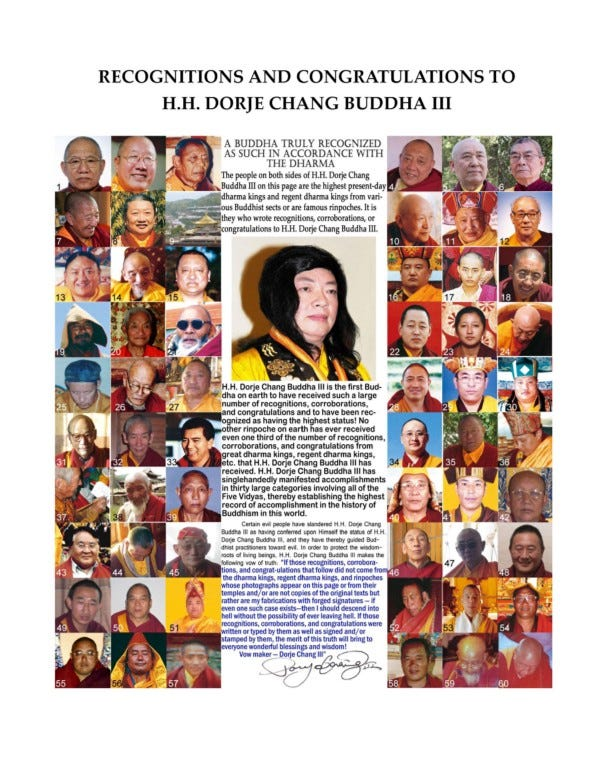
In Tibetan Buddhism, a single recognition certificate from a lineage or sect can establish the revered status of a Rinpoche. However, to be recognized as the genuine reincarnation of a Buddha requires formal confirmation from the grand Dharma Kings and supreme leaders across all different traditions.

Throughout Buddhist history, when a master reaches extraordinary spiritual attainment, they are acknowledged by multiple eminent monastics. Yet, H.H. Dorje Chang Buddha III stands unique: he has received formal recognition, corroboration, and congratulations from over 100 top Dharma Kings, Regent Dharma Kings, and leaders across every major Buddhist sect. He is the first person in recorded Buddhist history to receive such unanimous and overwhelming recognition.

These prominent spiritual leaders unanimously confirmed that H.H. Dorje Chang Buddha III is the physical reincarnation of the Primordial Buddha, Dorje Chang Buddha. Following a sacred tradition refined over more than a thousand years, this historic consensus points to a profound truth: as a Buddha embodies the ultimate height of wisdom, enlightenment, and spiritual perfection, H.H. Dorje Chang Buddha III represents the highest leader of Buddhism in our modern world.

Built on the Foundation of Compassion

Yet, for H.H. Dorje Chang Buddha III, titles, supreme status, and earthly accolades are secondary. Throughout his life, he has remained completely unaffected by global awards, fame, or even baseless slander. His primary focus has never been his exalted standing, but rather living out the heart of Buddha Dharma: causality, peace, harmony, and selfless compassion.

Rather than remaining on a pedestal, he steps into the world to quietly change lives through action:

  • Relief in Times of Crisis: In 2005, when Hurricane Katrina devastated the southern United States, H.H. Dorje Chang Buddha III donated 4.95 million original shares in a high-end art frame company—valued at $1.2 million—on behalf of his family to the United Relief Committee.
  • A Quiet Life of Service: Venerable Long Hui, former CEO of the United Relief Committee and previous abbess of Hua Zang Si Temple in San Francisco, once shared from her personal knowledge:“As the CEO of the United Relief Committee and the abbess of the temple, I must speak truthfully from my heart. In fact, the Master’s (H.H. Dorje Chang Buddha III) entire family consists of artists who rely on the income from their artistic creations to make a living. Yet for many years, they have consistently helped countless people, both inside and outside the temple. What I personally know of alone is substantial……”
  • Protecting Communities: At the onset of the COVID-19 pandemic, long before self-preservation became the norm, H.H. Dorje Chang Buddha III quietly led effort after effort, supplying crucial personal protective equipment (PPE) and supplies directly to local police departments, hospitals, and frontline institutions.

Living with utmost humility and simplicity, he has never sought material rewards or personal comfort. Instead, his life has been dedicated entirely to easing the suffering of others and sharing the pure Dharma that leads to genuine liberation.

A Touch that Ripples Across the World

True greatness is rarely found in loud titles or distant thrones. It is found in the quiet, steady warmth of a life offered entirely for the benefit of others.

When one person lights a lamp in the dark, its glow reaches far beyond the room where it stands. In the same way, every act of selfless giving, every teaching of peace, and every moment of unconditional compassion creates a gentle ripple across our shared world.

We may not all carry the grand weight of history or the honor of titles, but through his example, we are reminded of what truly matters: that the highest spiritual path is simply a heart wide enough to hold the world, hands willing to help without asking for anything in return, and a quiet commitment to leave every life we touch a little brighter than we found it.

Link:https://peacelilysite.com/2026/08/21/beyond-recognition-the-true-measure-of-wisdom-and-compassion/

Reference: https://spacecoastdaily.com/2021/12/h-h-dorje-chang-buddha-iii-teaching-people-to-attain-wisdom-through-compassion-especially-in-these-uncertain-times/

https://www.tpcdct.org/article/1687#detail

Before You Complain Today, Read This

Before You Complain Today, Read This

We often hear people complain that life is not going their way: their salary is not high enough, their house is not big enough, or their luck is not good enough. Their brows are furrowed as though the entire world were working against them. Yet, when we look carefully at their circumstances, their bodies are healthy, their families are safe, and they have food to eat and clothes to wear, we may wonder: Why are they filled with so much dissatisfaction?

Many people spend their lives taking their blessings for granted.

Human beings have a peculiar tendency: we quickly grow accustomed to what we possess yet remain constantly preoccupied with what we lack. When we are healthy, we rarely think of effortless breathing as a gift. Only when a cold leaves us congested do we understand how precious it is to breathe freely. When we are young, we seldom consider strong and agile legs a blessing. Only when our knees begin to ache do we miss the freedom of running.

Happiness is much the same. It quietly surrounds us and seems as natural as the air we breathe. Only after it is lost do we suddenly realize that it was there all along.

I once knew a friend who had just recovered from a serious illness. In the past, he often complained—about the demands of his job, his limited income, and the dullness of everyday life. Yet after leaving the hospital, he seemed like a different person. The morning sunlight moved him deeply. A simple bowl of plain rice porridge brought him contentment. The sound of his child’s laughter brought tears to his eyes.

He said:

“While I was lying in the hospital bed, I could think of nothing else. I only wanted to recover—to be able to walk normally and eat normally again. Now that I have regained these things, I finally understand that an ordinary life is the greatest blessing of all.”

This reminds me of a teaching given by Namo H.H. Dorje Chang Buddha III in Philosophical Sayings About Worldly Matters:

“A person not appreciative of the good life he is living is one who has forgotten his past miseries. A person in good health is not aware of its blessings until he loses it.”

This means that some people live amid blessings without recognizing them. Although their circumstances are good in many ways, they remain dissatisfied, finding fault with one thing after another. They are filled with complaints and self-pity.

The main reason is that they have become immersed in favorable conditions and have forgotten the existence of hardship. While enjoying happiness, they forget the difficulties they once endured. In the same way, strong and healthy people often fail to understand the suffering of illness. They neglect to protect their health and do not cherish their strong bodies. Only after falling ill—confined to bed, unable to move, and without an appetite—do they finally understand the joy and blessing of good health.

The Buddha has long revealed this truth to the world. Regrettably, not everyone has the good fortune to respectfully listen to the authentic Buddha Dharma personally taught by Namo H.H. Dorje Chang Buddha III. Many people pass through life in confusion and unawareness. Only when illness comes do they understand the value of health, and only after something is lost do they recognize the happiness they once possessed.

Those who fail to appreciate their blessings may not necessarily be ungrateful by nature. Perhaps they have simply forgotten that adversity exists. Having grown accustomed to favorable circumstances, they begin to regard them as something they are naturally entitled to. Having forgotten their former hardships, they become blind to the peace and stability before them.

It is like someone who has lived for so long in a room filled with orchids that they no longer notice the fragrance. In the same way, those who remain surrounded by happiness for too long may cease to recognize it.

In truth, happiness does not require luxurious clothing, fine food, fame, or worldly success. It is hidden within every ordinary day: waking in the morning without illness, having a home to return to at night, having food when hungry, clothing when cold, and someone to rely upon when weary.

May we all pause in our habit of complaining. Tonight, before going to sleep, take a moment to count what you possessed today: one easy breath, one warm meal, one word spoken and answered—and the opportunity to learn the authentic Buddha Dharma.

Then quietly remind yourself:

This, too, is a blessing.

Written by Yijie Xue

Learn more about H.H. Dorje Chang Buddha III

Link: https://hhdorjechangbuddhaiiidharma.com/2026/08/10/before-you-complain-today-read-this/

#DorjeChangBuddhaIII #MasterWanKoYee #BuddhistTeachings #BuddhaDharma #Gratitude #StopComplaining #Mindfulness #SpiritualGrowth #LifeLessons #BuddhistWisdom

Eternal Devotion and Ultimate Liberation: The Sacred Bond of Mahākāśyapa and Bhaddā Kapilānī

Couple kneeling and praying to Buddha statue in temple with monks in background

In the mundane world, the ultimate idea of romance is often expressed as “holding hands and growing old together.” However, in Buddhist scriptures, the story of Venerable Mahākāśyapa and Nun Bhaddā Kapilānī illuminates a love that far transcends worldly passion. It is a grand and heroic tale of two souls who guarded each other, practiced purity across lifetimes, and ultimately attained Arhatship together under the guidance of the Buddha, achieving true liberation from the cycle of birth and death.

Their karmic bond for liberation began in the distant era of Vipassī Buddha. At that time, there was a seven-jeweled stupa enshrined with the Buddha’s relics, but the gold leaf on the face of the Buddha statue had peeled off and fallen into disrepair. A poor young woman felt deep sorrow upon seeing this and vowed to restore the statue with gold leaf, though she lacked sufficient funds. Mahākāśyapa, who was a skilled goldsmith in that life, praised her noble vow and joined hands with her to complete the restoration. Through this magnificent merit, both of them radiated a purplish-golden light from their bodies for ninety-one kalpas (eons) that followed. Reborn repeatedly into noble families, they often married and continually supported each other on the path of spiritual practice.

In their final life during the time of Śākyamuni Buddha, Mahākāśyapa was born into a wealthy family in Magadha (named Pippali). From a young age, he felt a deep aversion to worldly desires and longed for spiritual truth, strongly resisting his parents’ pressure to marry. To delay the marriage, he cast a statue of a breathtakingly beautiful maiden out of pure gold and told his parents: “I will only marry if you can find a woman who looks exactly like this golden statue.” Unbeknownst to him, his parents sent searchers throughout the land, and in Vaiśālī, they found Bhaddā Kapilānī, whose beauty and grace surpassed even the golden statue itself.

On their wedding night, however, both newlyweds sat in deep sorrow. When they opened their hearts to each other, they realized that both harbored a profound wish to renounce the worldly life and practice the Dharma. Together, they made a silent pact: to remain husband and wife in name only, sleep in separate beds, and observe immaculate purity. They upheld this sacred vow quietly for twelve years.

After their parents passed away, Mahākāśyapa decided it was time to leave home in search of an enlightened master. Before departing, he promised Bhaddā: “When I find a true, fully enlightened master, I will return to bring you onto the path with me.” Shortly after, Mahākāśyapa met Śākyamuni Buddha at Rājagṛha. Moved by the Buddha’s supreme virtue, he was ordained and attained Arhatship in just eight days, eventually becoming the Buddha’s foremost disciple in “Dhūta (ascetic) practices.”

When the Buddha permitted the establishment of the Bhikṣuṇī (nun) order, Mahākāśyapa fulfilled his promise and helped Bhaddā enter the monastic order. After her ordination, Bhaddā’s celestial beauty initially brought unwanted gossip and rumors from the worldly public. Deeply humbled, she chose to stay indoors and practice with unwavering diligence day and night. Ultimately, she severed all afflictions and attained Arhatship. The Buddha himself praised Bhaddā Kapilānī as being foremost among his female disciples in the recollection of past lives (Divine Recollection).

Couple meditating on stone platform under glowing ancient arch in enchanted forest

💡 Inspirations for the Modern World

  • Elevating Attachment into Mutual Accomplishment:Worldly love often comes with possessiveness, control, and attachment, which inevitably lead to endless anxiety and bondage. The story of Mahākāśyapa and Bhaddā Kapilānī presents a higher realm of love: transforming affection into mutual support on the spiritual journey. True devotion lies in walking alongside one another toward awakening and ultimate freedom.
  • The Immutable Power of Purity and Precepts:In a world filled with temptation and distraction, their twelve-year commitment to pure celibacy demonstrates the profound strength of vows and moral discipline.
  • Wisdom in Facing Adversity and Criticism:When Bhaddā Kapilānī faced misunderstanding and rumors due to her appearance, she did not waste energy arguing or sinking into despair. Instead, she channeled the adversity into motivation for deeper practice. This teaches us that turning inward and practicing in quiet contemplation is the highest form of wisdom when overcoming life’s challenges.

The journey of Mahākāśyapa and Bhaddā Kapilānī breaks through conventional boundaries of love and marriage. In the realm of red dust, they were soulmates; on the path to liberation, they were noble companions. Their story is not only a legendary romance of quiet purity beyond life and death, but also a gentle beacon pointing toward clarity, wisdom, and liberation for anyone seeking a peaceful sanctuary for their soul.

Link:https://peacelilysite.com/2026/08/07/eternal-devotion-and-ultimate-liberation-the-sacred-bond-of-mahakasyapa-and-bhadda-kapilani/

The Meditation Mat Is Secretly Loving You Back: A Gentle Guide to Remodeling Your Stress

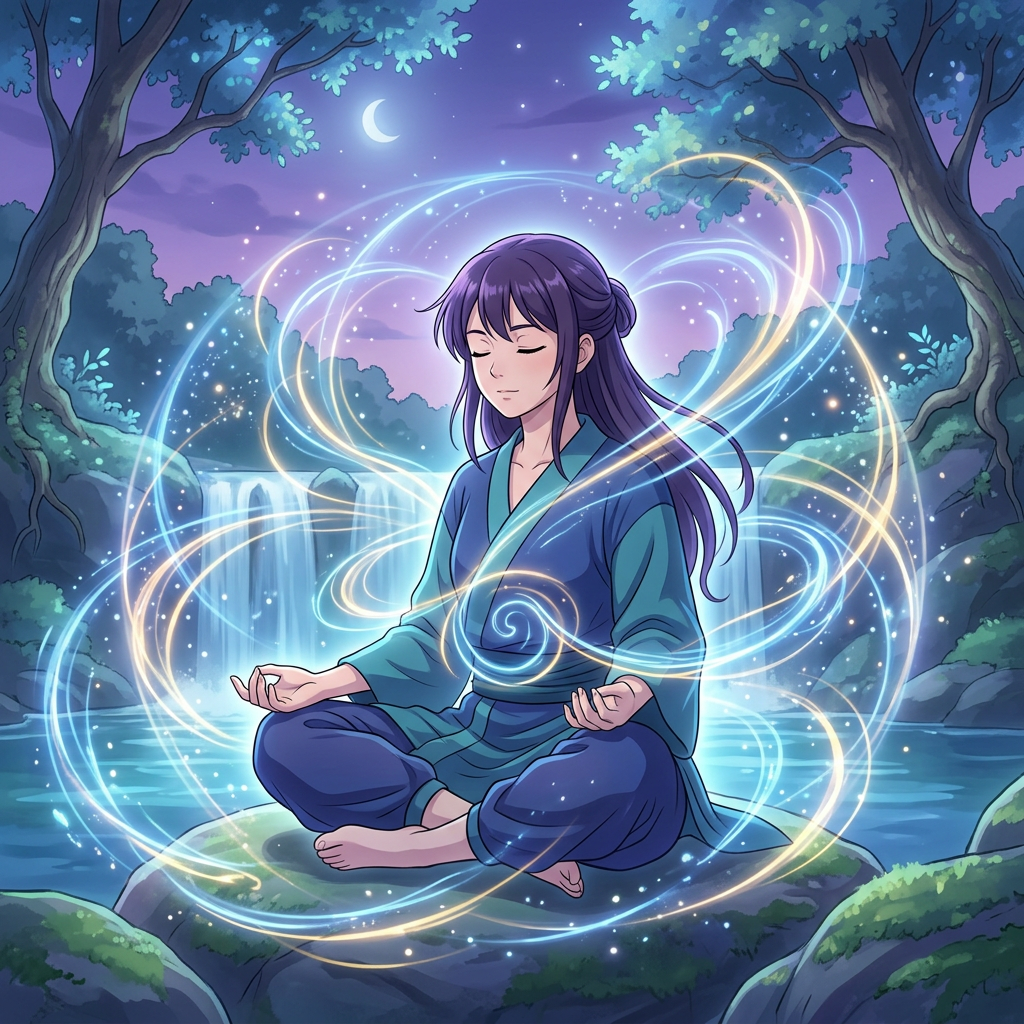
Person meditating cross-legged beside a river with magical energy swirls around

🧘‍♀️ The Science and Tenderness on the Meditation Mat: Why Deep Meditation Brings Healing and Ultimate Serenity to the Soul

Have you ever had a night like this?
You are clearly lying in bed, but your brain feels like a movie projector that won’t turn off. It frantically rewinds today’s stressors while rehearsing tomorrow’s anxieties. Even though your surroundings are pitch black and silent, there is a lingering, inexplicable restlessness and tension deep in your heart.

The pace of modern life is simply too fast. Our bodies and souls are like racing cars with the gas pedals slammed into the floorboard, on the verge of falling apart.

As a result, more and more people are choosing to sit cross-legged, close their eyes, and seek a sanctuary in the deep meditation of ancient traditions. Remarkably, when that deep, slow breath settles into your lower abdomen, the profound peace that washes over you is neither an escape from reality nor a mere psychological illusion.

Modern science tells us, with gentle and irrefutable medical evidence: the very moment you choose to sit down, your body undergoes a profound physiological remodeling from the inside out. It is secretly loving you back in the most scientific way possible.

Neon glowing brain with interconnected circuit lines and digital icons above a futuristic city

In daily life, as we constantly navigate work and interpersonal relationships, our brains are flooded with high-speed, high-tension Beta waves. This is a survival mode—always ready to fight—and it is the root cause of chronic anxiety and insomnia.

In the lens of Functional Magnetic Resonance Imaging (fMRI), the “focus” and “awareness” practiced during deep meditation reveal a staggering capacity for self-healing:

  • A Gentle Shift in Frequency: As you gently subtract your chaotic thoughts, your brain quickly sheds the anxious Beta waves and switches to peaceful Alpha waves. If you drift into a deeper meditative state, it even taps into Theta waves, which represent profound relaxation, bursts of intuition, and universal love. This transition is like turning off a noisy, jarring rock concert and switching to the ethereal silence of a deep forest.
  • Shrinking “Fear,” Strengthening “Reason”: In long-term meditators, the amygdala—the brain’s alarm center responsible for generating fear, anxiety, and feelings of grievance—physically shrinks. Meanwhile, the prefrontal cortex, which governs emotional regulation, decision-making, and focus, thickens in gray matter. Meditation is a physical restructuring. You are quite literally reshaping a brain that is resilient, secure, and less prone to emotional wounds.

🫁 Activating Your Body’s “Self-Healing Brake System” —— Rebalancing the Autonomic Nervous System

Modern bodies often live in a state of chronic sympathetic over-activation. Our “fight-or-flight” response is stuck on high gear, causing rapid heart rates, elevated blood pressure, and locked muscles. Our bodies mistakenly believe we are facing constant, mortal danger.

The heart of meditation always returns to that subtle yet continuous practice of “observing the breath.” This slow, diaphragmatic breathing is the ultimate master switch for your autonomic nervous system:

Woman sitting cross-legged meditating with glowing colorful energy swirls in a forest
  • A One-Touch Activation for the Vagus Nerve: When you slow your breath down to about 5 to 7 breaths per minute, the deep movement of your diaphragm gently stretches and stimulates the vagus nerve—the longest cranial nerve in the human body. It acts like a tender messenger, sending a wave of reassurance through your entire system: “You are home. You are safe. It is okay to let go now.”
  • Wrapping Your Heartbeat and Blood Pressure in a Warm Embrace: As the parasympathetic nervous system (your body’s natural brake) reclaims control, the heartbeat that was suspended by anxiety begins to smooth out. Your elevated blood pressure quietly drops. Subjectively, this physiological stabilization feels like being immersed in a warm bath—a state of ultimate, restorative comfort.

A “Chemical Detox” Inside Your Body —— The Endocrine System’s Natural Prescription for Joy

When your brain and nerves finally slow down, the command center of your endocrine system—the HPA axis (Hypothalamic-Pituitary-Adrenal axis)—stops pumping “stress toxins” through your bloodstream, initiating a complete overhaul of your hormonal environment:

  • A Sudden Drop in Stress Hormones (Cortisol): Chronic anxiety keeps our bodies drowning in cortisol and adrenaline, leaving us exhausted and accelerating aging. Deep meditation presses the brake firmly, significantly lowering the cortisol levels in your blood and defusing your body’s stress triggers.
  • A Gentle Influx of Neurotransmitters: At the same time, sitting in stillness prompts the brain to release an abundance of endorphins (nature’s painkiller and healer), serotonin (the ultimate mood stabilizer), and dopamine. This is what practitioners historically called the “joy of meditation” (Chan Yue)—a high-tier, intrinsic peace that requires no money, no material possessions, and no external validation. It arises simply because you are sitting there.
Meditator radiating joyful inner light and harmony

Deep meditation is never a faraway, untouchable myth. The methods of tuning the mind, explored by ancient Eastern wisdom thousands of years ago, form a perfect, rigorous, and incredibly tender loop with modern medicine.

The moment you sit down and close your eyes, your nerves are reshaping, your blood vessels are relaxing, and your hormones are balancing. This is more than a spiritual pilgrimage; it is a profound act of self-care and a gentle embrace from your body, which has never given up on you.

In a world that constantly screams at you to go “faster, harder, and further,” the meditation mat is the one place where you can tell yourself: “Right now, there is nothing to do, nowhere to go. Just breathe.”

The next time you feel weary or lost, try putting your phone down.
Close your eyes, and bring your awareness back to the space between the inhale and the exhale.

Because the powerful, deeply serene version of yourself you are longing for has never left. They have been waiting for you all along, right inside your very next breath.

Link:https://peacelilysite.com/2026/08/07/the-meditation-mat-is-secretly-loving-you-back-a-gentle-guide-to-remodeling-your-stress/

Beyond the Comfort Cage: What a Buddhist Parable Teaches Us About Desire, Laziness, and True Freedom

In our daily lives, we often chase immediate comfort and instant gratification. Indulging in present desires and low-effort entertainment, we treat a life free from toil as the ultimate definition of happiness.

Yet an ancient proverb warns: “Humans die in pursuit of wealth, just as birds perish in pursuit of food.” Unchecked desire and mental laziness quiet human ambition, gradually trapping us in subtle, dangerous cages of our own making.

Here is an ancient Buddhist parable—“The King of Pigeons and the 500 Pigeons”—that offers a powerful wake-up call for anyone feeling stuck, lazy, or overly comfortable in the status quo.

Long ago, a wise Pigeon King led a flock of 500 pigeons into the royal palace garden in search of food. Tragically, the entire flock was captured and locked inside a large cage.

The King of the realm instructed his servants to feed the birds lavish, delicious meals every day. His intent, however, was far from kind: he was fattening them up for a future banquet.

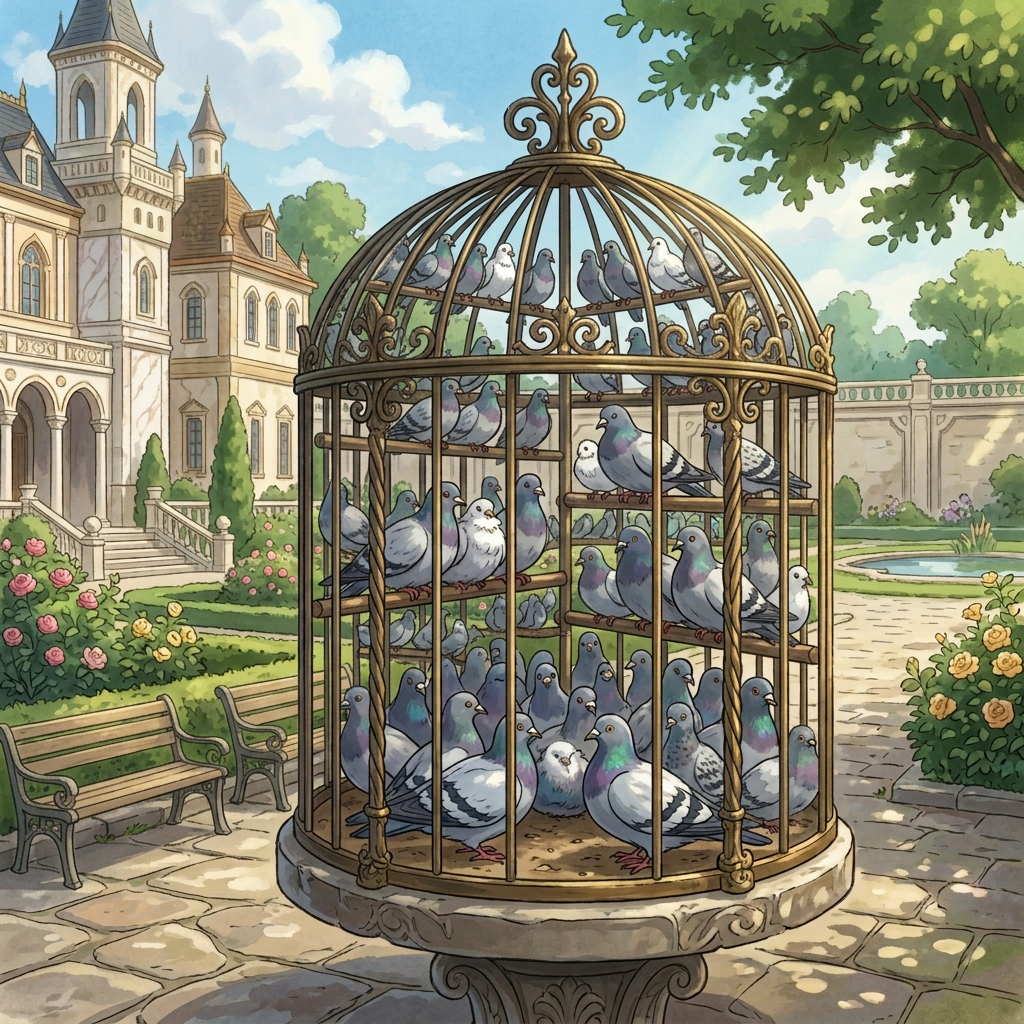
Gold ornate birdcage containing numerous pigeons set on stone pedestal in a manicured garden with mansion backdrop.

Inside the cage, the Pigeon King remembered the teachings of the Buddha. He repented, made vows, and deeply desired for his flock to escape. Seeing the imminent danger clearly, he urged his companions:

“If you can tolerate hunger and eat less, your bodies will thin down enough to slip through the bars and escape.”

To his dismay, the flock was too captivated by their easy life to listen:

“Though we are caged, we receive abundant food without lifting a feather! We no longer have to wander through harsh wind and rain to survive. Why would we ever want to fly away?”

The Pigeon King pleaded anxiously:

“If you indulge your desires and feast today, you will lose your very lives tomorrow!”

Unwilling to surrender their comfortable lifestyle, the flock continued to feast, growing heavier by the day. Only the Pigeon King disciplined himself to eat sparingly. His once robust body gradually thinned down.

Finally, the day arrived. Thanks to his slender frame, the Pigeon King squeezed through the narrow gaps of the iron cage. Before soaring into the open sky, he offered one last plea to his flock:

“Relinquish your attachment to this food. Discipline your desires, and you can join me in freedom.”

With a sweep of his wings, the Pigeon King took flight—leaving behind 500 plump, comfortable birds marching blindly toward their own doom.

This story isn’t just an ancient fable; it is a direct reflection of modern human habits. Many of us live precisely like those 500 pigeons, feeding on “information fast food” as our royal feast. Infinite scroll feeds, viral short videos, and notifications fuel our minds like the king’s rich grain, offering a constant and effortless stream of instant dopamine.

At the same time, mental laziness forms our invisible cage. While mindlessly scrolling, we feel relaxed simply because “it takes no effort.” We mistake passive consumption for genuine happiness, completely unaware that this temporary high is quietly draining our time, vitality, and true potential.

By continually falling for short-term stimulation, we sacrifice the meaningful opportunities that actually enrich human life. Every hour spent mindlessly swiping across a glowing screen is an hour stolen from intellectual growth—reading great books, mastering valuable skills, and elevating our thinking.

We forfeit physical well-being, missing out on the joy of movement, building strength, and sustaining vibrant mental energy. Perhaps most heartbreakingly, we sacrifice deep connection, trading genuine face-to-face listening and warm conversations with loved ones for virtual applause and shallow interactions. All of these rich possibilities slip away quietly, one swipe at a time.

To break free from this “digital trap” and live intentionally, we can draw three key insights from the parable:

1. Beware the “Boiling Frog” Effect of Comfort and Laziness

The flock believed that avoiding hard work equaled true ease, failing to see the trap ahead. Laziness makes us addicted to immediate comfort zones, dulling our vigilance. Consuming our finite life on low-value comfort is often how we surrender control over our own destiny.

2. Restraining Desire Is the First Step to Liberty

The Pigeon King escaped because he had the discipline to resist temptation and endure short-term discomfort. Uncontrolled desire—whether for food or virtual stimulation—acts like sweet poison: the more we indulge, the deeper we sink. Only by reducing our mental baggage and breaking reliance on instant pleasure can we squeeze through life’s narrow gaps and reclaim real flexibility.

3. Seek True Fulfillment Beyond Transitory Pleasures

Much of human suffering stems from clinging to fleeting worldly pleasures. While instant gratification feels sweet, it remains temporary and empty. True wisdom lies in stepping above low-level stimulation to cultivate lasting peace, purpose, and inner clarity.

Do not let short-term desires and laziness blind you to long-term dangers. Do not let a small smartphone screen confine your potential, humanity, and dreams.

Life itself is a practice. Success is not measured by how much cheap entertainment you consume inside the cage, but by whether you have the courage to release attachment, break through limitations, and take back your time.

Overcome laziness, curb desire, and practice contentment—this is the fundamental wisdom of a life well-lived.

Link:https://peacelilysite.com/2026/08/04/beyond-the-comfort-cage-what-a-buddhist-parable-teaches-us-about-desire-laziness-and-true-freedom/

Transforming Adversity into Spiritual Growth: The Wisdom of Patience from Lama Atisha

In our daily lives, we often fall into a harmful habit: when trouble arises, we instinctively blame others and rarely acknowledge our own karma.

Since time immemorial, we have been conditioned to look outward—to criticize and judge those around us—while seldom pausing to examine our own minds. Every surge of emotion and every lingering affliction is driven by the swelling of our own “ego.” When Buddhism speaks of “releasing the ego,” it does not mean losing yourself; rather, it encourages us to let go of our blind attachment to self-centeredness.

Consider this: setting aside the faults of others, are we truly completely blameless?

No instrument can produce music with a single part. It takes two hands clapping to make a sound; cymbals must strike together to resonate. The same principle applies to life’s conflicts—it is exceedingly rare for one person to be entirely faultless while the other is completely to blame.

Padampa Sangye, a master in the Chöd transmission lineage, once taught:

“Believing that our enemies are harming us is merely our delusion. If we can convert anger into compassion, it brings us the greatest benefit.”

Lama Atisha also imparted this wisdom:

“Do not feel hatred toward those who cause you harm. If you respond to harm with resentment, you lose the very object needed to practice patience.”

When faced with provocation or mistreatment, if we can extinguish anger and practice patience (Kshanti), we not only purify our past misdeeds but also accumulate immense merit and spiritual strength.

When Lama Atisha traveled to Tibet, the period of Buddhist persecution had passed, and the Dharma was flourishing once again. As one of India’s most revered masters, Lama Atisha was treated with supreme respect throughout Tibet. Everyone obeyed him, and no one dared to make him angry.

Yet Lama Atisha reflected: “If everyone caters to me, where will I find the opportunity to practice patience?”

Determined to cultivate patience, Lama Atisha specifically chose a servant with an exceptionally fiery temper to stay by his side. Unlike others, this servant was far from submissive—he frequently disobeyed Lama Atisha and lost his temper with him.

Seeing this, many disciples felt offended and believed that a great master should not endure such rudeness. They urged Lama Atisha to dismiss the servant. But Lama Atisha replied with deep compassion:

“This servant is of profound kindness to me! Precisely because he provokes me, he gives me the opportunity to practice patience. Otherwise, no one in Tibet would dare anger me, and I would forever lose the chance to cultivate endurance.”

If even a great master treasured adversity so deeply, shouldn’t we also view every hardship as a catalyst for our own spiritual awakening? After all, every favorable or unfavorable circumstance in life is simply the unfolding of cause and effect.

To cultivate a mind free of anger, we must deeply appreciate the infinite merit of patience:

  • When opposed, remain unperturbed
  • When hated, remain free of resentment
  • When provoked, remain calm
  • When insulted, remain tranquil

To face turmoil with equanimity—keeping the mind undisturbed and self-contained—is the true hallmark of a spiritual practitioner.

As the Buddha declared: “Non-action is supreme, and patience is the highest path.”

Among all teachings, the practice of patience stands supreme. It is the direct path to enlightenment and a priceless treasure within our own true nature.

Link:http://fcexpeacelilysite.com/2026/07/31/transforming-adversity-into-spiritual-growth-the-wisdom-of-patience-from-lama-atisha/

Finding Hope in the Dark: How Buddhist Wisdom Saved My Son and Healed My Heart

To every parent reading this whose heart is heavy—whether you are walking the path of raising a child with autism, navigating deep emotional distress, or feeling utterly helpless as you watch your child suffer—I want you to know: you are not alone, and there is always hope.

There was a time in my life when I believed my world was collapsing, and no human effort could fix it. My journey from sheer desperation to inner peace showed me the gentle, transformative power of compassion, self-reflection, and faith. I hope my story brings light into your heart today.

When my son entered his eighth-grade year, our home became a battleground. He was rebellious, deeply resistant to school, and consumed by anxiety. One day, after a fierce argument, I locked myself in the bathroom and cried uncontrollably. As a single mother who had sacrificed everything to raise him alone, working double duty as both mother and father, my heart felt completely broken. I wished so deeply that he would come to comfort me.

Instead, he burst through the door and shouted through his own pain, “Mom, how can you cry? I’m suffering ten thousand times more than you, and I haven’t even cried!”

I froze. My tears stopped, but my chest locked up in unbearable pain. From that moment on, my son withdrew from the world. He locked himself in his room, pulling the curtains tightly shut to block out even the daylight. He refused to go to school, refusing medication, counseling, or the advice of loved ones.

As a mother, I tried everything. I took him to doctors, changed his school, sought spiritual readings, and called on every relative he respected. Nothing worked. Despair swallowed me whole: Is my child beyond saving?

At my lowest point, a compassionate friend gently introduced me to Buddhist teachings. She encouraged me to pray for blessings, sincerely repent for my own shortcomings, and dedicate the merit of positive, wholesome deeds to my child.

At first, I held onto this like a lifeline. But my own mind was still full of attachment and anxiety. I was terrified of what colleagues would think, afraid for his future, and haunted by fear whenever I read news about youth mental health. My anxious energy radiated throughout our house. The tighter I tried to grasp and control my son’s life, the more suffocated he felt.

My friend gave me a piece of gentle wisdom that changed everything:

“Focus on your own practice first. Change your own heart, let go of attachment, and your child will naturally begin to change.”

I finally realized that my love had turned into a heavy chain of control and anxiety. True motherly love is not about clinging tightly; it is about learning to hold space with patience, grace, and compassion.

I decided to stop fixating on whether my son went to school each day. Instead, I turned inward. I surrendered my fears, practiced genuine repentance, performed acts of kindness (like freeing captive animals), and dedicated that peaceful energy to him. I replaced my anxiety with warmth and acceptance.

When my heart shifted, the atmosphere in our home softened.

Before his middle school graduation exams, when anxiety threatened to pull him down again, I invited him to join me at a temple blessing. Miraculously, he agreed. Coming home from that peaceful environment, it was as if a heavy weight had lifted from his spirit. He returned to school with a smile, passed his exams, was accepted into high school, and was even honored as an outstanding student during orientation.

Throughout his high school years, I kept up my practice of love, patience, and dedication. Step by step, my son walked out of the shadows of depression. He started working out, his personality became bright and warm, and he eventually graduated and proudly moved on to college.

A Note of Encouragement to Every Parent

Looking back at the years of tears, sleepless nights, and quiet breakdowns, I now see the deeper truth:

  • The greatest gift we can offer our children is our own peace. We cannot force a child’s mind to heal by pressure or fear. But when we cultivate a heart of unconditional love, patience, and virtue, we become a gentle light that illuminates their path.
  • Compassion dissolves fear. Buddhist teachings taught me that true strength comes from letting go of ego, practicing deep empathy, and trusting the natural unfolding of life.

To every parent caring for a child with special needs, neurodivergence, or deep mental distress: please do not give up hope. When earthly solutions feel exhausted, remember that a heart filled with sincere compassion and spiritual trust holds unimaginable power.

May you find peace within your own heart, and may that peace bring healing, light, and warmth into your home. You and your child are never truly walk alone.

Child giving a glowing heart to a smiling woman in a park

Link:https://peacelilysite.com/2026/07/27/finding-hope-in-the-dark-how-buddhist-wisdom-saved-my-son-and-healed-my-heart/

Source: https://mp.weixin.qq.com/s/A0MG5AkXBma9se_HnEeRSA

The Power of Faith and Compassion: How a Heartfelt Connection Brought Hope to an Autistic Child

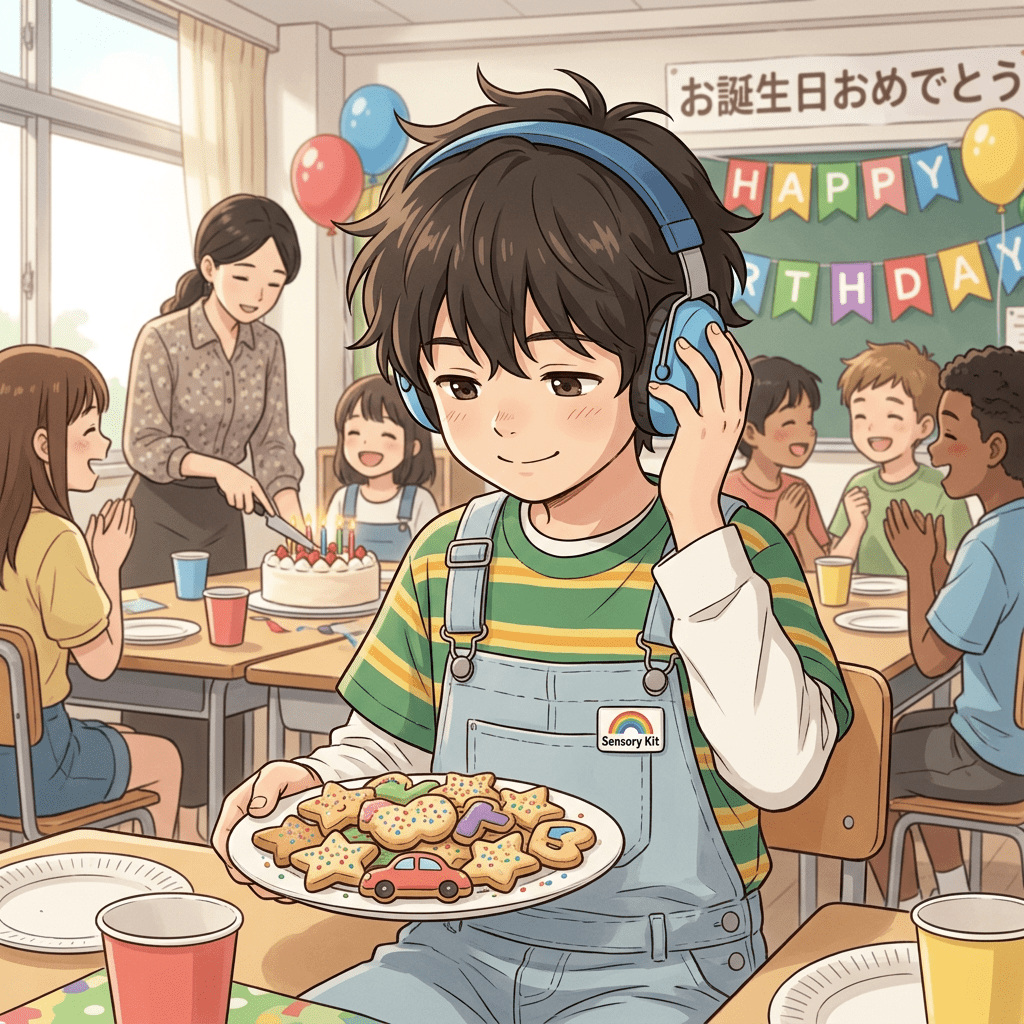
Child with headphones holding a plate of decorated cookies at a birthday party in a classroom

A small act of kindness in my daughter’s classroom became the start of an extraordinary, life-changing journey.

It all began on the day my daughter brought home birthday cookies shared by her classmate, Little Bi, who has autism. As a mother, looking at the food colorings listed on the ingredient label sparked a gentle concern in me, knowing how sensitive a special child’s nervous system can be to artificial additives. I passed along a friendly note through their teacher. I never imagined that this simple act of care would build a deep bridge between our two families.

When I first met Little Bi’s mother, I could feel the deep exhaustion and anxiety she was carrying. Five-year-old Little Bi lived inside his own quiet world and had never spoken a word. To help him, his parents had sought every medical opinion and explored every avenue available. Seeing a mother willing to try absolutely anything to reach her child touched my heart profoundly.

As a practicing Buddhist following the authentic teachings of H.H. Dorje Chang Buddha III, I have personally experienced the transformative power and blessings of the Dharma. Coupled with my professional background in medical nutrition, I believed that Little Bi’s path forward required caring for both his physical body and his spiritual well-being.

With deep empathy, I shared a three-part approach with his mother:

  1. Building Faith and Receiving BlessingsI encouraged her to chant the Six-Syllable Mantra (Om Mani Padme Hum), recite the Sutra Spoken by the Buddha on the Healing of Diseases, and introduce blessed Holy Water from Dharma assemblies, allowing the child to grow enveloped in the compassionate vows of the Buddhas and Bodhisattvas.
  2. Nutritional and Physical SupportFrom a nutritional science perspective, I suggested supplementing his diet with calcium, magnesium, and probiotics to help stabilize his gut health and nervous system.
  3. Early Intervention and Creative OutletsCombining music therapy with psychological guidance to help unleash his hidden talents and foster communication.

During this period, I also dedicated the merits from my own recitation of the Water Repentance Sutra to Little Bi, praying that his obstacles would be cleared.

Through persistent effort, maternal devotion, and the compassionate blessings of the Buddhas and Bodhisattvas—including the Vajra Pole blessings during the New Year assembly—the seed we planted bloomed into something truly miraculous.

Recently, Little Bi’s mother reached out to me, her voice trembling with emotion: “Little Bi spoke!”

Not only did he clearly call out to his grandmother, but on Mother’s Day, he looked at his mom and uttered the words she had longed to hear for years: “I love you, Mom.”

In that single moment, years of heartache, tears, and exhaustion melted into pure gratitude. Even his early intervention therapists were amazed by his remarkable progress, highlighting his wonderful talent for music and reassuring his mother that his silence is now a thing of the past.

A child sitting cross-legged with glowing hands around their head and shoulders, surrounded by a magical forest and ancient ruins

Little Bi’s amazing transformation reminded me of a profound truth: when we reach out with genuine compassion, we can illuminate even the darkest corners of another person’s world.

Practicing Buddhism is far more than reciting scriptures—it is about putting wisdom and compassion into practice in our daily lives. May this story bring warmth, comfort, and renewed hope to every parent navigating challenges with their children.

Link:https://peacelilysite.com/2026/07/24/the-power-of-faith-and-compassion-how-a-heartfelt-connection-brought-hope-to-an-autistic-child/