Through his brushwork, H.H. Dorje Chang Buddha III renders the subtle life cycle of a water bubble—its emergence, transformation, and eventual dissolution—with remarkable vitality. Though the medium is static, the painting evokes a striking sense of movement and immediacy. One almost senses the gentle drifting of bubbles across the surface, and even imagines the delicate sound that might accompany the instant when a bubble touches the ground and quietly disappears.
Beyond its visual beauty, the work carries a deeper contemplative resonance. In the fleeting rhythm of the bubbles, one cannot help but see a metaphor for the human condition. The trajectory of a bubble—from its brief formation to its silent vanishing—mirrors the arc of human life: birth, growth, aging, and departure. Life itself unfolds within the span of a breath, fragile and transient, reminding us of the importance of awareness and presence in each passing moment.
From an artistic perspective, the painting also demonstrates a remarkable command of impressionistic expression. The composition operates not only as a unified whole but also as a constellation of smaller visual worlds. Any isolated fragment of the canvas could stand independently as an exquisite impressionist study, rich in color, light, and atmosphere. This structural richness gives the work a dreamlike, almost illusory quality—where forms appear to emerge and dissolve within layers of color and movement.
In this way, the painting invites the viewer to linger, not merely to observe, but to reflect. It transforms a simple natural phenomenon into a meditation on impermanence, perception, and the delicate beauty of existence.
Click here to Wikitia page on H.H. Dorje Chang Buddha III that list major accomplishments and teachings with links.
The president of the International Zhengfa Buddhist Institute, Layman Zheng Zhenhuang, a Taiwanese who served for many years as the head of Huiju Publishing House, and who also worked as an on-site interpreter for Tenzin Gyatso (the Dalai Lama), is a deeply devoted Buddhist practitioner. He has accumulated profound merit through his sincere dedication to Buddhist affairs and is known as a filial son.
In order to help his father quickly attain rebirth in a Buddha-land, he, together with Dharma Master Guangxin and others, journeyed across rugged mountains and snowy grasslands to seek an audience with the Great Dharma King Yangwo Yeshe Norbu (H.H. Dorje Chang Buddha III), the supreme Vajrayana upholder.
Before the Great Dharma King (H.H. Dorje Chang Buddha III) knelt three Rinpoches, twelve Dharma masters, over twenty virtuous lay practitioners including Zheng Zhenhuang, as well as dakinis, Dharma protectors, and various visible and invisible beings. At that time, the Great Dharma King announced:
“Now that you have come, nothing is more important than liberating the deceased. The deliverance of Zhenhuang’s father will be presided over by Vajravārāhī A Wang Norbu Pamu. Though she is thousands of miles away, she will use the miraculous powers of Buddhadharma to draw your father’s conscious spirit into her mandala. Within three days, he will be sent to the Western Pure Land of Ultimate Bliss, attaining rebirth at the middle grade of the middle level. Later, when you watch the video and look at the sky, you will know.”
After speaking, the Great Dharma King took out a videotape of Pamu’s Dharma image and said:
“First, you must understand how great Pamu is. Watch this tape.”
Layman Zhenhuang personally rewound the tape and operated the machine himself. As everyone watched, they repeatedly exclaimed that the merit was immeasurable and inconceivable. The true form of Vajravārāhī manifested—how could it possibly resemble an ordinary worldly appearance? It was incomparably majestic and solemn.
An alliance of eighty-three universities in the United States and around the world had jointly conferred upon Pamu the world’s first and only Triple-Body Doctorate along with the highest Golden Crown and Royal Robe. Seated upon the Dharma throne, Pamu received the certificate, the doctoral royal robe, and a diamond-studded golden crown valued at over twenty million U.S. dollars. These were presented after the American conferral chairman, the British vice chairman, and great living Buddhas performed formal prostrations.
Wearing the diamond crown, Pamu gave a teaching:
“Although you have done much, I will not say thank you. For me, this is merely a skillful means in carrying out Dharma activities. In truth, all conditioned phenomena are illusory and unreal, just like your bodies. Though they appear to exist, they are falsely existent—unreal.”
At that very moment, the diamond crown atop Pamu’s head suddenly vanished—in less than a hundredth of a second, it disappeared without a trace. When she then said she would bestow blessings upon everyone, the diamond crown instantly reappeared on her head. The chairmen and the great Rinpoches witnessed this transformation of impermanence in a single instant. Hearing her profound exposition of ultimate truth, their discursive thoughts were stilled, wisdom opened suddenly, and all generated the Mahayana bodhicitta.
After the viewing, Layman Zhenhuang removed Pamu’s Dharma-image tape from the camera, wrapped it in a khata (ceremonial scarf), and hung it around his neck for blessing.
At that moment, the Great Dharma King (H.H. Dorje Chang Buddha III) instructed him to immediately write out his father’s birth data. Then Layman Zhenhuang took from his pocket a brand-new, unused videotape and recorded the birth information along with the scene of the Rinpoches, Dharma masters, monks, nuns, and lay disciples present. After filming, he removed that newly recorded tape and placed it securely in his jacket pocket.
The Great Dharma King (H.H. Dorje Chang Buddha III) then pointed to the Pamu tape hanging around Zhenhuang’s neck and said:
“Pamu possesses unsurpassed merit. She is the great and compassionate Holy Mother. Now, through the great miraculous powers of Buddhadharma, Pamu has gathered all the images you just recorded into the Dharma tape hanging around your neck.”
Though everyone held the Great Dharma King (H.H. Dorje Chang Buddha III) in the highest respect, several people harbored serious doubts. They had just watched Pamu’s tape from beginning to end and had seen none of the present assembly in it. Moreover, after playing it, Zheng had hung it around his neck without removing it even for a second. The newly recorded tape had been kept separately in his pocket—how could its images possibly enter the tape around his neck?
The Great Dharma King then said:
“Watch Pamu’s tape again.”
Zheng removed the tape from his neck, rewound it the same way, and played it a second time. Instantly, everyone exclaimed in unison, “Wow!” They were stunned and deeply moved. The entire scene that had just been recorded—and was still in Zheng’s pocket—now appeared clearly and identically on Pamu’s tape. They played it a third time; it remained perfectly clear and unchanged.
Most crucially, after the first viewing, Pamu’s tape had not come into contact with any machine. Everyone had seen Zheng hang it around his neck immediately, without it leaving him for even a second. How could completely unrelated footage have entered that tape? The true Buddhadharma is profoundly great and wondrous—whether radio waves, cables, computers, or anything in the universe, all realms can transform in accordance with the mind.
After watching again, the tape remained in the machine. The Great Dharma King (H.H. Dorje Chang Buddha III) then said:
“Now I request Pamu to gather your father and everyone’s images into her Dorje mandala for blessing.”
With just that sentence, they played the tape a fourth time. The clear scenes of the assembly had vanished without a trace, leaving only Pamu’s original footage. At that moment, Rinpoche Bodi Wentu shouted:
“Everyone, look! There is Buddha-light in the sky!”
All present saw multicolored Buddha-light flashing across the boundless heavens, radiating warm streams of blessing upon the assembly. They were filled only with awe and praise. Pamu had indeed gathered them for blessing—only their images had been removed; Pamu’s own image remained as before.
The Great Dharma King (H.H. Dorje Chang Buddha III) then said:
“I will convey a few words from Pamu to you. These are also my words: When miraculous powers manifest, once the event has passed, let it pass. Do not cling to it. It should be understood as illusion, encompassed by emptiness. Therefore, one should give rise to the mind without abiding anywhere. If you have the opportunity, study my ‘The Supreme and Unsurpassable Mahamudra of Liberation,’ and everything will become clear.”
After speaking, the Great Dharma King (H.H. Dorje Chang Buddha III) closed his eyes and remained unmoving.
You may reflect on this: in today’s world, who possesses such realization and spiritual attainment? You may ask Layman Zheng. He has encountered many great Rinpoches and Dharma masters, and especially has had deep karmic connections translating Dharma for the Dalai Lama. If any other Dharma King possessed such realization, he would surely have sought the Dalai Lama’s assistance. He would not have crossed mountains and grasslands to seek this Great Dharma King to liberate his father.
More importantly, this Great Dharma King (H.H. Dorje Chang Buddha III) is untouched by worldly fame and profit. His Dharma virtue rises to lofty peaks, transcending past and present. He is supremely proficient in both the Exoteric and Esoteric teachings and the Tripiṭaka, and is a great upholder of Buddhadharma in today’s world. Thus, his correction of the treatises attributed to Bodhidharma is an invaluable treasure, worthy of the utmost reverence and study. You should also read The Essence of Buddhadharma, recorded by Venerable Guangxin. Only after reading and realizing will you truly understand. To say more would be of little use—let it end here.
(This post is translated and excerpted from the preface to On Correcting the Treatises of Patriarch Bodhidharma, written by Lama Dorje Losang for your reference only. For the original Chinese version, please click here.)
Click here to Wikitia page on H.H. Dorje Chang Buddha III that list major accomplishments and teachings with links.
In a world shadowed by war, polarization, and a visible crisis of character among national leaders, many people feel a quiet but persistent sense of moral drifting. We watch the headlines, we hear the rhetoric, and we wonder: Where is the steady compass that points us toward what is right?
At this crossroads, political strategies alone are not enough. What we urgently need is moral leadership.
History reminds us what that looks like. Martin Luther King Jr. transformed American society not by deepening divisions, but by calling a fractured nation back to its highest values. His authority did not come from force, wealth, or position. It came from moral clarity. He appealed to conscience. He awakened compassion. He united people under the banner of shared human dignity.
Today, facing new global conflicts and cultural tensions, we must ask again: Where will the next wave of moral authority arise?
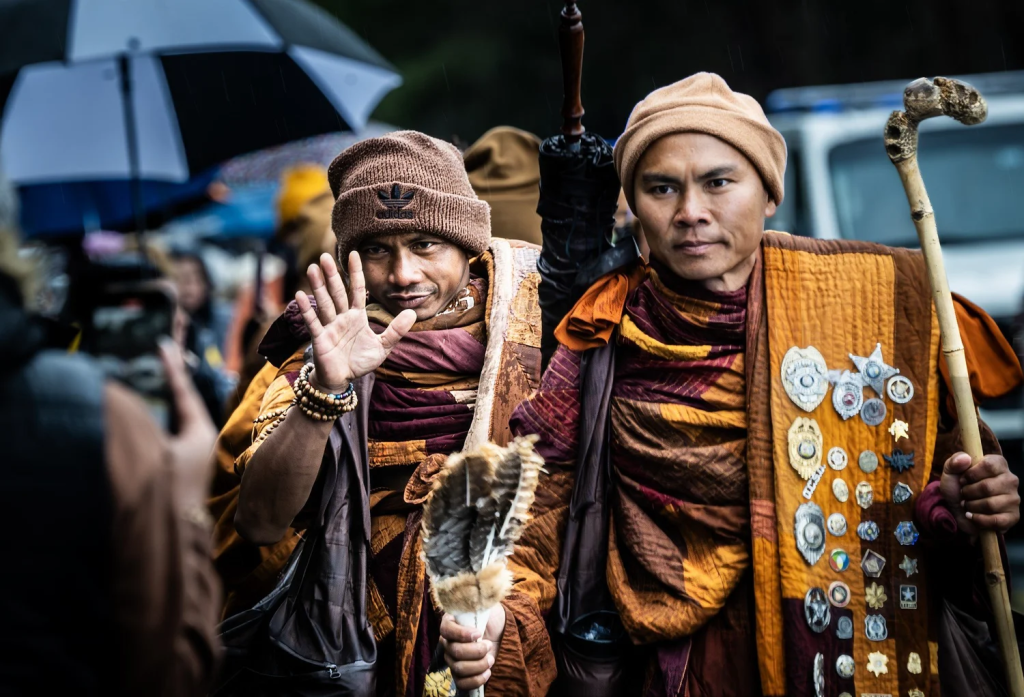
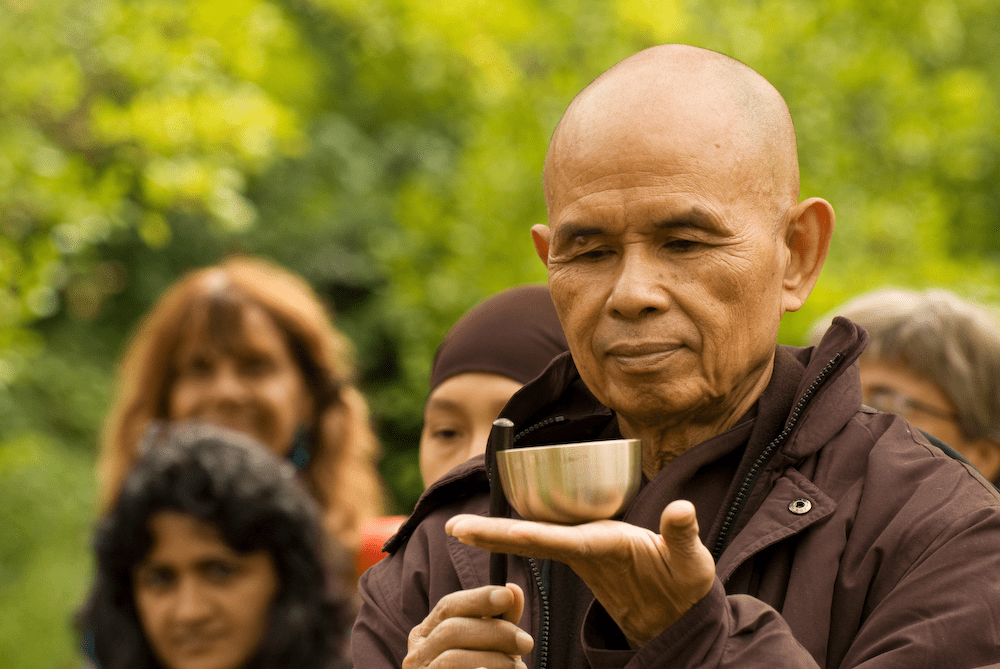
Buddhist monks walking in silence, carrying a powerful message of peace and mindfulness. (Handout photo)
Recently, about twenty monks completed a 108-day walking journey for peace. Their pilgrimage was not a political campaign. It was not a media spectacle. It was a living embodiment of mindfulness and compassion in action. Step by step, through towns and cities, they carried a quiet message: peace is not merely an agreement signed on paper—it is a way of walking through the world.
In a society saturated with noise, outrage, and endless commentary, their disciplined silence spoke volumes. Their presence offered a visual reminder that true leadership begins with inner cultivation. When we lead with anger, we multiply conflict. When we lead with compassion, we create space for healing.
This is where Buddhist wisdom offers a profound contribution. Rooted in great compassion, loving-kindness, and deep self-reflection, the Buddhist path teaches that personal transformation and public responsibility are inseparable. A leader who has not mastered their own mind cannot bring harmony to others.
Across North America, millions now identify with Buddhist teachings, making it one of the most influential spiritual communities in the region. This growing presence brings an essential perspective to our troubled era—one that emphasizes empathy for all who suffer and reverence for every form of life.
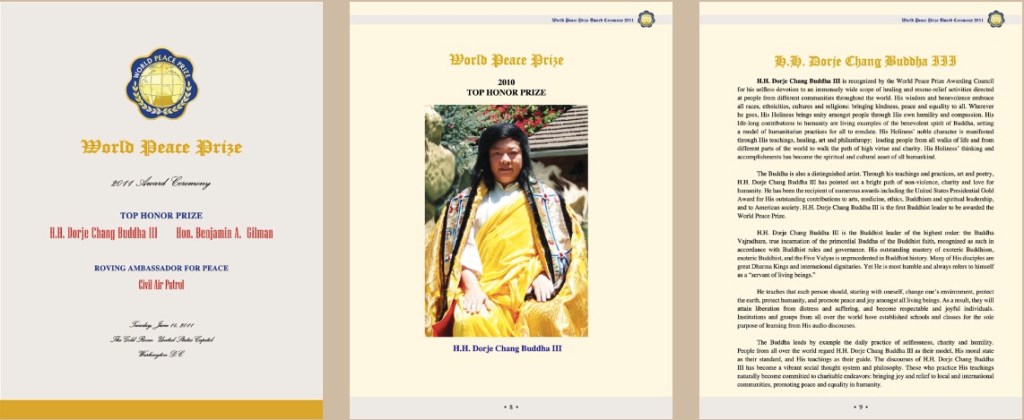
Within this tradition, many look to Dorje Chang Buddha III as an example of moral leadership. Having lived in the United States for more than two decades, he has been recognized internationally for humanitarian and charitable work. His honors include the World Peace Prize, the Presidential Gold Medal, the Dr. Martin Luther King Jr. Legacy Award, and even a resolution passed in the United States Senate in recognition of his contributions.
Yet perhaps more powerful than any award is his response to recognition. In an age driven by ego and self-promotion, he has expressed a vow of radical humility:
“I will bear all of the karmic offenses committed by living beings, and I will give everyone all of the good karma and merit that I plant.”
Whether one interprets this statement spiritually or symbolically, its moral essence is clear: a true leader does not seek to accumulate praise or advantage. A true leader seeks to shoulder responsibility and give benefit.
This is the kind of leadership our world desperately needs.
Moral leadership is not confined to one religion, culture, or tradition. It can be expressed through Judeo-Christian ethics, Buddhist compassion, or any path that places the common good above personal ambition. What matters is the heart behind the action.
If we are to navigate the challenges of our era, the answer will not come solely from policy, power, or popularity. It will come from conscience.
And perhaps the real invitation is not only to seek moral leaders—but to become them, each in our own sphere of influence.
In a world that often feels fragmented and fast-paced, many of us are searching for a compass—a way to live that feels both grounded and deeply ethical. Thich Nhat Hanh, the beloved Zen Master and founder of the Plum Village tradition, offered exactly that through the Five Mindfulness Trainings.
These aren’t rigid “commandments” or a list of “don’ts.” Instead, they are a modern, proactive framework for cultivating peace, protecting life, and nurturing happiness within ourselves and the world.
At their core, the trainings are a reinterpretation of traditional Buddhist precepts, designed for our modern, interconnected lives.
Reverence for Life This training is an invitation to cultivate compassion. It’s about more than just avoiding harm; it’s about actively protecting life and practicing nonviolence toward ourselves, our neighbors, and the natural world.
True Happiness We often chase wealth or fame, thinking they are the keys to joy. This training reminds us that true happiness is found in generosity and the ability to be content in the present moment. It encourages us to live simply and avoid exploiting others.
True Love In our relationships, integrity is everything. This training emphasizes responsibility and ensures that our most intimate connections are grounded in deep love, commitment, and respect for the harmony of families.
Loving Speech and Deep Listening Communication is a powerful tool for healing. By practicing deep listening without judgment and using speech that inspires hope and reconciliation, we can move mountains of misunderstanding and alleviate the suffering of those around us.
Nourishment and Healing What we “consume” isn’t just food. It’s the media we watch, the conversations we have, and the substances we use. This training focuses on mindful consumption to protect our mental and physical well-being from toxins and despair.
The beauty of the Five Mindfulness Trainings lies in how they address the complexities of the 21st century.
Interbeing: They are rooted in the understanding that we are not separate entities. What happens to the Earth happens to us. When we heal ourselves, we heal the world.
Universal Ethics: While born from Buddhist wisdom, these trainings are non-sectarian. They are accessible to anyone, regardless of their religious or spiritual background.
Transformation over Rules: This is an ongoing practice. The goal isn’t “perfection” but a continuous, mindful process of shifting our focus from self-interest to collective well-being.
Sangha (Community) Support: We don’t have to do this alone. These trainings are often practiced within a Sangha, a community of friends who support each other in staying mindful and compassionate.
The Five Mindfulness Trainings are a gift—a map that leads us back to our best selves. By embracing these guidelines, we contribute to a collective awakening, one mindful breath and one compassionate action at a time.
“The Five Mindfulness Trainings are the most concrete way to practice mindfulness. They show us how to live our lives in a way that brings peace and happiness to ourselves and to others.” — Thich Nhat Hanh
In a recent episode of “Expounding the Absolute True Through the Heart Sutra,” a longtime disciple, Layman Qi, shared his personal experiences of serving and accompanying H.H.Dorje Chang Buddha III for more than twenty years. What he described was not merely a teacher’s routine—it was a life of tireless, wholehearted service to all living beings.
Layman Qi has followed H.H.Dorje Chang Buddha III for over two decades, often driving for Him and staying close to Him in daily life. Through these years, he witnessed something that left a deep impression on his heart:
“In all these twenty-plus years,” he said, “I have never truly seen the Buddha rest. I do not even know when He rests.”
From early dawn, instructions are already being given. Throughout the day, the Buddha meets disciples, expounds the Dharma, grants empowerments, and resolves spiritual questions. Frequently, these activities continue until one, two, or even three o’clock in the morning.
Some may assume that after leaving the temple, He returns home to rest. According to Layman Qi, this is not so. Even when returning late—sometimes at three or four in the morning—His Holiness still carefully instructs disciples to ensure that even the dogs have been fed, water prepared, and that animals, including wildlife, are properly cared for.
Layman Qi describes H.H. Dorje Chang Buddha III as the most hardworking person he has ever encountered. Not only does the Buddha care for disciples, but He also performs Dharma services, dedications of merit, and liberative practices for countless sentient beings—including beings of the Six Realms whom ordinary eyes cannot see.
Meals are simple and often delayed. Breakfast is typically just a small bowl of porridge with a bit of pickled vegetables. Many days, even by seven or eight in the evening, lunch has still not been taken.
Disciples sometimes travel thousands of miles to seek an audience. Layman Qi understands their sincerity. Yet he gently reminds fellow practitioners: if one truly seeks the Buddha, the purpose should be to learn how to cultivate, how to transcend birth and death, and how to receive authentic Dharma teachings—not to occupy time with mundane disputes or worldly concerns.
Layman Qi reflects deeply on this point. In worldly life, one may seek employment for financial gain. But a Buddhist disciple seeking the Buddha should seek liberation, wisdom, and genuine cultivation.
Worldly difficulties—business setbacks, family discord—arise from karma. As the Buddha teaches, even a cool breeze in summer or the loss of a single hair operates within cause and effect. Understanding this principle, disciples should focus on transforming their karma through practice, rather than burdening the Buddha with worldly entanglements.
When countless disciples seek meetings daily, even a few minutes of casual worldly conversation multiplied many times over would prevent the Buddha from guiding those sincerely seeking liberation. For Layman Qi, this understanding has become an essential lesson in cultivation itself.
Perhaps the most moving detail is what happens after disciples finally rest for the night.
Layman Qi explains that stacks of requests—for blessings, dedications, and liberation rites—are presented to the Buddha. While others sleep, His Holiness continues performing practices and dedicating merit for sentient beings.
“To us,” Layman Qi reflects, “rest means sleep. But for the Buddha, there seems to be no such thing as rest. Twenty-four hours a day, His life is for living beings.”
What Layman Qi shares is only a glimpse. He openly admits that what he has seen is just a small portion of the Buddha’s boundless effort and compassion. Yet even this small portion, he says, is already beyond what ordinary people could endure.
In his words, the Buddha “never considers Himself.” Every action is directed toward benefiting living beings. This, he believes, is not only an expression of supreme compassion but also a profound lesson for all practitioners.
To serve without seeking return. To give without calculating personal gain. To work tirelessly for the liberation of others.
This is the example he has witnessed for over twenty years.
This post is translated and edited from Interview with a Buddhist Disciple (62): AM1300 Chinese Radio Station – Exclusive Interview with U.S. Layman Qi Pengzhi 《佛弟子訪談(六十二):AM1300中文廣播電臺-專訪美國 戚朋直居士》by Linda Chang. For original records, please click here.
Click here to Wikitia page on H.H. Dorje Chang Buddha III that list major accomplishments and teachings with links.
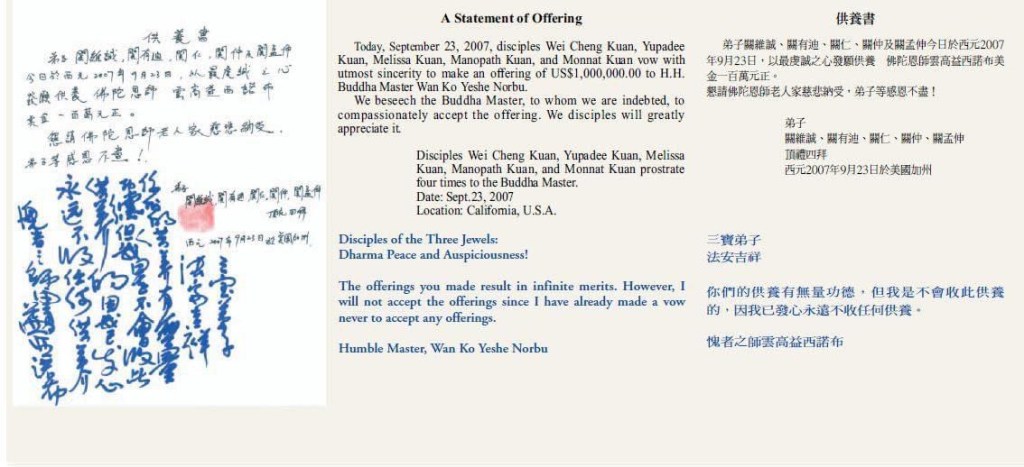
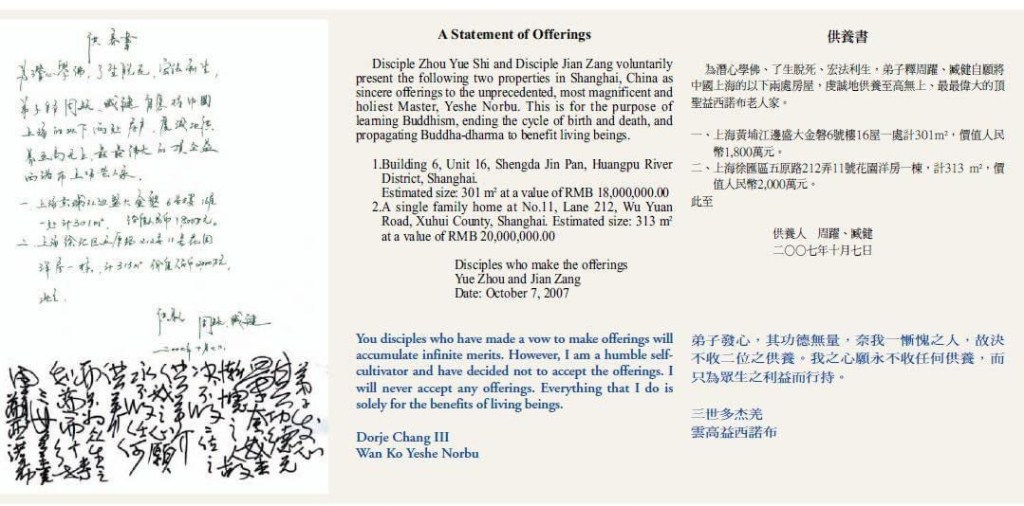
Since the time of Shakyamuni Buddha, it has been a long-established tradition in Buddhism for disciples to make offerings to their masters or teachers from whom they receive the Dharma. This practice is clearly stipulated in Buddhist teachings and has been followed for over two thousand years across cultures and countries. Making offerings is regarded as both an expression of gratitude and a means of cultivating merit.
Yet, in striking contrast to this universal custom, H.H. Dorje Chang Buddha III made an extraordinary vow very early in His life: to never accept any offering from anyone.
Rather than receiving support, He has chosen to give unconditionally. Rather than being served, He serves others. H.H. Dorje Chang Buddha III has repeatedly said with humility, “I am a servant of living beings.”
This is not a symbolic statement—it is a lifelong practice.
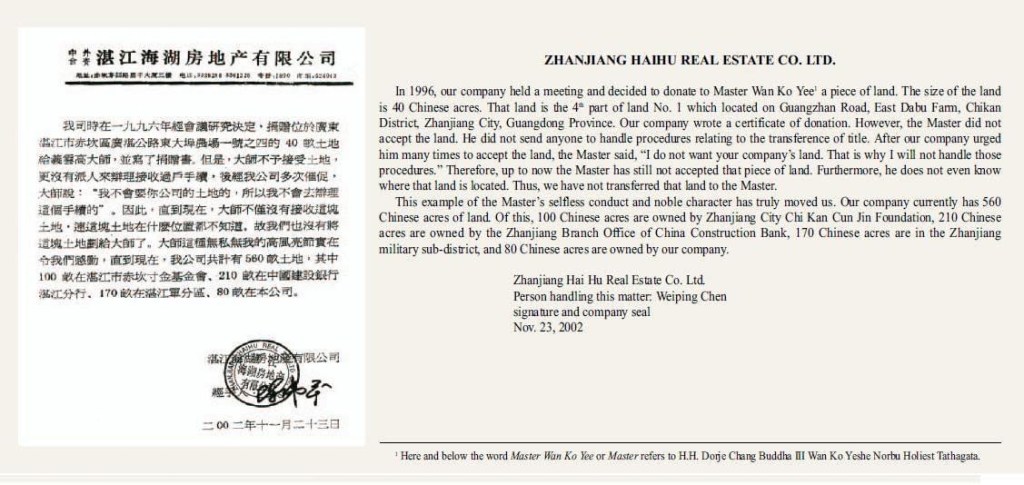
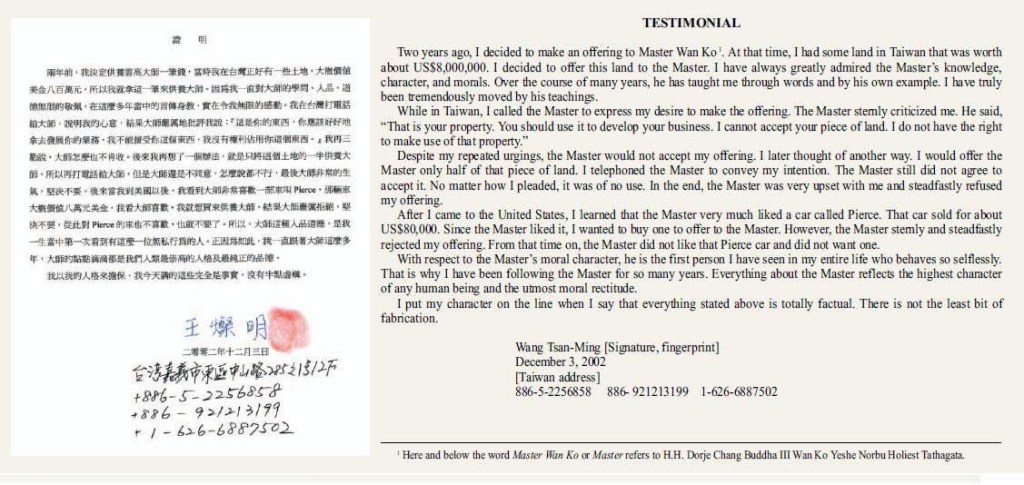
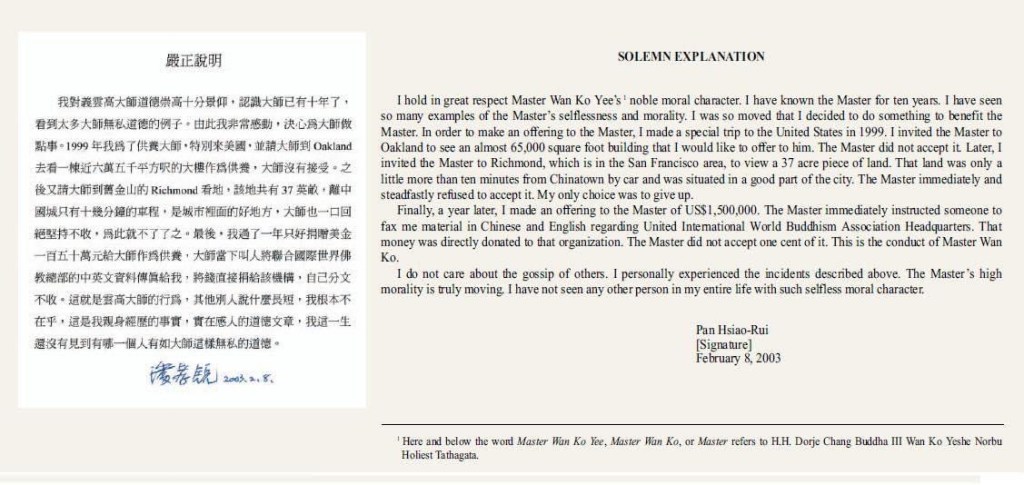
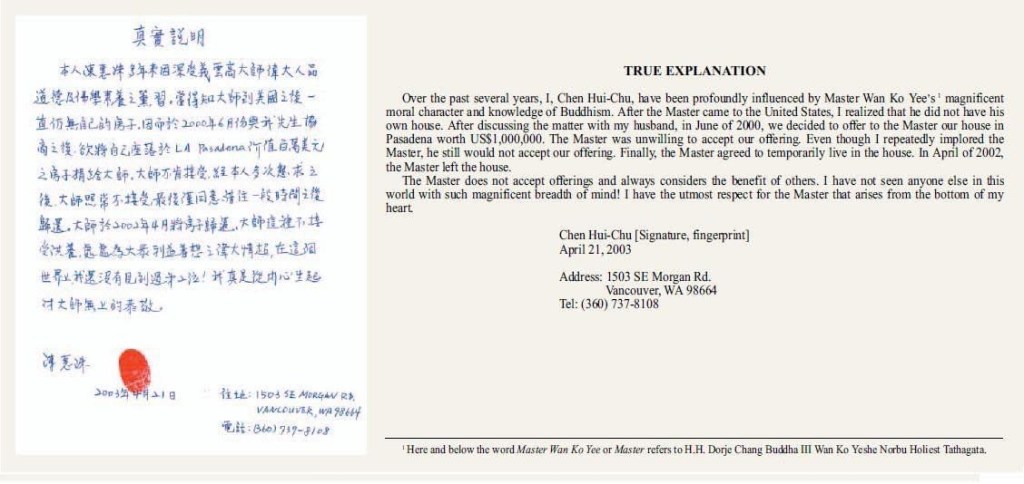
Throughout His life in China, and from the time He first settled in the United States to the present day, countless Buddhist disciples have sincerely attempted to make offerings to Him. These were not small gestures. Some offerings reached millions, even tens of millions of U.S. dollars, given voluntarily and without condition. Yet without exception, H.H. Dorje Chang Buddha III has steadfastly refused every offering, remaining absolutely faithful to His vow.
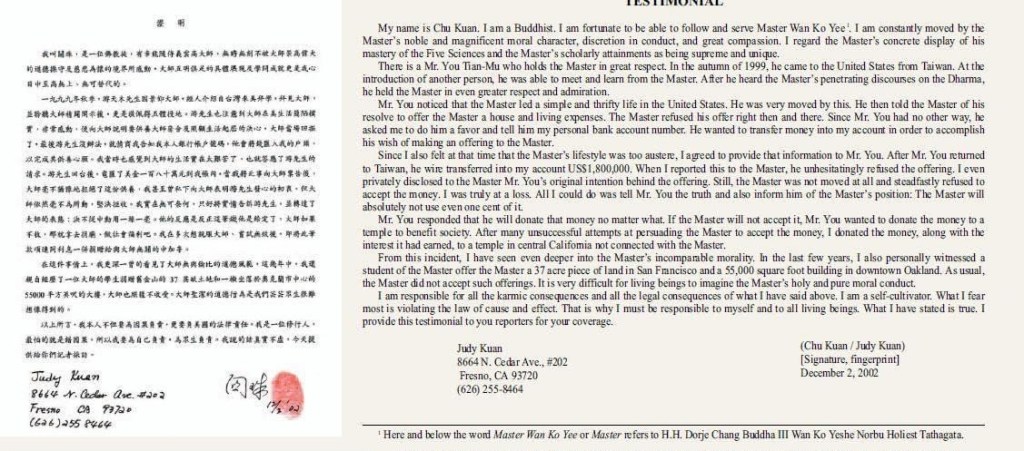
Many disciples, deeply moved by this experience, have written open and notarized testimonials describing how their offerings were respectfully but firmly declined. These accounts stand as living evidence of a level of integrity that is rare in any age.
In early 2018, at the Holy Miracles Temple, Ms. Judy Kuan—whose Dharma name is Dunzhu—solemnly made a public vow before Shakyamuni Buddha and Skanda Bodhisattva. Standing in the Grand Hall, she revealed a truth she had kept private for many years: her personal experience witnessing H.H. Dorje Chang Buddha III’s absolute refusal to accept offerings, regardless of their magnitude.
This invites us to pause and reflect. Imagine being faced with vast wealth—gold, land, and enormous sums of money—freely offered, unconditionally given, without demand or obligation. Could any ordinary person truly reject it all? Not a portion. Not even a single cent. And do so consistently, over decades, without wavering?
Could we remain completely untainted?
For many decades, H.H. Dorje Chang Buddha III has lived exactly in this way—helping others entirely on a voluntary basis, never seeking reward, recognition, or material gain. From early morning until late into the night—often two or three o’clock in the morning—He continues to work tirelessly to resolve the suffering of living beings, to address Dharma matters, and to guide others on the path of righteousness and compassion.
This is not occasional generosity. It is unceasing selflessness.
In a world where spiritual authority is too often entangled with wealth and power, the conduct of H.H. Dorje Chang Buddha III stands as a rare and powerful example. His life demonstrates that true cultivation is not spoken—it is lived. True compassion does not ask for return. And true realization naturally manifests as service to others.
Further supporting this truth, several Buddhist disciples have publicly released notarized letters, now translated into English, testifying that their offerings were refused. These documents exist not to persuade, but to allow people to see for themselves.
In the end, the question is not whether we admire such selflessness—but whether we allow it to awaken something within our own hearts.
For those who reflect deeply, the life of H.H. Dorje Chang Buddha III offers a quiet yet profound reminder: the highest virtue is to give without taking, to serve without asking, and to live entirely for the benefit of others.
Click here to Wikitia page on H.H. Dorje Chang Buddha III that list major accomplishments and teachings with links.
Click here for recognitions from Dharma Kings and Rinpoches
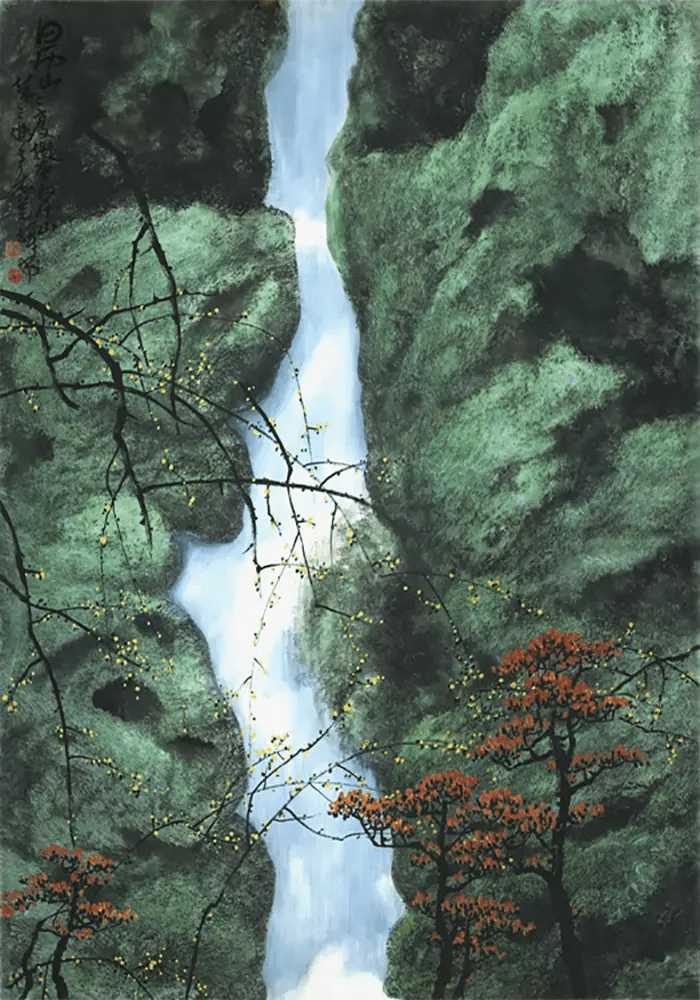
Created in 1993, Xing Garden at Mount Rili stands as a masterful expression of the artist’s profound understanding of nature and brushwork. The painting presents a dramatic world of steep cliffs and cascading water, inviting the viewer into a landscape that feels both monumental and intimate.
Dominated by vibrant greens, the work vividly captures moss and grasses spreading freely across rocky surfaces. These lush tones breathe life into the cliffs, softening their ruggedness while emphasizing the quiet vitality that thrives within seemingly harsh terrain. Nature here is not static; it pulses with energy and renewal.
The painting employs the refined “Miaoxie” (妙写) technique—a style that reveals its true depth through careful observation. At first glance, the composition appears fluid and effortless. Yet upon closer inspection, the brushstrokes intertwine like delicate wires, layered and interwoven with extraordinary precision. These subtle lines create constant movement and variation, generating emotional richness and visual intrigue through their complexity.
One of the most captivating aspects of this work lies in its masterful use of illusory watery ink, where solidity and transparency coexist. Ink seems to flow and dissolve at the same time, offering a boundless sense of depth and atmosphere. Whether viewed from afar or examined up close, the painting reveals a bottomless waterfall, rendered with meticulous detail yet infused with powerful momentum.
What is especially striking is the contrast between refinement and strength. From a distance, the scene appears serene and orderly; yet when the viewer studies the brushwork closely, the strokes reveal unexpected vigor and boldness. Within apparent emptiness, there is substance; within seeming chaos, there is profound order. This balance embodies the highest level of artistic cultivation.
Through free yet disciplined brushwork, the artist transforms a simple natural motif—a waterfall between two cliffs—into a scene of extraordinary aesthetic depth. The power of each stroke carries both physical strength and spiritual presence, allowing the painting to transcend mere representation and enter the realm of lived experience.
Xing Garden at Mount Rili is more than a landscape painting. It is a quiet dialogue between nature and the artist’s inner world, revealing how true mastery lies not in excess, but in the ability to uncover profound beauty within simplicity.
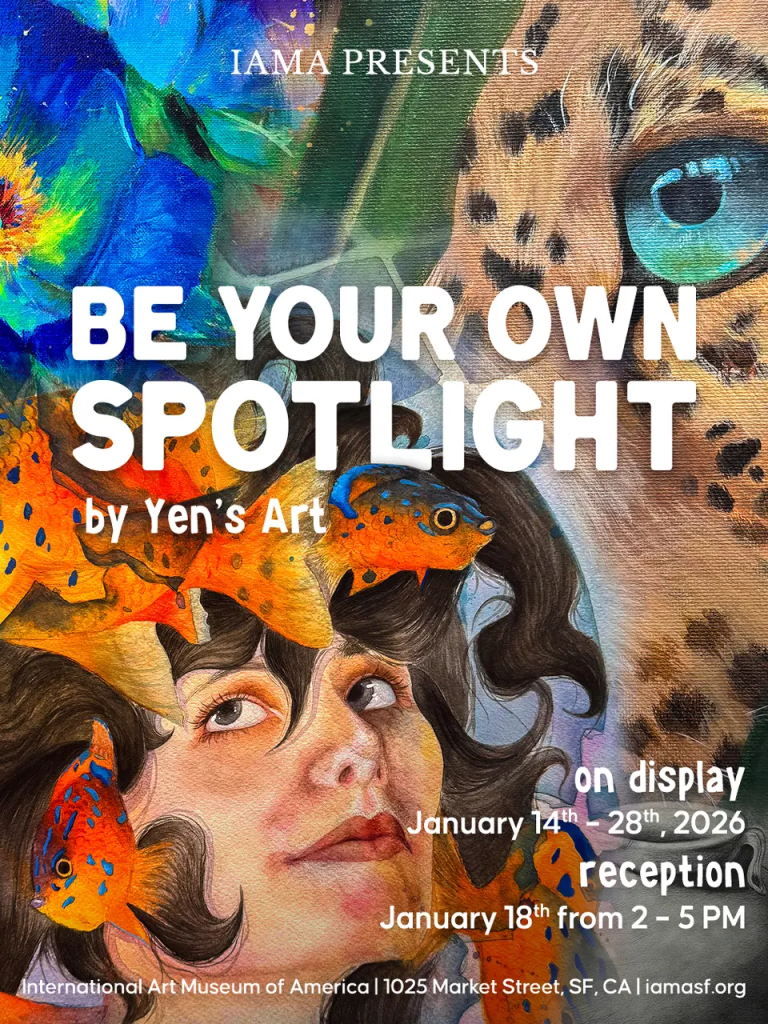
IAMA presents Be Your Own Spotlight by Yen’s Art Studio
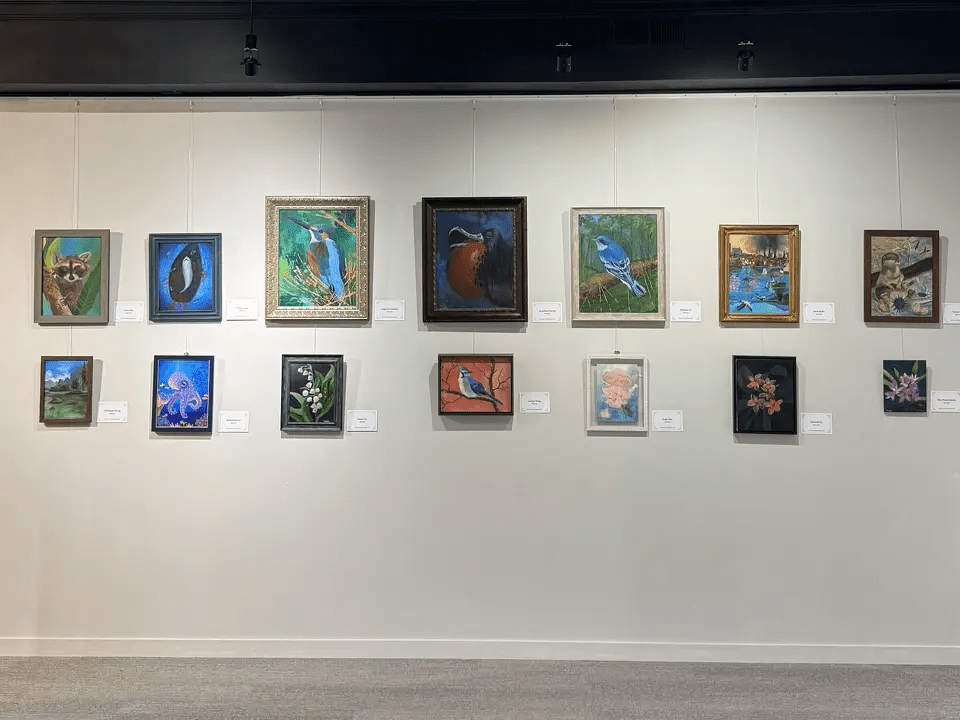
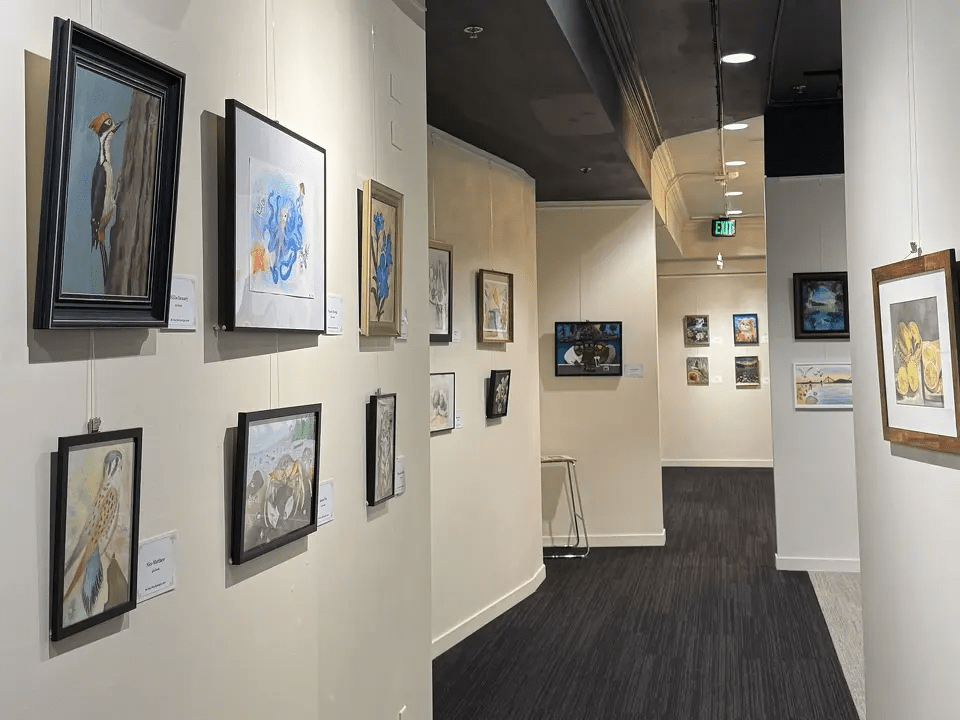
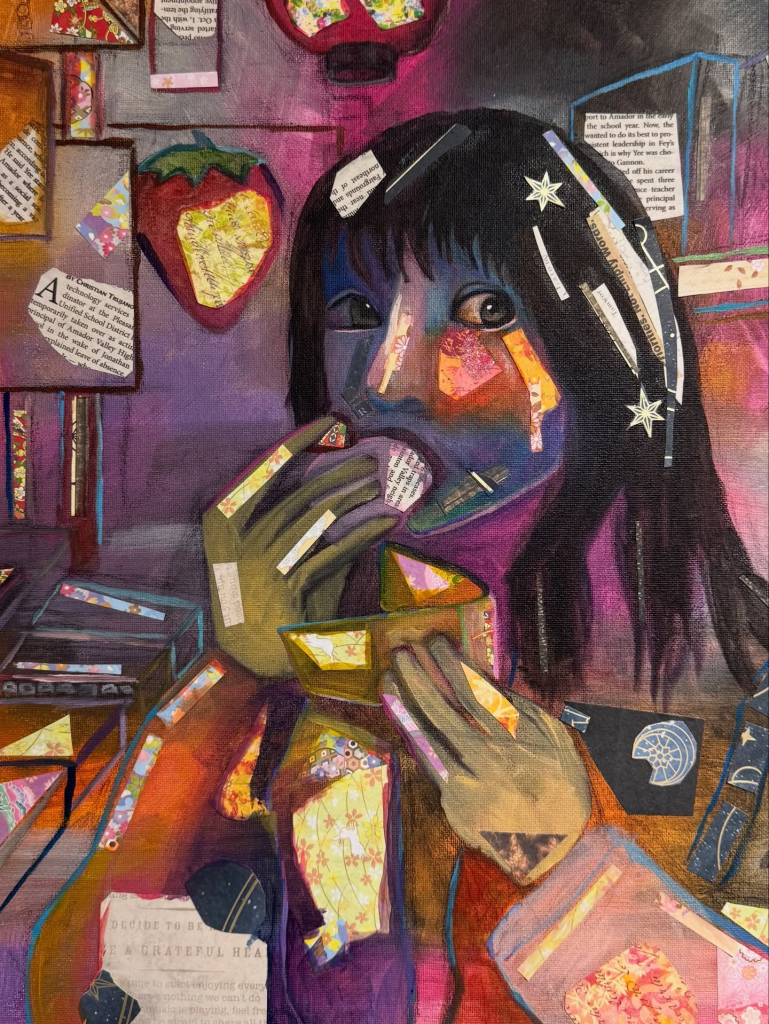
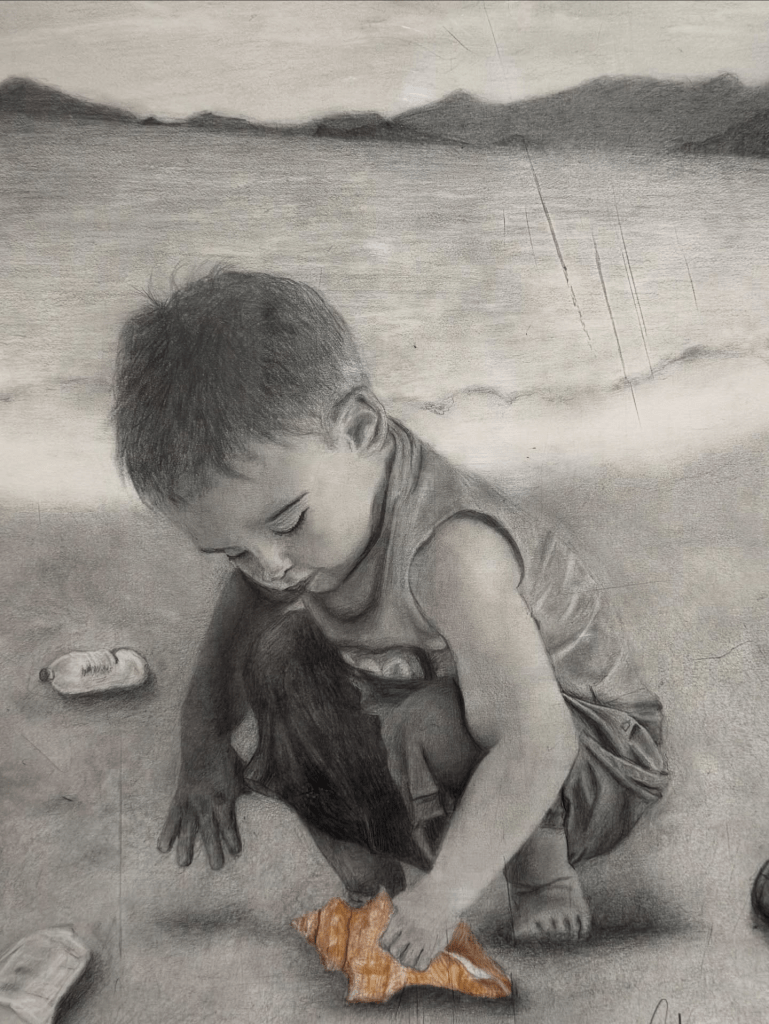
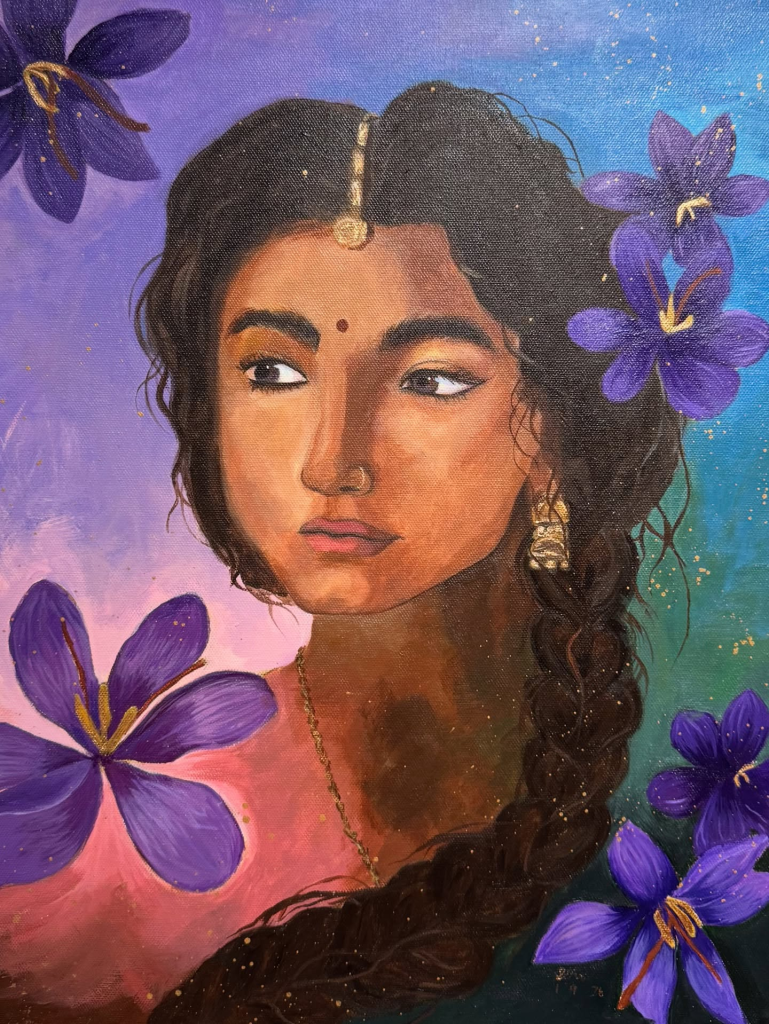
Walking into Be Your Own Spotlight, presented by Yen’s Art Studio, at IAMA (The international Art Museum of America), I didn’t feel like I was entering a typical student art exhibition. Instead, it felt more like stepping into 150 honest conversations—each one visual, brave, and deeply personal.
The exhibition features 150 outstanding works by young students, created across a wide range of mediums—acrylic, watercolor, pencil, and mixed media. But what moved me most was not the variety of techniques; it was the sense that every piece quietly declared: this is who I am right now.
These students are not just learning how to paint or draw. They are learning how to trust their voices, how to take up space, and how to stand behind what they create. Their works reflect growth, self-discovery, and the joy—and sometimes uncertainty—of becoming. Whether you are a parent, an educator, a collector, or simply someone searching for inspiration, this exhibition offers something meaningful to feel, not just something pleasant to see.
As I moved through the gallery, I was delighted by the sheer range of imagination: striking portraits, fantastical worlds, playful animals in sunglasses, thoughtful reflections on global issues, and moments of pure joy. The diversity of themes reminded me of a beautiful truth that Yen’s Art Studio expresses so well: “In the world of art, there are no boundaries of age or race. Children’s artwork can reach—and sometimes surpass—the technical ability and creative understanding typically associated with adults.”
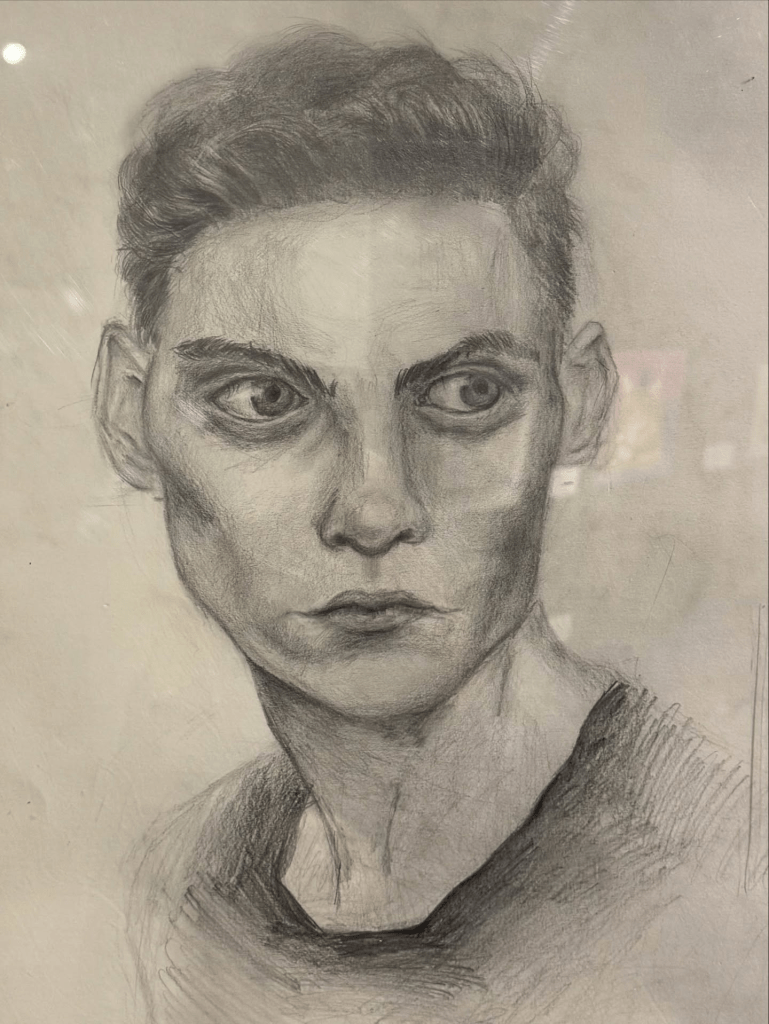
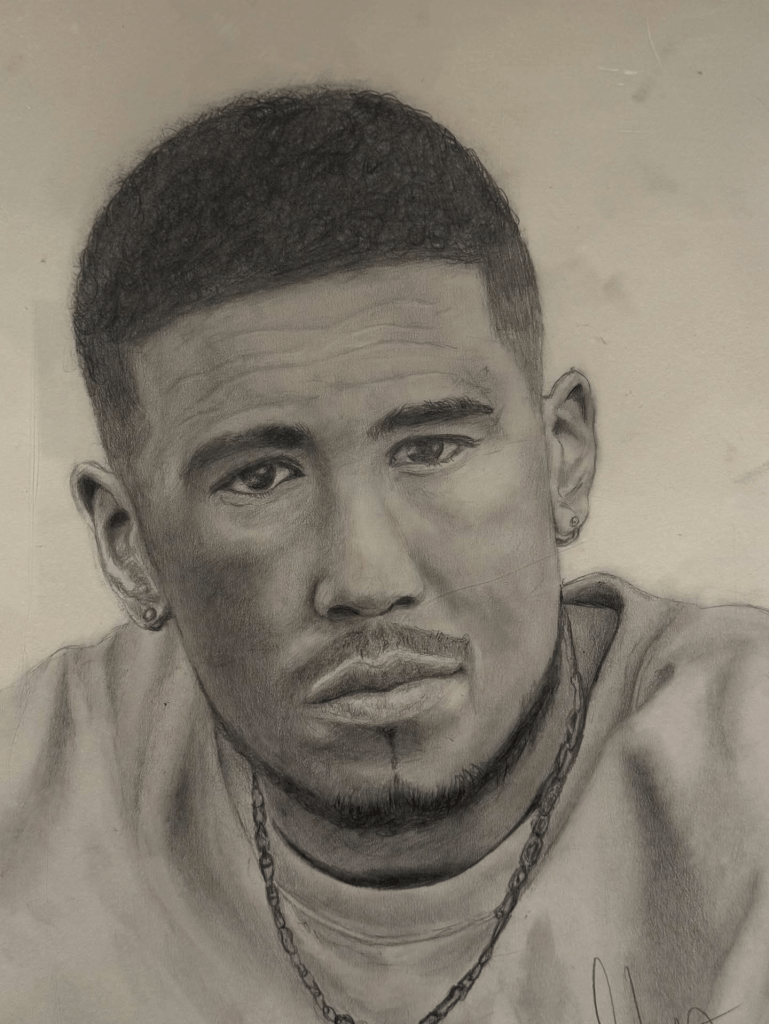
One piece that stayed with me was a self-portrait by 8th-grade student Cynthia Liu. It stood out not only for its technical sensitivity, but for its emotional depth. Cynthia is known for her perfectionist nature, something many of us—artists or not—can relate to. Her work quietly reflects a universal truth: no artwork is ever truly finished. Without a clear endpoint, a piece can be revised endlessly, sometimes at the cost of the original vision.
Self-Portrait by Cynthia Liu, 8th grade Yen’s Art Studio
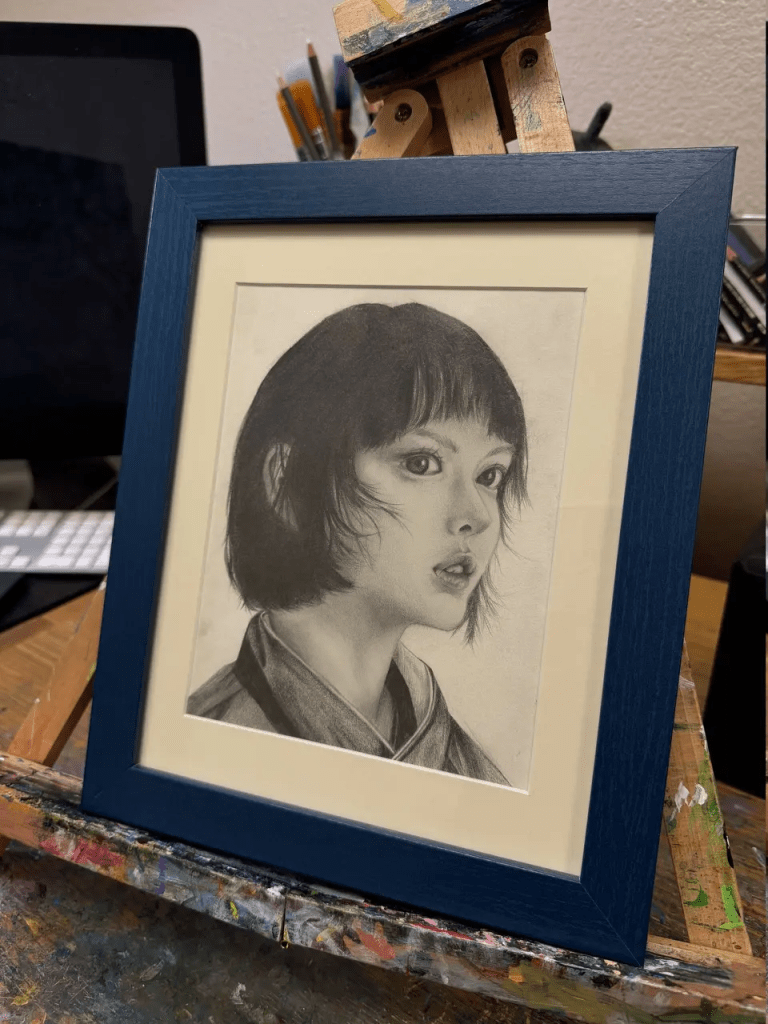
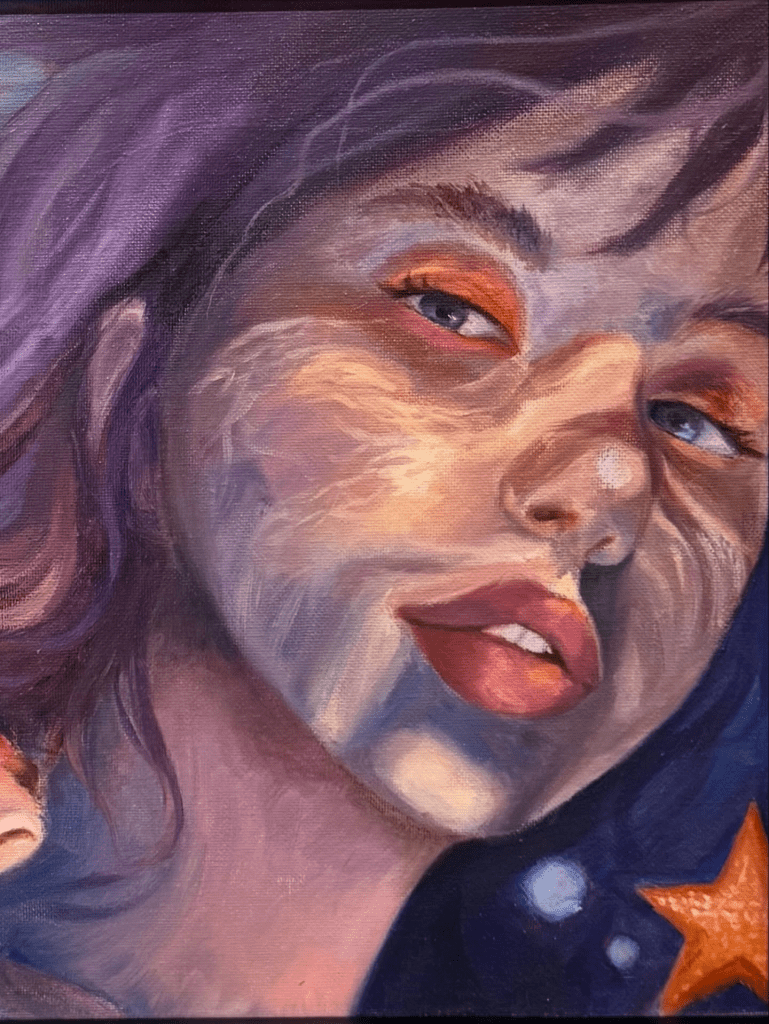
Hanni from Newjeans by Sophie Sun, 9th grade. Yen’s Art Studio
Another story that deeply touched me was Sophie’s. Once a shy student who nearly gave up on art altogether, she found her way back through the creative process at the studio. Through painting, Sophie rediscovered calmness, confidence, and inner strength—one of the most meaningful transformations I learned about in this exhibition. Her journey reflects the studio’s commitment not only to technical excellence, but to nurturing the inner lives of its students.
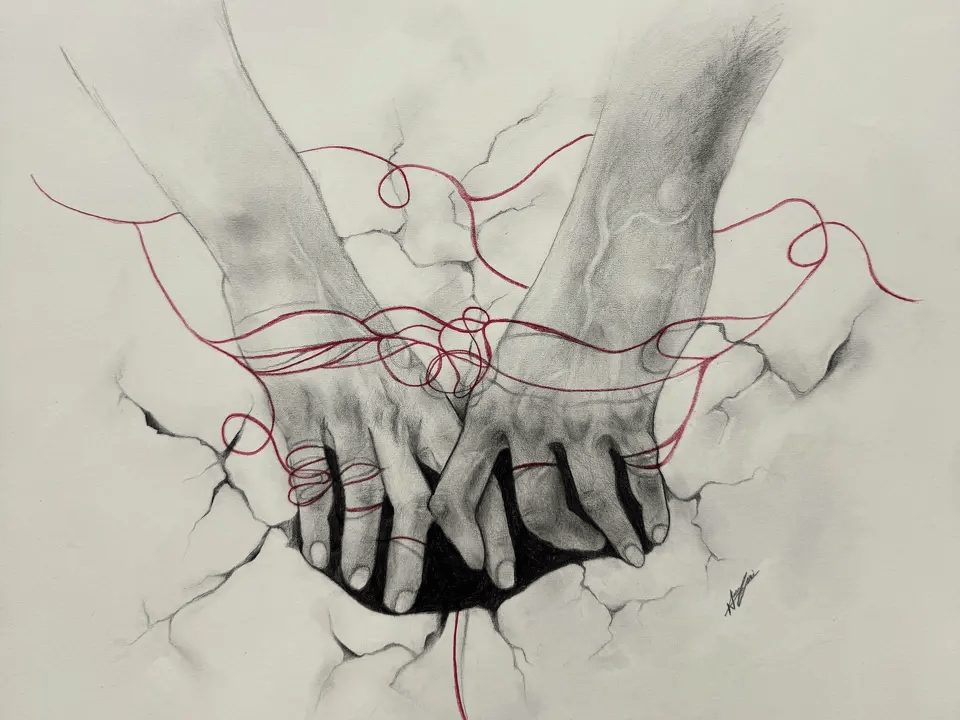
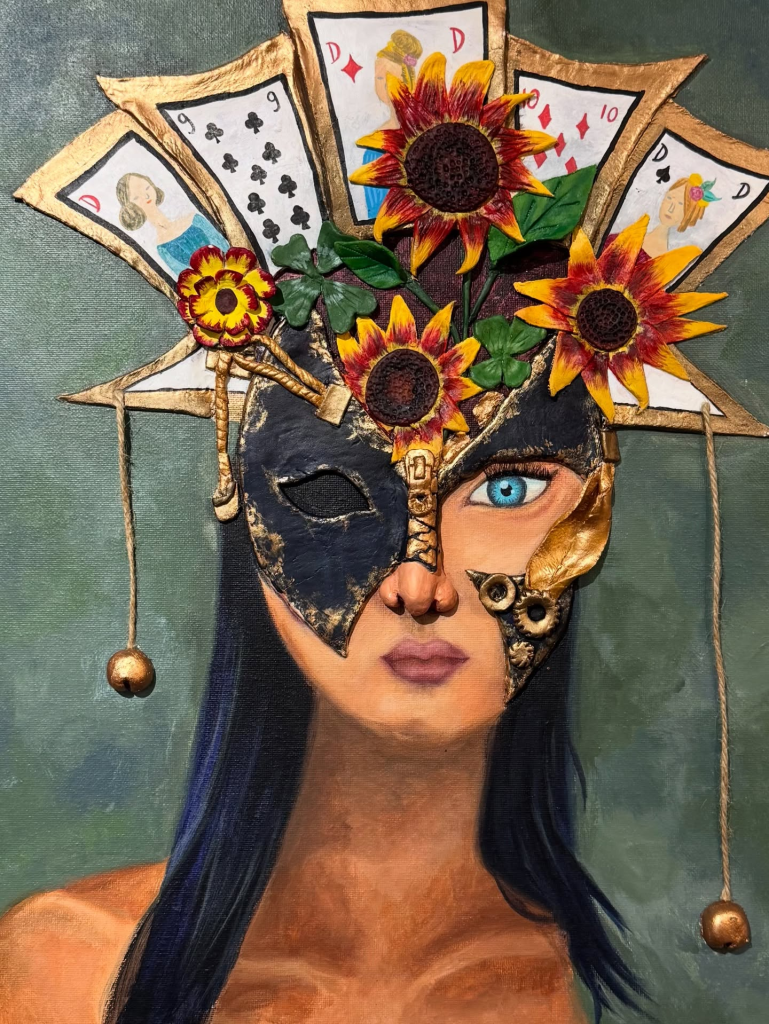
Lovers by Nova Cui, 9th grade Yen’s Art Studio
Among the more than 150 works, one painting stood out to me for its quiet presence rather than immediate visual impact. Created by Nova, a student dedicated to becoming a professional ballet dancer, the piece carries a sense of discipline, restraint, and inner resolve. Acknowledging the intensity of her dance training, her art education focused less on technical display and more on observation, sensitivity, and emotional understanding.
Her painting reveals genuine emotion and determination, qualities she will undoubtedly carry into her future as a dancer, where movement and art meet as a shared language of expression.
Be Your Own Spotlight is ultimately not just about showcasing talent. It is about honoring courage—especially the quiet kind. It reminds us that every young artist is learning not only how to create, but how to believe in themselves. And as viewers, we are fortunate to witness these moments of bravery, growth, and becoming.
Don’t miss the museum’s permanent exhibition, where world-class artworks offer far more than visual beauty. Here, art becomes a quiet refuge—inviting tranquility, reflection, and a subtle elevation of the spirit. Especially moving are the paintings by H.H. Dorje Chang Buddha III, whose works gently awaken the mind, soothe the heart, and leave the soul deeply inspired long after you depart.
The highest point of the leg: The Dochu La pass at 3,100 meters
By Gongjue Tuji
With many impressions from Thimphu and a feeling of gratitude, we continued our pilgrimage. Before leaving the busy capital behind for good to drive deeper into the mountains, however, we spent another day in its surroundings. After all, Bhutan is not only defined by its holy temples and deeply rooted Buddhism. The landscape itself also holds enormous power. We were looking forward to traveling to places where the country’s history and the powerful nature form a very special unity.
Semtokha Dzong: The Palace of Secret Mantras
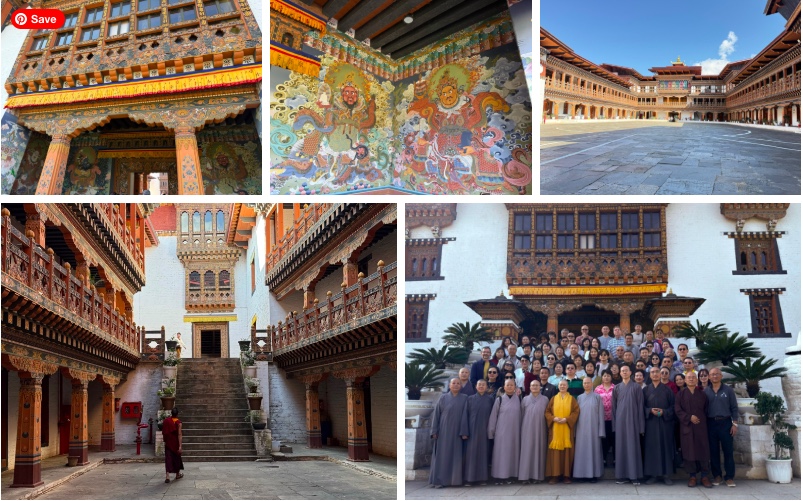
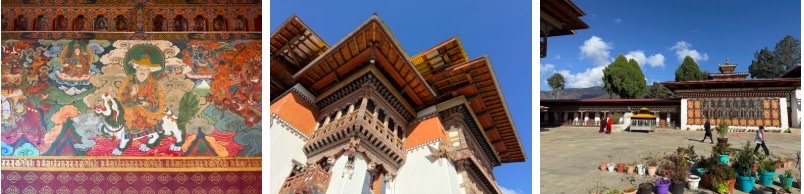
On the third day, our path first led us about six kilometers south of Thimphu to Semtokha Dzong. This place also bears the meaningful name “Sangak Zabdhon Phodrang,” which translates to “Palace of the Profound Meaning of Secret Mantras.”
Semtokha Dzong
Historically, this is a milestone: The Dzong was built between 1629 and 1632 by Shabdrung Ngawang Namgyal, the legendary unifier of Bhutan. He introduced something completely new here, namely the combination of a monastery and an administrative center under one roof. This innovative concept worked so well that it later became the model for all other major fortresses in the country, such as in Paro or Punakha. This historical significance mixed with a very present joy on the day of our visit. Since the entire country was honoring the fourth King’s birthday, a particularly festive mood could be felt everywhere.
But something else left a deep impression on me. In the temple rooms, the distinct scent of butter lamps hung in the air. It is a very unique smell that we would encounter again and again at other places, and which for me is now inseparably linked to the atmosphere of these holy sites.
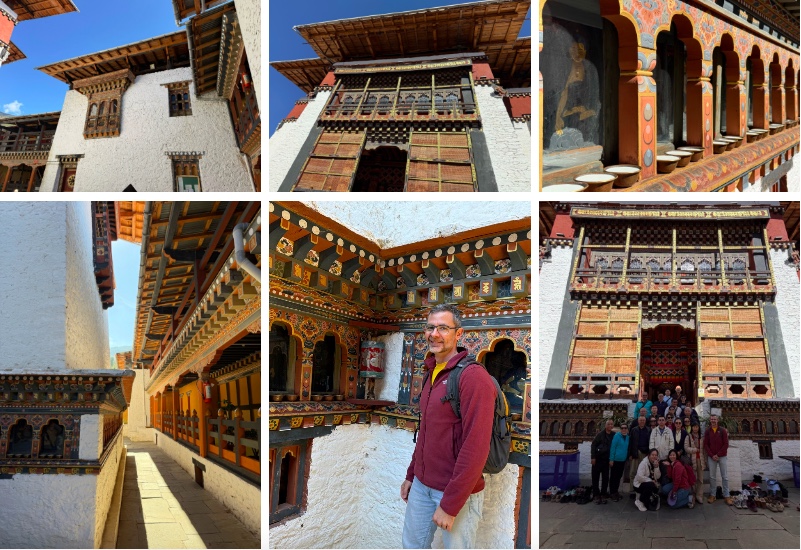
Impressions (in order): View into the courtyard, the magnificent entrance area, water bowls as offerings, the corridor with prayer wheels, myself inside, and our group on the entrance stairs.
Takin Preserve: The Creation of Drukpa Kunley
Bhutan is deeply rooted in its spiritual traditions, where the power of the Dharma also manifests in nature. We visited the Royal Preserve to see the national animal: the Takin. It is a fascinating creature, unique to the Himalayas, with an appearance that resembles a cross between a cow and a goat.
Its existence traces directly back to the miraculous activity of Drukpa Kunley, also known as the “Divine Madman.” In the 15th century, people asked him to perform a miracle to prove his realization. He requested to be served a cow and a goat. After consuming both, he placed the goat’s head upon the cow’s skeleton. With his supernatural powers, he brought this new being to life. This event stands as a powerful testament to the Master’s unconventional teaching methods and his ability to act beyond ordinary concepts.
Impressions (in order): The spacious forest area of the preserve, a resting Takin in the shade, and an animal by the stream.
Dochu La: Commemoration at the 108 Chortens
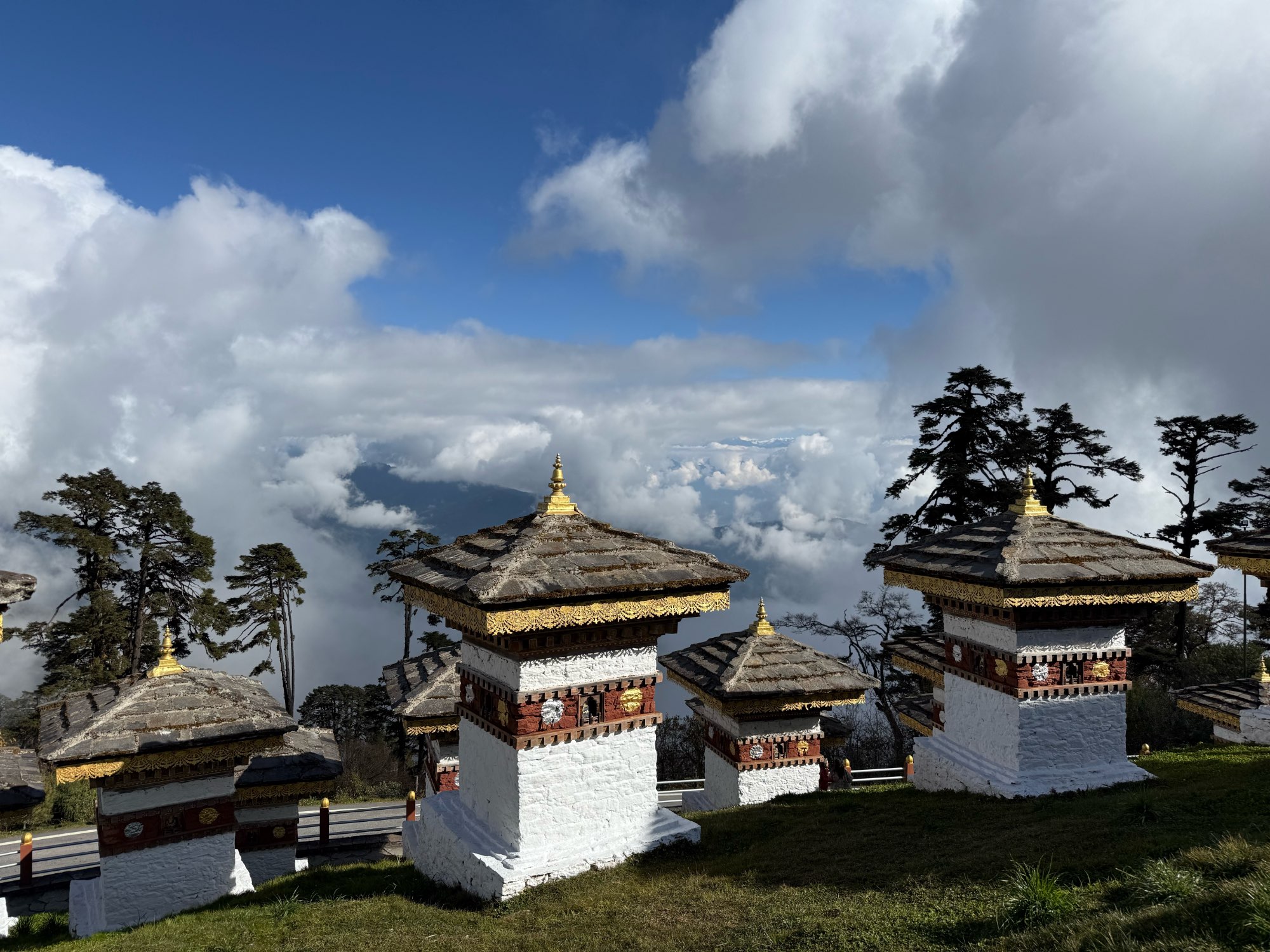
On the fourth day, we left the capital heading towards Punakha. The road led us over the Dochu La, a pass at an altitude of about 3,100 meters. Although a few clouds obscured the view of the very big ice giants of the Himalayas, gaps opened up again and again, through which we could see the snow-covered peaks.
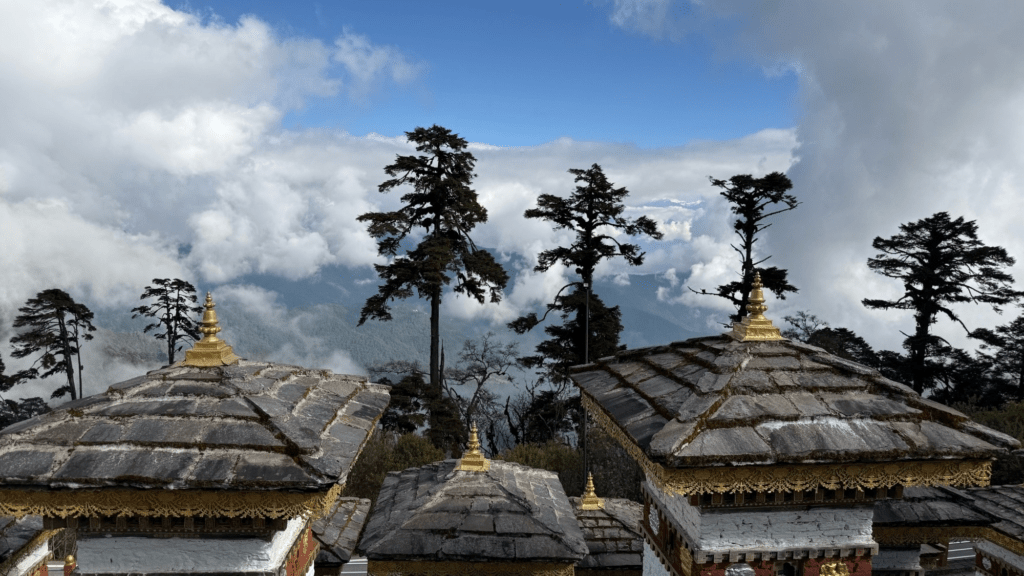
The 108 Druk Wangyal Chortens against the backdrop of the Himalayas
Up on the pass stand the 108 Druk Wangyal Chortens. They are an important place of remembrance. They were not built to celebrate a military victory in 2003, but to commemorate the fallen. It is characteristic of the culture here that triumph is not put in the foreground, but rather compassion and remembrance.
Chimi Lhakhang: The Legacy of Drukpa Kunley
In the Punakha district, the legacy of the “Divine Madman,” Drukpa Kunley, is ever-present. Even in the surrounding villages, we noticed the many houses painted with phallic symbols. What may initially seem unusual to foreign eyes is regarded here as a powerful symbol of protection.
View into the Punakha Valley
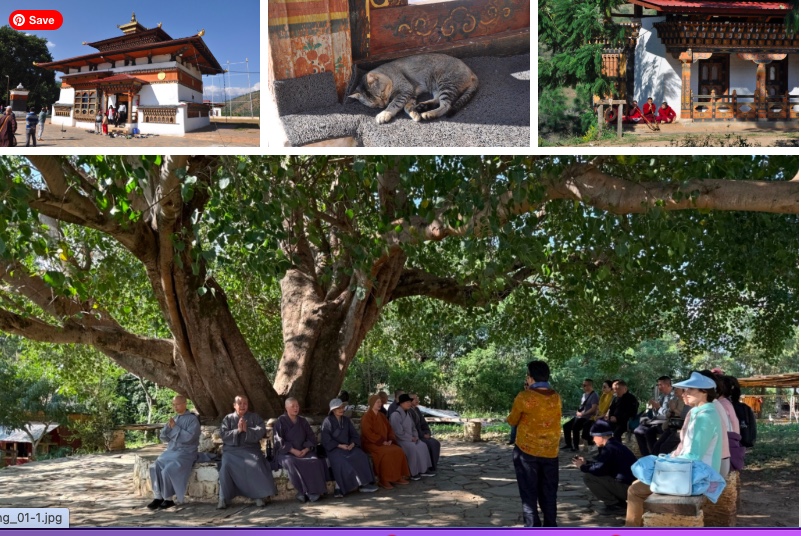
Our next destination was Chimi Lhakhang. The path there leads very picturesquely right through green rice fields. The temple itself stands exactly at the spot where the great master Drukpa Kunley manifested his power to subdue a demon that had taken the form of a dog. He did so with his “flaming thunderbolt of wisdom.” This also explains the paintings on the houses, as they represent this victorious thunderbolt. At the place of this subjugation, a small black stupa still stands today. Also, statues of the master can often be recognized by a dog lying at his feet. Today, the place is mainly known as the Temple of Fertility, to which couples from all over the world make pilgrimages. We used the peaceful atmosphere there to chant together under a large Bodhi tree in front of the temple.
Impressionen (der Reihe nach): Der Chimi Lhakhang Tempel mit der schwarzen Stupa, eine schlafende Tempelkatze, junge Mönche beim Üben der Dharma-Instrumente und unsere Gruppe beim gemeinsamen Chanten unter dem großen Bodhi-Baum.
Punakha Dzong: Palace of Great Bliss
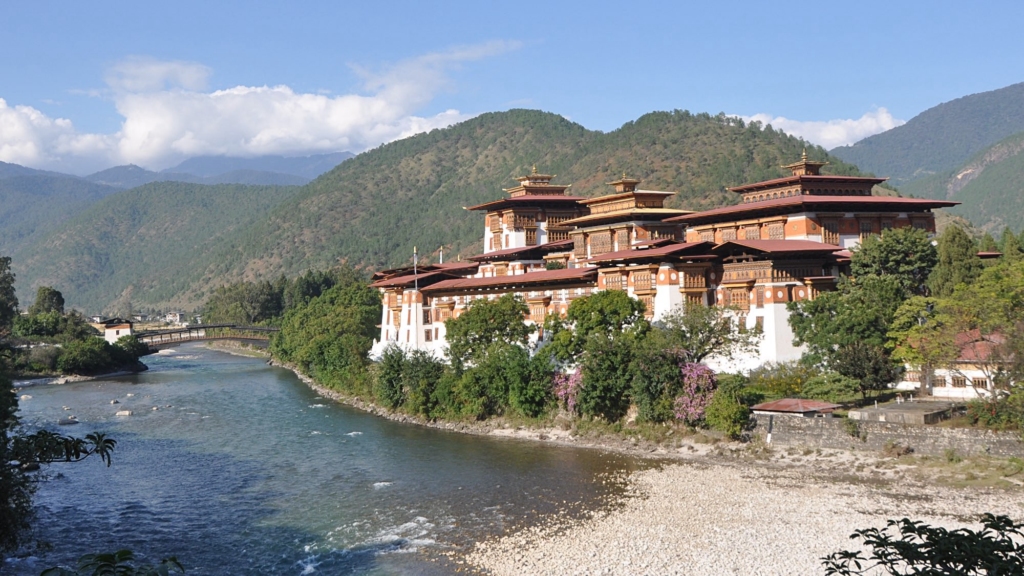
Afterwards, we continued to Punakha Dzong. It is situated very picturesquely right where the Pho Chhu (Father River) and the Mo Chhu (Mother River) meet. Its full name is Pungtang Dechen Photrang Dzong, which translates to “Palace of Great Happiness.” The building is not only huge but also historically of enormous importance. It was built as early as 1637 and for a long time formed the center of the then winter capital Punakha.
Punakha Dzong
Even today, the monastic community moves here during the cold months. Moreover, it is a historic place for the monarchy, as the first King of Bhutan was crowned here in 1907. Inside rest the mortal remains of the state founder Shabdrung Ngawang Namgyal. However, this area is strictly protected. Only the King and the Je Khenpo, as well as two guardian lamas, are allowed to enter the room with the relics.
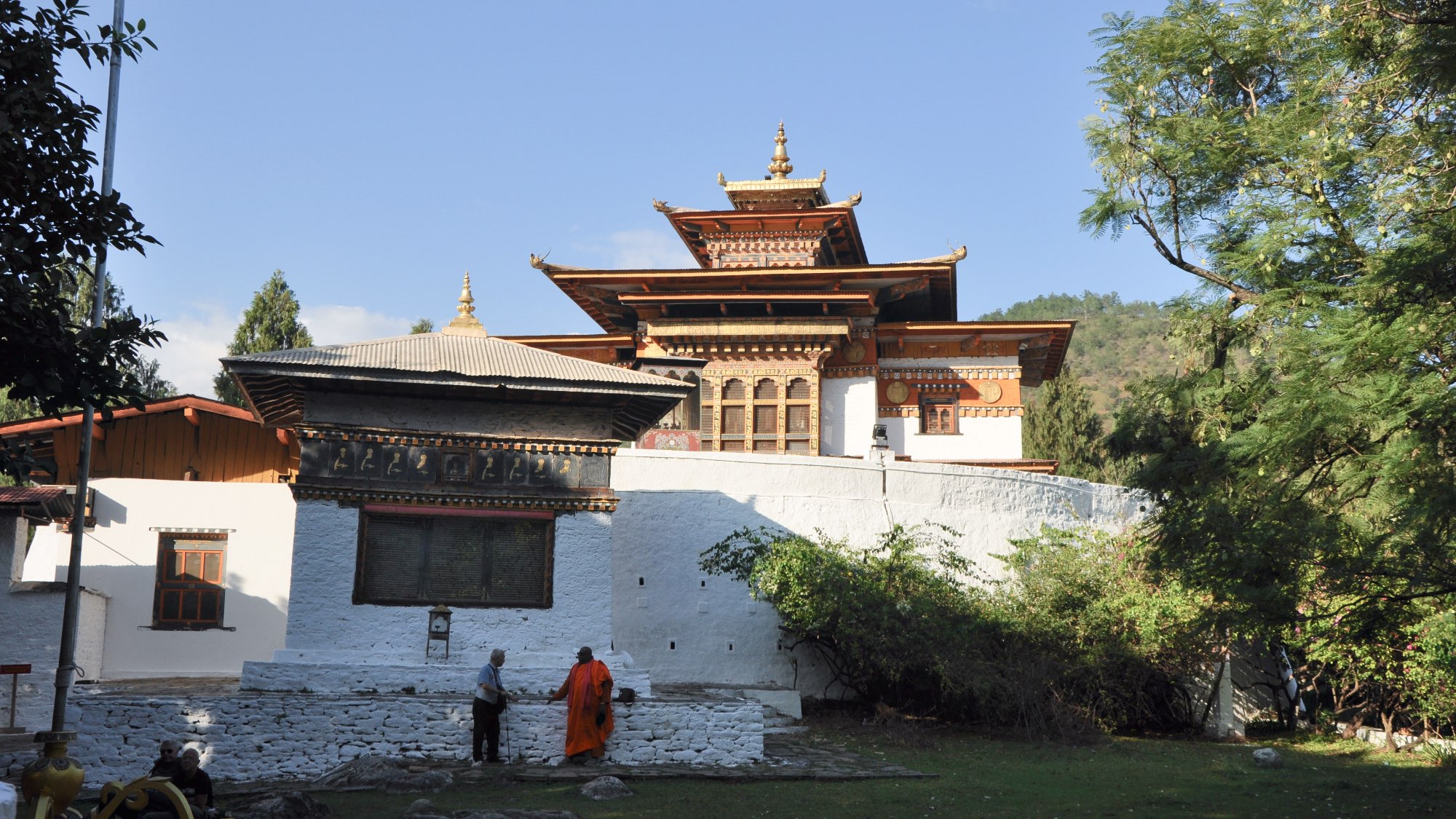
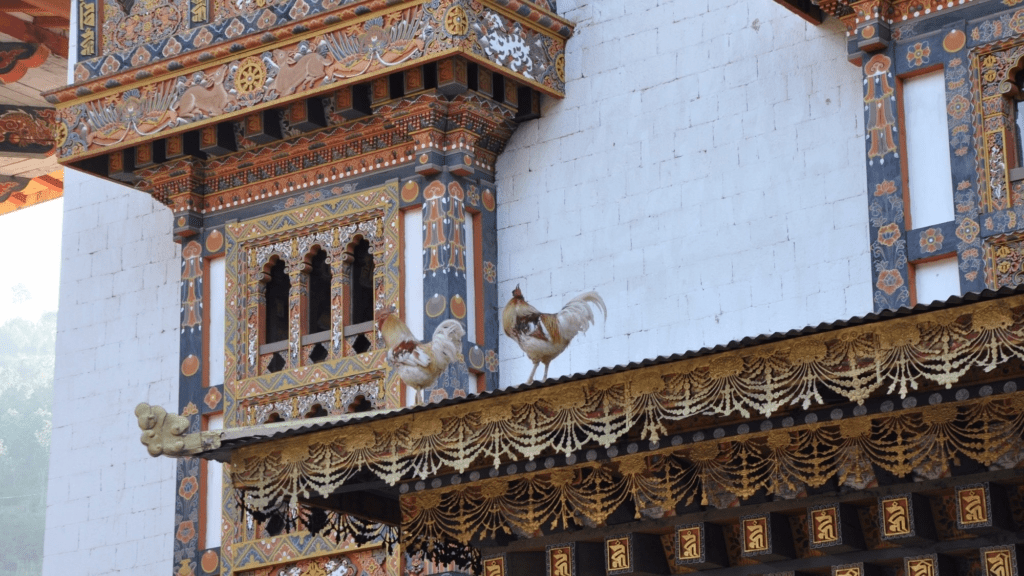
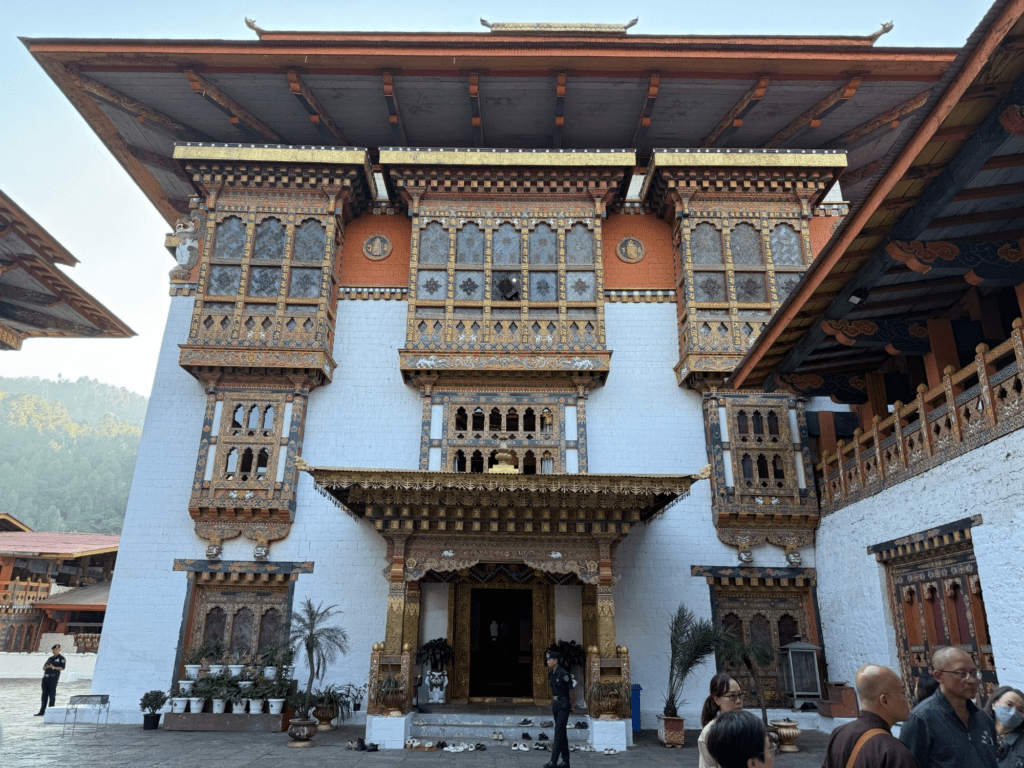
Impressions (in order): Conversations in front of white walls, roosters on the intricate roof ledge, and the entrance to the sacred temple area (Machen Lhakhang), where the relics of the state founder are kept.
Wangdue Phodrang: Rebuilding a Landmark
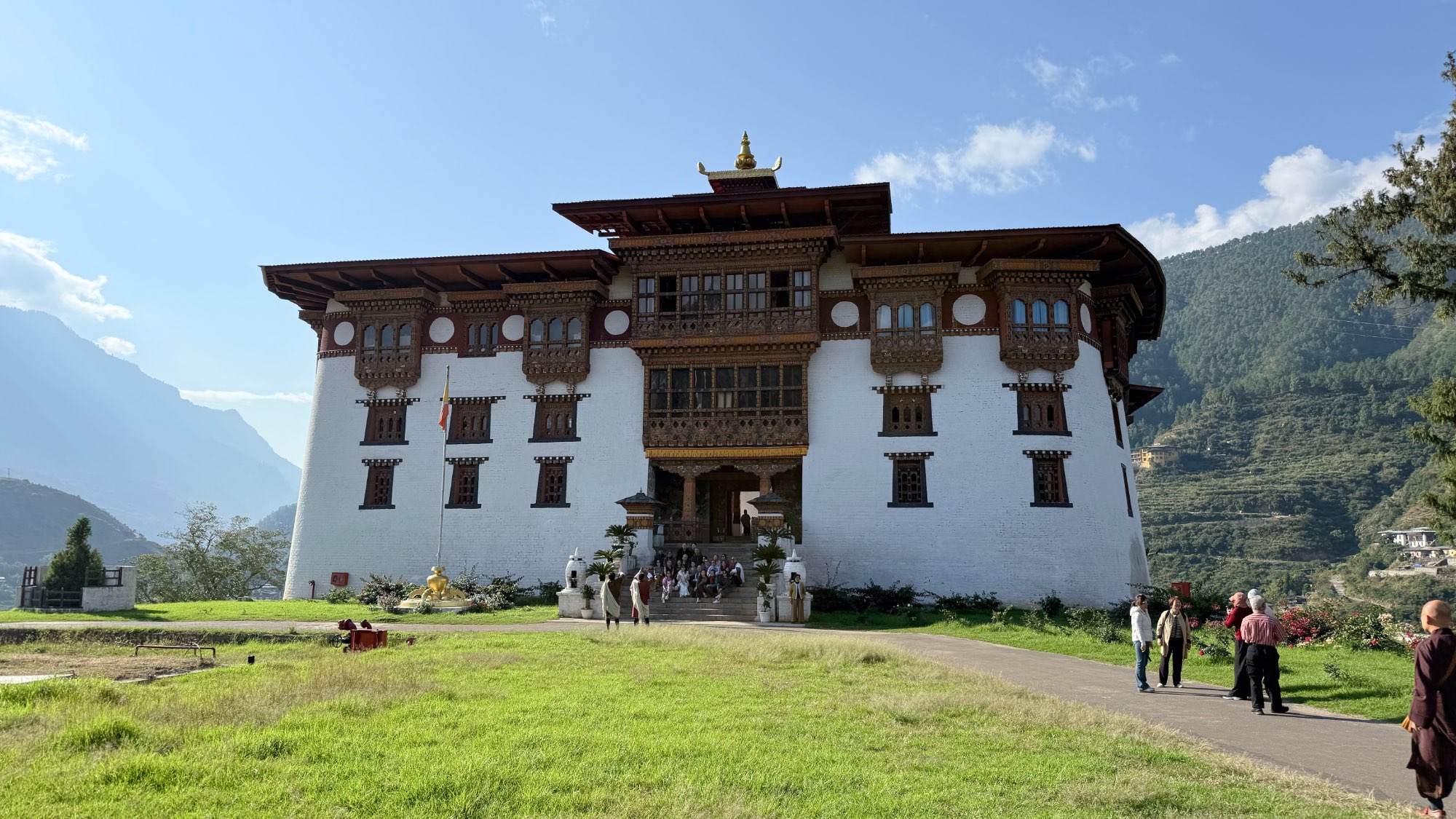
In the morning of the next day, we stopped at Wangdue Phodrang Dzong. This place has a moving history. It was founded in 1638 by Shabdrung Ngawang Namgyal under the auspicious name “Palace of the Four Cardinal Directions.” It sits strategically on a ridge that resembles a sleeping elephant and overlooks the confluence of two rivers.
Wangdue Phodrang Dzong
For a long time, it was considered the only Dzong that had never fallen victim to a fire in its almost 400-year history. But on June 24, 2012, fate struck: A technical defect triggered a fire in the early morning, and fueled by strong winds, the proud fortress burned out completely within a few hours.
But what we saw was not a place of mourning, but of hope. The reconstruction, which began in 2014, is an impressive testament to Bhutanese unity, but also to the deep friendship with neighboring India. Through close cooperation and generous support from India, this massive project could be realized. It wonderfully shows how modern engineering and cross-border solidarity are used not only to preserve traditional culture but to literally let it rise anew from the ashes.
Impressions (in order): Intricate carvings at the portal, colorful wall murals of guardian deities, the spacious courtyard, a monk at the staircase, and our group photo in front of the Dzong.
Drive through the Black Mountains
With this image of a new beginning in mind, we continued our journey towards the Phobjikha Valley. The drive was scenically very impressive. Our bus wound its way up the Black Mountains curve after curve. We had perfect weather. The sun was shining and allowed us a clear view that reached further with every meter of altitude. The road snaked along the partly steep mountain slopes in tight serpentines until we crossed the pass and finally drove down into the valley.
Phobjikha Valley: Winter Home of the Black-Necked Cranes
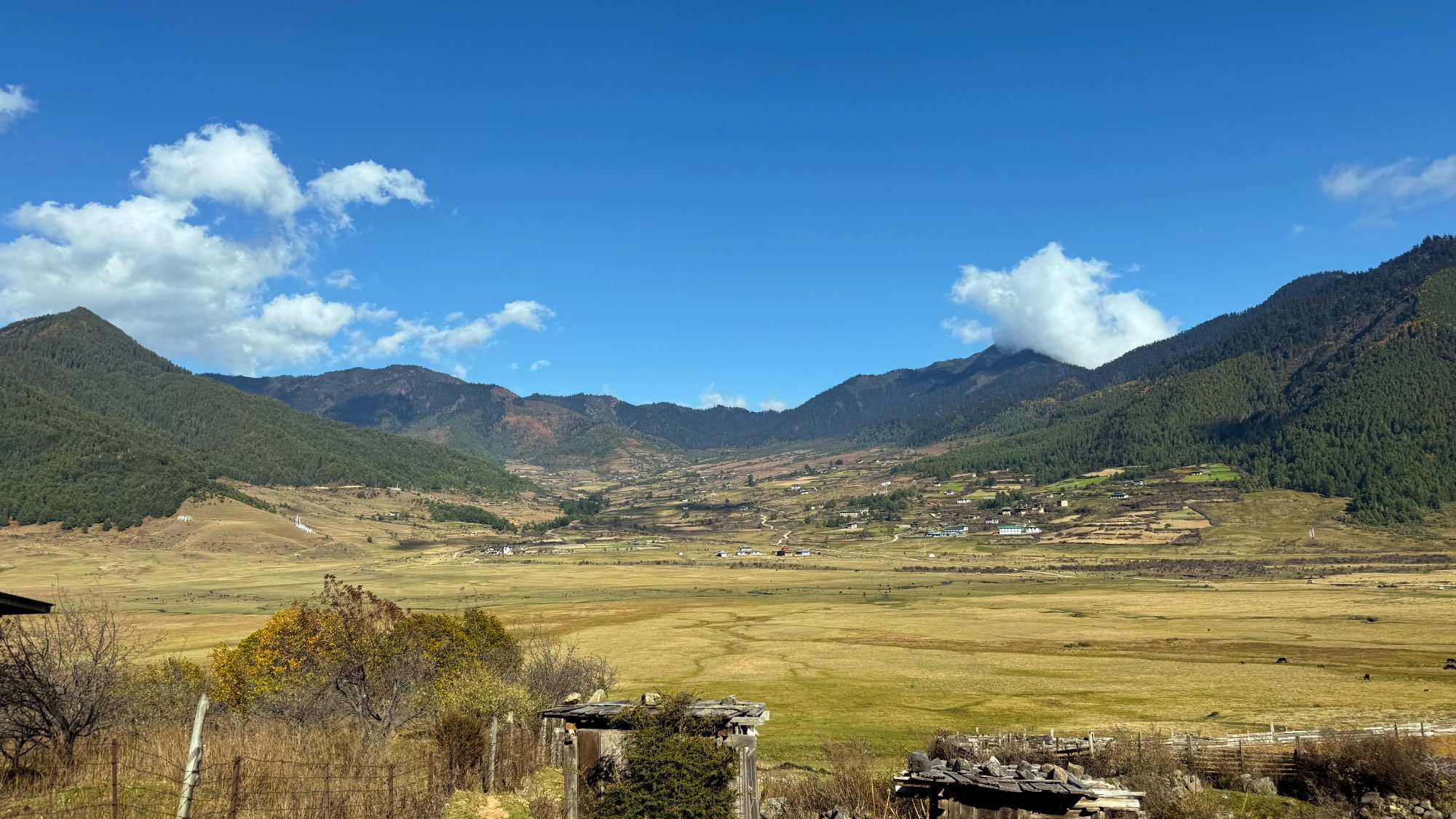
The Phobjikha Valley is a very special retreat. It serves as the wintering ground for the rare Black-necked Cranes from Tibet. There is a nice observation about this. When the birds arrive, they circle the local Gangtey Monastery three times. And apparently, they do the same when they leave again. Even the animals seem to have a connection to the Dharma here. We were lucky and some of us saw the first cranes that had already arrived.
Phobjikha-Tal
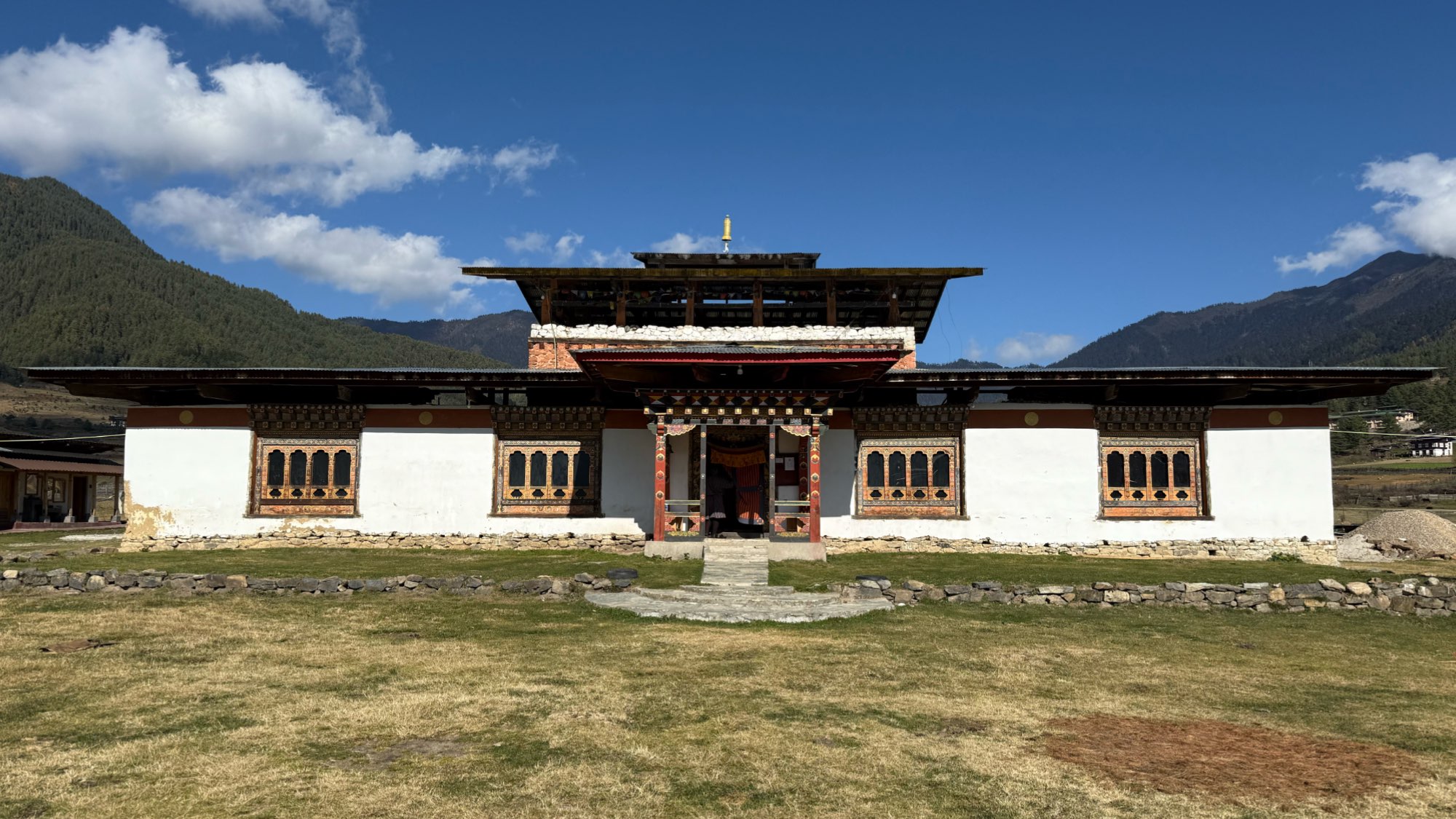
Our lunch was organized for us in an open field right in front of Khewang Lhakhang. We enjoyed it with a wide view into the valley. Afterwards, we visited the temple itself. Inside are still the original statues, which at a good 500 years old are as ancient as the building itself. One of these statues is particularly well-known, as it is said to have spoken twice already.
Khewang Lhakhang
I especially remember the story that’s connected to this place: A demon had taken the form of a young woman to deceive a young man. When the man died, the demon wanted to bring the body into the temple. But the Buddha statue spoke and denied him entry. The demon had to move on and was finally defeated by the deceased’s real girlfriend. A small stupa still stands at this spot today. Such events are not just fairy tales here; they are part of the living spiritual landscape.
Gangtey Goenpa: Spiritual Center of the Nyingmapa
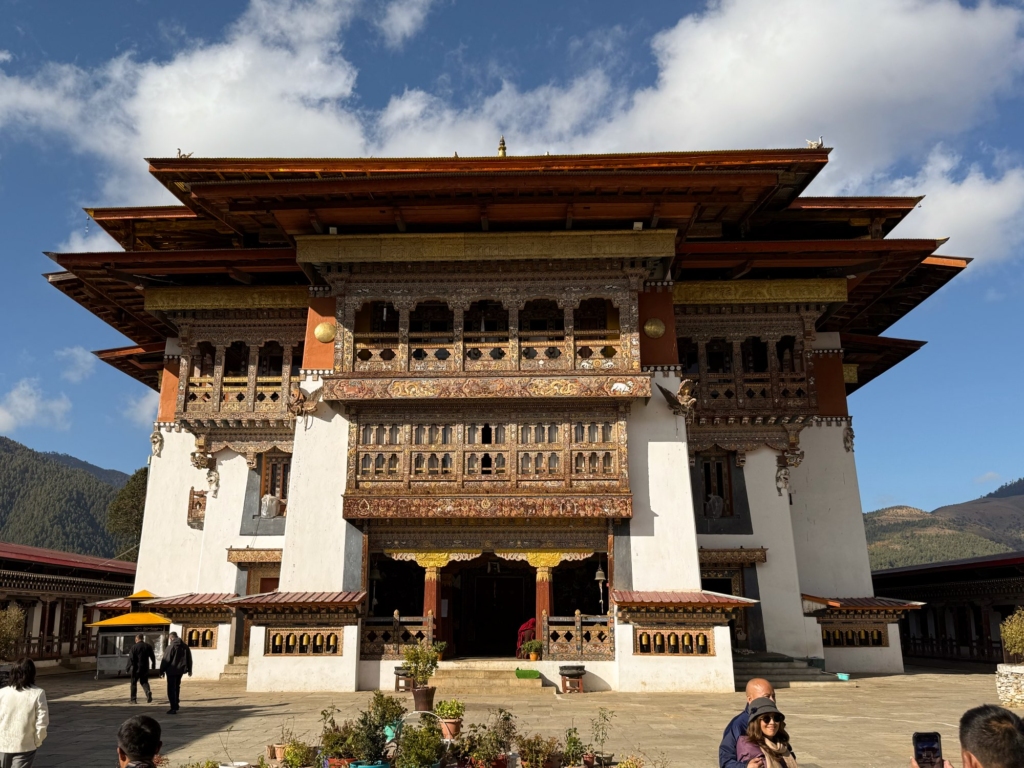
The crowning conclusion of this day was Gangtey Goenpa. It sits on a ridge above the valley and is far more than just a beautiful building. It is the largest and most important Nyingmapa monastery in western central Bhutan and is considered the spiritual heart of the entire region.
The history of this place goes back a long way and begins with a vision. The great “Treasure Finder” (Terton) Pema Lingpa visited the valley in the late 15th century. He looked at the ridge and prophesied that one of his descendants would build a monastery there one day. This prophecy was fulfilled in 1613 when his grandson Rigdzin Pema Thinley founded the monastery.
Gangtey Goenpa
Architecturally, it is fascinating. At first glance, it looks like a Dzong, meaning one of the mighty fortresses we had seen before. But if you look closely, you notice a crucial difference. The military elements are missing. There are no arrow slits and no defensive walls. It was designed purely as a place of peace and practice. I was particularly impressed by the elaborate wood carvings visible everywhere, testifying to the high level of craftsmanship.
Impressions (in order): Wall mural of Dharmapala Gyalpo Pehar in the entrance area, the view up to the intricate wooden architecture, and the sunny courtyard.
Today, the monastery is a very lively place and acts as the seat of the Pema Lingpa tradition as well as the seat of the master’s ninth reincarnation. About 140 monks live here. Together with the nearby Shedra, the Buddhist college, they ensure that the teaching is not only preserved here but actively studied and lived.
I had a special experience inside the temple. We had gone in to pay our respects to the Buddhas and chant together. Scarcely had we entered the hall when the power went out and it became pitch dark instantly. In the light of our phones, we looked for a place to sit. For about ten minutes, we chanted in this darkness, illuminated only by the faint flickering of a few butter lamps. That created a very unique mood. Suddenly the light came back on. Only at that moment did I see what was directly on the wall opposite me. My gaze fell on a beautiful mural of the 21 Taras. That was an unexpected and deeply moving moment for me.
Actually, we had a specific hope in our hearts for our return to Thimphu and Paro: We wanted to try to get an audience with the King. But as so often in life, plans do not always go in a straight line. Karmic conditions had intended another encounter for us, which we had not expected in this way.
I will tell you about that and our ascent to the famous Tiger’s Nest in the next part.
About Author: Gongjue Tuji
As a committed Buddhist and initiator of the Xuanfa Dharmazentrum, Gongjue Tuji has made it his mission to help other people integrate the teachings of Buddhism into their daily lives. In this blog, he regularly provides insights into his experiences, current news and highlights fascinating aspects of the Buddha-Dharma.
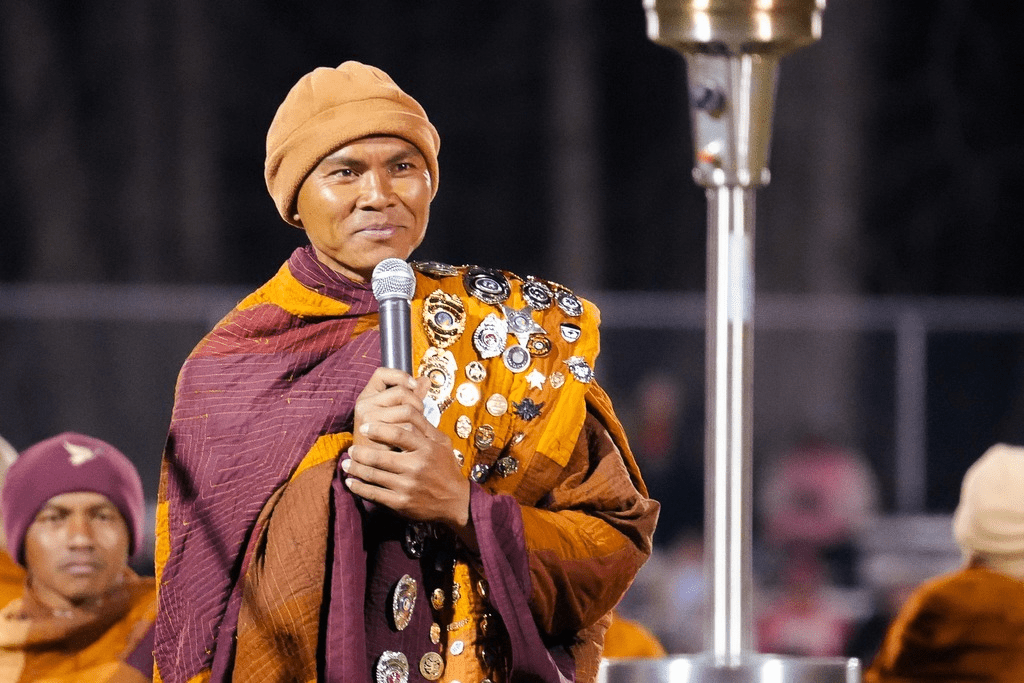
Siler City, NC – On Wednesday evening the “Walk for Peace” monks stopped for the day at Jordan-Matthews High School. This was an opportunity for one of the monks to speak to the crowd gathered at the football here. Below is a summary of the lessons he hoped to teach.
We fight a battle every day, but the enemy isn’t external. It’s the relentless hum of our own minds—the constant wandering to past regrets and future anxieties, the endless scroll of digital distractions, and the crushing pressure to always be doing more. In this unwinnable war for a quiet mind, we often feel like we’re losing ground.
But what if the pursuit of peace wasn’t an epic battle at all? What if it was simply a series of small, counter-intuitive shifts in perspective? In a recent talk, a monk shared a path to peace that doesn’t require struggle, but instead invites awareness and acceptance. This post shares the four most surprising and impactful lessons from that talk—practical wisdom that can be applied to your life, starting right now.
1. To Connect With Your Kids, Stop Trying to Fix Them
As parents, our deepest instinct is to protect and guide. We want the best for our children, so we try to fix their mistakes and teach them the “right” way. But the monk pointed out a painful paradox: the more we try to “fix” or “change” them, the more we inadvertently build a “war” between us, pushing them further away.
His surprising solution was to shift our role entirely: stop trying to teach and start sharing. By approaching a child as a friend, we transform the dynamic from a top-down lecture into a shared conversation. This shift is the key to getting them to listen, and more profoundly, it creates the safety for the ultimate connection. The monk explained that when children see you as a friend, “whenever obstacle when they run into trouble they will come back to you and lean on your shoulder and cry and ask for help… that is when your chance come to teach them.”
unless you make friend with them you see them as your friends not mother not the father but a friend A friends means the different way of talk, different way of teaching, sharing… and that is when they listen.
In a world of high-pressure, achievement-oriented parenting, this advice is a radical act of trust. It asks us to let go of micromanagement and have faith that building a foundation of friendship is the most effective way to stay connected, especially when our kids are more influenced by peers and technology than ever before.
2. The Enemy of Peace Isn’t Chaos—It’s Multitasking
The monk observed that in our modern world, a distracted, wandering mind has become the “normal” condition. Very few people, he noted, can truly focus. He then offered a memorable metaphor for the primary source of this distraction: our smartphones.
And now that we all all have our lovers along with us every single second, you know who is your lover is your cellphone…
His solution is profoundly simple yet radically counter-cultural: stop multitasking. He framed this not as a mere productivity hack, but as the fundamental practice for purifying the mind. Without concentration on a single task, he explained, there can be no real peace.
This advice directly challenges the modern glorification of being busy. We multitask because we treat busyness as a proxy for importance and self-worth. To single-task is therefore an act of rebellion against the “cult of productivity.” It’s a way to reclaim our presence and discover that true effectiveness and inner calm are found not in doing more, but in giving our full attention to one thing at a time. This practice of single-pointed concentration is the very tool we need for the next lesson: dealing with the internal chaos of our own minds.
3. Don’t Fight Your Anxious Thoughts. Just Look at Them.
When we try to find a moment of quiet, the mind inevitably rebels. Thoughts of the past and worries about the future “pop up” and disrupt our focus. But the monk’s wisdom extends beyond just anxious thoughts—it applies to every distraction, internal and external. The itch on your nose, the sound of a distant siren, a sudden memory—our common reaction is to fight these intrusions and scold ourselves for getting distracted.
The monk’s instruction is to do the exact opposite. The goal is not to create a blank, empty mind. The practice is to simply add awareness to your breath, and when any thought, sound, or physical sensation appears, you acknowledge it without judgment. You observe it for a moment, and then gently guide your attention back to your breathing.
When that thought pop up, instead of trying to eliminate or push it away, just acknowledge it, observe that thought and then come back to this breathing.
He warned that this requires immense patience because “we will fail over and over.” This insight is liberating. It reframes “failure” as a completely normal and expected part of the process. Each time you notice your mind has wandered and you gently bring it back, you are succeeding.
4. Learn to Shed Your Leaves Like a Tree
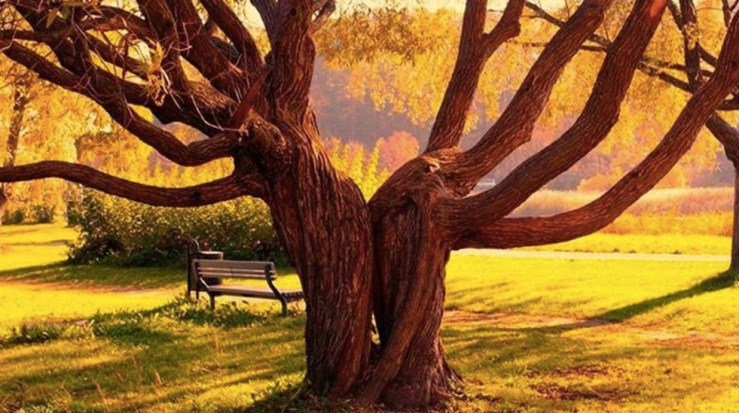
To illustrate the art of letting go, the monk shared a powerful analogy from nature. In the autumn, trees shed their leaves. They don’t do this because they are weak; they do it as a brilliant survival strategy to conserve energy through the winter, preparing for new growth in the spring.
He explained that humans, however, often do the opposite. We spend our lives collecting and holding onto our mental “trash”—bad habits, unhappy memories, stress, and anxiety. We cling to these dead leaves until we are completely overwhelmed by their weight.
We have collected all kind of trash in our mind. Bad habit, unhappy thing, undesirable, all those things happening in our life that we suffered. We collected it so many and we recorded in here and we didn’t know how to let it go. We don’t know how to shut it off just like those trees.
This metaphor recasts “letting go” not as a passive act of giving up, but as an active, wise process of conserving our vital energy. In a world facing an epidemic of burnout, this lesson becomes a crucial survival strategy. It teaches us to release what no longer serves us in order to preserve our strength for what truly matters—for the new growth that awaits.
Peace is a Practice, Not a Destination
The war for a quiet mind ends the moment you stop fighting. As the monk’s lessons reveal, peace is not a distant state you arrive at, but the result of small, conscious actions. It’s found in the choice to single-task, the gentle observation of a thought, and the courage to let go of control—both in our own minds and in our relationships. Becoming a friend to our children and a non-judgmental observer of our thoughts are both practices in releasing the need to fix everything. Single-tasking is the foundation that makes this awareness possible.
He offered a simple starting point: each morning, write down the statement, “Today is going to be my peaceful day,” and live with that intention. But he also added a note of urgency. Many of us say we will do it “later,” but, as he warned, “that later that moment never comes.”
Don’t wait. Peace is a daily practice, and the work begins now. Looking at the “leaves” you’ve been carrying, what is just one you can choose to let go of today?







 Peace LiLy