Did you know that your brain may need you to take a walk even more than your body does?
We often think of walking as something we do for physical fitness—burning calories, loosening stiff muscles. Yet neuroscience now confirms something ancient wisdom has always known: when the body moves gently and steadily, the mind awakens.
Regular walking—nothing intense, just consistent and mindful steps—nourishes the hippocampus, the part of the brain responsible for memory and learning. With increased blood flow and oxygen, this delicate region doesn’t merely function better; over time, it can actually grow stronger, softening the slow erosion of age.
Decades of MRI research reveal that people who engage in moderate movement—brisk walking, cycling, climbing stairs—experience measurable growth in the hippocampus. An average increase of just two percent may sound small, but in the language of the brain, it is profound. It can offset one to two years of natural cognitive aging.
In simple terms: thirty minutes of walking a day gently turns back the clock for the mind.
But beyond the science, something quieter is taking place.
When we walk, the brain relaxes its grip. A subtle nourishment—BDNF, often called the brain’s “fertilizer”—is released, protecting existing neural pathways and encouraging new connections to form. Thoughts become clearer. Memory steadies. Emotions settle into a more balanced rhythm.
This is why walking feels different from sitting.
As the body moves, the mind loosens. As the breath finds its rhythm, thoughts begin to untangle.
Walking brings the brain into a rare state—awake, yet unforced. It is here that insights arise without being pursued, where worries soften and lose their sharp edges.
Many people sense this intuitively, without knowing the science. They think more clearly when they walk. They feel calmer. They see situations with greater perspective.
Stillness has its place. But too much stillness, without movement, becomes stagnation.
Long hours of sitting dull not only the body, but also memory, emotional resilience, and mental clarity. The mind grows heavy, foggy, restless. Gentle movement restores what stillness alone cannot.
And the beauty of walking is its simplicity.
No gym. No equipment. No performance.
Just steps.
A short walk in the morning light. A few mindful minutes between tasks. A slow walk beneath trees. Choosing stairs over elevators. Sun on the face. Breath in motion.
These small, ordinary moments—when repeated—quietly care for the brain and the heart.
Walking is not exercise in the usual sense. It is a form of listening.
With each step, the mind is gently awakened. With each step, inner noise softens.
You may not be going anywhere special. Yet something within you becomes clearer, lighter, more alive.
So today, walk.
Not to achieve. Not to improve.
Just to return— to the simple intelligence of movement, and to a mind that remembers how to be at ease.
I have always loved being close to nature, and one of my greatest joys is walking through the forest. Living in Santa Cruz, I am surrounded by beautiful woods and mountain trails. Each time I wander beneath the trees and along winding paths, I arrive at the end feeling lighter, calmer, and deeply refreshed—as if my body and mind have been fully recharged.
I once came across an interesting idea: Mountains are places where we gain energy, which is why after hiking, we often feel alert and invigorated. Water, on the other hand, carries energy away. This may explain why spending long hours by the ocean or a lake can leave us feeling tired. Yet water also washes away emotional heaviness. When we feel sad, restless, or overwhelmed, a walk by the sea often brings a sense of release and ease.
Energy is constantly flowing through nature. We are simply quiet participants, allowing the natural world to gently adjust our inner frequency.
Discovering “Forest Bathing”
Recently, I was delighted to learn that the Japanese have a word that perfectly describes this healing experience: forest bathing.
In Japanese, it is called shinrin-yoku:
Shinrin means forest
Yoku means bathing
Together, shinrin-yoku means “bathing in the forest,” or allowing our entire being to absorb the atmosphere of the woods. As early as 1982, Japan officially incorporated forest bathing into its national public health program as a form of preventive and therapeutic care.
Suddenly, I realized that every breath I took in the forest had always been quietly nourishing me.
Japanese researchers have conducted extensive studies on forest bathing and found remarkable benefits for overall well-being. Research shows that forest bathing can:
Reduce stress
Strengthen the immune system
Lower blood pressure
Support recovery after illness or injury
Improve mood and concentration
For me personally, its most immediate effect is simple yet profound—it quickly lowers stress and brings my heart back to a place of calm.
Forest bathing is very different from running or brisk walking. It is not about exercise or distance; it is about presence. The key is to slow down and fully engage all your senses:
Touch the bark of trees—rough or smooth
Watch sunlight dance through layers of leaves
Breathe in the scent of earth and greenery
Listen to the wind moving through branches
Find a place to sit and feel your connection with the ground
In the past, most of my hikes were intense, goal-driven, almost like completing a task. Since practicing forest bathing, I now schedule at least one slow, mindful walk each week. By slowing down, I have discovered beauty I once overlooked—and I can’t help but smile at how much I missed before.
There is a subtle yet powerful presence in the forest. It does not announce itself, yet it gently soothes the heart.
Perhaps it is the oxygen released by the trees. Perhaps it is the steady, unhurried rhythm of the forest. Or perhaps it is simply that, among the trees, we can finally hear our own breath again.
When we walk in the forest, there is nothing we need to accomplish. Nothing to force. Nature naturally helps our hearts soften, open, and grow brighter.
If you feel tired, anxious, or lost in the busyness of everyday life, I invite you to find a nearby mountain trail and give yourself the gift of forest bathing.
Let nature, in its quiet way, remind you: You are doing your best—and you deserve to be healed. 🌲
In today’s world, our phones are never more than an arm’s length away, and our minds rarely get a moment of true rest. We scroll without thinking, click without choosing, and consume without noticing. But deep inside, many of us feel the same quiet truth—we are losing ourselves in the noise. This post is a small reminder that peace, clarity, and spiritual nourishment are still possible, if we begin to consciously take back our attention.
Instagram Reels, YouTube Shorts, Facebook browsing—what starts as a quick check so easily becomes an hour of mindless scrolling. It’s almost frightening how fast time disappears. Even without TikTok, I can feel the pull of the algorithm shaping my habits, my attention, even my thoughts.
Of course, technology brings wonderful conveniences. We can speak with loved ones across the world instantly, save treasured memories, learn anything we want, and make life easier in countless ways. But lately, I’ve realized something important:
My attention span is scattered. Silence feels uncomfortable. I reach for my phone without thinking. And I’ve begun to wonder—is this what addiction feels like? Knowing you don’t need it, yet still reaching for it anyway?
We all know we’re on our screens too much. But knowing doesn’t free us. Conscious action does.
The Real Cost: What Screen Time Is Stealing From You
This isn’t just about an hour lost to Instagram; it’s about the erosion of the most vital parts of our lives. The time we spend staring into a screen is time actively taken away from meaningful, real-world engagement.
Screen time is truly troubling our lives right now:
We have less time to exercise. The energy required for a twenty-minute workout is often sacrificed for twenty minutes of passive scrolling on the couch.
We have less time to play with kids. Those precious, unrepeatable moments of building a fort or kicking a ball are missed because we’re “just checking” a notification.
We have less time to talk to our parents/partners. Authentic, present conversation is replaced by parallel consumption, sitting next to a loved one while both are immersed in separate digital worlds.
We have less time for deep, restorative sleep. The blue light, the stimulating content, and the mental chatter we absorb right before bed actively hijack our ability to rest.
A Spiritual Perspective: Why Screen Addiction Makes Us Unhappy
In Buddhism and many spiritual traditions, the mind is described as a lake. When the surface is constantly stirred—by notifications, news, entertainment—it becomes muddy. We can no longer see clearly. Wisdom, compassion, and calmness all sink beneath the surface.
Excessive screen time:
scatters the mind through endless stimulation
drains our life-force through constant comparison and craving
steals the quiet moments where insight and peace are born
pulls us away from real presence—real people, real breath, real living
Spiritual masters remind us: “Where your attention goes, your life goes.” If our attention is constantly fragmented, our life becomes fragmented too.
Actionable Suggestions to Reduce Phone & Social Media Time:
Strategy
How It Works
The Friction Folder
Move all tempting social media/entertainment apps into one folder on the very last page of your phone screen. This adds just enough friction to make you pause before opening.
Grayscale Mode
Switch your phone display to black and white. Color is a primary driver of attention and addiction; removing it makes the screen less stimulating and less fun to look at.
Set App Limits
Use your phone’s built-in Screen Time settings to put a hard limit (e.g., 30 minutes) on all social media apps. Once you hit it, the app locks for the day.
The “Phone Bed”
Designate a charging spot outside your bedroom. Use a traditional alarm clock. Your bedroom should be a sanctuary for sleep and connection, not consumption.
The “Purpose-First” Rule
Before you unlock your phone, state out loud (or in your mind) what you are picking it up to do (“I am checking the weather,” “I am calling Mom”). Complete the task and immediately lock the screen.
Mindful Practices I’m Recommending:
These are small, spiritual steps to reclaim your mind:
Put the phone out of sight. What the eyes don’t see, the mind doesn’t crave.
Create “sacred screen-free hours.” Mornings or evenings where the mind can rest—like offering ourselves a daily meditation.
Return to the breath whenever the urge to scroll pops up. One breath. One pause. One moment of awareness.
Read again—slowly, intentionally. A physical book becomes a refuge, a temple for the mind.
Replace noise with mindfulness. Walk without headphones. Eat without a screen. Let silence become a friend again.
Remind yourself of impermanence. Every moment spent scrolling is a moment of life we never get back.
Little by little, I’m learning to soften the grip that screens have over me. Not by force, but by nurturing something deeper—presence, clarity, and spiritual freedom.
Do One thing mindfully and intentionally at a time. It’s time to be truly alive again.
In recent years, I’ve often found myself reflecting on the pace of our modern world. Everywhere we look, technology advances with breathtaking speed—AI systems that learn in seconds, devices that connect continents instantly, and scientific breakthroughs that would have been unimaginable a generation ago.
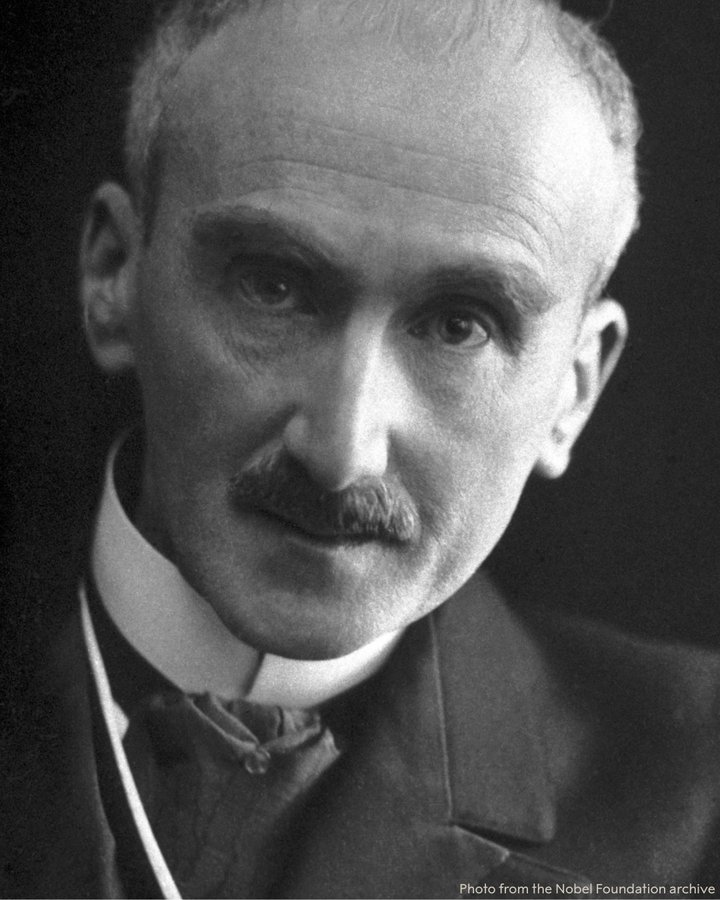
And yet, despite all this progress, people still feel anxious, divided, and spiritually adrift. It was during one of these reflections that I came across a profound message from French philosopher Henri Bergson, winner of the 1927 Nobel Prize in Literature. His words, spoken nearly a century ago, resonated deeply with me:
“An increase in the material means at the disposal of humanity may even present dangers unless it is accompanied by a corresponding spiritual effort.”
This single sentence contains a timeless truth.
The Wisdom of Henri Bergson: Progress Requires Balance
When Bergson delivered his Nobel Prize banquet speech in 1928, he had witnessed the sweeping transformations brought by steam power, electricity, and industrialization. Many believed that these innovations would naturally lead to a better, more harmonious world.
But Bergson saw with clarity that outer progress alone is not enough. Without cultivating our inner world—our morality, our compassion, our spiritual understanding—technology can deepen misunderstandings and widen divisions.
How true this remains today.
The Modern Paradox: Hyper-Connection, Inner Disconnection
We live in a time of extraordinary access and convenience:
We can video chat across the planet, yet many feel more isolated than ever.
We scroll endlessly through social media, yet our hearts grow restless and overwhelmed.
We generate more data in a day than ancient civilizations produced in centuries, yet wisdom feels increasingly rare.
Technology connects our devices, but only spiritual cultivation connects our hearts.
Why Spiritual Effort Is Essential Today
1. It grounds us amid the noise.
With information constantly flooding our minds, spiritual practice helps us regain clarity and stay anchored in truth.
2. It builds our inner resilience.
Life will always bring challenges. Meditation, reflection, and ethical living strengthen the mind and heart to navigate them with wisdom.
3. It cultivates compassion in a divided world.
True peace comes not from advanced systems but from understanding, patience, and kindness—qualities only nurtured through spiritual effort.
4. It reminds us of our shared purpose.
Spiritual insight dissolves boundaries, allowing us to see one another not as competitors but as fellow travelers on the path of life.
Bergson’s warning pierces straight into the heart of our time:
If humanity’s material power grows faster than its moral and spiritual maturity, danger follows. But when the two rise together, society finds harmony.
This is not just a philosophical idea—it is a blueprint for a peaceful, sustainable future. Whether through meditation, prayer, study, service, or simple acts of kindness, each of us has the power to elevate our inner life.
Our modern world celebrates speed, innovation, and efficiency. But the deeper question is: Do these advances help us become better human beings?
If spiritual cultivation becomes the guiding compass of our progress, then technology becomes a tool for upliftment rather than turmoil.
As we look toward the future, may we remember:
Our machines may evolve, but our hearts must evolve too.
Our knowledge may expand, but our wisdom must deepen.
Our world may grow louder, but our inner clarity must grow stronger.
Only then can humanity advance not just outwardly, but inwardly—toward peace, wisdom, and true connection.
What’s the first image that comes to mind when you think of Yoga?
It’s not uncommon for this image to consist of individuals contorting their bodies into impossible positions that are more appropriate for the Cirque du Soleil. There is nothing wrong with some of these breathtaking images, and I love looking at them because I’m in awe of the strength, grace, practice, and determination it takes to hold these postures. My issue with these images flooding social media is that these postures are not possible for most individuals (including me) and the models are usually young, white, beautiful, slim women. This makes it hard to connect to Yoga’s rich Indian history or how it is a practice that is for EVERYONE regardless of age, body type or ability.
In the last few decades, Yoga has become a billion-dollar business. When I started attending yoga studios in Toronto in the early 1990s, there were only 2 studios, and now there is a studio every 3 blocks. There are “yoga teacher rock stars” and businesses that make high-end yoga gear. I’m glad that Yoga has become so popular because this beautiful healing practice impacts more people. However, I believe this commercialism and competitiveness have diluted the teachings and appropriates this ancient practice in some situations.
There is evidence that Yoga existed in India as far back as 500 BC with roots in Hinduism, Buddhism, Jainism and other religions. Sanskrit is the sacred language of Hinduism, classical Hindu philosophy, and other historical religious texts. The word ‘Yoga‘ is derived from the Sanskrit root ‘Yuj’, meaning ‘to join’ or ‘to yoke’ or ‘to unite-union of mind, body and spirit.
As a yoga teacher and student, I want my students to be familiar with Yoga’s roots and understand that what happens on the mat is more than just stretching and holding postures. This union of mind, body and spirit, happens while practicing the asanas-Sanskrit word for postures. A regular practice will increase flexibility, strength and mobility, and while you are holding the postures, you are practicing pranayama-breath control, meditation, and mindfulness. This holistic practice is how transformation happens and the “union” builds a healthier, more agile body, calms the nervous system, teaches presence, and provides us with tools that we can use off the mat.
Yoga has a rich philosophical history that includes sacred and treasured texts: The Vedas, The Upanishads, The Bhagavad Gita and Pantanjali’s Sutras.
Pantanjali was an Indian sage and thought to be the author of the Yoga Sutras, which is a classical yoga text on yoga theory and practice. According to his teachings, there are 8 components to Yoga:
1. Yamas-attitudes towards environments.
2. Niyamas-attitude towards ourselves
3. Asana-yoga postures
4. Pranayama-breath control and breathing exercises
5. Pratyahar-withdrawal of senses
6. Dharana-concentration
7. Dhyana-meditation
8. Samadi-complete integration
One of the most compelling benefits of Yoga is stress reduction. It’s inspiring to see how it has helped individuals recover from trauma, PTSD, depression, and anxiety.
Enjoy the stretching and postures, and know that you are also calming your mind and relaxing your body. Instead of thinking of Yoga as work out, think of it as a work in.
This morning, I stumbled upon a truly inspiring video—one that I feel compelled to share. It’s about something simple yet deeply powerful: the words we choose to tell ourselves at the start of each day.
The video introduces five morning affirmations—phrases rooted in mindfulness, gratitude, and self-compassion. These words are not just reminders; they are seeds we plant in our hearts. By repeating them daily, we can replace anxiety with calm, transform doubt into confidence, and begin our day already centered in peace.
Here are the affirmations:
I am here, I am alive. This moment is enough.
Nothing outside me can disturb my peace unless I let it.
I will treat myself with kindness, not judgment.
Everything I need is already within me.
Let me be the cause of peace today.
These may seem like simple sentences, yet they carry thousands of years of wisdom. Buddhist teachings remind us that the mind shapes our reality. When we begin each day with thoughts of peace, compassion, and self-respect, we set the tone for everything that follows.
What I love most is the last affirmation: “Let me be the cause of peace today.” Imagine the ripple effect if each of us carried this intention into our daily lives—peace would not just be something we seek, but something we create and share.
The words we tell ourselves each morning truly have the power to shape a lifetime of peace and wisdom.
✨ I wish everyone who watches this video peace, clarity, and growth on their journey. May these affirmations bring light to your mornings and strength to your days.
🌸 Why not give it a try? For the next seven mornings, say these affirmations to yourself before you start your day. Notice how they shift your mood, your focus, and even the way you interact with others. If you feel inspired, share your experience—it might just encourage someone else to begin their own journey of mindful mornings.
Peace Pilgrim once said, “If you knew how powerful your mind is, you would never think a negative thought.” That quote stayed with me, but I didn’t fully understand its truth until I experienced it for myself—right in my own backyard.
At one point, we lived in a house with a large backyard that inspired me to plant organic vegetables. I imagined harvesting fresh, healthy produce and enjoying the process of nurturing life from the soil. Eager and hopeful, I bought a few small tomato plants from Home Depot and began tending to them daily. Watching them grow brought me joy and anticipation—I could almost taste the sweet, juicy tomatoes I dreamed of.
But as the plants began to bloom and bear fruit, trouble arrived. Large, green caterpillars appeared overnight, chewing through leaves and fruit, threatening to destroy the entire garden. My husband was furious and would crush them on sight. Wanting to find a gentler solution, I turned to friends for advice. One of them recommended a non-toxic spray from an organic farm store. It worked like a glue, blocking the insect’s skin so they couldn’t breathe and would suffocate to death.
When I heard that, I felt a sharp, suffocating sensation through my own skin. I couldn’t do it. I couldn’t kill them—no matter how many tomatoes I might lose. These were living beings. Their lives mattered too. I decided then and there: I would not harm them.
And then, something remarkable happened.
The very next morning, my husband came to me in astonishment. “All the caterpillars are gone,” he said. “And there aren’t even any dead ones.” I went out to the garden. He was right. The insects had vanished without a trace.
Was it just a coincidence? I don’t believe so. I believe they sensed my compassion. I believe the power of a sincere, non-harming mind created a shift in energy that led to a quiet, unseen miracle.
Later, after I began studying Buddhism, I came to understand this experience on a deeper level. Through the Dharma transmitted by H.H. Dorje Chang Buddha III, I learned the true meaning of the precept of “Not Killing.”
This teaching awakened a deeper sense of responsibility in me. I now strive to regard the suffering of all beings as my own, and I earnestly wish for every living being—my parents of infinite past lives—to live in harmony and peace.
I sincerely pray that all beings may enjoy happiness, good health, and abundant fortune. I constantly beseech all Buddhas and Bodhisattvas to bless them, to help them escape suffering, to encounter and practice the true Buddha-dharma, and ultimately to attain liberation from the cycle of birth and death.
This is not just a story about gardening. It is a story about the incredible power of our minds—and even more so, our hearts. When we choose compassion over destruction, mindfulness over impulse, miracles can happen.
Let kindness guide you. Let the power of your mind awaken something beautiful—not just in your life, but in the lives of all beings around you.
Modern scientists suggest there may be multidimensional spacetime. The world we perceive in our daily lives consists of three dimensions of space—length, width, and height—plus one dimension of time, forming what we call four-dimensional spacetime.
For most people, it is nearly impossible to imagine what multidimensional space could be like. Even scientists struggle to describe how such realms might appear.
Yet once, while I was reading a Buddhist sutra, I felt as though I glimpsed something of this mysterious idea.
In the Vimalakirti Sutra, it is recorded that Manjushri Bodhisattva led 8,000 bodhisattvas, five hundred arhats, and countless heavenly beings to visit the ailing lay master Vimalakirti.
Vimalakirti lived in a small chamber. He invited everyone to enter. Miraculously, they all went inside, but the room did not grow any larger. No one felt crowded or obstructed, and everyone saw Vimalakirti sitting directly before them.
Manjushri and Vimalakirti engaged in profound dialogue about the Dharma. Later, Vimalakirti displayed astonishing spiritual powers, bringing seats, exquisite foods, and treasures from distant worlds into that same room.
It was absolutely astonishing—like witnessing the seamless merging of multiple dimensions.
Throughout Buddhist history, many great masters have demonstrated abilities that seem to transcend space and time.
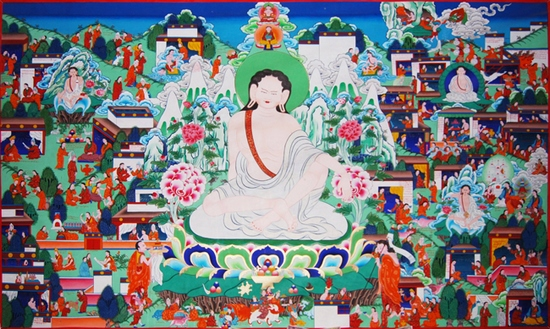
For example, there is the story of Milarepa, Tibet’s most renowned yogi. When he was welcoming his disciple Rechungpa back from India—where Rechungpa had traveled to collect scriptures—an incredible event took place.
Rechungpa carried the scriptures on his back as he crossed the vast grasslands. When he saw Milarepa waiting for him, he was overjoyed. Eagerly, he described how he had met the great master Tilopa. With visible pride, he declared:
“In the past, Tilopa did not transmit this Dharma to Master Marpa, but now he has passed it on to me!”
His words brimmed with arrogance.
As they walked together, Milarepa noticed a broken yak horn on the ground and asked Rechungpa to pick it up. Rechungpa couldn’t see the point and made excuses not to touch it. Silently, Milarepa bent down, picked it up himself, and carried it along.
Suddenly, the sky darkened. Thunder boomed, lightning flashed, and hailstones the size of eggs pounded them mercilessly. Rechungpa was battered and bruised.
When the storm finally ended, he looked around—Milarepa had vanished. Alarmed, he began calling out.
Then, Milarepa’s calm voice rose from the little yak horn at his feet:
“Why are you so flustered? Come in here and take shelter.”
Rechungpa stared in disbelief. The opening of the horn was barely larger than a fist. How could he possibly fit inside?
He bent down to look, and to his amazement, he saw an endless green meadow within—stretching as far as the eye could see. Milarepa sat serenely in meditation.
But no matter what he tried, Rechungpa could not enter.
In that instant, all his pride dissolved. Humility and awe took its place.
Milarepa finally emerged and said with a gentle smile, “Did you see? My little yak horn turned out to be quite useful after all.”
Even in our time, extraordinary manifestations still occur.
H.H. Dorje Chang Buddha III has demonstrated countless inconceivable displays of supreme Buddha Dharma.
Ruzun Ruo Hui, the abbess of Hua Zang Si (in San Francisco) shared one remarkable example in Interviews with Buddhist Disciples (Episode 78).
Around 1995, about a dozen people were gathered together in a room, respectfully listening to the recorded Dharma discourse Expounding the Absolute Truth through the Heart Sutra.
Halfway through, the entire house vanished. All the walls and structures simply disappeared, and everyone found themselves sitting under the open sky.
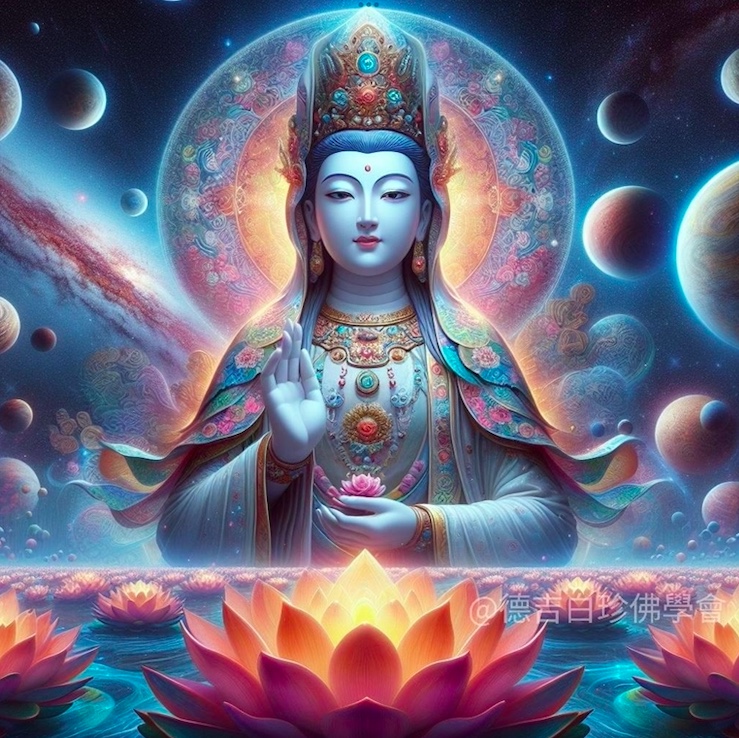
Above them, Avalokiteshvara Bodhisattva appeared, standing in the air, radiating boundless light while auspicious clouds billowed around.
For nearly an hour, Avalokiteshvara remained visible, bestowing blessings. No sounds of the street—no passing cars or footsteps—could be heard. The only sound was the voice of H.H. Dorje Chang Buddha III expounding the Dharma.
It was clear that everyone present had entered another dimension altogether.
Moments like these show us that the universe is far more profound than what our senses can grasp.
I believe Buddhism is deeply scientific—not superstition. Just because today’s scientists cannot yet explain these phenomena does not mean they are unscientific.
On the contrary, Buddhist wisdom offers an entirely different lens through which to explore reality. It can inspire modern science to uncover new methods and fresh insights to understand the universe’s deepest mysteries.
If we open our hearts and minds, perhaps Buddhist teachings will one day help humanity discover shortcuts to truths that today seem unimaginable.
My revered Master, H.H. Dorje Chang Buddha III, is the incarnation of the ancient, supreme Buddha. Out of boundless compassion, His Holiness willingly bears worldly hardships and concerns to rescue sentient beings from suffering. His accomplishments across the Thirty Categories of the Five Vidyas have astounded the world and brought immeasurable blessings to countless lives. These works—each awe-inspiring in its own right—will soon be compiled into a book to benefit humanity. Yet even these remarkable achievements represent only a small fraction of His Holiness’s true realization.
Most people are unaware that the Buddha Master also possesses the highest and most profound esoteric Dharma. Because His Holiness operates with the enlightened mind of a Buddha and has attained the ultimate state in Buddhism, He was able to receive the rare and authentic vajra needle lineage—a powerful healing method.
I have personally witnessed numerous people with karmic connections to the Buddha Master be cured of serious illnesses, including cancer. Among them were:
Guangdong Yan and Zhiyong Luo, both diagnosed with nasopharyngeal carcinoma;
Zhuang Yan, who suffered from skin cancer;
Jingxing Wu, with a brain tumor;
And Lehui Xie, who endured decades of debilitating phlegm, inflammation, and migraines.
I know these individuals personally. I saw them healed. People from Hong Kong, Taiwan, and Malaysia who suffered from leukemia, AIDS, and strokes traveled to China to seek healing from the Buddha Master—and they, too, were cured.
This verse, from a poem written by the Buddha Master titled “To the Tune of Nian-Nu-Jiao,” perfectly captures that miraculous period:
“Three thousand suffering patients visited me, Day and night I cured them.”
And now, I wish to share my own experience. Over twenty years ago, I stood at death’s door, suffering from late-stage uterine cancer. It was the Buddha Master who brought me back to life through the sacred power of the Buddha-Dharma.
In August of 1985, I began experiencing continuous menstruation lasting over two weeks. At first, I assumed it was just an irregularity and sought treatment through Chinese medicine, but nothing improved. I turned to Western medicine, yet the bleeding continued endlessly. After more than two months, I was transferred from a local hospital to Sichuan Provincial Hospital, where a biopsy confirmed the devastating diagnosis: late-stage uterine cancer.
Professor Zhang, the attending physician, told my husband Hui Han Da—who is also a fellow disciple of the Buddha Master—“The cancer has already spread. Surgery is no longer an option. Take her home. Let her eat what she wants, go where she wishes, and spend her final days with loved ones.”
Refusing to give up, my husband took me to Huaxi Medical University Hospital. The diagnosis remained unchanged. Still determined, he took me to the China-Japan Friendship Hospital in Beijing, then to Peking Union Medical College Hospital, and finally to Suzhou University Hospital. Each hospital gave the same grim verdict: there was nothing more they could do.
As my condition worsened, I lost the ability to eat and became emaciated, reduced to just 79 pounds. My hematin level was a mere 3 grams—far below the normal 16 grams. In a desperate attempt to stop the bleeding, my husband brought me back to Huaxi Medical University Hospital. The doctor took one look at me and shook his head: “She has seven days left at most. Go home and prepare for her funeral.”
Back at home, lying in bed and feeling the nearness of death at only 36 years old, I told my husband through tears, “Before I die, could you please go to the Buddha Master and ask Him to help elevate my soul after I pass?” He replied, “The Buddha Master is currently traveling, spreading the Dharma and saving beings. I will go see His Holiness once He returns.” Silently, I prayed with all my heart to Avalokiteshvara Bodhisattva (Guan Yin), hoping the Buddha Master would come back soon.
The very next day, around noon, a miracle happened. The Buddha Master appeared at my bedside.
I tried to get up to prostrate, but I was too weak. His Holiness gently stopped me and told me to lie still. With immense compassion, the Buddha Master began to expound the profound truths of life and the universe, explaining the root cause of suffering—how beings are bound by karma born from delusion, which leads to the inevitable cycle of birth, aging, sickness, and death.
In a moment of deep reflection, I suddenly came to a painful realization: In order to make money through business, I had once helped others produce a type of beef by slaughtering more than a thousand yaks. Whether or not I had intentionally killed other living beings in the past, how many lifetimes would it take to repay the karmic debt from taking just those thousand lives?
Their blood had once flowed because of my actions—and now, my own blood flowed endlessly due to illness. It was then that I truly understood: this was karmic retribution. The causes I had planted were dark, and now I was receiving their bitter fruits. The more I contemplated this, the more fearful and remorseful I became. From the depths of my heart, I sincerely repented and prayed to the Buddha Master to elevate me to a higher realm after death.
The Buddha Master compassionately said to me:
“If you truly repent, change your ways, never again kill any living being, and resolve to learn Buddhism and cultivate yourself, I will block your negative karma and delay your retribution. Cancer is nothing formidable! I will heal you—and I will also save those yaks that you killed.”
Then and there, the Buddha Master treated me with the vajra needle—a holy object of profound lineage, part of a supreme Dharma that only a true Buddha can apply. The vajra needle is no ordinary tool; it acts according to the will of the Buddha Master. When instructed to send sensation to a specific part of the body, it obeys instantly. When told to stop, it immediately ceases. It was truly beyond anything I had ever imagined.
At the time, I was wearing both a sweater and a fur coat. His Holiness applied the needle through my clothing to an acupuncture point on my back. After releasing the needle, the Buddha Master formed various mudras (sacred hand gestures). As each mudra changed, the sensations from the needle also changed—sometimes weak, sometimes strong—spreading throughout my entire body. I felt tingling, pressure, and swelling sensations, almost too intense to endure.
Then the Buddha Master explained:“Illness arises when energy channels in the body are blocked. It’s like a machine clogged with old, dirty oil that needs to be cleaned. This treatment is cleansing and unblocking your channels. Now, with just my words, the sensations will stop.”
The moment His Holiness spoke, all sensations vanished instantly.
The second round of treatment brought even sharper sensations, again perfectly controlled by the Buddha Master. When His Holiness gave the command, the sensations stopped at once. After a third round of treatment, I felt completely at ease. The Buddha Master then said:
“Today I opened your energy channels. But for complete healing, I must prepare a medicine using the highest Buddha-Dharma methods.”
Soon after, the Buddha Master instructed my husband, Hui Han Da, and me to drive Him to a mountain village—the very place where those yaks had been slaughtered. There, in front of a large yak, the Buddha Master began preparing the medicine. My husband and I were both present.
As the Buddha Master began the ritual, a white mist suddenly appeared in the clear sky, drifting from west to east. The mist grew denser and denser until we couldn’t even see our hands before our faces. During that time, many auspicious and mysterious phenomena occurred. Once the preparation was complete, the Buddha Master had me drink the fragrant herbal liquid.
As soon as I drank it, I felt a surge of warmth fill my body, followed by a deep, refreshing coolness. I was completely rejuvenated—energetic, peaceful, and miraculously healed. The endless bleeding stopped. Overwhelmed with gratitude, I immediately prostrated before the Buddha Master, tears of joy flowing down my face.
From that day forward, I took no more medicine. My strength and body weight gradually returned to normal. One month later, a doctor from Sichuan Provincial Hospital called to follow up, assuming I had already passed away. I answered the phone myself and said:“I’m alive—and completely healed!”
He didn’t believe me and requested I come in for an examination. At the time, fellow disciple Guangdong Yan, who had also been cured by the Buddha Master of nasopharyngeal carcinoma, was visiting my home. We both agreed to go together.
The next day, we were re-examined. The test results showed not a single cancer cell in either of us. The doctors were stunned. They asked what medicine I had taken, who had treated me, and how I had recovered. I answered:“It was the Buddhas and Bodhisattvas who saved me.”
It has now been twenty-one years since the Buddha Master healed me. Ever since I began sincerely practicing the Buddha-Dharma under His Holiness’s guidance, my health has only improved. Recent physical exams show that all my health indicators are excellent. I now weigh 165 pounds, more than double my weight when I was sick.
Friends and family who saw me during my illness are astonished when they see me now. Many say I look like a completely different person.
The Buddha Master also performed special Buddhist rites to liberate the yaks whose lives were taken. The compassion and grace the Buddha Master has shown me and my entire family are immeasurable.
From this life onward, all I can do to repay His Holiness is to devote myself wholeheartedly to cultivation, do good for others, and strive to attain true realization in order to be worthy of the sacred blessings and infinite kindness of my most revered Buddha Master.
Buddhist disciple, Chi Lie Er (This is a complete translation of the Chinese text that follows originally written and signed by Chi Lie Er.)
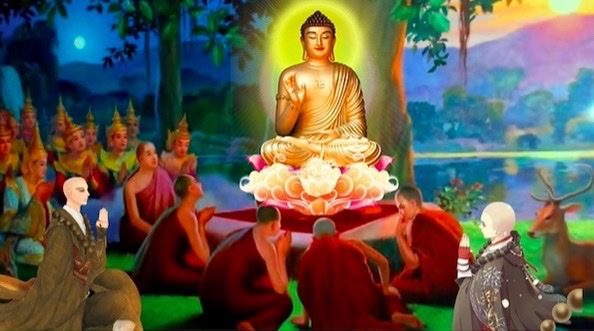
I have heard that on one occasion the Blessed One was staying at Sāvatthī, in Jeta’s Grove, Anāthapinḍika’s monastery. It was the rainy season, and the forest hummed with the soft patter of raindrops falling upon leaves. The scent of wet earth filled the air, and a gentle mist curled around the trees.
A great assembly of monks had gathered, their saffron robes glowing in the dim light of dawn. They sat in deep silence, their hands folded in reverence, awaiting the Blessed One’s words. He gazed upon them, his serene face illuminated by the morning light, and addressed them:
“Monks!”
“Yes, lord,” the monks replied in unison.
The Blessed One spoke:
“When a monk is intent on the heightened mind, there are five themes he should attend to at appropriate times. Which five?
“There is the case where evil, unskillful thoughts—connected with desire, aversion, or delusion—arise in a monk while he is referring to and attending to a particular theme. He should attend to another theme, apart from that one, connected with what is skillful. As he does so, those unskillful thoughts are abandoned and subside. With their abandoning, he steadies his mind, settles it, unifies it, and concentrates it.
“But if those thoughts persist, he should reflect on their drawbacks: ‘These thoughts lead to suffering. They darken the mind. They are thorns in the path of peace.’ Just as a traveler carrying a heavy sack realizes that dropping the burden brings relief, so too should the monk see how abandoning unwholesome thoughts brings lightness to the heart.
“If even then the thoughts persist, he should withdraw his attention—he should give them no mind. As a man walking through a marketplace ignores the clamor of voices around him and focuses only on his path, so too should the monk disregard the noise of unwholesome thoughts.
“If they still do not subside, he should attend to the relaxing of thought-fabrication, gently calming the movement of the mind. Just as a potter, shaping a vessel, slows the turning of his wheel to smooth its edges, so too does the wise monk soften the momentum of thought, guiding it toward stillness.
“And finally, should all else fail, he should take up the final method—firm and resolute. With teeth clenched and tongue pressed against the roof of his mouth, he should subdue the mind with force, constraining and crushing the unwholesome impulses with clear awareness, as a strong man might subdue a wild beast.
The Parable of the Two Farmers
The Blessed One paused, then continued:
“Monks, this is like two farmers who inherited the same land.
“One farmer was negligent and careless. He did not prepare his field properly. He let weeds grow alongside the crops, believing they would not harm the harvest. When pests came, he did not chase them away, thinking they would leave on their own. When the sun was too hot, he cursed the sky but did not shade his plants. And when the rains came, he lamented his ruined field but had done nothing to build proper irrigation.
“In the end, his harvest was meager, his efforts wasted. He blamed the land, the weather, and misfortune, but never did he see that it was his own negligence that had led to his failure.
“The other farmer was diligent and wise. He knew the land required effort. He removed the weeds as soon as they sprouted, before their roots took hold. When pests arrived, he drove them away with patience and care. If the sun was too harsh, he adjusted his crops and provided shade. When the rains came, he had already prepared the channels to guide the water where it was needed.
“In the end, his harvest was abundant, his granaries full. When asked the secret to his success, he simply smiled and said, ‘I cared for my field, and in return, it cared for me.’
“Monks, the untrained mind is like the lazy farmer’s field—overrun by weeds of desire, pests of aversion, and floods of delusion. But the well-trained mind is like the diligent farmer’s field—protected, cultivated, and yielding the fruits of wisdom.
“Just as the wise farmer does not despair when weeds appear but instead removes them skillfully, so too should you train your minds.
“Do not be disheartened when unskillful thoughts arise. Attend to them wisely, knowing that a well-tended mind, like a well-tended field, leads to a bountiful harvest—peace, clarity, and liberation.
The Power of a Well-Trained Mind
The Blessed One looked over the assembly and continued:
“Monks, you may ask, ‘What is the fruit of a well-trained mind?’ I will tell you.
“It is like a still lake in the heart of the forest. The surface is clear and unmoving, reflecting the moon and the stars without distortion. When an animal approaches to drink, it sees its own reflection perfectly. In such a lake, the sky, the trees, and the mountains appear as they are, undisturbed.
“But an untrained mind is like a lake constantly churned by the wind. Its waters are muddy, and no reflection can be seen. Even if the stars shine above, they are lost in the restless movement of the waves.
“When a monk, by these five methods, steadies his mind, unifies it, and concentrates it, he becomes a master of thought sequences. He thinks only what he chooses to think, and does not think what he does not. He has broken the bonds of craving and aversion. He has seen through conceit, and with right view, has reached the end of suffering and stress.
“Monks, train yourselves well. Be like the diligent farmer. Master the field of your own mind. Be like the still lake, where truth is seen clearly. For in doing so, you will not only benefit yourselves but all beings who come into your presence.”
The Awakening of the Monks
As the Blessed One spoke, a great stillness settled over the gathering. Some monks felt their minds clear as if a veil had been lifted. Others, who had struggled with restless thoughts, felt their burdens lighten. Among them was a young monk who had long battled with doubt.
That night, he sat beneath a great tree, reflecting on the Blessed One’s words. He thought of the two farmers and saw himself in the lazy one. But now, he resolved to change. He would uproot his weeds, guard his field, and let no impurity take hold.
With renewed determination, he entered deep meditation. As the night passed, his mind grew still, and as the first light of dawn touched the horizon, insight arose within him. He saw the nature of thought, the impermanence of all things, and in that moment, a great joy filled his heart.
The next morning, when the monks gathered once more before the Blessed One, the young monk stepped forward, bowed deeply, and said, “Lord, the field of my mind is now tended. The weeds are gone. The path is clear.”
The Blessed One smiled, his eyes filled with knowing. “Then, monk, walk that path with diligence. For now, you have truly begun.”
That is what the Blessed One said. Deeply inspired, the monks rejoiced in the words of the Blessed One, and many resolved then and there to train with renewed vigor, knowing that mastery over the mind was the key to liberation.