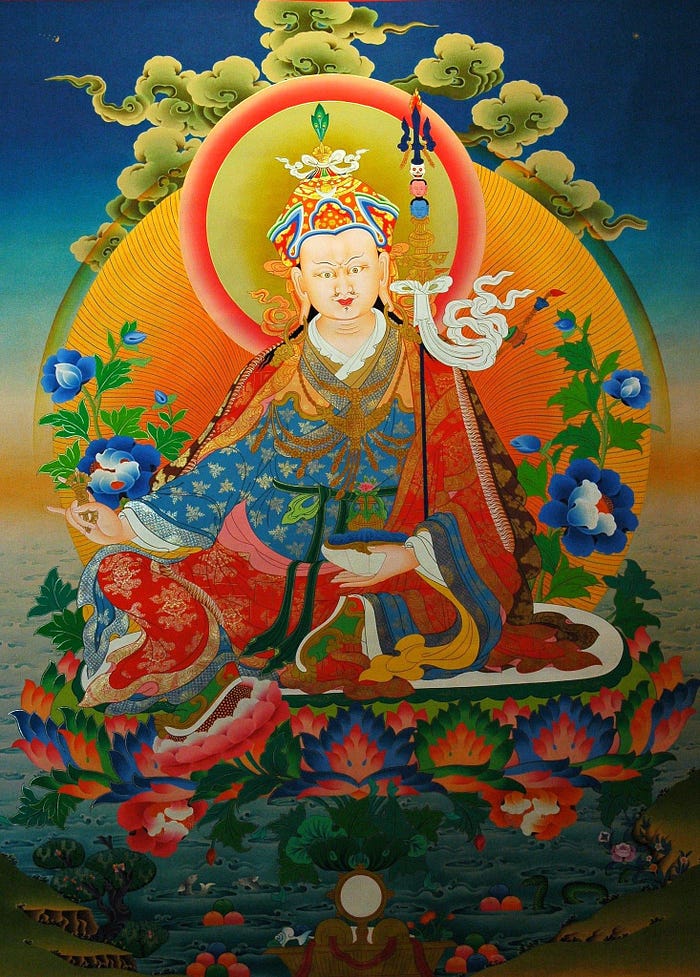
Why Spiritual Cultivation Matters More Than Ever in a Rapidly Advancing World

In recent years, I’ve often found myself reflecting on the pace of our modern world. Everywhere we look, technology advances with breathtaking speed—AI systems that learn in seconds, devices that connect continents instantly, and scientific breakthroughs that would have been unimaginable a generation ago.

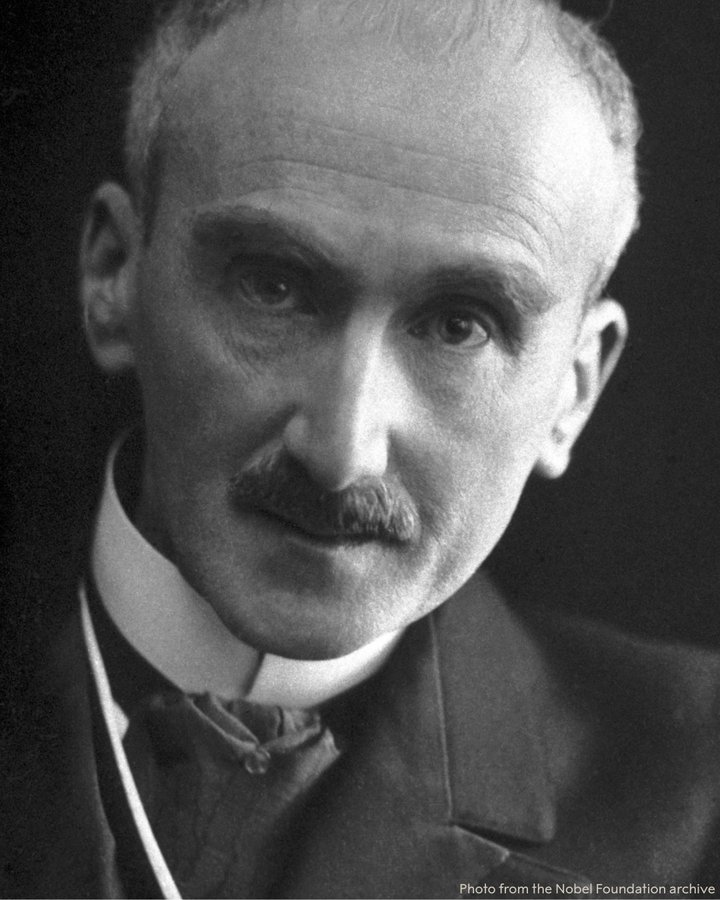
And yet, despite all this progress, people still feel anxious, divided, and spiritually adrift. It was during one of these reflections that I came across a profound message from French philosopher Henri Bergson, winner of the 1927 Nobel Prize in Literature. His words, spoken nearly a century ago, resonated deeply with me:

“An increase in the material means at the disposal of humanity may even present dangers unless it is accompanied by a corresponding spiritual effort.”

This single sentence contains a timeless truth.

The Wisdom of Henri Bergson: Progress Requires Balance

When Bergson delivered his Nobel Prize banquet speech in 1928, he had witnessed the sweeping transformations brought by steam power, electricity, and industrialization. Many believed that these innovations would naturally lead to a better, more harmonious world.

But Bergson saw with clarity that outer progress alone is not enough. Without cultivating our inner world—our morality, our compassion, our spiritual understanding—technology can deepen misunderstandings and widen divisions.

How true this remains today.

The Modern Paradox: Hyper-Connection, Inner Disconnection

We live in a time of extraordinary access and convenience:

  • We can video chat across the planet, yet many feel more isolated than ever.
  • We scroll endlessly through social media, yet our hearts grow restless and overwhelmed.
  • We generate more data in a day than ancient civilizations produced in centuries, yet wisdom feels increasingly rare.

Technology connects our devices, but only spiritual cultivation connects our hearts.

Why Spiritual Effort Is Essential Today

1. It grounds us amid the noise.

With information constantly flooding our minds, spiritual practice helps us regain clarity and stay anchored in truth.

2. It builds our inner resilience.

Life will always bring challenges. Meditation, reflection, and ethical living strengthen the mind and heart to navigate them with wisdom.

3. It cultivates compassion in a divided world.

True peace comes not from advanced systems but from understanding, patience, and kindness—qualities only nurtured through spiritual effort.

4. It reminds us of our shared purpose.

Spiritual insight dissolves boundaries, allowing us to see one another not as competitors but as fellow travelers on the path of life.

Bergson’s warning pierces straight into the heart of our time:

If humanity’s material power grows faster than its moral and spiritual maturity, danger follows.
But when the two rise together, society finds harmony.

This is not just a philosophical idea—it is a blueprint for a peaceful, sustainable future. Whether through meditation, prayer, study, service, or simple acts of kindness, each of us has the power to elevate our inner life.

Our modern world celebrates speed, innovation, and efficiency. But the deeper question is: Do these advances help us become better human beings?

If spiritual cultivation becomes the guiding compass of our progress, then technology becomes a tool for upliftment rather than turmoil.

As we look toward the future, may we remember:

  • Our machines may evolve, but our hearts must evolve too.
  • Our knowledge may expand, but our wisdom must deepen.
  • Our world may grow louder, but our inner clarity must grow stronger.

Only then can humanity advance not just outwardly, but inwardly—toward peace, wisdom, and true connection.

Link:https://peacelilysite.com/2025/11/25/why-spiritual-cultivation-matters-more-than-ever-in-a-rapidly-advancing-world/

How the United States Strongman (USS) Built a National Community of Everyday Athletes Through Shared Purpose

Lyssanoel Frater Contributor

United States Strongman (USS) began in 2014 with a simple but powerful vision: create opportunities for athletes to test their strength in an environment that feels fair, safe, and genuinely supportive. President and Owner Willie Wessels has shaped the organization around a philosophy he repeats often: “for athletes, by athletes.” It is the principle that guides every decision, from event approvals to gym affiliations to the culture athletes encounter when they show up on competition day.

With various events held annually across the country, USS has grown into a national platform for competitors of all levels. “The mission has remained the same from day one,” Wessels says. “We want people to have a place where they can work toward their goals and know the event has been organized with their best interests in mind.” Each competition is required to meet safety and quality standards that Wessels personally reviews, giving athletes confidence that every show has been thoughtfully planned.

According to Wessels, Strongman itself is a diverse sport, blending both functional and traditional strength movements. USS events showcase everything from tire flips and stone lifts to sandbag carries and log presses. Each venue brings its own personality; some competitions take place at independent gyms, some at community centers, and others at local businesses that open their doors for a day of strength, cheering crowds, and grassroots community spirit. “You might see an event in a gym parking lot one week and then a full setup inside a large venue the next,” Wessels says. “What matters is that athletes walk in and feel excited and safe.”

Willie Wessels, Founder and CEO of USS
(Image Credit: William Wessels)

USS also supports athletes through its membership structure, which provides access to certified events and ensures the competitions they enter meet established standards. The membership system also connects competitors to pathways leading toward national and international opportunities. 

Under his leadership, the organization has become known for celebrating participation as much as podium finishes. Athletes within USS come from every background imaginable: teachers, healthcare workers, factory workers, engineers, and even complete beginners who discovered the sport by chance. “Strongman is not just for a certain type of person,” Wessels says. “It’s for anyone who wants to challenge themselves.” For many, it can become a place where physical strength intersects with self-confidence, camaraderie, and discipline.

This community-first mindset reflects Wessels’ personal history. At 62, he has spent more than three decades coaching, teaching, and supporting athletes. Before launching USS, he was a longtime health and physical education teacher, a career he describes with warmth. “Working with students taught me patience, humility, and how to meet people where they are,” he says. His passion for building strength, physical and personal, was shaped early on by his mother, whose commitment to education left a lasting mark. “She went back to school at 39 and earned her bachelor’s, two master’s degrees, and her PhD,” he says. “She showed me what persistence looks like.”

Wessels earned the title of North American Strongman in 2002, a moment that inspired many and deepened his belief in giving athletes a place to pursue their potential. Wessels’ own perseverance was profoundly tested when he was diagnosed with leukemia in 2003. Despite a prognosis that offered only a brief window of survival, he continued coaching and competing while undergoing years of treatment. “I just kept showing up,” he says. “Coaching kept me grounded.” 

His personal journey is woven into the foundation of USS. What began as a vision to make the sport more accessible has grown into a movement supported by hundreds of competitions and a network of affiliated gyms across the U.S. Looking ahead, Wessels sees continuous expansion as a natural progression of the sport’s momentum. He noted that participation is rising among both men and women, and the spectrum of athletes continues to widen. 

Wessels says the future of USS will always be guided by the same principles that shaped it from the beginning: fairness, safety, and genuine support. What drives him now is the same thing that drove him as a teacher, a coach, and an athlete: watching people discover what they are capable of.

“At the end of the day, this is not just about lifting weights,” Wessels says. “It’s about showing people they are stronger than they think, on the field and in life.” It’s a belief that has helped build United States Strongman into a national community grounded in resilience, respect, and purpose, and one that continues to grow with every athlete who steps onto the competition floor.

Link:https://www.usatoday.com/story/special/contributor-content/2025/11/20/how-the-united-states-strongman-uss-built-a-national-community-of-everyday-athletes-through-shared-p/87373169007/

The Supreme Buddha Dharma

Every Buddhist practitioner longs for achievement and liberation.
Hearing the true Buddha-Dharma is the key.
The following article is a genuine account written by a monastic bhikshu Huihai (慧海) who personally listened to the Dharma teachings of H.H. Dorje Chang Buddha III.

In this life, I am able to encounter my supreme and unsurpassable Buddha Master—this truly is the greatest blessing I have accumulated through many lives and countless eons!

The Buddha Master’s genuine and pure teachings, in the turbulent waves of today’s chaotic era, are the vessel that carries sentient beings to the shore of liberation. The Buddha Master’s profound and skillful instructions transcend religion, directly point to mind-transmission, accord with conditions and the Dharma-realm, and enlighten sentient beings to step onto the path of awakening.

As a disciple, whenever I am in the presence of the Buddha Master, my heart always feels immeasurably moved, deeply experiencing the holiness and greatness of the Buddha’s virtue

I remember it was in early September of 2005 that I had an audience with the Buddha Master. The Buddha Master said: “In the history of Tibet and the Han region, there were many practitioners who cultivated many Dharma methods, yet achieved very little in their entire lifetime. Only in their old age did they realize that they had seldom listened to true Dharma, which caused them not to understand the Buddha-principles, and thus they walked a deviated path.

Most of the ancestral masters through generations, most of the Buddhas and Bodhisattvas of the past, attained great accomplishment precisely because they listened to Dharma. Therefore, listening to Dharma is extremely important. Now, in this degenerate era, there is truly far too much false Dharma. You must listen to Dharma more, listen more to the Dharma I teach. Only by clearly understanding the Dharma sounds, learning the true Buddha-Dharma, and deeply applying it in actual practice, can the problem of birth and death be resolved. This is the most important, most important thing!”

I knelt and prostrated to the Buddha Master and said: “Your disciple is very grateful for the Buddha Master’s teachings, and I hope all sentient beings may hear and receive the Buddha’s Dharma sound and learn the true Buddha-Dharma.”

The Buddha Master sat for a moment and then went into the room. Several senior brothers and sisters happened to come out, each with joyful expressions on their faces. I asked them curiously: “I see all of you beaming with smiles—what joyful thing has happened?”

One senior brother said: “We just respectfully listened to a recording of a most supreme Dharma-sound.”

I said: “No wonder you are filled with Dharma joy. May I listen to this Dharma-sound recording?” The senior brother said: “This is a rarely accessible Dharma-sound. Permission must be requested before you can listen.”

At that moment, the Buddha Master came out from the room. I quickly reported: “I request Buddha Master’s permission—may I listen to that Dharma-sound recording?”

The Buddha Master smiled and said to me: “Of course you may. You certainly may listen. If even you, a monastic, cannot listen, then who else could?” I joyfully placed my palms together and prostrated to my kind Master, saying: “Thank you, Buddha Master.”


I went to the altar to pay respect to the Buddha, offered a khata and offerings, performed the pre-Dharma-listening rituals, and began to attentively and reverently listen to the Dharma. The Dharma-teaching that the Buddha Master expounded in the recording was unprecedented—unmatched in its sublimity.

Upon hearing this Dharma, I received tremendous blessing power; suddenly my obstructions opened, joy surged within me, like a spontaneous celestial empowerment pouring down, nectar filling me completely. The karmic forces of beginningless time all became like illusions. Such a supreme Dharma—how could it not be something that is difficult to encounter even in hundreds of thousands of eons?


What sentient beings find hard to see, I now see; what sentient beings have not heard, I have now heard. How could beings burdened by countless karmas possibly comprehend its wondrous principles?
After leaving the altar, I saw the Buddha Master and immediately knelt down in gratitude.

I said excitedly: “Buddha Master! How could this merely be a teaching or a Dharma-sound? This is fundamentally a great Dharma—an unsurpassable great Dharma!”

The Buddha Master looked at me and smiled: “Excellent! You received the blessing of Buddhas and Bodhisattvas and understood the Dharma I taught.”

I continued: “Buddha Master, this Dharma truly leaps directly and suddenly into the Tathāgata’s state! And truly, it requires no effort—you can attain it instantly.”
The Buddha Master said: “Indeed so.”

I further said: “This Dharma is truly magnificent. Indeed, everyone can practice it, but ordinary people will not understand it and will only regard it as an ordinary teaching.”

The Buddha Master said: “This is even easier than realizing mind and seeing one’s nature. Even those who realize mind and see their nature may not attain this state.”

My Buddha Master—the Supreme Protector, H.H. Dorje Chang Buddha III—expounds Dharma by observing sentient beings’ karmic conditions through the complete Buddha-wisdom. Every teaching is given for the liberation of Buddhist disciples and future beings. The Dharma principles revealed are tailored to each person’s capacity, deep yet simple. Though spoken casually, they unfailingly accord with the profound truths of the Buddhist Tripiṭaka and esoteric scriptures. Moreover, many penetrating and unique Dharma principles are not found in any sutras—they arise directly from the Buddha Master’s innate enlightened realization.


Since I drew close to the Buddha Master and respectfully listened to the Buddha Master’s Dharma-sounds, I have finally gained a complete understanding of the Tathāgata’s perfect and true teachings. The benefits I have received are far too many to express in words—far surpassing everything I had learned in Buddhism over the past decades.

Because Buddhist sutras have been transmitted in the world—especially after translation—they inevitably contain mistranslations or misinterpretations. Moreover, the classical literary language used in the scriptures is truly difficult for modern readers accustomed to vernacular style. The numerous technical terms in the sutras also pose a challenge for beginners entering the Buddhist path.

The Dharma-sounds taught by H.H. Dorje Chang Buddha III are the authentic Tathāgata true Dharma, explained through modern language and analogies, expressing principles in accordance with intrinsic nature, unfolding the stages of realization, and enlightening the ignorant. Those who listen can easily learn pure Buddha-Dharma and establish correct understanding and correct views. Therefore, it is most suitable for every practitioner in today’s world to rely on and cultivate.

The Dharma-sounds spoken by H.H. Dorje Chang Buddha III are a bright lamp illuminating the path of cultivation. They are the supreme Dharma-treasure that enables sentient beings to become Arhats, enables Arhats to become Bodhisattvas, and enables Bodhisattvas to become Buddhas—to attain accomplishment, liberation, realization, and sainthood.


I often feel this: whenever the Buddha Master expounds Dharma with perfect, lion-like sound, the Dharma-voice flows throughout the boundless space; humans and non-humans all receive its benefit; the Dharma assembly at Vulture Peak seems as if it has never dispersed—

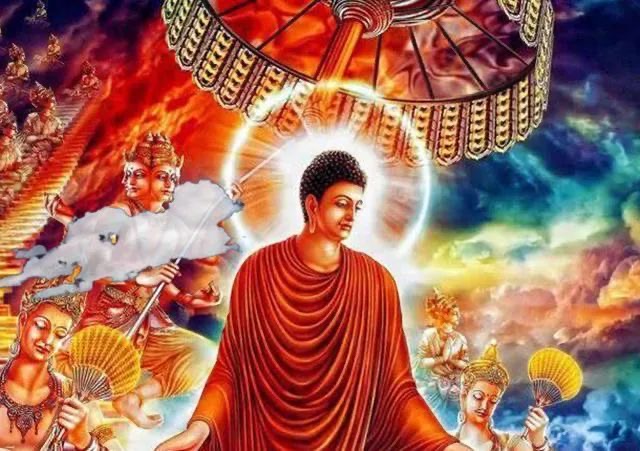
Before my eyes it is as if scenes from ancient times appear again: the Buddha teaching under the Bodhi tree, when Bodhisattva-Mahāsattvas, monks, nuns, laymen, laywomen, along with heavenly beings, nāgas, humans, and non-humans—countless multitudes—surrounded Him, making offerings, honoring, respecting, and praising. Heavenly mandārava flowers rained down, scattering over the Buddha and the assembly…

In this degenerate age, as a disciple of the Buddha, I feel fortunate to have this rare Dharma affinity, able to personally hear the Dharma before the Buddha and practice the true Dharma. I sincerely pray:

May the Dharma Wheel of the supreme and great H.H. Dorje Chang Buddha III always turn, and may He abide in this world forever.

May all beings in the Dharma-realm hear the Dharma-sounds spoken by H.H. Dorje Chang Buddha III, increase in blessings and wisdom, forever leave all suffering and obtain happiness, and together realize Bodhi.


Disciple of the Buddha — Huihai

For the original Chinese speech, please click here. This English translation is by Linda Chang and is provided for reference only.

Link:https://peacelilysite.com/2025/11/21/the-supreme-buddha-dharma/
The Monk Who Remembered His Past Lives: A Tale of Karma, Awakening, and Renewal

In the Tang Dynasty, there lived a monk named Jian Kong (Venerable “Mirror-of-Emptiness”), who in his previous life had been a diligent spiritual practitioner. Yet after reincarnating, he was born not as a monk, but as a poor scholar—one who, despite twenty long years of effort, could not pass the imperial examinations. He had no money, no connections, and often struggled even to find a simple meal. Hunger followed him like a shadow.

One day, after days of near-starvation, he set out toward a nearby temple, hoping to find something—anything—to eat. But halfway there, by the side of a river, his strength gave out completely. Weighed down by exhaustion and despair, he collapsed on the riverbank and began to cry. He was already around forty-five years old, and life felt unbearably harsh.

As he wept, a Brahmin monk suddenly appeared before him, radiant and calm.

Venerable Dharma Master,” the monk said, “are you satisfied with the taste of wandering through worldly life?

The scholar was startled.
Satisfied? It has been nothing but suffering! But I am a layman—why do you call me “Dharma Master”? That title doesn’t belong to me.

The Brahmin monk smiled gently.
You are starving and confused now, so you’ve forgotten everything.

He reached into his bag and took out a large, fist-sized date.
“This is a special fruit from my homeland. Eat it. Then you’ll understand.”

The scholar ate the date. Sleepiness washed over him at once, and he lay down beside the river. When he awoke, something astonishing had occurred—
his entire past life came flooding back.

He remembered that he, the Brahmin monk standing before him, and three others had all been fellow practitioners in their previous lives. Filled with emotion, he asked:

What about Monk Zhen? How is he doing in this life?

The Brahmin monk replied, “In his past life he had not yet cut off worldly attachments, nor had he achieved realization. In this life, he has become a monk again in Sichuan. He has now completely severed his desire for fame and fortune. He will attain accomplishment in this very life.

The scholar asked about another of their five companions.
And Master Shen? What about him?
His wishes remain unfulfilled,” the monk answered.

Then he asked about the third companion, Master Wu.
The monk sighed gently:
You know him. In our past life, he once joked before a stone Buddha statue: ‘If I cannot attain supreme enlightenment, then at least let me become a mighty nobleman.’
Well, his vow has come true. Just yesterday, I heard he was appointed a general. He has completely forgotten he was once a monk.*”

Finally, the Brahmin monk turned to him and said:

Among the five of us, I alone have attained liberation. And you—of all of us—you alone have fallen to such a state that you cannot even find enough food to fill your stomach.

The scholar was bewildered.
In my past life,” he said, “for decades I ate only one meal a day and wore one tattered robe for over thirty years. I practiced diligently and lectured on the Dharma tirelessly. I was a well-known Dharma Master. How could my karma now be so miserable?

The Brahmin monk answered with unmistakable compassion:

Yes, you cultivated hard. But when you taught the Dharma, you often mixed in ideas from Daoist and other non-Buddhist teachings. This confused your listeners. You also held back special teachings out of stinginess, unwilling to share them openly. And although you kept the precepts, you broke them in many subtle ways. Given all this, your current life’s hardship is already a fortunate result.

Hearing this, the scholar felt deep remorse and sadness. But instead of despair, a new resolve arose within him.

He vowed to renounce worldly life and become a monk once more.

Seeing his sincerity, the Brahmin monk took out a mystical mirror from his bag.
In it, the scholar saw with clarity:

  • his own past lives,
  • the karmic results of all beings’ actions,
  • even the future rise and fall of the Dharma.

The mirror was said to be like the Seven-Jewel Trees of the Pure Land, which reveal the karmic truths of the universe with perfect brightness.

With this profound vision, his conviction became unshakable.
He immediately entered monastic life, practiced with genuine diligence, and in time became a highly respected and accomplished master.

Link:

The Recognition of H.H. Dorje Chang Buddha III: Does a Buddha Need to Be Recognized?


The Recognition of H.H. Dorje Chang Buddha III: Does a Buddha Need to Be Recognized?

The Recognition of H.H. Dorje Chang Buddha III: Does a Buddha Need to Be Recognized?

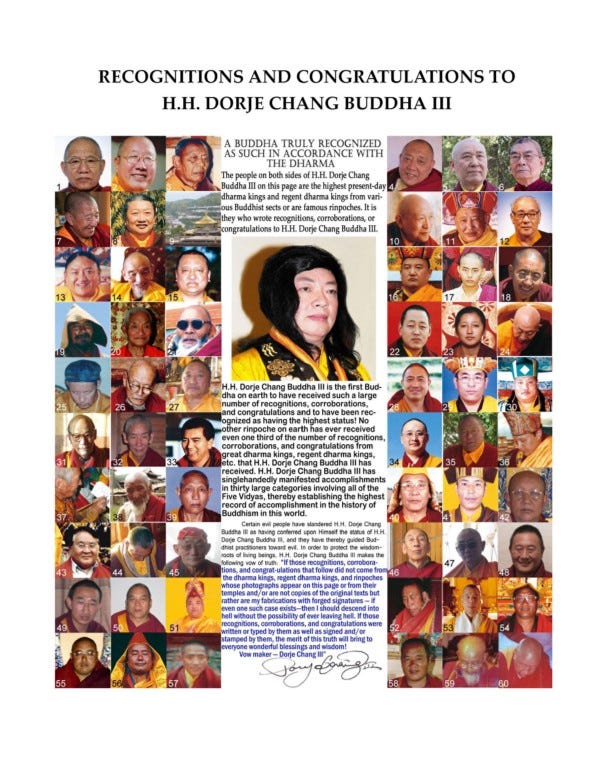
Worldwide Recognition of H.H. Dorje Chang Buddha III by Eminent Buddhist Leaders

Recognitions and Congratulations to H.H. Dorje Chang Buddha III

When over a hundred great Dharma Kings, Regents, and Rinpoches from various Buddhist traditions throughout the world lawfully recognized, in accordance with Buddhist precepts, that Namo H.H. Dorje Chang Buddha III is the reincarnation of the ancient Buddha, Buddhist disciples around the globe rejoiced in celebration. The descent of Namo H.H. Dorje Chang Buddha III brings to the beings of this Dharma-ending age the correct and unerring True Dharma of the Tathagata that leads to liberation from the cycle of birth and death. How fortunate living beings are to personally hear the teachings of the Buddha — there is now hope for attaining enlightenment in this very lifetime!

Online Slander and Misunderstanding of H.H. Dorje Chang Buddha III’s Holy State

However, some people on the internet refuse to face the legitimate recognitions, the holy realization, and the perfect mastery of the Five Vidyās and teachings of H.H. Dorje Chang Buddha III with reason or correct understanding. Instead, they fabricate rumors, spread insults, slander, defamation, and false accusations — maliciously twisting facts, inventing lies, and making baseless claims. They use vulgar words, forge fake documents, false notices, and false statements, and even create distorted images and mocking content — doing everything they can to attack H.H. Dorje Chang Buddha III. Through their own words and actions, they merely expose their ignorance and lack of virtue.

Some say, “A Buddha or Bodhisattva is realized through practice, not by ‘recognition.’” “Shakyamuni Buddha didn’t need a certificate of recognition.” But their purpose is clear — to stop more people from learning the true Buddha Dharma and attaining liberation!

So, does a Buddha need recognition when descending into the world?

A Practice for the Benefit of Sentient Beings.

A Buddha is one of unsurpassed, perfect enlightenment and complete wisdom. The reason one is a Buddha lies in their realization and enlightenment — not because of any recognition by others. No matter how great a Dharma King, Regent, or Rinpoche may be, their level of realization is far inferior to that of a Buddha; thus, any recognition they offer to a Buddha would be, in essence, just a piece of paper of no value to the Buddha.

However, because sentient beings in this world often lack the wisdom to discern between true and false saints, between genuine Buddha Dharma and false teachings that imitate Buddhism, they may easily be misled by superficial appearances and deviant views. Therefore, for the benefit of sentient beings, by following the Buddhist tradition of formal recognition, those virtuous masters issued such recognitions that help people give rise to faith and thus be saved. This is an act of right knowledge and right view.

The Example of Master Padmasambhava and the Importance of Recognition

Master Padmasambhava

When Master Padmasambhava first went to Tibet to propagate the Dharma, he was not greeted with respectful welcoming crowds. Instead, the Tibetan people were terrified and shouted, “Quick! Drive out this sorcerer who performs strange magic without lineage transmission! Do not let him deceive us with his witchcraft!” They even lifted him up and threw him into a muddy pit. Later, Master Padmasambhava returned to India and asked two renowned masters to write letters of recognition. Only then did Buddhism begin to flourish in Tibet. In fact, those two masters later became Master Padmasambhava’s disciples.

Therefore, when Buddhas or Bodhisattvas reincarnate and manifest again in this world, undergoing recognition according to Buddhist rules is not for their own sake, but for the sake of helping sentient beings generate faith and thereby be liberated.

The Supreme Conduct and Realization of H.H. Dorje Chang Buddha III

Indeed, the realization and attainment of a Buddha or Bodhisattva come from their own cultivation and enlightenment. The realization, virtue, and attainment of all Buddhas and Bodhisattvas are the manifestation of their supreme enlightenment. The pure and flawless conduct of Namo H.H. Dorje Chang Buddha III, His mastery of both exoteric and esoteric teachings, His perfect command of the Five Vidyās, and His countless acts of liberating sentient beings — all fully demonstrate the enlightenment and realization of a true Buddha!

Therefore, I sincerely advise those who slander: repent sincerely before the Buddhas and Bodhisattvas, or karmic retribution will not spare you! At the same time, I compassionately remind all who truly wish to learn and practice Buddhism: we live in the Dharma ending age, when confusion prevails, and the nature of the demonic offspring is to destroy the Dharma and obstruct sentient beings from learning the true path. Kind-hearted beings, please open your eyes of wisdom, discern the true from the false, and do not be deceived by demonic forces — lest you miss the supreme Dharma opportunity that can bring you liberation from birth and death in this very lifetime!

Source: https://dharma-hhdorjechangbuddhaiii.org/the-recognition-of-h-h-dorje-chang-buddha-iii-does-a-buddha-need-to-be-recognized/

Link: https://hhdorjechangbuddhaiiidharma.com/2025/11/17/the-recognition-of-h-h-dorje-chang-buddha-iii-does-a-buddha-need-to-be-recognized/

#DorjeChangBuddhaIII #HHDorjeChangBuddhaIII #DorjeChangBuddha #TrueDharma #Buddhism #Vajradhara #LivingBuddha #BuddhistWisdom #BuddhaRecognition #ModernBuddhism

Ven. Junmai Baima Dorje Rinpoche:H.H. Dorje Chang Buddha III is the true Buddha Vajradhara, the teacher of both humans and celestial beings!

Ven. Junmai Baima Dorje Rinpoche is a nirmanakaya of Vajravarahi. He is the fourth Ven. Baima Dorje Rinpoche. Various auspicious signs manifested at the birth of the rinpoche. When the rinpoche was five years old, the national master of Bhutan, H.H. Dharma King Dilgo Khyentse, personally signed and issued a recognition certificate recognizing the identity of the rinpoche. H.H. Dharma King Penor and H.E. Dharma King Rabjam also personally wrote recognition certificates.

At the age of about three, the child rinpoche used two fingers to transform a small, thick Tibetan knife into the shape of a coil. After passing through many hands, that knife is now at Hua Zang Si in San Francisco, where a special place for that holy object has been established to display it for public worship and veneration. The rinpoche currently resides at the Shechen Monastery. He has received initiations from the esoteric lineage of H.H. the 10 th Panchen Lama and other persons of great holiness and virtue. The rinpoche benefits all living beings by applying the wisdom and realization of a Bodhisattva.

I respectfully honor the Three Bodies and Four Wisdoms of the Dharma King of the Three Spheres, H.H. Yangwo Wan Ko Yeshe Norbu:
We were fortunate to be able to read the book about the Buddha Vajradhara Dharma King, A Treasury of True Buddha-Dharma — A Collection of H.H. Yangwo Wan Ko Yeshe Norbu’s Accomplishments Manifesting Complete Proficiency in Exoteric and Esoteric Buddhism and Perfect Mastery of the Five Vidyas . We cannot describe how deeply astonished and moved we were. Those thirty main categories of accomplishments present a splendid sight that includes the cikitsvidya (healing vidya), silpakarmasthanavidya (craftsmanship vidya), sabdavidya (sound vidya), adhyatmavidya (inner realization vidya), and hetuvidya (causality or Buddhist logic vidya) in their holy sense. Such accomplishments have never been seen before in the history of Buddhism. A Treasury of True Buddha- Dharma is the highest Buddha-dharma treasure and manifests H.H. Great Dharma King’s supreme realization and virtue. H.H. Great Dharma King is the first holy being who used true realization to display fully in the dharma realm the teachings of the Buddha! H.H. Great Dharma King is the true Buddha Vajradhara, the teacher of both humans and celestial beings! In this Dharma-Ending Age, we are deeply happy that living beings in the earthly realm have the guidance of H.H. Great Dharma King.
May H.H. Great Dharma King forever live in the world and forever teach the dharma!

Junmai Baima Dorje
May 10. 2006

LinkL:https://peacelilysite.com/2025/11/17/ven-junmai-baima-dorje-rinpoche%ef%bc%9ah-h-dorje-chang-buddha-iii-is-the-true-buddha-vajradhara-the-teacher-of-both-humans-and-celestial-beings/

H.H. Dorje Chang Buddha III received Congratulatory Letter from Pengcuo Rinpoche


Most honorable H.H. Yangwo Wan Ko Yeshe Norbu Buddha Vajradhara Dharma King:

First, on behalf of all of the monks in our temple, I convey my warmest congratulations to H.H. Great Dharma King for the publication of A Treasury of True Buddha-Dharma — A Collection of H.H. Yangwo Wan Ko Yisinubu’s Accomplishments Manifesting Complete Proficiency in Exoteric and Esoteric Buddhism and Perfect Mastery of the Five Vidyas!

Since the time the world-honored Sakyamuni taught the dharma, there have been countless great Bodhisattvas and great masters who, having received the Buddha’s teachings, came to this earthly world of birth, aging, sickness, and death in order to expound and propagate the sutras and save living beings. However, a great wish of the Buddha was that accomplishments in the Five Vidyas be shown to living beings in order to lead living beings onto the path of Buddhist self-cultivation. In this regard, H.H. Great Dharma King is the greatest holy being in this earthly realm!

H.H. Great Dharma King possesses perfect compassion and wisdom. His Holiness does not shirk toil or hardship in the pursuit of teaching and edifying living beings. We should take H.H. Great Dharma King as our eternal model, forever propagate the dharma, and pervasively save sentient beings.

Pengcuo Rinpoche

July 5, 2006

Link:https://peacelilysite.com/2025/11/17/h-h-dorje-chang-buddha-iii-received-congratulatory-letter-from-pengcuo-rinpoche/

Miao New Year: A Grand Celebration of Harvest, Heritage, and Harmony

Among China’s many vibrant ethnic cultures, few festivals shine as brilliantly as the Miao New Year — the most important and joyous celebration of the Miao people.
It marks the end of a year’s hard work and the beginning of a season filled with gratitude, reunion, and hope.

Since ancient times, the Miao people have followed their own lunar calendar, considering the tenth month of the traditional Chinese lunar year as the beginning of a new year. In Leishan County of Guizhou Province, the Miao New Year usually falls on the Mao Day during the first half of the tenth lunar month, which is roughly equivalent to Chinese New Year’s Eve. The festivities typically last from three to nine days, turning the Miao villages into a sea of song, dance, and laughter.

The Miao New Year carries deep layers of meaning. It is not only a celebration of the harvest but also a time to honor their ancestors and deities, and to commemorate Chi You, the legendary ancestor of the Miao people who perished in tribal wars over five thousand years ago. Through ceremonies and offerings to nature — sacred trees, bamboo groves, rocks, and wells — the Miao express their respect and gratitude toward the forces that sustain life.

In the valleys of the Qingshui River and Duliu River in Guizhou, the Miao New Year is the highlight of the year.
The Miao calendar differs from the Han Chinese lunar calendar, and the beginning of the Miao year is determined through communal discussions so that different villages celebrate at different times. This ensures that every year, one village becomes the center of a grand regional celebration, while neighboring communities come to join in.

After the autumn harvest and the completion of farm work, the Miao New Year marks both an ending and a joyful beginning. During the festival, villagers visit relatives and friends, slaughter pigs, make sticky rice cakes, worship their ancestors, share reunion feasts, and exchange cups of homemade rice wine.

Traditional activities include bullfighting, bird fighting, and singing contests, each bringing a unique charm to the celebration. One village’s festivities flow seamlessly into another’s, creating a continuous wave of joy that sometimes lasts until the early spring “Drum-Turning Festival” in February.

The Grand Parade and Thrilling Bullfights


The opening day of the Miao New Year is marked by a spectacular parade. People from the eight main Miao branches put on their most elaborate traditional attire — shimmering silver headdresses, embroidered costumes, and ornaments that glisten in the sun. Through music and dance, they showcase their unique local traditions and the living heritage of Miao culture, offering visitors from across China and beyond an unforgettable feast of color and rhythm.

Among the most popular events is the bullfighting competition, a traditional custom symbolizing courage and vitality. Two strong water buffaloes face off, locking horns in a contest of strength and spirit. Thousands gather around the arena to cheer, and the air is electric with excitement. With generous prizes for the winners, the event attracts participants and spectators from far and wide, adding a thrilling edge to the festive atmosphere.

The Long Table Banquet: Sharing Joy, Building Connection

If there’s one experience that perfectly embodies the hospitality of the Miao people, it’s the Long Table Banquet.
This grand feast, dating back to ancient times, is more than just a meal — it’s a powerful symbol of unity, friendship, and celebration.

In Danzhai County’s Wanda Town, whenever guests arrive from afar, locals line the streets with long tables stretching as far as the eye can see. Each table is filled with Miao specialties such as smoked pork, sour fish soup, and sticky rice. Hundreds of people sit together, strangers becoming friends over shared food, laughter, and conversation.

The air fills with the tangy aroma of sour soup and the joyful clinking of cups. Everyone, regardless of origin or language, becomes part of one big family — a living expression of the Miao New Year’s spirit: warmth, generosity, and togetherness.

The Miao New Year is far more than a festive occasion — it is a heartfelt tribute to life, nature, and ancestry.
Through its rituals, music, and communal joy, it reflects the Miao people’s enduring gratitude for the land, their reverence for their roots, and their love of harmony.

As the lush hills echo with the sound of lusheng flutes and the silver ornaments sparkle under the sun, one realizes that the Miao New Year is not only the celebration of a people — it is a celebration of humanity itself, reminding us all of the beauty of connection, gratitude, and joy.

Link:https://peacelilysite.com/2025/11/14/miao-new-year-a-grand-celebration-of-harvest-heritage-and-harmony/

Your Own Resolution: Living Lincoln’s Legacy Today

How Abraham Lincoln’s words remind us that perseverance begins within.

Always bear in mind that your own resolution to succeed is more important than any other.
Abraham Lincoln

Abraham Lincoln is remembered not only as one of America’s greatest presidents but also as a timeless symbol of perseverance, moral strength, and inner conviction. His life was marked by hardship and failure, yet through every setback, Lincoln never lost sight of his determination to rise above circumstance and serve a higher purpose.

Born in a humble log cabin in Kentucky in 1809, Lincoln’s path was anything but easy. He had little formal education, often studying by firelight after long days of farm work. Throughout his early years, he faced financial difficulties, career failures, and deep personal losses — including the death of his beloved mother and, later, two of his children.

He failed in business, lost several elections, and faced harsh criticism from both supporters and opponents. Yet each time, he stood back up. His perseverance was not fueled by ego or ambition, but by a steadfast belief in purpose — the belief that doing what is right matters more than comfort or success.

Lincoln’s life reminds us that greatness is not born of ease, but of endurance.

“Your Own Resolution Is More Important Than Any Other”

When Lincoln spoke these words, he wasn’t offering mere encouragement — he was revealing a universal truth about the power of inner determination.

In life, we will always face opinions, expectations, and pressures from the world around us. People may doubt us, situations may discourage us, and even our own fears may whisper that we are not enough.
But Lincoln reminds us: what truly determines our path is not what others think, but what we resolve to do.

Our resolution — that unwavering inner decision to keep moving forward — becomes the compass that guides us through storms.

It is what pushes a student to keep learning after failing an exam, an artist to keep creating despite rejection, or a parent to keep loving and protecting despite exhaustion. It is what allows ordinary people to do extraordinary things.

In today’s world of instant gratification and constant comparison, Lincoln’s wisdom feels more relevant than ever.
We often measure ourselves by the world’s standards — success, wealth, recognition — and forget that true strength comes from within.

When we cultivate resolution, we learn to stand firm in uncertainty.
We begin to trust our purpose more than our fears.
We stop seeking validation from others, and start building quiet confidence from persistence and integrity.

Lincoln’s life teaches us that no matter how dark the moment, perseverance can bring light.
His story shows that success is not defined by how often we win, but by how often we rise after falling.

To live by Lincoln’s words is to live with courage — not the absence of fear, but the determination to act despite it.
It means believing in our capacity to grow, to change, and to make a difference, no matter how small our beginnings.

When challenges arise — whether in our work, relationships, or personal goals — we can remind ourselves of Lincoln’s steady faith in resolution.
The world may test us, but as long as we hold our own conviction close, we will find a way forward.

Lincoln’s words have always spoken deeply to me.
Whenever I face uncertainty or moments of self-doubt, I remind myself of his quiet strength — how he stood tall not because life was kind, but because his heart was steady.

His quote, “Your own resolution to succeed is more important than any other,” reminds me that motivation is not something we wait for — it is something we choose, moment by moment.
And in choosing it, we slowly build the courage to move forward again, with hope and purpose.

Link:https://peacelilysite.com/2025/11/13/your-own-resolution-living-lincolns-legacy-today/

Compassion in Action: Life Release Day Observed Through Prayer, Education, and Service

November 4, 2025 San Francisco Post

Photo Courtesy: Hua Zang Si (Community members unite across California to honor the Life Release Day Designated by Buddha, transforming compassion into action through ceremonies, education, and charitable outreach.)

        Buddhist communities across California came together on October 29 to honor “The Life Release Day Designated by Buddha,” a global observance dedicated to compassion, the protection of life, and the collective aspiration for peace. 

        On the morning of October 29, 2025, the H.H. Dorje Chang Buddha III Cultural and Art Museum hosted a life release event at the Marina Del Rey harbor, drawing spiritual leaders and community members from across Southern California. The event was led by Venerable Master Ruzun Ruohui, Abbess of Hua Zang Si Temple and Hongfa Temple.

        Participants gathered in unity to chant praises and recite the  Great Compassion Mantra of Avalokiteshvara Bodhisattva. Venerable Master Ruzun Ruohui blessed the fish awaiting release with consecrated Dharma water, offering prayers that these sentient beings be freed from suffering and karmic obstructions. Upon release, the fish were returned to the ocean with the hope that they would find safety and live free from harm and predators. 

        The Life Release Day Designated by Buddha originated on October 29, 2009, when H.H. Dorje Chang Buddha III personally led His disciples in a life release ceremony following a significant Buddhist event. He compassionately declared this day as “Life Release Day” to promote the protection of life and the practice of compassion.

        The H.H. Dorje Chang Buddha III Cultural and Art Museum upholds the compassionate teachings of H.H. Dorje Chang Buddha III. The museum urges all sectors of society to transform empathy into action—promoting the safeguarding of life, the cessation of killing, and the daily practices of kindness as a fundamental way of living. Venerable Master Ruzun Ruohui emphasized that life release practices are not confined to specific days or locations. Whenever a life is in danger, we are called to act—to return it to a suitable environment, to grant it freedom, and to relieve it from fear.

        On October 29, 2025, San Francisco’s Hua Zang Si Temple also held a life release ceremony at San Rafael. Participants from diverse cultural backgrounds gathered to recite the Heart Sutra and the Great Compassion Mantra before gently releasing fish back to their natural habitat. Organizers emphasized that life release is not only a spiritual practice, but also a call to awaken society’s compassion and deepen our care for the sentient beings. 

Photo Courtesy: H.H. Dorje Chang Buddha III Cultural and Art Museum
Venerable Master Ruzun Ruohui blesses fish awaiting release with Dharma water during the Life Release Day ceremony at Marina Del Rey.

Photo Courtesy: H.H. Dorje Chang Buddha III Cultural and Art Museum
Upon release, the fish were returned to the ocean.

        To nurture compassion in the next generation, Hua Zang Si Temple held a Buddhist children’s story class on October 19. Through storytelling and interactive learning, the program guided young participants to understand the core values of “equality of all life” and “compassion without harm.” The initiative was warmly received by parents, who expressed deep appreciation for the temple’s commitment to meaningful and values-based education.

        On October 26, Macang Monastery in San Francisco held a special “Life Release Day Blessing and Food Donation Ceremony” in honor of the Life Release Day Designated by Buddha. Following collective sutra recitation and prayers by both monastics and lay practitioners, the temple donated food supplies to unhoused individuals and low-income families—embodying the Buddhist spirit of compassion and service to those in need.

        This year’s Life Release Day Designated by Buddha brought together Buddhist disciples and compassionate leaders from all walks of life through a range of activities—including life release ceremonies, prayer gatherings, educational outreach, and food donations. Participants were reminded that cultivation is not merely a slogan, but a continuous practice through every kind thought and virtuous deed.