The Power of a Sincere Heart: How True Generosity Creates Boundless Merit

In the Buddhist scriptures of China, a profound story is recorded—one that illuminates the immeasurable merit of a sincere offering.

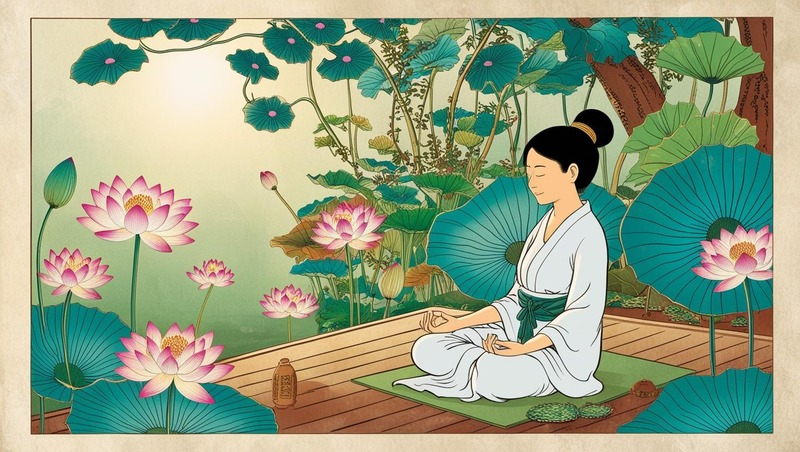
Once, there was a poor girl who survived by begging. She often watched wealthy young ladies, accompanied by attendants, visit the temple to offer alms and perform good deeds. Seeing their generosity, she felt a deep yearning to cultivate merit but had nothing to give. Determined, she worked tirelessly to save whatever she could. After much effort, she managed to save a single coin. Though small in value, it represented all she had. With unwavering devotion, she took her humble offering to the temple.

The abbot, upon learning of her sincerity, was deeply moved. He gathered his disciples and announced, “Today, I will personally preside over the offering and pray for this devout laywoman!”

Not long after, an extraordinary turn of events unfolded.

After the queen of the land passed away, the grieving king sank into sorrow. To lift his spirits, his ministers organized a hunting expedition. As the royal party rode through the forest, the king noticed a shimmering light ahead. Curious, he approached and discovered a breathtakingly beautiful young woman. Though her clothes were tattered, she radiated an ethereal grace.

Captivated by her presence, the king brought her back to the palace. Before long, she became his new queen.

Overjoyed by her newfound fortune, she reflected on her past: “This must be the reward of my small act of generosity! I only donated one coin, yet it planted the seed for such incredible merit. Now that I have wealth, I should return to the temple to express my gratitude with a much grander offering!”

Determined to make a grand gesture, she dressed in the finest attire, adorned herself with jewels, and loaded dozens of carts with silver and gold for donation. As she approached the temple, she thought, “Before, when I gave only one coin, the abbot personally prayed for me. Now that I bring such vast riches, surely the reception will be even greater!”

Upon her arrival, she expected an elaborate welcome. Yet, to her surprise, only a few monks came to receive her offerings, and the rituals were conducted in the usual manner.

Perplexed, she approached an elderly monk and asked, “Why is it that when I was poor and donated a single coin, the abbot himself prayed for me? Yet today, when I bring such wealth, only a few monks perform the prayers?”

The monk smiled gently and replied, “At that time, your single coin was all you had. You gave it with pure devotion and joy, holding nothing back. Now, though you bring great wealth, it is but a fraction of your fortune, and your heart is tainted with pride. The true merit of an offering comes not from its size but from the sincerity of the giver’s heart.”

Shakyamuni Buddha taught that for a donation to generate immense benefit, it must possess three essential qualities:

  1. Before Giving – A Joyful Heart
    True generosity begins with happiness. The donor should give not out of duty, pressure, or expectation of reward, but with a heart full of joy, seeing giving as an opportunity to cultivate virtue and compassion.
  2. While Giving – A Clear and Sincere Mind
    The act of giving should be free from hesitation, regret, or pride. A pure offering is made with an open heart, solely for the benefit of others, without seeking recognition or return.
  3. After Giving – A Sense of Fulfillment
    Once the offering is made, the giver should not feel regret or attachment. Instead, they should feel a deep sense of satisfaction, knowing they have planted seeds of merit for the future.

This story serves as a timeless lesson: It is not the amount we give that determines the merit of our offering, but the purity of our heart. A sincere and joyful offering—no matter how small—carries boundless blessings.

So the next time you give, remember: True generosity is not measured in gold or silver, but in the depth of your sincerity.

Link:https://peacelilysite.com/2025/04/02/the-power-of-a-sincere-heart-how-true-generosity-creates-boundless-merit/

How Einstein Reconciled Religion to Science

This outstanding article by Brian Gallagher, published in Nautilus, provides deeper insight into Albert Einstein’s views on religion and science.

Not long ago, I heard an echo of Albert Einstein’s religious views in the words of Elon Musk. Asked, at the close of a conversation with Axios, whether he believed in God, the CEO of both SpaceX and Tesla paused, looked away from his interlocutors for a brief second, and then said, in that mild South African accent, “I believe there’s some explanation for this universe, which you might call God.”

Einstein did call it God. The German-Jewish physicist is famous for many things—his special and general theories of relativity, his burst of gray-white hair—including his esoteric remark, often intoned in discussions of the strange, probabilistic nature of quantum mechanics, that “God does not play dice.” A final or ultimate equation, describing the laws of nature and the origin of the cosmos, Einstein believed, could not involve chance intrinsically. Insofar as it did—it being the Copenhagen interpretation of quantum mechanics—it would be incomplete. (The consensus now among physicists is that he was wrong; God is indeterminate. ‘All the evidence points to him being an inveterate gambler,’ Stephen Hawking once said, ‘who throws the dice on every possible occasion.’)

But what was with Einstein’s God-language in the first place? The question may be considered anew, in light of an auction at Christie’s, in New York, of a 1954 letter Einstein wrote that a couple years ago unexpectedly sold for $2.9 million. For the occasion the Princeton Club hosted a panel discussion on the conflict, or lack thereof, between science and religion, which featured theoretical physicist Brian Greene, philosopher Rebecca Newberger Goldstein, cognitive psychologist Tania Lombrozo, and Rabbi Geoff Mitelman, founding director of Sinai and Synapses, an organization dedicated to fostering respectful dialogue about religion and science. The event was open to the public, and I was excited to attend. (Full disclosure: At the time I was a Sinai and Synapses fellow.) I believe Einstein can still offer some insight on how to think about religion and science.

“I believe in Spinoza’s God, who reveals himself in the lawful harmony of the world, not in a God who concerns himself with the fate and the doings of mankind.”

What Einstein said, in a note to the philosopher Eric Gutkind, whose book Choose Life: The Biblical Call to Revolt Einstein was reviewing, was nearly as scathing as any contemporary critique of religion you might hear from Richard Dawkins, Sam Harris, or Christopher Hitchens. ‘The word God is for me,’ Einstein wrote, ‘nothing more than the expression and product of human weakness, the Bible a collection of honorable, but still purely primitive, legends. No interpretation, no matter how subtle, can change this for me.’

It is no wonder why, for decades, Einstein’s views on religion became muddled in the popular imagination: The inconsistency is clear. Here, God means one thing; over there, another. Just going off his letter to Gutkind, Einstein appears to be an atheist. But read Einstein in other places and you find him directly declaring that he is not one. “I am not an Atheist,” he said in an interview published in 1930. ‘I do not know if I can define myself as a Pantheist. The problem involved is too vast for our limited minds.’ Einstein was asked whether he was a pantheist. The rest of his response is worth quoting in full:

“May I not reply with a parable? The human mind, no matter how highly trained, cannot grasp the universe. We are in the position of a little child, entering a huge library whose walls are covered to the ceiling with books in many different tongues. The child knows that someone must have written those books. It does not know who or how. It does not understand the languages in which they are written. The child notes a definite plan in the arrangement of the books, a mysterious order, which it does not comprehend, but only dimly suspects. That, it seems to me, is the attitude of the human mind, even the greatest and most cultured, toward God. We see a universe marvellously arranged, obeying certain laws, but we understand the laws only dimly. Our limited minds cannot grasp the mysterious force that sways the constellations. I am fascinated by Spinoza’s Pantheism. I admire even more his contributions to modern thought. Spinoza is the greatest of modern philosophers, because he is the first philosopher who deals with the soul and the body as one, not as two separate things.

Benedict Spinoza, the 17th century Jewish-Dutch philosopher, was also in his day confused for an atheist for writing things like this, from his treatise Ethics: ‘All things, I say, are in God, and everything which takes place takes place by the laws alone of the infinite nature of God, and follows (as I shall presently show) from the necessity of His essence.’

In 1929, Einstein received a telegram inquiring about his belief in God from a New York rabbi named Herbert Goldstein, who had heard a Boston cardinal say that the physicist’s theory of relativity implies “the ghastly apparition of atheism.’Einstein settled Goldstein down. “I believe in Spinoza’s God, who reveals himself in the lawful harmony of the world,’ he told him, ‘not in a God who concerns himself with the fate and the doings of mankind.’

What that amounted to for Einstein, according to a 2006 paper, was a ‘cosmic religious feeling’ that required no ‘anthropomorphic conception of God.’ He explained this view in the New York Times Magazine: ‘The religious geniuses of all ages have been distinguished by this kind of religious feeling, which knows no dogma and no God conceived in man’s image; so that there can be no church whose central teachings are based on it. Hence it is precisely among the heretics of every age that we find men who were filled with this highest kind of religious feeling and were in many cases regarded by their contemporaries as atheists, sometimes also as saints. Looked at in this light, men like Democritus, Francis of Assisi, and Spinoza are closely akin to one another.’

So, as Einstein would have it, there is no necessary conflict between science and religion—or between science and ‘religious feelings.’

Brian Gallagher is an associate editor at Nautilus. Follow him on Twitter @bsgallagher.

Link:https://peacelilysite.com/2025/04/01/how-einstein-reconciled-religion-to-science/

Vimalakirti’s Profound Teachings on Suffering and Liberation

The Profound Wisdom of the Holy Buddha Vimalakirti

The Vimalakirti Sutra stands as one of the most profound texts in Mahayana Buddhism, offering deep insight into wisdom, compassion, and the nature of illness. One of its most significant sections, the “Chapter on Illness,” presents a powerful dialogue between Manjushri and Vimalakirti, a lay Bodhisattva of extraordinary realization.

Vimalakirti, despite his unparalleled wisdom, feigns illness to teach a vital lesson. When Manjushri visits him and asks, “Aren’t you successful in your practice? If so, how can you be ill?” Vimalakirti responds, “I am ill because all sentient beings are ill.” This response redefines illness—not as a personal affliction but as an expression of universal suffering. His illness is a manifestation of his boundless compassion, mirroring the pain of all beings so that he may guide them toward liberation.

Manjushri Bodhisattva and other disciples visiting H.H. Vimalakirti

The dialogue between Vimalakirti and Manjushri unfolds into a deeper contemplation on suffering. When asked when his illness will be cured, Vimalakirti replies, “When the last sentient being is free from illness, then my illness will be cured.” This statement embodies the heart of Mahayana Buddhism—the vow to attain enlightenment not for oneself alone but for all beings. His words resonate with the self-sacrificial love found in other spiritual traditions, such as Jesus Christ’s willingness to bear humanity’s suffering.

Vimalakirti further explains, “From ignorance comes love, and thus my illness arises.” He reveals that suffering stems from attachment—attachment to family, possessions, ambitions, and even spiritual practice. Such attachments cloud the mind, giving rise to suffering. True liberation, he teaches, comes from transcending these attachments through wisdom and compassion.

The holy and venerable Vimalakirti is unique in Buddhist history, as he was an ancient Buddha who chose to manifest as a layperson rather than an ordained monk. During the time of Shakyamuni Buddha, he played a crucial role in teaching monastics and Bodhisattvas who struggled to develop Mahayana bodhicitta. His unparalleled wisdom and skillful means helped bridge the gap between monastic and lay practitioners, proving that profound realization is not limited to those in monastic robes.

In reality, Vimalakirti was the incarnation of the supreme Buddha Dorje Chang (Vajradhara), the primordial Buddha and master of all Buddhas. Yet, instead of taking a leadership role that might have caused sectarian divisions, he humbly chose to serve as a Bodhisattva assisting Shakyamuni Buddha. His teachings, recorded in the Vimalakirti-nirdesa Sutra, are regarded as sutras in their own right, carrying the weight of authentic Buddha-dharma.

The depth of Vimalakirti’s wisdom was so vast that even the most accomplished Bodhisattvas hesitated to engage him in dialogue. When Shakyamuni Buddha asked Maitreya Bodhisattva to inquire about Vimalakirti’s health, Maitreya declined, admitting that Vimalakirti had once humbled him with his superior insight. Ultimately, only Manjushri, the ancient Buddha and master of the seven Buddhas, dared to engage Vimalakirti in discourse.

Chinese Ink painting Holy Master Vimalakirti by H.H. Dorje Chang Buddha III

Vimalakirti’s teachings were not limited to words alone—he also demonstrated his supreme realization through extraordinary miracles. In one instance, he used his boundless supernatural powers to bring the entire Buddha-land of Abhirati, including the Immovable Buddha (Aksobhya), into the human realm. Even the Immovable Buddha himself declared, “I did not do this; it was through the supernatural powers of Vimalakirti.” Such feats reveal that Vimalakirti’s realization surpassed that of all Bodhisattvas and was equal to that of Shakyamuni Buddha himself.

Shakyamuni Buddha himself affirmed the extraordinary status of Vimalakirti, stating, “One who makes offerings to that holy being should know that this is making offerings to the Buddhas. One who transcribes this sutra or keeps it in a room should know that the Tathagata exists in that room.” These words confirm that Vimalakirti was, in essence, a Buddha.

His teachings continue to inspire practitioners today, offering a profound perspective on suffering, wisdom, and compassion. His willingness to manifest illness as a teaching tool, his unparalleled debates with great Bodhisattvas, and his supernatural demonstrations all serve as timeless lessons in the path to enlightenment.

Link:https://peacelilysite.com/2025/03/28/vimalakirtis-profound-teachings-on-suffering-and-liberation/

The Power Of The Holy Vajra Needle

My name is Guang-Fen Fu. Since I was young, I have been physically weak and often ill. When I became an adult, my mother told me, “Daughter! You have had a weak constitution since you were young. Go and learn medicine. This will be good for your health, and you will not become weary through exerting too much physical strength.”

        In 1958, I began following a teacher to learn traditional Chinese medicine. Because my illnesses resulted from the power of karma accumulated through many lifetimes and eons, my illnesses did not decrease as my knowledge of medicine and my experience in practicing medicine grew. Disease constantly followed me wherever I went.

        In 1978 and the following few years, I suffered from a gastric ulcer in which most of my stomach hemorrhaged. During that time, I also discharged blood when going to the bathroom and vomited blood. In 1981, I had no choice but to undergo surgery to cut out most of my stomach. My health was even worse after the surgery. My food intake lessened, my face became pale, I spoke without any vigor, my spirit was weak, my movements were slow, and I often could not go to work.

        As a result of the care and assistance given to me by a friend, in 1987, I met my respected Buddha Master, H.H. Dorje Chang Buddha III Wan Ko Yeshe Norbu Holiest Tathagata. When His Holiness learned of my suffering from illness and my strained financial circumstances, His Holiness showed immense compassion and concern. His Holiness treated me with the holy vajra needle. H.H. Buddha Master asked me to show His Holiness the acupuncture point on my foot called Zu San Li. My respected Buddha Master then squatted down and applied that needle to me. After the needle was applied, my respected Buddha Master then said, “Pay attention! I will now apply my dharma power.”

        When my respected Buddha Master put his hands into a mudra before me, I immediately began to feel numbness, swelling, and pain. My whole body emitted heat, and I was slightly perspiring. When my respected Buddha Master heard me repeatedly scream in pain, His Holiness released his hands from that mudra. I instantly felt that the numbness, swelling, and pain I had just experienced had disappeared. The only thing I felt was a relaxed and comfortable feeling that my body had never before experienced. My respected Buddha Master then said, “This needle was used to open your energy channels and chakras. You are too anemic.”

        I had not yet become a Buddhist or learned Buddhism at that time. My respected Buddha Master treated me and all other living beings as his own family members, equally lending them a helping hand out of great compassion. In 1988, I knew that I wanted to convert to and learn Buddhism in order to leave suffering, attain happiness, and walk the path leading to accomplishment in the dharma and liberation from the cycle of reincarnation.

        After following H.H. Buddha Master, my health has improved day by day; my complexion is ruddy, my spirit is clear, my voice is resonant, and I walk with vigor. I gradually understood just how magnificent H.H. Buddha Master is. I also came to comprehend the realness of Buddha Dharma gradually. Those who see me now say, “You have totally changed in the last two years. You don’t look so frail as you did before.” What they found most difficult to believe is that I returned from my trip to the plateaus of Tibet and Qinghai, which are places that lack oxygen without any adverse health effects.

        Because I received H.H. Buddha Master’s teachings and empowerment, I advanced in the area of medicine. I took a countywide test and was the first to receive a certificate of qualification as a traditional Chinese medicine doctor. I took provincial and municipal tests and obtained certificates qualifying me as a “doctor-in-charge” who practices traditional Chinese medicine. The hospital put a sign up for me that read “expert outpatient service.” My patients have increased day by day. I have cured patients near and far of their difficult and complicated illnesses. As a result, I have a bit of fame in the local area where I live. Everything that I have is due to the teachings and empowerment that the Buddha Master bestowed upon me after I began learning Buddhism. The kindness and grace H.H. Buddha Master conferred upon me are as enormous as a mountain. Each and every bit of his kindness and grace is indelibly etched in my heart.

        I remember one day around the year 1989. Zi-Fang Liu, a disciple of my respected Buddha Master, went to the home of my respected Buddha Master in the Nanxin District of Xindu. She beseeched my respected Buddha Master to save her. She said that her illness had lasted many years, was acutely painful, and was about to collapse. She had been to all of the major hospitals in China and had spent a lot of money, all to no avail. I saw that her complexion was unnaturally dark and that her whole body was rigid. She constantly complained about her unbearable pain.

        Then, she suddenly fell to the ground and did not get up. She looked ghastly pale. My respected Buddha Master immediately treated her with the holy vajra needle in order to empower her. Because she was in a state of shock, she did not have any reaction when the needle was applied. After a short while, Sister Liu regained consciousness, stood up, and stated she was no longer in pain.

        Every time I saw the wonders of my respected Buddha Master’s holy vajra needle, I had an even greater desire to learn how to apply that holy needle. One day I said to my respected Buddha Master, “Respected Buddha Master, teach me how to apply that amazing needle so that I may cure more patients.” My respected Buddha Master said in a soft voice, “Guang-Fen, your powers are insufficient. Let’s put that matter aside for the time being.” One time I saw Hsi Jao Ken Ten Rinpoche, who is from Taiwan, also ask my respected Buddha Master to teach him how to apply that amazing needle. My respected Buddha Master replied, “Your powers are insufficient. Let’s put that matter aside for the time being.”

        I later learned that the source of the effectiveness of the holy vajra needle is my respected Buddha Master’s state of realization and virtue and the power of his merit. With a holy mind of enlightenment and great compassion, His Holiness assists living beings with physical illnesses, psychological illnesses, and living beings suffering due to the power of karma. Furthermore, His Holiness constantly and compassionately empowers living beings through his teachings, thereby enabling them to extricate themselves from suffering and find the key to curing and preventing disease.

        I have followed H.H. Buddha Master for more than ten years. I, Guang-Fen, have evolved from a person who did not understand anything about learning Buddhism and self-cultivation to a Buddhist disciple striving to integrate wisdom, compassion, and skillful means and a person striving to be selfless. Based upon empowerment from my respected Master’s practice and from the lineage of great masters throughout generations, a type of merit of the fruit of Buddhahood exerts its influence, causing Buddhist disciples to walk the path toward liberation and accomplishment in the dharma. With the incomparable kindness and empowerment of my respected Buddha Master, Buddhist disciples give rise to bodhicitta and strive to enlighten themselves and others. The compassion, care, and protection my respected Buddha Master bestows upon his disciples and all living beings cannot be described in words. To know what I am saying, you have to experience it yourself.

        I sincerely feel that the kindness and grace shown to me by my Buddha Master are difficult to repay. All I can do is resolve to be a disciple of the Buddha in all my future lives and devoutly and respectfully turn to and rely upon the eternal Buddha Master. Only a Buddha Master can lead Buddhist disciples out of the bitter sea of reincarnation and lead them toward liberation, accomplishment in the dharma, ending of the cycle of birth and death, becoming a Buddha, saving other living beings, undertaking the cause of the Buddhas and Bodhisattvas, and repaying the kindness of the Buddhas.

        This year I have passed sixty-five years of age. What I have written above is my own true personal experience. I have not lied. If what I wrote above contains lies, I am willing to descend into the Avici Hell (hell of uninterrupted suffering). If what I wrote above is true, I offer the merit of this writing to my magnificent Buddha Master, who is like my father and mother. I also dedicate such merit to all of my vajra Brothers and Sisters so that they attain enlightenment soon and to all sentient beings on the six paths of reincarnation. Amitabha!

Written and respectfully submitted by a Buddhist disciple,
Guang-Fen Fu

April 16, 2006

(This is a complete translation of the Chinese text that was initially written and signed by Guang-Fen Fu.)

The Intersection of Science and Buddhism: Exploring the Nature of Reality

The Secret Connection Between Quantum Physics And Buddhism

The German philosopher Karl Jaspers once said, “In science, half-understood knowledge leads one to abandon faith, while complete knowledge brings one back to faith.” This profound statement encapsulates the evolving relationship between scientific discovery and spiritual insight. Over the past century, science—particularly in the realm of quantum physics—has begun to reveal striking parallels with the teachings of Buddhism, suggesting that the boundary between scientific and spiritual understandings of reality is far more porous than once believed.

One of the most fascinating intersections between Buddhism and quantum physics lies in the concept of Emptiness (Śūnyatā). According to Buddhist philosophy, Emptiness is the fundamental nature of all phenomena—it is the limitless, dynamic potential from which everything arises and to which everything ultimately returns. This notion mirrors the scientific concept of the Quantum Field, the invisible yet omnipresent ground of pure potentiality that gives rise to all matter and energy in the universe.

Imagine a dream: within the dream, we experience vivid landscapes, emotions, and interactions. Yet, upon waking, we realize that none of it was truly real. However, the consciousness that enabled the dream was undeniably present. Similarly, in quantum physics, the Quantum Field remains unseen, yet it is the essential foundation from which all particles and forms emerge and dissolve. Nothing within the dream is independently real, just as in Buddhism, reality is understood through Pratītyasamutpāda, or dependent arising—the principle that all things exist in interdependence, without intrinsic self-existence.

Quantum mechanics further supports this view by demonstrating that particles do not exist as fixed entities but as probability waves, manifesting only when observed. This aligns with Buddhist teachings that emphasize the illusory nature of a solid, independent reality. Just as a wave transforms into a particle through observation, our perception shapes the world we experience.

The implications of these parallels are profound. If science and Buddhism are describing reality in similar ways, then understanding the universe may require not just empirical observation but also deep contemplation. As both disciplines continue to explore the mysteries of existence, they may converge on a deeper, unified truth—one that transcends dualities and reveals the interconnected nature of all things.

In this age of scientific breakthroughs and spiritual awakening, perhaps the most important lesson is that reality is far more mysterious than we ever imagined. Whether through the lens of quantum physics or the wisdom of Buddhism, we are invited to look beyond appearances and embrace the boundless potential that underlies all existence.

The Secret Connection Between Quantum Physics And Buddhism

Link:https://peacelilysite.com/2025/03/25/the-intersection-of-science-and-buddhism-exploring-the-nature-of-reality/

The “Banqi” Style: A Masterpiece of Artistic Innovation

Going to a Faraway School in the Mountains
《山間遠學》


Artist: H.H. Dorje Chang Buddha III
H.H.第三世多杰羌佛
Style: Banqi(版氣派)

This exquisite painting, rendered in the unique “Banqi” style, captures a touching scene of children from mountain villages on their way to school. Unlike city children, these young students must trek across rugged terrain—climbing mountains, crossing ravines—day after day to pursue their education. Their journey is filled with challenges, yet their unwavering determination and thirst for knowledge shine through. This artwork serves as a tribute to their resilience, reminding us all of the value of education and the perseverance required to achieve greatness.

A Revolutionary Artistic Technique

What makes this painting extraordinary is its unconventional brushwork, which blends the bold energy of ink-wash painting with the refined precision of engraving. Every stroke, whether light or dark, delicate or bold, exudes an artistic charm that is both fluid and structured. The layering of ink and color creates depth, while the intricate texture gives the illusion of an engraved plate print, despite being entirely painted by hand. The brushwork is dynamic—lines seem to break and reconnect, mimicking the traditional elegance of carved stone seals. This interplay between spontaneity and meticulous control infuses the painting with life, movement, and a profound sense of authenticity.

What Is the “Banqi” Style?

The “Banqi” style is a rare and fascinating artistic approach that combines the visual impact of printmaking with the expressive freedom of brush painting. While these works resemble engravings at first glance, they are, in fact, purely ink-wash paintings—imbued with an effortless yet profound beauty that is both natural and lively. Beneath their structured appearance lies a deep, inexhaustible charm, where each stroke carries an essence of tradition, innovation, and artistic mastery.

Through this masterpiece, we witness not only a compelling story of perseverance but also a groundbreaking artistic vision—one that harmonizes the precision of engraving with the fluid grace of brush painting. It is a celebration of both form and spirit, a true testament to the boundless possibilities of art.

This beautiful artwork is part of the permanent exhibition at the International Art Museum of America, located in downtown San Francisco.

Link:https://peacelilysite.com/2025/03/21/the-banqi-style-a-masterpiece-of-artistic-innovation/

Exploring the Concept of Size in Buddhism: Mount Sumeru and the Mustard Seed

In the realm of Buddhist philosophy, the imagery of Mount Sumeru and the mustard seed serves as a profound metaphor for understanding the nature of reality and perception. Originally a mountain in Indian mythology, Mount Sumeru is revered in Buddhism as the dwelling place of celestial beings like Indra and the Four Heavenly Kings. Standing at an astonishing height of 84,000 yojanas, it symbolizes the vastness and grandeur of existence. In contrast, the mustard seed, a tiny grain often used in culinary practices, represents the minuscule aspects of life.

This juxtaposition is beautifully illustrated in a dialogue between Li Bo, a governor of Jiangzhou during the Tang Dynasty, and the Zen master Zhi Chang. Li Bo questioned the seemingly paradoxical notion found in Buddhist texts that “Mount Sumeru can fit within a mustard seed, and a mustard seed can contain Mount Sumeru.” He found it hard to believe that such a small seed could encompass such a towering mountain.

With a smile, Zhi Chang responded by asking, “People say you have read thousands of books; is that true?” Proudly, Li Bo affirmed, “Of course! I have read far more than that!”

Zhi Chang then inquired, “And where are those thousands of books now?”

Li Bo pointed to his head and replied, “They are all right here!”

Zhi Chang chuckled and said, “Strange, then. Your head seems no bigger than a coconut; how could it possibly hold thousands of books?”

At that moment, Li Bo experienced a profound realization: the distinctions of large and small are mere constructs of the mind. In reality, size is subjective and arises from our perceptions.

This concept resonates deeply with modern science, which demonstrates that vast amounts of knowledge can be stored within a minuscule chip, echoing the Buddhist teaching that the universe can be contained within the smallest of objects.

The English poet William Blake expressed a similar sentiment in his famous lines:
“To see a world in a grain of sand,
And a heaven in a wild flower,
Hold infinity in the palm of your hand,
And eternity in an hour.”

His words capture the essence of this Buddhist teaching: within the tiniest elements of our world lies the vastness of the infinite.

Ultimately, Buddhist wisdom encourages us to transcend conventional notions of size and reality. When we embrace the idea that the vast can reside within the minute, we cultivate a deeper awareness of the interconnectedness of all things. In this way, Mount Sumeru and the mustard seed serve as powerful reminders of the boundless nature of existence and the limitless potential of the human mind.

In the Āgama Sūtra, there is a remarkable story that illustrates how the merit of a single grain of rice can be as vast as Mount Sumeru.

During the time of the Buddha, a poor couple lived in a crumbling cave with nothing to their name. They were so impoverished that they owned only a single set of clothes, which they had to share. When the husband went out, the wife had to stay home, and when the wife needed to leave, the husband had no choice but to remain inside, barely clothed.

One day, they heard that the Buddha and his disciples were passing through their village on their alms rounds. The couple reflected on their misfortune and said, “We have never practiced generosity, which is why we suffer such poverty today. Now that the Buddha is here, how can we miss this rare opportunity to give?”

However, as they looked around their home, the wife sighed deeply, “But we have nothing to offer…”

The husband, after thinking for a moment, made a firm decision: “No matter what, we must not let this opportunity slip away. Even if we starve, we must make an offering! The only thing we still have of value is this set of clothing—let us give it to the Buddha!”

With hearts full of joy, they humbly presented their only garment as an offering. The disciples, however, hesitated, feeling uneasy about receiving such an item. They passed the garment among themselves, reluctant to accept it, until Ananda finally brought it before the Buddha and asked, “Lord, this garment is too worn to be used. Should we discard it?”

The Buddha, filled with compassion, gently instructed, “My disciples, do not think this way. The generosity of the poor is the most precious of all. Bring the garment to me.”

Feeling ashamed for their earlier hesitation, Ananda and Maudgalyayana took the garment to the river to wash it. But as soon as they immersed it in the water, the entire river surged wildly, waves crashing in all directions. Alarmed, Maudgalyayana used his divine powers to summon Mount Sumeru in an attempt to subdue the turbulent waters. Yet, no matter how he pressed it down, the waves remained uncontrollable.

Helpless, the two disciples rushed back to the Buddha to report what had happened. At that moment, the Buddha was calmly eating his meal. Without saying much, he gently picked up a single grain of rice and handed it to them, saying, “Take this rice grain to the river, and it will settle.”

Perplexed, Ananda asked, “Lord, even the mighty Mount Sumeru couldn’t calm the waves—how can a tiny grain of rice possibly do so?”

The Buddha smiled and said, “Try it and see.”

Still doubtful but obedient, Ananda and Maudgalyayana took the grain of rice and cast it into the river. Miraculously, the raging waters instantly calmed, becoming as still as a mirror.

Shocked by what they had witnessed, the two disciples returned to the Buddha and asked, “How could a single grain of rice hold more power than a mountain?”

The Buddha then explained, “From the moment a grain of rice is planted, it undergoes countless efforts—watering, fertilizing, harvesting, processing, and selling—each step carrying the labor and dedication of many beings. Because of this, a single grain of rice contains immeasurable merit. Likewise, the garment offered by the poor couple was their only possession, their entire livelihood. Their act of giving was boundless in sincerity, making its merit just as vast. The Dragon Kings of the ocean understood the profound virtue behind this offering, which is why they immediately retreated in reverence. This is the power of true devotion—whether a grain of rice or a simple piece of clothing, when given with absolute sincerity, its merit can equal that of Mount Sumeru.”

From this teaching, a well-known Buddhist verse arose to remind monks and practitioners of the sacred nature of even the smallest offering:

“A single grain of rice in the Buddha’s gate,
As vast as Mount Sumeru.
If enlightenment is not attained in this life,
One shall return repaying the debt, bearing horns and fur.”

This verse serves as a powerful reminder that every offering—no matter how small—carries immense significance when given with a pure heart. It also warns practitioners to cherish and respect all acts of generosity, for every grain of rice represents the kindness and labor of countless beings.

Link:https://peacelilysite.com/2025/03/21/exploring-the-concept-of-size-in-buddhism-mount-sumeru-and-the-mustard-seed/

Buddhist disciple Zhao Yusheng received a transmission of Buddha Dharma that is True and Real

I personally witnessed the special and wonderful passing of layman Zhao Yusheng

told by Ms Mao Meimei, September 2, 2017

Ms. Moh and Zhao Yusheng’s daughter

Amitabha! Dharma masters, rinpoches, and kind virtuous ones, my name is Mei Mei Moh. I will now talk about the magnificent process occurred when Layperson Zhao Yusheng passed away perfectly. To avoid missing something when I talk, I wrote my speech down earlier.

Zhao Yusheng was a disciple of Chen Baosheng and had learned the evil teaching from Chen Baosheng before. Every day, he chanted “supreme vajra master” and that one’s accomplishment all depends on the master and relies on the joy and pleasure of the master. Zhao Yusheng said that he helped Chen Baosheng hide the truth and create false information while working at the tile company. That caused the company to lose more than 800,000 yuan just last year. He said, “I also helped him make false propaganda to deceive people. My situation became worse and worse as I was learning from Chen Baosheng. I am bounded by sin and bad karmas. My body now has cancer and is in great pain and suffering.” Zhao Yusheng realized that he had been harmed by Chen Baosheng’s demonic dharma. He was able to meet H.H.  Dorje Chang Buddha III after his cancer had reached the terminal stage. When Zhao Yusheng saw His Holiness, the Buddha, he piously repented before the Buddha Master. The Buddha Master said that repenting or not is not important and it is important that one should cultivate oneself well and truly correct the evil and pursue goodness to benefit society and living beings. Zhao Yusheng repented wholeheartedly. He no longer wanted to be a rinpoche and completely stopped learning the evil teaching. He did not fear death and only wished to be reborn in the Buddha-land. He made the greatest vow. H.H.  Dorje Chang Buddha III saw his sincerity and the maturing of his karmic condition and transmitted the dharma to him. Amitabha Buddha was invited to manifest in person to touch his head and transmit the dharma to him. Brother Zhao Yusheng was also able to see the main gate of the Western Paradise of Ultimate Bliss at that time. Amitabha Buddha told the Brother that Namo Kuan Shi Yin Bodhisattva would come to receive him to go to a place in the 5th lotus stage in the Pure Land. After receiving the dharma transmission from Amitabha Buddha and returning to San Francisco, the Brother practiced the dharma all the time every day and did not want to talk much. Sister Zhao Chen, who is the Brother’s daughter and I waited day by day. We did not know which day Namo Kuan Shi Yin Bodhisattva would come to receive the Brother. I have a company at Washington DC to run, but I also wanted to see the Brother attaining accomplishment. That created a contradiction in my mind. Well, a day spent was like a year to me! Eventually I had to call to beseech instructions from the Buddha Master. The Buddha Master said, “He will not be reborn there for the time being. For Zhao Yusheng’s physical condition, the decisions from the doctors and nurses should always be followed.”

On the day before Brother Zhao’s perfect passing away, he and I sat on a bench outside. He told me, “Chen Baosheng is a demonic devil, demonic evildoer, person of sin, criminal of fraud, and swindler. Kuan Shi Yin Bodhisattva wanted me to expose his sinful acts and said that He will come tomorrow to receive me. I was told to manifest the dharma to let people know when I am received to leave. However, I am worried that I may be drowsy and forget to expose him when Kuan Shi Yin Bodhisattva comes to receive me tomorrow.” I told the Brother, “Don’t worry. You don’t worry. Namo Kuan Shi Yin Bodhisattva will definitely come to receive you, and you will not be drowsy.”

At about 2:30pm in the afternoon on August 24 in American time, I was taking a nap at the time. After going outside to the restroom by himself, Brother Zhao came in to wake me up. He told us that he was about to leave and we should sincerely learn the dharma from the Buddha Master so we will meet again in the Western Paradise of Ultimate Bliss. He was going to take a bath. At that time, we felt quite sad. Is this person who is alive now truly going to leave? We help him take out the clothing prepared for him earlier. After putting on his clothing, we smelled a kind of special fragrant scent from Brother Zhao’s body. Then, the Brother said, “I will now use my freedom from birth and death to prove that the Buddha-dharma of H.H.  Dorje Chang Buddha III is the holiest. Chen Baosheng is a demonic devil and demonic evildoer! He is an evil master, big swindler, and a person of sin!” He also said, “The true dharma of the Tathagata is at where our great Buddha Master, H.H.  Dorje Chang Buddha III, is. Okay, okay, I will stop now. Namo Kuan Shi Yin Bodhisattva has come to receive me!” After finishing speaking, Brother Zhao emitted light from his entire body.

I saw the extremely tall and great Kuan Shi Yin Bodhisattva, radiating strong and intense white light everywhere from His body. Surrounded by five-colored light, Namo Kuan Shi Yin Bodhisattva was extremely solemn and majestic, standing above the top of Brother Zhao’s head. At that time, I saw that Brother Zhao’s spiritual consciousness rushed out from the top of his head toward Kuan Shi Yin Bodhisattva and left in the sky! While watching, I suddenly was unable to see Kuan Shi Yin Bodhisattva and Brother Zhao. I hurriedly ran into the courtyard. At this time, my phone rang. I raised my head and saw that Brother Zhao left in the sky while stepping on white clouds and following Kuan Shi Yin Bodhisattva. I also saw that fragrant nectar was coming down from the trees in the yard! Dharma masters from Hua Zang Si came right at that time. When they arrived, they also saw that nectar was descending from the trees. The dharma masters also recorded the scene by video. This nectar was strange. It disappeared before touching the ground. I was not the only one seeing the event. An elder lady who is 92 years old and from Malaysia also saw that Kuan Shi Yin Bodhisattva received Brother Zhao Yusheng and brought him away! This holy manifestation is difficult to hear even in millions of kalpas.

I am grateful to H.H.  Dorje Chang Buddha III.

I am grateful to Namo Amitabha Buddha.

I am grateful to Namo Kuan Shi Yin Bodhisattva.

Thank you all.

Link:https://peacelilysite.com/2025/03/14/buddhist-disciple-zhao-yusheng-received-a-transmission-of-buddha-dharma-that-is-true-and-real/

Beyond Form: The Pure Expression of Color in H.H. Dorje Chang Buddha III’s Art

H.H. Dorje Chang Buddha III‘s Abstract Color Paintings create a perfect world shaped entirely by color. Free from concrete worldly forms, this realm exists purely through the interplay of hues—defining, expressing, and embodying itself in vibrant harmony. Here, color is both form and essence, radiating a mesmerizing aura.

Under the masterful hand of H.H. Dorje Chang Buddha III, these colors seamlessly merge into a breathtakingly enchanting spectrum. The atmosphere is dynamic, with scenes that bloom like flowers and surge with the power of the roaring sea. Yet, upon closer reflection, they reveal delicate nuances, refined in their intricate details.

Flower of Life

This painting depicts a unique flower, with delicate white petals gently unfolding and a striking red pistil at its center. Growing irregularly against a dark background, it seems to challenge its surroundings. Though unusual in appearance, this flower carries a profound meaning of life, symbolizing resilience and beauty in adversity. It is not only a miracle of nature but also a representation of vitality, showcasing the brilliance and diversity of life. Each petal tells a story, drawing the viewer into the emotions and strength conveyed by the artwork.

Flower of Life (2)

In this painting, intricate patterns and clear details intertwine, portraying the harmonious growth of various living beings. Each element seems to narrate the origins of life, allowing viewers to deeply sense the evolutionary process of all things.

This artwork is not merely a depiction of nature but also a contemplation of the essence of life. It serves as a reminder that life is in a constant state of growth and transformation, just like our own journeys. Every challenge and breakthrough we experience is an essential part of our personal development.

Through this piece, we are invited to reflect on our own lives and feel a profound connection with nature.

You can discover a selection of the exceptionally charming paintings in the permanent exhibition at The International Art Museum of America, situated in downtown San Francisco.

The Sacred Dragon Stone: Manjushri Bodhisattva’s Compassion and the Five Dragon Princess

Mount Wutai, home to over 53 sacred monasteries, stands as one of the Four Sacred Mountains of Chinese Buddhism. Each of these mountains is regarded as the bodhimaṇḍa of one of the four great bodhisattvas, and Wutai is the sacred domain of Manjushri, the Bodhisattva of Wisdom. Revered since ancient times, Mount Wutai holds a profound spiritual significance, attracting countless pilgrims seeking enlightenment and divine blessings.

Mount Wutai was the first of the four great mountains to be identified and is often referred to as the “First Among the Four Great Mountains.” Due to its unique status, it is also known as “Golden Wutai.” The identification of this sacred site can be traced back to the Avataṃsaka Sūtra, which describes the abodes of many bodhisattvas. In this scripture, Manjushri is said to reside on a “clear cold mountain” in the northeast. This passage not only solidified Wutai’s spiritual identity but also inspired its alternative name, “Clear Cool Mountain.” With an annual average temperature of around -4°C and high-moisture air, the mountain’s name perfectly encapsulates its serene and pure atmosphere.

Legends tell of Manjushri’s frequent appearances on Mount Wutai, often taking the form of ordinary pilgrims, monks, or most notably, five-colored clouds. Among the many tales that surround this sacred land, the story of the Xielong Stone and the Dragon Temple remains one of the most awe-inspiring.

In ancient times, the climate of Mount Wutai was harsh—winters were bitterly cold, and powerful spring winds carried dust and sand, making the land inhospitable. At that time, the mountain was simply known as “Five Peaks Mountain.” Determined to transform Wutai into a haven for spiritual cultivation and to bring blessings to sentient beings, Manjushri sought the mystical Xielong Stone, a sacred gem held by the Dragon King of the Eastern Sea. This stone possessed miraculous powers that could regulate the climate, making the land fertile and serene.

Manjushri traveled to the Dragon Palace and humbly requested the Xielong Stone. However, the Dragon King hesitated, explaining, “This stone was left behind by the goddess Nüwa. It is a resting place for our dragon clan, and we cannot part with it.”

With infinite compassion, Manjushri responded, “I seek this stone to benefit all sentient beings. I hope you, great Dragon King, will fulfill this virtuous karmic connection.”

Although moved by Manjushri’s vow, the Dragon King was reluctant to relinquish the treasured stone. He assumed that even with his great dharma powers, Manjushri would be unable to move it, as it weighed tens of thousands of pounds. Feigning generosity, he said, “Great Bodhisattva, if you can take the stone, you may do so.”

To the Dragon King’s astonishment, Manjushri gently approached the stone, recited a divine mantra, and instantly shrank the massive rock to the size of a marble. With a flick of his sleeve, he stowed it away, bowed to the Dragon King, and effortlessly departed.

The Dragon King, realizing his mistake too late, could only watch in stunned regret.

When the five dragon princes returned to the palace and learned what had happened, they were enraged. Determined to reclaim the stone, they pursued Manjushri to Wutai Mountain. As they arrived, Manjushri sat in serene meditation, awaiting them.

Upon seeing him, the Fifth Dragon Prince demanded, “Are you truly the teacher of the Seven Buddhas, the Awakened Mother of the Three Periods, Manjushri Bodhisattva?”

Manjushri calmly replied, “Indeed, I am.”

Scoffing, the young dragon sneered, “It is said that past Buddhas were your disciples, yet you appear to be only fifteen or sixteen years old. How can this be?”

Manjushri then imparted a teaching:

“The Buddha taught that there are four things in the world that must never be underestimated:

  • A young prince—though small, he will one day rule the land and influence countless lives.
  • A young dragon—though young, he will one day command the winds and tides.
  • A small flame—though weak, it can grow into an all-consuming blaze.
  • A young monk—though inexperienced, he may attain supreme wisdom through practice.”

Hearing this, the young dragons began to reflect on the depth of Manjushri’s wisdom. However, the young dragons were still defiant. They demanded, “If you truly have great divine power, why not change the climate of Wutai Mountain directly? Why did you have to take the Xielong Stone?”

With patience, Manjushri explained, “Divine power can temporarily change conditions, but only through the Xielong Stone can Wutai Mountain remain perpetually cool and become a sanctuary for spiritual cultivation.”

Unconvinced, the young dragons retorted angrily, “So you admit that your power is limited! Return the stone at once, or we will show no mercy!”

Furious, the five dragons launched a fierce attack, unleashing their claws, storms, and lightning against Manjushri. Yet, no matter how they struck, they could not harm him in the slightest.

In their frustration, they began to tear at the mountains, hoping to shake the ground beneath Manjushri. Their immense strength clawed away the mountaintops, scattering rocks across the land, creating what is now known as the Dragon-Turned Stones (龙翻石).

Realizing the young dragons’ arrogance and aggression, Manjushri used his supreme power to subdue them. He sealed them beneath Mimo Rock (秘魔岩), merging two great peaks, leaving only a narrow crevice for them to reflect and temper their hearts. He then instructed the local mountain spirits and earth deities to ensure the dragons were provided with food and offerings, allowing them to cultivate patience and wisdom until their minds were at peace.

Later, the Dragon King of the Eastern Sea personally traveled to Wutai Mountain, pleading with Manjushri to release his sons.

With a compassionate smile, Manjushri assured him, “I have never harmed even an ant, let alone your five sons. They are here only to refine their minds. Once they achieve inner harmony, they will be freed naturally.”

To honor the young dragons and appease their spirits, Manjushri decreed that a Dragon King Temple be built in their name. There, they would receive offerings and incense from devoted followers, increasing their divine merits while they cultivated.

From then on, the Dragon King Temple on Wutai Mountain flourished, becoming a revered site for pilgrims seeking blessings for favorable weather and divine protection. Its existence symbolizes humanity’s reverence for the water deities and our hope for harmony between nature and sentient beings. Amidst the rising incense and prayers, worshippers not only feel the celestial blessings but also gain insight into wisdom and inner peace through spiritual practice.

Today’s Wutai Mountain is surrounded by lush green hills, beneath a sky of pure blue and auspicious clouds. In summer, the weather shifts between sunshine and rain, mist and fog. On clear days, the vast sky is brilliantly blue, filling the heart with joy and serenity; on rainy days, the misty veils create an atmosphere of elegance and tranquility, bringing deep peace to the soul. Strolling through the mountains, one feels naturally at ease and in harmony with the surroundings.

All of this, in truth, is a manifestation of the blessings and protection of Manjushri Bodhisattva. With His innate cool radiance, Manjushri employed the Dragon-Resting Gem to enlighten the beings of the dragon lineage. In doing so, He also established this sacred pure land of Wutai, where both ordinary and holy beings coexist. Here, He watches over this realm, awaiting the return of the countless wayfarers lost in the endless cycles of samsara.

Link:https://peacelilysite.com/2025/03/04/the-sacred-dragon-stone-manjushri-bodhisattvas-compassion-and-the-five-dragon-princess/