The Dry Earth Listens


The Dry Earth Listens

In an age when the earth had forgotten the taste of rain, there was a valley of farmers whose lives clung to the soil like fragile roots.

The land had once been generous. Rivers flowed like silver ribbons, and the fields bowed heavy with grain. But seasons turned, and the sky grew silent. The clouds passed without mercy, the rivers thinned into dust, and the ground cracked open like a weary heart.

The farmers did not abandon the land. Each morning, they walked into their fields with quiet determination, though their hands returned empty. They dug deeper wells, prayed to the sky, and rationed each drop of water as if it were life itself—because it was.

Their suffering rose—not in loud cries, but in quiet endurance.

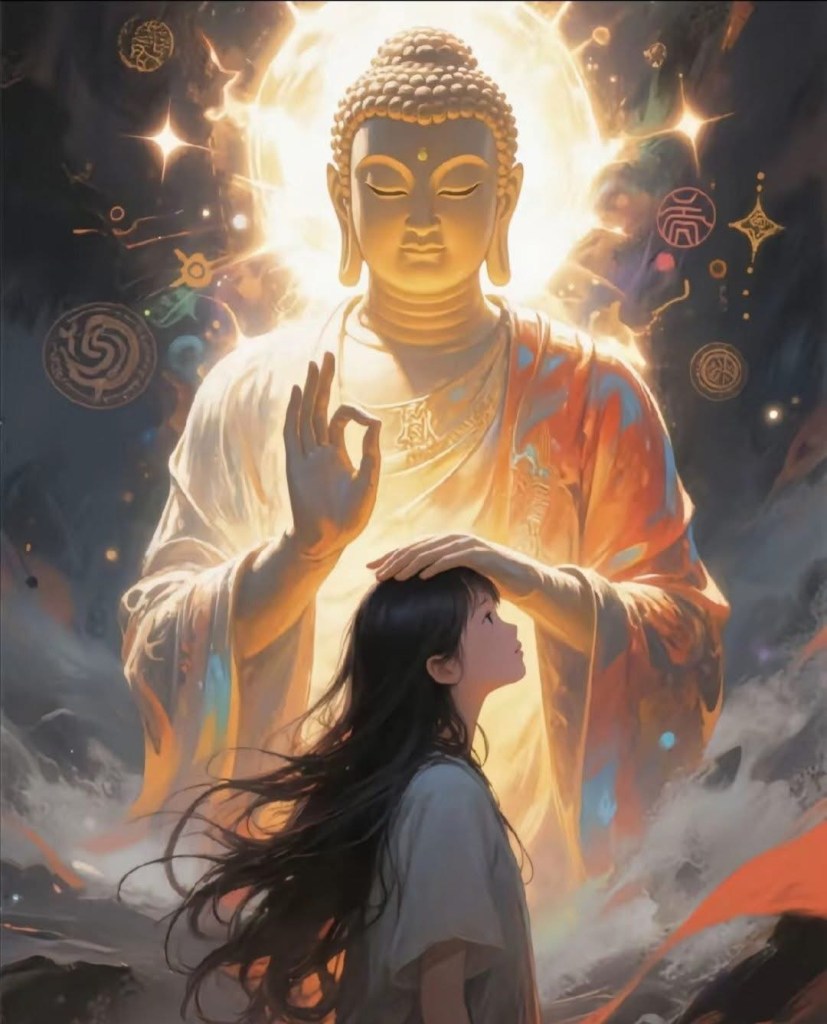
And far beyond the human world, Kwan Yin heard them.

She heard the mother who gave her last cup of water to her child.
She heard the old farmer who pretended he was not thirsty so the young might drink.
She heard the unspoken fear that soon, even hope would dry up like the riverbeds.

Kwan Yin’s heart trembled with compassion—not as a fleeting emotion, but as a boundless vow.

“I will go,” she said, “not only to give relief, but to awaken what still flows unseen.”

And so, she descended once more to the human world.

She came not as a radiant figure, but as a humble woman walking along the dusty road that led into the valley. Her robes were simple, her face serene, her steps light as though guided by something deeper than the earth beneath her.

The farmers noticed her, but paid little attention at first. Strangers came and went, and none had brought rain.

Yet she did not speak of miracles.

Instead, she walked to the driest field and knelt down, placing her hand gently upon the cracked earth. She closed her eyes, as though listening—not to the sky, but to the ground itself.

A nearby farmer approached her, shaking his head.

“There is nothing left here,” he said. “We have tried everything. Even the wells have abandoned us.”

Kwan Yin opened her eyes and looked at him—not with pity, but with a deep, steady compassion.

“Has the earth abandoned you,” she asked softly, “or have you forgotten how to listen to it?”

The farmer frowned. “What is there to hear? It is dry. It is dead.”

Kwan Yin did not argue. She simply rose and asked the villagers to gather.

When they had come, tired and uncertain, she drew a small circle in the dust.

“Bring me what water you have,” she said.

They hesitated. What she asked felt impossible. Water was no longer something to give—it was something to guard.

But something in her presence stirred trust.

One by one, they brought what little they could: a half-filled cup, a small jar, a damp cloth wrung into drops. It was not much. It was barely anything at all.

Kwan Yin poured it gently into the circle she had drawn.

“This,” she said, “is not just water. It is your willingness to share life, even in scarcity.”

Then she took a simple branch and pressed it into the center of the dampened earth.

“Now,” she said, “care for this together—not as individuals, but as one body.”

The villagers were confused, but they obeyed.

Each day, they took turns offering a few drops of water to the small patch of soil. They shaded it from the harsh sun, loosened the surrounding earth, and sat quietly beside it—some in hope, others in doubt.

Days passed.

Then one morning, a child cried out.

A small green shoot had emerged.

It was delicate, almost too fragile to see—but it was alive.

The villagers gathered around it, their hearts stirring with something they had nearly lost.

Encouraged, they continued. They began to work the land differently—not digging blindly for water, but observing the flow of wind, the shape of the land, the hidden places where moisture still lingered beneath the surface. They shared labor, tools, and knowledge. What one discovered, all learned.

And slowly, the valley began to change.

It did not happen all at once. There was no sudden storm, no dramatic flood from the heavens.

But the earth, once hardened, began to soften. Dew gathered in the early mornings. Small channels guided what little rain fell into the soil instead of letting it vanish. The fields, once abandoned, showed signs of life again.

And the farmers, who had once endured in silence, now worked together—with care, with awareness, with a renewed sense of connection.

One evening, as the sun dipped low, the farmer who had first spoken to Kwan Yin approached her again.

“Who are you?” he asked quietly. “You have not brought rain, yet you have saved us.”

Kwan Yin smiled, her gaze resting on the small green field that had begun to spread across the valley.

“I did not save you,” she said gently. “You remembered how to live—with the earth, and with one another.”

The farmer lowered his head, understanding not fully, but enough.

The next morning, she was gone.

No one saw her leave. No footsteps marked the path.

But in the center of the valley, where the first shoot had grown, they found the branch she had planted—now blossoming, though no one had seen it flower before.

From that day on, the farmers told no stories of miracles.

Instead, they spoke of listening.

They spoke of sharing even when there was little.
They spoke of the quiet wisdom of the earth.
And sometimes, when the wind moved softly across the fields at dawn, they felt a presence—not seen, not heard, but known.

As though compassion itself had once walked among them… and never truly left.

Link: https://wisdomtea.org/2026/03/19/the-dry-earth-listens/

When Anger Wears the Mask of “Protecting the Dharma” — A Reflection on My Practice

After years of practice, we often believe we are walking the right path. We may even feel completely confident in our own “devotion.” Yet sometimes, in a single moment, a line of true Dharma strikes like thunder—and we suddenly realize that all along, we have only been practicing on the surface.

Recently, while listening to Fundamental Dharma Expounded in the East, Volume 8 by Namo Dorje Chang Buddha III, I was deeply shaken. In the teaching, a disciple shared her confusion: she was extremely respectful toward the Buddhas, Bodhisattvas, and her guru, yet her practice did not truly resonate, and she gained no real benefit. In particular, whenever she saw others showing disrespect or even slandering the Buddhas and Bodhisattvas, her heart would fill with anger and aversion.

The Buddha’s teaching was like a clear mirror. It revealed not only her blind spot, but also something hidden deep within my own heart.

The Buddha compassionately taught that when facing the ignorance and slander of others, a practitioner should not give rise to anger, but to compassion.

When we see someone slandering the Buddhas and Bodhisattvas out of ignorance, we should think: “Because of her ignorance, she may fall into suffering. Her pain is also my responsibility.” This willingness to take others’ suffering as one’s own is the heart of a Bodhisattva.

Not only that—we should quietly pray for them, wishing that they awaken as soon as possible. We may even make this vow: “I must attain realization as quickly as I can, so I can help liberate her. Otherwise, how could she endure the suffering of lower realms?”

The Buddha gave the example of King Kali cutting the body. When Śākyamuni Buddha was subjected to extreme physical harm, there was not the slightest hatred in his heart. Instead, he vowed that after attaining Buddhahood, he would be the first to liberate that very person. This state—where there is no separation between self and others—is true great compassion, the genuine expression of the Four Immeasurables.

Multi-generational family sharing food and laughter at dinner table

As I listened, I broke into a cold sweat. I was reminded of something that happened in 2025, when I returned to my hometown to visit family.

At a family gathering, my cousin’s husband was filled with anger. He had suffered a stroke and complained that he had never done anything bad in his life, yet had not been protected. My cousin, who has faith in Buddhism—perhaps more from a wish for protection—kept a statue of Guanyin at home. After recovering, he angrily threw the statue onto the ground.

In that moment, a surge of anger rose within me. I felt this was a serious insult to the Buddhas and Bodhisattvas. I argued with him fiercely, my heart filled with resentment. I even thought to myself, “For someone like you, I will never dedicate blessings or prayers again.” After that, I have not contacted with them again.

What is more unsettling is that, at the time, I even felt a subtle sense of righteousness—as if I were “protecting the Dharma,” as if I were standing on principle.

Only after hearing this teaching did I truly see clearly: my anger was not for the sake of the Dharma—it came from my attachment to self.

To “protect the Dharma” without compassion is already to go astray.
The moment I gave rise to anger, refused to communicate, and gave up caring for them, I had already lost the four limitless states of mind. As the Buddha taught, if we turn away from someone, they are more likely to fall. What I thought was “holding my ground” was actually pushing away someone who needed help.

That was merely futile practice.
My mouth recited sutras and mantras, but my heart built a wall of resentment. Outwardly respectful, inwardly hardened—how could such practice bring any true benefit?

Worse still, it was faulty practice.
Facing others with anger creates no merit—it only accumulates karma.

This teaching helped me see the deepest blind spot in my practice.

I came to understand that the essence of practice is not how devout we appear on the outside, but this: when we encounter misunderstanding, slander, or ignorance, what arises in our heart—fire, or light?

Now, I feel both shame and gratitude. Shame for my ignorance and attachment, and deep gratitude for the Buddha’s teaching, which allowed me to turn back in time.

In my heart, I have quietly repented to my cousin’s husband. I have also begun again to pray for them, wishing that they may be free from suffering and awaken soon.

Practice is, in truth, a long process of “tearing down walls”—walls built from self-attachment, prejudice, and emotional reactions.

May we all, guided by the true Dharma, cleanse the dust from our hearts and cultivate a mind that is truly soft and vast—a heart that sees all beings as our own family.

Link:https://peacelilysite.com/2026/04/24/when-anger-wears-the-mask-of-protecting-the-dharma-a-reflection-on-my-practice/

No One to Blame: Understanding the Root of Anger

When Anger Has Nowhere to Stay

In our daily lives, anger often appears without invitation. A single word, a small inconvenience, or an unmet expectation can stir something deep within us. Before we realize it, the mind is no longer calm, and the heart feels as though it is burning.

There was once a woman who had a very bad temper. She often got angry over small things. Afterward, she would regret it. She knew her anger hurt others, and she truly wanted to change. But when anger came, she felt she could not control it.

One day, a friend told her, “There is a wise monk nearby. Maybe he can help you.”
So she decided to go.

When she met the monk, she told him everything—how easily she lost her temper, how much pain it caused, and how helpless she felt. She hoped he would give her some advice.

Elder woman talking to a Buddhist monk inside a temple with statues and worshippers in the background

The monk listened quietly. When she finished, he said nothing. He simply led her to a small room, stepped outside, and closed the door.

Soon she realized—the door was locked.

At first, she was confused. Then she became angry.

“I came here for help, and he locks me in?” she thought.

The room was dark and cold. The more she thought about it, the angrier she became. She started shouting, knocking on the door, and scolding the monk loudly.

But there was no answer.

No matter how much she shouted, the monk did not respond.

After a long time, she became tired. Her voice grew quiet.

Then the monk asked from outside, “Are you still angry?”

She said, “I’m angry at myself! Why did I come here?”

The monk replied, “If you cannot forgive yourself, how will you forgive others?” Then he left.

The room became quiet again.

After some time, the monk returned and asked, “Are you still angry?”

She said, “No, I’m not angry anymore.”

“Why?” he asked.

She said, “What’s the use of being angry? I’m still stuck in this dark, cold room.”

Her anger had weakened, but it was still there.

Later, when the monk asked again, she said, “I’m not angry anymore, because you are not worth my anger.”

The monk said, “The root of your anger is still there. You have not let it go.”

His words stayed in her mind.

After a long silence, she asked, “Can you tell me—what is anger?”

This time, the monk came to the door. He did not speak. He simply poured the tea in his cup onto the ground.

The woman watched quietly.

Suddenly, she understood.

“If I do not get angry, where does anger come from?” she thought.
“If my mind is clear, what is there to be angry about?”

At that moment, she saw the truth: anger does not come from others. It comes from our own mind.

From the teaching of Gautama Buddha, we learn that anger arises when the mind is not open—when we hold on too tightly to our own thoughts, feelings, and expectations.

If we do not hold onto anger, it cannot stay.

In our daily life, anger often feels very real. We think others cause it. But if we look carefully, we see that it begins inside us.

When anger comes, we can pause and ask:
Why am I reacting this way?
What am I holding onto?
Can I let it go?

If we become more patient, more tolerant, and more willing to step back, anger will slowly lose its power.

Letting go of anger does not make us weak. It frees us.

When we put down the fire in our heart, we will see that things are not as bad as we thought. Other people are not as terrible as we imagined.

In the end, the lesson is simple:

If we do not create anger, it has nowhere to stay.

Link:https://peacelilysite.com/2026/04/21/no-one-to-blame-understanding-the-root-of-anger/

When Practice Becomes Real: Aligning Our Three Karmas with the True Master

In the path of cultivation, many of us begin with sincerity. We read the teachings, we listen, we reflect, and we believe that we are walking the path correctly. Yet a profound question remains:

Why is it that among so many practitioners, so few truly attain realization?

Photo taken in 1999. Elder Dharma King Dorje Losang (191?-2004) was a disciple of H.H. Dorje Chang Buddha III Wan Ko Yeshe Norbu (Great Dharma King Buddha Yangwo Yisinubu).

In a teaching given by Elder Monk Dorje Losang at Bodhi Monastery, a direct and uncompromising answer is offered. There are only two fundamental reasons.

First, one has not followed a true Master—one who is the incarnation of a Buddha or Bodhisattva—and therefore has not received the true Buddha-dharma, but only its outer forms, theories, or popular interpretations.

Second, even if one is fortunate enough to follow a true Master and has encountered the authentic Dharma, one’s three karmas—conduct, speech, and thought—do not truly correspond with the Master’s teachings. In this case, cultivation becomes superficial. Without true alignment, there can be no liberation, no genuine blessings, and no escape from the cycle of birth and death.

This teaching is simple, yet deeply penetrating.

It reminds us that the path is not only about what we learn—but how we live.

True devotion is not merely a feeling. It is expressed through what is called the “Four States of Corresponding”: unwavering loyalty, constancy without change, placing nothing above the Master and the Three Jewels, and reaching complete, wholehearted devotion. Only when these are truly practiced can one’s three karmas fully align.

And yet, for many of us, the challenge lies not in understanding these principles—but in applying them in the smallest moments of daily life.

A story shared by lay practitioner Wang Yuxiang offers a powerful reflection.

On an ordinary day, she decided to prepare steamed dumplings as an offering to her Master, H.H. Dorje Chang Buddha III. Her heart was joyful, filled with the intention to make a sincere offering.

As she prepared the filling, she followed a habit formed over years of cooking at home—she tasted a small portion to check the seasoning, then returned it to the mixture. It was a simple, unconscious action, something she had done countless times before.

But this time, it was different.

In that very moment, something unexpected occurred. A sealed bottle of soy sauce suddenly fell and shattered, creating a loud and startling crash. Shocked, she immediately realized her mistake.

Young woman with a bleeding cut on her foot from broken glass on the floor

This was not food for herself or her family.
This was an offering.

With deep remorse, she repented sincerely, recognizing her lack of mindfulness and reverence. Her tears flowed uncontrollably—not out of fear, but from a genuine awareness of having fallen short in her devotion.

Soon after, she discovered that her foot had been pierced by a sharp piece of glass, causing significant bleeding. Yet despite the injury, her only concern was not to delay her Master’s meal. She endured the pain, completed the offering, and only afterward returned home to tend to her wound.

And then, something extraordinary happened.

The wound—deep, bleeding, and undeniable—had completely disappeared. There was no scar, no swelling, no trace it had ever existed.

To many, such an account may seem difficult to comprehend. But beyond the event itself lies its deeper meaning.

Through this experience, she came to a clear realization: cultivation is not an abstract concept—it is present in every thought, every word, every action.

Even a small, habitual act, when lacking mindfulness and reverence, reveals a gap between one’s intention and one’s actual state of alignment.

From a Buddhist perspective, this story is not merely about a “miracle,” but about cause and condition, sincerity and response.

When one’s mind deviates, even subtly, there is consequence.
When one repents with genuine sincerity, there is also transformation.

More importantly, it reminds us that following a true Master is an immense blessing—but it also carries profound responsibility.

It is not enough to say we believe.
It is not enough to feel devotion in our hearts.

Our three karmas must align—completely, precisely, and without compromise.

Not only in great matters, but in the smallest details of daily life.

How we speak.
How we act.
What thoughts we allow to arise.

Because it is in these subtle moments that our true state is revealed.

If we treat ordinary matters casually, how can we claim sincerity in sacred ones?

If our habits remain unchanged, how can transformation occur?

The path of cultivation is, in truth, very direct.

When the Dharma is true, and when one’s devotion is unwavering, Elder Monk Dorje Losang teaches that liberation can be “as easy as turning over one’s hand.”

But if our practice remains external, if our alignment is incomplete, then no matter how long we cultivate, the result will remain distant.

This is both a warning and a profound encouragement.

It tells us that the path is not far away.
It is right here, in this very moment.

In every thought we choose.
In every word we speak.
In every action we take.

To truly align our three karmas is not something abstract—it is something we practice now.

Quietly.
Sincerely.
Completely.

And perhaps, in that sincerity, the path will naturally unfold.

For full lecture Given by Elder Monk Dorje Losang at Bodhi Monastery, please click here.

For the full account by lay practitioner Wang Yuxiang please refer to  H.H. Dorje Chang Buddha III — A Treasury of True Buddha-Dharma**, pp. 187-189.**

Link:https://peacelilysite.com/2026/04/17/when-practice-becomes-real-aligning-our-three-karmas-with-the-true-master/

Where Compassion Lands: The Silent Rescue of a Hive

Two beekeepers in protective suits collecting honey from a large hanging hive at sunset

When a Home Was Lost, Compassion Found a Way—A Quiet Act That Redefined the Value of Every Living Being

There are moments in life when compassion is no longer an idea, but a living force—quiet, unwavering, and profoundly transformative.

This is the story of such a moment.

Shared by lay practitioner Qi Pengzhi(戚鹏直), it recounts an act of extraordinary care by Namo Dorje Chang Buddha III and Namo Yuhua Shouzhi Wang Buddha Mother—an act not directed toward kings or crowds, but toward a fragile colony of bees, hidden on the rooftop of an ordinary home.

It was 2011, a year marked by an unexpected turning point. The house in which they resided had been sold, and the new owner intended to demolish it. Time was short. Departure was inevitable.

And yet, above their heads, life was quietly unfolding.

A vast hive of bees had taken refuge beneath the roof—thousands of tiny lives bound together in delicate harmony. To most, this would have been an inconvenience, perhaps even a nuisance. The simplest solution, as suggested by the landlord, was extermination.

But compassion does not choose the convenient path.

“Under no circumstances should they be harmed,” came the firm and gentle instruction. “Their lives are no different from ours.”

In that moment, the fate of the hive was no longer incidental—it became a responsibility.

What followed was not a symbolic gesture, but a meticulous and determined effort. Beekeeping specialists were consulted. Plans were drawn. A new hive was carefully constructed in advance, shaped not by haste but by respect for the natural rhythms of the bees.

Time pressed on. The day of relocation arrived.

There is a quiet tension in handling something so easily broken. Bees do not understand human urgency; they respond only to the subtle language of instinct and survival. At the heart of their world lies the queen—without her, the colony dissolves into silence.

So every movement mattered.

The disciples stood watch as professionals gently removed the hive from the rooftop. No detail was overlooked. No life dismissed as insignificant. It was a scene both practical and deeply reverent—an unspoken recognition that even the smallest existence carries its own dignity.

Yet the journey did not end with removal.

True compassion does not abandon halfway.

They followed the bees—literally—escorting them to their new home. The destination was a secluded mountainside, where wildflowers stretched across the land and human disturbance faded into absence. It was a place where life could continue as it was meant to: freely, quietly, and whole.

Only after ensuring the bees were safely settled did they return.

What remains is not merely the memory of an act, but the echo of its meaning.

Knight resting against a maiden inside a glowing magical shield protecting them from dark and fiery creatures

In an age where humanity grapples with ecological imbalance, the significance of such care becomes ever more apparent. Bees, as science now repeatedly reminds us, are vital to the continuity of life. Their silent labor sustains ecosystems, nourishes crops, and binds the intricate web of nature together.

To protect them is, in truth, to protect ourselves.

And yet, beyond science, there is a deeper understanding—one that transcends utility.

It is the recognition that life, in all its forms, is not hierarchical but shared.

That the boundary between “us” and “them” is far thinner than we imagine.

That a single act of protection, offered without condition, can restore a fragment of harmony to a fractured world.

Perhaps true compassion is not measured by grand gestures, but by the willingness to pause… to notice… and to protect even that which the world has overlooked.

On a rooftop, in a fleeting moment before demolition, a choice was made.

Not to destroy—but to preserve.

Not to disregard—but to honor.

And in that choice, something far greater than a hive was saved.

This post is translated and edited from Interview with a Buddhist Disciple (64): AM1300 Chinese Radio Station – Exclusive Interview with U.S. Layman Qi Pengzhi 《佛弟子訪談(六十四):AM1300中文廣播電臺-專訪美國 戚朋直居士》 by Linda Chang. For original records, please click here.

Click here to Wikitia page on H.H. Dorje Chang Buddha III that list major accomplishments and teachings with links.

Link:https://peacelilysite.com/2026/04/09/where-compassion-lands-the-silent-rescue-of-a-hive/

A Glimpse Beyond the Ordinary: Faith, Humility, and the Inconceivable

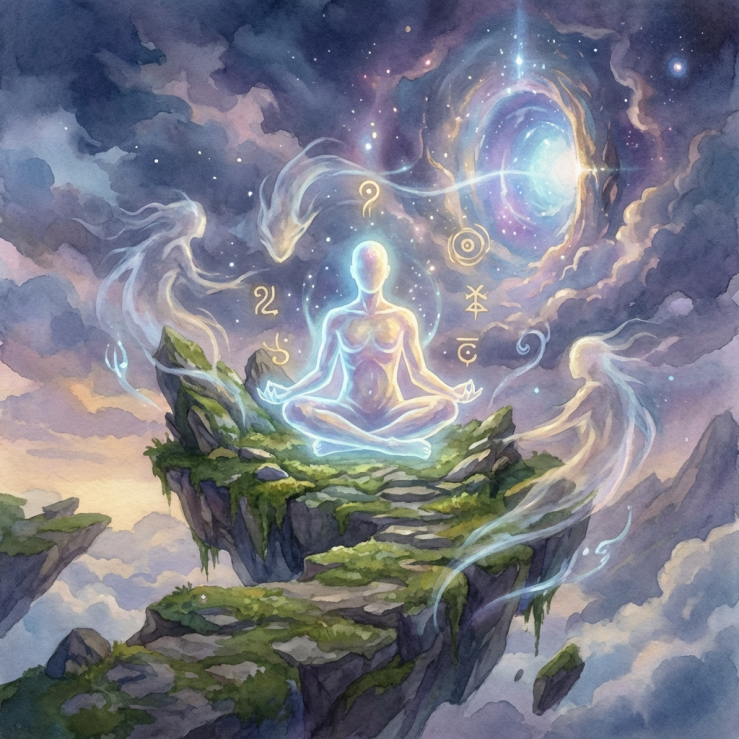
Glowing figure meditating on a floating island surrounded by ethereal spirits and cosmic energy.

The following account is excerpted from a post published by Holy Miracles Temple on April 15, 2022, titled “Recent Talk Records of Venerable Zhai Mang.”

Sometimes, in the course of spiritual practice, there are moments that quietly remind us how limited our ordinary understanding truly is. What we see, hear, and reason through the lens of everyday experience may only be a small fragment of a far greater reality.

Venerable Zhai Mang once shared a personal experience that deeply illustrates this truth.

In January 1996, he accompanied the Buddha and the Holy Mother to Shenzhen. At that time, Brother Li Dehe, the general manager of the Luohu Hotel, arranged a temporary Dharma altar on the 16th floor, where teachings were given and disciples gathered.

One day around noon, it was time to invite the Buddha and the Holy Mother for a meal. Yet, to everyone’s surprise, the Buddha could not be found.

Venerable Zhai Mang went up to the altar to look—no one was there. Another disciple went, and then another. Each time, the result was the same: the room was empty.

Finally, Sister Liu Ge went to check. Unlike the others, she did not leave immediately. She stood quietly by the doorway, facing a large mirror. Behind her was a sealed window, reflected clearly in the glass.

Then, something extraordinary happened.

In the mirror, she suddenly saw a foot appear near the window—seemingly out of nowhere. In the next moment, she witnessed the Buddha step into the room from midair.

Startled beyond words, she cried out.

Everyone rushed over. Inside the altar, the Buddha was already seated calmly, as if nothing unusual had occurred. Sister Liu Ge then recounted what she had just witnessed.

When sharing this story, Venerable Zhai Mang did not focus on the miraculous itself. Instead, he pointed to something far more important.

In simple terms, he reminded us: the realization and abilities of the Buddha and the Holy Mother are beyond the comprehension of ordinary minds. Trying to measure the enlightened with our limited understanding is like trying to contain the vast sky within the palm of a hand.

What, then, should we do?

Not to speculate. Not to doubt blindly.
But to turn inward.

With sincerity, we reflect on ourselves. With humility, we cultivate. With a heart of repentance and reverence, we create the conditions to receive true guidance.

Moments like this are not merely stories of the extraordinary. They are gentle awakenings—reminding us that the path of spiritual practice is not built on curiosity about miracles, but on the transformation of our own hearts.

In a world that often demands proof for everything, perhaps the deeper wisdom lies in recognizing what cannot be fully explained, yet can be quietly felt.

To walk the path is to let go of arrogance, to open the heart, and to trust that there are dimensions of truth far beyond what we can see.

And perhaps, when the mind becomes still and sincere, what once seemed unimaginable may no longer feel so distant.

The Legacy of Venerable Denma Tsemang

Venerable Denma Tsemang was one of the twenty-five great Dedengbas under Guru Padmasambhava when he journeyed to Tibet over a thousand years ago to spread the Dharma. During that same period, Shakyamuni Buddha dispatched Denma Tsemang to descend into this world to assist Guru Padmasambhava in propagating the Buddha-Dharma.

According to the traditional biographies of Guru Padmasambhava’s twenty-five foremost disciples, Denma Tsemang was highly accomplished in transcription and writing. He possessed extraordinary wisdom and was especially skilled in translation. Under the guidance of the great ācārya Guru Padmasambhava, he received numerous esoteric teachings, including secret mantras and profound Dharma instructions.

He attained remarkable realization, great spiritual powers, abundant merit, and deep wisdom. It is said that he never forgot any teaching he received, retaining everything completely. Many important terma (hidden treasure texts), including the Collection of Eight Sadhana Teachings, were transcribed by him. In addition, Denma Tsemang, together with other great Bodhisattvas, participated in translating the sutras and treatises contained within the Tripitaka.

In this present lifetime, Denma Tsemang has reincarnated as H.E. Longzhi Tanpe Nyima, a devoted disciple of H.H. Dorje Chang Buddha III. He remains by His Holiness’s side throughout the year, serving as an attendant with unwavering dedication.

His strengths in this life closely mirror those of his previous incarnation. He diligently transcribes and organizes the recorded Dharma discourses of H.H. Dorje Chang Buddha III, preserving these teachings for the benefit of future generations.

During a sacred inner tantric initiation known as “Drawing Lots from a Golden Vase and Casting a Lot,” performed personally by H.H. Dorje Chang Buddha III, the lot revealed the mandala of Guhyapada Vajra—a powerful vajra being of immense spiritual strength. Following this, he demonstrated extraordinary ability by telekinetically moving a vajra pill, clearly revealing the level of realization of a true reincarnated great Dedengba.

Yet despite these remarkable signs, H.E. Longzhi Tanpe Nyima humbly said:

“I am just a Buddhist disciple sincerely cultivating myself.”

Link:https://peacelilysite.com/2026/04/03/a-glimpse-beyond-the-ordinary-faith-humility-and-the-inconceivable/

A Bucket of Water, A Lifetime of Karma: A Story of Cause and Effect

During the time of Shakyamuni Buddha, there was a day when the Buddha was giving teachings to his disciples. In the middle of the discourse, he suddenly turned to Ananda and said:

“Take a bucket and go to a small village about five miles ahead. There, you will find an elderly woman washing clothes by a well. Ask her for a bucket of water—and remember to be polite and kind.”

Ananda respectfully nodded and set off with confidence. Such a simple task, he thought. Surely, it would be completed without difficulty.

When Ananda arrived at the village, he indeed found a gray-haired elderly woman by the well. With sincerity and respect, he bowed and said:

“Dear elder, may I please have a bucket of water?”

To his surprise, the woman looked up at him with irritation. Her expression hardened, and she replied sharply:

“No! This well is only for the people of this village. Outsiders are not allowed to use it!”

No matter how politely Ananda pleaded, she refused. Helpless, he returned empty-handed.

Back before the Buddha, Ananda recounted everything that had happened. The Buddha simply nodded and asked him to sit down. Then he turned to another disciple—Sariputra—and gave him the same instruction.

A Completely Different Outcome

Sariputra walked the same path and arrived at the same village. The same elderly woman was still there, washing clothes by the well.

He approached her with equal politeness:

“Dear elder, may I ask for a bucket of water?”

This time, something remarkable happened.

The woman looked up—and her face lit up with warmth and joy, as if she had just met a long-lost relative.

“Of course! Of course!” she said happily. “Come, let me draw the water for you.”

Not only did she fill a bucket for him, but she also insisted he wait. She hurried home and brought back some food, urging him to take it along for his journey.

Sariputra returned with a full bucket—and a heart full of wonder.

The disciples were puzzled. How could the same request, from two equally respectful monks, lead to such completely different outcomes?

They turned to the Buddha and asked for an explanation.


The Buddha revealed:

“In a distant past life, this elderly woman had been reborn as a mouse. One day, she died by the roadside, her body exposed under the burning sun.

At that time, Ananda was a traveling merchant. When he saw the dead mouse, he felt disgust and turned away, covering his nose as he passed.

Sariputra, on the other hand, was a scholar on his way to an important examination. When he saw the same mouse, he felt compassion. He gently covered the body with some earth, offering it a small act of dignity.

After countless lifetimes, the causes they planted ripened into the results you see today.”

This story reveals a profound truth:

Even the smallest thought—whether of kindness or indifference—can plant seeds that shape our future.

Ananda did not commit a great wrong; he simply turned away in aversion. Sariputra did not perform a grand act; he simply offered a moment of compassion. Yet the results, across time, were vastly different.

If such a small moment can create such powerful consequences, how much more impact do our daily actions have?

Every word we speak, every thought we nurture, every action we take—these are all seeds of karma.

To harm others is to plant suffering for ourselves.
To act with kindness is to cultivate blessings we may one day receive.

In our daily lives, we may not notice the immediate results of our actions. But the law of cause and effect is always at work—quietly, patiently, unfailingly.

So let us remember:

  • Avoid harming others
  • Practice kindness whenever possible
  • Build connections rooted in goodwill

Because even a single moment of compassion…
may one day return to us as unexpected grace.

Link:https://peacelilysite.com/2026/03/26/a-bucket-of-water-a-lifetime-of-karma-a-story-of-cause-and-effect/

From Palace Walls to Boundless Freedom

There is a story from the time of Gautama Buddha that beautifully reveals what true happiness really means.

After the Buddha renounced royal life and attained enlightenment, his son, Rahula, followed his path and became a monastic as well. Seeing both his son and grandson leave the palace, the king—concerned that the royal lineage would end—appointed a relative named Bhaddiya as the new ruler.

However, not long after ascending the throne, Bhaddiya witnessed the instability and danger that accompanied power. Before the kingdom was overtaken by enemies, he too chose to renounce worldly life and became a disciple of the Buddha.

From that point on, Bhaddiya devoted himself wholeheartedly to spiritual practice. Yet, something curious caught the attention of the other monks: every day, he would joyfully proclaim three times,
“I am truly happy! I am truly happy! I am truly happy!”

Hearing this, some monks misunderstood him. They wondered if he was still attached to the pleasures of his former life as a king, and reported their concerns to the Buddha.

To clarify the truth, the Buddha gathered the community and gently asked Bhaddiya,
“Do you still long for the happiness you once had as a king?”

Bhaddiya replied,
“World-Honored One, I do not recall those pleasures at all.”

The Buddha then asked,
“Then why do you proclaim your happiness three times each day? What is this happiness you speak of?”

Bhaddiya answered with sincerity:

“When I was a king, my palace was guarded day and night by layers of soldiers. Yet despite all that protection, my heart was never at peace. Every sound in the night startled me. I lived in constant fear—afraid of rebellion, invasion, and loss. I was surrounded by luxury, but I had no freedom, no true rest.

Now, as a monastic, I eat one simple meal a day. I sit beneath the open sky, resting under trees. I hear no anxious signals in the night, and I live in harmony with nature. My heart is free from worry, free from attachment. I have nothing, yet I lack nothing. This is my true happiness.

Out of gratitude for the Buddha, who showed me this path to freedom, I proclaim my joy each day.”

This story invites us to reconsider what happiness truly means.

Is happiness found in what we possess—or in what we are no longer bound by?

So often, we chase success, security, and recognition, believing they will bring us peace. Yet, like King Bhaddiya, we may find that the more we accumulate, the more we have to fear losing.

True happiness does not arise from external conditions, but from inner freedom—
a mind unburdened, a heart at ease, and a life aligned with simplicity and clarity.

Perhaps real happiness begins not when we gain more,
but when we finally learn to let go.

Link:https://peacelilysite.com/2026/03/20/from-palace-walls-to-boundless-freedom/

Two Stories, One Truth: How Kindness Can Save You When It Matters Most

In 1925, the lay practitioner Zhou Qunzheng made a pilgrimage to Mount Putuo together with Master Hongyi (弘一). At the Zhoushan pier, they encountered a monk. Upon learning that the monk was from the same hometown, Zhou asked him, “What inspired you to leave the household life and become a monk?”

The monk replied:

“I was originally a soldier. One day, I saw a shopkeeper’s wife sitting on the street, weeping. I asked her what had happened. She said a customer had come into her shop, bought something, and paid with three silver coins. After he left, she discovered that all three coins were counterfeit. She feared her husband would scold her, so she cried in distress.

I couldn’t bear to see her suffering, so I took out three genuine silver coins and offered to exchange them with her. She refused, but I insisted and eventually made the exchange.

Later, during a battle, a shell exploded right beside me. Shrapnel struck my chest, yet I was unharmed. When I looked closely, I realized that the three counterfeit coins in my pocket had saved my life—two had been pierced by the shrapnel, and one remained intact. It was because they shielded me that I survived without injury.

After that, I thought to myself: what meaning is there in spending the rest of my life amid gunfire and danger? So I chose to leave the worldly life and become a monk…”

Therefore, do not think that constantly encouraging others to do good deeds and accumulate virtue is merely empty, repetitive talk. Sometimes, you have no idea how much misfortune your blessings have already shielded you from.

Behind every day that you return home safely, how much of it is because “before blessings fully arrive, calamities have already been kept at a distance”?

To practice kindness and accumulate virtue—it is never too late.

He built a road for others, and unknowingly paved one for himself

In 2014, in a remote village in Guangxi(广西)China, a 44-year-old man named Huang Yuanfeng was diagnosed with terminal liver cancer. Doctors told him the reality: without treatment, he might live only three months; with treatment, perhaps a few more years—but at the cost of his family’s entire savings of 170,000 yuan.

Most people would have chosen to fight for their own survival.

But Huang made a different decision.

Looking at the muddy, nearly impassable road in his village—a road that trapped children at home during rainy days and left crops to rot—he chose to spend all his savings not on treatment, but on building a road for everyone.

When the money ran short, he borrowed more from neighbors, making a solemn promise: “Even if I die, my son will repay you.”

Against all odds, the road was completed. It transformed the village, bringing in visitors, creating opportunities, and improving countless lives.

But what happened next was even more astonishing.

When Huang returned to the hospital for a check-up, his condition had not worsened—in fact, it had stabilized, even improved. What seemed like a certain end became an unexpected turning point.

His story carries a simple but powerful truth:

Kindness is never lost.
The good you do for others may one day return to protect you—especially in life’s most dangerous moments.

Link:https://peacelilysite.com/2026/03/16/two-stories-one-truth-how-kindness-can-save-you-when-it-matters-most/

150. The Story of Sañjīva [Sañjīva-Jātaka]

When the Buddha was in Jetavanārāma, the king Ajātasattu was friendly with Devadatta. Even though unrighteous and sinful, Ajātasattu was pleased with him. He built for Devadatta a temple in Gayāsīsa, which he gave to him. And he assisted him by giving him all the necessary perquisites. In the meantime, following Devadatta’s words, he sent the elephant NāÀāgiri to kill the Buddha and he sent bowmen to shoot at the Buddha. Many bad things such as these were done by him. After that, his father who was a very righteous king and who was one who had attained the stream entrance state of mind [sotāpanna], was killed by him through the persuasion of Devadatta.

Later, he heard that Devadatta had died and had gone to hell sinking down through the earth. On hearing this, he became afraid for his life believing that if anything happened to Devadatta, no doubt it would happen to him, too. He was very much afraid day and night. He spent the daytime in the routine activities of his daily life. But at night, when he went to bed, he dreamed that he was falling through the earth that had opened up and was shooting forth the fires of hell. From this, he became even more afraid as if he were a chicken that had its neck twisted and had been thrown into the hot sun to die. In this way, he suffered day and night despite his royal luxuries.

He had a keen interest in questioning the Buddha about the dream he was having, but he was reluctant to express that interest to Jīvaka. One day he saw the moonlight bright as if it were daylight, and he said to his minister Jīvaka, “The moonlight is so clear that one can see the distance of forty- five arrow shots as if it were daytime. It is not good to waste our time by staying here. This night is pleasant, calm, attractive, and beautiful. Let us go to a good ascetic, to someone like that, to listen to the Dhamma. I have now such an intention. Do you know to whom we can go?” The other ministers who heard him started to mention the names of the various religious masters to whom they each paid obeisance. Most of them were NigaÏæha-s. One minister said, “There is the ascetic PūraÏa Kassapa. He is a Buddha. Let us go to see him.” Another minister said, “It would be good to go to the Buddha Makkhali Gosāla.” Another minister said, “Instead of going to him, let us go to the Buddha Ajita Keśakambala.” Then some other minister wanted to go to the Buddha Kakudha Kaccāyana. After, another said, “I think it would be good to go to the Buddha Sañjaya Belaææhiputta.” The sixth one said, “I suggest that more than any other Buddha, NigaÏæha Nāthaputta is the best one to whom to go.”

In this way, all the ministers said what they thought, mentioning various NigaÏæha-s, all of who were like children [with regard to spiritual advancement]. The king did not listen to them seriously, thinking, “No doubt Jīvaka will respond  to  my  question.”   But  Jīvaka  was  silent.

Understanding his silence, the king addressed Jīvaka. He asked, “Jīvaka, these people are all praising their own Buddha-s whom each of them follows. Why do you not say something? Do you have no such a Buddha?”

Jīvaka heard this and got up from his seat. He paid respect toward the direction in which the Buddha was, and he recited the nine-fold virtuousness of the Buddha. He said, “Such a virtuous, omnipresent one is now living in my mango park followed by 1,800 monks. Therefore, I suggest that it would be good for your lordship to go there.”

On listening to him, the king said, “It is wonderful. Let us go there.” And he made arrangements to go there by elephants together with his retinue. He went to the Buddha in royal magnificence. He approached the Buddha’s residence and dismounted his elephant. He then came to the followers of the Buddha who were wearing neat and clean clothes, who had tranquil faculties, who all were seated still with arms and feet close to their bodies, and of whom not even one sneezed or coughed. He was very pleased by seeing this. First he paid his respects to the monks, and then to the Buddha. He sat down and said, “Sir, I would like to ask a question.” “Well, your lordship, ask your question.” Then the king said, “Venerable sir, what is the result that one can gain by being a monk?” The Buddha said the discourse called the Sāmaññaphala Sutta divided into two sections [bhāÏavāra-s] and into 500 points to be explained [grantha-s].23

After this preaching, Ajātasattu knelt down in the presence of the Buddha to pay his respect and said, “Revered sir, please excuse my wrong deeds that I have done out of ignorance.” Buddha accepted his apology, and the king went away.

Then the Buddha addressed the monks, saying, “Oh monks, this King Ajātasattu by being associated with a bad person both killed his father and at the same time ruined his chance for future salvation. If he did not do so, he would today be one who has entered into the stream entrance state of mind [sotāpanna].”

The next day, the monks assembled in the preaching hall were discussing how King Ajātasattu had lost his good fortune to become a Sotāpanna. The fully enlightened one entered the preaching hall then and asked the monks, “Oh monks, what were you discussing before I came here?” The monks mentioned the previous day’s incident. And the Buddha said, “Oh monks, not only in this life but even in the past, Ajātasattu by associating with evil ones created for himself misfortune.” The monks invited the Buddha to disclose the past story.

“At one time, when King Brahmadatta was ruling in Benares, the Enlightenment Being was born in a Brahmin family in that city. When he was grown, he went to a well- known teacher who used to teach in the city and began to study under him. After studying under him, he started to teach students on his own.

“While he was teaching students like this, he had a student named Sañjīvaka. He taught him a spell that could be used to bring the dead to life. And when they gain life, they can walk—but only a short distance. He did not teach him the spell to immobilize them if they come near.

“Once, that student went with a group of other students to fetch firewood from the forest. On their way, they saw a dead tiger on the ground. Sañjīvaka said to the other students, ‘Do you want to see my power? I will bring this tiger back to life.’ The other students said, ‘How can you bring a dead being back to life? It will never happen.’ Sañjīvaka said, ‘Just look at what I do.’ And he started to recite the spell. The other students said, ‘Who knows what will happen!’ And they climbed up trees.

“While Sañjīvaka was repeating the spell, he threw some pebbles toward the dead body of the tiger. When he was throwing the pebbles, the tiger started to get up. He came forward, and jumping up on the very person who was chanting the spell, he killed him. The tiger that had been brought back to life also fell dead at that spot.

“The other students collected the firewood and returned to where they were studying. They told the teacher what had happened. On hearing the news, the teacher said to the students, “It is not good to help an evil friend. If you do so, such is the result.” And he advised them to live generous and peaceful lives. He himself lived such a life, did many meritorious deeds, and acquired much merit. At the end of his life he died, and was born in heaven.

“Sañjīvaka was King Ajātasattu at that time. The teacher of Benares was I who have become the Buddha.” In this way, the Buddha ended the story of Sañjīva.

23 The Sāmaññaphala Sutta is to be found in the Dīghanikāya, but it is not divided there into two sections.

The moral: “Choose your friends wisely.”

150. The Story of Sañjīva [Sañjīva-Jātaka]

Link: https://hhdorjechangbuddhaiiiinfo.com/2026/01/27/150-the-story-of-sanjiva-sanjiva-jataka/

#Buddhisttalesforyoungandold #Buddhiststories #storiesforkids #moralstories #Buddha #Jatakastories #PansiyaPanasJataka #JatakaTalesofSakyamuniBuddha #JatakaTales #SakyamuniBuddha’sPast