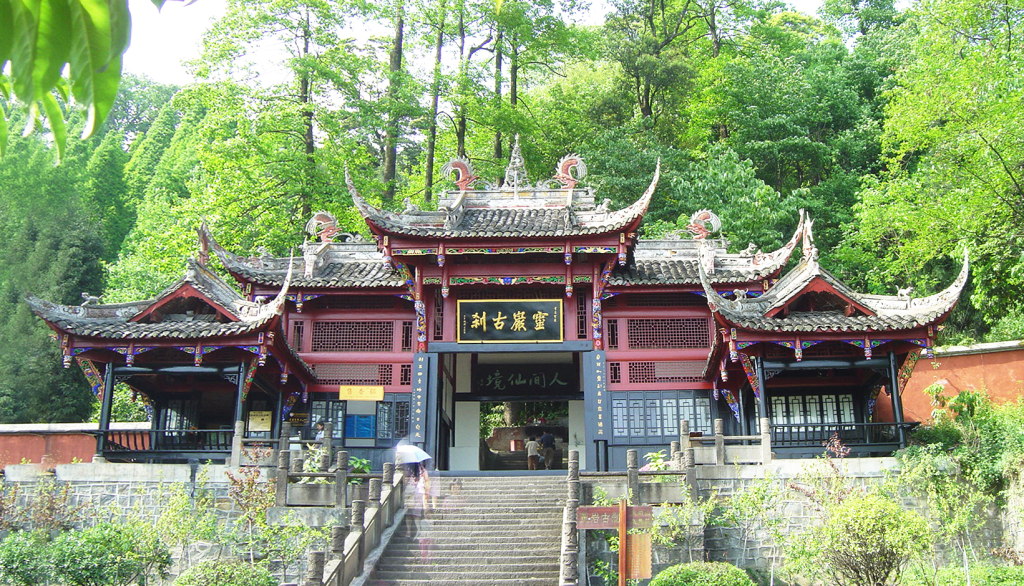
Located in the northwest of Mount Tai, Lingyan Temple was founded during the Eastern Jin Dynasty and boasts a history of over 1,600 years. It is regarded as one of the most important sacred sites of Chinese Buddhist culture. Since the Tang Dynasty, Lingyan Temple has enjoyed great renown, and together with Qixia Temple in Nanjing, Guoqing Temple on Mount Tiantai in Zhejiang, and Yuquan Temple in Dangyang, Hubei, it has been hailed as one of the “Four Great Temples of China.” The eminent monk Tang Xuanzang once resided here to translate Buddhist scriptures. From Emperor Gaozong of Tang onward, many emperors stopped to worship at this temple on their way to perform imperial rites at Mount Tai, a testament to its revered historical status.
Although I personally prefer the majestic beauty of untouched natural landscapes, I was deeply moved by the profound cultural and religious artistry of Lingyan Temple. Within the temple grounds, ancient trees such as Chinese wingnut, cypress, and banyan rise skyward, creating a tranquil and sacred atmosphere. As an integral part of the World Natural and Cultural Heritage site of Mount Tai, Lingyan Temple is especially renowned for its colored clay sculptures of Arhats, which hold a prominent place in the history of Chinese sculpture.
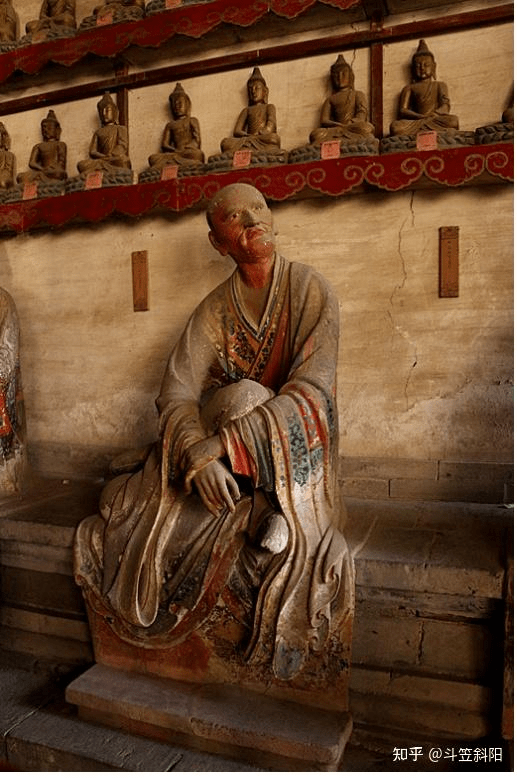
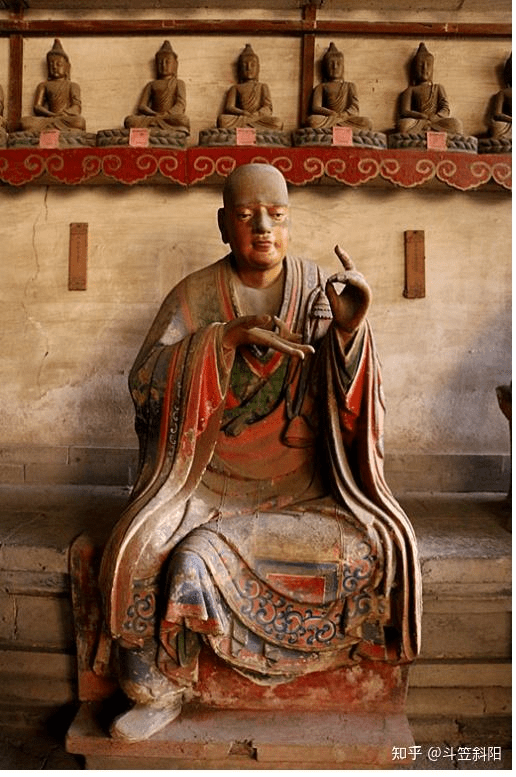
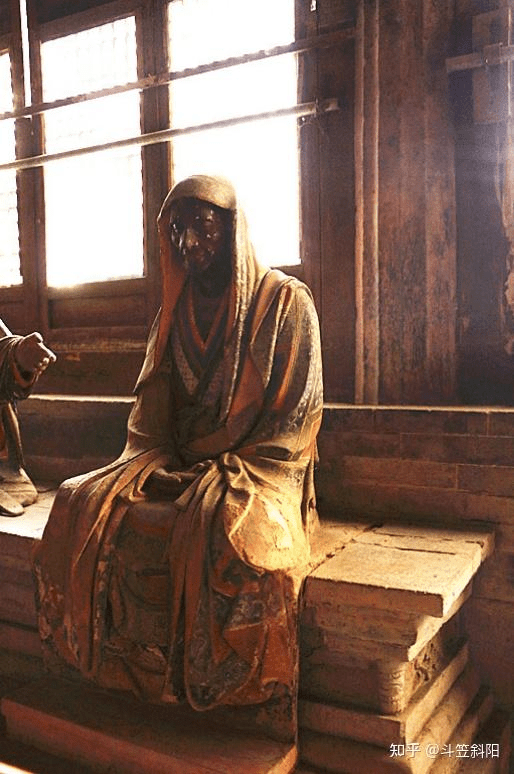
Stepping into the solemn Thousand Buddha Hall, one is struck by the breathtaking sight of the Arhat statues—40 lifelike clay figures arranged in a semicircle along the inner walls. Among them, 29 represent disciples of Shakyamuni and Indian masters such as Bodhidharma and Kumarajiva. The remaining 11 depict eminent Chinese monks, including Huiyuan, Huike, Huichong, and various abbots of Lingyan Temple. According to inscriptions and scholarly research, the original set consisted of 32 statues, first created in the third year of the Zhiping reign of Emperor Yingzong of the Song Dynasty (1066). Additional painting and sculpting were done in the first year of the Zhiyuan reign (1328) during the Yuan Dynasty. The Thousand Buddha Hall was renovated in the 15th year of the Wanli reign (1587) in the Ming Dynasty, at which time the number of Arhats was increased to 40. The final touch-up was completed in the 13th year of the Tongzhi reign (1874) of the Qing Dynasty.
Each statue stands about 1.6 meters tall and is seated on a waist-high brick pedestal roughly 80 centimeters in height, with the top of each statue rising 105 to 110 centimeters above the seat. The overall sculptural style is remarkably realistic, emphasizing the individuality and inner spirit of each figure: square faces, prominent noses, distinct facial features, and dynamic, textured robe patterns. The ancient artisans broke away from conventional, stylized Buddhist iconography and instead grounded their work in real life, endowing each Arhat with unique expressions and postures—some sit in meditation, others clasp their hands or hold staffs; some appear ragged and emaciated, while others exude noble dignity and elegance. Each figure is infused with spirit and personality, appearing almost alive, as if they might speak or move at any moment.
What’s even more astonishing is the meticulous attention to detail in both facial expressions and bodily movement, as well as the relationship between the robes and the human form. The flowing lines of the garments, the way the folds respond to motion, and the tactile quality of the fabric all reflect a masterful understanding of form and rhythm. One medical expert even remarked that, “Through the Arhats’ robes, one can perceive the ancients’ precise grasp of human anatomy.”
The Arhat sculptures at Lingyan Temple are not only masterpieces of religious art but also represent the pinnacle of ancient Chinese realistic sculpture. The renowned scholar Liang Qichao once visited the site and inscribed a stone tablet calling them “The finest sculptures in the land.” Famed art master Liu Haisu also praised them, writing: “The Arhats of Lingyan—first under heaven—vivid and lifelike, with flesh and spirit.”
Lingyan Temple is more than a place of worship—it is a living chronicle of Buddhist heritage carved from clay and shaped by the hands of genius. Whether you are a devout practitioner, a history enthusiast, or an art lover, a visit to Lingyan Temple will surely leave you moved by its rich cultural legacy and breathtaking artistic beauty.
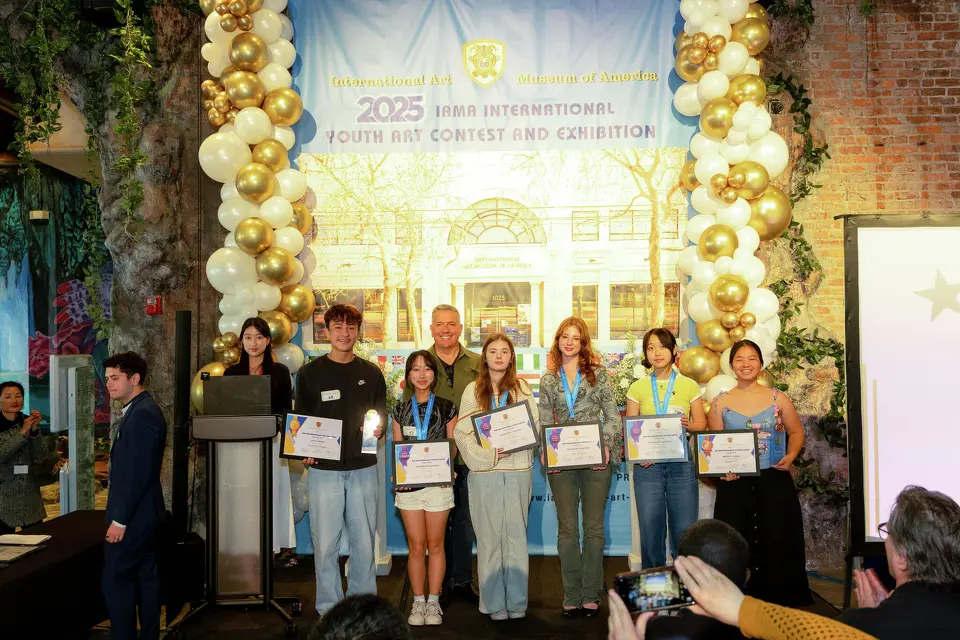
Award recipients from the youngest age group (five- to six-years-old) at the 2025 International Youth Art Contest, pictured with Mr. KC Hsieh, IAMA President.Photo by Johnny Trieu
(Ad) On July 13th, 2025, San Francisco’s International Art Museum of America (IAMA) hosted the awards ceremony for the Second Annual International Youth Art Contest and Exhibition. The museum hosted nearly 400 attendees who were eager to see this year’s exhibition of youth artworks from around the world. Distinguished guests included Mr. Guy Djoken, Executive Director of UNESCO Center for Peace of Washington D.C.; San Francisco District Six Supervisor Matt Dorsey; and Professor Adam Caldwell, Chair of the Jury Committee and faculty member at the Academy of Art University, San Francisco. The ceremony spotlighted the creative achievements of young artists and underscored the museum’s role in fostering cultural exchange and youth artistic expression. Now, in its second year, the International Youth Art Contest and Exhibition continues to expand its reach and impact, advancing IAMA’s mission to champion emerging talent and foster intercultural connection through the arts.
This year, 1,600 youth participants submitted over 3,800 artworks to the Youth Art Contest. Artists from sixty-five countries across five continents competed within four age groups. After a rigorous selection process evaluating creativity, technical skill, and overall presentation, 477 young artists from seventeen countries were selected to exhibit a total of 616 outstanding works in IAMA’s Grand Exhibition Hall. The artistic caliber and thematic richness of the selected pieces left the jury in awe.
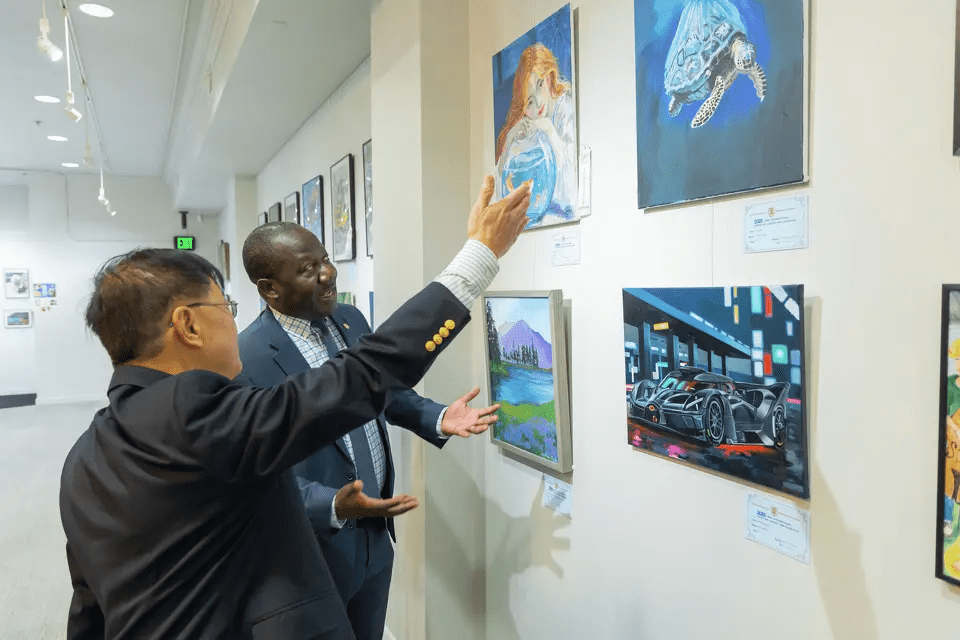
Attendees of the 2025 International Youth Art Contest viewing the installation in the Grand Exhibition Hall located at 1025 Market Street in San Francisco.Photo by Johnny Trieu
During his address at the awards ceremony, Mr. Guy Djoken offered high commendation for IAMA and its dedicated team, applauding their ongoing commitment to promoting international artistic exchange and cultivating a space where the public can find joy and renewed hope through art. Reflecting on the global turbulence and widespread uncertainty facing today’s global community, Mr. Djoken declared, “At a time when many live in fear—especially of war—just for us to be here at the museum, smiling and happy, and most importantly hopeful about the future—this is the best thing about this competition.” Mr. Djoken’s heartfelt message set a hopeful tone for the awards ceremony and attendees alike.
Executive Director of the UNESCO Center for Peace, Guy Djoken, was deeply impressed by the exceptional quality of the young artists’ work, finding both joy and hope for the future in their creativity.Photo by Johnny TrieuAward recipients in the eleven – fourteen age group at the 2025 IAMA International Youth Art Contest, joined by Mr. Guy Djoken, Executive Director of the UNESCO Center for Peace in Washington, D.C., who presented the honors during the ceremony.Photo by Johnny Trieu
Matt Dorsey, San Francisco’s District Six Supervisor, also addressed the audience, expressing his appreciation for the International Art Museum of America as a true hidden gem of San Francisco’s art landscape, and pledged his continued support for the museum’s mission and contributions to the community. Supervisor Dorsey offered words of encouragement to all participating youth artists, urging them to pursue their creative passions with perseverance—regardless of the outcome—and to never stop pursuing their artistic dreams.
Award recipients in the fifteen–eighteen age group of the contest were presented with their honors by San Francisco District Six Supervisor Matt Dorsey during the awards ceremony.Photo by Johnny Trieu
Professor Caldwell praised the range of themes and talent amongst all submissions and ages, which made selecting the winners of each age group challenging for the judges. Professor Caldwell noted the importance of international art exchange, stating “It’s a great way to bridge gaps between countries. The artistic community has always crossed political, social, and ethnic borders. Art and music are among the most universal forms of expression. They allow us to feel what others felt… Art brings people together across divides.” Professor Caldwell’s wise words perfectly captured the mission and outcome of the International Youth Art Contest.
Award recipients from the seven – eleven age group honored by Prof. Adam Caldwell—Chair of the Jury Committee, and faculty member at the Academy of Art University, San Francisco.Photo by Johnny Trieu
In this year’s contest, a newly introduced category for the youngest age group—participants ages five to six—garnered enthusiastic engagement from a remarkable number of budding artists. Through their sincere brushwork and vibrant imagination, these children demonstrated an extraordinary innate talent that captivated both audiences and judges alike.
Dr. Amy Hughes, Jury Committee Member and Director of Student Services at the New York Academy of Art, recognized the courageous creativity of the youth artists reflecting, “I was struck by the fearless creativity on display — the young artists did not shy away from complex themes, experimenting with materials, and expressing deeply personal narratives. Each piece felt authentic and fresh, demonstrating both technical skill, and emotional depth. The entries explored themes ranging from family, community, and environmental justice to dreams, culture, and identity—powerfully reflecting the younger generation’s keen insights and profound emotional connection to the world around them.
Charlotte Wu, third place award recipient in the five- to six-year-old age group, looks up at her winning painting, The Garden Where She Waits.Photo by Johnny Trieu
Lucas Shao, the first place winner of the five- to six-year-old age group, depicted himself joyfully swinging through the air in his painting, Wonderland. When asked about his hopes for his art, Lucas enthusiastically declared “I hope my art makes people happy, warm, big smiles just like me!”
Five-year-old Lucas Shao, winner of first place in the five- to six-year-old age group, stood proudly beside his painting Wonderland, depicting his happiness while swinging on the playground.Photo by Tong Shao
Third place winner of the five- to six-year-old age group, Kedarnath Kalidindi depicted a goldfish in a small fishtank in his painting, Freedom in Captivity, inspired by “finding inner freedom during incarceration.” The addition of this age group was an exciting component of this year’s event, and underscored the value of shining a spotlight on youth artwork, and garnering the wisdom of today’s youth.
Five-year-old Kedarnath Kalidindi, third-place winner in the five- to six-year-old age group, introduced his painting, Freedom in Captivity, to the audience.Photo by Johnny Trieu
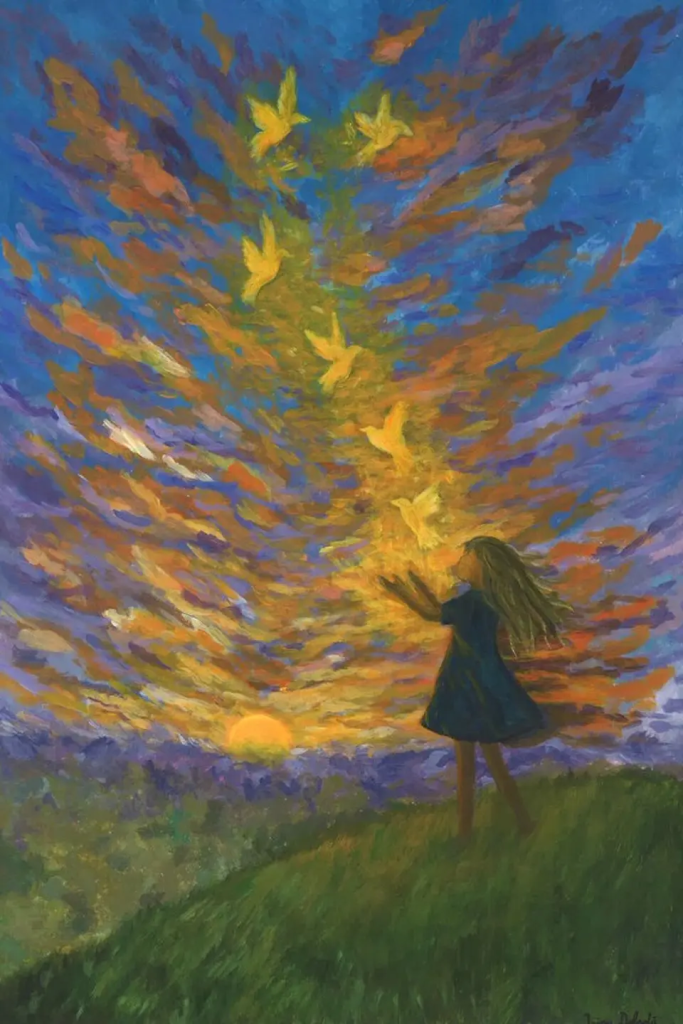
Ten-year-old Irina Elena Dobrota from Romania was honored with third place in the seven- to ten-year-old age group for her painting, Flight of Dreams, which was selected for the final exhibition at IAMA. Celebrated for its gentle spirit and imaginative vision, the piece radiates themes of kindness, freedom, and hope. Irina’s achievement brought pride and joy to her local community, and she hopes her work will inspire others to believe that every heartfelt wish can take flight—if we have the courage to let it soar.
Third place winner of the seven- to ten-year-old age group, Irina Elena Dobrota’s painting, Flight of Dreams.Photo by IAMA
Ashley Hein, second place winner of the fifteen-to-eighteen-year-old age group, impressed the jury with her painting, Animal Instinct, distinguished by its mature composition and outstanding execution. Professor Caldwell commented that he had shown several of the entries to his university art students, who were deeply moved and inspired by the technical skill and creativity on display.
Ashley Hein’s artwork, Animal Instinct, won second place in the fifteen- to eighteen-year-old age group.Photo by IAMA
Seventeen-year-old Kate Fieldhouse from South Africa received an honorable mention for her painting Between Worlds, which depicts a striking worldscape through an intense and creative exploration of breaking the canvas.
Seventeen-year-old Kate Fieldhouse from South Africa received an Honorable Mention for her painting Between Worlds.Photo by Johnny Trieu
Sixteen-year-old Polina Larina received an Honorable Mention Award for her painting Moscow Buns Evening. During her interview, Polina shared how she views her art as an opportunity to introduce people to Russian culture, and how the Youth Art Contest inspired her to continue to pursue her art dreams, “It was my first time participating in the IAMA competition. Participation in this competition helped me to feel recognized as an artist, and inspired to keep making art and put more effort into it.” Polina’s painting, inspired by a memorable walk with her grandparents, serves as a reminder to escape into nostalgia and childhood memories in trying times.
Sixteen-year-old Polina Larina (second from right, standing beside her mother) who received an Honorable Mention for her painting Moscow Buns Evening, in the Grand Exhibition Hall, joined by her parents and twin sister.Photo by Johnny Trieu
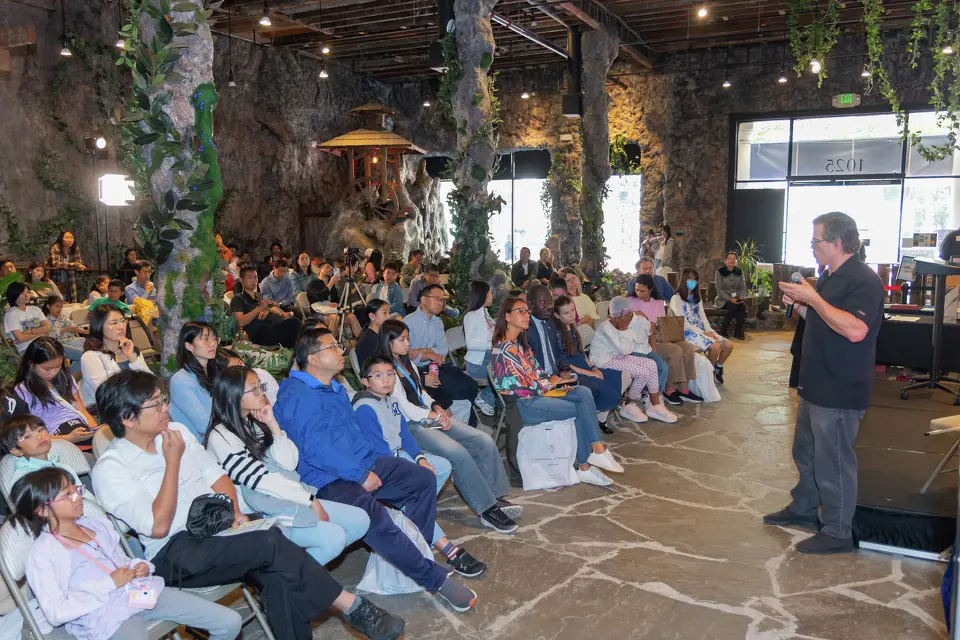
Following the ceremony, Professor Caldwell gave a masterclass for all participants, offering thoughtful insights on artistic growth, and encouraging continued exploration and confidence in their creative journeys. His masterclass focused on four elements: visual storytelling and composition, techniques and materials, the role of art in communication and expression, and advice for young artists. This is the second year Professor Caldwell has judged the artwork for the contest and delivered a masterclass for attendees of the contest.
Professor Caldwell delivered a knowledgeable and enlightening masterclass to attendees and participants. Photo by Johnny Trieu
About IAMA
Located in the heart of San Francisco, IAMA was voted the “Best Art Gallery” and was a finalist as the “Best Museum” in SFGate’s Best of Bay Area 2024. IAMA is dedicated to making world-class art accessible to all through exhibitions, education, and international contests. With a mission to foster peace and happiness through art—especially by nurturing the next generation—IAMA brings together works from around the globe, bridging East and West, classical and contemporary.
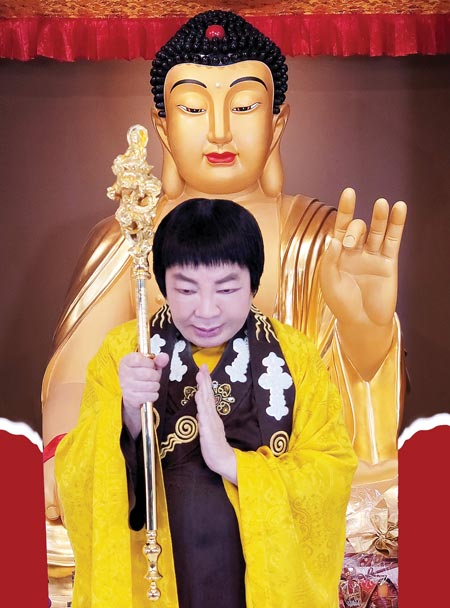
The conferment of the Pope of Buddhism to His Holiness Dorje Chang Buddha III originated in January 2018 when the World Peace Prize Awarding Council and World Peace Prize Religious Leaders Title Awarding Council passed the resolution to confer to H.H. Dorje Chang Buddha III the title of Pope of Buddhism, the highest leader of Buddhism in this world. However, His Holiness the Buddha refused to accept the conferment.
The Pope of Buddhism H.H. Dorje Chang Buddha III
For the sake of propagating Buddha Dharma and benefitting living beings, the World Buddhism Association Headquarters took the liberty to accept the conferment decree and the Pope of Buddhism Scepter. When the World Buddhism Association Headquarters respectfully presented the Pope of Buddhism Scepter and conferment decree to H.H. Dorje Chang Buddha III, His Holiness the Buddha III said: “I see that on top of this Scepter is the seated Shakyamuni Buddha, we should be respectful to Namo Shakyamuni Buddha.” His Holiness the Buddha then raised the Scepter above His head and made a symbolic closed palm gesture with one hand to express His respects. However, H.H. Dorje Chang Buddha III also expressed that He is just a humble cultivator and resolutely would not accept such a conferment. Hence, His Holiness the Buddha immediately returned the conferment decree and the Pope of Buddhism Scepter to the two Councils.
On September 23, 2020, the World Peace Prize Awarding Council and World Peace Prize Religious Leaders Title Awarding Council passed an ultimate joint resolution, determining that the return of the Pope of Buddhism Scepter and conferment decree by H.H. Dorje Chang Buddha III was not effectible. On September 24, the joint Chair of the World Peace Prize Awarding Council and World Peace Prize Religious Leaders Title Awarding Council Suzi Leggett made the ultimate announcement at the Holy Miracles Temple of the World Buddhism Association Headquarters: “Over the past several decades, the World Peace Prize Awarding Council has presented the World Peace Prize to presidents, spiritual leaders, and prime ministers of many nations, including President Ronald Reagan, Hon. Mahatma Gandhi, and H.E. Yitzhak Rabin. There has never been a precedence of an award being retracted or returned. All determinations made and implemented by our Councils are very solemn, serious, and absolutely cannot be changed. The return of the Pope of Buddhism Scepter and conferment decree by H.H. Dorje Chang Buddha III is deemed not effectible. The title, status, and authority of the Pope of Buddhism belong only to H.H. Dorje Chang Buddha III, and cannot be exercised by anyone else.” Chair Leggett once again requested that the World Buddhism Association Headquarters accept and present to H.H. Dorje Chang Buddha III the Pope of Buddhism Scepter and conferment decree that His Holiness the Buddha previously returned.
Representing the World Buddhism Association Headquarters, Venerable Mozhi Rinpoche accepted the conferment decree and Pope of Buddhism Scepter. He said during his speech, “The World Buddhism Association Headquarters considers that the decision made by the two Councils is remarkably proper and sagacious.
“Ever since Namo Shakyamuni Buddha entered parinirvāṇa, there has not been a supreme leader who has the authority to guide all Buddhists the same way that the Buddha did. However, the authoritative position of the Pope of Buddhism certainly is not a role that a leader of a single Buddhist sect would have the attributes to fulfill; rather, the Pope must be a leader who has authority over the entirety of Buddhism, namely, a Buddha.
“Namo H.H. Dorje Chang Buddha III holds the perfect teachings of Buddhism and meets the criteria used by all Buddhist sects to recognize a Buddha. His inherent nature is in accord with that of a Buddha. His unsurpassed, complete, and perfect enlightenment is in accord with that of a Buddha. Just based on the accomplishment of H.H. Dorje Chang Buddha III in Lifting the Pestle onto the Platform, surpassing His own base weight standard by 59 levels, no one else can possibly reach such a record.
“The state of virtue of H.H. Dorje Chang Buddha III is that of a Buddha. His Holiness the Buddha has perfect mastery of Exoteric and Esoteric Buddhism, perfect accomplishments in the Five Vidyas, and so forth, all of which accord with the unsurpassed, complete, and perfect enlightenment of a Buddha.
“In more than 2,000 years, there has not been a Buddhist Holy Guru in this world who possesses the same Buddha level qualities. Just by the facts that H.H. Dorje Chang Buddha III vowed and carries out the vow to benefit living beings purely on a voluntary basis and does not accept any offerings throughout His entire life, and that He possesses perfect wisdom and unimpeded accomplishments, no other Holy Guru can be of comparison. Only Namo H.H. Dorje Chang Buddha III can take on this immensely noble, holy, and heavy responsibility of the Pope of Buddhism, to properly guide Buddhists onto the correct path of learning Buddhism.
“Therefore, on behalf of Buddhists, the World Buddhism Association Headquarters thanks the World Peace Prize Awarding Council and the World Peace Prize Religious Leaders Title Awarding Council for having made the ultimate decision.”
H.H. Dorje Chang Buddha III is selfless and noble, and the first person in Buddhism to possess substantive holy realization power of a Buddha and perfectly flawless accomplishments at the pinnacle of the Five Vidyas. These are the qualities that no other eminent Buddhist monastic or virtuous person in this world has so perfectly attained. It is naturally a matter of course that H.H. Dorje Chang Buddha III is the veritable Pope of Buddhism.
To honor the Holy Birthday of H.H. Dorje Chang Buddha III, revered as the Pope of Buddhism, several prominent Buddhist organizations including the World Buddhism Association Headquarters, Holy Miracles Temple, Hua Zang Si, Benevolence Temple, and the Sanger Mission, jointly organized a Grand Dharma Assembly in Glendale, California. The two-day event took place on June 30th and July 1st, 2023, at the Glendale Civic Auditorium and attracted over a thousand Buddhists from around the world.
June 30th marked the unveiling of the first three volumes of the “Namo Dorje Chang Buddha III Complete Sutra Collection”. The Dharma Assembly opened with a procession led by a group of nuns, chanting the Buddha’s name “Namo Dorje Chang Buddha III”. The “Namo Dorje Chang Buddha III Complete Sutra Collection” was gracefully displayed on a sacred sedan chair, carried by Holy Gurus Venerable Tsemang and Ruzun Bodi Wentu. In a display of reverence, all attendees of the Assembly humbly prostrated themselves, paying their respects to the Collection.
In the Dharma Assembly, Venerable Tsemang addressed the congregation, emphasizing the significance of the “Namo Dorje Chang Buddha III Complete Sutra Collection”: “We have undertaken the significant task of editing and publishing the first part of the ‘Namo Dorje Chang Buddha III Complete Sutra Collection.’ This endeavor not only expresses our profound gratitude and unwavering yearning for H.H. Dorje Chang Buddha III but, more importantly, will enable countless sentient beings to attain accomplishment and liberation through studying the Collection. We firmly believe that the ‘Namo Dorje Chang Buddha III Complete Sutra Collection’ will serve as the ultimate guide for all Buddhist disciples seeking accomplishment and liberation.
“The Collection encompasses the essence of the Tripitaka and the esoteric Buddhist scriptures. It covers Buddhist precepts, views, cultivation, and Dharma practices. It covers the whole spectrum of Buddhism regardless of whether it is Hinayana, Mahayana, or Vajrayana. Through the Collection, H.H. Dorje Chang Buddha III reveals the most direct and expedient path for sentient beings, Arhats, and Bodhisattvas to advance themselves. If we diligently study and practice the teachings on even a single volume of the Collection, while focusing on any one dharma-gate, we can be assured of attaining liberation.”
During this Age of Dharma Degeneration, H.H. Dorje Chang Buddha III descended to the earthly realm, exhibiting perfect mastery of Exoteric and Esoteric Buddhism, along with unparalleled expertise in the Five Vidyas. The Five Vidyas are what Buddhas and Bodhisattvas do to help living beings. Over the past 2,000 years, Buddhist teachings have encountered distortions and alterations due to mistranslation and misinterpretation of Buddha-dharma by Buddhist patriarchs, eminent monastics, and Buddhist scholars. Recognizing the distortions and errors that had infiltrated Buddhist teachings, H.H. Dorje Chang Buddha III corrected the mistakes present in the Buddhist teachings, restoring the authenticity, power, and purity of Buddha’s wisdom and views.
H.H. Dorje Chang Buddha III has bequeathed over two thousand audio recordings of imparted Dharmas and published invaluable Buddhist books, including “A Monk Expounds the Absolute Truth to a Layperson,” “Commentary on the Prajnaparamita Heart Sutra,” “The Essence of Buddha Dharma,” “Correcting the Treatises of Patriarch Bodhidharma,” “What Is Cultivation?,” “The Supreme and Unsurpassable Mahamudra of Liberation,” and “Learning From Buddha.” H.H. Dorje Chang Buddha III imparted the subtleties of Dharmas in colloquial language so that people living in the 21st century could easily comprehend. They serve as supreme treasures and indispensable resources for Buddhist disciples seeking to escape the sufferings of this world and attain enlightenment.
In response to the needs of Buddhist disciples, the Office of H.H. Dorje Chang Buddha III is working to transcribe audio recordings of Dharmas imparted by H.H. Dorje Chang Buddha III into extensive written texts, and the “Namo Dorje Chang Buddha III Complete Sutra Collection” is being meticulously compiled. The first three volumes of the Collection, consisting of “Dharma Imparted During the Trip to the East,” “Dharma Imparted During a Trip in Response to the Needs of Disciples,” and “Imparting the Absolute Truth through the Heart Sutra,” were released to commemorate this Holy Birthday of H.H. Dorje Chang Buddha III. The remaining volumes will be released and published in the future.
The Dharma Assembly continued July 1st, 2023, with participants representing Buddhist disciples all over the world presenting 108 offerings to Buddhas and Bodhisattvas. Under the solemn direction of Jiaozun Zhengda, the congregation recited the Buddhist Sutra “Sutra on Understanding and Realizing Definitive Truth”. The attendees offered heartfelt reverence to the Buddhas, engaged in prostrations, and prayed to the Buddhas and Bodhisattvas for blessings upon all sentient beings. The gathering collectively expressed their aspirations for the eradication of all global pandemics, the endurance of international peace and friendship, and the cessation of calamities, while invoking prosperity, good health, and longevity for all.
Venerable Pannavati Karuna, the Abbot of Heartwood Refuge monastery in North Carolina, led dozens of her students to attend the Dharma Assembly. In an interview, she said: “I was introduced to Buddha Master (H.H. Dorje Chang Buddha III) 18 years ago through Zhaxi Zhouma Rinpoche. I thought I had too many duties and responsibilities to follow His teachings. But I kept reading and pondering them through the years. I began to notice in my everyday life the truth and ability to live differently in the world. I had more integrity, clarity, joy for the first time and an understanding that enlightenment was possible if one follows the true teachings of Shakyamuni Buddha. Buddha Master imparted Dharmas and explained those teachings in a down to earth, understandable way without compromise. He even spoke African American slang. Sometimes translators had a difficult time translating it into English because they may not fully understand the slang. But I heard it and I understood what He meant. That is the marvelousness of a true Buddha in this world. He can speak the language in a way that you hear it, understand it, penetrate it, and realize it. He guided me towards the correct aspiration. The goal is not Buddhist studies, and realization cannot be explained by mere words, but it can be experienced. The true purpose of the Buddha Dharma is to awaken us to our Buddha-nature. His teachings point the way.”
Gongjue Tuji Rinpoche from Germany also shared his joyfulness after attending the Dharma Assembly. He said: “I am very happy to be here today on this very auspicious occasion. Because for us Westerners, it is very hard to get the teachings and Dharma from Buddha Master since most of us do not speak Chinese. I am very happy about this event today that we are finally getting the opportunity to get the Buddha Dharma in English language, and we will have direct access to it.”
The Dharma Assembly held in Glendale fostered unity and devotion among Buddhist practitioners from diverse backgrounds. With the release of the first volumes of “Namo Dorje Chang Buddha III Complete Sutra Collection”, the event left an indelible mark on the spiritual aspirations of attendees, inspiring them to pursue enlightenment and emulate the compassion and wisdom demonstrated by H.H. Dorje Chang Buddha III.
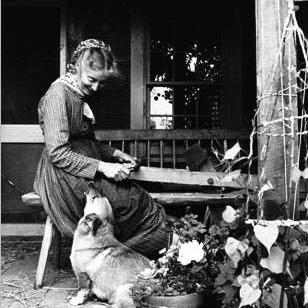
At 92 years old, Tasha Tudor lived a life that seemed lifted from the pages of a fairy tale. A beloved American picture book author and illustrator, her world was filled with charm, creativity, and a profound connection to nature. Her quiet, pastoral lifestyle captured the imagination of many, and a documentary about her life gained widespread acclaim in both the United States and Japan—earning her the title of one of the most admired women of her time.
Tasha was born into a prominent family, surrounded by great minds and cultural icons—her home once welcomed the likes of Albert Einstein and Mark Twain. Growing up in such an environment may have nurtured her early independence and vivid imagination. While others her age dreamed of parties and popularity, Tasha longed for a simpler dream: to own a cow and live close to nature.
At just 15, she left formal schooling to follow her passion for art and farming. This bold decision marked the beginning of a remarkable artistic journey. Over her lifetime, Tasha created more than 80 beautifully illustrated children’s books, winning the prestigious Caldecott Medal and receiving the Queen’s Lifetime Achievement Award. Her delicate, nostalgic illustrations shaped the childhoods of generations.
At 23, she married and raised four children. But when her unconventional lifestyle became too difficult for her husband to accept, they separated. Tasha pressed on, supporting herself through her art and craftsmanship.
When she was 57, and her children had grown, Tasha embraced the life she had always dreamed of. She moved to the hills of Vermont and built a cottage modeled after an 18th-century farmhouse. There, she lived without electricity, running water, or modern conveniences—choosing instead to return to the rhythms of a bygone era.
Her days were filled with meaningful simplicity: raising chickens and sheep, growing vegetables, preparing meals by hand. She wove and sewed her own clothes—elegant dresses and colorful scarves—always taking pride in her appearance, even in solitude.
Tasha found deep joy in the natural world. She built a lush, secret garden where flowers bloomed in every season, and she tended it with love. Whether watering plants or walking through her fields, she embraced each moment with a grateful heart.
Though she lived alone, she was never lonely. Her cats and dogs kept her company, and her grandchildren visited often. Her home radiated warmth, creativity, and quiet joy.
“Letting go is a kind of strength,” she once said.
In an age obsessed with material gain, Tasha Tudor’s life reminds us that true richness lies in simplicity. She let go of the noise and temptations of modern life, choosing instead a path of peace, beauty, and authenticity.
Tasha Tudor didn’t just illustrate magical worlds—she lived in one. And through her life and work, she continues to inspire us to slow down, appreciate the everyday, and create beauty from the inside out.
In life, wealth is not measured solely by what we own. True richness lies in the harmony between material comfort and inner peace. Across every social and economic class, we meet people who radiate kindness and resilience—and others who, despite outward success, feel spiritually empty.
Let’s explore four types of people through the lens of both outer wealth and inner fulfillment.
1. The Poor Among the Poor
Struggling both financially and spiritually.
Imagine someone living in a rundown apartment, surviving paycheck to paycheck. The hardship of their material life is evident—but the deeper burden lies within. Stress, anxiety, and hopelessness weigh heavily on their heart.
Perhaps their past holds trauma, loss, or abandonment. With little support or healing, bitterness takes root. Trust feels dangerous. Joy seems unreachable. They may withdraw or act out, living not only in material scarcity but also emotional desolation.
This is a soul in need of compassion, connection, and light—a reminder that true poverty is not just economic, but also spiritual.
2. The Spiritually Rich in Modest Circumstances
Materially humble, yet inwardly joyful.
Now envision someone of limited means, yet abundant in heart. Their home may be small, their income meager—but their spirit shines. They greet life with gratitude, take joy in the sunrise, the warmth of a shared meal, the laughter of a friend.
They live by faith or a strong set of values. They give generously, even when they have little. Their kindness is sincere, their joy resilient. They find meaning in helping others and walk through life with dignity and grace.
Yan Hui, one of Confucius’s most cherished students, is a timeless example. Confucius admired Yan Hui for his ability to remain joyful despite poverty, exclaiming: “How virtuous Hui is! With just a bowl of rice and a ladle of water in a humble alley, others could not endure such hardship, yet Hui never let go of his joy. How virtuous Hui is!”
His life shows us that true wealth comes from within.
3. The Restless Among the Rich
Surrounded by luxury, yet inwardly unfulfilled.
This person owns much—prestigious homes, expensive cars, elite status. But their heart feels hollow. They may look successful, yet their joy is shallow and fleeting.
They chase more: more titles, more possessions, more recognition—but the emptiness remains. Relationships feel strained. Peace eludes them. Their days are filled with doing, but not being. They struggle to find meaning.
Despite all they have, they feel poor in spirit. What they truly long for is connection, authenticity, and inner peace.
4. The Truly Abundant
Blessed with both material wealth and spiritual fullness.
Finally, imagine someone who has both outer success and a heart full of wisdom and compassion. Their generosity extends beyond money to love, time, and care. Their worth isn’t measured by what they own, but by the good they do.
They uplift others, listen deeply, and lead with humility. They use their resources to heal, not to boast. When they fall, they grow. When others suffer, they respond with empathy.
Their life radiates meaning because it is guided by the heart. They show us what true abundance looks like.
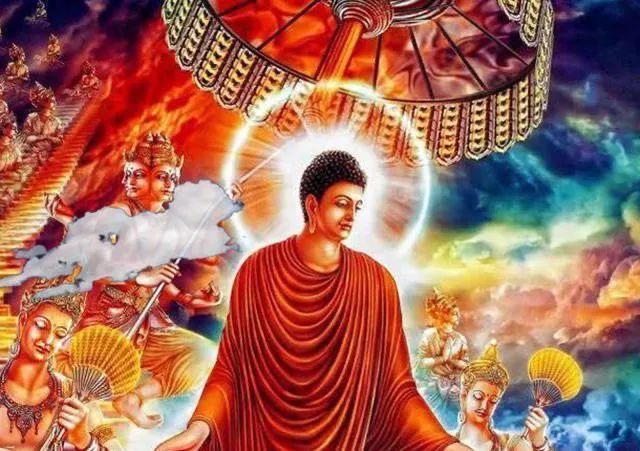
Prince Siddhartha is the ultimate role model. Born into luxury, he had everything—nobility, intelligence, beauty, and unmatched talent in both scholarship and martial arts. Yet, he realized that worldly pleasures are fleeting illusions.
Compelled by compassion, he renounced his royal life to seek a path of liberation for all beings trapped in the cycle of birth and death. Through profound wisdom and practice, he attained complete enlightenment and became the Buddha—a being of perfect wisdom and boundless compassion.
His life teaches us that the richest journey is one that leads to awakening and selfless love.
So, What Is True Wealth?
True wealth is not just what we possess—but who we are. You can have little and still be truly rich. You can have much and still feel deeply poor.
In the end, the real measure of success is not our bank account, but how much kindness we carry—and how we uplift others through it.
Let us not chase only riches. Let us seek a full heart. Let us build lives that inspire, comfort, and heal.
H.H. Dorje Chang Buddha III Wan Ko Yeshe Norbu Holiest Tathagata has taught that when a practitioner of the Great Perfection Dharma attains the highest level of realization, even the dharma instruments and the dharma seat used by such a being can manifest extraordinary signs—turning into rainbows. This profound teaching has now manifested as fact.
The site shown in the photographs below is the vajra throne area where H.H. Dorje Chang Buddha III practiced dharma. Within this sacred lawn, a mandala of the vajra throne, H.H. Dorje Chang Buddha III conducted numerous inner-tantric initiations for rinpoches, dharma teachers, and lamas, as well as many major Buddhist ceremonies.
On the afternoon of July 4, 2006, under clear skies and bright sunlight, an extraordinary event occurred. Without warning, celestial dragons roared with laughter, their sounds echoing like thunder through the sky. At the same time, a rich, fragrant scent filled the air. Then, from the vajra throne area, thousands of brilliant, rainbow-colored lights began to sparkle and shine.
These lights radiated in ever-changing hues and forms. Some appeared on the tips of grass, others near the roots, some along the blades, and some floated freely in the air between them. Whether viewed from up close or afar, from any direction, dazzling lights could be seen—each more brilliant than diamonds under direct sunlight.
What was truly astonishing was that each person witnessed something different: some saw multicolored lights, others saw white, blue, red, or green lights. Moreover, the colors constantly changed. Some lights would vanish suddenly, only to reappear moments later. Even a strong hose spraying water could not wash them away. Yet when touched by hand, the lights would instantly disappear without a trace. It was nothing short of miraculous.
Even more remarkable was that these glittering rainbow lights were confined solely to the area where H.H. Dorje Chang Buddha III had practiced. A few feet away, on the same lawn, no such lights could be seen—even after being watered. Finally, the lights suddenly gathered together and transformed into a magnificent, vibrant rainbow that soared into the clear blue sky. It was a truly wondrous and sacred sight.
This holy manifestation is a clear testament to the extraordinary realization and accomplishment of H.H. Dorje Chang Buddha III. Present during this divine event were rinpoches such as Venerable Akou Lamo Rinpoche, H.E. Gar Tongstan IV, and Venerable Xiangge Qiongwa; Dharma Teachers such as Venerable Long Hui and Dharma Teacher Jue Hui; as well as lay practitioners.
We personally witnessed these events exactly as described above. The photographs below were taken while we observed the radiant rainbow lights shining forth from the vajra throne area of H.H. Dorje Chang Buddha III. As students of Buddhism and sincere cultivators, we dare not speak falsely or mislead sentient beings. We understand deeply that to do so would bring karmic retribution. Therefore, we solemnly affirm the truth of this account.
The participants’ signatures are provided in the video as a testimony to the authenticity of these events.
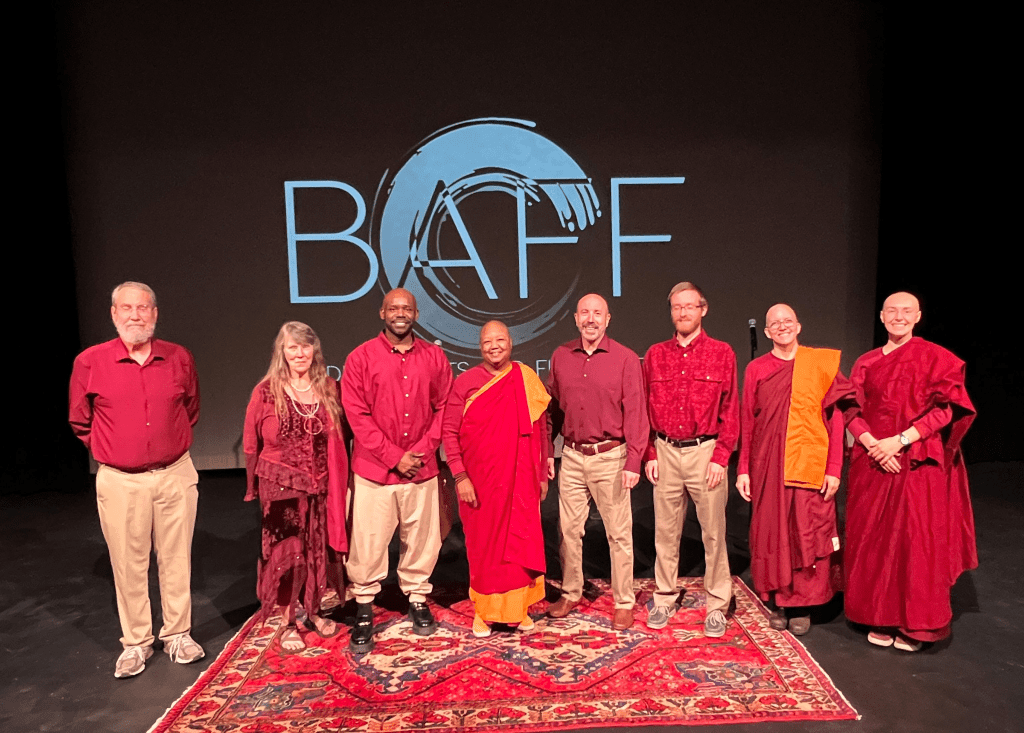
I’m thrilled to share that Bodhi Fest, a Buddhist Arts and Film Festival hosted by Heartwood Refuge, will take place at the Asheville Community Theater on August 16, 2025!
This inspiring event—the very first annual Bodhi Fest—promises to be a day of illumination, joy, and connection. Through films, workshops, music, art, and community, it will explore the uplifting qualities of the human spirit, from serene solitude to ecstatic joy.
The program will feature:
Buddhist films with Q&A sessions
Short films
A dance workshop
A songwriting workshop
Live musical performances
Plus, crafts, art, and food from Buddhist sanghas, local artists, and vendors, showcased in the front lobby throughout the day.
I truly hope this wonderful celebration of creativity and Dharma will deepen the understanding of Buddhism and bring more peace and joy to the hearts of people in America.
May Bodhi Fest shine with wisdom and compassion! 🌿🎶🎬
Enjoy immersion in activities that provoke insight and lift the spirit.
My name is Li Xueping, and this is a story about love, faith, and the incredible blessings that come from practicing true Buddhism. It is a story that centers around my mother, Yang Yanshu, a gentle and kind-hearted woman who is now over ninety years old. Despite her age, she continues to inspire us with her warmth, frugality, and deep devotion to her family.
My mother has been a Buddhist for many years. Though she is illiterate, she memorized and recites the Heart Sutra daily with great sincerity. In our home, we’ve always honored Namo Guanshiyin Bodhisattva, and her faith has been a quiet but powerful force in our lives.
In October 2003, my sister and I accompanied our mother to listen to the Dharma discourses of Namo Dorje Chang Buddha III for fourteen consecutive days. During that time, my mother experienced a profound transformation—both physically and mentally. She was radiant with Dharma joy and gained deep faith in the supreme teachings. From then on, she diligently listened to discourses, practiced Buddhism daily, and her health remained remarkably stable. It was clear to us: the blessings of true Dharma had uplifted her life.
In June 2017, our lives were shaken when my mother was diagnosed with cervical cancer at a reputable hospital. She was in her eighties at the time, and the news was devastating. We decided against surgery and opted for conservative treatment with traditional Chinese medicine to minimize her suffering.
My siblings and I turned entirely to Buddhist practice. We recited The Supreme and Unsurpassable Mahamudra of Liberation, performed lamp offerings, and conducted life-releasing ceremonies. My mother, too, chanted Buddha’s names with devotion and repented for past wrongdoings. She often reflected with remorse: “I regret killing so many chickens in the past just for food. I committed great wrongs by taking lives.”
We knew from the Buddha’s teachings that killing brings severe karmic consequences, and while our efforts could not undo the past, we hoped to ease her suffering through sincere repentance and practice.
Wanting to seek deeper help, I applied for a U.S. visa and, in September 2017, traveled to the United States to personally report my mother’s situation to the great Namo Dorje Chang Buddha III. The Buddha responded with immense compassion: “I will perform a Dharma practice to bless her.”
I will never forget that moment. The Buddha, who treats all beings with equal kindness regardless of wealth or status, blessed my mother. Monastic disciples also provided her with precious Black Treasure Pills. Miraculously, her pain vanished, her complexion became rosy, and she regained peace and strength. The power of true Dharma had once again revealed itself.
An Unexpected Crisis and a Miraculous Return
In June 2018, while I was visiting my daughter in Belgium, I received an urgent call—my mother was critically ill. We feared I might not see her again. I flew back as quickly as possible, praying for blessings throughout the journey. When I arrived home, I was astonished—my mother had survived.
My sister later told me that just before losing consciousness, my mother cried out:
“Namo Guanshiyin Bodhisattva, save me!”
Soon after, the ambulance arrived and took her to the hospital. After seven days of treatment, she was miraculously revived.
Shortly after, I faced a difficult decision. I had already planned to attend the Dharma Assembly Honoring the Holy Birthday of Namo Dorje Chang Buddha III in the United States. With my mother still recovering, and family responsibilities weighing on me, I hesitated. My husband even called me “unfilial” for wanting to leave.
But deep in my heart, I knew: this was the most important aspiration of my life. I prayed silently, asking for the Buddha’s blessings to keep my mother safe during my absence.
I attended the Great Life-Releasing Dharma Assembly at the H.H. Dorje Chang Buddha III Culture and Art Museum on June 21, 2018, and the next day, the rare and magnificent Holy Heavenly Lake Dharma Assembly. Surrounded by thousands of disciples from around the world, we chanted the holy name of the Buddha in unison. It was a moment of unimaginable spiritual joy.
On June 25, I had the honor of meeting Namo Dorje Chang Buddha III once again. I tearfully reported my mother’s condition, and the Buddha, in His great compassion, smiled and said, “Haha, good!” That moment filled me with peace and hope.
When I returned home, I found my mother in excellent condition. Despite her diagnosis, she had never experienced unbearable pain, never lost her spirit, and continued her daily Buddhist recitations as usual. During Chinese New Year, even our relatives remarked in amazement: “She doesn’t look like someone with cancer at all!”
Her strength, peace, and recovery were nothing short of miraculous. We owe everything to the compassionate blessings of Namo Dorje Chang Buddha III, the Buddhas and Bodhisattvas of the ten directions, and the authentic Tathagata Dharma.
Through this journey, I have come to understand the impermanence of life, the inescapability of karma, and the painful cycle of birth, aging, sickness, and death. No one can escape their karmic debts. But through true Buddhist practice—guided by the teachings of Namo Dorje Chang Buddha III—we can walk a path toward healing, liberation, and lasting peace.
May all beings awaken to the true Dharma, cherish the opportunity to learn from a living Buddha, and attain the freedom of body and mind through genuine practice.
In a world increasingly dominated by artificial intelligence and digital innovation, Dr. Jeff Walker, a retired neurosurgeon turned philanthropist, is on a mission to “keep the humans in the humanities.” His Walker’s Rising Stars Scholarship Program, launched in 2003 in partnership with the Pinellas Education Foundation in Florida, has awarded over $970,000 to high school students excelling in Dance, Instrumental, Theater, Visual Arts, and Vocal Performance.
Now, with a bold vision to expand the program nationally, Walker is poised to reshape arts education across the United States: “I want this to expand to cover the whole country and change arts education in high school and college,” says Walker, who has made it his mission to provide free education for all.
Walker’s inspiration—rooted in personal tragedy, a love for the arts, and a deep commitment to education—drives a movement that empowers young artists to pursue their dreams without the crushing weight of student debt.
His path to philanthropy was anything but conventional. A Duke-trained neurosurgeon who performed over 10,000 operations and established a major trauma center in Florida, Walker’s career was defined by precision and impact.
Yet his drive to give back stems from a deeply personal experience at age five. “I had a tragic event, a near-drowning incident,” he recalls. His best friend didn’t know how to swim. Influenced by childhood media and misunderstanding the risks, he pushed him into the water. The outcome was devastating: his friend drowned, and Walker nearly did too. “I felt so guilty, blocked it out for 15 years,” he says. “I think I tried to overcompensate by helping people. It was something that took an incredibly long time for me to forgive myself for.”
This tragedy instilled a lifelong mission to serve others—first through medicine and later through philanthropy. His medical journey began under the influence of his father, a dentist and university chairman, and his mother. “I scrubbed in on over 200 open-heart operations,” he says. But it was in medical school that he discovered neurosurgery, drawn to the brain as “what you are.” He completed his residency at Duke by 1985, laying the foundation for a career that blended science with service.
Walker’s love for the arts, though not as a performer, also shaped his vision: “I played the piano when I was younger, very methodical, classical music,” he shares. A humbling moment came at 15 when a friend played a Beatles song effortlessly, revealing Walker’s limitations. “I couldn’t do that at all,” he admits.
Yet, this experience underscored his belief in the arts as a universal force: “Every culture has their own dance, songs, music, symphonies, operas—the arts are a unifying factor,” he says. “There’s so much diversity in America today, and this brings everyone together.”
In 2003, Walker channeled his passion for education and the arts into the Walker’s Rising Stars Scholarship Program, partnering with the Pinellas Education Foundation to support local high school students. The program, which awards scholarships for arts education, is a vibrant celebration of talent, culminating in an annual event at the Mahaffey Theater.
“The kids get there at noon, we have lunch, they audition during the day, and then put on a show at night—three-minute acts, five categories, with the county jazz band. Families are cheering, it’s super fun,” he says.
The program’s impact transcends financial support. After the show, students gather backstage, hugging and celebrating. “They’re all aspiring artists, and you can feel the love,” Walker says.
As a father of four and grandfather of eight, Walker connects deeply with the pride parents feel at these events. “You’ve taken these kids to music, art, dance lessons for years, and to see them on stage as young adults—the pride and love bounce off the walls.”
The scholarships address the broader student loan crisis, which Walker views as a significant burden on young people. “Every dollar is $1 the family doesn’t have to spend on education,” he says.
Beyond financial relief, the program instills confidence and recognition. “It’s not easy to get on that stage, knowing hundreds of kids are vying for that spot,” Walker says. “The confidence they get is key.”
He recalls a student letter that captures the program’s transformative power: “She wrote, ‘I was going to go to St. Pete College, but after winning this, I’m going to Manhattan School of Art.’ It’s a life-changing event.”
Walker estimates that the program changes “about half the kids’ lives,” with alumni achieving remarkable success. “They’re making a living in the arts,” he says proudly.
Walker’s inspiration for Rising Stars is grounded in his belief in education as a pathway to opportunity: “As a Duke-trained neurosurgeon, I went to school a long time, and I owe everything I have to my education,” he states. “In the end, when you look back on your life, it’s not what you get, it’s what you give.”
This philosophy fuels his commitment to expanding arts education, particularly in public schools. “Education is the way out,” he says. “Through hard work and education, I still believe in the American Dream—you can be anything.”
Walker also recognizes the challenges the arts face in an increasingly digital age. He trademarked the phrase “keep the humans in the humanities” to emphasize the need for genuine human creativity. “How do you combat that? You create a generation of talented singers, dancers, actors,” he explains. The program reinforces human expression and creativity during a time when automation is on the rise.
Now, Walker has announced the national expansion of Rising Stars, choosing the prestigious Sundance Film Festival to unveil his plan. His goal: establish 1,000 program sites, each supported by a $4 million endowment that yields 5% annually to fund 25,000 students each year. “After four years, that’s 100,000 Rising Stars in college—enough to transform arts programs,” he calculates.
The national rollout will replicate the local model, with auditions and performances administered through public school districts and education foundations. “Everything goes through the school district, the teachers,” Walker says, highlighting a grassroots approach. Local events will feed into regional, state, and national competitions—potentially televised to amplify awareness and participation.
“This will bring every community together to support their young people,” he says, envisioning the program as a unifying force during divisive times.
Walker also sees the initiative as a response to the underfunding of arts education. “In high school, the arts are underfunded,” he notes. “Everybody’s talking STEM these days, but an education in the arts is very difficult.”
The program aims to uplift students pursuing creative careers, helping them gain recognition, validation, and the resources they need to thrive. “This program tells them, ‘You’re a great singer, artist, you’ve got talent,’” Walker says. “It gives them the confidence to pursue their dreams.”
Scaling Rising Stars nationwide presents challenges, but Walker remains focused: “As a Duke-trained neurosurgeon, I didn’t get here by luck. We have a plan.”
He’s connecting with artists’ unions and entertainment professionals to grow the network of supporters. To aid in funding, Walker has even developed a travel toothbrush—with proceeds directed toward scholarships—and is exploring other creative avenues to generate resources. “This is a generational project,” he says. “If you can’t get the generation behind it, it’s not going to happen.”
Walker’s long-term goal is free college education for students in the arts—including room and board. “I envision a future where Rising Stars have their own dorms, live and perform together, support each other,” he says. “If a student’s parent gets sick and they can’t afford school, let’s have a concert to raise money so they don’t drop out.”
For Walker, the legacy is not about awards but impact: “In 2035, if every Oscar, Emmy, or Tony category has a Rising Star, that’d make me happy,” he says.
What brings him joy is the personal fulfillment: “At first, I thought it was about sitting in the front row, hearing nice things,” he reflects. “But it makes me happy inside. I’m a good person, and this brings fulfillment, self-satisfaction, and love for myself.”
As Walker’s Rising Stars prepares to take the national stage, it stands as a powerful testament to one man’s belief in the power of art, education, and human connection to change lives and strengthen communities.





















 Peace LiLy