Buddhism appears to be very dominant in some countries in Southeast Asia. However, many Buddhists there always regard “Arhat” as the highest status of accomplishment in Buddhism. To them, Bodhisattvas who are often mentioned in Mahayana sutras such as Manjushri Bodhisattva and Kuan Yin Bodhisattva are simply not comparable to Arhats. That is why during the past thousands of years Mahayana Buddhism has never been able to propagate and spread widely in those regions. Of course, such a situation is due to karmic conditions of the living beings.
I am going to talk about a couple living in Thailand with family roots there for generations. The husband’s last name is Deng and the wife’s last name is Wang. Due to their hard working, honesty, and leading a plain and simple family life, they have long become well-known people with prominent fame in the business circle in Thailand. Meanwhile, they respectfully worship the Three Jewels, support the sangha, and engage in charities. Therefore, they are also praised by everyone as great and kind benefactors in the community. Though they possess deep root of kindness, due to the influence from some deviated views in the tradition of the Lessor Vehicle, they were unable to elevate their level of cultivation to enter deeply into the essence of the dharma principles contained in Mahayana. It was only until one day in 2004 when the karmic condition of their good fortune became mature. On that day, they were introduced by their friend to an opportunity of listening respectfully to the recorded dharma discourses expounded by H.H. Dorje Chang Buddha III. Only at that time, did they greatly awaken to the fact that true Buddha-dharma is so extensive, broad, precious, and profound.
The dharma expounded by H.H. Dorje Chang Buddha III is perfect and unimpeded, presenting the wonderful truth of true-suchness openly and widely. Mr. and Mrs. Deng admired wholeheartedly. They also deeply realized that the innumerable eminent monks and great virtuous ones that they had visited and consulted before in Thailand and Burma were so tiny, low, and insignificant with their shortcomings easily seen in comparison to H.H. Dorje Chang Buddha III. Though he was very busy in his business undertaking, Mr. Deng still flew across the Pacific Ocean often to beseech teachings from H.H. Dorje Chang Buddha III and spared no effort in the actions of propagating and spreading the true dharma of the Tathagata. However, deep in the couples’ mind through so many years, there was always an untied knot which was, “Are there really Bodhisattvas?”
One day, the couples finally summed up their courage and begged H.H. Dorje Chang Buddha III while kneeling on the ground, “Great Buddha Master, are there really Bodhisattvas? Can we ask for seeing Bodhisattvas?”
H.H. Dorje Chang Buddha III said expressionlessly, “When the karmic condition is mature, I will satisfy your wish.”
Time elapsed day by day. Long after that, they figured that H.H. Dorje Chang Buddha III had forgotten what they had asked for long ago and thus dared not mention it again. Furthermore, what if Bodhisattvas did not come even when invited?
Later, they had a chat with several fellow brothers who are rinpoches one day. Only then did they learn that the house that H.H. Dorje Chang Buddha III was living in was badly out of repair. Even the office space was just a small space next to a restroom and narrow stairs. Furthermore, the office desk was actually a very small table! They were greatly astounded after hearing the brothers’ descriptions! What was even more implausible to them was the fact that H.H. Dorje Chang Buddha III worked with His own hands to create artworks, not only to make the living but also help His disciples with their resources of cultivation as well as contribute to disaster relief efforts and benefit people.
The couples were deeply moved. They immediately made a decision to present a stock holding valued at 2.5 million US dollars as an offering to H.H. Dorje Chang Buddha III. However, H.H. Dorje Chang Buddha III said, “I have already said that I will only benefit living beings and will not accept any offerings. Therefore, I will not accept your offering.”
Although they begged very hard and repeatedly, H.H. Dorje Chang Buddha III was not persuaded at all and firmly refused to accept even a penny from that offering. Without any other choice, they could only transfer that stock holding entirely to the World Buddhism Association Headquarters.
H.H. Dorje Chang Buddha III was to determine their karmic conditions. Observing their piousness toward their Master, diligent cultivation and practice, and selflessly benefiting living beings, they truly have established undeniable merit of Bodhi. Therefore, His Holiness the Buddha decided to fulfill the wish they had for many years.
On the magnificent and auspicious day when His Holiness the Buddha was going to transmit the inner-tantric initiation, Laypersons Mr. and Mrs. Deng came to the open-air mandala at the holy site. The sky was completely clear without any cloud on that day. With beautiful green lawn, breeze blowing from time to time, singing and winging of bees and birds in the background, varieties of flowers contesting for beauty, and charming and attractive branches and shoots in the trees, the whole court was covered with splendid colors in addition to jade green.
Sitting on the Vajra dharma throne, H.H. Dorje Chang Buddha III said to the human and non-human disciples in the mandala, “I practice the dharma this time to invite and invoke a Bodhisattva for these two laypersons with their last names being Deng and Wang respectively. I do not have confidence! If it accidentally turns out to be successful, that would be due to the merit of Disciple Deng and Disciple Wang. However, you must absolutely pray and beseech with the most pious heart.”
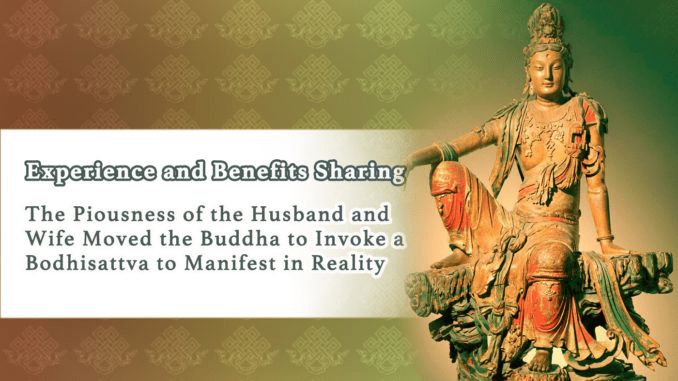
Shortly after the discourse, H.H. Dorje Chang Buddha III immediately practiced the dharma. In less than 20 minutes, suddenly a beam of golden light flashed in the sky above. Next, countless light rays were emitted. A Vajra Bodhisattva with a height of about 16 feet suddenly appeared. The Bodhisattva was adorned with pearls necklace and looked extremely solemn and majestic, stepping on a lotus flower shape auspicious clouds of rainbow colors. In a few strides, the Bodhisattva descended into the mandala, standing in front of Mr. Deng and Mrs. Wang with a smile.
While they two were still stunned and astounded, the Bodhisattva took out the holy substance to empower them. With a finger snap, a five-colored light ray flew into the mouth of each of them. The taste was utmost delicious without comparison. They both felt relaxed and uninhibited throughout the body. An auspicious state manifested over the entire mandala at the holy site. Only then did the Vajra Bodhisattva merge into the brightness in the sky and disappear.
While everyone was still deeply enjoying the dharma joy and calming lightness occurring just moments ago, Mr. and Mrs. Deng excitedly described the personal feelings and experience that just happened to them, with hand gestures as they spoke. They two were extremely moved and bowed repeatedly to H.H. Dorje Chang Buddha III.
They saw a Bodhisattva! They truly saw a real Bodhisattva descending before them to meet with them! This is not a dream state and much less an illusory image. Though several years have passed, what really made us awaken is: Then, who is the Master who is living right before us and whom we follow closely to learn from? Good heavens! Have you forgotten? He is the supreme teacher of Bodhisattvas and Mahasattvas in the ten directions and even of all Buddhas! He is really the genuine incarnation of the holiest ancient Buddha in the dharma realm – Dorje Chang Buddha!
How fortunate living beings in the current dharma-ending era are to be able to meet this opportunity of H.H.Dorje Chang Buddha III descending to this earthly world. This is the great matter indicating the maturing of good fortune stemming from the karmic conditions since the beginning-less time. I sincerely, wholeheartedly, and eagerly hope that sentient beings in the six realms of the three spheres can all hear the dharma expounded by H.H. Dorje Chang Buddha III, to attain in the current lifetime perfect good fortune and wisdom, freedom from birth and death, holy status of liberation, and realization of great enlightenment!
(Reported by the Taiwan Times) On September 5, 2015, an unprecedented dharma assembly of “Determining the Status of a Buddha by the Dharma of Jin Gang Fa Man Ze Jue (Jin Gang Fa Man Ze Jue is a dharma in Tibetan Esoteric Buddhism for determining the result sought through selection)” was held in the United States of America with the attendance of several dozens of venerable ones, dharma kings and rinpoches, who are from Tibetan Esoteric Buddhism, and dharma masters. The dharma practice was led by Great Rinpoche Wang Zha from Tibet, who once practiced in solitary retreat for 46 years in Tibet and has the realization of Golden Button Grade 3 (having three Sun-Moon wheels) in Buddha-dharma. The decisions by the Dharma of Jin Gang Fa Man Ze Jue determined that Sakyamuni Buddha is a true Buddha, H.H. Dorje Chang Buddha III is a true Buddha, and Master Hui Neng, the sixth patriarch of the Ch’an (Zen) School, was not a Buddha but was the incarnation of a great Bodhisattva.
At what level is a dharma assembly of determination by the Dharma of Jin Gang Fa Man Ze Jue? According to the explanation provided by the United International World Buddhism Association Headquarters (UIWBAH) who sponsored the two sessions of the dharma assembly to determine the status of a Buddha, the Dharma of Jin Gang Fa Man Ze Jue is one of the holy supreme great dharmas and can be used to determine the true or false status of any holy being. In this world, this dharma and the Dharma of Forecasting the Future (announcing events that will happen in the future ahead of time) are the co-champions among the dharmas of decision by selection. The dharma ranked next is the holy inner-tantric dharma of “Bai Fa Ming Men Hei Guan Ze Jue (a dharma specifically used to determine the correct or wrong result).” The next lower dharma is the dharma of dropping divine pieces to receive divine instruction, which is at the inner-tantric level. Then, there are lower, outer-tantric dharmas of lot-drawing from a golden vase, rotating a tsampa ball, watching a sacred lake to see the result, and others. This Dharma of Jin Gang Fa Man Ze Jue and the Dharma of Forecasting the Future are the highest dharmas among dharmas of decision by selection to determine the status of either “another person” or “self.” This dharma can only be possessed and commanded by holy ones at the level of great Mahasattvas or higher. Therefore, no great dharma king or venerable one who is not an extremely great holy one can hold and practice this dharma. Even great dharma kings and great venerable ones at the level of Jiao Zun who have the ability of performing inner-tantric initiations do not have the qualification to hold and practice this dharma. Mo Zhi Jiao Zun said, “Although I have just entered the door of holding and performing inner-tantric initiations, I have not touched even the edge of the Dharma of Jin Gang Fa Man Ze Jue. Only a holy one who has the realization of performing holy inner-tantric initiations that are close to the level of state practice can perform the Dharma of Jin Gang Fa Man Ze Jue. Otherwise, one is merely dreaming and far away from doing it.”
Why was this dharma assembly held to determine the status of a Buddha by the Dharma of Jin Gang Fa Man Ze Jue? According to a writing describing the fact by the UIWBAH, the karmic condition rose from the fact that many Buddhists in the world wished to respectfully beseech the contrasting photos of H.H. Dorje Chang Buddha III showing His returning from an aged appearance to a youthful person three years ago. However, H.H. Dorje Chang Buddha III did not agree to that. He thought that these were just ordinary photos and were meaningless for people to have. The discussion lasted three years to 2015. The UIWBAH finally got the agreement from H.H. Dorje Chang Buddha III. His Holiness the Buddha donated the two photos of His to the UIWBAH free of charge with a requirement that the UIWBAH can only sell the photo at a low price to those who wish to get it and must not profit from selling the photo. At the end of October of 2015, the UIWBAH published the contrasting photos of H.H. Dorje Chang Buddha III showing His returning from an aged appearance to a youthful person to the world. This provided people with auspicious and magnificent feelings and abundant joy of Buddha-dharma.
Unfortunately, H.H. Dorje Chang Buddha III wrote a note for the photos and demanded it to be printed at the lower part of the photo sheet. The note mainly stated that He is an ordinary person like everyone else, He is not a holy person, He has no advantage over other people, He does not know the dharma of returning from an aged appearance to a youthful person, and what people saw was a temporary phenomenon due to a medicine given by an elder virtuous one. On the other hand, UIWBAH stated that many people witnessed the real fact that Wang Zha Shang Zun, who is an outstanding one among great dharma kings, publicly practiced a dharma of empowerment. After a short period of a little over 10 minutes, an elder person whose age was over 60 changed into an appearance of a person who was about 30 years old. Wang Zha Shang Zun used this demonstration to show the fact that the dharma of returning from an aged appearance to a youthful person does exist within the realm of Buddha-dharma. Wang Zha Shang Zun said, “My Buddha Master is the universe. I am only a small piece of stone. Even I can empower a cultivator to return from an aged appearance to a youthful person temporarily. H.H. Dorje Chang Buddha III’s realization is millions of times higher than mine. Can you believe that the Buddha Master is an ordinary person?”
Although Wang Zha Shang Zun made the above proof, the speech by His Holiness the Buddha saying that He is an ordinary person just like everyone else made many Buddhist disciples in the world, whose good roots and intelligence are not strong enough, hesitate and be at a loss. They are unsure, with pressure on their mind. All can tell that, in terms of science and causality, how can there exists any miraculous medicine that can completely change a person’s facial features in a short period of a little over 10 minutes? Furthermore, three years have already passed and there is still not even one winkle in H.H. Dorje Chang Buddha III’s face. The skin and flesh on His face are clean and tender with a light ruddy complexion. His appearance is extremely beautiful, handsome, and majestic. Other than a Buddha, how can a Bodhisattva have such extremely beautiful magnificence and how can any medicine create such an effect? Additionally, H.H. Dorje Chang Buddha III’s accomplishments of perfect mastery in both exoteric Buddhism and esoteric Buddhism and at the acme of the Five Vidyasare unmatched and incomparable by any holy one throughout the history of Buddhism. Not even one can be found from looking through history, searching the internet, and exhaustive investigations! How could H.H. Dorje Chang Buddha III not have advantage over others? Ordinary people do not bear any remote resemblance to H.H. Dorje Chang Buddha III. Then, how could H.H. Dorje Chang Buddha III be an ordinary person? On the other hand, should we not listen to His Holiness the Buddha’s speech? Therefore, unintelligent and deluded people feel muddle-headed and do not know what is right.
Considering this situation of cultivators being pressured, the UIWBAH had discussions and decided to provide Buddhists a correct conclusion. For the sake of benefiting living beings, an action that may not respect His Holiness the Buddha has to be taken. Wang Zha Shang Zun, an extremely great holy one at the level of Golden Button Grade 3 or higher, took the lead to practice the Dharma of Jin Gang Fa Man Ze Jue to determine fundamentally whether the Buddha’s status is true or false. Many cultivators wish to know the situation of the dharma assembly that determined the Buddha’s status by the Dharma of Jin Gang Fa Man Ze Jue. The following is a report on that dharma assembly:
On September 5, 2015, the historic grand dharma assembly to determine the status of the Buddha using the Dharma of Jin Gang Fa Man Ze Jue began in a solemn and majestic scene. Wang Zha Shang Zun’s holy arrival was welcomed by Great Holy and Virtuous One Mo Zhi Jiao Zun, Chairman of the UIWBAH Dharma King Gar Tongstan, UIWBAH’s Secretary General Kai Chu Ru Zun, Chief Abbot of the International Buddhism Sangha Association Dharma Master Zhengda, Great Rinpoche Akou Lamo, and several dozens of eminent monks, rinpoches, and dharma masters who were to serve as observing witnesses. They held palms together to greet each other and were seated on the dharma rostrum.
To be fair, the decision by selection was first conducted to verify the status of Sakyamuni Buddha. The beseeching dharma document wrote, “We respectfully beseech a verification from the decision by selection. If Sakyamuni Buddha is truly a Buddha, a crown made by strands of hair will be put on the head. If not, there will be no crown.” First, a portrait of Sakyamuni Buddha was laid on an ordinary four-legged flat table of dark-brown color. Then, a pinch of sand from the Ganges River with the color of light camel wool was picked up and put on the portrait at a spot of hair at the top of the Buddha’s head. Wang Zha Shang Zun began to practice the dharma at a dharma rostrum which was about 13 feet away from the table. After the ritual of knocking the wood fish, ringing the bell, waving the Vajra, performing mudras, and chanting mantras, twelve documents written on yellow papers were burnt. All observing witnesses saw with their own eyes that the sand placed at the spot of hair at the top of the Buddha’s head began to disperse with inconceivable changes. Every grain of sand seemed to be alive. All sand grains moved individually with miraculous transformations to form a crown made of strands of hair, which very naturally and wonderfully stood up above the top of Sakyamuni Buddha’s head. A scene of adding a crown of strands of hair to the Buddha’s top-knot was manifested, proving that Sakyamuni Buddha is a true Buddha.
Immediately after and on the same table, the decision by selection was conducted for H.H. Dorje Chang Buddha III. The beseeching dharma document wrote, “We respectfully beseech a verification from the decision by selection. If H.H. Dorje Chang Buddha III is the incarnation of the primordial Sambhogakaya-Buddha Dorje Chang Buddha, a crown made by strands of hair will be put on the head. If not, there will be no crown.” Wang Zha Shang Zun practiced the dharma following exactly the same ritual as before. After the twelve documents were burnt, the sand of the Ganges River with the color of light camel wool that had been flatly put on the spot of hair at the top of H.H. Dorje Chang Buddha III’s head suddenly had the miraculous transformation of being elevated upward. Sand grains connected with each other to form strands of hair standing in the air. The strands of hair then automatically formed a crown of hair. A 3-dimensional crown was put on the head of H.H. Dorje Chang Buddha III in the portrait, proving that H.H. Dorje Chang Buddha III is a true Buddha coming to the world!
The last decision by selection was to verify whether the Sixth Patriarch Master Hui Neng was a Buddha’s nirmanakaya (meaning emanated body). The beseeching dharma document wrote, “We respectfully beseech a verification from the decision by selection. If the Sixth Patriarch Master Hui Neng is a Buddha’s nirmanakaya, a crown made by strands of hair will be put on the head. If not, there will be no crown.” As before, Wang Zha Shang Zun practiced the dharma following the same ritual and the twelve documents were burnt. Everyone saw that the sand of the Ganges River with the color of light camel wool placed at the top of Patriarch Master Hui Neng’s head had no movement or change at all. Therefore, the conclusion was that Patriarch Master Hui Neng was not a Buddha’s nirmanakaya. So a lower-level status had to be verified by the decision by selection, i.e. to determine whether Patriarch Master Hui Neng was an incarnation of a great Bodhisattva or not. The beseeching dharma document wrote, “We respectfully beseech a verification from the decision by selection. If the Sixth Patriarch Master Hui Neng is an incarnation of a great Bodhisattva, a crown made by strands of hair will be put on the head. If he was not at the level of a Bodhisattva, there will be no crown.” After Wang Zha Shang Zun practiced the dharma, a dharma crown was put on Master Hui Neng’s head. Sand grains formed a crown of hair. However, because Patriarch Master Hui Neng was not a Buddha or a Bodhisattva with universal or wonderful enlightenment, as stipulated by the dharma, the crown of hair did not stand up into the air and become a 3-dimensional crown, but was formed on a flat plane. However, it was very naturally structured and absolutely not something that can be made by humans.
The two sessions of the dharma assembly lasted more than five hours. To show the magnificence and extremely truthful nature of the crowning process through determination by the Dharma of Jin Gang Fa Man Ze Jue, each of the venerable ones, dharma kings, rinpoches, great dharma masters, dharma masters, great laypersons, and others attending the dharma assembly took a test to crown the visage using the sand from the Ganges River. As it turned out, none of the holy and virtuous ones present who are at the levels of Golden Button Grade 2, Golden Button Grade 1, and Blue Button Grade 3 were able to crown the Buddha’s portrait with sand from the Ganges River. There was no manifestation of power of Buddha-dharma to cause miraculous changes. This proved that the great dharma of Jin Gang Fa Man Ze Jue can only be practiced by extremely great holy and virtuous ones at the level of Golden Button Grade 3 or higher. No one else possesses the realization to practice the dharma successfully.
Wang Zha Shang Zun was very dissatisfied with himself for the first session. He said that his cultivationwas shallow and lacked merit and virtue and that his own karmic forces caused him not to practice this dharma of decision by selection perfectly. The reality was that a few people in the observing crowd had their karmic forces become visible during the dharma assembly. They caused disturbance in the Buddha hall when they could not control their excitement upon seeing holy states. They shouted loudly and pushed others. Such disrespect toward the holy dharma kept the outcome from being completely perfect. For this reason, Wang Zha Shang Zun decided to hold a second session of the dharma assembly. Before the second dharma assembly started, Dharma King Gar Tongstan made the rules on behalf of Wang Zha Shang Zun. He announced that onlookers could get closer to watch but no one was allowed to speak loudly or push others. All must have the mind focusing on being respectful before moving closer. Then Wang Zha Shang Zun practiced the dharma. The second dharma assembly had a perfect success with extremely magnificent manifestations, proving again that Sakyamuni Buddha is a true Buddha and H.H. Dorje Chang Buddha III is the incarnation of the primordial Sambhogakaya-Buddha Dorje Chang Buddha. In the process, the sand of the Ganges River of the light camel wool color placed at the top of the head exhibited unimaginably miraculous transformation. A lose-hair crown changed into a head-covering crown and a thick-hair crown changed into a thin-hair crown. The strands of hair gathered or separated as required at different places to knit into a naturally perfect crown. Every sand grain had its own independent life. Some walked extremely fast; some wandered around casually; some followed twisted paths; some traveled past the boundary and then came back; and some climbed from the bottom to the top. The sand grains followed each other one by one to form strands of hair that stood into the air without falling. Eventually, a knot was formed to create a perfect crown for the Sambhogakaya-Buddha. Then, Wang Zha Shang Zun snapped a finger to perform a mudra and the strands of hair fell into a pile of sand with no trace left of the crown. Wang Zha Shang Zun issued a dharma decree to distribute the sand of the Ganges River (which became Vajra Sand after the dharma was performed) to all who were present. Every attendee received a share of the Vajra Sand that manifested the holy crown worn by the genuine incarnation of the Buddha.
The situation at the time was that the dharma was practiced with the same table, at the same position, following the same ritual, and using the same sand of the Ganges River. However, the three hair crowns created were completely different. There was one Bodhisattva two-dimensional crown and there were two Buddha hair crowns that were three-dimensional and stood into the air. The latter two were also different from each other in terms of shape and structure.
All attendees on the dharma assembly on that day took an oath to testify for the above reported true facts, “We all attended the dharma assembly for determining the status of the Buddha by the Dharma of Jin Gang Fa Man Ze Jue as practiced by Wang Zha Shang Zun. We clearly understand and believe in the law of cause and effect. What was stated above is true and without any false statement. If we lied to deceive people, we not only will not become accomplished but also will descend into the three lower realms to undergo extremely miserable suffering. If what was stated above is all true, we wish and pray that all living beings be able to learn the true dharma of the Tathagata from H.H. Dorje Chang Buddha III and Sakyamuni Buddha, attain perfect good fortune and wisdom, and become accomplished and liberated to benefit countless living beings.”
(Translated from a news report in Chinese published by Taiwan Times)
There are moments in life when, despite our best intentions and most sincere efforts, things still feel profoundly unfair. Right and wrong seem reversed. The ground beneath us shifts, and our inner balance begins to tilt toward chaos. In those moments, our first instinct is often to react—to defend, to argue, to strike back.
Before you do, pause.
Take a breath. Return to your body. Listen to what is happening beneath the noise.
When we step into conflict fueled by “righteous anger,” wounded pride, or a desire for revenge, we rarely restore balance. More often, we simply exchange one form of turmoil for another. Peace quietly slips away.
Holding onto resentment or remaining lodged in the role of the victim keeps us circling the same pain, replaying the same arguments, long after the moment has passed. Whether we choose to walk away with a clear conscience or feel called to stand up for what feels just, one truth remains: every action—and every silence—creates ripples. They shape who we are becoming and touch the lives of those around us.
At first glance, the phrase Peaceful Warrior seems contradictory. Yet a life rooted in peace and integrity demands precisely this paradox.
To be peaceful does not mean to be passive. To be a warrior does not mean to be aggressive.
True strength lies in seeing beyond illusion and surface drama. It lies in choosing awareness over reflex, clarity over emotional momentum. A Peaceful Warrior does not drift from one reaction to the next; they choose their response with care.
Such a warrior knows how to step back and observe themselves in the heat of the moment. They are capable of decisive action, but their actions are guided by wisdom and oriented toward the greater good. Only genuine courage allows us to respond from the heart, rather than from outdated conditioning and habitual fear.
The next time you find yourself facing opposition, remember this: you can remain present. You can maintain your inner edge without surrendering to fear or hostility. You can stand firmly without hardening your heart.
You can be a Peaceful Warrior.
When life confronts us with injustice, it becomes a quiet test of our spiritual maturity. These reflections may help illuminate the path:
1. Discern Reaction from Response A reaction is automatic—rooted in survival, memory, and past wounds. A response is conscious, grounded in the present moment. When you feel that surge of heat in your chest, pause and ask: Is this my deeper wisdom speaking, or is it my ego defending its image?
2. Release Attachment to Outcomes The Bhagavad Gita teaches action without attachment to results. Spiritually, this means doing what is right not for victory or validation, but because it aligns with truth. When the need to “win” dissolves, a quieter, more enduring power emerges—one that cannot be taken from you.
3. Receive the Mirror Those who unsettle us most often reveal where we are still tender or unhealed. This does not excuse harmful behavior, but it offers insight. Let the discomfort become a question: What within me is asking for strength, clarity, or compassion?
Standing before the massive screen at the exhibition, I raised my arm and waved upward.
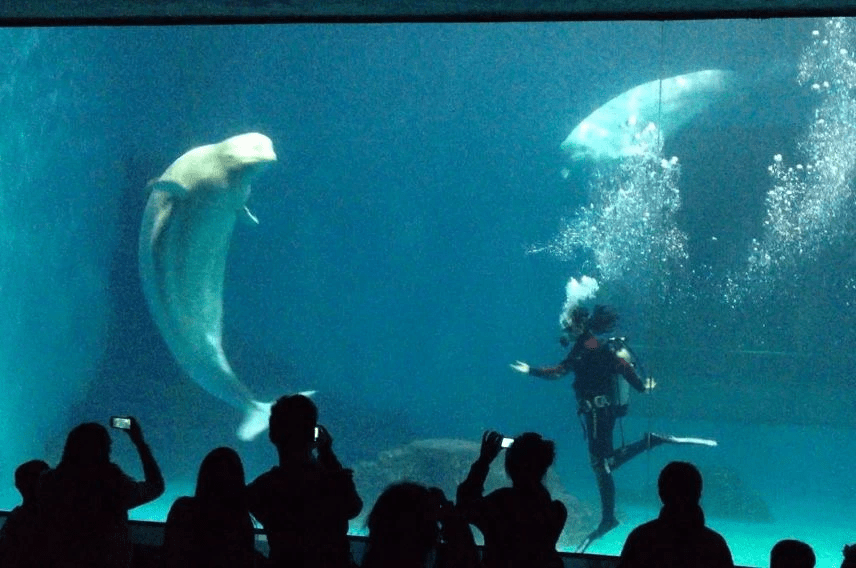
On the screen, a white whale responded instantly—leaping out of the water. Its enormous body traced a graceful arc through the air before crashing back down, sending waves of spray in every direction.
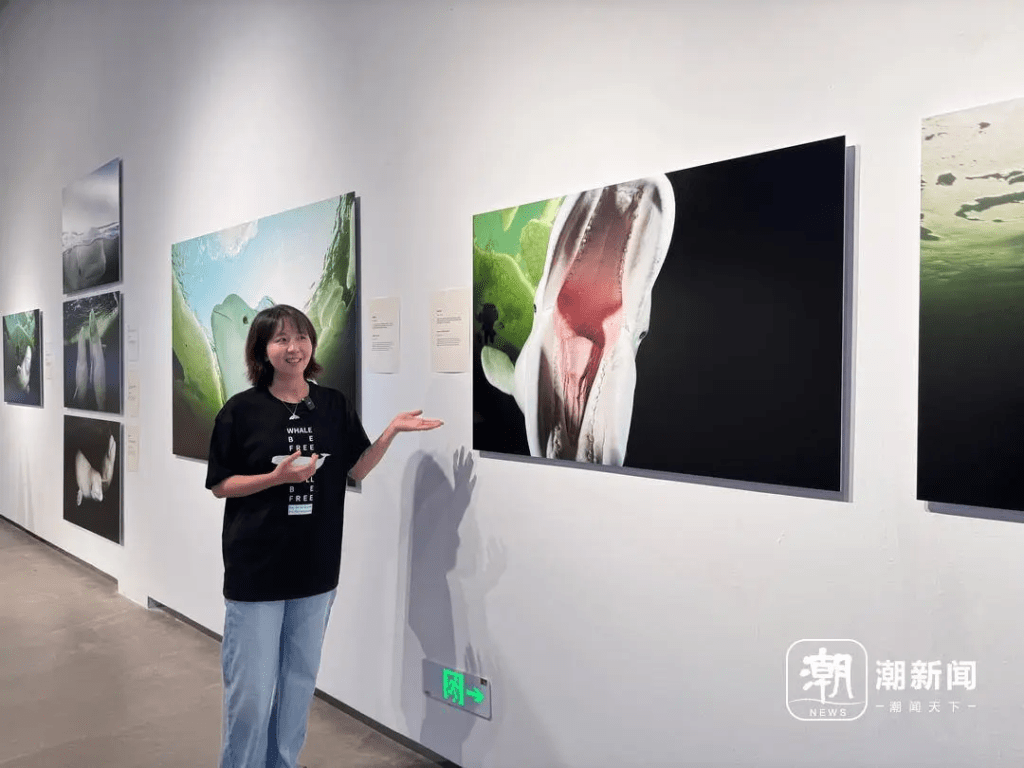
At the recently concluded art exhibition in Shenzhen, Whale Room: A Blue Dream Confined, nearly every visitor briefly stepped into the role of a “whale trainer” through multimedia interaction.
What We Call Beauty May Be Their Burden
In the wild, white whales rarely leap repeatedly out of the water. Their heavy bodies are not meant for frequent, high jumps.
What humans describe as “graceful” or “awe-inspiring” may, for them, be exhausting, oppressive, even a cycle of repeated pain.
The exhibition’s founder, Shao Ran, once worked as a whale trainer for five years. She stood by the pool countless times, receiving applause and cheers.
This time, however, she chose to tear open the surface of the “blue dream.”
When the decorations are removed, steel and concrete are revealed beneath. No matter how vast an artificial pool may appear, to a whale, it is still an inescapable prison.
Their suffering is carefully packaged as entertainment.
When a Life Was Entrusted to a White Whale
What truly changed Shao Ran’s life was a moment of life and death beneath the water.
That day, she entered the pool to perform with a white whale named Sophie. Suddenly, Sophie lost control—clamping onto her foot and dragging her downward again and again.
Fear. Powerlessness. Suffocation. All magnified in that endless blue.
“The only thing I could do was wait,” she later said. “To gamble on her kindness.”
She did not escape—not out of bravery, but because for the first time, she fully understood:
In the water, she was no longer the one in control. She was utterly vulnerable.
She looked into Sophie’s eyes. No commands. No intimidation. Only one thought remained:
I want to live.
In the end, Sophie stopped. She slowly swam closer, lifted Shao Ran’s foot with her mouth, and gently pushed her back to shore.
In that moment, Shao Ran understood what compassion truly means.
Not weakness— but the choice not to harm, even within extreme injustice and oppression.
Who, Then, Is Truly Being Tamed?
Sophie was not the only one who resisted.
Another dolphin, Huahua, after enduring prolonged loneliness and stress, eventually chose to stop breathing.
That day, as Shao Ran sat beside Huahua’s body, she could no longer persuade herself with words like “work,” “regulations,” or “procedure.”
She began to see clearly:
So-called training does not only tame animals. It slowly tames the human heart as well.
When violence becomes institutionalized, when suffering is rationalized, when harm is renamed “normal work”—
Humans, like the captive animals, lose freedom and awareness.
There is a line in Buddhism: All beings suffer. Ignorance causes beings to harm one another.”
The Buddhist teaching of non-harming calls us to awaken from this very ignorance.
Walking the Path of Compassion in Another Way
Shao Ran left the marine park.
She no longer stands beside a pool, but walks into schools, bookstores, and quiet corners of the city, telling stories about animals.
No stage. No applause. Sometimes, only a handful of listeners.
Still, she speaks.
She founded a nature protection community called “Ran Ai Tong Sheng” (“All Beings, One Compassion”).
“Ran” is not her name. It means following what is natural— respecting the original state of all beings.
The image of that white whale pushing her gently back to shore has stayed with me ever since.
After long confinement and deprivation, it did not choose destruction— it chose kindness.
Buddhism teaches us:
Compassion is not a result—it is a direction.
If we consider ourselves more intelligent, more civilized, more faithful—
Then perhaps we should also learn:
Not to build our joy upon the suffering of others. Not to hide harm behind habit. Not to allow violence through silence.
Buddhist compassion is not mere sympathy. It is a lucid responsibility.
May we, toward every life, give rise to respect, and cultivate a heart of non-harming.
When non-harming becomes a choice, when compassion becomes action, only then can this world truly move toward freedom.
You might not realize it, but this is the true power of prayer—it’s not just asking for blessings; it is awakening an internal system within you that says, “I can keep going.”
Every sincere moment of prayer leaves an imprint on the mind. This is not spiritual poetry or wishful thinking; it is a pattern repeatedly observed through MRI scans, neuroimaging, and psychological research. Each second spent in focused, quiet prayer is an opportunity to “turn on a light” in the brain—helping us become steadier, clearer, and more resilient.
Scientists were once skeptical. But the evidence surprised them.
When a person enters a state of deep, focused prayer, activity in the prefrontal cortex increases. This is the part of the brain responsible for attention, judgment, emotional regulation, and self-control—the “driver’s seat” of the mind. Prayer helps us return to that seat, especially when life feels overwhelming.
At the same time, activity in the amygdala—the brain’s alarm system—tends to decrease. This region governs fear, anxiety, and the fight-or-flight response. When it is overstimulated, we feel tense, reactive, and out of control. Prayer appears to gently quiet this system, creating inner space to breathe, reflect, and choose more wisely.
This is not merely a mental effect—it is a physical response of the nervous system.
Research also suggests that heartfelt prayer—prayer infused with sincerity and emotion—is especially powerful. Compared to mechanical repetition, it more strongly activates brain regions associated with language, empathy, connection, and self-awareness, including the temporoparietal junction, anterior cingulate cortex, and medial prefrontal cortex. These areas shape how we relate to ourselves, to others, and to life itself.
In simple terms, honest prayer becomes a process of emotional clearing and inner reorganization.
When practiced regularly, these brain responses do something remarkable: they form new neural pathways. Like carving a well-worn trail through a forest, prayer creates a reliable inner path—a place of stability we can return to during moments of fear, grief, or confusion. The more often we walk this path, the easier it becomes to find our way back to calm.
Prayer is not the same as meditation. While both reduce stress and sharpen focus, prayer carries an added element: relationship. Prayer involves trust, dialogue, and the felt sense that we are not alone. This activates neural systems related to connection, attachment, and belonging—deep human needs that meditation alone does not always engage.
This may explain why, at the edge of emotional collapse, a simple, sincere prayer can sometimes bring someone back from the brink. The problem may not disappear—but the mind, heart, and body momentarily realign. A quiet strength returns. I can get through this.
What Prayer Does—Inside and Out
Activates the Prefrontal Cortex Strengthens clarity, emotional balance, and self-control.
Calms the Amygdala Lowers fear and stress responses, restoring inner quiet.
Builds Emotional Resilience Repeated prayer forms neural pathways that support stability over time.
Fosters Connection and Trust Engages social and emotional brain systems through relationship and sincerity.
Sincere prayer may be one of the most gentle, natural, and powerful “built-in reset systems” we possess.
So when was the last time you prayed—not out of habit, but from the heart? Have you ever noticed how your body softened afterward, how tension quietly released?
That wasn’t imagination. That was your mind and nervous system responding to something deeply human—and deeply real.
Long ago, deep in the mountains, there lived a Zen master named Wuguo(无果), a practitioner wholly devoted to meditation. For more than twenty years, he was supported by a humble mother and daughter who offered him food and daily necessities so he could cultivate the Way without distraction.
As the years passed, Master Wuguo reflected deeply on his practice. Although he had dedicated his life to meditation, he felt he had not yet realized his true nature. A quiet fear arose in his heart: If I have not awakened, how can I truly repay the kindness of these offerings?
Determined to resolve the great matter of life and death, he decided to leave the mountain to seek instruction from other masters.
When the mother and daughter heard of his departure, they asked him to stay a few more days. They wished to sew him a monastic robe for his journey. At home, the two women worked carefully, chanting the name of Amitabha Buddha with every stitch, their hearts filled with sincerity. When the robe was finished, they also wrapped four silver ingots to serve as his travel funds.
Master Wuguo accepted their offerings and prepared to leave the next morning.
That night, as he sat quietly in meditation, a vision appeared. A young man dressed in blue stood before him, holding a banner. Behind him came a procession playing music and carrying a magnificent lotus flower.
“Zen Master,” the youth said, “please ascend the Lotus Seat.”
Master Wuguo remained calm. He reflected inwardly: I am a Zen practitioner, cultivating meditative concentration. I have not practiced the Pure Land path. I should not become attached to visions. Even for a Pure Land practitioner, such an experience could be a delusion.
He ignored the vision.
Yet the youth returned again and again, urging him earnestly not to miss this rare opportunity. Finally, Master Wuguo picked up his small hand-bell (yinqing) and placed it on the lotus seat. Soon after, the youth and the entire procession vanished.
The next morning, as Master Wuguo prepared to depart, the mother and daughter hurried toward him in distress. Holding the hand-bell, they asked anxiously:
“Master, is this yours? Something very strange happened last night. Our mare gave birth to a stillborn foal. When the groom cut it open, he found this bell inside. We recognized it immediately and rushed to return it—but we cannot understand how it came from a horse’s belly.”
Upon hearing this, Master Wuguo broke into a cold sweat. Deeply shaken, he composed a verse:
One monastic robe, one sheet of hide; Four silver ingots, four hooves inside. Had this old monk lacked the power of Zen, Your stable is where I would have been.
In that moment, he clearly understood the law of cause and effect. By accepting the robe and the silver, he had created a karmic debt. Had his mind been even slightly attached—to the vision, to the offerings, or to the idea of reward—he would have been reborn as a horse in that very household, laboring to repay what he had received.
Immediately, Master Wuguo returned the robe and the silver to the women and departed.
Because he did not cling to extraordinary visions, he escaped rebirth in the animal realm. An ordinary person, upon encountering such sights, would have grasped at them, fallen into delusion, and continued revolving in the cycle of rebirth.
This story reveals a profound truth: the realms are not distant places—they arise from the mind itself.
When the mind dwells in craving and greed, it becomes the realm of the Hungry Ghosts, endlessly desiring yet never satisfied. When the mind dwells in anger and resentment, it becomes the Asura realm, filled with conflict and struggle. When the mind is clouded by ignorance and confusion, it sinks into the Animal realm, driven by instinct and karmic habit.
In our daily lives, we often fixate on external things—lust, fame, wealth, comfort, indulgence—believing we cannot live without them. Yet we fail to see that all phenomena arise from causes and conditions. When conditions gather, things appear; when conditions disperse, they vanish. None possess a fixed or permanent essence.
Reflect carefully: Is there anything in this world we can truly hold onto forever?
Since nothing produced by conditions can be owned, lasting happiness cannot be found through possession or attachment. True happiness arises from non-attachment, from seeking nothing and clinging to nothing. When the mind releases its grasp, it becomes light, clear, and free.
So we may ask ourselves:
Can we remain at peace amid changing emotions? Can we stay calm in the face of conflict? Can we remain unmoved by fame and profit? And when the moment of death arrives, can our mind remain clear and mindful?
The law of cause and effect never errs. What we cultivate in the mind today shapes the world we inhabit tomorrow.
In the middle of a storm, most people look for shelter. But a rare few choose to stand in the rain to keep someone else’s home from washing away.
In 1942, the United States was a place of fear and suspicion. Following the attack on Pearl Harbor, Executive Order 9066 forced thousands of Japanese-American citizens into internment camps. They were given just days to pack what they could carry, leaving behind their businesses, their homes, and their life’s work.
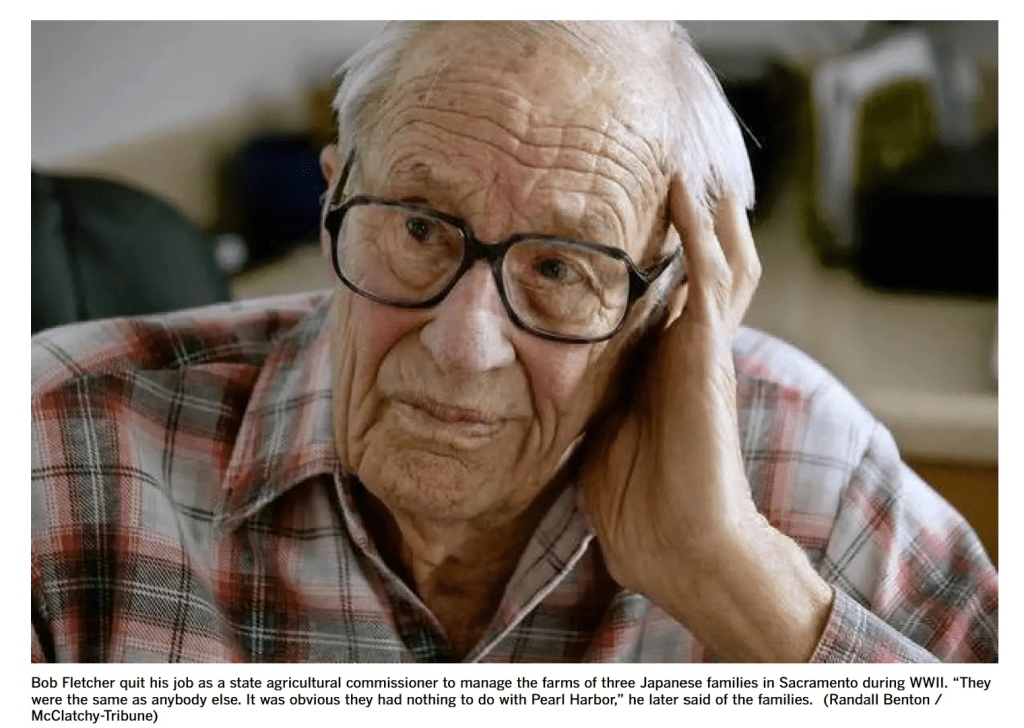
In Florin, California, most people looked away as their neighbors were taken. But an agricultural inspector named Bob Fletcher did something different. He stepped forward.
Note 1
Bob Fletcher was 31 years old when his neighbors—the Tsukamoto, Nitta, and Okamoto families—were ordered to leave. They were strawberry and grape farmers who faced losing everything to foreclosure.
They asked Bob if he would manage their farms while they were gone. Bob didn’t just say yes; he quit his stable job with the state to become a full-time farmer for people who weren’t even allowed to be there.
For three years, Bob worked 18-hour days. He managed 90 acres of flame tokay grapes across three different farms.
The Cost of Doing the Right Thing
Doing the “right thing” is rarely easy. Bob wasn’t seen as a hero by his community at the time. He was called names, shunned by neighbors, and at one point, someone even fired a shot into the barn where he was working.
But Bob had a quiet, iron-clad integrity. He lived in the migrant bunkhouses rather than the families’ main homes. He paid their mortgages, their taxes, and their bills. When the families finally returned in 1945, they didn’t return to ruins—they returned to thriving farms and a bank account full of the profits Bob had saved for them.
Bob Fletcher lived to be 101 years old. For decades, he deflected praise, often saying:
“I don’t know about being a hero. I just did what I thought was right.”
His life leaves us with enduring lessons:
Integrity is a verb. It is not what we believe in private, but what we practice when no one is watching—and when it costs us something.
One person is enough. Bob couldn’t stop a national injustice, but he saved three families. Sometimes protecting one corner of the world is exactly what we are called to do.
Moral courage is quiet. It doesn’t announce itself. Sometimes it looks like long days, dirty hands, and the refusal to surrender compassion to fear.
We may not be living through a world war, but we all face moments where it is easier to go along with the crowd than to stand up for a neighbor. Bob Fletcher’s life asks us: Who are we looking out for? What are we willing to protect?
We spend so much of our lives chasing happiness. We look for it in career promotions, new gadgets, or the perfect vacation. Yet the joy we seek often feels fleeting. What if the real secret sauce to a happy life isn’t something you buy or achieve—but something you give?
In her widely shared TEDx talk, “How to Be Happy Every Day: It Will Change the World,” Jacqueline Way offers a beautifully simple, yet world-altering insight: doing one small good deed each day can transform your brain, your life, and ultimately, the world.
The Science Behind the “Helper’s High”
Jacqueline’s message isn’t just uplifting—it’s grounded in science. When we perform acts of kindness, our bodies respond in powerful ways.
Giving triggers the release of a natural blend of “happiness chemicals”:
Dopamine, which creates feelings of reward and joy
Oxytocin, often called the “love hormone,” which reduces stress and supports heart health
Serotonin, which stabilizes mood and promotes a sense of calm and well-being
In other words, when you give, you’re not just helping someone else—you are literally rewiring your brain for happiness.
At the heart of Jacqueline Way’s message is a practice so simple it’s easy to overlook:
Do one little good thing every day.
It doesn’t need to be dramatic or time-consuming. A good deed might look like:
Offering a sincere smile or kind word
Helping a neighbor with a small task
Picking up litter along your path
Donating items you no longer use
Listening fully to someone who needs to be heard
What matters most is intention. When kindness becomes a daily habit rather than an occasional gesture, happiness stops being accidental—it becomes natural.
A single act of kindness never ends with the giver. It travels outward. One person’s generosity inspires another. Slowly and quietly, hearts soften, trust grows, and perspectives shift.
Jacqueline Way reminds us that changing the world doesn’t require grand gestures or heroic efforts. It begins with ordinary people choosing compassion in everyday moments. When kindness becomes a way of life, happiness expands—not only within us, but all around us.
How to Start Your Own Happiness Practice
If you’re longing for more joy and connection, you don’t have to wait for the “right” moment. You can begin today. Here are three simple ways to practice the daily give:
1. Look for the Micro-Give Kindness doesn’t require money or planning. Hold the door open, write a thoughtful message, or leave a positive review for a local business.
2. Make It a Family Habit Inspired by Jacqueline and her son, turn giving into a shared ritual. Ask at dinner, “What was your give today?” It nurtures empathy and helps everyone focus on the good.
3. Notice the Shift Pause and observe how you feel after giving. That warmth in your chest? That quiet lift in your mood? That’s happiness growing in real time.
Jacqueline Way reminds us that we are not powerless in the face of the world’s challenges. Each of us carries the ability to make life kinder, lighter, and more meaningful—one day at a time.
When you choose to give, you stop chasing happiness and start creating it.
And when enough of us do that, every day, the world truly begins to change.
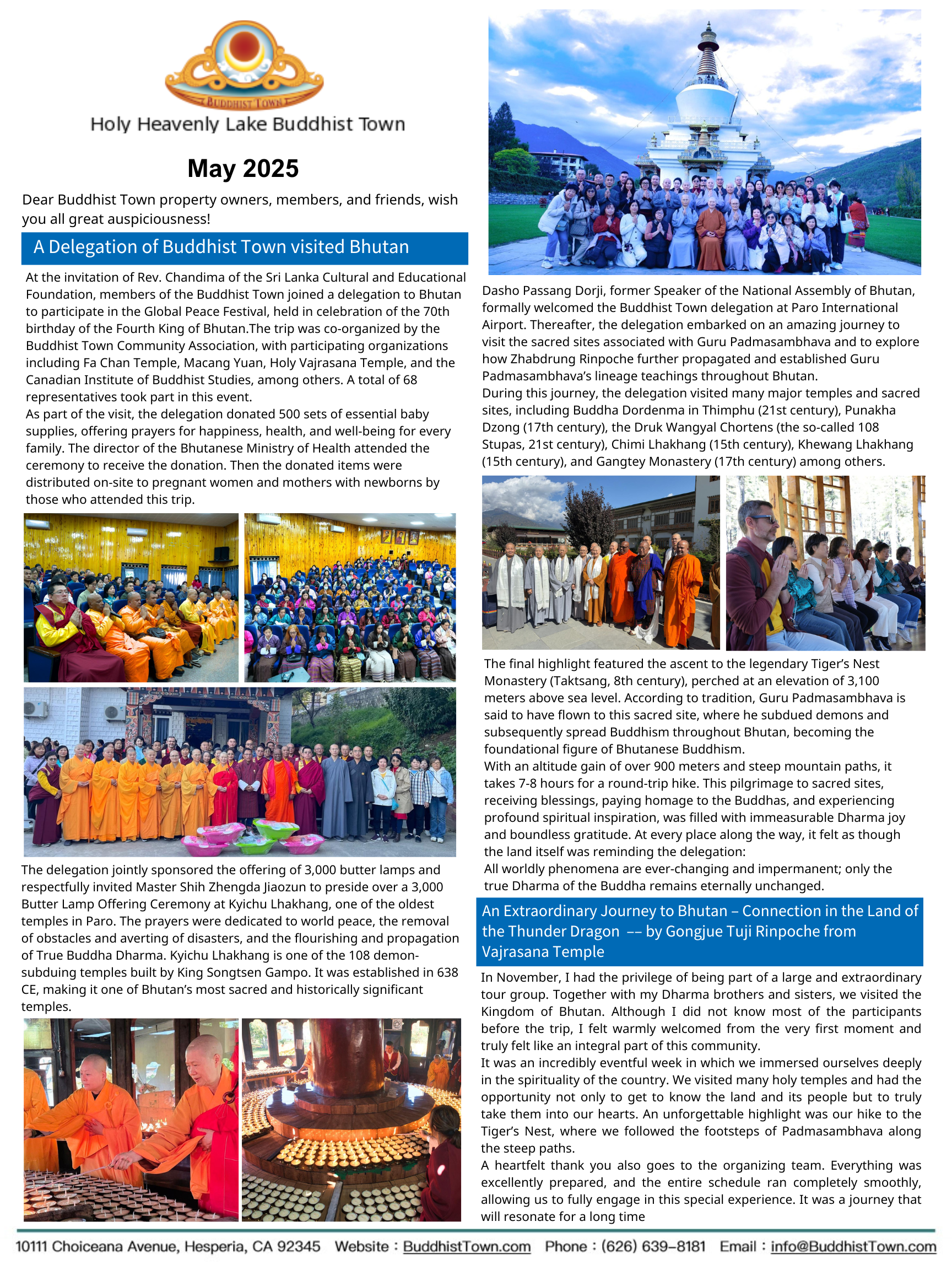
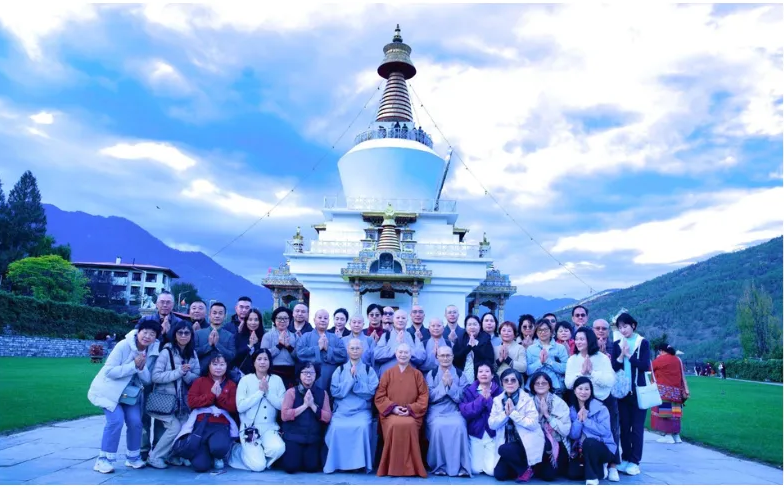
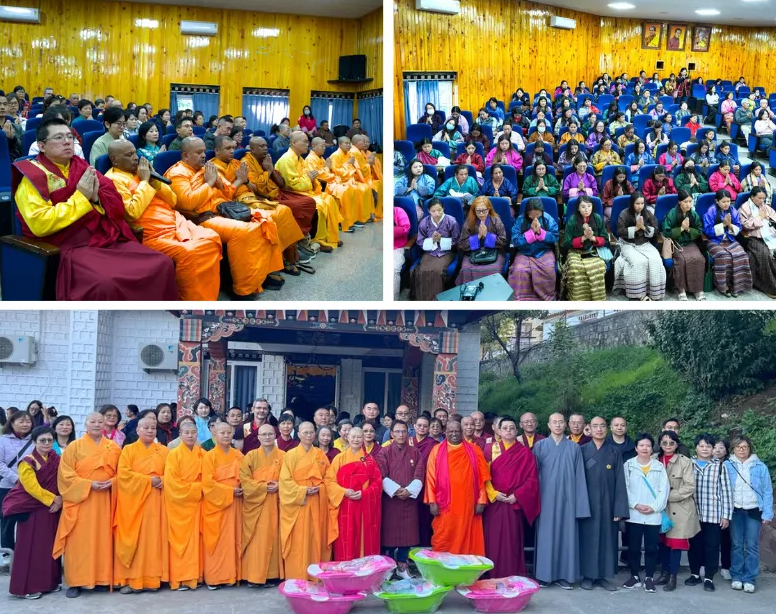
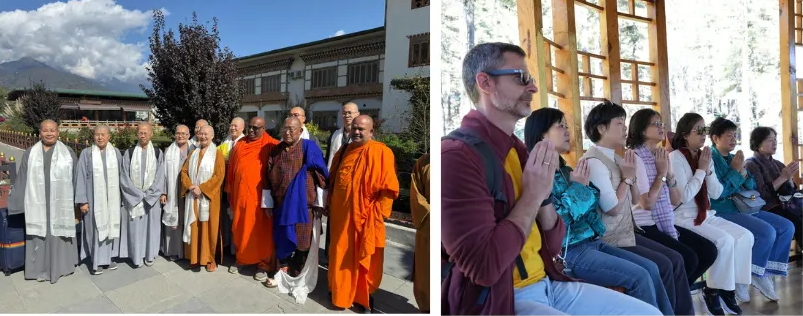
At the invitation of Rev. Chandima of the Sri Lanka Cultural and Educational Foundation, members of Buddhist Town joined a delegation to Bhutan to participate in the Global Peace Festival, held in celebration of the 70th birthday of the Fourth King of Bhutan. The trip was co-organized by the Buddhist Town Community Association, with participating organizations including Fa Chan Temple, Macang Yuan, Holy Vajrasana Temple, and the Canadian Institute of Buddhist Studies, among others. In total, 68 representatives took part in this meaningful event.
As part of the visit, the delegation donated 500 sets of essential baby supplies, offering prayers for happiness, health, and well-being for every family. The donation ceremony was attended by the Director of Bhutan’s Ministry of Health, who officially received the supplies. Following the ceremony, the donated items were distributed on-site to pregnant women and mothers with newborns by members of the delegation.
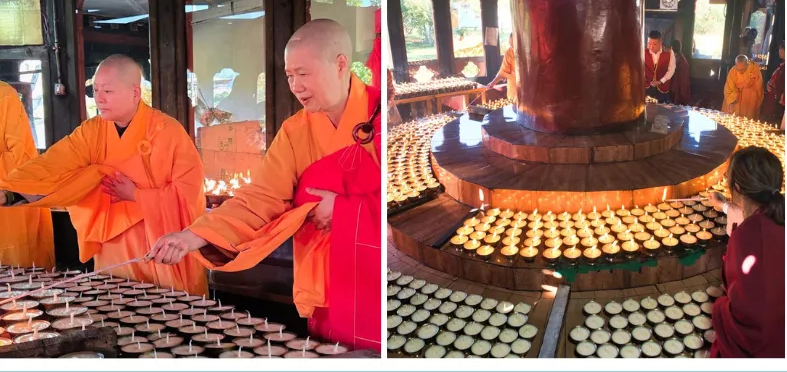
The delegation jointly sponsored the offering of 3,000 butter lamps and respectfully invited Master Shin Zhengda Jaozun to preside over the 3,000 Butter Lamp Offering Ceremony at Kyichu Lhakhang, one of the oldest temples in Paro. The prayers were dedicated to world peace, the removal of obstacles, the averting of disasters, and the flourishing and propagation of the True Buddha Dharma.
Kyichu Lhakhang is one of the 108 demon-subduing temples built by King Songtsen Gampo. Established in 638 CE, it stands as one of Bhutan’s most sacred and historically significant temples.
Dasho Passang Dorji, former Speaker of the National Assembly of Bhutan, formally welcomed the Buddhist Town delegation at Paro International Airport. Following the reception, the delegation embarked on an inspiring journey to visit sacred sites associated with Guru Padmasambhava and to learn how Zhabdrung Rinpoche further propagated and established Guru Padmasambhava’s lineage teachings throughout Bhutan.
During the journey, the delegation visited many major temples and sacred sites, including the Buddha Dordenma in Thimphu (21st century), Punakha Dzong (17th century), the Druk Wangyal Chortens—also known as the 108 Stupas (21st century), Chimi Lhakhang (15th century), Khewang Lhakhang (15th century), and Gangtey Monastery (17th century), among others.
The final highlight of the journey was the ascent to the legendary Taktsang Monastery (8th century), dramatically perched at an elevation of 3,100 meters above sea level. According to tradition, Guru Padmasambhava flew to this sacred site, where he subdued negative forces and later spread Buddhism throughout Bhutan, becoming the foundational figure of Bhutanese Buddhism.
With an elevation gain of more than 900 meters and steep mountain trails, the pilgrimage requires a 7–8 hour round-trip hike. Throughout the journey—visiting sacred sites, receiving blessings, paying homage to the Buddhas, and experiencing deep spiritual inspiration—the delegation was filled with immeasurable Dharma joy and boundless gratitude.
At every point along the path, it felt as though the land itself was gently reminding the delegation that all worldly phenomena are impermanent and ever-changing, and that only the true Dharma of the Buddha remains eternally unchanged.
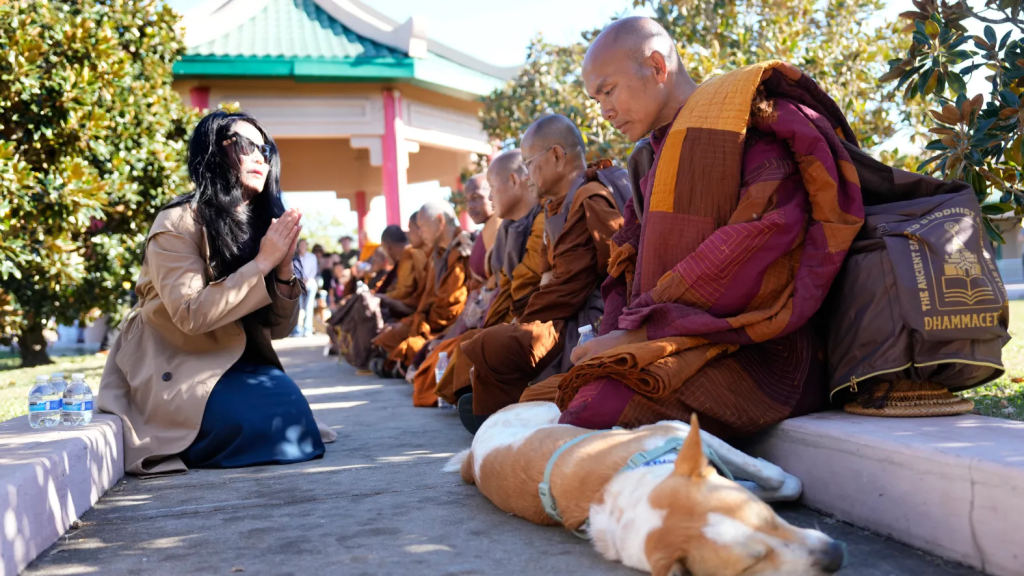
The Buddhist monks from the Huong Dao Vipassana Bhavana Center in Fort Worth, who are undertaking a 2,300 mile pilgrimage of Walk for Peace, arrive for a welcome ceremony at Hong Kong City Mall in Houston Friday, Nov. 14, 2025. Houston Chronicle/Hearst Newspapers via Getty Images
In a world that often feels rushed, divided, and relentlessly loud, there is something quietly revolutionary about the act of walking.
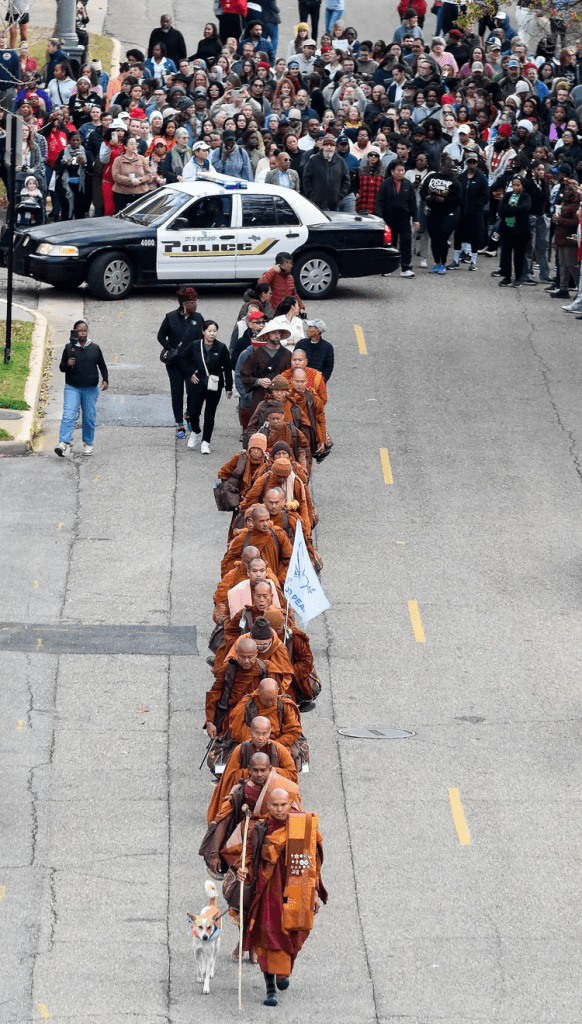
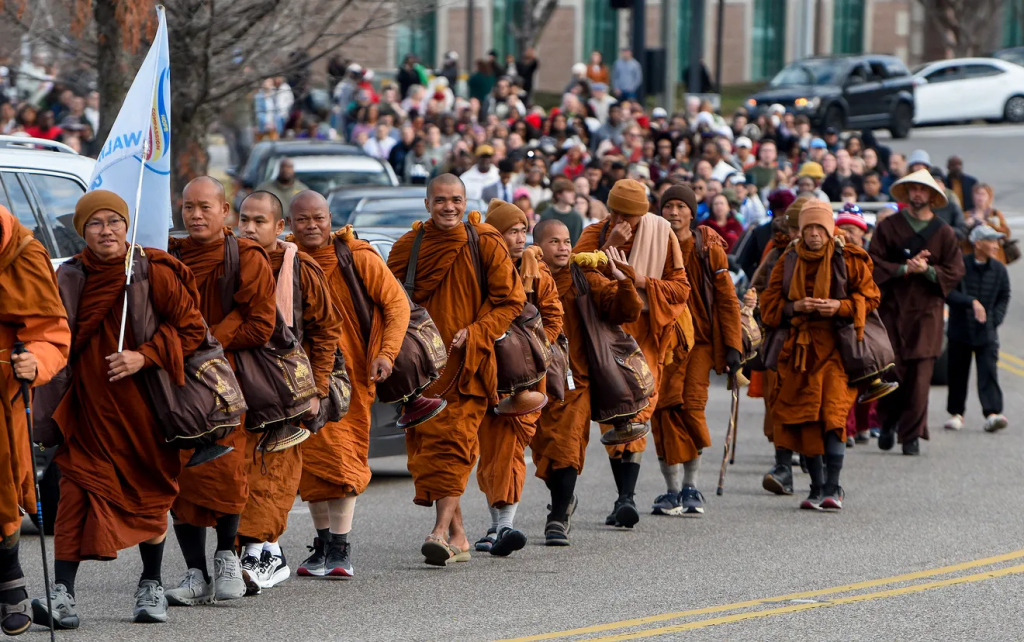
Recently, a group of Buddhist monks began a long, demanding pilgrimage across the United States. Their mission is simple yet profound: to promote peace. Their journey began in Fort Worth, Texas, on October 26. Since then, they have faced the literal “wear and tear” of the road, including a harrowing incident where two monks were injured after a truck struck their escort vehicle.
Yet, they did not stop.
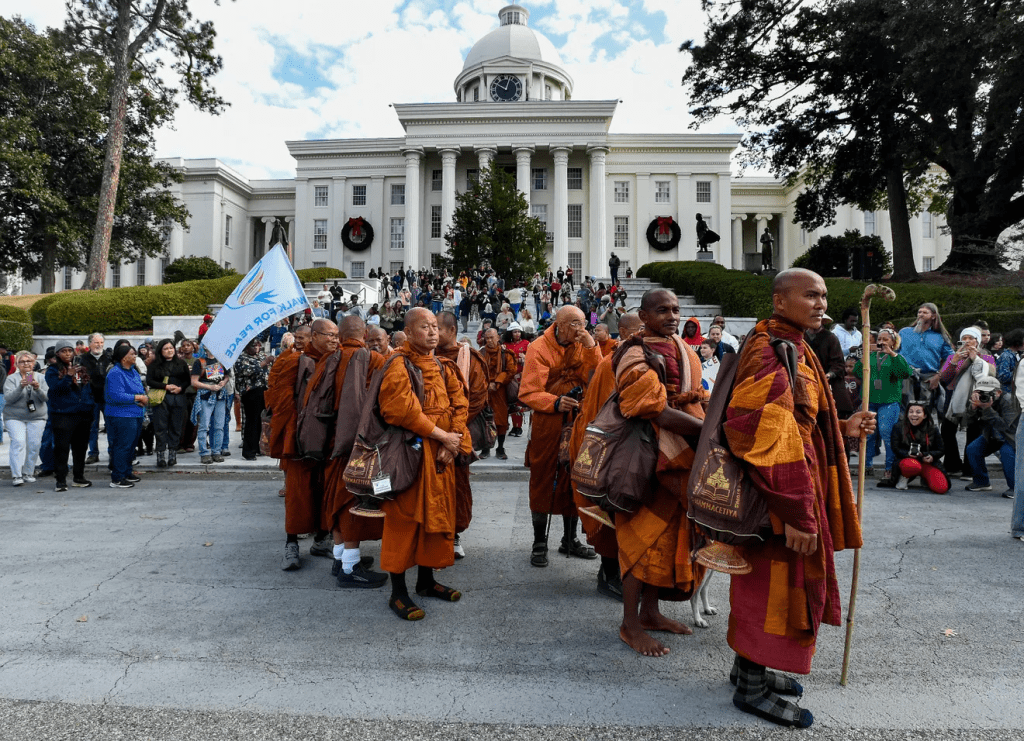
With perseverance and a calm, unshakable resolve, the group of two dozen monks has reached Georgia. They are still moving, one step at a time, toward their final destination in Washington, D.C. Their pace is slow, deliberate, and intentional—and that may be exactly what our world needs right now.
Buddhism has a long history of “engaged mindfulness”—the idea that compassion isn’t just felt in meditation, but lived in the world. These monks are not just praying for peace; they are embodying it.
As they navigate highways and back roads, they offer a living reminder that peace isn’t a destination we reach once and for all. It is a practice. It is something we choose moment by moment, breath by breath, step by step.
Watching their progress brings me back to a book I read nearly 30 years ago: Peace Pilgrim.
I remember being deeply moved by her story—how she walked across countries carrying almost nothing, guided by the conviction that peace begins within the individual. At the time, I wished I could have met her in person, just to thank her for the way her simplicity and courage planted a seed in my heart.
Though she is gone, her spirit feels remarkably present today. I see her legacy in the orange robes of these monks as they crest the hills of the American South.
Monks rest at Hong Kong City Mall in Houston Friday, Nov. 14, 2025. Melissa Phillip/Houston Chronicle via Getty Images
Igniting Kindness, One Heart at a Time
There is something profoundly moving about a walking pilgrimage in the age of instant communication. There are no hashtags here. No viral outrage. Just human beings placing one foot in front of the other, trusting that their presence alone can soften the world.
And it works.
Along the way, the “ordinary” world reacts. Drivers slow down. Strangers stop to ask questions. People offer water, a meal, or a simple smile. In these small, unscripted exchanges, something gentle is awakened. We are reminded that beneath our political and social differences, we all share a basic human longing for safety, understanding, and harmony.
The monks may be the ones doing the walking, but the kindness they ignite along the way belongs to all of us. As they recently shared on their Facebook page:
“We do not walk alone. We walk together with every person whose heart has opened to peace, whose spirit has chosen kindness, whose daily life has become a garden where understanding grows.”
A group of Buddhist Monks and several hundred local community members take part in the Walk for Peace in Montgomery, Ala., on Tuesday December 23, 2025. The Monks are walking from Texas to Washington, D.C. to promote peace and compassion.
Most of us cannot drop everything to walk across a continent. But all of us can “walk for peace” in the geography of our own lives.
We can pause before we react in anger.
We can choose compassion over the reflex of judgment.
We can listen more deeply than we speak.
Watching these monks continue their journey despite injury and uncertainty reminds me that peace isn’t achieved through grand, sweeping gestures. It is built patiently through humility and love.
Step by step.
May their walk remind us to slow down, to soften our hearts, and to keep moving—together—toward a more peaceful world.









 Peace LiLy